A Daily History of Holes, Dots, Lines, Science, History, Math, Physics, Art, the Unintentional Absurd, Architecture, Maps, Data Visualization, Blank and Missing Things, and so on. |1.6 million words, 7500 images, 4.9 million hits| Press & appearances in The Times, Le Figaro, Mensa, The Economist, The Guardian, Discovery News, Slate, Le Monde, Sci American Blogs, Le Pont, and many other places… 5000+ total posts since 2008.

Category: Children’s Art

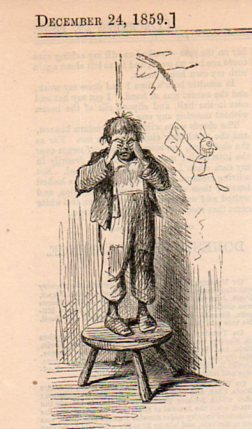
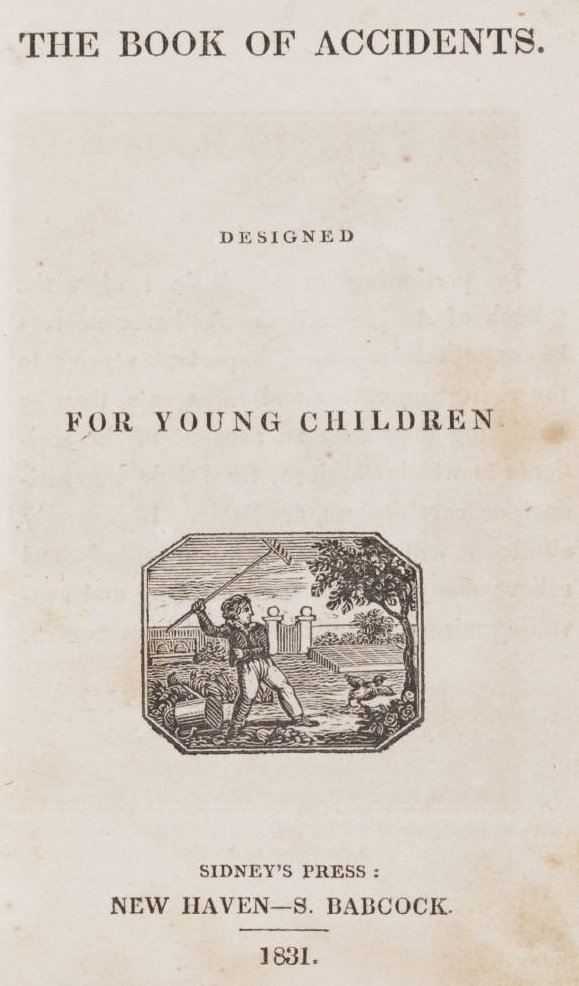
  • The Book of Accidents Designed for Young Children, 1831.

    JF Ptak Science Books   Quick Post

    Accidents
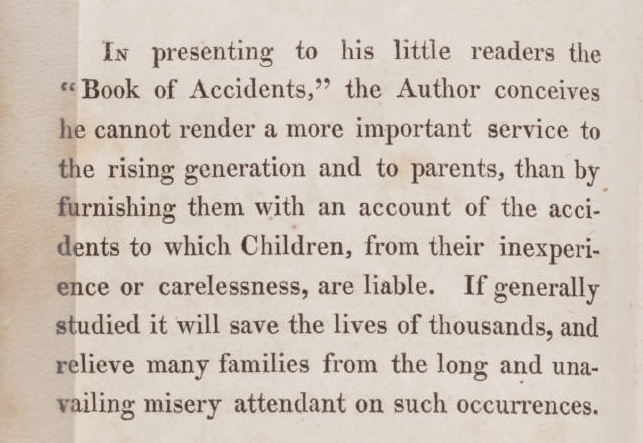
    The very Gorey-ish title of this book–seemingly designed to manufacture accidents for children–is actually a children’s advocate book. Its a small book, a chapbook, made for small hands, produced on the cheap and meant to be consumed by children and adults alike, warning people of the commonplace dangers that called on children in the 1830’s.  Scalding, being kicked by a horse, falling, being injured while playing with knives and candles and firearms, crossing the street, being tossed by a bull or wild horse, falling out of a coach, drowning, playing and throwing stones, tumbling down stairs and the like made a devastating impact on the lives of children–sometimes ending them, as the author points out.  By pointing out these dangers, and by having them read by (or to) children, the author believed that the lives of thousands of children could be saved.

    [Image sources:  Beinecke Rare Book and Manuscript Library, Yale University.]

    http://brbl-images.library.yale.edu/PATREQIMGX01/size3/D1169/1026953.jpg

    The mission statement:

    Accidents 2

    He was correct, of course; its a legendary problem trying to protect children from the obvious.

    http://brbl-images.library.yale.edu/PATREQIMGX01/size3/D1169/1026954.jpg


  • A Child’s Reader on Being a Migrant Farmer, 1940

    JF Ptak Science Books  Post 1549

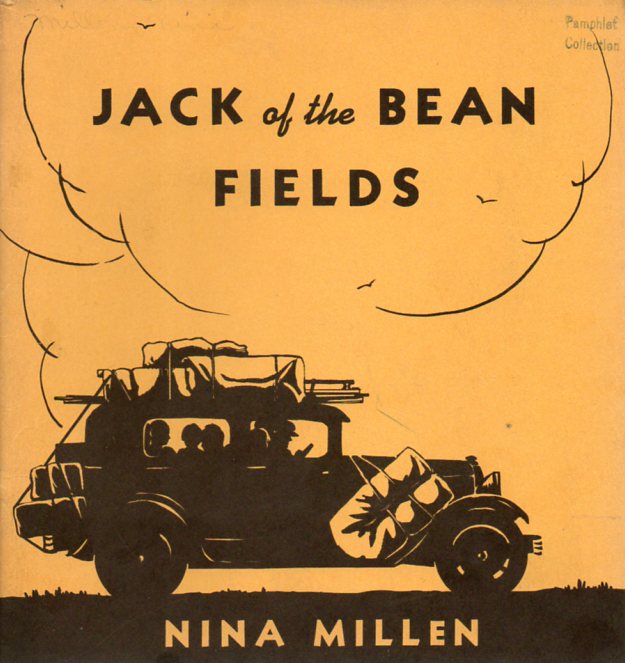
    I hardly expected the story that I found in this little square pamphlet, particularly since I had selected it because of its cover art.

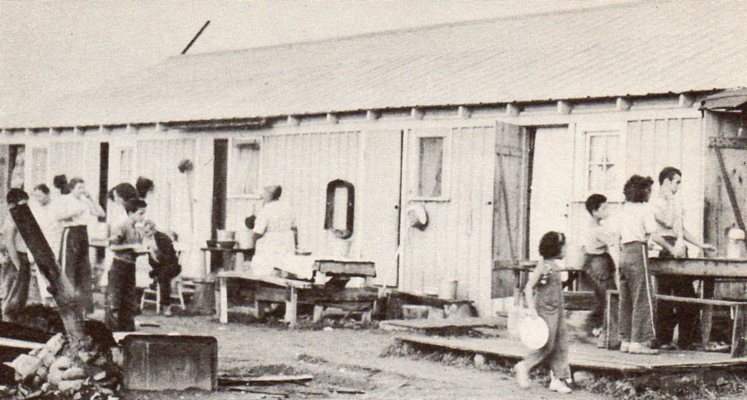
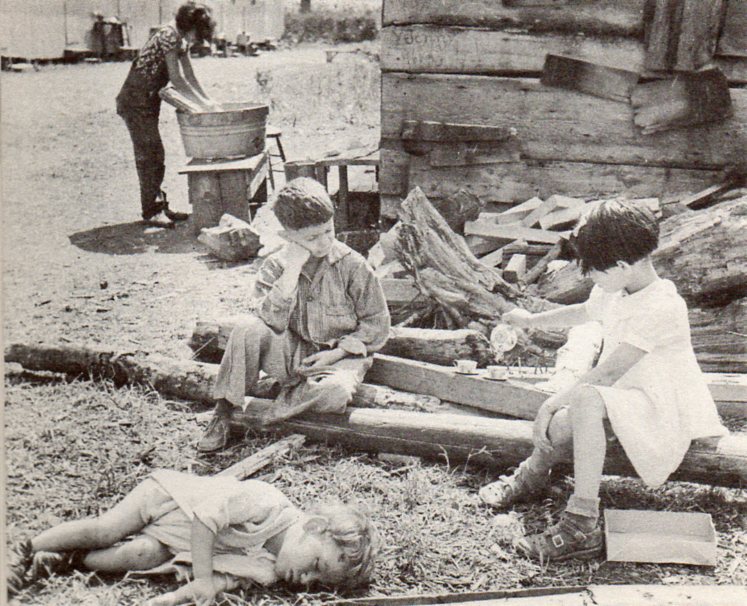
    Jack of the Bean Fields–written by Nina Millen and published by the Friendship Press of New York–turns out to be a photo-essay on one seasonal adventure of a boy named Jack Marco and his migrant vegetable-picking family.  The story starts with the family in a bad way, heading out on the road in a broken car filled with Jack’s mother, father, grandmother and three siblings, out to find a camp where they could find jobs picking early beans. 

    Depression579 As the family fixes the car, Jack heads out to play in the fields, where he finds a book.  We find that–at age 8 or thereabouts–Jack hasn’t been taught to read and hasn’t been to school in years, and the family doesn’t own a single book. The family gets underway, finds a camp, and moves into an empty unit in a series of shanties. They clean the place up, and Jack lays his book on a shelf.  “Now we are settled again” announces Ma.  Wincing.


    Depression580

    In a story that could have been a very maudlin or saccharin affair, it was surprisingly matter-of-fact, eventually telling how community and church groups appeared through the intercession of a camp nurse to help the migrant families, clothe the children, and send them to school. 

    Depression581

    The war was underway, the Depression was on its way out, the economy was beginning to bounce–but then, as today, there were migrant farmers–they just weren’t being displaced by Dust Bowl factors anymore.  But, basically, it was a good story for kids, focused mainly on appreciating what we have and our small gifts, such as family–and the ability to read. 


  • An Image Addition to a Series of Posts on the Antiquarian Publication of Artwork by Children

    JF Ptak Science Books   Quick Post

    Part of this blog’s series on The Antiquarian Publication of Children’s Artwork

    Continuing an earlier post on the Great Rarity and Sublimity of Antiquarian Artwork by Children

    I have found another small bit to add to the few posts I’ve made on this blog concerning the wide, vacant spaces of antiquarian publications of children’s artwork.  Its a small bit, but every bit is very difficult to come by:

    Childrens art507   Childrens art508


    I think that I can safely say that artwork by children does not make very many appearances in Western art prior to the 20th century–published images just don’t appear.  Nor do the originals–considering the ephemeral nature of the effort at art by children, their work just don’t seem to survive.  Some of that reason–particularly in America–was the scarcity of materials for kids to produce art with: paper was not inexpensive, and neither brushes and paints.  Crayons, invented for chubby and reachy fingers, were not invented for the mass market until 1903.  (Crayola sold eight crayons in a box for a nickel.  The colors?  Black, brown, blue, red, purple, orange, yellow, and green.)   Then of course the artwork would have to be saved, somehow, for generations.  As much as it would be fascinating to find artwork done at age four by your great-great grandparents, it would have to survive the cleansing tendencies of four generations of clean-up.  End result:  there’s just not that much antiquarian chldrens’ art floating around…

    (Continue reading here.)

    ·Posted by :

    ·in:

    — — —

  • Found: Children’s Advice for Life, 1825

    JF Ptak Science Books   Post 1383
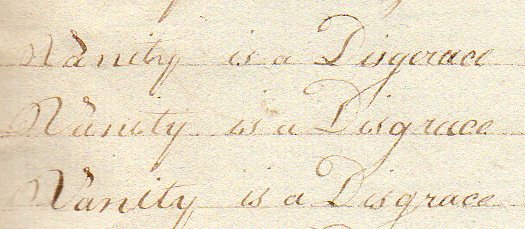
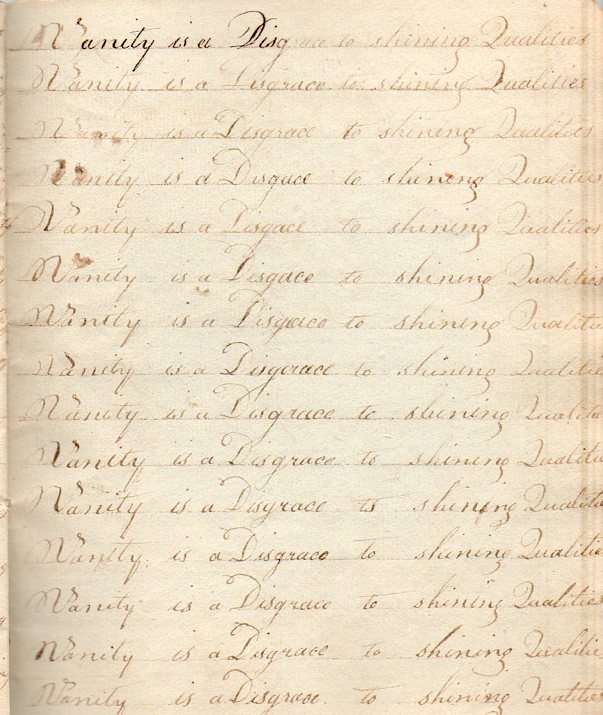
    Manuscript Vanity det151

    Manuscript Vanity det148

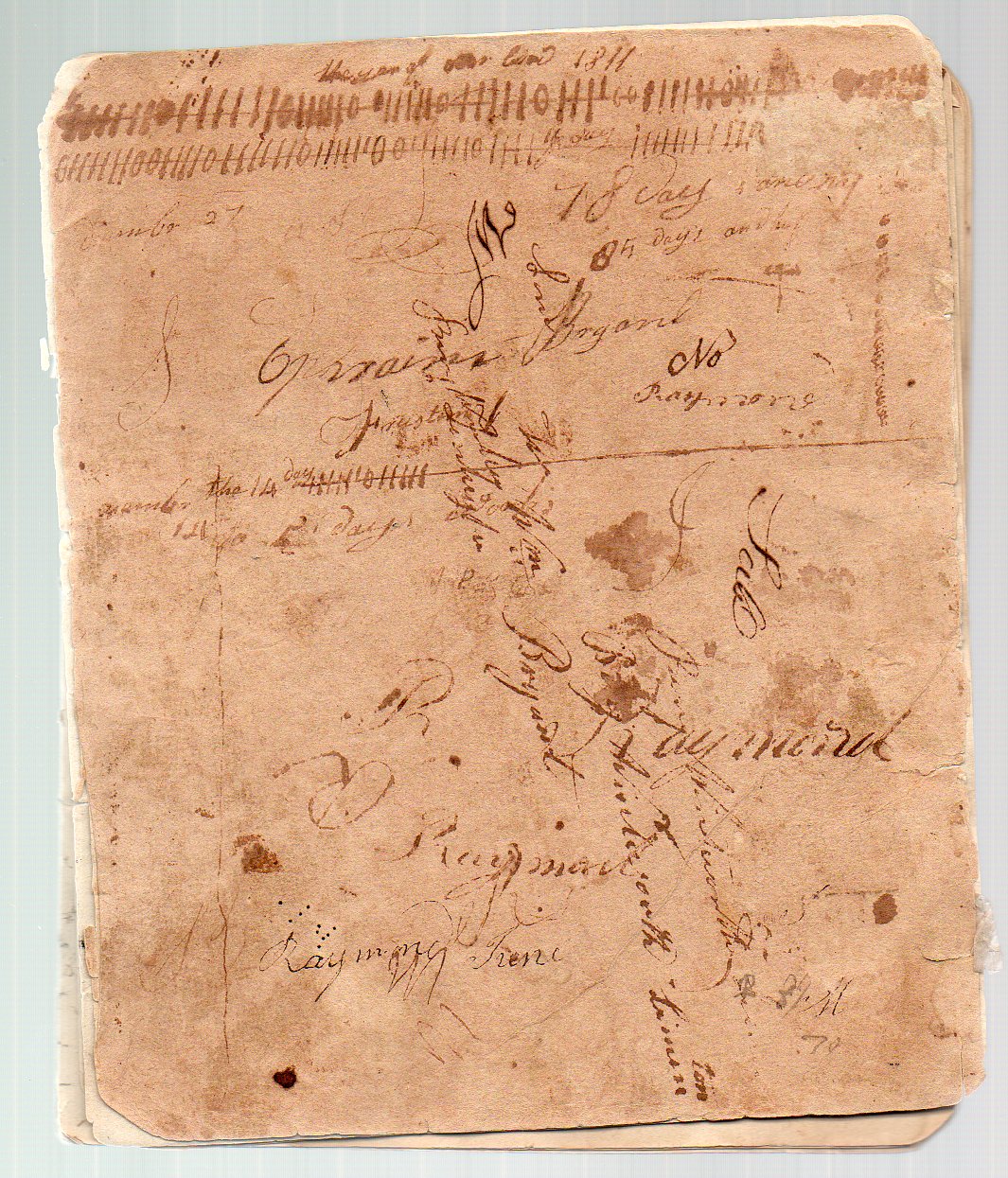
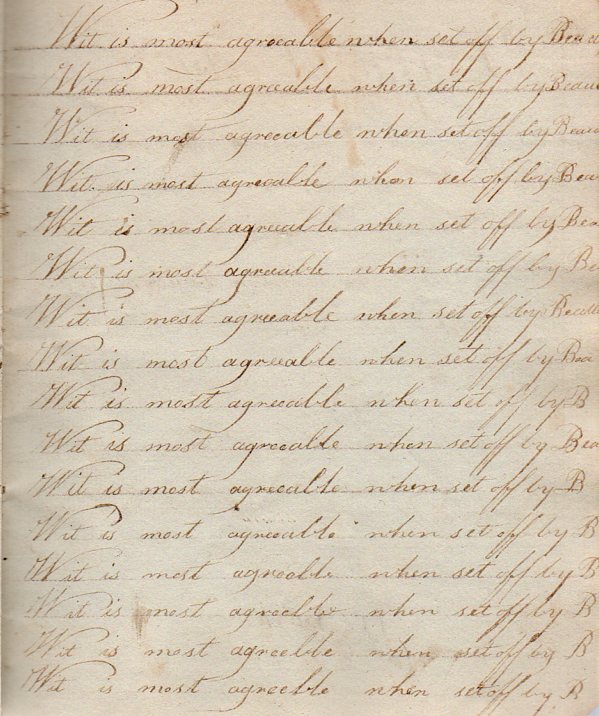
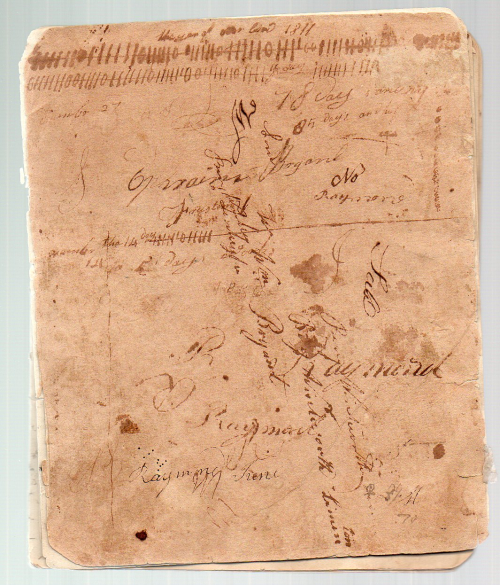
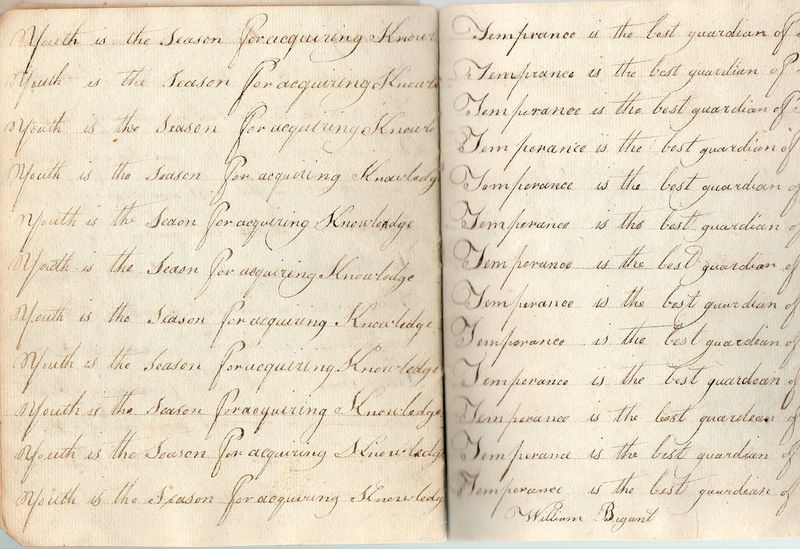
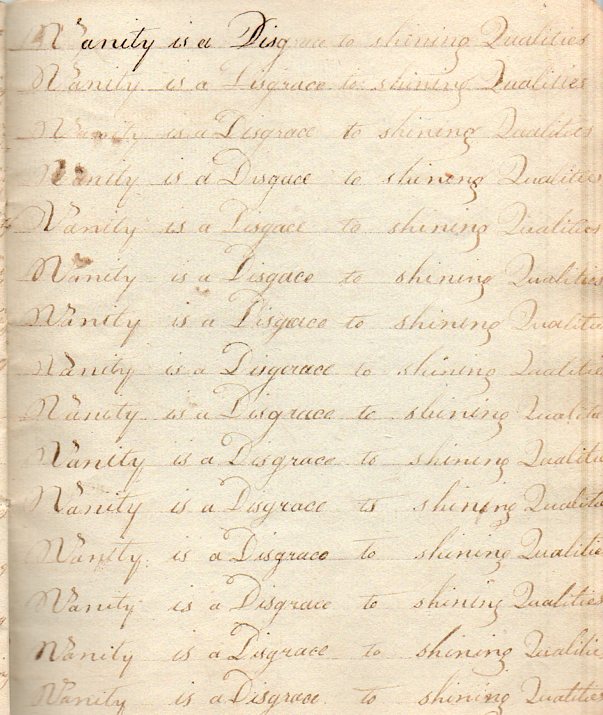
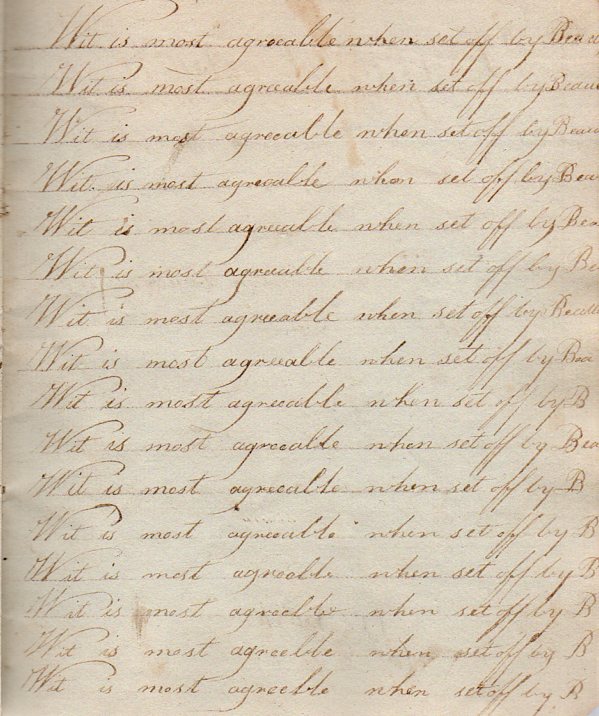
    I have a small collection of 18th and 19th century notebooks–ciphering books, tally books, keepsakes–kept by children and young adults.  These books are remarkable for their contents, empty scratchbooks filled with whatever was necessary, whatever was important, whatever was trivial.  There are notes about who-owes-what, provisions purchased, goods borrowed; mathematics problems, poesie, miniature observations, memorized bits.  Signatures made over and over again, looking exactly like what children do nowadays, practicing writing their names, perfecting a signature, identifying themselves to themselves in private.  These notebooks are far less formal say than a diary–they caught all sorts of ephemera of the day, stray information, all manner of stray bits. (This notebook is also available from our blog bookstore, here.)

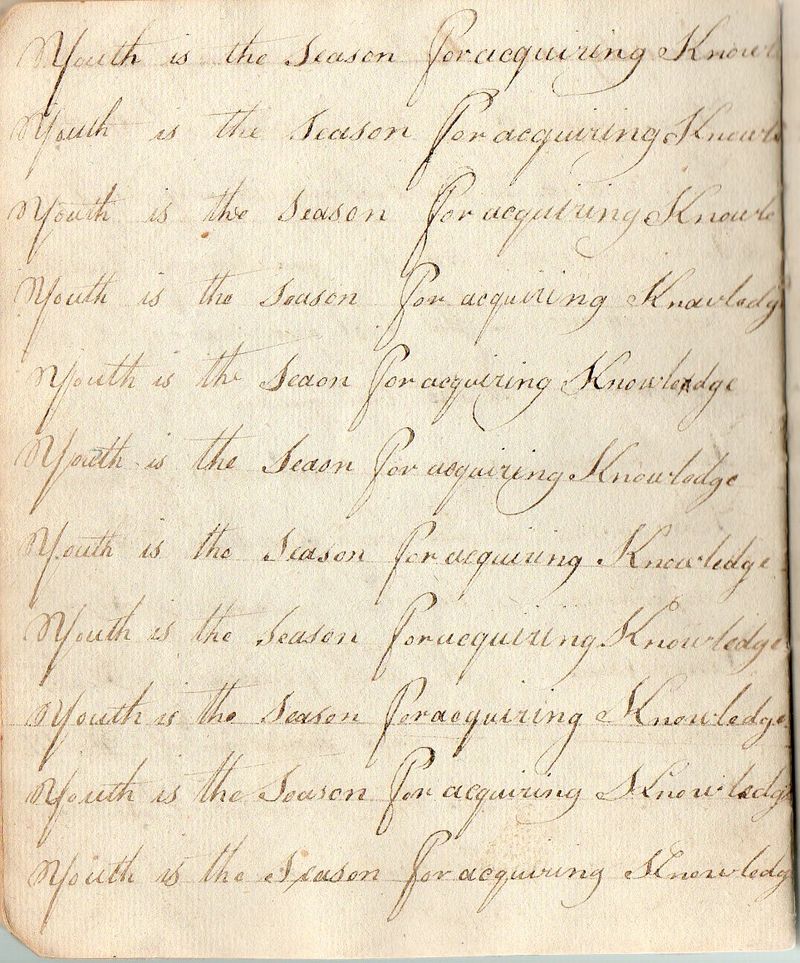
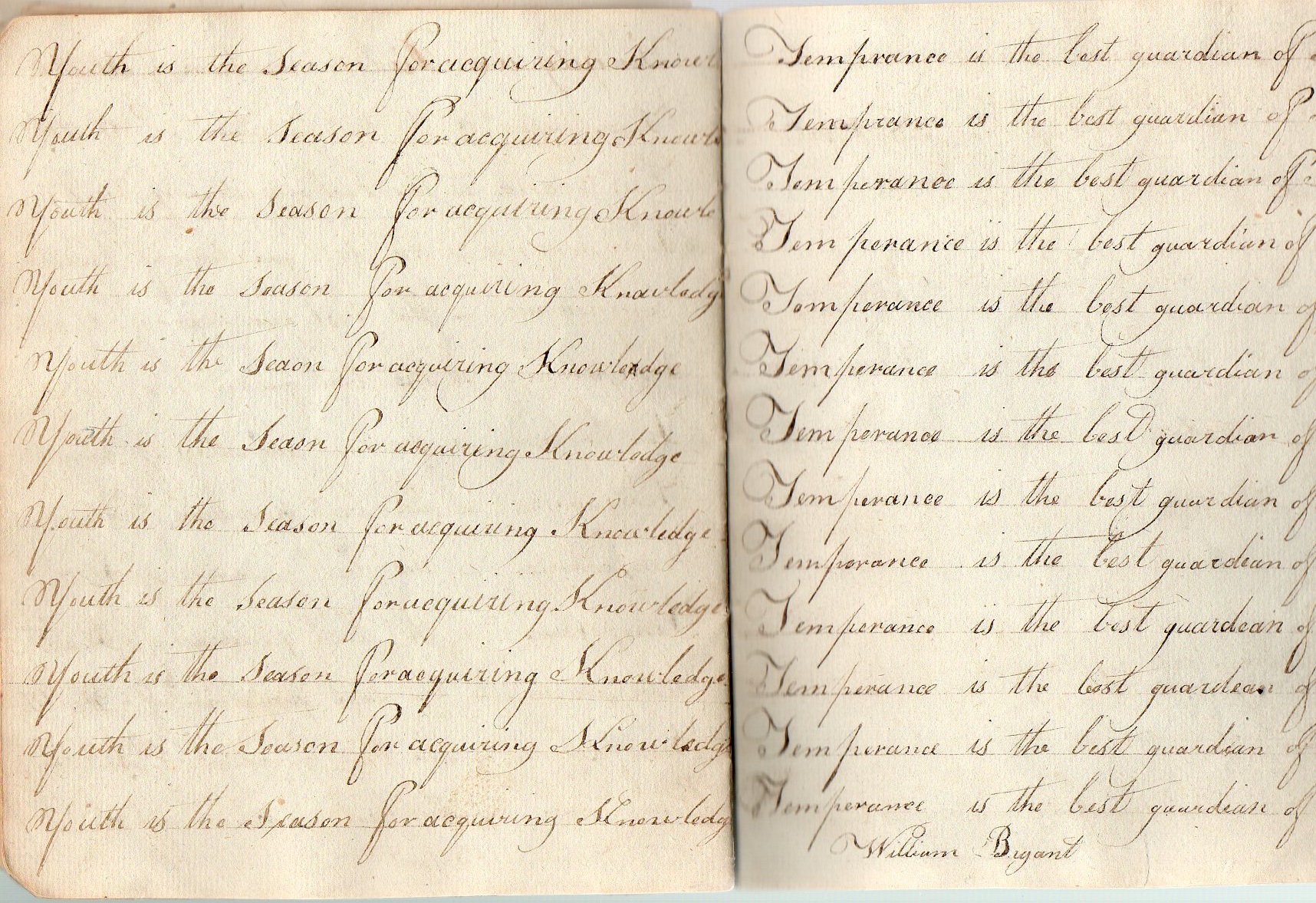
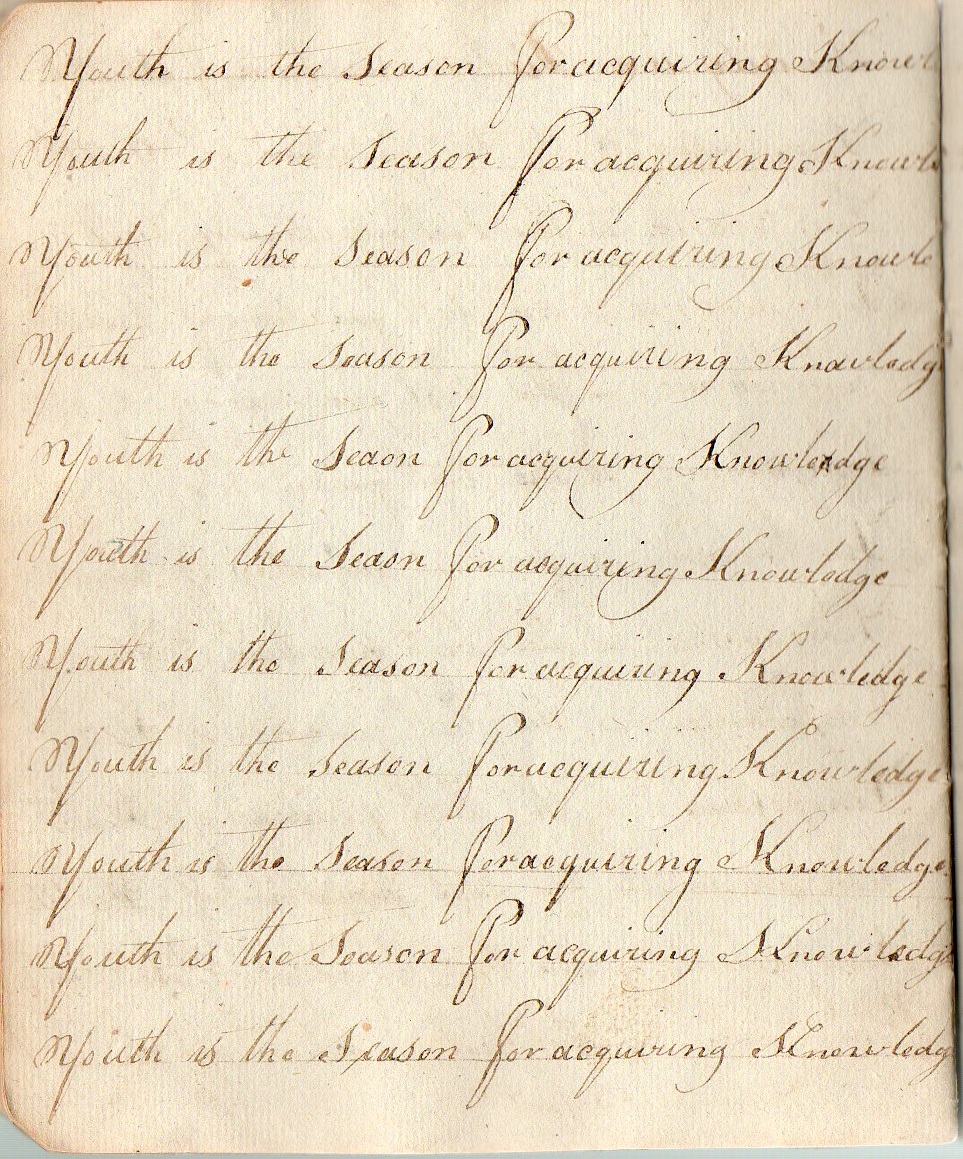
    In this notebook, used between 1811 and 1836, there are also repeated personal lessons and life’s aphorisms, generally one page each, written over and over,  practicing penmanship by repeating the advice, 

    “Youth is the season  for acquiring knowledge” and “Temperance is the last guardian of health”:
    Manuscript Vanity det149
    Manuscript Vanity det150

    I find it remarkable that this small item–about 8×5 inches, and having no more than 30 pages–survived in somewhat haphazard and occasionally directed use for more than 25 years.  Then again, paper wasn’t all that terribly common among the working poor in the United States at this time, so it is very understandable that this notebook would’ve been kept, and carefully so, as an important household object–and possibly a significant family-history document.  For those of us today this looks like disposable information, ephemeral knowledge–evidence would say that this was definitely not the case when this book was still being used. 

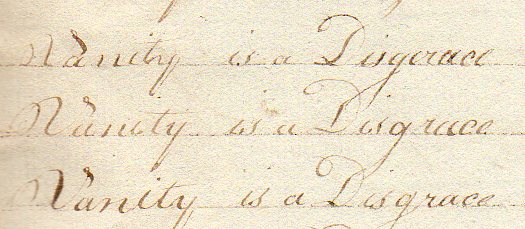
    “Vanity is a Disgrace to shining Qualities”:
    Manuscript Vanity147

    “Wit is most agreeable when set off by beauty”:
    Manuscript WIT146

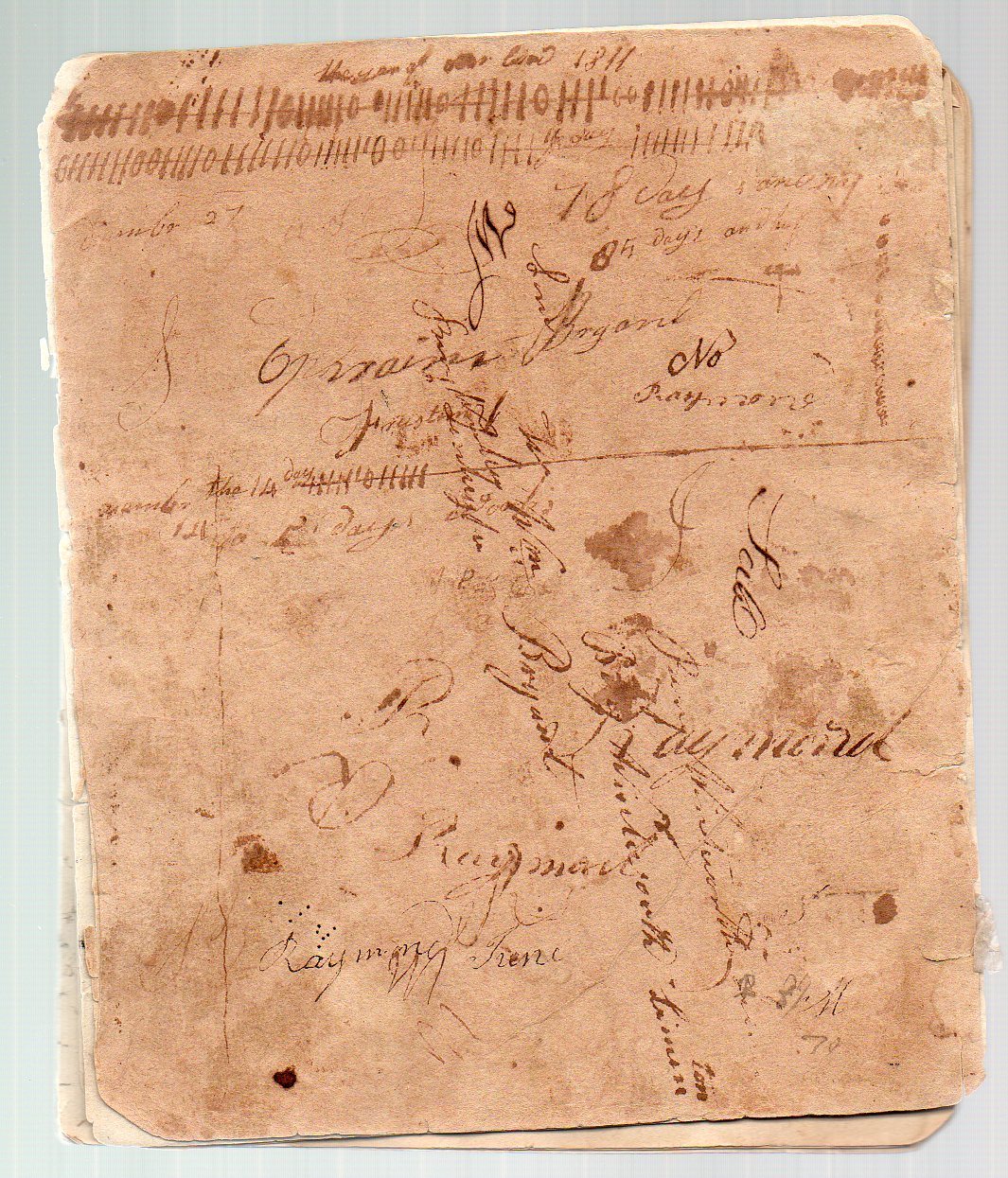
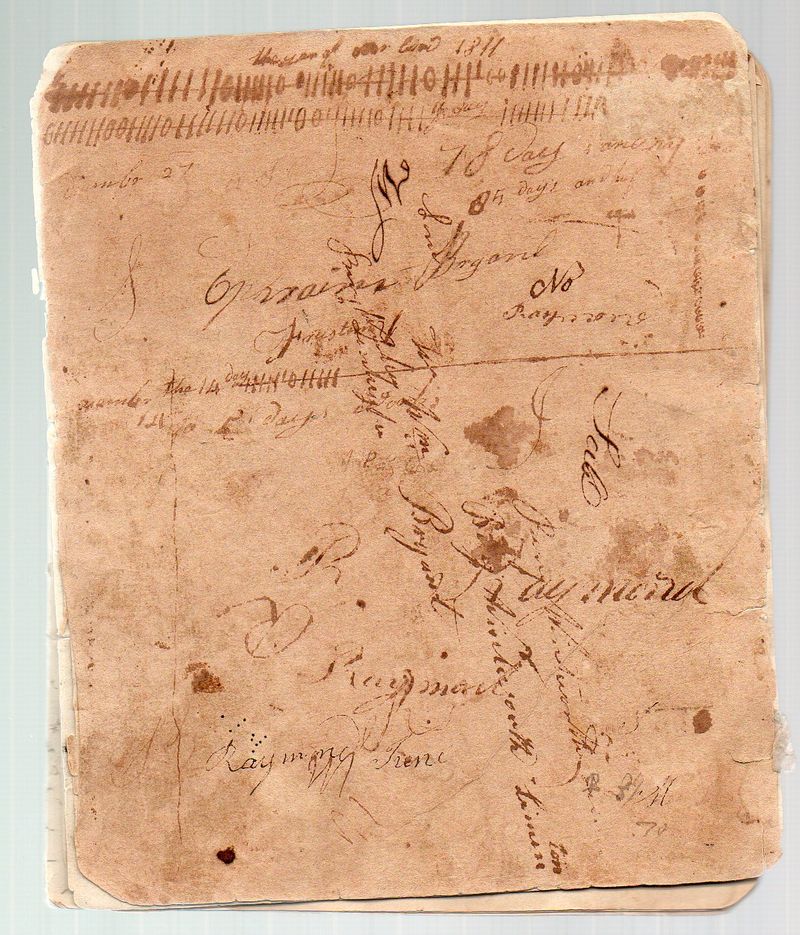
    And the cover:, which is a curious thing, as someone kept track of “days” on a number of occasions here, not the least of which ran across the top of the book:
    Manuscript Vanity det151

    The record of items purchased, of money charged for labor, allows us a peep into the daily working life during the first part of the 19th century:

    Purchases made included 2 pounds of butter (15 cents), six pounds and a half of veal ($2.00), a gallon of molasses (30 cents), “half a berril of flower” (3 dollars), a pound of wool (12 cents), plus pork, potatoes, tea, salt, corn, rye

    The labor is also of interest:  renting the services of two yoke of oxen for one day seems to have cost one dollar, “tapping in a pair of boots” (30 cents), “one day’s work on shaving hoops” (50 cents), and then many entries for “one days work a planting” and “a mowing” which seems to have been 50 cents; “hauling wood one day” was also 50 cents.  It seems as though you could exchange a day’s labor for two pounds of butter, a pound of wool, and two pounds of potatoes–at hose rates, I suspect that these people would’ve considered the veal to be a luxury meal. 

  • Magnificent Displays of Quantitative Data by 5-Year-Olds

    JF Ptak Science Books

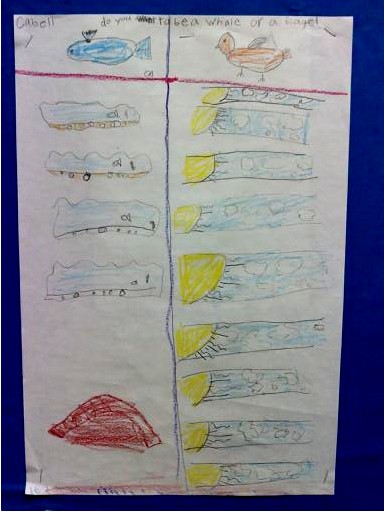
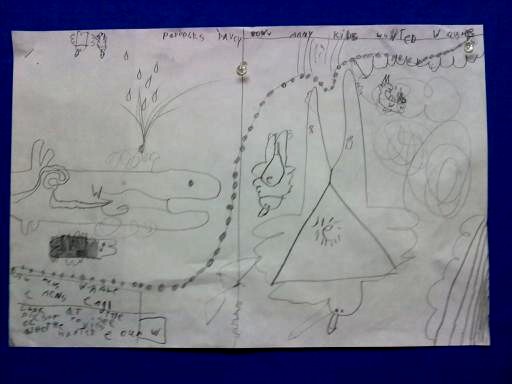
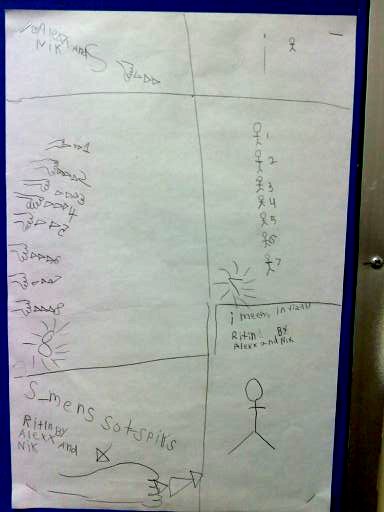
    “Do You Want to be a Whale or a Eagel?”[sic]

    Walking down the hall of my daughter Tess’ school today I came across these absolutely brilliant displays of information tacked up on bulletin boards.  The kids polled their classmates on whether they would rather be a whale or an eagle.  The designs of the survey results were staggering to me, purely brilliant reasoning and expression.

    The results here are magnificently displayed, elegant and crisp, and of course with a child’s beauty.

    Downsized_0127010808

    Another astonishing work of private clarity–I really do need to interview the statistician to find out the deep depth of what is being presented here. It is just beautiful.

    Downsized_0127010810

    And even though I don’t quite follow this one, there is a LOT of effort in it:  perhaps the kids were asked to raise their hands for a whale and to stand to be an eagle.  Those hands though I have seen drawn in books and manuscripts going back to the 12th century–they have stayed basically the same for 800 years. 

    Downsized_0127010811
    My best wishes and congratulations to these children at Isaac Dickson School, Asheville, North Carolina.

    ·Posted by :

    ·in:


  • The History of Children, 4/7–the Sciences and Learning /”Infinite Islands float in the Seas”

    JF Ptak Science Books  Post 1287    Continuing the post 1285

    “Taking the Scarecrows out of Wisdoms Gardens”

    This is Part 4/7 of John Comenius’ great work, the first illustrated instructional to children, first written in 1676 and then translated into English in 1726–it is from this translation that all of the images (below) are taken.  This is the second of seven installments on introducing 17th and 18th century children to wide ideas, the other sections including: Part 1, Occupations; Part 2, Anatomy; Part 3, Books and Book Arts; Part 4, the Sciences; Part 5, Morals and Philosophy; Part 6, Games and the Arts; and Part 7, the Military.  

    The work itself: John Amos Comenius’ Orbis Senfualium Piélus: Omnium Principalium in Mundo Rerun/ &f m Vita АШопит,  translated as Pictura et Nomenclatur, the Visible World, or A Nomenclature, and Pictures of all Chief Things that are int he World, translated into English by Charles Hoof…1726.

    The purpose of the book, writes the translator in the introduction of the 1726 12th edition, is:  

    To entice witty children to it, that they may not conceit a torment to be in the school, but dainty/are., For it is apparent, that children (even from their infancy almost) are delighted with Pictures, and willingly please their eyes with these fights: And it will be very well worth the pains to have once brought it to pafs, that fcare-crows may be taken away out of Wisdom’s Gardens…”

    Even at this early stage of publishing books for children it was easily recognized that children learn better when eased into their subject with pictures.  This is not so far off the mark with the moderns, and in its own way a precursor to the Dick and Jane and Dr. Seuss books–not so much for subject matter, but for the very act of putting a book into the hands of a child and getting them comfortable wit the idea of reading.  It seems to me that this is by far the most important lesson-the actual content at tis point is secondary to the act of holding a book.  

    [ocr errors][merged small][graphic][merged small][ocr errors][ocr errors][ocr errors][table]

    [merged small][ocr errors][ocr errors][graphic][ocr errors][ocr errors][merged small]

    [graphic]
    [ocr errors]
    [ocr errors]
    [ocr errors]
    [ocr errors]

    [merged small][ocr errors][ocr errors][graphic][merged small][ocr errors][ocr errors][ocr errors][ocr errors]

    [ocr errors][ocr errors][merged small][graphic][merged small][merged small][merged small]


    [ocr errors][ocr errors][merged small][merged small][ocr errors][graphic][ocr errors][ocr errors]

    into the ßadotv oftheEatih,». it is darkened, nvhich ive tall an Eclipfe, or defeil.

    But when the Moon runutth hetwixt the Sua and the Earth, 3. it covtilth it -with it 1 Jbaàomi; and this toe call the Eelipfe of the Sun, hecaufc it takethfrom us the ßght of the Sun, and its light;

    neither doth the Sun/br all that fuffer any thing, eut the Earth.

    [ocr errors][ocr errors]
    [merged small][ocr errors][graphic][merged small][ocr errors]

    is 360 degrees’, (“•whereof every one maketh 60 Engliih Miles) or 2 1600 Miles, and yet it is tut a prick, compared •with the World, •whereof it is the Centre. – 4″hey mea/иrе the Longitude «fit hy Climates, 1. and the Latitude hy Parallels, *•

    The Ocean, 3. cempajjeth it ahout, and ßve Seas voafi it, the Mediterranean Sea, 4. the Baltick Sea, 5. the Red Sea, 6. the Perfian Sea, 7, end the Calpian Sea, 8.

    [ocr errors]

    ей graduu»k CCCLX. (quorum quifque facit LX. Milliaria Anglica) vel 21600 Milliarium, & tamen eft puncbm, collata cum orhe, cujusCentrum eft. – Longitudinem ejus dimetiuntur Climatihus, 1. l-atitudinem, lineis Parallelis, 2.

    Occanus, 3. amhit earn Se Maria V. perfundunt, Mtditerraneum, 4. Balticum, 5. Erythraum, t Perßcum, 7. … _ Caffium, 8.

    [merged small][ocr errors][graphic][ocr errors][ocr errors][ocr errors][ocr errors]

    art uninhahitahle }.

    the II. Temperate ones, 10. .10.

    end the Torrid one, 11.

    hahitable»

    Beßdes it is divided into three Continents; thh of ours, 12. ‘which isfubdividedinto Europe, 13. Afia, 14. Africa, 15. America, 16. … 16. fivhofe Inhahitants are Antipodes to us) and the South Land, 17.. .1 7. yet unkno•wn.

    They that d•well under the North Pole, 18. have the days and n’gbts 6 months long.

    Inßnite Iflands float in tht Seas.

    [merged small][ocr errors][merged small][merged small][merged small][graphic][graphic][merged small][ocr errors]

    [merged small][merged small][merged small][graphic][ocr errors][ocr errors]

    [ocr errors][merged small][merged small][merged small][merged small][graphic][ocr errors][merged small][merged small][ocr errors]

    [ocr errors][ocr errors][merged small][merged small][graphic][ocr errors][ocr errors][merged small][ocr errors]

    The Afp, 4. in the ßelds. The Boa ^rMild fnake)5.in Houfes. The Slow-worm, 6.

    is hlind.

    The Li2ard, 7. mid the Salamander, 8^ (that liveth long in ßre) have fee(.

    The Dragon, 9. 2 winged Serpent, killeth ivith his Breath,

    The Bafiliik, 10. with his Eyes;

    And the Scorpion, 11. ,ivith his poi/onous tail.

    [ocr errors]
    [ocr errors]
    [merged small][graphic][ocr errors][merged small][merged small]

    fhe Earth-worm, i. the Earth.

    The Caterpillar, 2. the Plant.

    The Grafs-hopper, 3. the Fruit:.

    The Mite, 4. the Gern.

    The Timher-worm, 5. IVood.

    The Moth, 6. a garment.

    Tbe Book-worm, 7. я Book.

    Maggots, 8. FUß and Cheefe.

    Hand-worms, the Hair.

    Thefiipping Flea, 9. the Loufe, 10. ostd the ßinking Wall-loufe, (Bug) 11. hite us.

    The Tick, 12. it a Bkod-fucker.

    The Siik-worm, 131 makethßlk.

    The Pifmiie, 14. is painful.

    SVSpider, ijy •wearveth a Cob•weh, nets for ßies.

    The Snail, 16. tarrietjf about her Snail-horn.

    . Lumbricns, 1. Terra m.

    TL rue a, 2. Plantara.

    Cicada, 3. Fruges.

    Curculh, 4. Frumento»

    Teredo (coffis) 5. Ligna.

    Tinea, 6. vefiem,

    Blatta, 7. _

    Lihrum.

    Tir mites, 8. Camem & Cafeum.

    Acari, Capillum,

    Saltans Pпlex, 9. Pediculus, 10. foutens Cimex, 11. mordent поз, ‘Ricinus, п. fantruifugus eft.

    Bombyx, 13. facit fericum.

    Formica, 14. eft lahoriofa. ч Aranea, 1J. texit Araneum, retia inufcis. .

    Cochlea, \6. Icircumfert Teftarbi

    [ocr errors][ocr errors][merged small][merged small][ocr errors][graphic][ocr errors][ocr errors]

    [ocr errors][ocr errors][merged small]


    [merged small][merged small][graphic]

    The e¿/e/rKingdoms qf In Europa noftrâ

    Europe, are I funt Rtgna primaria, Spain,Spain, i. France, 2. Italy, 3. England, 4. Scotland, 5, Ireland, 6. Germany, 7; Bohemia, 8. Hungary, 9. Croatia, 10. Dacia, 11. Sclavonja, 12. Greece, 13. Thrace, 14. Podolia, 15. Tartary, 16. Lithuania, 17. Poland, 18. The Netherlands, 19. Denmark, 20. Norway, 21. Swedeland, 22. Lapland, 23. Finland, 24. Lifland, ?ç, Pruffia, 26. Mufcovy, 27, W Raffia, 28. .


  • The History of Children, 3/7: Books, Book-Making and Booksellers

    JF Ptak Science Books  Post 1287    Continuing the post 1285

    “Taking the Scarecrows out of Wisdoms Gardens”

    This is Part 3/7 of John Comenius’ great work, the first illustrated instructional to children, first written in 1676 and then translated into English in 1726–it is from this translation that all of the images (below) are taken.  This is the second of seven installments on introducing 17th and 18th century children to wide ideas, the other sections including: Part 1, Occupations; Part 2, Anatomy; Part 3, Books and Book Arts; Part 4, the Sciences; Part 5, Morals and Philosophy; Part 6, Games and the Arts; and Part 7, the Military.  

    The work itself: John Amos Comenius’ Orbis Senfualium Piélus: Omnium Principalium in Mundo Rerun/ &f m Vita АШопит,  translated as Pictura et Nomenclatur, the Visible World, or A Nomenclature, and Pictures of all Chief Things that are int he World, translated into English by Charles Hoof…1726.

    The purpose of the book, writes the translator in the introduction of the 1726 12th edition, is:  

    To entice witty children to it, that they may not conceit a torment to be in the school, but dainty/are., For it is apparent, that children (even from their infancy almost) are delighted with Pictures, and willingly please their eyes with these fights: And it will be very well worth the pains to have once brought it to pafs, that fcare-crows may be taken away out of Wifdom’s Gardens…”

    Even at this early stage of publishing books for children it was easily recognized that children learn better when eased into their subject with pictures.  This is not so far off the mark with the moderns, and in its own way a precursor to the Dick and Jane and Dr. Seuss books–not so much for subject matter, but for the very act of putting a book into the hands of a child and getting them comfortable wit the idea of reading.  It seems to me that this is by far the most important lesson-the actual content at tis point is secondary to the act of holding a book.  


    [merged small][merged small][graphic]

    The Ancients nvrit /яTables done over with wax ivith a hrazen Poitrel, i. ivith theJharp end, i. ivhereofletters ivereengraven, and ruhhed out again with the hread end, 3.

    Afterwards they writ Letters with a fmall Reed, 4.

    We ufe a Goofe-quill, 5. the Stem, 6. of which tue mabe with a Pen-knife, i7. then ‘wt dip the Neb in an Ink-horn, 8. which is ßopped wit h aStopple, 9. andiiie put our Pens into /rPennar, 10.


    [merged small][ocr errors][graphic][merged small][merged small]

    makttjfik a Paper-mill, 4. of Linen nigs, 5. fiampedto Malh, 6. ‘which heing taken up in Frames, 7. . he fpreadetb into Sheets, 8. andfetteth them in the Air that they may he dried.

    1 vsenty -ßve cf thefe make a C¿iure, д. t•wenty Squirts a Ream, 10. and ten of thefe a Bale of Paper, 11.

    That iwhich is to laß long is written on Parchment, 12

    [merged small][ocr errors][merged small][graphic][merged small][merged small]

    taketh them out one hy owe,and according to the Copy,(•which he hath faßened hefore him in a Viforum, 2.)compofeth •words in a Compoíing-ftick, 3. tilla Line he made; he putteth thefe in a Gaily, 4. till a Page, 6. he made, and thofe again in a Form, 7. and he locket h them up ., •. in Iron Chafes, 8. •with Quoins, 9. leß they Jhould drop out, and putteth them underthe Prefs, 10. Then the Prefs-man heateth it ever •with Printers Ink, hy means of Balls, 11. fpreadeth upon it the Papers put in the trinket, 12. •which heing put under the Spindle, 14. on the Coffin, 13. and prejfed down -with a Bar, 15. he maieth to taie mprejjton.


    [merged small][merged small][graphic][merged small][merged small][merged small][ocr errors]

    [merged small][graphic]

    In times paß they g hued Paper to Paper, and rolled them up together, into one Roll, 1.

    At this day the Book-hinder bindeth Rooks, ivhilß he ivipeth, 2. ever Papersßcrpt in Gum-water, and then foldeth them together, 3.

    hec.teth ivith a hammer, 4.. J hen ßitcheth them up, ç. prefj’eth them ii a Prefs, 6. .ivhich hath tivo Screws, 7. glueth them on the hack, cutteth off the edges ivith a round Knife, 8. and at laß comer et b them ivith Parchment o/Leather, 9 maketh them handßme, andfetteth on Clefps, 10.

    Olim agglutinahant Chartam Chartae,. convolvetiantque eas in unum Volumen, 1.

    Hodiè Compaclor compingit Lihros, dum tergit, 2. Chartas niaceratas aqua glut tnef я, deinde complicat, 3. rr.alleav, 4.tum confuit, 5. cemprimitPrtlo, 6. quod hahet duos Cochlea!, ~. conglutinat dorio, demr.rginat rotundo Cuttro, 8. tandem veftit Membrana, vel Corio, д. efTormat, Scafiigit Unchndcs, 10.

    A Book

    [merged small][ocr errors][merged small][graphic]

    A Book, as to its outtuard Shape, is either in Folio, i. er in Quarto, i, in Oitavo, 3. in Duodecimo, 4. either made to open Side-ways, ç er Long-ways, 6. ivith Bra2en Clafps, 7. or Strings, 8. and Square-boflês, 9.

    Within are Leaves, 10. nvithfwo Pages, fometimes divided ivith Columns, 11. and Marginal Notes, 12t.

    [ocr errors][merged small]

    [merged small][ocr errors][graphic]
    [ocr errors]


    [ocr errors][ocr errors][merged small][ocr errors][ocr errors][graphic]

    7 he Study, 1. ii a place -where a Student, 2 apart ftоm Men, fttteth alene, addicted to his Studies, ‘whilji he readelh Booki, 3. luhith heing within hit reach be laytth open upon a Deflc, 4 andpickttb all theheß things out of them into hit ozvii Manual, 5.  cr market h them in than  with a Daih, 6. cr a little Star, 7. m the Margin.


  • History of Children, 2/7–the First Illustrated Rendering of the World for Kids: Anatomy

    JF Ptak Science Books  Post 1286    Continuing the post 1285

    “Taking the Scarecrows out of Wisdoms Gardens”

    This is Part 2/7 of John Comenius’ great work, the first illustrated instructional to children, first written in 1676 and then translated into English in 1726–it is from this translation that all of the images (below) are taken.  This is the second of seven installments on introducing 17th and 18th century children to wide ideas, the other sections including: Part 1, Occupations; Part 2, Anatomy; Part 3, Books and Book Arts; Part 4, the Sciences; Part 5, Morals and Philosophy; Part 6, Games and the Arts; and Part 7, the Military.  

    The work itself: John Amos Comenius’ Orbis Senfualium Piélus: Omnium Principalium in Mundo Rerun/ &f m Vita АШопит,  translated as Pictura et Nomenclatur, the Visible World, or A Nomenclature, and Pictures of all Chief Things that are int he World, translated into English by Charles Hoof…1726.

    The purpose of the book, writes the translator in the introduction of the 1726 12th edition, is:  

    To entice witty children to it, that they may not conceit a torment to be in the school, but dainty/are., For it is apparent, that children (even from their infancy almost) are delighted with Pictures, and willingly please their eyes with these fights: And it will be very well worth the pains to have once brought it to pafs, that fcare-crows may be taken away out of Wifdom’s Gardens…”

    Even at this early stage of publishing books for children it was easily recognized that children learn better when eased into their subject with pictures.  This is not so far off the mark with the moderns, and in its own way a precursor to the Dick and Jane and Dr. Seuss books–not so much for subject matter, but for the very act of putting a book into the hands of a child and getting them comfortable wit the idea of reading.  It seems to me that this is by far the most important lesson-the actual content at tis point is secondary to the act of holding a book.  

    [graphic]

    Septan Mtaies Hominis. A Man is ßrjt un Infant, 1. j Homo di primum Infasts, 1.

    tien

    [ocr errors]

    [merged small][merged small][ocr errors][ocr errors][merged small][graphic][merged small][merged small][ocr errors][ocr errors][ocr errors]
    [graphic]
    [ocr errors]
    [ocr errors]

    [merged small][graphic][ocr errors][ocr errors]

    a Tongue and Palate,
    and Teeth, 16.
    in the Cheek-hone.

    A Man s Chin
    is covered ivith a Beard, 14.
    mnd the Eye
    {in •which is the White
    and the Apple)
    •with Eye-lids,
    and an Eye-hrow, 15.

    The Hand heing clofed, is a Fift, 17. heing of en ira palm, i8, in the midß is the hollow, 19. of the Hand i the extremity is the Thumh, 10.iviehfour Fingers, the Fore-finger, 2s. the Middle-finger, гs. the Ring-finger, 23 and the Little-finger, 24. .

    In every one are three ]o\ms, a. h. C. and asman knuckles, d. e. f. ivith a nail, 25.

    [ocr errors][ocr errors][ocr errors]

    [merged small][graphic]

    In the Body are the Skin .nvith the Membranes, the Fleih ivith the Mafcles, the Chanel;, .,

    the Griffles,
    tie Bones andthe Boweli.

    The Skin, i: heing puttV ef, the Fleih, 2. appeareth, vol in a continued lump, Lut heing diftnhuled, es it ‘were in ßufi puddings, fuihuh they callMukks, ivhireof1here aie reckoned four hundred and five, heing the Chañeis cf the Spirits to move the Members.

    The Bowels are the inward Members:

    As in the Head,th.rBrains, 3. heing compajfed «bw with a Skull, and

    In Corpore funt Cutis cum Mimhranis, Caro cum Mufcults, ..’

    Canales,
    Cartilagines,
    Oßi & Vecera.

    Cute, 1. detraíla,
    Ca”o, 2. appaiet,
    non continua raafsâ,
    fed dil.tributa,
    tanquam in farcimina,
    quos vocant Mu/tules,
    quorum numerantur
    quadringenti quinque,
    canales Spirituum,
    ad movendum Memhra,

    Vijcera funt Memhra interna:

    Ut in Capite, Cerehrum, 3. cire umda tum Crem», Sc

    [ocr errors][ocr errors][ocr errors][graphic][merged small]

    The Arteries currying Blood from the Heart;

    4’he Veins returning the Mood to the Heart}

    The Nerves carrying Setife and Motion throughout the Body from the Brain.

    You jkallßnd thefe three, 1. t’very inhere joined together.

    Beßdes, from the Mouth into the Stomach it the Gullet, 2,

    the way of the meat and drini, and-hy it to the Light!, the Wezand, 5. for hr.athing; f cm the Stomach to the Arfe it a great Gut, 3. to purge out the Ordure; from the Li-ver to the Bladder, the Ureter, 4. for making ‘wJter. .

    Tie Bones are in the Head, the Skull, 6. the ttuo Cheek-bones, 7. with thirty tTvo Teeth, 8. Then the Back-bone, 9. the Pillar of the Body, tonfifling of thirty four turning Joints, that the Body may hend itfelf

    The Ribs, re. ,uihereof there are twenty four.

    The Breaft-bone, 11. the five Shoulder-blades, ii. the Buttock-bone, 13.. the bigger Bone in the . Atta, 15. *W/¿/kfi’crBone inthi Arm.

    V-Л ù •;

    vi;

    [ocr errors][ocr errors][merged small]

    [merged small][merged small][merged small][merged small][graphic][merged small][merged small]

    Mußcal Типа.

    The Nofe, 3. fcenteth fmelh and ßinhs.

    The Tongue, 4. •with the reef of the Mouth taßet Favours, •what is fweet or hitter, keen or hiting, four or каф.

    The Hand, 5. hy touching difcerneth the quantity and q: ality of things; the hot and cold, the moifl and dry, She hard andfft, the fnooth and rough, the bsavy and light. The in•ward Sen fes are three. . The Common Senfe, 7. under the forepart of the head, afprehendeth i

    t/.ings taken from the oufward Senfes.

    The Phantafye, 6. under the crown of the head, judgeth ofthefe things, t hinket h and drcameth

    The Memory, 8. under the hinder part of the head, layeth up every thing end fctcbeth them out; it Ufethfome, and this is forgetfulnefs.

    Sleep, is the reft of the Senfes.

    [ocr errors][ocr errors]

    [merged small][graphic]

    The Soul is the Life tf the Body, oie in the ivhole. Only Vegetative in Plants;

    Withal Seníltive in Animals;

    And alfo Rational in Men.

    This confifteth in three things;

    In the Underftanding, wherehy it judget h, and underßandethy – a thing good and evil, or true, or apparent.

    In the Will, •whereby it choofeth, and deßreth, tr rejeéleth, er mißiketh a thing knovn.

    In the Mind, •whereby it purfueth

    Anima eft vita corpoiii, una in tota.

    Tantum Vegetativa In Plantis;

    Simul Senßtinsa in Ahímalibus J,

    Etiam Rational is in Hernie/i

    liaec coniiftet in trihu»;

    In Mente (Intelleflu) qua cognofcit, & intelligit, honum ac malum, vel verum, vel apparent»

    In Voluntate-, qua eligir, Sc concupifcit, aut rejicit, & averfatur cogniuim.

    In Animo, quo prpfequituv

    [merged small][merged small][merged small][graphic][merged small][table]


  • History of Children, 1/7–the First Illustrated Rendering of the World for Kids: Occupations

    JF Ptak Science Books  Post 1285

    This is the first of seven installments on introducing 17th and 18th century children to wide ideas.  The text and images all come from the 1726 English translation of John Comenius’ Orbita Pictus, and cover the following territory: Part 1, Occupations; Part 2, Anatomy; Part 3, Books and Book Arts; Part 4, the Sciences; Part 5, Morals and Philosophy; Part 6, Games and the Arts; and Part 7, the Military.  

    “O Babees yonge, my Book only is made for youre lernynge” says what well may be the first book made in the West for children, written in the 14th century.  It was made for the eyes of noble blood, of course, and was basically a contribution towards how the children should act and behave, rather than teaching them anything outside of their immediate interactions with each other or their parents.  Books of manner and behavior was the dominant—if perhaps the only(?)—category of books for children until the late 16th century.

    John Locke, in his Thoughts on Education (1691), suggests that “when a child begins to read, some easy, pleasant book, like Aesop’s Fables or Reynard the Fox, with pictures if possible, should be put into his hands”. He adds, “What other books there are in English of the kind above-mentioned, fit to engage the liking of children, and tempt them to read, I do not know, but am apt to think, that children, being generally delivered over to the method of schools, where the fear of the rod is to enforce, and not any pleasure of the employment to invite them to learn, this sort of useful books, amongst the number of silly ones that are of all sorts, yet have had the fate to be neglected; and nothing that I know has been considered of this kind out of the ordinary road of the hornbook, primer, Psalter, Testament, and Bible.” (This quote from C.M. Watkins article in The Atlantic Monthly, 1880.)

    Preview

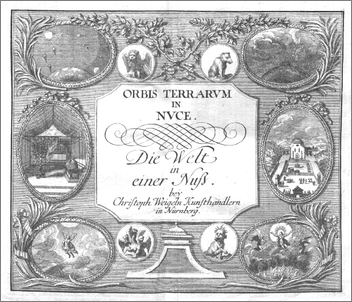
    Perhaps the most beautiful of early books for children is found behind this deeply designed title page, brought to us by Christoph Weigel (German, 1654-1726), the author, illustrator and engraver of Die Welt in einer Nuss oder die Historien vom Aufgang der Welt…1 published in Nurnberg in 1726.  The book was a tall, thin production, with 16 pages of text and 43 engraved plates, much like this one, emblazoned with emblematic studies and dedicated to a particular point in the historical continuum.  And it was intended, believe it or not, for children—the title can be basically translated as “The World in a Nutshell” and was absolutely intended for kids, compressing all of the human story into 16 terse pages and a whole bunch of gorgeous illustration. This image shows the second millennium after the birth of Christ, illustrated with seven engravings (secula septem).


     But the first of all of the encyucloepdia-like books fasiohioned for children–and the first with illustratiions–belongs to the very well studied 13. The fteeple-crowned, 15. add te thefe The bald-pated, 14.

    [ocr errors][merged small][graphic][merged small][merged small]

    [graphic][subsumed][subsumed][subsumed][subsumed][ocr errors][subsumed]

    [ocr errors][ocr errors][merged small][graphic]

    The Plow-man, i. yoketh Oxen, 3. to a Plough, 2. and holding the Flow-Rïlt, 4. in his left hand, and the Plow-ftaff, 5. in his right hand, ivith ‘which he remcveth Clods, 6. he еutteth the Land {ivhich ivas manured afore ,uiifh Dung, 8.) with a Share, 7. and a Coulter, and makethFurrows, 9. Then he foweth the Seed, 10. and harroweth it in with a Harrow, 11. The Reaper, I2. jheareth the ripe Corn with a Sickle, 13. gatheteth up the handfuls, 14, und bindcth the Sheaves, 45.<t¿í Threiher, 16.; threfieth Corn en the Barn-floor, 17. ,with a Flail, 18. .*. toffeth it in a winnowing bafket, 19.andfo ivhen the Chaff’, and the Straw, 20. are ßparatedfrom it, heputteth it into Sacks, 21 ,The Mower, 22. maketh Hay /я я Meadow, tutting do’wn Grafs with a Scythe, 23. and raketh it together üvith a Rake, 24. andmaketh up Cocks, 26. nvith a fork, 25. and carrieth it on Carriages, 27. into the Hay-barn, 28.

    [merged small][ocr errors][merged small][graphic][merged small]

    [graphic]
    [ocr errors]


    [ocr errors][merged small][merged small]
    [graphic]

    Vhe Bees find ota ¿r/warm, i. andfiet over it «Leader, 2. That Jkxiarm heing ready to fly away, is recalled hy the Tinkling ef a braaen Vefl.el, 3. and is put up into a neiv Hive, 4. They make little Cells nvith ßx comers, 5. and Jill them with Honey-dew, and make Combs, 6.cut of ivhich the Honey runneth, 7.The Partitions heing melted -with ßre, turn into Wax, 8.

    Grinding

    [merged small][ocr errors][ocr errors][graphic]

    In a Mill, i. « ft’one, 2. runneth upen a ft one, 3.A Wheel, 4. turning them ahout, end grindeth Corn poured in by a Hopper, 5. endparteth the Bran, 6. falling into the .Tro ugh, 7. from the Mealßipping through aBolter, 8.Such a Mill voasßrft a Hand-mill, 9. then a Horfe-miil, 10.. then a Water-mill, 11. anda Ship-mill, i2. amdatlaßt a Wind-mill, 13.


  • History of Children, 7/7–the First Illustrated Rendering of the World for Kids: the Military

    JF Ptak Science Books  Post 1291    Continuing the post 1285

    “Taking the Scarecrows out of Wisdoms Gardens”

    This is Part 7/7 of John Comenius’ great work, the first illustrated instructional to children, first written in 1676 and then translated into English in 1726–it is from this translation that all of the images (below) are taken.  This is the second of seven installments on introducing 17th and 18th century children to wide ideas, the other sections including: Part 1, Occupations; Part 2, Anatomy; Part 3, Books and Book Arts; Part 4, the Sciences; Part 5, Morals and Philosophy; Part 6, Games and the Arts; and Part 7, the Military.  

    The work itself: John Amos Comenius’ Orbis Senfualium Piélus: Omnium Principalium in Mundo Rerun/ &f m Vita АШопит,  translated as Pictura et Nomenclatur, the Visible World, or A Nomenclature, and Pictures of all Chief Things that are int he World, translated into English by Charles Hoof…1726.

    The purpose of the book, writes the translator in the introduction of the 1726 12th edition, is:  

    To entice witty children to it, that they may not conceit a torment to be in the school, but dainty/are., For it is apparent, that children (even from their infancy almost) are delighted with Pictures, and willingly please their eyes with these fights: And it will be very well worth the pains to have once brought it to pafs, that fcare-crows may be taken away out of Wifdom’s Gardens…”

    Even at this early stage of publishing books for children it was easily recognized that children learn better when eased into their subject with pictures.  This is not so far off the mark with the moderns, and in its own way a precursor to the Dick and Jane and Dr. Seuss books–not so much for subject matter, but for the very act of putting a book into the hands of a child and getting them comfortable wit the idea of reading.  It seems to me that this is by far the most important lesson-the actual content at tis point is secondary to the act of holding a book.  


    [merged small][ocr errors][merged small][graphic][ocr errors][ocr errors]

    [ocr errors][ocr errors][merged small][ocr errors][merged small][graphic][ocr errors]

    When aDeíign is undertaken, the Camp, i. is pitched, and the Tents if Canvas, гor Straw, Jarefaßened •with Stakes; and they entrench them aient, fer ßcurity’s fake, •with Bulwark?, 4. and Ditches, 5. Sentinels, 6. ere alí’ofel; and Scouts, 7. arefent out.SaUyings-out, 8.ere made for Forage and Plunder-fake,where they often cope with the Enemy, 9. infiirmijhing.. The Pavilion of the Lord General is in the midßoftht Camp, 10.

    [ocr errors]
    [ocr errors][graphic][merged small][subsumed][merged small]

    il to hi fought, the Army is/et in order, and divided into the Front, 1.the Rear, 2.and the Wings, 3.The Foot, 4. mre intermixed •with the Horfe, 5,That is divided into Companies, this into Troops.Thefe carry Banners, 6. tho/e Flags, 7. in the midft of them.Their Officers are, Corporali, Enfigns, Lieutenants, Captains, 8. Commanders of the Horfe,9, Lieutenant Colonels, Colonels, and he that is the chief of all, the General. The Drummers, 10. and the Drumílades, 11. as alfo the Trumpeters, 12. call to Arms, and inßame the Soldier, At theßrß Onfet the Mofitets, 13. and Ordnance, 14. areßot off. After•wards thtyfight, 15. hand to hand •with Pikes and Swords. They that overcome are flain, 16. tr taken Prifoners, ,r run away, 17. They that are for the referve, 18. come upon thtm

    [ocr errors]
    [graphic]
    [merged small][ocr errors]

    [merged small][ocr errors][merged small][ocr errors][graphic]

    A Sea-fight « terrihle, ,when huge Ships, like Caftles, run one upon another ivith their Beaks, 1 , or ßiatter one another with their Ordnance, 2. und/o, heing hored through, they drink in their own Deßnition, and art funk, 3. Or when they arefet on ßre, mid either hy the ßring of G un-powder, 4.

    [ocr errors][merged small][merged small][ocr errors][graphic][ocr errors][ocr errors][ocr errors][ocr errors][ocr errors]

    sr hreaking them doivn with Battering-engine!, 3, er demolifiing themwith great Guns, 4.or breaking through the Gates with a Petard, 5. er caßing Granadoes, 6. tut of M01 tar-pieces, 7. tuto the City,hy Engineers, 8. (ivho He hehind Leaguer-ha&ets, 9.) er 0 uerthroivingit avith Mines hy Pioneers, to. They thait are hefieged defend thtmfelves from the Walls, 11. •with ßre and ßones, &C or hreak out hy force, iz. A City that is taken hy Horra is plundered, deßroyed, andfomelimes laid evtl •with the ground.