A Daily History of Holes, Dots, Lines, Science, History, Math, Physics, Art, the Unintentional Absurd, Architecture, Maps, Data Visualization, Blank and Missing Things, and so on. |1.6 million words, 7500 images, 4.9 million hits| Press & appearances in The Times, Le Figaro, Mensa, The Economist, The Guardian, Discovery News, Slate, Le Monde, Sci American Blogs, Le Pont, and many other places… 5000+ total posts since 2008.

Author: JF Ptak

  • A Scientific/Industrial Vision of the Future City (1842)

    JF Ptak Science Books  2723

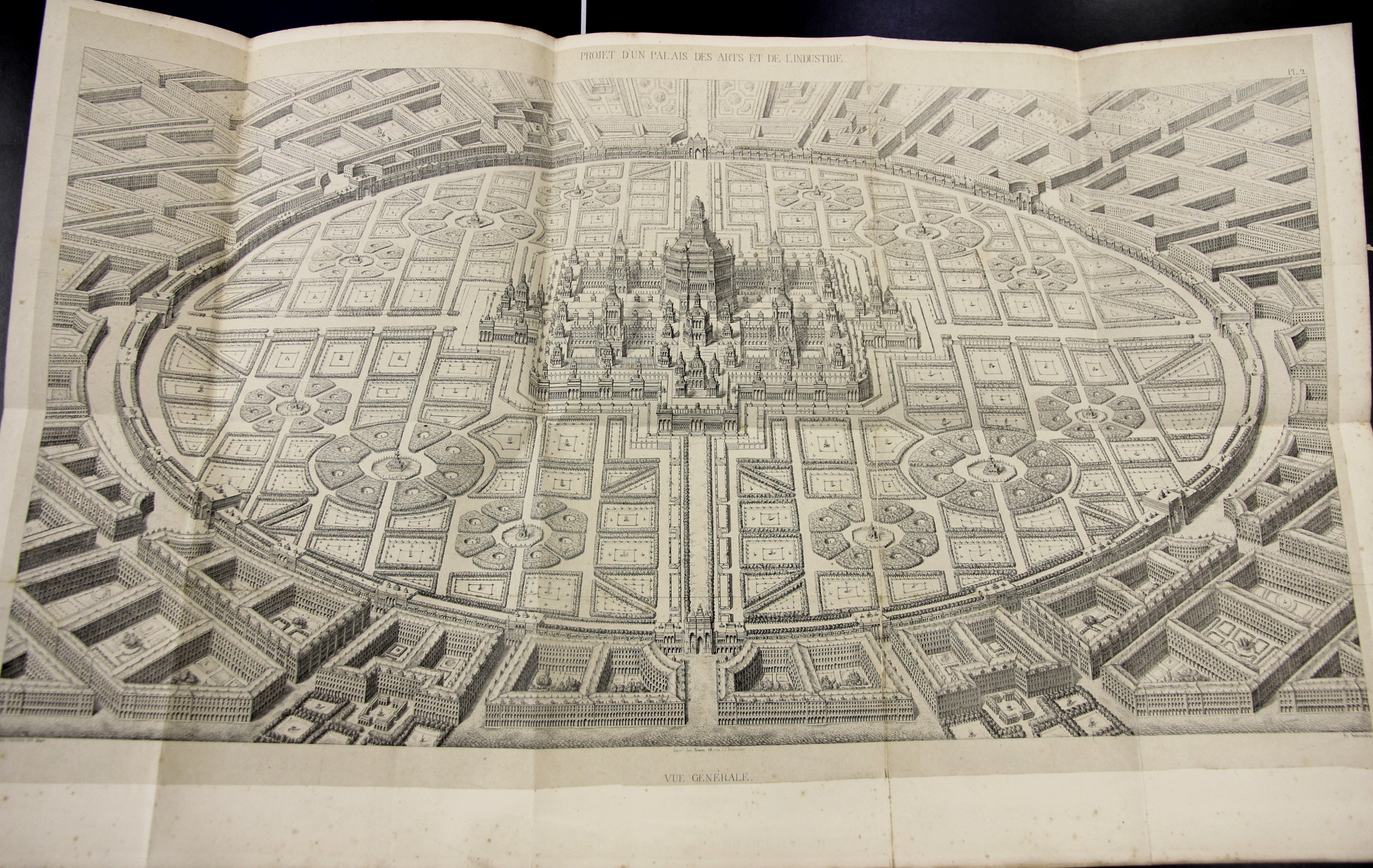
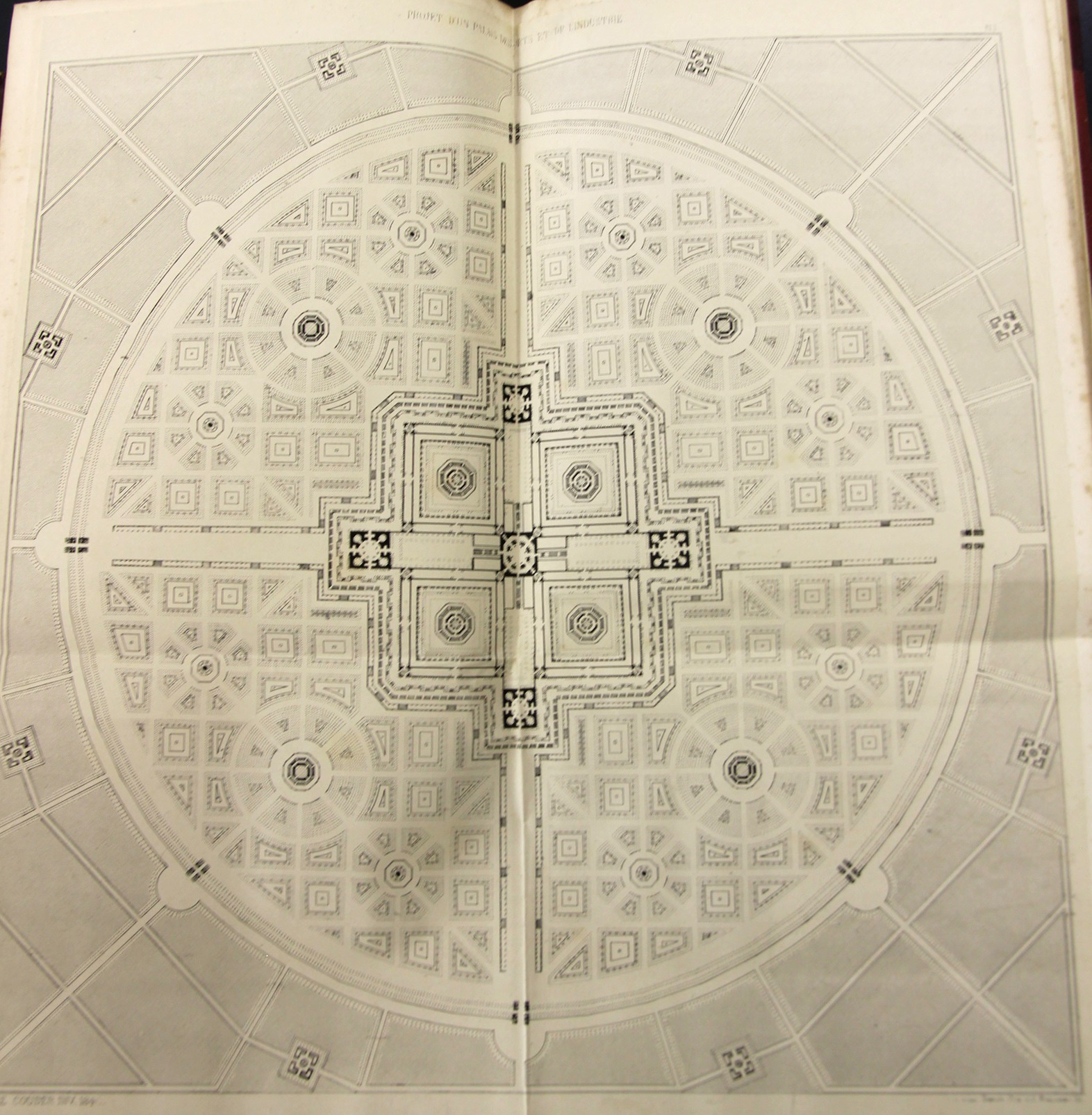
     Amédé Couder wrote L’Architecture et l’industrie comme moyen de perfection sociale, a fine work that was published in Paris (by Brockhaus et Avenarius) in 1842.  The work presents Couder’s rather stroing visionary plans for a perfect city of industrial and scientific harmony, laid out in suggestively-fractal harmony, with the suggestions of a Renaissance-laden snowflake design. Whatever it was, it was beautiful to look at, at least on paper, though I’m not so certain that I’d care to live in the canyonlands of stone and shadow on the other side of the garden wall of the perfect scientific-industrial conclave. 

    Couder 1

    Couder 2 detail

    Couder 5

    ·Posted by :

    ·in:


  • The Beauty of Speed in Chess Notation

    JF Ptak Science Books   Post 2723

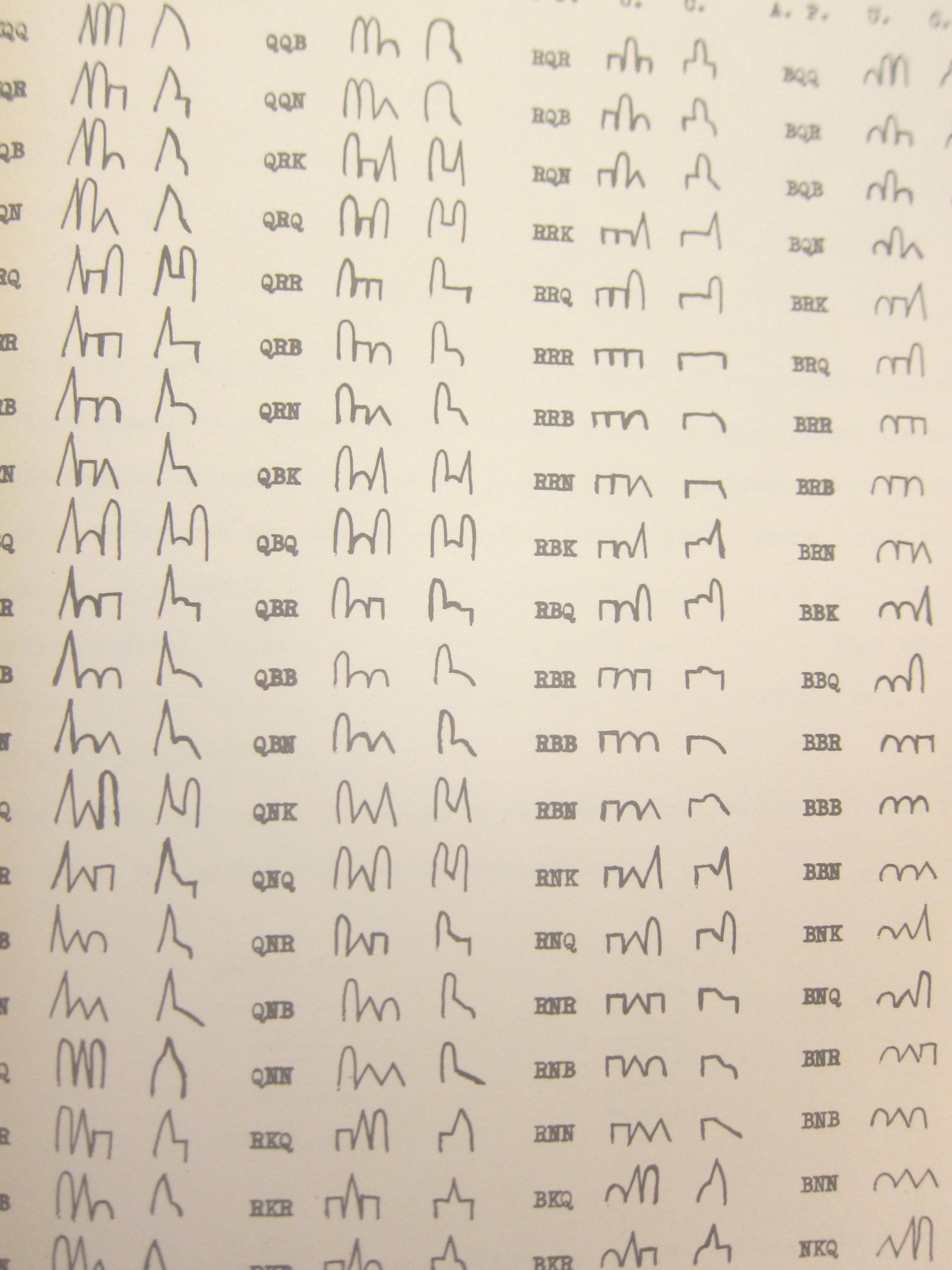
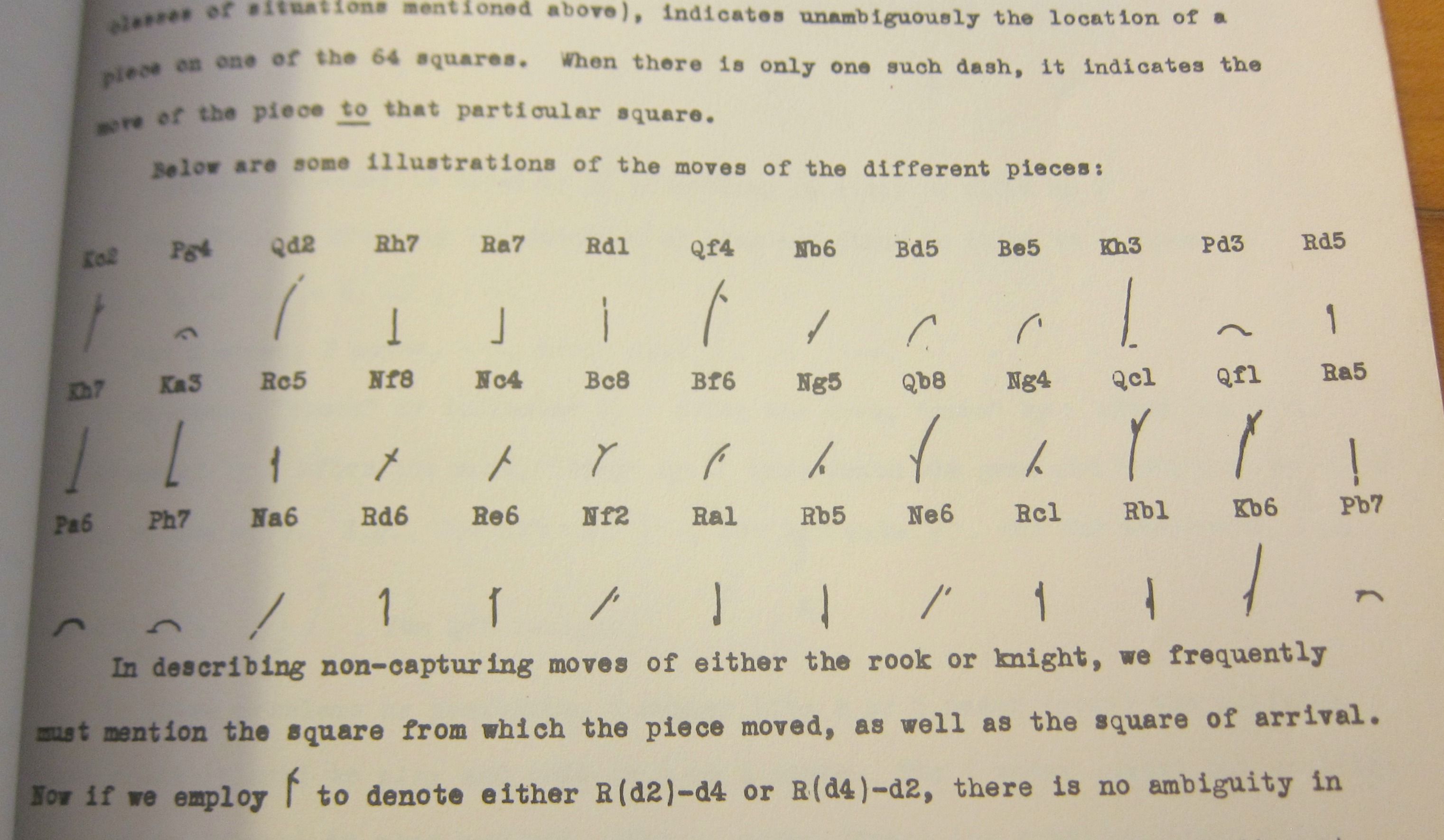
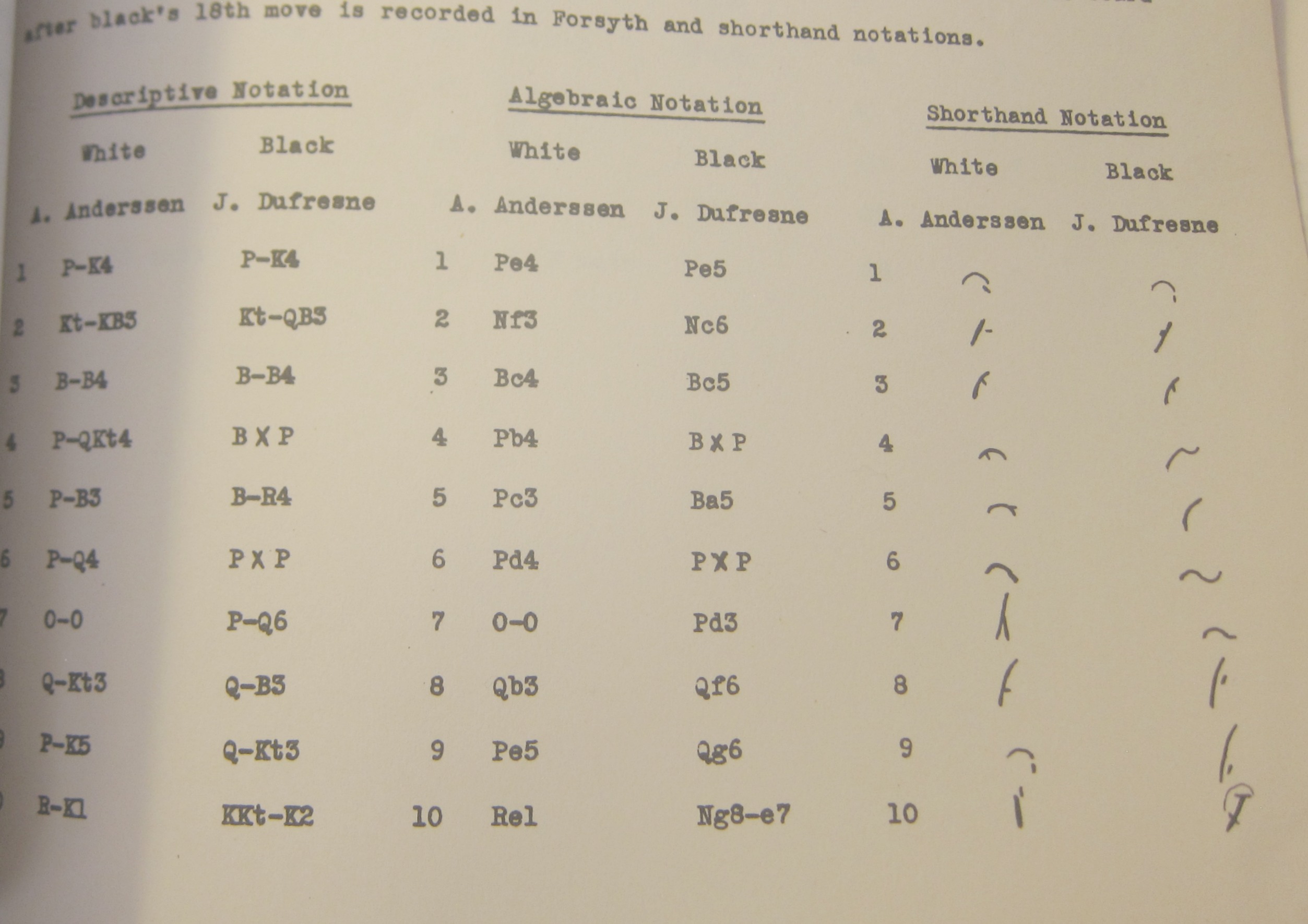
    In the occasionally speedy and occasionally not-speedy world of chess, it may sometimes be necessary to take speedy-or-not notes, and one attempt to address this need was made by Herbert E. Salzer in his non-mysteriously titled Chess Shorthand (1971).  Chess notation–like algebraic notation (in different iterations), English notation, ICCF notation, and so on–can reach back hundreds of years. Even the shorthand approach tried out here in mathematician Salzer’s short work dips back into the 19th century (‘Shorthand Notation” by M. Barnard, a short entry in  Chess Player’s Annual and Club Directory, 1893-94 by Mr and Mrs T.B. Rowland, London, 1893). But the Salzer work is really pretty interesting, and so I thought to at least surface the work.

    The thing is is that Salzer’s work has a certain autonomous, musical, simple splendor to it–that or it has the feel of a cipher (or a double cipher). Here’s an example:\Chess ahorthand _1_
    On second thought a shorthand for chess at first (or second) blush doesn’t really seem terribly necessary, given the brevity of the notation that already exists or existed. The author though is convinced that such an effort was needed, or at least wanted the intellectual exercise of creating such a thing, and provides in twelve packed pages the foundations of recording chess moves quickly, if not inconveniently. The notation the author creates reminds me somewhat of Gregg shorthand, but not as much as alien written communication system, being mostly soft lines and bumps. More striking is that as soon as these abbreviated symbols are introduced, the abbreviations’ abbreviations appear. In the attempt to make things less complicated this system may complicate things—maybe not, because I really can’t tell. Perhaps if you became fluid and fluent in the new symbolic language the Salzer system becomes a godsend, or perhaps not. I can appreciate the thinking and the work, and the interesting road that the author took to his shortcut, but I’ve never been good at those, once taking a “shortcut” to a location directly south of me and finally getting to it 3x-longer than usual, getting to the place going north. All that said, I respect this work, though I really don’t understand it–in a certain way Mr. Salzer created a work of art in creating his writing system. 

     
    Chess ahorthand _1_
    Chess ahorthand _1_


    ·Posted by :

    ·in:


  • Burroughs, Batman, and Bullets in the History of Holes and Punched Card Computation

    JF Ptak Science Books   Post 2722

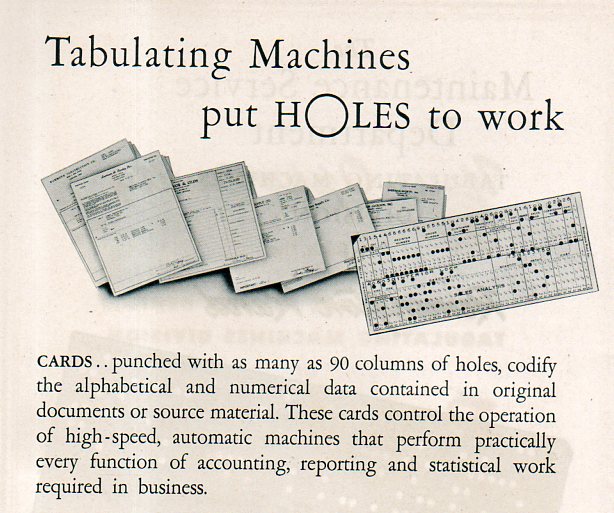
    There is a continuing thread on this blog on The History of Holes–it is a series about, well,  holes and what isn’t in them/what used to be in them/what you can see through them, and so on. This particular section of holes relates to the control and distribution of data and the great efficacy of utilizing holes punched into cards which would be arranged and tabulated in such a way as to order and manipulate mountains of data.  That said I don’t recall seeing anything in print from the heyday of keypunching that actually mentioned the holes, as it does here–nor have I seen a non-William-Burroughs connection made between handguns, bullets, holes, and tabulation. Oddly enough, there is a connection with a crime fighter who didn’t use a gun and whose sidekick used the exclamation “Holy ______ (computer, etc., and no expletives). And so we get to unite punched cards, computers, W.S. Burroughs, Batman, and The Time Tunnel.  (The Time Tunnel?–yes indeed, the tv show from the 60’s can be brought into this as well..)

    Remington rand holes057

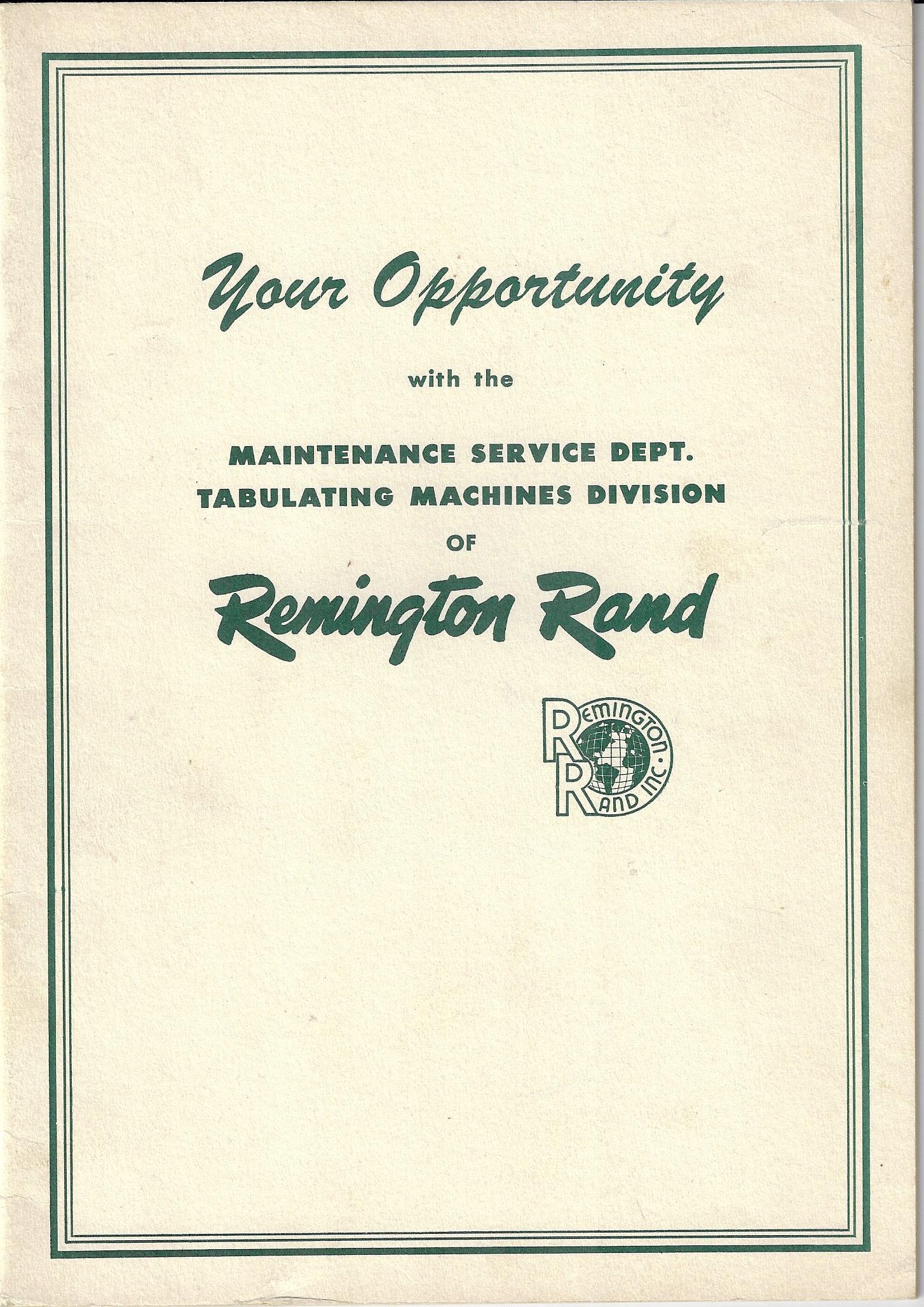
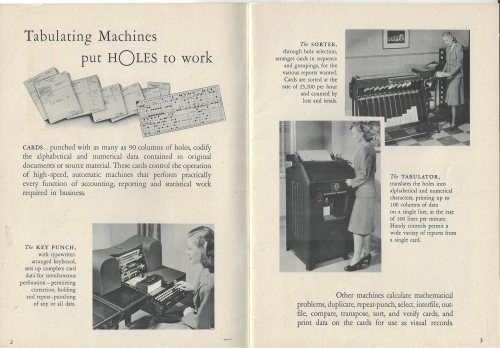
    This is one of the first pages in a promotional pamphlet entitled Your Opportunity with the Maintenance Service Department Tabulating Machines Division of Remington Rand (ca. 1935-40). The title is stubby and factual, and the company was putting out a feeler for future engineering employees who could be trained to service and repair the many machines produced by Remington Rand that could be found in a largish business. 

    Remington Rand at one time was Remington Arms, and then diversified to produce all manner of light and heavy electrical goods (and of course famously producing the standard U.S. Army sidearm, the 45-calber Remington M1911 pistol), and by the end of WWII the company produced a vast line of tabulating equipment (of another order of high caliber).  Interestingly the pamphlet exclaims that a person working for RR could work there for as long as they wanted, that the company was there to stay.  

    Remington rand holes058

    Certainly the company would hang on for some time in one form or another, but the tabulating card division was about to change drastically.  In 1950 RR purchased Eckert-Mauchly Computer Company (ENIAC) and a few years later (1952) secured another giant computer pioneer, Engineering Research Associates (ERA), making Remington Rand about the largest computer company in the world. RR would be purchased a few years later by Sperry in 1955, becoming Sperry Rand, and then simply Sperry a short time after that; later, in 1986, Sperry would merge with Burroughs and become Unisys. Somewhere in there all of these tabulating machine repairmen and techs hired fresh in 1946 would be out of their lifetime job less than a decade later.  

    Now back to William S. Burroughs–the gun/tabulating connection there is that Mr. Burroughs accidentally shot and killed his wife in a game of “William Tell”–he is also the grandson of William Seward Burroughs of Burroughs Adding/Tabulating Machine and computer mainframe fame. (Burroughs was founded in 1886 and became Burroughs Corp in 1953 and was one of the nine major computer manufacturers in the U.S. 100 years after its founding Burroughs Corp merged with Sperry–which had absorbed Remington Rand–to become Unisys.) 

    On to The Batman of the 1960’s tv show where the connection between punched holes and “holy” is obvious and obscure–the caped crusader and Robin used a Burroughs computer (the B205) in the Batcave. The same goes for The Time Tunnel, where we see another use of the B205, used to enable the intrepid time travelers to jump into their funnel-shaped time machine and dive into a hole in time much like Harry Potter at platform 9 3/4.   I suspect that there are more examples, but I’ll stop here.

    • (A big salute to the “Starring the Computer” website, which has an extensive list of the B205 appearing in movies and television: http://starringthecomputer.com/computer.html?c=45  as well as a very long list of appearances of many other non-fictional computers. It is an excellent effort!)

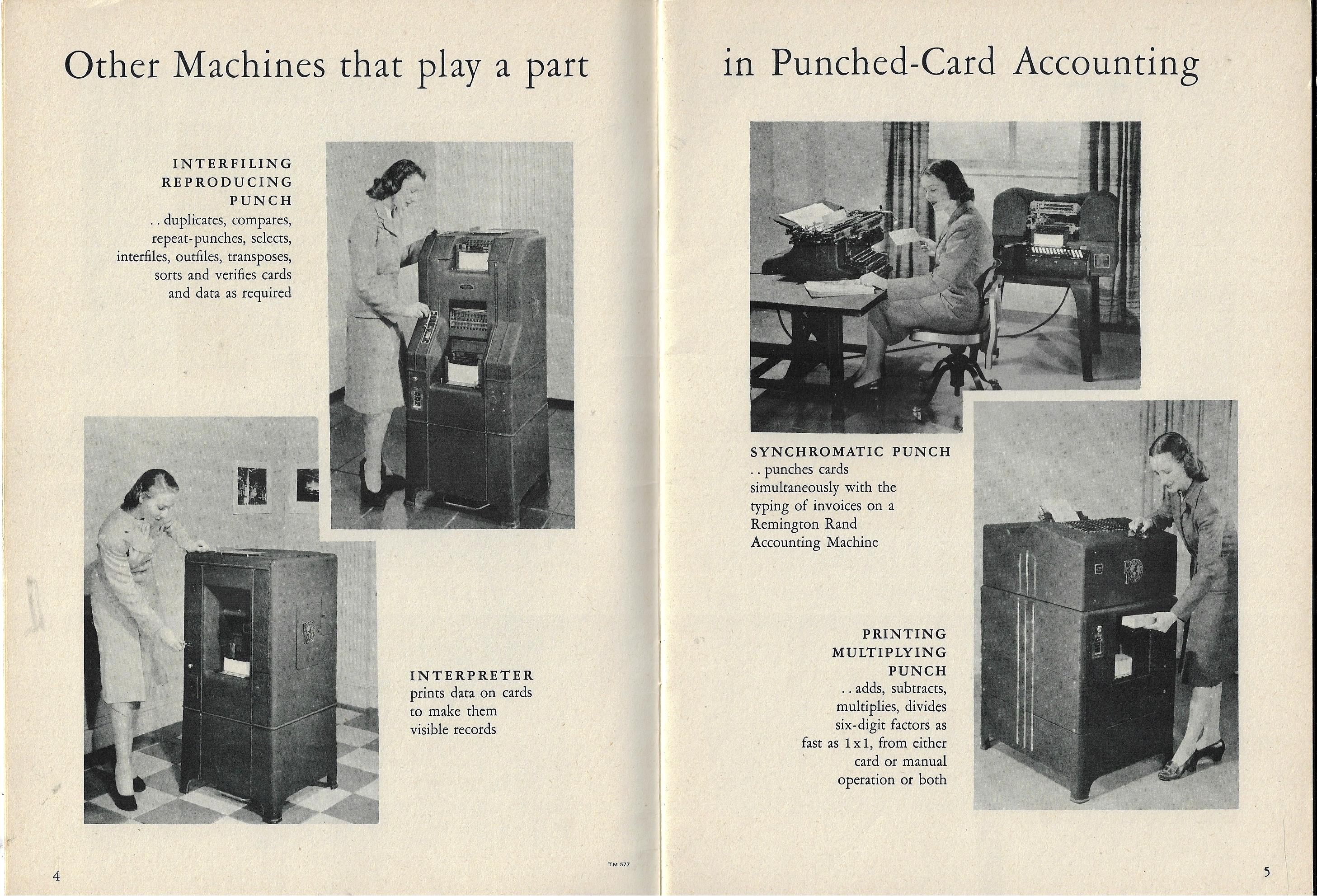
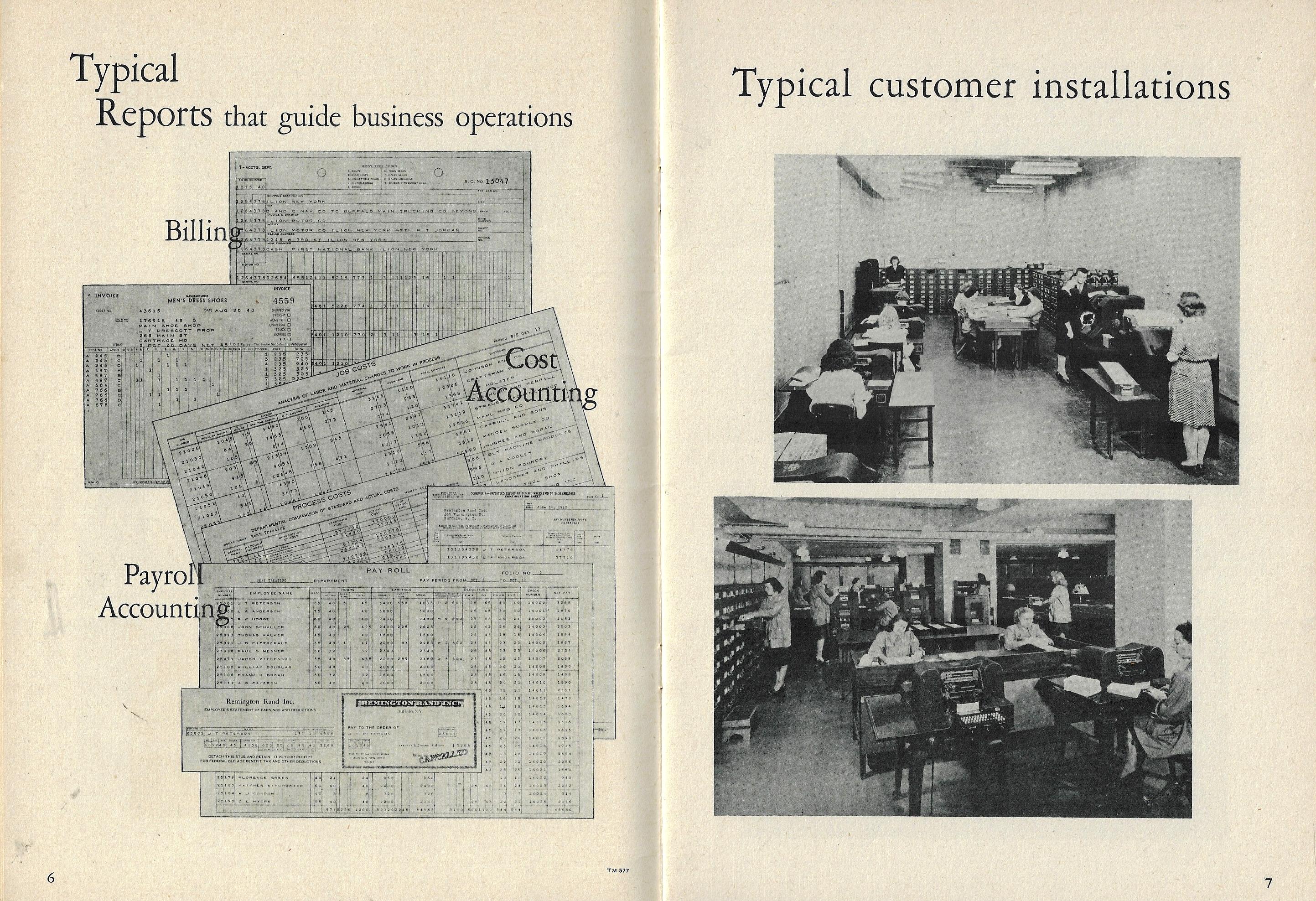
    Lastly, some illustrations from the pamphlet, which surpisingly does not show up at all in WorldCat/OCLC.


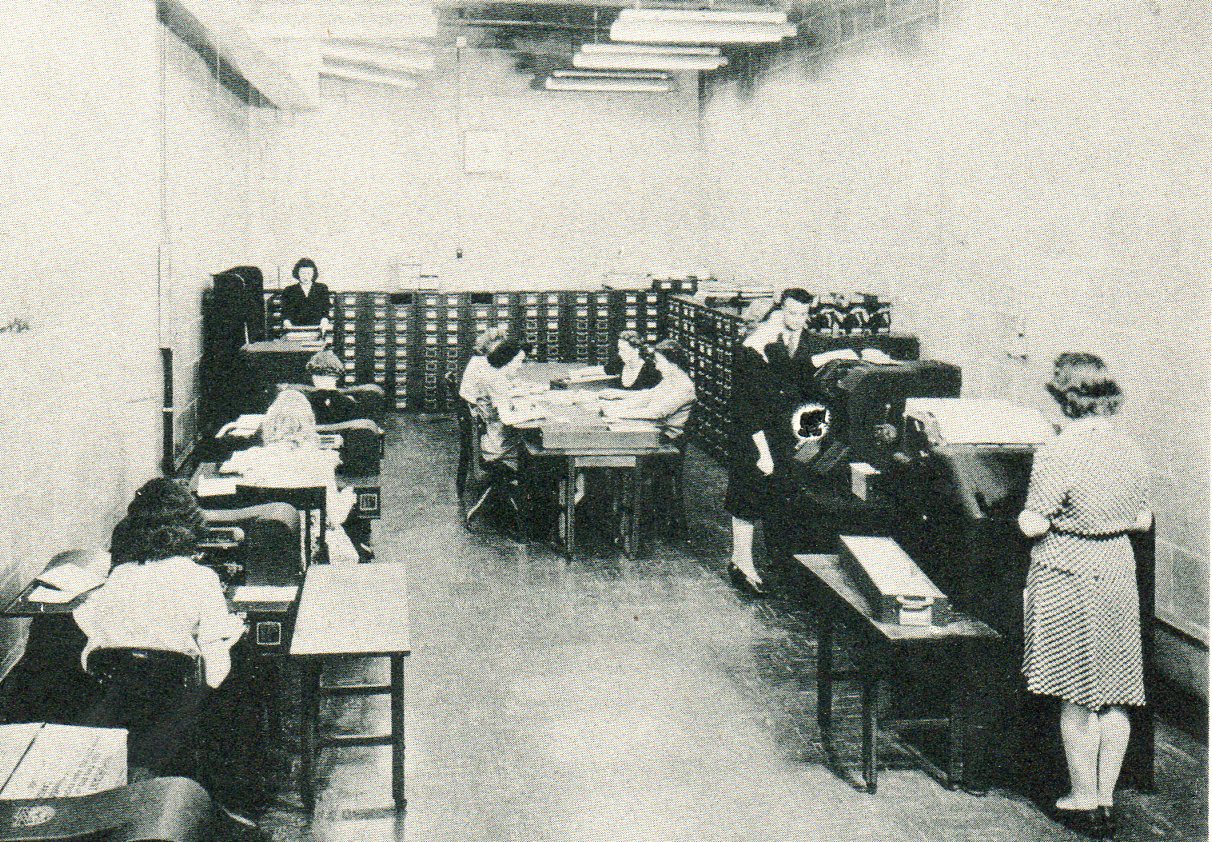
    Remington rand holes059

    [“Typical office installations of Remington Rand equipment”]

    Remington rand holes060

    Remington Rand Opportunity _2__0001
    Remington Rand Opportunity _2__0001
    Remington Rand Opportunity _2__0001
    Remington Rand Opportunity _2__0001


  • How Did One Keep Ice Icey in the Summer of 1845?

    JF Ptak Science Books   Quick Post

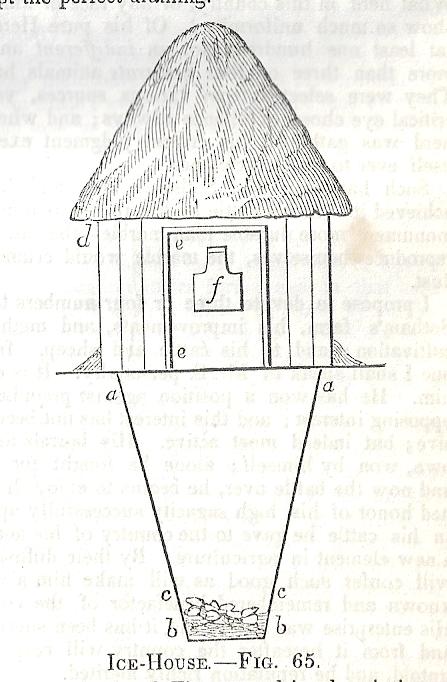
     I cam upon this curious drawing in The American Agriculturalist for July 1845.  “Ice-House” it was, and the accompanying text described how this design was found to be among the most perfect. There is even a recommendation for the design from a gentleman in Virginia, a summertime recommendation from a moist and steamy environment. The author described how well the building worked, built into the side of a hill with a 12-foot-square pit dug 14′ down, and how the bottom of the pit was never revealed, even after eight summers of ice and heat…there was always something cold down in the hole. 

    I wonder how old the oldest ice was in the state of Virginia or any other hot place, how old the oldest unrefrigerated ice may have been? The thought would be that you would just need to keep adding ice, but that other ice needed to come from somewhere, and in 1845 that “somewhere” may have been nowhere at all–after all if the ice didn’t melt then we would have a significant problem with the laws of the universe. 

    Ice house _2_

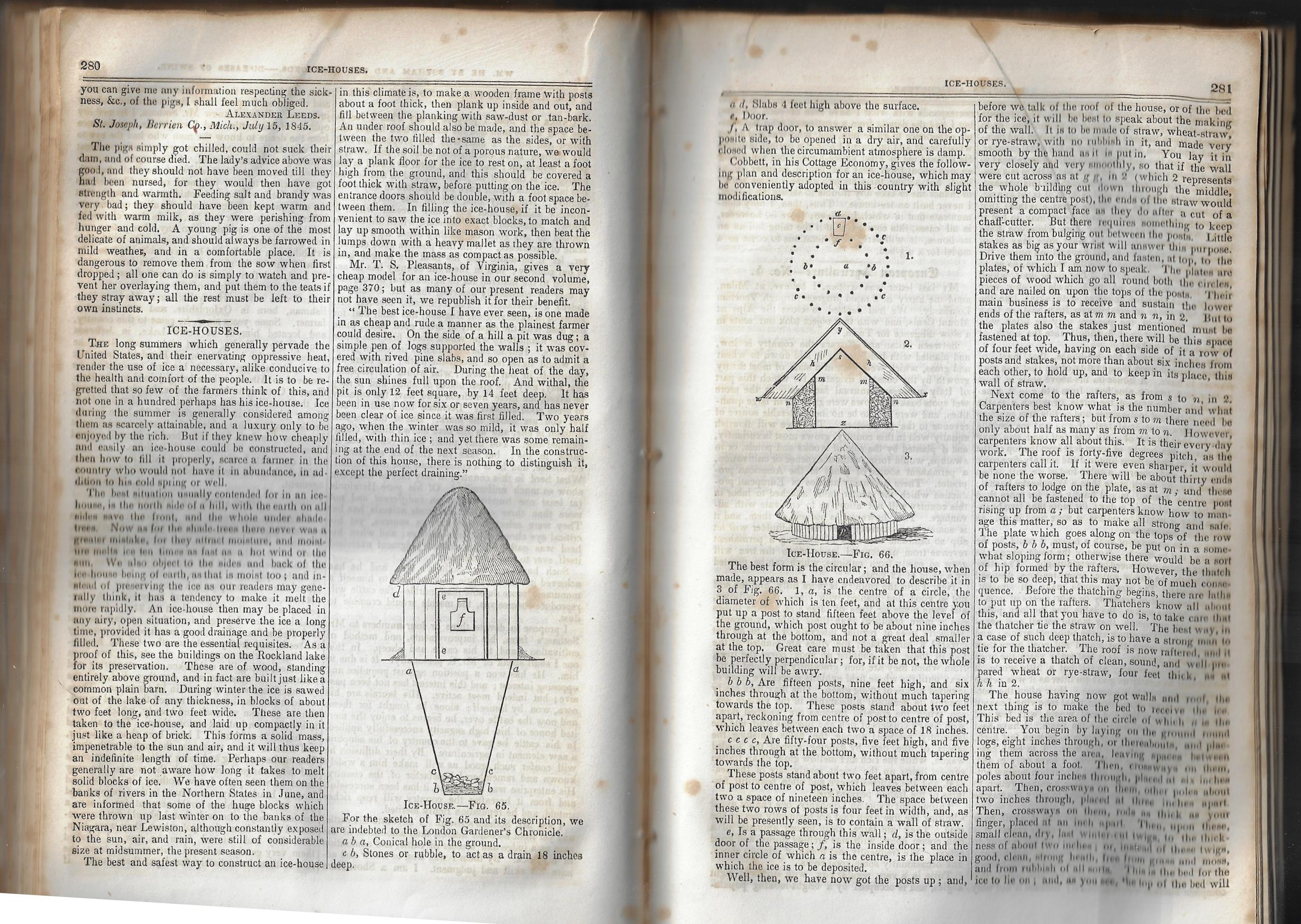
    And the full text, with descriptions on how to construct the ice house: 


    Ice house 1845 _1_

    [Click to expand.]

    ·Posted by :

    ·in:


  • Black & White in Color, Part V

    JF Ptak Science Books  Quick Post

    This is another installment in a series on putting color into what we normally would think of in terms of black and white photos (and movies)–the results are sometimes surprising and unusual. (There are posts here on the color schemes on 1930’s schoolrooms in Cleveland, air recon in color, color dissonance in 1940’s bathrooms, colorless color charts, and other such bits, all findable by entering “color black and white” int he Google search box.)  The pamphlet below would sound like a simple and badly-titled publication (How to Plan Walls that Please, by Armstrong Cork Products, 1938) if you were just reading about it in a catalog, but in real life, it is a symphony of exploding and unexpected color. At first the color combinations had a somewhat claustrophobic effect, but I think it was mostly because the rooms were small and densely packed–once that is accounted for, the colors seemed to take on a welcoming attitude…especially in the kitchens, where you’d expect to sit down at one of those small tables and wait for Grandma to serve you some fresh pie.  

    In any event, here are some examples for the pamphlet:

    How to Plan Walls that Please _5_

    How to Plan Walls that Please _5_


  • A Unique Copy of a Rorschach Test Interpretation Tool (1947)?

    JF Ptak Science Books   Post 2721

    Yesterday I wrote about a problem I was having in understanding a difficult-to-understand document on applying a computer in creating a bibliography of meteorology from 1949. Today the nature of the object is just completely outside anything I know about, and I thought if I posted something here and other palces in the Great Social Media that someone out there in Webtopia will know exactly what this thing is.

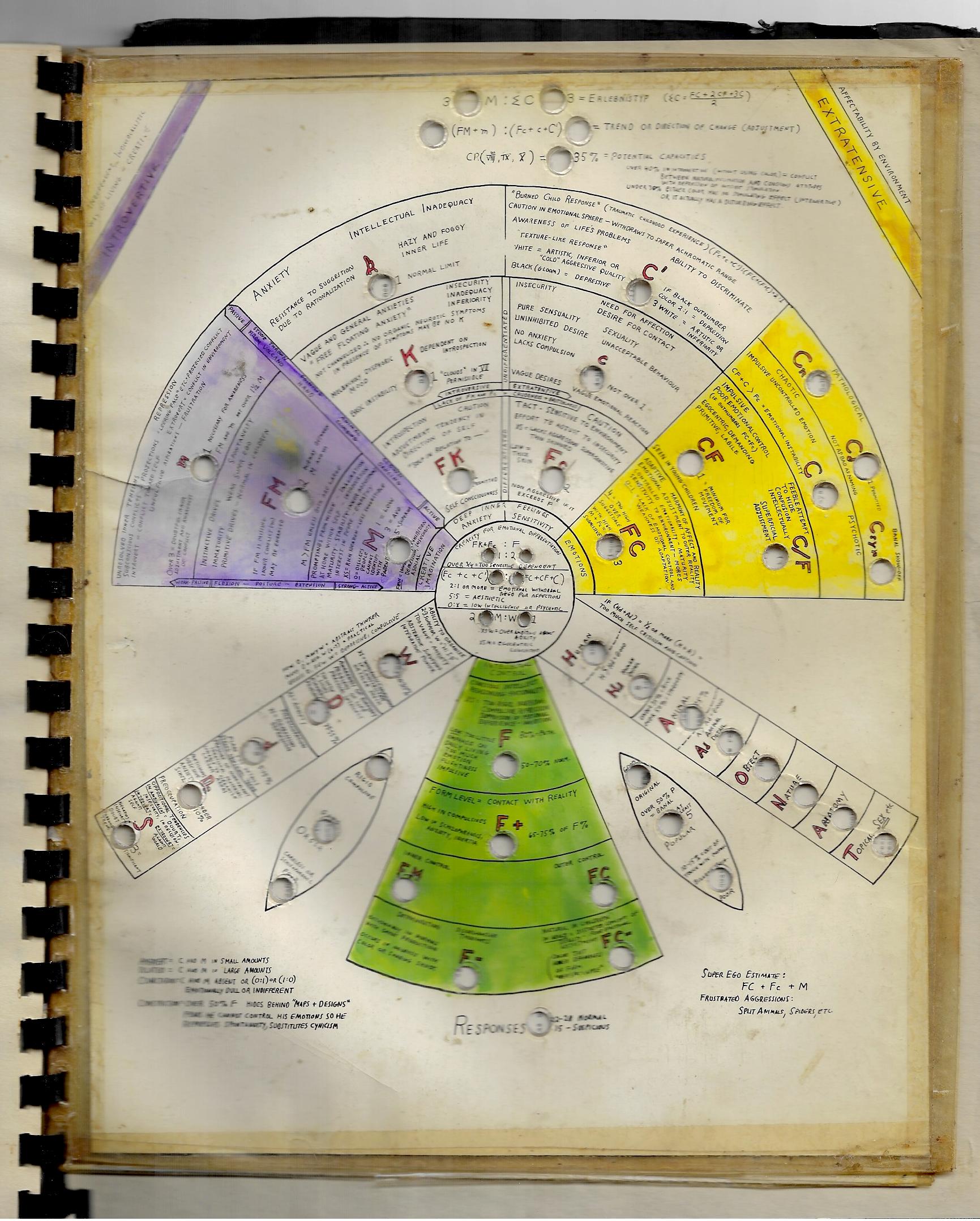
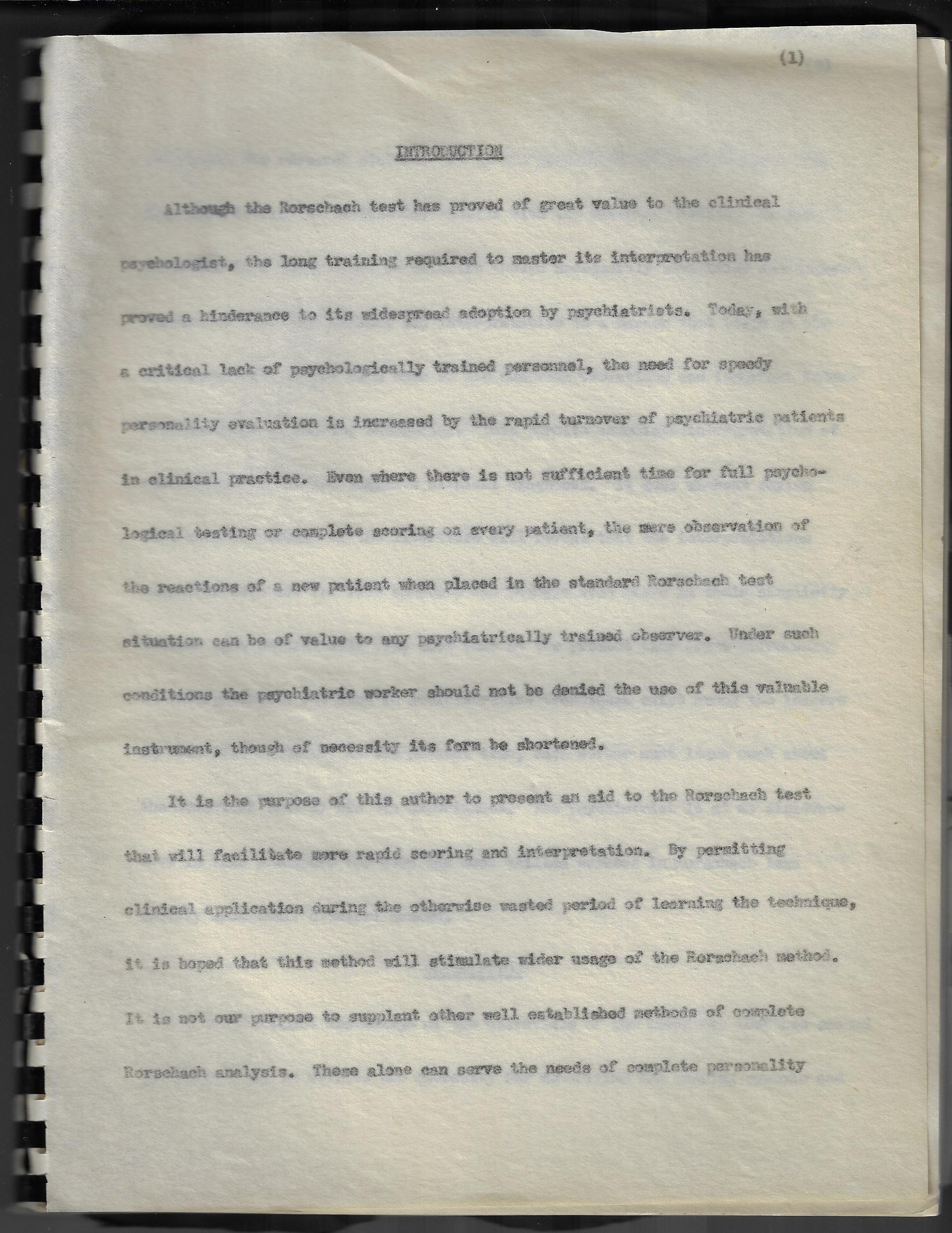
    The subject here is a paper by Dr. George Ulett called A Rapid Method of Rorschach Analysis, which was created in 1947. The whole production is obviously home-made, the text being some generation of carbon copy from the typed original, with the “calculator” or rapid-method template being hand made. I can find no evidence in WorldCat/OCLC that this work was published as it stands. I also cannot tell if it was incorporated in a later work. I also cannot tell its utility, but given Dr. Ulett’s achievements in the field, and particularly within the Rorschach specialty, he must have seen a use for this tool.


    Ulett rorschach _1_

    And the notes on the reverse of the Rorschach tool:

    Ulett rorschach _2_

    Notes:

    Ulett, George A.: “…former director of the Missouri Division of Mental Diseases where, under his leadership, Missouri went from one of the worst-funded mental health programs to a national leader. He founded what is now the Missouri Institute of Mental Health. He was former medical director of St. Louis City’s Malcom Bliss Hospital. He was instrumental in setting up alcohol and drug abuse treatment programs at city and state hospitals. One of his proudest achievements was to bring racial integration to the city’s mental health system. He was a professor of psychiatry at Washington University, Directory of Psychiatry at Deaconess Hospital, and was in private practice for over three decades.”from obituary at Legacy dot com

    Dr. Ulett was also the author of books and numerous papers, including a number on the Rorschach test, including: Rorschach workbook : a primer for the psychiatrist, with interpretive diagram to permit clinical use while learning the ink-blot test, 1948, and Rorschach introductory manual : a self-teaching primer of Rorschach for the clinical psychiatric worker, 1960.

     (Provenance: Library of Congress, undoubtedly from the author, received May 1947. From the “Pamphlet Collections”, and stamped on the title page with the LC/ surplus/duplicate stamp. 11×8.5”, 18, 2, pp, plus a plastic-encased (though retrievable) cardboard hole-punched enumerator for recording Rorschach responses. GVC bound in manila wrappers, both of which are detached, though present.)


  • On Expanding the Boundaries of Things I Don’t Know

    JF Ptak Science Books  Post 2720

    Here’s a good example of “where do I go with this puzzle now?” from the daily work that I do. The stages in working with odd material like the following goes from (1) recognizing that this junky-looking bit isn’t nothing; (2) identifying the something in the nothing that an outsider like me can recognize; (3) figuring out where the thing might fit in context with its development of whatever; (4) seeing how it may or may not be significant in the development of its subject; and (5) trying to figure out if I know what I was talking about in #s 1-4 (this is usually the most difficult step). In an event, I worked with something just now where it seemed to strike interesting chords along several areas, but in the end I was back at the beginning.  

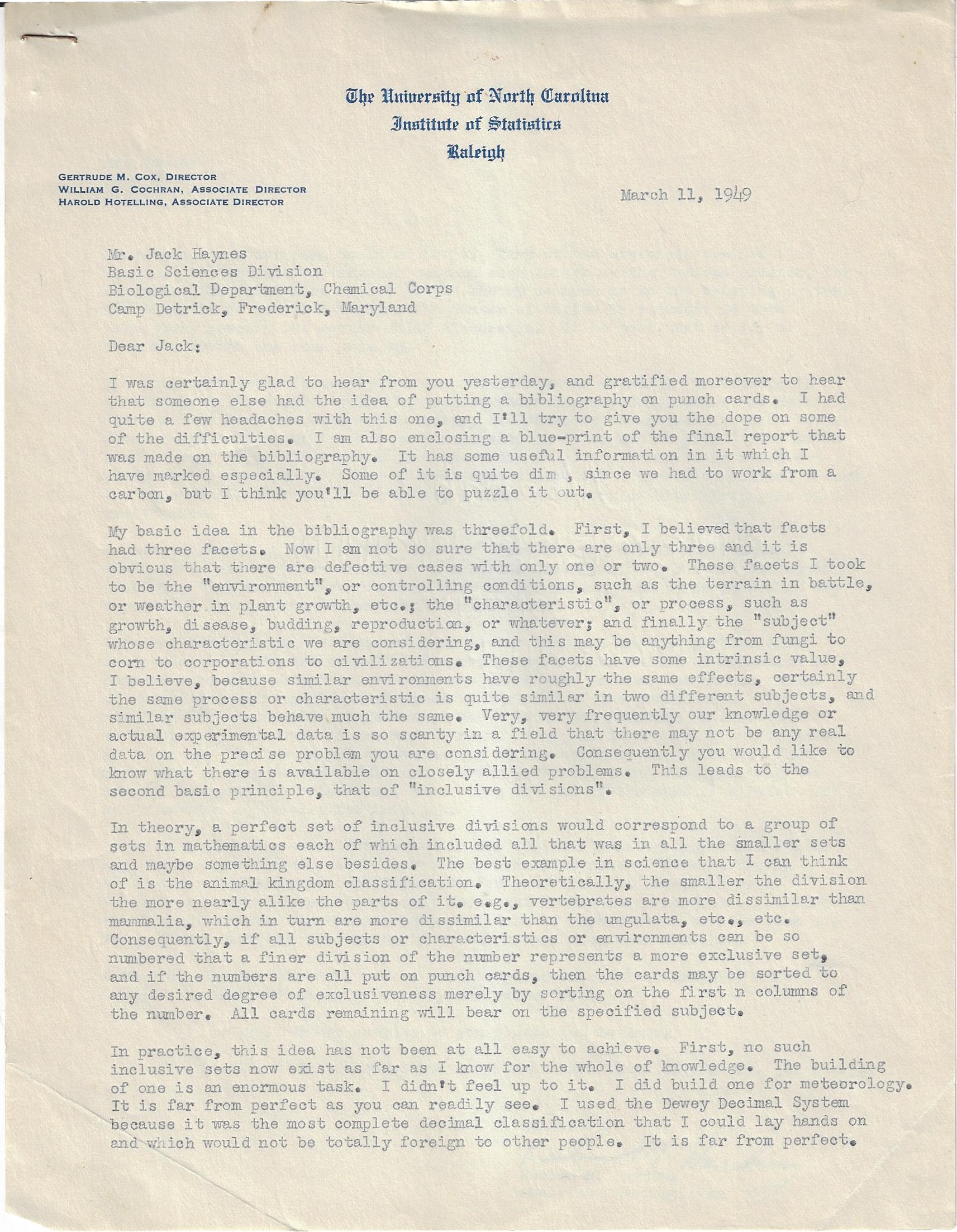
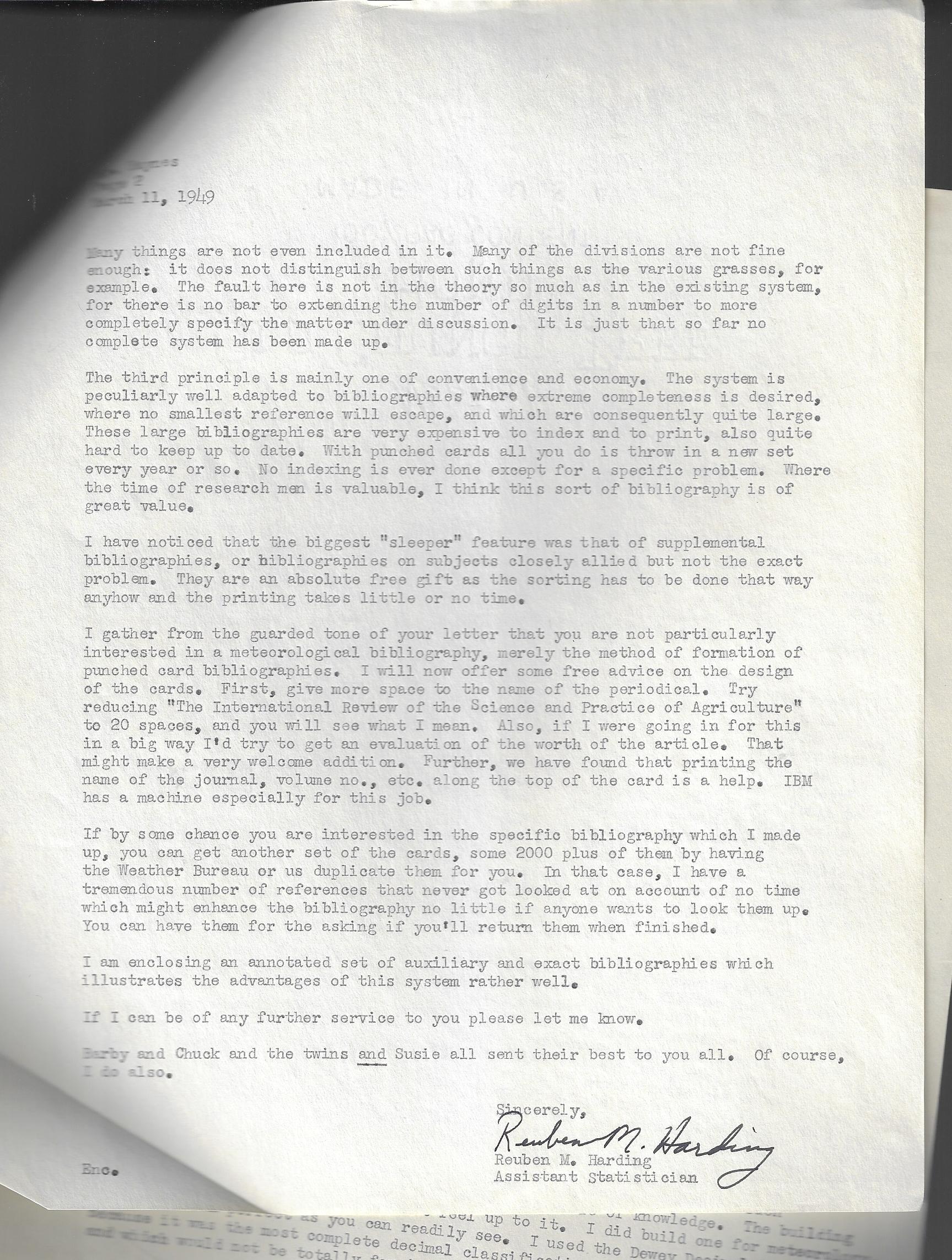
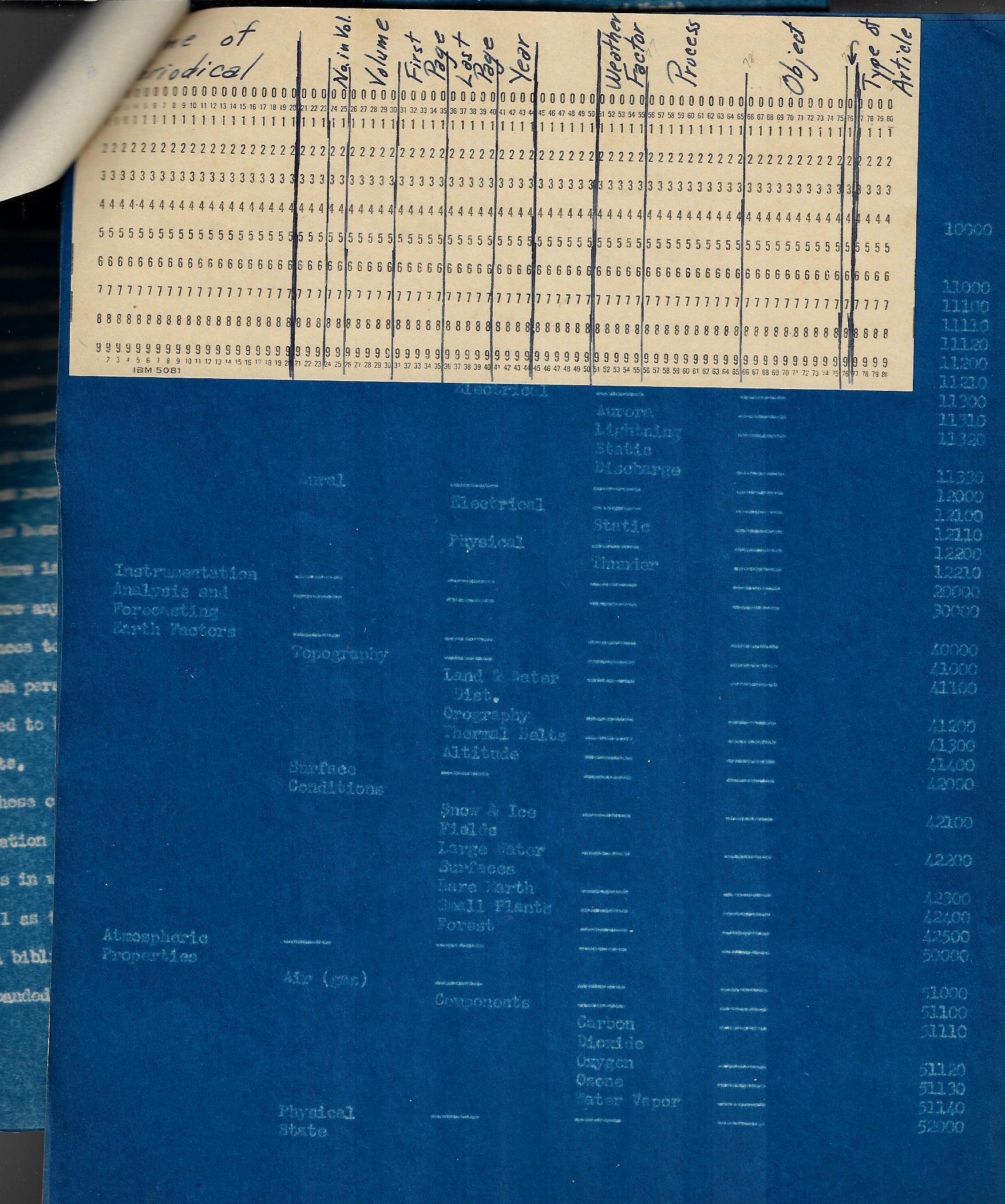
    The item in mind is an early application of computers in forming a bibliographic meteorological database: Final Report of Bibliographic Section of Cooperative Research Project Between the U.S. Weather Bureau and North Carolina State College, which was produced in 1949 in 11 sheets, 9 of which are blueprints of text (including“Final Report…” pp 1-6, “Appendix 2 [sic], Meteorological Factor Codes”, 3pp).  Also included is a sample IBM card mock-up with hand-printed notation.  It is accompanied by an extensive two-page cover letter explaining the bibliography project in some detail, and was written by Reuben M. Harding (“assistant statistician”) on the UNC at Raleigh Institute of Statistics letterhead. (The director and associate directors were all heavy hitter statisticians, including Gertrude Cox, William Cochran, and Harold Hotelling.)  The letter is dated March 11, 1949, and written to Jack Haynes (“Basic Sciences Division, Biological Department, Chemical Corps, Camp Detrick”. “Camp Detrick” was named so from “Detrick Field” in 1943, and became after great expansion in Biowar “Fort Detrick” in 1953.) I cannot find out anything about Harding save for his dates (1919-1997) and I found nothing on Mr. Haynes, though given the nature of Fort Detrick, this does not surprise me at all, as those guys–being at the center of biological and chemical weaponry establishment in the U.S.–were doing work that generally was not published or publicly shared.

    Basically it seems that Haynes wrote to Harding for general information on creating database on punch cards, though not necessarily for meteorological purposes. There is a mention for example of “battlefield conditions” which would not necessarily appear in a meteorological bibliography, but there is no hint in the letter at all regarding the ultimate applied interest of Detrick might’ve been. So my guess is that Haynes was interested in structure and not content. Harding responds mostly outlining the weaknesses of his project, though this critique is very highly useful in itself, and for all I know may have been the most significant contribution of the entire affair. 

    Here’s the cover letter, which makes for interesting reading in itself, with some good insight on how to convey information on a proposed project and what the troublesome issues were–it is worth a read from that perspective alone.

    Punch card meteorology

    Punched cards meteorology _2_

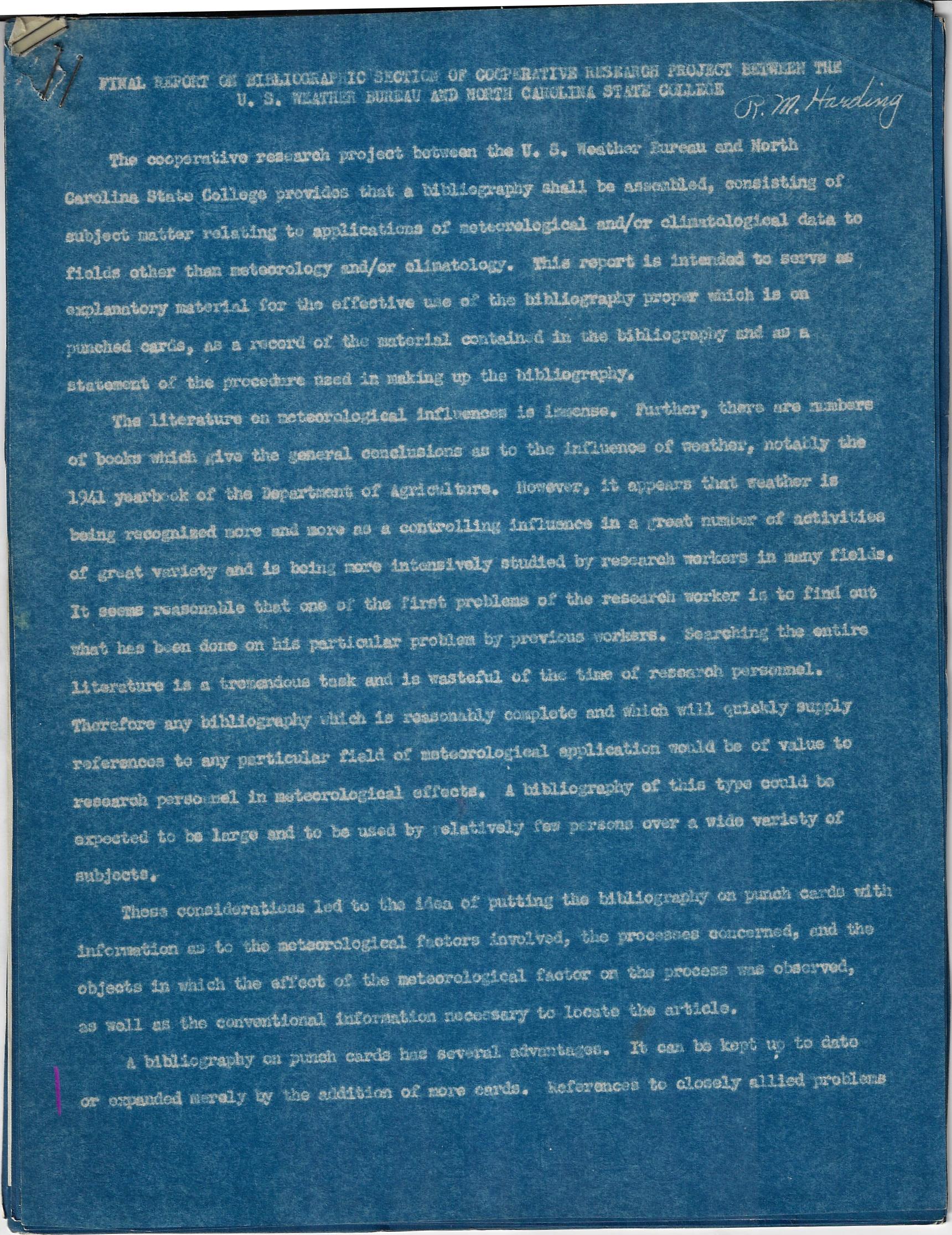
    And the first page of the blueprinted document:

    Punch cards meteorology_3_

    And the punch card mock-up:

    Punch card meteorology _4_

    And so, it was an interesting time figuring out some of the parts of this document, but after everything was said and done, I really didn’t know where I was. The document itself didn’t show up as a published entity in WorldCat, and general academic searches revealed nothing of use on my early attempts, which means all I have thus far are discrete bits of information, explaining more deeply what I don’t know. Sometimes these things are a challenge, and sometimes they need to be let go, in spite of the convincingly-interesting bits that surround them.  We’ll see what happens to this…

    And speaking of things that I don’t know, I’m not even sure what post number this really is–I say “2720” but I think in the last few hundred numbered post I’ve lost my numerical way, and I’m not positive of what number I am up to. It gets more confusing as there are unnumbered “quick posts”, which number probably now about 2k, and since there can be 5 or 10 or more of them spaced between numbered posts, I sometimes just forget what number I am pushing against. 

    ·Posted by :

    ·in:


  • Writing on the Clouds

    JF Ptak Science Books  Post 2719

     “Euery Cloud engenders not a Storme.”–Shakespeare, Henry VI, Pt. 3 (1623) v. iii. 10

     “Vapour, previously unseen, makes its appearance as cloud, or mist, or fog.”–T. H. Huxley Physiogr. (ed. 2) 40  

    “But Howard gives us with his clearer mind
    The gain of lessons new to all mankind;
    That which no hand can reach, no hand can clasp,
    He first has gain’d, first held with mental grasp.
    Defin’d the doubtful, fix’d its limit-line,
    And named it fitly.—Be the honour thine!
    As clouds ascend, are folded, scatter, fall,
    Let the world think of thee who taught it all.”–Goethe, “Howards Ehrengedächtnis”, 1821

    The great cloud pioneer Luke Howard (1772-1864) first published on his cloud classifications in his papers “On the Modifications of Clouds and on the Principles of their Production Suspension and Destruction being the Substance of an Essay read before the Askesian1 Society in the Session 1802-3″ in 1803, launching him from general normal obscurity into the ranks of the internationally known. He had done what Aristotle and many others down the years hadn’t–classified (his “Modifications” of the title of his 11k-word effort) the moving mountains in the sky, making him a Linnaeus/Godfather of clouds, his nomenclature quickly adopted worldwide. 

    Howard, a pharmacist/chemist/meteorologist2 invoked a Latin nomenclature for his classification, which was a very smart idea, as Latin was already Latin (as it were) and didn’t need to face the difficulties and obstructions of being translated into other languages, as was the case with the problematic Lamarckian system introduced just a year earlier which was phrased out in French and which encountered many problems in translation. Howard’s universal nomenclature and his creative and poetic descriptions following deep study and endless sketches3 created a static environment from what was seen as an impossibly dynamic flow of changes in the structure of clouds.

    According to the Dictionary of Scientific Biography (the entry written by Richard Hambyn, the only person to write a book on Howard’s naming of clouds), “…he proposed that every cloud belonged to one of three principal families, to which he had given the Latin names: cirrus (meaning “fiber” or “hair”), cumulus (“heap” or “pile”), and stratus (“layer” or “sheet”). In recognition of the essential instability of clouds, Howard also introduced a sequence of intermediate and compound modifications, such as cirrostratus and stratocumulus, in order to accommodate the regular transitions occurring between the cloud types…”

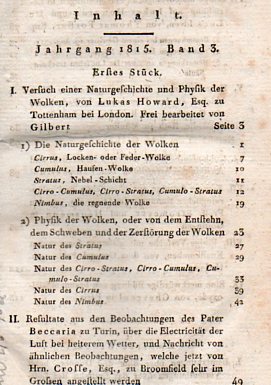
    I’ve written about Howard elsewhere on this blog, and he comes back to me today for his odd place in the realm of highly-visual-works-published-without-illustration, or at least the first German language treatment of his work appears so, without benefit of a single image, as with the first of the three iterations of this paper in 1803 in the Philosophical Magazine. (It was in the second paper of 1803 that three images of clouds first appeared.) The paper appeared very quickly in Germany, published as “Ueber die Modification der Wolken” in 23pp in the November 1805 issue (volume 21) of the Annalen der Physik, though without any illustration. (Howard’s “Versuch einer Naturgeschichte und Physik der Wolken” is published in the Annalen in 1815 also without an image, as do three of his other papers; the lone exception is one engraving illustrating his paper on waterspouts in volume 57.)  I wonder why the article is unembellished–it is almost in a sense a defeat of the classifying idea, not to have some sort of visual reference for the new taxonomy. Perhaps it was a rush to publish, though if that were the case a return to the paper with engravings in a later issue would have been a good idea. In any event, it was a work that demanded pictures, and even though Howard was an accomplished cloud artist, there was little of that lovely work seen until the “third edition” of his essay appeared in 1832. Aside from the historic difficulty of rendering clouds in art, I do not know why it was the case that the earliest works on clouds passed by largely unillustrated,

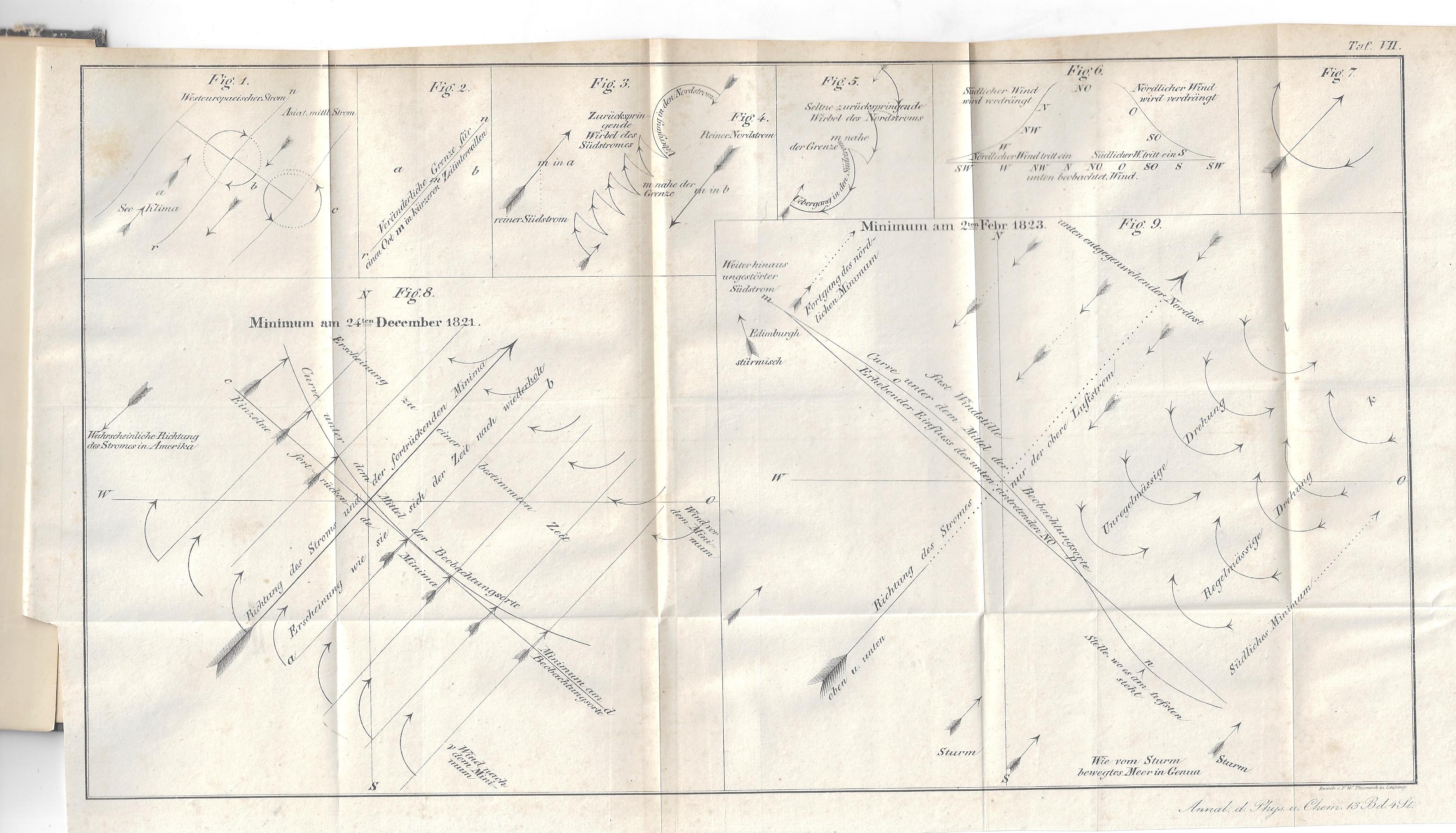
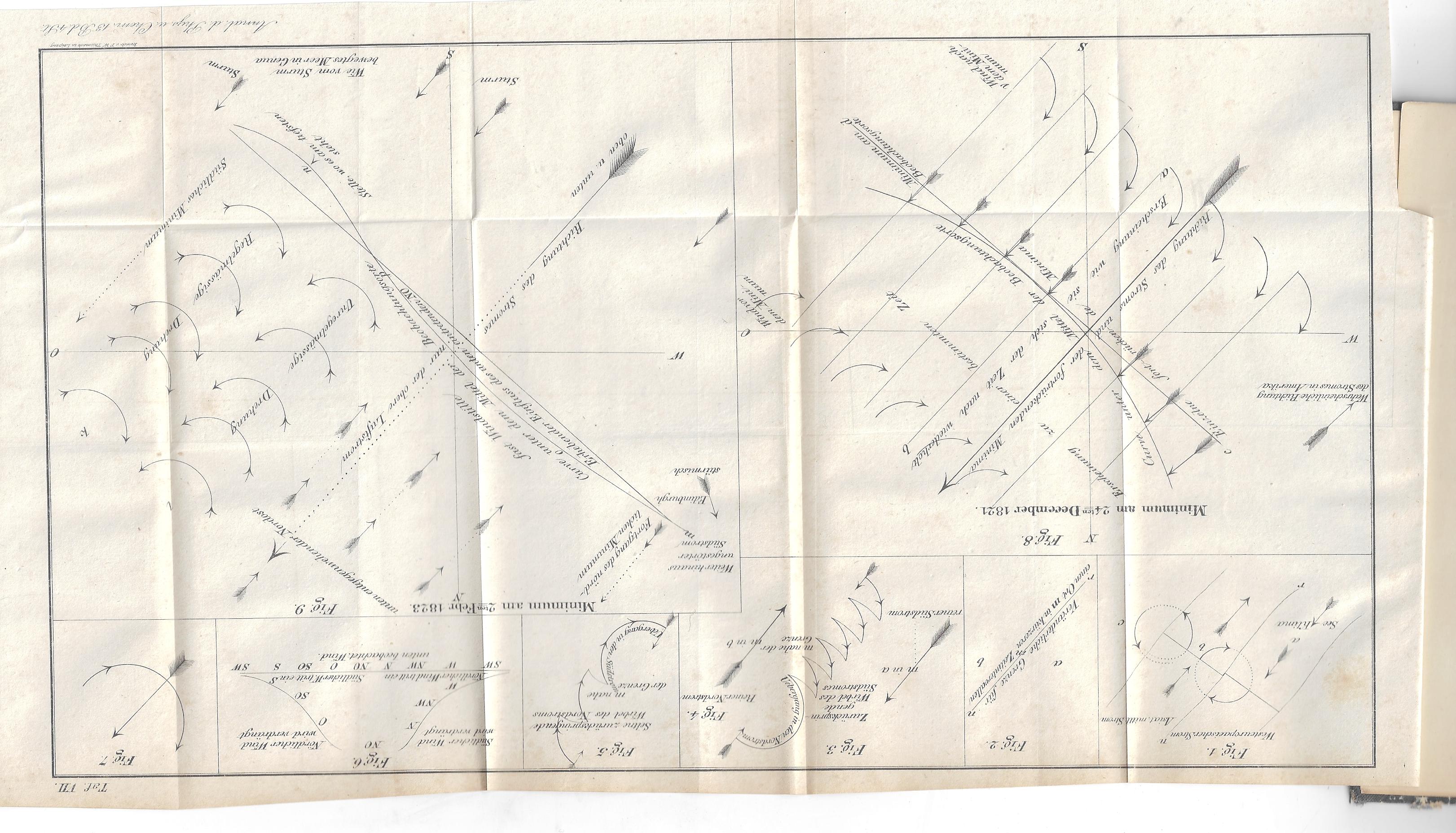
    No doubt there is room for a work on papers written on highly-visual ideas that should’ve been illustrated but weren’t–that’s partially how I cam to write this post to begin with, being thwarted by a very early call by Heinrich Brandes in the Annalen der Physik  (1816, noted by Gerald R. North in the Encyclopedia of Atmospheric Sciences, p. 290) for a system of making weather maps, but published without an example. And in pursuing that I came upon Heinrich Wilhem Dove’s paper “Ueber Barometriche Minima” in the Annalen  for 1828 on barometric pressure and the wind (where the wind seems to do a 360 turn generated by falling  pressure), the cartographic elements of which were said to be illustrated on a folding engraved plate and though the symbols are there in a pre-non-representational-art sorta way, the map part wasn’t….I mean, there’s just no “amp” to the map, except for a scant reference to a city, and that’s it. Anyway, it is a curious category that I’d rather read about than research. 

    Here’s the unusual Dove illustration:
    Dove map corrected

    Images or no, the work by Howard was immortalized by Goethe, who admired and respected the man, painting clouds in poetry in 1817:

    “To find yourself in the infinite,

    You must distinguish and then combine;
    Therefore my winged song thanks
    The man who distinguished cloud from cloud.”

    …and then proceeded to describe the main four (of the seven) main cloud types described by Howard:

    “STRATUS

    When o’er the silent bosom of the sea
    The cold mist hangs like a stretch’d canopy;
    And the moon, mingling there her shadowy beams,
    A spirit, fashioning other spirits seems;
    We feel, in moments pure and bright as this,
    The joy of innocence, the thrill of bliss.
    Then towering up in the darkening mountain’s side,
    And spreading as it rolls its curtains wide,
    It mantles round the mid-way height, and there
    It sinks in water-drops, or soars in air.

    CUMULUS

    Still soaring, as if some celestial call
    Impell’d it to yon heaven’s sublimest hall;
    High as the clouds, in pomp and power arrayed,
    Enshrined in strength, in majesty displayed;
    All the soul’s secret thoughts it seems to move,
    Beneath it trembles, while it frowns above.

    CIRRUS

    And higher, higher yet the vapors roll:
    Triumph is the noblest impulse of the soul!
    Then like a lamb whose silvery robes are shed,
    The fleecy piles dissolved in dew drops spread;
    Or gently waft to the realms of rest,
    Find a sweet welcome in the Father’s breast.

    NIMBUS

    Now downwards by the world’s attraction driven,
    That tends to earth, which had upris’n to heaven;
    Threatening in the mad thunder-cloud, as when
    Fierce legions clash, and vanish from the plain;
    Sad destiny of the troubled world! but see,
    The mist is now dispersing gloriously:
    And language fails us in its vain endeavour —
    The spirit mounts above, and lives forever.”

    (Full text here for the illustrated third edition of 1865.  And, yes, this post is not illustrated.)

    Notes:

    1.  “Askesian”, meaning “philosophical exercise”, was “…a practically oriented and largely non-conformist group dedicated to natural and experimental philosophy”.  http://journal.sciencemuseum.ac.uk/

    2.  According to the OED, “meteorology” goes back quite a way as a word, popping up in 1563; “meteoroloician” appears in 1580, and “meteorologist” in 1683.)

    3.  “The location of many of the sketches gives us an initial hint of their Romanticism. For many years Howard travelled between London and the Lake District in order to capture the full range of what he termed ‘cloud modifications’, training himself in the notoriously difficult art of depicting clouds, of fixing them as they changed  “

    Howard begins his 1803 paper so:

    “If the necessary pursuit If clouds were the mere result of the condensation of var pour in the masses of atmosphere which they occupy if their variations were produced by the movements of the atmosphere alone then indeed might the study of them be deemed an useless pursuit of shadows an attempt to describe forms which being the sport of winds must be ever varying and therefore not to be defined. But however the erroneous admission of this opinion may have operated to prevent attention to them the case is not so with clouds. They are subject to certain distinct modifications produced by the general causes which effect all the variations of the atmosphere they are commonly as good visible indications of the operation of these causes as is the countenance of the state of a person’s mind or body…”

    ·Posted by :

    ·in:


  • On the Economic Efficiency of Poison Gas in Wartime (1921)

    JF Ptak Science Books 

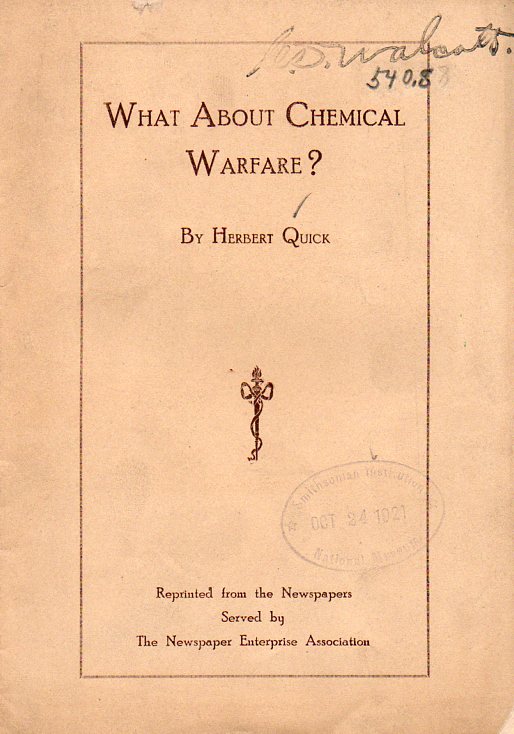
    • Review: QUICK, Herbert. What About Chemical Warfare? The Newspaper Enterprise Association (1921) 15pp.
      7×5 inches. Fine condition. WorldCat/OCLC locates 6 copies. 

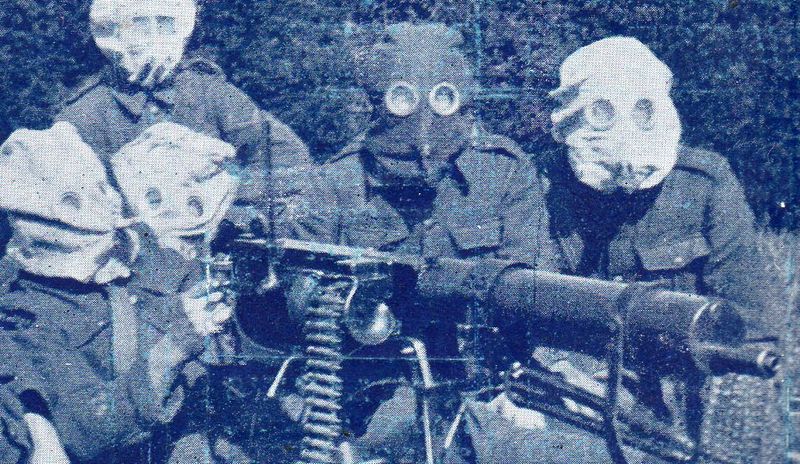
    WWI--gas machine gunb712

    [Image: Illustrated London News, October 30, 1915, detail of photo on front cover.]

    Herbert Quick did a fair amount of thinking about the military use of poison gas, and it winds up, in the
    final analysis, thinking that it was tolerable. What About Chemical Warfare? (published by the
    Newspaper Enterprises Association in 1921) is certainly a possible title for a Duck-and-Cover A-Bomb
    or You and Your Hormones kind of film. But Mr. Quick took the slow boat around his issue, thinking
    about it a little long and out loud, before coming to his final conclusion in the chapter titled “Gas
    Warfare Cheapest and Most Effective Arm of Defense”.


    [Internet Archive offers the full text : https://archive.org/stream/whataboutchemica00quic/whataboutchemica00quic_djvu.txt]

    He points out the enormous impact in the war effort that relatively small chemical corps played in
    WWI–something on the order of hundredths of one percent of all serving soldiers were employed in
    the combined chemical corps, saying “how small a body to produce such great results!” Which is true,
    assuming that by “great” he meant ‘widespread’, though it is unclear exactly what he was talking about.
    Quick does make a case for poison gas being not so inhuman as presented by most civilized people,
    pointing out both its high quick-death rate and survivability/recovery rates, which seems to be
    giving/taking at the same time. No matter: “But woe to the army or nation that does not keep up with
    the times. The Angel of Death will breathe in their faces” he writes.

    The author also warns that though Germany was “stripped” of her war-making capacities, he thought it
    was not so of the industries necessary to produce poison gas. He points out that Germany can produce
    these munitions in secret, and that if any “militaristic nation conquers the world in the future”, it will be
    through the use of the poison gas it developed in secret.

    Defense was also important: “in the absence of efficient defense worked out beforehand, our great
    cities might be wiped out with gas bombs dropped from aircraft”. Mr. Quick believes that protecting
    cities is possible, writing simply “preparation will prevent such a crisis”. Indeed. Unfortunately no
    ideas about this defensive posture were forthcoming, though he did bring himself around to writing
    about gas as a defensive tool. Against looters. And rioters. And snipers. “Gas puts the sniper in the
    power of his enemy” Quick writes, using the Marine action in Vera Cruz, Mexico, as a good example of
    where gas (“gas grenades”) would have come in handy.

    The bottom line is of course the bottom line, practically stating that poison gas as a weapon was
    indisputably more cost-conscious than anything else, by far, each dollar spent on chemical warfare
    being worth “from three to five hundred for the army”. Poison gas services Quick says should be
    pursued, because “gas warfare cannot be stopped until all war is stopped”.
    Gas warfare “gives the educated, intelligent nations the advantages over the people of lower
    civilizations”.

    “When both sides are prepared it is much less inhumane than war with bullets and high explosives; but
    it means horrible annihilation to the army which is unprepared.”
    It is an interesting exercise to replace “poison gas” with other types of weapons, just to see how it
    reads.

    Mr. Quick was up and down in his treatment of poison gas and war, though almost entirely down. One
    thing he didn’t see, that no one saw, really, was the use of a particular gas that was used to destroy
    millions of people, and which was developed quite in the open in Germany for many years, used for
    killing rats. The Nazis simply used it instead on people. No one saw Zyklon-B coming, and no one
    could have, even when they did.


  • The Soviet Union’s Statement on Being Attacked by Germany, July 8, 1941

    JF Ptak Science Books  Post 2715

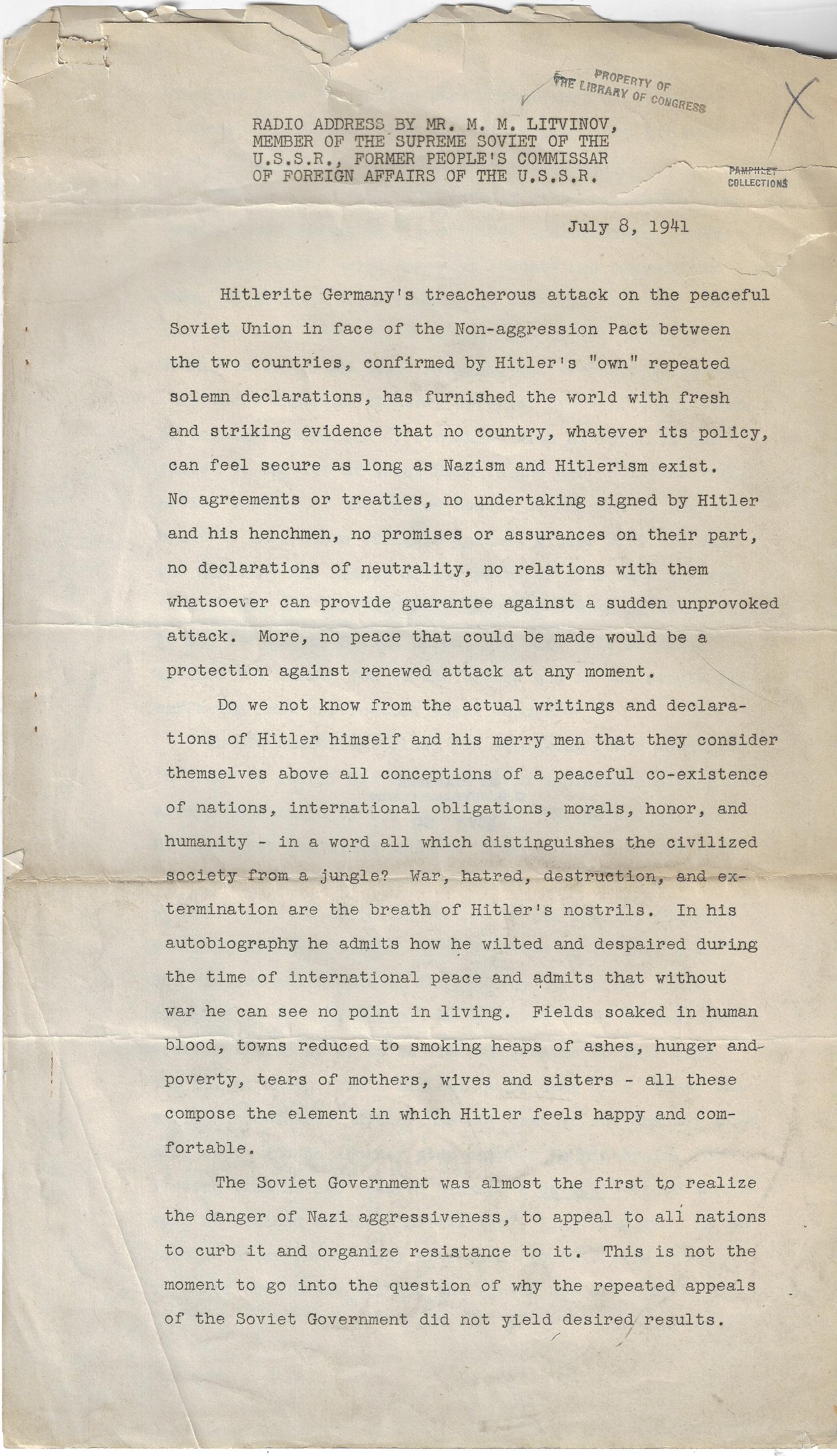
    Russia Litvinov _1_It is hard to criticize the Soviets when they were at their post WWI weakest, but I needed to point out a few, well, inconsistencies in the following statement by Maxim Litvinov. The text is that of a radio address by the mega-connected and high profile Russian revolutionary and People’s Commissar of the USSR, and it was delivered on July 8, 1941. At this point Litvinov (1876-1951)–who would in a few weeks become the Soviet Ambassador to the United States–was addressing the weeks-old attack and declaration of war made upon the U.S.S.R. by Nazi Germany.  

    It was a terrible and nearly mortal blow to the state, and Hitler’s vast overreach very nearly came to be. Still there were some bits in the address that were difficult to absorb. 

    For example Litvinov states: “Hitlerite Germany’s treacherous attack on the peaceful Soviet Union in face of the Non-aggression Pact…”  The Soviets did indeed sign a hands-off/so-no-evil Non-Aggression Pact (the Molotov-Ribbentrop Pact) with the Nazis in August 1939 and enjoyed the fruits of that special relationship, the two nations dividing conquered border states according to each other’s “sphere of influence”. So, this pact was “peaceful” only so far the U.S.S.R. is concerned, and not so peaceful for other nations.

    Then this: “The Soviet Government was almost first to realize the danger of Nazi aggressiveness…”, which seems hard to acknowledge when they shared a non-aggression pact/treaty in the early stages of WWII.

    Then the “veritable miracles of heroism” of the Red Army is “bearing the whole of Hitler’s powerful war machine and compelling him to transfer more and more forces from West to East”. I will not doubt heroism of fallen soldiers in a near lost cause effort, and it is true that the Germans would half- or mostly-exhaust themselves in the East, maybe more than that, probably, probably costing Hitler far more than he could ever have conceived. Stalin had already murdered his way through a large swath of the Soviet command structure, and was also unwilling to recognize that the Nazi attack was in fact the Real Thing. Stalin hesitated, and went incognito a little, and in general did not know what to do; he did come to his senses in short order, but a great amount of damage had already been done to Soviet defenses, and that would nearly cost him the country. But it didn’t, and the U.S.S.R. rallied, and at the cost of millions of lives killed the Germany armies in the East, and really was responsible for contributing in large part to the defeat of Nazism. 

    “Thanks to this the English people are enjoying a certain respite after twelve months of incessant bombardment…”, which was true to some degree.

    “Each blow struck now is ten times as effective and entails infinitely less expenditure and sacrifice than if it is delivered when anyone [sic] of his adversaries becomes weaker”. 

    And so on.  

    I’ve reproduced the 4-page document below.  

    ·Posted by :

    ·in: