A Daily History of Holes, Dots, Lines, Science, History, Math, Physics, Art, the Unintentional Absurd, Architecture, Maps, Data Visualization, Blank and Missing Things, and so on. |1.6 million words, 7500 images, 4.9 million hits| Press & appearances in The Times, Le Figaro, Mensa, The Economist, The Guardian, Discovery News, Slate, Le Monde, Sci American Blogs, Le Pont, and many other places… 5000+ total posts since 2008.

Author: JF Ptak

  • On “Long” and “Short” Time in the History of Modern Computers

    JF Ptak Science Books   Post 2714

    The history of computing, at its inception, could have its fluidity measured in decades, beginning, say with Babbage; by the time of the earliest large machines (1945-1955) computer time could be measured by less than a decade, and probably half of that.  In the 1960s the computer year could be measured, finally, in single years.  After that, after microminiaturization, and the personal computer, the year of currency started to be measured in months.  And then, of course, the year really sped up–I’m not sure if there is only a week or two in the year, now; maybe the year of progress in 1955 is today measured in days, or hours. I suspect that this will all continue to get faster, as it has been only 70 years or so that the computer world started to bulk up; I imagine that the changes that will come in 2087 will have us looking at least as “quaint” as 1947 looks to us. 

    And how far back is “way back”, or “waaay back”, in terms of (computer) history?  I’ve written earlier in this blog about going deep into history in various disciplines, but perhaps in no discipline is time so compacted than in the computer sciences.   Mr. Peabody would probably agree (though he wasn’t a very agreeable person), finding that in terms of other big leaps into the past that to go “way back” in his “way back machine” to get chronologically deep in computer history wouldn’t take very much at all. 
    Acm draft713

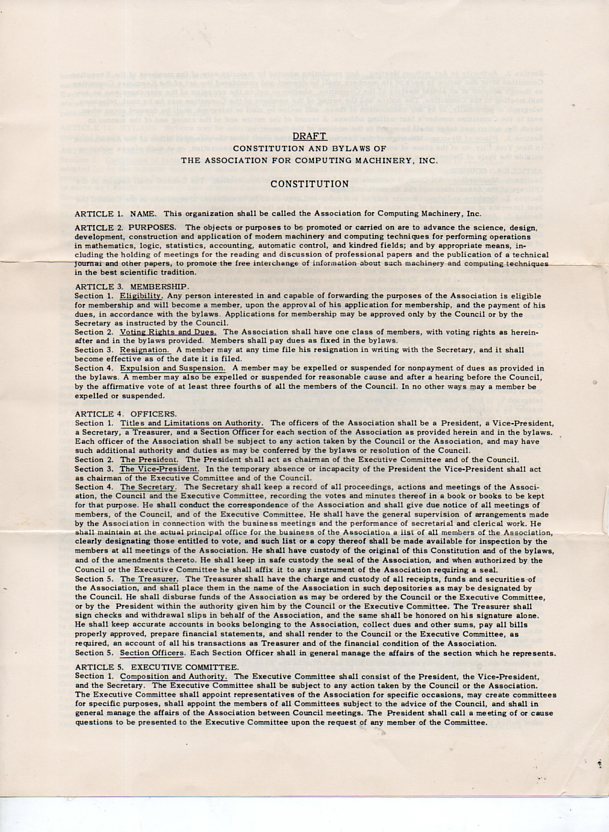
    Anyway, some of these senses of time and how only 50 years ago seems like much longer can be seen in the bits and pieces of computer science ephemera. Looking into the “archives” here I found a document from the beginning of the first tweaks of mass professionalism in sompsci.  This draft of the constitution and bylaws of the Association for Computing Machinery (the ACM) was complete in only four pages, including the data on the establishment of its members, officers, executive committee, meetings, bylaws, meetings–the whole deal, in four pages. 
    Acm draft717

    The document is undated, but as far as I can determine, I believe that this document was printed in 1953, soon after the ACM dropped the “Eastern” that used to appear as the first word in the title of the organization, and after it moved to 2 East 63rd St 

    Its quite a quietly, unspectacular spectacular thing, seeing what would become a vast organization be summed up in its infancy on two sheets of folded paper.   


    Acm a835

    1954 is extremely deep in the history of electronic calculation–it is three years before Backus et alia created FORTRAN, five years before the integrated circuit was created, eight years before the first compsci department is established at Purdue, eleven years before the first Ph.D. is awarded in computer sci from a computer science department (Wexelblatt), and fourteen years before the first woman (Liskov) earned a Ph.D.(whose dissertation was A Program to Play Chess Endgames) in the field.  All of which sounds like ancient history, but almost all of which takes place during my own lifetime, which doesn’t make it sound so terribly “ancient”.

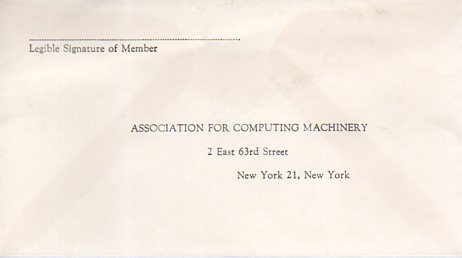
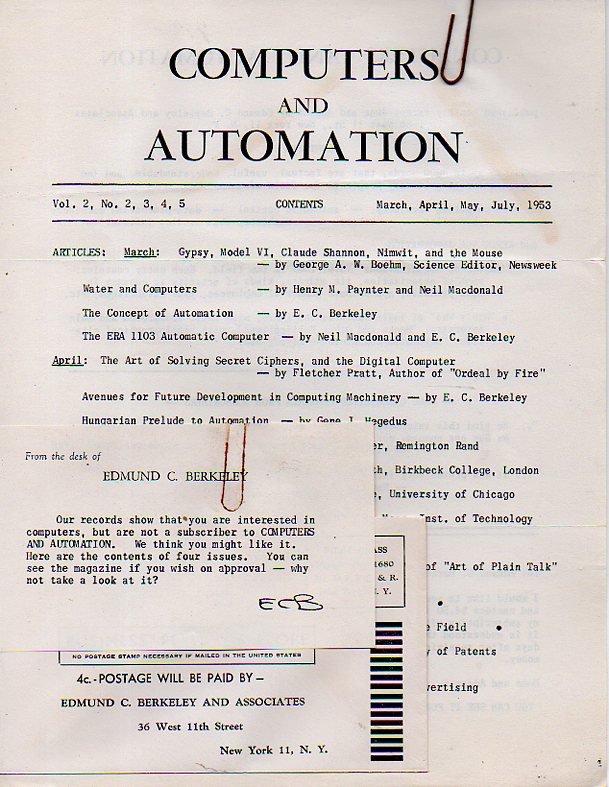
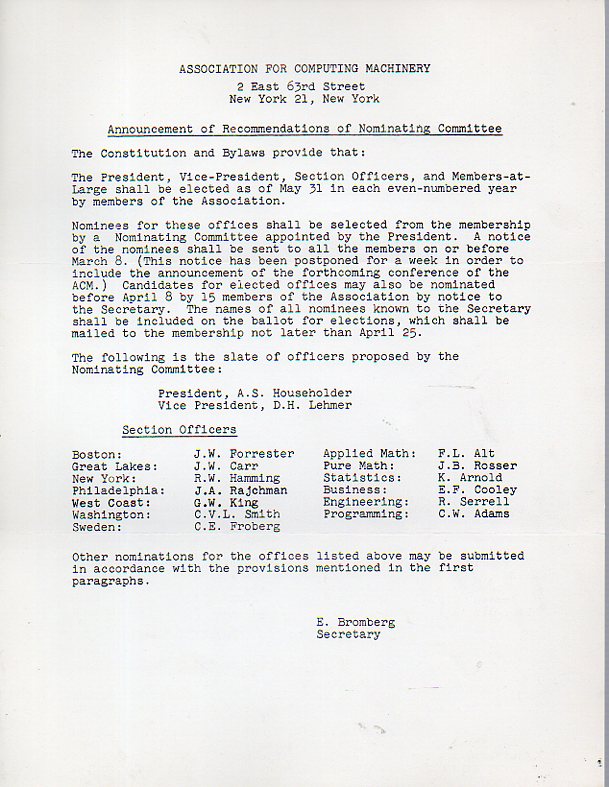
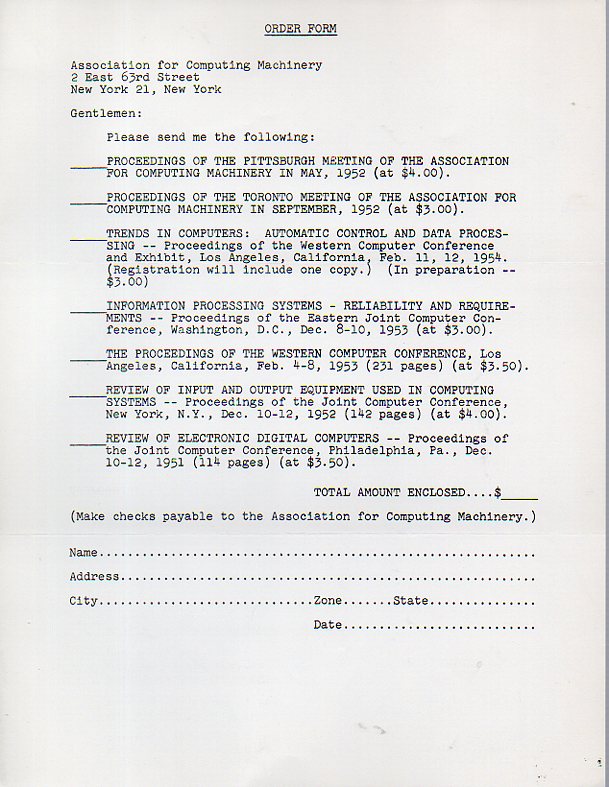
    But looking at this ephemera on membership and dues and voting on the Constitution for the Association for Computing Machinery certainly makes it seem as though so–the voting and bylaws ballot is a few mimeographed pages long and is hand-stapled at the top, the announcements for meetings fits on one sheet of paper, and Edmund C. Berkeley is hand signing his initials on pleas for new subscribers to his Computers and Automation journal.  Everything looks so fresh and new and uncomplicated–and that’s because it was, relative to what we experience now.  In 1954 there weren’t 10,000 people working in the field of computing; 63 years later the growth in involvement of people working in the field is at least three orders of magnitude more, the growth in the sheer volume of printed and digitally-circulated material is probably somewhere on the order of the differences between post-Gutenberg European printing and the printing industry in the year 1990.  The changes are tremendous, and they seem to be so much more appreciable when one looks at the foundation efforts from the early years.
     

    Acm a830

    Acm a831 


    ·Posted by :

    ·in:


  • A Map of an Early Electronic Brain (1948)

    JF Ptak Science Books   Quick Post

    Eniac

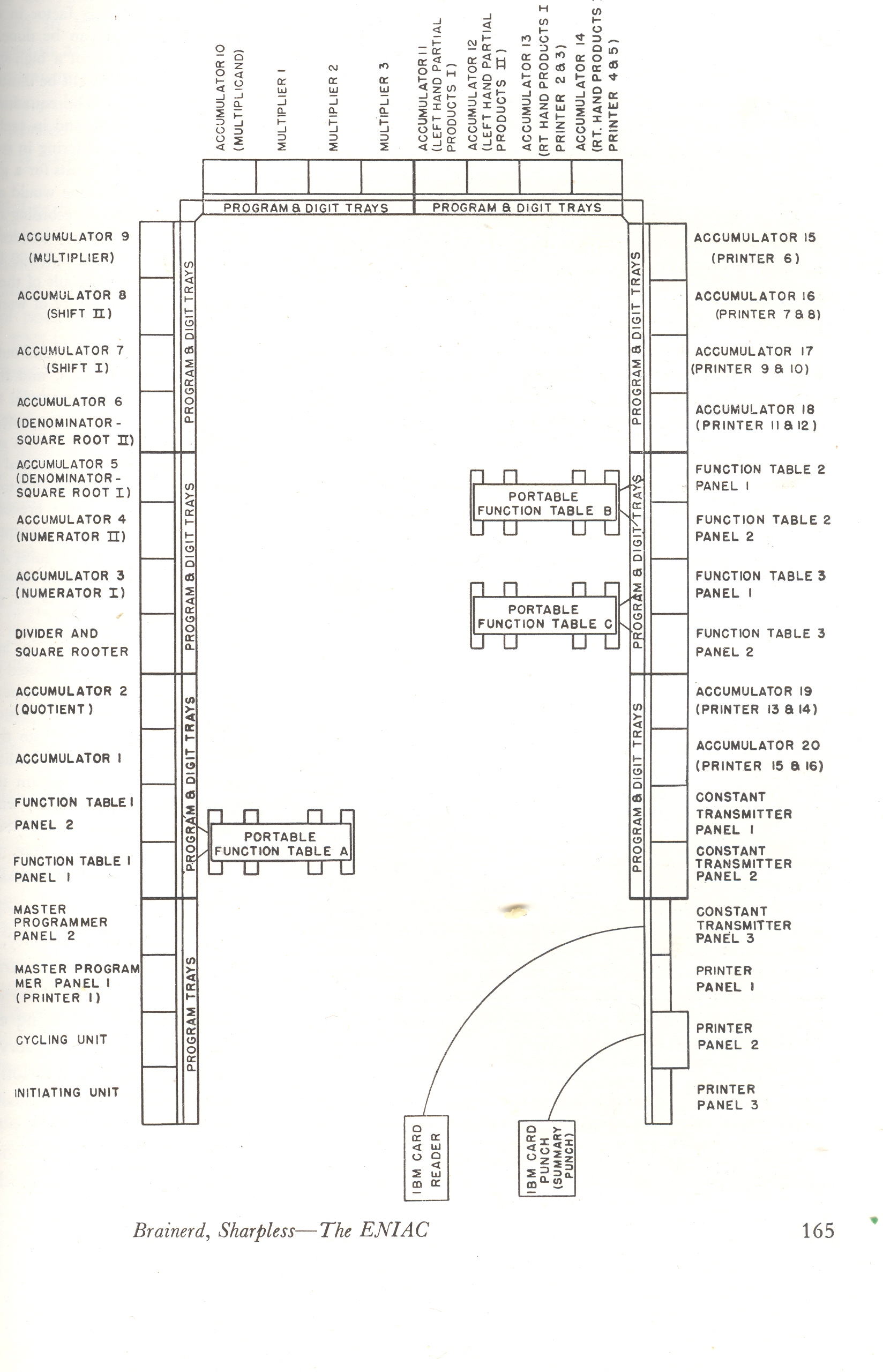
     This is the floor plan for the ENIAC (Electronic Numerical Integrator And Computer, b. 1943-45) which was, basically, the world’s first operational, high-speed digital computer, and (about) marked the beginning of the next stage of technological revolution.  What we see above is the floor plan for the computer-with-no-monitor—I know to most people working today with a computer that the idea of a “floor plan” for anything that is not in a dark place at NSA is not easily conceivable.  The 30-ton, 18,000 tube, 125 KHz ENIAC’s space was about 1800 square feet, where it was able to add about 5000 numbers/second, which was vastly faster than anything else in existence. It operated with 70,000 resistors, 10,000 capacitors, 5 million hand-soldered joints and 6,000 manual switches. It was a magnificent achievement.

    [Source: J.G. Brainerd & T.K. Sharpless. “The ENIAC.”  Article occupying pp 163-172 of the February 1948 issue of Electrical Engineering. ]


  • People in the NYC Skyline (1937)

    JF Ptak Science Books  Quick Post

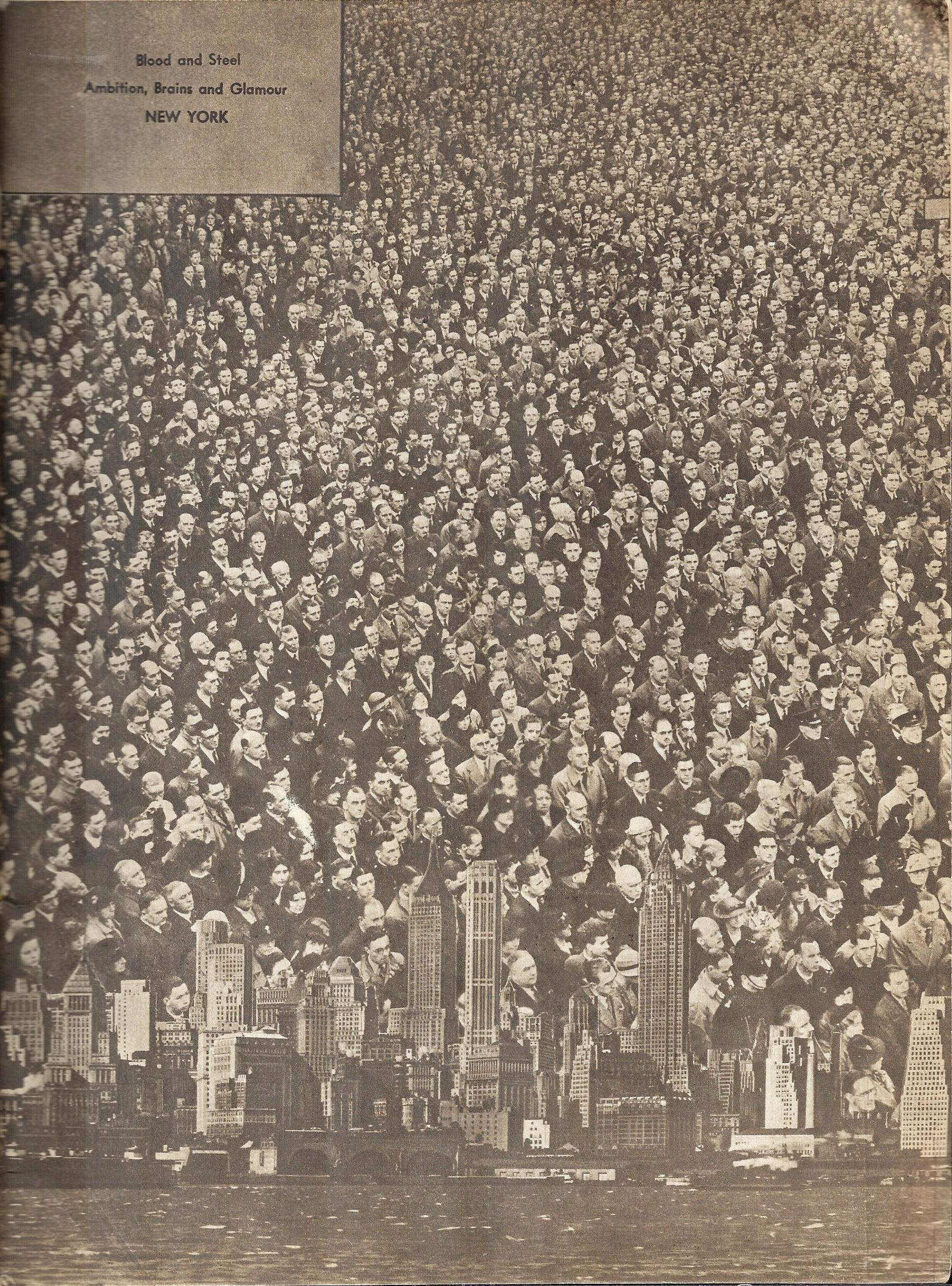
    There are many photographic souvenir publications for New York City, but there are very few that are so interested in including people in their many city landscape images as Illustrated Souvenir of New York (1937). It is attractively bound–or at least it has a more complicated binding than most of these publications–which was something that attracted my attention. In any event, it turns out that there are quite a few unusually-social images for a publication meant to concentrate on tourists’ high points of a visit to NYC, a few of which I’m including below.

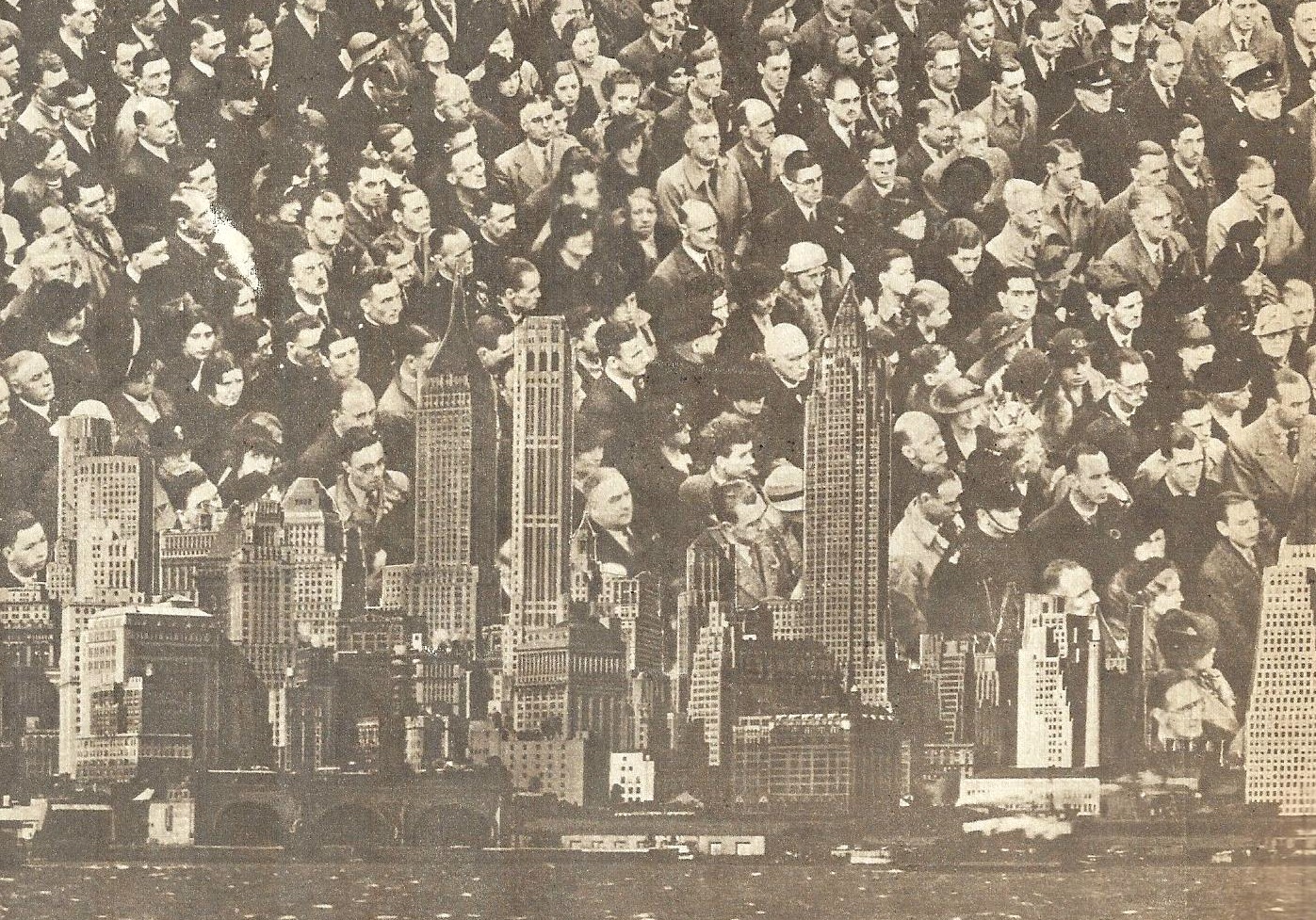
    One of my favorites from the series is a montage of people in the Manhattan skyline–this seems a little unusual for the period, though I’ve encountered this sort of image before (a few examples of which you can find on this blog by searching people/skyline). The title for the image is a little odd –“blood and steel, ambition, brains and glamour New York”–and has a bit of a train-wreck flavoring, along with a taste of Prussia (as in the “Blut und Eisen”/”Blood and Steel” speech of von Bismarck in 1862):

    NYC People in skyline detail

    [Detail]

    NYC People in skyline

    ·Posted by :

    ·in:


  • Graphic Design in “PM” Newspaper, September 1944

    JF Ptak Science Books   Quick Post

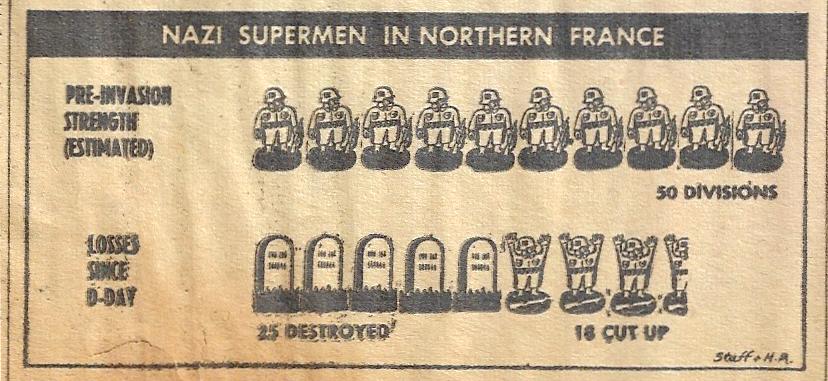
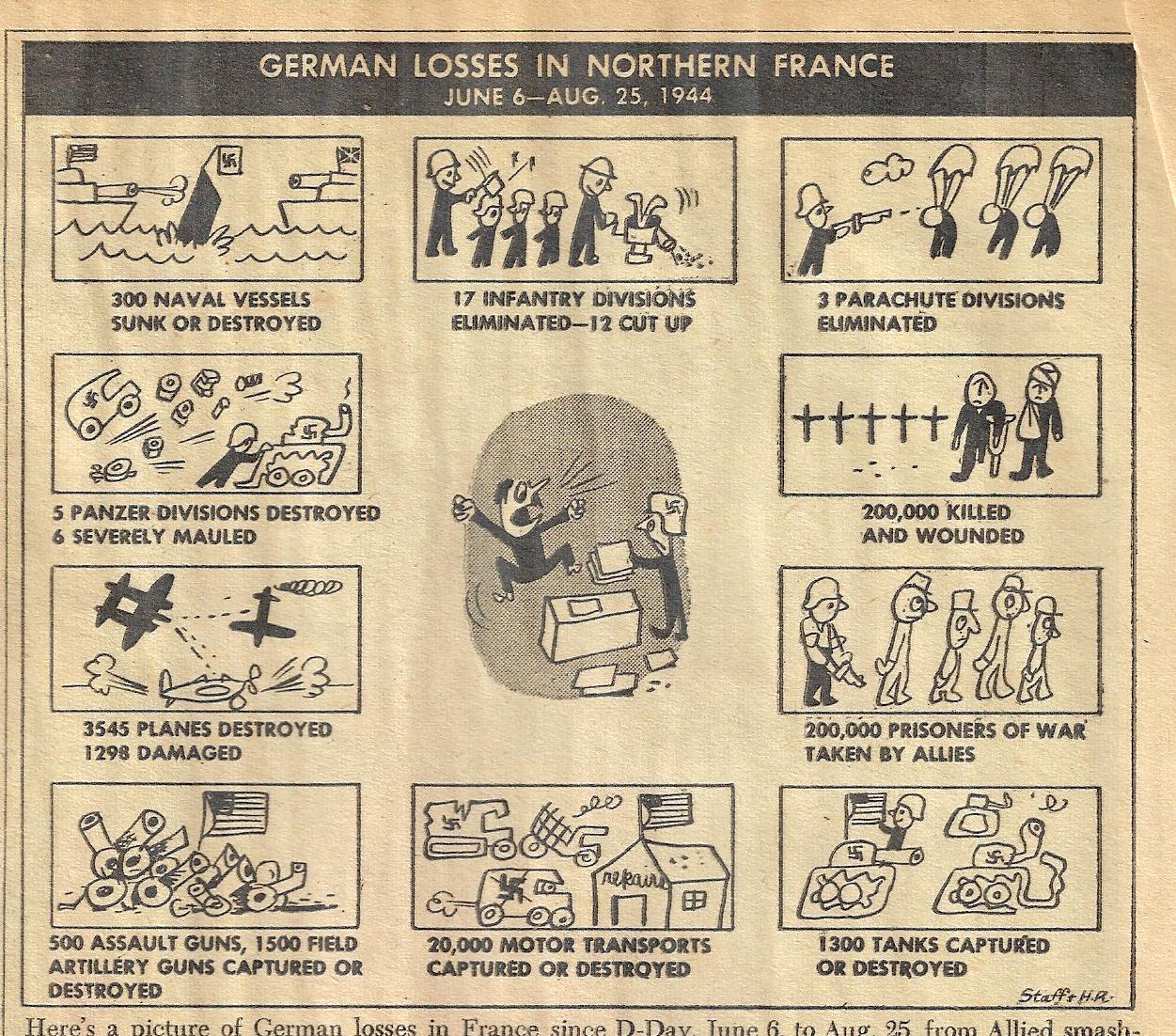
    Here’s another noteworthy, unusual, and most likely very seldom seen display of data from the excellent PM newspaper, this published September 1, 1944. (I’ve made numerous posts to this blog on PM–for more information, just search the name of the newspaper in the Google search box at right.)  The larger image below measures about 5″x5″ in the original; the “Nazi supermen” image directly below is only about 1.5’x3″, and really does make a strong graphical point about the demise of the German army in northern France. This is reporting good news to the readers, though it was hardly the true end of the story in that region–three months later, on 16 December, the Germans would begin Unternehmen Wacht am Rhein (“Operation Watch on the Rhine”), their last push against the Allied forces in the West. To the Allies this attack was known as the Ardennes Counteroffensive, and would last until 25 January, ending in disaster for the German forces. 

    Bottom line here is that the design is very compelling. 

    PM 1944 Carton Nazio losses _2_

    And another, larger image:

    PM 1944 Cartoon Nazi losses _1_


  • “Restricted” Reports of Allied Aircraft Performance, 1944

    JF Ptak Science Books   Quick Post

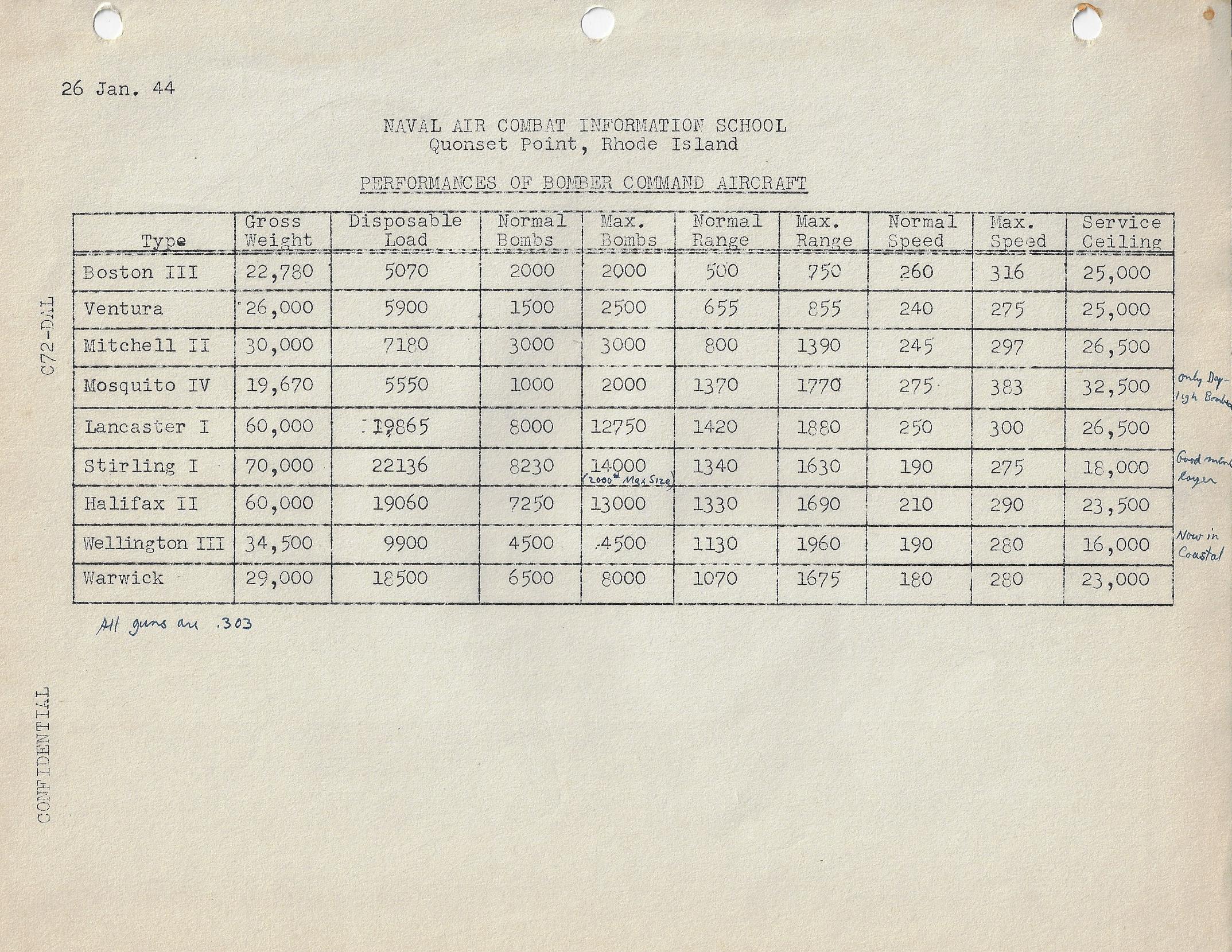
    This is another installment of interesting bits and pieces that have emerged from a notebook prepared (ca. 1944) by a naval student of the Naval Air Combat Information School at Quonset Point, Rhode Island. The printed text for the curriculum and classes for an intelligence officer given during the summer of 1944 are nearly all marked “RESTRICTED” in the typed original of the offset pages, and the entire document runs about 220pp.  It seems as though there is an elevated high-and-dry possibility here, but the fact of the matter is that there is a ton of great material, much of it unexpected. For example, in one section there was this three-page chart displaying major engineering factoids of British aircraft: 

    NACIS Air Command Bomber

    ·Posted by :

    ·in:


  • Cancer and the Psychology of Buying Stuff

    JF Ptak Science Books  Post 2713

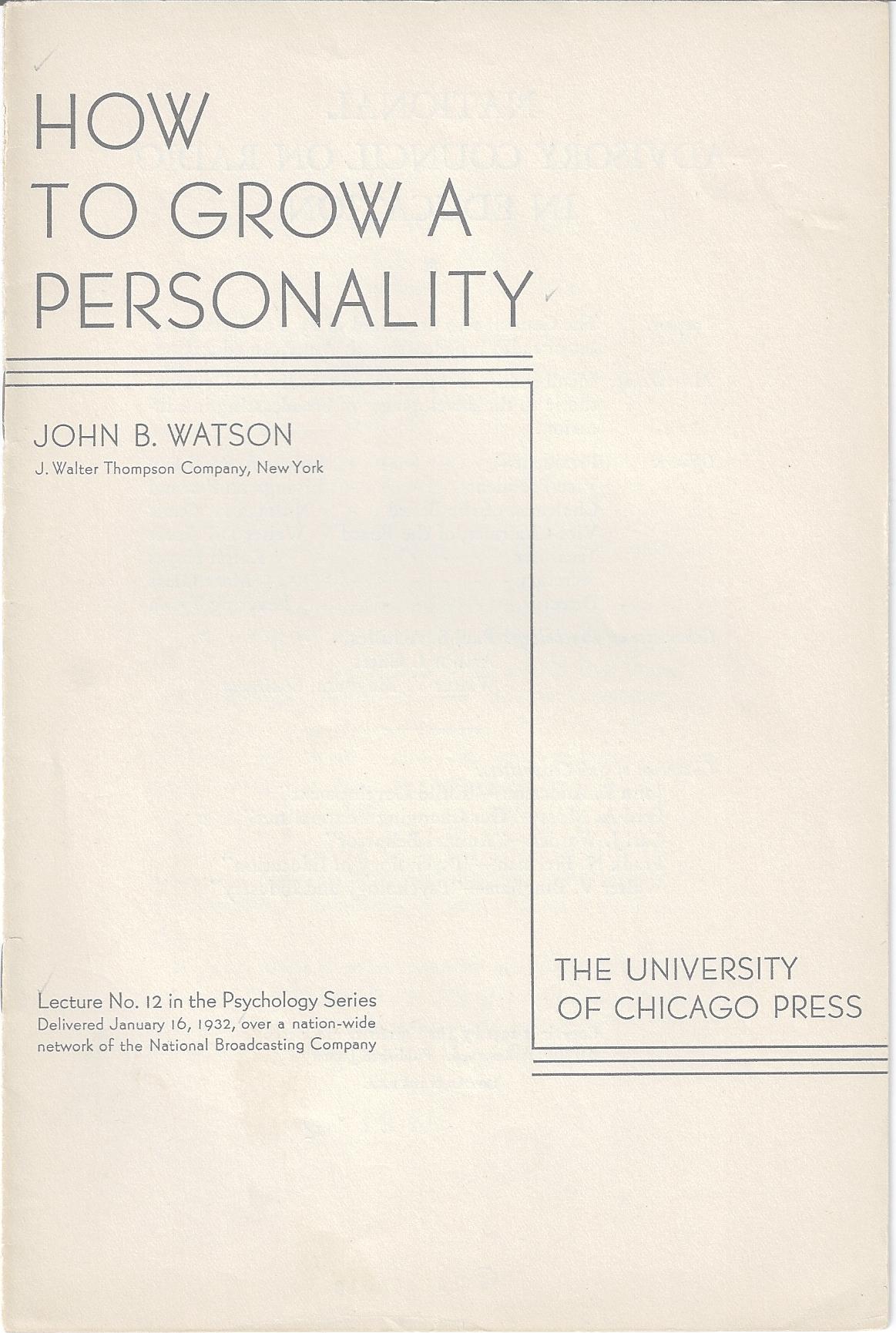
    WatsonWhen John Watson began his radio talk on NBC on January 12, 1932, on “How to Grow a Personality”, he meant it…literally and figuratively. Watson (1878-1958) is considered to be one of the founders of psychological school of behaviorism, which stated simply is the theory that all of human and animal behavior is derived or implied or controlled by “conditioning” or the stuff that happens to/in-and-around the being, and that emotions and thinking (such as they are) have little or nothing to do with forming the response to a stimulus. He claimed that he could train 12 infants to become 12 different sorts of people–lawyer, doctor, engineer, thief, etc.–if given access to training the infants/children–he never got too terribly close to doing that, though he did with a human experiment with the infamous case of “Little Albert”, which is a sodden story of questionable ethics. 

    In the case of personality, Watson defines it so: “Your personality at any age is just a cross-section of the things you can do at that age. There is nothing mysterious about it–it is just a steady growth coming out of your past.” And evidently that means that you can grow your personality by growing the things that you can do, thus training yourself by the stuff you can get done.  Sounds a little circuitous and has a strong scent of a napping carny in a big sweaty revival tent, but it did pass great psychological barriers, as Watson is held in very high regard in the history of 20th century American psychology.

    This is no doubt a rude and crude assessment, but so it goes. 

    One thing is without doubt–he did figure out how to create a “demand” for something. After he was fired from his post at Johns Hopkins (for having an affair that resulted in an enormously popularized divorce trial) Watson took himself and his intellectual toolkit and began work at the J. Walter Thompson advertising agency. He put his two decades of experimental research to hard use, and “discovered” that he could make something desirable by making it familiar and memorable, selling more a positive memory of (or surrounding) a particular thing more so than teh need or use for the thing itself. One example of the use of his behavioral talents was in selling cigarettes.  Billions of them. In keeping with his idea, he created a tremendously repeated slogan for a cigarette, and found that he could basically sell the thing wrapped in its memory/slogan layers. The product was Camel ciggies, and the slogan was “I’d walk a mile for a Camel”.  The slogan could’ve been for Cigarette X, or a rope, or a hammer, or sugar, or whatever–the object didn’t matter; only the environment and landscape created for it did.

    So there’s that.


  • Weekly People, 1942–definitely Not “People Magazine”

    JF Ptak Science Books  Quick Post

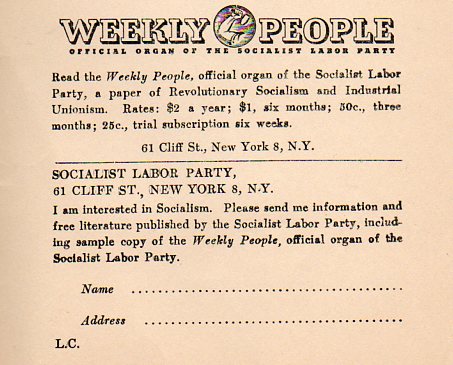
    I have developed a sort-of  collection in the History of Blank and Empty Things series of not-filled-in applications and diaries and questionnaires and such, from Hitler Jugend diaries to notebooks for Nazi Warsaw telephone directories to applications for membership in the Women’s KKK, and so on.  This small installment comes on the back inside cover of Labor Conscription, What Does it Mean…Involuntary Servitude!, a hopeful ad for the reader who might be interested in Socialism and receive the magazine People Weekly, as this far Left pamphlet was after all published by the New York Labor News Company on behalf of the Socialist Labor Party U.S.A. This of course in no way bears any resemblance to the modern People Magazine, the fruits and labor of that periodical being sweets and fats.

    Labor Conscription761 Labor Conscription762


  • Measuring Things with the Hindenburg (1936)

    JF Ptak Science Books   Quick Post

    There have been a number of posts to this blog on “Measuring Stuff With Unexpected Things” (a collection that never became its own category and which is basically folded into the “Display of Information” series) where there are graphic displays of objects being unexpectedly measured with known but unusual units of measure. The Eiffel Tower seems to be a favorite (seeing a stacked column of them showing how deep the Atlantic Ocean is, for example); there is also occasional use of the Great Pyramid, the Woolworth Building, the Titanic (up to a certain point), the Hoover Dam, rows of the Great Pyramid filled with Dirt (!), and so on. It is actually a useful tool, even though I’m having a bit of fun with the idea right now–people might not be able to comprehend how much xxx-tons of dirt is that was excavated from the Panama Canal, but if you put it in terms of filling the Great Pyramid and having a row of them going from one end of Manhattan to the other, then there is some sense made of a big number. 

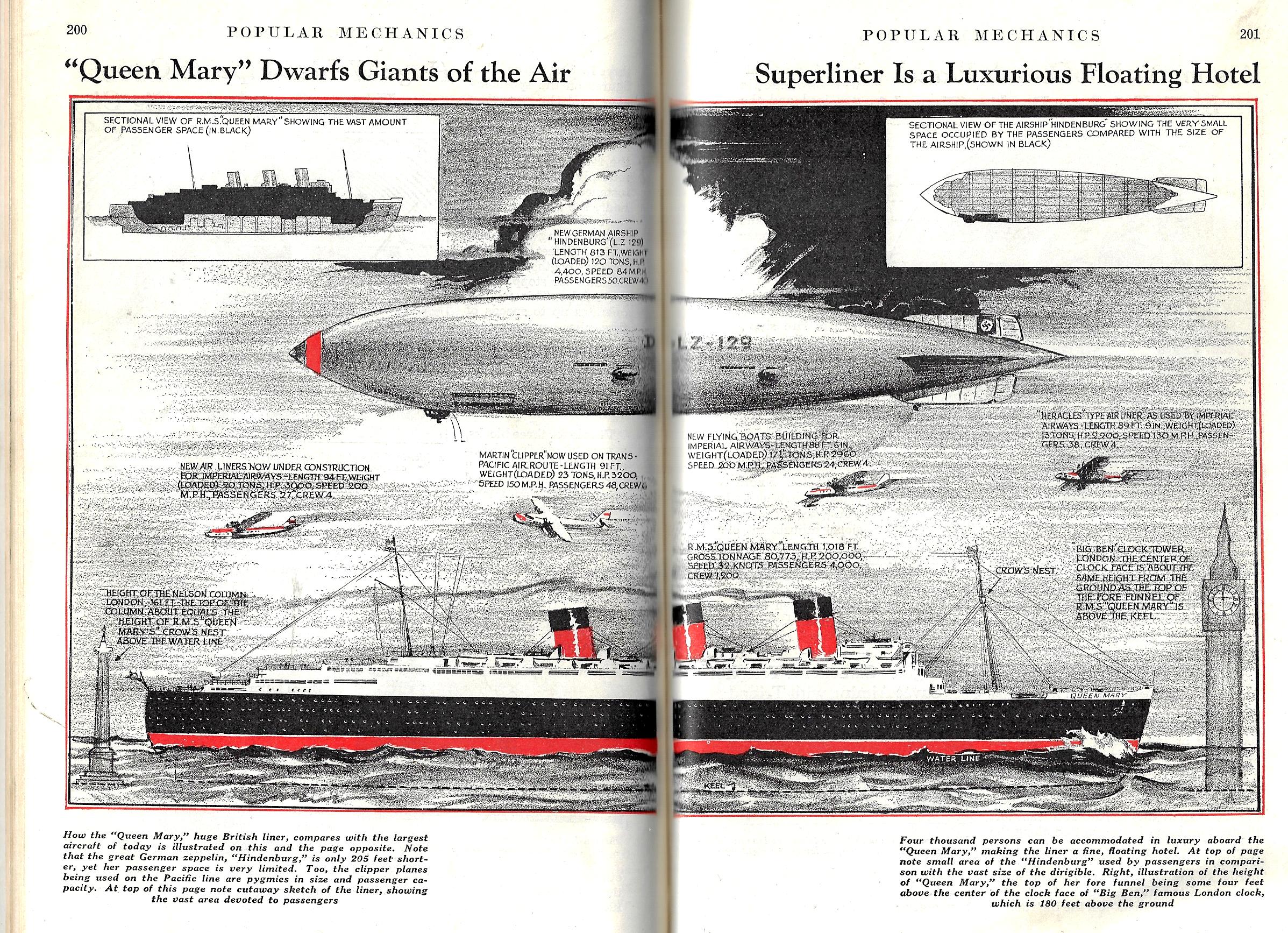
    Tonight’s example is much simpler than most of the other entries, as we’re simply measuring the new ship Queen Mary against the Hindenburg had newly burst onto the fame stage, and became an instant well-known entity, a manufactured mountain in the sky, an impressive sight to everyone–and so when it is compared to the Queen Mary and found to be smaller, everyone knew instantly how big the ship must be–making this mode of comparison a useful tool.

    The Hindenburg had been first launched just months before it appeared in this piece in the August 1936 issue of Popular Mechanics; it would famously crash just seven months later.

    The other reason I decided to share this image is that it is simply a wonderful design, something that would look fantastic enlarged to 4’x8′.  

    Pop Mech 1936 Queen MAry Graf Zep


  • Unusual Maps Department: (1) Map of Brunetness and (2) Heights of the British Isles (1897)

    JF Ptak Science Books   Quick Post

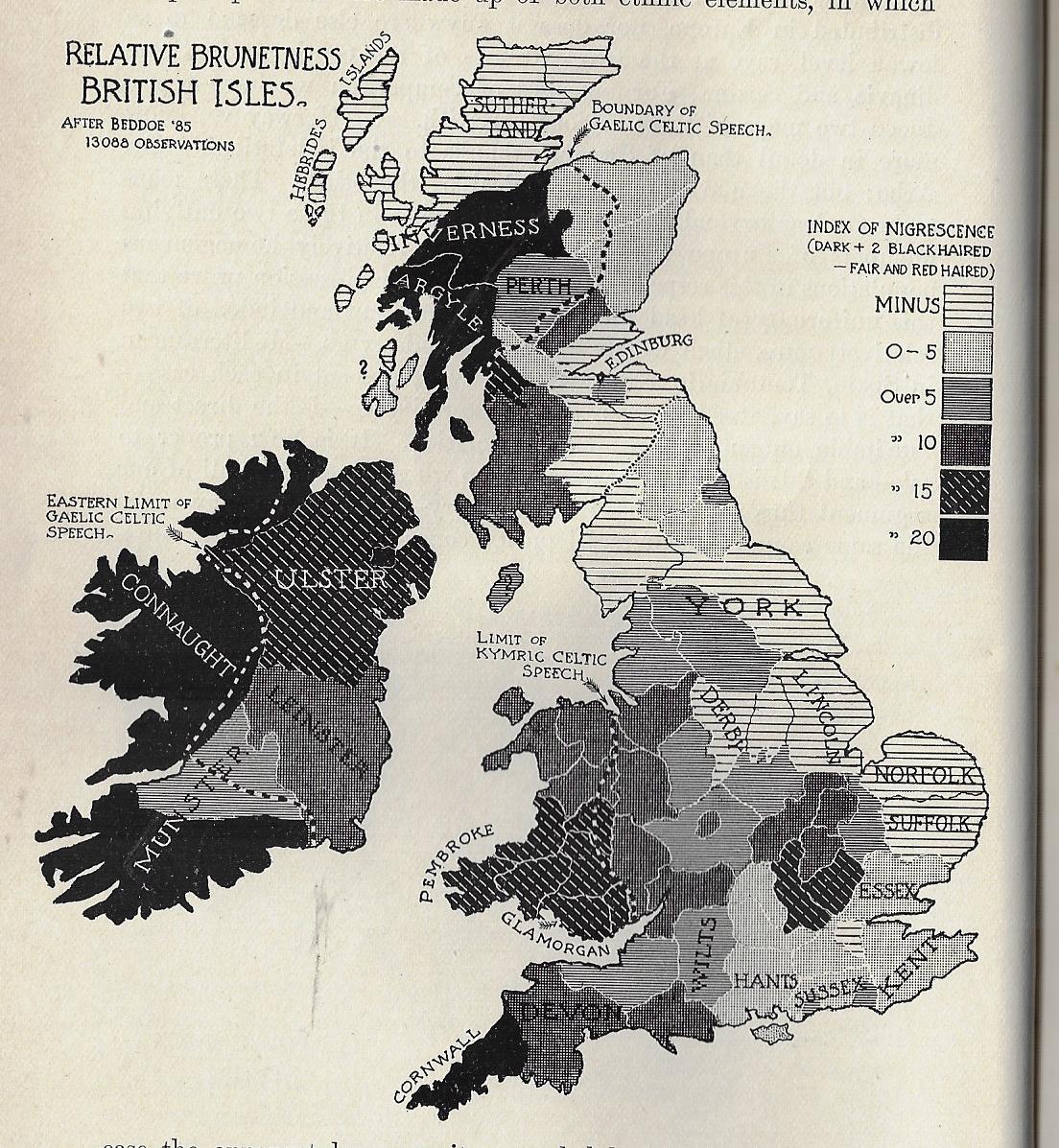
    I must say that I’ve never seen a map of “Relative Brunetness” before finding this one, today. It occurs in a little bit of a wincing article by William Ripley (Ph.D., and assistant prof of sociology at (surprisingly) M.I.T) called “The Racial Geography of Europe”, and appearing in Appleton’s Popular Science Monthly for December 1897.  Here we see the “Index of Nigrescence”, which I take is a measure of blackness of the hair (in this case), with light to dark meaning, well, light-to-dark measures of hair, this taken from 13,000 observations.  A few pages away comes a map of the stature of adult males in the British Isles, locating the averages between the gross average of 5’6.5″ to 5’10” and over. 

    I don’t have anything to say about the maps, but I thought that it was worth reproducing them.  

    Maps of Brunetness of British Isles


  • Missing the Fog for the Mist–Where was Fog in Renaissance Painting?

    JF Ptak Science Books   Post 2713

    If there is one thing that you can say about Renaissance art is that it was determined to represent nature–in form, color, perspective–as truthfully as possible.  Except–so far as I can tell–in some cases, like, say, fog.  And mist. I’m not sure why this is so, but once I started looking for examples of major and then minor cases showing fog in painting in the 1400-1550 period…and then later.  Much later.  Fog–and mist–seem to pop up regularly in the  mid-19th century, along with the new genre of Impressionism, which seems to be when people became more more comfortable with nothingness and the suggestion of things that may or may not be present or in existence. 

    There are examples of suggested forms in the Renaissance where the outlines of forms come to life without their detail, as with the great Paolo Uccello (and the solids in the horses in the Battle of San Romano, ca. 1450s), but for the most part, where detail was supposed to be, there was detail. 

    Fog _2_ evening bellLeaving elements of an artwork open to interpretation was not a problem with other cultures at this time, as in China and Japan, where fog and mist and rain and obscurity were very comfortable elements in artwork, and for centuries earlier than the Western Renaissance. The classic rendering say of a swath of fog obscuring everything but the top of a mountain was a “comfortable” mode of expression that can be seen in a number of landscapes that are listed as national treasures of Japan. For example, the “evening Bell from Mist-Shrouded Temple” and one of the Eight Views of Xiaoxiang is attributed to to Muqi Fachang (or Muxi Fachang) and was painted in the mid-13th century. 

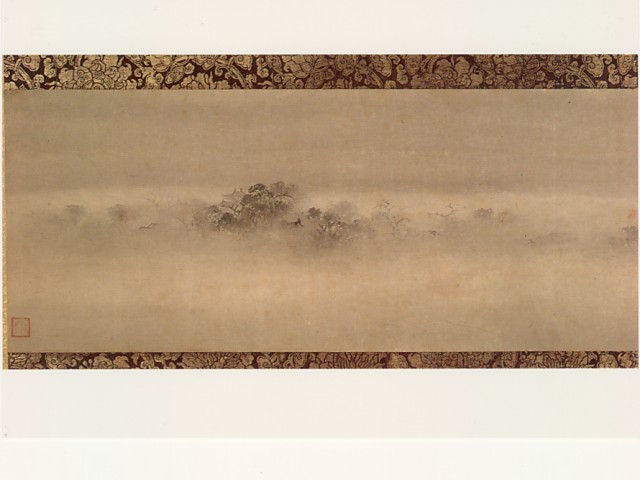
    Another interesting example of countless others (and which like the Muqi Fachang is counted as a Japanese National Treasure) is that by  Sesshū Tōy, in a landscape with broken ink/splashed ink (“hatsubokun, evolving an abstract simplification of forms and freedom of brushwork”–Wiki), and created ca. 1495. The dreamy landscape and the sparse and (somewhat aggressive) brushwork of the “broken ink” seem more a creation of Zen and meditation than anything else.

    Like the rarity of the full-toothed, open-lipped smile, the image of fog and mist and the difficulty in representing what it is that they are mostly-hiding seems to be a not-at-all popular genre in Western art for hundreds of years. This is of course all conjecture on my part and is based mostly upon a little research and a lot of what is probably faulty memory, but it does at least seem to be an observation worth a little thought.  After all, clouds had their many champions for long periods of time, though they served mostly to frame and accentuate the subject of the painting rather than being subjects in themselves (or at least so until the 18th century).  Fog couldn’t even exist in the West as a major part of paintings even as clouds-on-the-ground until the 19th century, when painting was catching up to work done by the Chinese and Japanese in the 13th century.

    I suspect I’ve gotten a lot wrong in this speculation, and I’d like to hear about it as a form of conversation. 

     Image: https://en.wikipedia.org/wiki/List_of_National_Treasures_of_Japan_(paintings)


    ·Posted by :

    ·in:

    —