A Daily History of Holes, Dots, Lines, Science, History, Math, Physics, Art, the Unintentional Absurd, Architecture, Maps, Data Visualization, Blank and Missing Things, and so on. |1.6 million words, 7500 images, 4.9 million hits| Press & appearances in The Times, Le Figaro, Mensa, The Economist, The Guardian, Discovery News, Slate, Le Monde, Sci American Blogs, Le Pont, and many other places… 5000+ total posts since 2008.

Author: JF Ptak

  • Data Visualization and Enormity 2: NYC Overtaken by Gigantic Corn, Bread, and Cigars (1912)

    JF Ptak Science Books  Post 2745

    On this blog I have entertained stories about Manhattan being completely detached/uprooted, attacked by bloomers and aliens and spaceships and spaceship aliens, floated above itself, nuked (numerous times), miniaturized, crushed under sudden ice, joined to Brooklyn and New Jersey (?!), and other such game-enders. There have also been posts on data visualization techniques comparing the known to hard-to-grasp bits of other information or statistics or entities, using the Brooklyn Bridge, Woolworth Building, Empire State Building, Eiffel Tower, Hoover Dam, and so on, as measuring sticks for oil or nail or auto production and the like. It seems that only once before on this blog of nearly 5k posts has Manhattan been used as an intellectual tool of comparison for something non-nuclear-related, and that was for a salt mine. (And according to advisers to President Merkin Muffley the salt mine comes close to playing a strategic nuclear role.) This in mind, finding today’s piece of Overtaken Manhattaniana was a fabulous bridge between two imaginary islands of not very useful data visualizations(s). 
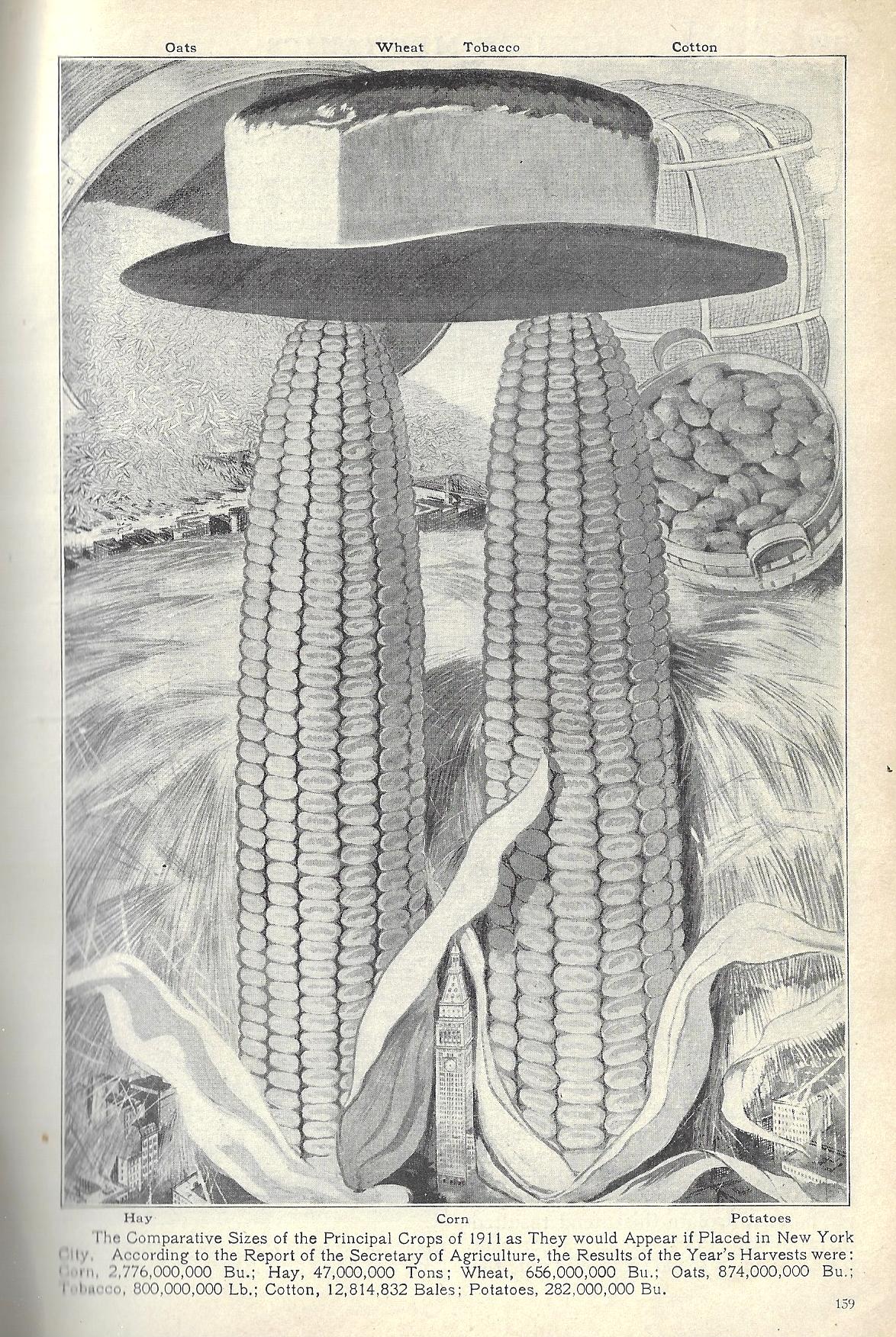
    Pop Mech 1912 Dataviz crops NYC

    Image source: Popular Mechanics, 1912, pg 159.

    So what we have here is the presentation of the yearly production of some principal crops of the USA for 1911, spread across Manhattan with a wide-data butter knife. Nestled between the two ears of corn is the tallest building in NYC (and the world) for 1911, Metropolitan Life, which stood 700′ tall, and reigned for a few skinny years until the Woolworth Building was finished off at 792 feet in 1913. So it looks like the corns were about 2100′ tall with a 600′ diameter at the base. Big. On top of that rests a cigar which is crowned buy a loaf of bread, all of which lords over a sea of hay that covers the rest of the island and almost all of its buildings. For some reason nothing very creative is done with the potatoes, which are just sitting there in a 1000′-tall basket. In the upper left there is a positively enormous pouring of something-or-other of disaster movie proportions. It is slightly disappointing that the maker didn’t figure out how many people it would take to eat all of that stuff in one day. (Throwing caution to the wind mainly because getting to the mostly-useless answer to this is not all that interesting, I will guess that it would require 10x the current global population to eat Manhattan clean in one day.)

    There you have it.   

    The ironic thing here is that this use of corn size really doesn’t tell you very much, except that corn production in the U.S. is (1) a lot and (2) more than bread, which of course you can tell by just looking at the numbers…though that isn’t quite fair as it does give some basic common denominator for measures that are given in pounds, bushels, and bales. The point is that whether the twin corns were 2000′ or 8000′ tall probably didn’t help your understanding of what the numbers meant. But all is fair in war and war, and since this is basically an info-toon, we’ll just enjoy it for what it was, or is.  
    ·Posted by :

    ·in:


  • A Very Large and Very Early X-Ray Photo, February 1896

    JF Ptak Science Books  Quick Post

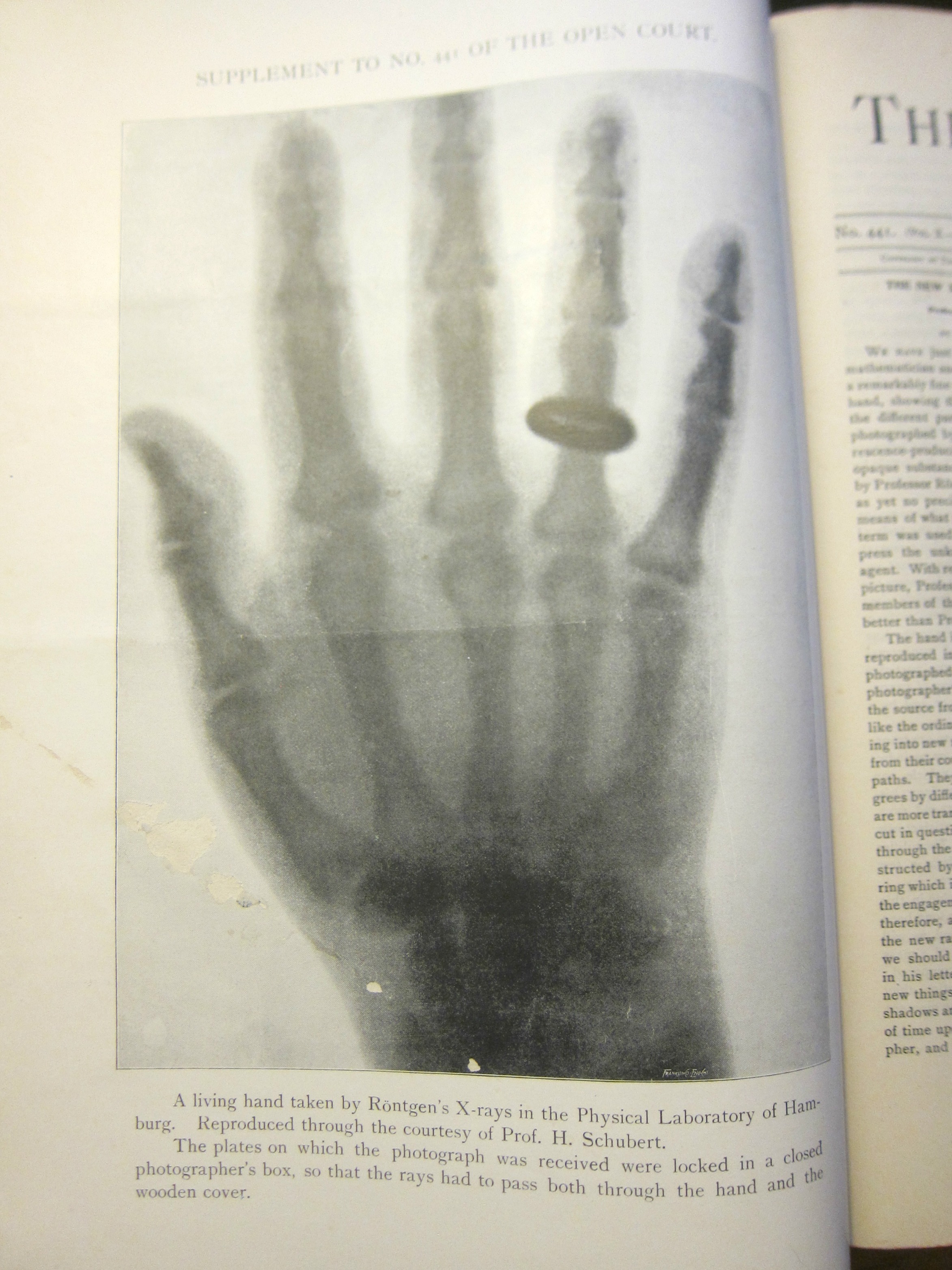
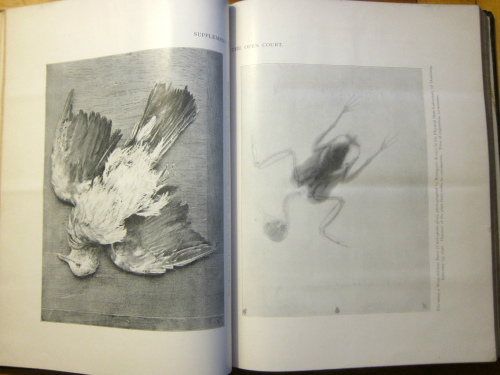
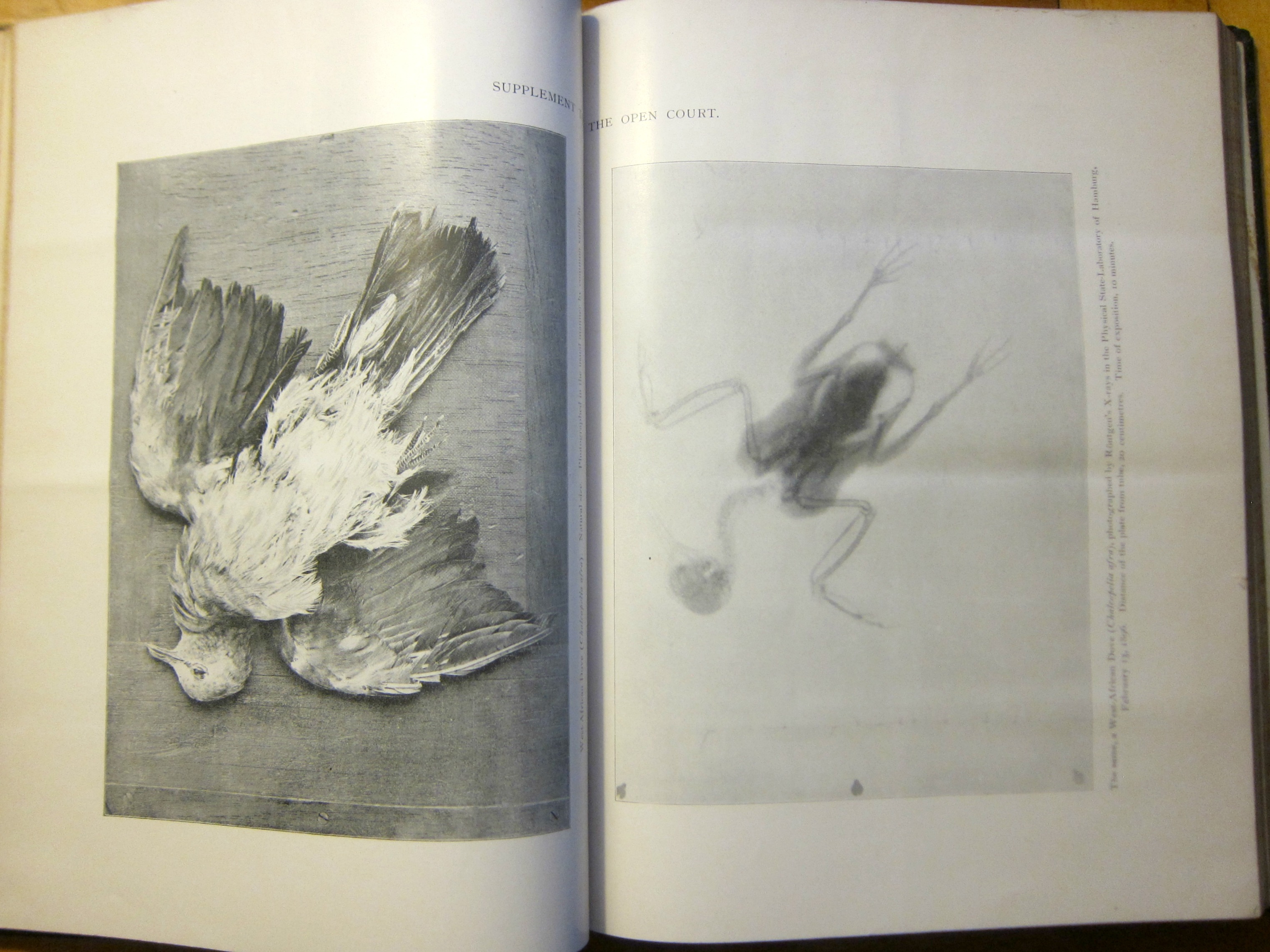
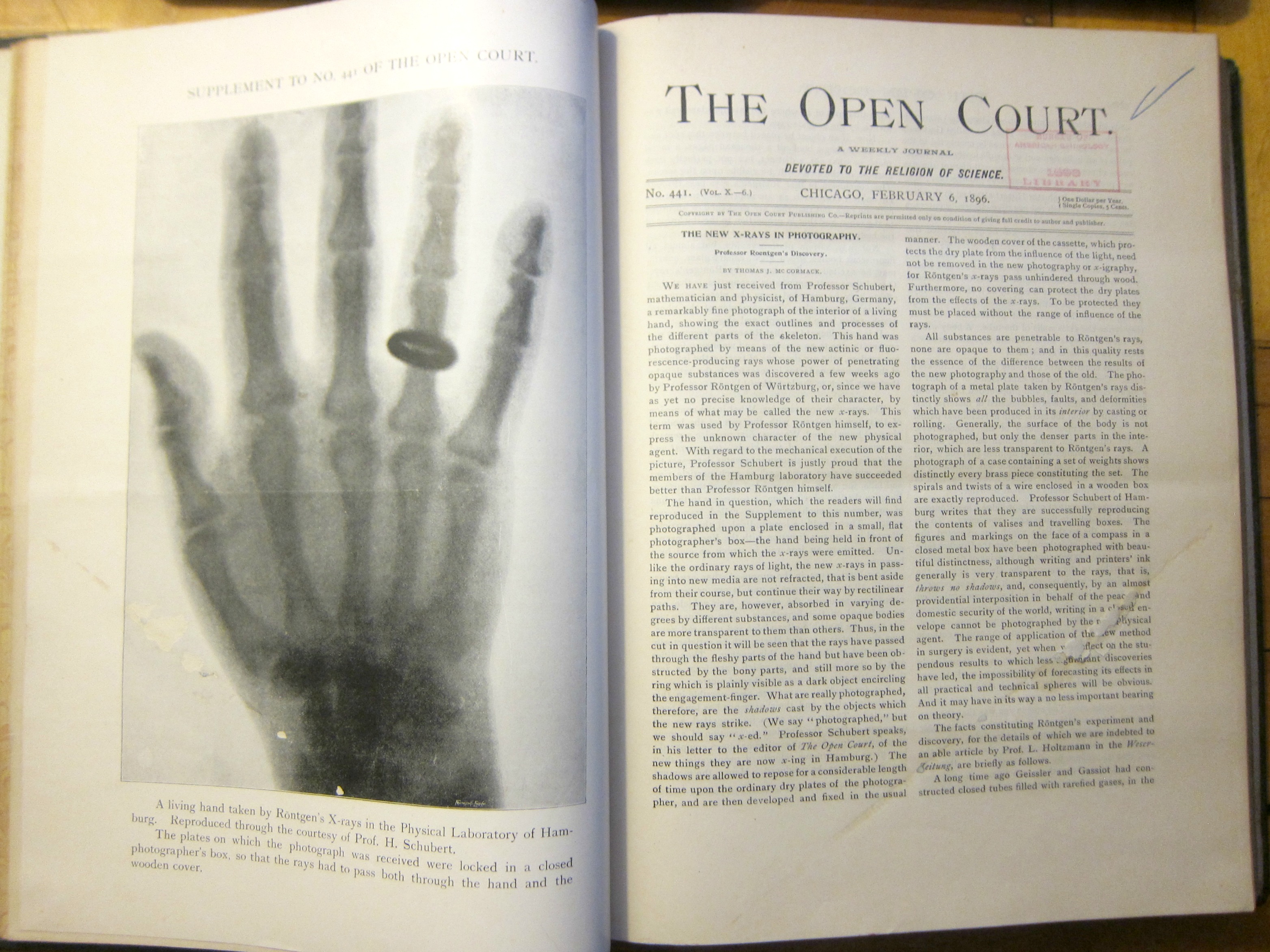
    I made an unexpected find today, poking around in a February 18961 volume of the probing, somewhat classically-radical and Easternist journal, The Open Court, a Weekly Journal Devoted to the Religion of Science.  The photo and article form a very early appearance in the U.S. of the weeks-old Roentgen discovery of the x-ray. The first journal edition in English appears to be 23 January 1896 in Nature (vol 53), and the first in a U.S. journal in Science on 31 January, though that is not illustrated.  (The Science article, written by Hugo Muinsterberg of Harvard, notes that this was a good thing for the reassurance of German stature in physics as they had in the last year lost Kundt, Hertz, and von Helmholtz, and now they had Wilhelm Roentgenfor a new placeholder of living greatness.) 

    X-ray _3_


    X-ray _2_

    A close-up of the 12″ tall image

    The illustrated article by McCormack, in the Taoist-historico-scientific journal Open Court, shares an example of x-ray photography by H(ermann). Schubert (1848-1911, and who would have his paper on the Rontgen rays translated for the Monist in April) ) of the Physical Laboratory in Hamburg which is very large, more than 12″ tall, and by far the largest of these famous photos that I have seen. There is a short discussion on what exactly to call the “photograph”, since it really wasn’t a photo by general standards, and the term “x-ed” is suggested…I’m not sure when the “X-Ray” as a term for the product of being exposed to x-rays and photographic film was, but it wasn’t long after this.)  There is a bit of history of the discovery of the x-ray, and a discussion on the idea of chance and discovery in scientific progress. 

    There would be an enormous wave of publications on the x-ray over the course of the next year–in fact, the Bibliography of X-ray Literature and Research (1896-1897) by Charles Phillips (published in 1906) is 68pp long and finds more than 1500 books and articles published over just two years. Oddly, the Open Court papers are not to be found in the Phillips bibliography, and I’m not sure why.  

    It seems to me that Open Court publishes on the of the first photographs of an x-ray in a U.S. journal. 

    McCormack (1865-1932) had an interesting career, translating Lagrange, Weismann, Mach, as well as the photographer and mathematician  Hermann Schubert’s books on recreational mathematics), and wrote several books in disparate disciplines.  

    X-ray _1_

    Notes:

    1. Thomas J. McCormack, “The New X-Rays in Photography”, in a bound volume of The Open Court, a Weekly Journal Devoted to the Religion of Science, February 6, 1896, no. 441, volume x-6, pp 4799-4801.  With a very large photographic image (12×9.25″ 31x24cm).
    Also appearing in this volume, again by McCormack,  “Roentgen’s Rays Again”, no. 446 vol X-11, March 12, 1896, pp 4483-4844, illustrated with a double-page photographic image. 

    ·Posted by :

    ·in:

    —

  • 269 Miles of Dead Soldiers

    JF Ptak Science Books  Quick Post


    The Illustrated London News
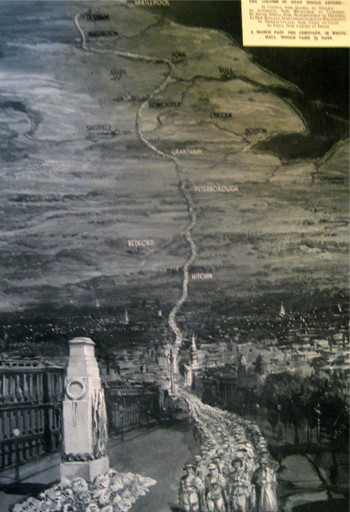
    published this very sobering image showing the general reader in London in 1933 the absolute strength and weight of the dead–and probably in a way that they had never seen before.  The image is entitled “In Memory of the 1,104,890 British Dead of the Great War”, and was drawn by D. Macpherson.  It very graphically represents all of the war dead of the British Empire for the period of the Great War of 1914-1918 (not to be called “WWI” or “The First World War” until after the second week in September, 1939, when there was a new World War from which the older one needed to be distinguished).  Depicted here are the dead as a line of men, four across, extending from London to Durhham.  The column passes from London through Hitchin, through Bedford and Peterborough and Grantham, past Sheffield and Leeds and York, and then on to Durham.  An extraordinary column of the war dead: 900,000 of the dead were not soldiers at the beginning of the war, but they sure died that way, and this map shows them all in a line, marching from  a point 269 miles distant.

    This line of dead soldiers would be 2,690 miles long including all military deaths for the war; 5,380 miles for all deaths overall. 


    Blogmarch

    Blogmarching_2


  • The Department of Things that Didn’t Seem as Though They Could Fly, but Did (1907)

    JF Ptak Science Books  Quick Post

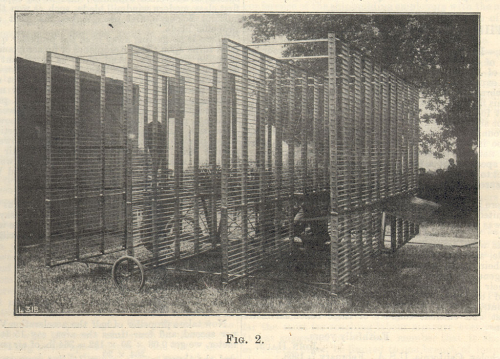
    This aircraft not only moved, but flew:

    Aviation horatio Philips 1902

    Source: the 1907 Philips flying machine,  https://en.wikipedia.org/wiki/Horatio_Frederick_Phillips


    Offhand it seems to be the winner of an award for the design of the most unflyable-looking aircraft award where the aircraft had some chance of actually lifting off and was not made of cement and hope.  

    The design belongs to Horatio Philips (1845-1924), a jolly-looking pioneer whose belief in multiple layers of lifting surfaces working together brought him to this aircraft, which in 1907 flew about 150m, and became the first powered aircraft created by a Brit to fly in England. Evidently the 200-wing aircraft powered by a 22-hp engine was basically not-controllable, but it did fly, and Philips experiments and practices (if not the aircraft themselves) and particularly for airfoil research were of some importance in the history of aviation.  


    ·Posted by :

    ·in:


  • The Last Day of Manhattan (1905)

    JF Ptak Science Books  Post 2741

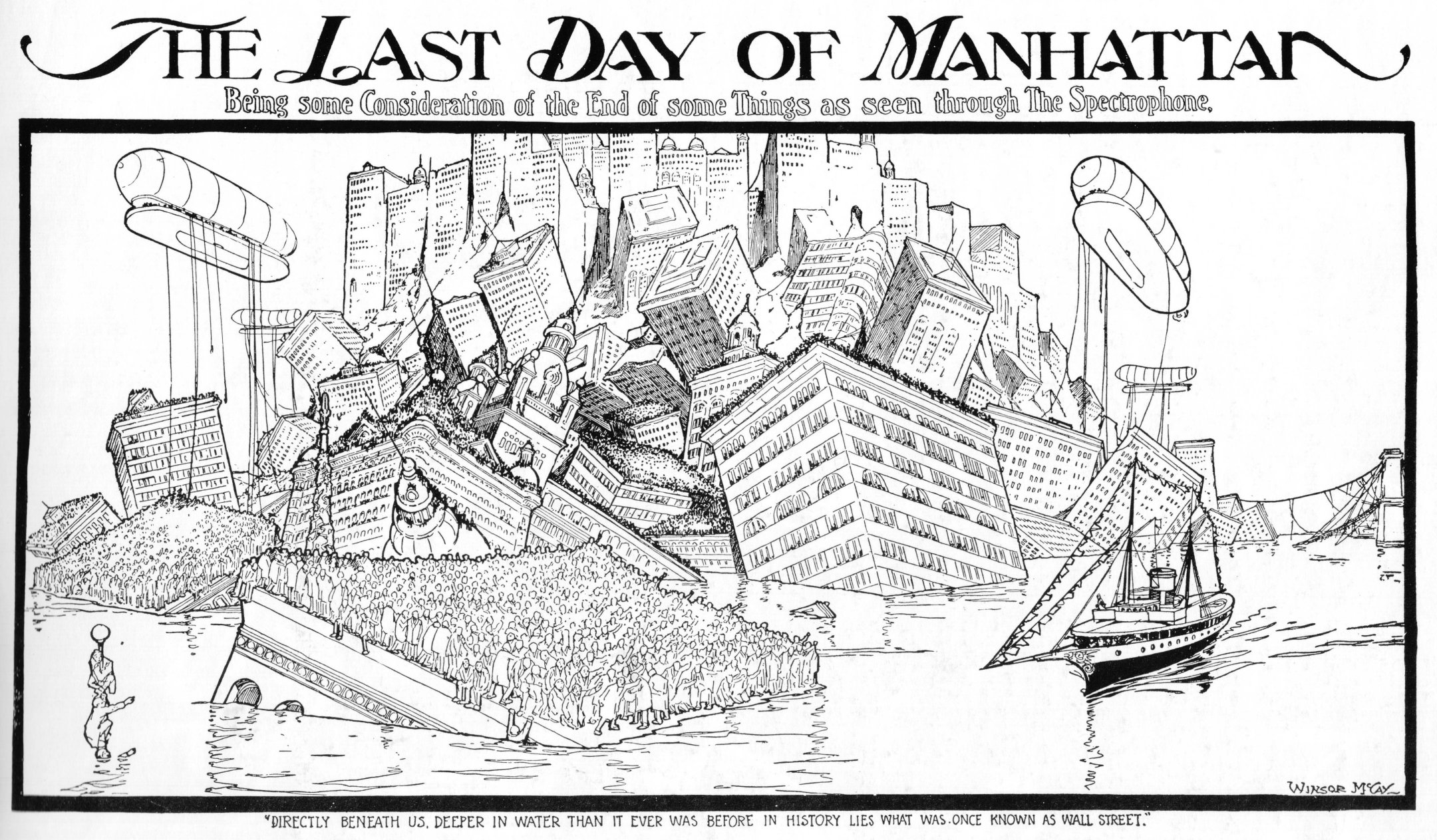
     “The Spectroscope, the Last Day of Manhattan”, was part of a 1905 sci-fi series written by John Kendrick Bangs (1862-1922) and illustrated by the great Winsor McCay (1869-1934). McCay illustrates what is evidently a vastly over-built, over-populated, over-weighted, and over-Manhattaned  Manhattan, so monumentally built up that it (however impossibly) sinks into  the satirical Bangs’ NYC harbor.  This is viewed by the technically magical “Spectrophone”, which allows the viewer to see into the future–and the future that the viewer peeps into is in the 57th century, some 3600 or so years from now. 

    I’ve seen some other images of Manhattan in the distant future, most of which show this sort of overcrowding though without the sinking part–one of those images shows the opposite of the Bangs/McCay scenario, and has the mega-city floating, tethered to the hole in the bedrock where it used to be, silent and placid like a cement cloud hovering over its old missing self.

    Elsewhere on this blog are some posts showing New York City destroyed, a topic that I never pursued though I’d find myself confronted with the images every now and then, so I saved many of them and wrote about them a little.  Just enter that phrase in the google box and you’ll see them.  

    •  There’s another bit on this blog from this series on the Supermegalopolis of 4307, here: https://historyofideasblog.com/thesciencebookstore/2016/04/megalopolis_mccay.html

    Future lasdt days manhattan

    “Being some Consideration of the End of some Things as seen through The Spectrophone. The Last Day of Manhattan”.  Illustration published in the New York Herald (Sunday February 26, 1905): Magazine Section, p. 6, by the great Winsor McCay (1867-1934)

    “The Bangs newspaper piece illustrated by McCay . . . revolves around the creation of a fantastic imaginary piece of scientific equipment, The Spectrophone. This object allowed the viewer to look ahead and see into a specific future time . . . In various newspaper installments on The Spectrophone accompanied by McCay illustrations, Bangs chronicled how advertising had proliferated in the subway by 1907; what the public libraries of Boston and New York looked like in 1914; and the strange changes that happened to the New York Horse Show in 2263 . . . what McCay illustrated was not our contemporary destruction, but a distant future disaster in the 57th century when Manhattan, so over-built both above and below ground, begins to implode”–rockwell-center.org  The Rising Tide

    ·Posted by :

    ·in:


  • Found-Art in Scientific Journals–Lonely Little Light (1926)

    JF Ptak Science Books  Quick Post

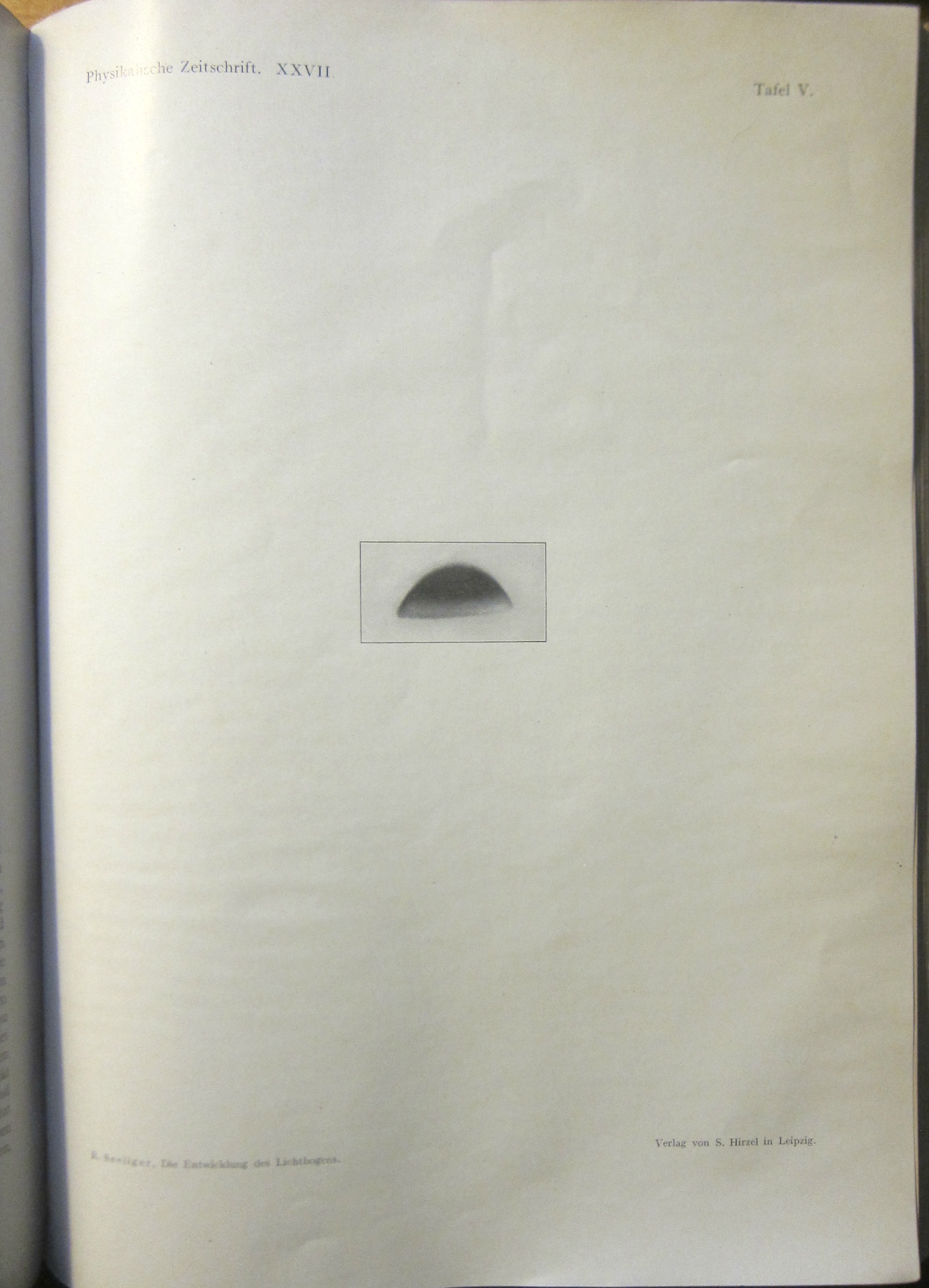
    There haven’t been that many entries in the scientific journal found-art category on this site, and it seems that mainly the artworks found/noticed have occurred in the Annalen der Physik, Scientific American,  and Nature. Hunting for something else (as is usually the case) I found this lovely bit of design in Physikalische Zeitschrift, volume 26, 1926 (page 731, plate 5), illustrating an article by R. Seeliger on the electric arc, “Die Entwocklung des Lichtbogen”. It isn’t so much that the image itself is interesting for the sake of found-art–rather it is its placement, and the lack of almost anything else, and the pleasure of it being surrounded by pretty much nothing that makes this image so artful (or at least noticeable) to me. 

    Phyz Zeit 1926 arc

    There is a bit of an unusual history about the priority of discovery of the electric arc, though that notice usually goes to Humphrey Davy in 1802 and 1809. There was earlier work in 1802 by Vasily Petrov (d. 1834), but even at the time his experimentation was obscure and not much shared. I only mention this because of the line that leapt from the “page” of the Wiki entry for him, saying  “…soon after his death he fell into oblivion in Russia”, which seems pretty harsh to me, however true it may be.


  • Radio and Television, a Peep into the Future of 1930 from 1929

     JF Ptak Science Books   Post 2740

    Pop Mech 1929 radio of the future

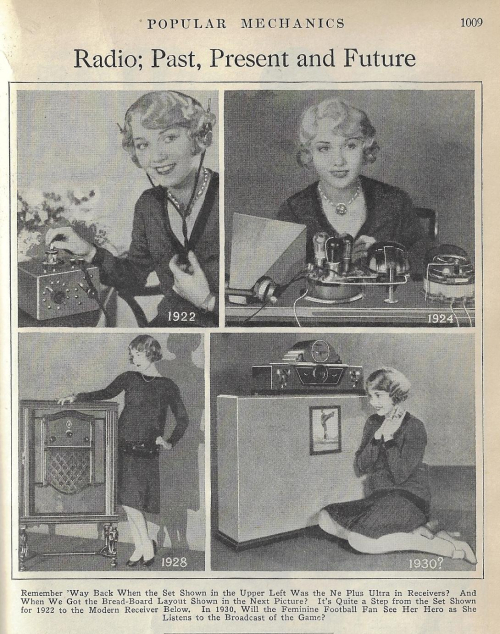
    The odd thing about this odd speculation for an odd look advancing a single odd year into the future is that it is so, well, odd. Here on page 1009 of the January-June volume of Popular Mechanics the editors speculated on what the approaching year might bring in the evolution/revolution of the radio. Radio as a popular medium was relatively new-ish in 1922 and the in six quick years very much developed for wide use, and so it must have appeared not too long a leap to jump into a radio for 1930 that offered images to accompany the broadcast. The idea of “seeing by wireless” was already upon folks back then, or at least the technology was.

    Since the vision of the future of 1930 was that of the radio, I’m assuming that the image that “the feminine football fan” was seeing in 1930 was a static image of someone punting–the capacity for that already existed, so I suppose that what Popular Mechanics was expressing was the general distribution of this new wireless set.  Perhaps “television” wasn’t mentioned because this was a speculation on radio.

    As a matter of fact, television as an invention was already established by 1929–deeply so. There was already a television station  (established in 1928, WRGB), which already was several years after John L. Baird’s1 first public demo of his mechanical tv at Selfrdige’s department Store in London on March 25, 1925. And by 1926 Baird had made a successful demonstration of a moving image, which was well documented in a 62-page book months later by Alfred Dinsdale, Seeing by Wireless, in which “television”  is elegantly described as an invention where “we see what is happening at a distance while it is happening”. (There is a famous and relatively creepy image that is described as the first photo of a moving image transmitted via television, a death-mask-like portrait of Baird’s business part, Oliver Hutchinson, and which first appeared in The Times on January 28, 1926.)

    In the same period a D.C. man, Charles Francis Jenkins, was having success with his electronic television, where by 1925 he had already publicly demonstrated a transmission of silhouetted images (and this following a dozen years after his first publication on the subject, “Motion Pictures by Wireless” in 1913).  Two years later (April 7, 1927) yet another very successful demo was made by Herbert E. Ives and Frank Gray (both of Bell Labs). A year later, on September 3, 1928, the beautifully-named Philo Farnsworth was far enough along with his invention that its public demonstration on that date is recognized as the first electronic television demonstration.

    In any event, I wanted to note some of the events in the development of television that occurred around the time of the publication of this issue of Popular Mechanics to show how much work and how far along the new medium had come to give  a little background into the question of why this photo essay would stand by a static-image radio while a moving image electronic television was being shown to be so successful. I’m a little stumped.

    Notes:

    1. I don’t know where else to hang this tidbit, so here it goes: it is just interesting to note that two Scots–Alexander Graham Bell and John Logie Baird–gave ears and eyes to human communication, one with the telephone and the other with the television.  There are many others who made very significant contributions to both developments, but I thought that this was worth a mention.

    Also, Frankenstein’s “monster” may not have been flesh and blood, but a moving picture of it. Here’s the work of one Frankenstein with a patent relating to the development of the media monster, television: “VON JAWORSKI, W. und FRANKENSTEIN, A., “Verfahren und Vorrichtung zur Fernsichtbarmachung von Bildung und GegenstÄnden mittels Selenzellen, Dreifarbenfilter und Zerlegung des Bilden in Punktgruppen durch Spiegel”, Brevet allemand, 172 376, 20 August 1904.”

    ·Posted by :

    ·in:

    —

  • A Great Mental Calculator (1856)

    JF Ptak Science Books   Post 2739

    George Parker Bidder (1806-1878) gave a lecture (without notes) explaining to the audience at the Institution of Civil Engineers in 18561 his interior practices and habits in performing absolutely prodigious and complex arithmetical feats entirely in his head. He was among the first tier of performing human calculators (like Zerah Colburn, b. 1804) mental calculations enchanted large audiences from the stages, answering seemingly impossible questions with accuracy and speed. It is in the 1856 paper (which Martin Gardner refers to as “historic2” and “valuable”) that he relates some of the practices which clarify his process–for example, one large element was that he would keep one fact in his head at a time, until it was finished, and then move on. Of course for people who did not have anything even remotely resembling this impossible ability, the information is interesting, though I have no idea how useful it may be…unless you were already a savant, that is.  Some things are just not to be known by mere mortals. Like the probably-apocryphal story of someone asking Hans Bethe how Richard Feynman had solved–on his feet–some impossible something, and Bethe responds: “First he thinks very very hard….and then he gets the answer”.) Something like that. 

    In any event, here’s the article, reproduced by Devonshire Perspectives website. My own copy is in a tightly-bound volume from the proceedings, and no doubt I would have broken the spine trying to copy the thing. That said, if anyone wants to buy this volume, it is for sale–this is a book selling site, sorta, after all.  

    The full lecture by Bidder:

    https://www.devonperspectives.co.uk/georgebidder/OnMentalCalculation.pdf

    Notes:

    1. Bidder, George Parker. “On Mental Calculation”, in Minutes of Proceedings of he Institution of Civil Engineers with Abstracts of the Discussions, volume XV, Session 1855-6, London, published by the Institution,  pp 251-280 in the 534pp volume. 

    2.  Gardner, Martin. “Mathematical Games”, in Scientific American, 216/4, April 1967, p. 117. 

    Also, I found an interesting biographical treatment of Bidder:

    • Bidder, George Parker. Mental Arithmetic. A short account of George Bidder, the celebrated mental calculator: with a variety of the most difficult questions, proposed to him at the principal towns in the kingdom, and his surprising rapid answers, etc. by George Parker BIDDER Rapid Calculator and Engineer., 1821

    It seems as though there was a separate edition of this 1856 lecture tens years later, published by Clowes:

    • Bidder, George Parker, and Institution of Civil Engineers (Great Britain). On Mental Calculation. Edited by Charles Manby. London: Printed by W. Clowes, 1866.

    And another printing somewhat later:

    • Bidder, George Parker. On Mental Calculation. London: Printed by W. Clowes, 1886.

    ·Posted by :

    ·in:


  • “Youth too often fails to interpret itself to age” (1927)

    JF Ptak Science Books  Quick Post

    I found an interesting bit a the end of an article that I happened to see–a wonderful last line, and the second good line I’ve seen in this young day. (The other one comes from my friend Jeff Donlan out in Santa Fe, who started the sentence of an email yesterday with “The ice sublimed…”, but that is another story.)  The sentence that I had in mind is “Youth too often fails to interpret itself to age”, which is the half-inscrutable closer to the anonymous book review “The Numerical Measurement of Genius” of Lewis Terman’s Genetic Studies of Genius which appears in Nature magazine for 14 May 1927. The reviewer is referencing the translation of childhood IQs of their  later-to-be-famous selves. The reviewer points out that Ben Franklin’s intelligence quotient was estimated at 145 IQ at a young age, while Darwin as a child was 135, and (somehow) Newton was given 130 and  John Locke a 125.

    Where this was going, I don’t truly know (though the reviewer ultimately found high potential in Terman’s work here in 1927, and Terman lists as top-100 or so of all-time cited work in psychology). I do know that this one one installment of Terman’s work on genius and is one of the longest-conducted longitudinal studies in the history of psychology. One conclusion that Terman reached after many years up to his elbows in geniousity was that high-IQ doesn’t necessarily make a “success”, that there isn’t a correlation between intellect and achievement. So I guess the mostly “normal” IQs for the geniuses named earlier also didn’t correlate to their later super-achievements, or something.  

    I just liked the sentence for its oddness, disappointing as it is, because it is almost artful in its vaguely condescending nature. 

    ·Posted by :

    ·in:


  • High Realism in Anatomical Art: the Skull (1690 and 1872)

    JF Ptak Science Books   Quick Post

     Anatomy--braun--

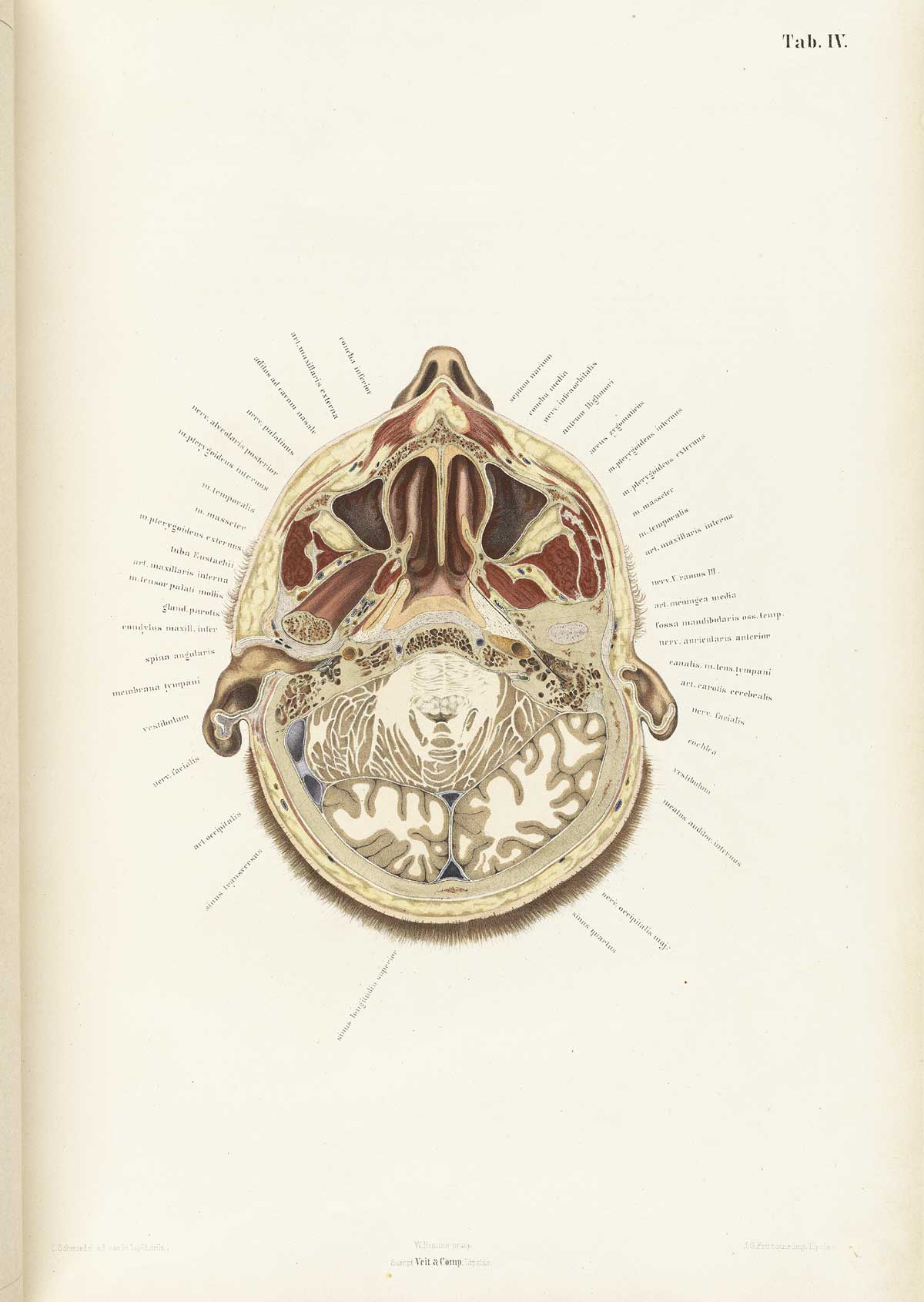
    The collaborative work of anatomist Wilhelm Braune (1831-1892) and artist C. Schmiedel (fl. mid-1800s) produced a singular work,  Topographisch-anatomischer atlas nach durchschnitten an gefrorenen cadavern…(published in Leipzig in 1872), which was an oustanding example of high-realism in the art of anatomy. This book is pretty much right-to-business, with no extraneous bits as had appeared in many anatomies for centuries. And even though these practices had pretty much expired by the first quarter of the 19th century, Braune/Schmiedel was ever more so detailed and simple–their design was fabulous, and their detail light and exceptional. 

    I love the detail of the eyelashes and the short haircut.  


    Anatomy braune04[Source: National Library of Medicine.]

    They also made use of sliced frozen sections of cadavers, which seems to give their work that crystalline touch.  The first image looks at the brain from top-to-bottom, while the second reverses the view, which is in itself somewhat unusual, even in 1872. 

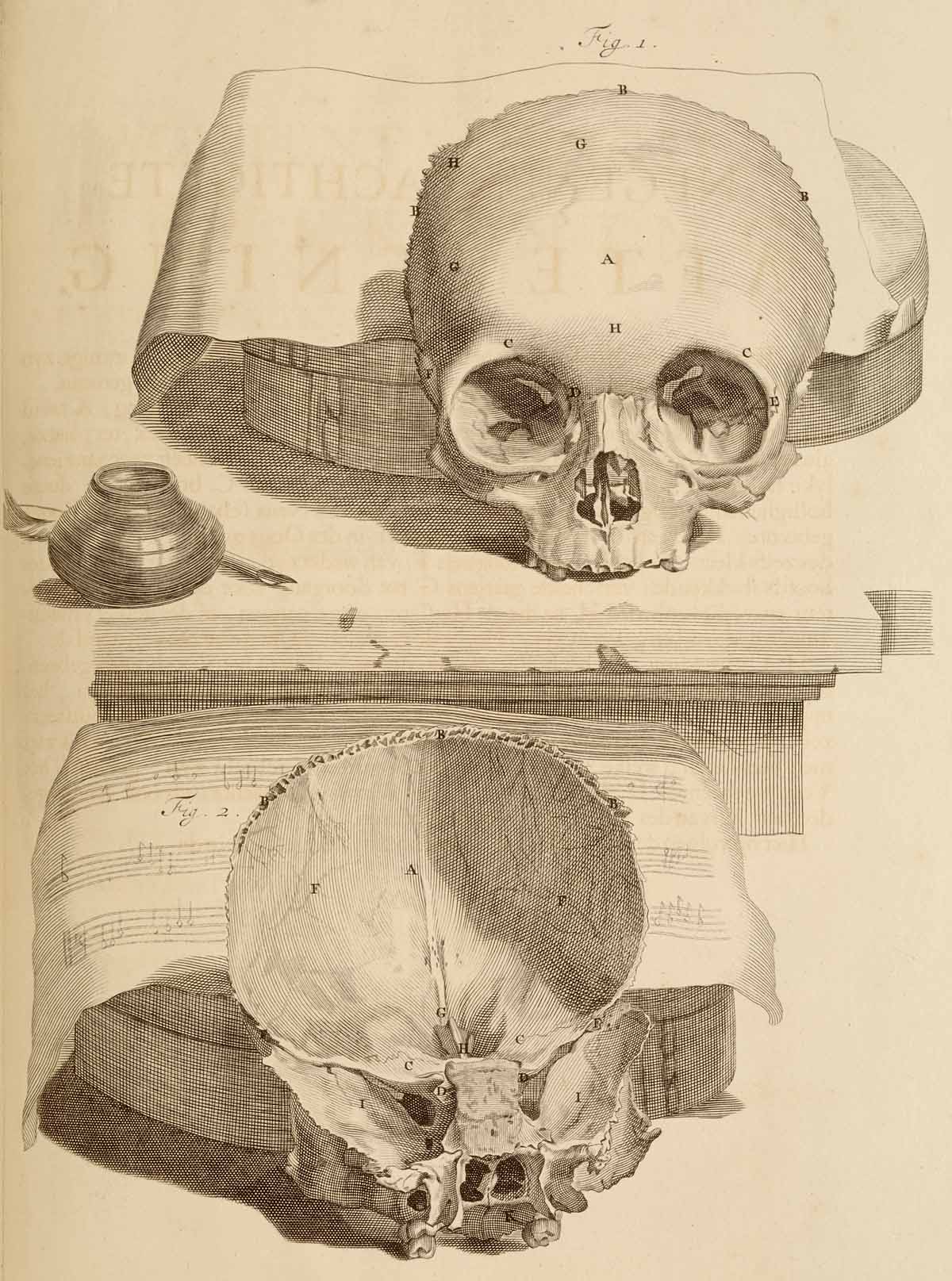
    Looking into a very finely-produced skull from an earlier period in the work of the anatomist Govard Bidloo (1649-1713) and the artist Gérard de Lairesse (1640-1711) in their Ontleding des menschelyken lichaams, (which was printed in Amsterdam in 1690) we find a bit of a different story.

    Anatomy skull[Source: National Library of Medicine.]

    One interesting aspect of Bidloo is that he can be extraordinarily dedtailed and still lend a rather baroque still life to engage his subject–like the skull with musical score, above.  There’s no reason for the added bit of scenery, its just a luxurious background for the anatomy. And then there are examples like this incredible facial/neck dissection below, which is very hard-core realisitc, just as what you might find on any dissecting table, which most assuredly did not come equiped with pen/ink/music score.  Bidloo here is ulrta-real, more so than the greater majority of anatomist/illustrators. [Ontleding des menschelyken lichaams...printed in Amsterdam, 1690, as a copperplate engraving with etching. 


    ·Posted by :

    ·in: