A Daily History of Holes, Dots, Lines, Science, History, Math, Physics, Art, the Unintentional Absurd, Architecture, Maps, Data Visualization, Blank and Missing Things, and so on. |1.6 million words, 7500 images, 4.9 million hits| Press & appearances in The Times, Le Figaro, Mensa, The Economist, The Guardian, Discovery News, Slate, Le Monde, Sci American Blogs, Le Pont, and many other places… 5000+ total posts since 2008.

Author: JF Ptak

  • “Youth too often fails to interpret itself to age” (1927)

    JF Ptak Science Books  Quick Post

    I found an interesting bit a the end of an article that I happened to see–a wonderful last line, and the second good line I’ve seen in this young day. (The other one comes from my friend Jeff Donlan out in Santa Fe, who started the sentence of an email yesterday with “The ice sublimed…”, but that is another story.)  The sentence that I had in mind is “Youth too often fails to interpret itself to age”, which is the half-inscrutable closer to the anonymous book review “The Numerical Measurement of Genius” of Lewis Terman’s Genetic Studies of Genius which appears in Nature magazine for 14 May 1927. The reviewer is referencing the translation of childhood IQs of their  later-to-be-famous selves. The reviewer points out that Ben Franklin’s intelligence quotient was estimated at 145 IQ at a young age, while Darwin as a child was 135, and (somehow) Newton was given 130 and  John Locke a 125.

    Where this was going, I don’t truly know (though the reviewer ultimately found high potential in Terman’s work here in 1927, and Terman lists as top-100 or so of all-time cited work in psychology). I do know that this one one installment of Terman’s work on genius and is one of the longest-conducted longitudinal studies in the history of psychology. One conclusion that Terman reached after many years up to his elbows in geniousity was that high-IQ doesn’t necessarily make a “success”, that there isn’t a correlation between intellect and achievement. So I guess the mostly “normal” IQs for the geniuses named earlier also didn’t correlate to their later super-achievements, or something.  

    I just liked the sentence for its oddness, disappointing as it is, because it is almost artful in its vaguely condescending nature. 

    ·Posted by :

    ·in:


  • High Realism in Anatomical Art: the Skull (1690 and 1872)

    JF Ptak Science Books   Quick Post

     Anatomy--braun--

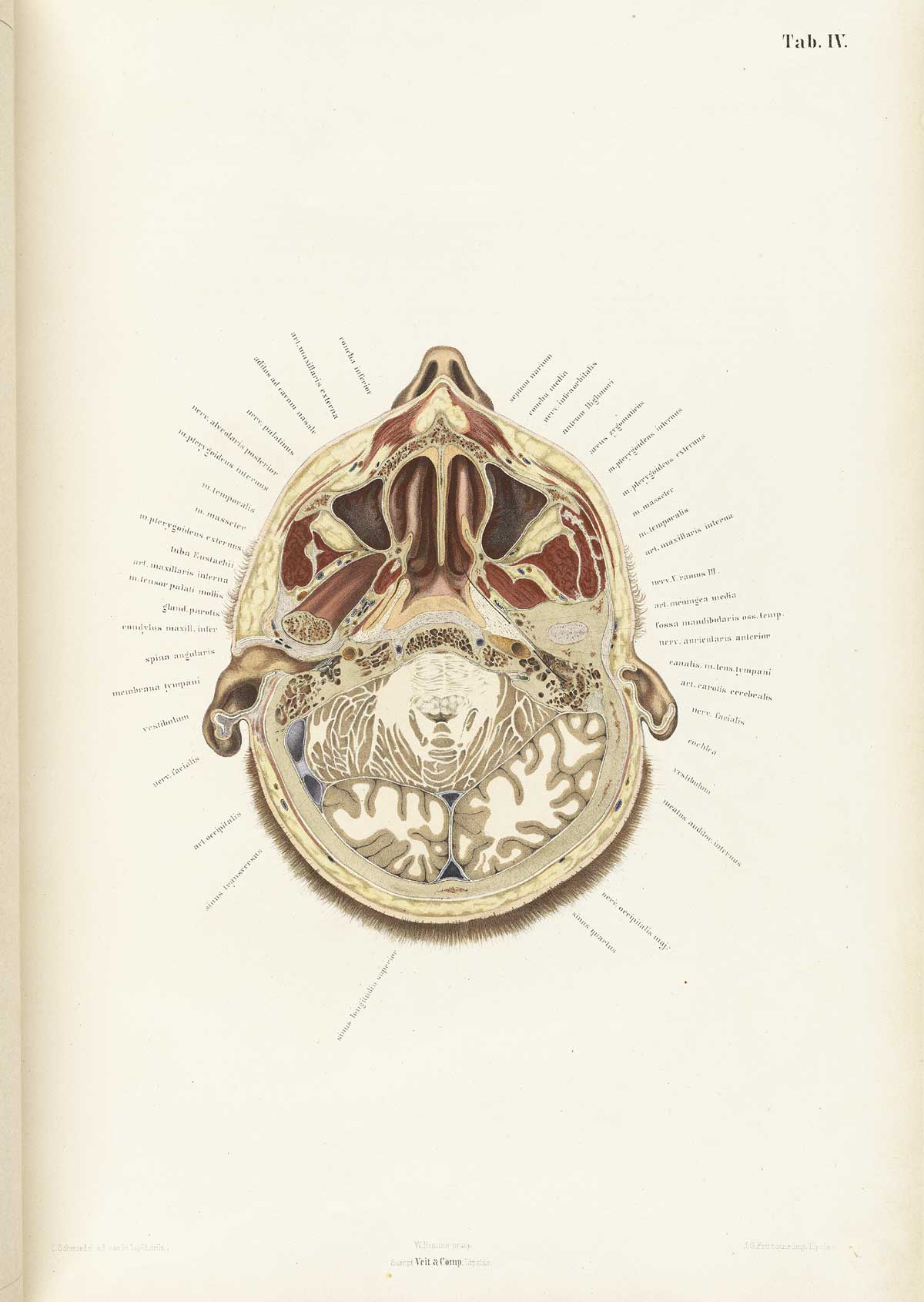
    The collaborative work of anatomist Wilhelm Braune (1831-1892) and artist C. Schmiedel (fl. mid-1800s) produced a singular work,  Topographisch-anatomischer atlas nach durchschnitten an gefrorenen cadavern…(published in Leipzig in 1872), which was an oustanding example of high-realism in the art of anatomy. This book is pretty much right-to-business, with no extraneous bits as had appeared in many anatomies for centuries. And even though these practices had pretty much expired by the first quarter of the 19th century, Braune/Schmiedel was ever more so detailed and simple–their design was fabulous, and their detail light and exceptional. 

    I love the detail of the eyelashes and the short haircut.  


    Anatomy braune04[Source: National Library of Medicine.]

    They also made use of sliced frozen sections of cadavers, which seems to give their work that crystalline touch.  The first image looks at the brain from top-to-bottom, while the second reverses the view, which is in itself somewhat unusual, even in 1872. 

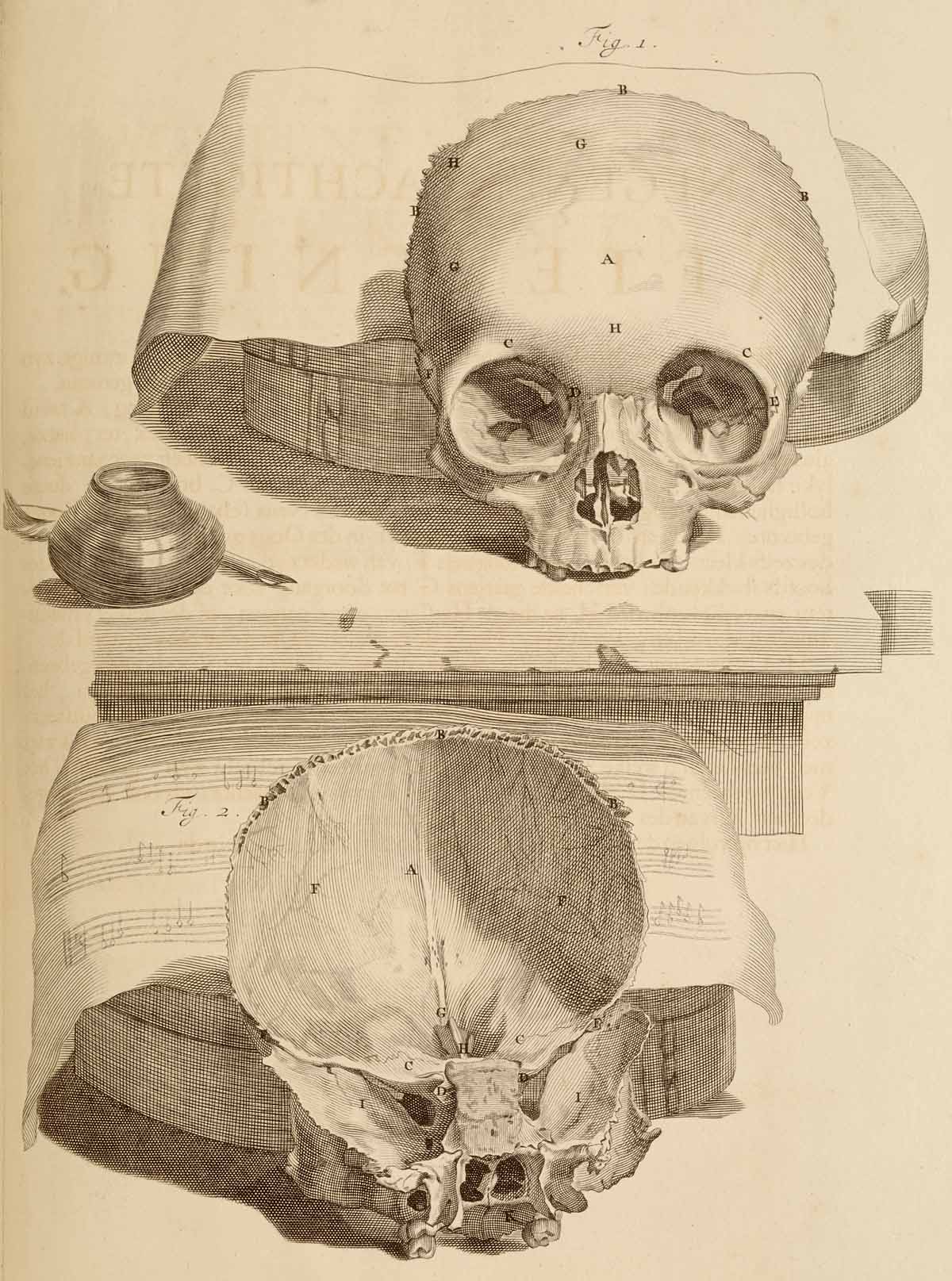
    Looking into a very finely-produced skull from an earlier period in the work of the anatomist Govard Bidloo (1649-1713) and the artist Gérard de Lairesse (1640-1711) in their Ontleding des menschelyken lichaams, (which was printed in Amsterdam in 1690) we find a bit of a different story.

    Anatomy skull[Source: National Library of Medicine.]

    One interesting aspect of Bidloo is that he can be extraordinarily dedtailed and still lend a rather baroque still life to engage his subject–like the skull with musical score, above.  There’s no reason for the added bit of scenery, its just a luxurious background for the anatomy. And then there are examples like this incredible facial/neck dissection below, which is very hard-core realisitc, just as what you might find on any dissecting table, which most assuredly did not come equiped with pen/ink/music score.  Bidloo here is ulrta-real, more so than the greater majority of anatomist/illustrators. [Ontleding des menschelyken lichaams...printed in Amsterdam, 1690, as a copperplate engraving with etching. 


    ·Posted by :

    ·in:


  • The Wright Brothers in the Popular Press: Scientific American, 1902 (Revisited)

    JF Ptak Science Books  Post 2738

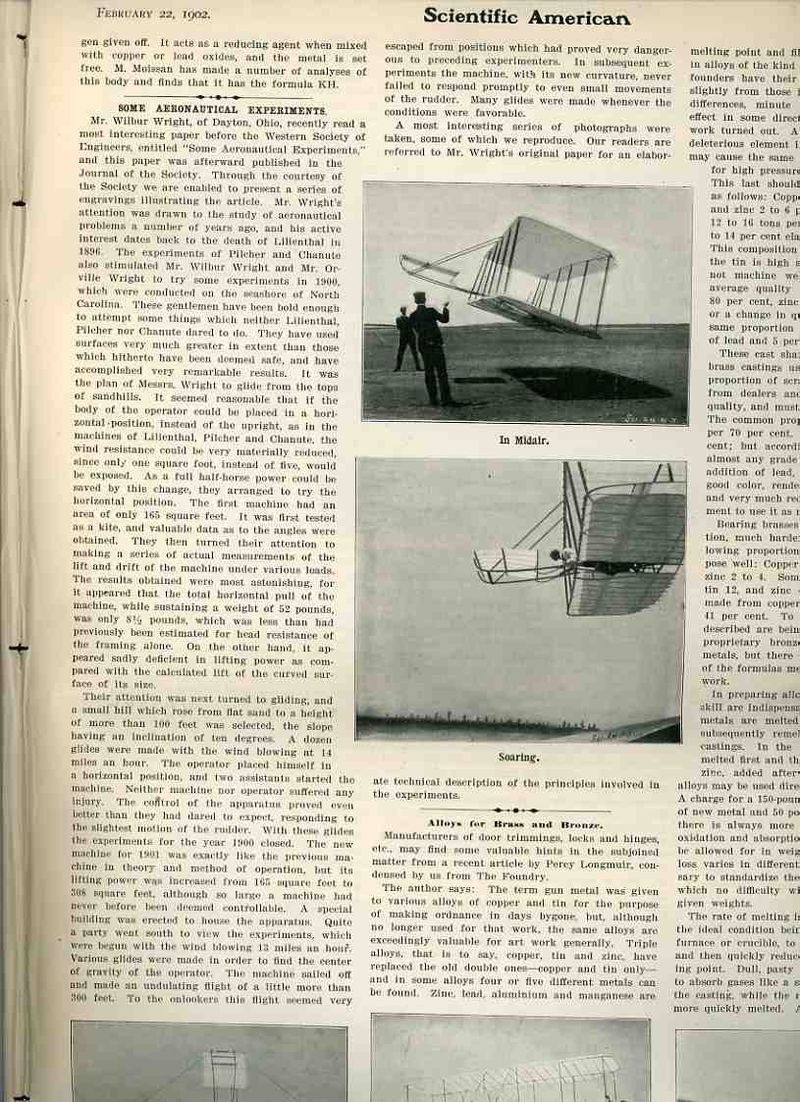
    Wright bros 1902 Sci AmI used to wonder why the Wright brothers’ experimental gliding flights at Kill Devil Hills in 1901 received so little attention in the popular scientific press at that time–particularly the coverage in Scientific American. The reporting on their successful experiments was tucked away safely in the depths of the SA issue for 22 February 1902, cushioned and obscured by other news reports on minor but newsworthy subjects.

    The report is sandwiched in between “Winter Railroading in Alaska”, “Experiments of M. Moissan  with hybrids of potassium” and “A Garbage-Consuming plant” on the page opposite with  “Alloys for Brass and Bronze “ just below it.  And as it turns out there are more words devoted to the Alaska railroading article than to the Wrights as well.  There are dozens of articles given better placement in this issue: steam boiler inspection, variable speed gears for pumps, making photographs with electric headlights, domestic manufacturing of Portland cement, assorted announcements of electrical progress, and other such stuff. The front page of the issue is dedicated to the new bridge of the Redheugh Bridge at Newcastle-on-Tyne; the Wright article follows on page eight. 

    Even though the brothers had been experimenting with gliding flight at Kill Devil since 1900, reports of their activities had been mostly unreported–and this partly of their own accord, for the sake of security and privacy, partly from the event being dismissed as another crackpot flying idea, and possibly partly because the location of their flights was so removed and obscure.  And this seems to have suited them—the brothers seemed not to need or even want publicity, or recognition, at this point. The Wrights were not predisposed to be accommodating to strangers, necessarily, though neither would they ever be rude; as they did enjoy their privacy, and they would protect the details of their flying machine with scrupulous vigor. So, even though there weren’t necessarily public demonstrations of their flying machine, neither were they done in secret.

    Kill Devil Hills was very remote at that time, and few people outside of the Outer Banks made the trips to bear witness. There were people who  did witness  the Wrights’ successes here, but it seems that this was not enough to convince many people that the remarkable achievements made there were true and accurate. So here were reports on their progress, that they had made incomparable strides since they first became interested in flight in 1896 following the failure of Samuel Langley and the Potomac River crash of his aerodrome. (Just for the record, Alex Bell also referred to his aircraft as aeromdomes.) And there was still at this point the perceived lunacy of people who pursued the construction of flying machines, an unbrilliant assumption that would persist until 1908, when all of that would change.

    This report for February seems to be the earliest on the 1901 flights in North Carolina, with the principle difference (from what I can see) is that this earlier glider didn’t yet have a tail which would make an appearance a little latter in the year (followed by a very critical discovery on the need for the maneuverability of the tail.) It also seems that the 1902 gliders were as different from the 1901 gliders as the 1903 glider/plane would be from the 1902 model. 

    Still, given the competing news of the day, and the importance of the Wrights’ experiments, and the amount of interest in flight at this time,  it is a little bothersome to me why the report on their sandy accomplishments got so gobbled up in the nonchalant scientific bric-a-brac and standardiana of 1902. 

    Of course there is the whole “crackpot” angle, and the endless parade of significant people who claimed that human flight (not in a balloon) was impossible, and experimenting on that a waste of time and money…and there were plenty of experiments to back this up. The Wrights were different–they weren’t just two engineering-able tinkering brothers with a bike shop and some tools; they were scientific explorers, observers of a high order, scientific method men. 

    Even after the success of the December 17, 1903 powered flights, the Scientific American seemed lukewarm (and even critical and questioning) to the reports of the brother’s achievements, not really embracing them until April 1906. It certainly seems that they were far more asknowledged in Europe during their tour there in 1908 than they had been in the U.S.–even the U.S. army  expressed no interest in the flyer when first presented with the opportunity to purchase it in 1905, though the Wrights found very willing potential buyers for their aircraft in England in France. It was after the Wrights European exposure that the Army finally became interested in the aircraft enough to have the Wrights perform test trials prior to purchase and contract at For Myer in 1908. (Actually it was just Orville there in the summer of 1908 as Wilbur was in Europe entertaining business interests of a similar sort.) It was really with these flight trials in Fort Myer in 1908 (and concluding) in 1909 that the U.S. public seemed to truly understand and accept the success of the Wrights in human powered flight–after all, the Army did begin purchasing aircraft and began training pilots in the autumn of 1909, so it was outstandingly obvious that the new era had begun.

    Notes:

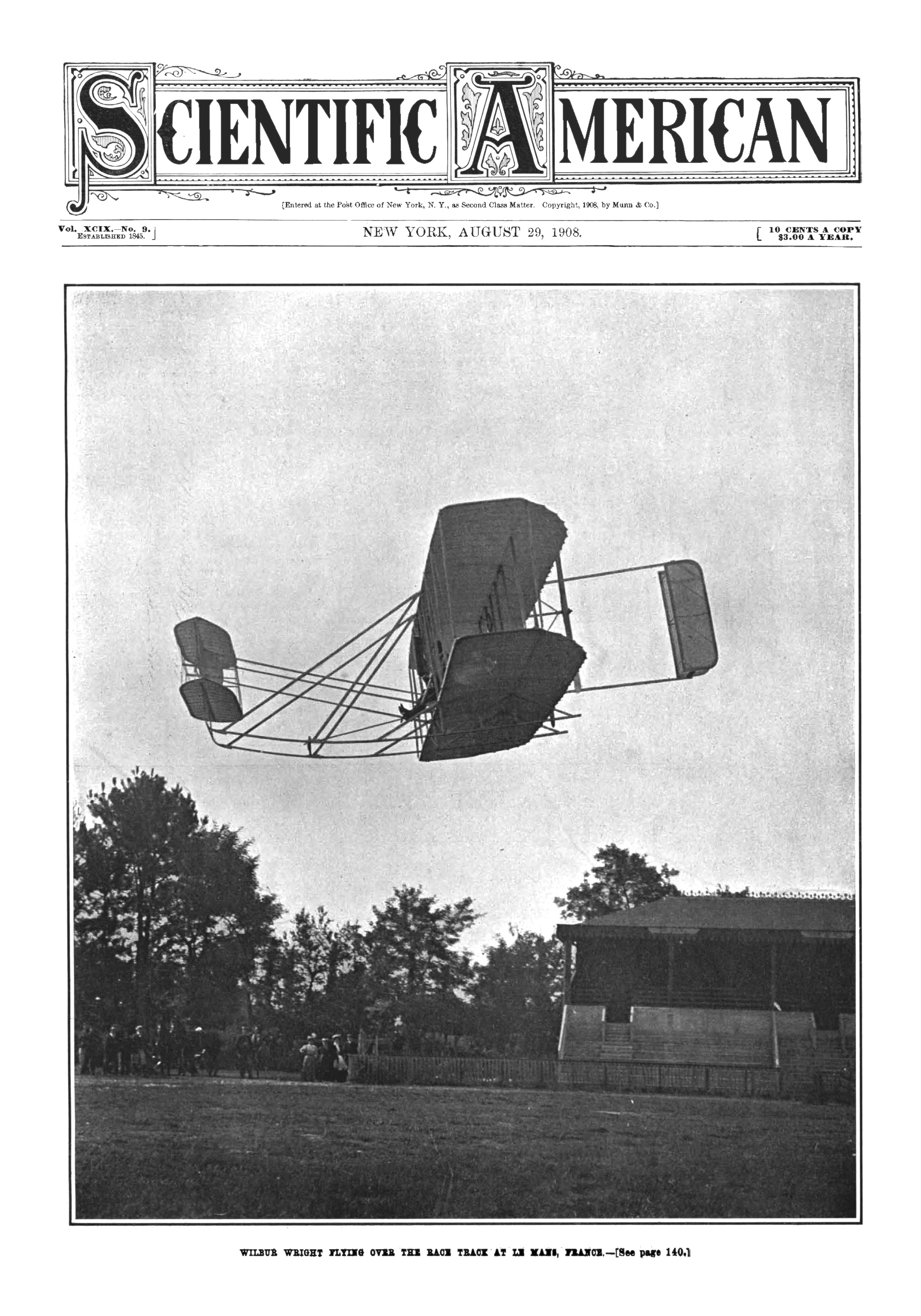
    By my reckoning from what I can see in my run of the Scientific American that the magazine did not dedicate a cover to the Wrights until 1908: 
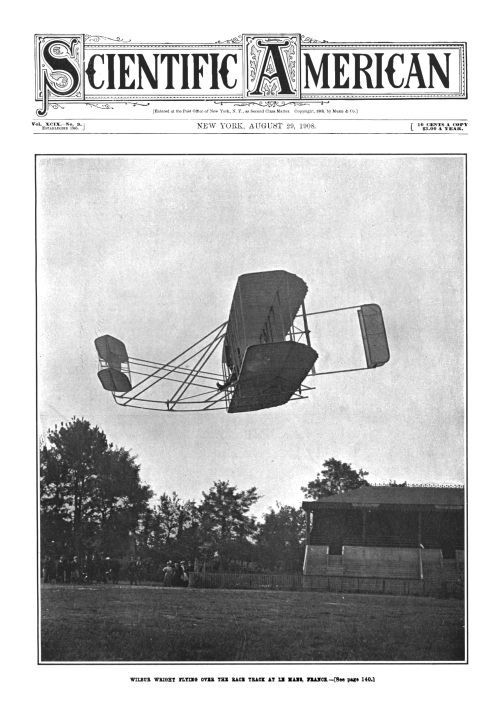
    Wright flyer 1908 cover Sci Am

    https://blogs.scientificamerican.com/observations/first-airplane-flight-marks-111th-anniversary/

    Since this is outside my area I quote liberally from the US Commission on the Centennial of Flight for a more exact description of the difference of the gliders between 1901 and 1902:

    “Their 1902 glider had a new wing with a shallow camber and high aspect ratio. It was a major departure from their earlier machines. It had roughly the same wing surface area as the 1901 machine, but the similarities ended there. The wingspan was ten feet (three meters) longer and the chord two feet (0.6 meter) shorter than the old machine, making the glider look larger and more graceful. It had an overall length of 16 feet (5 meters) and weighed 112 pounds (51 kilograms). The wing camber followed a shallow parabolic curve, and the elevator was extended farther out in front of the pilot. This gave it more leverage, which allowed better control. The 1902 glider also had a new rudder that consisted of two fixed vertical surfaces located behind the aircraft . Wilbur and Orville calculated that these would help prevent the skidding that had occurred when they warped the wings.”

     And the following on the 1902 flights from Orville Wright “How We Made the First Flight”:

    “The flights of the 1902 glider had demonstrated the efficiency of our system for maintaining equilibrium, and also the accuracy of the laboratory work upon which the design of the glider was based. We then felt that we were prepared to calculate in advance the performance of machines with a degree of accuracy that had never been possible with the data and tables possessed by our predecessors. Before leaving camp in 1902 we were already at work on the general design of a new machine which we proposed to propel with a motor…”

    ·Posted by :

    ·in:


  • Revolutionary Lines (1811)

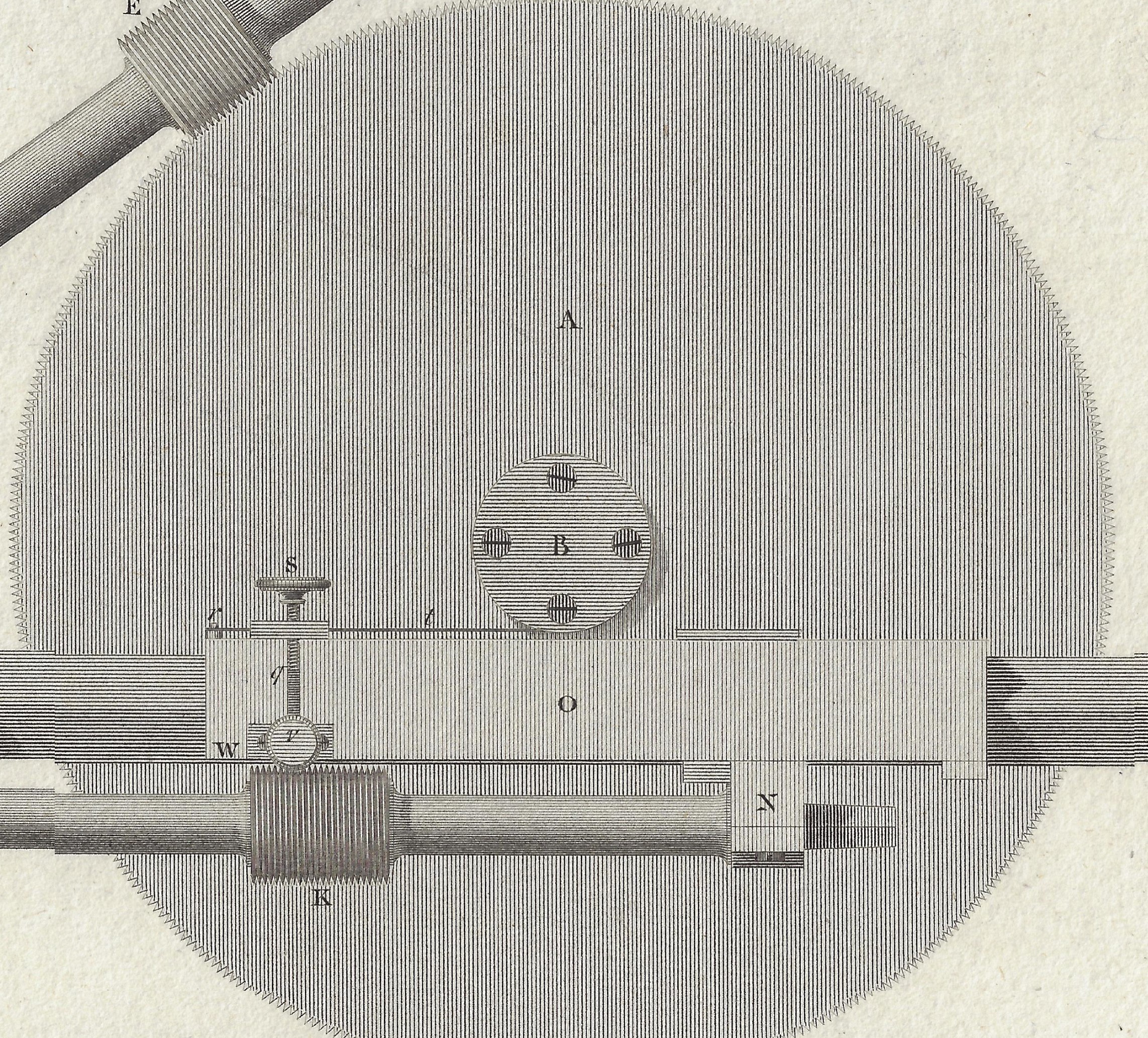
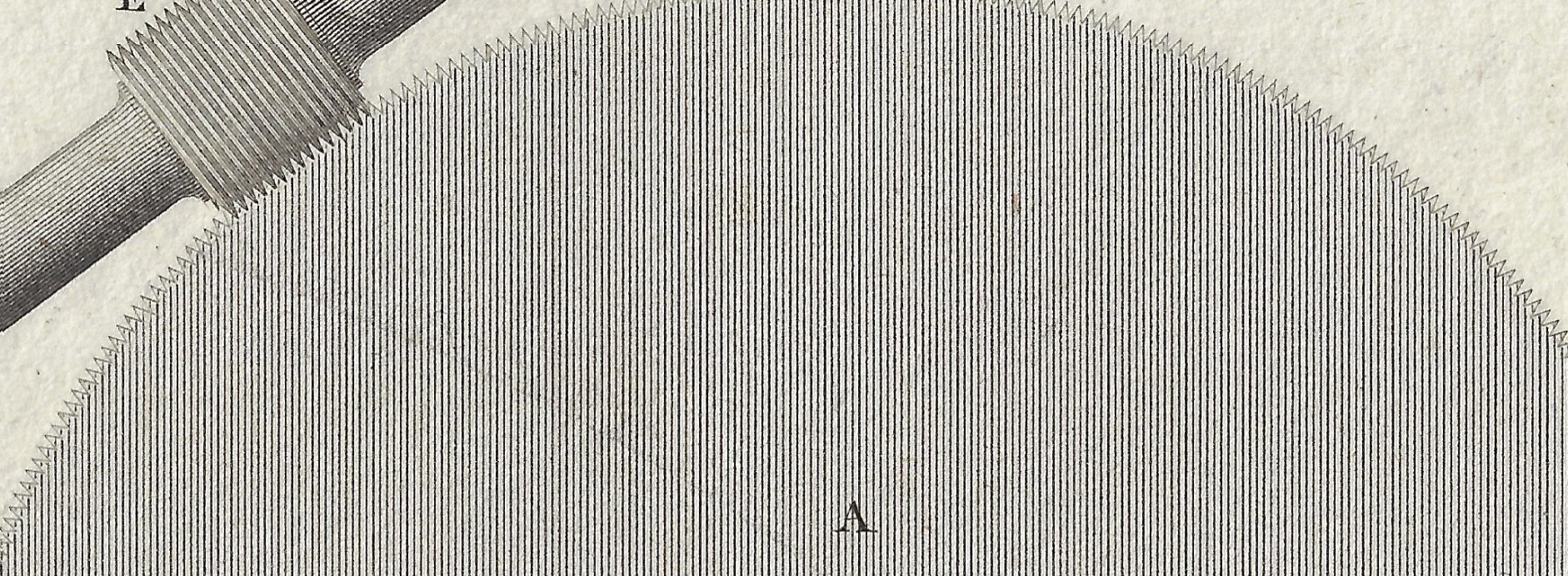
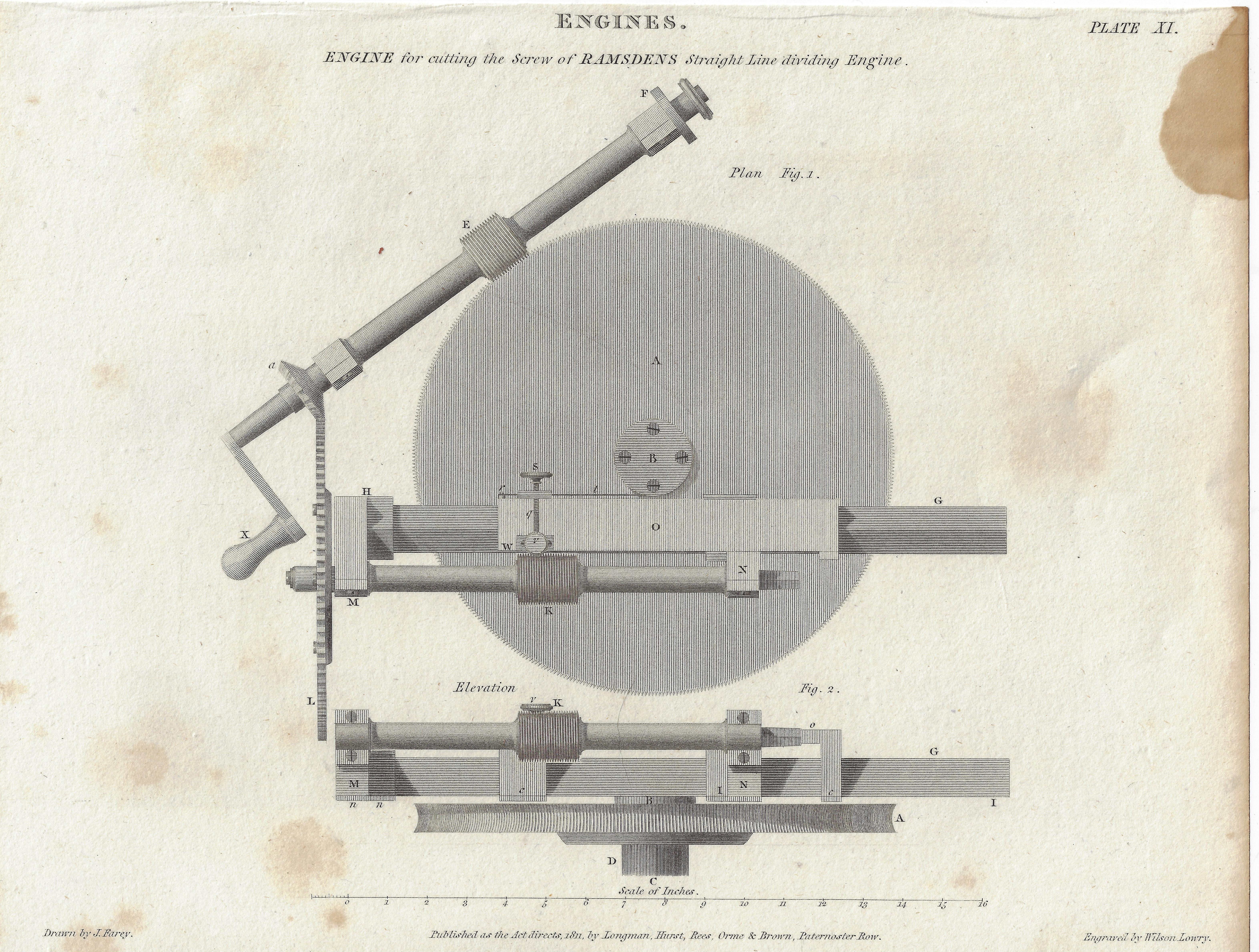
    Here’s a very fine example of a beautiful piece of engineering and a lovely rendition of it. The artwork is an engraving found in Abraham Rees’ monumental Encyclopedic Dictionary…,and was published in London in 1811. It shows in exquisite detail the straight line dividing engine of Jesse Ramsden (1735-1800), which here is being used as “an engine for cutting screws”.  A person could crawl all over this image in varying degrees of microscopic inspection and find  beautiful internal images nestled within the larger drawing in a Ken Burns/fractal-y way. 

    [Click on each image for a better resolution–seems as though this is restricted in a general view by my host]

    Ramsden _2_

    This and other similar inventions by  Ramsden’s were key additions to the developing scientific technologies of the Industrial Revolution, integral improvements necessary for integral improvements. (And as we see below in the Wiki quote on this subject, one of the very first things that Ramsden fabricated with his new and accurate lathe was to construct and even more accurate lathe before getting to work–that is an essential and brilliant idea.) Simply put, to make something more precise you need a more precise instrument, and this is exactly what Ramsden made. 

    Ramsden _3_

    And the full engraving:

    Ramsden _1_

    Notes:

    From Wikipedia–“The first truly modern screw-cutting lathe was likely constructed by Jesse Ramsden in 1775. He appears to have been the first person to put a leadscrew into actual use (although, as Leonardo’s drawings show, he was not the first person ever to think of the idea), and he was the first to use diamond-tipped cutting tools.  His device also included a slide rest and change gear mechanism. These form the elements of a modern (non-CNC) lathe and are in use to this day. Ramsden was able to use his first screw-cutting lathe to make even more accurate lathes. With these, he was able to make an exceptionally accurate dividing engine and in turn, some of the finest astronomical, surveying, and navigational instruments of the 18th century.”

    ·Posted by :

    ·in:


  • Indicting Documents on Conditions in the Soviet Union, and the Holomodor, 1933/4

    JF Ptak Science Books   Post 2737

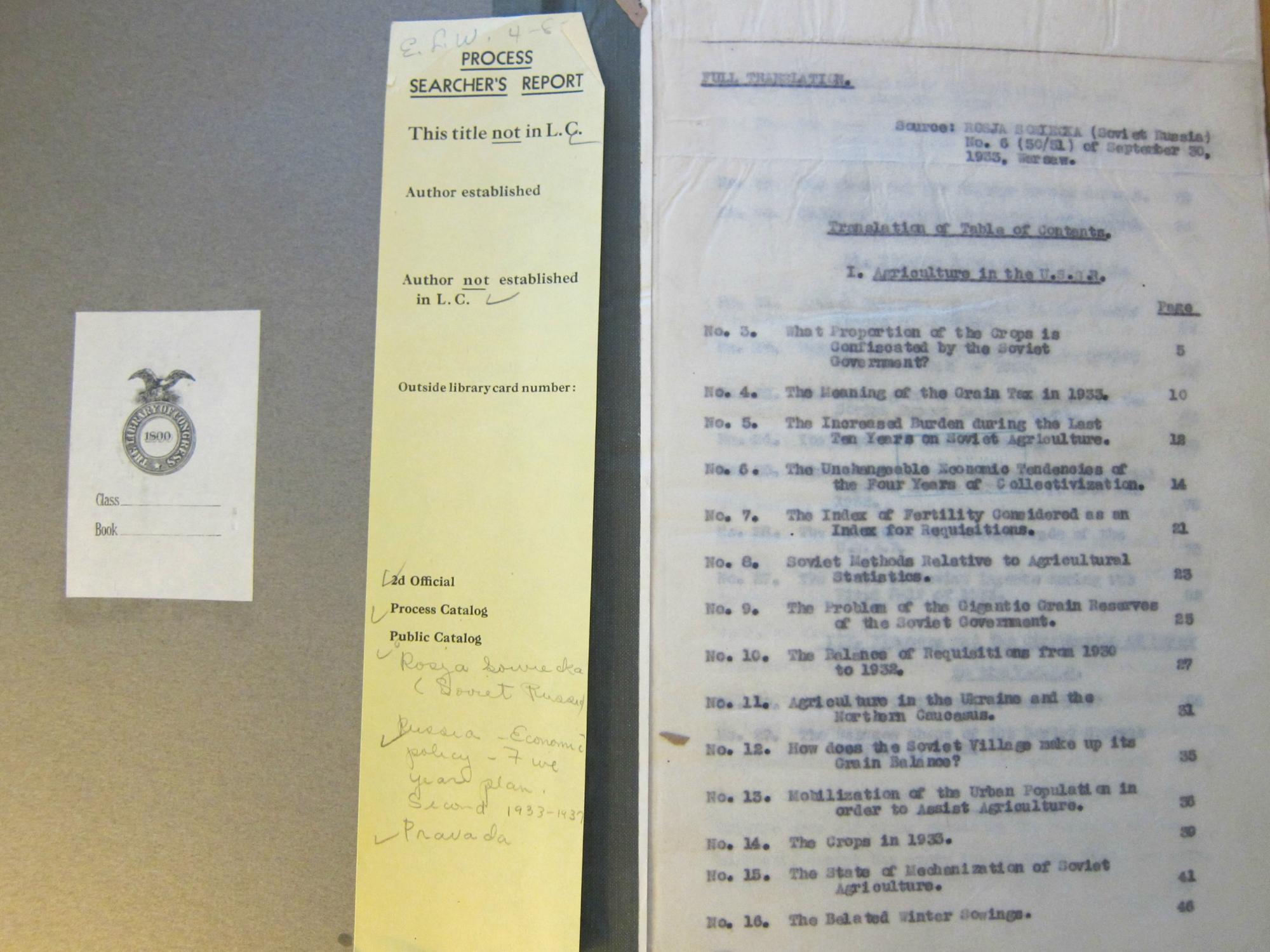
    I’m reposting the following from my books-for-sale section, as I think it may be useful for someone out there who happens to read this blog to know that this fairly rare resource is out there in the world, and available. I am not well acquainted with this area except for the basics of the Soviet Union in the 1930’s, so the descriptions of the contents and interpretations are necessarily rudimentary, though there’s enough there I think for someone interested in this area to be able to know if this material may be useful.

    The post is on three volumes of translations of news and reports coming out of the cloaked and secretive U.S.S.R. in 1933 and 1934. The publication was produced at the U.S. Embassy in Warsaw, a translation from the Polish journal, as referenced by Kris Dietrich in his Taboo Genocide: Holodomor 1933 & the Extermination of Ukraine. There are definite and numerous statements in this journal that—even for the limited amount that I have read in it—are very critical of the Soviet leadership, particularly in regard to the grain tax and the effect of collectivization in Ukraine and the Northern Caucasus. This comes at the time of massive political and social repression, manipulating the criminal code, establishing a new constitution, and the beginning of the next wave of extermination by starvation in Ukraine (the Holodomor). For example, in the chapter on agriculture in the Ukraine (on page 7 of that section) we read the summary of the extent of the “participation of the Soviet State in the grain balance” by the kolkozi was at least 70% in Ukraine and about 100% in the Norther Caucasus, meaning that there there would be no food left for those farming it, with this particular paragraph ending “what is left for the peasants”?  The answer to that question was written in millions of lives lost to the monster that was Stalin

    Rosja Sowieka. 3 documents, September 1933, February 1934, March 1934. 

     (1) Rosja Sowieka (“Soviet Russia”, printed originally in Warsaw) No. 6 (50/51) of September 30, 1933.


    Rosja

    ·Posted by :

    ·in:


  • Data Visualization of Comparative Naval Strengths, 1929

    JF Ptak Science Books  Quick Post

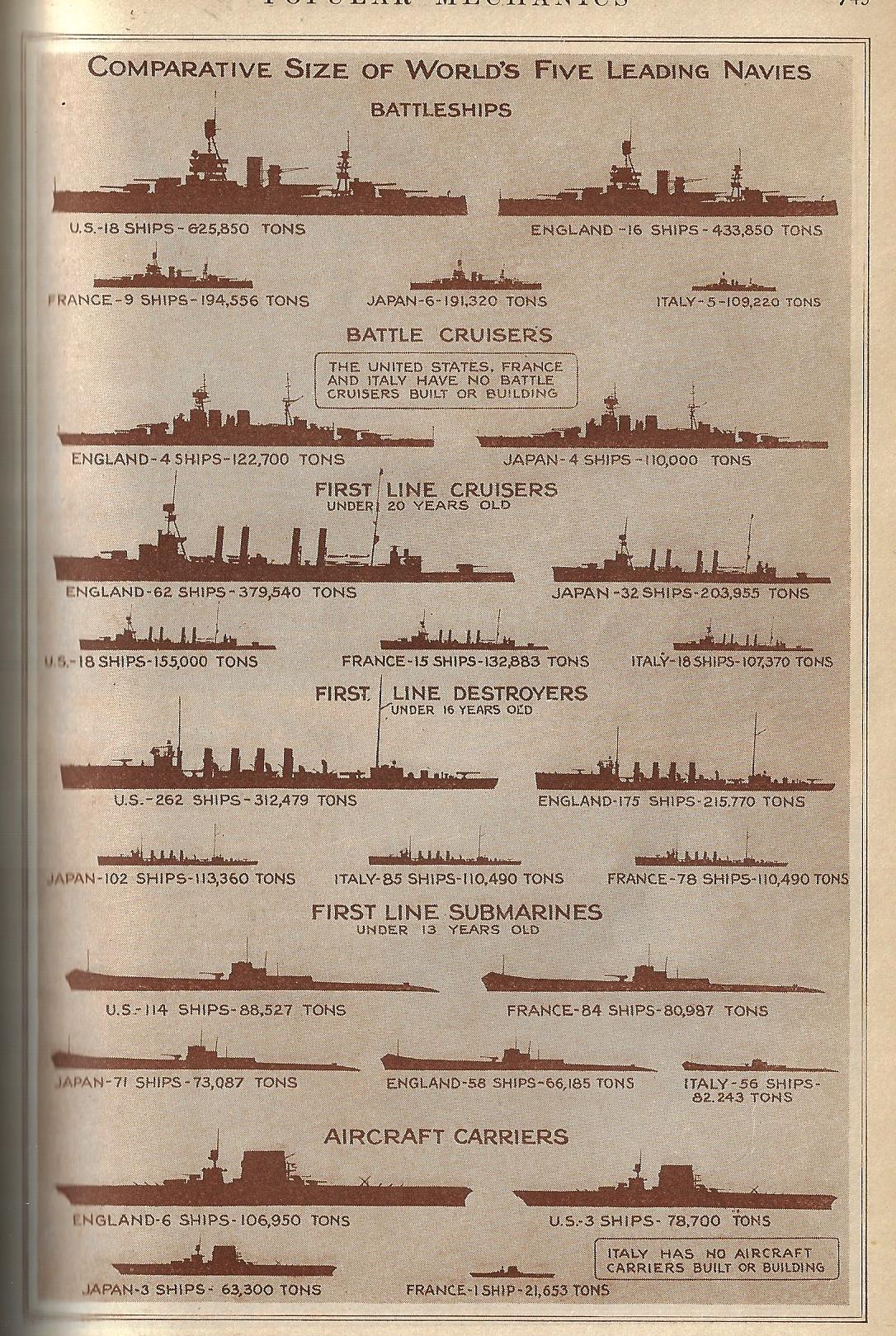
    There are many more complex, complicated, and data-rich displays like this one presented on this blog (just access the “Display of Quantitative Info” section), but there is a certain attraction with this simple-ish one. It is the design of W.R. Robinson–an artist with a fine touch, which is on display here more for the employment of empty space than lines–and gets across the information pretty easily and quickly. In any event, here it is, displaying the relative strengths of the world’s navies ten years after the end of WWI, which at that point was still the great War, “World War I” waiting to be invented in another ten years when there was a needed distinction between that world war and the newest world war.  

    Pop Mech 1929 dataviz navy strength

    [Image source: Popular Mechanics, June, 1929.]


  • H.L. Mencken’s Copy of a Stone Catalog for the Big Sleep

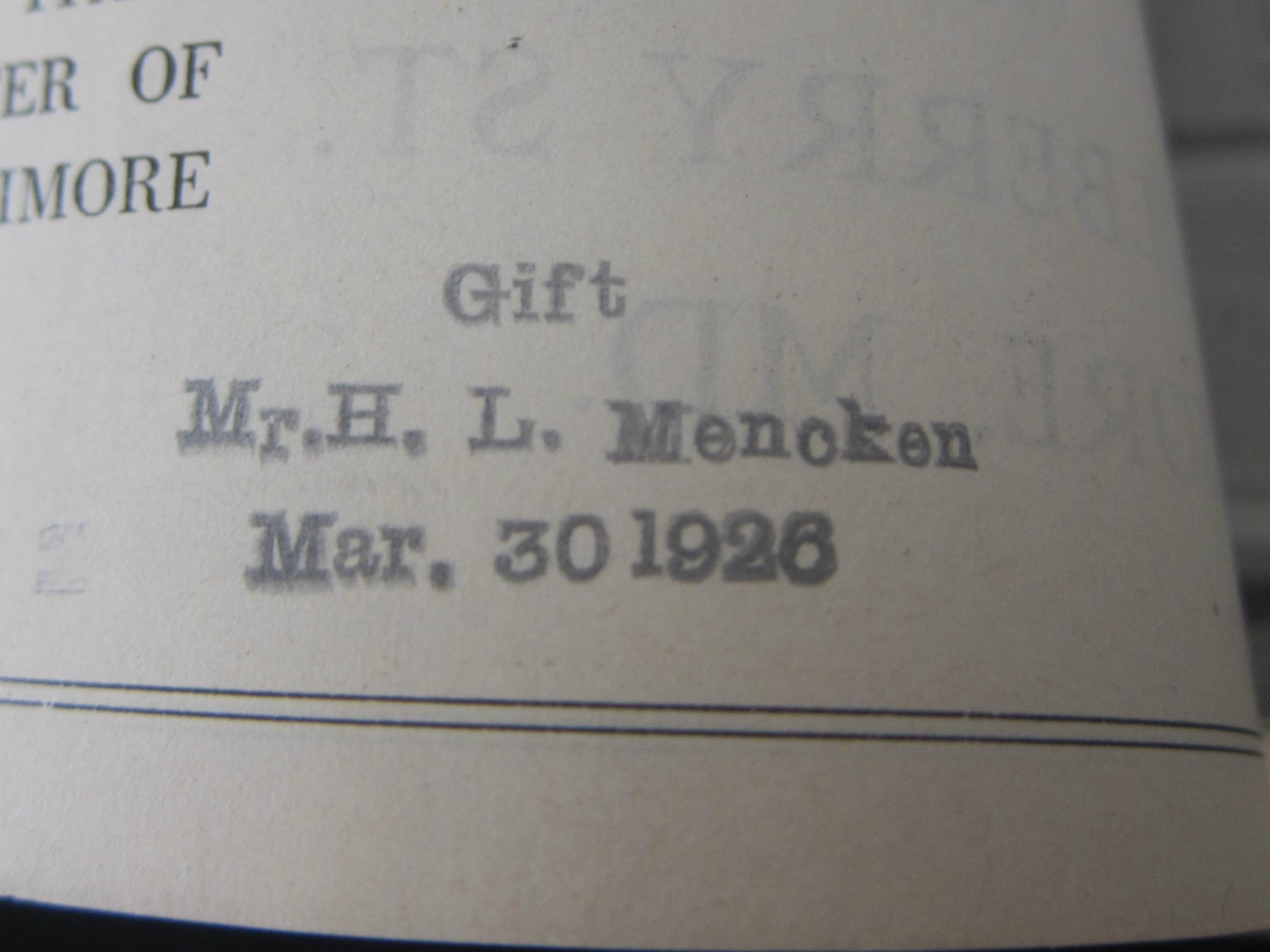
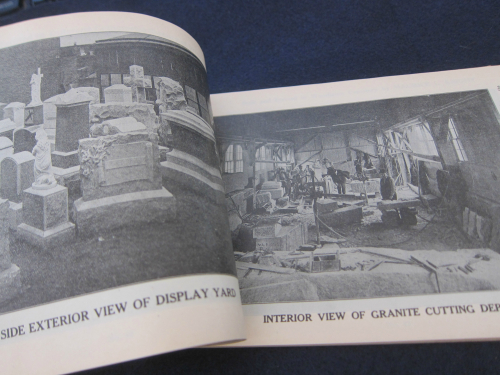
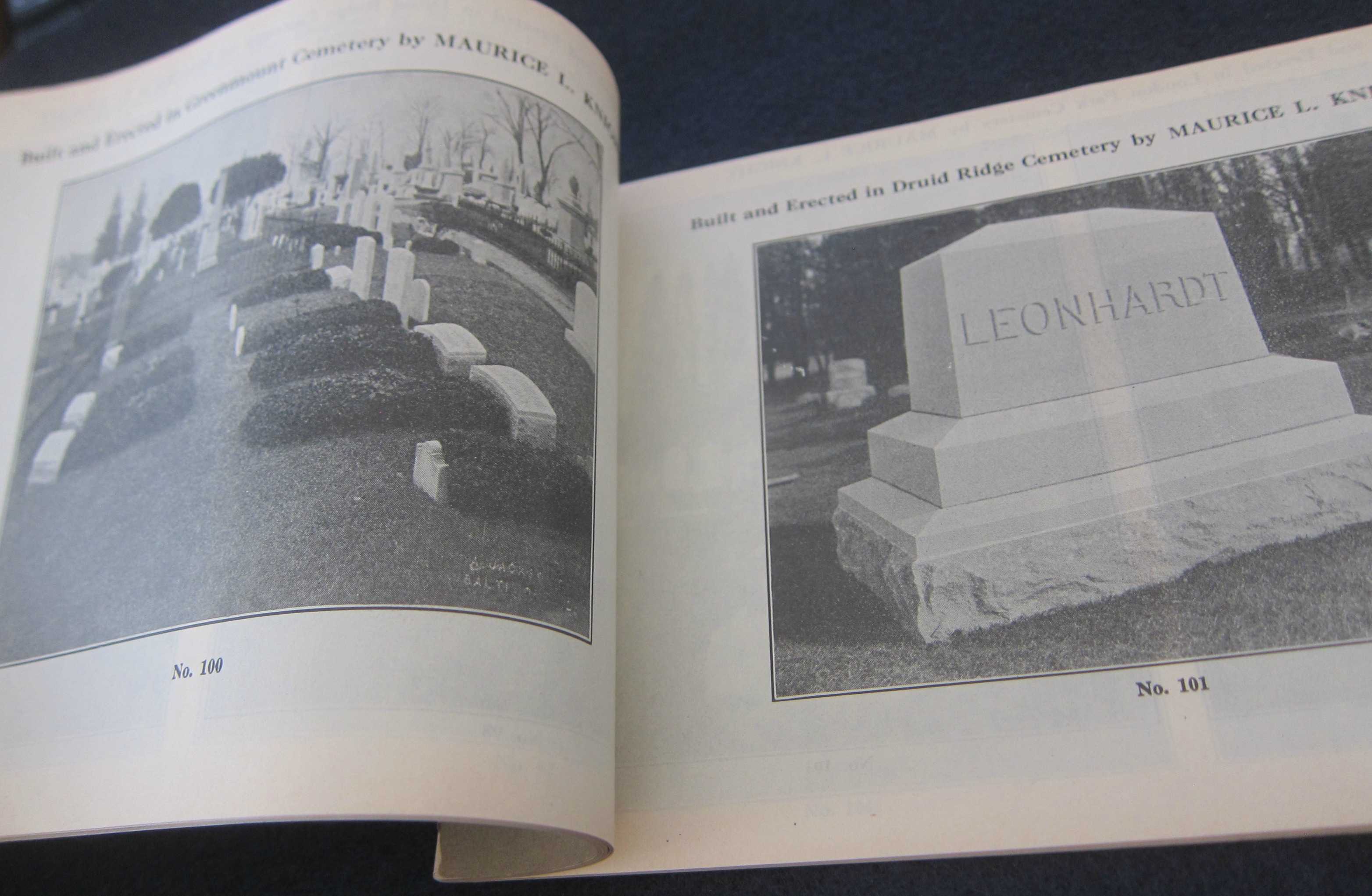
    Mencken tomb _5_ I came upon this curious pamphlet1 by Maurice Knight, curious in itself, being a manufacturer’s catalog for gravestones/markers/monuments, which was something I knew must have existed in dozens of different incantations through the years, though I had never actually seen one. Opening the catalog I saw at the bottom the small and distinctive rubber stamp stating that this was once the property of H.L. Mencken, who shed it to the Library of Congress in 1926, and which later was sold to me in the library’s Exchange Program for surplus and duplicate material. 

    Knight was a Baltimore man and firm, and as it turns out there are numerous examples of  Knight’s work pictured (“in use”) in a number of Baltimore cemeteries, but most interestingly in Loudon Park Cemetery, where the Mencken family plot is located. I cannot tell if the Mencken stones have any connection to Knight, or if Mencken was planning something else. (There are no annotations by Mencken in the text nor I guess should there be–I just state this because if I don’t I imagine that someone will ask.). Mencken’s family plot was already well-established, so I’m really not sure why he would have this prospectus.  

    Anyway, here it is. The title of the catalog tells the reader to “Consult the Master”–with Mencken, I wonder who that master might have been? 

    Ironically the location of the stone works (1025 West Mulberry St, Balto) is now a simple empty lot, its nothingness secured by a chain-link fence. Not a very romantic end to a business who purpose was remeberance. 

    Notes:

    1. Consult the Master, Maurice L. Knight, for your Monument-Tomb-Vault. Office and Works, 1025 West Mulberry St., Baltimore, MD. 9×6″, ca. 75pp, with 150+ illustrations of the work of the stone master. Title printed vertically though the book opens horizontally. Original wrappers. The wrappers are scuffed and bumped a bit around the edges, though the text is bright and clean.  Provenance: stamped on the reverse of the title page “Gift/Mr. H.L. Mencken/March 30, 1926”, being a gift to the Library of Congress, with their surplus stamp on the rear cover. 

    Mencken tomb _2

    Mencken tomb _2

    ·Posted by :

    ·in:


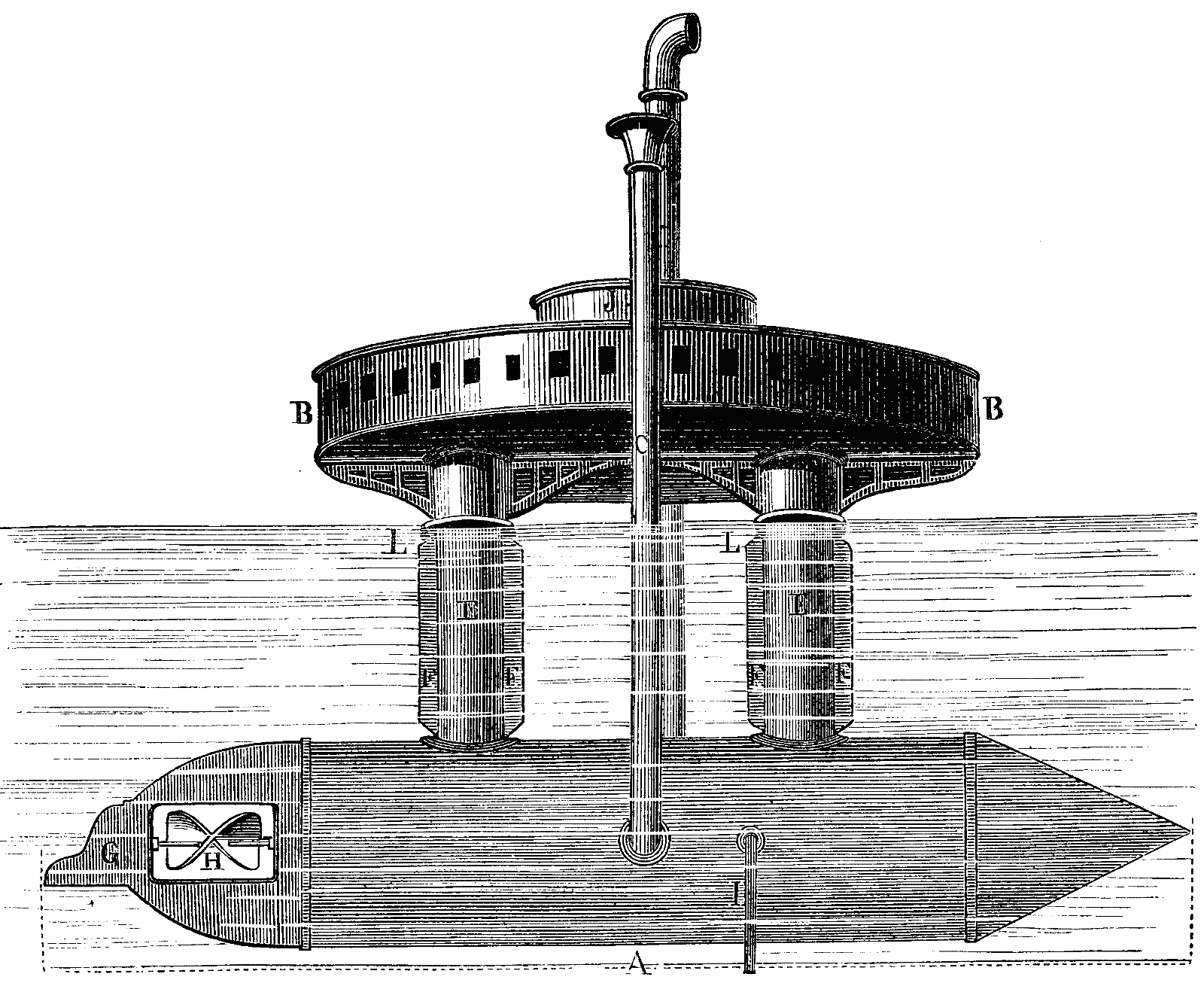
  • A Few Circular Ships (Some Submerged and Semi-Sugmerged) 1868-1880

    JF Ptak Science Books     (Expanding an earlier post)

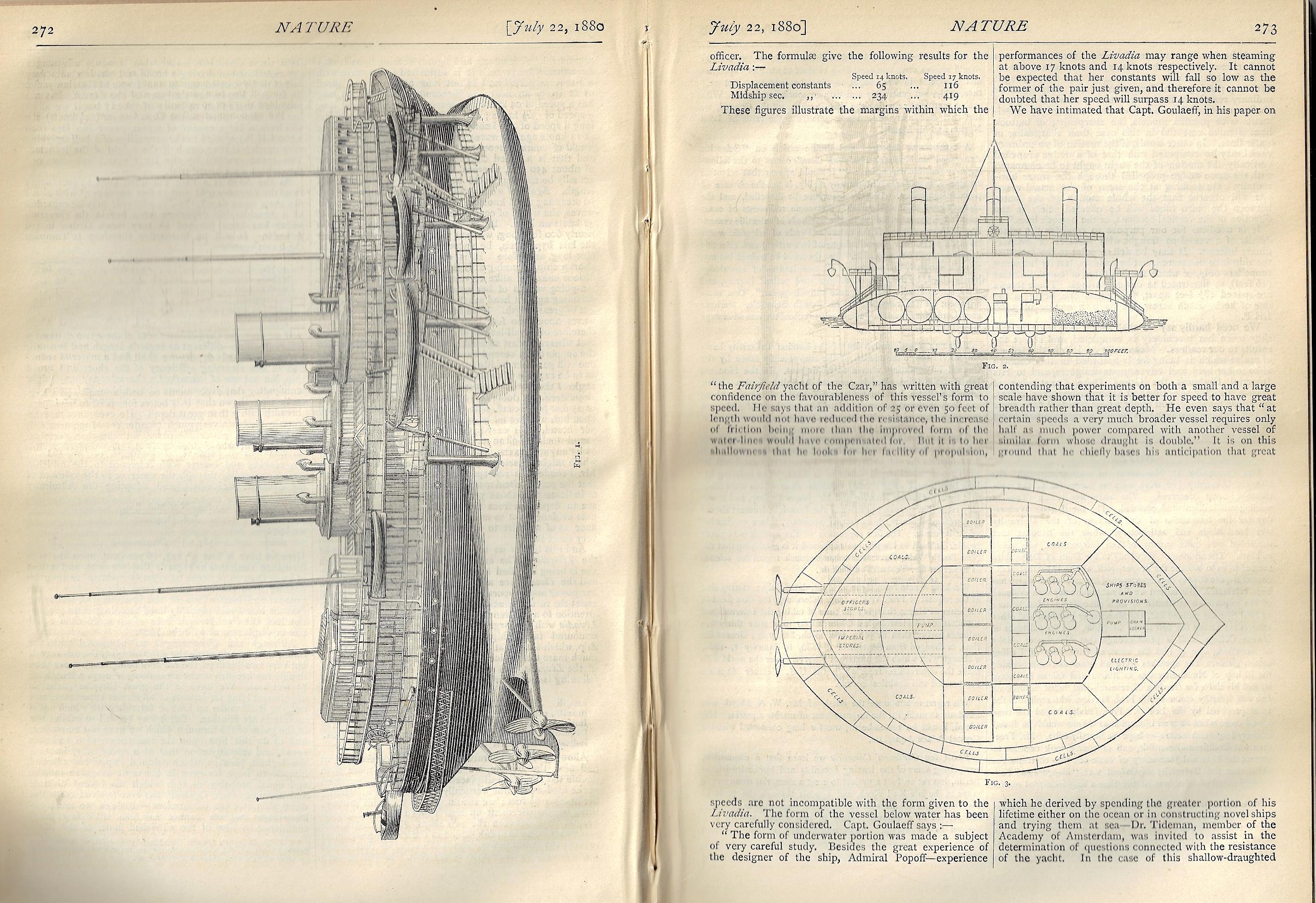
    I’ve noticed a few interesting articles on the circular ship from mid-late 19th century; I don’t really have much to say about them except that I appreciate their structure and, well, beauty, and so I’m just sharing them here. 

    First is “The Russian Imperial Yacht, ‘Livadia’”, which is an article in Nature, July 22, 1880, appearing on pp 270-274, with several large illustrations, including an elevation and a plan of the ship.  

    Nature 1880 Lividia

    “The Livadia was an imperial yacht of the House of Romanov built in 1879–1880…intended for service on the Black Sea…a radically novel ship conceived by Vice Admiral Andrey Popov, designed by naval architect Erast Gulyaev and built by John Elder & Co. of Govan on Clyde. The Livadia continued Popov’s line of circular shipsalthough this time Popov sacrificed geometrical perfection for seagoing capabilities. She had a beam of 153 ft (47 m) against overall length of only 259 ft (79 m). An extreme example of tumblehome architecture, she sported a conventionally shaped superstructure mounted on a wide, flat-bottomed, turbot-shaped submerged hull or pontoon. The Livadia turned out a surprisingly maneuverable and stable ship with a respectable maximum speed of 15.7 knots and her efficiency was comparable to conventional ships. Her performance at sea trials surprised most naval architects and was attributed to the favorable placement of the propellers.”–Wikipedia

    Next is this fantastic set of drawings for a proposed circular semi-submerged ship, the work of Donato Topmmasi of Paris, and which appeared February 24, 1877, in the Scientific American, page 115.

    Submerged ships tommasi a


    ·Posted by :

    ·in:


  • Heavy (Underground) Metal, 1910

    JF Ptak Science Books  Quick Post

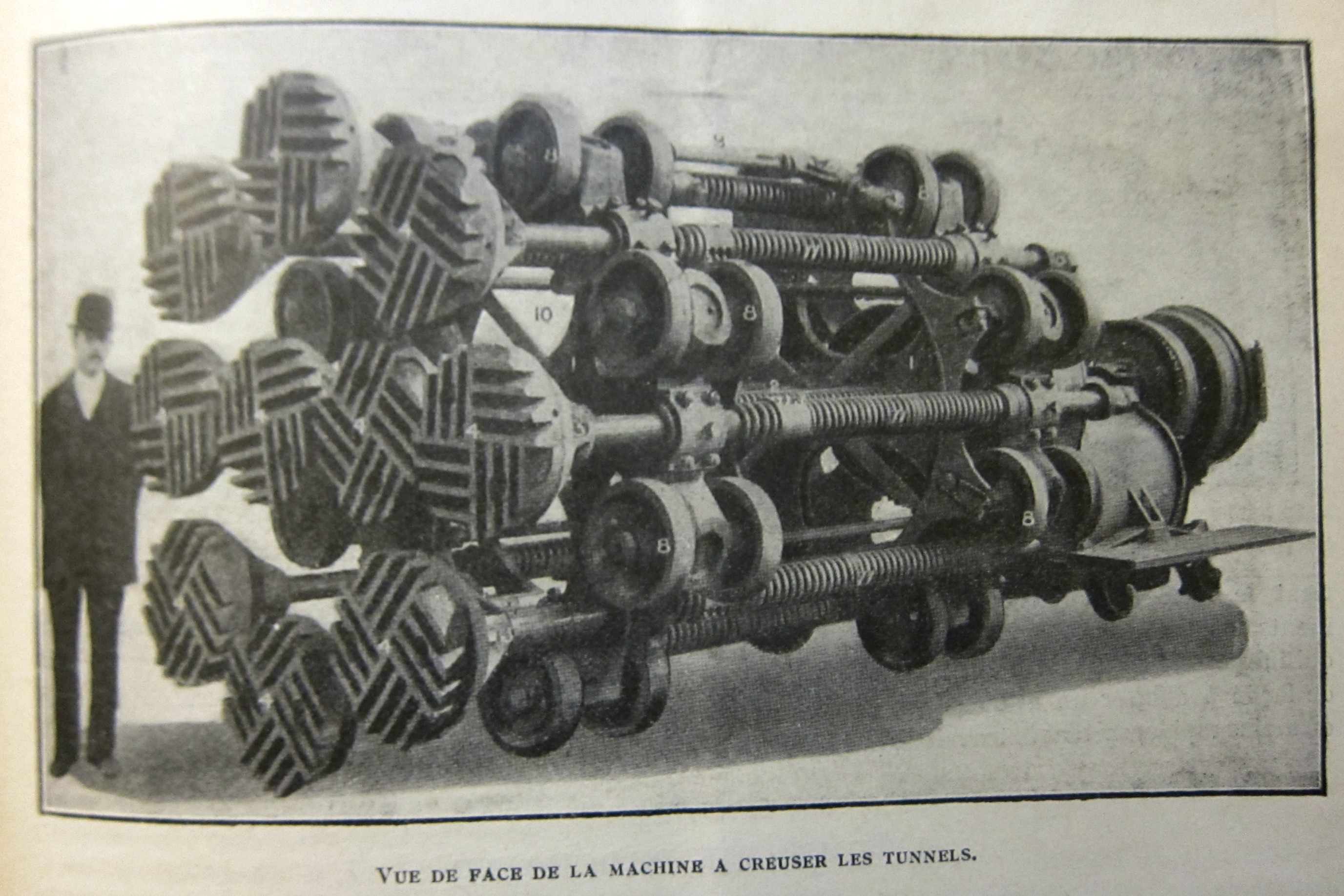
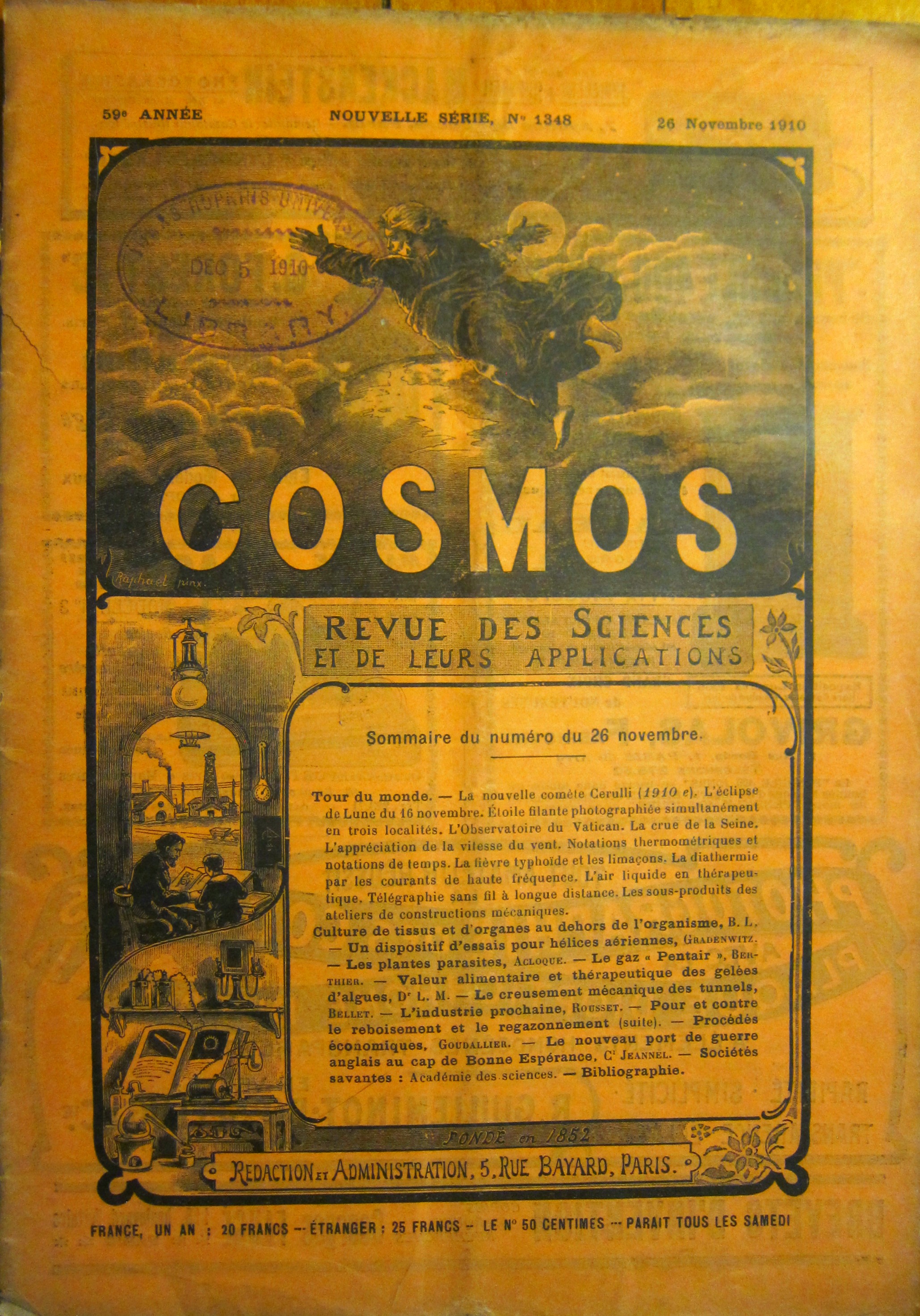
    This is a beast, and the beast was a tunnel digger. This image is from the article “Le Creusement Mechanique des Tunnels” and is captioned “Vue de face de la machine creuser les tunnels”, with “creuser” meaning to dig, and the entire thing meaning, simply, “front of the tunnel digger”, though it sounds much better in French. It appears in Cosmos, Revue des Science et de Leurs Applications, which was published in the weekly issue for 26 November 1910.  This is the only science journal/magazine with a cover illustration featuring the Creator of the Universe.  

    What a wonderful thing this machine was, though right after I think of how many backs of laborers it saved, I am moved immediately to what an engineer would do if the machine got stuck.

    Cosmos November 1910 _2_

    Cosmos November 1910

    ·Posted by :

    ·in:


  • Data Visualization and Enormity–the Cost of War in Terms of Iconic Buildings (1917 and 2017)

    JF Ptak Science Books  Post 2733

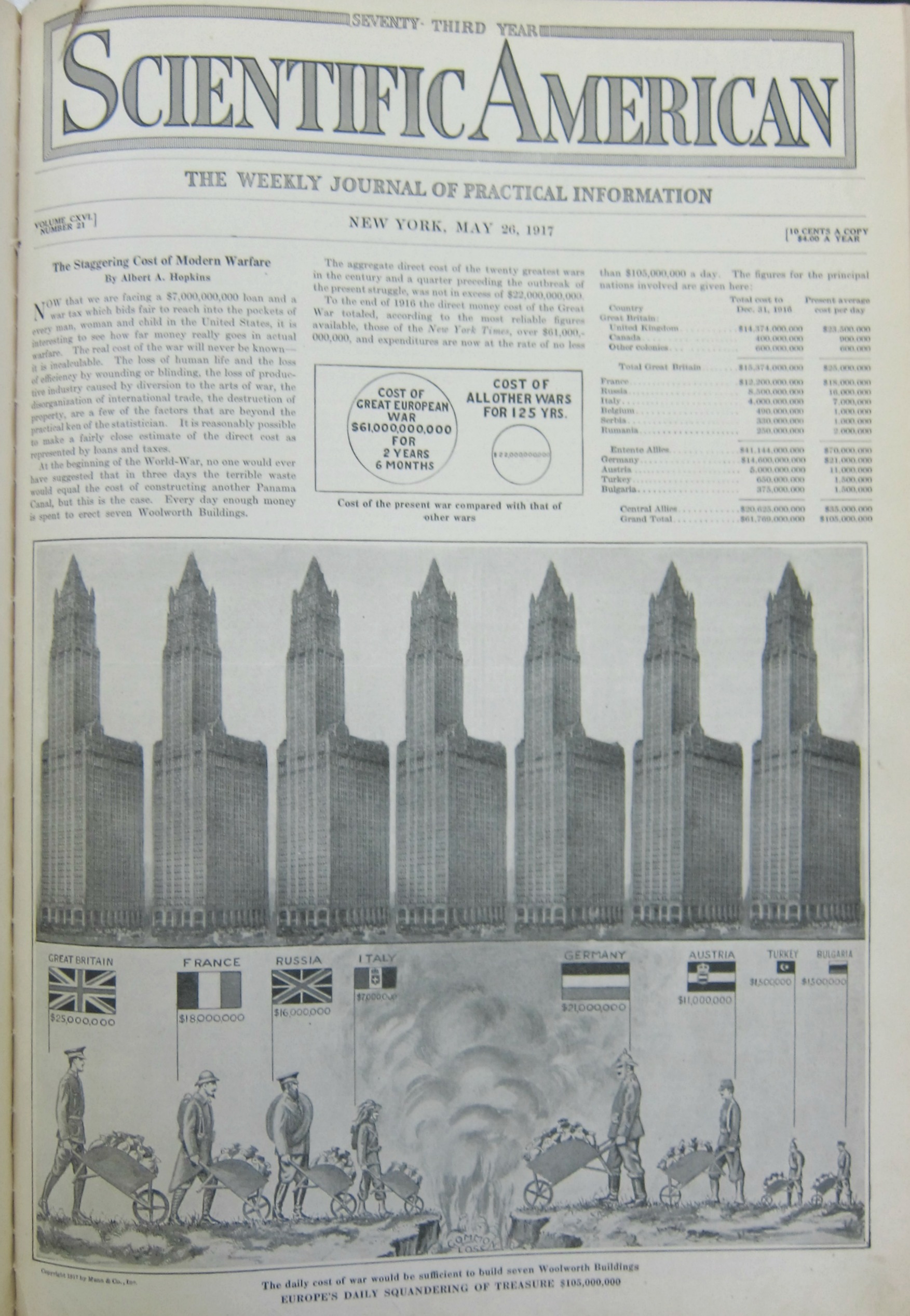
    The first thing that a reader in the U.S. will probably notice in this graphic is that there is no “United States” entry–that is because the U.S. had only entered the war seven weeks before this image was made after having been steadfastly neutral for the war’s first 2.5 years.  That said the daily cost of war was made accessible and understandable to the readership of the Scientific American by putting costs in terms of the construction of the then-tallest building in the world, the Woolworth Building (the world record holder for height from 1911-1930). 

    Overall, for the eight major combatants, the total daily cost of the war was the equivalent of the cost for building eight Woolworth Buildings, every day.  At the end of the war that would have been a stack of Woolworth Buildings that was 30 x 30 Woolworths square and 100 Woolworths tall.  

    And just for perspective, the daily cost for Great Britain was 25 million pounds in 1917, which using the B of E calculator for inflation, would be about 1.2 billion pounds today (per day).  This is roughly in league wit the cost of U.S. involvement in the 2003 Iraq war at about 700 million dollars a day (since 2003). 

    It is difficult to “translate” what $61 billion in 1917 is related to in 2017 dollars. The Bureau of Labor statistics says it is something on the order of  $1.3 trillion, so it must be in there, within or so of an order of magnitude. And now it looks like the “total” cost of the U.S. wars in Iraq and Afghanistan will probably be $10 trillion when all is said and done. That would be equal to the cost of about 2,000 2 World Trade Centers. Given that the costs for WWI still had another year and a half to go, they may have accumulated costs doubling up on the 900+ Woolworth Buildings to 1,800 or 2,000–anyway something pretty similar to 2 World Trade Center measurements, which is pretty odd. 

    There are many ways of looking at this data, though the Scientific American wanted to approach the expenditure in terms of gigantic piles of waste, given that people are pouring money from wheel barrows into a hole.

    • See also an earlier post here on data visualization and the measuring of things with the Woolworth Building:  https://historyofideasblog.com/thesciencebookstore/2016/06/data-vizualization-automobiles.html

    Dataviz WWI war expenses full

    [Source: Scientific American, May 26, 1917.]