A Daily History of Holes, Dots, Lines, Science, History, Math, Physics, Art, the Unintentional Absurd, Architecture, Maps, Data Visualization, Blank and Missing Things, and so on. |1.6 million words, 7500 images, 4.9 million hits| Press & appearances in The Times, Le Figaro, Mensa, The Economist, The Guardian, Discovery News, Slate, Le Monde, Sci American Blogs, Le Pont, and many other places… 5000+ total posts since 2008.

Author: JF Ptak

  • Data Visualization and Enormity–the Cost of War in Terms of Iconic Buildings (1917 and 2017)

    JF Ptak Science Books  Post 2733

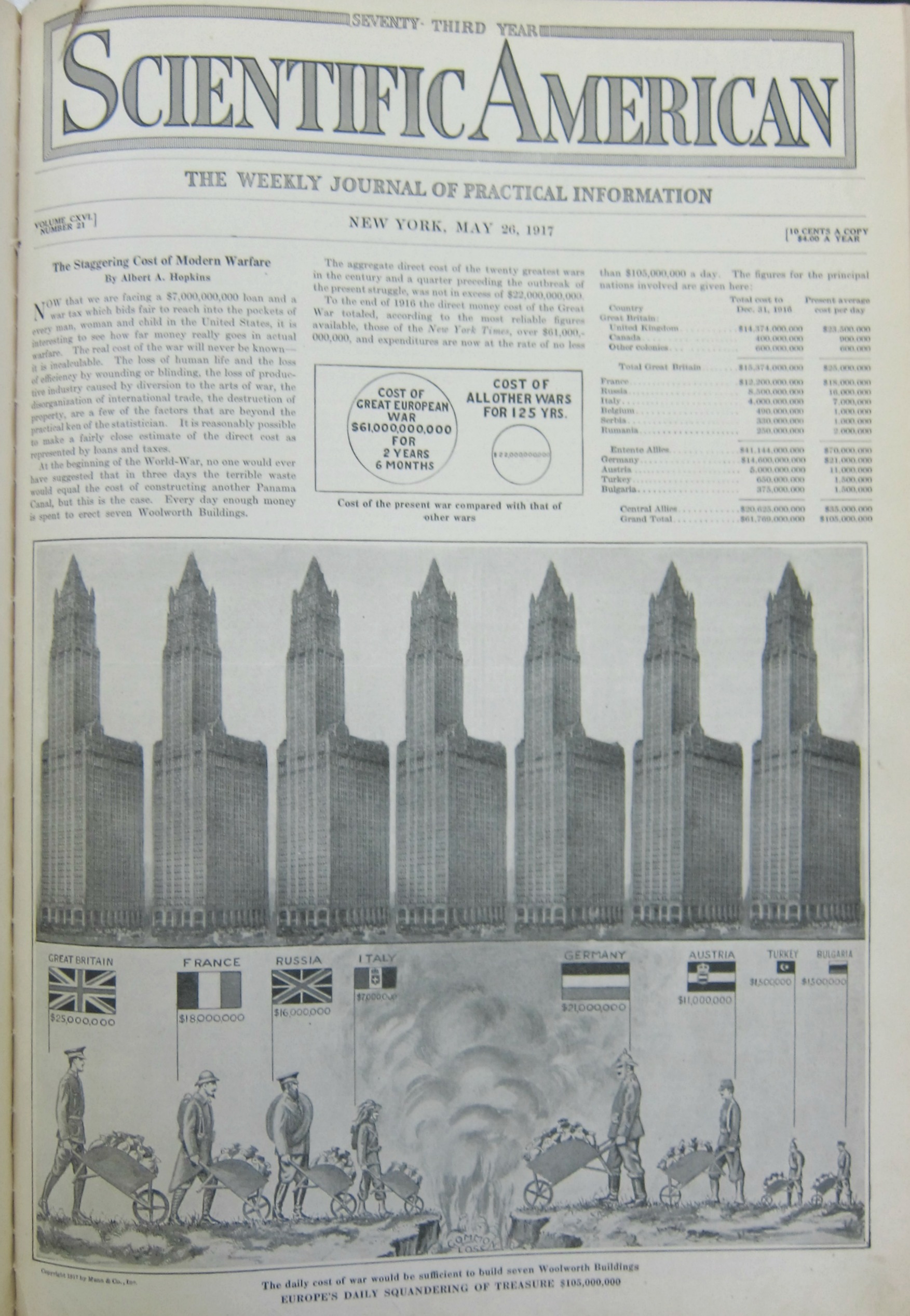
    The first thing that a reader in the U.S. will probably notice in this graphic is that there is no “United States” entry–that is because the U.S. had only entered the war seven weeks before this image was made after having been steadfastly neutral for the war’s first 2.5 years.  That said the daily cost of war was made accessible and understandable to the readership of the Scientific American by putting costs in terms of the construction of the then-tallest building in the world, the Woolworth Building (the world record holder for height from 1911-1930). 

    Overall, for the eight major combatants, the total daily cost of the war was the equivalent of the cost for building eight Woolworth Buildings, every day.  At the end of the war that would have been a stack of Woolworth Buildings that was 30 x 30 Woolworths square and 100 Woolworths tall.  

    And just for perspective, the daily cost for Great Britain was 25 million pounds in 1917, which using the B of E calculator for inflation, would be about 1.2 billion pounds today (per day).  This is roughly in league wit the cost of U.S. involvement in the 2003 Iraq war at about 700 million dollars a day (since 2003). 

    It is difficult to “translate” what $61 billion in 1917 is related to in 2017 dollars. The Bureau of Labor statistics says it is something on the order of  $1.3 trillion, so it must be in there, within or so of an order of magnitude. And now it looks like the “total” cost of the U.S. wars in Iraq and Afghanistan will probably be $10 trillion when all is said and done. That would be equal to the cost of about 2,000 2 World Trade Centers. Given that the costs for WWI still had another year and a half to go, they may have accumulated costs doubling up on the 900+ Woolworth Buildings to 1,800 or 2,000–anyway something pretty similar to 2 World Trade Center measurements, which is pretty odd. 

    There are many ways of looking at this data, though the Scientific American wanted to approach the expenditure in terms of gigantic piles of waste, given that people are pouring money from wheel barrows into a hole.

    • See also an earlier post here on data visualization and the measuring of things with the Woolworth Building:  https://historyofideasblog.com/thesciencebookstore/2016/06/data-vizualization-automobiles.html
    Dataviz WWI war expenses full

    [Source: Scientific American, May 26, 1917.]

  • Using a Stick to Find Fugitive Murderers (1693)

    JF Ptak Science Books Quick Post

    Here’s a quick bit, found in the title of a book that I bumped into–one could evidently hire a dowser to find “fugitive murderers” and “robbers” in addition to precious ore, and water, and treasures, and what-have-you. It appears in Pierre Le Lorrain,  l’Abbe de Vallemont’s  La Physique occulte, ou Traité de la baguette divinatoire et de son utilité pour la découverte des sources d’eau, des minières, des trésors cachez, des voleurs et des meurtriers fugitifs. Avec des principes qui expliquent les phénomènes les plus obscurs de la Nature (1693) which almost translates by itself to “Occult Physics, or the Treatise of the Divine Wand and its Use in Discovering Water Springs, Mining, Hidden Treasures, Robbers and Fugitive Murders. With principles that explain the darkest phenomena of Nature”. 

    The subject of dowsing is just something I cannot spend any time on, except to say that it was of particular interest at this time (in the late 17th century), and that in addition to this semi-spiritual mind-application of mining and etc. M. Le Lorrain (1649-1721) also includes astrological tables to help in the pursuit of the inexplicable. I don’t know how that was supposed to work outside of making his hocus pocus less approachable and more complex by showering it in complicated-looking astrological diagrams, showing that “science” was at work.

    In addition to all of the other gifts that Le Lorrain’s practice offered, finding robbers and “fugitive murderers” were among its talent set. And why not? Perhaps the practice was entirely removed and existed in a set of unexpected Umwelten. Perhaps the diving involved “need” as a confluence of the alignment of the stars and the specific needs of finding water, or criminals, each of which would offer its own vapor-need trails to the diviner.  (As it turns out it seems that need/vapor-need wasn’t too far off a guess, as Le Lorrain thought the connection to be invisible corpuscles.) In any event, that world is a secret one, with the answers to exactly what it is all about (present tense intended) probably answerable on a Ouija board, even though in other aspects of his life Le Lorrain was a man with a scientific background (writing on the Copernican cosmology and on magnets).  As I’ve already said a couple of times, I don’t understand this. 

    • An epigram on dowsing/diving, the rod being known in Latin as Virgula Divina. The rod makes an appearance here, in 1651, a hundred years after it makes its first appearance in general, in print. Water-finding by divination etc. is an ancient practice, though the special stick that is now associated with it seems not to be mentioned until much later.
    Virgula divina.
    “Some Sorcerers do boast they have a Rod,
    Gather’d with Vowes and Sacrifice,
    And (borne about) will strangely nod
    To hidden Treasure where it lies;
    Mankind is (sure) that Rod divine,
    For to the Wealthiest (ever) they incline.”–Samuel Sheppard, from Epigrams theological, philosophical, and romantick (1651) 


    ·Posted by :

    ·in:


  • The First Published Photo of the Wrights in Flight (1908)

    JF Ptak Science Books   Post 2731

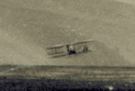
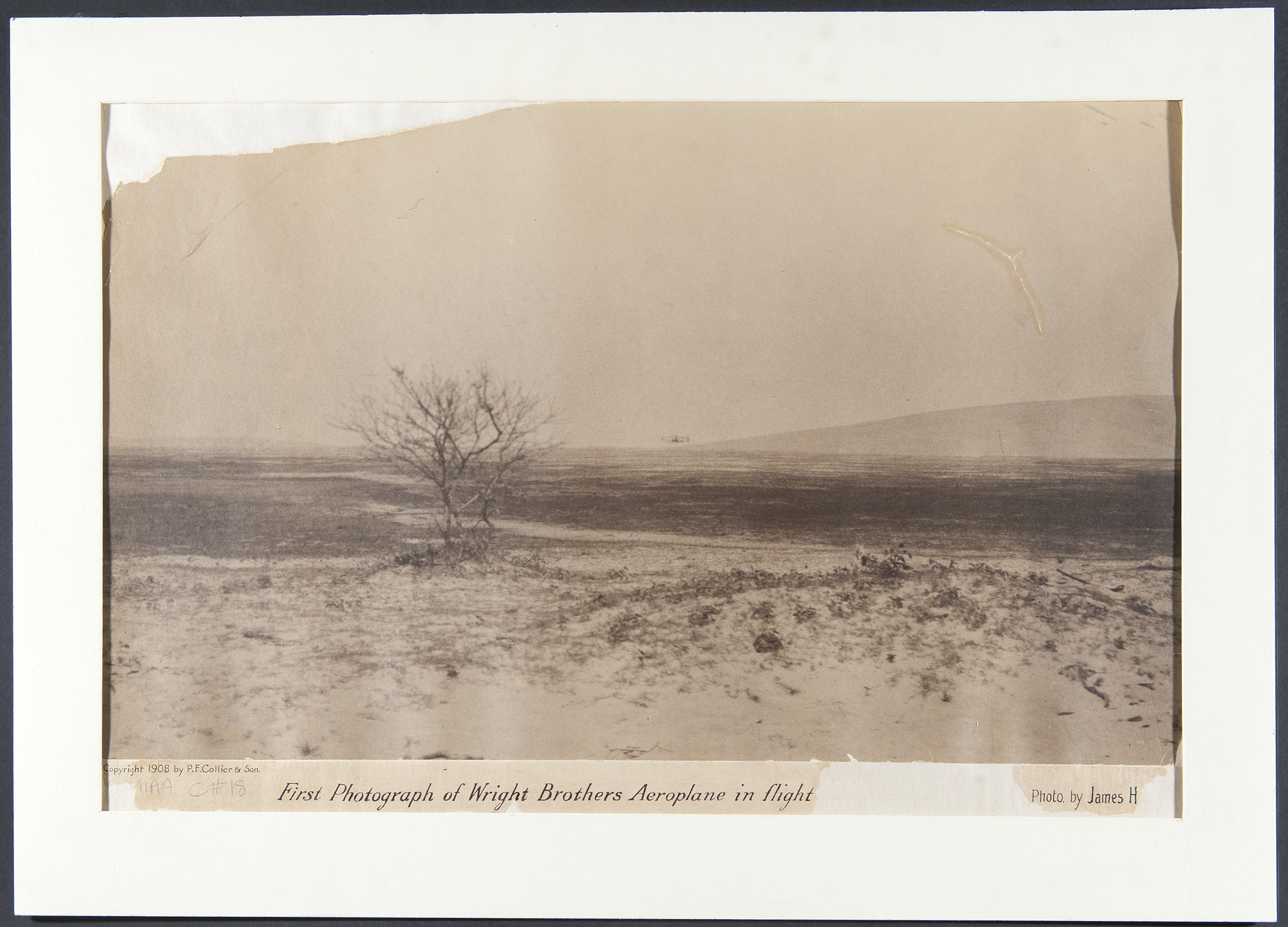
    This photograph is the way most of the world was introduced to the Wright Brothers’ flyer (1905 Flyer III)–in flight. The image was made by the very well-known  photographer James H. “Jimmy” Hare, working for Collier’s Weekly magazine, May 14, 1908, at Kill Devil Hills in North Carolina. There had been photos of the brothers and their machines before, though not with the flyers powered and in flight. This was the photo that changed the perception of the possibility of human flight to some great swath of  doubters–even though there had been hundreds of flights before, the weight of evidence was still not ample enough to popularly convince some section of casual thinkers.  Evidence was all. 

    Just a few months from now, on 1 August 1908, Wilbur would put on his first public flying demonstration at Le Mans, France, a masterful two minute performance that came at the end of a day of patient waiting by a large and attentive crowd. The high-level doubters who attended the performance were doubters no longer after Wilbur took off with his perfectly controlled high-performance machine. The Wright invention went from being questionable that morning, and by sunset, the Wrights had been anointed as the conquerors of the air. Their victory across Europe was enormous and immediate. the response to the demonstration was spectacular. 

    At nearly the same time as Wilbur was displaying the flying machine in France, Orville was doing so for his Army trials at Ft. Myer, Virginia, just outside of DC, abutting Arlington National Cemetery. During this two month period, the brothers traded world records back and forth in a spectacular display of human flight. After Orville initial flights at Ft. Myer, it became known far and wide to the ruling elite in DC what Orville was up to only a few miles away, and there was an exodus of legislators and etc. across the river to watch the history that evidently was being made. There were thousands of people there to witness the flights, and Orville did not disappoint, and the crowd of people high and low were astonished and impressed, and the acknowledgment of the new era of flight had arrived. As famous as Wilbur was in Europe, the news of Orville’s accomplished eclipsed his brother’s (for a while). 


    Source of images:  http://core.ecu.edu/umc/wrights/exhibitpressrelease.html

    Wright Hare photo 1908


    This is the detail from near-center of the photo:

    Wright hare photo closeup 1908

    And another, from the collections at Air and Space:

    https://airandspace.si.edu/collection-objects/wright-brothers-1905-flyer-iii-photograph

    Wright hare photo _2_

    ·Posted by :

    ·in:


  • Two Curious Bits in the Early History of the Wright Brothers

    JF Ptak Science Books  Post 2730

    This is something of a stray thought, thinking about some ironies in the history of the Wright Brothers and their connections to early flight, back in the 1890s.

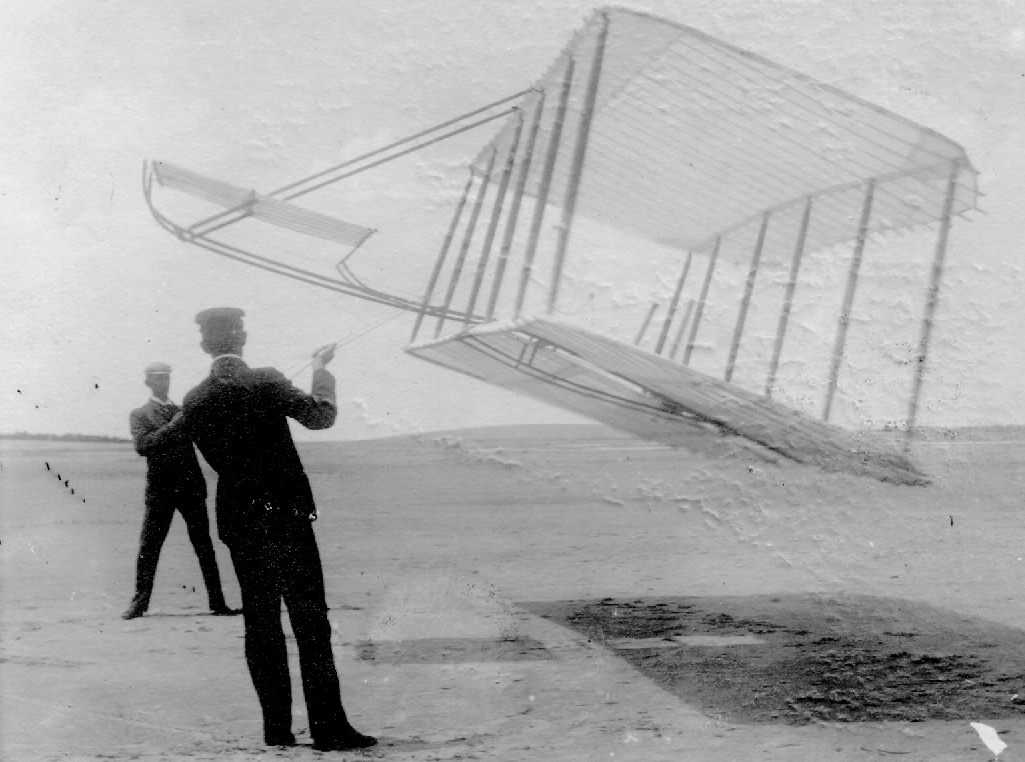
    Orville and Wilbur seem to become acquainted with the substantial aeronautical work and experimentation of Otto Lilienthal (1848-1896) while Orville was laid very low from a near-fatal bout of typhoid fever. According to David McCullough in his book on the Wrights, Wilbur read to the very weakened and bed-ridden Orville about Lilienthal as Orville tussled with the angel of death. The brothers were fascinated by the work, and would become heavily influenced by it (though in truth by 1902 they would find via their own experimental work that much of the data compiled by Lilienthal was problematic, and somewhat useless.) 

    Wright-glider-kited

    [The Wrights with their glider, at Kill Devil Hills, from Wright-Brothers dot org http://www.wright-brothers.org/Information_Desk/Just_the_Facts/Kites_&_Gliders/1901_Glider.htm]

    Lilienthal was a glider man, convinced that the only way to become acquainted with the ways of the wind was to experience it the way that birds would.  In that vein his gliders were pretty much designed after bird wings, and he would operate them much like a  person on a hang glider would today.  He was very successful in these endeavors, soaring for several decades before the Wrights became acquainted with him, and was perhaps one of the most famous men in the world in the realm of human flight. No doubt part of the reason for this were the photographs of Lilienthal that were circulated in the popular press and periodicals, and subsequently part of the “crazy” haze that descended on so many early pioneers of flight was somewhat lifted because of unimpeachable records of success. I suspect that the photographic imaging of the progress by Lilienthal  took hold in the Wrights as well, as they made very careful photographic documentation of their own progress, as well as having some proof for their successes.

    Lilienthal though was killed in a 50′ high fall shortly before Orville fell ill. As McCulloch points out Lilienthal too had a brother, Gustav (1849-1933) who helped him in his technical pursuits, and it was his brother who sat next to him the day after his accident in Berlin when he died. I suspect that the Wrights felt an affinity or at least an understanding for the brothers’ support of one another, something that the Wrights shared to a very high degree, right up to Wilbur’s death in 1912. (Wilbur would die from typhoid fever, unable to beat it as his brother had.) 

    The other part of this slight ironic connection occurred at 1127 West Third St, which was the address of the last Wright brothers bicycle shop in Dayton from 1896 to 1908 (and since removed to Dearborn, Michigan, along with the Wright family home on Hawthorne Street, purchased in 1936 and moved there by Henry Ford). Opened in the year of Lilienthal’s death and Orville’s typhoid experience, the shop–which furnished the only income to the brothers and the only funding source for their flight experiments–was located in the ground floor of a duplex, the other business sharing the property being Fetters & Shank, “Undertakers & Embalmers; Coffins, Caskets & Robes of any Style or … quality furnished at reasonable prices”2 I know, I know, that these are only slight coincidences, but they struck me this morning, out for a walk with the dogs. There are no connections there, of course–these are just two curious things. 

    Notes:

    1. David McCulloch, The Wright Brothers, Simon & Schuster, 2015. Even though this book seems a little slim at 320pp, it has a very definite weight to it; McCulloch  shares their story with deep insight and wisdom.

    2. James Tobin To Conquer the Air: The Wright Brothers and the Great Race for Flight, 2003. 

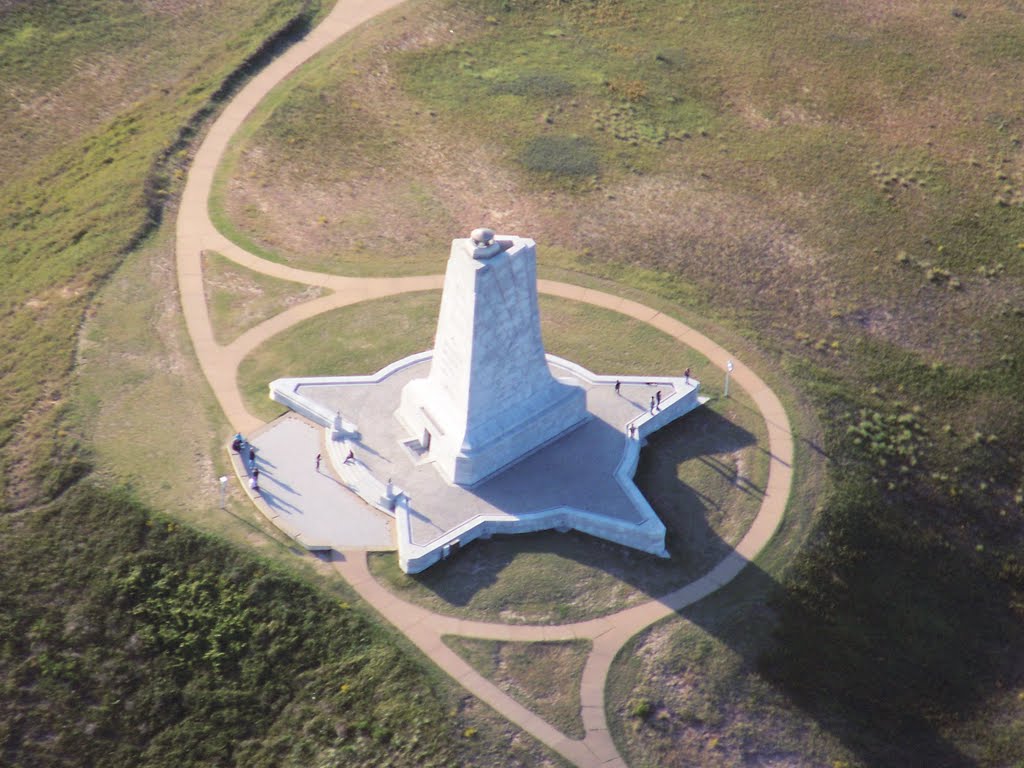
    Okay, there’s also this: the Wright Brothers memorial at Kill Devil Hills in North Carolina is exceptionally stumpy and heavy, and ugly, and seems the least likely design to honor something as beautifully designed and implemented as the Wright glider. 

    Wright borther memorial

    [Photo image source: http://warrior481.blogspot.com/2011/10/pilgrimage-that-almost-wasnt.html]


    ·Posted by :

    ·in:


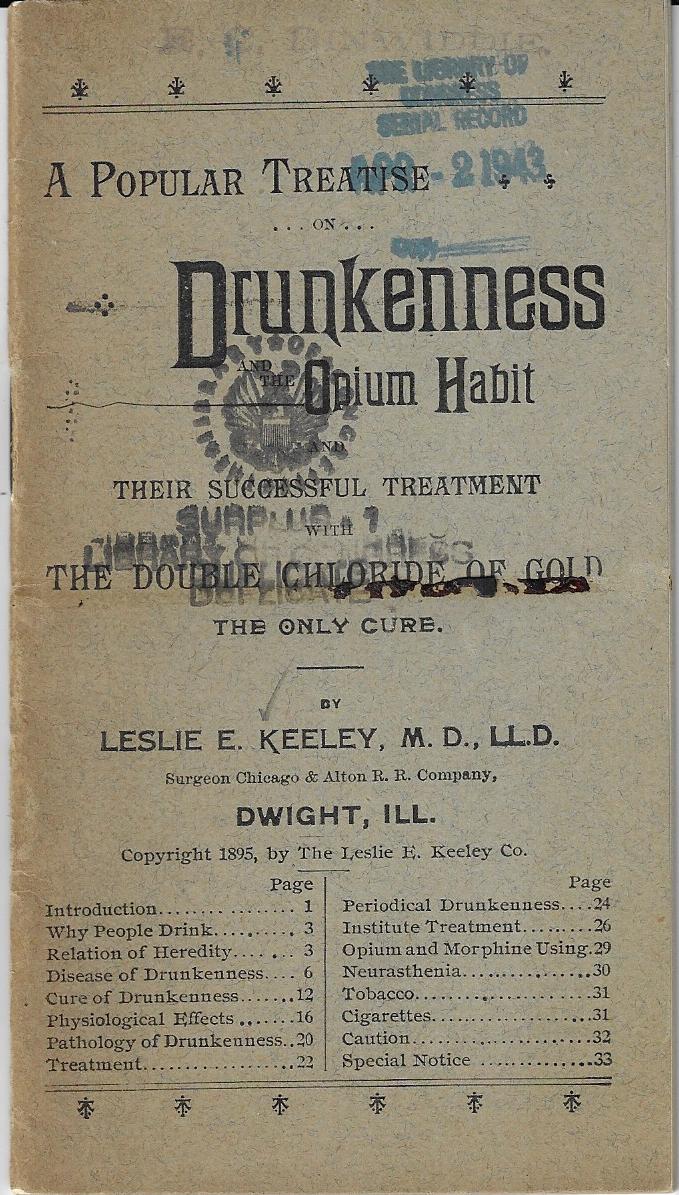
  • Drinking, Drugs, and the Gold Cure (1891)

    JF Ptak Science Books   Post 2729

    Gold cureLeslie E. Kelley (1836-1900) was a doctor, lawyer, and a Civil War surgeon who opened his own surgical practice and stayed at it for a couple of decades before coming upon the idea of a cure for alcoholism. Seen through the lenses of his patented gold cure for alcohol addiction I think there is little room other than to see him as a quack1 (if not an uncommon one) in the history of medicine–he was however somewhat significant in this cure venture in that he was an early figure in describing alcoholism as a medical disease. People who stayed for weeks at one of the Leslie’s cure institutes were weened away from drink and given treatments including the double chloride of gold tonic, something that was shown to be “27.55% alcohol plus ammonium chloride, aloin and tincture of cinchona but no gold”. The patients also received dozens of hypodermic injections which were shown to be combination of “sulfate of strychnine, atropine and boracic acid” –(Wikipedia)   

    Dr. Kelley ran a persuasive campaign, with bulging results, with over 90 franchised Kelley institutes by 1893 and gin-blossoming to over 200 soon afterwards (data from Wikipedia).

    (Joe Nickell writes for the Center for Inquiry that “…the result of Dr Keeley’s medicines was to make patients experience fear, confusion, vomiting, and dizziness, among other ill effects” which may have induced or trained them into associating those symptoms with drinking. (See http://www.centerforinquiry.net/blogs/entry/historic_gold_cure_for_addiction/)  The remedy/cure of course did not work–and so far as how this was supposed to work to cure alcoholism, I do not know. The only thing that evidently did work was restricting and then eliminating the consumption of alcohol at the clinics. 

    Kelley claimed huge success; after some time, there was a big difference of opinion on his success rates. It was finally admitted that a large percentage of the “cured “ alcoholics going through his clinics relapsed–though there was an enormous draw-back to this admission. The brilliant and diabolical move from the Institutes’ part was to claim that those who were cured were cured even after relapse, as the return to drinking was a choice rather than the cured medical necessity.Redefining terms (and in this case, all terms) in language suitable to a specific goal is the penultimate defense before failure (the last line being simple denial).

    The last Kelley Institute to close did only in 1966, back in the small town where it all started, in Dwight, Illinois.

    The infallible, never-failing cure was said to also prove indispensable in curing tobacco and opium addiction.

    Notes:

    1. “A 1908 article in the Illinois Medical Journal stated that ‘Leslie Keeley was a common, ordinary quack with a useless remedy which made good by advertising and catching suckers’.”–Wikipedia


  • A Flamingo-Legged Boat of 1876

    JF Ptak Science Books   Quick Post

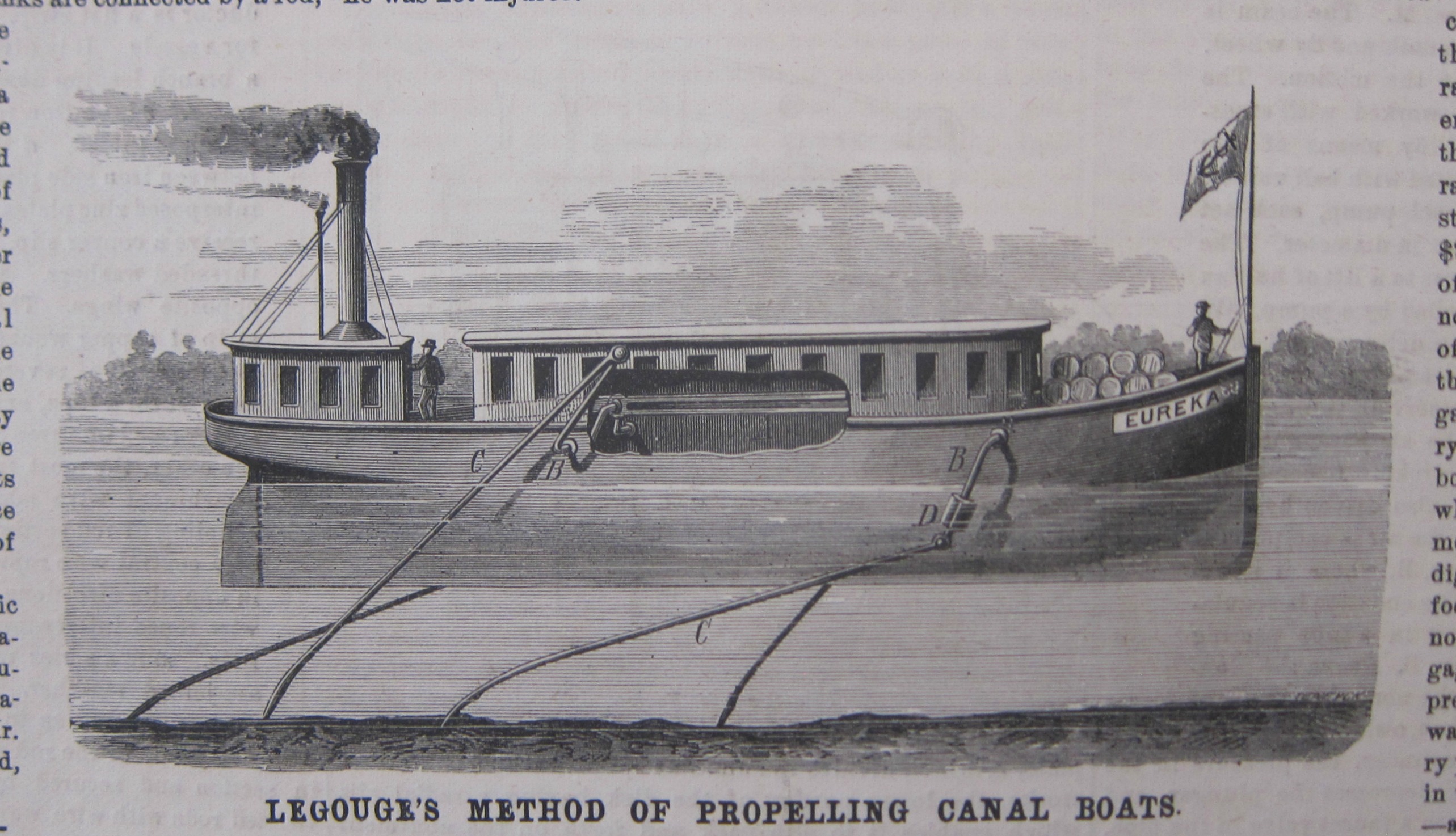
    Sure, I’m poking a little fun here at this propulsion system, but the “legs” do remind me of a flamingo’s. The article, “Improved Method of Propelling Canal Boats” (appearing in Scientific American for December 9, 1876) details their function, and I must say, the thinking and engineering were of high quality in spite of the overall efficacy of the plan.  The inventor, Louis F.A. Legogue, developed the engine and an articulated series of push bars that were connected to a steam-powered crank and wheel which in its complete revolution pushes the bar obliquely down (resulting in it pushing the boat forward) and on the return revolution the bar is pulled up again ready to by pushed down. And so the canal boat would makes its way in the water. That would have taken this job away from humans, whose job it was to do pretty much the same thing, only without steam. (They also remind me of one of those cartoons in Punch magazine in the 1870’s of long-legged gentlemen pushing their way into a headwind without mussing one moustache hair.)  

    SciAm 1876 creeping canal boat


    ·Posted by :

    ·in:


  • WWI Boxing Exhibition (1918)

    JF Ptak Science Books   Quick Post

    WWI Photos boxing

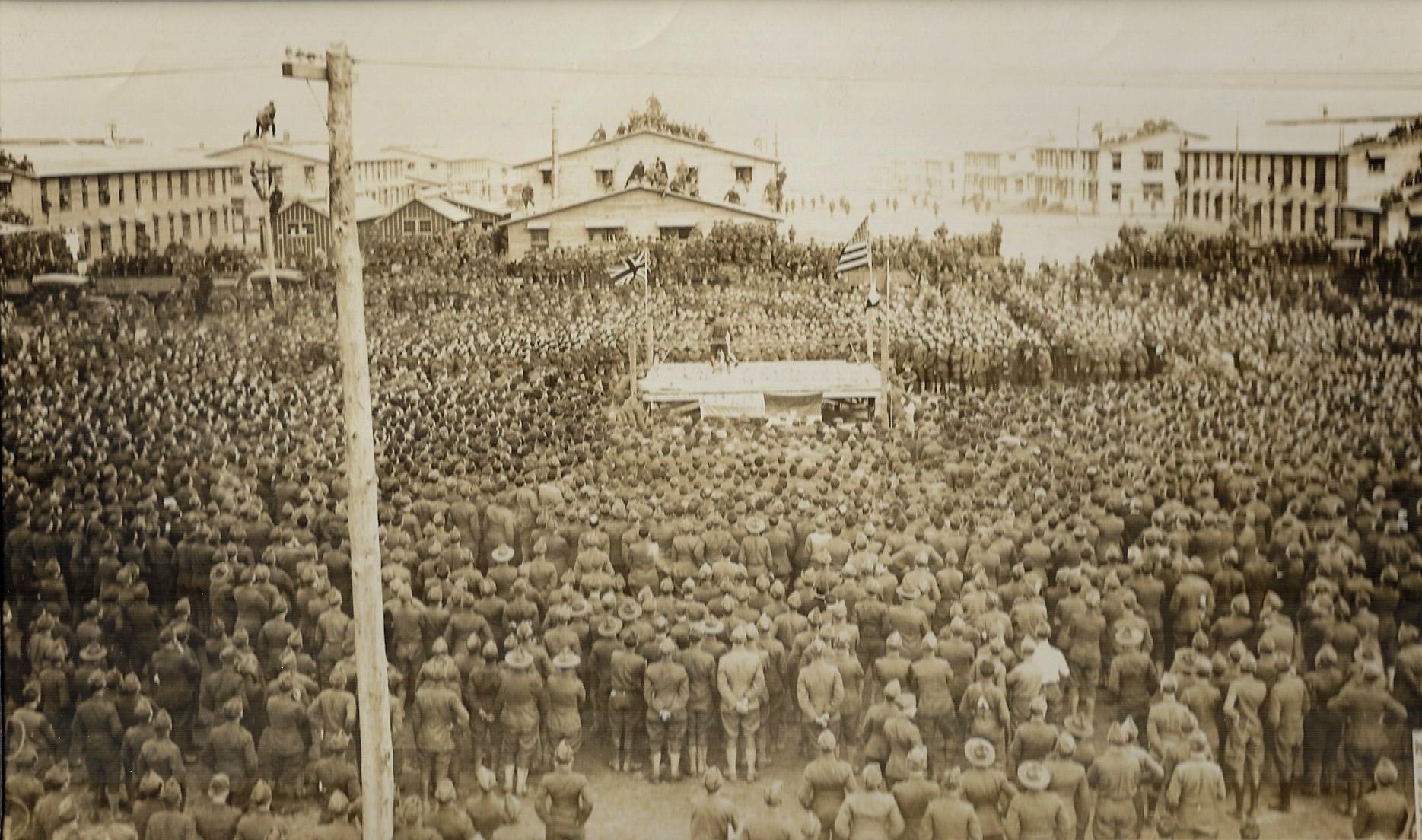
    This fantastic photo comes from a collection of WWI News Photo Service photographs. Given that in general photographers were not allowed free and unrestricted access to military areas (let alone battlefields) photographs were made by pools of photographers working for several different photographic news agencies. The content of the images were generally secured and approved by the Committee for Public Information (CPI), which came into existence by executive order under President Woodrow Wilson on April 13, 1917, and which was charged with the task of wining the hearts and minds of the people of the U.S., to gain public support for the war and for American participation.  

    It is somewhat both ironic and not terribly uncommon for Wilson to have run for the presidency for one thing and then doing exactly the opposite, as he did with his 1916 re-election campaign slogan “He Kept Us out of War”.  

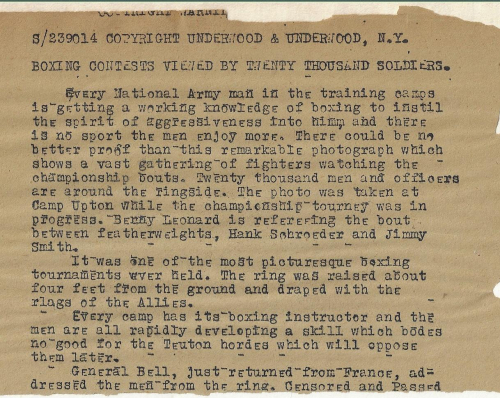
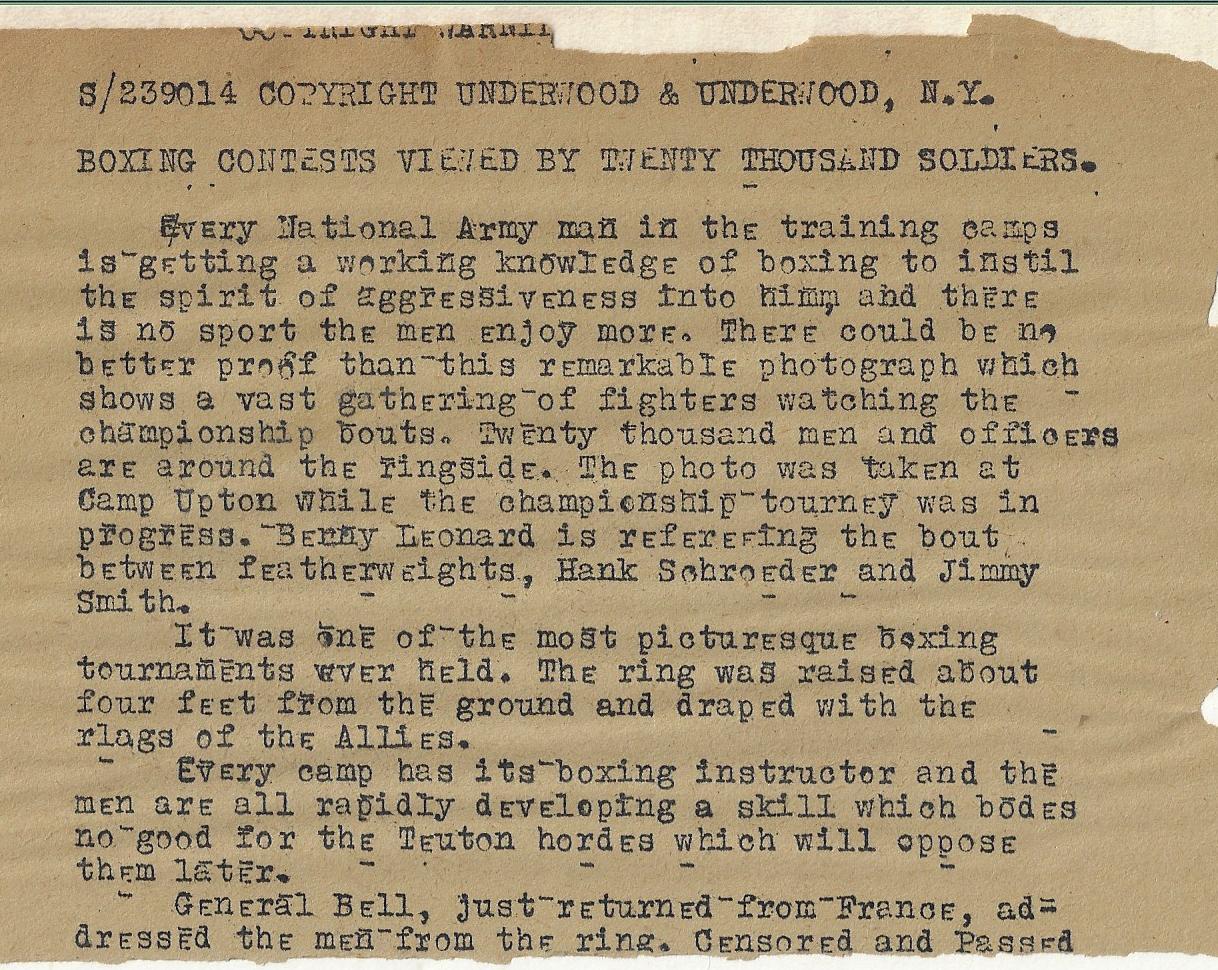
    The way that many newspapers obtained the war images that they published in their papers was via a semi-centralized pool of war images.  The newspaper would request, say, a photo of German prisoners, and would contact one of these photographic agencies—for example, say, the Central News Photo Service of 26-28 Beaver Street, NYC—and purchase the rights for republication, and then print it in the newspaper along with the story.  In almost every case the photo would be accompanied by a caption mimeographed onto an attached piece of cheap paper, or have the information stamped on the reverse.

    WWI Photo boxing text

    Photography was just one aspect of the information distribution and control by CPI–there were also thousands of Newspaper articles, public speakers (the famous “Four Minute Men” who would give some 7 million pepper talks at the beginnings of movies and public events), radio broadcasts, films, posters, demonstrations and anti-demonstrations, and other public displays.  


    ·Posted by :

    ·in:


  • The Progression of Construction of a Hawker “Hart” R.A.F. Day Bomber (1934)

    JF Ptak Science Books  Quick Post

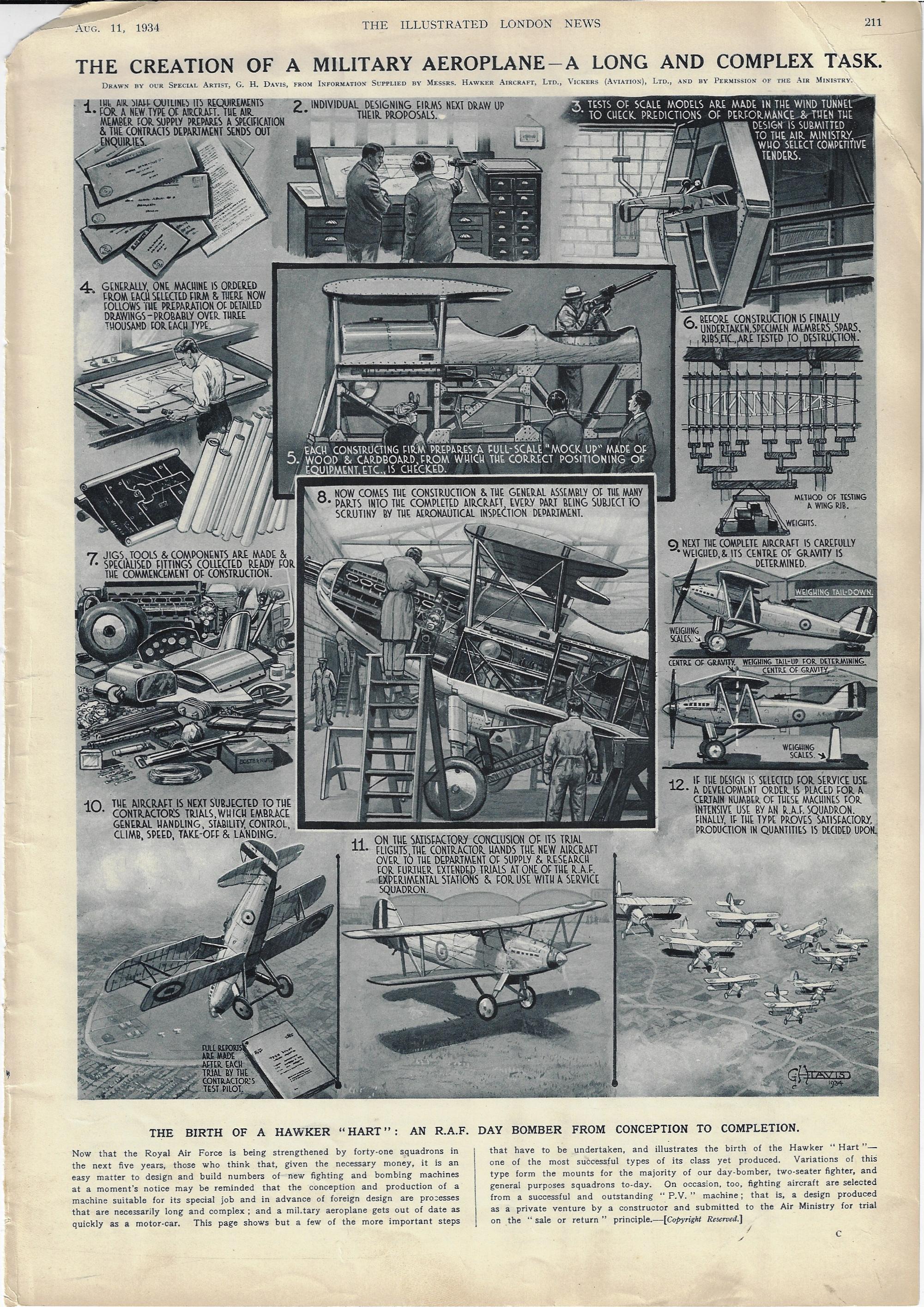
    I enjoy stages-of-construction series of illustrations, showing how cars are made, or boxes, or trenches, and so on.  Sometimes the object being constructed is relatively simple enough and the components few enough that the thing could actually be built from the series of pictures–most of the time, this is not the case, though they do give a good idea of the procedure of construction and the background to it. “The Creation of a Military Aeroplane–a Long and Complex Task” by the prolific and highly detailed G.H. Davis for the Illustrated London News (August 11, 1934) is a good one-page example of this process:

    Dataviz Hawker HArt aircraft 1934


  • Faux Outsider Speculative Political Theory Performance art, 1887

    JF Ptak Science Books   Quick Post

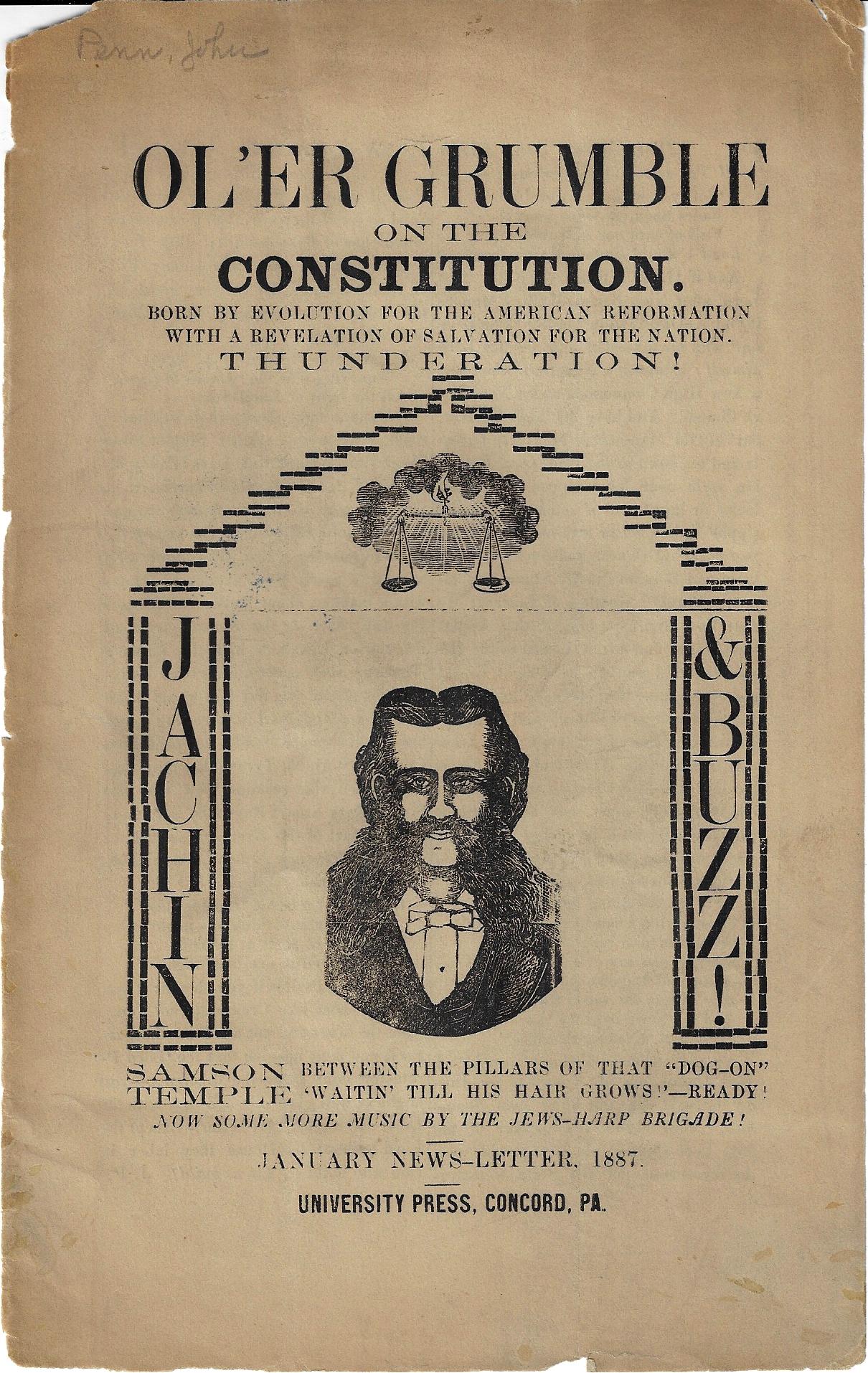
    Having just finished a similar post (“Faux Outsider Speculative History of Rattling Musical Jaw Bones, or Something”) I think that there may be room enough in this blog garden for a series of Faux Outsiders to Accompany the True Outsider Speculatives. For this one, though, I just can’t read the thing because the whole thing comes off in slightly wobbly, gelatinous manner, though I do like the cover art. The pamphlet starts on page 401 volume II, though it is unclear if this pagination actually means something. After the introductory page, we are introduced to a newsletter, which begins with volume II no. 2 for the first month of “Julian Year 6600”.

    So I’ll just reproduce the cover and the first page of the newsletter, and consider my service complete.

    Books cover ol'erNote:

    “According to the Bible, Boaz and Jachin [names used in the design on the cover] were two copper, brass or bronze pillars which stood in the porch of Solomon’s Temple, the first Temple in Jerusalem.”–WIkipedia

    ·Posted by :

    ·in:


  • Faux Outsider Speculative History of Rattling Musical Jaw Bones, or Something

    JF Ptak Science Books  Quick Post

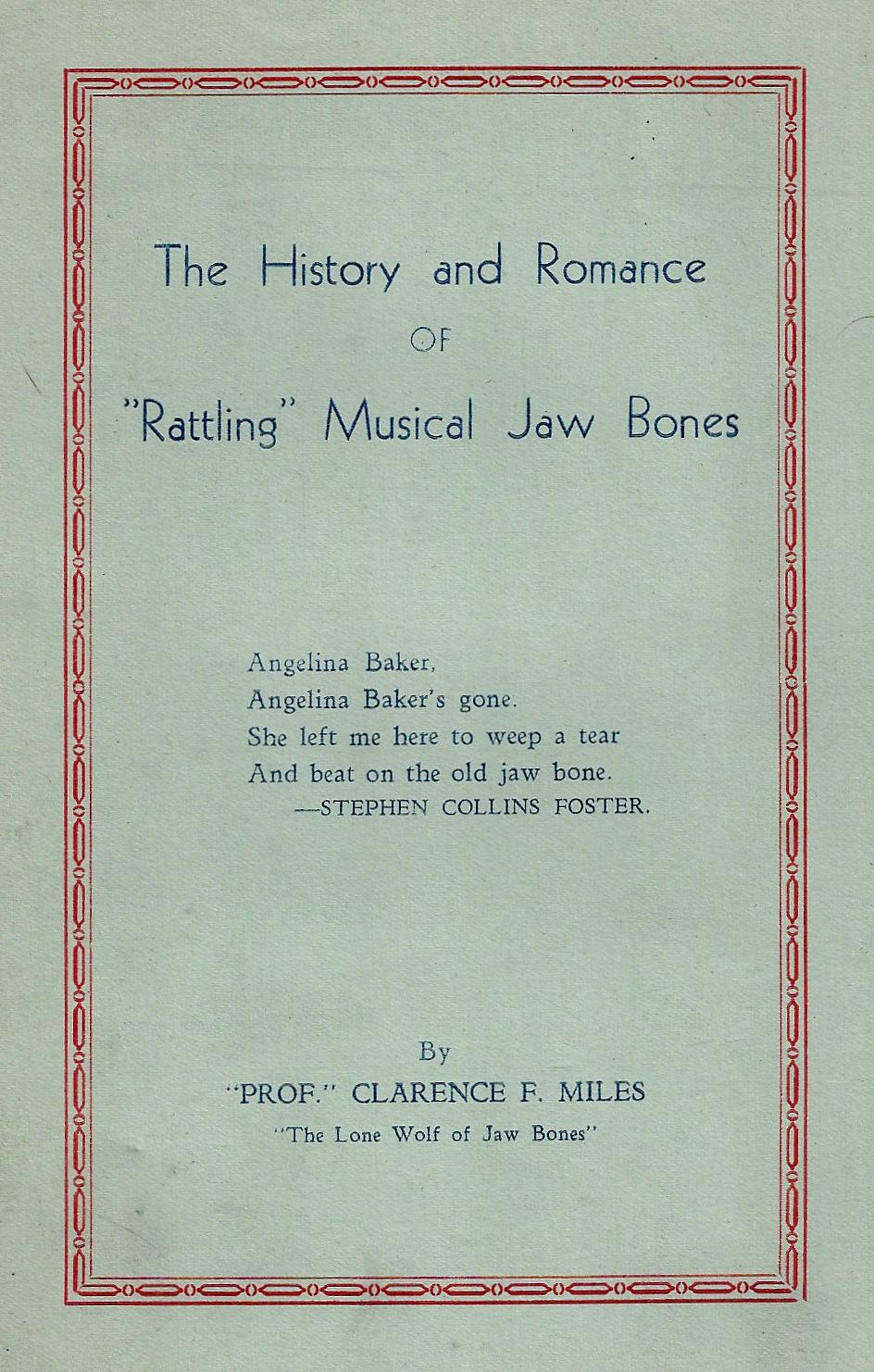
    Books cover rattling jaw bonesWell, here I am, uncertain about posting this odd piece about an odd subject, oddly written in odd style, with odd logic, all wrapped up in a big flat ball of buttery odd.

    At first I thought that this was a true Outsider adventure–that, or a work of a somewhat deep personal dialog that should have stayed deep, and private. In the end I’ve decided that it is a work of Speculative Outsider Fiction, though the subject may be real, but the presentation is purely performance. I think.  

    The work was written by “Prof” Clarence F. Miles, and pertains to horse jaw bones made into a tambourine-type instrument, and has some connection to Stephen Foster1.

    The History and Romance of “Rattling” Musical Jaw Bones,  (1936), “First and only edition, Bulletin No. 1, being the third part of a history of jaw bones” is boasted on one of the sub-title pages, even though it is stated immediately afterwards that “this is my first history of Jaw Bones”. This is an early display of this logic–there are for example the following section headings: “The Last Half of the Second and Last Section of Supplement No. 3” which of course followed the final section called “Second and Last Section of Supplement No. 3” both of which are preceded by  a chapter head  reading “Third Supplement to the First and Only Edition of Bulletin No 1 which is my book the history and romance of rattling jaw bones”! All of those sections fight each other for space in just over three pages. This pamphlet contains powerful displays of such battle construction made even more remarkable by the great brevity of the work, which is only 36 pages, about 10 of which are repetitious bits and chatter. 

    There are also numerous non-sequitur forays into unchartered waterless waters where the unexpected and the unconnected are frequently obtained and connected by brute force: 

    "The above evidence is conclusive proof that Mr. Charles Darwin wasted the five years of his life between the years 
    1831
    and 1836 that he spent as naturalist on the surveying ship H. M. S. Beagle on a voyage around the world
    and that the
    research work performed upon rattling jaw bones by the Stephen Collins Foster Institute of Rattling
    Musical Jaw Bones
    has knocked Mr. Darwin's famous or infamous theory into a cocked hat and the cocked hat
    can be found in the middle of
    next week. Deny it if you can."

    At the end of the work, and after much repetition of the title and the necessity for this history of jaw bones, the author
    states in the third to last paragraph that he hadn't even begun to write the history of jaw bones in his history of jawbones
    book. "From now on I start writing jaw bones at the exact point where jaw bone science ends and the jaw bone skill
    begins", which is a great line. He continues, "I will raise jaw bones to their rightful and exalted station and watch my
    style, speed and dust in accomplishing it".  

    There's more, but I think I've now exhausted my interest, though I do salute Mr. Miles for his great dexterity.

    Notes:
    1. "The quijada, charrasca, or jawbone (in English), is an idiophone percussion instrument made from the jawbone of a
    donkey, horse or mule cattle, producing a powerful buzzing sound. The jawbone is cleaned of tissue and dried to
    make the teeth loose and act as a rattle."--Wikipedia

    ·Posted by :

    ·in: