JF Ptak Science Books Quick Post
Its curious how there were so many names for something that was invisible though its effects were instantly understood, compared to not naming something so visible but whose effects were not as well understood as the former. I’m talking about the wind and clouds. Winds and clouds I should say–it is so easy to write in terms of the singular with wind whereas one would never do so with clouds.
Also the visual vocabulary for depicting winds that aren’t directly associated with a cloud (say, a tornado) are extremely difficult to depict unless you are showing direction and severity. Another obvious exception would be depicting the mythological wind gods, of which there are many and in some cases the wind gods are paired with thunder gods (as with numerous Asian examples, see https://en.wikipedia.org/wiki/List_of_wind_deities#Aztec_mythology for a quick list). And its not like winds are easily represented as wind in art, though again it seems to me that for early works prior to say 1700 its feels to me like Chinese/Korean/Japanese artists are more interested in the subject than others. When I try to imagine the wind and to some degree its effects in art I come up with Andrew Wyeth’s blown curtains, a windy (?) van Gogh “Starry Night”, the great wave of Hokusai, Turner’s Rain/Steam/Speed, and Homer’s nautical scenes (and the nautical genre in general). It is a different story for books with “Wind” in the title–there are no doubt hundreds (Gone with, Name of the, Shadow of the, Reap the, Paint the, Before the, Written on the, and so on). Perhaps the wind is a little bit like the quark of art, in that it is a confined environment but it is observable, and measurable…which I guess makes it nothing like the quark, except that it is “difficult”.
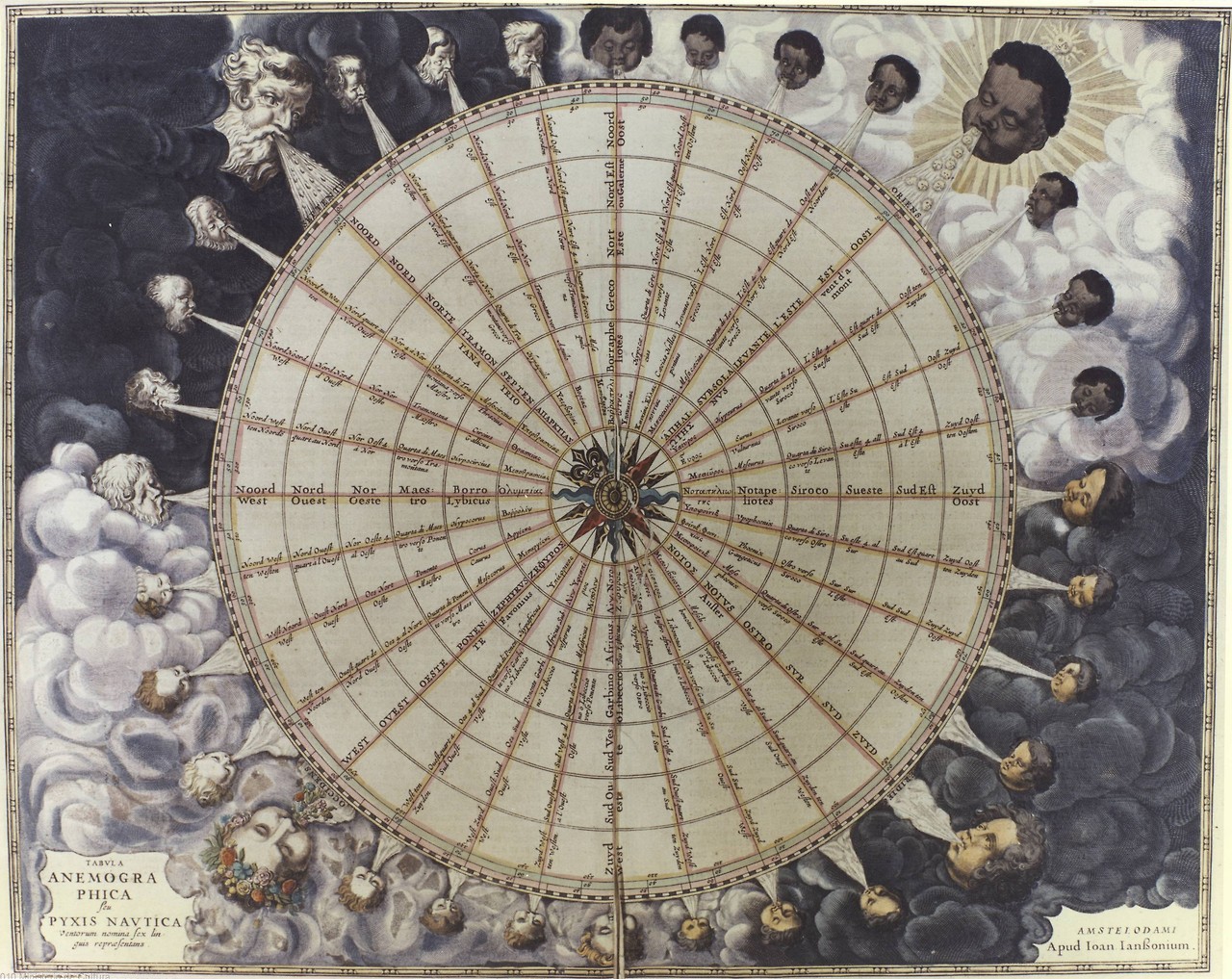
In any event, following up on post from a while ago on the names of the winds ( https://historyofideasblog.com/thesciencebookstore/2012/04/chasing-the-squamish-the-fremantle-doctor-and-naming-the-wind.html) I wanted to share this great display of information, Jan Jansson’s volvelle/chart of the 32 winds from the fifth volume of his monumental Atlas Major, which was published in 1650. (Jansson, “Tabula Anemographica seu Pyxis Nautica Ventorum nomina sex linguis repræsentans”. Amsterdam, c.1690. Image via Bibliodyssey .)
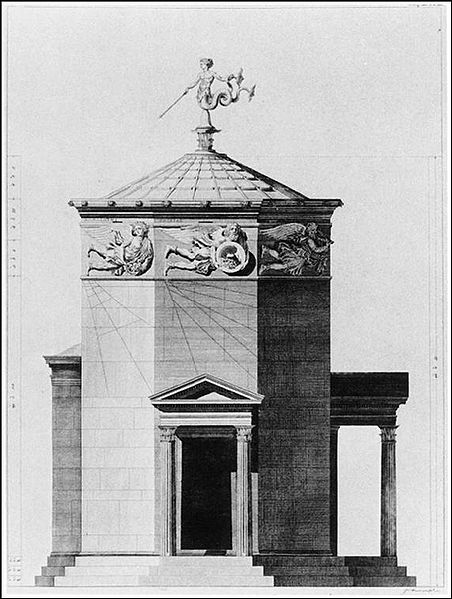
A monumental, three-dimensional form of wind identification exists in Greece, a marble Roman clocktower (an horologion) with a wind vane at the top, along with eight symbols of the associated gods of the winds (the Anemoi) that the vane depicts: Boreas (N), Kaikias (NE), Eurus (SE), Apeliotes (E), Notus (S), Livas (SW), Zephyrus (W), and Skiron (NW).
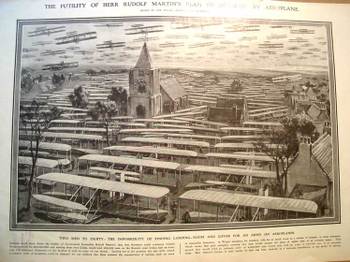
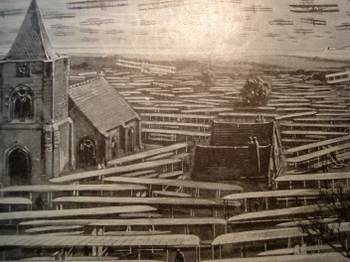 “Nothing could show better the futility of Government Councillor Rudolf Martin’s idea that Germany could construct 50,000 flying machines for 50-million pounds…and land 100,000 men on the Kentish coast from Calais within half an hour.” I would imagine that this illustration drove the point home to the folks who didn’t actually bother to read anything about the Martin defense plan. (It was in a similar way that Thomas Nast was able to control public opinion and sway political refuge and protection away from Boss Tweed. Tweed famously boasted that he didn’t care what the newspapers said about him because his power base didn’t read–he might’ve been and probably was correct here, so Nast took after Tweed via the political cartoon, and big too, and frequently; and the cartoons, even if the people looking at them couldn’t read, told the whole story graphically, and it was this that brought an end to Tweed more than anything else.)