JF Ptak Science Books Post 2193
I was looking around for one of the original references to the earliest human-tech definition of “singularity” and found it in a roundabout way, a classic reference referenced in a classic paper on singularity. Vernor Vinge wrote a breakout paper in 1993 called “The Coming Technological Singularity: How to Survive in the Post-Human Era”1. Among many other things the San Diego State math prof quotes how the great Stan Ulam paraphrased John von Neumann saying: “One conversation centered on the ever accelerating progress of technology and changes in the mode of human life, which gives the appearance of approaching some essential singularity in the history of the race beyond which human affairs, as we know them, could not continue.” This was in 1958, and it appeared in Ulam’s “Tribute to John von Neumann” in the Bulletin of the American Mathematical Society, (volume 64, number 3, part 2, pp 1-49).
It struck me as ironic that the “singularity” would appear just at the time von Neumann2–perhaps without equal in this century in thinking in terms of the computer and its applications and overall sheer brain-power–died, Ulam surfacing the term in what was basically a memorial/obituary/celebration issue of the Bulletin, the carbon-based life-form container finally failing the great mind.
It was then that I came to realize how much biologicalization has taken place in compsci terminology–not the least of which is the self-replicating and damaging “virus”, which itself of course is a massive biological deal, though in the digital world it is not its most abundant entity3. E-viriology is found just about everywhere, much like its bio counterpart, which is located in every ecosystem on Earth.
Even the word “computer” has an earlier biological counterpart–the “computer” was a human tabulator, a person grunting out figures into some sort of tabulating device. (Tracts for Computers, a series that began in 1919 and edited by Karl Pearson, is filled with statistical elements intended for the human computer…)
But what strikes me first are the bio references for the bad stuff. The viruses, and then later, the worms, and Trojan horses. (I should point out the “bug” enters the computer vernacular fairly early, in 1949, via (later Admiral) Grace Murray Hooper, though it doesn’t get listed by her in her 1954 glossary of computer terms as published in two parts in Computers and Automation, volume 4, 1954. There’s no “bug”, though there is “de-bug”.)
“Virus” emerges in a science fiction effort by Douglas Gerrold in 1972, a few years before they were artificially produced, which was a few years before a virus was released into the e-phere (“in the wild”). In 1975 John Bruner unleashes a “worm” in his Shockwave Rider.
Others early viruses have biological names: Creeper (1970), Rabbitt (1974), ANIMAL (by John Walker, though not created for being malicious, 1975), Top Cat (1980), Elk (1982), Whale (1990), Hare (1996), Blackworm (2006). There are of course many more names for viruses (and company) that are not biological, but it struck me of how many of the earliest examples do have animal names. I’m not sure that I have much to say about this presently, though I did want to put the general observation out there in this note.
Notes:
1. The abstract of the paper begins: “The acceleration of technological progress has been the central feature of this century. I argue in this paper that we are on the edge of change comparable to the rise of human life on Earth. The precise cause of this change is the imminent creation by technology of entities with greater than human intelligence. There are several means by which science may achieve this breakthrough…”
2. Perhaps of most interest here is von Neumann’s 1949 paper, “Theory and Organization of Complicated Automata”, which looks as the logic required for the self-replicating machine, in A. W. Burks, ed., Theory of Self-Reproducing Automata [by] John von Neumann, University of Illinois Press, Urbana, pp. 29-87. This was based on transcripts of lectures delivered at the University of Illinois, in December 1949, and then edited for publication by A.W. Burks.
3. “Virus” is an old word, and is Latin for “poison” or “poisonous”, and which first appeared in English in 1392. “Virulent” appears in English in 1728, “viral” in 1948, “virion” in 1958. “Virus” as we know it bioloigcally today has a somewhat complicated history, escaping Pasteur and his microscope until it emerges (again) with Martinus Beijernick in 1898.


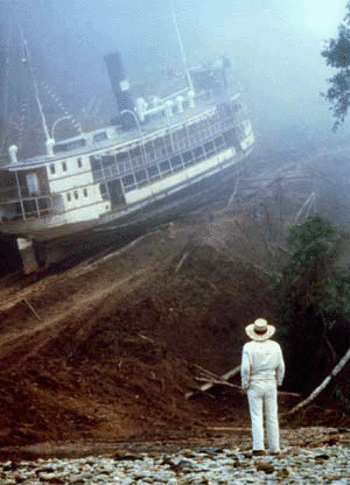 In 1982 Werner Herzog, in what may have been a weirdly fashioned and irresistible death-wish effort, released a very difficult film that he wrote and directed: Fitzcarraldo. It is a spill-over-big, magnificent film about a would-be ice-making rubber baron bringing an opera house into the trans-Andes, trying to make his way into the dense forest in a huge rear-paddle steamboat on the Amazon to stake a claim in exploiting leased lands filled with rubber trees The problem faced by Fitzcarraldo (played by the probably-insane Klaus Kinski–just see Herzog’s 1972 Agiurre, Wrath of God and you’ll know what I mean) is that his path is blocked by unnavigable rapids–he can however reach his destination by hauling his very large ship up and over a mountain to get to a more pliant river and then to his goal. Herzog actually does this for the film–no digital anything here–in what is one of the most glorious things I’ve even seen in the movies. He really does have native people clear a path up and over a mountain, and they DO haul this ship up and over. It really, truly, is magnificent.
  The bigger and deeper back-story though is the effort–mainly by Elmer Cotherell and James Eads–to build a combination railroad ship canal across the Tehuantepec isthmus in Nicaragua. The idea of moving across central America rather than taking the enormously long route around the tip of South America and up again is hundreds of years old. The Cotherell/Eads plan, begun in 1870’s and alive in the early ’80’s, was really the first feasible (and workable) initiative.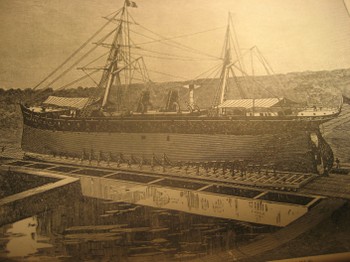
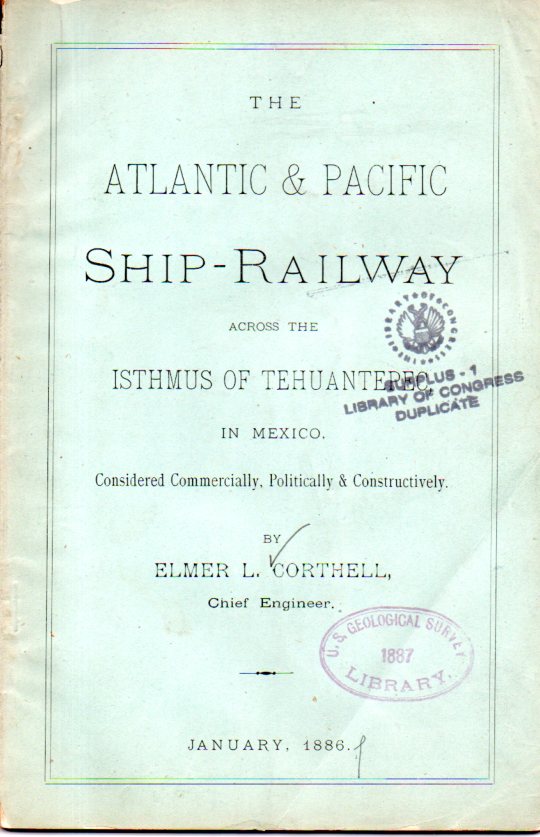
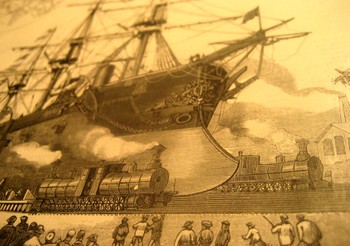
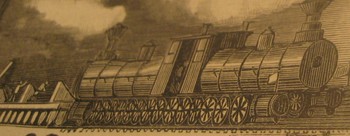 .There is something pleasing though about the Ship Railway, though, something that appeals to the little bit of Mr. Herzog in me. Perhaps it was the appraisal of the very stiff-lipped Sir Edward Reed–who was the former master engineer for the British navy and consultant to Eads—that makes it all so irresistible. “It would be best to avoid a very high rate of speed” when hauling the massive ocean-going and heavily laden cargo ships. Indeed.