A Daily History of Holes, Dots, Lines, Science, History, Math, Physics, Art, the Unintentional Absurd, Architecture, Maps, Data Visualization, Blank and Missing Things, and so on. |1.6 million words, 7500 images, 4.9 million hits| Press & appearances in The Times, Le Figaro, Mensa, The Economist, The Guardian, Discovery News, Slate, Le Monde, Sci American Blogs, Le Pont, and many other places… 5000+ total posts since 2008.

Author: JF Ptak

  • Aliens and the Spirituality of Bubble Gum

    JF Ptak Science Books  Quick Post

    Bazooka

    What would an Alien, an alien life form of unspecified type and intelligence (but with necessary assumptions taken to allow this little expedition in possibility), think of bubble gum?  It would be an interesting thing to know. After all, even though gum is very trivial matter for humans, the process that produces it is not.  Let’s assume that the aliens are allowed to see the story of gum from start to finish. They would see a physical plant containing workers and heavy machinery; the machines are tended and maintained and work tirelessly to produce the gum product. The gum bits are fed into the machines which processes the brew and then wraps and boxes and prepares them for shipment; the boxes are packaged and arranged, loaded in some instances onto ships that take them halfway around the Earth, and then loaded onto trucks, and then onto smaller trucks, taken to distribution centers (like, say, supermarkets) which are big and bright and shiney and attractive to hundreds or thousands of cars which transport humans in order that they may receive the gum gift. And then a magical thing happens when humans make an exchange of labor for the gum as represented by “money” and are then allowed to remove the gum from the final distribution center, possession of the gum now complete.  And then, finally in its seemingly long life of preparation, the gum is unpackaged, put inside the human for a small amount of time, and then removed (sometimes unceremoniously).

    After this enormous expense of energy in producing and moving gum (not to mention the advertising and sales aspect of it) it is consumed for less than 1% of the time it took to be produced, and then disposed of in the trash, on the street, under a school chair, or passed through the human digestive system where it releases less energy than what it took to consume it making the trip through the energy-replacement system more or less completely intact. 

    Bubble gum  superman[Source: Robert Edward Aucions]

    Would they think of gum as a sacred object, or as trivial?

    I think it could go either way.  It could be sacred and trivial, which would make things  complicated. But less so when comparing the consideration of gum to alien interpretation than, say, cars.
    ·Posted by :

    ·in:


  • A Visual History of Art: 188 Artists on 780 Engravings (1814)

     JF Ptak Science Books

    2013-07-25 14.52.12

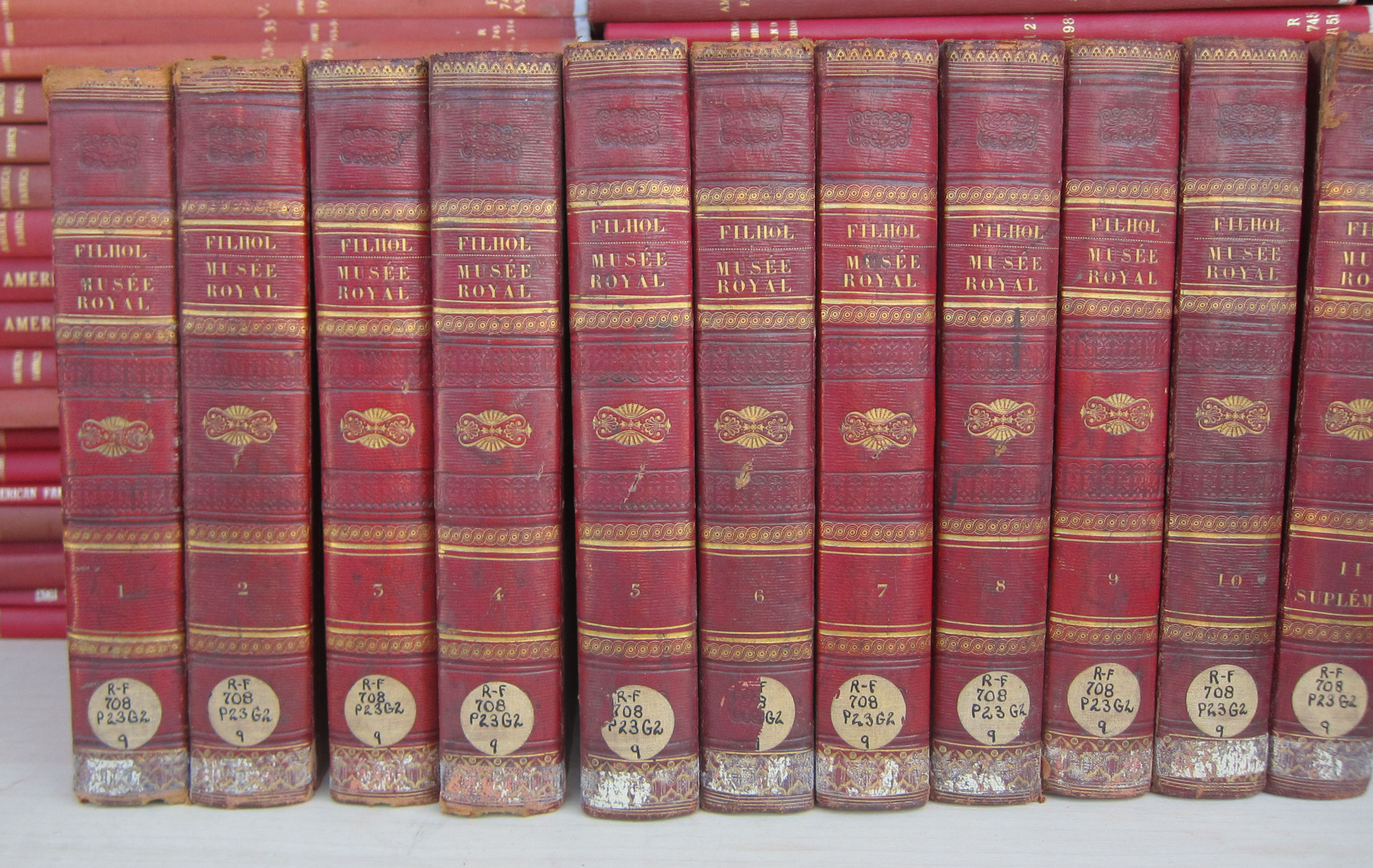
    There’s a fine experience in reading and looking at a history of art that is an artwork in itself–especially an antiquarian artwork. That is in a way what this work (Gallerie du Musee de France publiee par Filhol, Graveur, le Texte Redige par Lavallee..) edited by Antoine Michel Filhol, and Armand Carafee, and Joseph Lavallee is–it is exciting and exhausting, in good and perhaps not-so-good ways.  Being a general history of art the book looks at Ancient and Western art over the 1700 years or so, but mostly from the Renaissance forward.  It is exhaustive in its way and exhausting, in an Old School museum sort of way, where there is a lot of stuff to look at, all jammed in together, sometimes without a unifying force.  That means for each section there is artwork from, well, anywhere; although frustrating it is also exciting, because you never really know what’s coming next.  This is especially true due to the fact that every engraving is protected by a tissue guard, which makes it mostly not possible to see the artwork until you open the guard page, which is when you may be surprised by the Rembrandt or Holbein.

    ·Posted by :

    ·in:


  • The Beauty of Dirt

    JF Ptak Science Books  Quick Post

    “All the roots hang down
    Swing from town to town
    They are marching around
    Down under your boots
    Below the gopher holes
    Where they all unfold
    There’s a world going on underground
    Underground”–Tom Waits (“Underground”, with audio)

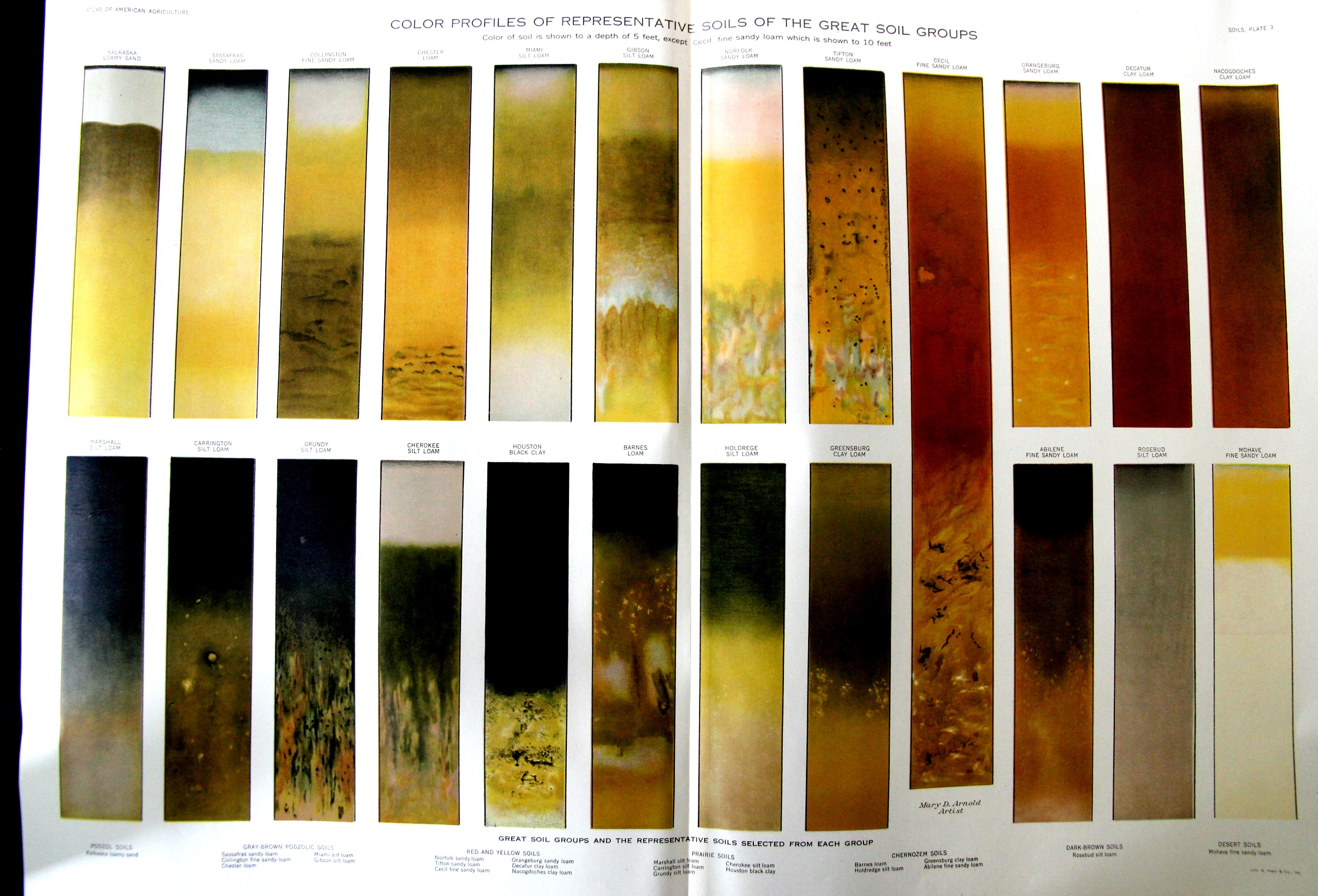
    Dirt isn’t just the stuff that one gets rid of, of course–it is the basis of all that we are. Varieties of dirt are the stuff of the connoisseur and the expert, and when laid out properly, and particularly in a scientific manner, dirt is exceptionally beautiful. For example, this exceptional and large illustration appears in the Atlas of American Agriculture, which was printed in a very unpretty/dustbowly year for soil, 1936.  (The image is clearer once you click in and expand.)

    SOil samples

    The lithograph is also available for sale at the blog’s bookstore, here. 


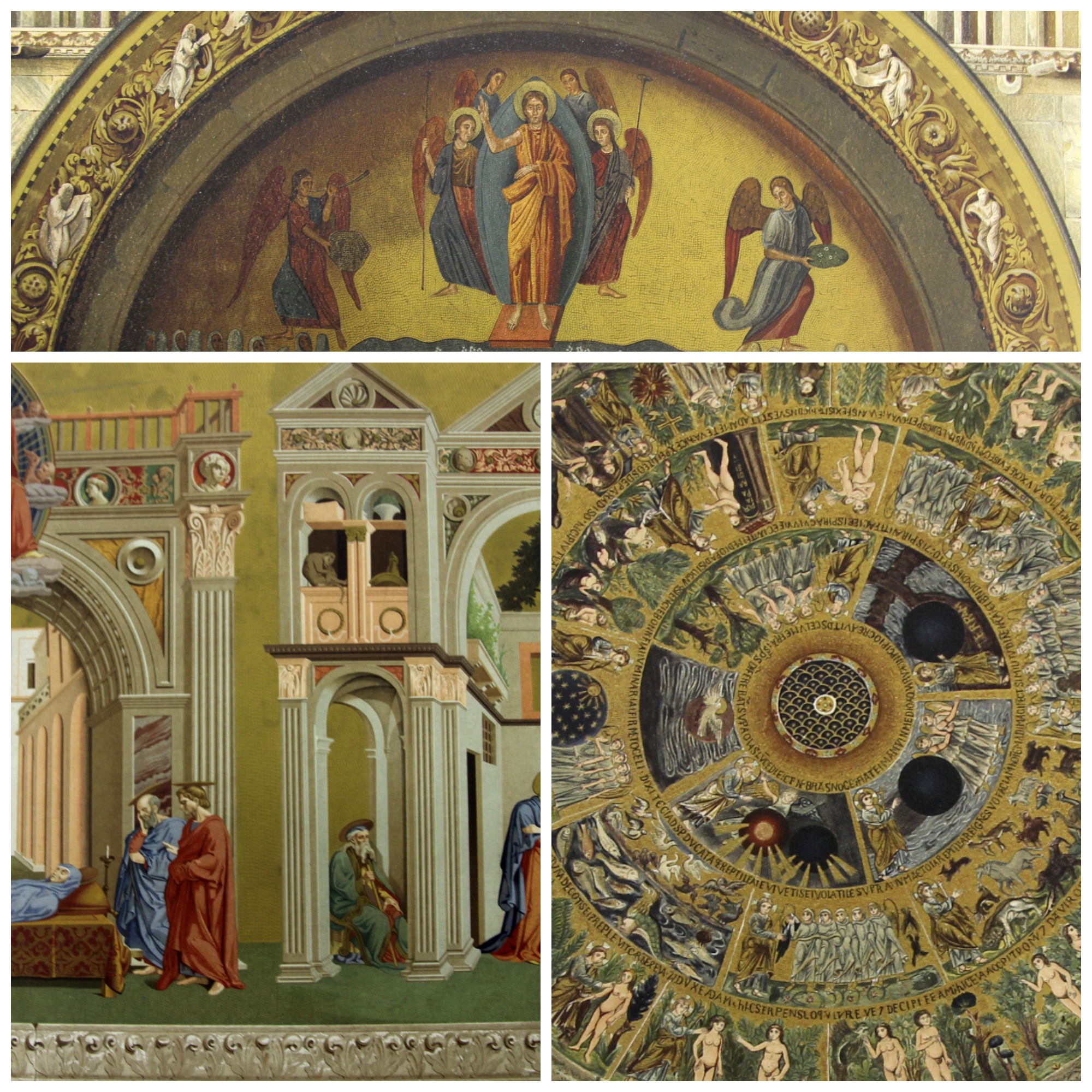
  • Lavish Chromolithographs of the Basilica San Marco (1886)

    JF Ptak Science Books  Quick Post

    So, these are just about here:

    Ongania montage

    (The rest the 25 images from Ongania’s massive and sumptuous work on the Basilica San Marco published in 1886 are just about ready for posting.  They are a real treat to work with, so large  (27″x21″) and jaw-dropping lovely.

    • Here’s a short bit on the “Creation” mosaic that I did a few days ago, here;
    • And then the tremendous black and white hyper geometry mosaics, here.

    ·Posted by :

    ·in:


  • “Our Puny Earth!”

    JF Ptak Science Books  Quick Post

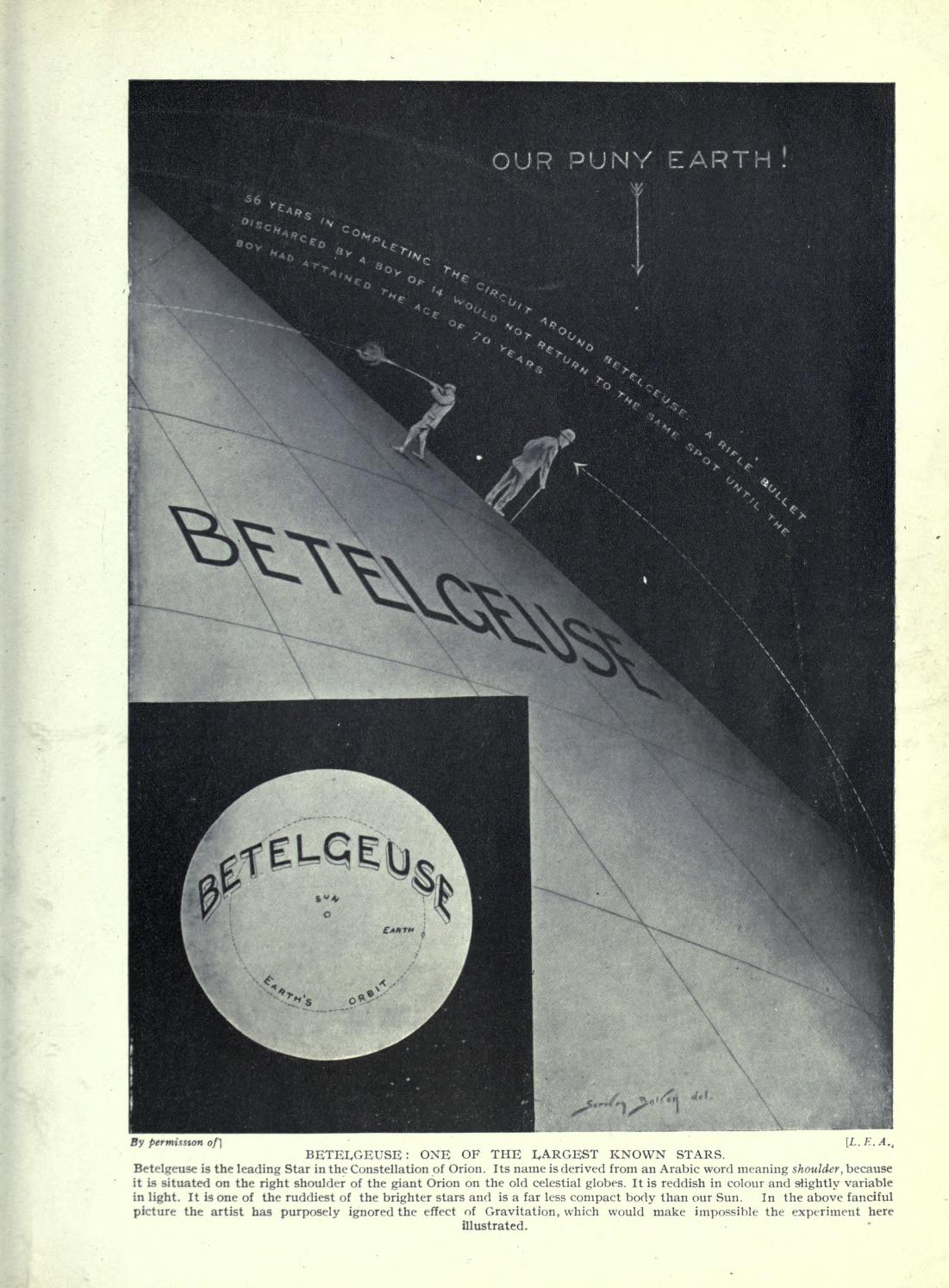
    Hutchinson’s Splendour of the heavens; a popular authoritative astronomy, by Theodore Philips and William Steavenson, was a splendid popular work filled with fine images, some of which were rather unusual.  One that I thought I had to share was the f=one below, which contains the first time that I have seen the phrase “Our Puny Earth!” in a non-comic book.  It is also a nice graphical display of data underneath the “puny Earth” bit–enjoy. 


    Astronomy  Betelgeuse[Source: Internet Archive,  https://archive.org/stream/hutchinsonssplen01philuoft#page/418/mode/thumb]


  • Low-Tech Prep for War, 1911-1941

    JF Ptak Science Books   Quick Post

    I’ve bumped into three interesting instances of using replacements for the actual equipment in preparing for war.  When you think of the action and order and behavior expected of them, and then observe the materials they were given to prepare to do so, it is absolutely remarkable to think of how they responded, and of the enormous valor and courage with which all of this was accomplished. 

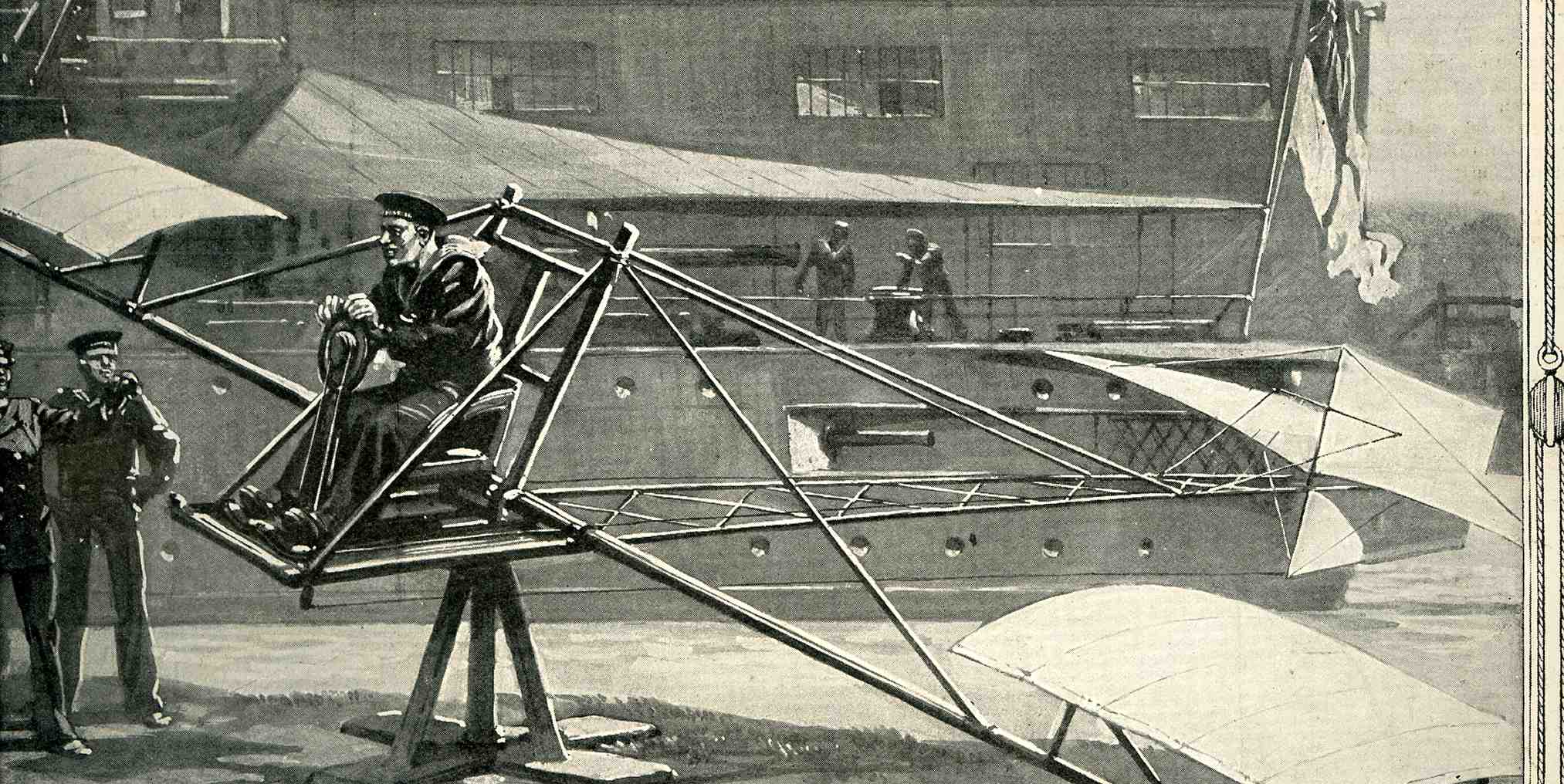
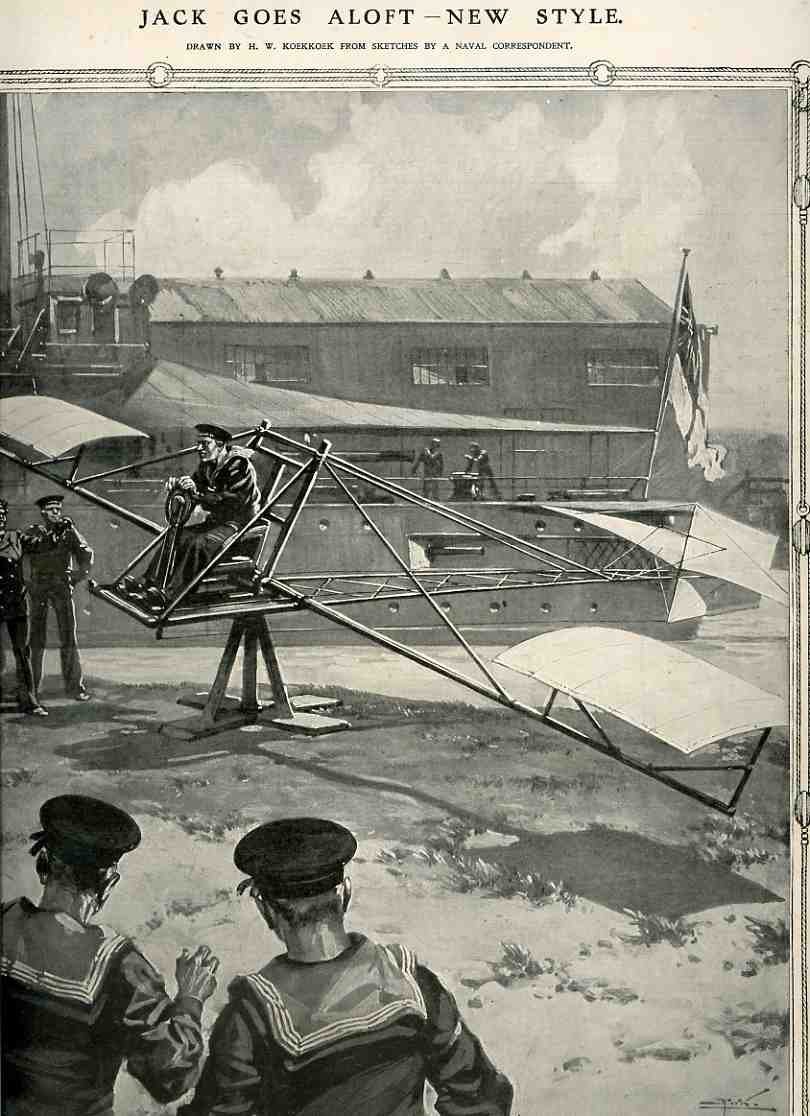
    Case A:  Flight Simulator, 1911

    Just three years after the Wright Brothers arrived in Europe to revolutionize European flying, and following an order of magnitude series of advancement and achievement, the British Navy was already beginning to train classes of sailors as aviators in  dynamic flight-free devices. This idea of simulating flight enabled the training (and more importantly, the selection) of aviators before anybody actually got into a plane, speeding the process of determining who was fit for flight and who was not, quickening the British pace to form a fighting force in the air.
    00-blog--Oct 28 sea plane trainer951

    This interesting graphic appeared in The Illustrated London News for 29 July 1911, and was entitled “Jack Goes Aloft–New Style…Trying to Keep a Stationary Machine Steady in a Wind; Sailors Practicing with a Dummy Aeroplane”.  This was five months before the establishment of the Royal Naval Flight School, but more importantly, just a few months after the historic flight of Eugene Ely, who took off in his aircraft from the deck of the USS Pennsylvania in the Mare Island Navy Yard–of more profound interest perhaps is the fact that Ely landed his plane on the same restricted deck space. (In a way the primitive stopping mechanisms use by Ely are sort of in use today. ) I am sure that few naval people missed the significance of this event–I know that across the ocean Winston Churchill was instantly at work on the idea of using aircraft on ships. But it seems that after all of the initial successes in the U.S. that when everything was said and done, the Brits took the lead in modernizing their navy to include aircraft. 

    00-blog--Oct 28 sea plane trainer950


    ·Posted by :

    ·in:

    —

  • Paper Love–Moveable Paper Prints: the Protos Automobile, 1925

    JF Ptak Science Books  Quick Post

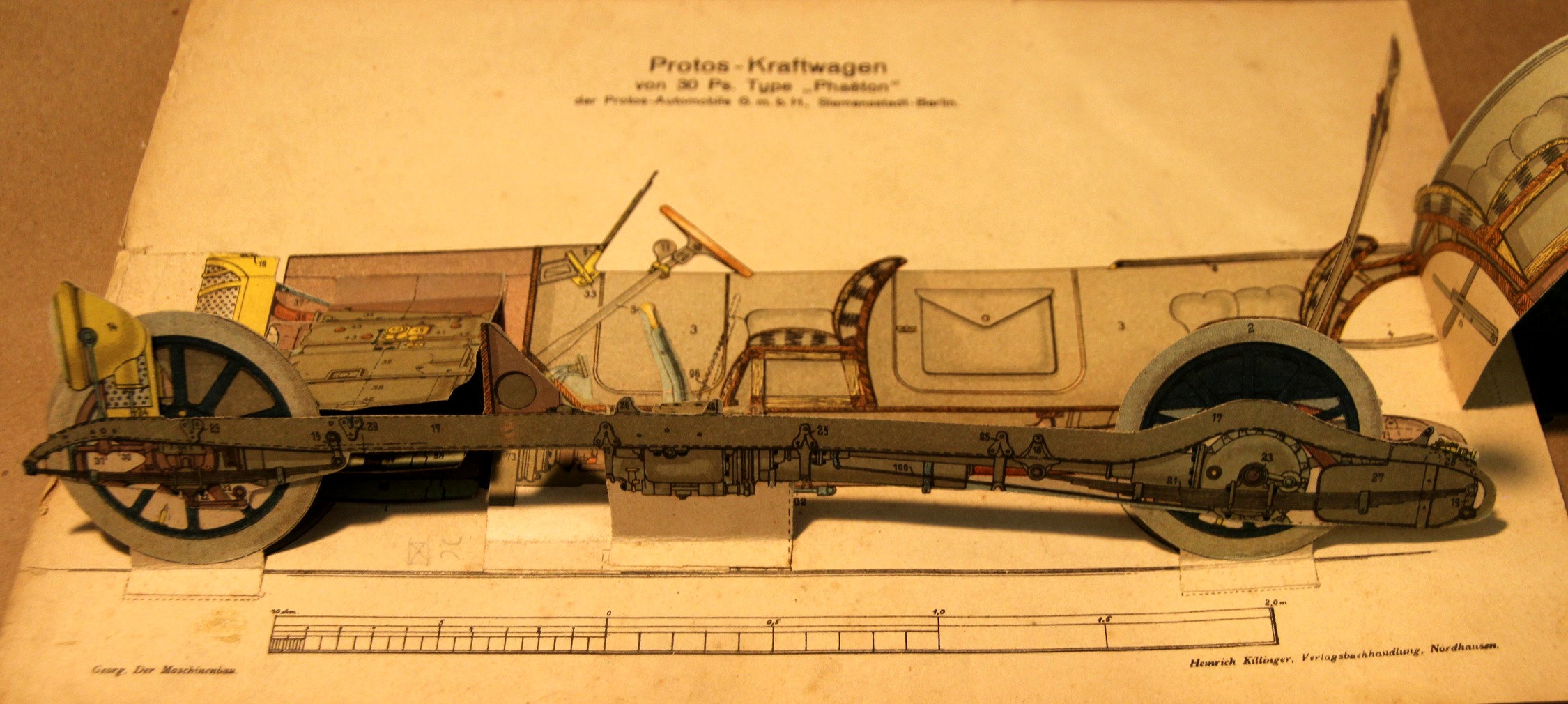
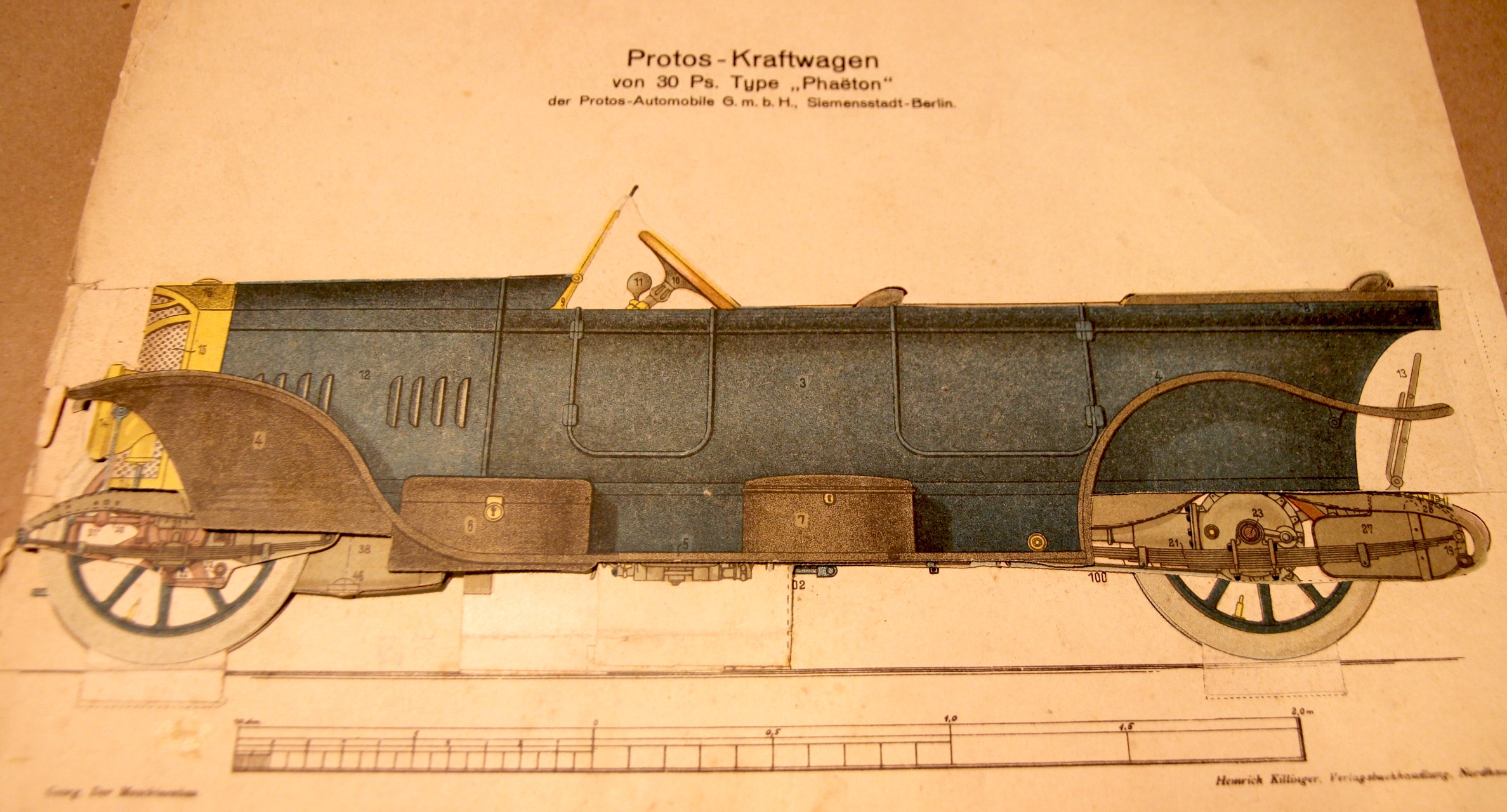
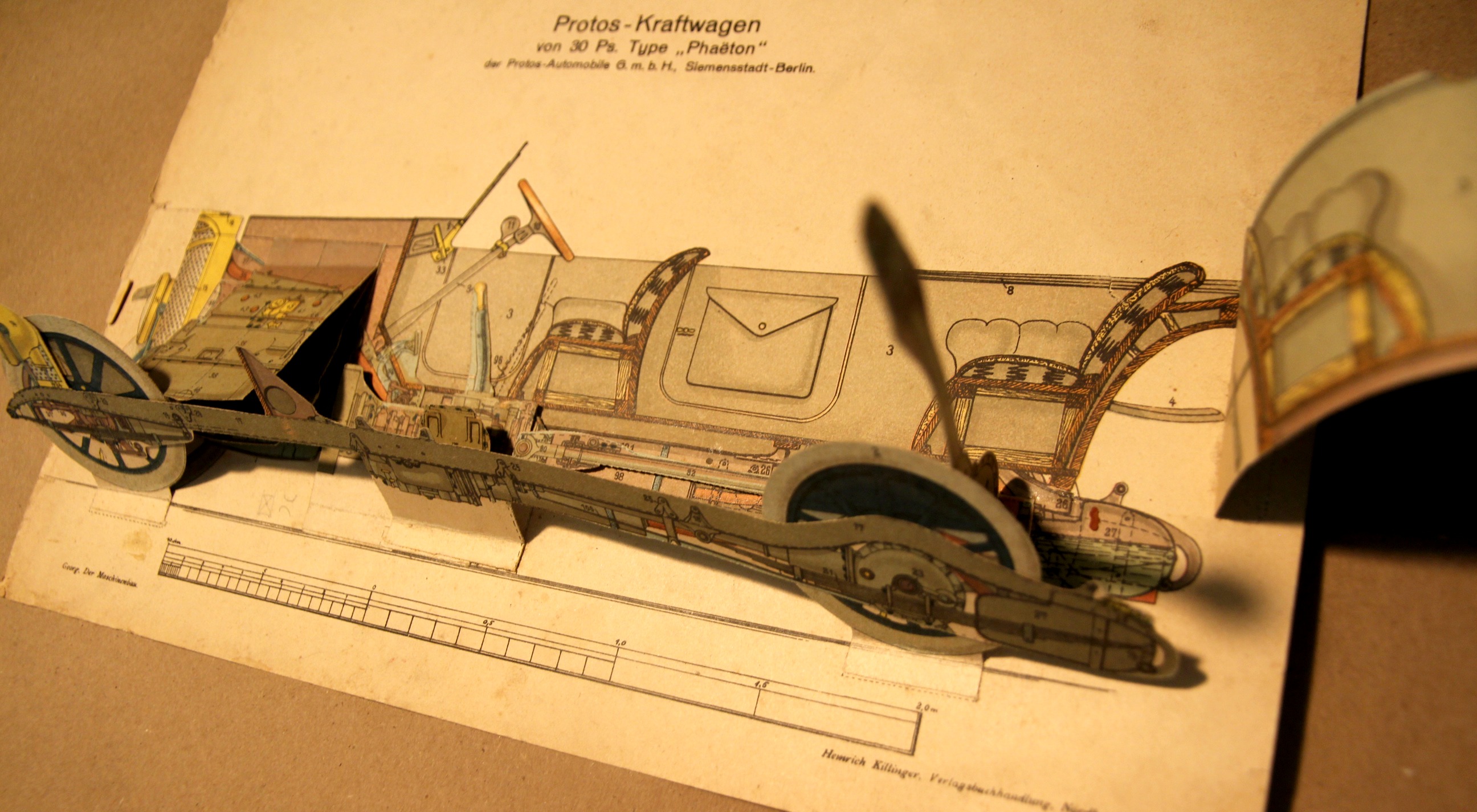
    The moveable book (flapbook) has long been interesting to me–unfortunate though that in my own fields they weren’t used very often. There are some very notable exceptions–early geometries would occasionally be published with many of the geometric illustrations made to pull out a little with the tug of a string to show you the construction in 3-D. Then of course there are the paper dissection manikins, where you can find nearly-life-sized paper anatomies with hundreds of movable/liftable flaps, and smaller examples of the body and specific organs that can be simple or not simple whatsoever.  These were time-intensive efforts, and in their own way they provided a sort of pre-MRI MRI by revealing the various layers of 3-D objects with 2-D tools–and they’re beautiful and captivating objects.

    (And this example is for sale at the blog bookstore, here.)

    Moveable_car_3

    This plate appears in Der Maschinenbau. Modelle.Zeichenerklärungen zu den Modellen des Werkes, by R. Georg, printed by Heinrich Killinger in Nordhausen in 1925.  The major detraction here is an old 5-inch tear that has been repaired verso with aacid-free tape, otherwise in nice condition. 

    The full image, “unmoved”:

    Moveable_car

    Moveable_car_2_


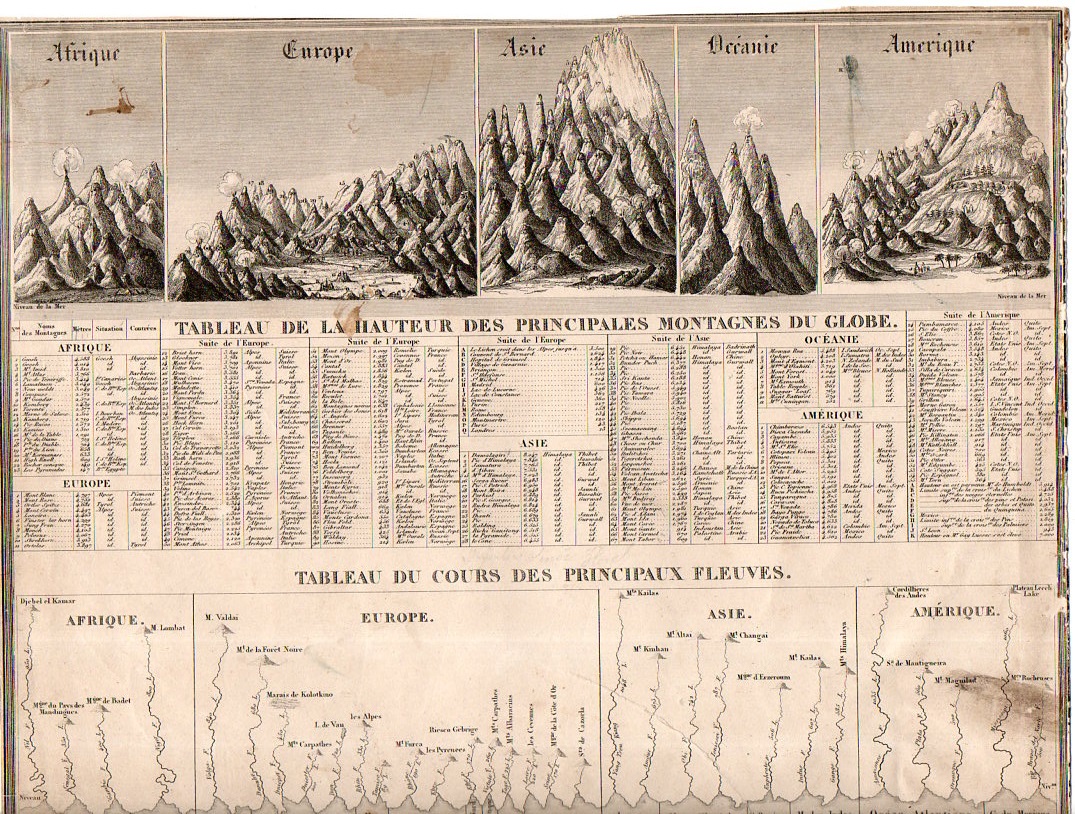
  • Small, Compact, Unusual Comparative Heights of Mountains Map

    JF Ptak Science Books   Quick Post–revisited and expanded

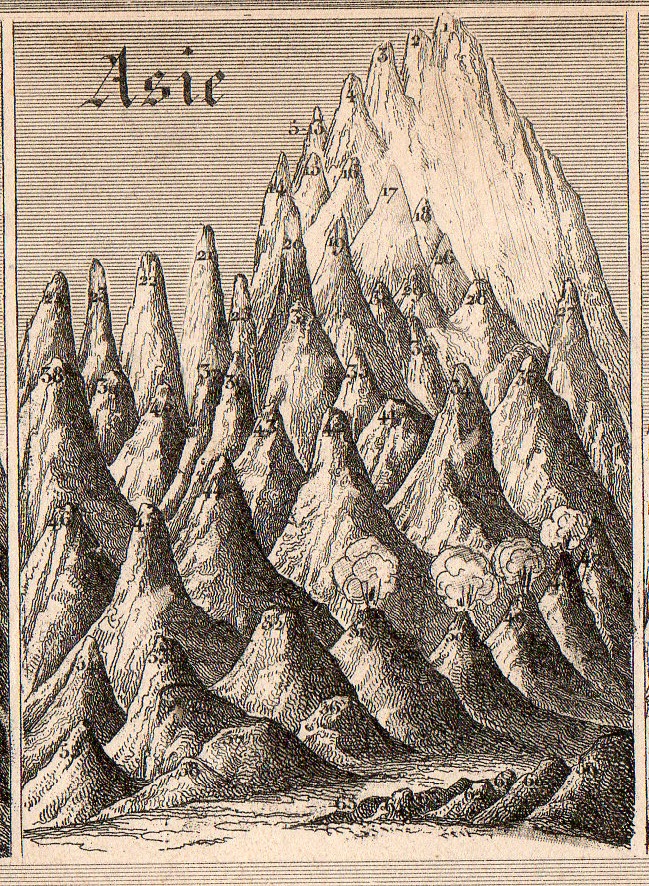
    Mountains small compact114[Small detail from the quantitative display, below; measures 2×2 3/4″.]

    • I wrote about this earlier on this blog but went back to it today to expand it a little and add to the illustrations–and to also place it in the for sale section of the blog. 

    Generally the dozens of maps/charts showing the comparative heights of mountains and lengths of rivers maps that have come through the store part of this blog have been somewhat large–or at least larger than the present example, which may be about the smallest (at about 11×8″) detailed representative of this genre that I have seen. 

    Mountains small compact113

    “Tableu de la Hauteur des Pricnipales Montagenes du Globe” was published in Guillemin’s Atlas universel de Geographie Ancienne et Moderne, and published by Langlume in 1845.  It is also at the beginning of the more-modern heyday for publishing maps and charts such as these.  (The practice began modestly at the end of the 18th century, came into a high tide in the 1850’s/1860’s or so, and then pretty much disappeared by the 1880’s.) 

     There’s a lot of comparatively-displayed information presented on 88 square inches, including the lengths of 30 rivers and the heights of about 500 mountain peaks distributed over Africa, Europe, Asia, Oceania, and the Americas.  And for as much imagery and data there is on this sheet, the whole is very nicely designed, a real success in the display of quantitative data.  


  • WHen the Barbarians Were Big

    JF Ptak Science Books 

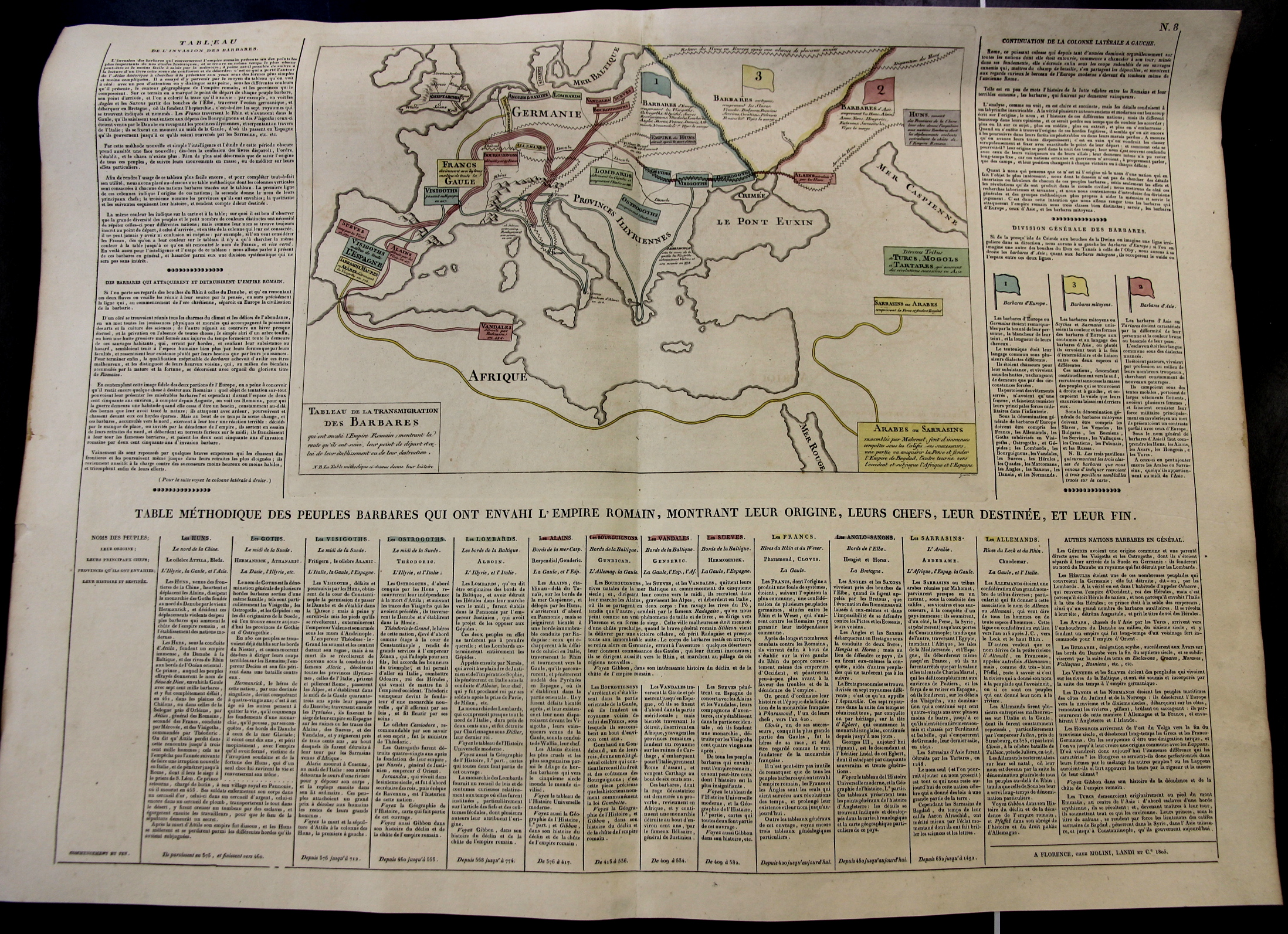
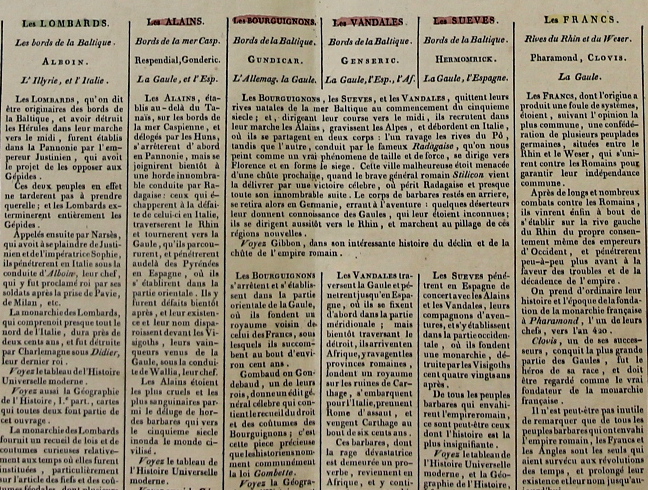
    It is interesting to look at the Roman Empire from “The Other Side”, seeing the world (extending from Ireland to the Caspian) of the surrounding and numerous Barbarians. This map was printed in 1808 and identifies the peoples at all points of the compass outside of the Empire:  Huns, Goths, Visigoths, Ostrogoths, Lombards, Vandals, Swedes, French, Anglo-Saxons, Sarrasins, Germans, Avars, Bulgarians, Danish, Hungarians, and others, all outlined in 14 columns beneath the central map.  This is a finely-designed, accurate, and attractive way of displaying a lot of data in a relatively small (27×21″) space. 

    [Note: the image below is very expandable and readable when enlarged.]

    • Also: the original may be purchased via the blog’s bookstore, here. 

    Maps_lesage_barbarian

    And a detail:

    Maps_lesage_barbarian_b_

    ·Posted by :

    ·in:


  • Big Paper History: 1806 Chronology of the Years 14-1800

    JF Ptak Science Books Post 2478

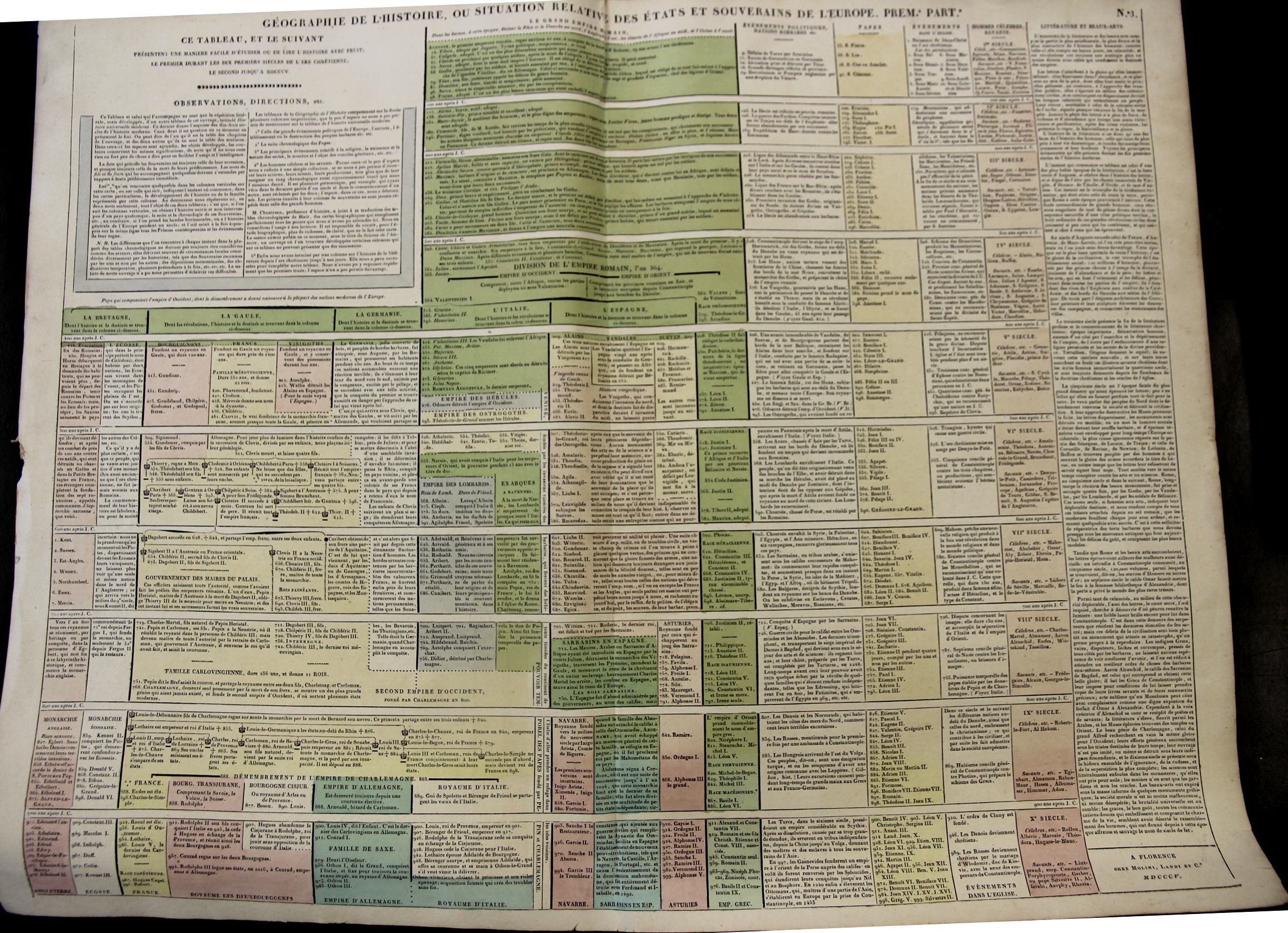
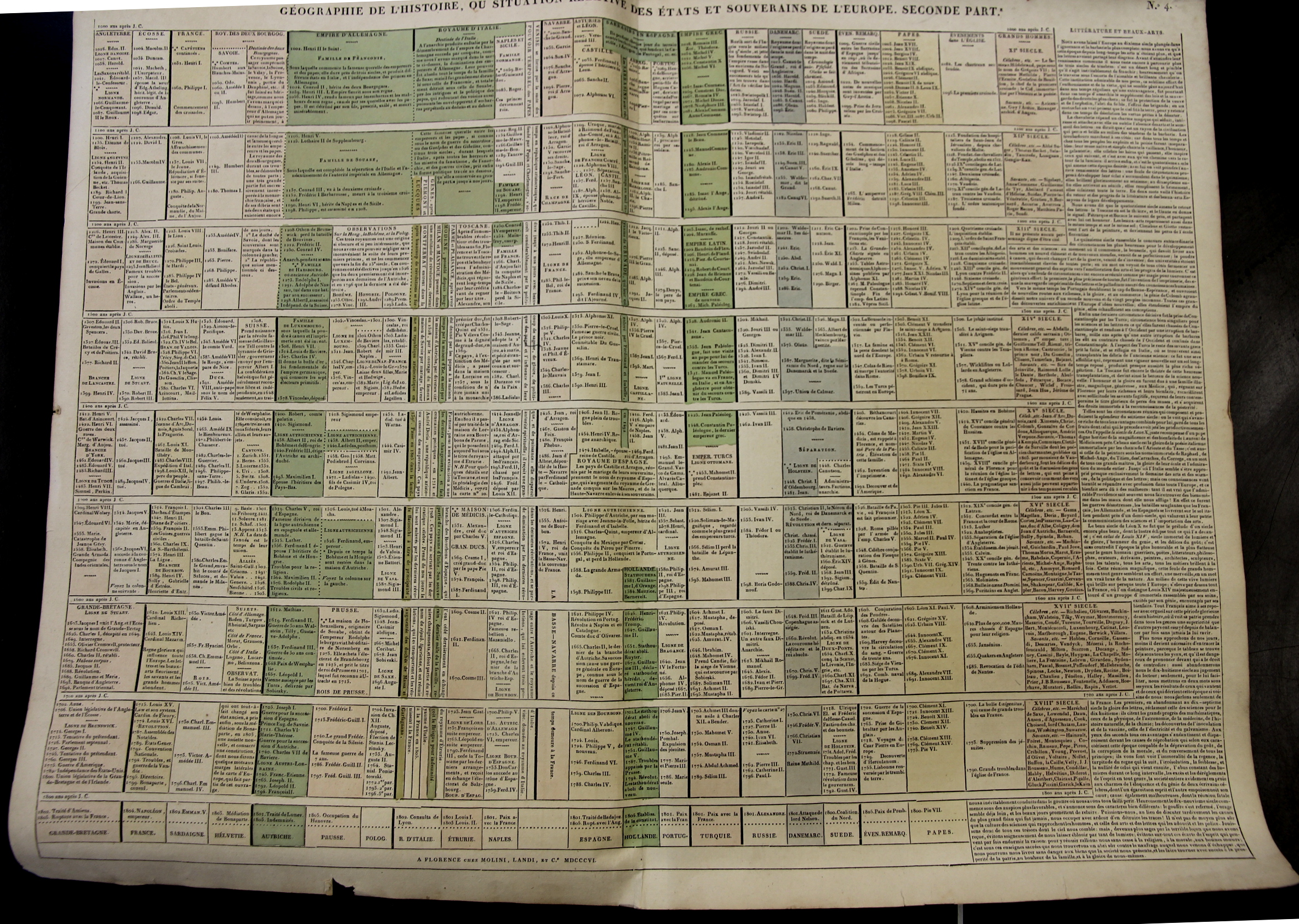
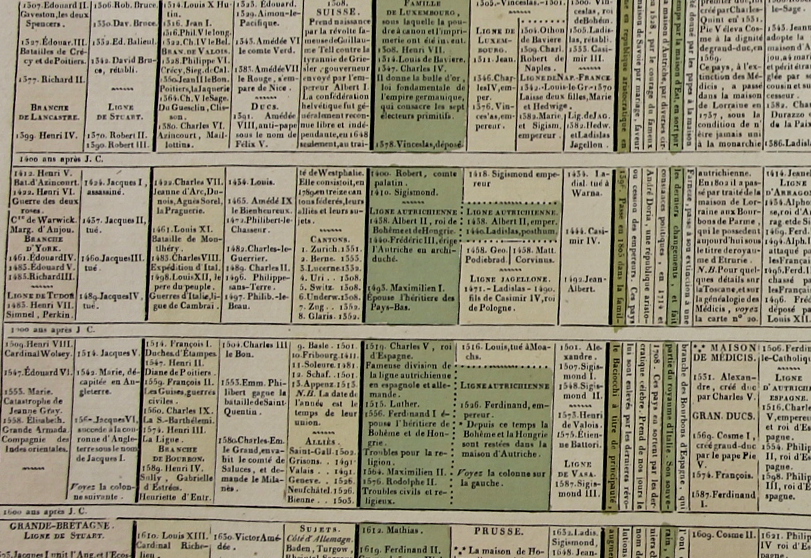
    Starting at the year 14 (ACE) with the reign of Augustus Caesar this large two-sheet chronology organizes the rulers of the Western world so far as it was known into the early 19th century. (“Geographie de l’Histoire. ou Situation Relative des Etats et Souverains de l’Europe (in two parts), published by Molini and Landi, in Florence, in 1806.) There are 15 major divisions from the year 400-1800, with a short bit at the top of the first chart covering the previous 386 years or so.  The columns show the rulers of reach century for Britain, France, Germany, Italy, Spain  (then subdividing as necessary). There is one column for the “nations barbares” that covers everyone else in about 2″ per century; there is another column for the chronology of Popes; one column for a general history of the Christian church, one column for celebrated and famous people, and then a final column for literature and the arts. 

    Maps_Chronology_LeSage_1_

    • You can own these!  Check them out on the blog’s bookstore, here. 

    At the very least the chart helps you keep your rulers straight, so to speak–it is also the sort of engaging display of data that if it was hanging up and accessible that people would read it all the time in passing. 

    The sheets are large (27×21″ or 68x53cm, and combined (as I have done in the past) they make a very imposing display 42×27″ (106x68cm).  The coloring (except for the odd darkish green) is fairly subtle but evident and useful in distinguishing the blocks of data at an easy glance. 

    Maps_Chronology_LeSage_2

    I’ a big fan of this sort of arrangement and display of data, trying as I used to in graduate school (and still do now) to fit the appropriate memory triggers on any given subject onto one sheet of 8.5×11″ paper.  It is a highly useful memory exercise, creating your own memory palace. 

    Maps_Chronology_LeSage_3

    These charts appear in A. Le Sage (Comte de La-Casas) Atlas historique chronologique et géographique ou Tableau général de l histoire universelle présentant un moyen sûr et facile de classer avec fruit tout ce qui s est passé depuis la création jusqu à Jésus Christ espace de 4004 ans….