A Daily History of Holes, Dots, Lines, Science, History, Math, Physics, Art, the Unintentional Absurd, Architecture, Maps, Data Visualization, Blank and Missing Things, and so on. |1.6 million words, 7500 images, 4.9 million hits| Press & appearances in The Times, Le Figaro, Mensa, The Economist, The Guardian, Discovery News, Slate, Le Monde, Sci American Blogs, Le Pont, and many other places… 5000+ total posts since 2008.

Category: Militaria

  • From the Just-a-Few-Months-Shy-and-Everything-Changes Department (1941)

    JF Ptak Science Books  Quick Post    

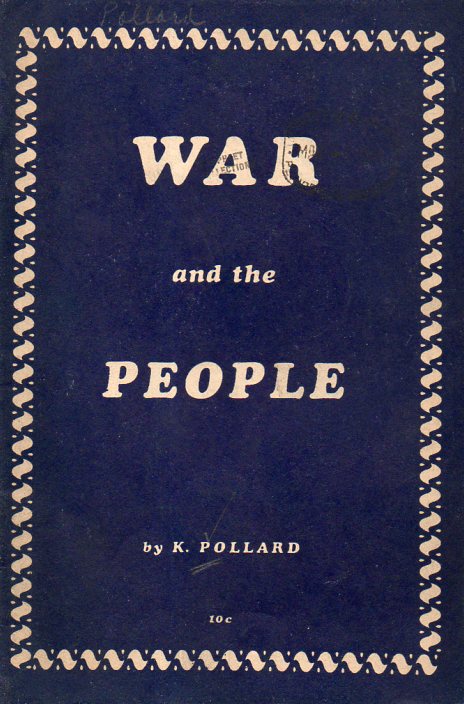
    War and the People791This pamphlet enumerates the benefits of Communism and the pact of the Soviet Union with Hitler. It was printed in February 1941, and after describing the Imperialist world war, the war and the Middle Classes, “how the war hobbled the working classes”, it goes on to (obtusely) describe how the understanding between the Soviet Union and Germany has saved 150 million lives.  All of this goes away four months later when the Soviet Union is viciously and brutally attacked by Germany in Operation Barbarossa, and then, most of those “saved lives” turn out not to be so.

    ·Posted by :

    ·in:

    —

  • An Early-ish Report on the V1, January 1945

    A Technical Report on the V-1, 1945

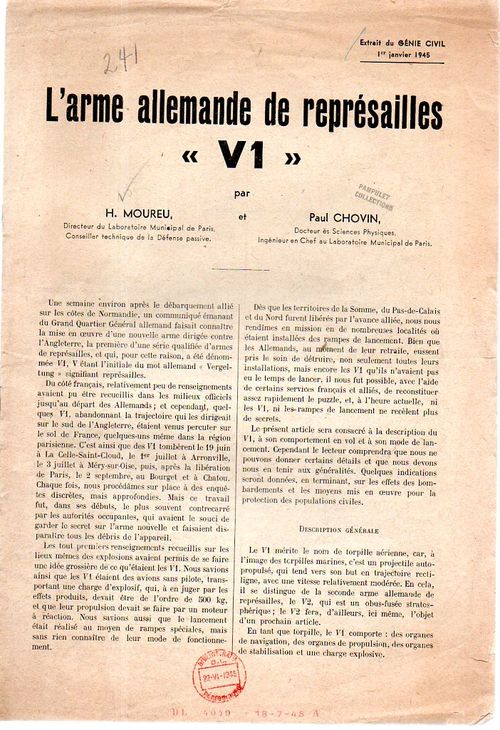
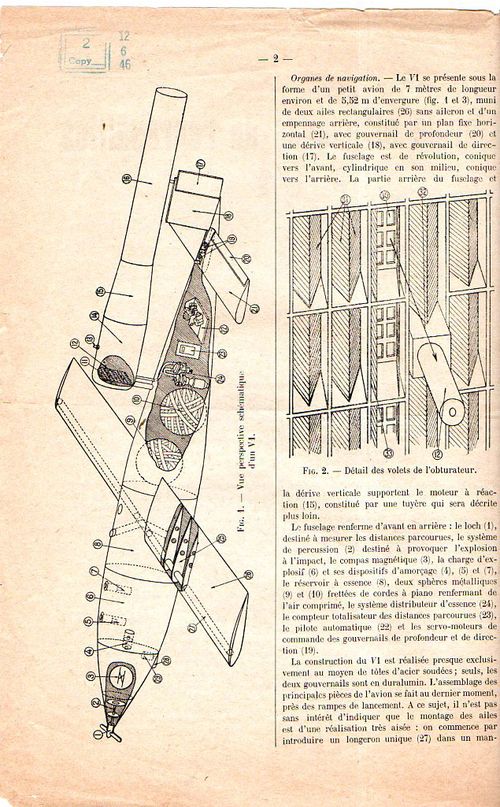
    This report by Henri Moreau (1893-1978) and Paul Chovin–“L’arme allemande de represailles V1”–is an offprint from Genie Civil, and printed 1 January 1945. It is  9×6 inches and runs a pretty-involved eight pages, and was printed in Paris (newly liberated from the German army 25 August 1944) on the first day of 1945.

    I was frankly surprised to find this fairly-well documented piece on the V-1, and couldn’t find much on it at all, so I reprinted the report in its entirety. Some of the text runs off the side of the scanner, but that is the best I can do in scanning the pamphlet without taking it completely apart. 

    V1_1_


    V1521

    ·Posted by :

    ·in:

    —

  • 115-Pages of Directions on How to (Possibly) Leave Manzanar (1944)

    JF Ptak Science Books   Post 2635
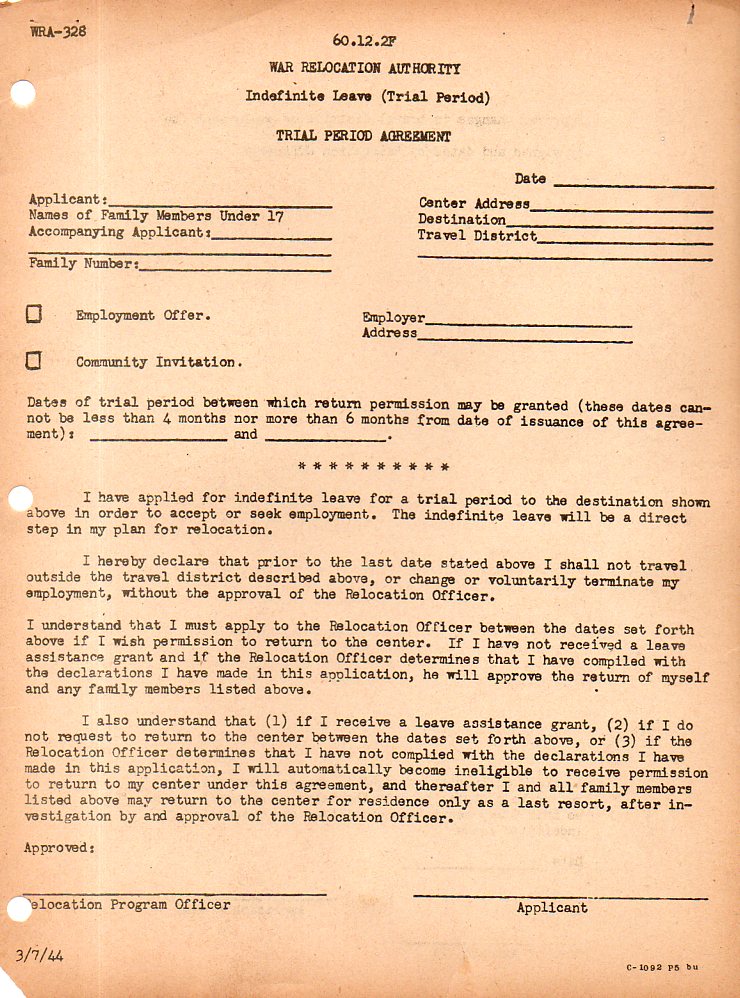
    WRA_1_732
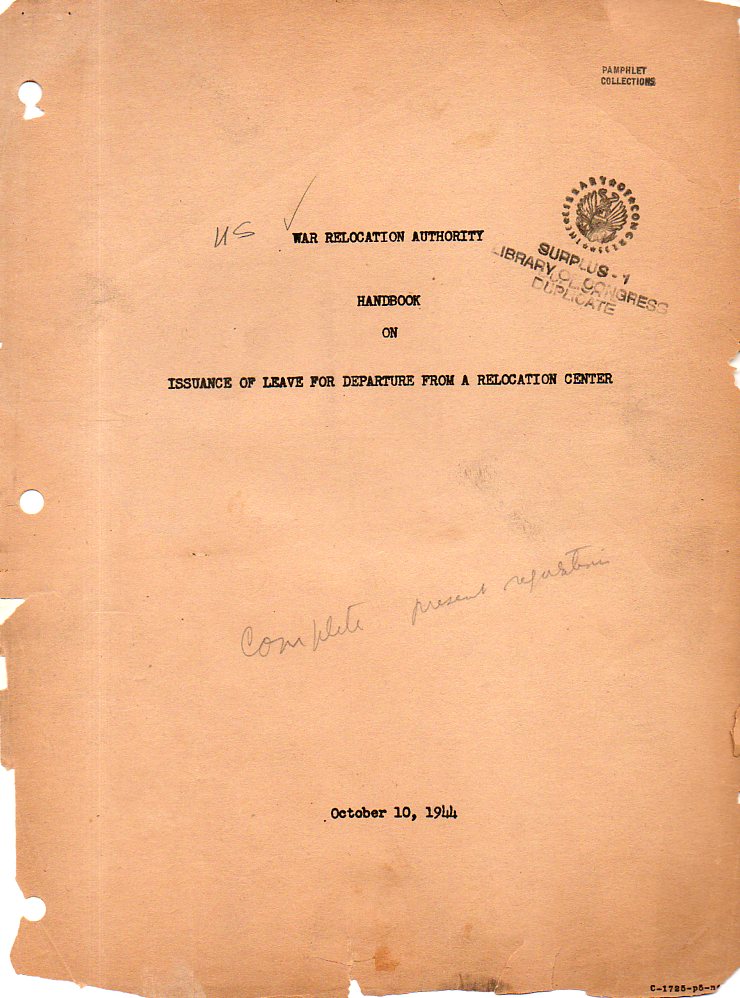
    Just this morning I unearthed this interesting document: War Relocation Authority Handbook on Issuance of Leave for Departure from a Relocation Area October 10, 1944, which was basically a set of rules and regs on how an a Japanese person/”evacuee” could apply for dispensation for leaving the relocation center /internment camp. The language and organization of the document is dense, misleading, and labyrinthine, and spread wide and thin over 115 pages. It is in fact difficult to go from page one to the final page, as there is no real pagination that one can distinctly follow to get through the document in order–if you were to take the thing and toss it into the air and then try to put it back together again, it would not be a straightforward task. It is a confusing and seemingly-contradictory work bibliographically, at least if you were try to define it by its structure. Perhaps this speaks to the administration of the places that this document was trying to describe: there are numerous versions of the document issued over several years, some replacing parts of sections and other replacing entire sections though leaving in place sections contiguous to and within the new sections; the tiny sub-pagination at the bottom right of each sheet doesn’t necessarily follow from one page to another although the text does (for example, there is a page “C-109 2 p1 of 11 nubu-cos-pun-wp”; further, the pagination which is the most useful is the section/page designation at top right, however the numeration of sections and paragraphs in the actual text seems a little thick, starting sections as “.1” rather than “1” and the “.1 A.” rather than 1A or some such. In the end,  when I figured out that the document was actually complete, I was very surprised, because it hardly looked so while trying to follow pagination alone. 

    The War Relocation Authority was formed on March 18, 1942 via Executive Order 9102, following the Japanese attack on Pearl Harbor and the U.S. Entry into WWII, with Milton S. Eisenhower as the director. This was the action taken in the interests of national security resulting in rounding up and deporting to remote internal U.S. Destinations more than 125,000 people—mostly U.S. citizens—of Japanese heritage. The WRA was the consequence of the larger initiative, the Roosevelt administration’s Executive Order 9066 (19 February 1942), which was the legal bombshell that gave the War Department the authority to authorize the removal of the Japanese and theoretically prevent those people from engaging in sub rosa and fifth column activities as wartime terrorists fighting for Imperial Japan within the United States—and this effort concentrated mainly on the Pacific coast and West. For the greatest majority these people stayed in the “Relocation Centers” (routinely referred to as “internment centers” and “U.S. Concentration Camps” for the remainder of the war, and then some. The Japanese/internees were bused away from their homes and lives and businesses with extremely limited notice, and were forced to sell nearly all possessions (including lands and businesses) at what were less than fire-sale prices.  They were made to board buses and trains and were shipped to locations (mainly in California) where they were processed and sent further and deeper into the trying hinterlands of the West for their final destinations until the war was won.  (One of the processing centers was the Santa Anita racetrack, where thousands of Japanese were sent to live for periods in converted, just-painted horse stalls.)  After 3+ years and WWII won, the relocation centers were closed, with Tule Lake was the last (that once included Gila River, Granada, Heart Mountain, Jerome, Manzanar, Minidoka, Poston, Topaz,and the Rohwer War Relocation Centers) to close, though that didn’t take place until March 20, 1946, via Executive Order 9742, signed by President Harry S. Truman on June 26, 1946.

    Here is what seems to be a sample of what the interned Japanese would fill out and submit for leaving the internment camp:

    WRA_3_734

    The overall introduction to the document is signed (in the original, and then reproduced) by Dillon S. Myer, who was the Director and oversaw the WRA from 1942 until 1946; other sectional introductions in the document are signed similarly by Duncan Miller (who in 1945 was at the Colorado River Relocation Center at Poston, AZ), Malcolm Pitts (who was an executive administrator and who wrote Administrative Highlights of the WRA in 1945), E(?)D. Brooks, and Leland Barrows—all but Brooks are located as being “Executive Officers” of the WRA.

     From my reading this series of rules and regulations for the possibility of an “evacuee” to leave the relocation center is a Menkenian example of using 10 words where one word will do. The introduction is sufficient enough for a general reader to be able to guess at what is to come over the next 100+ pages:

    ·Posted by :

    ·in:

    — —

  • Underground Military Airbases, 1938

    JF Ptak Science Books  Quick Post

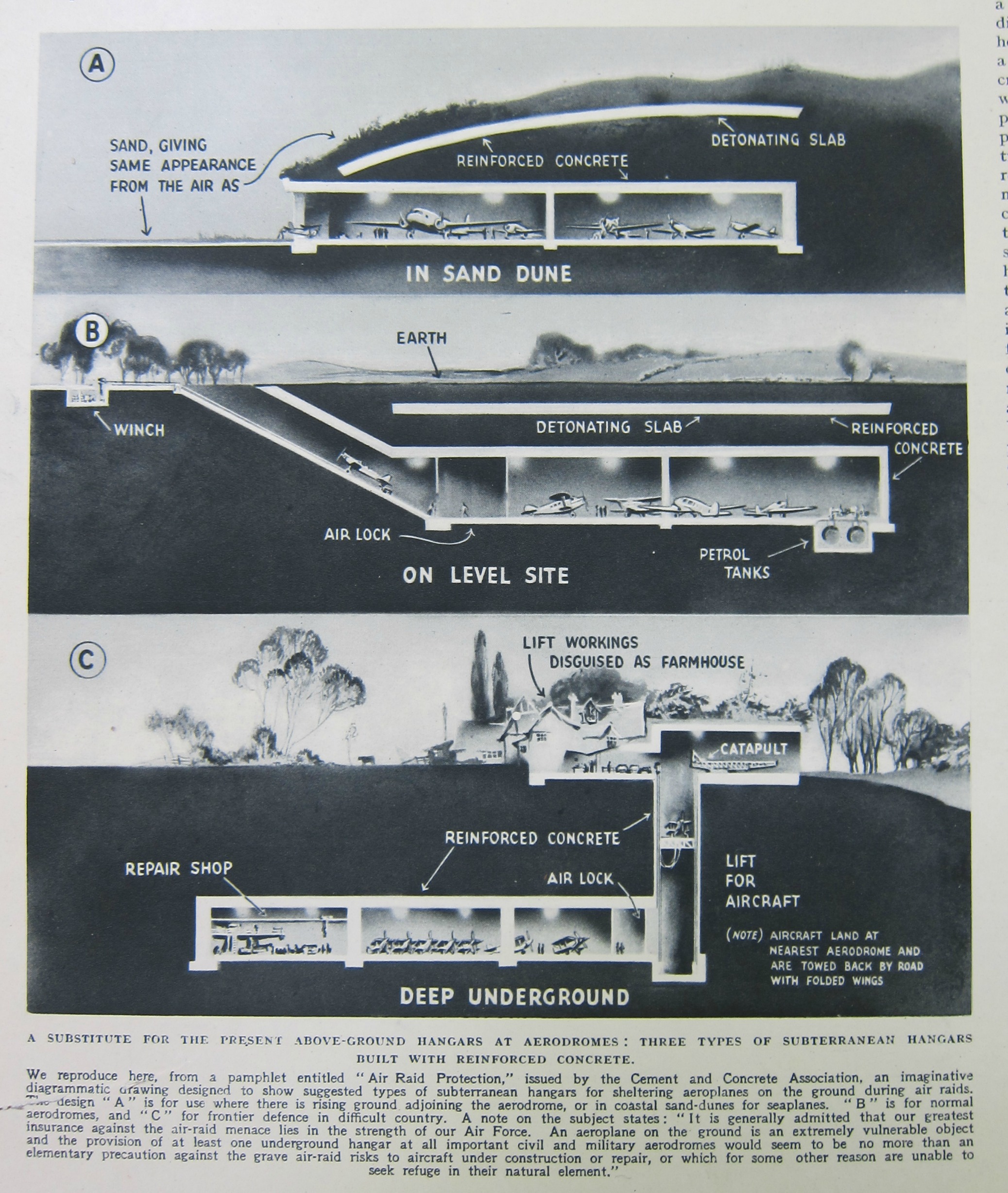
    The Cement and Concrete Association of Great Britain had issued several pamphlets in 1938 regarding air raid shelters for the protection of individual families, groups, and  cities.  In the pages of the Illustrated London News, writer and war correspondent John Langdo-Davies (1897-1971) reviews (or at least shares) the associations plans for underground fortified military airfields, the illustration for which I reproduce below:

    AIrport undergrouned 1938

    Langdon-Davies saw utility in these ideas, no doubt tempered by his experience covering the Spanish Civil War, which saw the first modern wide-scale use of bombing from aircraft, including the work done by the German Luftwaffe the impact of which was not lost on too many people. In any event, the aviation facilities were not moved underground for a variety of general reasons, some of which have to do with the utility of  the vast scale of the operation versus the introduction of replacement aircraft.  This doesn’t address some of the most adventurous ideas shown in the drawings, like the (assumed to be) very large hangar “deep underground”, the planes hauled up and shot into the air on a catapult, which is a different matter entirely.  The overall interest here though is the recognition–growing in 1938–that there is something going on in Germany that requires this sort of response.  


  • WWII Military Secrets in British Politics (1945)

    JF Ptak Science Books   Post 2632

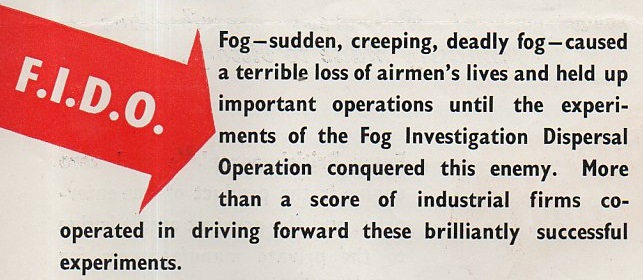
    British political pamphlets fido detail705

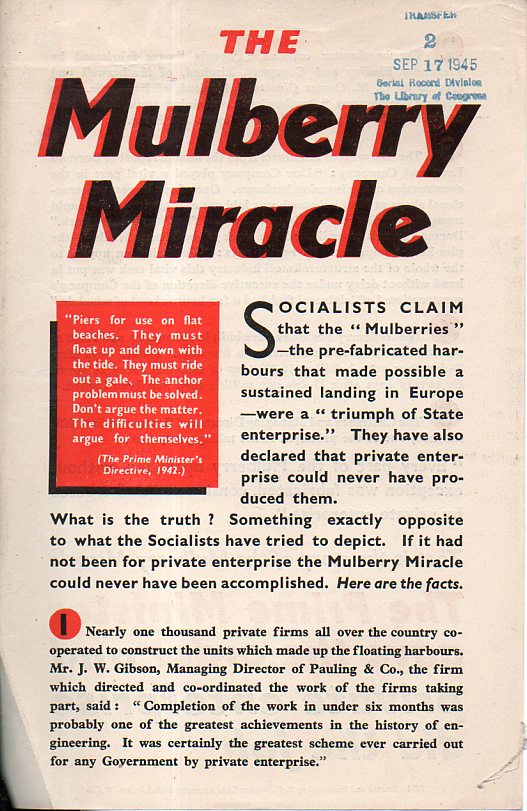
    British political pamphlets Mulberry703Earlier this morning I was looking at a collection here of British political leaflets (half around the 1893-1895 period, and then a bunch around the election of 1945) when I read a very dynamically-designed handout on how the Conservative government mobilized private industry into wartime production, and concentrating on the much-beloved and critical creation of the “Mulberry”, or the Mulberry Floating Harbor.  It was striking to me as the creation of the enormous floating harbor was a deep secret as it was an essential element in supporting/supplying the Allied invasion force in Normandy–and yet here it was, used by the Conservative party in an effort to re-elect Prime Minister Churchill, in a publication printed perhaps just a year after they were pulled across the Channel and presented to the world.  

    And it happens again in the following leaflet, though this one employs more of the previously secret stuff.

    I should say that this election in July 1945, just weeks after VE Day, produced what must have been a very surprising/shocking result, a result probably none the less surprising ti the unexpected victor, Clement Attlee, whose Labor Party produced a seemingly impossible small landslide victory over the (probably) most important man to the Allied war cause in WWII, Winston Churchill,  and the Conservatives.  (Churchill would return the favor in 1951.) 

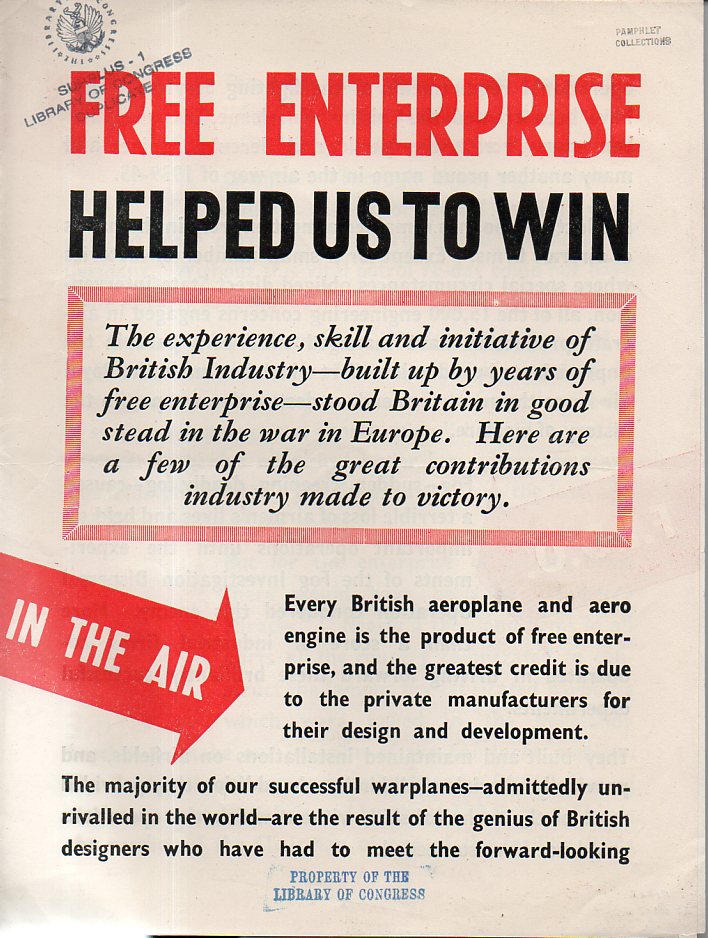
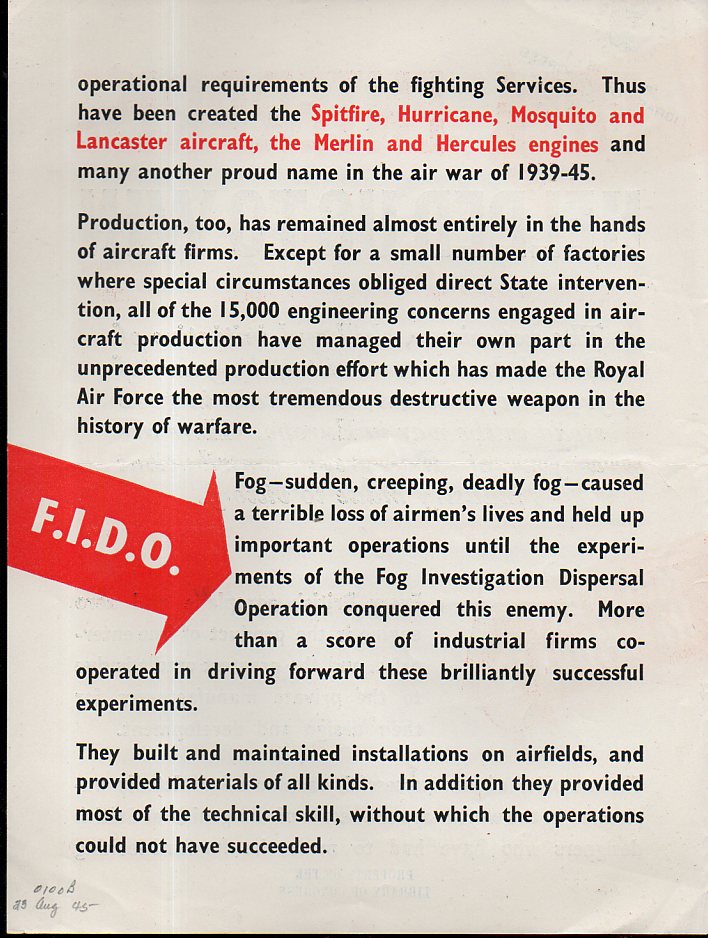
    Be that as it may, in this leaflet, “Free Enterprise Helped Us To Win”, produced by the Conservatives and ending with the ringing slogan, “Vote National”, used a number of the important and secret military developments of WWII as examples of private enterprise contributing to the war effort and standards of free enterprise.  Included here are:

    British political pamphlets fido704

    • the private designers who helped produce the singular Spitfire and other warplanes;
    • F.I.D.O, the Fog Investigation Dispersal Operation, which was a system installed at airfields by which (as teh acronym tells us) dissipated fog and smog so that bombers and fighter planes could land in foggy conditions;
    • P.L.U.T.O.: “Pipe Under the Ocean”, an enormous operation, was an oil pipeline that stretched from England under the Channel and basically deep into Europe, a much more efficient and effective way of getting fuel to your advancing armies than, say, the German shipping fuel across the Mediterranean where Rommel’s necessary petrol was happily torpedoed;
    • and as mentioned the Mulberry Harbours, plus the “sticky bomb”, the “flying dustbins, the Spigot mortar, and the P.I.A.T…all brought about by Free Enterprise, according to the leaflet.

    I’m not saying anything about this in a judgmental way–I was just very surprised to see all of this here, in a public handout leaflet, a brief description of some formerly very secret stuff. 

    British political pamphlets fido705


  • Hollow Plans for the Sleeper–Protection from Bombs and Poison Gas (1927)

    JF Ptak Science Books  Post 2642

    Anti-aircraft moscow bomb falling

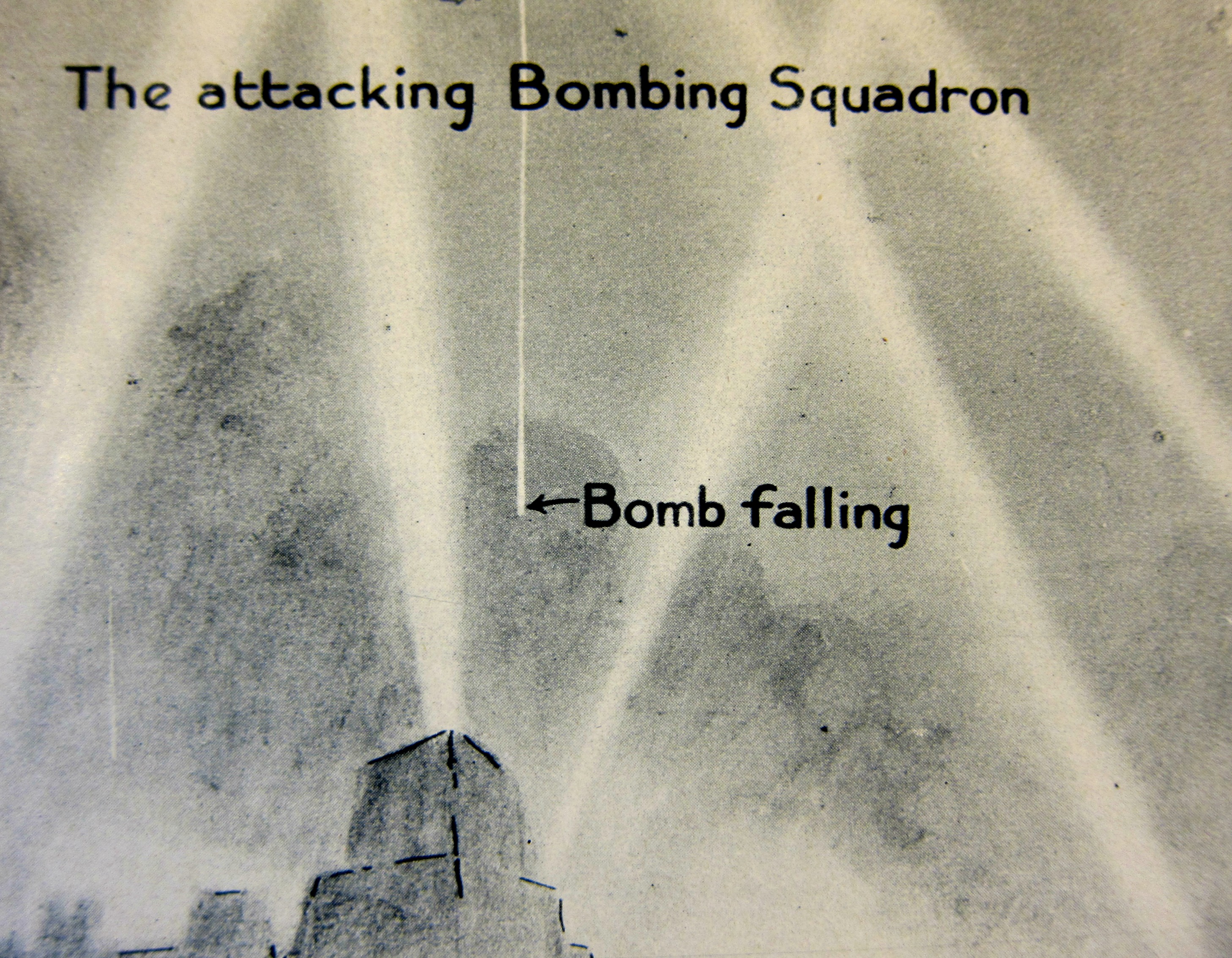
    The OED identifies the first usage of “anti-aircraft” 1914, which to me sounds about right–and pre-war, of course.  That said there were many opportunities to talk about something like anti-aircraft, as bombs had been dropped from balloons by 1849, and airplanes had been dropping grenades/bombs on soldiers and civilians since at least 1911–so the need for combating aircraft was there even though it took the English language a few years to catch up to expressing this idea in a hyphenated term.  By (July 23) 1927, when this short picture-article appeared in the Illustrated London News, there was enormous evidence and experience in anti-aircraft weaponry, and it seems that the Soviet Union was in a full-bore status to acquire a competent system, or at least they were talking about some aspects of it.  

    Anti-aircraft Moscow city street

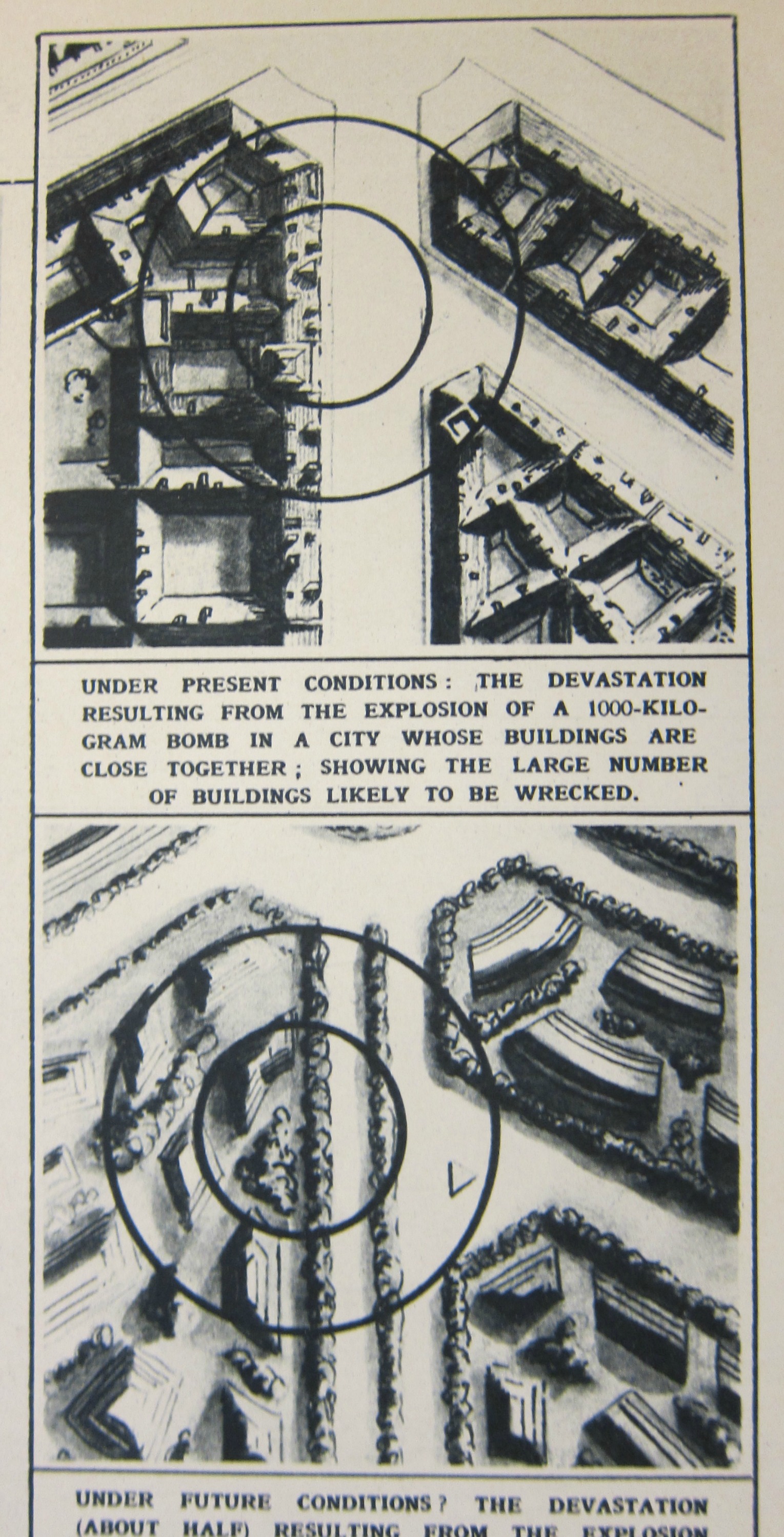
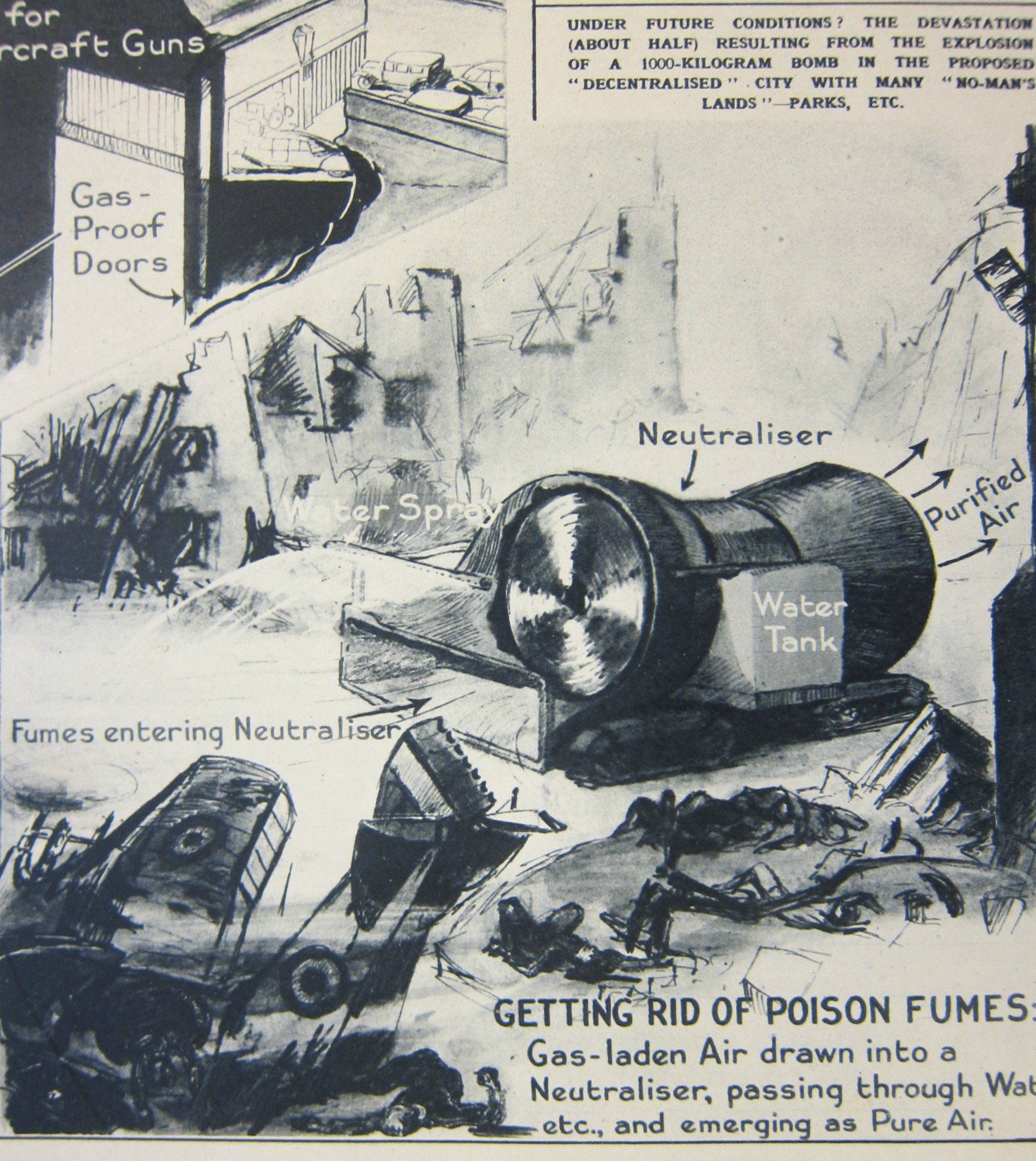
    And thank goodness for the artist who provided us with the right stuff to discern the “bomb falling”, dropped from one of the “attacking Bomber Squadron” able to elude the anti-aircraft defenses. The changes proposed were somewhat large in regards to the AA emplacements–on the other hand, the reassignment of space in a city, spreading stuff out so that dropped and exploded bombs would destroy less given the proximity of structures to one another, is an absolutely monumental undertaking. The city rebuilding is also predicated on a problem, as the bomb used in the scenario is only 1000-kilograms. This sort of thinking extends into the nuclear age when think tanks proposed Atomurbias, spreading out the population of the U.S. to basically everywhere, as well as evenly distributing industrial centers throughout the country (sometimes underground). There are problems enough relieving Flint of its water supply problems–it would be terrifying to think of redistributing the majority of the population of the U.S. and providing entirely new urban-ish areas for everyone to move into.  Of course there wouldn’t be enough material to do this, or workers, or more, or will, but that didn’t stop people from undertaking some federally-funded planning for it.  

    Anti-aircraft moscow gas scrubber

    The other part of this scenario is the protection from poison gas. And I guess we can just stop right there, with that small tank “neutralizer” that is supposed to absorb poison fumes and release “purified air”, because that sort of protection just will not happen…especially back in 1927.  

    ·Posted by :

    ·in:

    —

  • On What Cost What–Medical Costs of the U.S. Navy 1813-1817

    JF Ptak Science Books   Post 1659 (expanded)
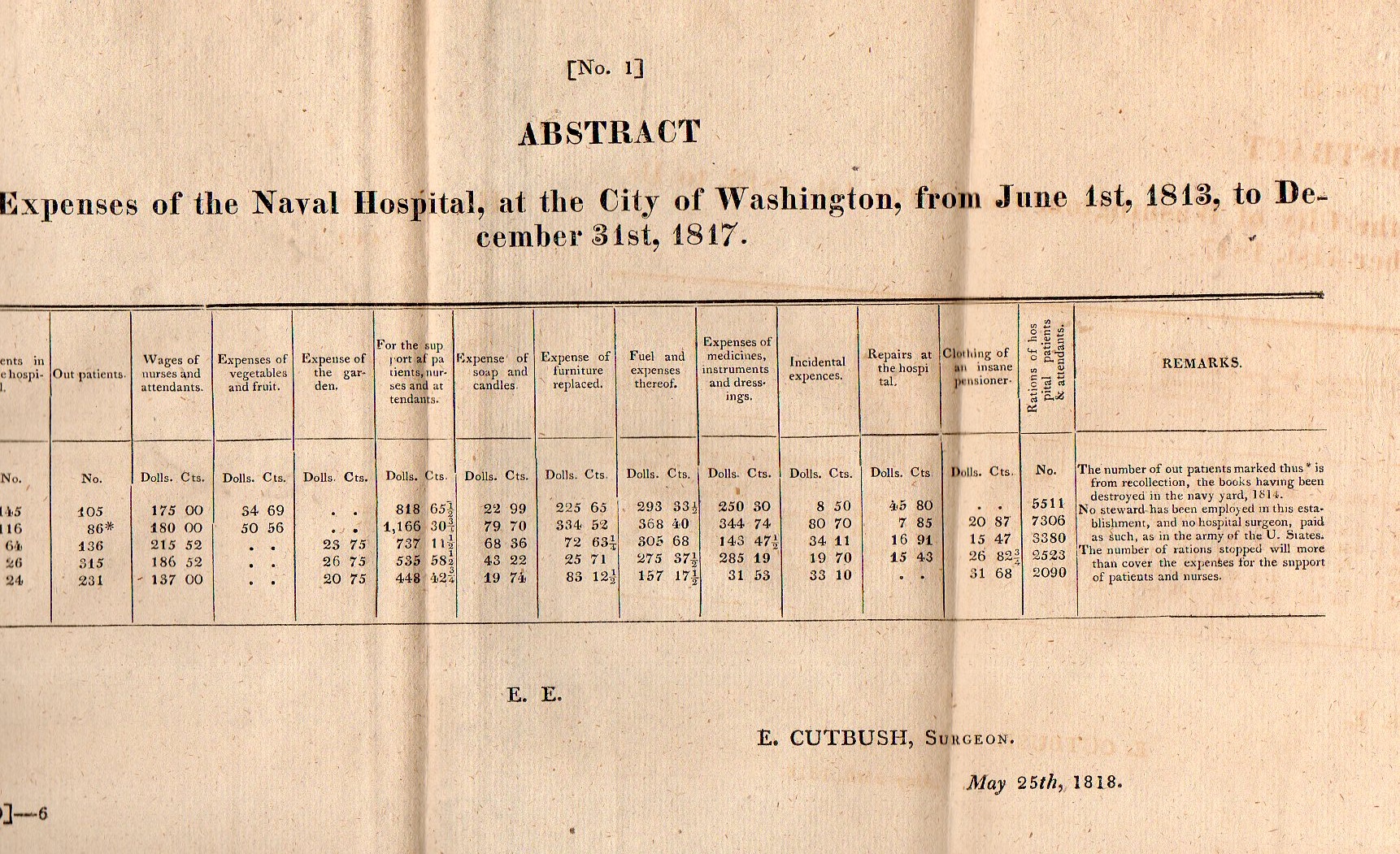
    Us navy medical 1817683

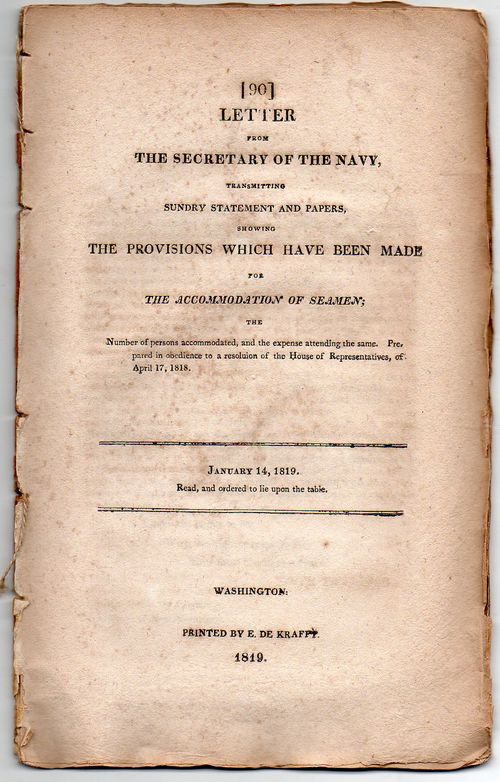
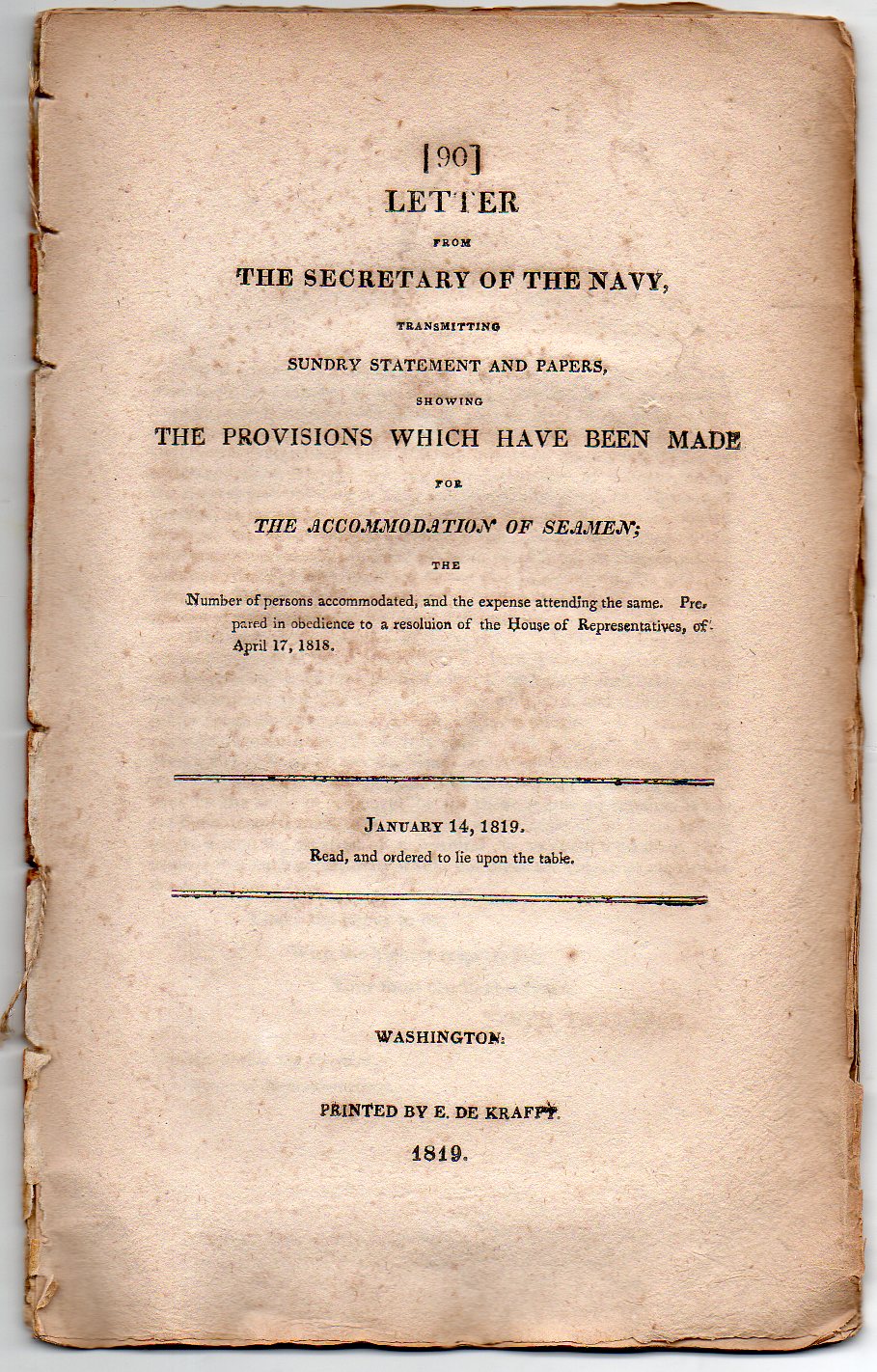
    Medical  expenses995When you think of expense and medical care, why on Earth should any of it cost so much?  Well, that question would make more sense if asked in the year 1819, because–according to the make-believe history of Medical Billing Capacity– the need for compensation for knowledge or spent stores or supplies or whatever was not very great, at all. 

    E(ward) Cutbush, a very capable naval surgeon (and noted as the father of modern American naval medicine) attests to this, and did so in this report on the status and expense of the hospitals and medical care facilities available to the U.S. Navy (and which was published in 1819). He didn’t of course know necessarily that health care wasn’t very expensive at all–especially if relation to the price of wine–Cutbush just reported the numbers. 

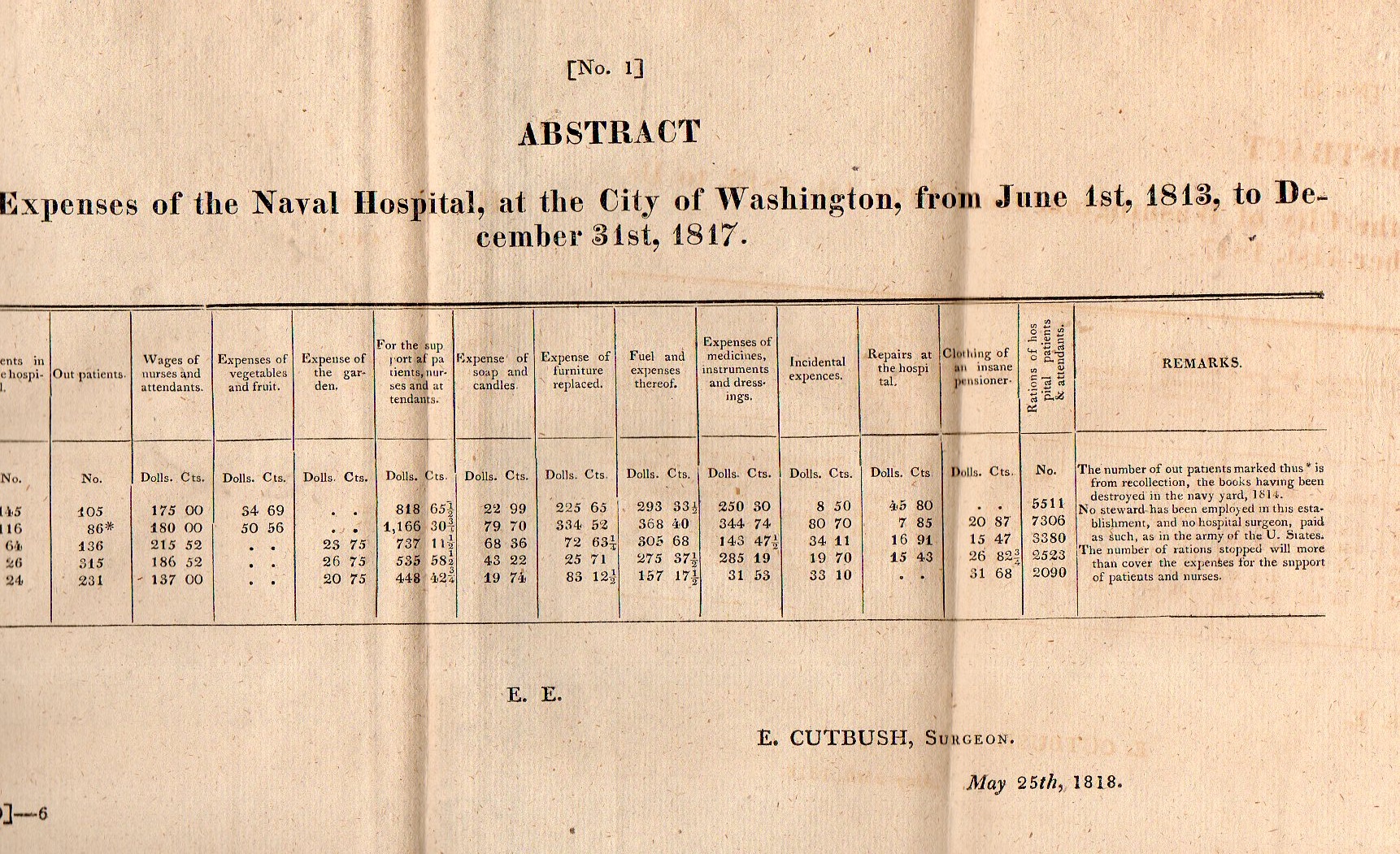
    And the numbers are interesting:  in 1814, for the U.S. Naval Hospital in Washington, D.C., for the 116 inpatients and 86 outpatients seen during the year, a total of $344.74 was spent on “medicines, instruments and dressings”, $1,166.30 on “support of patients, nurses and attendants” (which really meant food and sundries),  and another $180.00 in wages for  “nurses and attendants”.  By comparison, $79.70 was spent on soap and candles, $334.52 on replacement furniture, and $368.40 on fuel. $50.56 was spent of fruits and vegetables.

    And somewhere in there, we are shown that about $30 was spent on “clothing of an insane pensioner”, which I guess must mean that some old Seamen were judged to be “insane”, and needed clothing, before they were sent off and away from the hospital. 
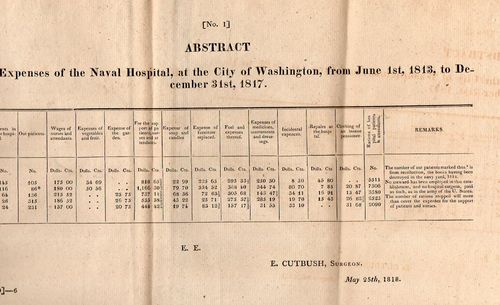
    US navy medical spreadhseet

    [This image is clear once enlarged.]

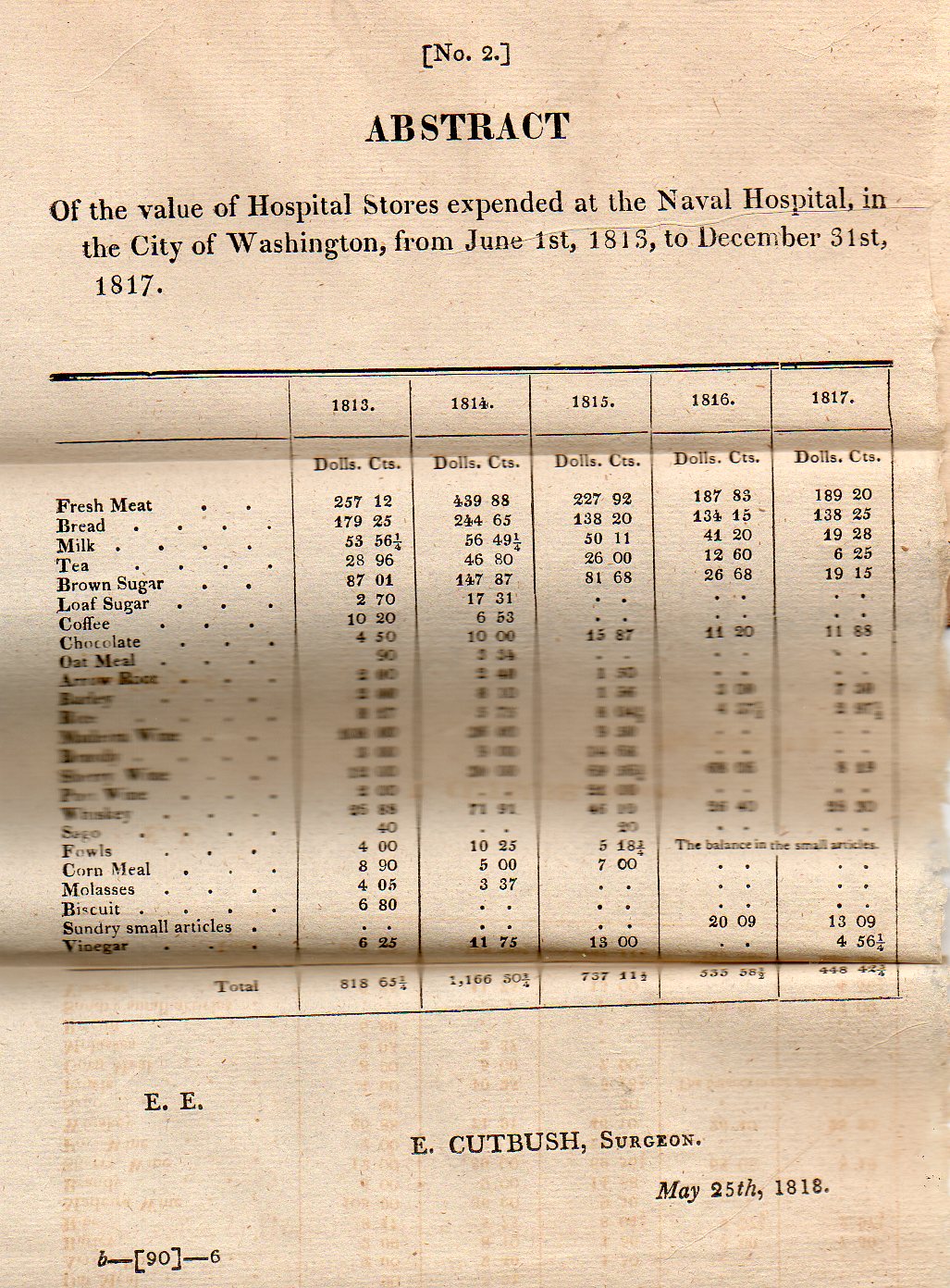
    A little bit further on, Cutbsuh tells of the more exact expenses on food/”support” for the folks at the  D.C. hospital  in 1814.  By far the leading expense (in the total of $1,166.30 3/4) was meat, meaty fresh meat, which accounted for nearly half of the total outlay ($439.88).  Bread was next ($179) followed by Madeira wine ($108).  Actually all of the alcoholic beverages–which included Madeira, brandy, sherry, port and whiskey) added up to $153.00, almost as much as bread.  Meat, bread and booze then accounted for $726, or 62% of the food budget (less the minimal cost of fresh veggies).  Milk, tea and coffee weighed in at $92, which means the drinking-goods totaled $245, or 21% of the food outlay.  Barley, rice, oat meal corn meal and “biscuit” came in at $24; vinegar, molasses and brown sugar surpassed those staples at $97.
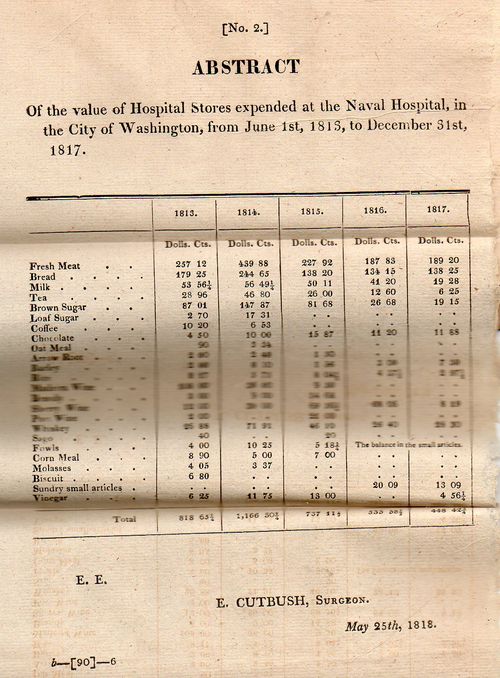
    Medical  expenses993

    We don’t get any information on the surgeon’s pay, unless we look at the stats for the naval hospital at Baltimore.  There, for 1814, we see that $352.00 was spent on medicine, $80 on surgeon’s instruments, $231 on fuel, $1645 on provisions, $18 for nurses, $18 for cooks, and $1282 on surgeon pay.  Unfortunately, I cannot find how many surgeons were called to receive this compensation, but we can see that their pay consumed 26% of the hospital expenses while caring for a total of 244 sailors over the run of one year.  It is not impossible that there was one surgeon on hand, and one nurse.  So, each sailor getting care from Baltimore received about $1.44 worth of medicine for their stay; the nurse and cook each got about 7 cents for each of the patients receiving care there, and the doctor picked up about $5.25 per sailor.

    Of course there wasn’t much in the way of surgical tools when compared with even the late 19th century to spend money on–ditto medicine.  Stand-alone hospital machinery was virtually non-existent in 1814, and so the major factor upon which all hopes were laid was the surgeon, a sort of walking hospital–a job of superior messiness and long and lonely responsibility.

    These numbers were for the late period of the War of 1812, when more than 2,650 servicemen were killed and 4,500 wounded.I could not in a cursory effort find the number of surgeons serving or employed during 1814, nor an overall figure on total medical care cost for seamen.  But it does seem likely that more was spent on milk, bread and booze than on medicine and surgical instruments.  And certainly the doctor cost far more than any other single unit int he medical care scheme–and, given that the greatest part of all care necessary resided with the physician, it was probably worth every penny (or fourth thereof.)

    Notes:

    1.  Cutbush at this time was given the direction of the “Marine and Navy Hospital establishment and of the medical and hospital Stores, which may from time to time be required for the use of the hospitals, or for the vessels of the United States equipped at this place.”-–Dudley, William S.. The Naval War of 1812, a documentary history, Volume 3.. Naval Historical Center, 1985.
     

    ·Posted by :

    ·in:

    —

  • An Empty Notebook for Hitler Youth, with Map (1941)

    JF Ptak Science Books  Quick Post   A History of Blank, Empty, and Missing Things series 

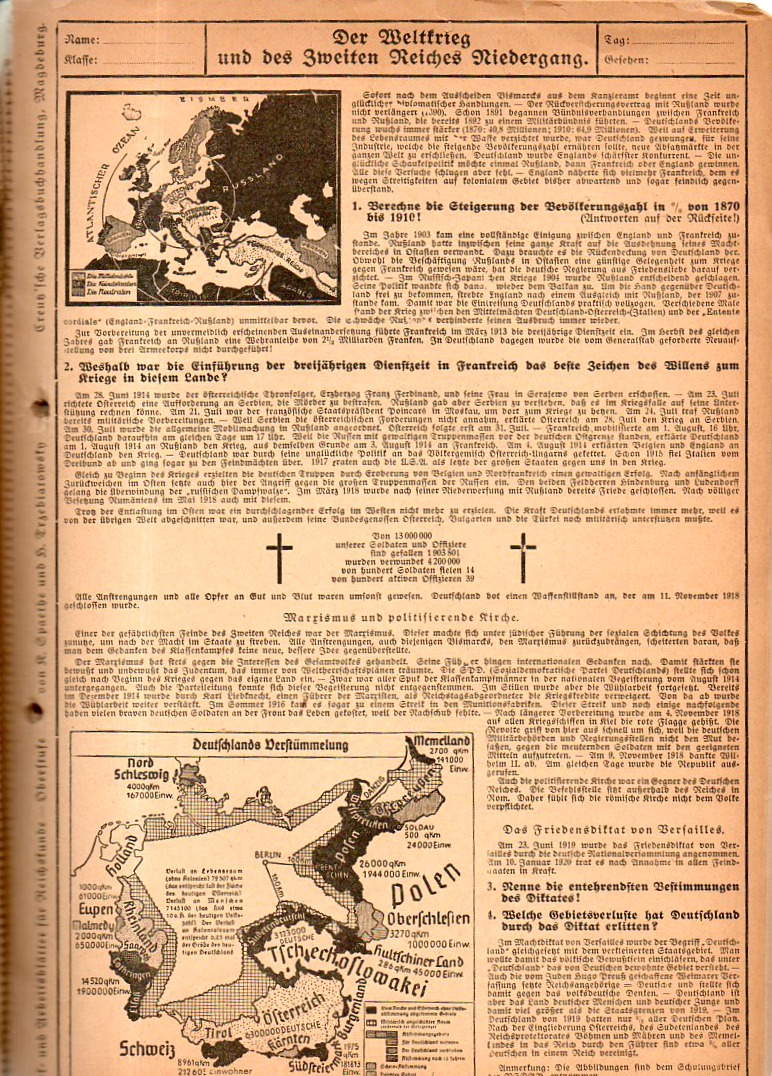
    Hans Trzebiatowsky & Karl Spaethe–two engineers turned propagandists–wrote the study/notebook for “students” working through modern German history, Merk- und Arbeitsblatter fuer Reichskunde, which was published in Magdeburg in 1941. It was very successful, as the title page states that this edition (“18…23 Auflage”) was the “1058 ,,, 1035, Thausend” which seems to put the print run over one million. Given that there were 66 million people in Germany in 1940, and that 6.6 million were soldiers, this may mean that just about every child between the ages of 12-17 had one of these–in any event, if those publication numbers were accurate, then the publication must have been ubiquitous. 

    The paperback publication is tall (about 12″) and densely written, and for all of that is only 24 pages long.  It is designed with perforation along the left-hand edge of the sheets so that the page could be removed and gathered in a two-ring binder. After dealing with the first and second Reichs in pages 1 and 2, the rest of the issue is a history and philosophy lesson on the Third Reich, presented for the Hitler Jugend in the best interests of the Nationalsozialistche Deutsche Arbeiter-Partei. 

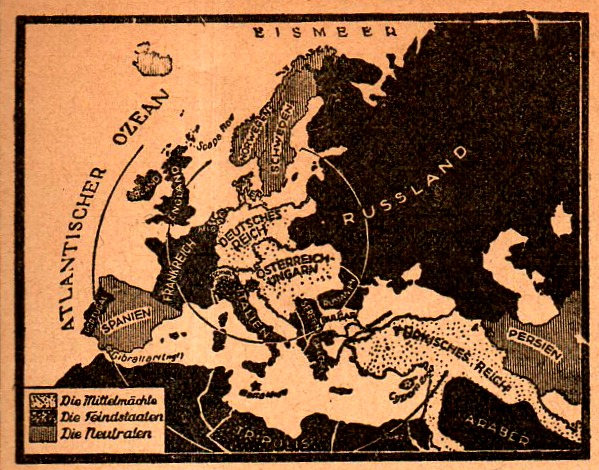
    The images in the publication were striking, and even for a bored general student or Hitler Youth could have lazily flipped through these pages without noticing them and having soem sort of message delivered. For example, this map that shows the state of the alliances in WWI and how the rest of the world outside of these allies stood against Germany:

    Spaethe652

    (Map is about 100% larger than the original)

    It should be understood though that the booklet was most definitely not a picture book for kids, as it was detail-heavy and brimming with Nazi needs:

    Spaethe651

    The book was definitely intended for instruction, as the back of every sheet of text is a 40-line ruled notebook page, ready for note–my copy hasn’t a word in it.  

    Blank empty


  • Suggesting a Landscape–the Beauty of Contour Lines on Maps

    JF Ptak Science Books   Quick Post

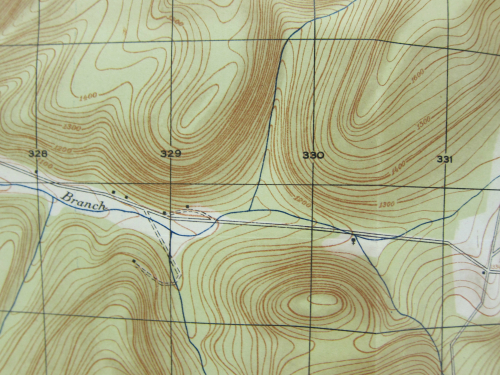
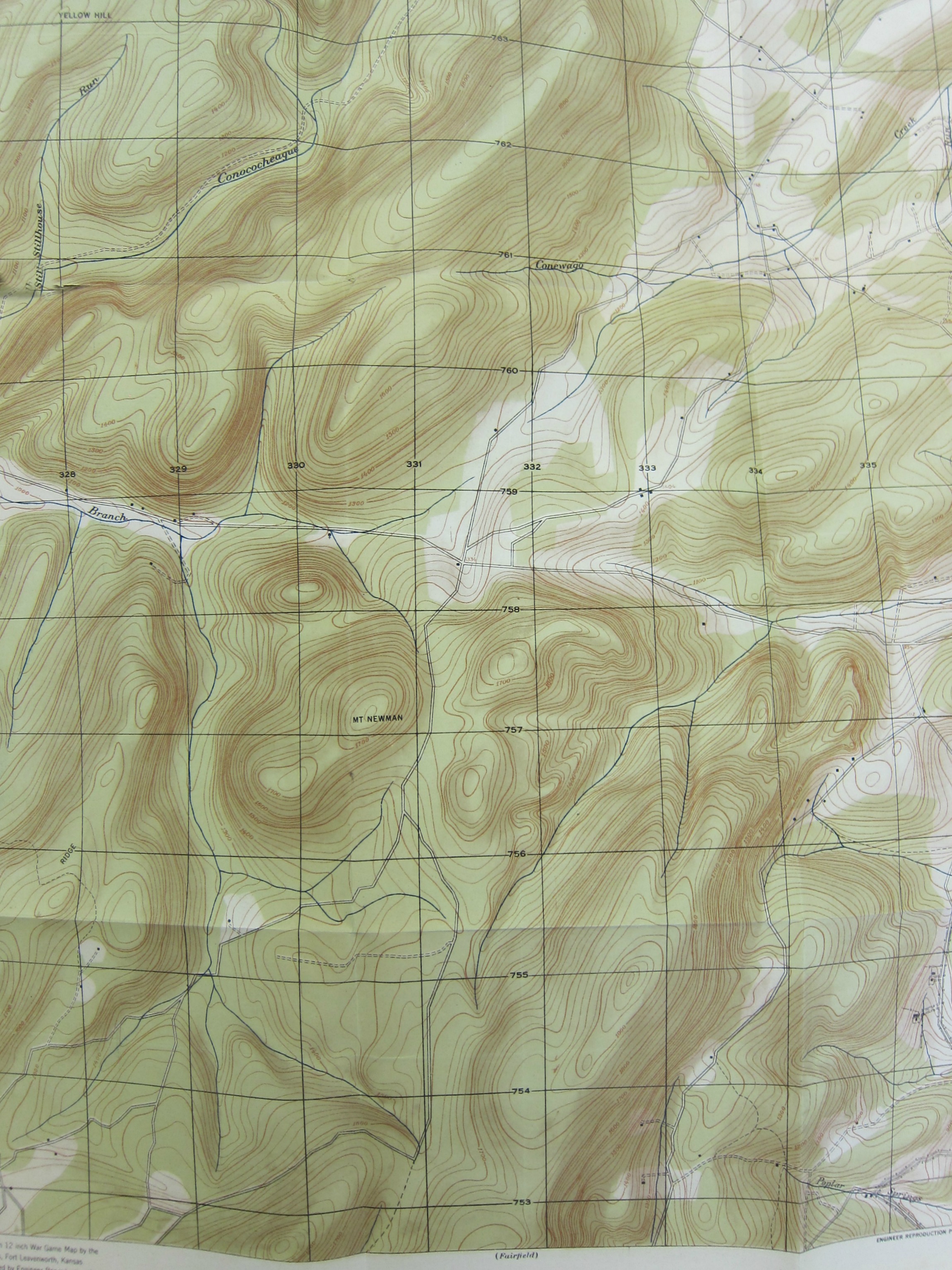
    There is a deep beauty in the imagery of maps with contour lines. This is found over and over again here, and tonight it rose from piecing together an enormous map of Gettysburg and its approaches.  Here is an example:

    Gettysburg map _detail 3_

    Source: A Map of Gettysburg and Antietam.  From: The Military Engineer, the journal of the Society of Military Engineers, published at the Mills Building, Washington, D.C., 1925-1927. 


    Gettysburg Map _detail 2_


  • Tinian, the Manhattan Project, and Manhattan (1944/5)

    JF Ptak Science Books   Quick Post 

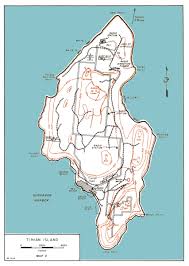
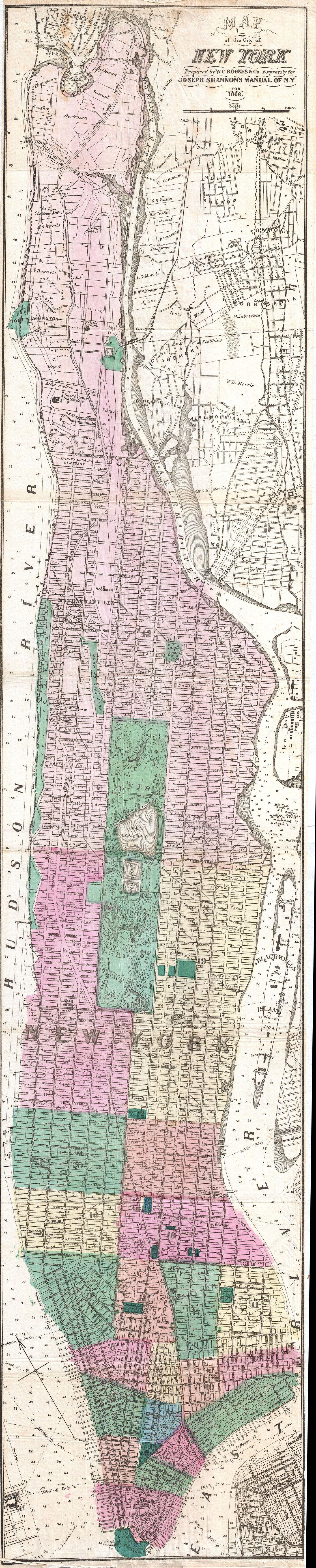
    As we all know Tinian Island was of a vast strategic importance to Allied War effort against Japan.  It sits just a few miles away from Saipan, and is situated close enough to Japan (1500 miles) to make the place an integral part of the advance on Japan as an airstrip.  The battle fought to control the island–in August 1944–resulted in it being taken by U.S. forces, the Japanese losing all but 300 or so of a garrisoned force there of 8500. Tinian became home to (among others) the 509th Composite Group, which was the home base for the bombing of Hiroshima and Nagasaki. It was the penultimate step of the fulfillment of the Manhattan Project–the last being the dropping of the bombs–and it struck me only very recently that after all of this time, it seems to me that Tinian bears a resemblance to Manhattan Island, which  makes for a peculiar irony. 

    Now that I have for the first time looked at a map of Tinian with street names, I see that this irony was deeply incised into the very earth of the place by Seabees, because when the plan of the city was laid out in the fall of 1944, the place received a gridwork of streets similar to Manhattan–and as a matter of fact, a number of the streets were named with Manhattan in mind: Broadway, Riverside Drive, Canal Street, 42nd Street, Wall Street, Canal were there and named, and even for the north end of the island, the major road leading out was named Saw Mill River Parkway, which is what I would drive leaving the city for Great Barrington, Ma. I don’t know why I am so very late to this party, but I am.  If you’ve not noticed this before, join the club, and enjoy.  (See here for a clearer map of the Tinian street names: http://www.pacificwrecks.com/provinces/marianas/maps/tinian.html#axzz4HjqvMu1w )

    Tinian Tnian manhattan