A Daily History of Holes, Dots, Lines, Science, History, Math, Physics, Art, the Unintentional Absurd, Architecture, Maps, Data Visualization, Blank and Missing Things, and so on. |1.6 million words, 7500 images, 4.9 million hits| Press & appearances in The Times, Le Figaro, Mensa, The Economist, The Guardian, Discovery News, Slate, Le Monde, Sci American Blogs, Le Pont, and many other places… 5000+ total posts since 2008.

Category: Calculating

  • Putting the “War” into “War Gaming” (1959)

    JF Ptak Science Books  Quick Post

    Out of the many references I’ve seen for war gaming in early-ish computer journals and reports from the RAND corp  (and other such places before, say, 1962)  I don’t think I’ve ever since a direct visual connection between three-dimensional gaming objects and a computer.  But here are two examples,in the same journal and within a few dozen pages of each other, one featuring chess pieces and the other featuring toy soldiers.  Both are obvious selections, but not used very often at all in illustration.
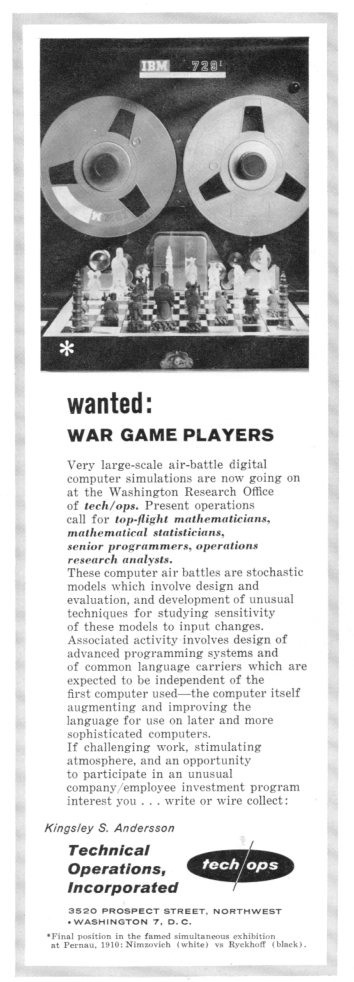
    War gaming495[Source: Communications of the Association for Computing Machinery, volume 2, number 10 and 12, October and December, 1959. Another image follows below.]

    Games of war and capture go far back, with chess many hundreds of years old and Go older still. Early war games as “war games” appeared in the late 18th and early 19th century, developing past Strategoes  (in the 1880’s) with other iterations, and then famously in two mass culture works by H.G. Wells, Little Wars (1911) and Floor Games (1913). 

    [The two Wells works may be found here and are well worth looking at: http://www.gutenberg.org/ebooks/3691 (Little Wars, though fair warning here of the unfortunate but time-laced subtitle, “(A Game for Boys from twelve years of age to one hundred and fifty and for that more intelligent sort of girl who likes boys’ games and books”)  and then http://www.gutenberg.org/ebooks/3690 (Floor Games)]

    And a second image, from a few months later:
    ·Posted by :

    ·in:


  • A Peek Behind the Curtain at the U.S. Strategic Bombing Survey (1945)

    JF Ptak Science Books  Post 2371

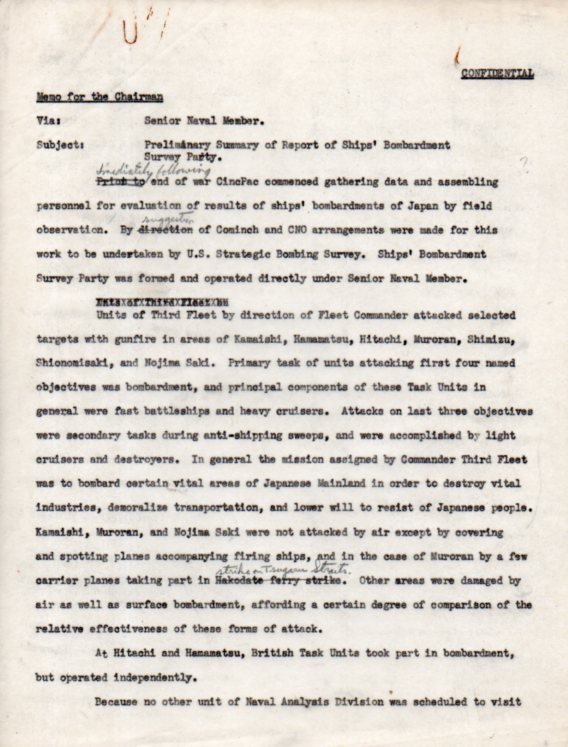
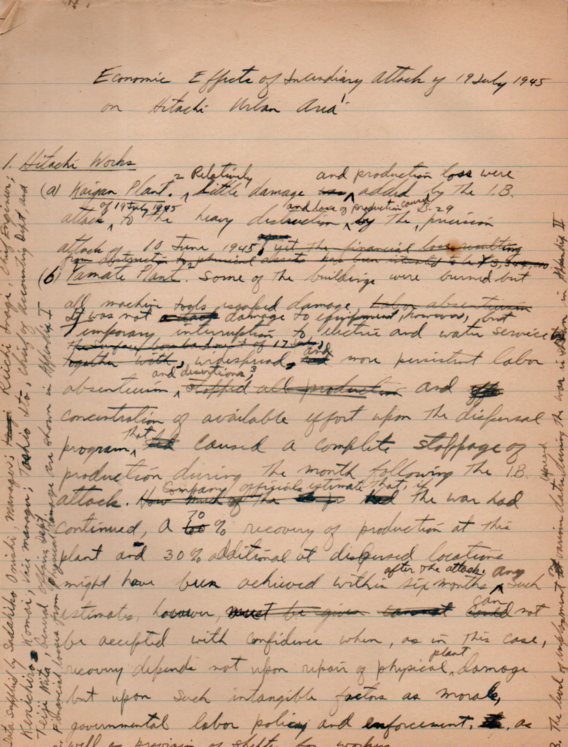
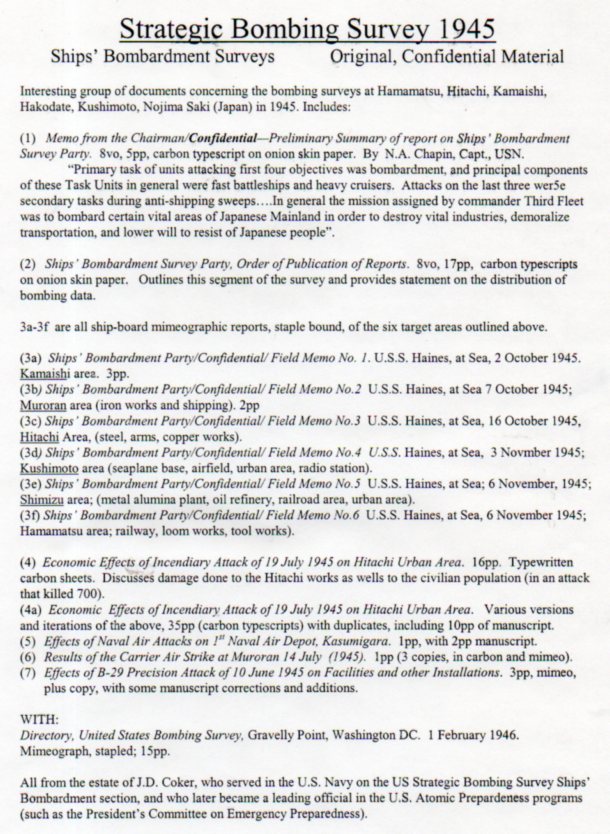
    The U.S. Strategic Bombing Survey was a massive intelligence operation composed of a 1000-person team. It attempted to establish the successes and failures of American bombing operations during WWII, resulting in a 208-volume set of findings for the war in Europe and another 108 volumes for the war in the Pacific. Atomic bombing was another matter. I am not going to address the effectiveness issues of different sorts of bombing here–it is a very large and complex issue, and just outside the scope of what I set down to down just now and the amount of time I have. What I did want to do was share this typed/manuscript material (below) that was kept by a member of the analytical team serving in the Pacific. It is interesting to see how the form of the final reports took shape from some of the original notes.  

    This small archive—from the estate of J.D. Coker, who served in the U.S. Navy on the US Strategic Bombing Survey Ships’ Bombardment section, and who later became a leading official in the U.S. Atomic Preparedness programs (such as the President’s Committee on Emergency Preparedness)—are mimeographs and manuscripts that comprise what seems to be the summary of the Navy’s bombardment of Kamaishi, Muroran, Hitachi, Kushimoto, Shimizu and Hamamatsu.  This was about the extent of the Allied naval bombardments against Japan, as it was not possible for battleships to maneuver close enough to the Japanese homeland to fire against industrial and production centers.  (It may have also been the case that the aircraft used to protect the assaulting ships could have perhaps done as much damage to the targets as the ships themselves.)

    The archive includes:

      USSBS overview191

    USSBS 1176

    USSBS economic effects189

    ·Posted by :

    ·in:

    —

  • Notes on Two Great Early Computer Science Textbooks (1950-1953)

    JF Ptak Science Books       Post 2368

    It is worth reporting on these two perhaps-forgotten (outside of the specialty area) classics in the early history of computation. The first was written by a powerhouse married team of Andrew and Kathleen (Britten) Booth—Andrew was the inventor of the magnetic drum memory and the Booth multiplication algorithm, and Kathleen was the creator of the first assembly language, for starters).

    The book was a superior effort and was a survey of the state of computation via digital computer for the Post WWII-1953 era.  The 17 chapters are geared mainly as an instructional–an advanced “how to”, if you will, with plenty of diagrams and illustrations.  After a few historical chapters, we have:  the overall design of a computing system; the control; the arithmetic unit; miscellaneous operations; input-output; gates; single digit storage; miscellaneous components, storage devices.  From this point on, from p136-196, the book deals primarily with programming issues:  definitions of a code and discussion of its form and controls (!), pp 136-151; the techniques of coding; the use of subroutines in coding; program design; some applications of computing machinery. 


    ·Posted by :

    ·in:


  • A Great Ad for the Comptometer, 1894

    JF Ptak Science Books   Quick Post

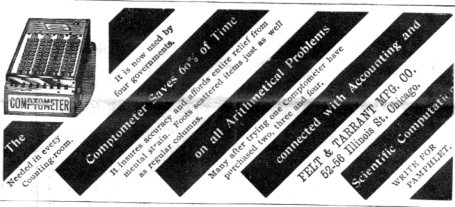
    Earlier in this blog I posted a magnificent illustration of the fabulous new comptometer adding/calculating machine, here.  I wanted to include this unusually designed ad for the machine somewhere on the blog before I lost it (again), and so here it is:

    Comptometer379In my experience the use of diagonal black-and-white lines like this for illustration or advertisements was really very uncommon.  


  • The Kingdom of Fingers

    JF Ptak Science Books  Quick Post

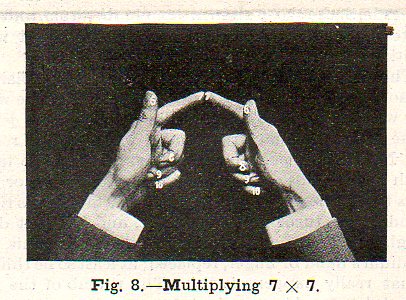
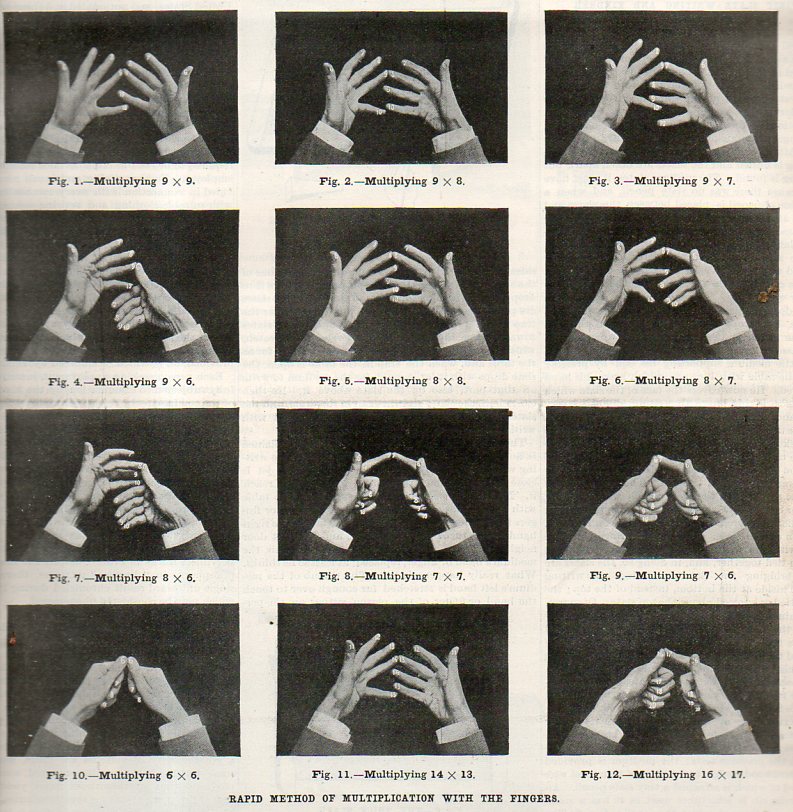
    “The Fingers as an Aid in Multiplication” is another wonderful find coming from a general browse in the great Scientific American (October 22, 1898, page 265). It is an interesting article, using the fingers so that the multiplication tables didn’t have to be memorized by kids–I think that they absolutely should be–but the images taken out of context can also be regarded in some sense for this blog’s “Found Absurdist” series.  (We are told that the system was devised by “a Polish mathematician”, Procopovitch–he is repeatedly referred to as “the Polish mathematician”.)

    • See “Digital “Computers 1450-1750: Memory and Calculating on the Fingers and Hands”, a post on this blog from 2008, here.

    Hand calculating300

    A detail from:

    Hand calculating299


  • Table Top Calculator that is the Table, and the Top

    JF Ptak Science Books   Quick Post

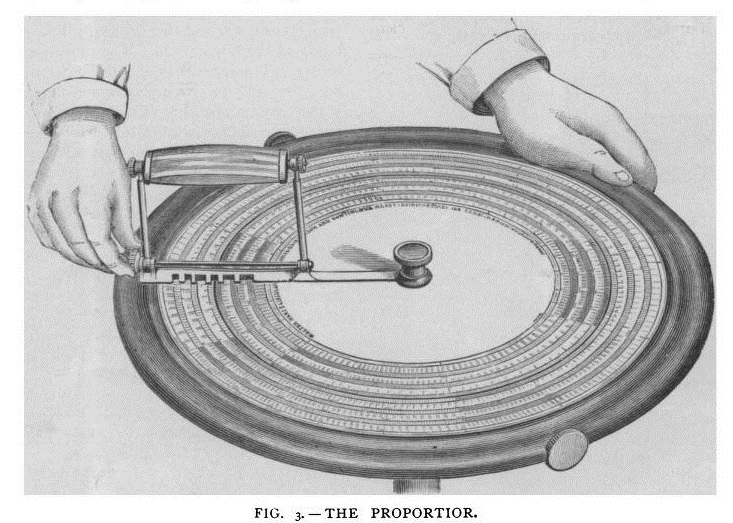
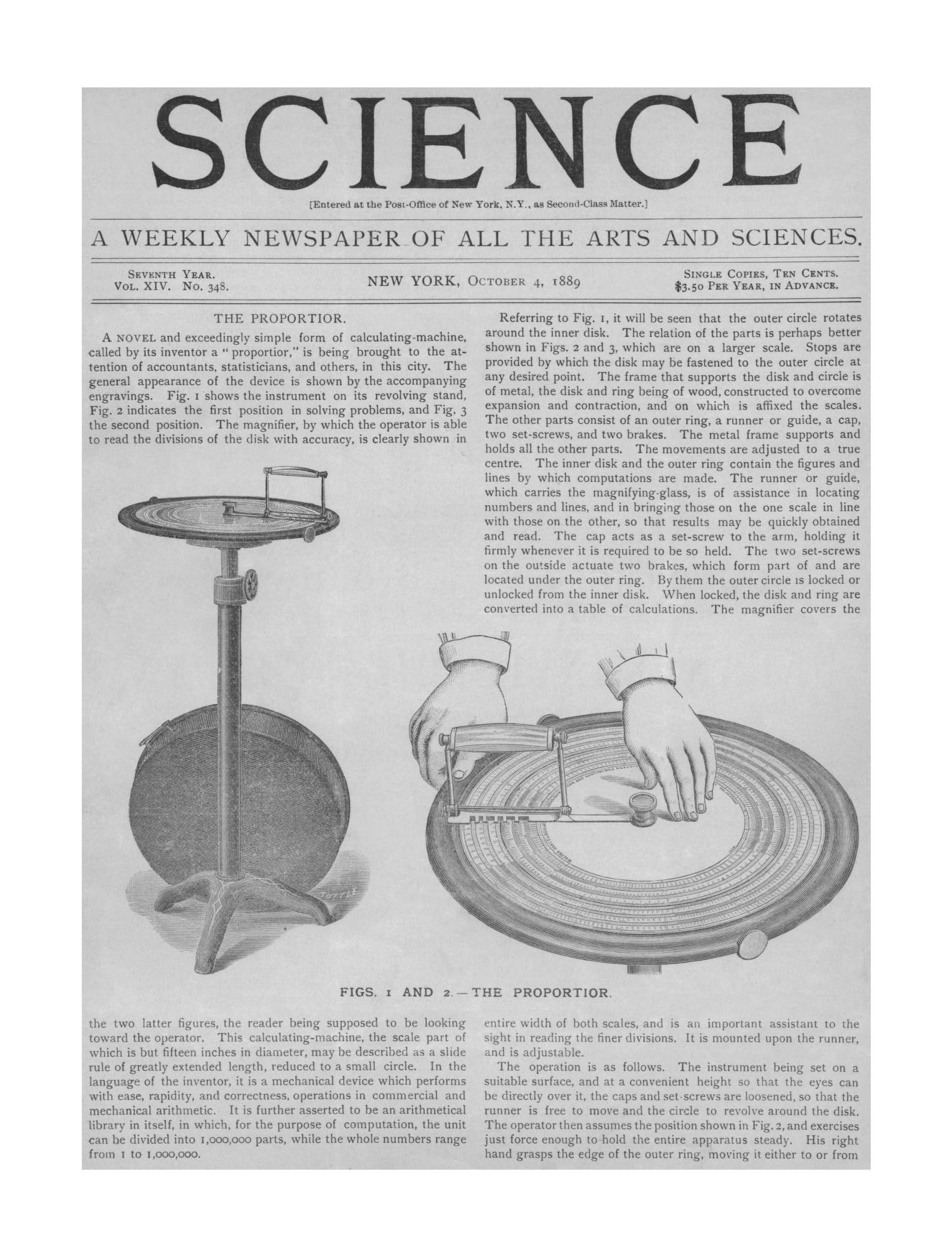
    The “Proportior” (sounding somewhat like an exclamation, like Excelsior!, and looking for all the world like it should be spelled some other more appropriate way) a fabulous desktop/tabletop calculator, as seen in the Science, October 4, 1889:

    Proportioner

    Proportioer2Thanks to Ray Girvan for the link to a successful download of images for this!


  • A Beautiful Idea: the Knight’s Magical Magic Square Tour (1888)

    JF Ptak Science Books  Post 2243  
    Follow Me on Pinterest

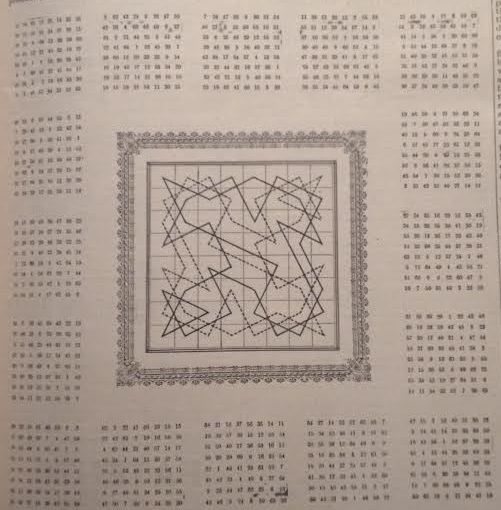
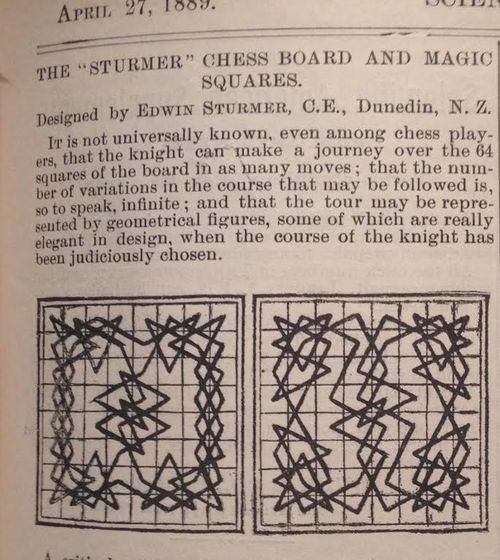
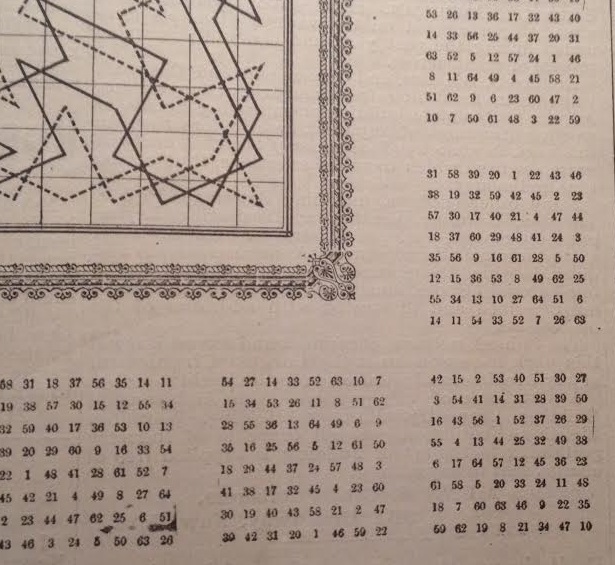
    The idea behind this extraordinary image below is the construction of an 8×8 magic square capable of describing BOTH the Knight’s tour (” a sequence of moves of a knight on a chessboard such that the knight visits every square only once…if the knight ends on a square that is one knight’s move from the beginning square) WITH the resulting moves forming a series of magic squares. It is the product of a Kiwi engineer named Sturmer, and appeared in the Scientific American Supplement for 1888.

    Sturmer2

    Eric Weinstein says in his article “There Are No Magic Knight’s Tours on the Chessboard” on Wolfram’s Mathworld site says, well, such a thing is not possible. “After 61.40 days of computation, a 150-year-old unsolved problem has finally been answered. The problem in question concerns the existence of a path that could be traversed by a knight on an empty numbered 8 x 8 chessboard.”

    Weinstein is concise: “Not surprisingly, a knight’s tour is called a magic tour if the resulting arrangement of numbers forms a magic square, and a semimagic tour if the resulting arrangement of numbers is a semimagic square. It has long been known that magic knight’s tours are not possible on n x n boards for n odd. It was also known that such tours are possible for all boards of size 4k x 4k for k > 2. However, while a number of semimagic knight’s tours were known on the usual 8 x 8 chessboard, including those illustrated above, it was not known if any fully magic tours existed on the 8 x 8 board.”

    Source:  http://mathworld.wolfram.com/news/2003-08-06/magictours/

    Sturmer


    Sturmer 3

    And this, from the British Chess Maagzine, 1888, page 278: 


  • A Beautiful Confusion

    JF Ptak Science Books   Quick Post

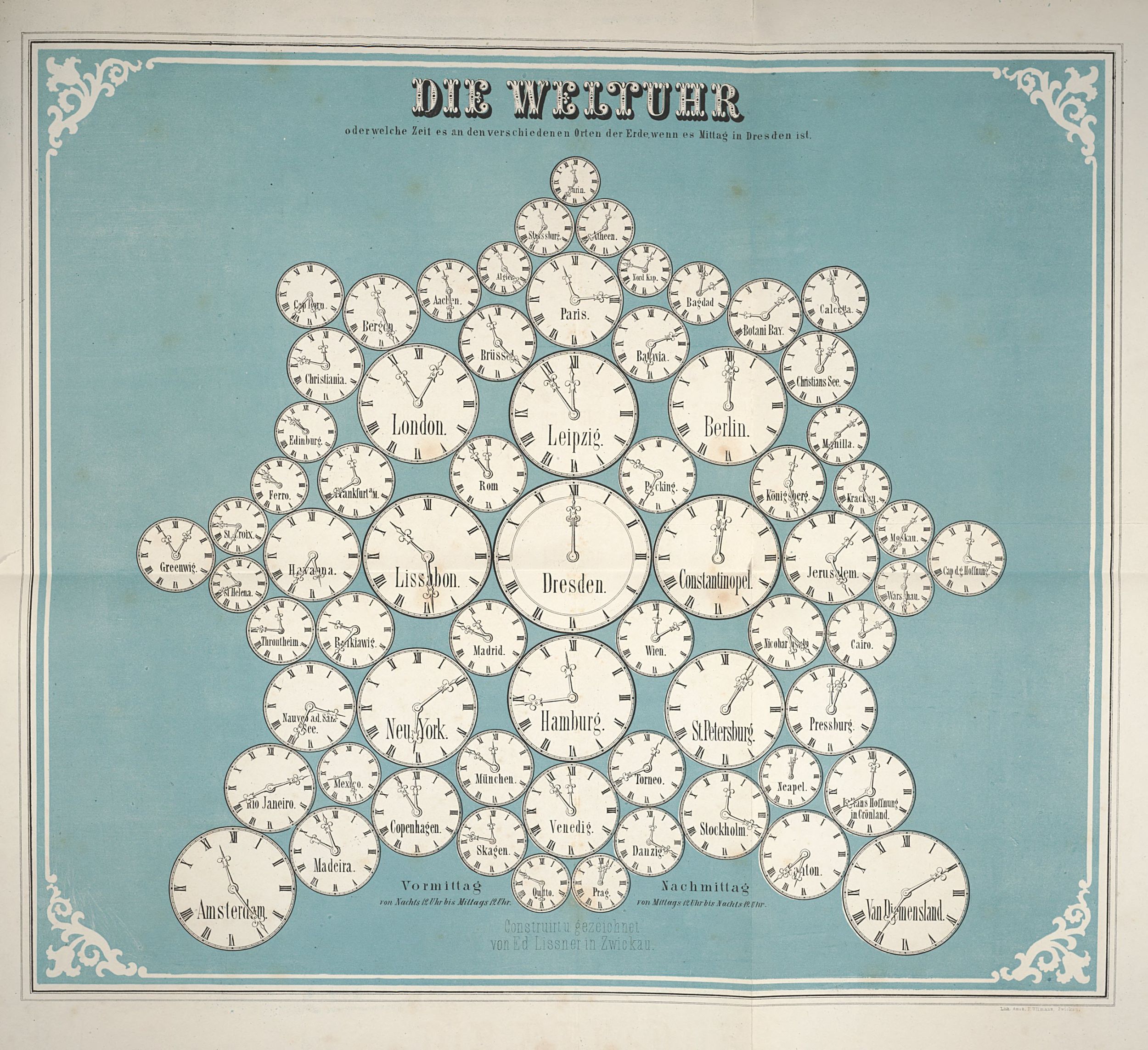
    Time Germany 2

    [Image source: Bibliodyssey, 19th Century Infographics]

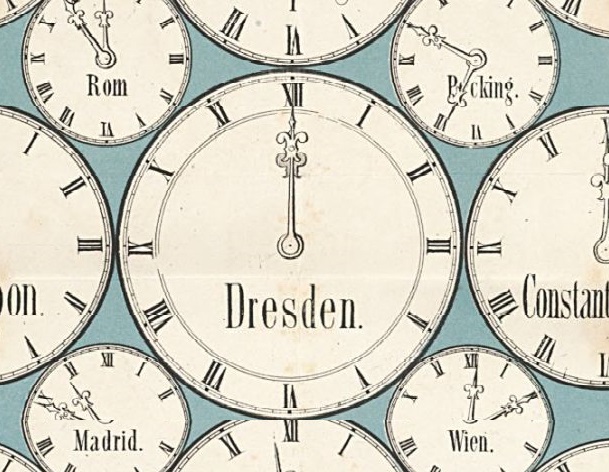
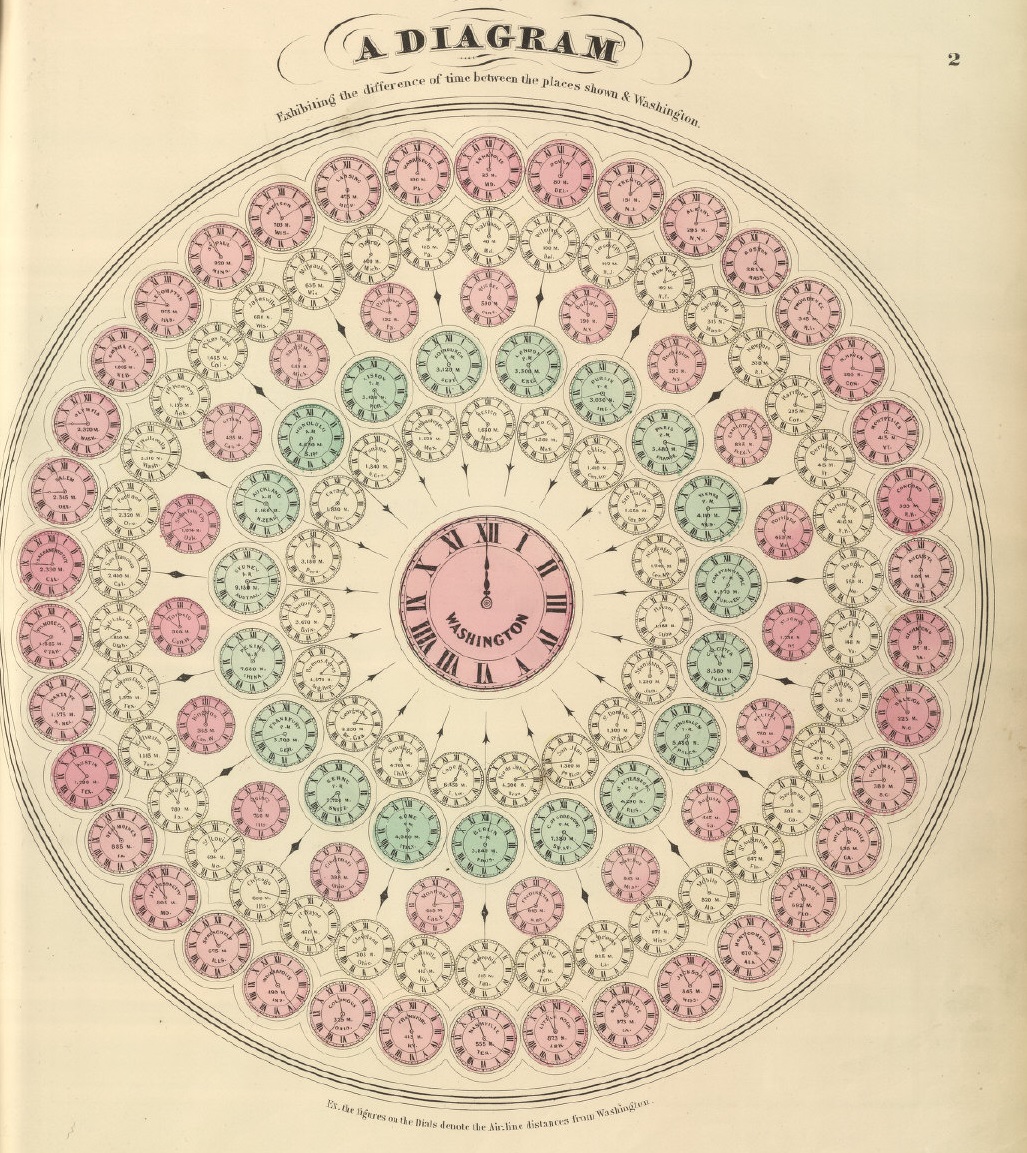
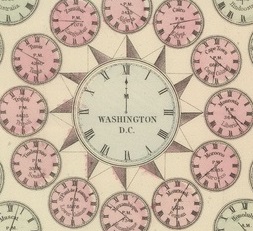
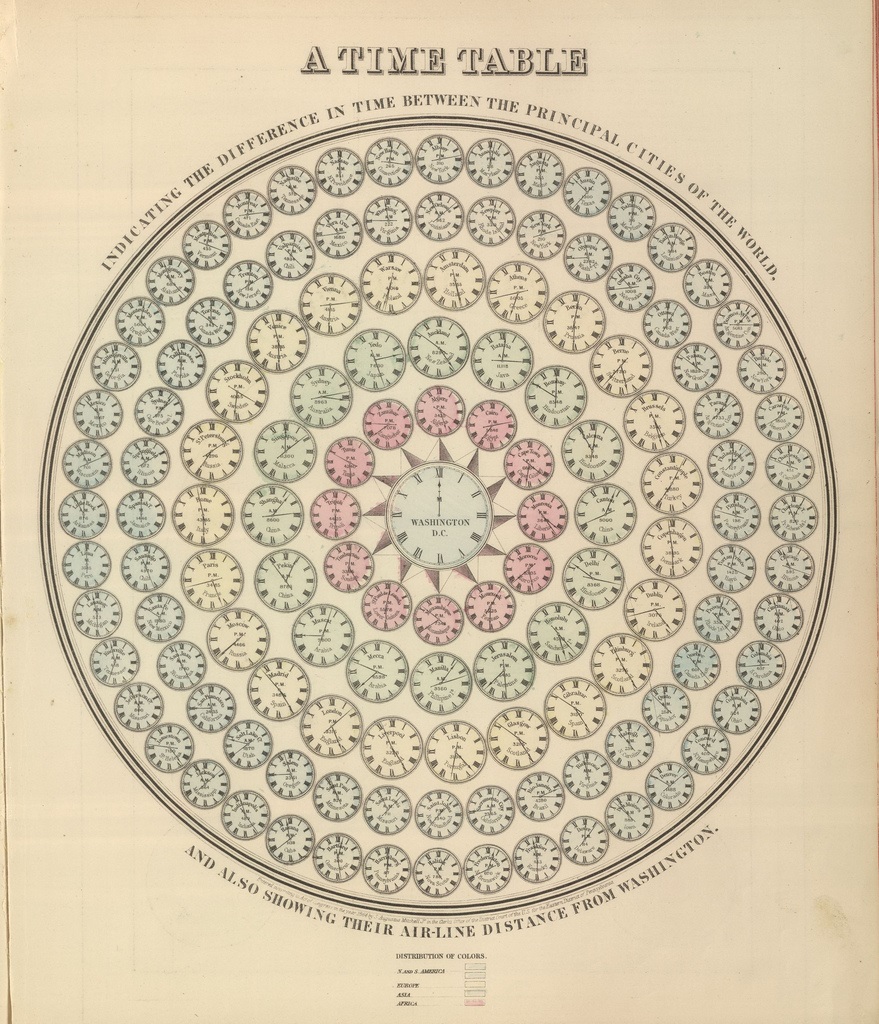
    Reckoning time from city to city before the adoption of Standard Time (1883/4) was a difficult and confusing process.  Local time was local, and usually dominated by a central timepiece located in a public area, as in a church steeple or town hall.  The problem is is that the foundation for this timekeeping–the zenith of the sun during the day–would be different from area to area. That’s not so bad when communication over periods of days was involved, bu tit was very noticeable to train travelers who would find their home-reckoned pocket watches to be not-quite-right when moving hundreds of miles over the course of a day.

    And that’s where these charts come in.  They were made before the institution of a standardized system for keeping time worldwide, and so the “Dresden Time” of new was actually equal to about 10:48 in Madrid or 12:02 in Vienna.  In the U.S. in the 1870’s there were hundreds of time zones (whittled down somewhat to 100 towards the end of that era) which made it a bit of a nightmare for maintaining railroad schedules.  Sanford Fleming fixed all of that (the end of a long line of people who attempted standardized systems) in 1884, and did away with the need for these beautiful but confusing time arrangements.  

    On the other hand the displayed results for dealing with the pre-standardized chrono-confusions are beautiful things…

    4574g(1)

    Image Source:  Johnson’s New Illustrated Family Atlas of the World, (1874). Source: David Rumsey Map Collection, here


    Time table 2


    Time table

    Time Germany

    [Source: Bibliodyssey, 19th Century Infographics]


  • A Beautiful Manuscript of Square Roots, 1830’s

    JF Ptak Science Books   Post 2082

     309

    (Note: we’ll deal with square root of  3 at another time…)

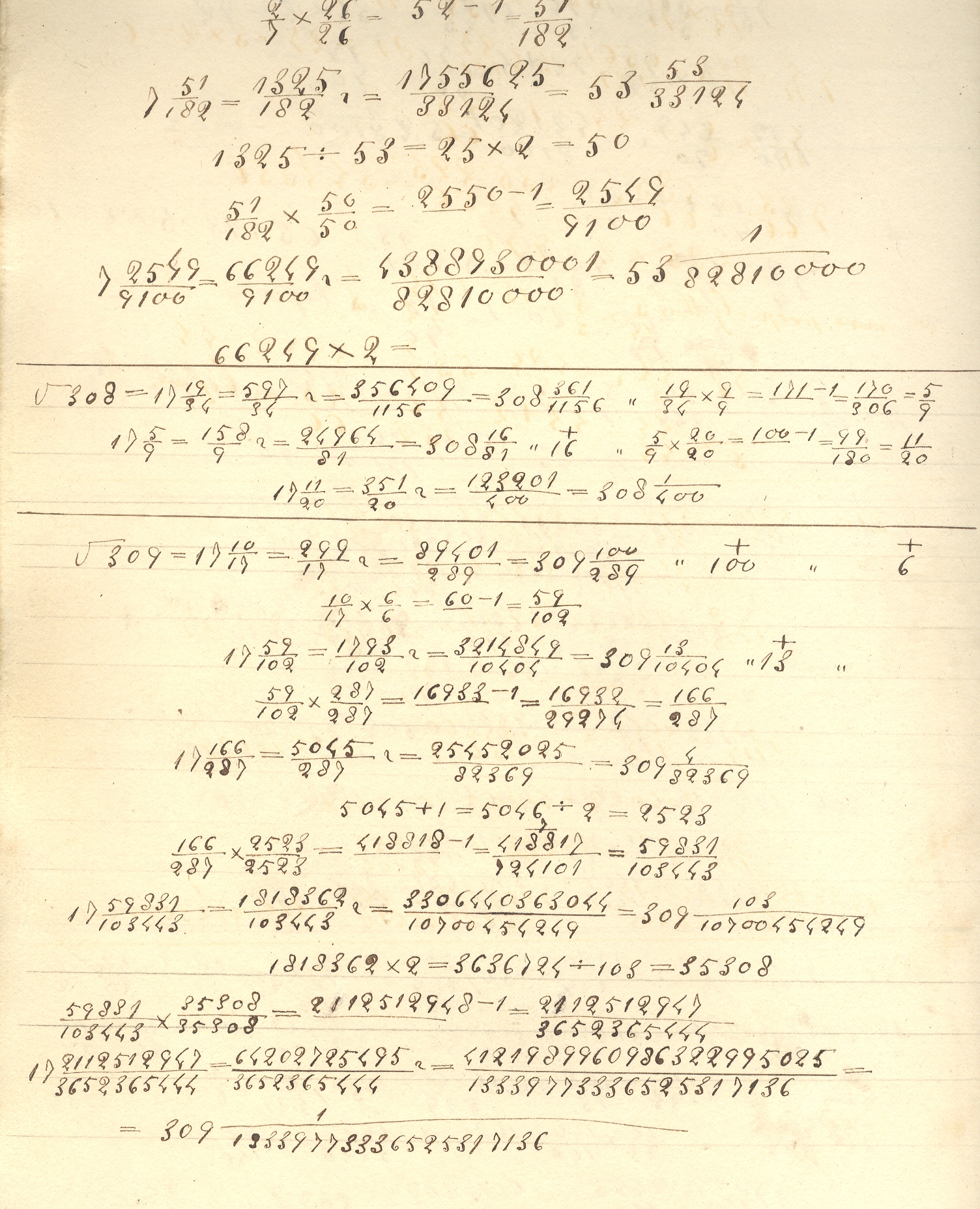
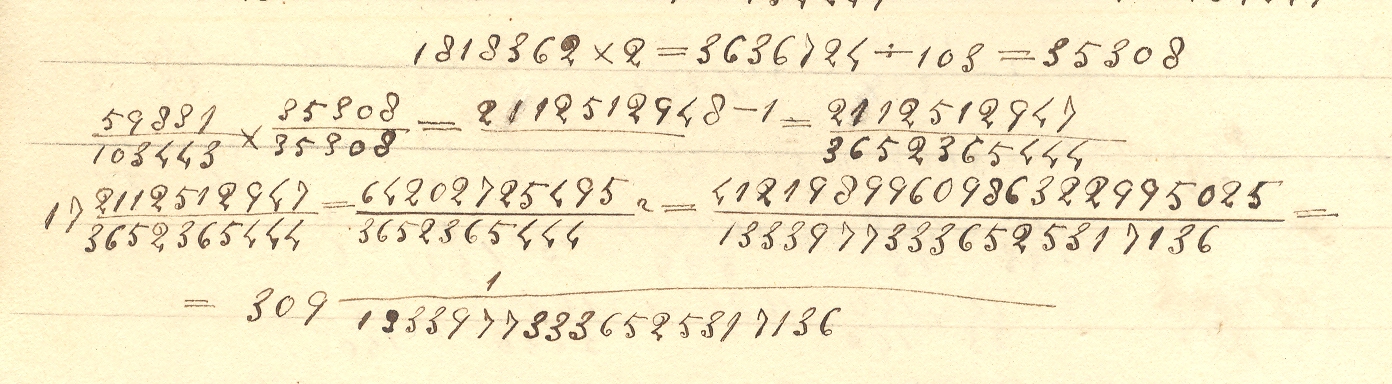
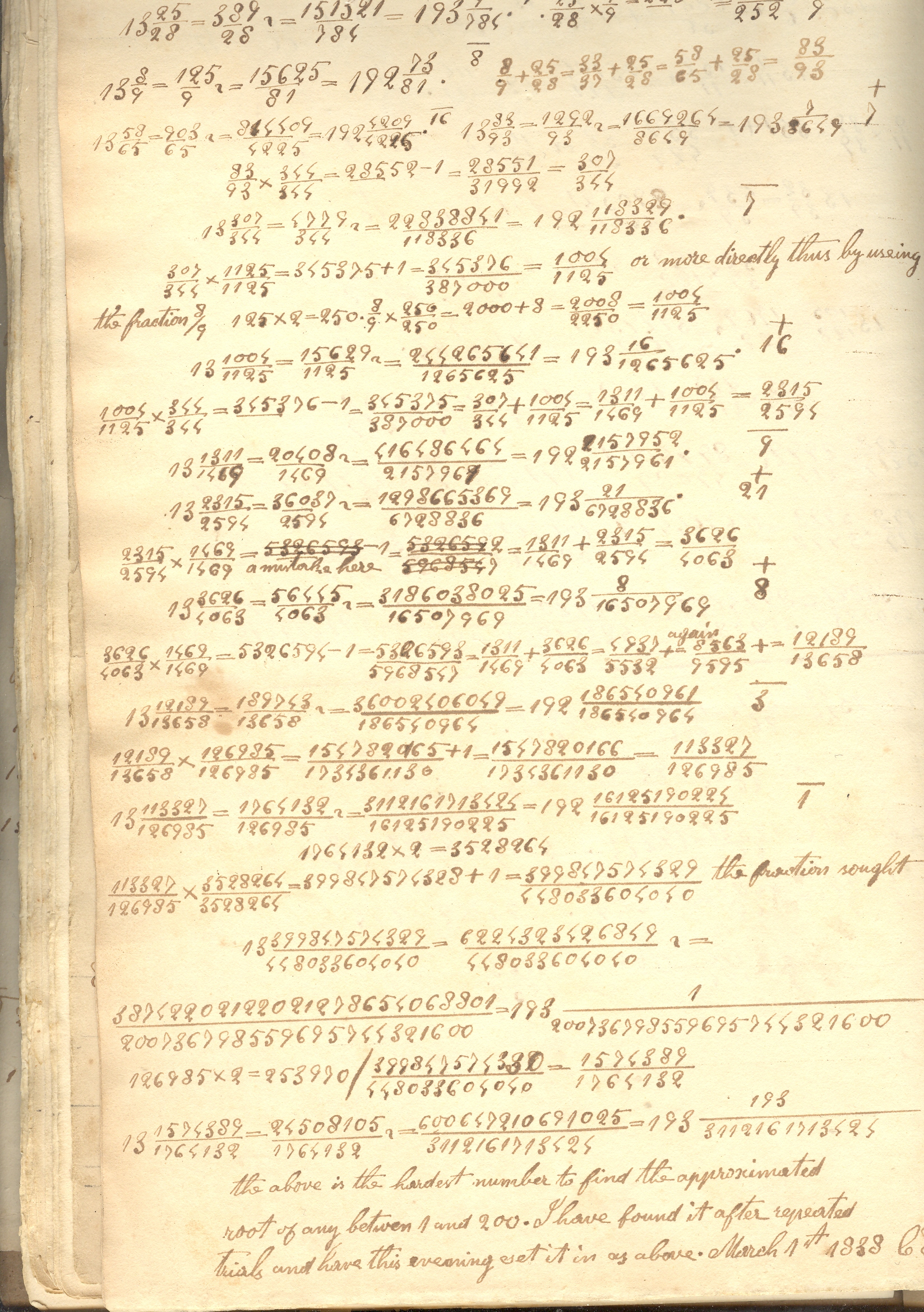
    The author of this manuscript, Charles Fisher, took a solitary pleasure in calculating the square roots of numbers from 2  to 589, not bothering to write down the 24 perfect squares to 576.  (The sqrt being r2 = x for every non-negative real number x.) From the few bits that I have checked the man seems to have done a good job back there in the 1830’s. 

    I cannot determine where this book was written or who Mr. Fisher was, though it is possible that he was a (Baptist) Minister from the few short textual notes that pop up here and there. 

    [This 140pp manuscript is being offered for sale at our blog bookstore, here.]


    His work is pretty elegant.  Take for example his solution (and proof) for the square root (hereafter sqrt(x)) 309,

    309 det

    which the calculator living under this page says is 17.578395831246947    Mr. Fisher’s answer is 17 10/17 = 799/17=89401/989=309 100/989, and after some more involved arithmetic comes t the lovely proof number of   

    4121989960986322995025 /13339773336525317136 or

    309.00000000000000000007496379247

    Which is getting pretty close. 

    309 193

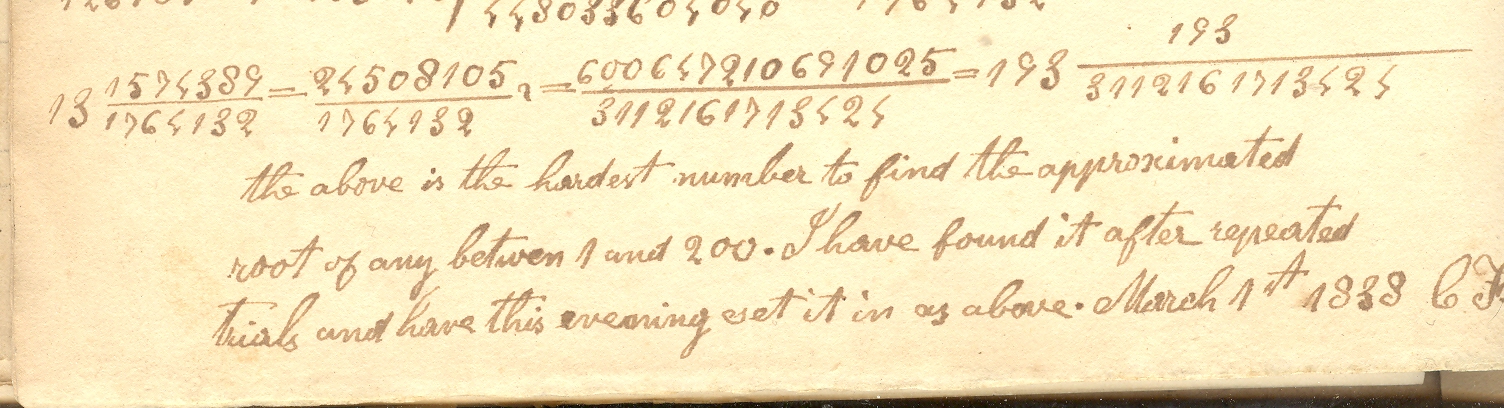
    The only note that Mr. Fisher makes on his calculations is for the sqrt(193), which he notes as “the hardest number to find the approximate root of any between 1 and 200. I have found it after repeated trials and have this evening wrote it in as above. March 1st, 1833. CF.”

    309 193 det

    ·Posted by :

    ·in:

    —

  • Magical Magic Squares of Some Advanced Age

    JF Ptak Science Books   Post 1987Follow Me on Pinterest

    Magic square 7096
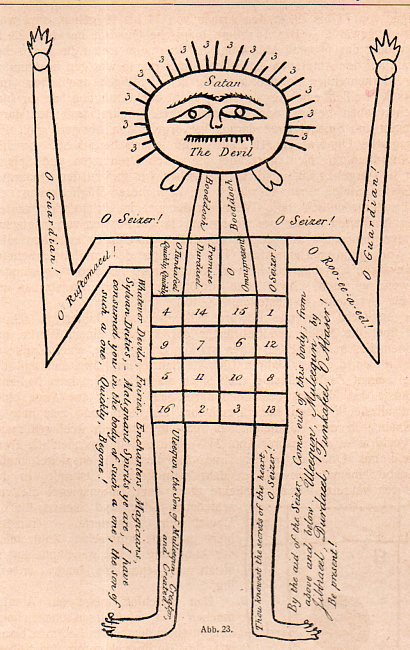
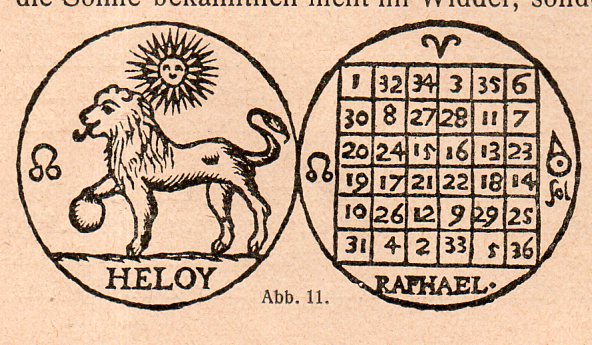
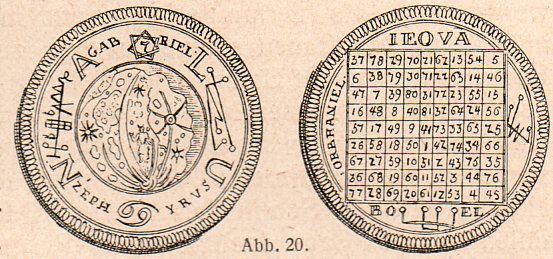
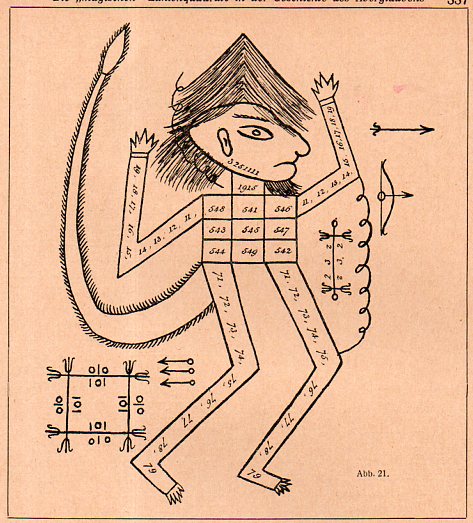
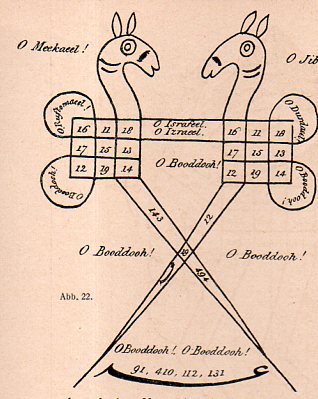
    I found these extraordinary magic squares lurking in the September 1915 issue of Himmel und Erde–seeing them was a shock to me, especially since I was expecting articles dealing with more technical and also astronomy-related issues, though treated as a history of astrology/astronomy aspect I guess that I should’ve have been too surprised.  The author, W. Ahrens (of  Rostock) had written on different aspects of the magic square in the South Pacific (“Etwas von magischen Quadraten in Sumatra und Celebes”) and more extensively on the Kabalah and magic squares (in “Hebraeische Amulette mit Magischen Zahlenquadraten” for example), and in general in his Mathematische Unterhaltungen und Spiele (1901). 

    Magic square 1090
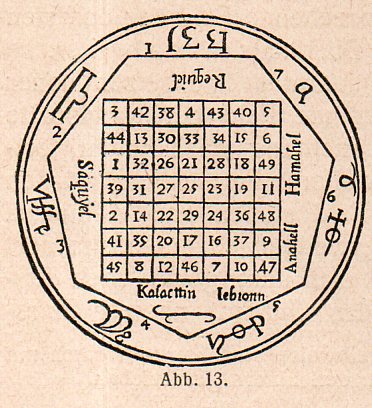
    (An interesting example of a “Venus” magic square, with seven cells).

    Magic square 4093
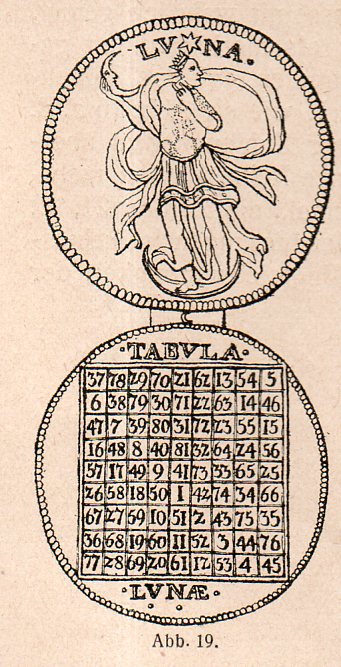
    (This magic square, a “Moon” or “Lunar” square, has nine cells, and also has a form of a “T” world map.  The names of the magic squares were adopted by Cornelius Agrippa (1486-1535) who constructed squares of 3,4,5,6,7,8 and 9 cells, naming them for the seven “planetary” astrological symbols, Saturn, Jupiter, Mars, the Sun, Venus, Mercury and the Moon.  The magic square as an idea seems to have been introduced in the west by Moschopulus of Constantinople in the earlier 15th century–the magic square itself though is ancient, alive and well in India more than 1500 years before its arrival in Europe). 

    Magic square 5094

    A magic square amulette from East India.

    Magic square 6095

    Magic square 3092
    Another 9-cell magic square, indentifying itself with “Lunae” and “Luna”. 

    Magic square 2091

    They’re all quite beautiful.


    “

    ·Posted by :

    ·in:

    —