A Daily History of Holes, Dots, Lines, Science, History, Math, Physics, Art, the Unintentional Absurd, Architecture, Maps, Data Visualization, Blank and Missing Things, and so on. |1.6 million words, 7500 images, 4.9 million hits| Press & appearances in The Times, Le Figaro, Mensa, The Economist, The Guardian, Discovery News, Slate, Le Monde, Sci American Blogs, Le Pont, and many other places… 5000+ total posts since 2008.

Category: Calculating

  • What Did Sailors in the U.S. Navy Make in 1820?

    JF Ptak Science Books  Quick Post

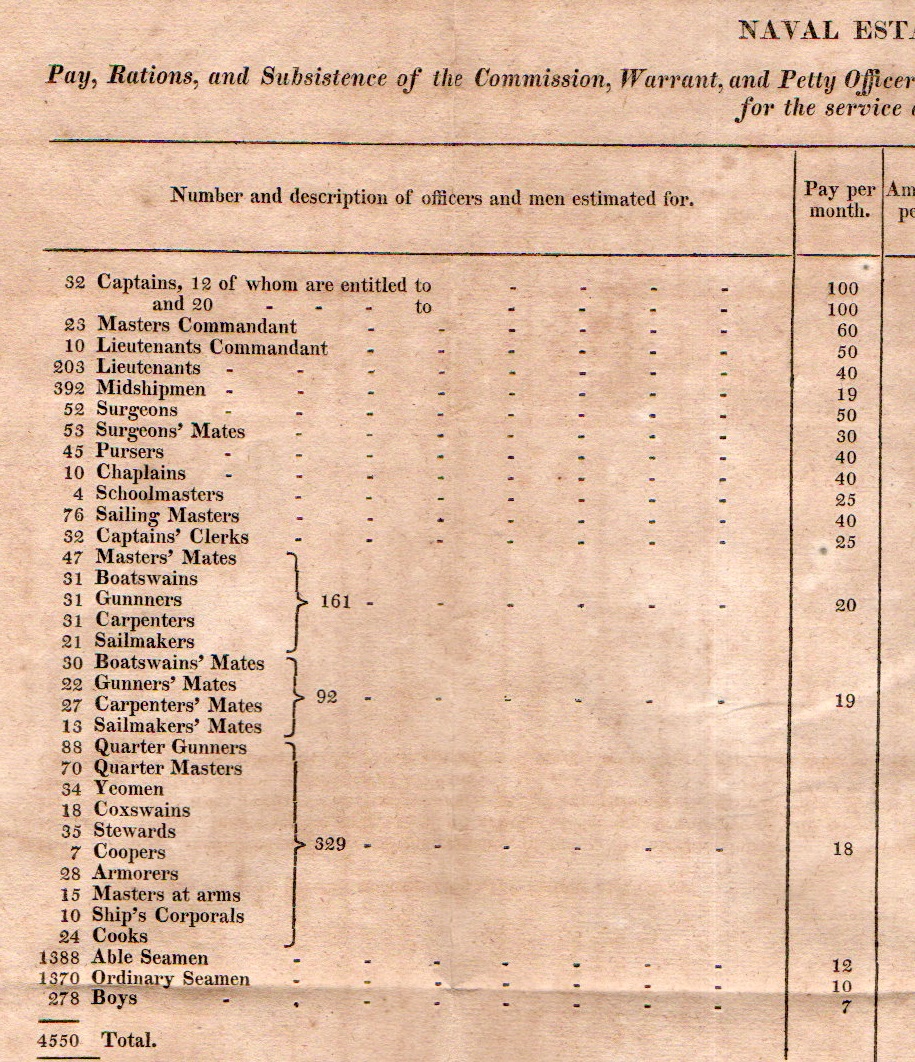
    This is one of those fascinating bits that you come across that in the moment are just thrilling, but overall really doesn’t have anywhere particular to live in your memory.  Still, it was curious to find this data on the positions and pay to the members of the U.S. Navy in 1820 and to see the amount and distribution of pay, and to see the aggregates.

    The pay ranges (for example) from $100/month for (52) Captains, $50/month for ( 52) surgeons, $40/month for (10) chaplains, $20/month for (21) sailmakers, $18/month for (24) cooks, $12/month for (1388) able seamen, $10/month for 1370 ordinary seamen, and $7/month for (278) boys.  
    Naval pay177

    [Source: can’t remember. This is a detail from a  loose, folding sheet from a U.S. government document from 1820, probably looking at the finances of armed forces, or some such.]

    So it looks as though the total pay for U.S. naval personnel in 1820 (excluding “rations”, which I believe included food and housing allotments) was $867, 578.00 (or pretty close to that) for 4,550  sailors/etc., which is about $200 per year per person, on average.  41% of that total outlay went to the 3,158 able and ordinary seamen, who composed 71% of the total naval force.  So it looks like if your removed the pay for “boys” then the highest paid officer made about ten times what the lowest paid seaman made, which by today’s standards is pretty corporate-responsible (a la Ben & Jerry’s).

    I’m not yet finding what a carpenter/laborer would make in salary for that year for comparison, but I will add that here later.  


  • A Remarkbly- and Completely-Disappeared Invention from 1890

    JF Ptak Science Books 

    I’ve written a number of times on this blog about my interest in collecting the artwork of children–kid art from say before 1900–and how difficult it is to actually find examples. Most of that has been serendipitous, finding scribbles and drawings of notebooks, and ledgers,  and free endpapers of schoolbooks, that sort of thing.  There are a number of reasons for this scarcity–the greatest being lack of paper, and pencils, or paints; that, coupled with the stuff needing to survive multiple generations of house cleans and moves and so on, well, it just means that not a lot has survived. 

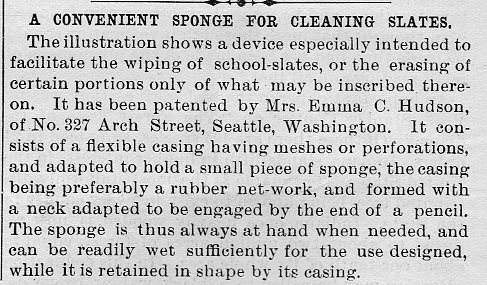
    Scientific american slate pen sponge102[Source: Scientific American, September 13, 1890]

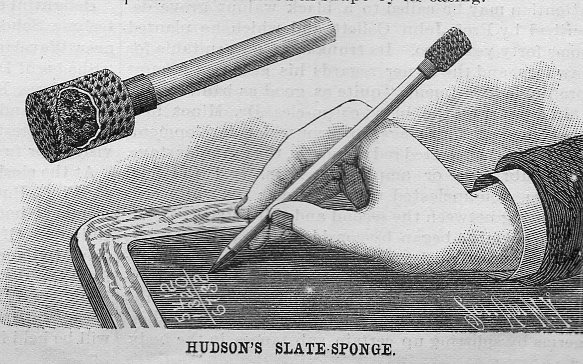
    Lack of paper or paper being too expensive was a big deal, and so kids used slates, which means that very little has survived on the slate itself.  And to further point out the ephemeral nature of slate-written/drawn material, I present the slate eraser sponge! It is a little bit of a thing that fits over the slate stylus and allows a really thorough erasure/sponging of anything on your slate.  No only was the slate stuff gone, it was double-gone. 

    This is also an invention that is remarkably well nested in the dustbin of abandoned and unnecessary useful inventions that worked superbly for about two decades, and were never heard from again. 


    And the text:

    Scientific american slate pen sponge103


  • A Giant’s Giant: Fr. Kircher, 1668.

    JF Ptak Science Books   Quick Post

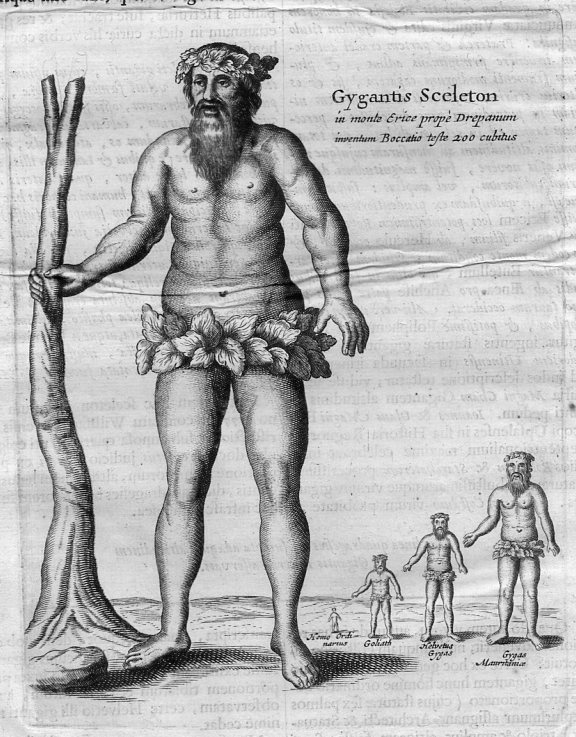
    Kircher Giant034[Detail of below]

    The wonderful and occasionally problematic Fr. Athanasius Kircher (addressed numerous times in this blog, just check out a search under his name in the Google box at left) inferred by “anthropomorphic calculus” (so says Jan Bondesman, in A Cabinet of Medical Curiosities, pg 82) the size a human/giant must have been to accommodate (for example) an elephant tooth. So instead of dinosaurs you’d get these enormous creatures many time larger than a “Homo ordinarius”–as you can see in the scale, we have the enormous creature flanked by “homo ordinarius”, then Goliath (still puny), “Helvetius Gygas”, and “Gygas Mauritanius”, all quite tiny compared to the big boy, who stood 200 cubits. (A cubit was a measure from he elbow to the fingertips, so depending on where you were, the cubit could be 17-20 inches or so; in any event the giant would have been 300-400 feet tall.) This image appears in Kircher’s great Mundus subterraneus, quo universaw denique naturae divitae, published in 1668.

    • This original image is available for purchase via the blog’s bookstore, here.

    Kircher Giant033{This is a detail from the full image, following]


  • The 1% in 1910 and 2014

    JF Ptak Science Books   Post 2469

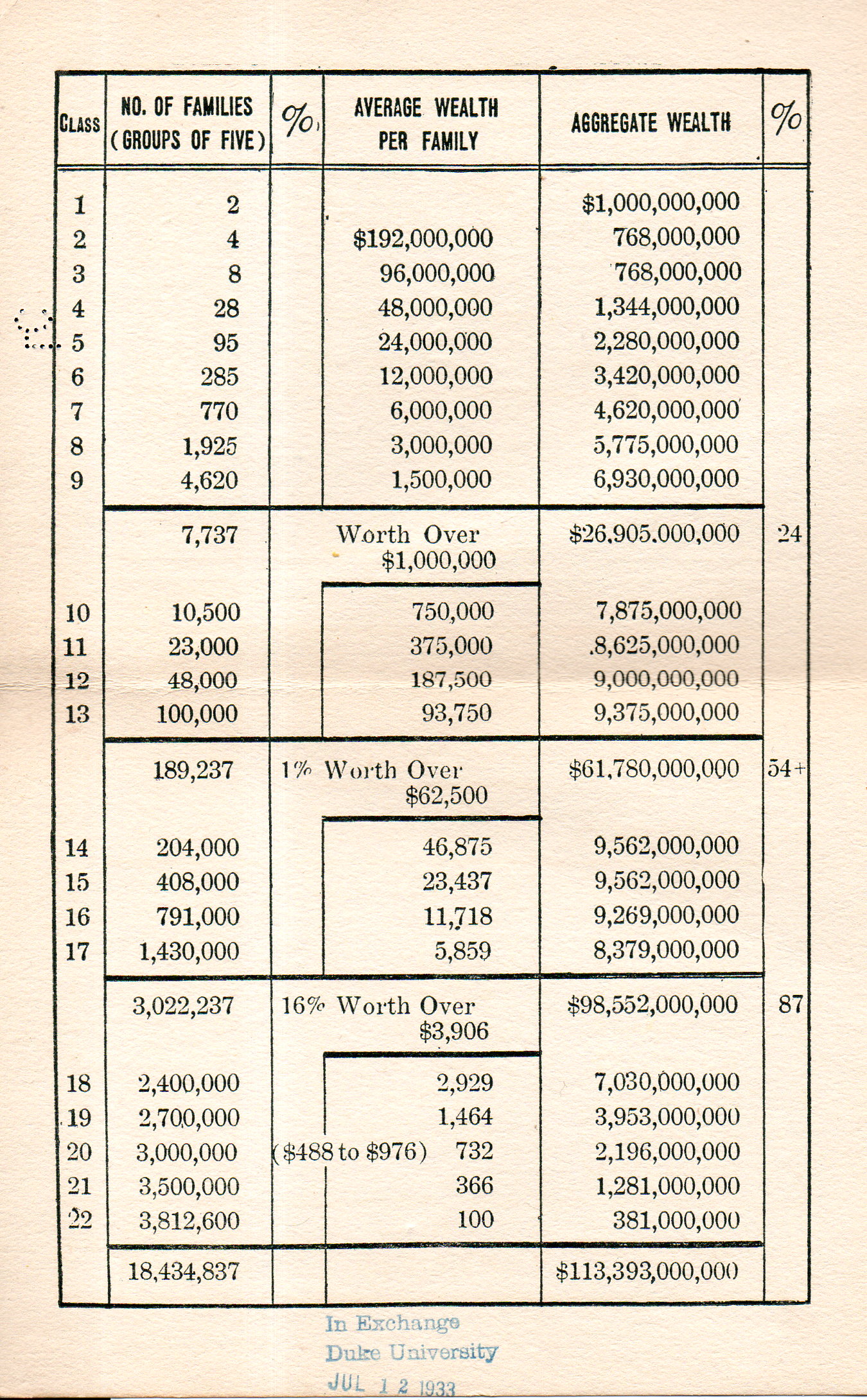
    It is always difficult comparing value of objects over periods of time–this is especially so when trying to compare the value of wealth, in general. And so I won’t be tempted to much to do this while relating the data of this interesting and tiny handout, The Distribution of Wealth in the United States, 1910. It was published in 1912 by Edward G. Hewitt (who curiously locates himself in “Brooklyn Borough”, rather than just “Brooklyn” or the “Borough of Brooklyn”, the incorporation taking place 14 years earlier) and presented in a bit of an odd way, at least to me, dividing the wealth into groups of families. It makes it a little hard to understand, even if there are only 22 divisions to the analysis.

    What attracted my attention in this was the number of millionaire families, which was 7,737 in the total of 18,434,837 families–or about .4%–with an aggregate wealth of $26.9 billion, which was a 22.6% share of the national wealth stated at $115,000,000,000. That millionaires club would be about $24 million in 2014 dollars, using the Bureau of Labor Statistics inflation calculator.

    One percent028

    Secondly, the much-discussed 1% here totaled 189,237 families with wealth of over $62,500, or about $1,494,545 or so in 2014 dollars.

    Since “wealth” really isn’t defined here it is difficult for me to extrapolate the differences between the 1% of 1910 and the 1% of 2015–especially so since I’ve seen several different current interpretations of what the modern 1% actually means.

    In 1910 there were 7,737 families of millionaire status–today there are something like 5.4 million millionaires in the U.S., though that is counted as individuals, or about 1.6% of the population compared to .4% in 1910. And as my friend Jeff Donlan points out, it would be more useful to talk about the 24-millionaires club than simple millionaires, but I don’t have access to that data, at least not for this half-hour post.  

    It is interesting that The Economist in 2012 stated that the average household income of the 1% was $1.2m in 2008, according to federal tax data. I find it very surprising that the 1910 1% (adjusted by BLS) comes in at $1.49m.

    Again, this is all sorts of problematic, but even though stumbling around like I am here with these numbers it is very curious to see how closely those 1% numbers from 1910 and 2014 come together. It feels like this is wrong on many or all levels, and the 1910 data might all be junk for all I know, and that it is like saying that the stars are all the same size because that’s what it looks like here on Earth, but it is strange about how those numbers worked out–at least here, using the stated data.  I’m not saying that what I’m saying above has any value beyond indicating that there may be something interesting here…

    ·Posted by :

    ·in:


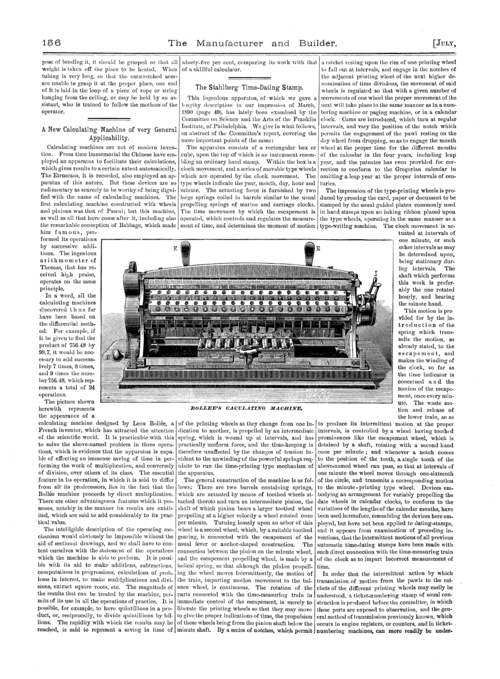
  • Bollee’s Calculating Machine, 1889

    JF Ptak Science Books   Quick Post

    Bollee
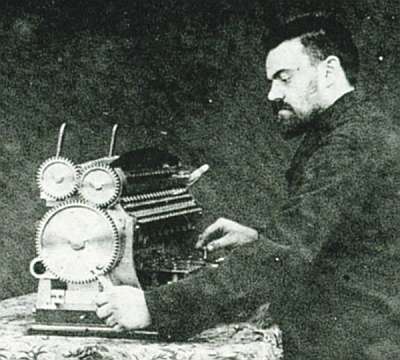
    [Image source: http://www.rechnerlexikon.de/artikel/Bild:Bollee-mit-Maschine-CNAM1990.jpg]

    This was a surprise, finding M. Bollee’s article (“Sur une nouvelle machine a calculer”) in the 1889 Comptes Rendus, pecking around in that big 10-pound volume looking for something else.  It was very easy to miss if you weren’t looking for it, just a few pages long in a 1000-page book.  But there it was, nestled comfortably in pp 737-739.  It these few pages Bollee describes his machine and with particular reference to his innovative approach to direct multipilication–a fine addition (ha!) to the long line of contributions by Babbage and Clement, Scheutz, Wiberg and Grant and Hamann. 

    Notes:

    Léon Bollée: “Sur une nouvelle machine a calculer”, in Comptes Rendus de l’Academie Sciences (Paris), volume 109, 1889, pp. 737-9.  (You can purchase the original paper if you’d like by following this link to our Books for Sale page, under “Bollee”.)

    An image of the machine from The Manufacturer and Builder:

    Bollee

    See:  the Making of America, http://digital.library.cornell.edu/cgi/t/text/pageviewer-idx?c=manu;cc=manu;rgn=full%20text;idno=manu0022-7;didno=manu0022-7;view=image;seq=0162;node=manu0022-7%3A21

    ·Posted by :

    ·in:


  • My Two-Cent Opinion on the Penny and the Diminution of the Number 9

    JF Ptak Science Books  Quick Post

    Commie pamphlet decomposition476

    My friend Jeff Donlan  (who writes a fine and insightful blog, At the Library) cent (ha!) me this  article on the false tyranny of the penny–rather it is about getting rid of the penny, which the author claims has run its course of usefulness, swallowed by the history of economic need for it. Maybe it takes more money to deal with the one-cent piece than it is worth, I don’t know–the author of the article goes through that along with a short history of other currencies dumping their minuscule and antiquarian denominations.  

    What I wonder about is what happens to the number “9”?

    My made-up statistical reference notes that about half of all prices on all the stuff in the U.S. use at least one nine; many use two.  What happens to people excitedly advertising “,..and all your’s for only three small payments of $19.99!!!  And what about gasoline prices which are $2.89 and 9/10?  Assuming that we keep the nickel, prices will have to re-adjust to accommodate the five-cent piece, dropping the “9” in millions of prices.  No doubt tens of millions of people will think that prices have been raised across-the-board.  

    And what will we do with this enormous surplus of 9s? 

    Seriously though why not just get rid of the whole lot of less-than-a-dollar currency?  I know that would be very problematic, but no doubt it there will be less time between the introduction of the penny to its demise than there will be from now to the elimination of all coin-and-paper currency,  After all, in for a penny, in for a pound.  

    ·Posted by :

    ·in:


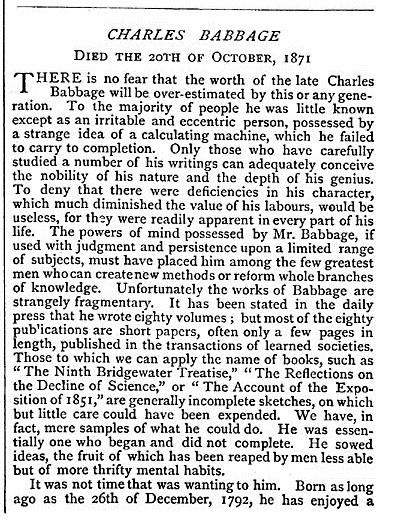
  • Babbage Obituary and Other Babbage Bits

    JF Ptak Science Books    Quick Post

    BBabbage portrait detail

    [Image source: Giants of Science]

    Here’s a fine piece of work on Charles Babbage from a very early period (volume 5) of Nature–succinct and tight and only two pages.  (It was buried in the middle of the issue, which surprised me, as I thought he’d be placed up front rather than tucked into the middle. So it goes.)

    Some other bits on Babbage on this blog:

    • Poe, Babbage, and Thinking Machines, 1836 (here) 
    • The Broken Windows of Uncle Chuckles–Charles Babbage Figures Stuff Out, 1857 (here)


    NATURE Babbage obit

    ·Posted by :

    ·in:

    —

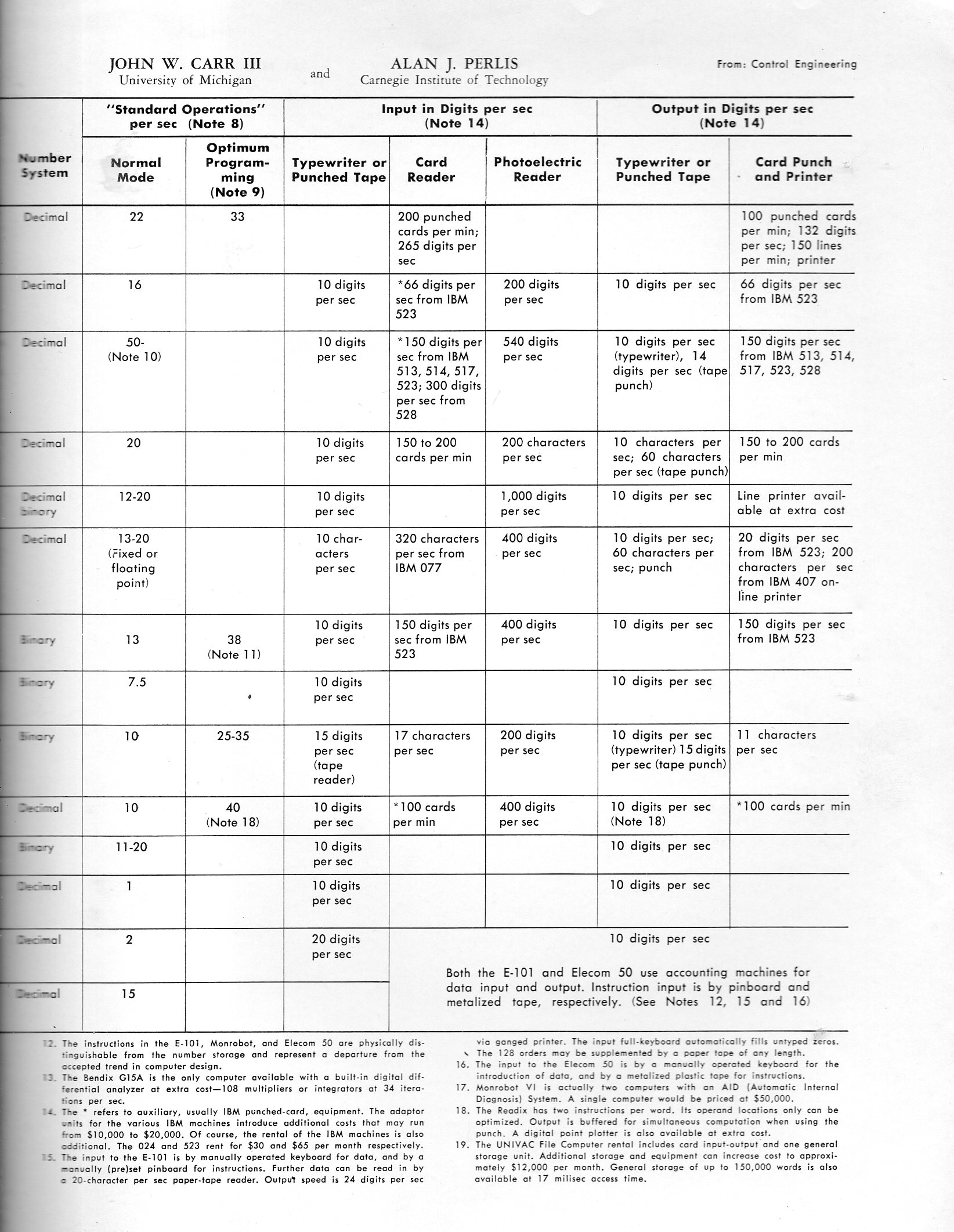
  • Superior Table of Early Computers (1956)

    JF Ptak Science Books  Quick Post

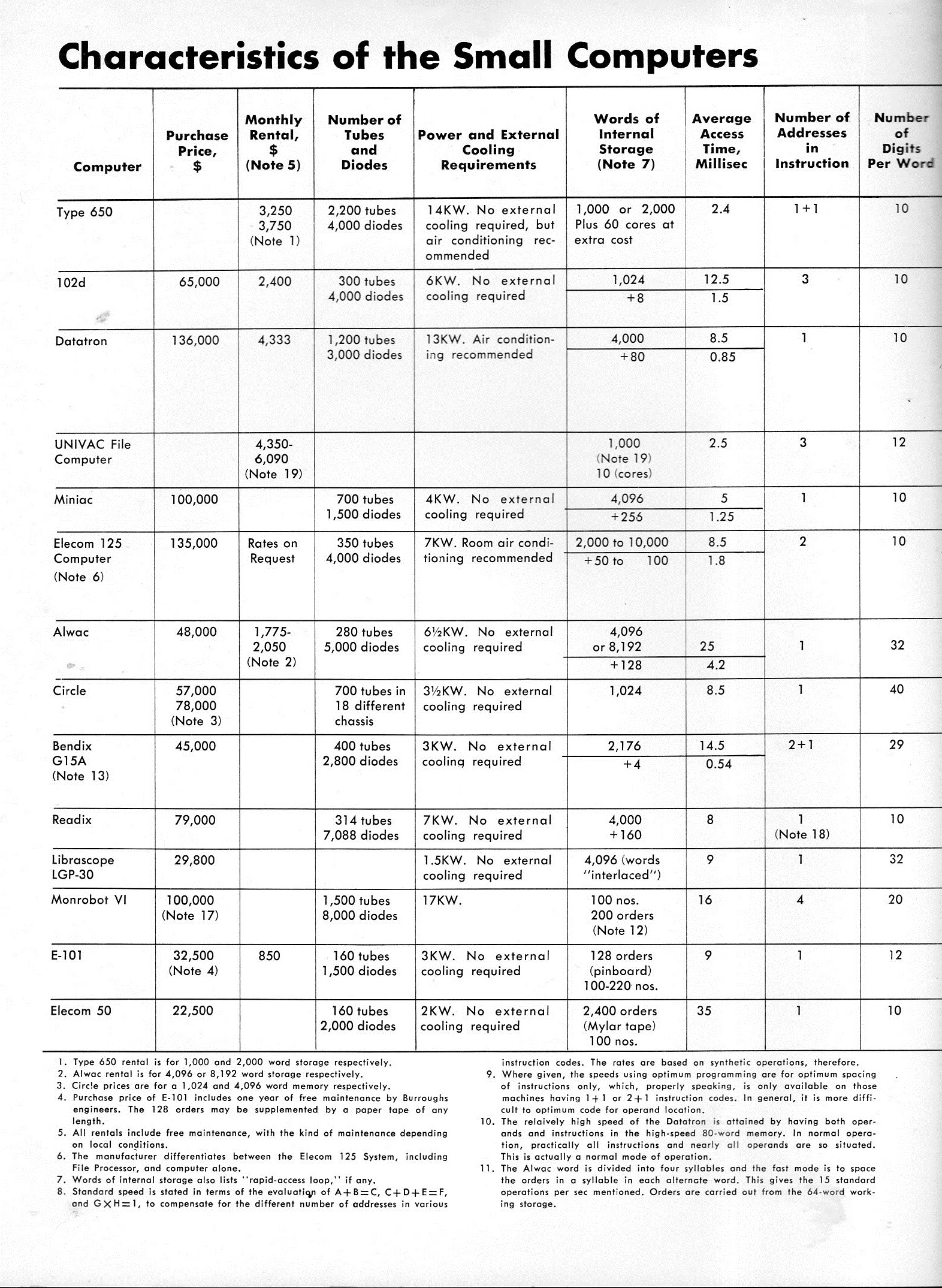
    “Characteristics of the Small-Scale Computers” looked innocent enough, 12″ tall and one folded piece of paper, and published in 1956.  The authors–John W. Carr III and Alan J. Perlis–were heavy hitters, and so I really wasn’t very surprised to see what they had done “inside”, though I was impressed and happy to see the data. Displayed on the 12×16″ sheet of paper are 15 data points on 14 computers, many of them classic/famous:  the 650 IBM, UNIVAC, Elecom, Alawac. 

    (Remember that when you’re looking at purchase price and monthly rental amounts that the 1956 dollar is equal to about $8.70 in 2015 dollars, so that $3275/month for the 650 would be about $30k.  The $136k for the Datatron is about a million today.)  


    Perlis795

    Perlis794

    ·Posted by :

    ·in:

    —

  • Candy & Cellophane & duPont=Food! For Profit! (1939)

    JF Ptak Science Books  Quick Post

    Candy & WOnder Woman

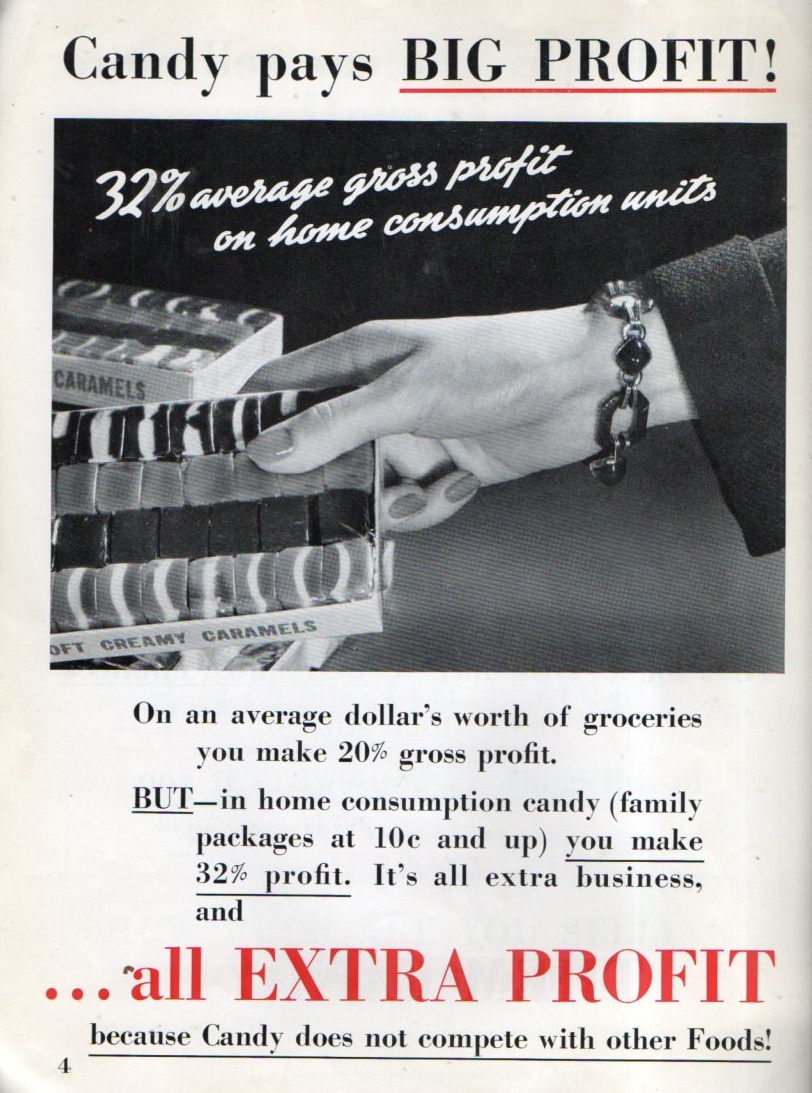
    This hand-out pamphlet seems to be a case where the sale of an edible product is made for the sale of its packaging.

    Candy is food609

    The pamphlet shouts that CANDY IS DELICIOUS FOOD, which is certainly a correct statement if food=digestible.  It tells/sells the story of candy as a profit-maker to the grocery seller, saying that “32% average gross profit on home consumption units“, those delicious-sounding unit-things being the candy.

    There are bits and pieces about candy display and placement, all on the advice of the maker of the stuff that in which the candy was wrapped–cellophane. The publisher and distributor of the pamphlet, the “Cellophane” Division of the E.I. du Pont de Nemours & Co. Inc., had a huge vested interest in candy sales: candy was mostly wrapped in Cellophane (starting with Whitman in 1912) and by the time du Pont achieved its water- and moisture-proof Cellophane in Delaware the product accounted (in 1938) for 25% of the company’s profits.  That’s pretty big, and so candy as a major muncher of Cellophane would be promoted by du Pont as pretty big, too. And as food, for added Bigness.  

    Candy is food610


  • A Nickel-Plated Low-priced Arithmetical Godsend (1922)

    JF Ptak Science Books  Quick Post

    The small $25 miracle/godsend to number crunchers everywhere was this small, nine-place, sliding-digit chain-adder mechanical calculator, set in nickel-plated metal, and which we see in this fantastic and half-bizarre ad in Illustrirte Zeitung for June 1922. The instrument was about eight inches long and came in its owns hard case, and was a very good instrument for the lowish-end market.  The add of course is fantastic. (“Die Erloesung” could I guess be transliterated as “Deliverance!” from the drudgery of making calculations by hand.) 

    German--comptator520