A Daily History of Holes, Dots, Lines, Science, History, Math, Physics, Art, the Unintentional Absurd, Architecture, Maps, Data Visualization, Blank and Missing Things, and so on. |1.6 million words, 7500 images, 4.9 million hits| Press & appearances in The Times, Le Figaro, Mensa, The Economist, The Guardian, Discovery News, Slate, Le Monde, Sci American Blogs, Le Pont, and many other places… 5000+ total posts since 2008.

Category: Books–Great Cover Art

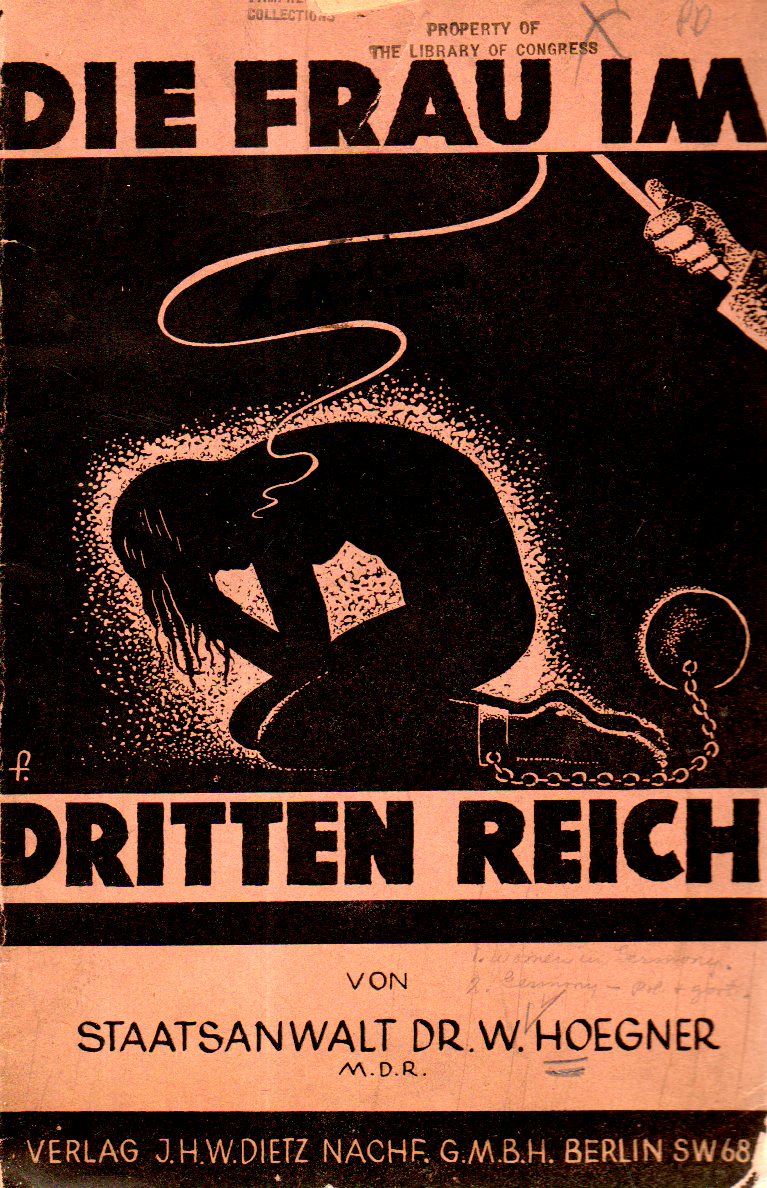
  • Striking Anti-Nazi Work on the Subjugation of Women, 1931

    JF Ptak Science Books  Quick Post

    German design frau in reich031

    Wilhelm Hoegner was an early and influential opponent of Adolf Hitler and the NSDAP–a very early opponent, having been involved in the investigation of Hitler’s Beer Hall Putsch in 1923.  He maintained his strong opposition as a member of the Reichstag from 1930-1933; after the elections and after Hitler consolidated his power in 1933, Hoegner’s position became “untenable” in Germany and he left for Austria, and by 1934 he was situated as a journalist in Switzerland.  He played a prominent role in German postwar politics, and died in 1980. 

    Hoegner wrote Die Frau im Dritten Reich  in 1931 as a warning to all about the totalitarian possibilities of the Nazis, and in particular of the tyranny against women–the result is pretty much evident on the very striking cover of his pamphlet.


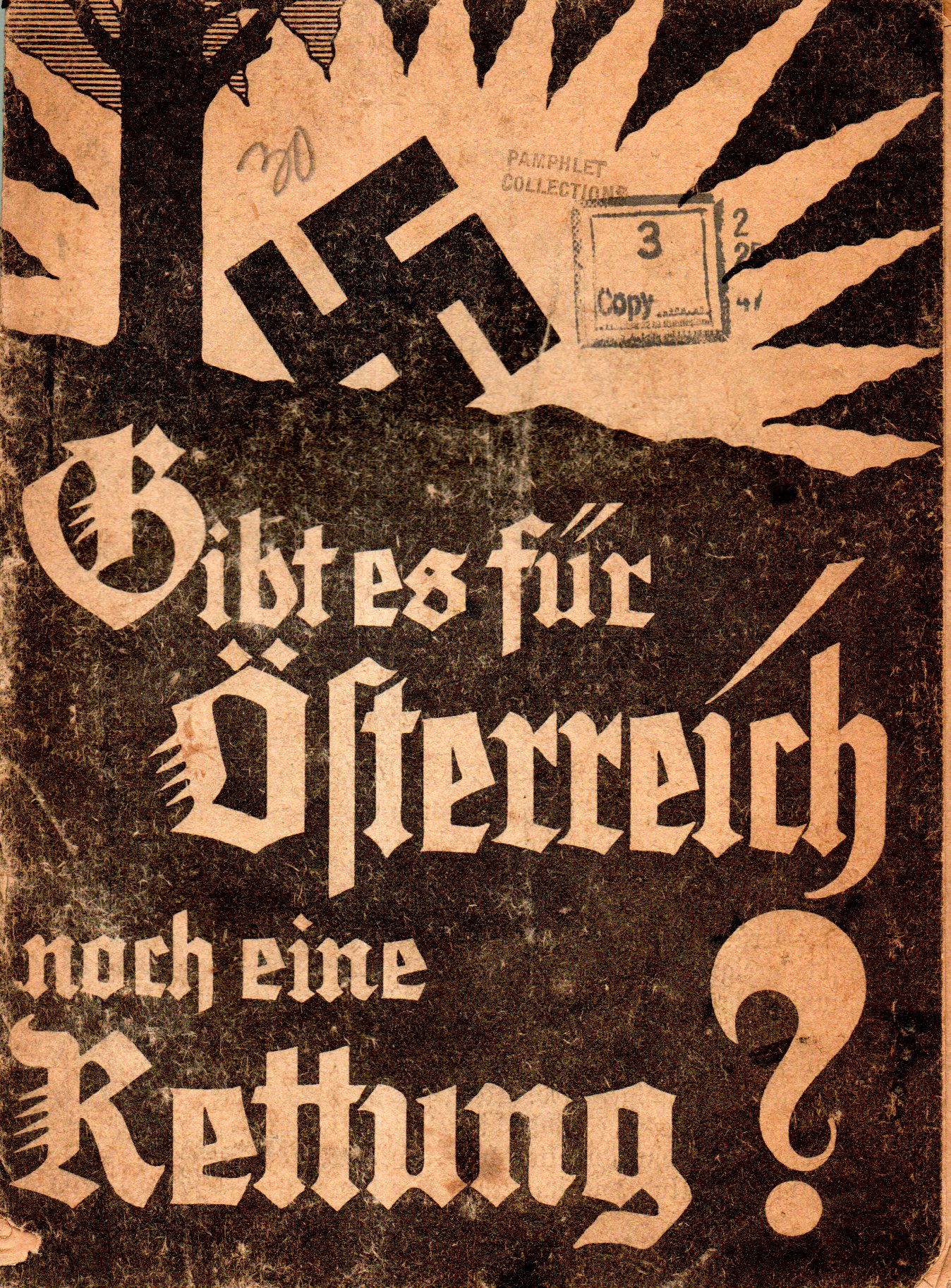
  • The Swastika as a Rising Sun–Linz, ca. 1935

    JF Ptak Science Books   Quick Post

    Judging from the cover art it is not necessarily clear what is going on with that swastika. But given the question in the title (“Can Austria Still Be Saved?”) and the publisher, the NSDAP’s Volkstimme (Linz) leaves little doubt that the swastika is a rising sun rather than setting.  I can’t find another title in the OCLC/WorldCat–which makes this piece of propaganda rare–and which means that I can’t date it precisely, though I would say it was printed prior to the annexation in 1938 (though the design definitely has an earlier touch to it…)  There is a mention of the Gauleitung der N.S.D.A.P. and the Hitlerbewegung located at Goethestrasse 7 in Linz–and since the Nazis were suppressed under Dollfuss from 1932-1934, which means this document may have been printed in the mid/late 1930’s.  

    German design salvation Austria032


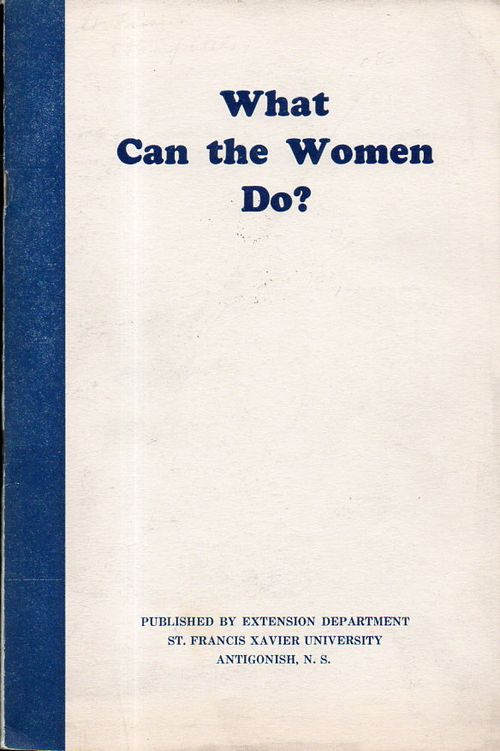
  • Unusual Book Titles Department: “What Can the Women Do?” (1940)

    JF Ptak Science Books  Quick Post

    What can th e women do159

    I think that this pamphlet could stand without comment, but, well, here it goes anyway:

    Here’s an extraordinary title from the Found-Absurd/Surreal Department:  What Can the Women Do?  was published by the Extension Department of St. Francis Xavier University in Antigonish, Nova Scotia in 1940.  It is a odd, uncomfortably-phrased work that seems completely antiquarian today–and yet the work is only 75 years old, well within the lifespans of 10% of U.S. citizens alive today.  That such a question would and should be asked within the space of the lifetime of millions of grandparents is remarkable, and brings the past bursting into the present. This question did not die here in 1940, but would continue for several decades more.

    The other point here is that this is only 20 years after women were granted the rights to vote in the U.S., and in some ways was an advancement in showing the number of different sorts of occupations open to women besides her job as housewife and mother.  


  • Poemsuicdramauraliterature–Outsider Literary Work (1947)

    JF Ptak Science Books   Quick Post    Outsider Logic series

    Here’s another remarkable find for the sub-category of this blog’s thread on Outsider Logic/odd books:

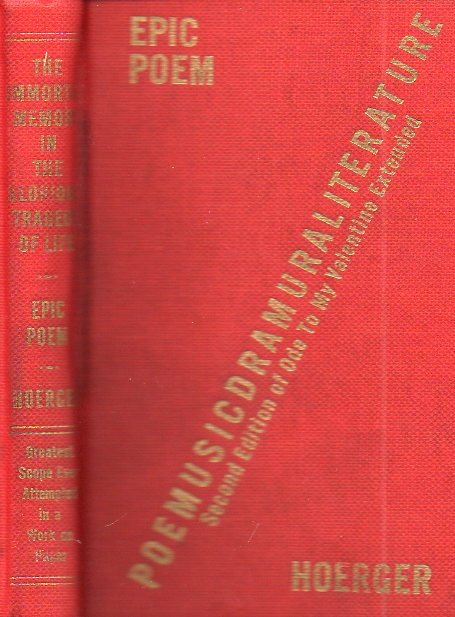
    Odd book371

    It is self-published, and tiny, and bound in a red cloth that surprisingly has the title stamped on its spine. The title begs attention, and then the text begs comprehension–and that’s okay, as this is someone’s proud work, and it is entirely possible that I have missed the object of the experience. That said, the construction, illustration, literary undertaking, and poetical wanderings are occasionally extremely surprising–and if “surprise” and revealing an insight that you’d never have had on your own is the point of writing, then I’d have to say that this experiment was successful.

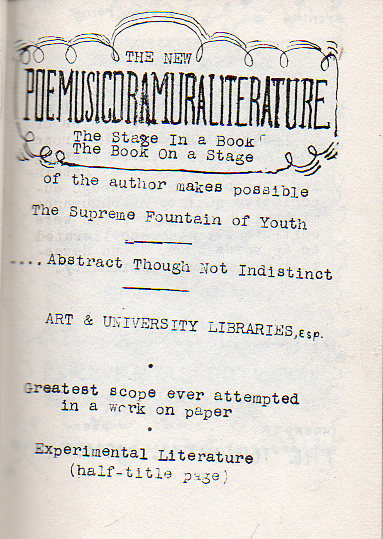
    I won’t go into the story line too much because it escapes me. As a sample though I will illustrate the title page, which is remarkable and small found-miracle even on its own, a shining element of shining elements in the history of odd title pages, and which will give some insight into the possibilities of what follows:

    Odd book372

    The author notes with no pomp and no modesty that his is the “greatest scope ever attempted in a work on paper”.  And what he meant was at least on little paper, because this book measures 3.5×2.5 inches, and one quarter of that is set aside for ample margins which flesh the work out to 88 pages.  The title and subtitle are mysterious, as with everything else–even the final parenthetic note at the bottom of what is actually the title page (“half-title page”) gets an eyebrow-raise. 

    But as the author says, this is “experimental literature”, and perhaps judgment of this work should be unresolved, as the experiment might still be underway. 


  • The Great Green Eye and l’Espirit Humaine (1938)

    JF Ptak Science Books  Quick Post

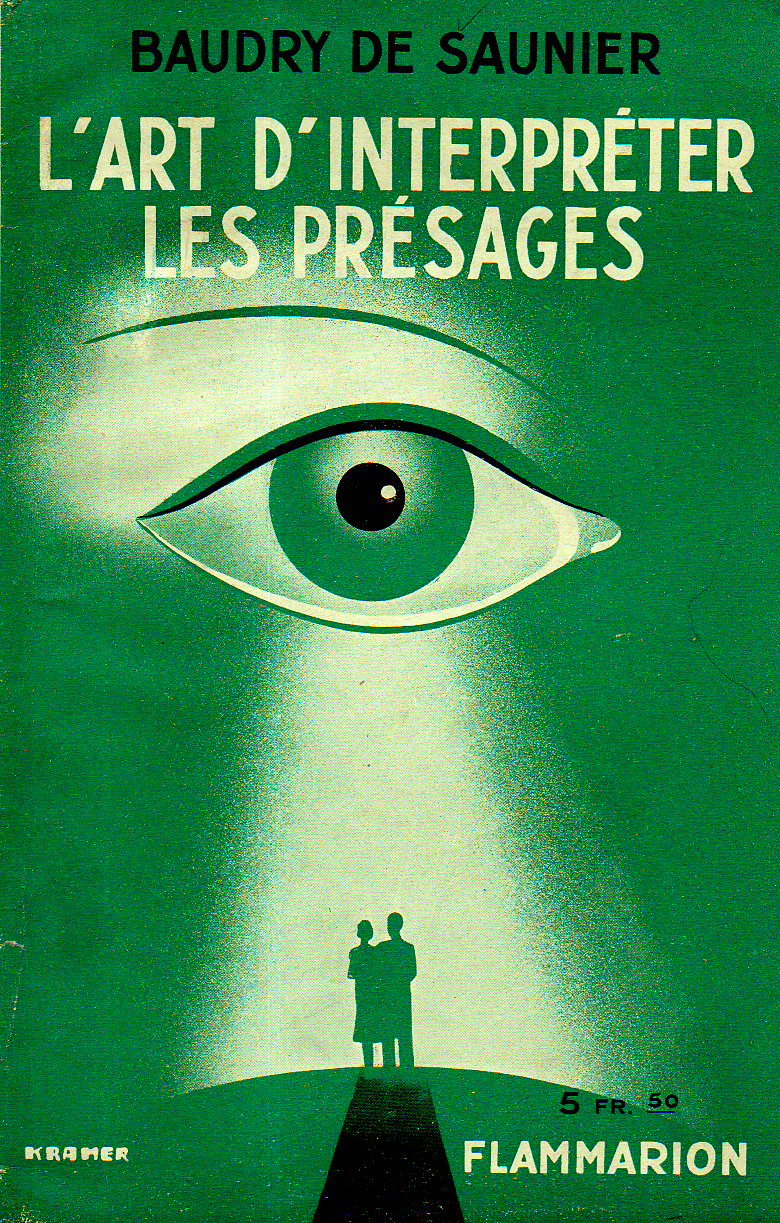
     The author of this attractive (looking) pamphlet seems an interesting man, and evidently was a busy and highly productive popularizer of science. I don’t know his work at all, but looking at some of his books tells me that he was on the scene early and often for several technological breakthroughs. For example, he has several works on the bicycle (Cyclisme théorique et pratique,1892, Les recettes et procédés vélocipédiques 1893,  Suivis de l’Art de la bicyclette, 1894); plus a very early book on the automobile, (L’Automobile théorique et pratique and Traité élémentaire de locomotion à moteur mécanique,1893,  followed by  L’Automobile théorique et pratique II, Voitures à pétrole, 1899); and then another early book on the aeroplane (Éléments de locomotion aérienne,‎ 1907).

    This nicely-designed pamphlet with the provocative cover (the work of “Kramer” in 1938) seems though to have strayed from the mark, resting for a while on the slim shoulders of popular interest in a person’s interpretation of symbols and what they revealed about the viewer, for the “formule de l’espirit humain”.  The book is arranged well, and has a dictionary of sorts of what people saw in Rorschach-like inkblots and what those interpreted images meant.  Ah, well, the cover is great, and one does not often see a big green eye on a tall French pamphlet, and so the cover design is good enough for me, soft&squishy contents or not. That said there are some interesting section headers, like “Do Not Confuse Messages and Beliefs” and “Good or bad, not everything is lost”. 

    Cover design big eye de saunier365

    ·Posted by :

    ·in:


  • Book Fists

    JF Ptak Science Books  Quick Post      Daily Dose from Dr. Odd

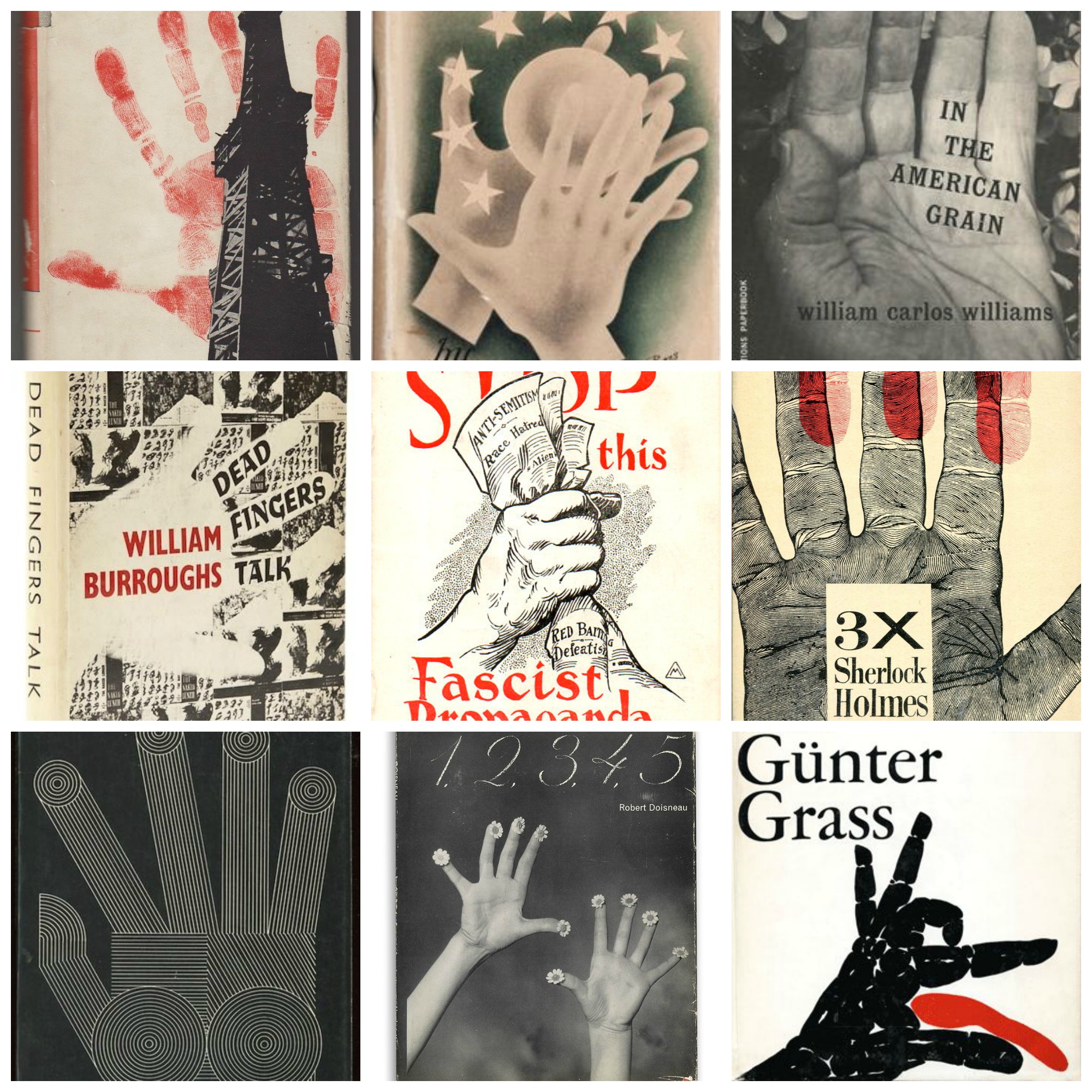
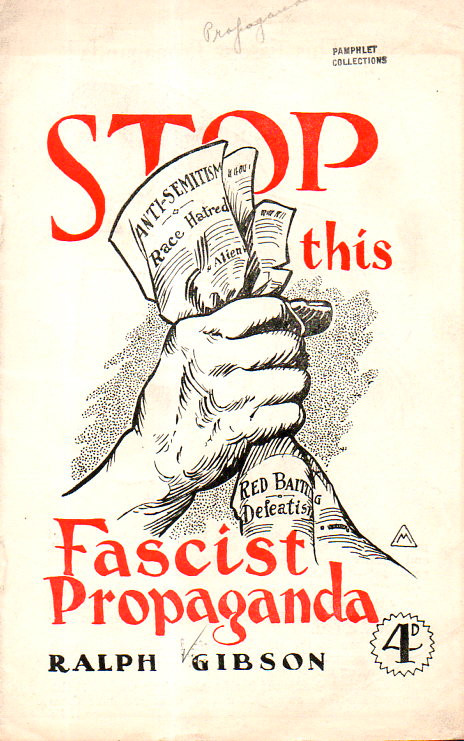
    Just a collection of hands on the covers of books and pamphlets. I guess it is sort of interesting that the hands that started this small collection in the first three examples are two fists and a gloved half-fist snuffing out a lamp; the fourth example is a power thumb, and the the rest of the examples I came up with were almost entirely open-handed. I’m sure that there must be plenty of fist images on book covers out there, but in my brief soiree I only found a few.  

    Books hands montage


    Books hands fascist prop293


  • Is the Dust Jacket Art Better than the Book?

    JF Ptak Science Books  Quick Post

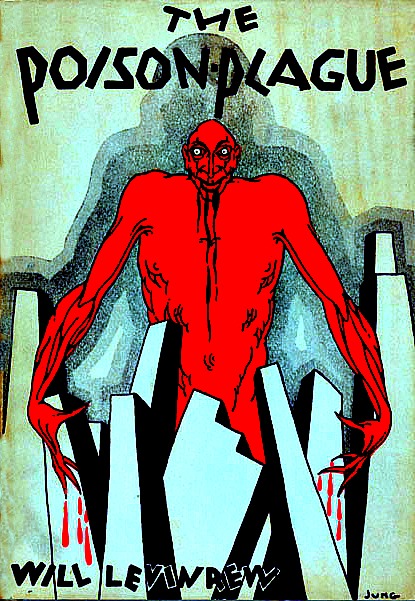
    The Poison Plague was written by Will Levinrew (William Levine) and published in 1929, and by accounts that I have seen is the birthplace of an early and very competent scientist/detective, Prof. Herman Brierly. I don’t know much about detective fiction from this time period, but I do like this just jacket artwork, and from the little bits that I have been able to find of this novel online I can so far safely say that I like the dj image more than the text.

    Books poison plague

    The stories for The Poison Plague were evidently serialized in Argosy–here’s an interesting ad for the story, set to appear just a week after the ad in 1922, though it took another seven years for the book form to be published);


    Levine created an interesting character, though perhaps one of the reasons we don’t know of his prof-gumshoe was how his story was told: the writing seems unbroken in a broken way, waiting for someone to stop it with some good punctuation. Here’s a random sample from one of his other books (available in full online, here http://www.loyalbooks.com/download/text/Death-Points-a-Finger-by-Will-Levinrew.txt):

    “Marie LaBelle was cursing fluently the luck that on that occasion had seemed to run all in one direction with Pop Fosdick. Marie hitched up the left half of his suspenders and began his old plaint…” —Death Points a Finger, 1933. Some of Levine’s other works include  Murder on the Palisades (1930), Murder from the Grave (1930), and For Sale, Murder (1932).

    Anyway, I wasn’t attracted to the book by the writing–it was for the dust jacket art, which is pretty good.

    ·Posted by :

    ·in:


  • Design in U.S.A-Themed Pamphlets, 1895-1945

    JF Ptak Science Books   Quick Post 

    USA Naive_3_

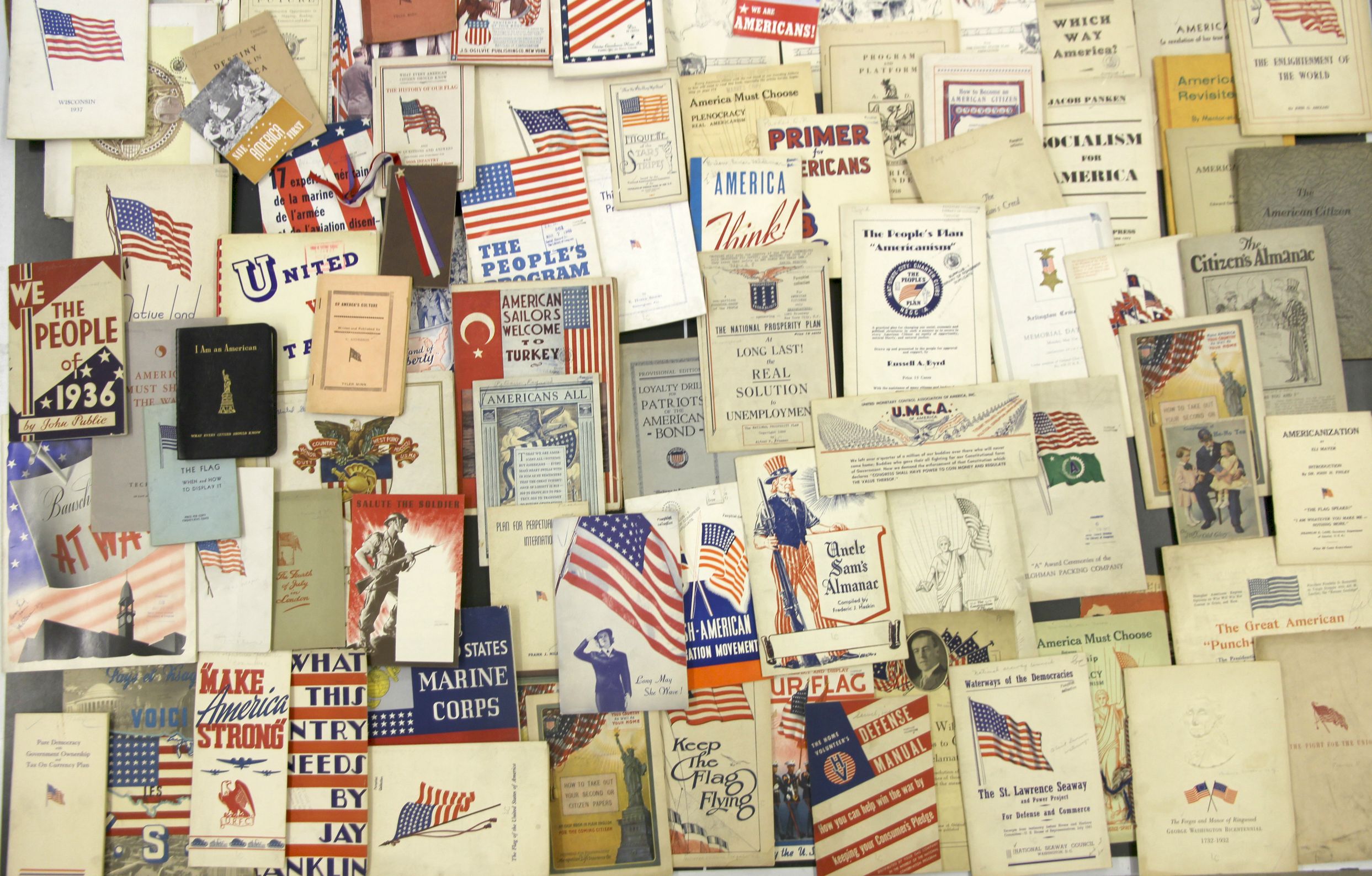
    I’ve written a number of times on this blog on the now-unusual covers and titles and contents (sometimes all three combined) culled from a 90,000-item pamphlet collection. This afternoon I came across a small collection of U.S.A. patriotic (and otherwise) covers, published 1895-1945, most of which have a flag or other patriotic emblems on them.  Some of the 125+ so works are simply patriotic works, some are flag-emblazoned works on economics, some are anti-Commie, some are isolationist, and some are, well, a little meshuga–what they all have  in common is that they either have a flag or the (declarative!) words American/American on the cover.  There’s more to this collection, but this will do for now–I think these would be very interesting, and attractive, displayed properly, and they’d have more than a design-related story to tell. 

    And details:


  • Help China! (1943)

    JF Ptak Science Books  Quick Post

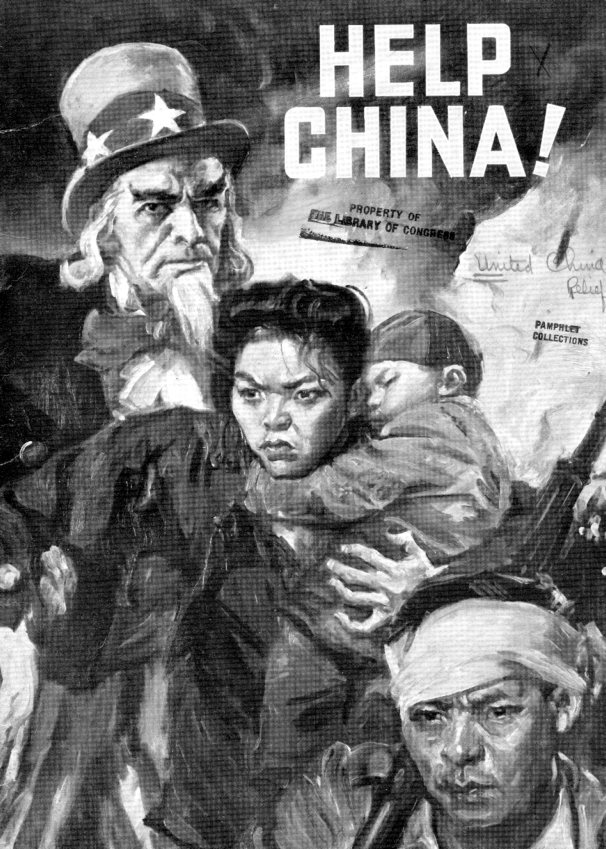
    I was looking through my pamphlet collection of Uncle-Sam-on-the-Cover and noticed this one:

    Help China!129

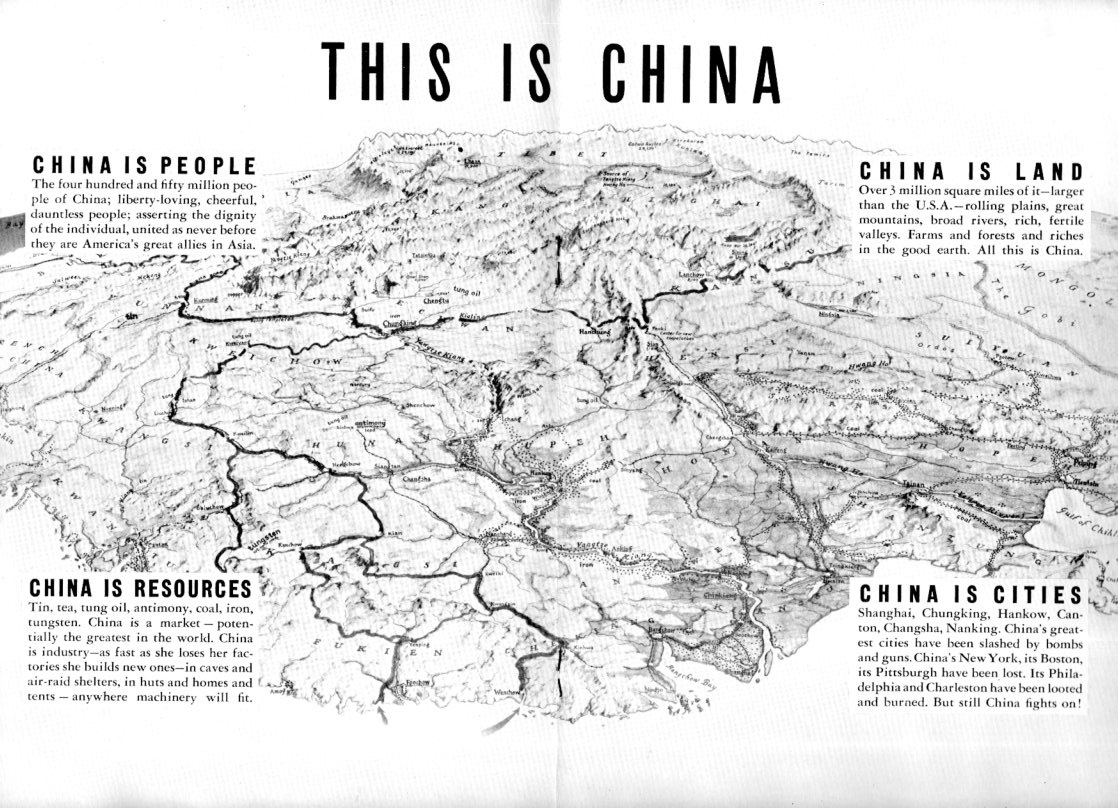
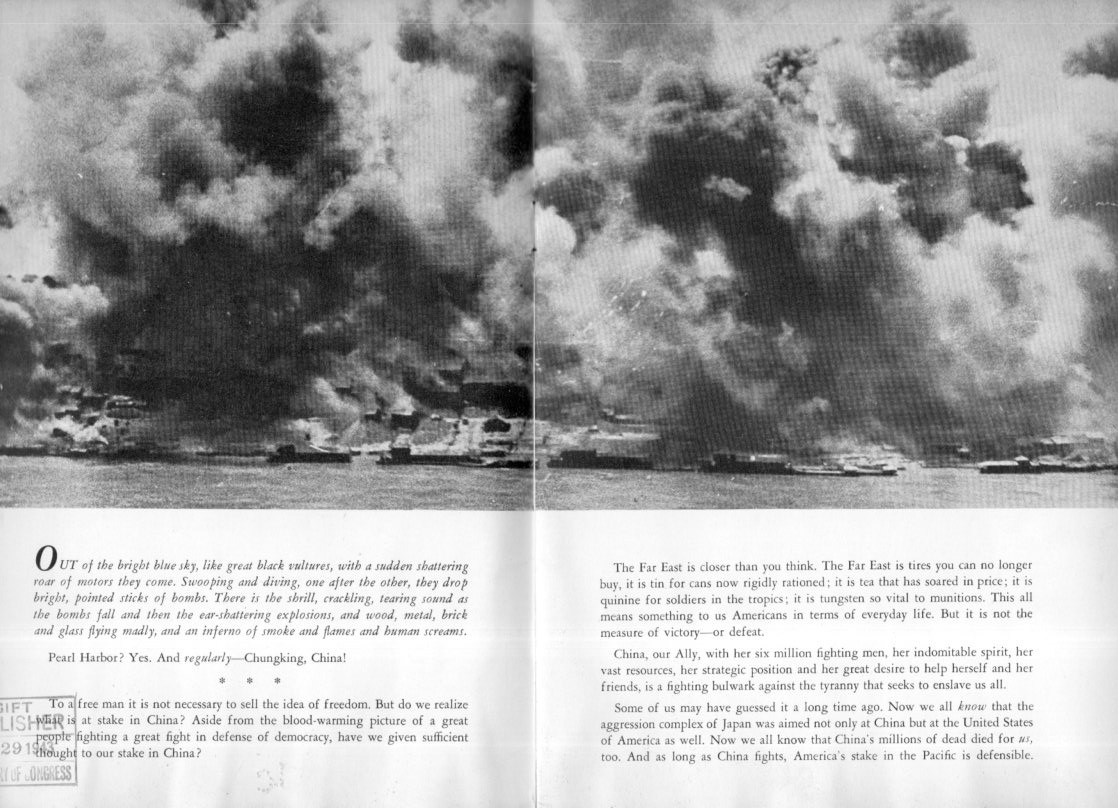
    This is distant to our relationship with China today, but in 1942/3 China was already embroiled in a war with Japan since 1937 (and actually a good ten years before that of Japanese intervention).  In the Second Sino-Japanese War there were more than a million soldiers killed on each side, more so than that wounded–plus an unbelievable 20+ million Chinese civilians were killed.  

    Uncle Sam looks pretty grim here–the Chinese family is battered, and angry, and resolute.  The artist here is the old hand James Montgomery Flagg, and the appeal and impact is very strong.

    The pamphlet was an attempt at raising money for the desperate situations in China, and reminds the U.S. that China’s role in the war int he Far East was of utmost importance.

    Help China!130

    Help China!131

    [Source:  China, a Brief Study of the Chinese…our Allies and Friends, published by United China Relief, New York City, (1942 or 1943).  20pp, illustrated.]

    ·Posted by :

    ·in:

    —

  • The United States Invaded, 1916-1944

    JF Ptak Science Books  [Expanding an earlier post from 2013]    

    There were 75 entries to this blog in June–see archive at left to access

    • “The cheek of every American tingle with shame as he reads the silly, flat, dishwatery utterances of the man who has been pointed out to intelligent foreigners as the President of the United States”–The Chicago Times, on the Gettysburg Address, 1863

    We all know today what to expect when we hear something referenced as a Gettysburg Address–and we certainly know what something might be if it was referenced as not-the-Gettysburg-Address.

    The address as it was when Lincoln gave it didn’t even have a title, named as it was post  facto by the newspapers and periodicals covering the event (on the spot or remotely).  The speech is considered as being among the greatest ever given by an American, though at the time it its reception was very mixed—in many cases it was seen as a failure and even as an embarrassment to the solemnity of the moment and place. There were many newspapers which panned the speech (as in the case above with the Chicago Times, which at the time was considered more of a Democrat paper than anything else), while others (like the New York Times gave the speech a warm reception.   The speech’s presence in national memory was crafted over time (not unlike Mr. Leonardo), its perception formed into the polished gem that it is seen as being today. 

    The possibility of the implied actions of the titles of the pamphlets below were somewhat similar, though mostly in reverse.  I’m not saying that some of them were always seen as quacky and the works of demented seers; their titles and possible content, though, were not seen as dismissible, and their concerns were real and a possibility. The concerns over “invasion” today depend on what invasion means.  I don’t imagine that people are seriously considering the possibility of a land or air force attacking this country, though other sorts of invasions (biological, chemical, cyber, etc.) are a possibility.    
    ==Blog July 15==bsttle for amer

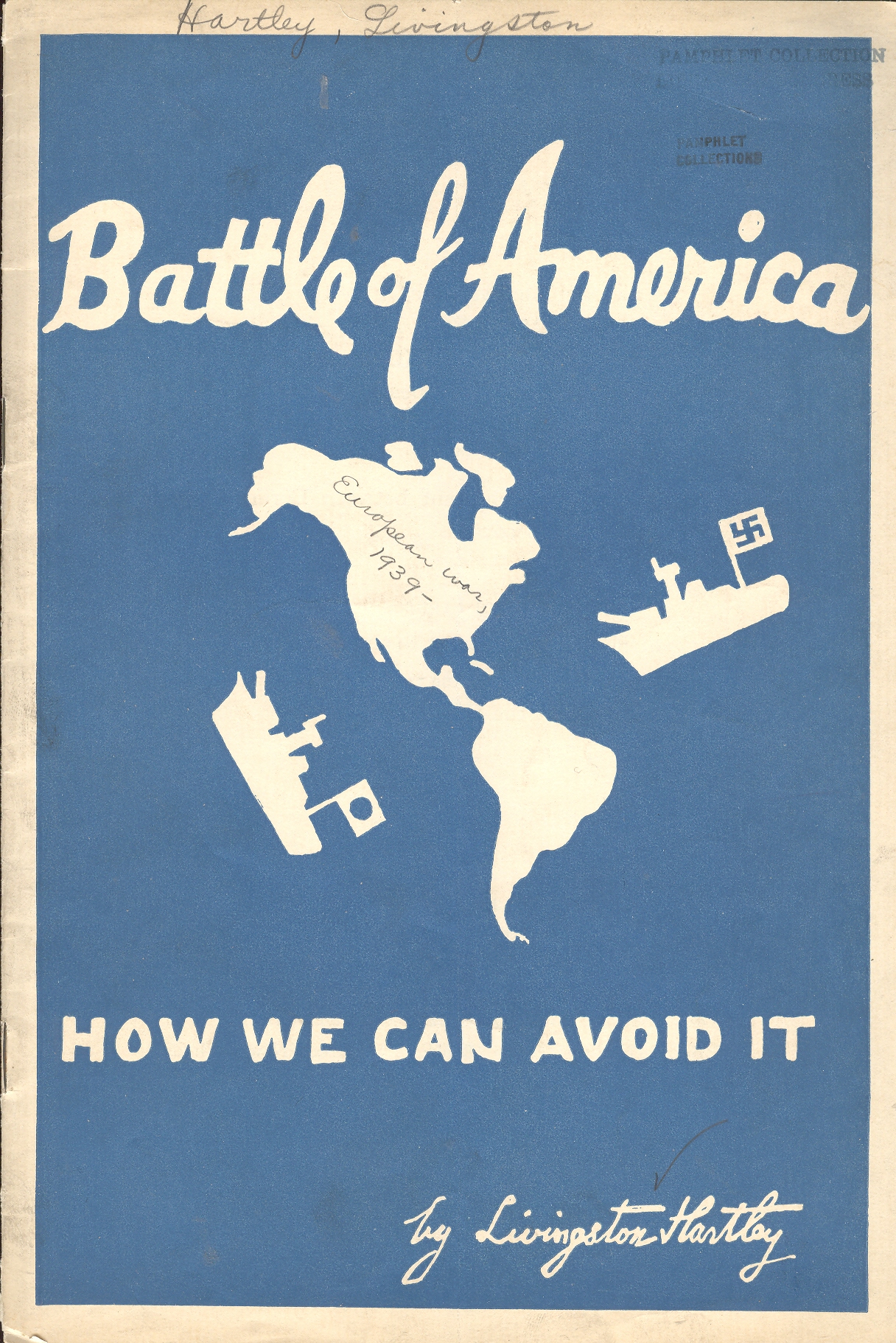
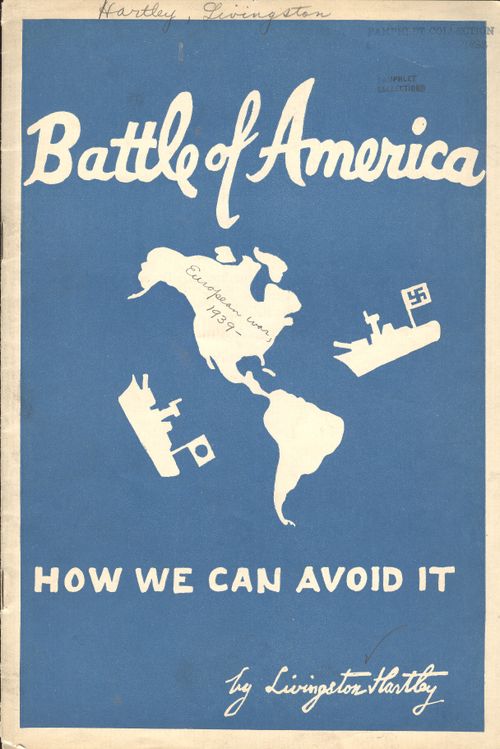
    The Battle for America/How We Can Avoid It (1939) was published by the Committee to Defend America by Aiding the Allies (and headed by William Allen White, iconic middle America newspaper editor and editorialist) which attacked isolationism and advocated strong support of the European effort.  The thinking here was that if America didn’t become involved now it would so later, with battle lines of a Nazi-illuminated truce drawn close to American borders.  So it was a pay-now-or-pay-more-later position from a man who supported the New Deal but whop didn’t support FDR. 
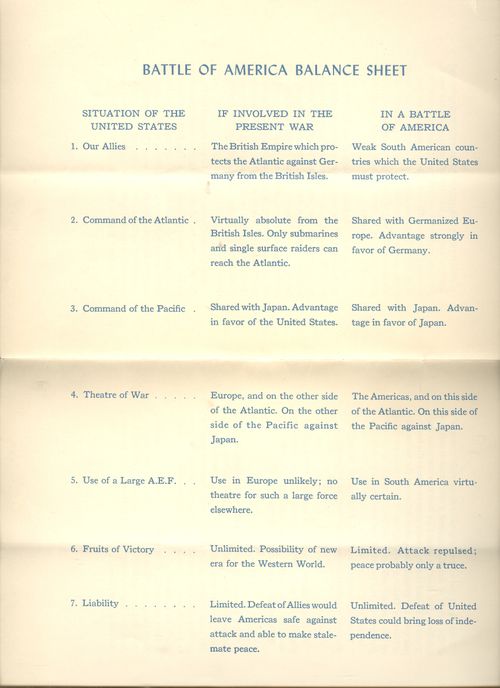
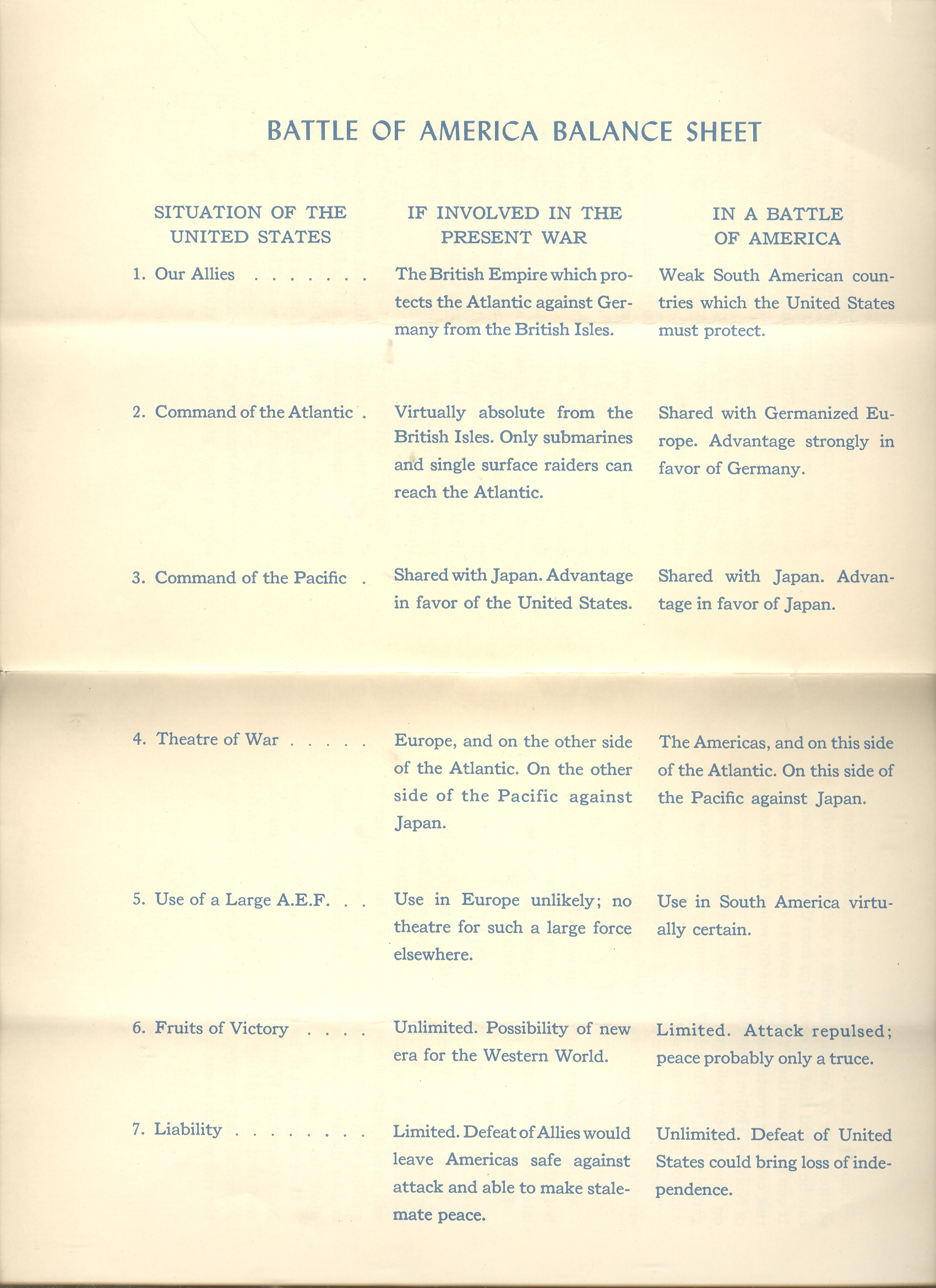
    ==Blog July 15==battle detail


    Much of this thinking looks a bit tenuous to me.  For example the position excluded the use of an American expeditionary force in Europe (“for theatre for such a large force elsewhere”), though if nothing at all were done there would be a “certain” use of the AEF in South America combating Nazism.  Also, if the U.S. backed the Allies with supplies and war materiel the “liability” to the US in the consequence of European defeat “would leave America’s fate against attack and able to make stalemate peace”.  So at the very least, doing a little bit of something would d at least allow us to make a truce with the German/Japanese alliance.   Doing nothing at all in this area would infer “unlimited” liability, and “defeat of the United States could bring loss of independence”. (“Could”?)

    The way aid ourselves in this war “(was) to aid  Britain to hold out to defeat Nazi Germany….the chance for Britain to hold out and win is a good risk for America”.
    America Invaded Tetens166

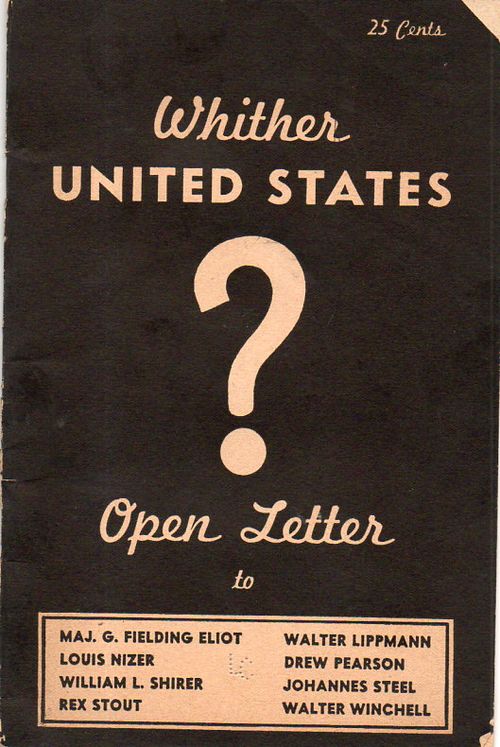
    Then there is Whither United States?, written fairly late in the war (1944) by T.H. Tetens, who was a journalist (born 1899) thrown into a concentration camp in 1933 and who subsequently escaped, making a career in the U.S. The provocative cover brings up a real issue inside, as Tetens questions how people are appointed to sensitive positions in the war-time. His major example is Hans M. Hoffmann, who was appointed to a critical post in the Office of War Information.though Tetens’ investigation shows that Hoffmann was the editor of teh Staats Zeitung, which was pro-Germany and Hitler-supportive through Hoffmann’s tenure there from 1933 to 1941. I don’t know about Hoffmann–he doesn’t show up in any of my references here and doesn’t make an appearance in this capacity on the internet, but Tetens seems to make a very strong point.  And hence, I guess, the large question mark.

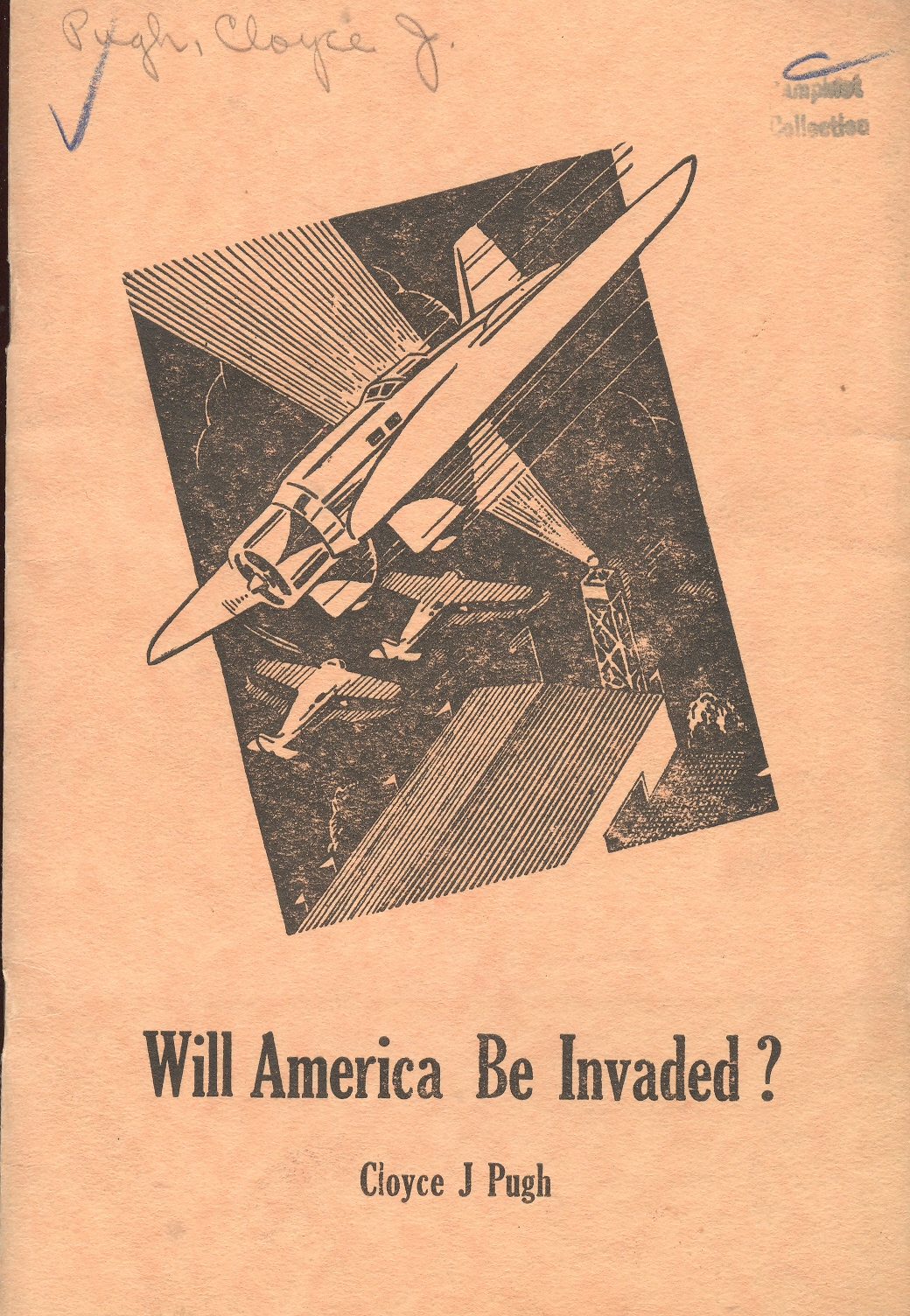
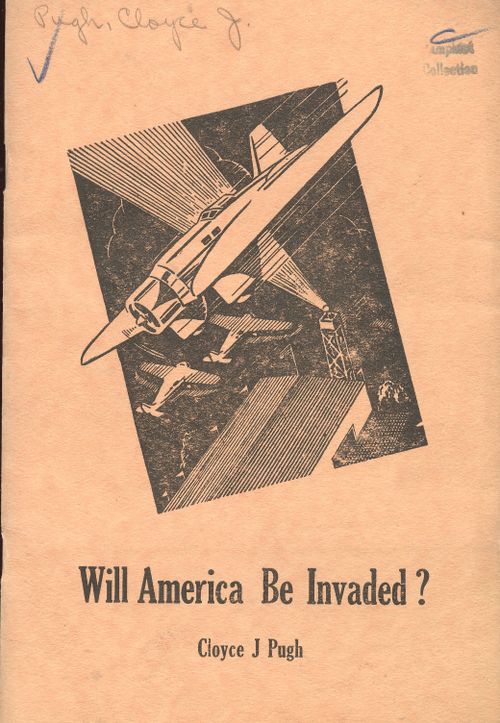
    The next pamphlet, Will America Be Invaded, was published by the Christian Fellowship Press in Akron, Ohio, in 1941, and leans mightily upon scripture to state assumptions about the coming menace to America being presaged in the Bible.  That invasion also seems to be allowed by God (according to prophesies and such) in pursuit of murky results.  The conditions which will prevail “when God permits invasion” (according to this person’s reading of the bible)) include the formation of monopolies, extensive wine and music, “unbelief in God’s judgments”, conceit, “wine and bribes in high places”, and “perverted moral stanfa5rds.  All of this—it is claimed—can be remedied through one medium:  prayer; and prayer through only one mediator, Jesus Christ, who would then take the communications to god’s ear.  
    ==Blog July 15==will america be


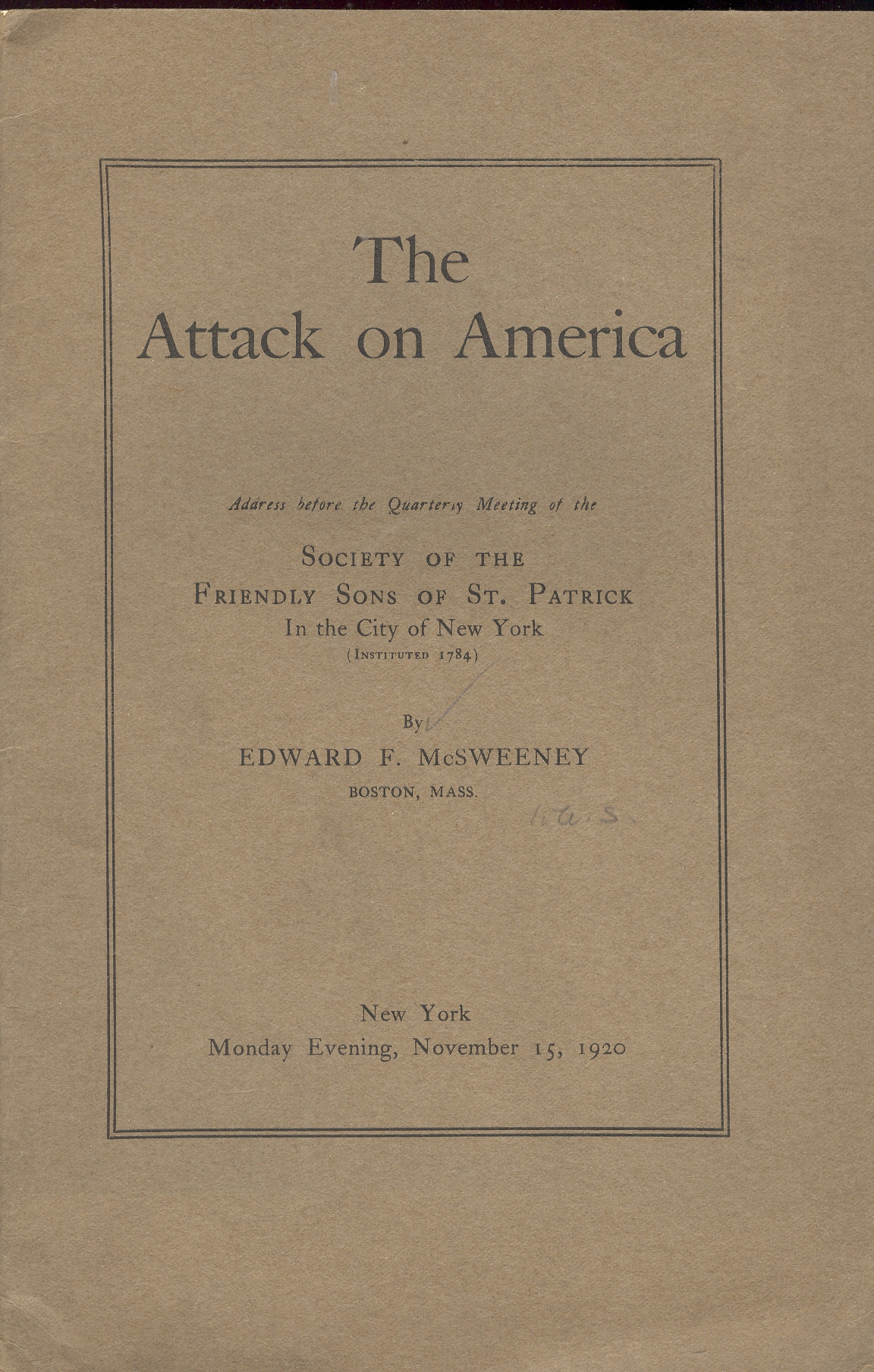
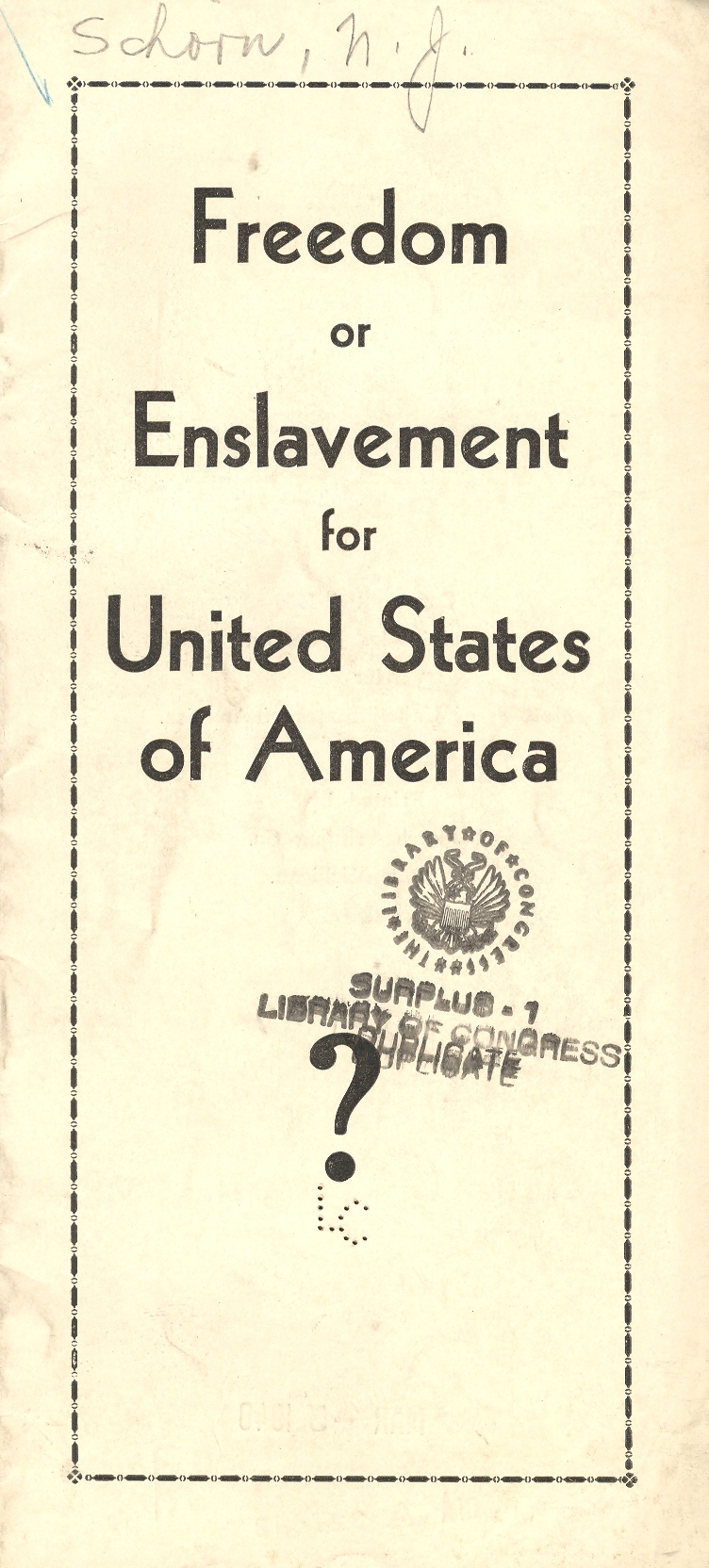
    The Attack on America, published by the Friendly Sons of St Patrick (of NYC), was a cautionary pamphlet published in 1920 warning against certain dispassionate evils of British propaganda in the United States.  Freedom or Enslavement for United States of America (sic), published in 1939 for the Mothers of United States of America (sic) advocated a freedom policy that prohibited conscription in foreign wars and would present a state of permanent neutrality. It also made some pretty vicious anti-Roosevelt attacks, finding him the Socialist root of the coming empire of American evils with a wildly power-mad and legislative-grabbing presidency.
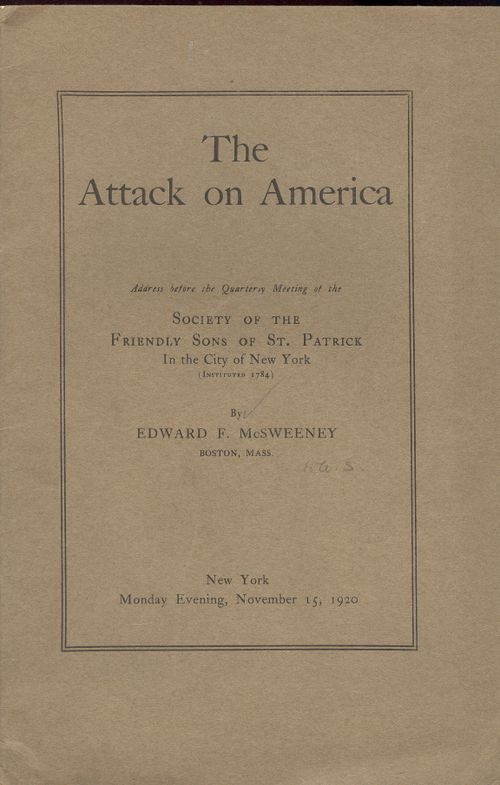
     ==Blog July 15==attack omn amer

    Quite a grouping of pamphleteers concerned with the potential overthrow of the United States, each seeing the unfortunate possibility of national death via divergent and disparate means:  the fall of the country due to not being part of the Allies during the war and also for being in it; biblical ordination of invasion that is only combatable through prayer; British and European propaganda control of the national welfare; and of course the diabolical Socialist menace of Franklin Roosevelt and the imperial presidency as the ruination of the nation’s future.  All of this gently hidden by disturbing titles which really don’t give you a hint about what wildly unexpected ways the end was approaching.  And whatever they were, they were definitely not high-order thinking.
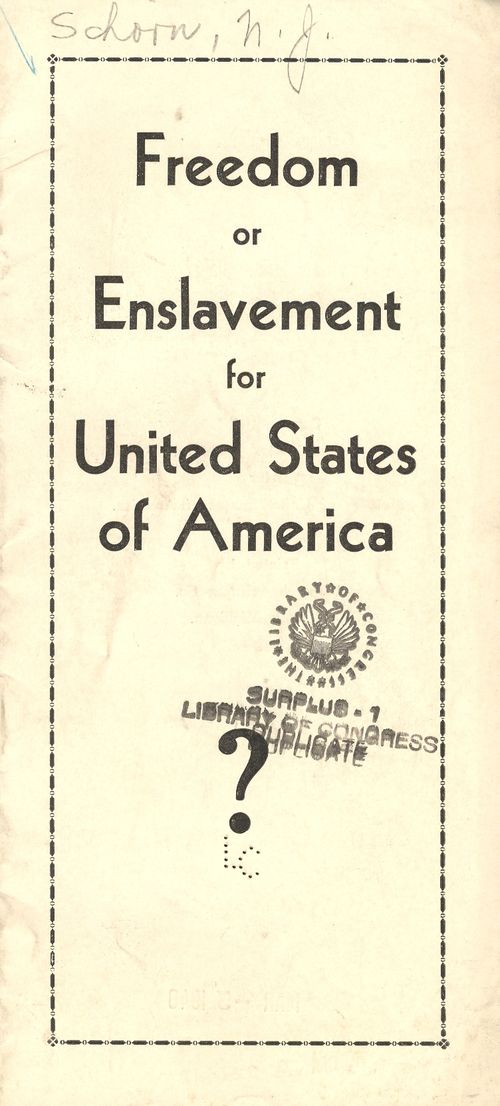
     ==Blog July 15==america slave


    And then there is this:

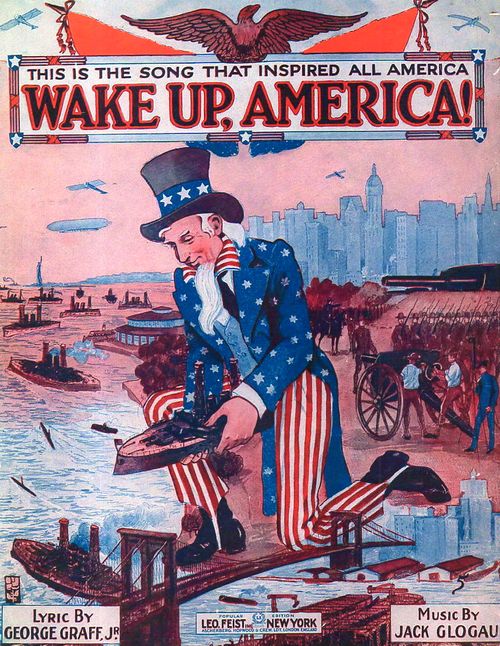
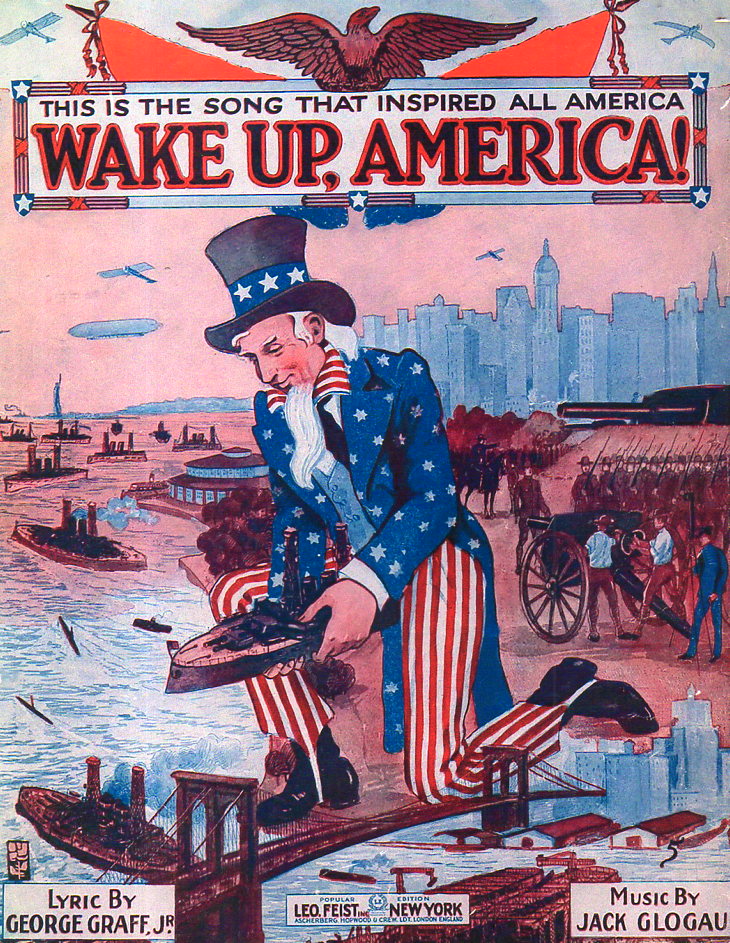
    America Invaded  Wake Up Amerrica 167

     To listen to the song, check out this link to the Library of Congress  (male solo, orchestra), 1916.