A Daily History of Holes, Dots, Lines, Science, History, Math, Physics, Art, the Unintentional Absurd, Architecture, Maps, Data Visualization, Blank and Missing Things, and so on. |1.6 million words, 7500 images, 4.9 million hits| Press & appearances in The Times, Le Figaro, Mensa, The Economist, The Guardian, Discovery News, Slate, Le Monde, Sci American Blogs, Le Pont, and many other places… 5000+ total posts since 2008.

Category: Books–Great Cover Art

  • Octopusiana: the Failure of the Bank of the United States (the White House copy) 1931

    JF Ptak Science Books  Quick Post

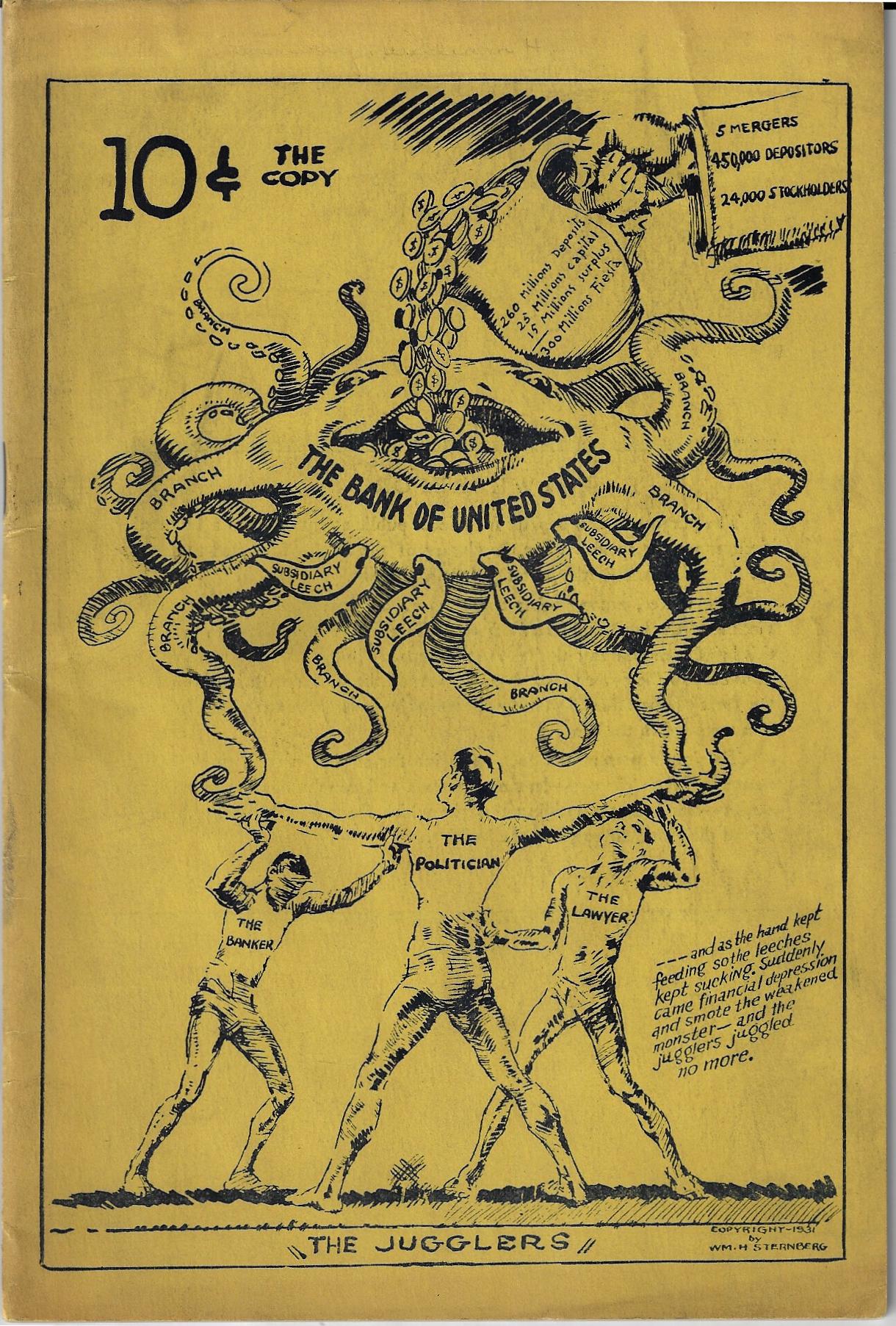
    Book cover octopus bankWilliam Sternberg.  Finis. The Bank of the United States, 1913-1930.  No publisher or place of publication listed, though copyrighted by William H. Sternberg, 1931, and “distributed ” by National Distributors. 23×15.5cm, 40pp. Highly decorated cover. Original wrappers.  Provenance:  the White House, and then the Library of Congress (stamped “by transfer/The White House, Jul 29 1931”. Very Good copy, with the LC surplus/duplicate stamp on rear cover, and a 6mm perforated “LC” stamp at the very bottom of the title page.  

    I was about to say that not many books have started their lives with the word “Finis” starting the title–a quick check in WorldCat has proved this wrong, as there at least hundreds of books with this word in the title. 

    The cover art–perhaps by Sternberg?–is very striking, and as with lots of political art, could be understood without having to read it, a glancing view being pretty much enough to tell the story.  The image features the Bank of the United States as a sort of 16-legged octopus, being fed money food from a merger/depositor pitcher, underneath which and perhaps keeping the whole thing afloat are a banker, lawyer, and politician. Sternberg evidently didn’t think much of the BOUS’ many acquisitions/mergers since it went into business in 1913, being particularly upset with the late 1920’s movements. Anyway this is a pretty screedy diatribe, though it also seems to be an informed one. 

    A Series of Unfortunate Events led to an infamous run on the BOUS’ Bronx branch, with 25,000 people showing up and wanting their deposits, all of which fed into the making of the Great Depression. The bank did not do well after the run.  

    ·Posted by :

    ·in:

    —

  • A Glorious Episode in Outsider Literature–“the Great Scope Ever to be Attempted in a Work on Paper”, and a Peep into the Year One Billion A.D…

    JF Ptak Science Books    Post 2691

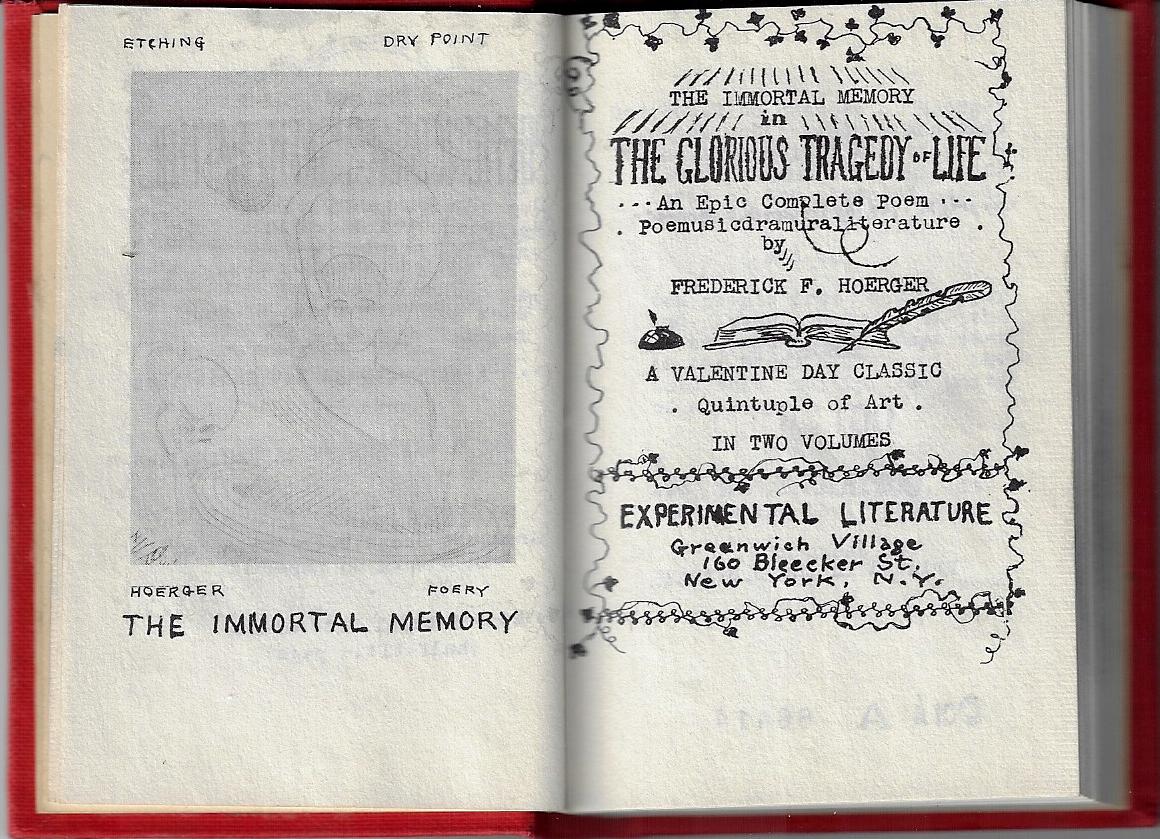
    There are some things that stand to be admired simply because exist. They may be mundane, but they are the magnificent mundane, brought to life by sheer force of will. Such I think is the case of Mr. Hoerger’s Poemusicdramuraliterature Epic Poem the Immortal memory in the Glorious Tragedy of Life (1946). The work is billed as a “Valentine Day Classic, quintuple of Art”, the “greatest scope ever attempted in a work on paper”.  It is a big claim made by a little book–bound in red cloth, it measures 4″x2.5″ and is 86 pages long, though the word count for all of the little pages only makes it to about 8000 words, or about 20 type pages. I don’t think that the book ever actually catches up to itself, as for what I can see of it, it is always one step ahead of itself and one step behind.
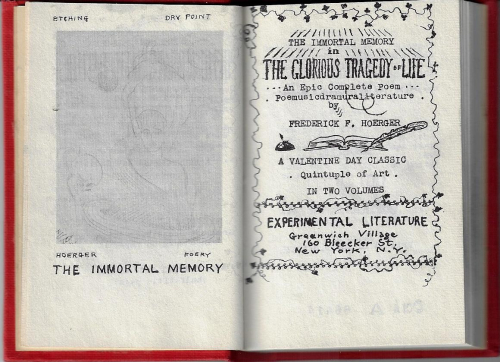
    Outsider poemliterature _1_

    (I’m guessing that Mr. Hoerger could have lived at 160 Bleeker Street–it is the Mills Building No. 1, and was built in 1910, where today you could easily spend 4.5k/month for a one-bedroom place…unless the printer for this book was in the basement, and Mr. Hoerger lived elsewhere. This copy by the way came to me via the Library of Congress and is one of the Copyright Deposit copies. There are at least five other works copyrighted by Mr. Hoerger; Highroad Number Z, Vintage One (1941),  Immortal Aid (1946), The Daze of Forty-Nine (1958), and Deep Surprise, post-Abstraction, Space-age Understatement (1961).)

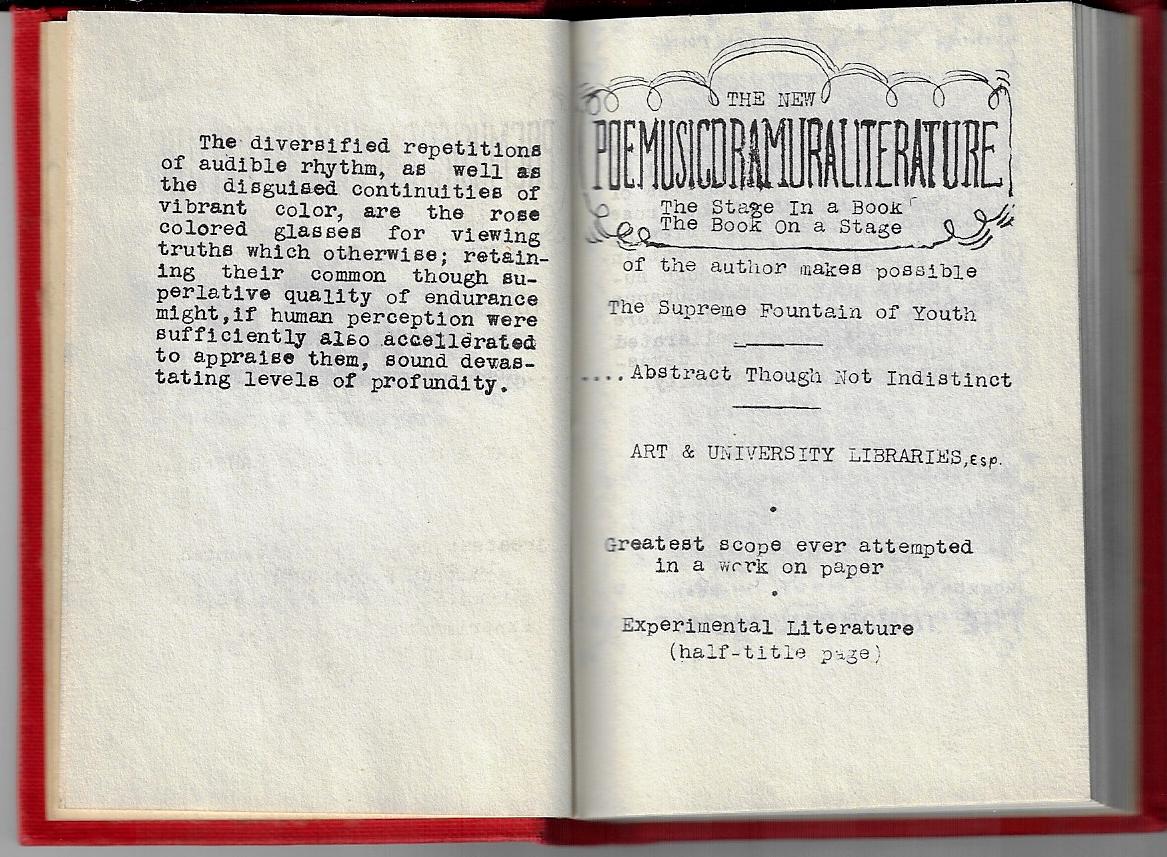
    We are reminded of the new sort of “work on paper” this is on the half-title page (identified so), as well as the non-sequitur “art & university libraries, esp”, which seems like an enormous emotion of some unidentifiable sort that the author brings to bear on the possible reader:
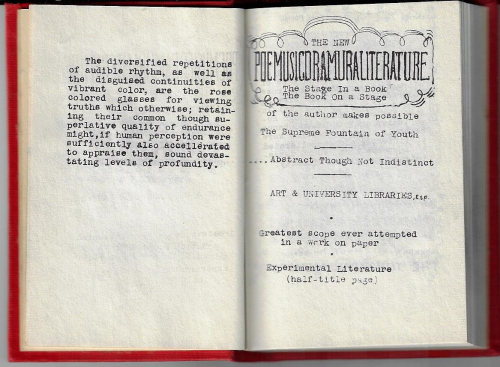
    Outsider poemliterature _2_

    The extraordinary cover:

    Outsider poemliterature _3_

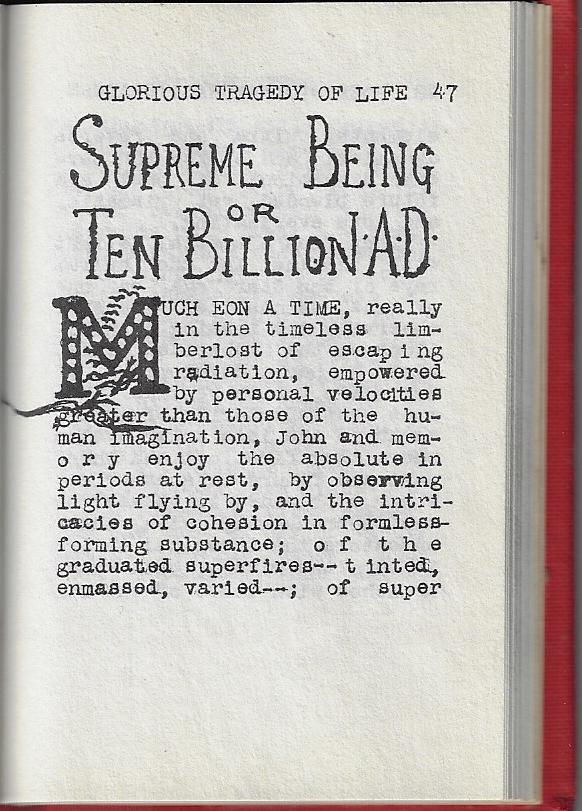
    And a sample of the writing, which is, at the very least, quite something; it seems a major attempt at producing and communicating ideas that are just too far in an unreachable zone for me, though I have to give credit to the author for his imagination and for completing a project.  

    I should point out that in the last section of the last page reproduced here something is “calibrated” at “50 septillion light years”, which is a pretty big number in the scale of the base -illions, especially when you think about the universe being “only” 13 billion years old–that means that the width of the universe in 26 billion light yeas wide  or 156 billion light years in the altogether or some such, but 26,000,000,000 is crushed by the 50,000,000,000,000,000,000,000,000 light years being discussed here. Of course there’s also the fast-forward to the future part, introducing the year 1,000,000,000. That would be impossibly far into the future, considering that Homo sapien has been around for 150,000 years or so, and that there have been about 7,500 generations in that time. The Year Ten Billion would entail 400 million generations (and that’s assuming that we haven’t started to “live” forever after the year 3000 or 2500 or whatever) since we have been brought to our present medical modernity in the scant eight or nine generations since Joseph Lister invented the idea of sterilizing operating instruments, and considering again that we are just three or so generations removed from DNA (1953) and the first successful heart transplant (1967) and how far the replacement of human bits has come since then, it is impossible to say where medicine might be in a 50 generations or a thousand years, let alone in ten billion years. 

    I do have to commend the author for thinking big. And: he does make you think. 
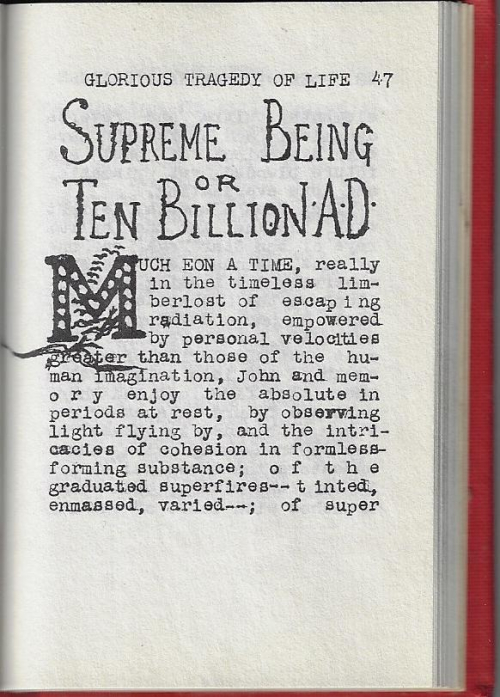
    Outsider poemliterature _4_


  • Weird Questions and Weirder Answers Department: Curing Insanity

    JF Ptak Science Books  Quick Post

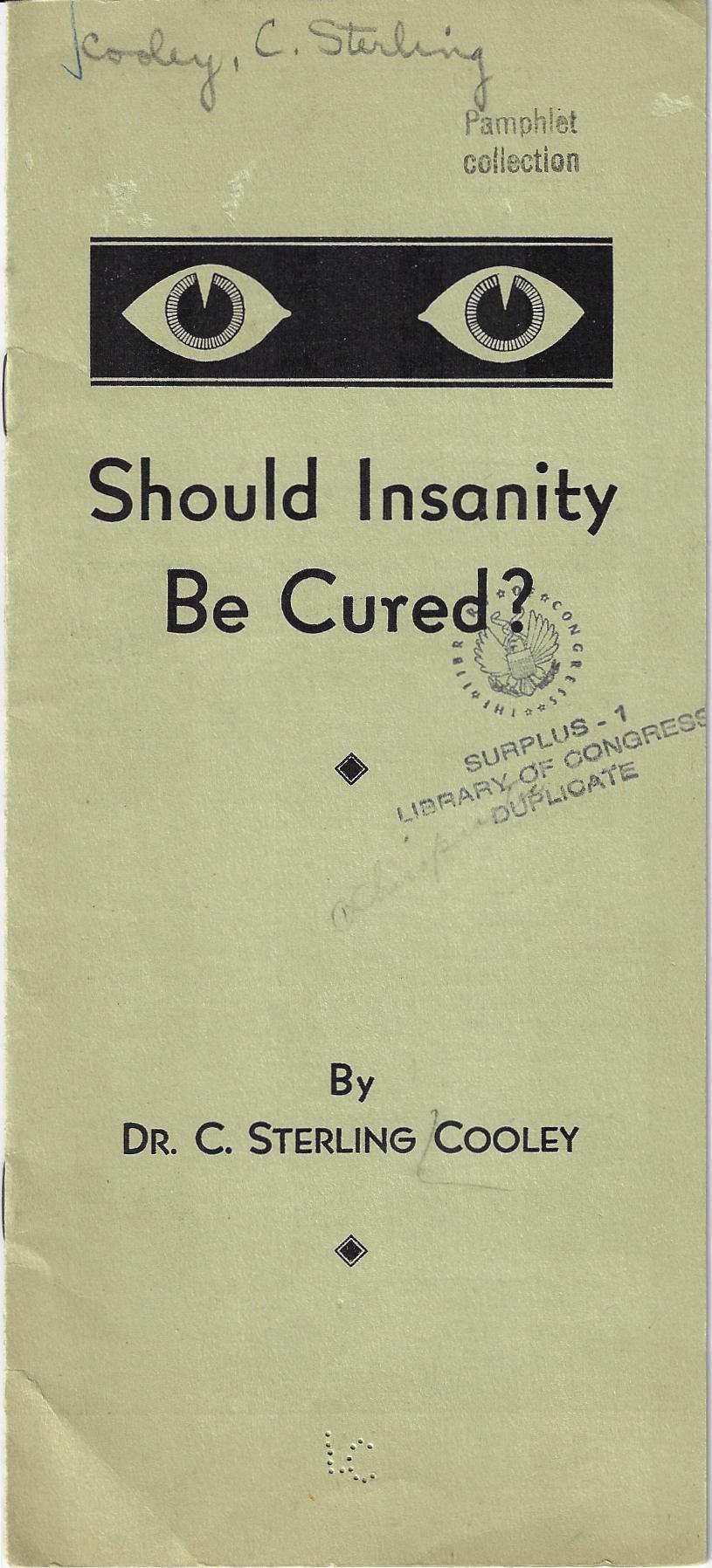
    Pamphlet cover should insanity detail

    Pamphlet cover should insanity be curedDr. C. Sterling Cooly wrote an incredibly-titled pamphlet of slim means called Should Insanity be Cured?  How could anyone proceed further than this?  Dr. Cooley wasn’t a eugenic apologist, nor was he an accountant for a life insurance firm—he was advocating a drugless cure for all different sorts of “insanity”, which was a term he doesn’t really stop to identify and classify, which of course is deeply problematic. 

    Or it is so until you hear how one can treat the insane via his new drugless method:  chiropractic.  I didn’t see that one coming.  “An insane mind is a sick brain, a sick body is an insane body” writes Dr. Cooley with leading confidence, claiming that chiropractic can release “the power within…marvels of healing are performed not only in mental cases but in virtually ALL forms of disease”.  That’s a lot to live up to in theory, let alone in practice. 

    Dr. Cooley was evidently a deeply important founder father of modern chiropractic, with a 50  year career in the area (1908-1957), and who was also very prolific–this is one work that he probably should’ve edited out of the publishing phase. 


  • Another Piece of Found Book Knot Art, from Another Dorothy Dix Pamphlet (1850)

    JF Ptak Science Books  

    This is a quick follow-up to an earlier Found Book Art found in another pamphlet by Dorothy Dix. (Dorothea L(ynde) Dix (1802-1887) was an nurse and ultratrian, a very-much-practiced humanitarian who for years fought for the stabilized and just treatment of people with disabilities, mainly and for extended periods of time and travel for those suffering from mental diseases and development. Read more here https://historyofideasblog.com/thesciencebookstore/2014/07/dorothea-dixs-report-on-the-state-of-the-indigent-insane-in-the-us-1848.html) 

    The present Dix pamphlet has another perfect little in the string used to bind the pamphlet together tie:

    :Dix _2_ 530

     [Source: DIX, Dorothy L.Fifth Letter to Convicts in State Prisons and Houses of Correction, or County Penitentiaries. “Printed but not published”, November 1950. 18.5×12 cm, 24pp. Provenance: Smithsonian Institution (with their small oval rubberstamp), and the Library of Congress (with their surplus duplicate stamp on back page).]


    DIx130


  • What This Country Needs is a…Strong Communist Party (1946)

    JF Ptak Science Books  Quick Post

    This is a very quick post on an arresting cover graphic for a pamphlet by the ubiquitous William Z. Foster.  At the time he was the chair of the Communist Party U.S.A. (1945-1957) which was a desperately weird time to be in charge of anything Commie in the U.S. Foster was a more “centrist” radical labor organizer (if there is such a thing) before joining the Communist Party in 1919, jumping ship from the Wobblies and the Socialist  Party. He stayed with The Party until the end, when h died in Moscow in 1961, 60 years into his career. In any event, this is an interesting cover of a very hard sale to make in the U.S. in 1946.

    Communist party, what this country needs646

    ·Posted by :

    ·in:


  • Targeting Communism in Cover Art, 1930’s

    JF Ptak Science Books  Quick Post

    This is just a quick picture-post sharing the cover art for anti-Communist works by the Jesuit priest, Raymond Feely.  Fr. Feely was not a fan of the Communists, who he felt amidst all other things raised the importance of the state to a religion and beatification of the State, and that of course just would not do. He wrote these in the mid-1930’s before the bestial stuff of Joseph Stalin had come out popularly in the West, and also before the Great Terror enveloped the U.S.S.R. There was still some interest in Stalin’s brand of Communism in the U.S., though that was the left-over mythological and chromed-over trumpian gilted Communism that people thought existed earlier, but actually didn’t.

    Anyway, Feely had no use for that, and wrote about it–you can pretty much tell by the cover art what he thought of Communism.  

    Communism Today or Red535


    JustWhatIsCommunism1935_0000


  • Found Art: in a Liberal Treatment of the Sociology of Working Class (1851)

    JF Ptak Science Books   Quick Post

    This is the front cover of an impossibly-thin work on social contract and cooperation among the working classes.  It was written by a very well-known German (from Stuttgart) liberal social reformer named Victor Aime Huber (1800-1869) and related some of his observations on the conditions of workers during a trip to England and which was published in 1851 in Berlin.  I am going to scoot along on this one and not comment on Huber’s social or economic work because I just don’t know anything about it (at least tonight)–all I wanted to do was comment on the beautiful found-art cover for the none-page pamphlet.  Non-representational beauty won’t be discovered in the art world for another sixty years or, otherwise sturdy construction of color and drifting text might have been considered artistic.  I like it quite a bit for its design–as well as for the very deep and swirling nature of the blue paper wrapper.  

    FOund Art Berkin 1851368

    (Ueber Association mit besonderer Beziehung auf England. 4. Vortrag, veranstaltet von dem Centralverein fiir das Wohl der arbeitenden Klassen, Berlin, 1851.)

    ·Posted by :

    ·in:


  • Mathnocracy & the Mathless God of Mathematics

    JF Ptak Science Books

    Squidward: What’s that horrible smell?! [sees steam coming out of SpongeBob’s window] Is Patrick thinking again?

    Patrick: [sticking his head out of the window] I’m making art!

    Squidward: Patrick, it smells like something crawled into your brain and died!

    Patrick: That’s the creative process at work!

    This is one of those pamphlets with a title that goes on and on, and on, and pretty much tells you everything that there is about the work, and perhaps a little more. It is in the fine tradition of The Era of Enormous Book Titles that was so not-uncommon in the 17th c and Western Dime Novels from the turn of the century.  This “newer democracy” really didn’t have so much to do with “math” than it did with God being a mathematician, though not invoking much math, per se.   I’m not getting into the content very much because it really isn’t worthwhile—and unfortunately the pamphlet is not illustrated.  But it has a great title and cover, and is also a new entry in the “-ocracy” contingent, including the far more well-known “Technocracy” and the as-obscure “Humanocracy”, among others.  (Aha! I am reminded of an anti-FDR pamphlet called NewDealOcracy that was a fascist something or other…) 


    MAthnocracy363

    ·Posted by :

    ·in:


  • How a Trade Union is Run–in Bright Red (1932)

    JF Ptak Science Books  Quick Post

    Katherine Pollack (b 1905) wrote this informative pamphlet in 1932–it is red though Ms. Pollack wasn’t.  She did have a solid and liberal background–Ethical Culture School in NYC, economics at Vassar, grad work at Columbia, “tutoring, teaching and writing for the Bryn Mawr Summer School for Women Workers (1927-49), Brookwood Labor College (1929-32)…field work in Southern textile mill towns and West Virginia coal camps…”1, and then on to national offices for the CIO and then the AFL-CIO.  

    I hate to say it, but I was drawn to the pamphlet for the design.  It turns out that Ms. Pollack had the Right Stuff, and knew her business, and lived that life.  I’m glad to have made her acquaintance.

    The pamphlet was published by the Brookwood Labor College (1921-1937) evidently the first U.S. college devoted to the study of labor, and published in 1932.


    How a trade union is run348

    Notes:

    1. Katherine Pollack Elikson papers:  https://reuther.wayne.edu/files/LP000321.pdf


  • Outsider Logic, Part 17: Monkey on the Brain

    JF Ptak Science Books   Quick Post

    There are hundreds and hundreds of pamphlets like the one below in the store’s Outsider Collection–honest work that somehow has gone a little astray, or over-the-side, or reached too high, or fell too low, or some such thing. Sometimes I read in the work a little, and sometimes not–the present pamphlet is in the later category, which means I really have no idea what the author is channeling, except that I know it is fairly evangelically religious and capitalist. I don’t know why the human head profile is on the cover, and I also don’t know what it means. But no doubt it was something encapsulating, something representative to the work as a whole, otherwise it (probably) wouldn’t be there. If I was 25 years old I might stop to read the 193-page work a little; but I’m not, so I won’t.

    (P.S.: the covers are velveteen.)

    Americanism vs communism130