A Daily History of Holes, Dots, Lines, Science, History, Math, Physics, Art, the Unintentional Absurd, Architecture, Maps, Data Visualization, Blank and Missing Things, and so on. |1.6 million words, 7500 images, 4.9 million hits| Press & appearances in The Times, Le Figaro, Mensa, The Economist, The Guardian, Discovery News, Slate, Le Monde, Sci American Blogs, Le Pont, and many other places… 5000+ total posts since 2008.

Category: American History: Western Exploration & Native Americans

  • History of Lines: Barbed Wire Borders for San Francisco’s Chinese Scapegoats

    JF Ptak Science Books  Post 1698 [Part of the History of Lines series.]

    [All images below via the Library of Congress, The Chinese in California, 1850-1925]  

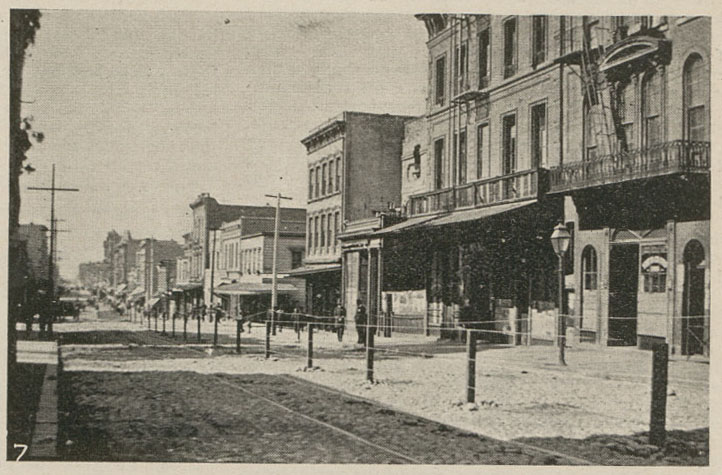
    Part of this blog’s history of line series inevitably deals with some of our planet’s most cutting lines:  barbed wire.  Talking about just the United States for the moment, it cut land into small, bite-sized chunks in the parceling-out and extinction of expansion in the American Westward movements, and has done pretty much the same in keeping apart the races in some areas of the country where the legal/social/cultural lines begged for steel more than paper. Such is the case in these remarkable photographs from San Francisco
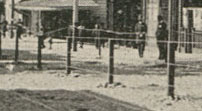
    Chinatown barbed wire 2
    And the full image:

    Chinatown barbed wire
    [“The Barb-Wire Barricade: From The Wave: v. 21, Jan. – July 1900: no. 21, page 7: Scenes Outside the Chinatown Quarantine Lines, San Francisco”.]
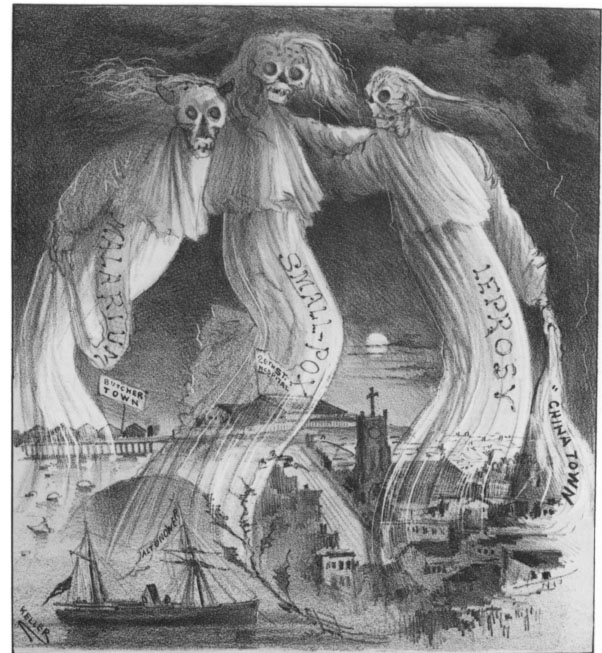
    Chinatown three gracesThe reason for this barbed wire in the streets of San Francisco was simple–it was a quarantine of Chinese people who were thought to be infested with bubonic plague. The reasons for this were simple and racist–given that the Chinese were seen from (at the very least) the 1860’s to be an “inferior” and “degraded”1 race, living in close quarters and in fair squalor at times (given the wages that they were paid and the abuses they suffered from the Chinese Exclusion Acts), and given the codified racist sentiments against them, it was seen that these people were capable of spreading the diseases via their very presence and “vapors”. (At least one of these “three graces” of “malarium”, “small-pox” and leprosy were seen as coming directly from Chinatown in San Francisco. See notes #1 for source.)

    And so up went the barbed wire, “and no Chinese American was allowed to leave the area bounded by California, Kearny, Broadway, and Stockton streets”2.  This of course restricted the access of Chinese immigrants and Chinese-American citizens, and held for some three months, prohibiting access out and in, meaning that food was in short supply, prices for goods and food went very high, and many Chinese businesses suffered loss and closure.  At the end of three months, the barbed wire quarantine was lifted, and of course not one case of plague was reported among the Chinese population. 

    There is a long history to this sort of thinking, as we find that, for example, in the 1875/6 smallpox epidemic San Francisco’s father’s determined that one cause might be the Chinese, and had all of the houses in Chinatown fumigated.  This of course had nothing to do with the epidemic; yet, at the end of it  all, “the  city health officer, J. L. Meares, offered the following explanation:  I unhesitatingly declare my belief that the cause is the presence in our midst of 30,000 (as a class) of unscrupulous, lying and treacherous Chinamen, who have disregarded our sanitary laws, concealed and are concealing their cases of smallpox.”3

    Here’s another image from the 1900 quarantine:
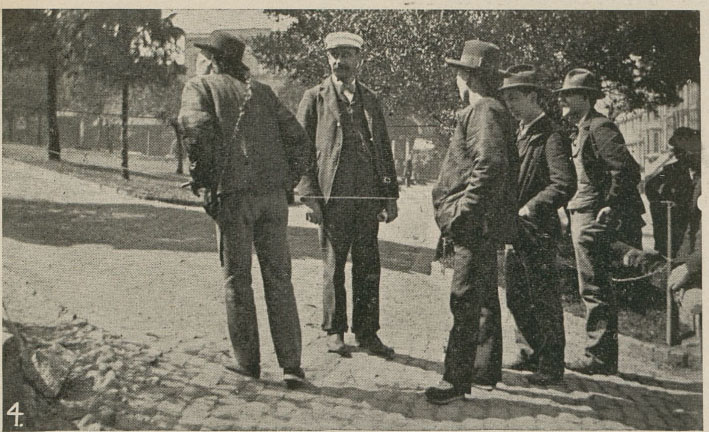
    Chinatown 2--the ropes
    [“A Conversation Across the Ropes: From The Wave: v. 21, Jan. – July 1900: no. 21, page 7: Scenes Outside the Chinatown Quarantine Lines, San Francisco“ Publisher: Wave Publishing Company.]

    And another, keeping San Francisco “clean and healthy” with barbed wire and rope.  
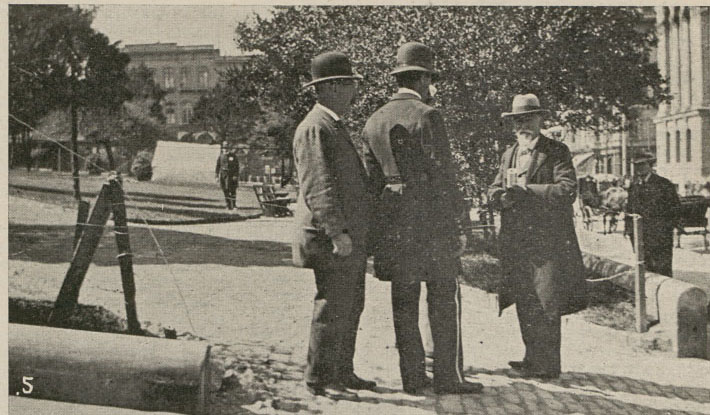
    Chinatown 3 barbed wire
    [“No Admittance: From The Wave: v. 21, Jan. – July 1900: no. 21, page 7: Scenes Outside the Chinatown Quarantine Lines, San Francisco.”]

    Another example of the institutionalized despoilment of the Chinese is seen here in an 1880 Board of Health pronouncement on the state of Chinatown in San Francisco was an official “nuisance”, and that the “Chinese cancer:” must be cut out:   “The Chinese cancer must be cut out of the heart of our city, root and branch, if we have any regard for its future sanitary welfare . . . with all the vacant and health territory around this city, it is a shame that the very centre be surrendered and abandoned to this health-defying and law-defying population. We, therefore, recommend that the portion of the city here described be condemned as a nuisance; and we call upon the proper authorities to take the necessary steps for its abatement without delay.”4

    And of course examples can go on and on–but there is really nothing quite like seeing a racial sentiment transferred into a three-dimensional object–like a barbed wire fence going down the middle of a street in San Francsico, in 1900–to drive home a message of learned bad thinking. 

    Notes:

    1. An excellent article by   Joan B. Trauner, “The Chinese as Medical Scapegoats in San Francisco, 1870-1905,” California History, Vol. LVII, No. 1 (Spring 1978), pp. 70-87.  Full text is available online with an academic account.

    2. Source: History of Chinese Americans in California, the 1900’s, blog  here.

    3. Trauner, ibid. Page 73

    4.  _____, pg 75.


  • The Farm and the Boring Frontier in the Closing of the West

    JF Ptak Science Books   Post 1699  [Part of the series on Blank, Empty and Missing Things:  the Frontier, 1885.]

    Farming and the closing of the frontier–more notes on reading Larry McMurtry’s Lonesome Dove, part 4.

    It is difficult to underestimate the impact of the technological revolution on the development of the American West. The impact of the railroad is obvious; efficient fencing material in the form of barbed wire revolutionized land distribution and control. Less obvious is the less glamorous—the plow, harrow, windmill, silo, well drilling, and harvesting machinery. All made farming less difficult and opened the way to ever more land being farmed—the cultivation and civilization of the vast tracks on the Great Plains was made possible by these innovations.

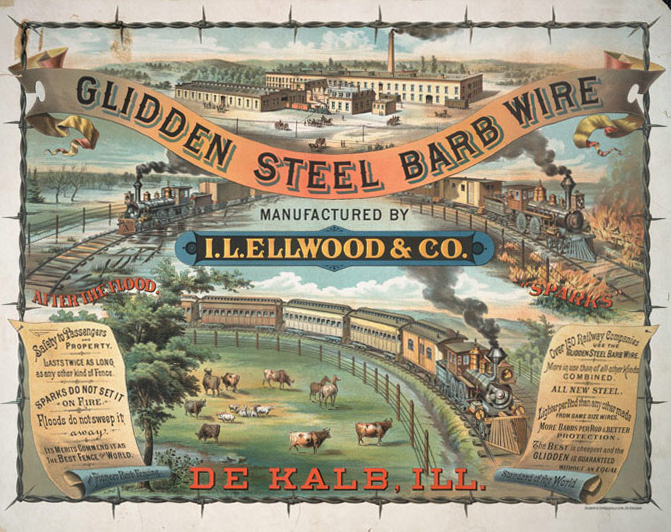
    Barbed wire
    [The use of the railroad in this ad for the famous Glidden barbed wire is interesting because in the history of lines and the American West, it was the lines of the railroad tracks, telegraph wires and barbed wire that changed the face of the place more quickly than anyone could have imagined in the 1840’s.  Certainly if Jefferson had been able to survive to his 150th year he would have been absolutely shocked to see how fast the West had been not only explored but brought into some sort of control, a feat that he imagined would take many generations past his exploratory team of Lewis and Clark.] 

    All of the machines needed in the West—chilled-iron and steel plows, grain drills, reapers, disk harrows, straddle-row cultivators, and threshing machines—were in use before the Civil War. The appropriate improvements and modification needed for use on the Great Plains came about in the 10 years or so following the war.
    The improvements made in farm machinery from 1870-1890 had the following effects on time, effort and money saved in the production of each acre of the following:

    Crop Time Worked Labor Cost

    Hand Machine Hand Machine

    Wheat

    61 hours

    3 hours

    $3.55

    $0.66

    Corn

    39 hours

    15 hours

    3.62

    1.51

    Oats

    66 hours

    7 hours

    3.73

    1.07

    Loose Hay

    21 hours

    4 hours

    1.75

    0.42

    Baled Hay

    35 hours

    12 hours

    3.06

    1.29


    The effects of technology were staggering—in the 1870’s, a farmer knew he could only plant seven or eight acres of wheat because he knew he could only cut a certain amount during the limited harvesting season. By 1890 the same farmer could plant 135 acres knowing that he had effective means to harvest, bind and store the wheat without spoilage. These improvements meant more production from more farmers, and changed the face of the Great Plains.

    Railroads helped a great deal in bringing farmers west—sometimes covertly. The Great Northern Railroad did its fair share in structuring the land during the “Dakota Boom” of 1878-1885. It was formed in 1879 by James J. Hill, a former employee who managed to seize control of the railroad following the Panic of 1873. Its progress west was deeply planned by Hill—since the railroad had no land grants, he realized that income must come from revenue, so he brought revenue-makers with him, building communities along the railroad as he went. He advertised and brought in immigrants from Europe, established model farms, imported blooded cattle, and loaned money to farmers, homeseekers and immigrants of all persuasions. His actions were persuasive and successful.

    Its a horrible thing in some ways to identify farming as a “Boring Fronter” in the history of ” _____ Frontiers”, but it is in some ways accurate.  Not to say that all of farming is boring, not by any means, particularly in difficult places in trying times–but the presence of an easily-accessible borderland defined by a very inexpensive means of identification (as in barbed wire) meant that the property of individuals was defined, and that new property owners would have to fan out and away from existing farms and ranches, thus settling more and more territory.  And this of course meant more and more land was under control.  And “under control” means, well, under control.


  • An Eloquence on the State of Indians and Liquor on the Reservations, 1871

    JF Ptak Science Books  Quick Posts

    [Electronic source here.]

    In the Report of the Board of Indian Commissioners for 18711 I found the following report of a meeting held between General S.J. McKinney (Superintendant of Indian Affairs for Washington Territory) and Chief Napoleon at the Tulalip Reservation in Washington Territory:

    “Napoleon, the Chief, came forward with much and laid before…a bunch of split sticks, saying ‘these represent the number of Indians killed by white men in the past year, all Indian chiefs, fifteen of them, and yet nothing has been done by the government to the white men who killed them. They killed them by selling them whisky. I do not speak of them because I have a bad heart, but because I want you to know what kinds of men live about us. The whites now scare all of the Indians, and we wonder when they will kill all of us.’”

    After his eloquent and impassioned speech came that of his brother, Peter, who continued to explain the evils of the Indian agents:

    “Every agent has done wrong. No money comes our way. I will find money to go to Washington and tell the President of these evils. McKinney (the superintendent) has gone to the woods; he knows things are bad. The young Indians want to be helped and live like white men, they are not lazy. They see the Indian agent; he works for himself and never helps the Indian. I can not tell you the many stories; the sun would go down before I was finished…”

    The Indian Commissioner present at the proceedings, Mr. Felix R. Brunot, made an interesting response:

    “It would take four months to go to Washington in a canoe…I have much to do and little time to do it in. I must go to two more reservations before I go home and I have little time left to spend here. I am going to stay here just half an hour longer and then I must go…

     Notes:

    1) THIRD ANNUAL REPORT OF THE BOARD OF INDIAN COMMISSIONERS Washington DC December 12 1871, pp 128-129.

    Present at this meeting were:

    "August 28. A council was held with the Indians of this reservation at 10 a. m., meeting 
    in front of the trading-house. There were present Hon. F. R. Brunot, chairman of the 
    board of Indian commissioners, and his secretary ; General S. J. McKinney, superintendent of 
    Indian affairs for Washington Territory; Father Chirouse, superintendent; Napoleon, the 
    chief, and all the minor chiefs and young men ; the employes, and a large number of the 
    men and women of the tribe. Before the council opened, Napoleon, the chief, reminded 
    them that he was the only one left of the old men who took part in the treaty with Governor 
    Stevens ; all the others had passed away..."


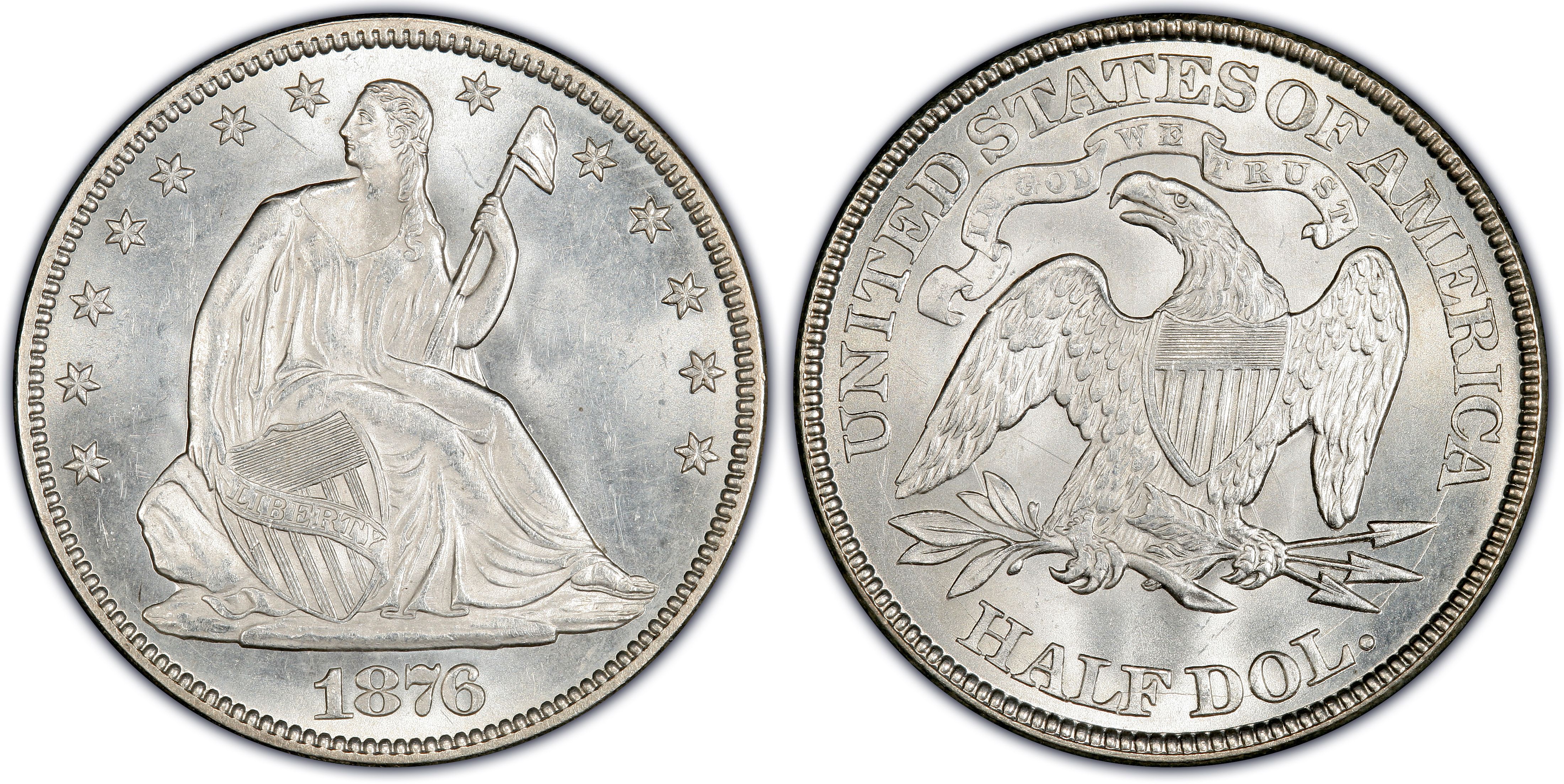
  • How Much Was 50 Cents Worth in 1876?

    JF Ptak Science Books    Post 1697

    Continuing a new series of posts on big, underwritten hidden segments of the history of the American West in my current reading of Larry McMurtry’s Lonesome Dove, I come to wonder about what it meant–what was the value–for one of the cowboys to spend 50 cents.  (The sum comes up here and there.) What did 50 cents mean in a working person’s life at the time this novel takes place, in 1876?   

    One way to look at the value of a half-dollar then is to see what portion of a week’s pay it represented.  That, and of course to compare what things cost in general, compared to how much it cost to make the money needed to purchase the thing. 

    For example, a songsheet as advertised in Spirit of the Time, 1877) cost 30 cents. Coffee (“Gillies Old Plantation”) cost 25 cents per pound.  After enjoying the coffee,  a guy could get a shave for 10-25 cents, or get a pair of shoes (“Harman’s Hand Made Shoes”) for $3; a decent hotel room in a modest city could cost $1-2 per night, and a half-barrel of flour would set you back $2.50.    A W + C Scott & Sons double action .45 calibre revolver would put you back $20 (according to the Spirit of the Times) in 1877, while a Remington sporting rifle #1 model (30″) would run $30.  A simple-ish hat could cost $3 dollars, but a good hat for the trail would be considerably more, ranging from 5-25 dollars. (See more examples below.)

    But what did 50 cents mean in terms of a paid salary to a cowboy?  I think it is relatively safe to say that at this time the “average” cowboy made about $30 a month.  Wranglers would pull down $20-$30; top hands, $50-$75, and the trail boss, say about $100.  So, spending a half-dollar would be equal to about a half-day’s wages. 

    So we can see that if you made $30 a month, spending 50 cents was something. 

    Most workers made more than cowboys—farm hands (with board) made $35-$45 a month; store clerks made $45-$95; “superior clerks and bookkeepers” made $100-$150 monthly; “female cooks and servants” received $25-$35; carpenters ($75 and up) and masons ($75+) made more.  Railroad workers building the first Texas railroad actually received a pay decrease from $2.75 to $2.00 a day. They worked 6 days a week from 7am to 6 pm, and were allowed to fish in the Pecos and Rio Grande Rivers with dynamite, “Italians on the one side and Germans on the other.”. (More examples below.)


  • Where Were People and What Did they Do? U.S.A., 1876

    JF Ptak Science Books   Quick Post

     I’m reading Larry McMurtry’s Lonesome Dove now, again (see yesterday’s post on this, here), experiencing that brittle silence spacing the dialog of long, open, open places.  That’s probably because the area where we start out in the novel is fairly flat land filled with tough scrub, and not many people.  The land wasn’t necessarily quiet–anyone hiking in bog country or high desert knows that there is plenty of life going on around you, and its just that the sound that gets made in its living doesn’t have much to bounce on, and so the sky swallows most of it.  But the sound is definitely there–but in general in the country around Lonesome Dove there weren’t many people, either.


  • An 1880’s Cowboy Speaks for the Record (1937)

    JF Ptak Science Books     Post 1698

    (Photo credits see below)

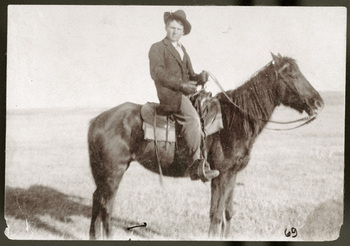
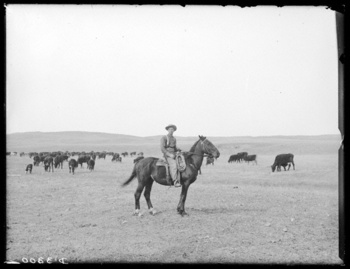
    Blogcowboy_1886 This interview of L.M. Cox  was conducted by Elizabeth Doyle in San Angelo (Texas), in 1937 as part of the WPA (Worker’s Project Administration) effort to record American oral history. We know only this of Mr. Cox: “L.M. Cox of Brownwood, Texas was born in Benton County, Arkansas, in 1858 and came to Brownwood in 1880. He engaged in the ranching business for a number of years before retiring.” I’ve got a feeling that this last sentence would be something like “Joe Dimaggio played baseball for several years before retiring”, perhaps intentionally droll, perhaps not.
    The interview, a paper copy of which is located in the Archives section of the Library of Congress, follows:
    “The cowboy’s life as we know it was certainly lacking in the glamor which we see on our screens today,” says L. M. Cox of Brownwood, Texas.

    “I have known cowboys to ride one hundred miles per day. I know this sounds unreasonable but they were off before daylight and rode hard until after dark. Their usual day’s work was to be off as soon as they could see how to catch their horses, throw the round-up together around 10 o’clock then work cattle or brand until dark and often times stand guard one-third of the night after that.

    The usual ride was sixteen hours per day. No Union hours for them. It was from daylight until dark with work, and hard work as that. One cowboy complained of having to eat two suppers, so he quit, packed his bed and left. In about three months he returned, carrying only a bull’s-eye lantern, saying that where he had been working he needed only the lantern and had no use for the bed.

    Blogcowboy_city “Each cowboy had his mount, which usually consisted of ten or twelve horses and he rode four each day. Many of the horses were remarkably trained and like their owners, had their good and bad points. My own horse would tell his age by pawing on the ground and I have been criticized for saying that he could tell marks and brands but I know he could.
    “There were few buffalo left, but there were antelopes in vast herds on both sides of the Pecos. I have seen hundreds of them on one drove, also black-tail deer. We could rope the deer but not the antelope. They were too swift on foot, faster than our fastest horses.

    “In the late 80’s and early 90’s came the covered wagons and then the sheepman. We stood the covered wagons pretty well but it took a long time to get on friendly terms with the sheepman. They were sure enough trespassers in the cowman’s eye. One sheepman got his flock located on some good grass and the cowmen came along and ordered him off their premises. ‘I can’t go now,’ the sheepman complained, ‘I have lost my wagon wheel.’ Cowboys always had a heart and tried to be lenient but they also hated deception. One of the cowboys who had heard this gag before, looked around a bit and found the missing wheel hidden away in some mesquite bushes. The sheepman was hustled away in a hurry.

    “Early days were hard on all stockman. With sheep selling at 75¢ per head, wool at .04¢ and cattle no better, a panic seemed evident.

    “Neglect of herds caused lots of cattle rustling, stealing, burning of brands, etc. Many tales were told of mysterious increases in herds, one fellow had an old red cow that fruitfully produced twenty mavericks in one year. Another with a yoke of oxen reported an increase of twenty-six in a short time.

    Blogcowboybutcher

    “We never heard much complaint about hard times. People thought about a lot of things more than they did money then, ’cause it didn’t take so much money to live
    .
    “No cowpuncher ever talked much. Ride further and talk less, few words and fast action, were rules which they followed pretty close

    “The president of a big cattle company who resided in the North, came down to the camp once and was late getting there. When he arrived the boys had all either gone to sleep or out on night guard. He had one of those new-fangled talking machines with him and he turned it on out there under the midnight skies and all the punchers stampeded.
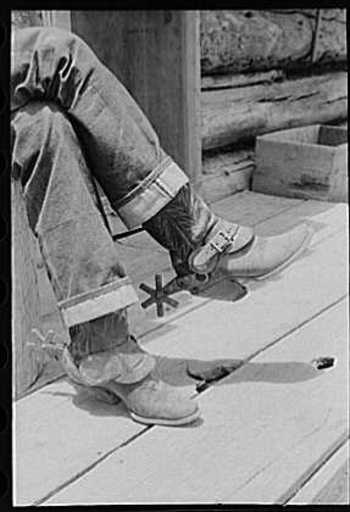
    “No respectable cowman ever wore any other footwear but boots, and the spurs were never removed only when the boots were

    “A stranger rode up to our camp one day and announced himself as a cow buyer. ‘He’s a damn liar,’ whispered one old puncher, ‘look at them there shoes he’s a-wearin’.’

    “Cowboys lay awake nights trying to think of “good ones” to play on the tenderfoot. We tied an old cowboy to a tree once and told the tenderfoot that he was a madman, had spells and was very dangerous. At the appointed time the cowboy broke loose and the new comer made it to town, five miles on foot, in a very short time.

    “Boiled beef and Arbuckle Coffee was our standby. The boys used to say if old man Arbuckle ever died they’d all be ruined and if it wasn’t for Pecos water gravy and Arbuckle Coffee we would starve to death.

    Blogcowboyboot

    “There were two things that the cowboys were deathly afraid of and that was the Pecos River and rattlesnakes. The river was narrow and deep, with no warning as to when you were approaching the bank and a man was liable to ride right over into the deep water at night before he knew he was near it. Time, and many cattle drives, have worn down the banks to some extent but in many places it still remains a strange phenomenon of nature, with its smooth straight banks and no warning of your approaching a stream.

    “We don’t have ranches any more; just windmill and pasture projects. These dipping vats, bah! We used to have to dip some of the punchers but never the cattle. I tried for awhile to fall in with the their new-fangled ways but when they got to roundin’ up and herdin’ in Ford cars I thought it was about time for a first class cowman to take out, so I guess I’m what you’d call retired. Just the same, the cow business ain’t what it used to be to the old timers and I’m not the only one who says that, either. Everything else changes though, so guess we’ll just have to get used to that like we do other things and if we can’t get used to it, quit.”

    L. M. Cox, Brownwood, Texas, interviewed, November 22, 1937.

    Notes:

    Credit: Library of Congress, Manuscript Division, WPA Federal Writers' Project Collection.

    Photo credit 1:  cowboy, high plains, Nebraska, 1886, courtesy the Library of Congress. Photo by the great
    Solomon D. Butcher, who made perhaps the greatest photographic record of western American life. 

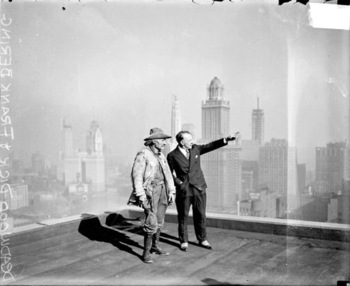
    Photo credit 2:  courtesy the Library of Congress.  Caption reads: Informal three-quarter length portrait of
    Frank Bering and Dick
    Deadwood standing in front of the Sherman Hotel, located at 106 West Randolph
     Street in the Loop community area of Chicago, Illinois, light
    exposure. Deadwood is wearing a cowboy hat
    and cowboy clothes and holding a pistol, and Bering is looking at the pistol.
    Photo credit 3:  cowboy, high plains, Nebraska, 1886, courtesy the Library of Congress. 
    Another in the Solomon Butcher series, 1886.


  • On “Lonesome Dove”, Mr. McMurtry and Mr. Cash

    JF Ptak Science Books   Quick Post

    I’m set to stat out with Larry McMurtry’s Lonesome Dove again–a great American novel, perhaps one of the Great American Novels, along with such masterpieces as Moby-Dick and William Gaddis’ The Recognitions.  Its a superb book, LD is, terrific story and the best dialog in the modern writing business.  And it also has a ton of history in there, just underneath the words, there for the taking, if you want it.  Part of McMurtry’s great craft was to weave the history semi-unseen in his novel, displayed to the reader who wanted to see it; translucent to the reader who didn’t need it.  It is a superb accomplishment.

    The book starts with a simple dedication, “for Maureen Orth, and in memory of the nine McMurry boys (1878-1983) “Once in the saddle they used to go dashing…”

    That line of course belongs here, the first lines from “The Cowboy’s Lament,” one of the great epic songs of the American West, a version of which follows:

    “It was once in the saddle we used to go dashing,

    It was once in the saddle we used to go gay.

    First took to drinking and then to card playing

    Got shot in the neck and now here I lay.

    Beat the drum slowly, play the fife lowly,

    Play the Dead March as you bear me along.

    Take me to Boothill and throw the dirt over me

    I’m but a poor Cowboy, I know I done wrong.”

    The roots of this classic song extend back to popular songs of the early 18th century such as “The Bad Girl’s Lament” and “St. James Infirmary.” Its modern version has hundreds of text variations and pieces of the lyrics can be found in many other songs—“The Dying Ranger,” “The Kansas Lines,” “The Dying Cowboy” and “The Streets of Laredo” among them.

    It sounds awfully good in the hands of Mr. Cash (American IV, 2002)–hard to believe it has been ten years:

    Its a good way to start a book.


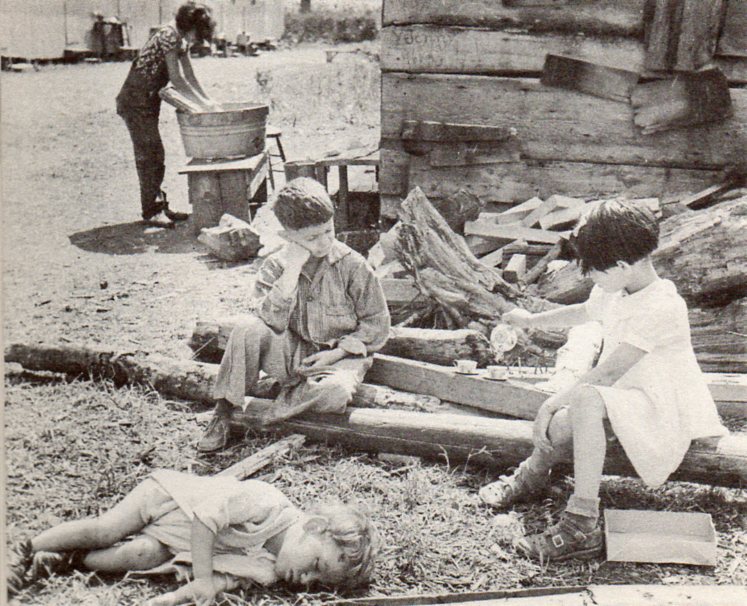
  • A Child’s Reader on Being a Migrant Farmer, 1940

    JF Ptak Science Books  Post 1549

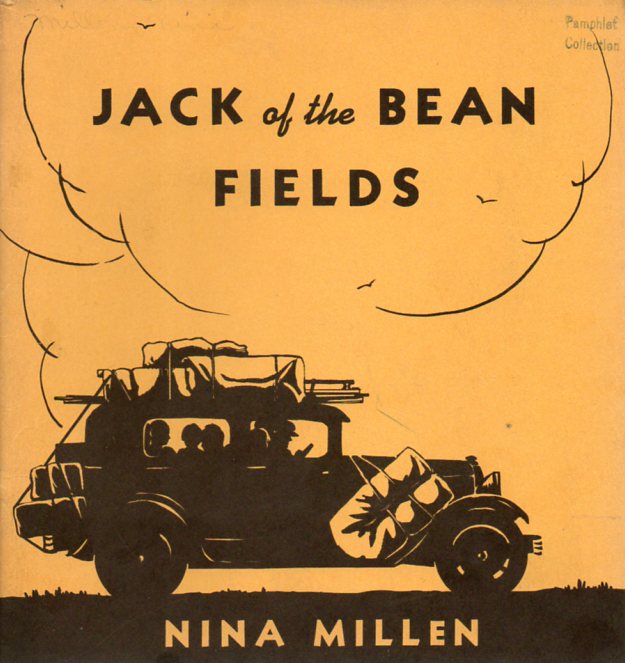
    I hardly expected the story that I found in this little square pamphlet, particularly since I had selected it because of its cover art.

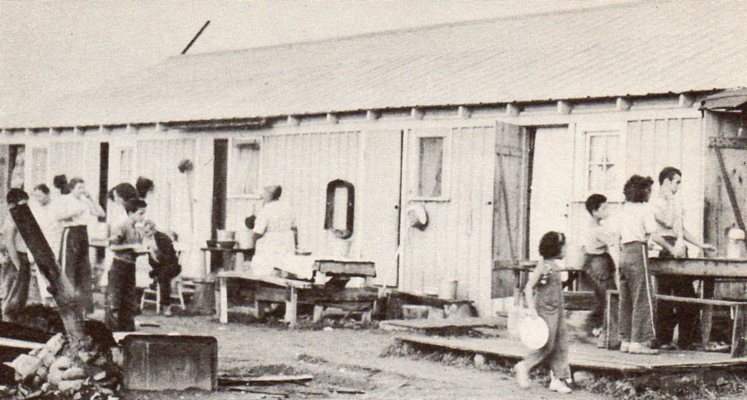
    Jack of the Bean Fields–written by Nina Millen and published by the Friendship Press of New York–turns out to be a photo-essay on one seasonal adventure of a boy named Jack Marco and his migrant vegetable-picking family.  The story starts with the family in a bad way, heading out on the road in a broken car filled with Jack’s mother, father, grandmother and three siblings, out to find a camp where they could find jobs picking early beans. 

    Depression579 As the family fixes the car, Jack heads out to play in the fields, where he finds a book.  We find that–at age 8 or thereabouts–Jack hasn’t been taught to read and hasn’t been to school in years, and the family doesn’t own a single book. The family gets underway, finds a camp, and moves into an empty unit in a series of shanties. They clean the place up, and Jack lays his book on a shelf.  “Now we are settled again” announces Ma.  Wincing.


    Depression580

    In a story that could have been a very maudlin or saccharin affair, it was surprisingly matter-of-fact, eventually telling how community and church groups appeared through the intercession of a camp nurse to help the migrant families, clothe the children, and send them to school. 

    Depression581

    The war was underway, the Depression was on its way out, the economy was beginning to bounce–but then, as today, there were migrant farmers–they just weren’t being displaced by Dust Bowl factors anymore.  But, basically, it was a good story for kids, focused mainly on appreciating what we have and our small gifts, such as family–and the ability to read. 


  • The History of Lines: Lines Come and Gone.

    JF Ptak Science Books  Post 1546    [Part of the History of Lines series.]

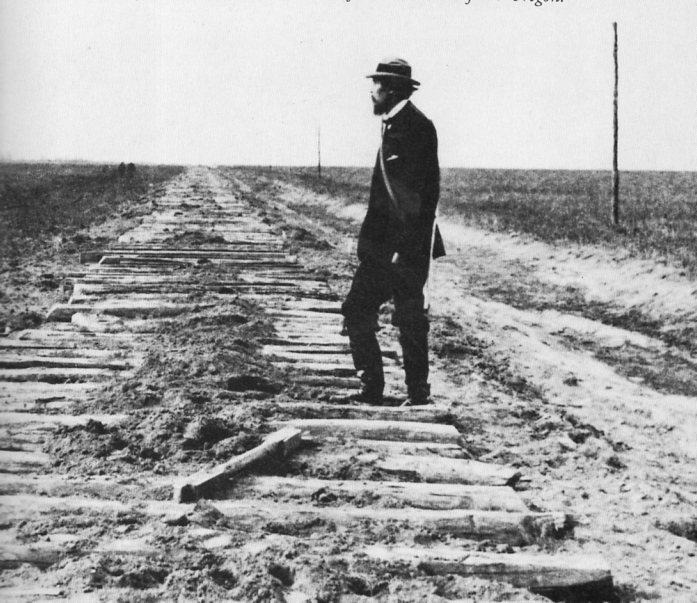
    Ines union pacific 573

    This picture tells as much about the making lines–railroads pushing their way  towards one another, the Union Pacific and the Central Pacific, pushing on towards one another to complete a rail line that connected the American coasts–as it does in covering them up.  The photograph is of a Union Pacific supervisor named Samuel Reed, who was inspecting the rail bed–in 1868/9 it was not uncommon for one team to clear the land and lay down the ties miles ahead of the track layers.  Miles of bits of wood, waiting for their iron.

    But most roads, or at least most early roads, were in their places for a reason, and generally that reason was because it was a good way for getting from Point A to Point B.  This photograph, along the way of the Old Platte Valley route,  seems to be a mid-way point between the old and the new, or between the old and the old, lines of communication and lines of travel.  These timbers are laid down on top of the old immigration route from the east to California and Oregon, which in turn were laid on top of the trails of fur traders, which were on top of those of Indians, which were on top of those of the buffalo herds, and so on, all the way down. 


  • High Color in Cowboy Vocabulary, Selections from an Unpublished Typescript (1938)

    JF Ptak Science Books  Quick Post

    I reckon that at some point or another one or some or all of these words might come in handy, a garnish to a small thought or medium sentence, or even as a companion to Patrick Starfish and his “sentence enhancers”.    They’re a little far from the “history of science” material that I guess I’m supposed to be writing about here, but, well, like all of the other non-science stuff that makes an appearance in these pages, its interest was too irresistible for me to say “no” to. 

    And so to some colorful Cowboy vocabulary, choice morsels that I plucked from a document found some time ago at the Manuscript Division of the Library of Congress.  They’re located in what still seems to be an unpublished typescript from the Texas Folklore Project of the Works Progress Administration (WPA) and the Federal Writers’ Project (FWP).  The language was collected by marginally-employed historians and such put on temporary dole by the U.S. government, sent out to the far regions, interviewing old Cowboys for what they knew and remembered. The document is dated February, 1938. 


    Bog rider

    Cowboy sent to patrol bogs and extricate cattle

    Button

    Boy

    Chuck eater

    Easterner come west to learn ranch work

    Circle

    Area a roundup rider must inspect in a day

    Climb your hump

    Fight

    Deep in the wood

    Firmly in saddle

    Drag your loop

    I didn’t steal that cow, itjust poked its head in the loop I was dragging”

    Fork a horse

    Ride a horse

    Forty Rod

    Liquor

    Give up the head

    Complain

    Gizzard gravel

    Courage

    Grass train

    Ox-team freighters

    He left the score

    Left in a panic

    Jiggle

    Ride

    Jingler

    One who herds horses for an outfit

    Lacing up a tree

    Putting the saddle on

    Moonshine

    Night rider

    Old cedar

    Six shooter

    Rattling his hooks

    Ride fast

    Riding through strong

    Riding horses average cowboy doesn’t want to ride

    Slop and tatter

    Pacing horse

    Swing a long rope

    Horse or cattle thief

    Turn a cat

    Take a fall

    Wheelbarrow man

    One who walks across the plains