A Daily History of Holes, Dots, Lines, Science, History, Math, Physics, Art, the Unintentional Absurd, Architecture, Maps, Data Visualization, Blank and Missing Things, and so on. |1.6 million words, 7500 images, 4.9 million hits| Press & appearances in The Times, Le Figaro, Mensa, The Economist, The Guardian, Discovery News, Slate, Le Monde, Sci American Blogs, Le Pont, and many other places… 5000+ total posts since 2008.

Category: American History: Western Exploration & Native Americans

  • Obfuscation as a Weapon–on Teaching Indians to Read, 1875

    JF Ptak Science Books   Post 1417 

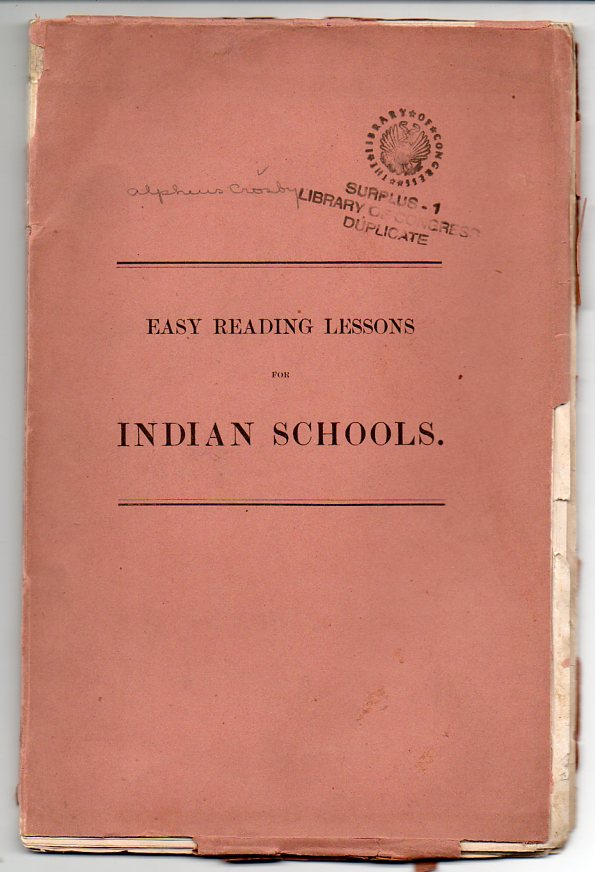
    This small pamphlet, Easy Reading Lessons for Indian Schools, was published for the Department of Indian Affairs (as a section of the Interior Department, classifying the Indian along the lines of cattle and agriculture) by the federal government, printed by the indomitable Government Printing Office in Washington DC in 1875.  (The original is available at our blog bookstore.)

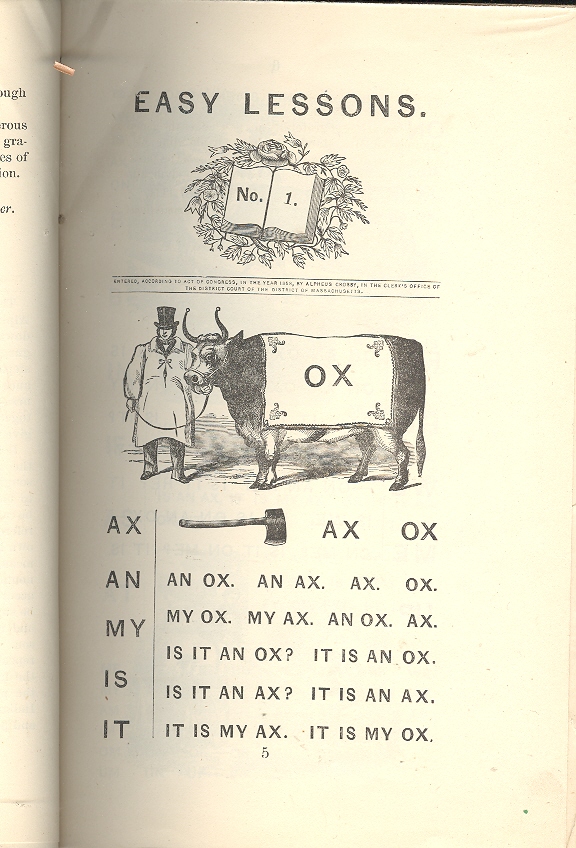
    Indian school269 It is an unintentionally quiet indicator of the general American policy towards the Native American in the last quarter of the 19th century.  The work is indifferent to any particular need of the student.  It is intended for the person who could not read, and nowhere in this work is there a listing of the alphabet.  It is ignominiously but softly complex, and looks to me to be a total disaster as a text.  (This is true when comparing the work to nothing at all; but when you stand it next to, say, McGuffey’s reader or the Eclectic or any of the other classic how-to-read books of the 19th century, the weaknesses of the Indian book become instantly clear.

    How in the name of great bog could anyone have thought it just and fair and equitable to teach English-illiterate “Indians” to read with such an instructional?  It isn’t even close to being a book, and it comes no where near to being able to transcend its own terminal obliqueness.  It introduces simple words and phrases in a tongue-twisting ways, and then complicates the situation by quickly adding more structured words in a more confusing environment.  The thing is terrifying.  I actually had a hard time reading it out loud. 

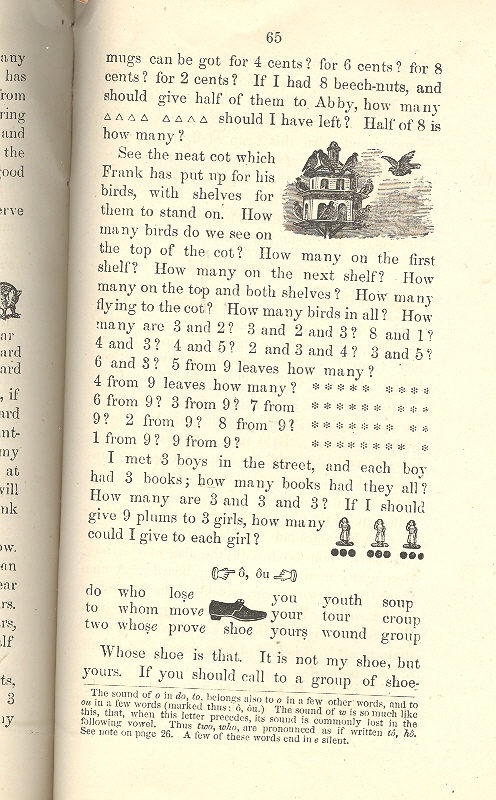
    Here on page 17 (already!) is a tremulous example:

    “See the lad.  Is it Mat?  It is Mat; and Fan is by him on the sod.  He has his hat. But it is not on. Has Fan a hat?  Mat has a bat. Dan cut it by the bog. Mat had his bat, and ran at my dog Boz., and sat on a log, and hit him.  He did it in fun. And Boz had his fun.  He got the bat and ran it way and hid it in a box. Dan got it but bid Mat not hit the dog.”

    Indian 001

    For crying out loud! (The bat by the way is, yes, a baseball bat.  Pretty early stuff in 1875.)  Why would someone use this series of images to teach someone how to read?  The pamphlet continues to exhaustion, taking only 80 pages to do so. For me it is a perfect symbol of the way in which the government—in general—dealt with the “Indian Problem”.  Confusing children and making life more needlessly complex, making it harder for them to succeed, making it more difficult for them to rise above the difficult situation that they have unexpectedly been born into,  is a superior sign of inferiority of the dominant power. 

    Wait a minute.  Am I writing about the Indian in 1875 or the poor kids in  SE DC in 2009?  I can’t tell.  The corruption of the social model for caring for people who need federal attention more than anyone else—the underprivileged child—is antiquarian and entrenched and as strong as ever.  At least there’s a moral foundation for the care of kids whose parents cannot afford health insurance.  Um, oh, wait another minute….

    Indian 002


  • Vast Understatement Department: Re-crushing the Crushed “Indian Problem”, 1887-1934

    JF Ptak Science Books   Post 1405

     “This might seem like a somewhat rapid reduction of the land of Indian estates”–Thomas Morgan, Commissioner of Indian Affairs, on the sale/disposition of 15% of all Indian Lands over the period 1887-1891.

     Indian Affairs Commissioner Thomas Morgan had a commanding view of the situation regarding the American Indian at the end of the 19th century, considering that he was king of the hill, surveying the scene from his commanding height, in control of the affairs of all American Indians from the relative security of knowing hardly anything about them. It so happens that during the period 1887 through 1903, the Indians suffered about as much loss to their way of life and their lands than about any other time in their history, and this at a time when almost all Indian resistance to federal control had already been eliminated by force or terror or hunger or the sheer weight of the impossibility of fighting the United States1.

    Most of the problems with the loss of land and the approach of the near-end of their tribal system occurred with what federal representatives referred to as the “Indian Emancipation Act”, which was formally known as the Dawes Act (and also the General Allotment Act) of 18872. The general fatal thrust in this Congressional action was to relieve the Indians of their reservation system and then their land, to enforce their assimilation into American (white) society, and then to become individual property owners and then tax payers, making the Indian self-reliant and independent. The underlying philosophy here is that it was the reservation system was the cause of the Indians’ problems—that it kept the Indians from fulfilling themselves by excluding them from American society, segregated them from “self-improvement”.

    “The Indian may now become a free man; free from the thralldom of the tribe; freed from the domination of the reservation system; free to enter into the body of our citizens. This bill may therefore be considered as the Magna Carta of the Indians of our country.” –Alice Fletcher, one of the Architects of the Dawes Act

    The Act not only managed to give the Indians the lands that they already owned, but it also took the land away at the same time, making it available to heads of households in 160-acre plots. It was supposed to make the Indians into useful members of the white community, and to teach them to be farmers, and to “properly use” the lands which they were given. According to Ronald Takai3, Morgan saw the Indian land as going fallow, and that if they didn’t use their land to a good end, then they should lose it. AS Commissioner of Indian Affairs, Morgan said that most of the land that was taken by the government was not being “used…for any purpose whatsoever” with “scarcely any of it….in cultivation”. Hence if the Indians didn’t farm the land then the land was being wasted, and if the land was being wasted then the Indian had no right to keep it. Thus the circularity of the Indian’s problem was complete—they would be given land if they were using it “properly”, which meant to break off chunks of tribal land and deed it to individual families, which at the end of the life of the head of the household the land would more than likely have to be sold4; and if the land wasn’t being cultivated, then the government would take steps to seize it via its system of aggravated purchase.

    “The sooner the tribal relations are broken up and the reservation system done away with, the better it will be for all concerned. If there were no other reason for this change, the fact that individual ownership of property is the universal custom among civilized peoples of this country would be a sufficient reason for urging the handful of Indians to adopt it.”

    In the four years following the passage of the Dawes Act, something on the order of 17.4 million acres of Indian land was sold or re-allocated, which was about 15% of all Indian lands.

    The Burke Act of 1906 was the second time the Dawes Act was amended, and was also perhaps the most devastating change yet made to the tribal ownership system. It gave the government the right to determine which Indians were “competent and capable” to own land, though by design the definition of “competency” was left vague, though it often meant that there was a certain amount of European blood in the Indian being judged. This meant that the “competent” Indian would have their land taken out of trust status, and then become subject to taxation and could be sold by the owner. This also meant that communally owned tribal lands could be divided into individual plots which may then top sold to the highest bidder, If the person was deemed to be “not competent”, though, something entirely different happened:

    “…the Secretary of the Interior may, in his discretion, and he is hereby authorized, whenever he shall be satisfied that any Indian allottee is competent and capable of managing his or her affairs at any time to cause to be issued to such allottee a patent in fee simple, and thereafter all restrictions as to sale, encumbrance, or taxation of said land shall be removed. “

    Given the situation that the Indian’s per capita income was so low, and that most of that was coming from the sale of land and from government stipends, it was almost entirely assured that the Indians, who were in desperate straights, would almost assuredly sell their property once it was within their individual capacity to do so. It was also the case that some Indians were actually judged to be “competent” but weren’t informed of it—this wouldn’t matter except for the critical part of that Indian’s lands now being subject to taxation; and if you didn’t know that the lands were being taxed, after come years Uncle Sam came by to collect on the back taxes, and since the Indian would have no money5, the land would then have to be sold to pay for the taxes that the landholder didn’t know was accumulating.

    The result of the complex story of the Dawes Act and its aftermath was that by its end (which came to an explosive halt in 1934) the Indians lost about 90 million acres of their 1887 land base., amounting to about 66% of all of their land. Plus the dozens of land-grants that were awarded to the railroad companies.

    The Indian Reorganization Act of 1934 stopped these practices, offering a “New Deal” to the Indians, empowering the new commissioner of Indian Affairs, John Collier, with a sensical approach to the institutional/bureaucratic Indian problem(s) created by U.S. Government with the Dawes Act. It stopped much of the bad craziness of the previous forty years, though the effects of that time are felt to this day.

    Notes:

    1. There was still the Ghost Dance to come in 1890, but this was a limited action of desperate people, ending in American soldiers of the 7th Cavalry standing over a trench filled with the bodies of 150 frozen Lakota Sioux (men, women and children) following their massacre at Wounded Knee Creek. There were another 51 Sioux wounded, including 47 women and children.

    2. Opening text of the Dawes Act: “….the President of the United States be, and he hereby is, authorized, whenever in his opinion any reservation or any part thereof of such Indians is advantageous for agricultural and grazing purposes, to cause said reservation, or any part thereof, to be surveyed, or resurveyed if necessary, and to allot the lands in said reservation in severalty to any Indian located thereon in quantities as follows: To each head of a family, one-quarter of a section; To each single person over eighteen years of age, one-eighth of a section; To each other single person under eighteen years now living, or who may be born prior to the date of the order of the President directing an allotment of the lands embraced in any reservation, one-sixteenth of a section.  The full text is here. 

    3. Ronald Takai, A Different Mirror, Little Brown, 1995, page 236-7.

    4. Under a new law in 1902 at the death of the head of the household the family was required to purchase the land or it would be sold at auction. Since most of the per capita income was made via federal distribution or payment from the government for earlier purchase of tribal land, it was in general the case that only a small percentage of the $200/year was made through farming. Basically, few Indians had the cash to actually buy their land, and so it went to sale, bought in the overwhelming majority of cases by white speculators.

    5. In 1907, the combined income of the Cheyennes and Arapahoes was $217,312, of which some $5, 312 resulted from farming. Of the 78 dollar per capita for these two tribes, about 78 cents came from working the fields.


  • Titanic Understatement Department: The Trail of Tears and “Beneficial Exercise”, 1838

    JF Ptak Science Books   Post 1387

    “…strong men, women, boys and girls, not only capable of marching twelve or fifteen miles a day, but to whom the exercise would be beneficial.”  —General Winfield Scott, military leader in charge of the removal of the Cherokee nation, 1838, on the benefits of enforced marching of men, women and children over a thousand-mile course.

    Most people are familiar with the story of the Trail of Tears, the epic tragedy of the “removal” of a class of people—the Cherokee Indians in this case—from their homes in the east to a new land appropriated for them in Indian Territory (present-day Oklahoma). (In the Cherokee language, the event is called Nu na da ul tsun yi (the place where they cried), another term is Tlo va sa (our removal).) The Cherokees were given the ultimatum to leave their homes in Georgia, Texas, Tennessee, Alabama and North Carolina, doing so in the period from 1836 to 1839—the first part of the exodus was prompted by the U.S. Government but not necessarily enforced. The later part, however, in the spring of 1838, was absolutely enforced, with General Winfield Scott arriving on the scene with 7,000 U.S. Troops to round up the last of the remaining Cherokees and take them—by force if necessary—to Indian Territory.

    There were approximately 12,0001 Cherokees left in the east by the time of Scott’s arrival—by the time their enforced march to the west was completed, around 4,000 Cherokees would be dead.

    The ease with which this re-settlement was partially removed from the broader moral and ethical implications of marching 12,000 men, women and children a thousand miles west in the fall and winter of 1838/9 was accomplished with abstract language in the government reports describing the affair.

    For example, in the Executive Documents published by the U.S. Government printing office, 25th Congress, 3rd session, 1838, volume 1, documents #s1-9, part of the 609pp document #2, Message of the President of the United States to the Two Houses of Congress…., contains a 94-page section called “Report of the Commissioner of Indian Affairs” (occupying pp 410-506), and in that section is the compelling sub-document, “Emigration of Indians”. It is there that we find the clinical appraisals of the government efforts to scoop the Cherokees up and deposit them far west. For example, we are told that “(an) aggregate of 18,000 Cherokees…have ceased to live east of the Mississippi during the Spring, Summer and Autumn”, this after General Winfield Scott had “collected them”. Removing an entire Indian tribe had been a simple matter of that tribe no longer living there anymore, having been “collected” by the Army and “emigrated” to points west.

    The “collection” part is told elsewhere and often and more brilliantly than I can relate here—it is the material of a deep national tragedy. Suffice to say presently that 10,000+ people were herded together at bayonet and gunpoint, given scant opportunity to collect themselves, and then brought together in concentration camps to await the arrival of the last of their tribe. After that, most were marched in stages to Oklahoma, through bad weather of all descriptions—from drought to rain to high heat and bitter cold—sometimes encamped in stockades to wait for river levels to rise and fall, allowing dysentery and other diseases to come into the population and take hold.

    The section on the emigration of the Indians is alternately heart-breaking and infuriating. There is a series of correspondence between John Ross, representing the leadership of the Cherokees, and General Winfield Scott, regarding the mechanics and monetarization of removal. The Cherokees at this point make every attempt to accommodate their pending future with dignity and humility, acquiescing on almost all government points in what I think were the hopes of gaining a few extra necessities for the people making the trip. Generally, the requests were rejected. Coffee and sugar were at one point presented to Scott as a necessary—Scott refused, saying that the disbursements for the removal had already been made, even though all of the monies were coming from government funds allocated to the Cherokees for the lands they were having stolen on the heals of their exit.

    Another particularly infuriating example of misogynistic governmental neutral-speak—a towering example, really, an incredible, unspeakably-wrong statement—occurs on page 435 in a letter from Scott to John Ross et alia. In response to a request from Scott for extra wagons to help transport the young and the old and possessions and food, Scott refuses, saying that the allocated wagons were enough to carry food and belongs and provisions and 35 people. And for those who could not ride in the wagons, Scott said the following:

     “…strong men, women, boys and girls, not only capable of marching twelve or fifteen miles a day, but to whom the exercise would be beneficial.”3

     And just to set the record straight on this, we are talking about 1,000 miles of marching, in weather good and bad, over a period of many months (and sometimes extending to a year).

    There were allocated 50 wagons and teams for the journey for all of those thousands of people, the teams costing $28,000 in rent for the entire journey, ironically paid for by the Cherokees. The sugar and coffee which had not been provided for in the original rations list and which were excluded, would’ve raised the cost of the average daily ration allowance a few cents too many, exceeding the 16 cents per day/person for the journey.

    This of course was not the only Indian “removal”, not even the only removal for this year—it was the stage of affairs for many dozens of tribes over the course of two centuries, revisited and replayed and reprise d over and over again, with different actors, different agents, different tribes and different places—all with the similar result. (For example, even among just the Five Civilized Tribes, the Choctaw were the first to be removed in 1831, then the Seminoles in 1832, the Creeks in 1834, the Chickisaw in 1837, and then the Cherokees in 1838.)

    As awful as Scott’s correspondence reads to me I am reminded that among the general staff it was Scott who was seen as sympathetic to the Indians’ plight, that it was Scott who was ostracized for being too accommodating. This may have actually been the very best that the U.S. Government could offer, which is ____________________ .

    Notes:

    1. In the fall of 1835, a census was taken by civilian officials of the U.S. War Department to enumerate Cherokees residing in Alabama, Georgia, North Carolina, and Tennessee, with a count of 16,542 Cherokees, 201 inter-married whites, and 1592 slaves (total: 18,335 people).  The total number of casualties for the Removal is much studied and debated–estimates range from 2,000 to 6,000 people. 

    2.  Message of the President of the United States to the Two Houses of Congress…. page. 412 for both quoted phrases.

    3.  Ibid, Page 435.


  • Geronimo, Finally Defeated by Miles and the Sun

    JF Ptak Science Books  Post 1355

    The Chiricahuan Apache leader and chief, Geronimo (1829-1909), famously led a progressively diminishing band  through the  Apache Wars of the 1850’s-1880’s.  For thirty years of so he quirted the U.S. Cavalry, darting here and there in great exploits and famous escapes, evading the armies of the United States and Mexico.  In the end, by 1886, there were just dozens who were following him, including women and children, and the elderly, ragged, tired, hungry, and pretty much, finally, beaten.

    I think what finally did Geronimo in were the miles of pursuit and the sun. 

    The sun got to him via the heliographic communication network established by Major W.J. Volkman under the direction of General Nelson Miles (the other “miles” of this equation of defeat), which allowed the pursuing American army to communicate instantaneously over great distances, over hundreds of miles, without the need for runners or men or horseback or cutable telegraph wires or time  The heliograph is an ancient instrument, used for more than two thousand years–in this case, they were very highly polished mirrors that reflected brilliant signals between stations, getting their light source from the sun. It allowed the army an enormous advantage, and one that finally caught up to Geronimo.

    The “miles” were just those, the thousands of miles Geronimo was tracked and retracked over that very difficult terrain in the southeastern part of Arizona and into northern Mexico, sharp mountains, endless badlands, caves, heat, height, cold….very difficult. (I’ve been there on treks.. .its tough land.)


    The capitalized “Miles” was the surname of General Nelson A. Miles who sent out  with Lt. Col. George F. Crook to track down and capture Geronimo–and they almost did, again, in late MArch, 1886, when Geronimo presumably surrendered, but then fled to Mexico. After another five months and 1,600 miles, Miles came upon Geronimo om in Sonoran mountain camp, and induced him for the final time in September, 1886, at Skeleton Canyon, Arizona.

    The details of the capture and surrender are told in many places by many others–I just wanted to surface the role of the sun in the capture of Geronimo.

    The old man (who lived until 1909 and outlived just about everybody involved with hunting him down except for General Miles, who died in 1925) was shipped east,  never to see Arizona again. He died after being thrown from his horse and contracting pneumonia as a result of being unable to help himself to safety through a long cold night, died in a bed as a prisoner in Ft. Sill, Oklahoma.

    [The original map is available from our blog bookstore.]


  • Executing Numbers instead of People: Lincoln and the Sioux, 26 December, 1862

    JF Ptak Science Books  Post  1298

    (Continuing Post 669)

    The great mystery was how those Indians were smuggled out of the grave, in spite of the watchfulness of those guards.   From the Autobiography of Theodore Edgar Parker
    Sioux Lincoln234
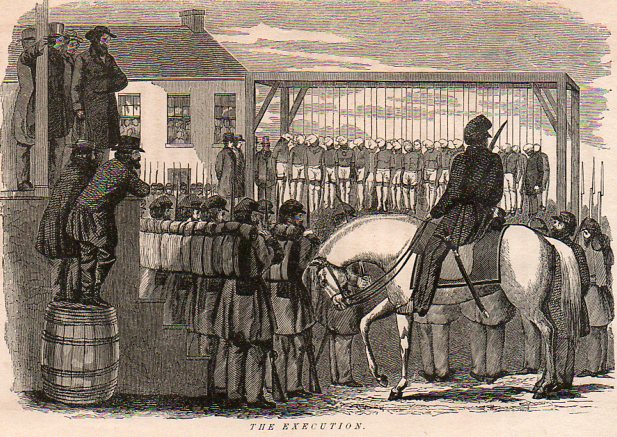
    One of the darkest moments of the spectacular Lincoln presidency came on 26 December 1862 when the president chose to not interfere with the vengeful hanging of 38 Santee Sioux (just south of St. Paul, Minnesota).  This was the legal outcome of a short-fought “war”(known variously  as “The Great Sioux Uprising”, “the Dakota War of 1862” and “Little Crow’s War”)  between U.S. soldiers and several Siouan tribes.  It was a war brought on by the desperate tribes after suffering failed crops and the reneged treaty obligations (including a long-overdue payment of $1.4 million for the purchase of 24 million acres, or about a nickel an acre) of their Great Father in D.C.  It was really more like a hunting expedition—the Indians, who had rampaged and taken hostages and killed over 200 white settlers and farmers, were at the end of their endurance. The warriors were ill-equipped for almost anything, with little food and failing horses, and were positively no match for the federal troops who would hunt them down and destroy them.  The end result was a six-week course of “trials”, conducted by a  commission of unsure legality, hearing the cases of 393 people over a span of 42 days, convicting 323, and sentencing 303 to death by hanging. Lincoln commuted most of the 303, but left 38 to be killed.
    Sioux Lincoln full235

    [This image is available for purchase from our blog bookstore.]

    “Destroy” isn’t my choice for words—it is used over and over again in the communications between the field commander General Henry Sibley and the general in charge of the entire region, General John Pope.  It turns out that Pope was of the Tecumseh Sherman school of Indian relations, writing for the record:

    “It is my purpose to utterly exterminate the Sioux. They are to be treated as maniacs or wild beasts, and by no means as people with whom treaties or compromise can be made.” 
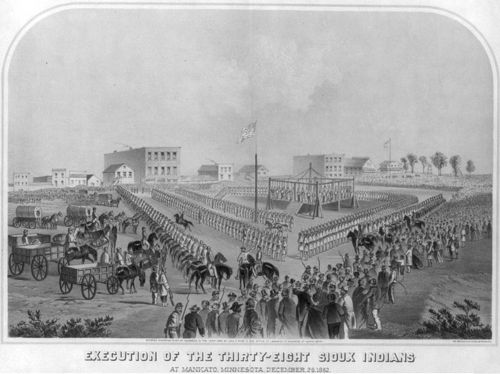
    Blog==july 1==mankato

    Sibley was a hardened veteran but comparatively understanding towards the Indian, though his communications read much harsher than that.  At least he used the word “destroy” rather than “exterminate”, though that was small comfort to those on the receiving end of that vocabulary. (In a letter written in October 1862 to four Sioux chiefs whose tribes might be seen as harboring the breakaway, “warring” tribal elements led by chief Little Crow, Sibley said that he was out to “destroy” Little Crow and that the chiefs  should be as invisible as possible, as the Union soldiers “might not be able to distinguish you from the guilty bands” and could kill them also/instead.)

    The war, which began in August ended almost immediately, found the troopers breaking the backs and the wills of the Indians at the Battle of Wood Lake in September 1862.  From that point on, it was Sibley’s job to round up as many of the warring bands as possible and bring them to justice in a military court of law which would not disappoint those with vengeance in their hearts.  The major difficulty seems not to have been the resistance of the Indians but of the problems of supply for the troops.  The prairie grasses then were brittle and dry and brown, forage was extremely limited, and moving 2000 men was a difficulty.  Little Crow and his followers of course had much less, plus they had already been semi-starved up to that point—now that they were on the run, their situation was beyond desperate. 

    And they weren’t hard to find.  Sibley’s main concern was to get as many in for trial and judgment and (probable) execution as possible before word leaked out that the guilty were going to be killed and their women and children impounded.  Sibley wrote to Pope on 3 October:

     “It is probable I shall not order any execution of the guilty until I can get those understood to be coming down to surrender themselves in my power, as otherwise they might be deterred from returning.”

    Deterred, indeed. He continues:

    “I shall send the Indians composing the friendly camp to the lower agency, in charge of a detachment of troops, to collect the corn and potatoes in the fields, which have remained hitherto undisturbed. This camp is composed of about 1,200 men, women, and children; mostly the latter, there being but about 250 men among them. How they are ultimately to be disposed of is a question for the determination of the proper authorities. They comprise perhaps nine-tenths of those who have not been actively engaged in the war.”

    So Sibley was successful early on his round-up campaign, catching all of those women and children–sounds like of the 1,200 that he overtook, there were about 500-600 kids.  The next day Sibley reported to Pope that the Indians were coming to surrender of their won free will, though they were doing it “slowly”. 

    Little Crow’s people were “coming in but slowly” and “I  may still be necessary to attack them”.

    Attacking for slowness.  In a later letter of 8 October Sibley notes that there is an actual reason for the slow movement:

    The messengers dispatched by me to the upper camps returned last evening. They communicated my demand to their small camps, one of which, of 20 lodges, will be here this morning. They say that they dispatched young men to the larger camp, and they state that they were informed that all of the lower Indians were moving down, but slowly, as their horses and oxen are so poor and weak that rapid marches are impossible.

    On 6 October Sibley reports to Pope on some other bands of the guilty Indians starting to slip away, writing of “destroying” them as well:

    “The bands of Lower Sissetou Sioux, headed by Sleepy Eyes and White Lodge, consist of perhaps 100 or more fighting men, and these have gone with their families toward the Cotean des Prairies; they will probably be found on or near the Big Sioux or James River, where they usually make their fall hunts, and they can only be overtaken and destroyed by a sufficient force of mounted men…”

    The next day, 7 October, Sibley seems to continue to play a diminishing role of understanding-the-Indian, telling Pope that the lawbreakers “small mercy”, preferring to wait until all of the Inians were brought in before he started to hang anyone.  Of course thius was all pre-trial conversation.

    If I succeed in securing them, as I hope to do, I shall have in my hands three- fourths of those principally concerned in the outbreak, and I promise you they will receive but small mercy at my hands. I have 20 prisoners under sentence of death by hanging. 1 have not yet examined the proceedings of the military commission, but although they may not be exactly in form in all the details I shall probably approve them, and hang the villains as soon as I get hold of the others. It would not do to precipitate matters now, for fear of alarming those who are coming forward to take their chances.

    As awful as this sounds, Sibley was a little too liberal and deliberate for General Pope, who wanted to get things settled immediately if not sooner—Pope actually wanted the Indians shipped to him so that he could dispatch the offenders upon arrival.  Sibley to his credit fought this. 

    Once the deed of rounding up the Sioux was completed, there was a quick trial, and 303 of the braves were found guilty and sentenced to be hanged. 

    The text of the orders from the Executive Mansion–and signed by Abraham Lincoln–to General Sibley read as follows:

    “Ordered that of the Indians and Half-breeds sentenced to be hanged by the military commission, composed of Colonel Crooks, Lt. Colonel Marshall, Captain Grant, Captain Bailey, and Lieutenant Olin, and lately sitting in Minnesota, you cause to be executed on Friday the nineteenth day of December, instant, the following names, to wit”… [39 names listed by case number of record: cases 2, 4, 5, 6, 10, 11, 12, 14, 15, 19, 22, 24, 35, 67, 68, 69, 70, 96, 115, 121, 138, 155, 170, 175, 178, 210, 225, 254, 264, 279, 318, 327, 333, 342, 359, 373, 377, 382, 383]. The other condemned prisoners you will hold subject to further orders, taking care that they neither escape, nor are subjected to any unlawful violence.

    The condemned did of course have names but I haven’t been able to find them as yet. 

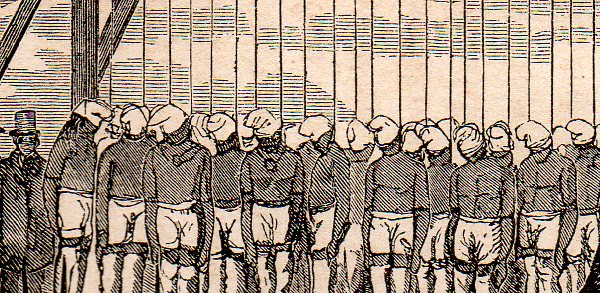
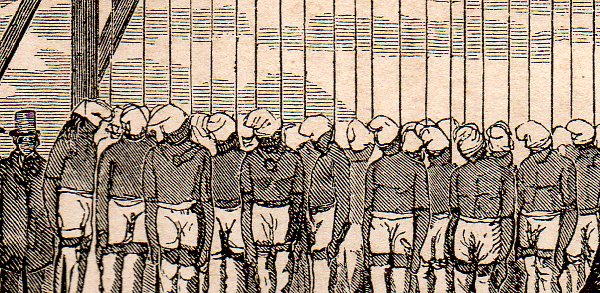
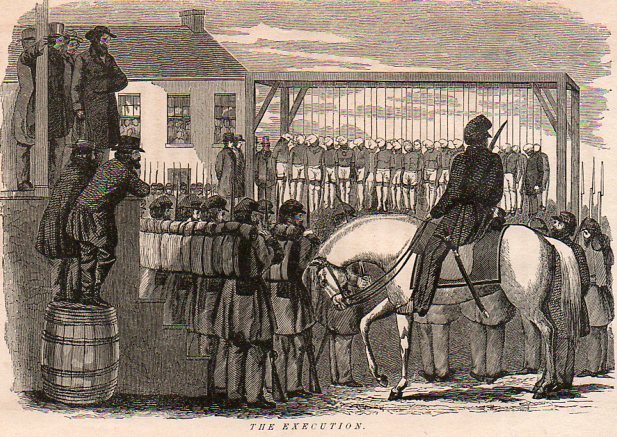
    The detail of the wood engraving that I’ve shown above may have these men shirtless in the bitter cold.  They were being watched by men in columns, at attention.  Then there were others who were standing on a barrel to get a better view. Others were on horseback.  Outside the obvious monstrosity of the situation, not having your feet on the ground, not standing, not bothering to keep yourself erect as witness to the enormity, was inexcusably bad behavior.  

    The sentences of all but 38 were commuted.  On the morning of execution the men were marched in 35 degrees below zero cold twelve miles to the place of execution at Mankato (outside of St. Paul).  The scene is reported by eyewitness  Theodore Potter (recorded in The Autobiography of Theodore Edgar Potter):

    “On the morning of December twenty-sixth our company was ordered to march to Mankato and act as guard at the execution. We were in our saddles and on the way before daylight. The distance was only twelve miles, but the thermometer registered thirty- five degrees below zero, and before we reached Mankato many of the men had frozen ears and feet, and all suffered severely from the intense cold.”

    Potter describes the execution thus:

    “At Mankato we met several other companies of our regiment who had been ordered here for the same purpose as we. Hundreds of angry men who had suffered at the hands of these savages were camped within sight of town. They were well armed and officered and were determined that the two hundred and eighty-two Indians who were not to be executed that day by the law, should suffer execution at their hands. Colonel Miller, who was in command of the troops had a force of fully two thousand men, including one battery of artillery, with which to protect his prisoners. The execution took place in the early afternoon. The thirty-nine Indians were ranged on one long platform and executed at the same moment, in sight of a vast multitude of people besides the two thousand troops. At the appointed moment W. W. Dooley, a former member of my militia company and a chief of scouts, whose family had been killed by the Indians at Lake Shetook, stepped forward and cut with an axe the two-inch rope that held the scaffold suspended and the entire number were plunged to death. The prisoners met their end like true soldiers of the plains. Missionaries who had been with them for years were permitted with them during their last days. When the time came for them to go to the gallows the braves asked to have the chains taken from their legs so that they could go in Indian style, single file. This was allowed, and they marched to the scaffold singing their Indian war- song, which was joined in by all the other prisoners. Each Indian placed the rope around his own neck and sang while the death cap was drawn down over his eyes. For five minutes after the scaffold fell everything was as hushed and silent as death itself. Then the crowd began to quietly disperse. The settlers who had formed in companies prepared to make an attack on the barracks, but Colonel Miller had his force well disposed to repel any attack, and the people saw that it would be foolhardy to make an attempt to storm the jail protected as it was by the force of disciplined soldiers. Nearly all the soldiers present were Minnesota men and many of them had had friends killed by the Indians, so that their sympathies were with the settlers and it was well understood among them that if an attack was made on the barracks, and they were ordered to fire on their own friends, they would do so indeed, but would see that none of the attacking party should get hurt. Fortunately the attack was not made and the settlers dispersed.”

    The hanged men were buried in a mass grave, though they didn’t stay buried for very long at all.  Potter concludes:

     The executed Indians were ordered buried on an island in the river near the spot of their execution. All were to lie in one grave and a strong guard was stationed to protect their remains. That night our company returned to St. Peter. On the way several sleighs passed us at different times with only two men in each sleigh. The surgeon of our regiment, a Dr. Weiser, who was riding at my side, remarked that it looked as if those sleighs might have dead Indians in them in spite of the guard at the grave. I jokingly assured him that even if there were dead Indians in those sleighs, there was no danger of his losing his scalp to them. That night after reaching St. Peter and supper at the Nicolet Hotel, the doctor invited me upstairs to the third floor, saying that he had some valuable Indian relics he would like to show me. There on the floor lay three of the Indians that had been buried that afternoon and placed under a guard consisting of a full company of live Minnesota soldiers. The great mystery was how those Indians were smuggled out of the grave, in spite of the watchfulness of those guards. It was soon known to all that their bodies had escaped the grave and were distributed among museums and hospitals in this country and abroad.

    Unfortunately, as we all know, these actions were all “normal”. The aftermath of all of this in Minnesota was that all of the remaining tribes were expelled and all Indian reservations were abolished.  That pretty much ended the “Indian problem” in Minnesota.

  • A Note on American Two-Way Border Wars

    JF Ptak Science Books  Post 1171

    Porosity  is a measure of spaces-in-between, voids in a material’s total volume.  Some things certainly have visible porous elements, like a cotton shirt or netting, and others–like rocks and soil–don’t.  Other elements are measurable but less visible and experimental than fluid flow though still experiential,  like truth and falsity, or the concepts of good and evil, good taste and bad, love, generosity, felicity.  Ideas like “god” are very porous, as are the prospects of salvation and redemption, and (getting into) heaven and hell. 
                               
    Skin is also porous because it is composed of, well, pores. We don’t think of things like skin being permeable, as it holds in the vast amounts of liquids that make up the majority of the human body (for example).  Football has porous defenses, a necessary design to the process of the game, because years of 0-0 games just won’t work so well as paid entertainment.  Poromechanics in real and abstract bits is all a matter of degree.  And direction.         
    http://blog.selfportrait.net/blog/wp-content/uploads/2010/07/frances-flora-palmer-for-currier-and-ives-across-the-continent-westward-the-course-of-empire-makes-its-way-1868.jpg
    The American border is fairly well porous–much less now than it used to be of course.  There’s 3,987 miles of border (excluding Alaska) with Canada, and another 1969 miles between the U.S. and Mexico (1241 of those shared with Texas), so there’s a lot of room for room–for people trying to get into the country.  The flow of people through/over the borders weren’t always gong one-way–the expansion of the country is a history of the mythic pioneer/settler moving into space contiguous  to property that was owned by the U.S.  (Actually, it wasn’t all contiguous, adventurers and “explorers and entrepreneurs and filibusterers reaching far and wide.)  It would be interesting to know how many miles of variable borders within the U.S. we have slipped through over the last few centuries–my offhand guess is that it is an order of magnitude greater than what we have right now.

    Before we constructed massive walls and armed our borders, before we started to erase the incised sentiments on the base of the Statue of Liberty, the border wars of the United States were being fought going the other way ‘round.  The borders of the country were extended in many different ways, not the least of which were what we would call “pioneers”–plus of course politicians and the military, all deeply at work in establishiung the sactions of expansion.

    For example, in the 1800-1850 period, there were 21 major attempts to access foreign properties to become part of the United States.  Ten of these were attempts made to purchase the land outright–only Louisiana (and that is a gigantic “only” was wholly successful, with Sonoma being half-successful.  Five of  the other cases– East Florida, West Florida, Texas, New Mexico  and Alta California–came to us via wartime acquisition.  Attempts to buy and bully Mexico for Baja didn’t work; Yucatan and Cuba escape our proposals for annexation and purchase as well, while Chihuahua resisted purchase, invasion and annexation. 

    All of this excludes Indian lands, of course, a list of the tribes involved in the 709 seizures1 can be found in the continued reading section, below.  (That’s the number of “transactions” for the 110 year history between 1784 and 1894, which extends beyond the 1800-1850 slice of our expansionist pie; there were still a hundred or so motions against the Indians during this time, not to mention the dreadful Southern Removals of the Five Civilized Tribes as well as the disastrous removals in Indiana.)

    Conquest and purchase has been the name of the game in moving the Americans through our borders, an exercise of great regularity and incredibly high return.  Again putting aside the Indian question, had we not pushed up against the owners of these lands in the first place and absorbed them in the second, instead of having California, Utah and Texas we may well have had the Republics of California and Texas and the entity of Dereret, not to mention a wide swath of the southwest (including New Mexico, Nevada and part of Colorado) reaching up nearly to SLC that still belong to Mexico.

    And what it all boils down to after the borders have been passed through and moved forward, again, are the people that wind up staying–pioneers, farmers. The log cabin came to symbolize this spirit in the 19th century, a picture of progressive civilization and stability, of spirit, of achieving Manifest Destiny.  In my own collection of images of log cabins (prior to the Civil War), there are very few of these structures that show people in or near them.  More often than not, the pictures are silent; every now and then, there is a woman in the doorway or inside looking through a window–a symbol of innocense and felicity. There are images with the log cabin in the background, the foreground filled with pulled stumps and men plowing the fields (with and without horses) I don’t own a single image that shows a man with a gun.  (I’ve not done a survey on this issue, but that’s my overall impression over the years.) A subtle message I think was definitely being sent.
     
    Even the name “America” proved to be exceptionally porous.  At one point it stood to include North and South America, and then  it changed to exclude South and Central, and then Canada, and then Mexico–it really only related to the United States during the period of greatest nation building.

    This is just an interesting thing to think about now when we discuss closing our borders–those lines had to get to those positions somehow over the last 500-odd years.

    Notes:

    1. Indian Land Cessions in the United States,1784-1894, United States Serial Set, Number 4015; this is the  second part of the two-part Eighteenth Annual Report of the Bureau of American Ethnology to the Secretary of the Smithsonian Institution, 1896-1897.  “The Schedule of Indian Land Cessions subtitle notes that it indicates the number and location of each cession by or reservation for the Indian tribes from the organization of the Federal Government to and including 1894, together with descriptions of the tracts so ceded or reserved, the date of the treaty, law or executive order governing the same, the name of the tribe or tribes affected thereby, and historical data and references bearing thereon.”

    Sometimes just seeing hte extent of a list of names gives you a much greater appreciation for the numbers involvewd than the sheer number itself:
    Acoma Pueblo
    Alabama
    Alsea et al
    Apache
    Apache (Eastern bands)
    Apache (Jicarilla bands).
    Apache (southern).
    Apache (Southern).
    Apache (Western bands)


  • Cowboy Porn: Displays of Quiet Lust

    JF Ptak Science Books   Post 1108

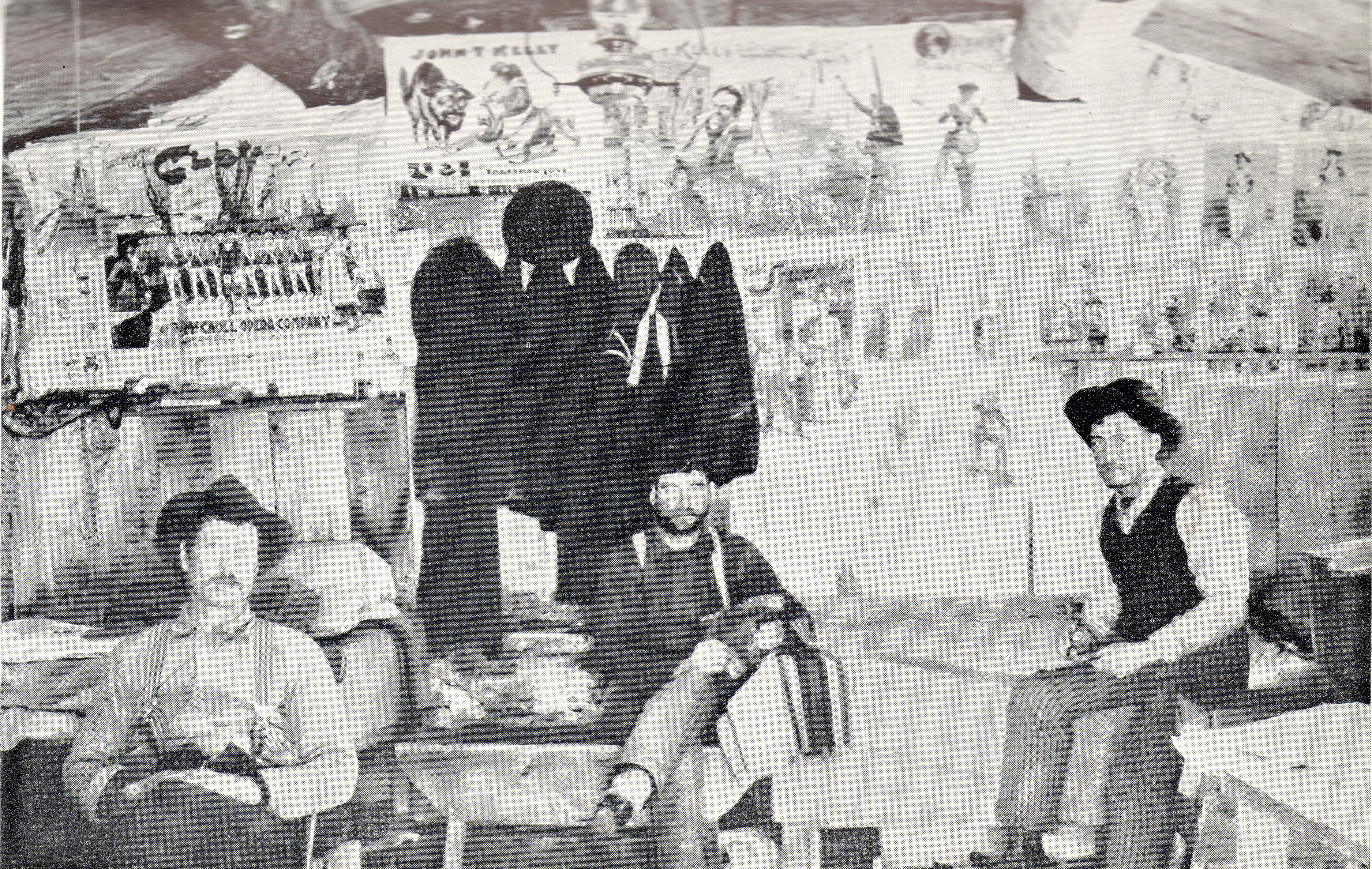
    I wonder when it was that working people (which would mean the overwhelming majority of people on the planet) first decorated their non-cave walls with art?  There aren’t all that many images in the history of art (that I know of, anyway) that depict the inside of a yeoman’s residence with some sort of artwork hanging or stuck on the wall. This is a tricky and potentially meaningless question, trying to differentiate bits of newspaper illustrations nailed to a wall in Montana in 1882 from messianic Aboriginal millenia-old cave paintings and such.  

    Cowboy porn305
    Inside-the-bunkhouse photographs from the American West like this are pretty scarce things–almost as scarce as nighttime photos of sleep-disturbed cowboys on the trail.  They’re just not around.  The remarkable thing about this photograph (from the archives of the Minnesota State Historical Society) is that it also shows a not-subtle vignette into what passed for provoking, night-stabbing man-images for a society of the working stiff. 

    These guys may be cowboys, or may not–there is a rifle on the wall over the shoulder of the striped suspenders guy on the left, and there seem to be a couple of dusters hanging on the wall, and some broad-rimmed hats.  Maybe they really are cowboys. 

    In any event they’re in a rough-hewn bunkhouse with not very much to pass the time, save for these few broadsides and mounted magazine pages.  I find it an interesting peep into an interior life that didn’t get seen very much, especially with such period-hot images of women. 

    And perhaps this paper is nothing more than the barrier that we see so often from FSA photos of the American Dustbowl West–paper put up on the wall to stop a cold draft or dust.  But these look too determined for something as simple as that…

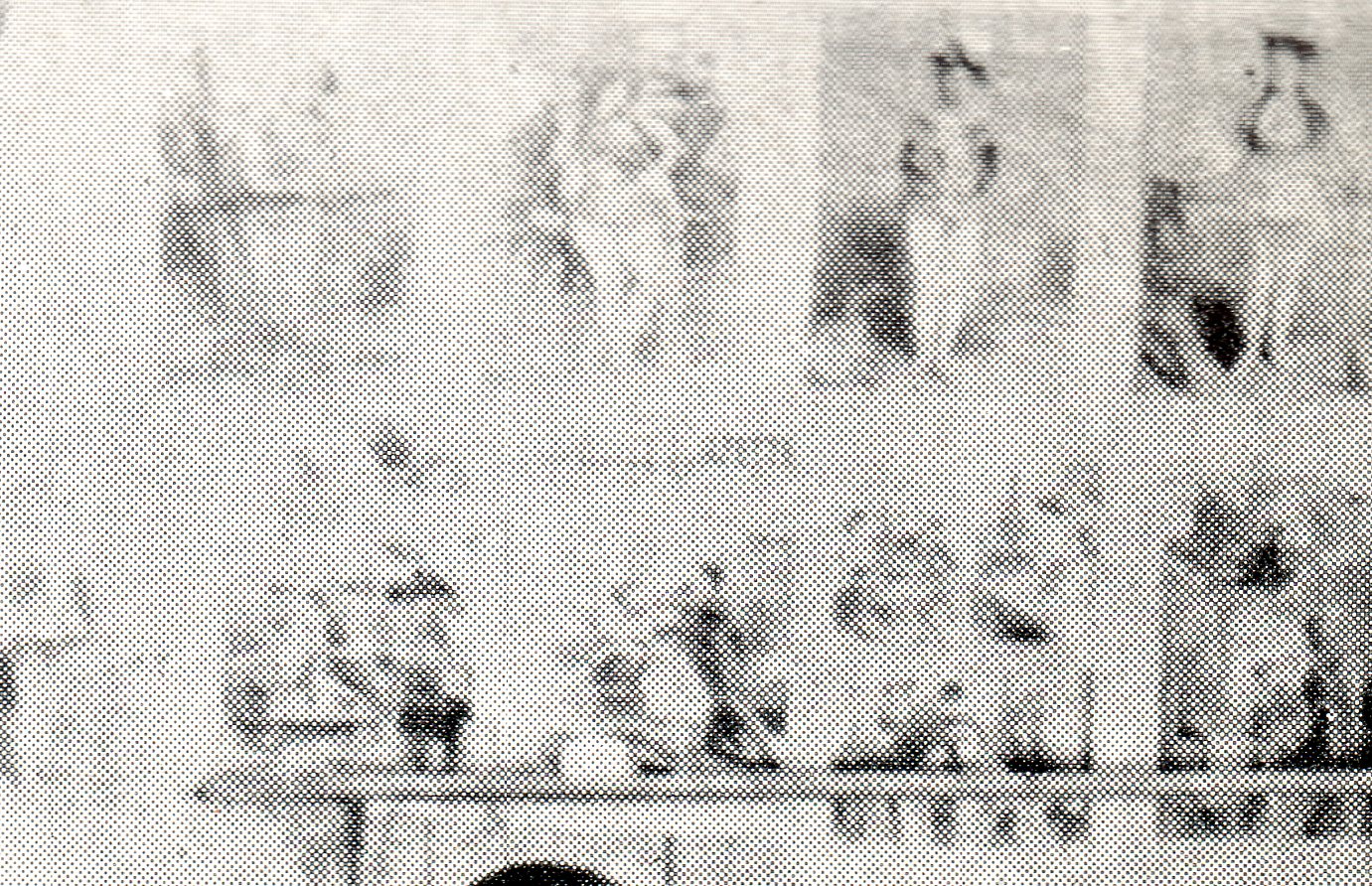
    Cowboy porn det 2307


  • Custer and the Extermination of…Southerners

    JF Ptak Science Books  Post 1109       

    Here’s a bit of Custer legend that is true and seldom heard—if
    left to his own devices in a Custer-filled world,  the general would have “exterminated” everyone
    in the South, every one (“men, women or children”) , “with an ounce of rebel
    blood”, hanged dead.  At that point the South
    would be free, and would be repopulated with the “loyal and patriotic”.

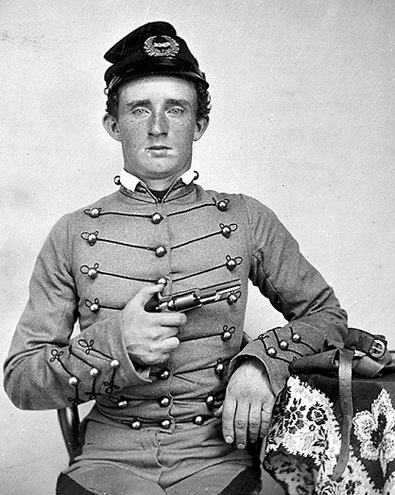
    Custer This was part of  a
    long letter (transcript below) to U.S. Senator Jacob Howard, written on 19th January 1864, in the
    field.  Custer was feeling on the ropes
    at the time, needing to defend his loyalty to Lincoln and his policies,
    and needing to distance himself from Lincoln’s
    election contender and inferior general, George McClellan. (Richard Slotkin, in
    his fabulous The Fatal Environment, the Myth of the Frontier in the Age of
    Industrialization, 1800-1890
    notes that Custer needed “to justify himself…(and)
    disabled his previous affiliations and the nature of his relationship with
    McClellan…’)

    Custer’s relationship–real and imagined–with McClellan was putting him in a stench void, creating the possibility of distance between himself and the powers that be–particularly with Senators like Howard and Zachariah Chandler, “who controlled army promotions” (Slotkin, page 384), which meant distancing himself from the higher rank he thought he was destined for. Custer had been on McClellan’s staff, and had aligned himself with his
    war policies, though not necessarily so his presidential ambitions. 
    Howard, a Republican from Michigan and member of the Military Affairs Committee, believed that Custer was a “McClellan Man” and set against Lincoln, and for that was set to block
    his promotion to brigadier general.  Custer’s  salvaging letter1 to Howard left no doubt about his supposed non-political feelings and where he stood on Lincoln, the Emancipation, and the treatment of the Confederates:

    “If  I could decide
    the questions, I would offer no compromise except that which is offense at the
    front of a bayonet, and rather than that we should accept peace, except on our
    own terms, I would, and do, favor a war of extermination. I would hang every
    human being who possesses a drop of rebel blood in their veins whether they be
    men, women or children. Then after having freed the country from the presence
    of every rebel, I would settle the whole Southern country with a population
    loyal and patriotic who would not soon forget their obligations to their
    country and to themselves.”

    Slotkin points out that the letter to Howard  was so well received that he wrote an update letter to the public-at-large, finding itself published in he Detroit Free Press in May 1865 (“and which was widely reprinted” (Slotkin, 384)) It read in part: “Extermination is the only true policy we can adopt towards the political leaders of the rebellion…Then, and not till then, may the avenging angel sheathe his sword, and our country will emerge from the struggle regenerated”.  

    Custer left out the women and children part of his Southern bloodbath, but left the “extermination” part in.

    Custer was a man of short bursts with little imagination or capacity for extended action or thought–a difficult character, a limited man with no limits.  This would come up again and again, more horribly so at Washita massacre2, and then, finally, the strength to endure his impulsive recklessness gone, at the Little Big Horn.

    The entire letter (and notes)  are  included below:


  • Boredom and the Re-Fencing of the American Frontier: Highway Billboards, 1930

    JF Ptak Science Books    Post 1049

    The West, the American West, had the foundations for effective an grid delivered by the late 1870’s, in the early-middle of what I guess people would consider the high Cowboy days of westward expansion.  But the exploration part had been mostly done by this point, as had the expansion bit, the exterior sections of the compartmentalization of the frontier taking place in ever-smaller concentric squares.  As I wrote earlier in this blog, it was the introduction of lines that really did the whole Wild West thing in–the introduction of the railroads, of course (followed by the refrigerated railroad car, which did in the great cattle drives and established needed-to-be-peopled rail heads all over the place), telegraph lines, and of course barbed wire.  Barbed wire meant barbed wire fences, fences that could be constructed for a small fraction of the cost of wooden fences and which replaced of course no fences at all, dividing the great open plains into more manageable units of owned and regulated land. (Barbed wire fences also needed far less maintenance than wooden fences, which means fewer cowboys riding fences for upkeep and so on.)

    By the time the eulogy on the American Frontier was famously delivered by Fred Jackson Taylor in 1893, the fate of the West had already been sealed for perhaps two decades, though the notion of its “closedness” was received with considerable shock. It was time for the truly great equalizer and innovative settler of the West to makes its appearance–boredom. 

    I think it might be that it was the Boring Frontier that nailed the coffin shut on the Western Frontier.  Once all of the lines had been delivered–barbed wire, telegraph, railroads, good maps–the greatest thing left to do was the settling.  And nothing quite spells settlement than boredom. Or comparative boredom.  Once the essentials of conquest had been delivered in terms of the civilizing lines, it became time to wait for the rest of it, surviving through cold Nebraska winters and hot Panhandle summers, waiting for the rest of America to come and settle.  It was the Boredom Frontier that spelled out the intent that the changes brought to that country were there to stay. 

    And barely three decades after the announcement of the closing of the frontier, automobiles were making their way across the land on new roads., which snaked their way deeper into the last-reached parts of the country.  It was very soon after the car and the road that the roadside billboard appeared, and appeared in such great quantity that legislation prohibiting banner display like this was introduced into the legal system during the teens.

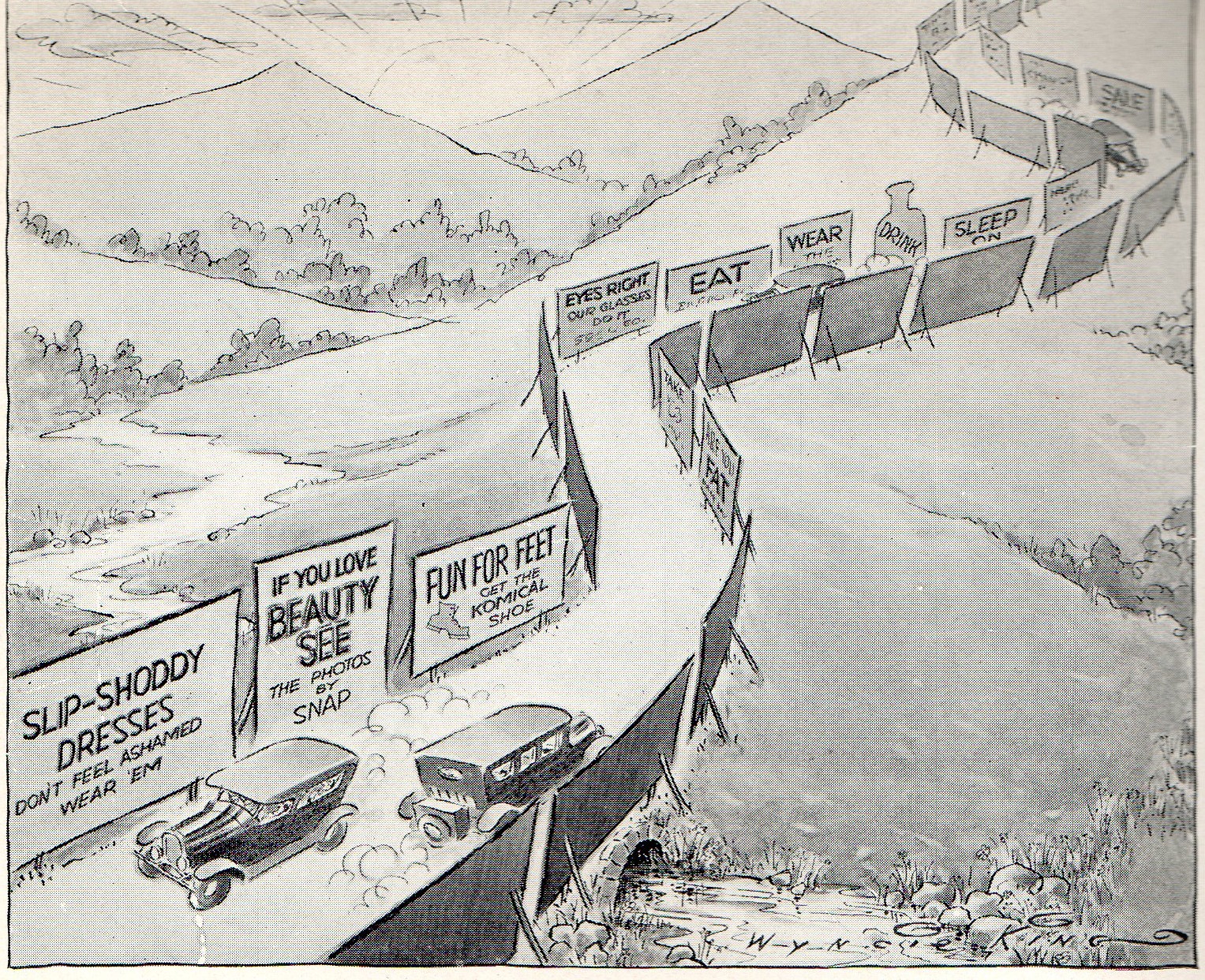
    Roads provided the last assault on the West, and brought with them their singular colonizing irony of billboards, which prohibited the view of the country through which their roads snaked and pulled.  And there’s something terribly wrong with that, as witnessed in this 1931 illustration tucked inside this almost-provocatively-named pamphlet, Billboards ad Aesthetic Legislation, New Applications of Police Power (published by the St. Louis Public Library).It is astonishing to think of the vast changes that took place in the remaining American frontier, taking place so quickly–two generations separated the last of the great cattle drives to billboard legislations along auto routes in the western states. 

    00--billboards036

    It seems to me that I’ve seen a similar illustration of the senseless explorer from the ‘teens, though I cannot find it now.  


  • Primitive De Luxe versus Civilized No Lux

    JF Ptak Science Books LLC  Post 992

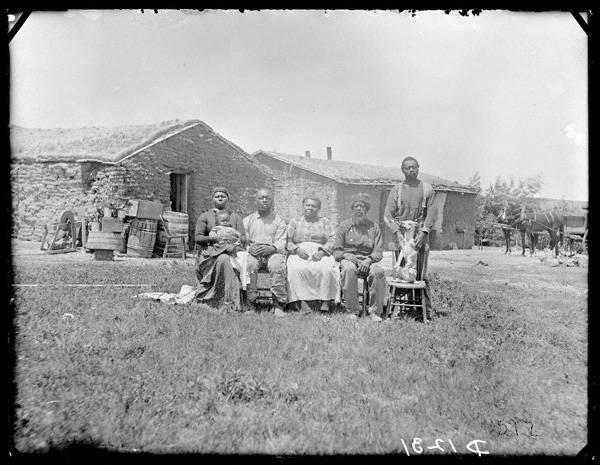
    I’m
    not sure exactly what Solomon Butcher told his subjects when he photographed them
    outside of their frontier houses out there in the Great
    Plains
    in the 1880’s.  His spectacular
    portraits included not only the family of the house, but in many cases, everything
    that the family owned.  Possessions were
    an

    Butcher

    encumbrance making your way across the country in the mid/19th century,
    especially if you didn’t have very many to begin with.  These families—the first generation in their
    mostly sod-built houses—would’ve been farmers scratching out a minimum trade
    and decent subsistence.   City/town goods
    would’ve been not-usual in these circumstances, and evidently whatever it was
    they had of these things wound up outside, displayed around the house and on
    the roof, when Mr. Butcher arrived in his photographer’s wagon. 

    (Who
    was it, I wonder, who came up with the initial idea of displaying all of the
    family’s possessions:  did Butcher set
    out with that idea, or did it happen spontaneously?  I wonder what it was the families thought as
    Butcher was packing up his equipment, his horse fed, his cameras stowed away,
    climbing up onto the driver’s bench.  Did
    they wait until he was a spot on the horizon to put away their things?  Did they gather everything up as Butcher
    gathered up his own material, or did they just wait for the stranger to
    disappear before pulling the family back together? Sitting their surrounded by
    the things that they owned, did these families feel a quiet pride, or were they
    embarrassed have their pictures made together with their frontier opulence? I
    suspect that the idea for display did not begin with the families.)

    On
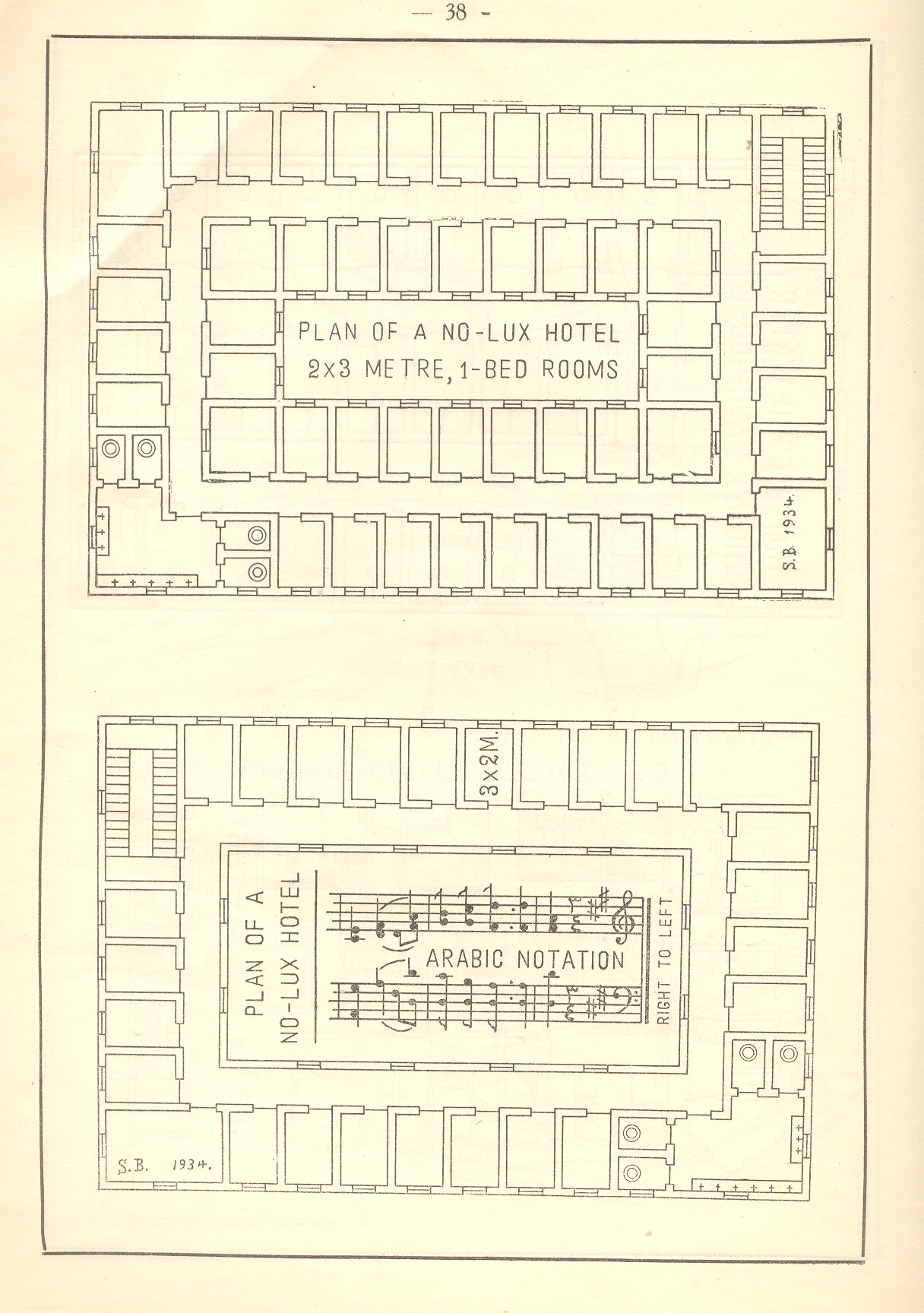
    another part of the luxury spectrum is this floor plan for a “No-Lux Hotel”, a 2×3
    metre/room place for folks to stay cheaply/inexpensively.  There were 50 
    rooms packed into a 36×24 metre footprint,

    Mar 30 no lux

    leaving precious little room
    for hardly anything else, like hallways (which seem very narrow), stairways
    (actually a singular, as there is but one) and bathrooms (one with 8 sinks and
    four toilets per floor). 

    The
    center of the structure seems curiously blank in the top plan.  The bottom one is confounding, a mysterious
    mystery:  why on earth would there be
    musical notation written backwards (via “Arabic Notation”) in the center of the
    plan?  No doubt the architect was on the iconoclastic
    side to have included such a thing; but its inclusion no doubt meant something
    to the author, though it is now lost to his/her dust.  Pity. 

    “Lusux”
    is Latin for something like “extravagance”. 
    “De luxe” appeared in France
    in 1928 or so for the first time to describe this added opulence in a word of
    its own, though there is a certain geology to the idea.  A luxury might well be a spice on a camping
    trip, or a back-up aircraft to the family helicopter.  Perhaps it was an extra sink in a cheap hotel,
    or a violin for the kids in a house that stood by itself in 10-square-mile
    solitude. At least the multi-floored Hotel No-Lux had a stairway.