A Daily History of Holes, Dots, Lines, Science, History, Math, Physics, Art, the Unintentional Absurd, Architecture, Maps, Data Visualization, Blank and Missing Things, and so on. |1.6 million words, 7500 images, 4.9 million hits| Press & appearances in The Times, Le Figaro, Mensa, The Economist, The Guardian, Discovery News, Slate, Le Monde, Sci American Blogs, Le Pont, and many other places… 5000+ total posts since 2008.

Author: JF Ptak

  • Quiet, the Quietists, and Not Finding a Missing “Principia Mathematica” (1687)

    JF Ptak Science Books  Post 2747
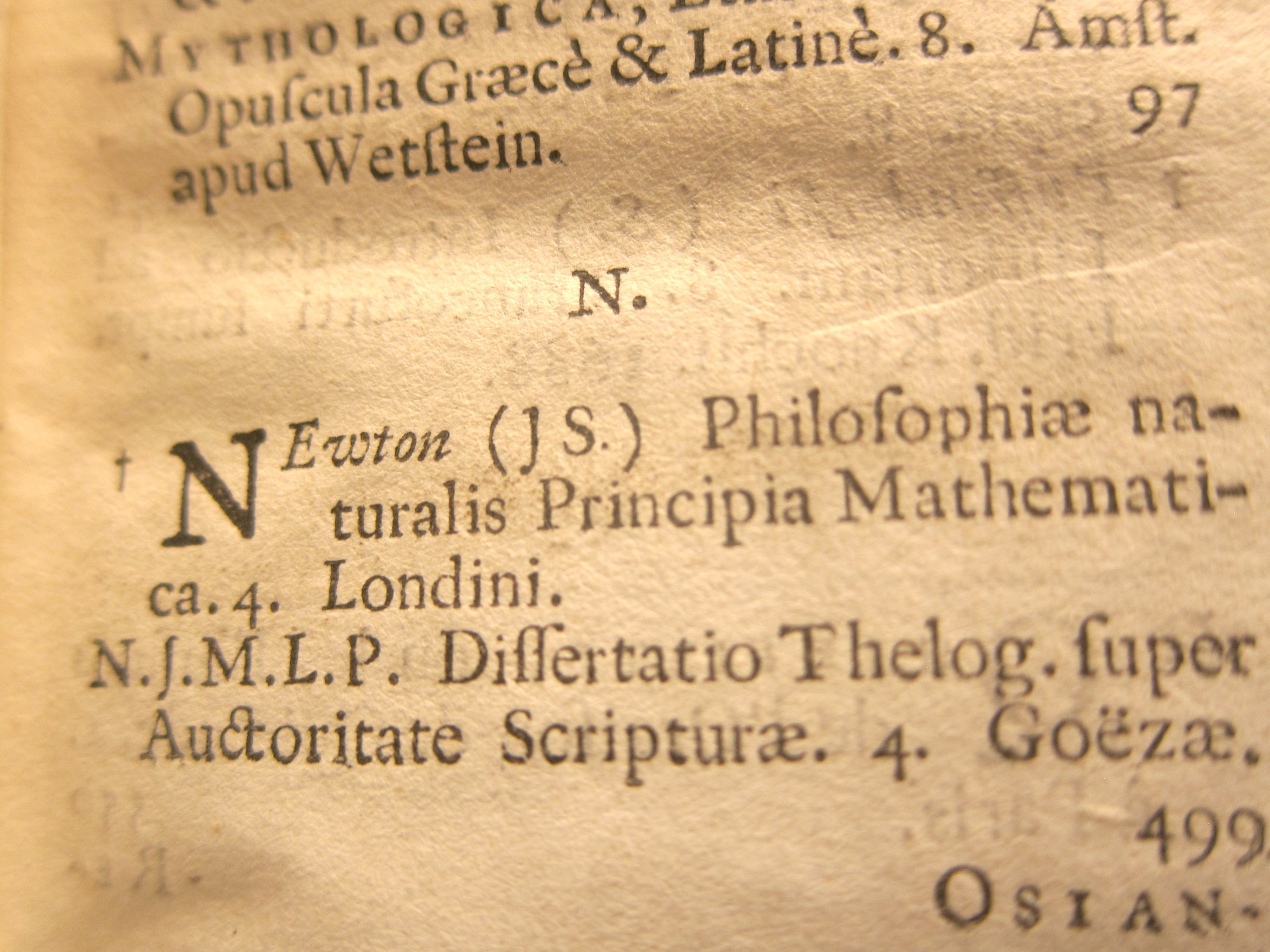
    Newton Principia

    Grazing through old scholarly journals is never a completed task—the more you have to bring to the adventure, the more you will take away from it. This is probably a general truth, though it is particularly so with journals that cut a broad path in the communication of ideas, and this is certainly the story with the late-17th century journal/magazine, Bibliotheque Universelle. It ran from 1672 to 1726, and the intellectually-thirsty editors ran a kind of review/abstract service for their readers—they found (mostly) newly published books in a wide variety of areas, and wrote summaries and statements on them, with background history, and the occasional editorial comment. Some of the articles were on significant works by John Locke and Antoine van Leeuwenhoek, but many and probably most were on obscure topics in nitty theological history and mostly-invisible philosophical issues, or at at least that is how the latter seems to me today. The Bibliotheque brought new ideas to the continent, and brought them in the Lingua Franca, which also happened to be French.

    This is the background as I thumbed my way through volume seven, one of several volumes for this year, finding few things that fired any nodule of memory or investigation in my head. 1687 is a big year in the history of science, seeing the publication in July of that year of what may one of them most important books ever published, Isaac Newton’s Pricnipa Mathematica.

    And then, suddenly, it was there. I knew from a previous experience that an interesting and uncommon review of the Principia by John Locke (of all people) in the next volume (8), which was the third statement on the book outside of Britain. But I hadn’t know about this appearance, which would have been published just a couple of months after the Principia appeared.

    There were just a few lines announcing the book in the table of contents, but no page reference. I consulted an online version of the journal and did a search on Newton, with no results. That of course made me go through the book—twice–page by page to make sure that the article wasn’t there. It wasn’t. I imagine that the mention of one of the world’s greatest books was, well, a mistake.

    The Principia was quiet.

    The funny thing was that there was another article on exactly that—quiet. And this was a dangerous quiet, at least for the originator of the theological movement, who would be cast into the flames of the Inquisition and die in prison for the temerity of quietude.

    In the next page of the table there was this fine find: “Le Quietiste, ou les Illusions de l’oration de Quietude”, (p 550-554) and “Receuil de diverse pieces concernant le quietisme et les quietistes”(pp 554-559).

    These two articles are statements/reviews of two books addressing the Quietism and Quiesiste movement as embodied by its founder, Miguel de Molino (1626-1696). Very long story short, Molino was seen as a threat to the pope and to the Jesuits, preaching a Christianity that seems quite personal and benevolent from where I sit, but at the time was seen as heretical, and for which Molino would be tried by the Holy Offices and condemned to life in prison, and as a matter of fact, Molino died in the (outwardly) beautiful Castel St. Angelo serving out his sentence.

    It seems to have a bit forward and backwards for Molino. Charges were brought against him chiefly through the work of pieces like the first presented above, by the Jesuit Paolo Segneri (1624-1697), whose first efforts were unsuccessful in dislodging Molino, with his own work finding its way to the Index. However, by 1685 he was again sent to the Inquisition, and just months before this book was published, he was already tried and imprisoned.

    William James (in his The Varieties of Religious Experience, 1902) found Molino to be a “spiritual genius” (p. 130) and his Quietism to be a ”transcendental idealism”, with “a healthy-minded opinion of repentance” (p. 130). He seems to have found nothing threatening in the man, and his imprisonment an “abomination”. The issues were longer and deeper than this, with 250+ points brought up before the Inquisition, including “moral deformity”), but on the whole Quietisme seems as destructive as George Fox’s Quakerism, which seems to have shared many spiritual practices with Quietism.

    So it seems that the established order in Rome found the message of the Quietists too loud, and the voice of the Principia was to be found in the next volume.

  • One Word, Three Un-hyphenated (?!) F’s in a Row!

    JF Ptak Science Books   Post 2746

      Luftfff

    I just came upon this fine word, which for a moment challenged my probably under-corrected vision, and saw that it contained three consecutive f consonants! On a Saturday, cranky with a fever and stiff(f) neck, this was a superb BLAST! Or “blast”. Or “b”. Anyway the word is Luftschifffahrft and it occurs in the title of a pamphlet by Wenzel Kotzauer, Die Luftschifffahrt und ihre Zukunft, printed in Vienna in 1895.

    The forty-page pamphlet is about the future of air flight and as fixed-winged aircraft rather than airships, noting in particular the 1894 Hiram Maxim “aeroplane1”. The Maxim machine was prodigious, and was mainly built for testing purposes—it weighed 3 to 4 tons, carried two steam engines that generated 180hp (!) and had pushing props that were 17.5′ in diameter, making the thing a beast-and-a-half. It was fixed to a very wide two-track system to keep it from lifting off the ground when the engines were running—or to keep it from careening around out of control. In any event, Maxim’s dream machine didn’t make it very far and was dismantled after a few years. (He also attempted an unsuccessful return to heavier-than-air flight in 1910.)

    But back to the three Fs. “Luftschifffahrt”, which translates basically to “airplane” or perhaps “aeroplane”, and thus the title is about Airplane/ship/aeroplane Travel in the Future. Or thereabouts. It is a technical work, with much on the actual “aeroplane”, which in its first use were the wings, and here there is much discussion on their size and shape.

    What most interests me though are the repetitive consonants. They just don’t seem to happen in English, naturally, without being hyphenated. (Using the word “un-hyphenated” again I just want to point out its terrific irony!) The word appears with fewer letters as “Schifffahrt”, which is simply “shipping”.

    The most obvious hyphenated candidate for me is “cross-section”, which I use often in this blog, though I can’t kill the hyphen and pulling the two words together as it makes it look like overstuffed snake-sausage: crosssection. As smaller snake is the person who sees a seer is not a seeer, and Scrabble-challenged words like “zzz” and “brrretc” definitely do not count, noooo sir.

    Anyway: fff.

    Notes:

    1.  In general at this time “aeroplane” referred to the wings/airfoils of a plane, not so much as an aircraft itself.  Mostly, it seems. The Oxford English Dictionary says that the first use of the word in this sense occurs in 1866, with a useful explanation of it found two years later:

    All of the following come from the Oxford English Dictionary:

    “Aeroplane”

    1868   3rd Ann. Rep. Aëronaut. Soc. 36   He had turned his attention to the wing and to the sustainer, or what he might call the aëroplane.

    1894   O. Chanute Progress in Flying Machines 237   This main aeroplane..is trussed and stiffened in every direction by wire stays.

    1905   G. Bacon Balloons 111   What are called ‘aeroplanes’—large flat surfaces, light but rigid inclined at a suitable angle to the horizon.

    Aeroplane=aircraft/airplane (as a noun) comes at about the same time:

    1868   Eng. Mechanic 24 Apr. 91/2   We have yet to see the ‘aëroplane’ with buoyancy sufficient to sustain 150 lb., or with apparatus sufficiently light and portable to make headway on an ‘air plane’… Supposing an aëroplane to have raised itself, if it reared out of equilibium it and the occupant would come to grief.

    1873   D. S. Brown in 8th Ann. Rep. Aëronaut. Soc. 17   I think this [sc. impetus] will be more requisite with respect to the aëroplane than any other vehicle.

    1873   Ann. Rep. Aëronaut. Soc. 20   Mr. Bennett introduced an Aëroplane invented by a Frenchman, to be worked by a screw by motive power derived from elastic springs.

    Finally, “airplane” as a noun comes into existence, or nearly so, in the early part of this past century:

    1906   Sci. Amer. 29 Dec. 487/1   Air-plane is a much better word than aeroplane. It is as good etymologically, and much better when it is spoken.

    1907   Westm. Gaz. 19 July 4/2   It is this ease of going against the current, with no motive force in evidence, that is..the despair of the aeronauts with their air-planes.

    1917   N.A.C.A. (U.S.) Rep. Nomencl. Aeronaut. 31   Airplane..This term is commonly used in a more restricted sense to refer to airplanes fitted with landing gear suited to operation from the land. If the landing gear is suited to operation from the water, the term ‘Seaplane’ is used.


  • On the History of Kindness to Children (1687)

    JF Ptak Science Books   Post 2745

    Bibliotheque Universelle 1687

    Another piece of great serendipity fell from the sky, again this week, this time on the idea of the history of childhood–more accurately, it is on the history of kindness extended to children. The idea of looking at childhood in that way lies in the work, for example, of Phillipe Aires (Centuries of Childhood, first French edition 1960) and Lloyd deMause (The History of Childhood, 1974), among others, who maintain that kindness towards children is a modern invention. (This is kind of wildly brief statement of this idea–suffice to say though that the treatment of children through long history has not been necessarily “kind”. For example, the word “childhood” appears only twice in the Bible (KJV), and really only once in reference to what childhood might have been rather than a simple statement regarding a period of human life. That occurs in Ecclesiastes 11:10: “Therefore remove sorrow from thy heart, and put away evil from thy flesh: for childhood and youth are vanity.” This is in line with an older variety of that book, the Cloverdale Bible, in Ecclesiastes xii. “A   Childehode and youth is but vanite” which again makes the point of childhood being something to get away from rather than a chance to improve the life of the new person. The Oxford English Dictionary takes the word back to Middle English times, but even into the 19th century I can’t really point to an applicable use of the word in connection to this discussion.)

    The issue came up while listening to a public reading by my wife’s (Patti Digh) favorite living author, Richard Powers. He was taking questions after a lovely read from his newest, called The Overstory, when a question came to him regarding human-like senses in animals. Powers responded saying that all was possible, seeing as how people question those human qualities in other human beings. He used the term “Anthropomorphism of Man”, which I found fantastic, as he was correct. For centuries certain people simply weren’t regarded on the same human level as other people (those people doing the judging). For example, in the U.S., women, African Americans, the poor, Asians, and so on from a long list, have only recently been elevated to the prospect of “sameness” with those in power in this country. Before this, they were something “lesser”. And it was here that Powers offered “children” as not being children, not even a full human, for most of the history of humans, and so only recently come into their own as full humans.

    Then came the serendipity.

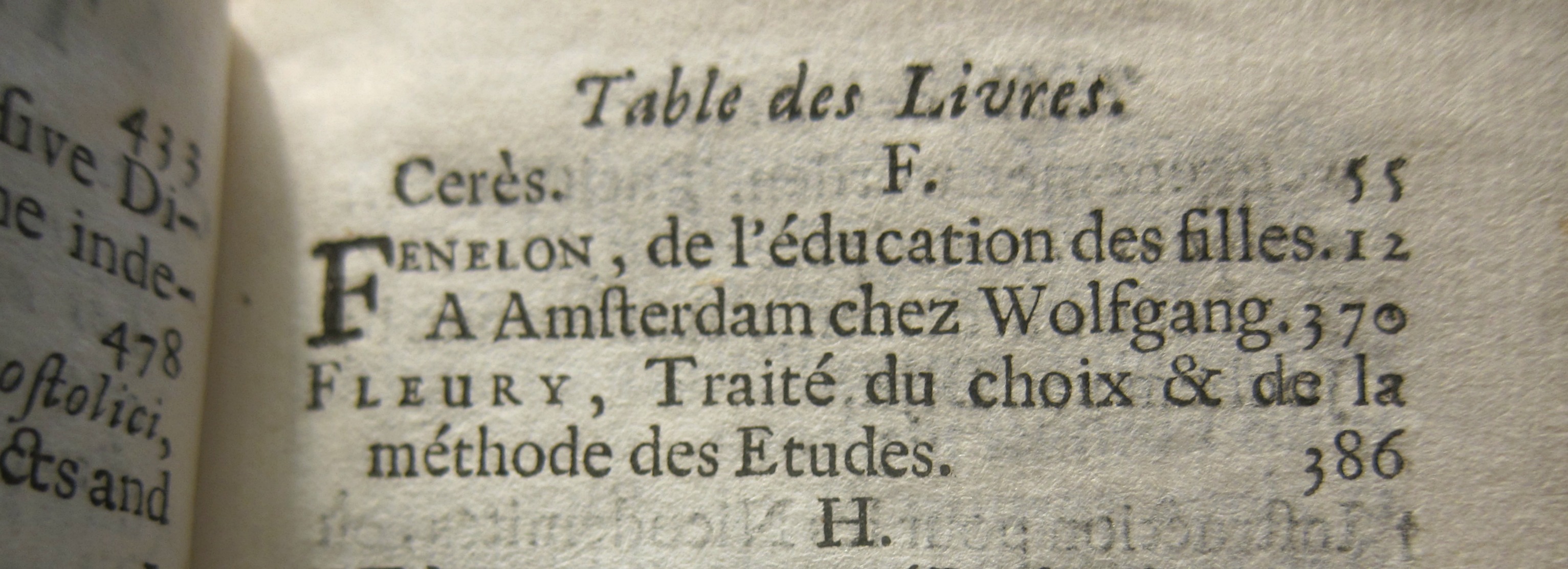
    I was browsing through one of the 30 volumes or so of an Amsterdam-published 17th century magazine/journal called Bibliotheque Universelle looking for articles of scientific interest. There’s a lot in these little bricks of books, and they do have some occasionally good (and great) scientific efforts in them, the one I was working on, one of several volumes for the Principia year of 1687 (July 5), yielded nothing of any great sci-interest in its 500+ pages. Then, I spotted it, just a simple four lines of 6-point type in the 5”-tall book: “Fenelon, de l’Education de filles…” That’s François de Salignac de La Mothe- Fénelon, of Telemachus (son of Ulysses, etc.) fame, and his book was on the education of daughters. It was published the year before, in 1686, and the editors of the Bibliotheque gave it 14 pages or so of review and explanation.

    It seems to me from this reading that in this account—really on education of children in general–M. Fenelon was an advanced thinker, a human human-rights person, treating children and their education as individuals, with understanding, and kindness.

    Evidently the man speaks to curiosity and rational amusement in the book—that curiosity must precede the rational, and that one must be careful in doing that, because there is a danger of “imitation”–curiosity is the thing that banishes ennui.

    At the same time instruction must be realistic, so that once mature and grown that the real world is not a total shock, and that once subjected to the daily routine of “housewifery” there will be no denouement from the dreams of childhood—all of that seems like a pretty sticky wicket. Fenelon did seem to insist on the beginning of education from infancy, but not to overdo the instruction as that would “oppress the facilities”.

    Perhaps the most surprising positive thing of them all to me was Fenelon’s insistence on being careful with your words with the mature child, and to never be guilty of a falsehood with children, which is pretty good and sane advice.

    There’s other stuff that doesn’t translate any longer into where we are today, but there seems to be a lot of material that is timeless.


  • A History of Big: Massive Aircraft, 1936

    JF Ptak Science Books   Quick Post

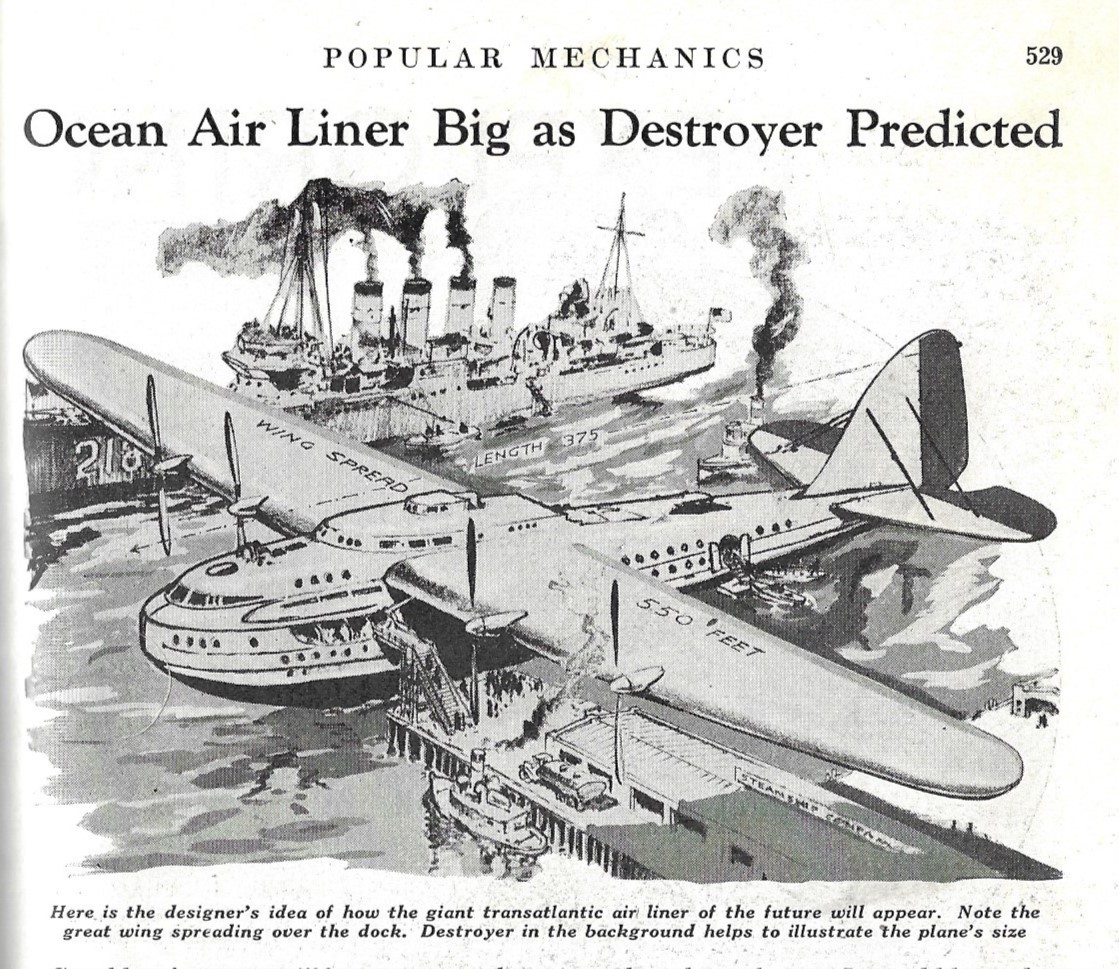
    In the history of aircraft, there’s big, really big, and then Hughes H-4 (“Spruce Goose”) big.  Then there’s the ocean-going aircraft below, found on p. 529 in the 1936 volume of Popular Mechanics. The nameless aircraft would be more than 375′ long and have a wingspan of 550′.  By comparison, an aircraft called the “Stratolaunch” now under construction and designed by Burt Rutan, would have a wingspan of 385′. The “Spruce Goose” was 319′ wide and 216′ long; the 747-8 was 249’wide and 242′ long; and the Airbus A 380-800 stands 262′ wide and 236′ long. In short, of planes having flown, this fabulous thing with the 550′ wings would be twice their size.  

    That said, this giant aircraft was limited not by imagination but by flight of technological fancy. It was supposed to require a crew of 100, fly at only 12k feet at 300mph, and make it across the Atlantic in 11 hours. So, the size was certainly awesome by today’s standards; the tech business end of it, not so much. In any event, the image is quite striking:

    Pop MEch 1936 massive plane


  • A View of the “Zones of Animal Life” (1889)

    JF Ptak Science Books  Quick Post

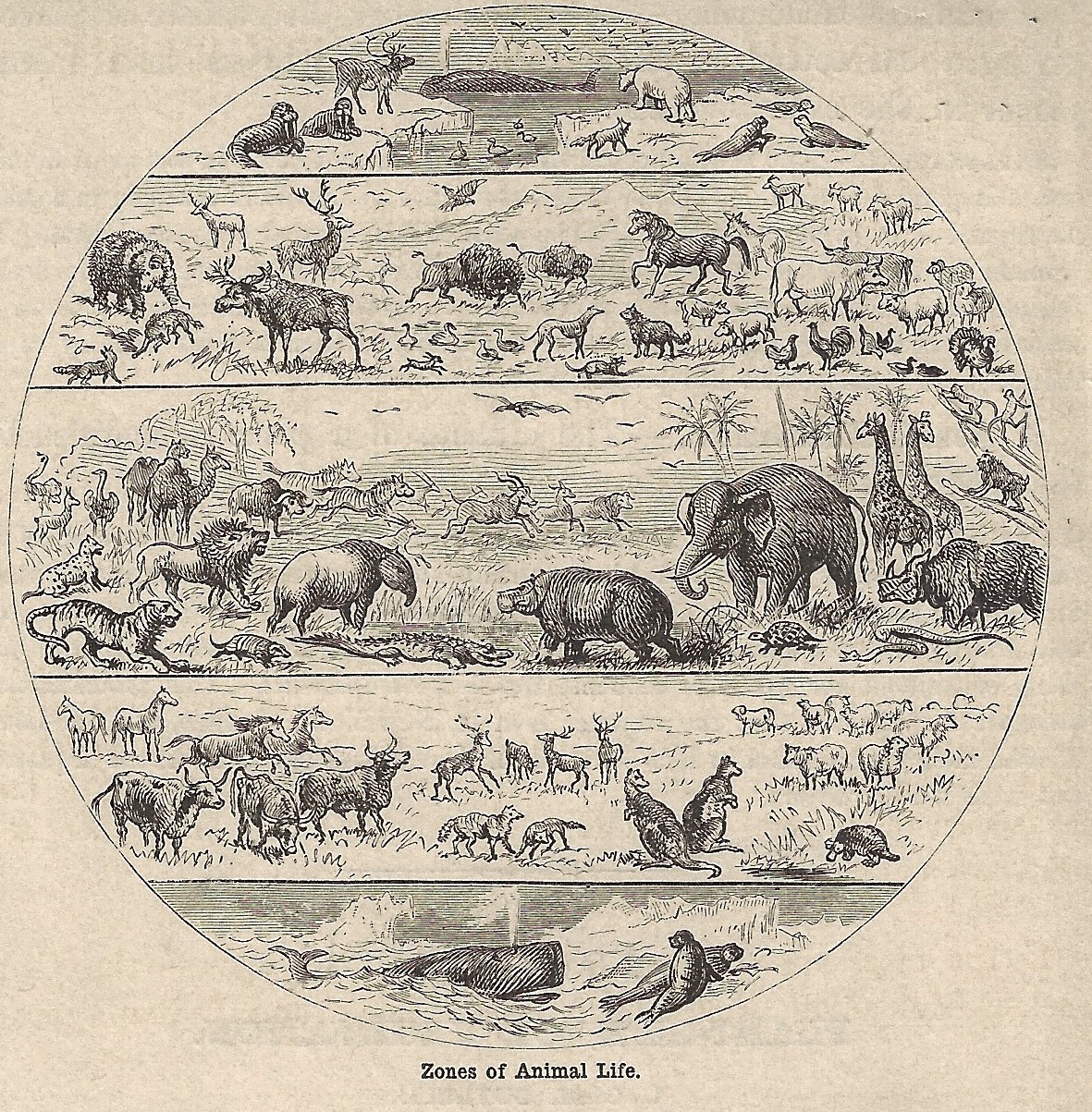
    Here’s is an interesting bit of data display, showing the distribution of animal life in torrid, temperate, and frigid zones. It is relatively small, 4×4″ or so, and is found in James Orton’s  Comparative zoology, structural and systematic, published in New York by Harper and Brothers in 1889, (pg 389). 

    Maps zones of animal life


  • The Department of Unexpected Questions: Is the Sun One Sided? (1878)

    JF Ptak Science Books   Quick Post

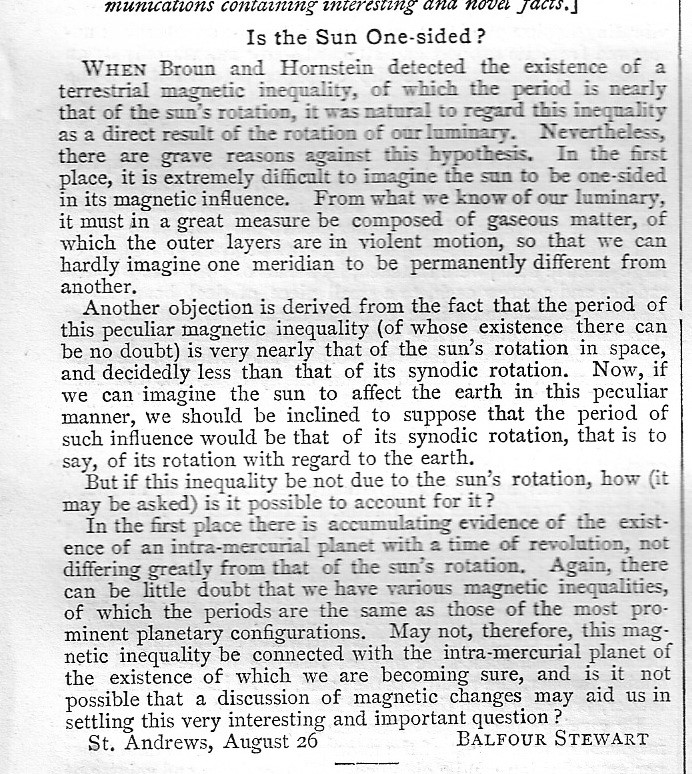
    I found–or bumped into–the following short note in Nature (September 5, 1878) .  At first glance it has a flat-earthy/Nazis-on-the-dark-side-of-the-Moon quality to it, or at least to me it did. It is a very unexpected question, though it isn’t quite what it seems at the outset before you try to think about what part of one-sidedness the author, Balfour Stewart, is addressing. Read the note, and then the title will make sense.  

    DocFile (2)

    “Balfour Stewart, (born Nov. 1, 1828, Edinburgh—died Dec. 19, 1887, Drogheda, Ire.), Scottish meteorologist and geophysicist noted for his studies of terrestrial magnetism and radiant heat. Stewart pursued a mercantile career for 10 years before becoming an assistant at Kew Observatory and later an assistant to James Forbes at Edinburgh University, where Stewart conducted his research on radiant heat. In 1859 he became director of Kew Observatory, and in 1870 he became professor of natural philosophy at Owens College, Manchester. In his work on radiant heat, Stewart was the first to discover that bodies radiate and absorb energy of the same wavelength; his work in this field was soon surpassed, however, by that of the German physicist Gustav Kirchhoff. In his studies of terrestrial magnetism, Stewart discovered that daily variation in the magnetic field could be explained by air currents in the upper atmosphere, which act as conductors and generate electrical currents as they pass through the Earth’s magnetic field.”–Encyclopedia Britannica

    ·Posted by :

    ·in:


  • An Early Indictment of the Japanese Invasion of China, 1931

    JF Ptak Science Books  Quick Post

    Here’s another bit of graphic design, a very aggressive cover from 1932 for Krieg in China! by Ernst Schneller1.   Schneller–a long-time KPD member–wrote this short work as an expose on the “war” and in support of the Chinese, published it seems just months after the Japanese invasion and conquest of Manchuria and another few months after the battle known as the January 28 Incident, all of which was foundational for the war that would officially be declared in 1937 (and last until the end of WWII). 

    Schneller was himself a persecuted communist intellectual who was arrested became among the first to be imprisoned in the Nazi KZ system in 1933, and who would stay in the system until he was executed at Sachsenhausen in 1944. 

    It is interesting to note that in one chapter heading the pamphlet refers to the war as a new threat to the world (“eine neue welt droht”).

    DocFile (4)

    Notes

    1. Berlin : Kommunistische Partei Deutschlands, [1932] 9×6”, 15pp. A little confusing, though it seems that there are only three copies of this book located in WorldCat/OCLC. Provenance, Hoover Institution, and then in 1933 to the Library of Congress.


  • The Dictatorship of Hunger (1931)

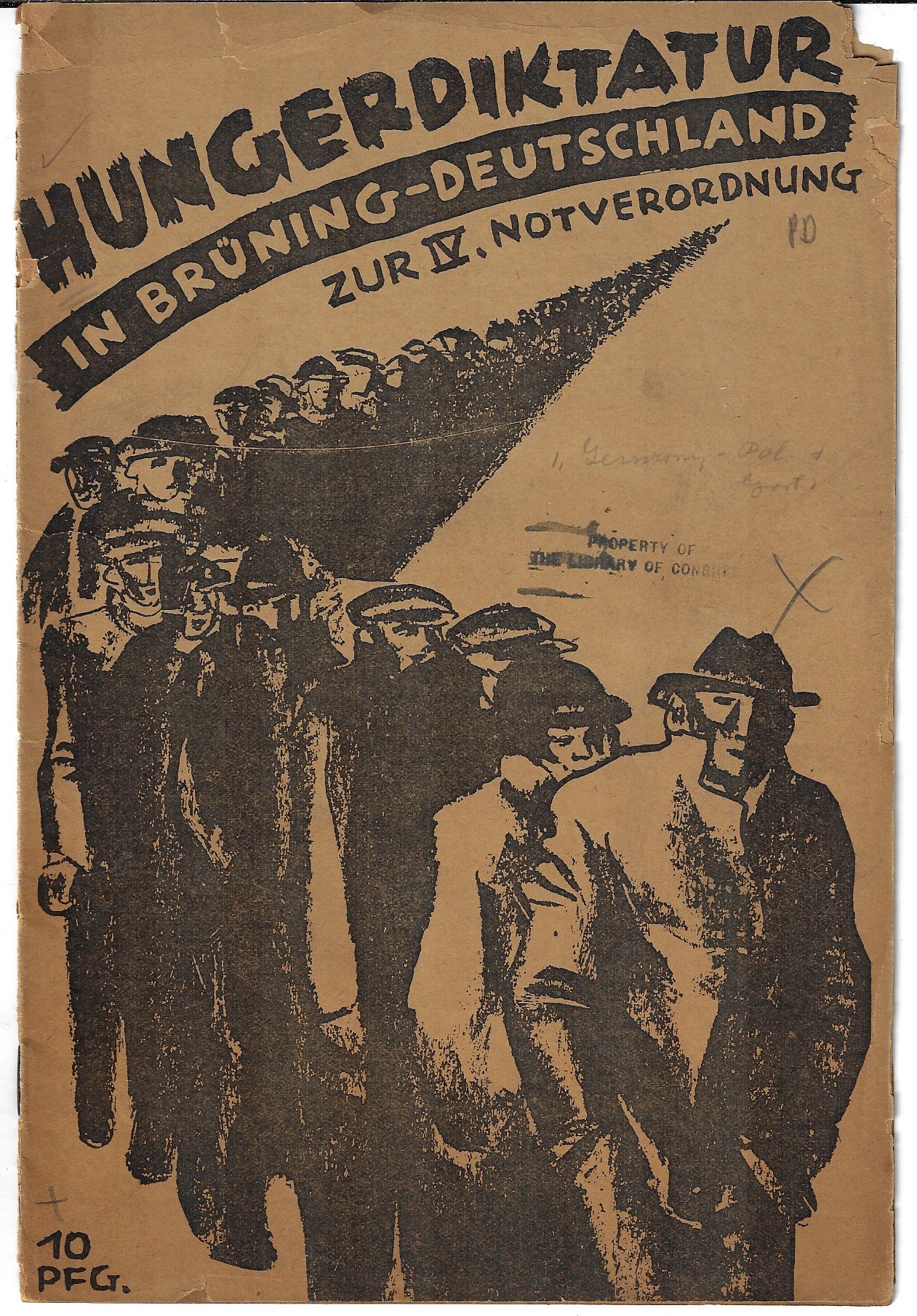
    DocFile (2)From what I can tell this pamphlet–Hungerdiktatur im Brüning-Deutschland zur IV. Notverordnung. Zk. Der KPD. 1931– is an indictment of the responses of German Chancellor Heinrich AME Bruning to the explosive Depression in Germany beginning in 1930. Bruning became Chancellor right at the outset of the Depression in 1930 and his options were already very limited, economically speaking, without the failure of the world economy adding to an already deeply compromised situation. Nevertheless, his policies are seen in different perspectives, and he was out of office by 1932 and fled Hitlerism and Germany altogether in 1934. (Bruning was two chancellors removed from Adolf Hitler taking the position in 1933.) In any event the pamphlet here leaves no doubt about the impossibility of the social situation in Germany in 1931 and places a long legion of the Hungry at the feet of Bruning’s Germany.

    The cover design is very striking, and unattributed.


  • How to Fly a Farman Biplane (1910)

    JF Ptak Science Books  Quick Post

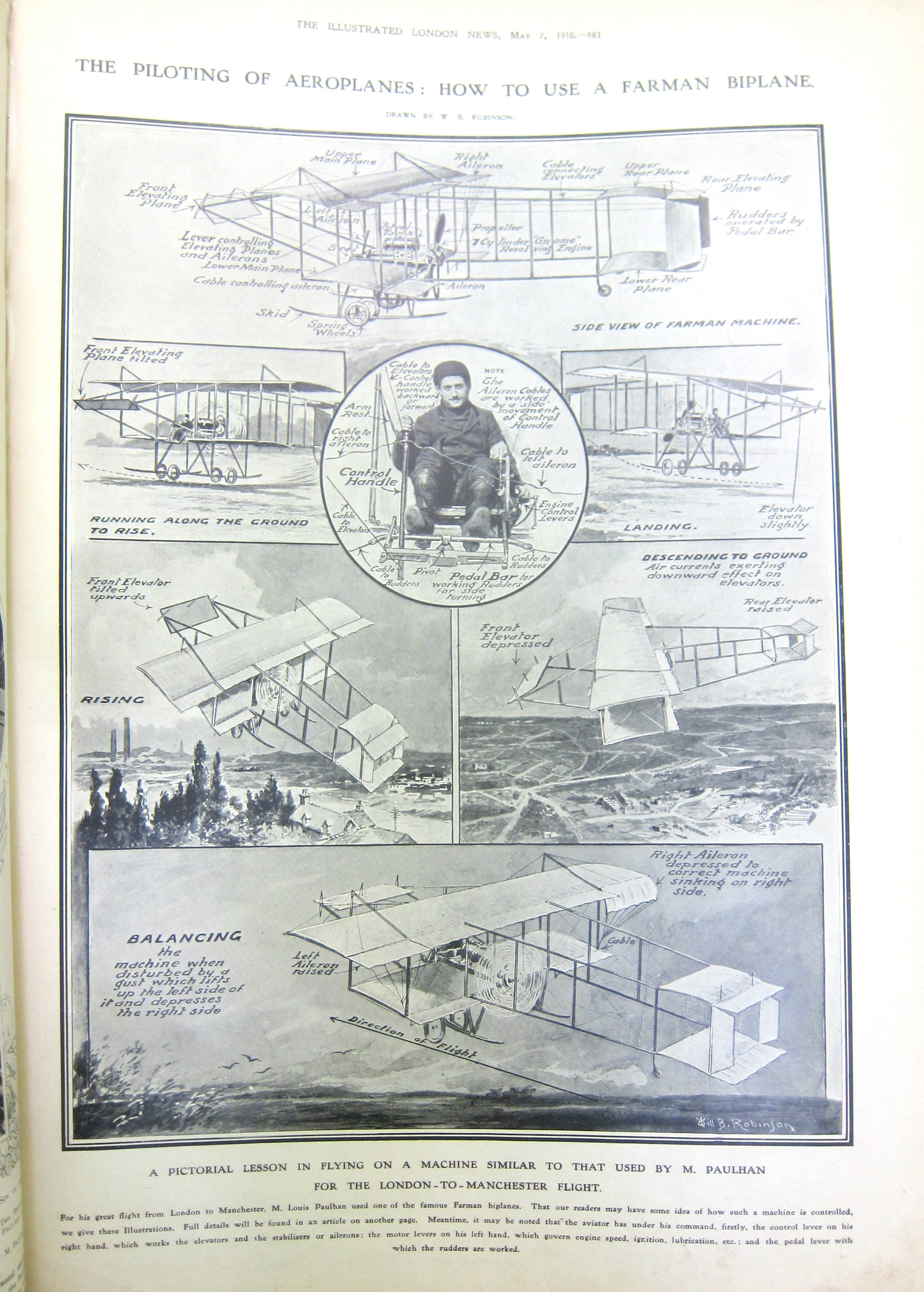
    I couldn’t resist sharing this because, well, I don’t often see a one-sheet explanation on how to fly a plane.  This is from the Illustrated London News, May 7, 1910, and concerns the Farman biplane:  

    Dataviz how to fly farman 1910


  • Great Calculators: Mental and Metal and back to Mental

    JF Ptak Science Books     Expanding Post 2739

    Two months ago I wrote on a paper that I found in a mid-century engineering journal (Minutes of Proceedings of the Institution of Civil Engineers with Abstracts of the Discussions) on the fantastic mental arithmetician George Parker. When I went to retrieve the volume to look for a different paper (on Fresnel lenses for lighthouses) I  flipped the pages to then end of the book to read through the index, and my thumb stopped on a page with a running header, “Mechanical Notations”. And lo and behold, the very familiar title was indeed a paper on a report to the Institution on Charles Babbage (1791-1871) and his “mechanical notation”, given by his son Henry P. Babbage (1824-1918).

    Well.  Babbage over the years proposed several different difference and analytical engines which indeed could be considered the first stored program Turing-complete computers. Never quite being able to get to the end of one project, and no doubt discovering along his various ways even better and more substantial designs (as well as int he pursuit of future money to build not “version 1.0” or “1.1” but “3.0”), Babbage tried within the limits of available technology to produce his heroic beast. His “mechanical notation” appears in full force in his diagrams for the design of his analytical engine, and it is there that we see his self-derived shorthand and symbols that produced and still-produce evident budgets of unknowns. The thing is, with these mechanical notations, is that they were part of a user manual, and the user manual was actually left unwritten and chiefly unexplained. And that is a problem. 

    In any event this paper by Henry Provost Babbage makes some attempt in outlining the notation, though for me it is done without success. This is further complicated by almost none of the notation presented in illustration. There were other and earlier illustrated papers (including some by Babbage himself) that stretch back at least to 1821–but this explanation of the notations leaves me a little on the outside. 

    And so we moved from the mental calculator George Bidder to the great metallic calculating engines of Charles Babbage, who takes us back to the opening biological/mental part of engineering thought via his manual-less manual, where his instructions and explanations of the interactions of thousands of perfectly manufactured precision gear works is printed but the key to which is left locked in Babbage’s head.  

    _____

    Here’s the part of the post that led to the discovery of the Babbage, both of these papers as I said appearing in the same journal volume: 

    George Parker Bidder (1806-1878) gave a lecture (without notes) explaining to the audience at the Institution of Civil Engineers in 18561 his interior practices and habits in performing absolutely prodigious and complex arithmetical feats entirely in his head. He was among the first tier of performing human calculators (like Zerah Colburn, b. 1804) mental calculations enchanted large audiences from the stages, answering seemingly impossible questions with accuracy and speed. It is in the 1856 paper (which Martin Gardner refers to as “historic2” and “valuable”) that he relates some of the practices which clarify his process–for example, one large element was that he would keep one fact in his head at a time, until it was finished, and then move on. Of course for people who did not have anything even remotely resembling this impossible ability, the information is interesting, though I have no idea how useful it may be…unless you were already a savant, that is.  Some things are just not to be known by mere mortals. Like the probably-apocryphal story of someone asking Hans Bethe how Richard Feynman had solved–on his feet–some impossible something, and Bethe responds: “First he thinks very very hard….and then he gets the answer”.) Something like that. 

    In any event, here’s the article, reproduced by Devonshire Perspectives website. My own copy is in a tightly-bound volume from the proceedings, and no doubt I would have broken the spine trying to copy the thing. That said, if anyone wants to buy this volume, it is for sale–this is a book selling site, sorta, after all.  

    The full lecture by Bidder:

    https://www.devonperspectives.co.uk/georgebidder/OnMentalCalculation.pdf

    Notes:

    1. Bidder, George Parker. “On Mental Calculation”, in Minutes of Proceedings of he Institution of Civil Engineers with Abstracts of the Discussions, volume XV, Session 1855-6, London, published by the Institution,  pp 251-280 in the 534pp volume. 

    2.  Gardner, Martin. “Mathematical Games”, in Scientific American, 216/4, April 1967, p. 117. 

    Also, I found an interesting biographical treatment of Bidder:

    • Bidder, George Parker. Mental Arithmetic. A short account of George Bidder, the celebrated mental calculator: with a variety of the most difficult questions, proposed to him at the principal towns in the kingdom, and his surprising rapid answers, etc. by George Parker BIDDER Rapid Calculator and Engineer., 1821

    It seems as though there was a separate edition of this 1856 lecture tens years later, published by Clowes:

    • Bidder, George Parker, and Institution of Civil Engineers (Great Britain). On Mental Calculation. Edited by Charles Manby. London: Printed by W. Clowes, 1866.

    And another printing somewhat later:

    • Bidder, George Parker. On Mental Calculation. London: Printed by W. Clowes, 1886.

    ·Posted by :

    ·in:

    —