A Daily History of Holes, Dots, Lines, Science, History, Math, Physics, Art, the Unintentional Absurd, Architecture, Maps, Data Visualization, Blank and Missing Things, and so on. |1.6 million words, 7500 images, 4.9 million hits| Press & appearances in The Times, Le Figaro, Mensa, The Economist, The Guardian, Discovery News, Slate, Le Monde, Sci American Blogs, Le Pont, and many other places… 5000+ total posts since 2008.

Author: JF Ptak

  • An Alphabet of -Ocracies

    JF Ptak Science Books    Post 2740

    The other day former CIA director John Brennan (2013-2017) dug up the word kakistocracy from its dirt nap to describe the Trump government. I had never heard of the word before, and so went to the Oxford English Dictionary to look it up. While there, I wondered how many other “-ocracies” and “-cracies” there were that have fallen completely off the RADAR, and it seems there are a lot—just about enough for a full alphabet, with dozens of “extras”. (See https://blog.oxforddictionaries.com/2016/07/18/words-ending-with-cracy/ for a 60-word list, a longer list with shorter descriptions.)  

    Adhocracy.   “A flexible and informal style of organization and management, characterized by a lack of bureaucracy. Also (depreciative): bureaucracy characterized by inconsistency and lack of planning.” 1970.   A. Toffler Future Shock vii. 113   We are..witnessing the arrival of a new organizational system that will increasingly challenge, and ultimately supplant bureaucracy. This is the organization of the future. I call it ‘Ad-hocracy’.

    Androcacy.  “The rule or paramount influence of money.” 1868   Pall Mall Gaz. 23 May 11.   The disease of argentocracy.”

    Angelocracy. “A government by angels. 1685   J. Scott Christian Life (1700) II. ii. vii. 320.   Those angelocracies or angelical governments of countries and nations.”

    Barbarocracy.  “Government or rule by barbarians, as that of Italy by the German emperors. 1866.   C. C. Felton Greece, Anc. & Mod. II. xi. 486   Better fitted to live under a constitution than under a barbarocracy.”

    Bestiocracy.   “The rule of beasts. 1863   Times 21 Nov. 8/5.   The English farmers, being..members of a vile bestiocracy, living among the beasts of the field, and even employing men to serve the beasts.”

    Chrysocracy/ chryso-ariˈstocracy.  “An aristocracy of wealth. [Is there an aristocracy of poverty? I guess so…i.e. Tramp Kings, that sort/] 1885.  E. C. Stedman in Cent. Mag. 29 511.   Even our ‘chryso-aristocracy’ he thinks is bettered by the process.”

    Demonocracy.   “Government or rule by demons; a ruling body of demons. Now chiefly in extended use (with punning contrast with democracy) referring to cruel or wicked political regimes . 1755, J. Maud Doctr. Endless Torments i. v. 83.   The House of Cain..may..not improperly be said to have put itself under a Demonocracy, where the implacable Adversary to God and Man, was the limited Tyrant.”

    ·Posted by :

    ·in:


  • Dickensian Details in a Pamphlet on Randall Island’s Pauper Children, 1876

    JF Ptak Science Books  Quick Post

    Here are a few things I learned from a ten-minute graze through a pamphlet1 describing the conditions and circumstances of the almshouses facilities on Randall’s Island (NYC) in 1876. Randall’s Island was pretty far removed from the great bustle of Manhattan and Brooklyn in 1876, having plenty of people to keep and incarcerate at a distance somewhat safely removed from polite society as well as the great unwashed. Today the island is mostly a collection of sports facilities, about an equidistant mile from Riker’s Island and the Guggenheim, as the crow flies.) 

    In any event, the bits and pieces that gave some insight into what was going on there are interesting:

    • Most of the children sent to this place (a collection of at least 12 buildings) were done so “by choice” by their parents, and most of those parents promised to pay for the fees to keep the child/children. Evidently fewer than 50% actually wound up paying. Most of the parents resorting to this were near or in a state of pauperism, and could not afford to keep their child, 
    • There were 91 girls, aged 8-14, housed in the “Large Girls’ Department” ; they were tended by one paid assistant and up to eight women from the alms-house and work house.
    • “Large Boys’ Department”: no mention of number, but drill master lives with them, plus 3 boys designated as monitors, and six females from the work house.
    • “Small Boys’ Department”: 136 children, tended by 5-6 women, one of whom received wages with five others being paupers or criminals sent from Blackwell’s Island. (Blackwell’s–now known as Roosevelt Island–was a skinny island about a mile south of Randall’s in the East River.  It served to host the first Lunatic Asylum for NYC and was also the country’s first mental asylum and also housed prisons, from which I assume the “Blackwell’s” helpers came.) 
    • “Infants’ Department”: 72 children aged 2.5-5, tended by 6 females, 5 from Blackwell’s.
    • The children on reception were dressed in blue gingham, white linen aprons and slept on straw beds and pillows, with food cooked by steam in six large cauldrons, mostly by inmates from Blackwell’s. I saw twice that children were released from this facility in the clothing in which they arrived, though there was no mention of what happened if that clothing was outgrown, as 50% of the children stayed here for about two years. 
    • Nursery Hospital held 769 between 2 and 16, most between 5-10
    • There were 1115 children on Randall’s, the near-majority placed there by their parents who promised to pay for care (half did), mostly Irish or “unascertained” ancestry;
    • Occupations of fathers “Unascertained”, mechanics, laborers, and 1 professional
    • Most had other family members in the same institution or Blackwells
    • Female (employed) helpers were mostly 30—40, widowed, and overwhelmingly Irish.

    There’s a lot more–actually a whole lot more considering the pamphlet’s brevity, including a description of schools and trade houses that were supposed to help prepare the kids for life in NYC once they reached the age of sixteen. Overall from my quick reading I was left a little hollow and tired, thinking about all of those kids, crammed together, many of them with continuing illnesses, eating steamed-everything, performing work tasks in stiff gingham, sleeping on straw, and attended by not many people at all, and most of those were convicts or fellow almshouses/poorhouse residents. 

    Notes:

    William P. Letchworth. Extract from the Ninth Annual Report of the State Board of Charities of New York, relating to PAUPER CHILDREN, New York County. Albany, Weeds, Parsons, and Company, 1876. 9×6”, 25pp. Original wrappers. Nice copy. Provenance: Library of Congress, with their surplus/duplicate rubber stamp on front and rear wrapper. Old vertical fold through-and-through. Includes a folding plan: “Diagram of Nursery and Nursery Hospital Buildings belonging to the Children’s department of the Almshouse of New York on Randall’s Island.”

    ·Posted by :

    ·in:


  • “On the 31st January, 1942, the War will End”, or not. An Astrologer Looks into the Future of WWII and Gets Confused.

    JF Ptak Science Books   Quick Post

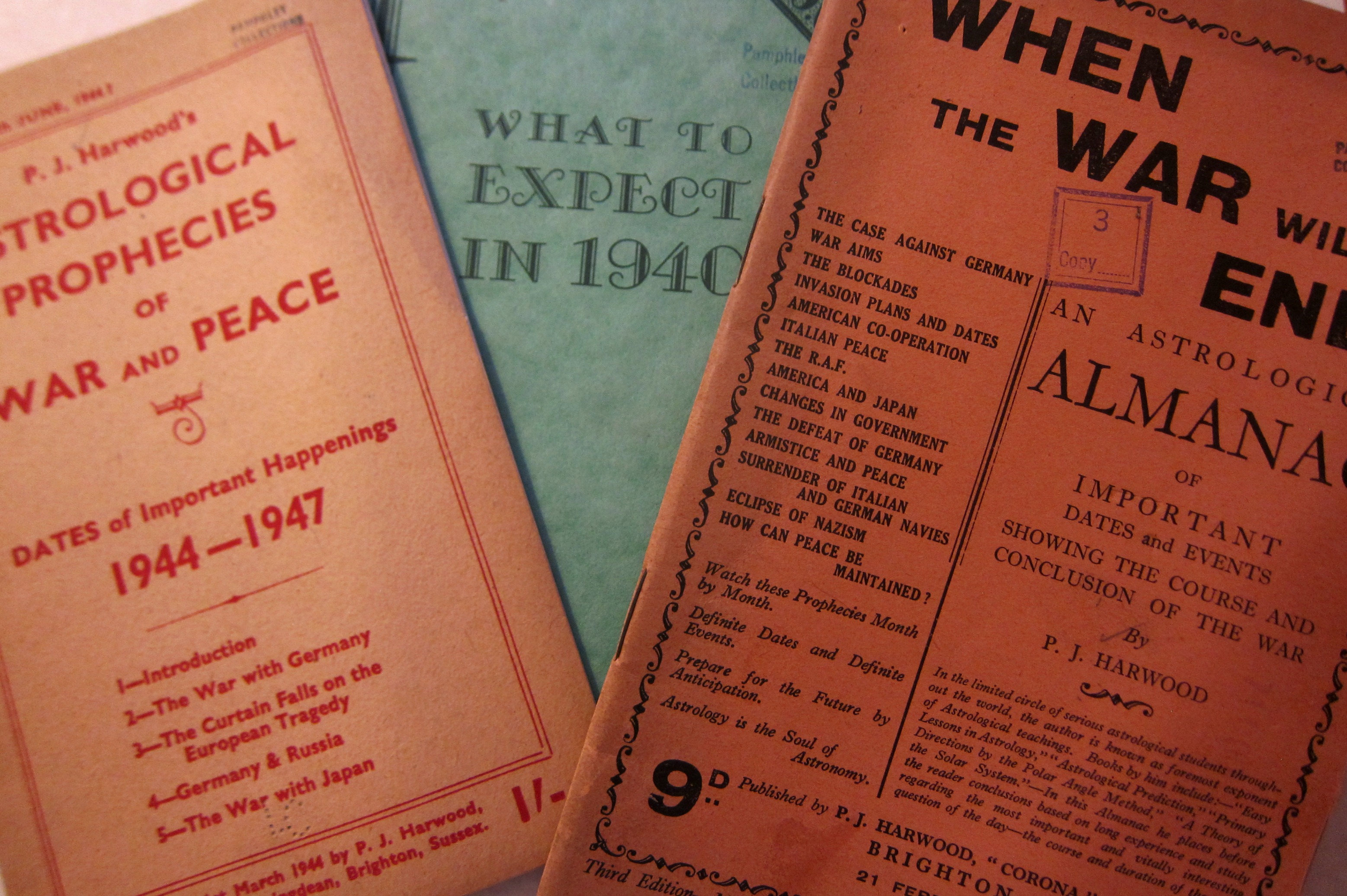
    The great Woo-woo (a blanket term used by James Randi to describe all manner of fake and fraud) of astrologers picking moist bits out of an imagined future during WWII proved to be of value for making an income for its users. One such person was P.J. Harwood, an astrologer who wrote two of the pamphlets I uncovered yesterday. He had shapely visions of the future metamorphised via the light of stars (and galaxies) that traveled for millions and billions of years, evidently their purpose in such vast time and impossibly enormous reaches of space being to cue in people on this planet about some influence their position in eternity has on future human events. The only predictive success these pamphlets by Harwood had was to ensure some sort of income and attention for himself. 

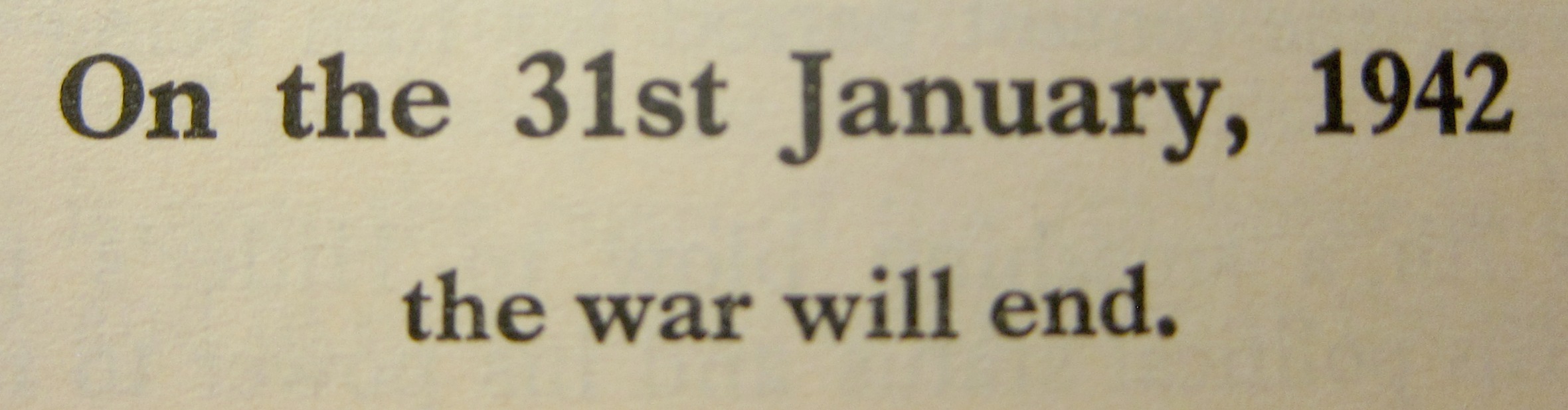
    I would not have stopped to say anything about these pamphlets (printed in 1941 and 1944) at all had I not opened one of them to a 32-pt announcement:                 

    Books astrology WWII war will end

    The funny thing is that this statement occurs in the third edition of the 1941 pamphlet. The way to move forward in publishing his views of the future was to ignore all of the misses and publish hios astrological results under a new title, which he did with his astrological prophesies book for 1944-1947, printed several times in 1944.  Britain was to invade Europe and speed towards Germany in May 1941, leading Hitler to eventually sign a peace treaty in 1944. The U.S. would suffer an enormous defeat on July 6, 1944, but recover enough to defeat Japan sometime in 1947, and so on.  This was one way for one man to make a living during WWII. 

    Books astrology WWII war will end

    ·Posted by :

    ·in:


  • An Early Indictment of the Japanese Invasion of China, 1931

    JF Ptak Science Books  Quick Post

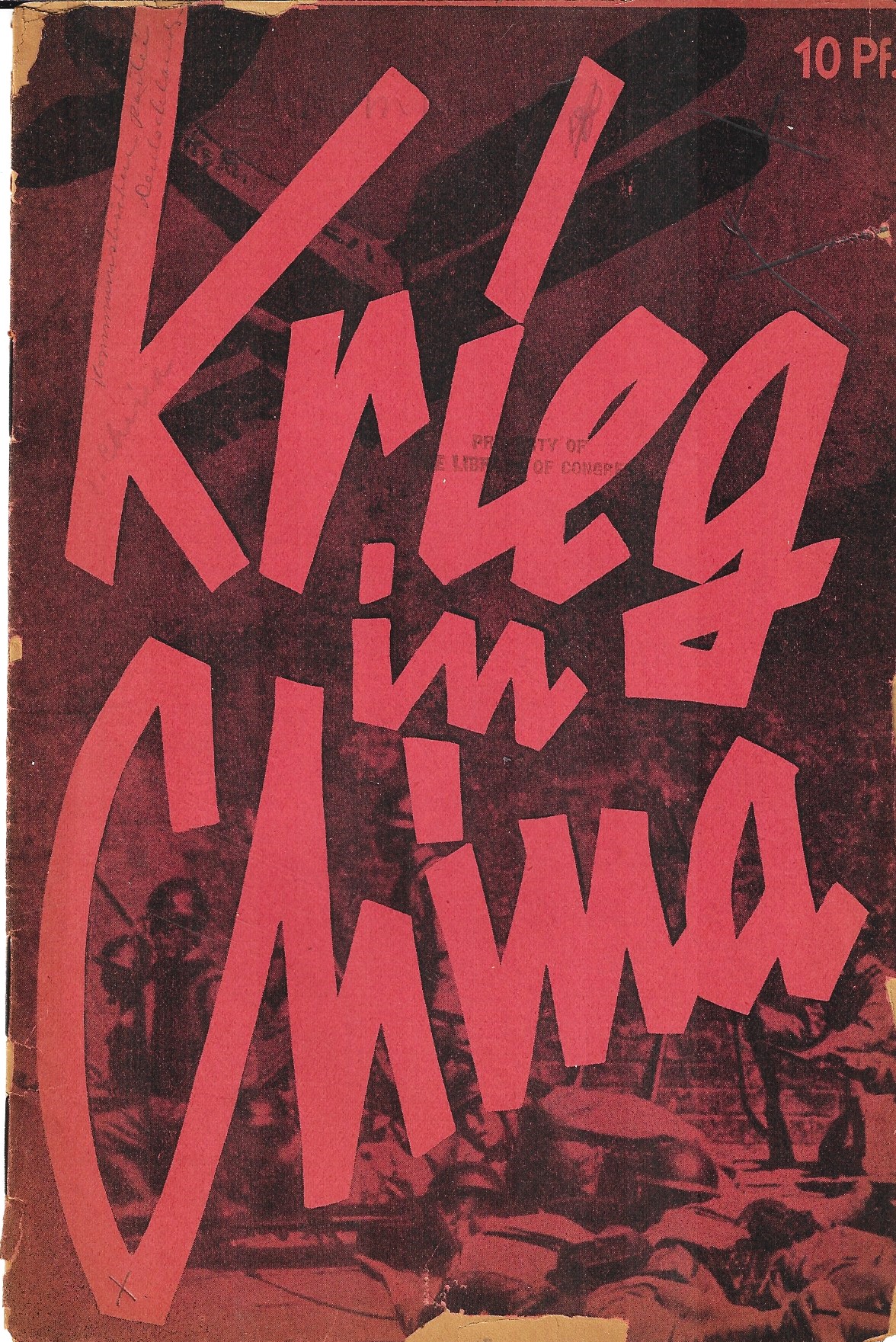
    Here’s another bit of graphic design, a very aggressive cover from 1932 for Krieg in China! by Ernst Schneller1.   Schneller–a long-time KPD member–wrote this short work as an expose on the “war” and in support of the Chinese, published it seems just months after the Japanese invasion and conquest of Manchuria and another few months after the battle known as the January 28 Incident, all of which was foundational for the war that would officially be declared in 1937 (and last until the end of WWII). 

    Schneller was himself a persecuted communist intellectual who was arrested became among the first to be imprisoned in the Nazi KZ system in 1933, and who would stay in the system until he was executed at Sachsenhausen in 1944. 

    It is interesting to note that in one chapter heading the pamphlet refers to the war as a new threat to the world (“eine neue welt droht”).

    DocFile (4)

    Notes

    1. Berlin : Kommunistische Partei Deutschlands, [1932] 9×6”, 15pp. A little confusing, though it seems that there are only three copies of this book located in WorldCat/OCLC. Provenance, Hoover Institution, and then in 1933 to the Library of Congress.


  • The Dictatorship of Hunger (1931)

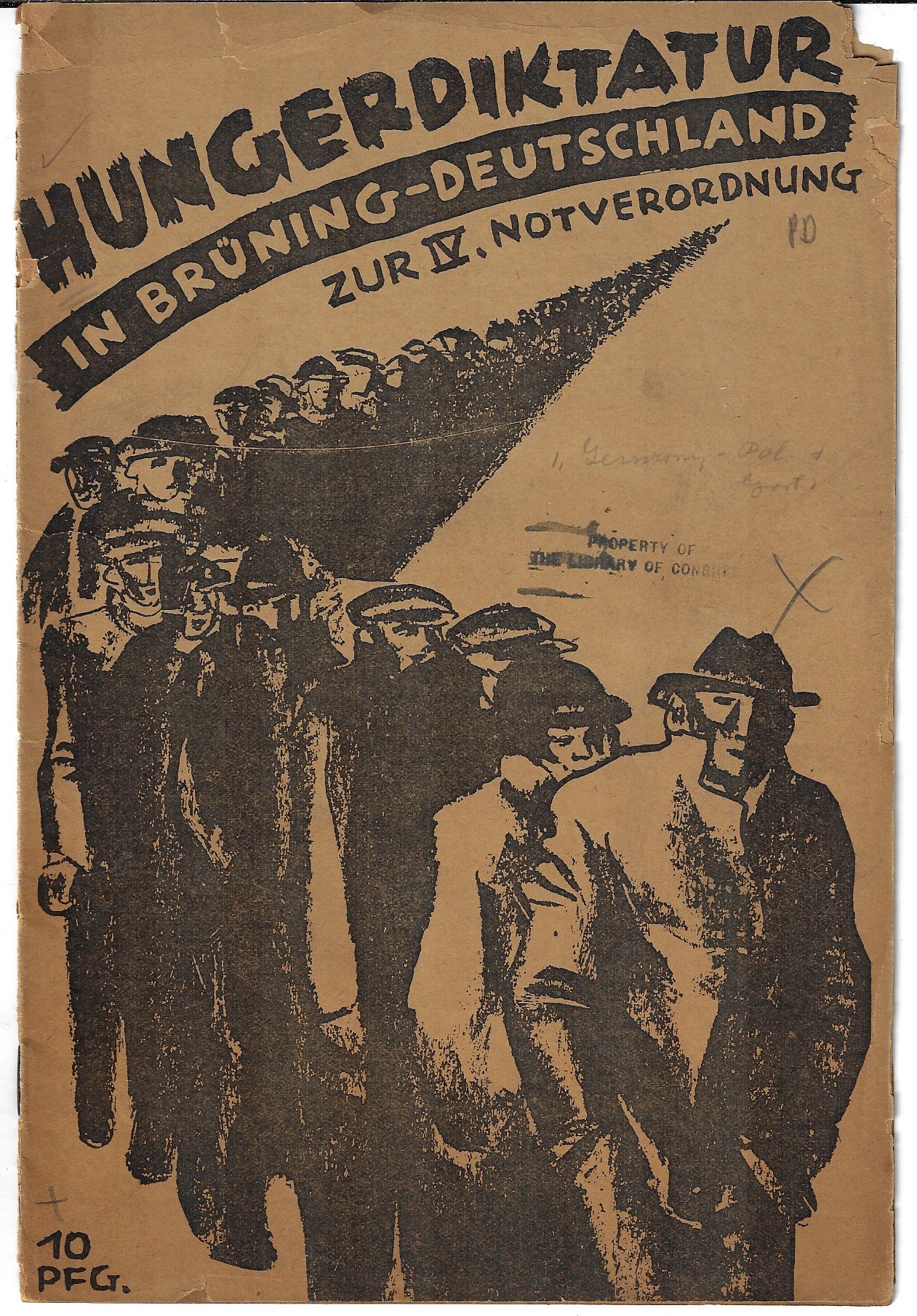
    DocFile (2)From what I can tell this pamphlet–Hungerdiktatur im Brüning-Deutschland zur IV. Notverordnung. Zk. Der KPD. 1931– is an indictment of the responses of German Chancellor Heinrich AME Bruning to the explosive Depression in Germany beginning in 1930. Bruning became Chancellor right at the outset of the Depression in 1930 and his options were already very limited, economically speaking, without the failure of the world economy adding to an already deeply compromised situation. Nevertheless, his policies are seen in different perspectives, and he was out of office by 1932 and fled Hitlerism and Germany altogether in 1934. (Bruning was two chancellors removed from Adolf Hitler taking the position in 1933.) In any event the pamphlet here leaves no doubt about the impossibility of the social situation in Germany in 1931 and places a long legion of the Hungry at the feet of Bruning’s Germany.

    The cover design is very striking, and unattributed.


  • How to Fly a Farman Biplane (1910)

    JF Ptak Science Books  Quick Post

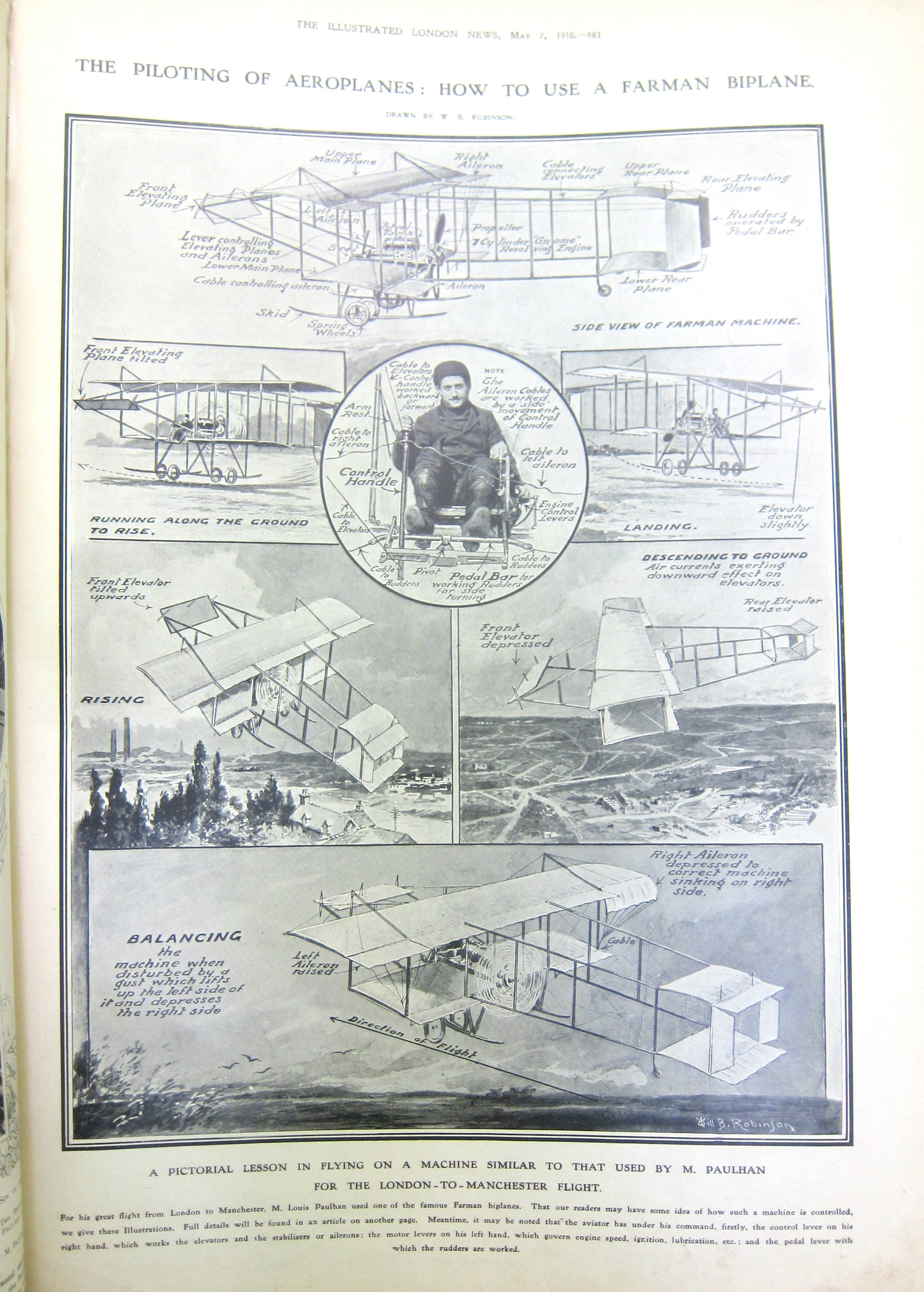
    I couldn’t resist sharing this because, well, I don’t often see a one-sheet explanation on how to fly a plane.  This is from the Illustrated London News, May 7, 1910, and concerns the Farman biplane:  

    Dataviz how to fly farman 1910


  • Great Calculators: Mental and Metal and back to Mental

    JF Ptak Science Books     Expanding Post 2739

    Two months ago I wrote on a paper that I found in a mid-century engineering journal (Minutes of Proceedings of the Institution of Civil Engineers with Abstracts of the Discussions) on the fantastic mental arithmetician George Parker. When I went to retrieve the volume to look for a different paper (on Fresnel lenses for lighthouses) I  flipped the pages to then end of the book to read through the index, and my thumb stopped on a page with a running header, “Mechanical Notations”. And lo and behold, the very familiar title was indeed a paper on a report to the Institution on Charles Babbage (1791-1871) and his “mechanical notation”, given by his son Henry P. Babbage (1824-1918).

    Well.  Babbage over the years proposed several different difference and analytical engines which indeed could be considered the first stored program Turing-complete computers. Never quite being able to get to the end of one project, and no doubt discovering along his various ways even better and more substantial designs (as well as int he pursuit of future money to build not “version 1.0” or “1.1” but “3.0”), Babbage tried within the limits of available technology to produce his heroic beast. His “mechanical notation” appears in full force in his diagrams for the design of his analytical engine, and it is there that we see his self-derived shorthand and symbols that produced and still-produce evident budgets of unknowns. The thing is, with these mechanical notations, is that they were part of a user manual, and the user manual was actually left unwritten and chiefly unexplained. And that is a problem. 

    In any event this paper by Henry Provost Babbage makes some attempt in outlining the notation, though for me it is done without success. This is further complicated by almost none of the notation presented in illustration. There were other and earlier illustrated papers (including some by Babbage himself) that stretch back at least to 1821–but this explanation of the notations leaves me a little on the outside. 

    And so we moved from the mental calculator George Bidder to the great metallic calculating engines of Charles Babbage, who takes us back to the opening biological/mental part of engineering thought via his manual-less manual, where his instructions and explanations of the interactions of thousands of perfectly manufactured precision gear works is printed but the key to which is left locked in Babbage’s head.  

    _____

    Here’s the part of the post that led to the discovery of the Babbage, both of these papers as I said appearing in the same journal volume: 

    George Parker Bidder (1806-1878) gave a lecture (without notes) explaining to the audience at the Institution of Civil Engineers in 18561 his interior practices and habits in performing absolutely prodigious and complex arithmetical feats entirely in his head. He was among the first tier of performing human calculators (like Zerah Colburn, b. 1804) mental calculations enchanted large audiences from the stages, answering seemingly impossible questions with accuracy and speed. It is in the 1856 paper (which Martin Gardner refers to as “historic2” and “valuable”) that he relates some of the practices which clarify his process–for example, one large element was that he would keep one fact in his head at a time, until it was finished, and then move on. Of course for people who did not have anything even remotely resembling this impossible ability, the information is interesting, though I have no idea how useful it may be…unless you were already a savant, that is.  Some things are just not to be known by mere mortals. Like the probably-apocryphal story of someone asking Hans Bethe how Richard Feynman had solved–on his feet–some impossible something, and Bethe responds: “First he thinks very very hard….and then he gets the answer”.) Something like that. 

    In any event, here’s the article, reproduced by Devonshire Perspectives website. My own copy is in a tightly-bound volume from the proceedings, and no doubt I would have broken the spine trying to copy the thing. That said, if anyone wants to buy this volume, it is for sale–this is a book selling site, sorta, after all.  

    The full lecture by Bidder:

    https://www.devonperspectives.co.uk/georgebidder/OnMentalCalculation.pdf

    Notes:

    1. Bidder, George Parker. “On Mental Calculation”, in Minutes of Proceedings of he Institution of Civil Engineers with Abstracts of the Discussions, volume XV, Session 1855-6, London, published by the Institution,  pp 251-280 in the 534pp volume. 

    2.  Gardner, Martin. “Mathematical Games”, in Scientific American, 216/4, April 1967, p. 117. 

    Also, I found an interesting biographical treatment of Bidder:

    • Bidder, George Parker. Mental Arithmetic. A short account of George Bidder, the celebrated mental calculator: with a variety of the most difficult questions, proposed to him at the principal towns in the kingdom, and his surprising rapid answers, etc. by George Parker BIDDER Rapid Calculator and Engineer., 1821

    It seems as though there was a separate edition of this 1856 lecture tens years later, published by Clowes:

    • Bidder, George Parker, and Institution of Civil Engineers (Great Britain). On Mental Calculation. Edited by Charles Manby. London: Printed by W. Clowes, 1866.

    And another printing somewhat later:

    • Bidder, George Parker. On Mental Calculation. London: Printed by W. Clowes, 1886.
    ·Posted by :

    ·in:

    —

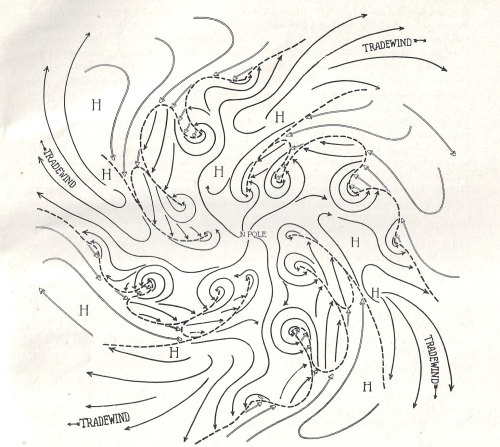
  • A Beautiful Diagram of Cyclone Activity (1922)

    JF Ptak Science Books  Post 2750

    This lovely and significant piece of sci-art appeared in Jacob Bjerknes and H. Solberg’s  “Life Cycle of Cyclones and the Polar Front Theory of Atmospheric Circulation”1 in 1922. This was an expansion of an earlier paper of 19192, and provided the basis for the motion of the atmosphere in terms of warm and cold fronts. “Although rapid transitions or discontinuities in temperature, pressure, and wind velocity had been noted in Jacob’s first model—and even by nineteenth century meteorologists—and although such discontinuities had been theoretically postulated, the 1919 Bergen cyclone model represented the introduction of discontinuities into meteorology as the major focus for practice and, eventually, theory. These “fronts,” as they later were termed, were endowed with scientific reality through the introduction of major changes in forecasting practice. The cyclone model based on fronts entailed the ability to specify in time and three-dimensional space important weather phenomena associated with cyclones to a much greater degree than earlier models could achieve. During the next few years the Bergen group of Vilhelm and Jacob Bjerknes, Ernst Calwagen, Halvor Solberg, and Tor Bergeron, among others, expanded this preliminary cyclone model and accompanying forecasting methods to a comprehensive system for explaining midlatitude weather changes. The polar front, the occlusion process, an evolving cyclone model, and air mass analysis were the conceptual foundation for a new era in meteorology.”3


    Bjernkes

    The two authors “…pictured the polar front as a string of families of cyclones, described by dashed lines linking successive warm and cold front”.–Mark Monmonier, Air Apparent: How Meteorologists Learned to Map, Predict, and Dramatize Weather, pg 64, with several reproductions of some of the lovely diagrams.

    Notes:

    1. J. Bjerknes and H. Solberg, Life Cycle of Cyclones and the Polar Front Theory of Atmospheric Circulation. Offprint/separate, Geofysiske Publikationer 3, no. 1, 1922. 12×9, 18pp (paginated 1-18). Bound in cloth, with a half-title and title, though no publication data save for a running abbreviation of the journal name and volume above the text. Nicely bound in buckram. Provenance: U.S. Navy, Naval War College. “Polar front theory is attributed to Jacob Bjerknes, derived from a coastal network of observation sites in Norway during World War I. … The convergence line ahead of the low became known as either the steering line or the warm front. The trailing convergence zone was referred to as the squall line or cold front.”–Wiki
    2. This was evidently a longer and more thorough version of a paper submitted by Bjernkes and Solberg to the Monthly Weather Review in 1919 on the findings of the Bergen group. –Robert Marc Friedman, Appropriating the Weather: Vilhelm Bjerknes and the Construction of a Modern Meteorology, p. 180; also noting that this article is “frequently cited”.
    3. Complete Dictionary of Scientific Biography.
    4. Wikipedia entry for Bjerknes. 

    “Bjerknes was part of a group of meteorologists led by his father, Vilhelm Bjerknes, at the University of Leipzig. (“Bjerknes’s father, Vilhelm. has often been called the father of modern meteorology. This title is doubly appropriate, for not only did Vilhelm’s vision and research programs lead to establishing new directions, methods, and the conceptual foundation for the science, but Vilhelm’s son also played a fundamental role in creating this new era in atmospheric science.”) Together they developed the model that explains the generation, intensification and ultimate decay (the life cycle) of mid-latitude cyclones, introducing the idea of fronts, that is, sharply defined boundaries between air masses. This concept is known as the Norwegian cyclone model.”–Wikipedia

    “The “Bergen School of Meteorology” is a school of thought which is the basis for much of modern weather forecasting. Founded by the meteorologist Prof. Vilhelm Bjerknes and his younger colleagues in 1917, the Bergen School attempts to define the motion of the atmosphere by means of the mathematics of interactions between hydro- and thermodynamics, some of which had originally been discovered or explained by Bjerknes himself, thus making mathematical predictions regarding the weather possible by systematic data analysis. Much of the work was done at the Geophysical Institute, University of Bergen, in Bergen, Norway.”–Wikipedia  It should be noted that Jacob was the chief forecaster and head at Bergen 1918-1931.–Complete Dictionary of Scientific Biography

    ·Posted by :

    ·in:


  • Radio HATE, Stuttgart, 1939/1940

    JF Ptak Science Books    Quick Post

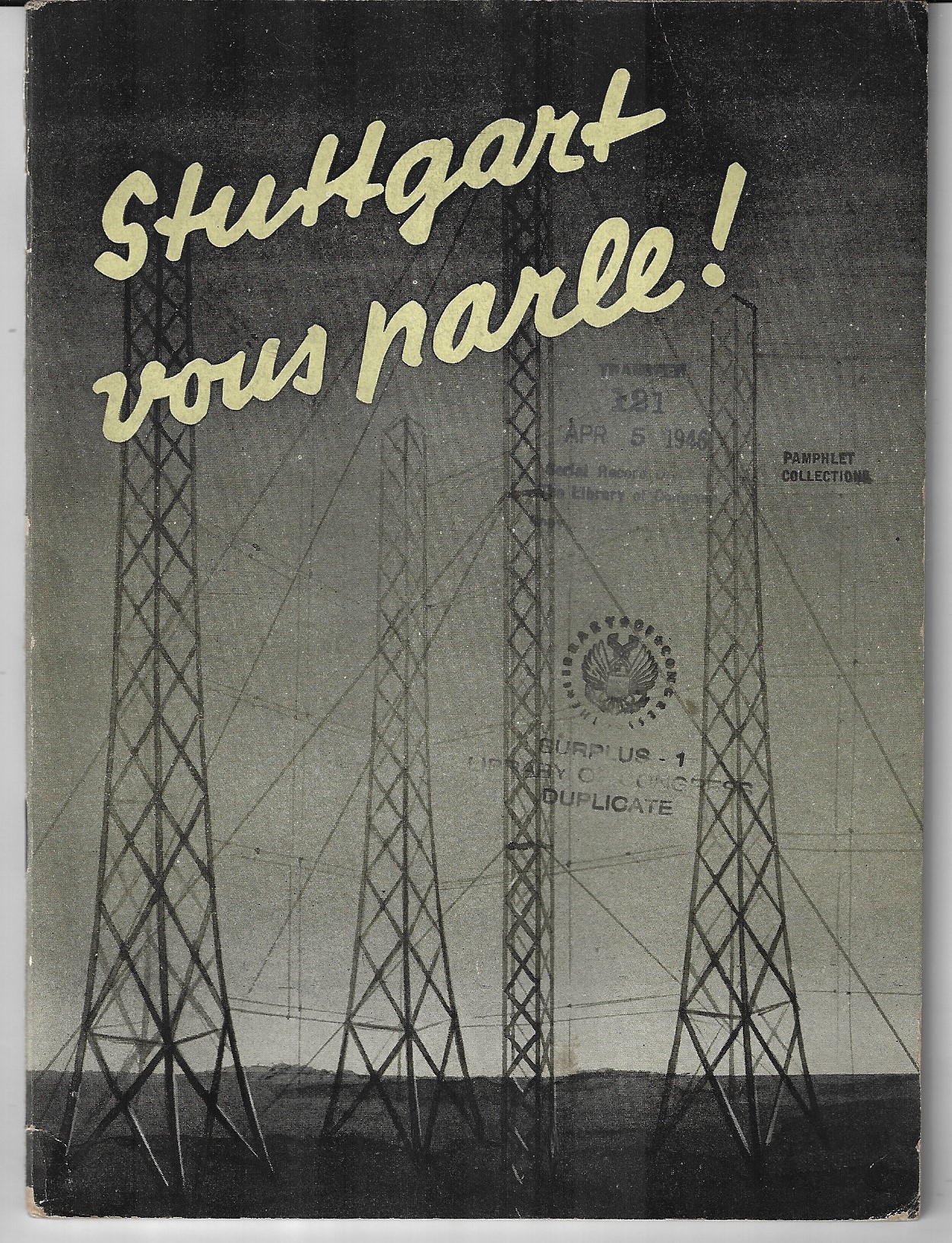
    Books covers stuttgart radioThe pamphlet Stuttgart vous parle! (ca. 1941) is nearly the same name as the Stuttgart radio station/program which was a propaganda arm of the Nazis, broadcasting into France in 1939 and 1940, and progressively less so after the French capitulation. Goebbels was very thorough in controlling the radio and television programming/writing/distribution in Germany, as well as creating propaganda broadcasts into Nazi-occupied countries. There is very little question about where this pamphlet is heading, its pro-German, appeasement, anti-Ally, anti-USSR, pro-Vichy sentiments being very clear.  For an example, here’s a bit from page 30, which recommends the immutability of Mein Kampf:

           “Si en quelques jours, devant l’evidence des menaces et des pieges que l’Angleterre lui tendait, le Reich s’est reconcilie avec Moscou, il faut admettre qu’il n’existe pas d’idees preconcues dans la mentalite du Fuhrer et qu’il dirige la politique allemande au mieux des eventualites. Que ces quelques explications vous fassent saisir ce qu’il y a d’immuable dans mein kampf et ce qu’il s’y trouve de momentane, c’esttout ce que nons esperions aujourd’hui.”

    Experts state that the principal broadcaster for the radio show was Paul Ferdonnet. Captured at the end of the war in Germany, Ferdonnet was tried as a war criminal, a charge he denied, saying that it was not he who was the broadcaster and so on. The court found otherwise, and Ferdonnet (“le traître de Stuttgart”) was convicted and executed in short order, not living to the end of the summer of 1945.

    [There is also a publication Stuttgart vous Parle! Les Discours de Paul Ferdonnet Diffuses vers la France a partir de la Radio Allemande en 1939-1940 (edited by VHO), which seems to state in certain terms that Ferdonnet was indeed guilty of war crimes for his participation in pro-Nazi propaganda. It is also interesting to note that  Stuttgart vous parle!  has no identifying marks for publisher, printer, or place of publication. Nothing.]

    On the one hand, free speech is a big deal; but free speech does not extend to shouting “Fire!” in a crowded theater. (I’m slipping up on the name right now, but there was a case back in the ‘teens of 100+ people, mostly women and children, family of union members, who were meeting in a hall when an anti-union thug yelled “fire!”, starting a deadly stampede.) Working away at the psyche of a people trying to defend itself, trying to survive, is very nasty and murderous stuff. Ferdonnet was executed for this action, a fate escaped by E. Pound for his Fascist broadcasts in Italy during WWII…but all of that is another story. 

    ·Posted by :

    ·in:


  • Creating National Monuments Made of the Ashes of the Dead (1917)

    JF Ptak Science Books  Quick Post

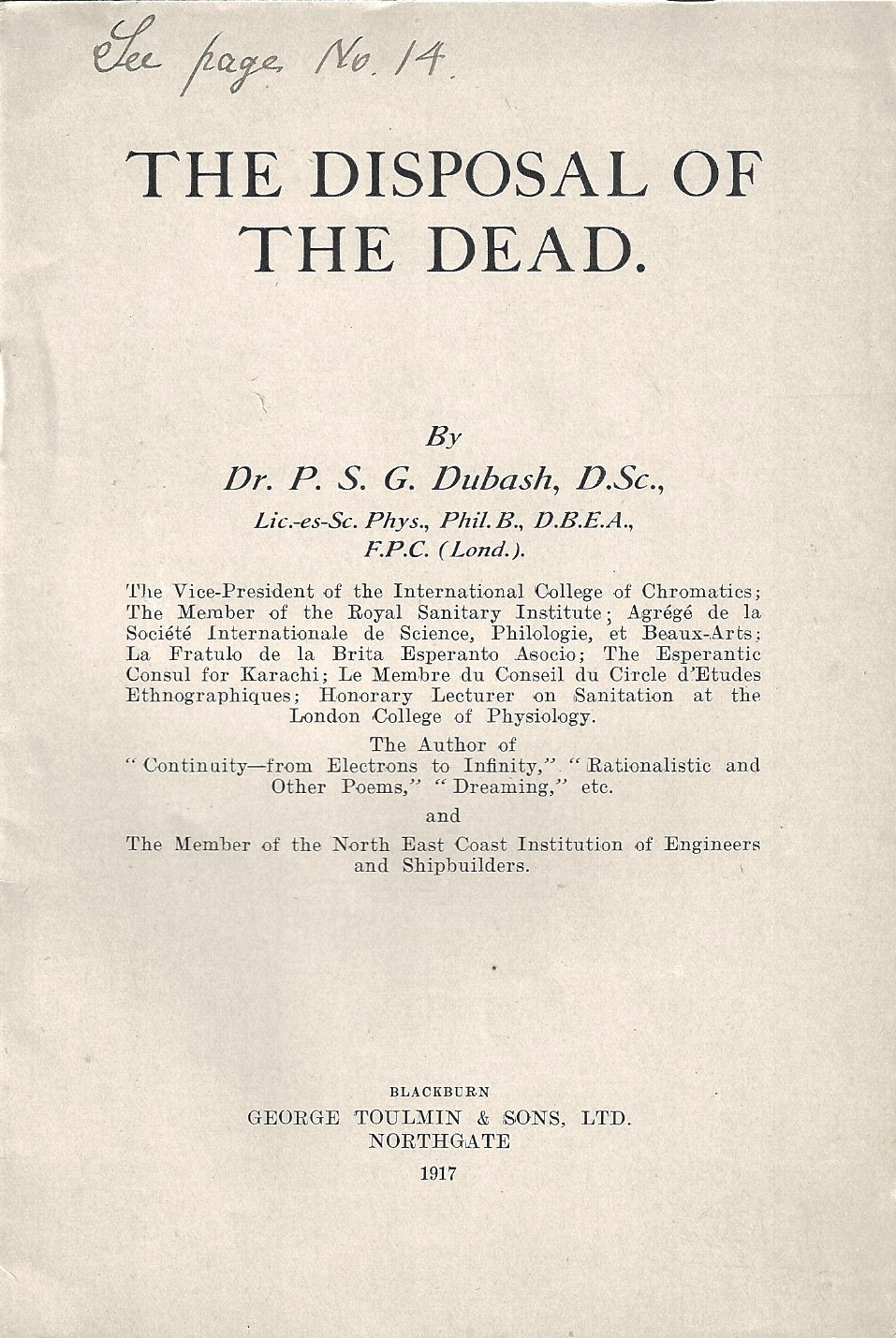
    Books covers disposal deadIn the death-drenched year of 1917, in the third year of the then Great War, P.S.G. Dubash offered to readers here and there the idea of transforming the ashes of the dead into something “useful”, using them as the material for creating statues of the “Great Departed”.  “The world today is so much the poorer for not having the ashes of such great men as Isaac Newton, Lord Kelvin, Martin Luther…”  and so, we can create statues of them using the ashes of others. This would be particularly so for people contributing their ashes to the statue of someone whom they admired. In that way, as Dubash points out, the remains of soldiers would live a more sustained post-death state by being part of a statue of, say, Lord Kitchener. “Towns can be thus adorned with the living memories of the great dead.”

    Part of this 18-page pamphlet (published by George Toulmin & Sons of Northgate) describes the four ways of disposal of the dead: internment, embalming, burning in the open, and the towers of silence (where bodies are brought to a height and displayed to be eaten by birds).  Dubash makes the case of great waste in three of the four, only finding use in the “exposure” category.  

    And so, there you have it. There’s a certain something here that makes sense, using thousands and tens of thousands of remains to create statuary. Gravestones and memorials aren’t made of ashes, but they are reminders of what sleeps underneath, and in a way they are a type of mostly-repetitive statuary sans biological remains. 

    There is an interesting part here at the end of the pamphlet, where Dubash makes the case that “there should be no colour prejudice, because after death there is no colour prejudice, because in the eyes of God the colour prejudice is a sin”. This is a provoking comment, and makes me think of the history of the skin color in Heaven…a history that I do not know.