A Daily History of Holes, Dots, Lines, Science, History, Math, Physics, Art, the Unintentional Absurd, Architecture, Maps, Data Visualization, Blank and Missing Things, and so on. |1.6 million words, 7500 images, 4.9 million hits| Press & appearances in The Times, Le Figaro, Mensa, The Economist, The Guardian, Discovery News, Slate, Le Monde, Sci American Blogs, Le Pont, and many other places… 5000+ total posts since 2008.

Author: JF Ptak

  • Finding the Center, continued: the Center Sun and the Center of the Universe. 11th Anniversary Post

    JF Ptak Science Books   Post 2787

    In the long history of finding the Center of Things is the subset (or overset) of finding the center of the galaxy (which until the 1920’s was the universe) or of creation. The center changes over the dozens of centuries, not the least of which was the flower of creation blossoming outward from Jerusalem.  
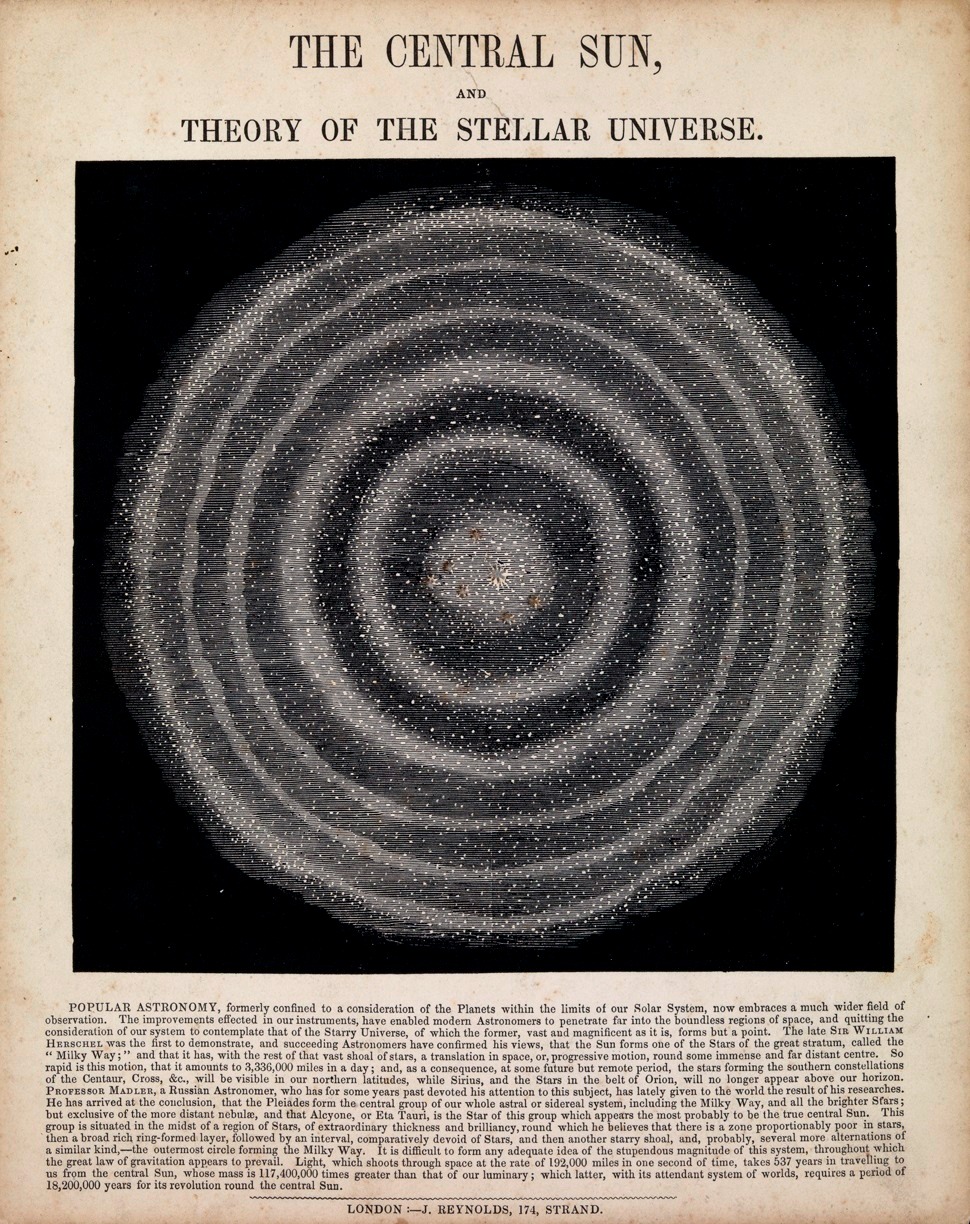
    Astronomy--central sun

    • Image source:  Greenwich Observatory29x23cm http://collections.rmg.co.uk/collections/objects/263846.html (This is a depiction of the center of the universe, the Central Sun, as hypothesized by William Herschel and  later by Johann Henirich von Maedler (1794-1874), who published his observational results in Die Central Sonne, Doprat, 1846.)  This legend to this image is very legible once expanded. 

    Where is the center?
    Where is the center of the Earth, of religion, of the United States, of the universe, of art, of consciousness, of seriousness, of complexity?
    The center of stuff throughout history has been an almost entirely shifting matrix, a collection of vortices coming from Jupiter’s strongbox–a three dimensional representation of the location of their shifting centers over time would make an interesting Fibonacci-like display, I think.\The question may seem meaningless at first, but people have long asked it of nearly everything within their experience, trying to find the center of their world and universe, of their selves, of their religion, of their country, of politics, of art and music, and on through the Encyclopedia of Things that Could Have a Center.

    Take for example the questions of where the center of the Earth, or solar system, or galaxy, or universe might be?  There have been answers to these question more often than not over time, though the answers have been shifting.  The center of the Earth has certainly stayed more-or-less constant over thousands of years, though the stuff in the center has been swarming with change, from being hollow, to being filled with magma, to being a solid magnetic core, to being occupied by Mole Men, to housing the seat of the Inferno, or to be simply located on the surface of the sphere at Jerusalem (as the old T-maps have shown for hundreds of years), and on and on.  Working backwards, the center of the universe has drastically changed over time–for thousands of years, it was assumed that the Earth was the center of all things, until it wasn’t (that beginning mostly with Copernicus, and then challenged with Galileo’s use of the telescope and his discovery of an order of magnitude more stars, etc.).  And then William Herschel beautifully represented the shape of the galaxy in 1782, placing our solar system in a far from central location.  The center of the universe’s fate changed along with that of the Earth, incredibly so beginning with the Big Bang and then with the possibilities of their being a universe without boundaries.  And then of course there’s multiple universe theories, and worm holes, and the space time continuum, which complicates things even further, making the discussion of a “center” pretty much nonsensical.

    Simpler things can be as complicated–where is the center of the United States?  If we measure the center for the lower 48 states, it will be different than if we included the two far-flung states, or protectorates like Puerto Rico. The geographical center is one thing; another might be where the population center might be–that has made a beautiful map published over time by the U.S. Census Bureau (Department of Commerce), showing the star of the center moving not-so-slowly westward into Ohio over the last 20 censuses or so.  And where is the heart of the country?  Where is the heart of the West?  Better yet, where is the center of the West (or North, or South, or Mid-West)?  To answer where the center of these places might be you’ve got to first locate where those geographical ideas begin and end, which for many is a tricky subject, making it a matter of opinion as to where the center of these places might be.  
                                        
    The center in art had been a findable thing for some time, though more recently people like the Impressionists and Kandinsky have shown that the center might not exist, and it might not exist along with anything that is recognizable as a form of nature, representation and the center falling away completely.  Perhaps this is like finding the center of a decade or year or month, or week or day or second.  The parameters keep getting both smaller and larger, the ability to measure halves of things or the center of a second growing almost incalculably small, small enough to reveal that in this Zeno-paradoxical way, that there is no center because there are no boundaries; getting half-way to something into infinity doesn’t actually get you there.  

    Now, getting back to today’s image: this lovely illustration shows what is supposed to be the center of the galaxy, which at the time also meant the center of the universe.  The model was based on the observations and hypothesis of William Herschel, and then later more firmly put forward by Johann Henirich von Maedler (1794-1874), who published his results in Die Central Sonne, Doprat, 1846. The Central Sun was supposed to be the star Alcyone in the constellation of the Pleiades. Alcyone (or Eta Tauri, “the Central One”), who in legend threw herself into the sea in deep grief after an encounter with the disguised Morpheus; the gods though took pity or exhibited compassion and changed her into a bird, the Kingfisher. The Kingfisher is a bird which lays its eggs around the time of the equinox in December, the gods showing more mercy by introducing a period of non-stormy weather for seven days, and so introducing the (H)alcyone Days of winter. (I just missed being able to post this during that period by about a week.)  The Pleiades, (“the Seven Sisters”), were the seven daughters of Atlas, who (long story fractured) were turned into stars to ease the worry of the father who was busy doing others things, saving them from their instant pursuers once their protector was otherwise engaged. Orion, however, still pursues them across the sky.

    Here’s the concept of the Central Sun, explained for the kids of 1872:

  • History of Holes: Filling Holes Up

    JF Science Books  Post 2786   (Part of, yes, the History of Holes series)

    Holes and Dots (and anti-Dots) and Circles all have some longish threads running through this blog, though where they are actually running to is unknown at this point–perhaps when they get “there” they’ll recognize it and stop. Today’s installment scopes out the writing property for filling-holes-up, perhaps on the road to a Picture Alphabet of Hole-Filling:  filling holes with seeds, explosives, death, trains, square pegs, cities, music, everything in existence, soldiers, blood, superconducting super colliders, fallout shelters, radioactive waste, books, a shadow, a sunbeam, light in general, and so on.

    Somehow though it seems a larger and more explosive time in describing how holes are made in the first place, but that’ll be for another time. 

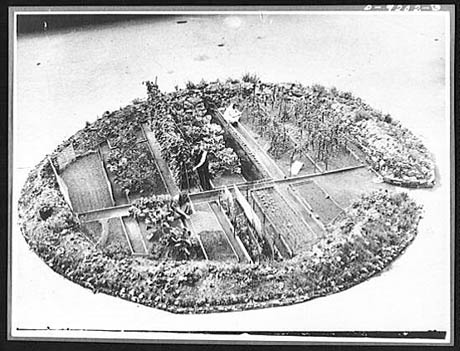
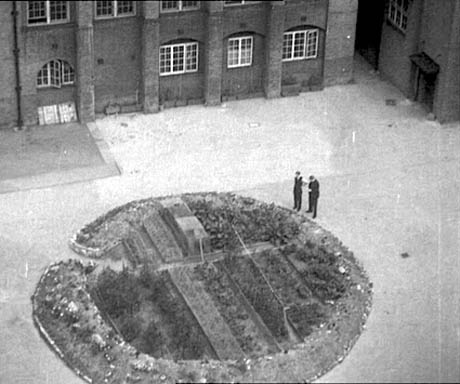
    The first image comes from Ediblegeography and shows a Nazi-caused bomb crater during the Battle of Britain ca. 1940/1 with its new innards. 

    And ditto1 here:

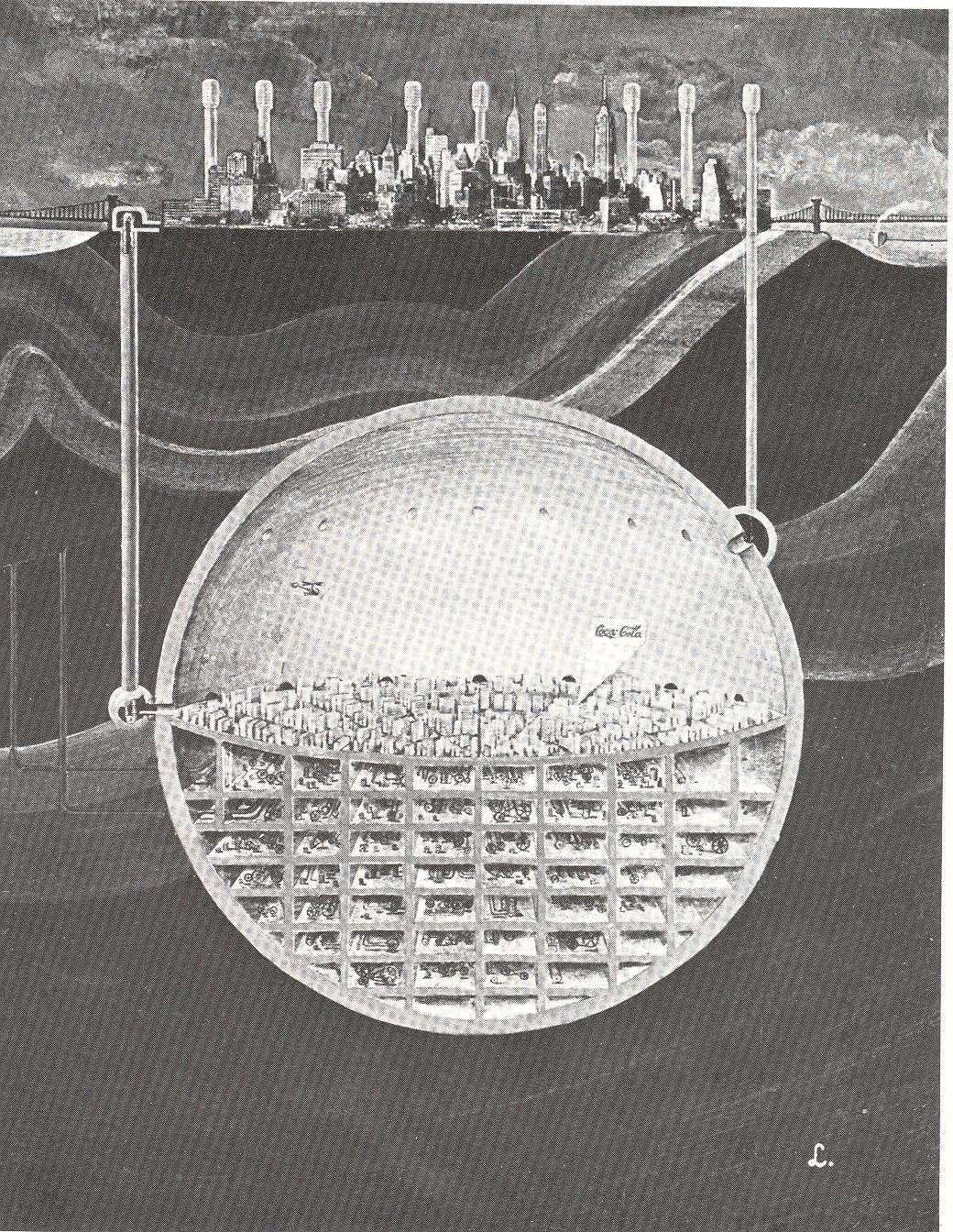
    A very unusual instance of filling holes up is when they are filled with cities.  Underground holes for some reason sang out their siren tunes of underground cities, landing the listening Oscar Newman on the rocks with his singular design.  The 1969 underground city (the image of which can be found in Alison Sky and Michelle Stone’s  Unbuilt America,  McGraw Hill, 1976, page 192–no home should be without this book) shows his fascination and unguarded belief in such an idea, though the whole things reminds me of a dog-buried ball.

    Blog--april 5 atomic city

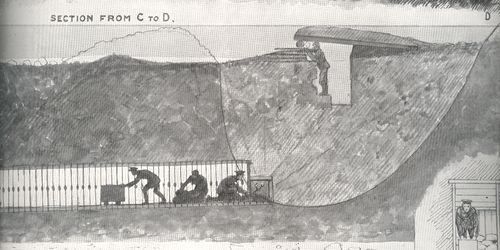
     During WWI  the indomitable sappers would dig long, tenuous tunnels under the field of battle to the enemy’s position, and then fill up the end of their hole with a lot of explosive, and then blow their enemy to kingdom come. This would be the Hole Filled With Death.

    Holes--sapper

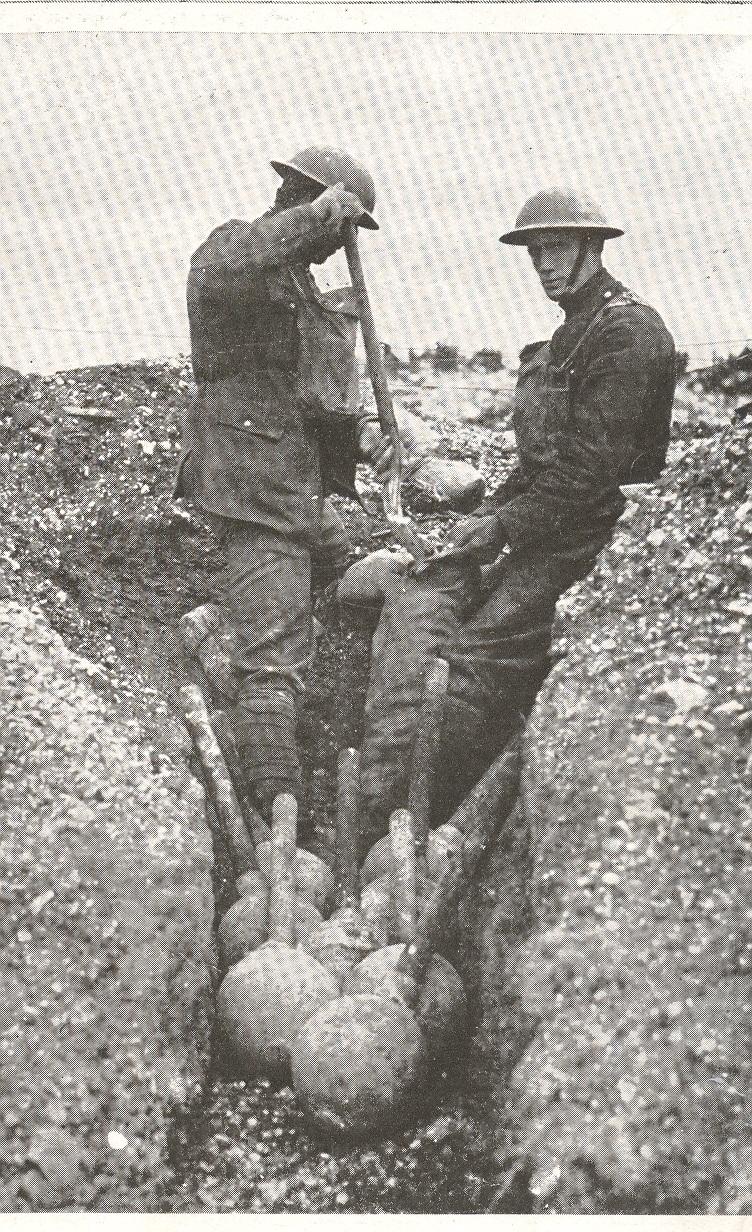
    Holes filled with men–if holes can be considered so that are half-a-hole, as in a “trench”, then the period from 1914-1918 saw a 25,000-mile half-hole filled with 50 million men, half of whom would not come out alive, as they had been riddled with holes that got filled up with their blood.   Blog april 29 trench

    recording telegraphs made holes in paper tape so that the messages could be played back in their entirety later on

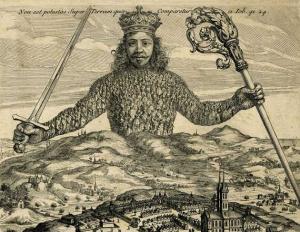
    I suppose too that a case could be made for the Leviathan, the empty holes of the political impresario filled to capacity with its subjects, the popular puppets filling the empty monarch because there is nothing there save for its need to be filled up, filled in the way that Gargantua and Pantagruel were filled.

    Leviathan_135448t
    Another very famous hole was filled with dark, a shadow cast by a stick, a lovely experiment carried out thousands of years ago by Aristarchus of Samos to prove his theory that the Earth was round.

    Not quite on the other hand is the sunbeam allowed to fall on the floor of the cathedral of S. Petronio in  Bologna through a speculuum in the ceiling, creating a solar clock (this being only one of many such examples).

    And I guess too that light entering one end of the telescope or microscope could also be considered a variant of filling-up-a-hole, if we can establish that a tube is a hole.  

    These holes below were filled with music–rather, they made it possible for music to be made through them, that they could actually produce a piano to play whatever music had been “transcribed” in them.

    In any event, this was meant to be a short thinking-out-load pieces on a Pictorial Alphabet of Hole-Filling, and it seems like a nice start.

      Music role making--1871


    Notes:

    1.  Again from Ediblegeography:  “Bomb crater victory garden (sadly long gone) near Westminster Cathedral, image from Pathé Films footage via City Farmer News”.

    ·Posted by :

    ·in:


  • A Stupendously-Dense Giant Atom Non-Bomb Threatens the Earth (1943)

    JF Ptak Science Books   Quick Post   (Another entry in the neglected “Strange Things in the Sky” category.) 

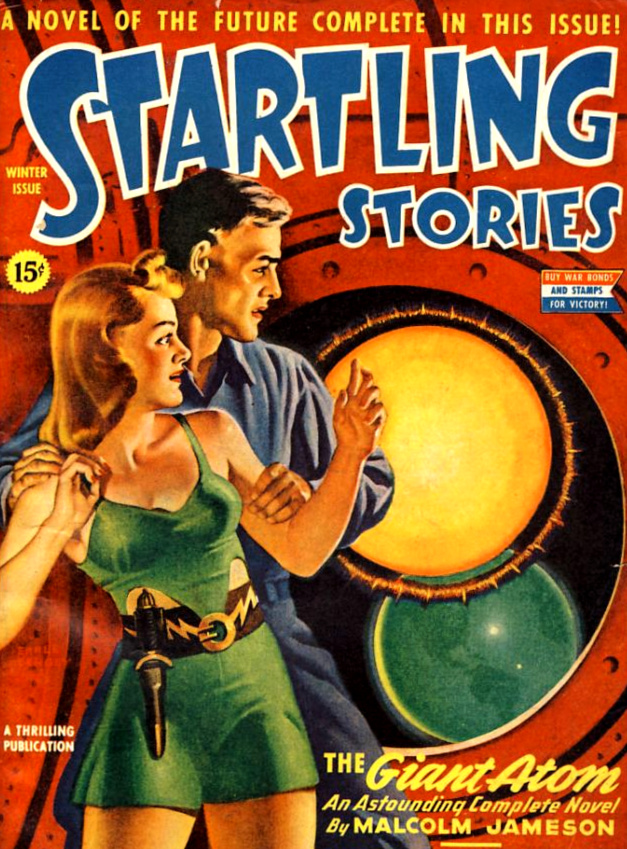
    Giant atomThe story “The Giant Atom” in Startling Stories was pretty striking to me, as it was published in December 19431 and (I thought) was illustrated with what looked like the first milliseconds of a nuclear explosion, except the reality of that event was still more than half a year away. There are a number of prescient atomic bomb stories written in the 50 years or so preceding the real one, and I thought that this one might be an odd, back-door entry to the little sub-genre. So before I got into the story I checked out the author, Malcolm Jameson, and found that the story was re-issued later as “The Atomic Bomb”, which ignited curiosity enough to at least start to read it to see if this was indeed an “atom bomb” story written in 1943.

    Possible evidence to the contrary, it seems as though this turgidly-written story was indeed about a gigantic blob-like atom. I can’t get to the details because the prose covered stuff up like a syrupy metal brick:  “Anything that is as small as four or five feet in diameter and weighs five or ten thousand tons is pretty dense, general.” 


    • Um. Yes.  It works out that this 5′ sphere would weigh about 3,000 average-sized cars, or 1/4 of the weight of the 887′ USS Missouri, something like 11,000 pounds/litre, or 11 pounds (4,983 grams) cm3 .  Osium, the densest metal, weighs in at 22 grams cm3.  That’s quite something. For another perspective, I believe a neutron star would weigh about 4×10⁷ pounds. 
    • Another way of looking at this, since the idea of the 4,000-lb bomb is introduced here, is via ordnance. The first 1000 plane bombing mission by the RAF occurred May 30, 1942 over Cologne, where the total amount of ordnance dropped equaled about one-third of the weight of the sphere. Cologne received 34,711 tons of ordnance from all Allied bombing missions during the war, about three times the weight of the sphere, doing vast damage and killing 20,000 civilians, or about 1.7 tons of ordnance per death.  So. The atom was heavy.

    The atom seems to have started out small and grew, though even at the beginning “a large formation of bombers dropping 4,000-pound bombs” had no effect on it. (Note: this was at just about the time when the Brits announced the introduction of a 4,000-pounder into its arsenal–about the largest bomb at the time.) 

    “Only Steve Bennion, Inventive Genius, and His Lovely Assistant, Kitty Pennell, Stand Between the Earth and Destruction When a Flaming Monster Threatens to Devour and Destroy Civilization!” it says, somewhere, of the “flaming monster” atom. How disappointing. 

    There’s too much going on in this work in too many (128!) pages, and I can’t be sure from a five minute browse that I know what the real story is.  It does seem as though some sort of giant atom comes to Earth and threatens the planet, somehow, and seems to grow quite a bit from the 4- or 5-foot diameter sphere to something much larger later on. There is some talk of “New Eden” and space ships and lifting the atom into the cargo bay of the space ship “New Hope”. As I said I thought that since this story would be re-titled (re-written?) as “The Atomic Bomb” that it had something to do with the bomb, though it seems not to, except for somehow weaponizing a cyclotron. Anyway I can’t go any further here because the story just isn’t interesting enough, though the cover art opens up some interesting twists of interpretation.  

    Notes:

    1.  Startling Stories, December 1943 [vol. 10, no. 2 “Winter Issue”] [New York and Chicago: Better Publications, Inc.] 

    Text source: https://gutenberg.ca/ebooks/jamesonm-giantatom/jamesonm-giantatom-00-h.html#chap05

    Image source: Parigi Books, where you can purchase the original, at  https://www.parigibooks.com/pages/books/27413/malcolm-jameson/the-giant-atom-in-startling-stories-winter-1944

    ·Posted by :

    ·in:


  • A First Book about Books about Books

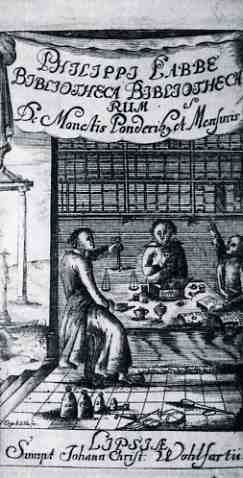
    Bibliography of bibliographiesPhillippe Labbe (1607-1677), a contemporary of the savant’s savant, Athanasius Kircher, and who was himself a prodigious polymath, produced this fantastic piece of scholarship, the Bibliotheca Bibliothecarum…accedit bibliotheca nummaria.  He was a member of the Society of Jesus, like Kircher (which whom he also shared similar birth and aeath dates, Kircher’s being 1601-1680); and was born in the town of Borges, France, which gives him an almost invisible connection to one of the 20th century’s most imaginative/flexible writers in the great blind librarian of Argentina.  This book, published in Leipzig in 1682 as the second edition of the 1662 first,  is the earliest extant work of bibliography of bibliographies (it also has a very useful work on numismatics, as we can see from the last part of the title.)  Gathering the data necessary to produce this work was a prodigious undertaking–Labbe needed to have had access to fine libraries to assemble the data, then of course he needed the brain to handle all of the disparate and erudite areas of learning, and then be smart enough to organize it all.  This was an enormous accomplishment in 1682–with the stuff that Labbe had floating around in his brain and the reasonable aspect of disseminating it, Labbe would’ve been a National Treasure to whichever country he would call “home”. 

    I haven’t seen the title page of this book for many years, and my memory of it had these three bibliophiles holding drinks in the air–but I’m wrong, unfortunately.  The scholar on the left is weighing something, the scholar o the right is pointing to a book, and I not exactly sure what scholar-middle is doing.  One thing for certain though is that these men are not drinking.  Somehow I’d’ve preferred a few rounds with all of that scholarly/scientific bric-a-brac strewn on the table, but it was not to be. 

    Some of Labbe’s selected works include:

    • Trirocinium Linguæ Græcæ etc. (1648)
    • La Géographie royale (1646)
    • De Byzantinæ historiæ scriptoribus, etc. (1648)
    • Concordia sacræ et profanæ chronologiæ annorum 5691 ab orbe condito ad hunc Christi annum 1638 (1638)
    • Bibliotheca antijanseniana (1654)
    • Bibliotheca bibliothecarum (1664)
    • Sancrosancti Oecumenici Tridentini Concilii . . . canones et decreta (1667)
    • Sacrosancta concilia ad regiam editionem exacta

    ·Posted by :

    ·in:


  • A Good Survey of 1950’s Computer Science

    JF Ptak Science Books   Quick Post

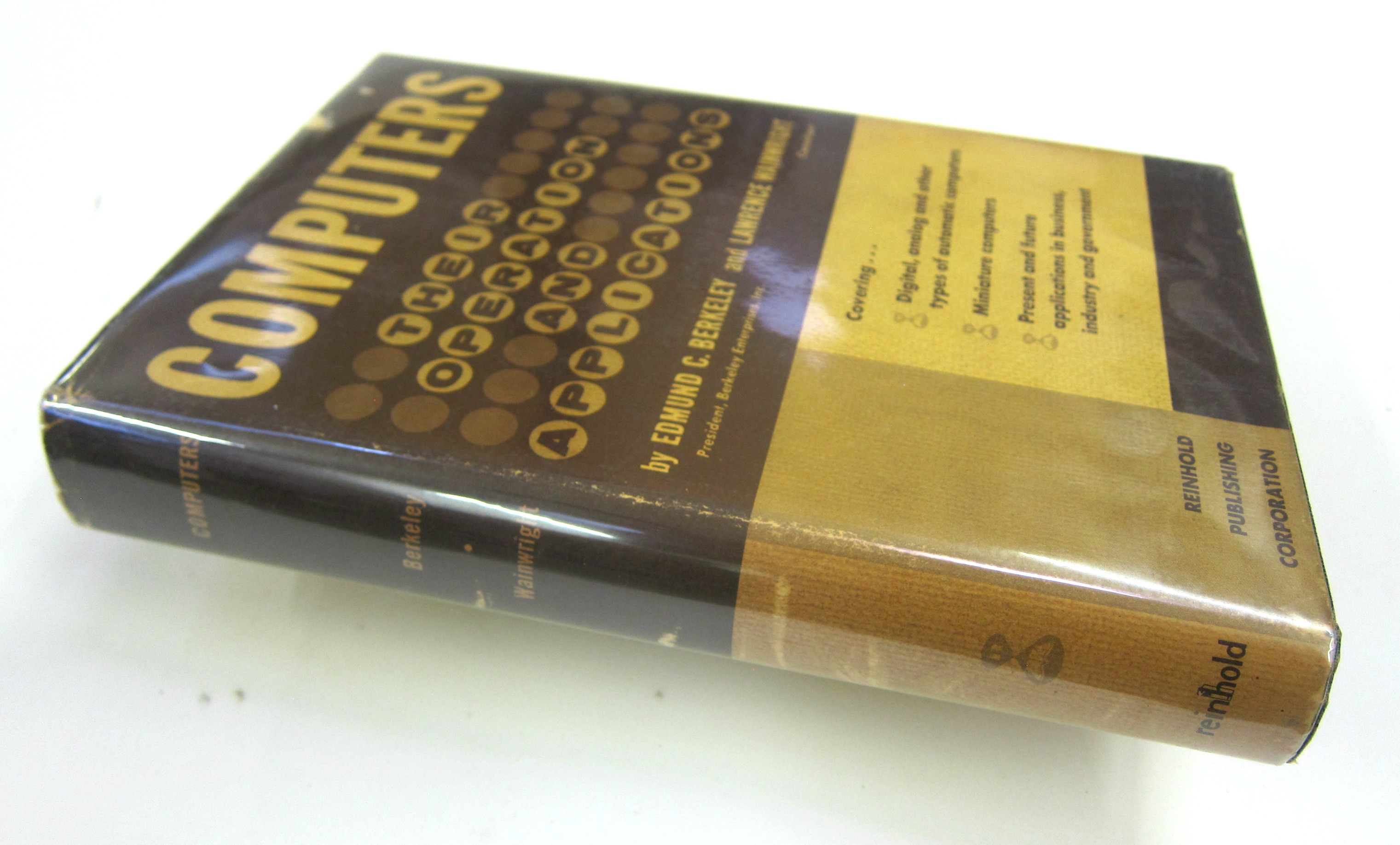
    Computer book berkeley COmputers 1956Edmund C. Berkeley and Lawrence Wainwright’s Computers, their Operation and Applications is a comprehensive, well-documented, and pretty-well referenced early-ish work in the field by one of the busiest men (Berkeley) in the computer field from 1948 (when he wrote Giant Brains or Machines that Think) to 1958. (Berkeley in many ways is like Gil Hodges of the Brooklyn Dodgers—one of the most productive  participant in his field for a decade but not in the HOF not so greatly acknowledged. even after long periods of major contributions. The difference is that Hodges has his champions; not so much for Berkeley.)

    The book’s chapters/sections include: Machines that Handle Information; Automatic Digital Computing Machines; Automatic Analog Machines; Other Types of Automatic Computing Machines; Miniature Computers and their Use in Training; Some Large-Scale Automatic Digital Computers; Applications of Automatic Computing Machines, followed by a good 24pp glossary “of terms and expressions”. The digital computer section is pretty nice, and includes at the end a five-page list of 200 or so digital computers; ditto that for a list of automatic computers.

    The “Miniature computers” section includes a long (pp 174-210) treatment of the history and main features of Berkeley’s own 1950 machine, “Simon”–certainly it is the longest piece I’ve seen dedicated to this machine outside of Berkeley’s series of articles on it in Radio-Electronics magazine in 1951. Some consider Simon to be the first personal computer, but the 39-lb machine had very little functionality outside of a demonstration device. That said, Simon was expanded in the interim, and those modifications are described here. There’s also a 15pp section on the Bush Differential Analyzer (“MIT II”),  6pp on the Harmonic Analyzer; 15pp on UNIVAC I, 8pp IBM 700 series, and 6pp ERA 1103. 

    Notes:

    1. . Reinhold Publishing Co., 1956. First edition. (8), 366pp, illustrated.

    ·Posted by :

    ·in:


  • Pigeon Heroes of WWI

    JF Ptak Science Books   Quick Post

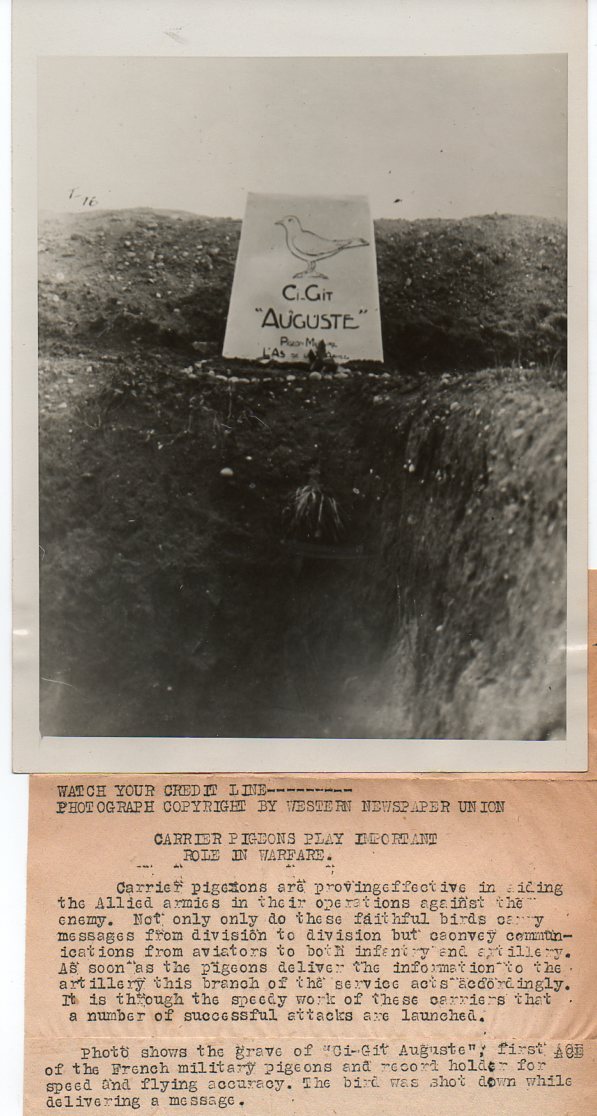
    Here’s a series of three photographs relating to carrier pigeons in WWI.  The first is a magnificent photograph of a memorial to a carrier pigeon named Auguste, a famous flyer who evidently performed invaluable services time after time, a bird of splendid behavior whose actions no doubt saved the lives of many soldiers, and who was shot down by German troops in commission of an assignment.  Auguste’s comrades constructed this makeshift memorial in the trenches for the heroic animal.

    WWI--pigeon714

    And another photograph that told the story of the pigeon in very plain  language:

    ·Posted by :

    ·in:


  • A Small World of Rubber Bands and Erasers (1903)

    JF Ptak Science Books   Quick Post

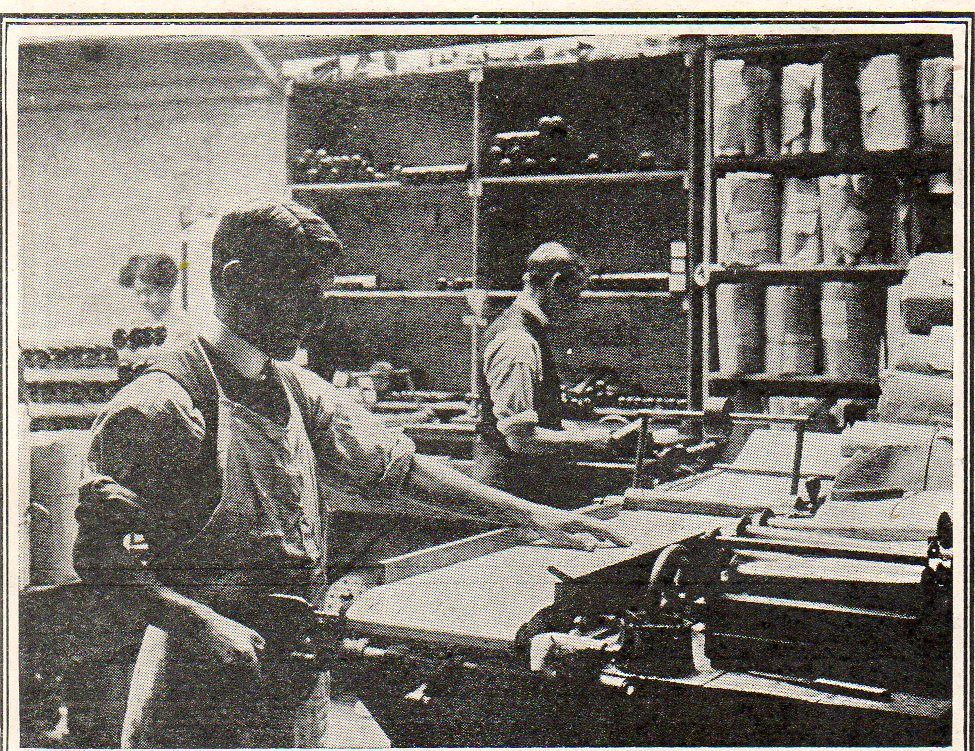
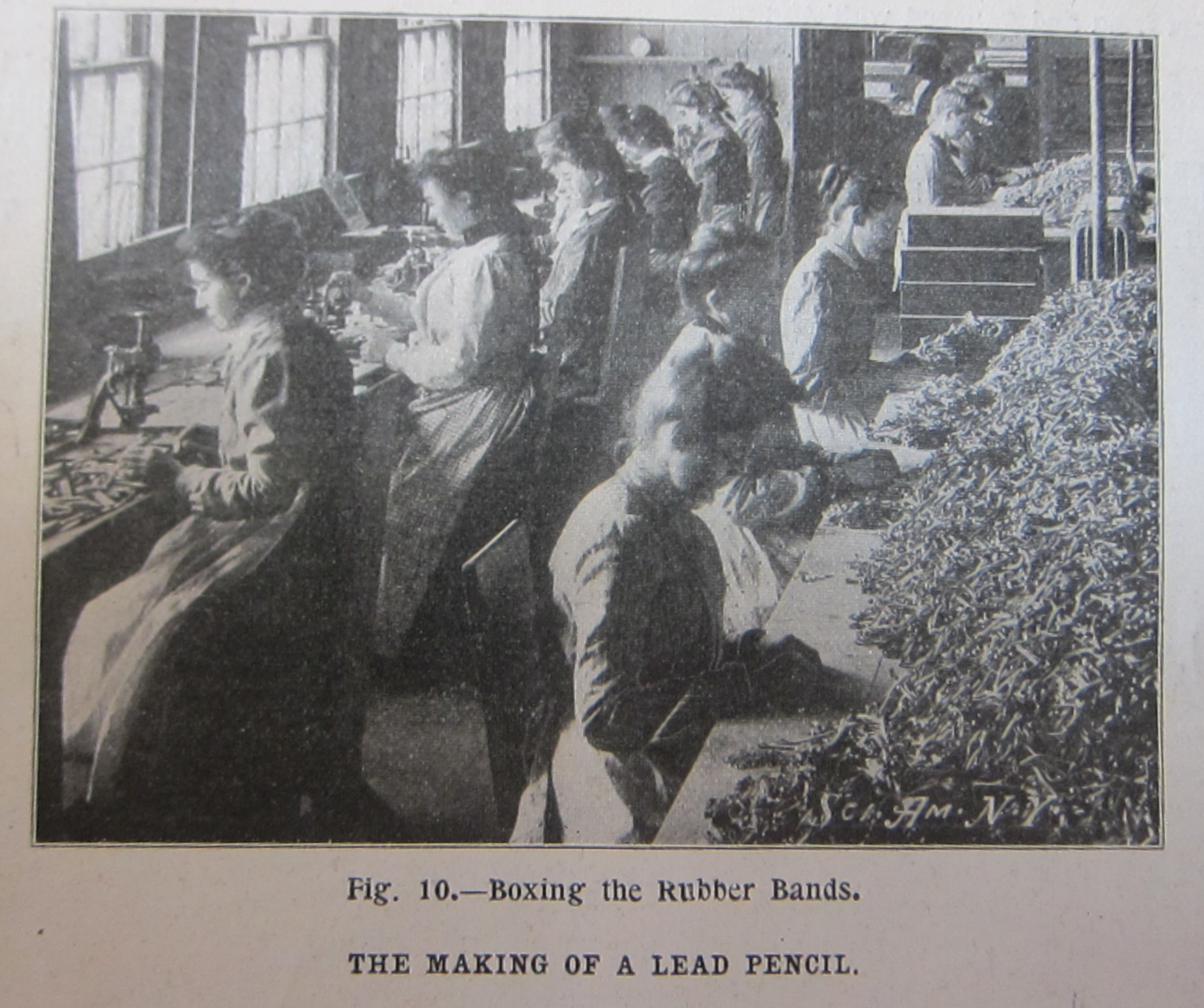
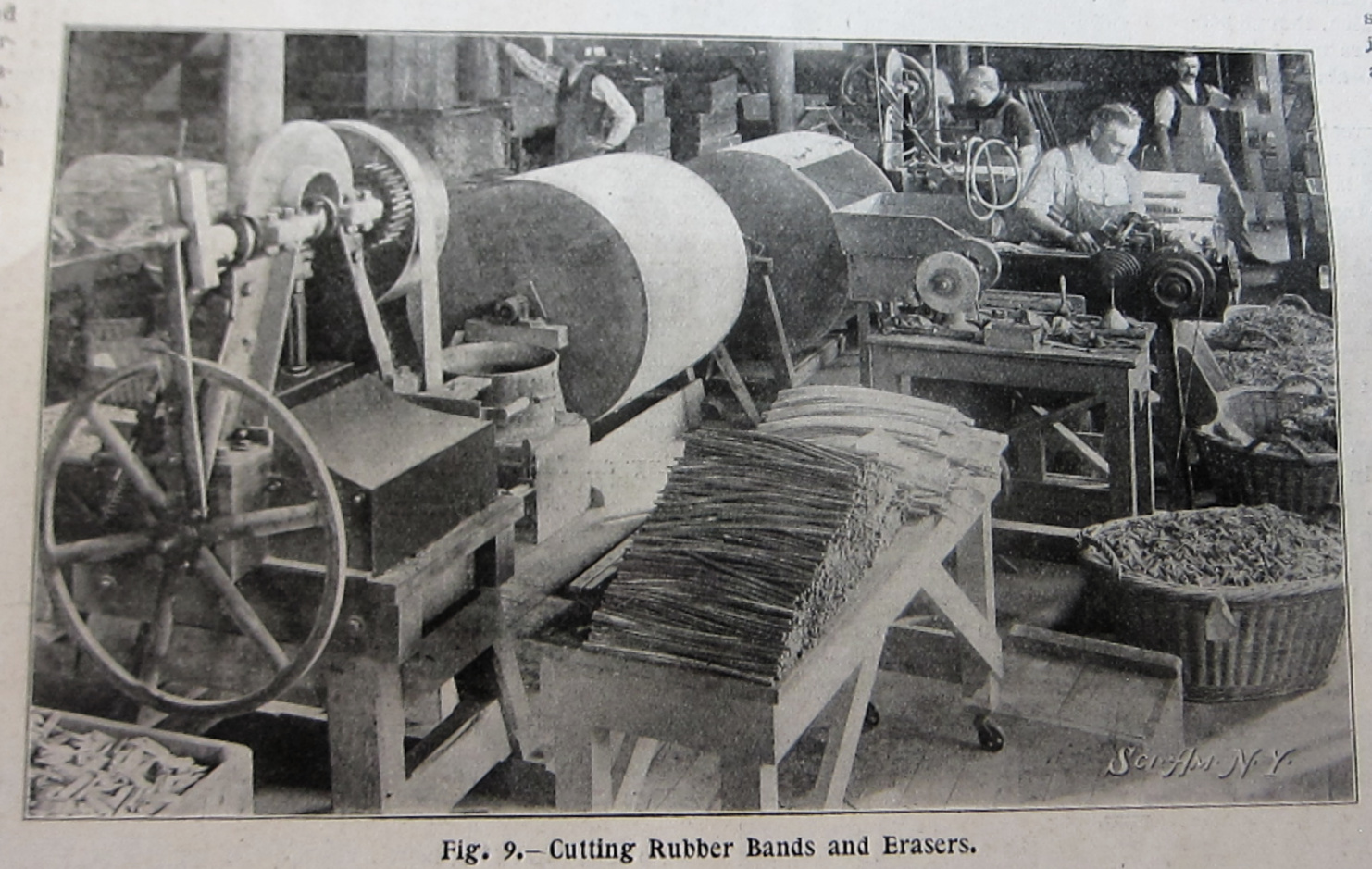
    Back in the days of burgeoning human-machine interfaces there were many industries employing some automation and independent machine operating assembly lines, though there were many more in 1903 that were not. This pictures struck me for the number of people working on what looks like an endless mountain of little tasks combined to make a little product, though there was nothing “little” about the labor that went into it all. In this case, it is a “lead” pencil and rubber band manufacturing establishment, and appears in a rather lengthy article in Scientific American for August 22, 1903. The machines seem to be run by hand, though there were a number of steps int eh process that were hand-done, including gluing the graphite into the pencil, polishing the wood, stamping the pencil, and applying the metal tips for the eraser (called “ferrules” which I hadn’t known about before) and the erasers themselves. An offshoot of the eraser here was the production of rubber bands, and as we can see below the work of sorting and boxing them was dauntingly accomplished by hand.  I wonder what the working conditions were like, and if any precautions were taken with the graphite dust that must’ve been misty here and there in the factory…

    Sci AM 1903 rubber bands _2_

    Here’s the rubber being prepared for both pencil and rubber bands:

    Sci Am 1903 Pencil rubber bands


  • Mozart and NYC: the Hudson River Tunnel und die Zauberflote’s Königin der Nacht

    JF Ptak Science Books   Quick Post

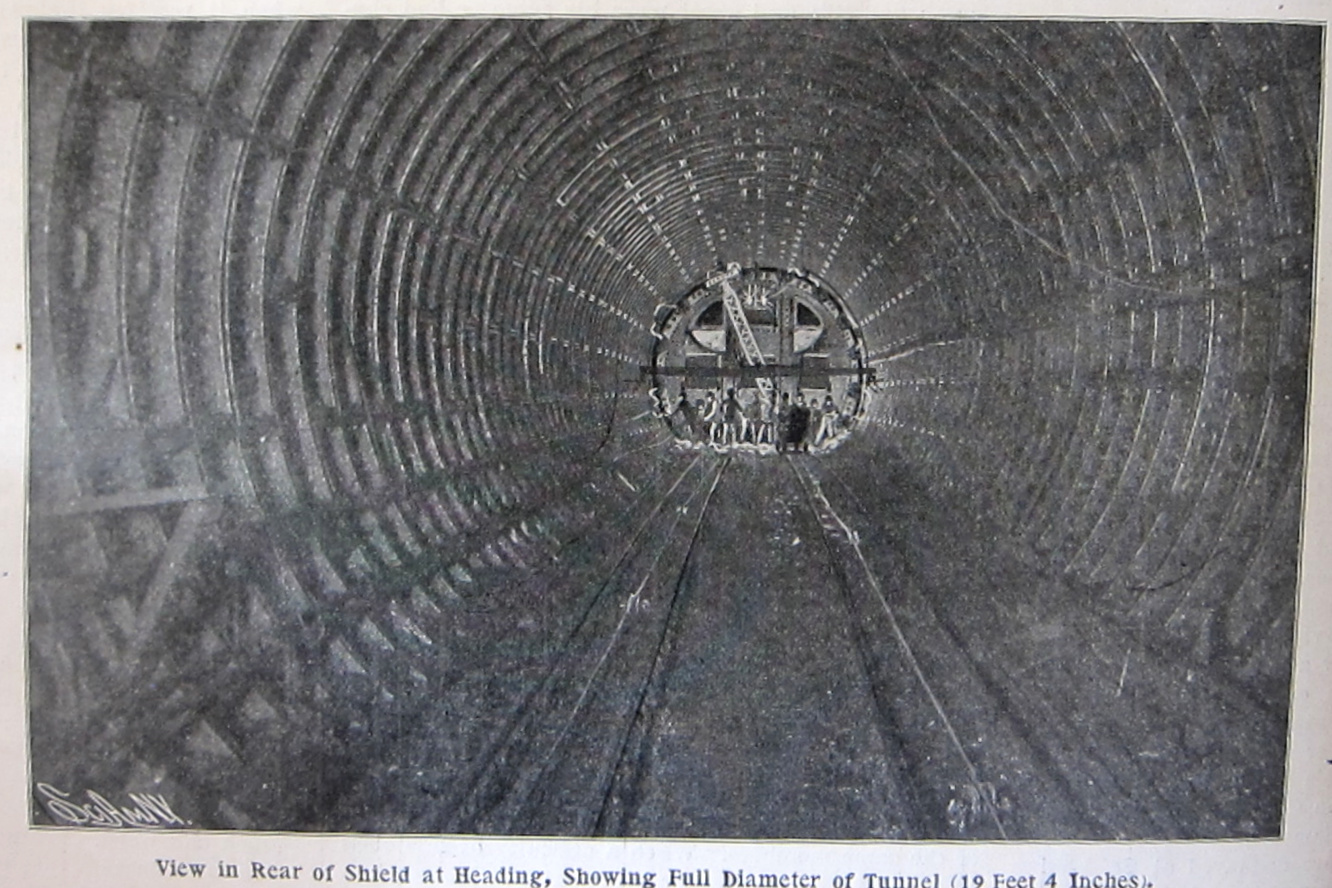
    Sci Am 1903 Hudson River tunnel

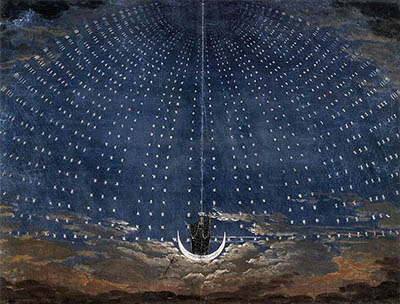
    This photographic view of the 19′ tunnel section of the Hudson River tunnel reminds me a little bit—I mean, it reminds me in a sparkly sense—of the 1815 stage set by Karl Friedrich Schinkel (1781-1841) for Mozart’s Magic Flute (from the original gouache, measuring 463 x 616 mm, and part of the collection of the Staatliche Museen, Berlin). Again, its just the initial reaction to the perspective pulled up the Schinkel more than anything else, except maybe for a non-existent underground image from Jan Vredeman de Vries’ book on perspective. That said, the set design I’m thinking of features the arrival of the Queen of the Night/Königin der Nacht, so perhaps this association isn’t too meshuga…excepting the ripped-to-shreds lust for revenge that the Queen of the Night sings about, which hasn’t much to do with digging a tunnel. 

    (And just in case you’ve never seen Amadeus by Milos Forman, you should, if for nothing more than watching M conduct the Queen of the Night aria.) Also, I’m writing this note at the tail end of the day of Beethoven’s 248nd birthday, and Mozart (although he would conduct the premier of the opera) wouldn’t live out the year of his opera. I don’t know what that has to do with anything, though it almost does. 

    Mozart_magic_flute

    Source for the Friedrich Schinkel image: https://www.wga.hu/support/viewer_m/z.html

    ·Posted by :

    ·in:


  • Two Interesting Papers on Mars–Disappearing Continents and Re-Filling Canals. AND a Bit on the Origin of “Martian”.

    JF Ptak Science Books   Post 2783

    I came upon these three papers while doing some research on the bookstore part of this blog and thought to share them here. Three papers touching different and unusual aspects of Mars.

    The first belongs to Henri Jules A. Perrotin (1845-1904 and with Louis Thollon, 1829-1887), “Observation des canaux de Mars; “Lettre de M. Perrotin à M. Faye.” found in Comptes rendus1. Perrotin’s (mostly remembered I think because of his excellent use of the Cornu apparatus in establishing the best speed of light numbers until Michelson) communication establishes that the great canals (“canaux”) he observed and reported to the Academy in 1886 were still there, as expected and as hoped for and celebrated by Schiaparelli. There were also three other rather significant observational findings:

    • First, a continent had disappeared. “Clearly visible two years ago, it no longer exists today” he wrote ( “Nettement visible, il y a deux ans, il n’existe plus aujourd’hui.”). A flood, “or something else” (“Cette inondation ou autre chose…”) could well be a periodic occurrence that did away with the land mass.
    • Second, there is a new arrival of a canal 20-degrees in size just north of the disappeared/extinct continent (“…au nord du continent disparu…”).
    • Third, there was a sort of canal that suddenly appeared on the North Pole ice cap, connecting the two seas on either side of the pole. (“…sur la tache blanche du pôle nord, d’une sorte de canal qui semble relier, en ligne droite, à travers les glaces polaires, deux mers voisines du pôle”).

    ·Posted by :

    ·in:


  • Ships in the Skyline, Part 11 (1904 and 1908)

    JF Ptak Science Books  Quick Post

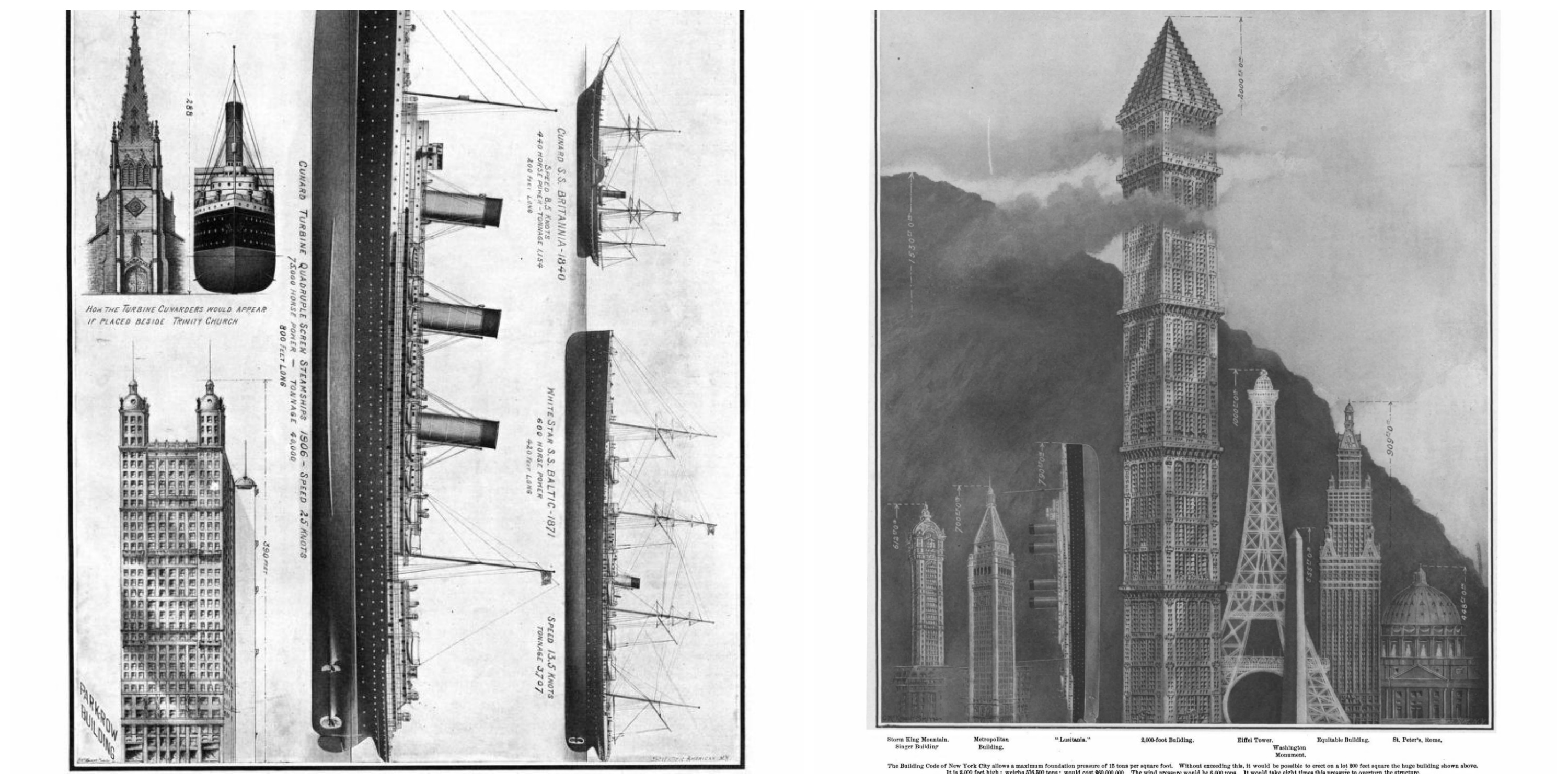
    SHips in skyline collage

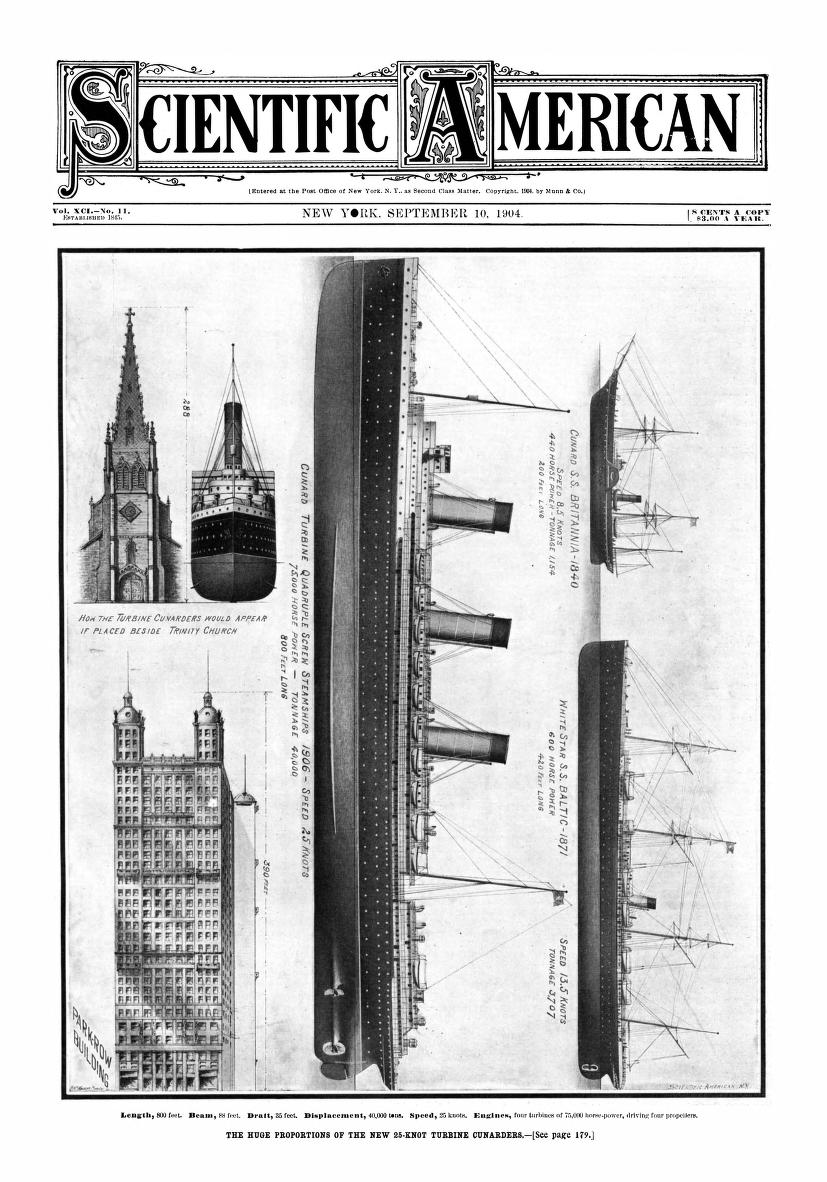
    In the continuing series of information presentation comparing new and relatively unknown objects to the very well known there is a subseries where the imagery uses ships as the new or the known, and they are usually presented in a city skyline or against a building. In the following two examples the first (Scientific American, September 1904) shows the new 800′ Turbine Cunard placed against Trinity Church and then, standing on end, impressively displayed alongside the 380′ Park Row Building, which at the time and until 1908 was the world’s tallest building. That means that the beautiful steel skyscraper designed by R.H. Robertson was not quite half the length of the new ocean liner, which also had the benefit of moving at 25-knots through the ocean whereas the Park Row, well, didn’t. In any event, it is a pretty interesting image.

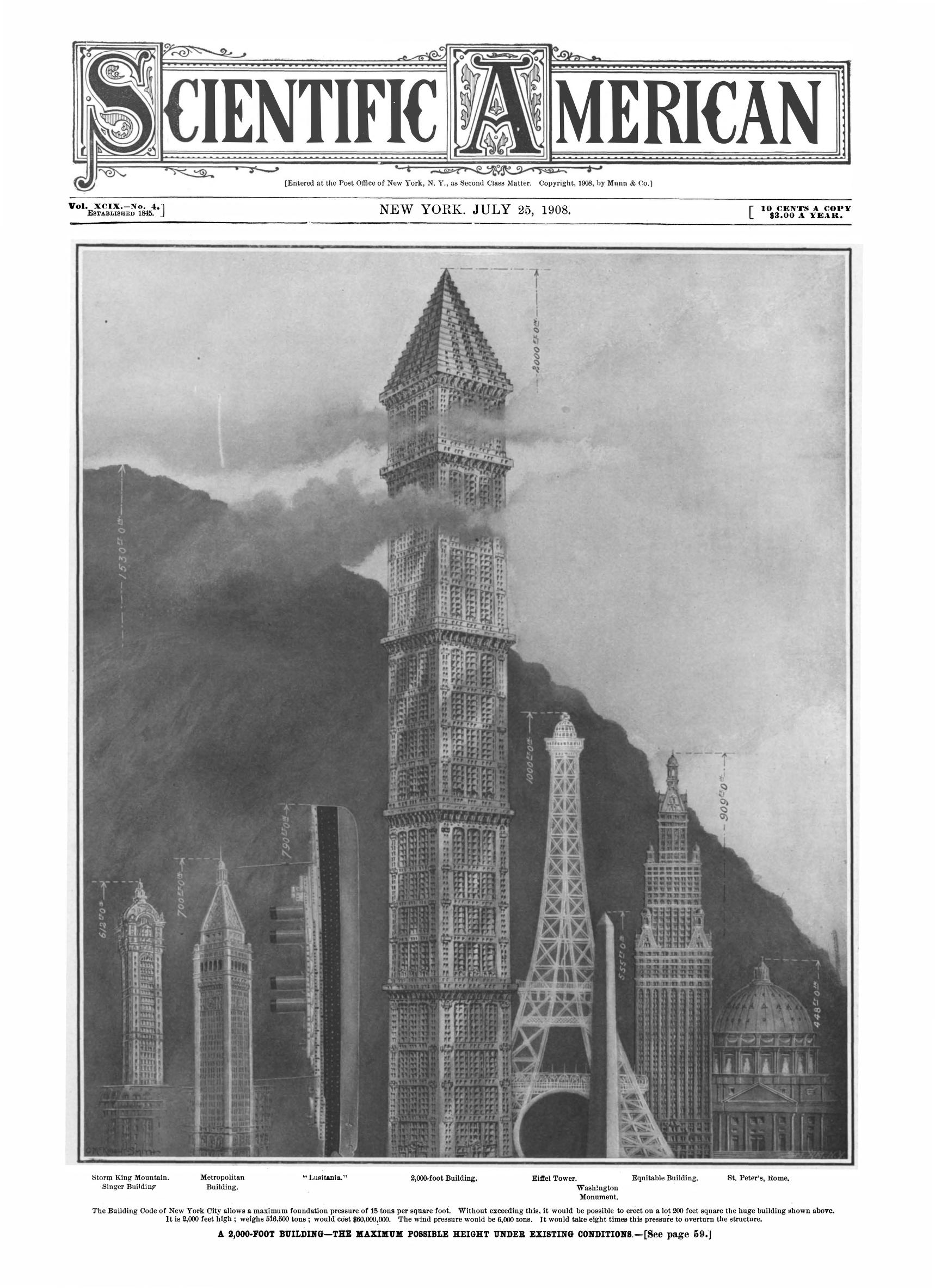
    The second (Sci Am 25 July 1908), compares what was thought to be the limits in the height of the still relatively new introduction of the skyscraper, which according to NYC building regulations listed the maximum foundation pressure at 15 tons per square foot. The editors of the Sci Am reckoned that you could build a 2,000′ tall structure under those conditions, and then compared this great beast to other tall buildings, plus the 790′ Luisitania, which was a very effective display. 

    Sci Am 1904 Sept Ships in Skyline

    Sci Am 1909 Ships in SKyline  2000 foot bldg