A Daily History of Holes, Dots, Lines, Science, History, Math, Physics, Art, the Unintentional Absurd, Architecture, Maps, Data Visualization, Blank and Missing Things, and so on. |1.6 million words, 7500 images, 4.9 million hits| Press & appearances in The Times, Le Figaro, Mensa, The Economist, The Guardian, Discovery News, Slate, Le Monde, Sci American Blogs, Le Pont, and many other places… 5000+ total posts since 2008.

Author: JF Ptak

  • An Alphabet of the Opening Lines of Charles Dickens’ Works

    JF Ptak Science Books   Post 2532
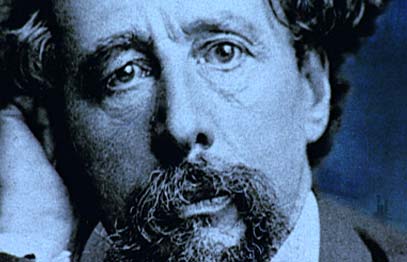
    Dickens

    I was thinking about the opening line from Dicken’s Tale of Two Cities, yesterday, one of the author’s great books, and probably one of his greatest sentences, period.This longish, single-sentence opener is 115 words long and punctuated with 16 commas, most of which are in the first half of the sentence, and all of which seem to work together like a piece of music. It is lyrical, and sweeping, and tells the story of everything and nothing.  

    So I decided to round up all of Dickens’ opening sentences for all of his books, and place them alphabetically, just for the sake of comparison.

    And here we are to begin, the beautiful opening sentence of a Tale of Two Cities, published almost at the same time as on the Origins of Species, in 1859:

    “It was the best of times, it was the worst of times, it was the age of wisdom, it was the age of foolishness, it was the epoch of belief, it was the epoch of incredulity, it was the season of Light, it was the season of Darkness, it was the spring of hope, it was the winter of despair, we had everything before us, we had nothing before us, we were all going direct to Heaven, we were all going direct the other way–in short, the period was so far like the present period, that some of its noisiest authorities insisted on its being received, for good or for evil, in the superlative degree of comparison only.”

    And by the way, TOTC has a great ending line, as well:

    ‘It is a far far better thing I do, than I have ever done; it is a far, far better rest that I go to than I have ever known.”

    I was going to add ending sentences to this list but this time, before looking all of it up in Gutenberg, I tried finding the list online, already completed—and there it was, on the literary/writing blog of Brett James, http://brettjanes.com/charles-dickens-last-sentences. It turns out that Brett James also has a list of opening sentences, too, with his listed chronologically—I would have done the same if I didn’t already have a bunch of posts on alphabets and the alphabetization of stuff. So it is unnecessary to reproduce that list here—just follow that link to James.

    And so to the list:

     American Notes, 1842

    “I shall never forget the one-fourth serious and three-fourths comical astonishment, with which, on the morning of the third of January eighteen-hundred-and-forty-two, I opened the door of, and put my head into, a ‘state-room’ on board the Britannia steam-packet, twelve hundred tons burthen per register, bound for Halifax and Boston, and carrying Her Majesty’s mails.”

    Barnaby Rudge, 1841

    “In the year 1775, there stood upon the borders of Epping Forest, at a distance of about twelve miles from London–measuring from the Standard in Cornhill,’ or rather from the spot on or near to which the Standard used to be in days of yore–a house of public entertainment called the Maypole; which fact was demonstrated to all such travellers as could neither read nor write (and at that time a vast number both of travellers and stay-at-homes were in this condition) by the emblem reared on the roadside over against the house, which, if not of those goodly proportions that Maypoles were wont to present in olden times, was a fair young ash, thirty feet in height, and straight as any arrow that ever English yeoman drew.”
    ·Posted by :

    ·in:


  • “Has several marks of lashing, and has irons on her feet”: Dickens’ Check-List of an American Tragedy: Slavery, 1842

    JF Ptak Science Books   Post 2531

    Charles Dickens made a tour of the United States in the first half of 1841–the results of his visit were a critical appraisal of U.S. society and culture, and in general he didn’t like much of what he saw. He published his impressions and observations in 1842 in his American Notes, and it was in chapter 17 (the final chapter) that Dickens undertakes a  thunderingly blistering condemnation of the U.S. institution of slavery–he found it repugnant and inhuman, and a demonstration of a hypocritical American way of life.  There was plenty that he didn’t like about the U.S., but it was the slavery issue that really set him on fire.

    Here’s the beginning of the chapter:

    CHAPTER XVII
    SLAVERY

    “The upholders of slavery in America—of the atrocities of which system, I shall not write one word for which I have not had ample proof and warrant—may be divided into three great classes.”

    “The first, are those more moderate and rational owners of human cattle, who have come into the possession of them as so many coins in their trading capital, but who admit the frightful nature of the Institution in the abstract, and perceive the dangers to society with which it is fraught: dangers which however distant they may be, or howsoever tardy in their coming on, are as certain to fall upon its guilty head, as is the Day of Judgment.”

    “The second, consists of all those owners, breeders, users, buyers and sellers of slaves, who will, until the bloody chapter has a bloody end, own, breed, use, buy, and sell them at all hazards: who doggedly deny the horrors of the system in the teeth of such a mass of evidence as never was brought to bear on any other subject, and to which the experience of every day contributes its immense amount; who would at this or any other moment, gladly involve America in a war, civil or foreign, provided that it had for its sole end and object the assertion of their right to perpetuate slavery, and to whip and work and torture slaves, unquestioned by any human authority, and unassailed by any human power; who, when they speak of Freedom, mean the Freedom to oppress their kind, and to be savage, merciless, and cruel; and of whom every man on his own ground, in republican America, is a more exacting, and a sterner, and a less responsible despot than the Caliph Haroun Alraschid in his angry robe of scarlet.”

    “The third, and not the least numerous or influential, is composed of all that delicate gentility which cannot bear a superior, and cannot brook an equal; of that class whose Republicanism means, ‘I will not tolerate a man above me: and of those below, none must approach too near;’ whose pride, in a land where voluntary servitude is shunned as a disgrace, must be ministered to by slaves; and whose inalienable rights can only have their growth in negro wrongs.”

    Then comes this incredible listing of runaway/escaped slaves—in attempting to identify their “property” properly, the slave owners described the various injuries made to the slaves’ bodies and how they happen to have been bound before their flight to freedom. It is an unknowing self-indictment, each ad a testimony to cruelty and viciousness.

    “The following are a few specimens of the advertisements in the public papers.  It is only four years since the oldest among them appeared; and others of the same nature continue to be published every day, in shoals.

    ‘Ran away, Negress Caroline.  Had on a collar with one prong turned down.’

    ‘Ran away, a black woman, Betsy.  Had an iron bar on her right leg.’

    ‘Ran away, the negro Manuel.  Much marked with irons.’

    ‘Ran away, the negress Fanny.  Had on an iron band about her neck.’

    ·Posted by :

    ·in:


  • “If Anything Else is Added the Post Card Will be Destroyed”, WWI

    JF Ptak Science Books   Quick Post

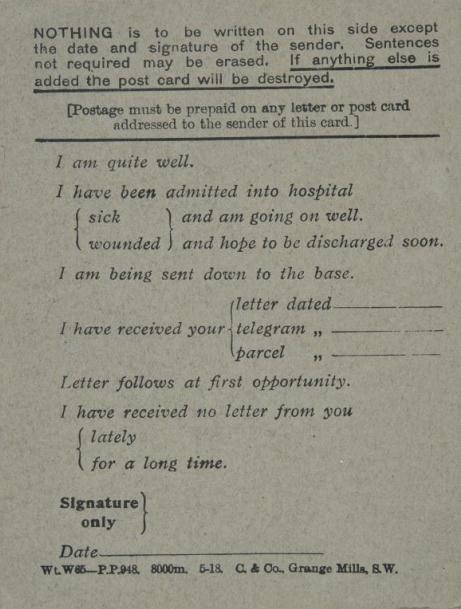
    This postcard was provided to British servicemen during WWI for a brief, highly abbreviated, communication with folks at home.  The writer could choose between being well, or being in the hospital (via illness or being wounded), or being sent “down to the base”.  There’s a following bit about whether the soldier had received mail and what kind, and then a memory note, telling the receiver that they had “received no letter” from them “lately” or for a heartbreaking “long time”.  

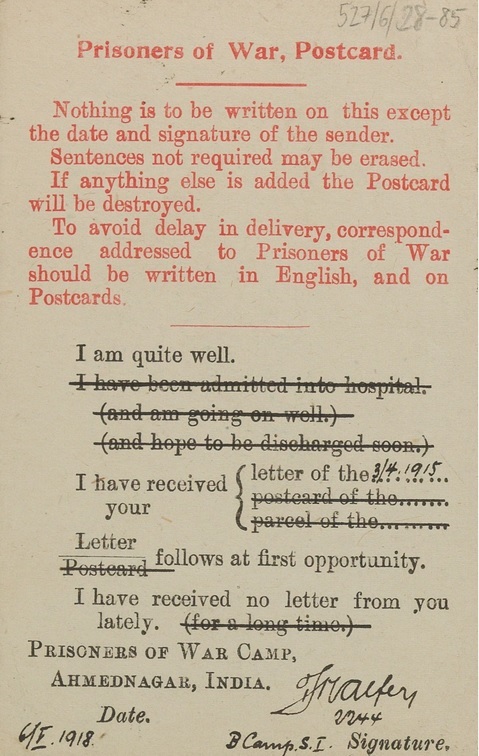
    There’s room for a signature–the only writing not a circle–and then room for nothing else. (Another version of this postcard below has been utilized with the “writer” placing a line through the text that was not applicable. In this case the postcard was identified as being for use by British POWs.)

    As the card states very explicitly, any other writing would lead to the card being destroyed. 

    It wasn’t much, but for the recipient, it might have been enough. Pity those who received this card with only “for a long time” circled.  

    WWI Project Blank and Missing Field Postcard

    • “The reverse of a field service postcard showing entries, such as ‘I am quite well’, to be deleted by the sender as appropriate.” MH 34058″ Source:  Imperial War Museum  http://www.iwm.org.uk/history/podcasts/voices-of-the-first-world-war/podcast-21-news-from-the-front

    See also this post with another example of a WWI “form letter” : “An Extraordinary POW Postcard 1918”  [https://historyofideasblog.com/thesciencebookstore/2014/09/an-extraordinary-censorable-pow-postcard-1918.html]

    WWI POW Postcard


  • Blank and Missing Things: a Map of Missing People of Europe and Russia, 1881

    JF Ptak Science Books  Expanded Post 636 (from 2009)  Blog Bookstore

    The History of Blank, Missing and Empty Things (Thread, #45)

    “Heaven and earth were one form…. (then they were separated from one another…)”

    “The mind is its own place, and in itself can make a heaven of hell, a hell of heaven..” 
    –John Milton, Paradise Lost

    In ancient times the representation of the gods and beliefs was handed from one writer or storyteller to the next, on and on, changes here and deletions there, for many generations.  This practice was possible (necessary?) because there really wasn’t a solitary scripture to follow (as in the Koran or the Bible) and no priestly class to guard and cherish a particular strong story line in all of its barbed details.

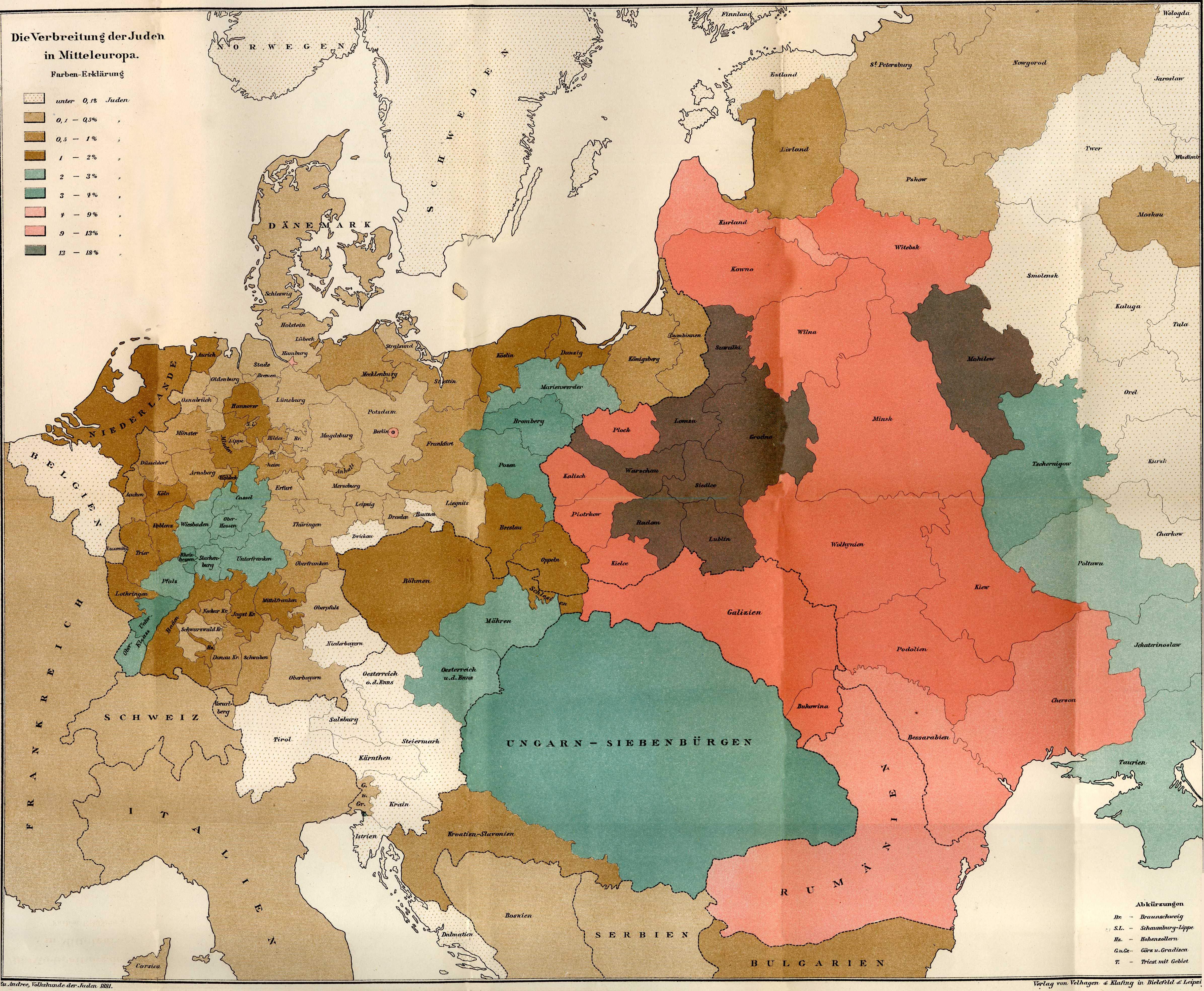
    Juden_1881  [Image source: wikicommons, https://commons.wikimedia.org/wiki/File:Juden_1881.JPG  The image is greatly expandable.]

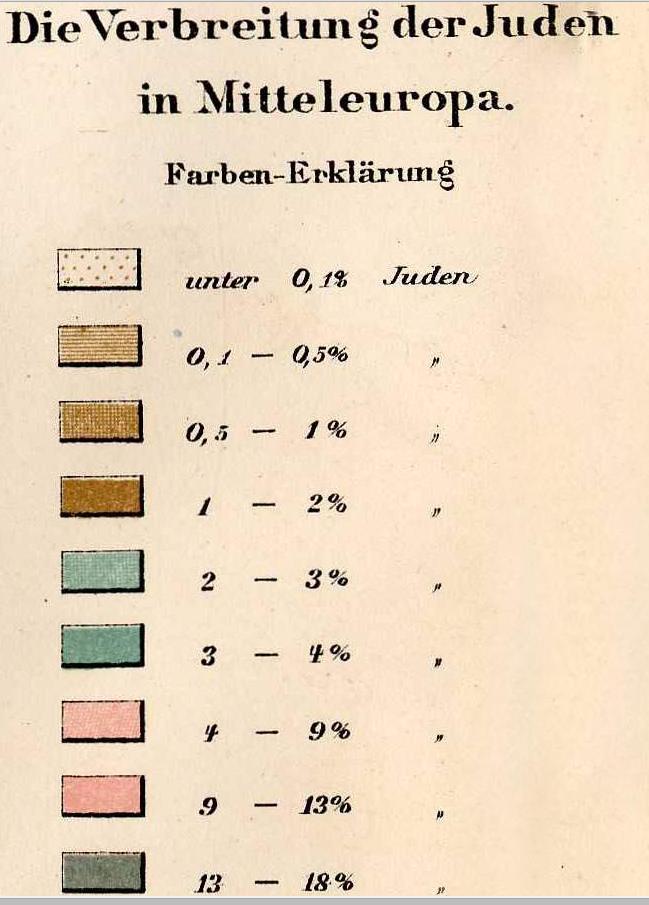
    And the key to the map:

    Maps Jewish populations in Europe

    There are of course bits that have survived intact for millennia.  One of these is this fragment from one of Euripides’ lost plays (only 20% or so are complete), The Wise Melanippe, and begins a statement of cosmogony that states the creation of all things.  The separation of heaven and earth has always stuck with me, because this separation begins with Euripides with the creation of the world seems to continue on its way with mini-separations of all things over the course of time—like the cosmological world-bearing turtles—all the way down. 

    I’m not sure how or who exactly did this heaven-rending, or to what force it owed its being:  evidently the Presocratics tended to depersonalize the actions of the gods and grant their actions to natural forces, so the issue with the heaven-separation business may well have been a motive force rather than a god.  Anyway it’s the tearing apart, the removal, the separation phenomena that got my attention to begin with, and one which has stayed with me, though I’m sure that Euripides didn’t have that sort of violent rending in mind while describing the birth of the earth.

    And so it is with this map1 showing the concentrations of the Jewish people in Europe  in the late 19th century. Between the time of the publication of this map—1881—and the beginning of the Nazi regime in  Germany in 1933, there were many persecutions and Pogroms and deportations of the Jewish people.  Nothing prepared anyone for the concentration camps and the systematic extermination of that people between 1935 and 1945.  What this map shows is the distribution of the Jewish people (by percentage of the total population) before they were eviscerated:  the difference between this map in 1881 and the map of 1945 would be completely different.  The Jews were gone:  killed.  Some deported.  Others escaped.  But they were basically torn from Europe  in the cruelest manner so that in almost every case the only indicators of their existence were shadows. 

    There are large-scale maps of this sort of evidence for other groups of people in their pre-Euripidean tearing from their home:  maps showing the locations of Indian tribes in North America (pre-Columbian, 17th century, 19th century, they’re all telling pretty much the same devastating story) is one good example of a slender category.  There aren’t maps for the mass extermination by starvation created by Joe Stalin, or the millions murdered by Pol Pot or Mao.  There are of course more small-scale, localized maps depicting the results of forced relocations or devastating war or drought or hunger or floods.  But few, I think, take such a compelling x-ray of a people’s past on a continental scales such as this. 

    Notes:

    1. “Die Verbreitung der Juden in Mitteleurope”  found in  Richard Andree’s , Volkskunde der Juden…,  Verlag von Velhagen & Klefirg in Bielfeld und Leipzig:  1881. 


  • Upset in the Belly, Insanity and Murder: a Southern Interpretation, 1831

    JF Ptak Science Books  Extending Post 647 (from 2009)  Blog Bookstore

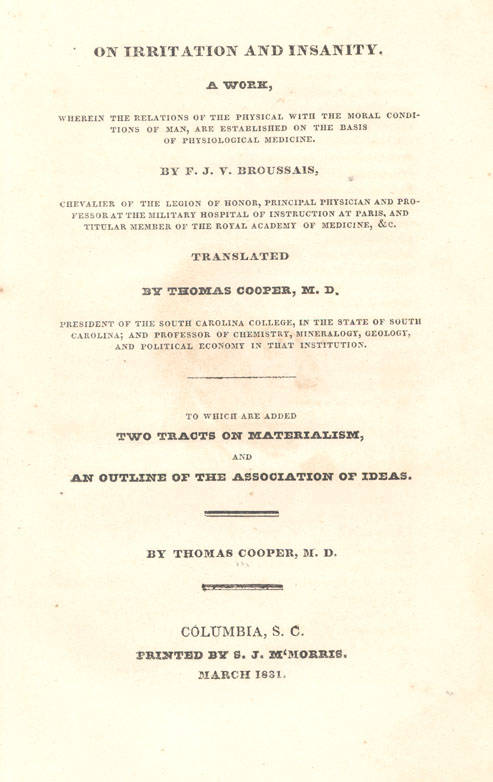
    Thomas Cooper, a merry, upper-educated intellectual called “a learned and talented mapcap” by none other than John Adams, wrote from his secure chair at South Carolina College a translation of a rather individual effort in explaining insanity’s connection with moral outrages.  The work, published in Columbia (South Carolina) is called On Irritation and Insanity … to which are added Two Tracts on Materialism, and an outline of the Association of Ideas, was written by Francis Joseph Victor Broussais (1772-1838) and introduced an unusual, foreign approach to the connection between sanity and malevolence.  Brousssais’ work may not have required such attention. 

    Blog--June 12--broussais


    He wrote, for example:

    “The causes of this morbid state consist always in irritation of the trisplanchnic apparatus, and especially in that of the stomach, acting on the brain. [Italics mine] This last viscus, may be such, by its normal constitution, as to give a propensity to cruelty ; but in the morbid state it is a sense of uneasiness perceived through the whole splanchnic apparatus, comprehending the brain itself, which renders ideas of murder predominant in spite of reason. This horrible perversion may be considered, as well as that of suicide, as a species of chronic anger or hatred, which impels the individual sometimes against himself, sometimes against other men or against inanimate objects. We have already considered it under a subacute form in furious mania ; but in the modification in which we now describe it, it is entirely chronic and apyretic. In fact it may be extremely obstinate, and conceal itself under the appearances of calm, of joy, of benevolence, until the lunatic finds the opportunity of executing his horrible project.”

     I can see these words being written by candle light.

    • Full text via Google books, here: http://tinyurl.com/ocyezpb

     James Cowle Prittchard early on dispensed with M. Broussais, writing  in his A Treatise on Insanity and Other Disorders Affecting the Mind (published by Haswell, Barrington, and Haswell in 1837, just six years after the Cooper translation) states:

    “Such is M. Broussais’ theory of these phenomena. It must be allowed that various irritations, and especially those in the digestive organs, often give rise to irritability of temper; but that any such state as that .which M. Broussais has described is a cause, and even the principal cause, of moral insanity, and in particular of that intense excitement of malevolent propensity which leads to murder and suicide, is a position which, before it can be admitted, requires proof; and no such proof has been afforded by the ingenious writer who has advanced this hypothesis. It must be confessed that this subject is as yet enveloped in obscurity.”

    As it turns out Broussais recommended courses of bleeding, diet, soothing drinks, applications of cold and mild purgatives to treat insanity.  This went somewhat against the established regimen of treatment (but of different philosophical and theoretical approach to the idea of insanity) of Benjamin Rush, who practiced all of the above but of harsher application and with more force.  Broussais at  least advocated a more temperate approach to bleeding, that it not be “severe”, and that the strength of the insane not be completely diluted by massive exposures to dunking and the cold.  The translator Cooper, however, disagreed with the milder treatments, establishing for the record that the hotter and harsher  temperatures of the South required harsher and colder treatment. From page vi of Cooper’s [reface we read: “The Southern climate of the United States , seems to require more bold and decisive practice, than the Northern climate of Paris or London : then, to us, the therapeutics of Broussais, Begin, Coster, &c. appear feeble; but the principles, founded on the physiology and pathology of the tissues, are undeniable and universally applicable.”

    Such was the spirit of the day.  Broussais is not even a shadow, today:  he tried to establish a connection between gastrointestinal distresses and insanity, and that was seen as futile even by immediate contemporaries. Cooper survives because of his far reach into many disciplines–his treatment of Broussais, well, is memorable for his appeal to treat the insane differently in courts of law because of what he viewed as their diminished capacities.  

    ·Posted by :

    ·in:


  • When Dirt Wasn’t Even Dirt

    JF Ptak Science Books   Quick Post

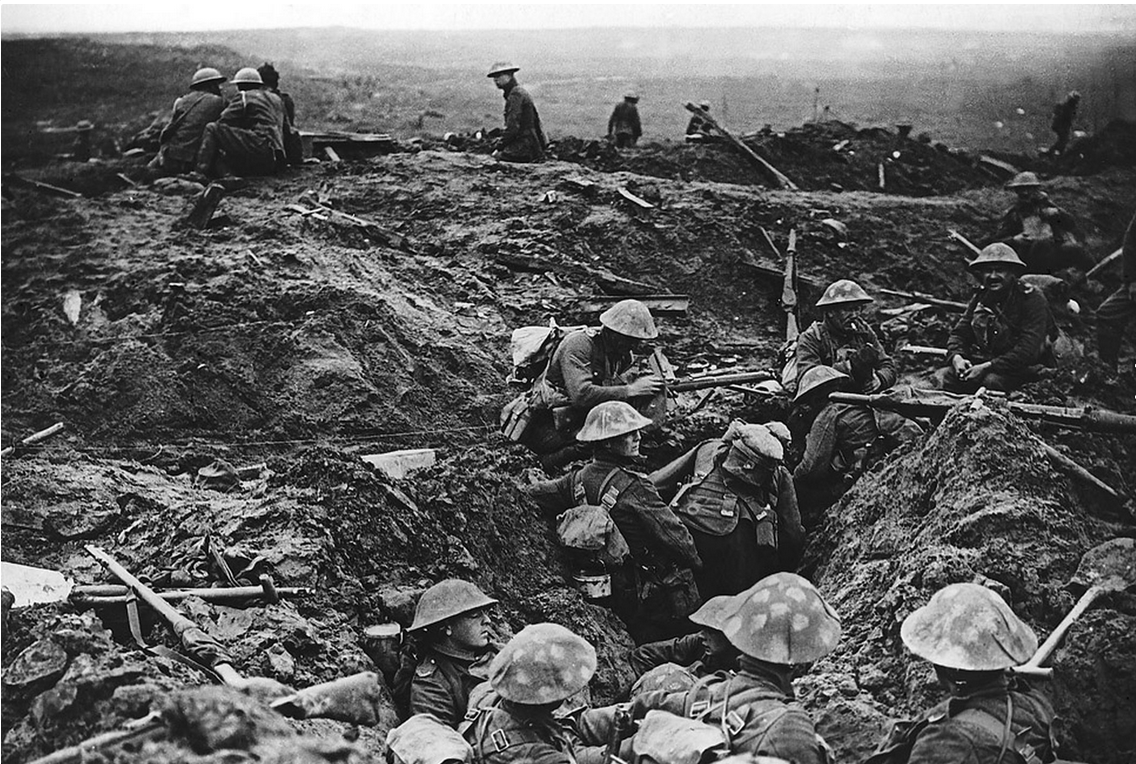
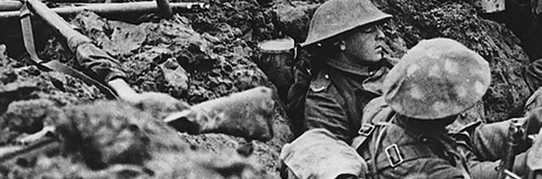
    There’s just a particular nothingness here, like a piece of bad-earth life raft in an ocean of blown up mud, a general nastiness of ground, junk  the land littered with sharp remnants of exploded trees, and these soldiers are in the middle of it in a scene extending to the horizon.

    WWI Project Trench photo rough condition

    There were lots of smells in WWI, though most of the time the idea of it all is hard to convey. Not ere, though, because this is an olfactory image, a photograph of smell as much as anything else.

    This ground reminds me of the mud I saw in Guguletu Township near Capetown–squalid, lifeless, smelling of some petroleum-something, unexpectedly unknown, unique.

    I don’t have a source for this photo, I’m sorry to say, though it is a scene of British soldiers.  It could be the aftermath of a battle, or an advance over a previously-contested. I can’t say which.  

    The soldiers in the foreground are probably in a bomb crater, and those in the near-background might might be in a trench, though that is uncertain. Outside of the orderliness of the soldiers, there’s really nothing else but a chaos broken into little pieces.

    There’s also the grime of it all.  In the detail–where we see a soldier grabbing a quick nap–we can see a rifle with a lot of damage to its stock, and another just beyond, with a cloth wrapped around the firing mechanism, an attempt to keep the rifle operational.  

    WWI Project Trench photo rough condition detail

    In the larger photo above you can see others attempting to keep their weapons clean and functioning–a trying and necessary undertaking in these circumstances. 

    Nobody is looking at the camera.  

    ·Posted by :

    ·in:


  • Skinny Data: City Populations, 1920

    JF Ptak Science Books  Quick Post

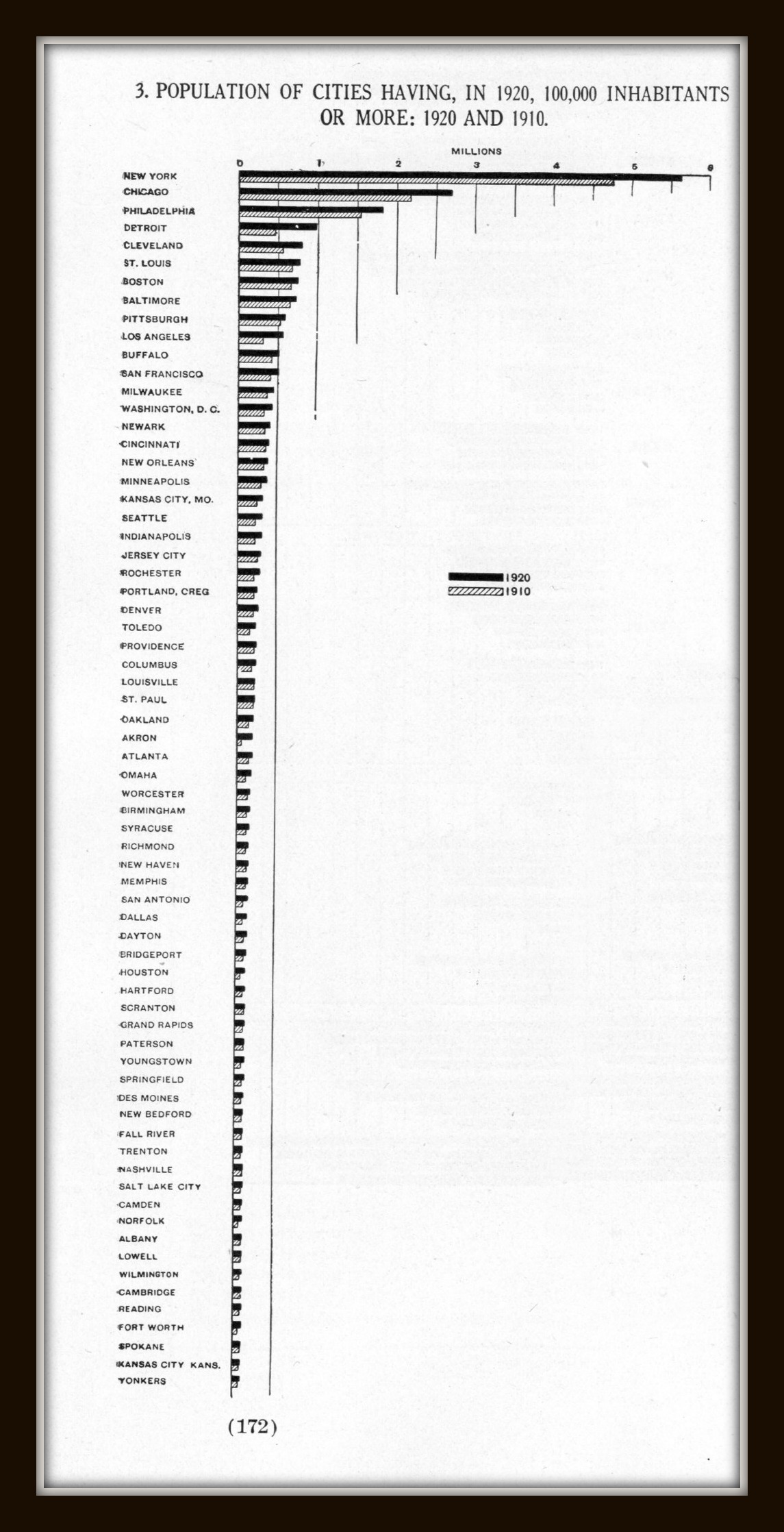
    This fine, odd, and aggressively progressive-towards-skinniness of a graph appeared on plate 143 (page 173) in the great series of data visualization classics, the Statistical Atlas of the United States, published in Washington D.C., 1924.  It is one of the simplest maps showing the development of the populations (compared to these extraordinary and classic attempts, here), and it is interesting to see where cities stood in 1920 relative to where they are today.  For example, Detroit comes up at fourth in 1920, Cleveland 5th, Pittsburgh 8th, Buffalo 10th, Milwaukee 12, Newark 14th, Cincinnati 15th–of these, only Detroit (#19) and Milwaukee (#28) break the top-thirty in the census for 2010.  

    Dataviz census 1920  city size241


  • James Reese Europe and the Harlem Hell Fighter Band

    JF Ptak Science Books   Quick Post

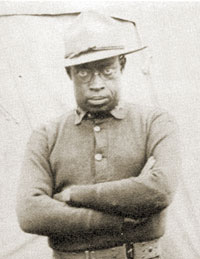
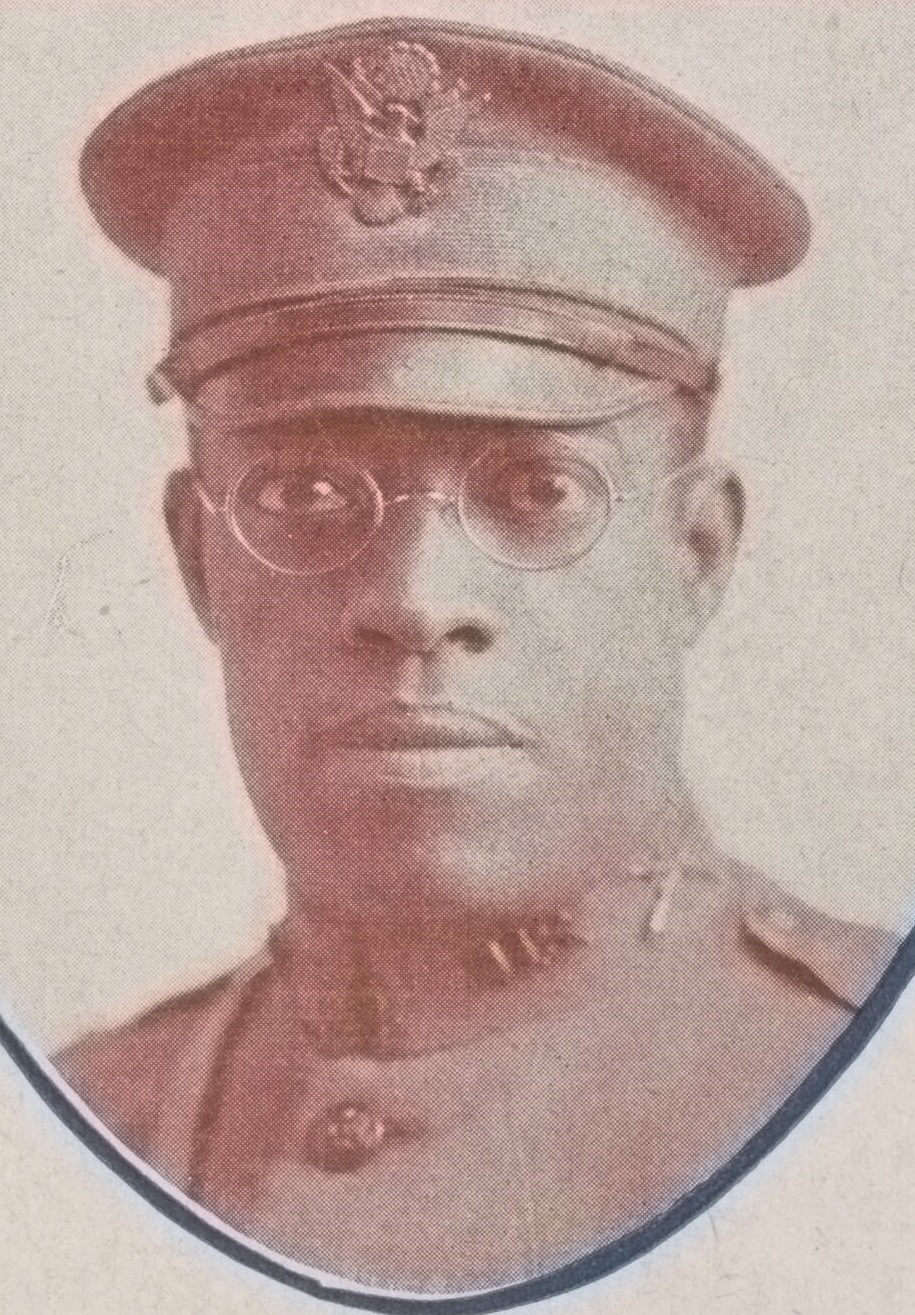
    This is an absolutely fantastic portrait of  James Reese Europe (188-1919)–the “Martin Luther King of Music” according to Eubie Blake–showing him as a lieutenant in the U.S. Army in 1917/18.  Europe enlisted in the 15th National Guard Regiment, in Harlem, and arrived overseas on January 1, 1918, the conductor of a military orchestra.  The 15th was eventually re-mobilized as the 369th, better know as “The Hell Fighters” and “The Harlem Hell Fighters”, and which served with very high distinction.  

    I’m posting this because I like Europe, and this is just a hands-down get-out-of-my-way portrait of the man.  

    James reece europe

    [Source: http://www.loc.gov/item/ihas.200038842/}

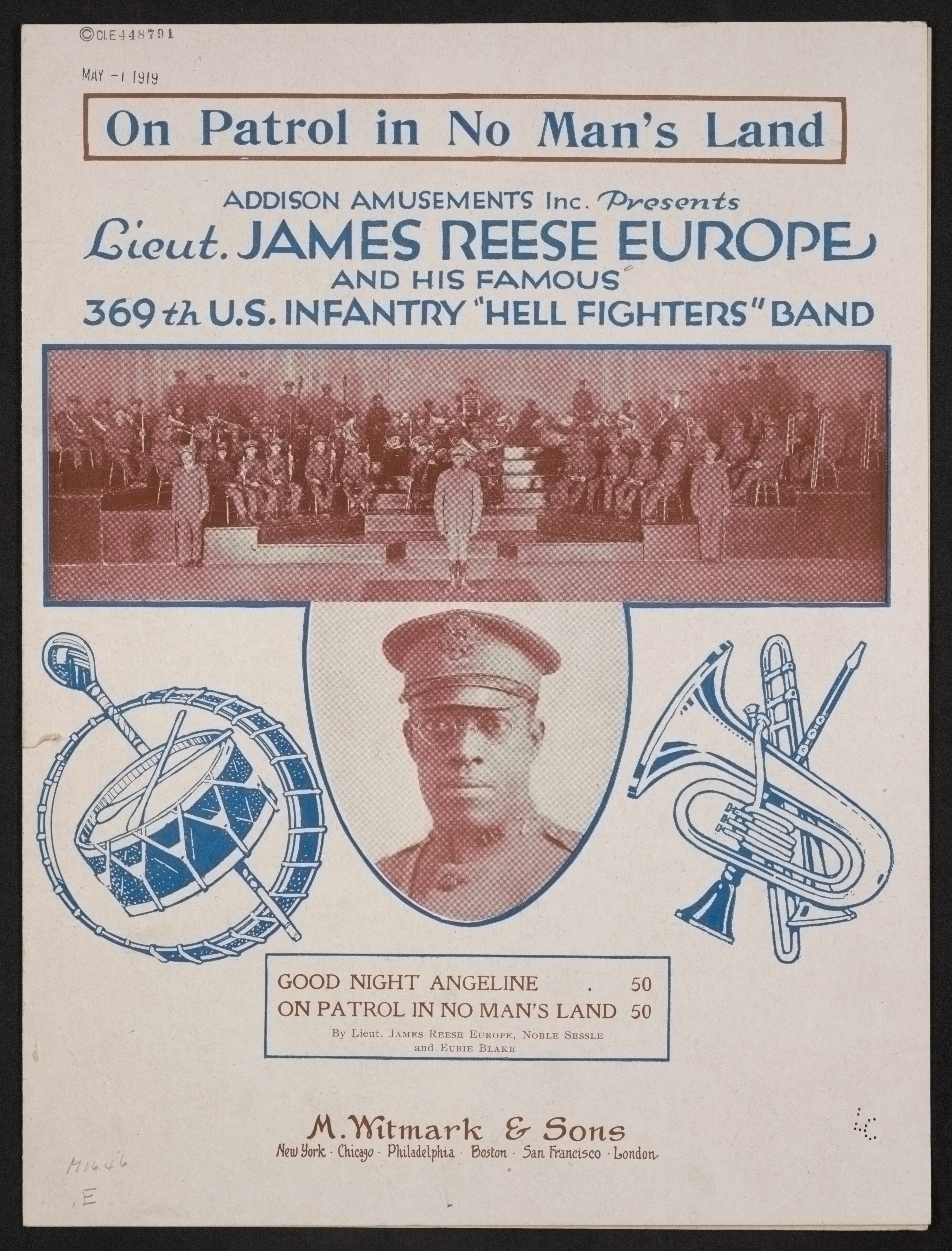
    Here’s a cover of one of Europe’s pieces of sheet music:

    Europe sheet music

    [Source: http://lcweb2.loc.gov/diglib/media/loc.natlib.ihas.200202032/0001.tif/3898]

    And in keeping with the portrait above, a study from the music:

    Europe large image sheet music


    Also, here’s a recording made by Europe and found at the Library of Congress National Jukebox: “The Castles in Europe”,  Europe’s Society Orchestra, 1914http://www.loc.gov/item/jukebox.3728/  

    …with more streaming audio from the Library of Congress here:  http://www.loc.gov/search/?in=&q=%22james+reese+europe%22&new=true

    Lastly, and again from the L.C., here is the full text of  the not-published Memoir of Lieutenant “Jim” Europe, by Noble Lee Sissle, completed in 1942.  http://memory.loc.gov/cgi-bin/query/r?ammem/aaodyssey:@field(NUMBER+@band(musmisc+ody0717))

    ·Posted by :

    ·in:


  • The Popular Plane: Aeroplane Sheet Music Covers, 1897-1911

    JF Ptak Science Books  Quick Post

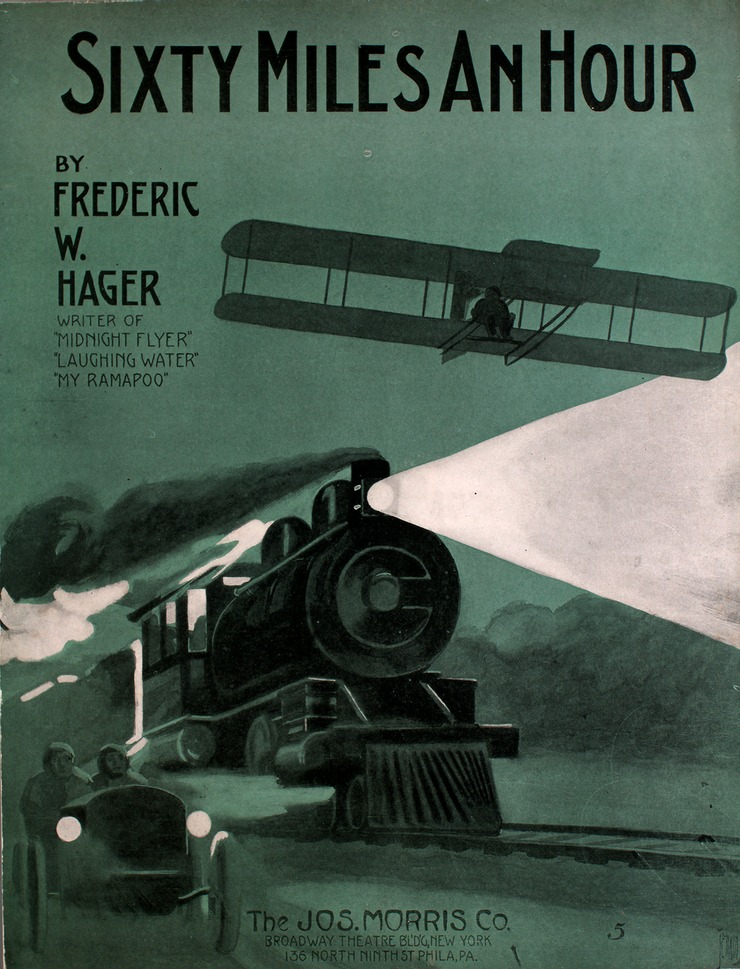
    I’m posting these following sheet music covers because of their lovely airplane covers. They are located at the wonderful (and highly available and useful) Lester Levy Sheet Music Collection at Johns Hopkins University.  

    Aeroplanes levy sixty

    “Sixty Miles an Hour. March and Two-Step’,  Frederick W. Hager, 1910.  [Image source: http://levysheetmusic.mse.jhu.edu/catalog/levy:059.065]

    ·Posted by :

    ·in:


  • Mars Misspelled & Cleveland as Canada! (1908)

    JF Ptak Science Books   Quick Post

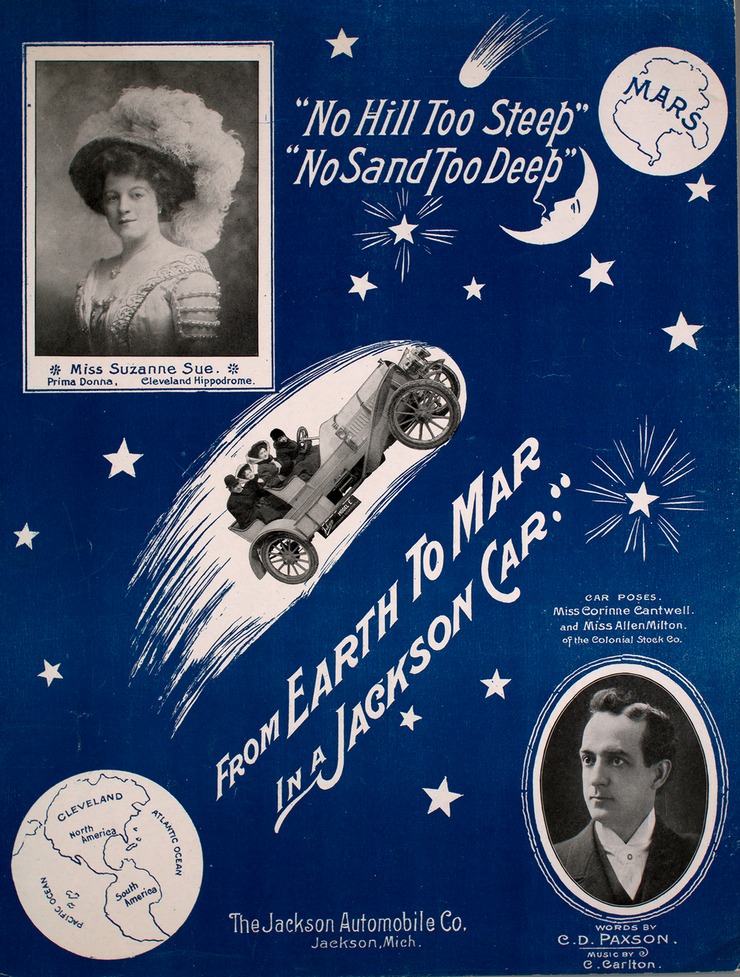
    In my big, old, sloppy cruiser that is this blog, I have misspelled may things, even after “editing” and forcing my way through squiggly spell-checks (sp?). I am not a good editor, so I appreciate one when I see it, And generally I squint m way through misspellings in others, until they get to be (1) very simple, (2) very obvious, and (3) published. The sheet music shared here is a great example of a something-I-cannot-identify:  first, it is pretty though not well designed; second, Mars is misspelled, somehow; and thirdly, “Canada” has become “Cleveland”.  

    I’m fairly certain that I have never heard anyone ask/wonder, “Is there life on Mar?”, or utter “Mar, the red planet”, or “we’re being invaded by aliens from Mar!”.  “Mar” looms large in the copy for the sheet music, and I just don’t know how that was missed–which means it probably wasn’t, and was made so to rhyme with “car”, though it would’ve been easy to spice up the slogan and make it all correct if “car” was plural.  

    The “cleve” part of  “Cleveland” (at least in the very earliest roots of the word) was no doubt applied to Canada because of the Cleveland to the featured/endorsing singer, Miss Suzanne Sue, of the Cleveland Hippodrome. Otherwise the Jackson car was made 100 or so miles away, in Jackson, Michigan, which means I guess that the Cleveland/Canada designation should’ve been “Jackson”. In any event it seems as though there is something for everyone in this sheet music cover.  

    MArs jackson auto

    [Source: Levy Sheet Music Collection, Johns Hopkins, http://levysheetmusic.mse.jhu.edu/catalog/levy:060.062]

    ·Posted by :

    ·in:

    —