A Daily History of Holes, Dots, Lines, Science, History, Math, Physics, Art, the Unintentional Absurd, Architecture, Maps, Data Visualization, Blank and Missing Things, and so on. |1.6 million words, 7500 images, 4.9 million hits| Press & appearances in The Times, Le Figaro, Mensa, The Economist, The Guardian, Discovery News, Slate, Le Monde, Sci American Blogs, Le Pont, and many other places… 5000+ total posts since 2008.

Author: JF Ptak

  • When the Catcher’s Mitt Was a Cage (1904)

    JF Ptak Science Books  Quick Post

    PAtent catcher cage detail


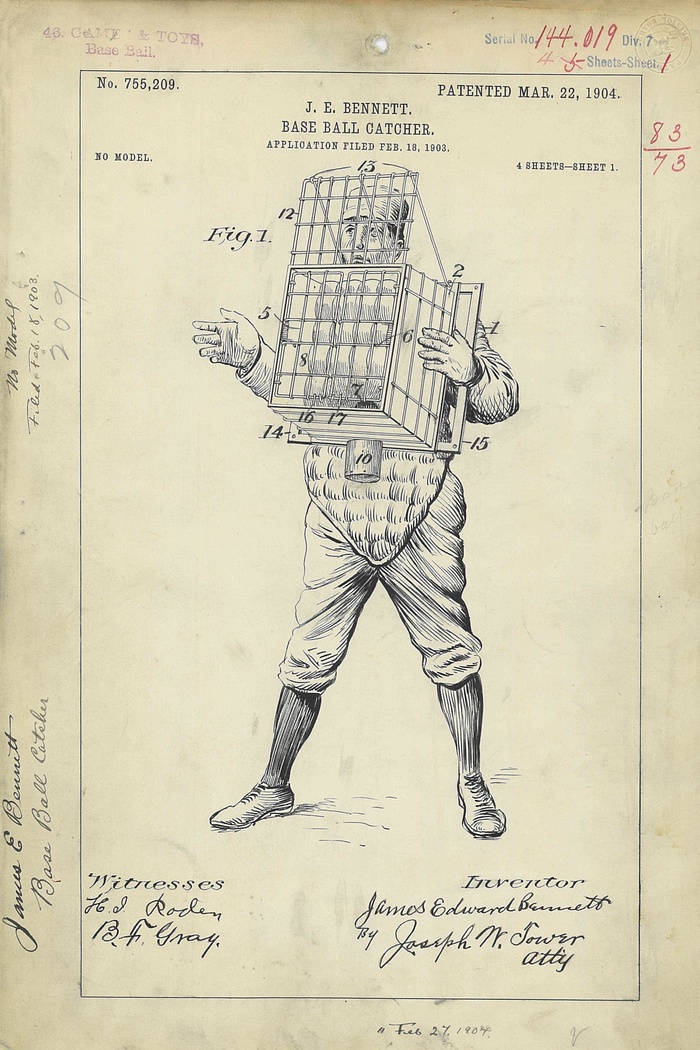
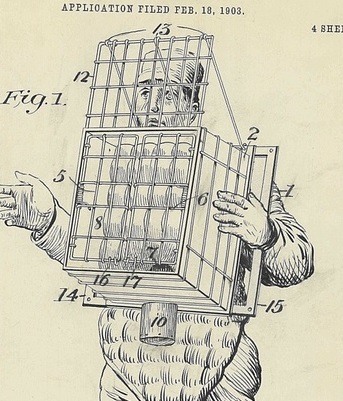
    In the history of baseball gloves–better still, in the history of the catcher’s mitt–there are few ideas that are as singular as the glove/mitt that isn’t a glove, or a mitt.  This was the patent report of the invention of J.E. Bennett in 1904, which proposed to replace the mitt with a cage.  The cage offered a receiving area easily double the size of a catcher’s mitt, with padding at the back of the cage to cushion the capture of the pitched ball, after which the ball would somehow be collected and deposited via that pipe.  I’m not sure what the catcher would do with pitched balls that were low, or high, but the cage certainly did not have any real versatility, particularly when comparing it to a real glove. It seems as though this idea didn’t go far, and that was a good thing. 

    http://www.theguardian.com/technology/gallery/2015/may/14/imagining-the-future-turn-of-the-century-us-patents-in-pictures

    Patent catcher cage


    ·Posted by :

    ·in:

    — —

  • The Eloquence of Baseball (Games), 1904

    JF Ptak Science Books  Quick Post

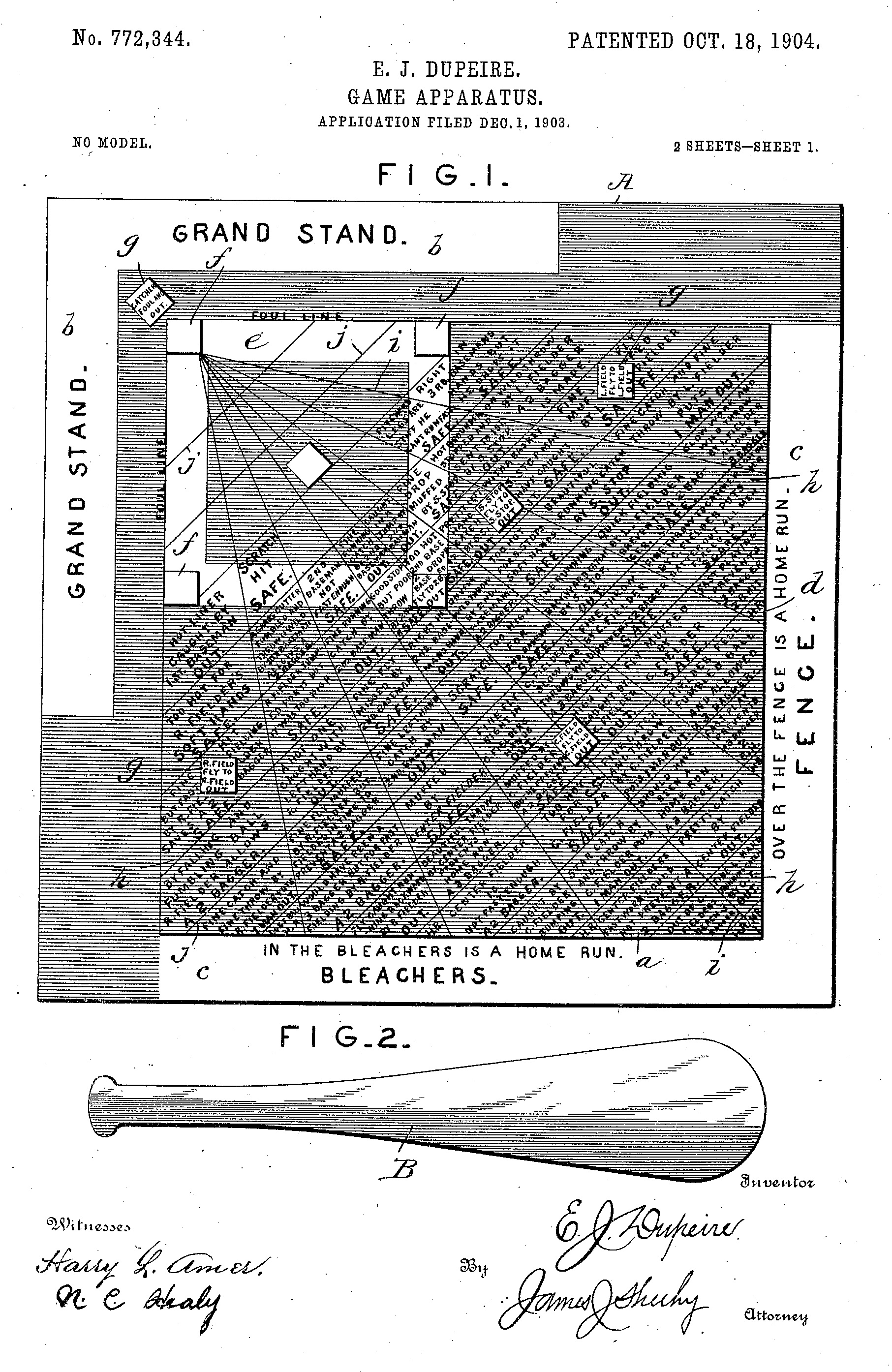
    Baseball season is either here or almost here, so picking around in old patents on baseball games in December is perfectly allowable.  This game (found at Google Patents) probably has more text on it than just about any game of any sort I’ve ever seen (and that may actually include Scrabble), and its lazy-staccato descriptions of the “play” are really quite lovely for a board game1. For example: 

    • “too hot for the right fielder’s hands”
    • “a hot one caught” 
    • “2nd baseman not fast enough”
    • “fine running catch” and “beautiful running catch” and “pretty left hand catch”
    • “good stop, poor throw”
    • “would have been a 3-bagger but for the fast fielding by the right fielder”
    • “slow work and wild throw”
    • “fly muffed”

    Patent baseball game lots of script

    [Source: https://www.google.com/patents/US772344?dq=catcher+baseball&hl=en&sa=X&ved=0ahUKEwiz0–e5L7JAhXK7CYKHWt_CPwQ6wEIVjAI]

    Notes:

    1.  I haven’t read many books on sports in my reading history, but from what I have seen over the years is that baseball literature is good enough to have its own genre. If you’re going to read only one or two baseball books in your life, consider one of these: Roger Kahn, The Boys of Summer (1972);  Eliot Asinof, Eight Men Out: The Black Sox and the 1919 World Series (1965); Jimmy Breslin, Can’t Anybody Here Play This Game? (1963);   Robert Creamer, Babe: The Legend Comes to Life (1974); Arnold Hano, A Day in the Bleachers (1955);  Donald Honig, Baseball When the Grass Was Real: Baseball from the Twenties to the Forties, Told by the Men Who Played It (1975); Bernard Malamud, The Natural, (1952).


    ·Posted by :

    ·in:

    —

  • The .50-Caliber Better Mousetrap

    JF Ptak Science Books   Quick Post    Daily Dose from Dr. Odd

    Patent better mouse trap

      [Source:  Google Patents, https://www.google.com/patents/US269766?dq=patent:269766&hl=en&sa=X&ved=0ahUKEwiyw_r6277JAhUGSiYKHV_eCdkQ6wEILDAC]

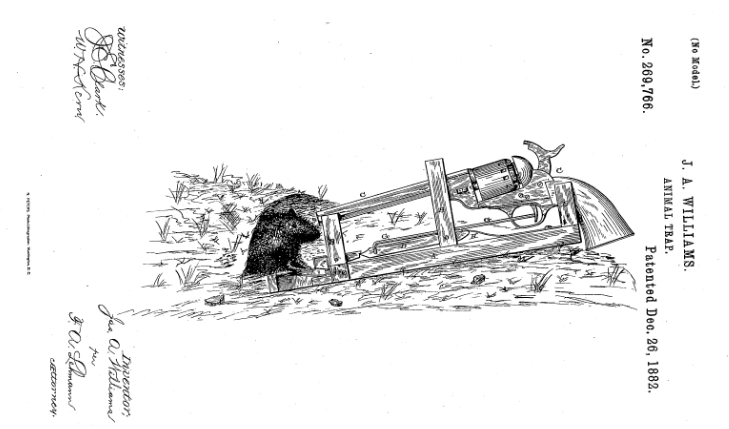
    Well, there’s not much that one can say about this that the reader is not already thinking.  

    The idea was that of J.E. Bennett of Fredonia, Texas, who patented the “trap” in 1882.  He reports that this apparatus has been used before, as a house “alarm”. He states in the patent that  “I am aware that burglar-alarms of various kinds have been used, and which have been connected to windows and doors in such a manner that the opening of the window or door causes a pressure upon a lever which discharges a tire-arm; but in no case have the parts been arranged and combined as here shown and described.”  Indeed.  I think that this sort of “alarm” was declared illegal decades ago because its use employed depraved indifference.  Poor little critter.  

    ·Posted by :

    ·in:

    — —

  • Away, Down the Dark Tunnel of Creation….

    JF Ptak Science Books   Quick Post

    Infographic Emma Willard detail

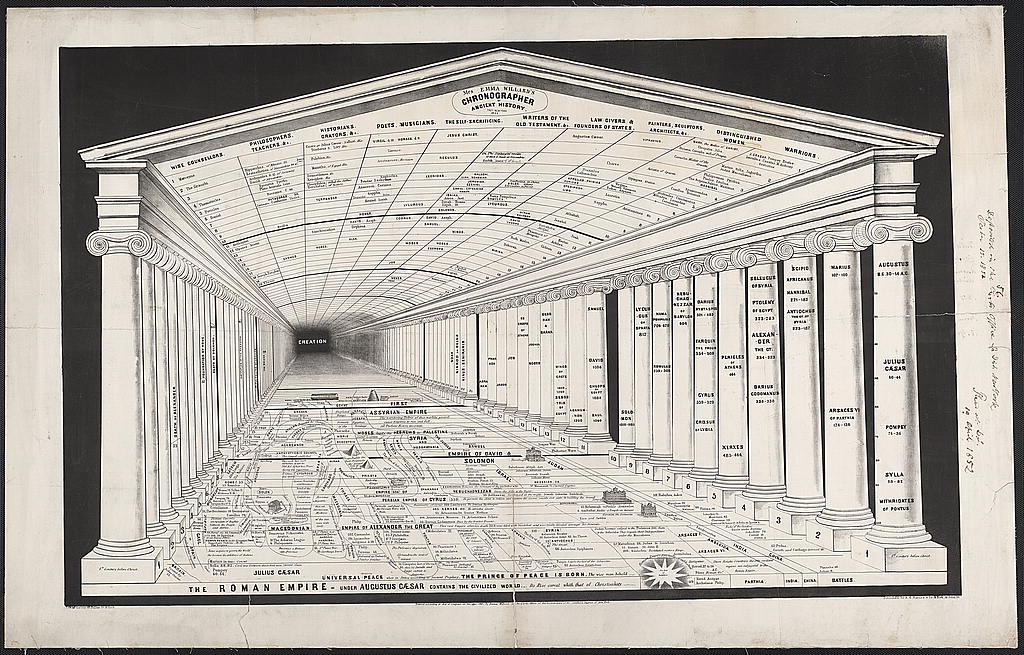
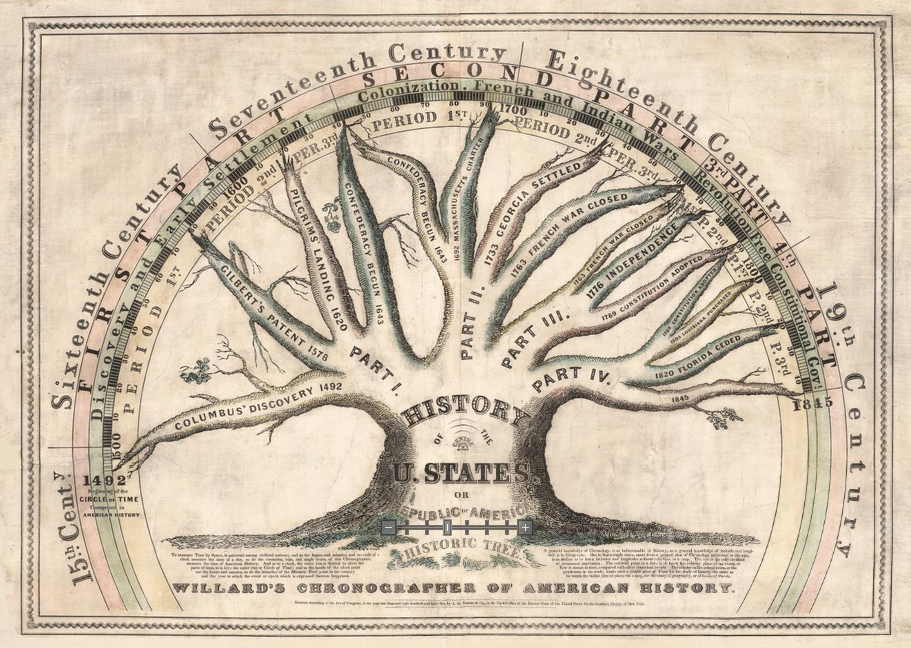
    Emma Willard (1819-1870) has been described as an “apostle” of female higher education in the U.S. She wrote some interesting texts on American history, concentrating in the telling of the story by chronology, and using some interesting visual aids to focus the readers’ attention in a condensed manner. She created several memory palaces in her imagery, making it easier and perhaps more elegant for her readers to be able to more easily record the progression of history.

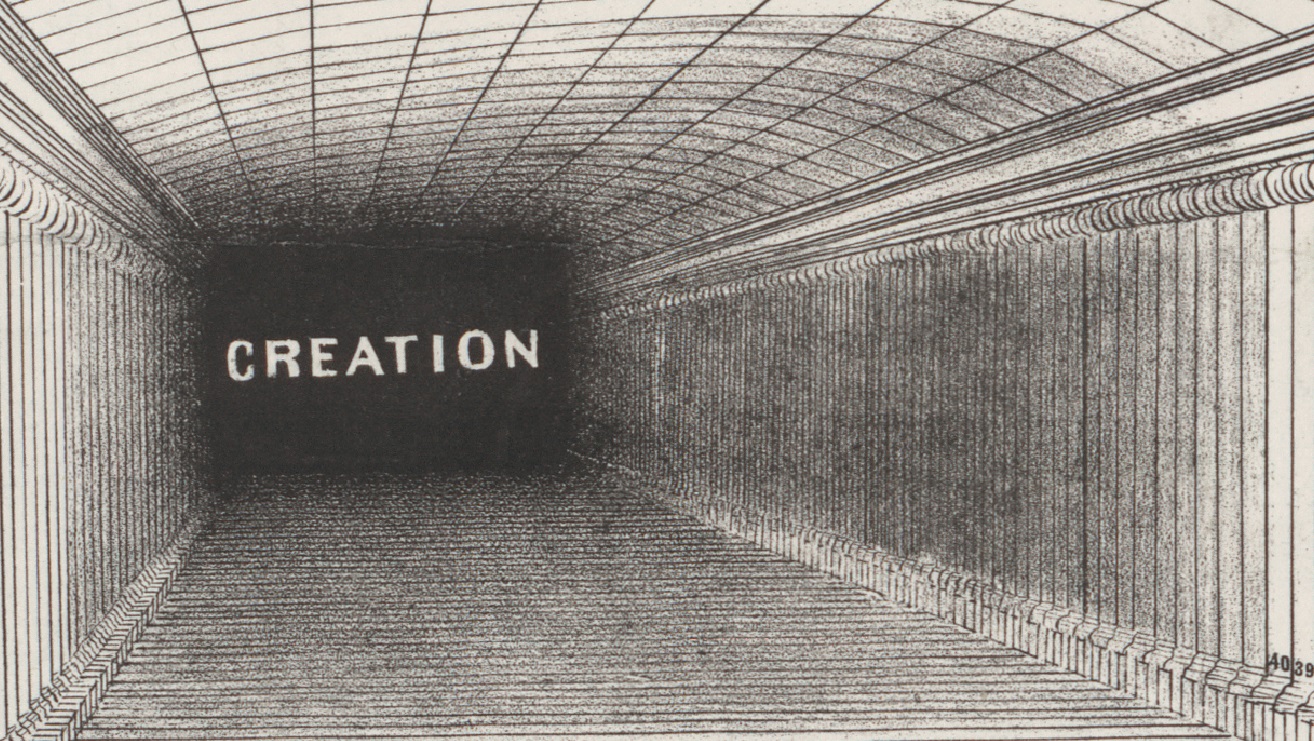
    The “dark tunnel of creation” here is the background of the events of history housed by an ionic temple–in the original (from the Library of Congress) the word “Creation” is really quite small, and then surrounded by a considerable well of darkness, the millennia slipping by without index or notice, until they don’t. 

    And the full image (images via the Library of Congress, http://www.loc.gov/item/2005694445/):

    Infographic emma willard small version

    (Mrs. Emma Willard’s Chronographer of ancient history, published in Troy, New York, printed by lithography via Sarony of NYC.

    Emma Willard also produced this beautiful chronological print, meant to be displayed no doubt on a schoolroom wall:

    Willard chronographer of american historyTree of chronology [Source: via DavidRumsey.com maps:  http://www.davidrumsey.com/luna/servlet/detail/RUMSEY~8~1~240521~5512286:Willard-s-Chronographer-of-American?utm_source=hootsuite]


  • A Peep Into the O.S.S. Library Files

    JF Ptak Science Books   Quick Post

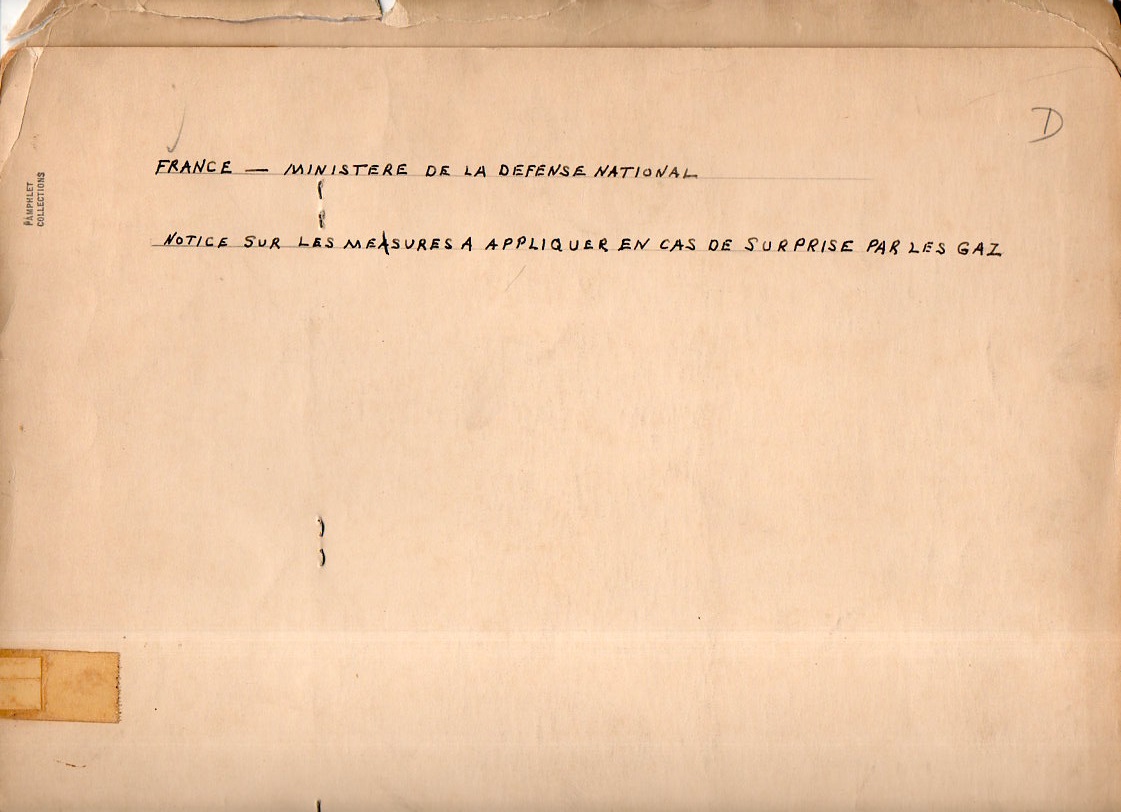
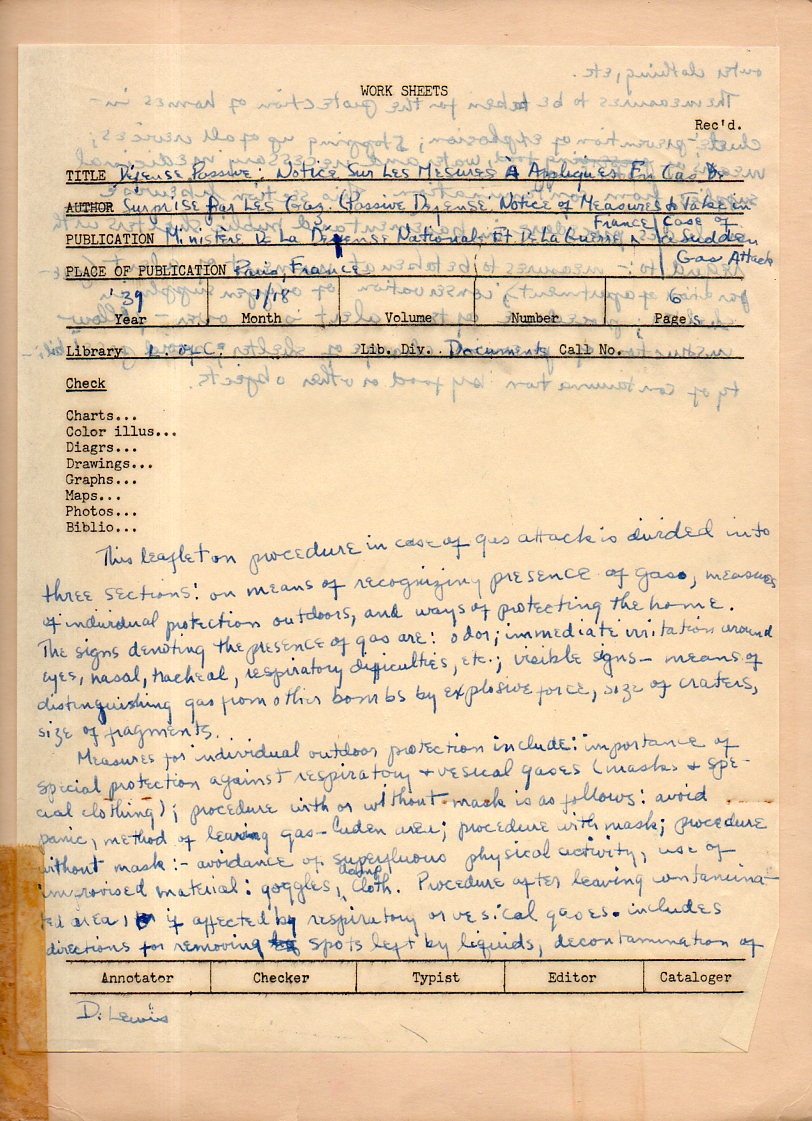
    In the widely-spaced interests of the massive Pamphlet Collection that I purchased of the Library of Congress years ago were a number of items that had once been in the library of the Office of Strategic Services (the O.S.S.), which was the predecessor to today’s Central Intelligence Agency.  Most of the pamphlets were stamped “Library/OSS” as were the foreign language pamphlets, which for my experience were housed in manila folders with internal routing slips.  The example below happens to not have that O.S.S. stamp, though I am sure that it is one among the others–this one though is from 1939, and the O.S.S. wasn’t formed until 1942.

    I’m sharing it here as an example of a small insight into the organizational capacity of the O.S.S. library–it is simply an interesting and thorough classification of ephemeral information. 

    WWII gas attack _a_358

    And inside:

    WWII gas attack _b_359


  • A History of Dots, Periods & Points, Part I: Descartes and a Year-Ending Post

    JF Ptak Science Books 

    I’ve posted this bit on most December 31sts since 2008, and I’m doing it again. I don’t have any other year-enders, so this will have to do, on ending the year on the dot.
    0 blog dec 31 descartes330

    In closing out my first year of blogging, I’d like to take an incidental look at one of our language’s most important fragments.  Like Mr. Eliot’s observations of Baudelaire being a fragmentary Dante, and like the brilliantly arranged frammenti of Piranesi, the great bits of our communication processes owe a breathy thanks to the lowly period.  A dot.  A point.  It separates to provide analysis and coherent recognition of thought. 

    A simple dot (.). But dots are as little or as big as you need:  there’s “Little Dot” (the cartoon character of Harvey Comics, created 1947, who was fascinated bylines and dots and dashes), “Admiral Dot”, polka dots, Mama Dots.  Dots get considerably ratcheted up in quantum dots, and then expanded beyond that with the idea of the dot as an abbreviation for the multiplication sign, both of which increase things rather than bringing them to an end, a conclusion.  The dot used after a musical note delineates that there is an increase in time by half, which would be an interesting notation to adopt in literature, if we were somehow able to magnify and increase that which would normally have been ended by the same notation.

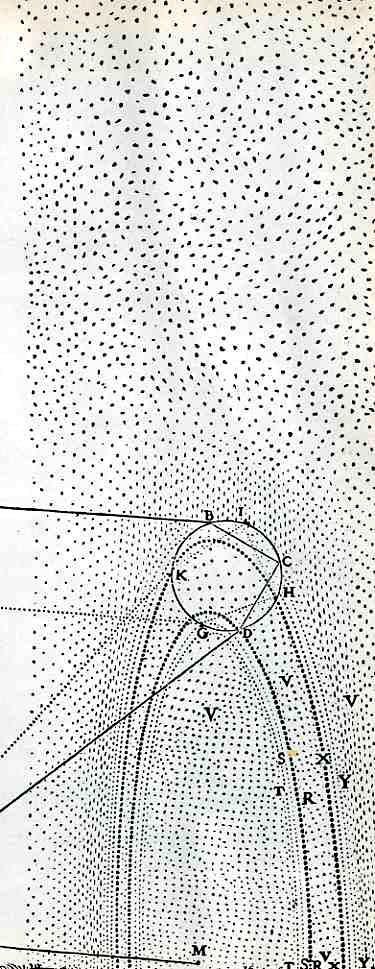
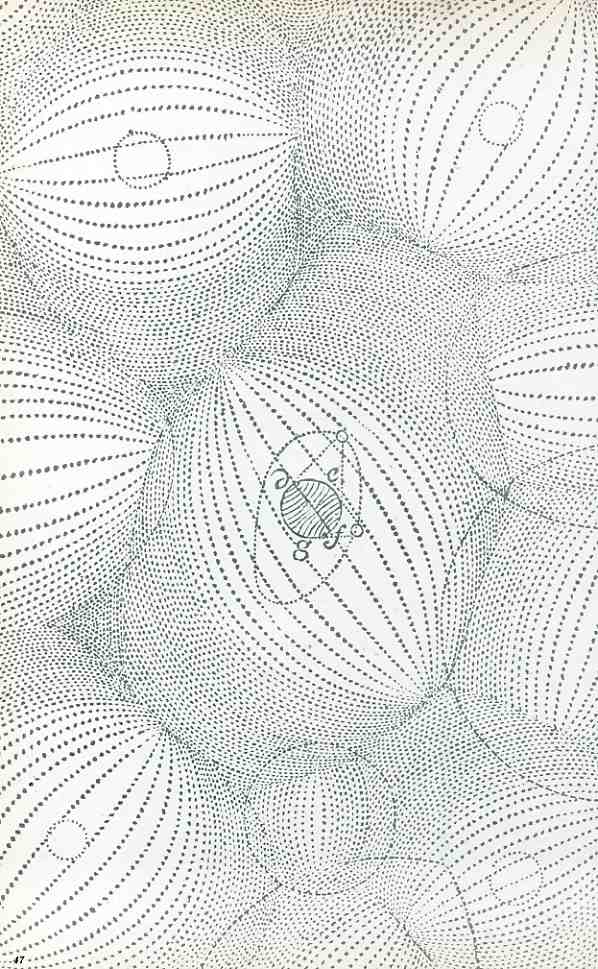
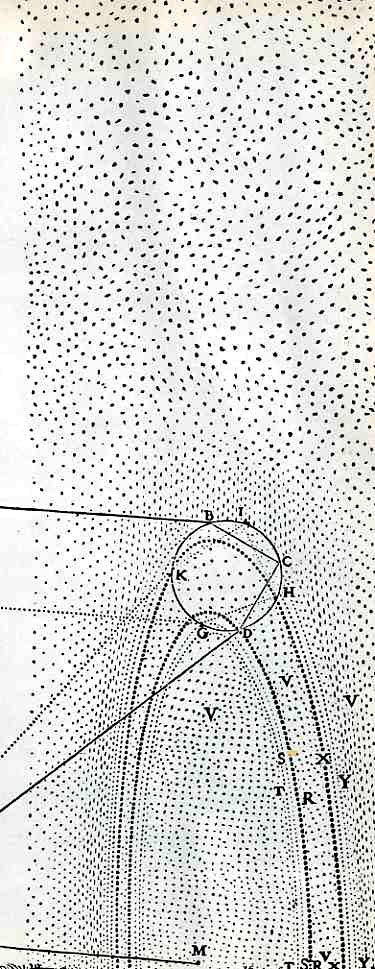
    Dots have formed the background to some of the most significant scientific illustrations of all time, like these two images, the first of which Descartes’ illustration of the decomposition of the rainbow, found in his Dioptrics, a fabulously important illustration. The second is from Descartes’ Principia Philosophiae (1684) which display his theory of vortices, accommodating an idea of physics eliminating atoms and vacuums and joining matter and space, matter being constantly deflected from moving in a straight line, moving in vortices.  Then of course there’s the fantastically appreciated advancement of Samuel Morse’s telegraphic instrument and his abbreviated transmitting alphabet (his “code”), which fascilitated the distribution of information in the 1840’s  in the same sort of way that the internet increased the flow and ease of data in the 1990’s. (Actually that’s only half correct for Morse, as his was a system of dots and dashes.)
     

    0 blog dec 31 descartes331

    Things get more interesting if we expand the idea of the “dot” to a “point”, as just about everything we have discussed in math for thousands of years has been based upon the idea of a “point in space”, forming the bits of the coat hanger on which the whole fabric of the heavens has been hung.  Going the other way, there’s the decimal point, which brings us to negative powers of ten, into smaller and smaller worlds, to the incomprehensibly small, showing that “nothing” probably doesn’t exist. (We’ll leave the idea of “spot” alone, tonight.)

    That’s quite a bit of expansion from a word that starts out life in Middle English as the definer of the head of a boil.

    But this year will end in about 50 minutes from now, and I wll be able to put the final keystroke to the final sentence to my final post of the year, and put it all to sleep.  And the year will end, at 11:59:59.  On the dot.
     

    ·Posted by :

    ·in:


  • Tall Structures and Dropping, Stopping, and Sliding Stuff (1892)

    JF Ptak Science Books  Quick Post

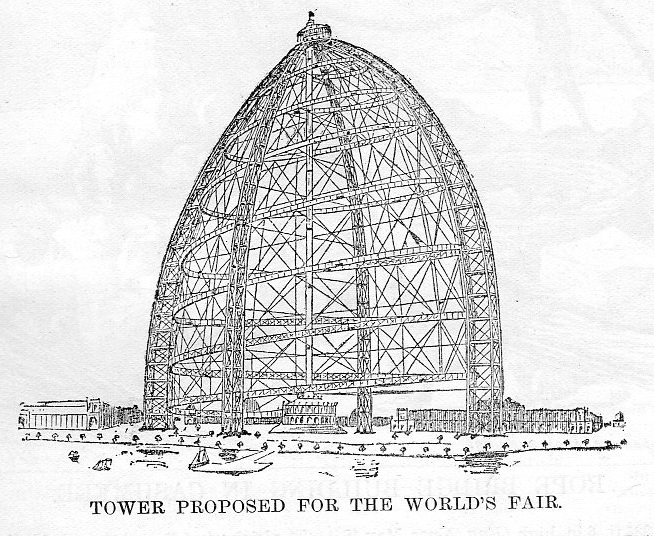
    Earlier in this blog I wrote a bit called “Dreaming of the 10-Ton Eiffel Tower Bullet, 1891” which was about the massive free-fall bullet ride that was to be part of an Eiffel Tower entertainment package–the apparatus wasn’t built, which was probably a good thing, what with dropping 20 people in a steel bullet from 900′ feet not being such a brilliant idea1.   The Eiffel Tower had been built a few years before for the 1889 world’s fair in Paris to mixed reviews–actually there was a call for its deconstruction post-fair because so many people found it so confounding/unappealing.  The Columbian Expo’s greatest “response” to the Eiffel Tower and the not-building-another-one was probably the 264′ Ferris wheel–it was very popular, and after the fair it was dismantled and moved to another location in Chicago in 1895, and then disassembled again and moved for use in the St. Louis World’s Fair of 1904–after that it was ingloriously retired and sold for scrap (for $1800). 

    This all came up just now because in browsing the 1892 volume of Scientific American I bumped into this drawing of a proposed exhibit/attraction for Chicago–an observation tower with a “slide”. Folks would be hauled up to the deck at the top, after which they would be loaded onto a car (descent controlled by air brakes) and sent back down on a 5o grade. There’s no help in the article or drawing to determine just how massive this structure was supposed to be, though it looks very substantial, hundreds of feet tall.  Given that the new form of building at this time was the skyscraper and that the only thing to make the skyscraper practicable was an elevator, this was probably a good advertisement/display/p.r. stunt for the machine–even more so for the brakes on the sledges and the elevator, because you really can’t have tall buildings without elevators, and you can’t have elevators without good brakes. 


    Columbian expo tower429

     Notes:

    1. (Check out this link for a fuller story on this bizarre and probably fatal idea https://historyofideasblog.com/thesciencebookstore/2011/11/dreaming-of-the-10-ton-eiffel-tower-luxury-bullett-addendum.html )


    ·Posted by :

    ·in:


  • On the Dreadful Nature of Unseen Point-Blank Racism

    JF Ptak Science Books  Post 2572

    I’ve written a number of times about tertiary,  massively incorporated examples of racist behavior in the pre-WWII United States. Impossibly bad stuff that we would never think of as having any place anywhere today was sort of every place everywhere 75+ years ago.  The racist imagery seems to spontaneously occur in places where there just wasn’t any “point” for it, but there it was, a sort of non-sequitur of half-conscious social quiet-loathing.

    Tonight’s examples were inspired by a Twitter post by Ward Harkavy (https://twitter.com/WHarkavy) on an incredible piece of social propaganda: a patent for rifle shooting game in which the target is an African American. (It is interesting in and of itself that the inventor thought enough of his invention to patent it so that no one would steal his idea.)

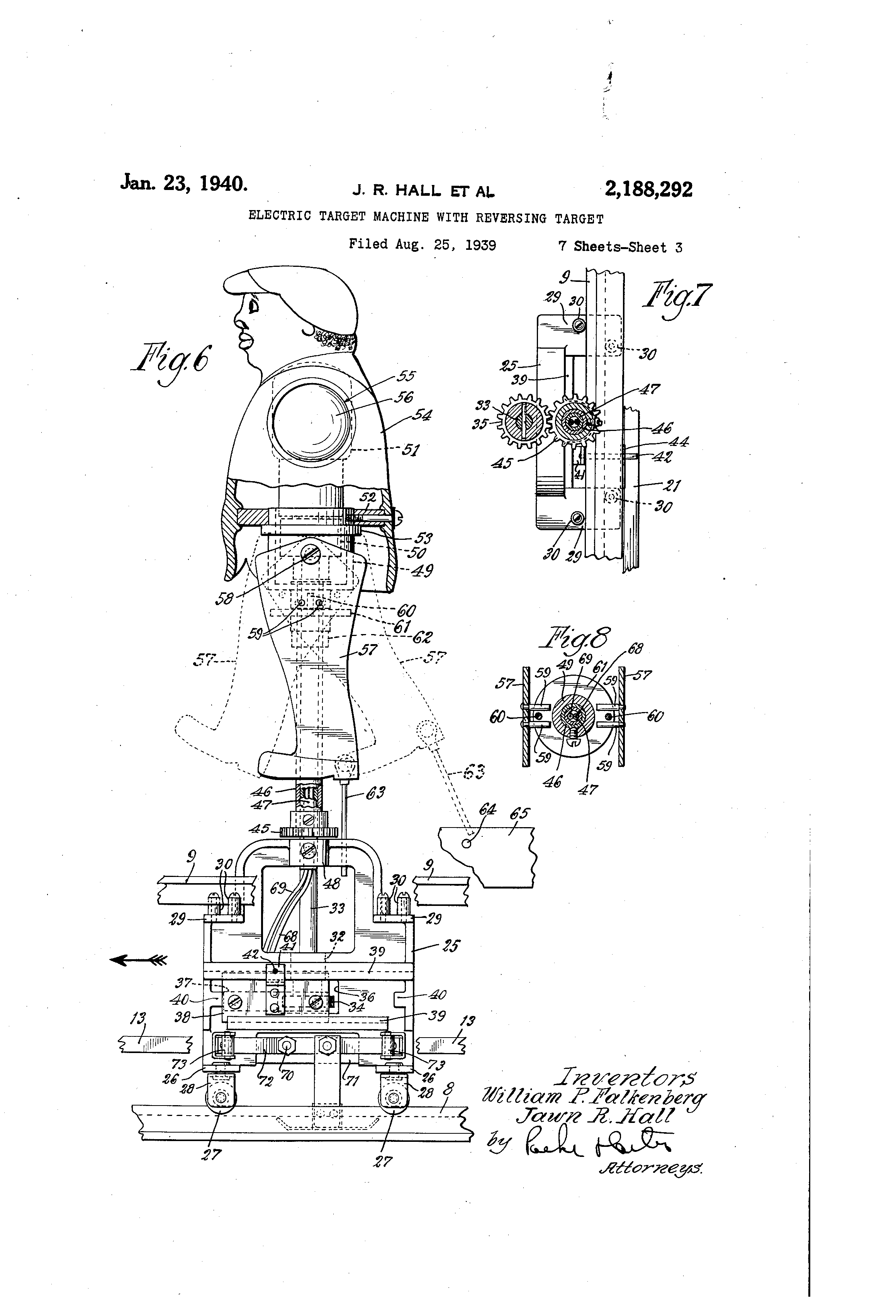
    There it is: the “Electric target machine with reversing target”, by William P. Falkenberg and James R. Hall, U.S. Patent # 2188292 A, 1939/1940. “Our invention relates to an improvement in electric target rifle ranges and has for one purpose the provision of an improved target”, the target being  Black man. Well, a Black man carrying a chicken, though it could be that “or any other suitable target”, whatever that was.  (The folks applying for the patent actually used the word “negro” with a small “N”, even though by about this time the fight to deprive African Americans of even the capitalization of the name of the race was over by about 10 years, though there were obvious pockets of resistance.)

    “…simulate a negro [sic] carrying a chicken,

    or any other suitable design.”

    Patent Negro shooting gallery a


     From the patent report:

    • “…#54 which may for example simulate a negro carrying a chicken, or any other suitable design.”
    • “We illustrate, however, means for reversing the movement of the target structure in response to every hit so that the negro, if hit, may reverse his direction of movement.”

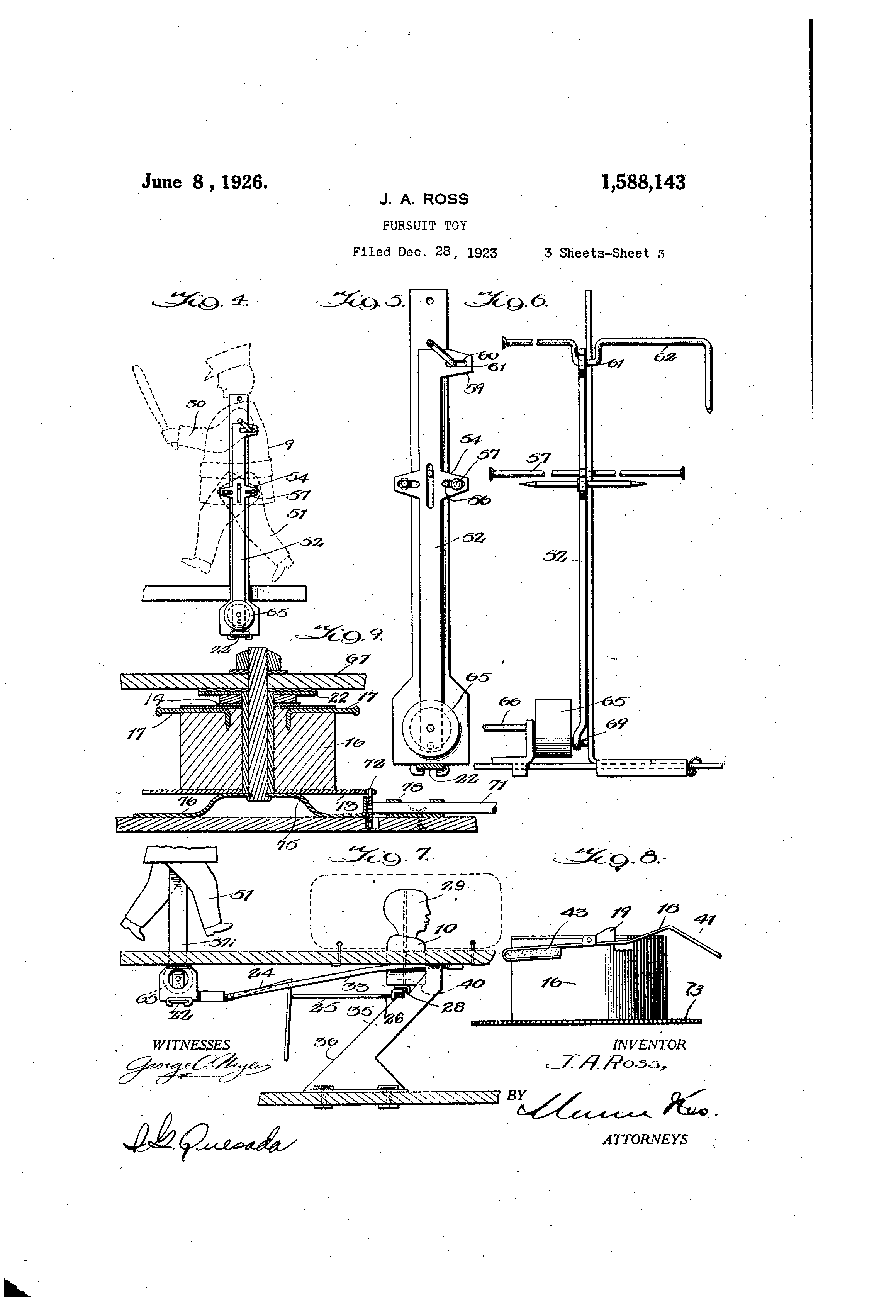
    I did a quick search on Google Patents and found a few more examples of this extreme passive-aggressive form of racism.  The second is from 1923,  a “Pursuit toy”, U.S. Patent # 1588143 A, by Joseph A. Ross, 1923.  The toy consisted of a cop who would spin ’round and ’round trying to catch/club a Black man whose head would pop up from a sewer cover.  The figure that the cop was chasing according to the report was “in the Form of a negro [sic] or any fugitive”.  The profile of the toy shows a cutaway of the patrolman (with raised baton) and the African American head (in the drawing beneath) coming up and through the manhole cover.  

    Negro Patent toy police pursuing Negro


    ·Posted by :

    ·in:


  • Eleventh Hour, Eleventh Day, Eleventh Month

    JF Ptak Science Books   Veterans Day Repost

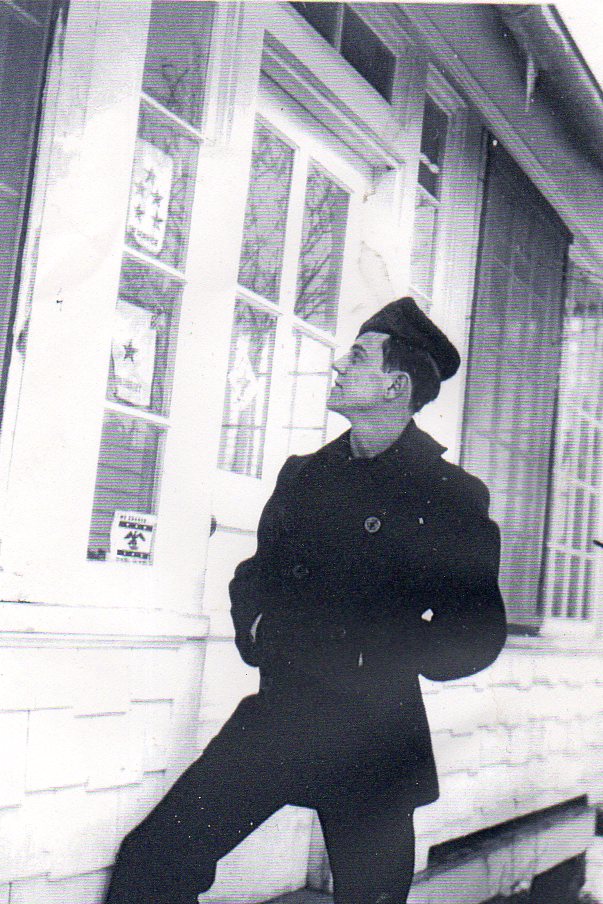
    I want to thank all Veterans today, all of our Veterans everywhere, for all of your sacrifices. I particularly want to say to say how much I appreciate the members of our family who have served: Uncle Pete (USMC, WWII), Uncle Ray (RCAF, RAF+USAAF, WWII), Uncle Stan (Navy, WWII), Uncle Alex (Army, WWII), Uncle Joe (Army, Korea), Uncle Jerry (Army, WWII), Uncle Frank (USAAF WWII), Uncle Walter (Navy WWII) and my other Uncle Stanley (Army, WWII), Uncle Francis (Army, WWII), Uncle Vincent (Army, WWII), cousin Billy (USMC, Vietnam) and Grandpa (Army, WWI); Patti’s father Melvin Lonnie (Navy, WWII) and stepfather Boyce (Army, 2nd US Cav WWII), Uncle Guy (USMC WWII), Uncle Max (Army WWII) and her four relatives in the CSA. Nearly everyone was in battle, and nearly everyone came home.
    [Image: Uncle Walter looking at the 5-star Blue Star flag at my great-grandparents’ house,  Housatonic, Mass, 1943.]

    Brothers 2990

    ·Posted by :

    ·in:


  • Now *That’s* a Front-page Newspaper Map…(1863)

    JF Ptak Science Books  Quick Post

    Georgia map

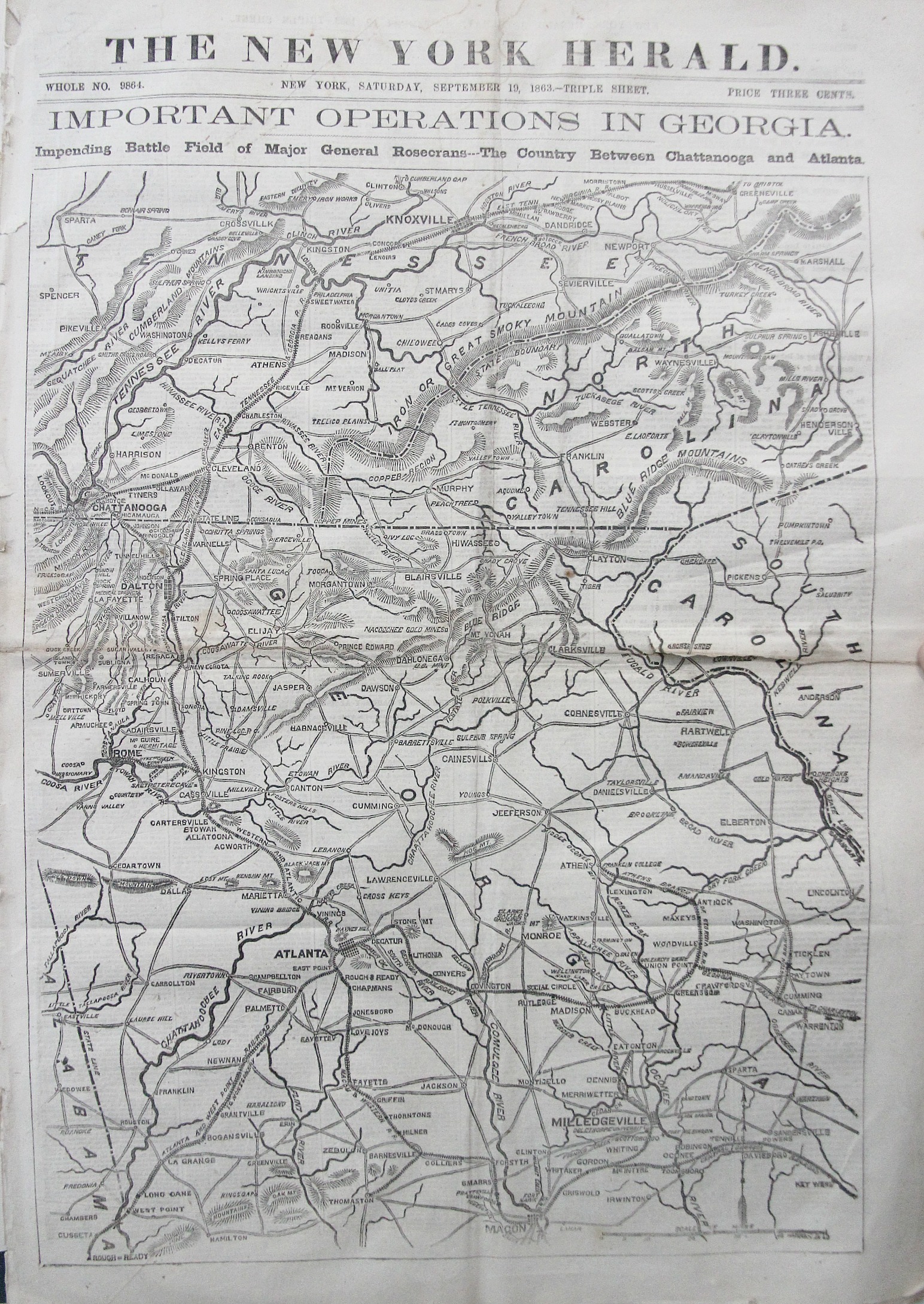
    This fine map popped out at the warehouse today–the New York Herald, September 10, 1863, with a fantastic full-page/front-page map of the theater of war in Georgia (and southern Tennessee and south-western North Carolina), back when newspapers were newspapers.  But the map centers on Georgia, and comes just a week before the second bloodiest battle of the war at Chickamauga. (The town appears right underneath the label for “Chattanooga”.)

    My own Hendersonville appears at the extreme east portion of the map in North Carolina, just north of the South Carolina line.  Most of the mountains seem to not make a very formidable entrance on this map (though Cold Mountain is seen just to the north-west of Hendersonville), and I think it is somewhat deceiving.  I’ve driven the mountains a lot in Western North Carolina and often thought of slogging around the region in the foothills, avoiding all of the mountains that I was driving through which really didn’t show up on this map.  There’s a reason that there wasn’t that much in the way of conflict in this region of WNC, northern SC, and eastern Tennessee–of course there wasn’t much worth winning, but marching through the mountains would have been a major piece of bad country to go through.  

    In any event, this was a good map for northern and central Georgia, introducing northern readers to an advancing front of the war.