A Daily History of Holes, Dots, Lines, Science, History, Math, Physics, Art, the Unintentional Absurd, Architecture, Maps, Data Visualization, Blank and Missing Things, and so on. |1.6 million words, 7500 images, 4.9 million hits| Press & appearances in The Times, Le Figaro, Mensa, The Economist, The Guardian, Discovery News, Slate, Le Monde, Sci American Blogs, Le Pont, and many other places… 5000+ total posts since 2008.

Category: World War I

  • Curious: *Two* Copies of a Quasi-Unique Work?

    JF Ptak Science Books   Quick Post

    I was cataloging some WWI material today and came across this book–again.  I thought I had placed it in with the early mimeograph/reprographic materials but then there it was, with the WWI pamphlets.  But then it struck me that I had seen it in that mimeo collection–and so I decided to check out my associative memory and, oh weird joy of weirdness, there was another copy of the work. Generally this would be rather uncommon with my stock since so much of it is really fairly obscure and scarce, but this one is exceptionally odd because it seems already to be near-unique.  

    The book is History of the Second Division (Regular) AEF. Text. -AND- History of the Second Division (Regular) AEF, Notes., and reads “Copyright 1936, The Second Division Historical Committee, Major General Preston Brown, Chairman”.  The work stands in two tall (13.5×8″)  volumes, a chunky 282+156pp; each page contains about 550 words, giving the work a length of about 250,000 words.   

    This is evidently an earlier version of a work that would be popularly published in 1937 as the The Second Division, American Expeditionary Force in France, 1917-1919, by J.W. Wright (text) and Oliver L. Spaulding (Notes), as the work above and this share the same copyright number. The authors are not identified in this work, and for its year of publication there are no copies located in the OCLC/Worldcat.  


    ·Posted by :

    ·in:

    —

  • A Call for Relief from Britons Overseas, 1916

    JF Ptak Science Books  Post 2501

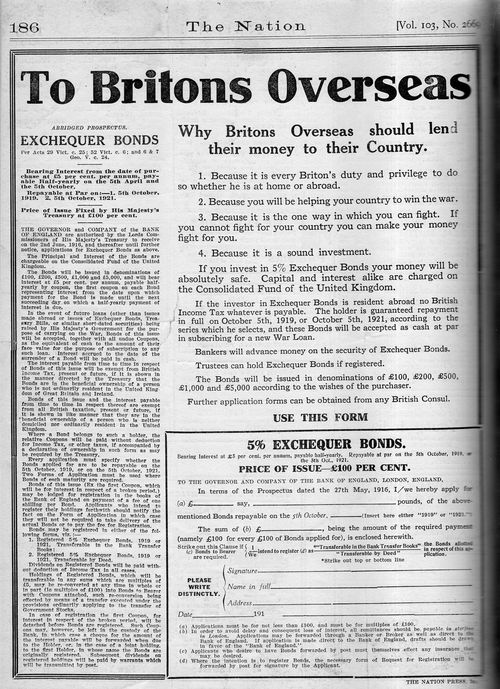
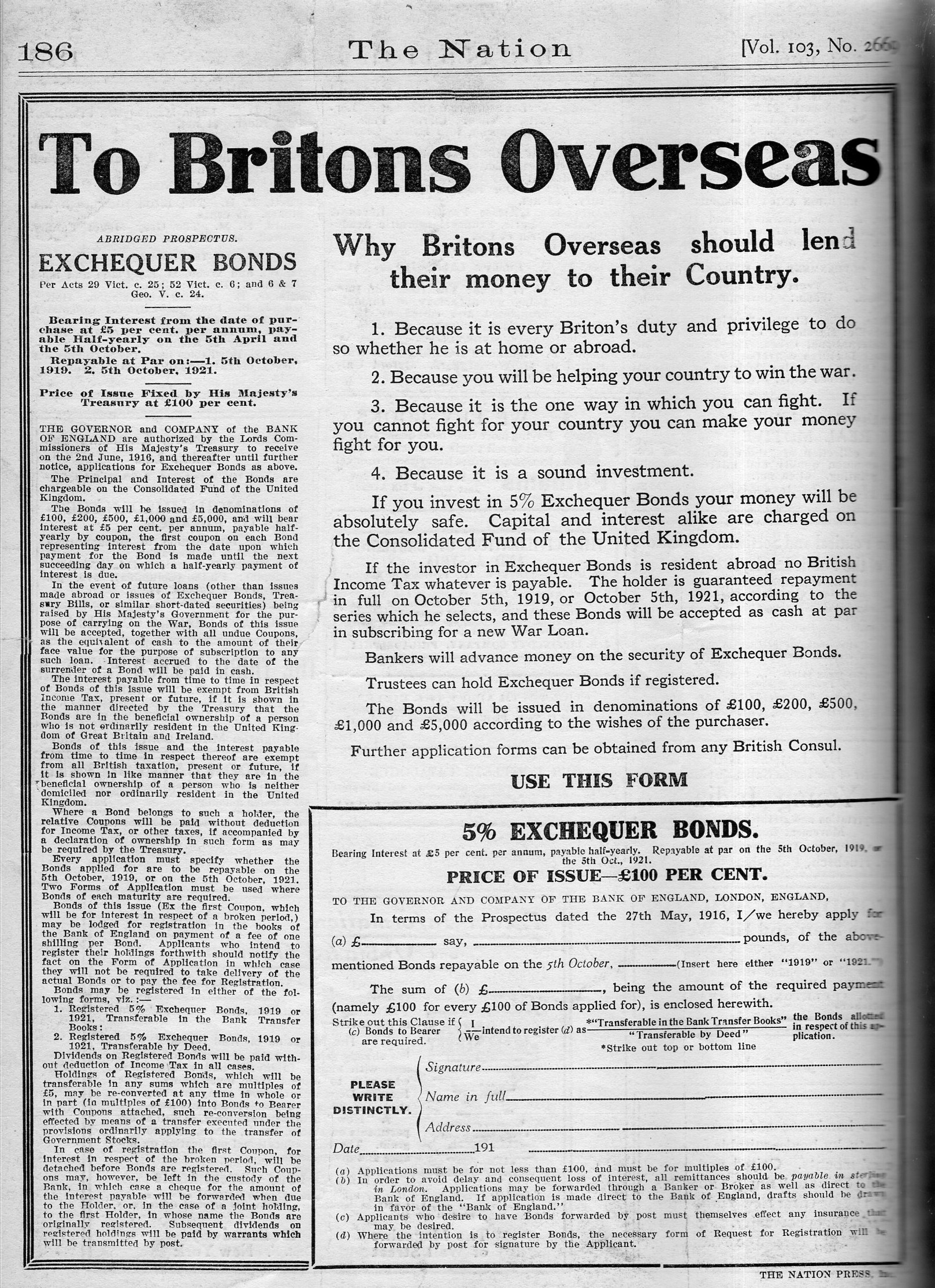
    In nearly the very middle of WWI, on August 24, 1916, there appeared this remarkable ad in the pages of the decidedly this-is-what-left-wing-magazines-look-like NYC-published magazine, The Nation:
    Britons overseas236

    It is interesting to think of the “middle” of this war with the “middle” of other wars, because, well, this doesn’t look like the middle of anything except for the post facto chronometer of fighting. In the U.S. Civil War, the almost-perfect middle turns out to be Gettsyburg, and that looked considerably past the middle so far as the Confederacy was concerned.  (And as a matter of fact, the section on Gettysburg in Shelby Foote’s great classic (The Civil War, a Narrative) comes in the near-exact middle of the middle volume of the three-volume work…the “capstone” of the book, as he referred to the battle.)  With WWII, the chronological middle, which is right around New Year’s 1943, doesn’t look like anywhere in the middle if you were there, though with the involvement of the U.S. and its enormous industrial/production capacity spelled the eventual end of the Axis; in January 1943, it still looked like a very hard road ahead. 

    It is highly probable that teh nature of being in the middle of anything is apparent only in hindsight.

    Anyway, the ad shown above was an appeal for financial support, to help fight a war that was enormously expensive, and soliciting from overseas sources one one approach. 

    The U.K. had been consumed by the war since August, 1914, and would wind up with enormous losses totaling more than 10% of the entire soldiers-in-unfirom for the war, with more than 800,000 soldiers killed (and more than 1.6 million wounded)–the fatalities being roughly twice the number of people buried in Arlington Cemetery. 

    As a matter of fact, the U.K lost more soldiers in WWI than the U.S. lost in the Revolutionary War (25,000), War of 1812 (15,000), Mexican American War  (13,000), Spanish American/Philippine American Wars (6,000), WWI (116,000), World War II (405,000), Korea (36,000), Vietnam (58,000), Iraq (3,600) and Afghanistan (1,800) combined, and then some. The U.S. Civil War, though, is another thing entirely, so far as these numbers go. (That said, and speaking of “another thing entirely, there was the Taipei Rebellion of 1850-1864, ending just before the U.S. war, claimed the lives of an unbelievable 20 million.)

    Other nations fared even worse: Austria-Hungary suffered 1.2 million soldiers dead, France 1.4 million, and Russia and Germany each with about 2 million dead. 

    I’m not sure how I got here in this short post–all of the above generated by this advertisement for financial help to fight the war and to keep a country solvent.  Now that I’ve had a quick look through the full years for 1916 and 1917 this seems to be the only appearance of the ad, and it is also I think the only full-page ad in The Nation for that time.  I have no idea what happened to the U.S. appeal–perhaps they were reaching out to the wrong audience, because in spite of the time and the spirit of the magazine, prior to U.S. involvement in the war for 1916 and 1917 there wasn’t much war coverage beyond the first page or two of general war news.  Interesting.
    ·Posted by :

    ·in:


  • A Relaxed Time on Sentry Duty, 1918

    JF Ptak Science Books

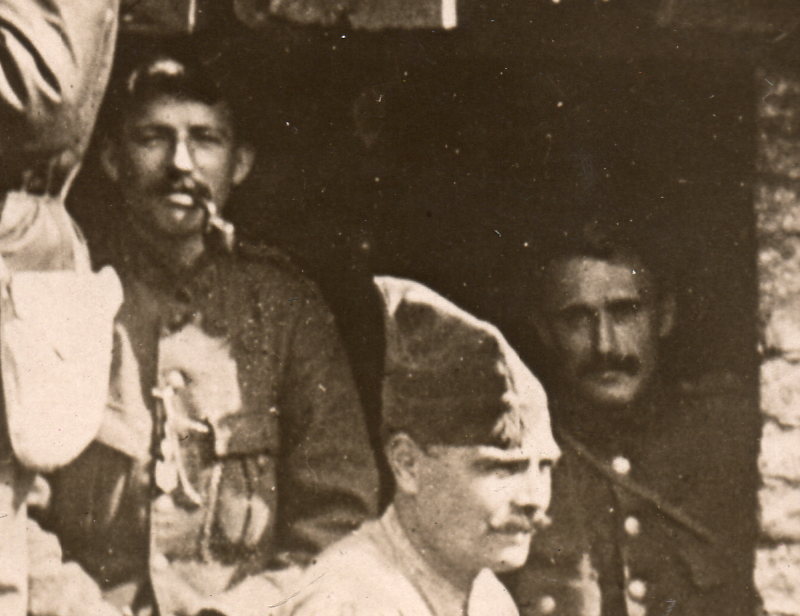
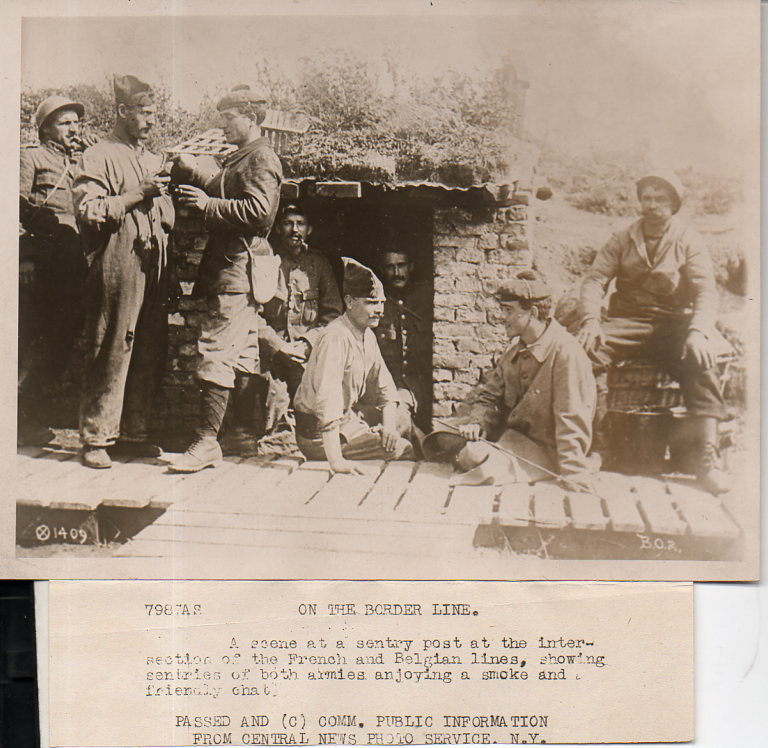
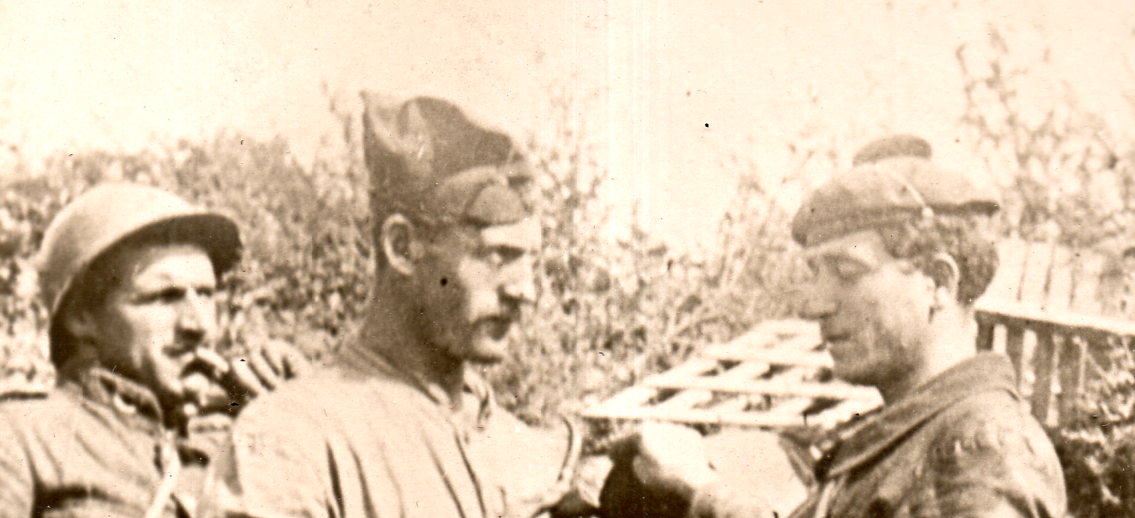
    Another interesting portrait within a photograph–this is one in a long series of images from the blog’s WWI News Photo Service Photography section, which can be found here and which will explain the purpose of pool photography during the War.  This image (explained in the original paper caption below) was made somewhere along the front at the intersection of French and Belgian lines.  The soldiers are gathered around a sentry post, enjoying some light time.  

    WWI--Photos--Border Line214


    WWI--Photos--Border Line212

    • This image is available for purchase via the blog’s bookstore, here.   

    Another detail:

    WWI--Photos--Border Line213


    ·Posted by :

    ·in:


  • The French Blue Devils at West Point, 1918

    JF Ptak Science Books   Quick Post

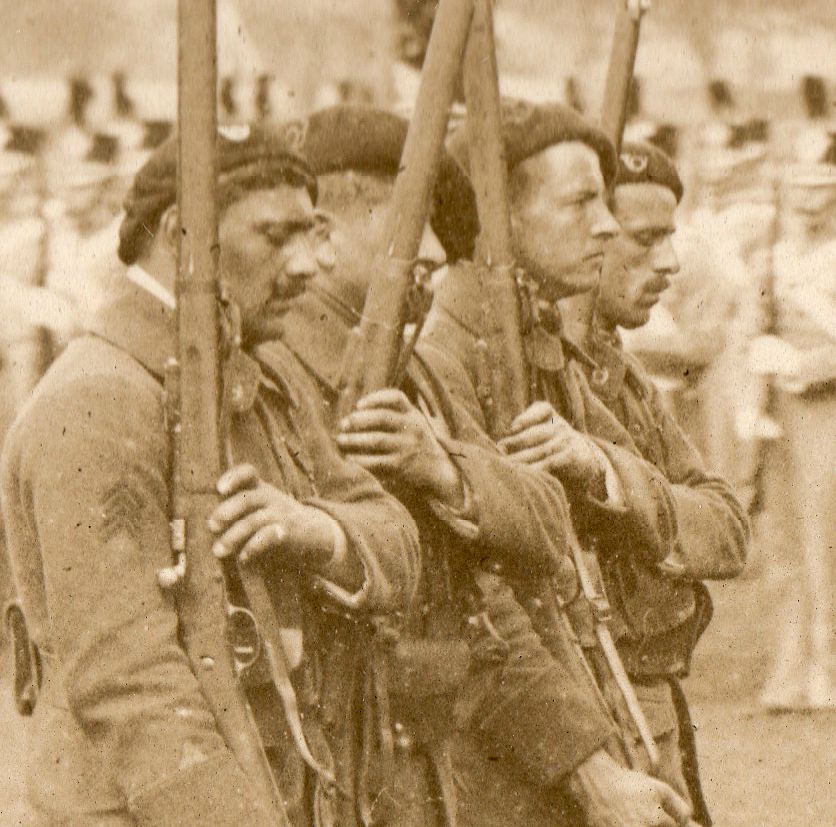
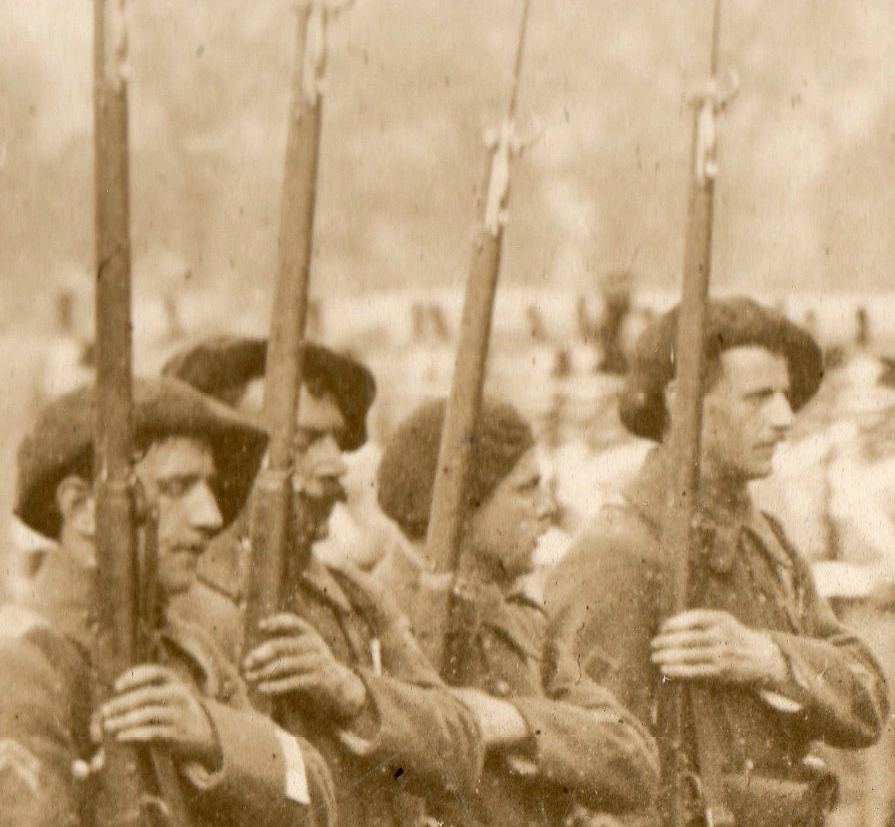
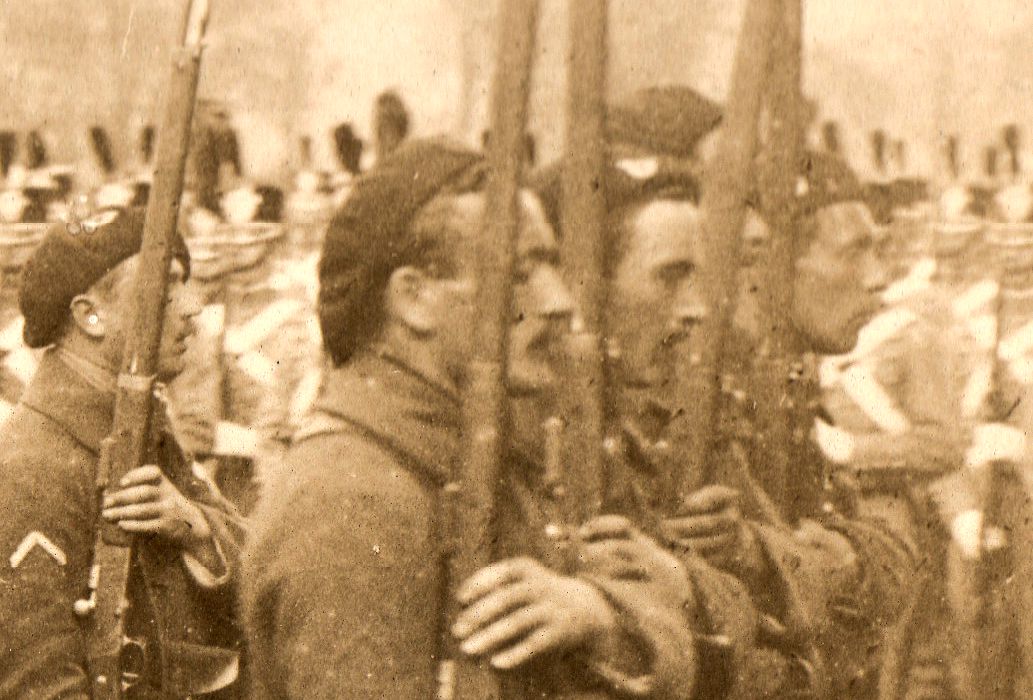
    I really enjoy looking at old photos with a magnifying glass, finding the pictures within the picture, until it is micro-images all the way down. It is odd “coming out” of them, sometimes, and then looking at the full image, and in some sense feeling utterly at a loss to try and find where you had just been in great detail.  

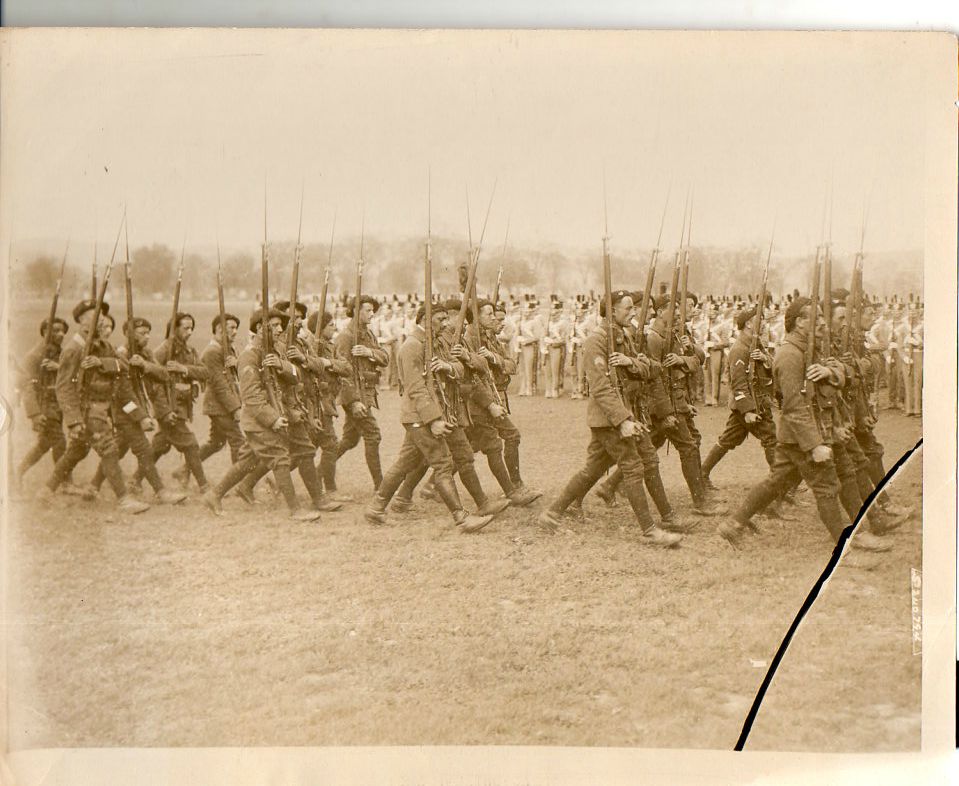
    Here’s an example with this great photo of the French Blue Devils on parade at the U.S. Military Academy at West Point.  These soldiers were and are elite mountain infantry, the Chassons Alpins, “Alpine Hunters”, and nicknamed “the Blue Devils”, and who saw their fair share of combat during WWI.  They made a tour of the U.S.at the beginning of the War in a fund raising drive, and evidently did so again, at least in this instance, showing up in New York in May 1918.  

    WWI--Photos--Blue Devils207

    WWI--Photos--Blue Devils206

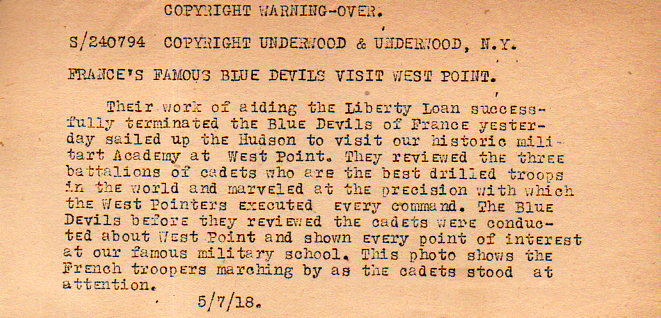
    This is a news photo service photograph (see here for the story) and is accompanied by this text which was supposed to be used along with the image when purchased for publication in a newspaper or magazine.  

    • The original photo is available for sale at the blog bookstore, here.                  

    WWI--Photos--Blue Devils210

    WWI--Photos--Blue Devils208

    WWI--Photos--Blue Devils209


  • Tired, Wounded, and Underground (1917)

    JF Ptak Science Books   Quick Post

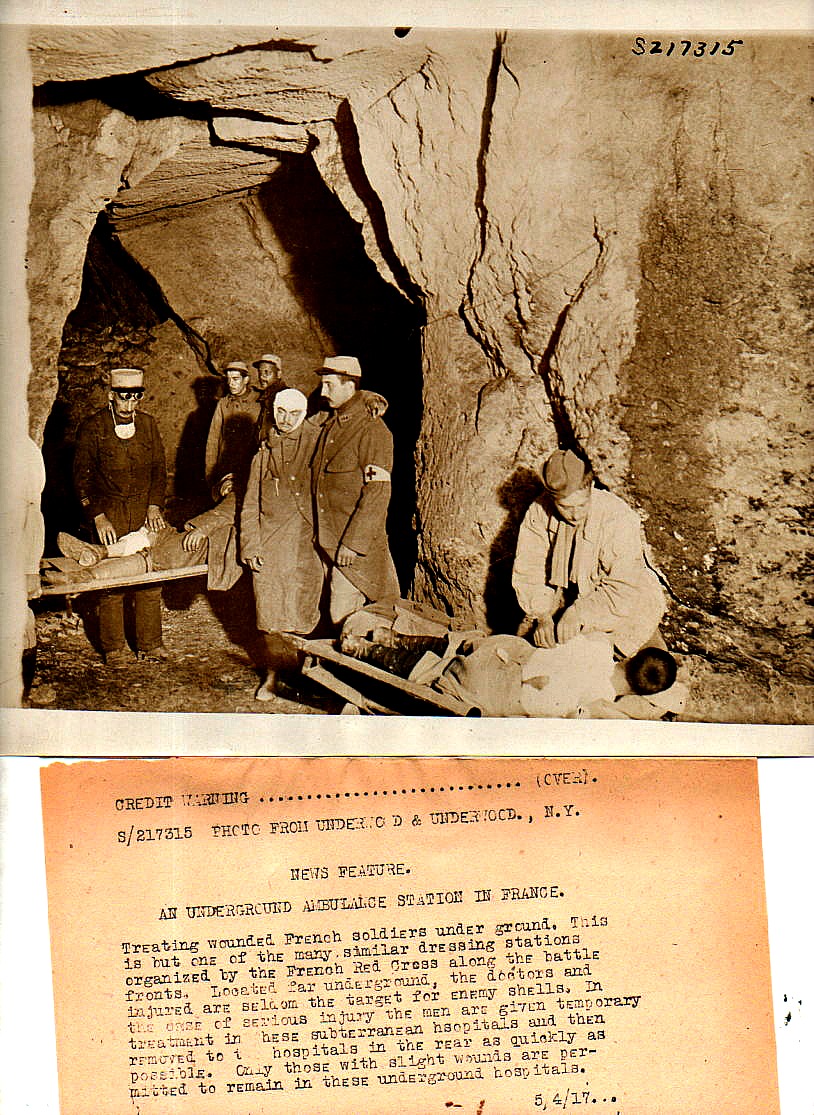
    See the WWI Photography section for more images and for an explanation of the source of the photographs.

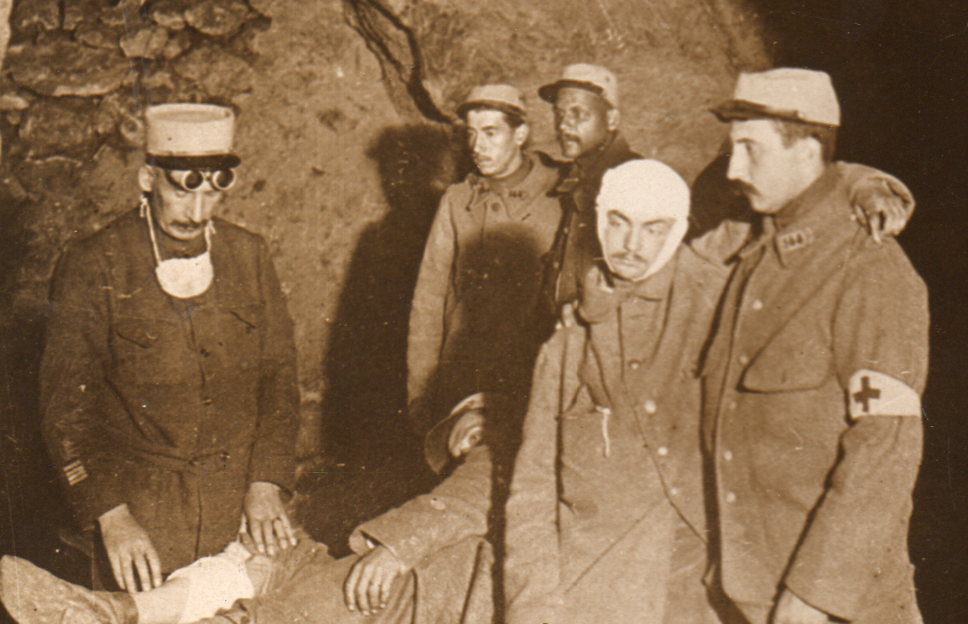
    This is a photograph of an aid station somewhere along the Western Front, 1917. Given the amount of digging going on throughout the course of the war, with the construction of hundreds of thousands of miles of trenches, and then the sapper war to tunnel underneath the tunnels and so on, it is quite possible that this underground shelter was dug out by hand. This is also an insight to the duration of some of those battles–to construct such a station impervious to possibly semi-continuous bombardment meant that the lines of battle were static, with many of the major engagements of hundreds of thousands of soldiers lasting for months, and in some cases, years. 

    The expressions here are difficult, and difficult to actually recognize as anything that isn’t exhaustion. There is a lot of “blankness” in the faces, a deep weariness.  

    WWI Photos--underground  hospital189

    This scene is a detail from the larger and full image (which is also for sale at the blog’s bookstore, here):

    WWI Photos--underground  hospital188

    ·Posted by :

    ·in:

    — —

  • The Mona Lisa of British Female Swimmers Photographed in an Awkward Moment (1918)

    JF Ptak Science Books  Quick Post

    WWI Photos--female swimmer detail

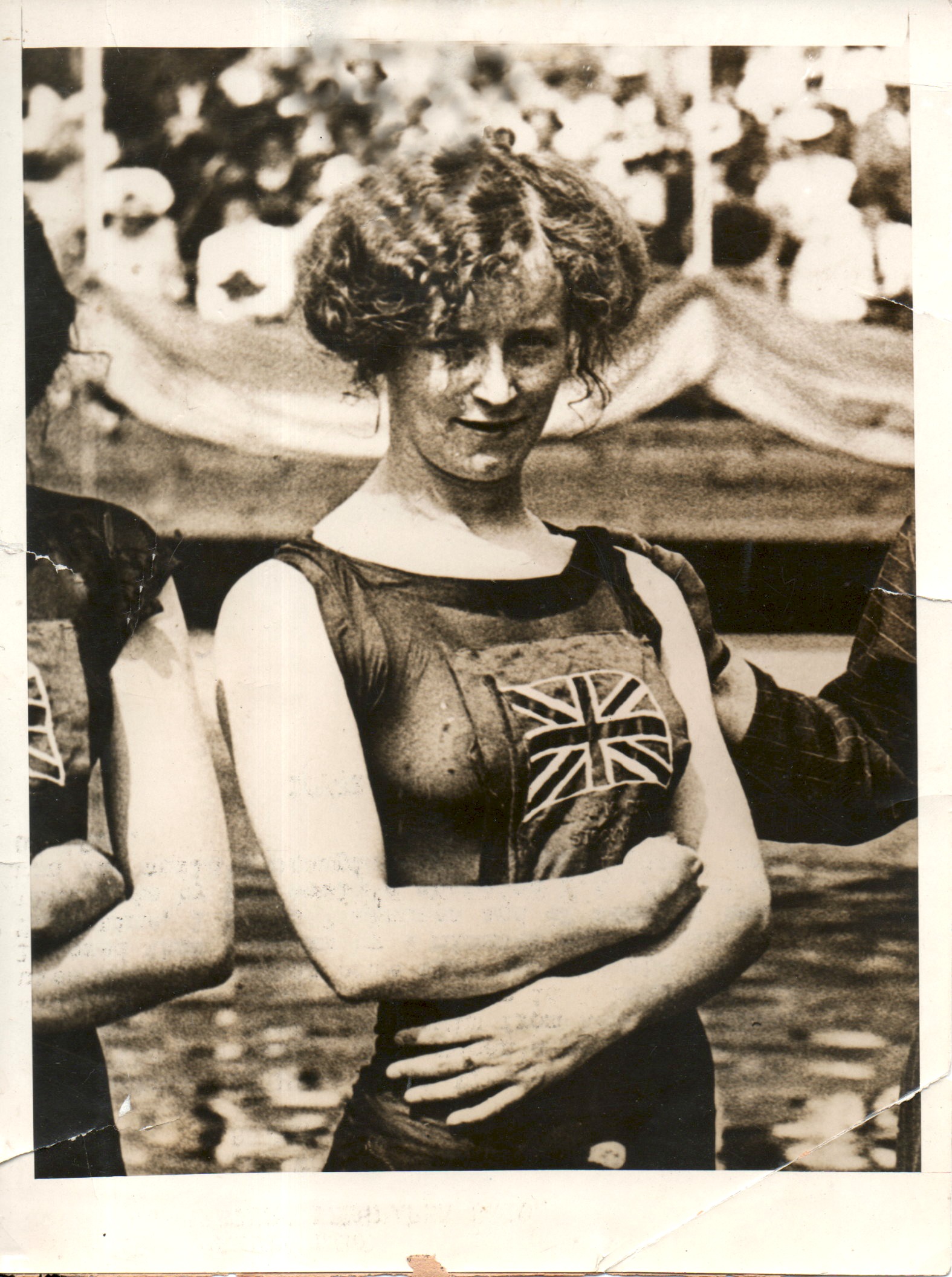
    I have made perhaps 100 posts on the images from a collection of WWI news photo service images that I have, and for quite some time this image  (below) has been one of he most captivating of the thousand or so that were in that collection.  Generally the images were accompanied by a suggested text that could appear alongside the picture when it was published (see here for the ins and outs of publishing photographs during WWI), but this one had no description at all, save for the copyright on the back belonging to Underwood and Underwood. 

    I thought that this photo was from 1918, as 1000 of its companions were, but I was corrected by on twitter about the Mona Lisa’s true name–Jennie Fletcher, (1890-1968), and the picture was at the 1912 Olympics.  It is nice to be able to put a name to the face.  (See the BBC for a good story: http://news.bbc.co.uk/2/hi/uk_news/wales/7554196.stm)

    The camera has caught her at an awkward time, especially given the sensitivities of showing skin in bathing attire. 

    What is she conveying? What is she saying with the attitude of her head and the look in her eyes?

    There have been Classic Attitudes among the photographs (like the Venus of the Tars, for example), and in all of these examples, she is the only Mona Lisa.

    WWI Photos--female swimmer185

    ·Posted by :

    ·in:

    —

  • Food as a Weapon, 1915

    JF Ptak Science Books   Quick Post

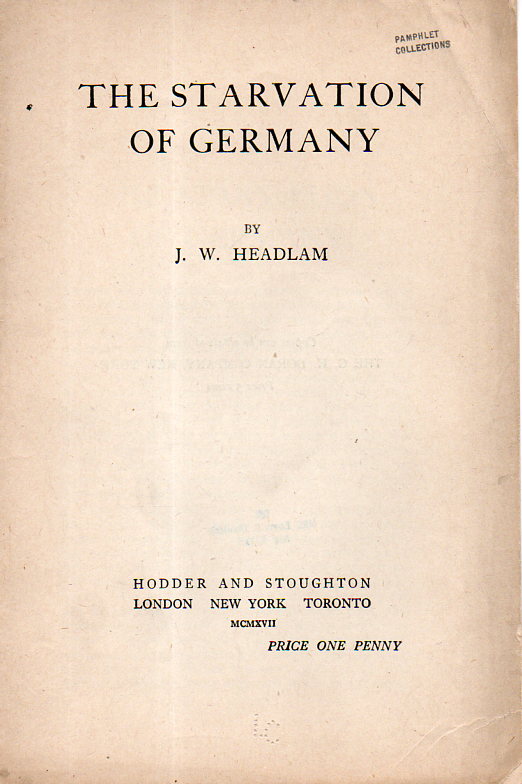
    Starvation of Germany118There are few people I think who can recall the names of any U.S. secretaries of agriculture–the notable exception being Earl Butz, who during his tenure from 1971-1976 was known for being vulgar and profane, a quality which led to his forced resignation. Another notable but less-remembered quote had to do with the thing he was secretary of:  food. He remarked that “food is a weapon”, and although considering the source, the quote was not intended as offensive ordnance. He explained that the best method of fighting the Cold War was to provide food and the means of producing it to countries that might fall under the influence of Communism to secure the birthright for their people. (He perhaps was building on President Eisenhower’s Food for Peace Program that began in 1954.)

    The Starvation of Germany was a piece of British propaganda, an explanation of the blockade being used against Germany to bring it to negotiations to bring an end to the World War.  It is not the end of World War II as I first thought–but the end of World War I.  There were blockades in both, and each being very detrimental to the population of Germany–killings thousands of German citizens–though not enough to convince the Germans to sue for peace.

    One thing that the 1915 pamphlet couldn’t yet mention–that by the end of 1918 between 400,000-725,000 Germans had died of starvation or diseases related to lack of food. 

    ·Posted by :

    ·in:

    —

  • An Extraordinary Map of Battle Death–“Body Density Maps”, 1918

    JF Ptak Science Books   Post 2461

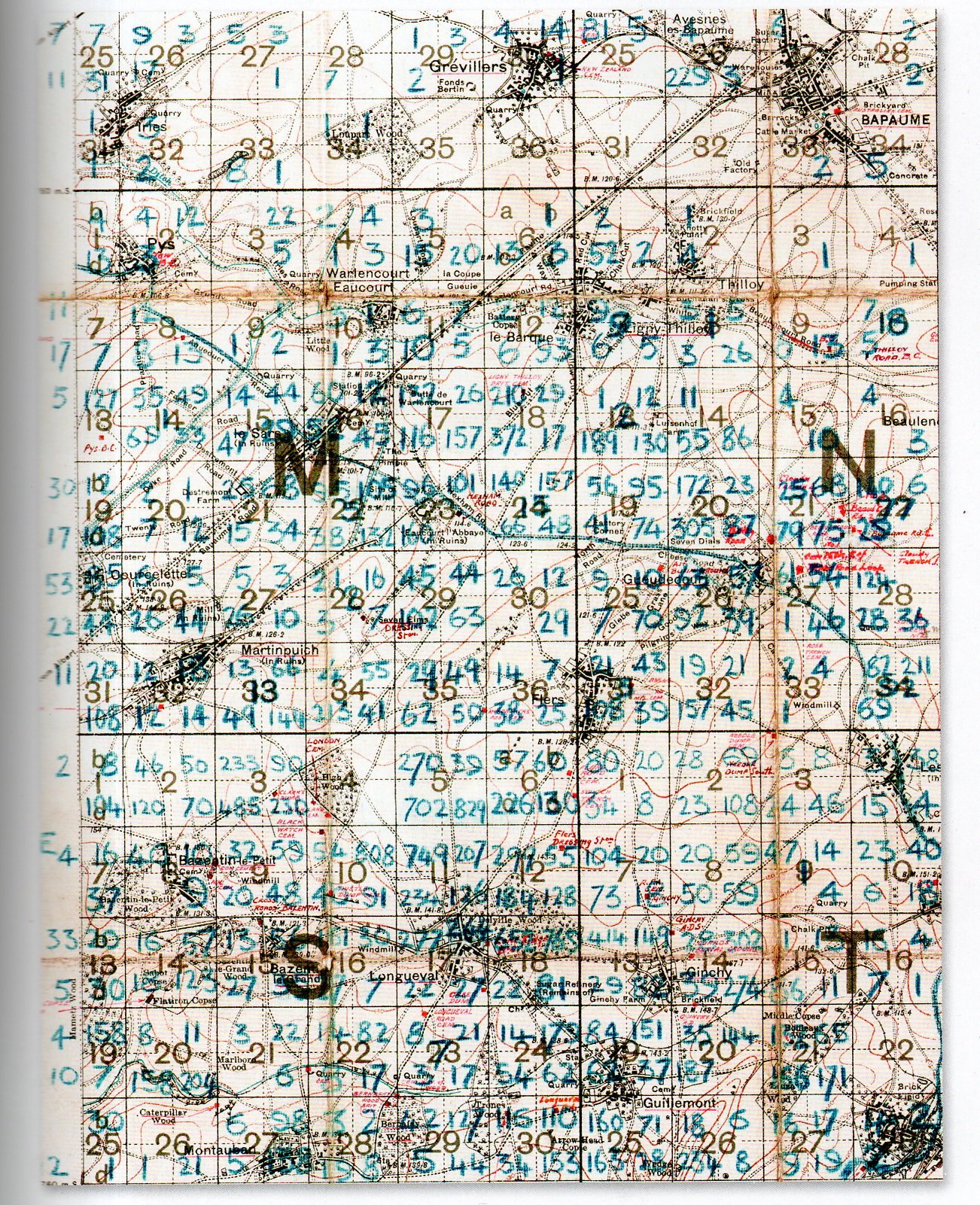
    At first glance this detailed and dense map looks foreboding and somehow off-putting–at least for me, and that was before I understood what the numbers represented.

    The blue numbers on this section of a larger map refer to soldiers killed on the battlefield of the 1916 Somme battlefield. It is the work of Lieutenant Colonel Arthur Messer (Assistant Director of Graves Registration and Enquiries in France), who undertook to record the crosses of the Fallen on the battlefield and register their location, and then to re-inter the bodies together in larger cemeteries.  

    MAP DEATH DENSITY977

     [Source: John Hughes-Wilson, The First World War in 100 Objects, Firefly Books, 2014.]

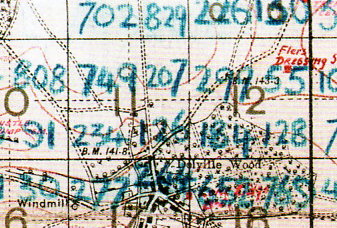
    What we are seeing here are pieces of four 6×6 grids (one complete and three partial) numbered (in red) 1-36, each one of these squares further subdivided into four section.  Each larger square composed of 36 squares is 1000×1000 yards total, meaning that each one of the 36 subdivisions is about 166×166 yards, and each of the four segments of one smaller square is 83 yards. The blue numbers indicate a soldier killed on that field of battle which means that in the large 36-square “M” subdivision  #18 that there were 210+29+372+17 fatalities, or 628 on a 166×166 yard field, or in one case 372 killed on a 83×83 yard plain.   The deaths were even more intense on other areas of the field–in Square S #11 there were 749+207+234+126, or 1,416 deaths in that 166×166 yard field, and 749 on the 83×83 yard field.  It is hard to visualize such loss. I picture a U.S. football field–there are 22 players on the field during play, and that seems to populate the area pretty well–casualties of 749 soldiers on a similar area would be nearly 35 times that, meaning that placed equidistantly and with a few feet on the sides they would cover the field.  There are, what, 75 people on a football team?  That means at the beginning of the game when all of the players and coaches and staff and cheerleaders and member of the band run out onto the field to take their places, they would all be dead–and then some.  That is a lot of death.  

    MAP DEATH DENSITY978

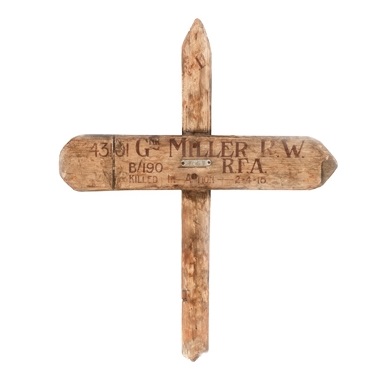
    According to the Imperial War Museum, temporary markers for fallen soldiers looked like this:

    Wooden cross

    After the war the Imperial War Graves Commission replaced the wooden crosses with stone markers.  

    The wooden markers would then returned to the family.  

    [Source: http://www.iwm.org.uk/learning/resources/remembrance-in-the-first-world-war]


  • Pause-Giving Photographs of Artillery Shell Vastness, ca. 1917

    JF Ptak Science Books   Quick Post

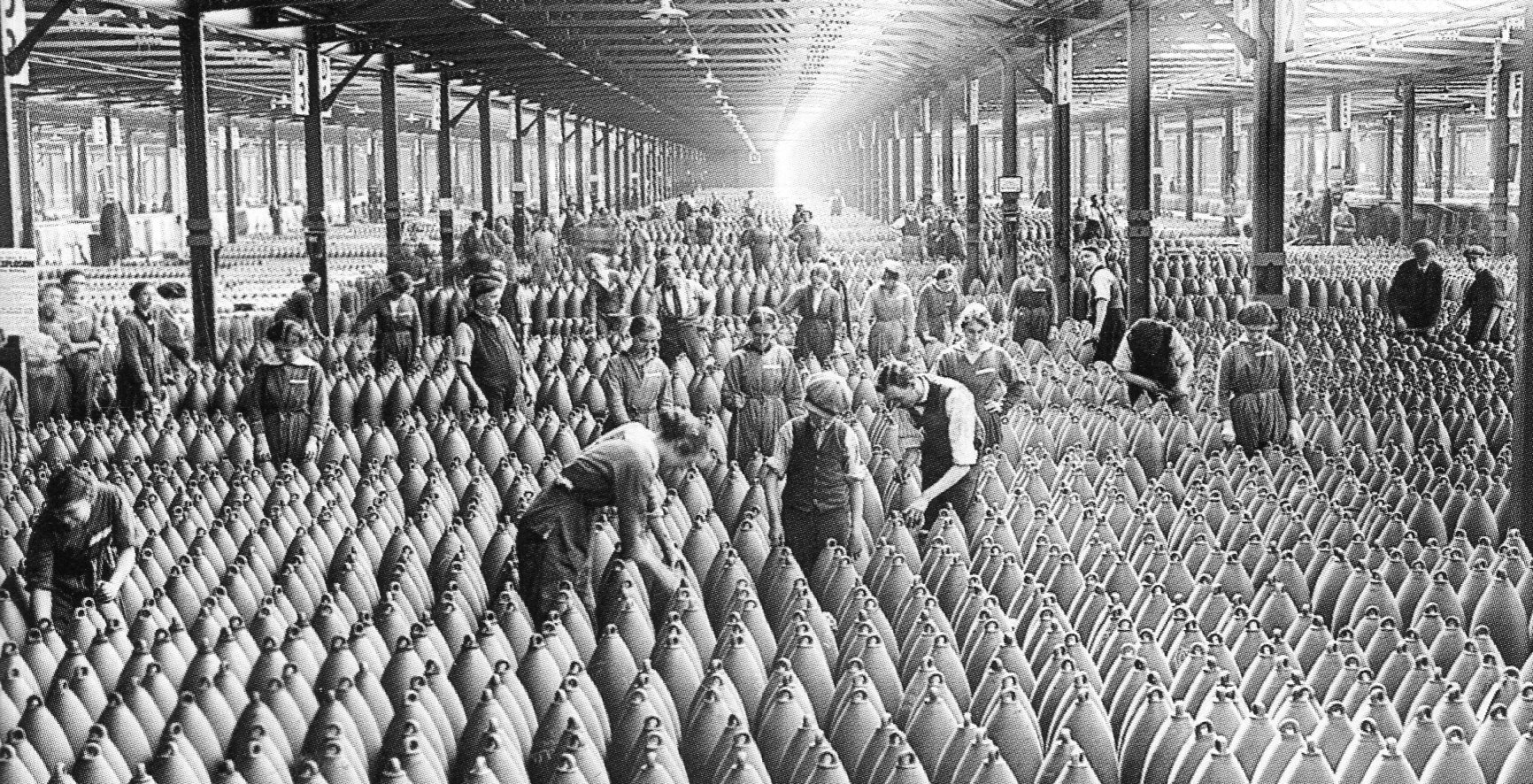
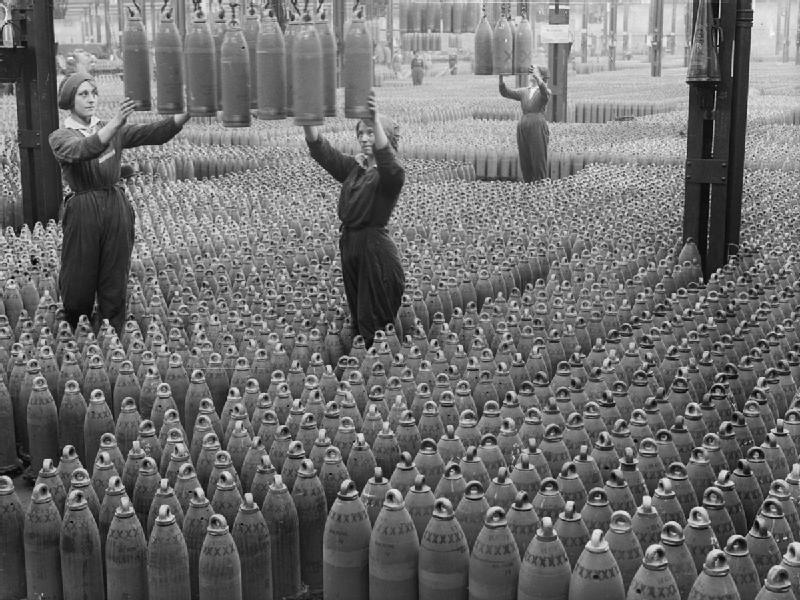
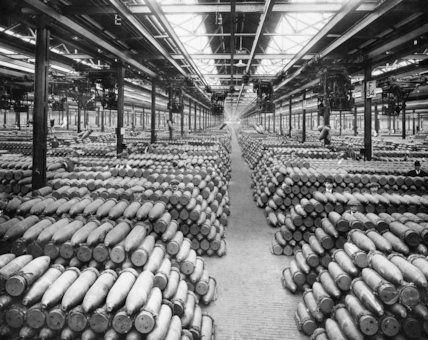
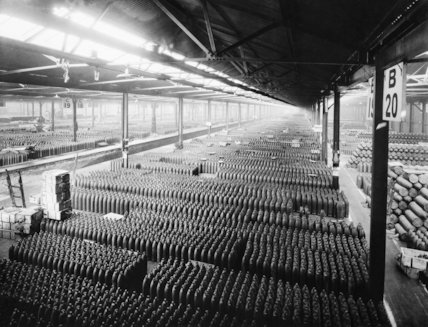
    Shells as far as the eye can see, at the National Filling factory at Chilwell, Nottinghamshire. Even though I enjoy calculating estimates at vast quantities of things (like all of the life that has existed on Earth, from multi-cellular onwards, how many Legos it would take to build a Dyson sphere around our Solar System, what distance the Enterprise has covered under the command of Capt Picard, that sort) I really can’t get a comfortable picture of the vastness of this factory to estimate the number of pounds of explosives under that roof.  

    Given that the factory produced about 19 million shells during WWI, I think it would be a safe guess that some 1 billion pounds of explosives were processed through the factory–and perhaps several billion.  But it is difficult to say what we are looking at in these photos, except to say that the number is “big”.

    WWI shells979[Source” John Hughes-Wilson, The First World War in 100 Objects, Firefly Books, 2014.  

    WWI shells canary girls[“Female munitions workers guide 6 inch howitzer shells being lowered to the floor at the Chilwell ammunition factory in Nottinghamshire, U.K.”–Source: “British official photographer : Nicholls, Horace – This is photograph Q 30040 from the collections of the Imperial War Museums.”]

    WWI shells nottinghamshire

    [Source: http://www.iwmprints.org.uk/image/1100193/milner-e-the-interior-of-the-filled-shell-store-at-the-national-shell-filling-factory-at-chilwell-nottinghamshire-15-may-1917]

    WWI shells long hall

    [Source: http://www.iwmprints.org.uk/image/1100192/milner-e-shells-awaiting-filling-with-explosives-in-a-store-of-the-national-shell-filling-factory-at-chilwell-nottinghamshire-21-november-1916]


  • The Liberty Ball March of 1918–a Superior Photograph

    JF Ptak Science Books  Quick Post

    WwI--photos--flags parade039

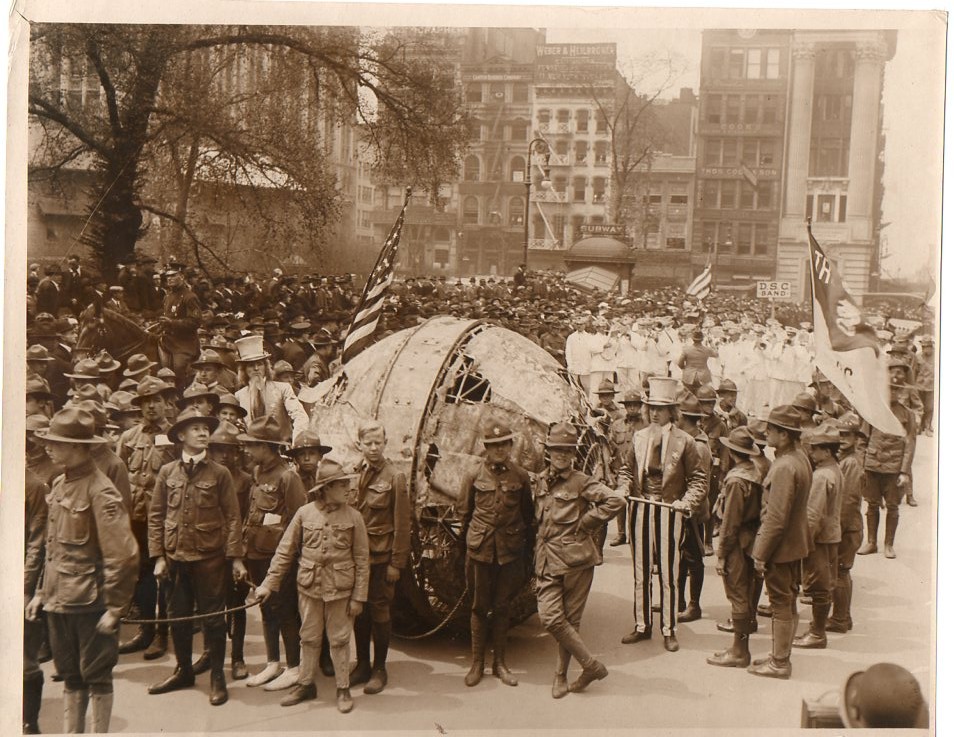
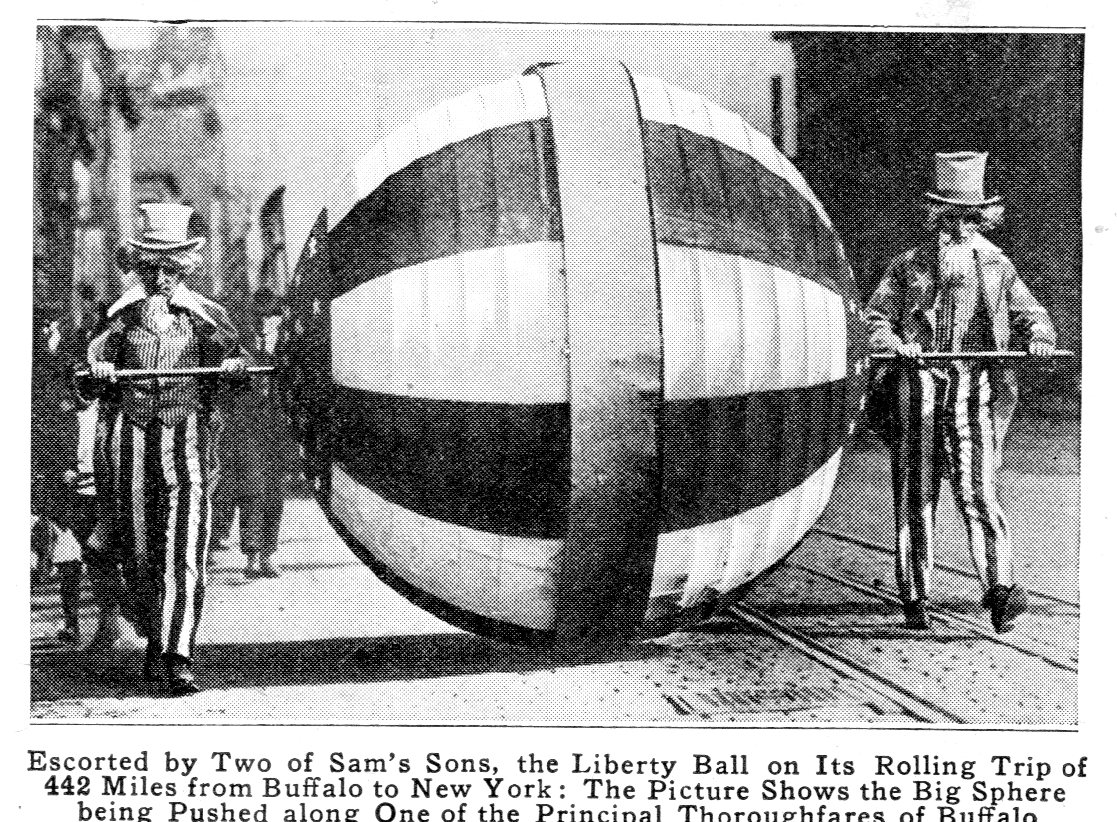
    I was looking through the 1918 volume of Popular Mechanics for an particle on an uphill walking machine that was supposed to look very much like an early bird-shaped flying machine when to my high happiness found the following picture of a WWI bond drive. Earlier in this blog I posted an image of this event without knowing what the image actually depicted, and now with the accompanying text in the Popular Mechanics volume I now now its story.  

    First, the photograph from Popular Mechanics

    Wwi liberty ball964

    (The image quality is not high in this half-tone (the original is 2″ x 3″) but it serves nicely.)

    And the text with the explanation of the ball:

    “One of the features of the recent Liberty Loan drive was the liberty ball a seven foot red white and blue sphere that was rolled from Buffalo to New York by two sons of Uncle Sam dressed in traditional attire The ball started on its long trip the first day of the bond campaign and reached Gotham on the closing one Keep the ball rolling was the slogan that helped to sell many bonds.”

    And so now I can correct the original writeup:

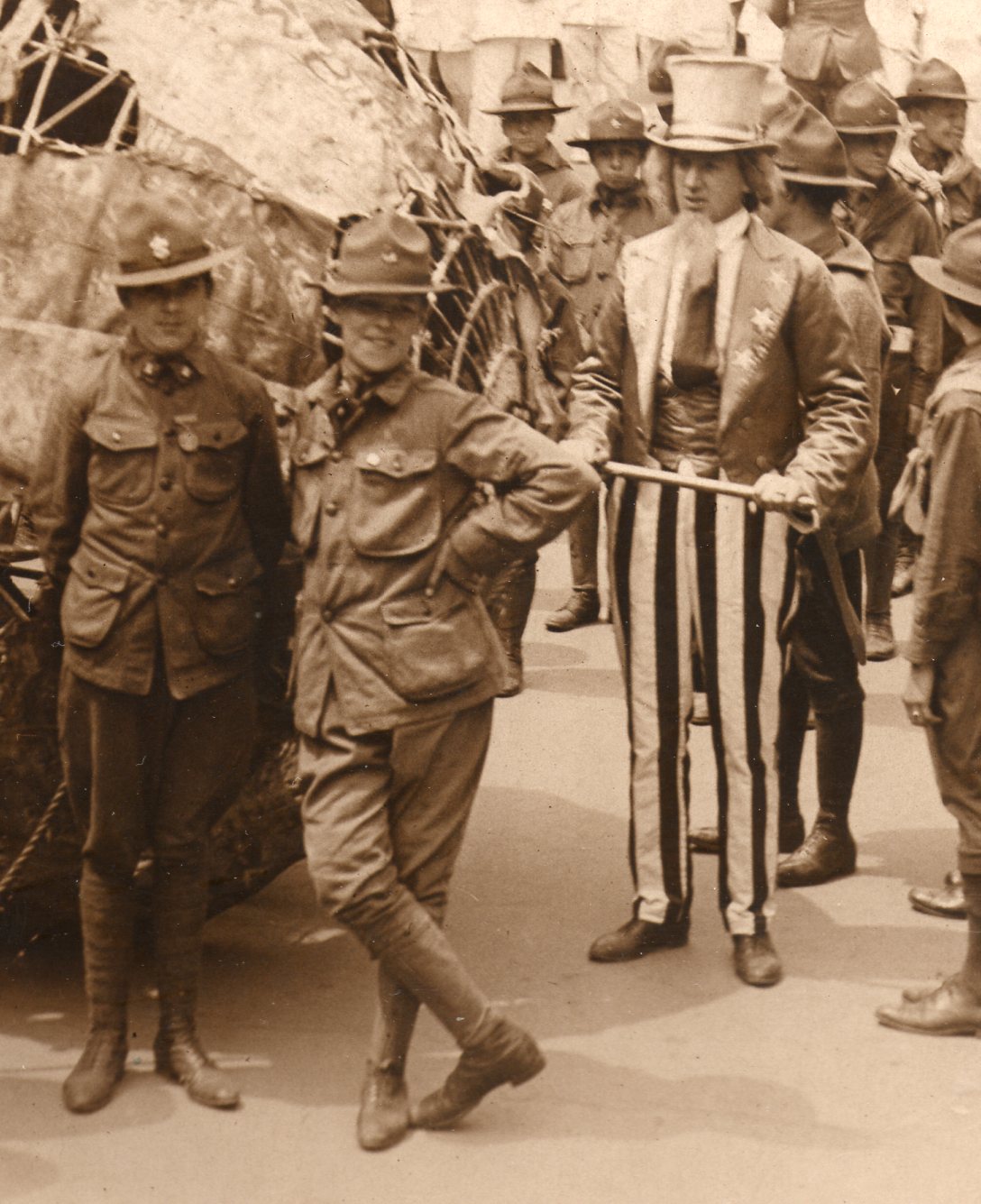
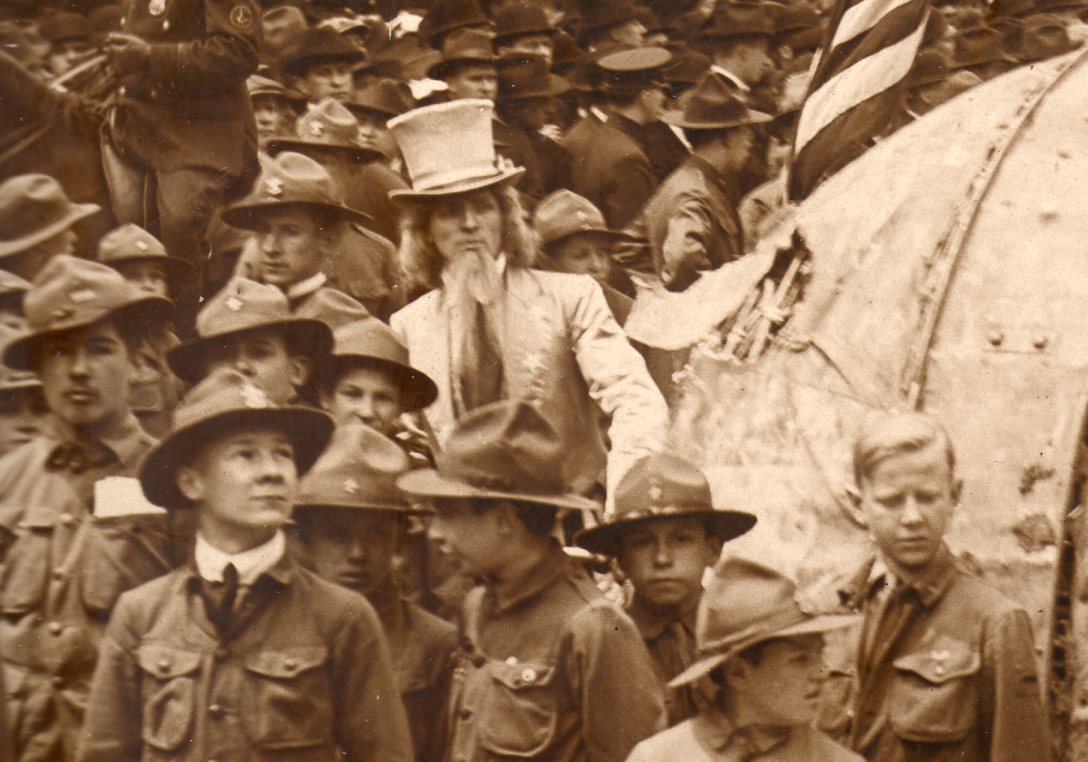
    Like its more-famous WWII counterpart, scrap drives during The Great War were also frequently conducted.  This is an original photograph showing just such a thing, depicting two Uncle Sams surrounded by Boy Scouts pulling a large hollow metal sphere. The sphere was rolled from Buffalo NY to New York City in an effort to raise awareness for the purchase of Liberty Bonds. By the time the ball reached NYC, it showed definite signs of wear and tear.     

    And of course this is a great photo.  

    • The original is available at our blog’s bookstore, here. 

    WwI--photos--flags parade039


    And the detail:

    WwI--photos--flags parade b040


    WwI--photos--flags parade c041

    ·Posted by :

    ·in:

    —