A Daily History of Holes, Dots, Lines, Science, History, Math, Physics, Art, the Unintentional Absurd, Architecture, Maps, Data Visualization, Blank and Missing Things, and so on. |1.6 million words, 7500 images, 4.9 million hits| Press & appearances in The Times, Le Figaro, Mensa, The Economist, The Guardian, Discovery News, Slate, Le Monde, Sci American Blogs, Le Pont, and many other places… 5000+ total posts since 2008.

Category: Technology, History of

  • Brevity and Complexity–ALGOL 1960

    JF Ptak Science Books     

    I think that I’d like to start a new category of observation for this blog–complicated work explained with celebrated brevity and clarity.  Earlier today I wrote a post on a 24-page effort by the great polymath and mathematical titan, Henri Poincare, describing his Newtonian-clad version of relativity, and it certainly classifies as a superior effort in a short, clarifying description of a wide and complex topic.  Wittgenstein’s Tractatus Logico-Philosophicus is another–it is considerably longer though incredibly short for the work that it undertakes, ending with a sentence that has become an independently-standing aphorism, “Whereof one cannot speak, one must pass over in silence”.

    But for right now, I’d like to look at a splendidly short work.
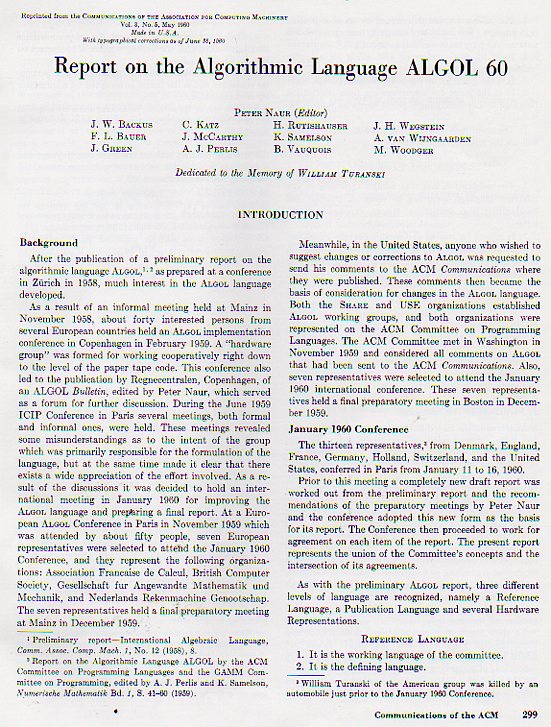
    ALGOL 1960

    Much is owed to people like Peter Naur1, a Dane who made an enormous contribution in the development of computer languages by being the lead developer in the creation of ALGOL.  As a matter of fact Naur (b. 1928) received the computing world’s equivalent of the Nobel Prize (“highest distinction in Computer science”)–the Turing Award–for this work, receiving the high honor in 2005. The official short description–again in the manner of the Nobel Committee– was “(f)or fundamental contributions to programming language design and the definition of ALGOL 60, to compiler design, and to the art and practice of computer programming”.         

    This all came to mind while looking through Report on the Algorithmic Language ALGOL 60 (published in the Communications of the Association for Computing Machinery, May 1960) which was edited by Naur.  ALGOL was the creation of 40+ minds, twelve of whom were listed contributing to this paper-–it is a great testament to Naur to control all of that input, producing a superb fifteen page report of great brevity, beautiful logic and utter accessibility.  Perhaps If the team was given a lot more time Naur could’ve made his work even more succinct, but I really doubt it.  It is written in a language that is somewhat foreign to me, but I can certainly appreciate the way the work is structured its precise manner of presentation.  It seems to me a hallmark of communicating complicated ideas in a small space.

    NOTES:

    1.  NAUR, P. (with J. W. Backus, F. L. Bauer, J. Green, C. Katz, J. Mccarthy, P. Naur, A. J. Perlis, H. Rutishauser, K. Samelson, B. Vauquois, J. H. Wegstein, A. Wijngaarden,M. Woodger) . Report on the algorithmic language ALGOL 60. Offprint:  Communications of the ACM,  May, 1960, vol 3, #5. 25x21cm, pp 299-314.  Rare.  There is evidently an two months earlier-but-not-circulated report (no citation for this), as well as a later printing appearing in  Numerische Mathematik, 2/1, December, 1960, followed in 1962 with a longer edition.
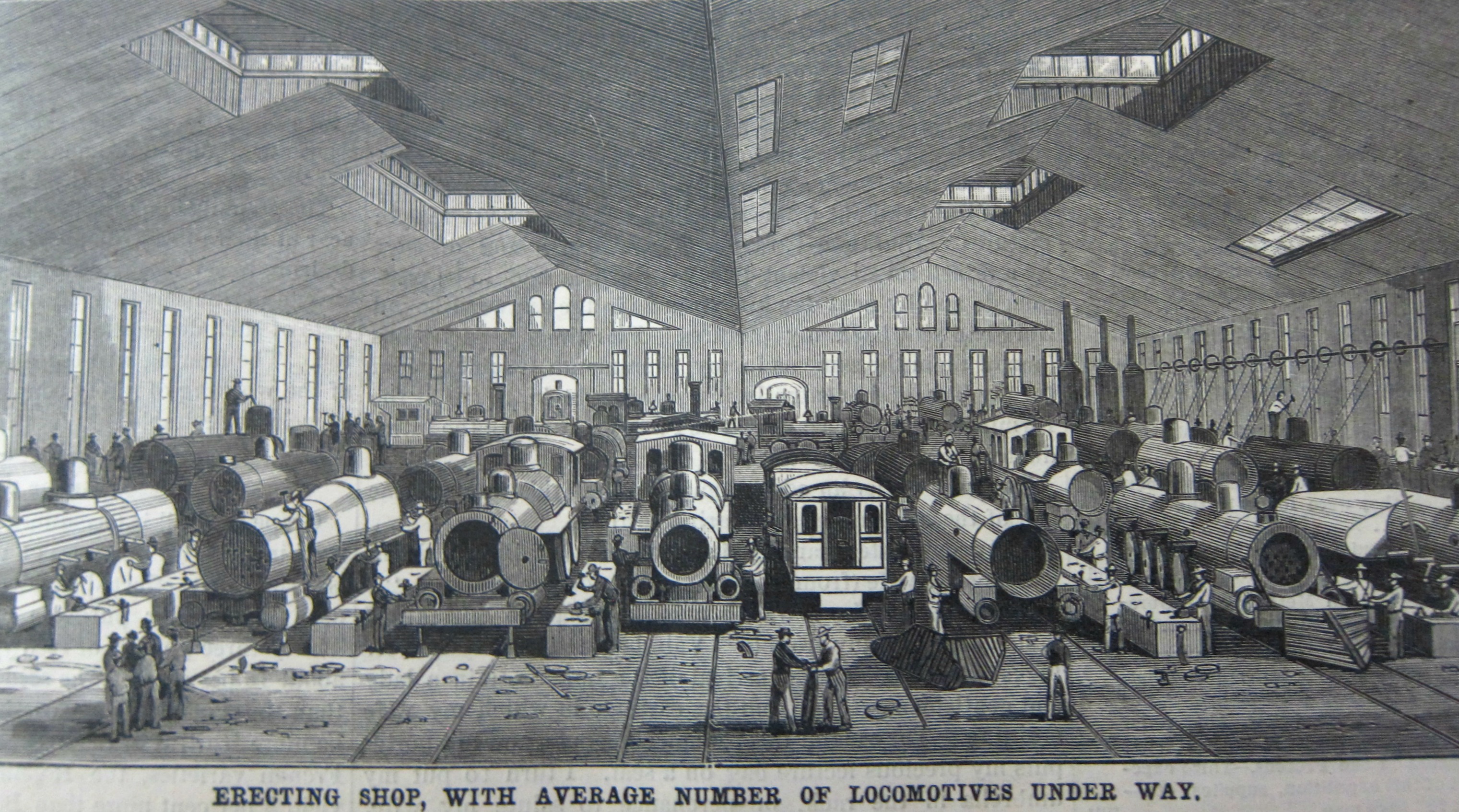

  • A Warehouse of Locomotives: Baldwin Works, 1884

    JF Ptak Science Books   Quick Post

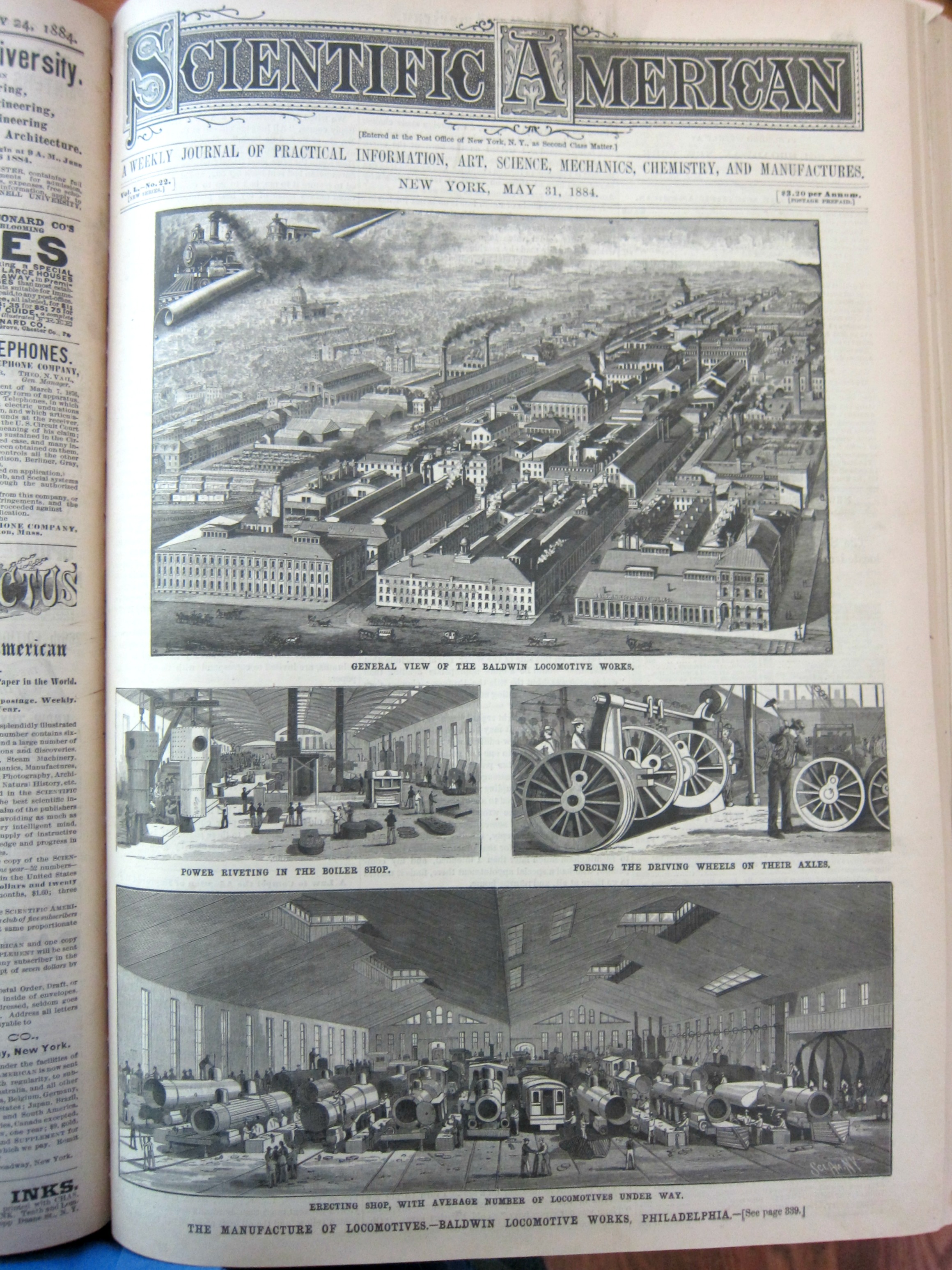
    There’s a definite real-or-imagined synesthesic olfactory reaction to this image–for me, at least.  The ceiling seems a little low for what’s going on inside this building, and none of the skylights seem to be open, and the windows in the walls don’t seem to be letting much air in, which means that there is probably a high order of oil and carbon and other hammering smells going on here, locomotives being assembled/fixed check-to-jowl. It looks to be about 12/15 locomotives in one stage of completion or another in this structure, which means that there must’ve been 100-200 engineers and workmen in there too.  The Baldwin Works–pictured here in a detail of the front page of the Scientific American for May 31, 1884–is shown at a very strong point in U.S. railroad development, and there’s nothing quite like an image like this that spells out “work” than something like this. 

    Locomotives Baldwin SI 1884


    Locomotives baldwin SI 1884


  • Nazis and T.V. (1944)

    Nazi tv770JF Ptak Science Books   Quick Post

    In all my exposure to the history of WWII  I am pretty sure that the only reference to Nazi television has been along the lines of the Berlin Olympics or Carl Sagan’s Contact–that and some dim memory about Hermann Goering somehow in the great bowels of the labyrinthine Nazi bureaocracy being in control of German tv broadcasting. The International Future of Television, an address by Paul Railbourn before the American Television Society in NY in January 1944, discusses the possibility of television in the Post WWII era–and in that, stresses in no uncertain terms that the Nazis should not have access to the new medium. Railbourne (who would later become a VP at Paramount Pictures) talks about how Hitler utilized and dominated the radio, and how after the war re-education of Germany was necessary along with free enterprise undertaking of newspapers, radio, television, and motion pictures.

    He notes that “The Nazis are well aware of the importance of television…destroy the Luftwaffe and the Krupps Armament works, but leave television in their hands, and we shall be leaving them with the most powerful weapon of all…”

    To that end the author discusses post-war control of radio and television in German. He also talks about establishing television networks throughout the U,.S. as quickly as possibly to “capture world leadership in television programming” and “carry the gosphel of the Four Freedoms to all mankind”.  “…Television will play a vital role, for good or ill as it is intelligently or evilly directed, in the establishment and maintenance of an enduring peace, once the present war comes to an end.”

    Railbourne made good sense, and had I think a pretty good idea of the coming possible influence of the new medium.


  • An Early-ish Report on the V1, January 1945

    A Technical Report on the V-1, 1945

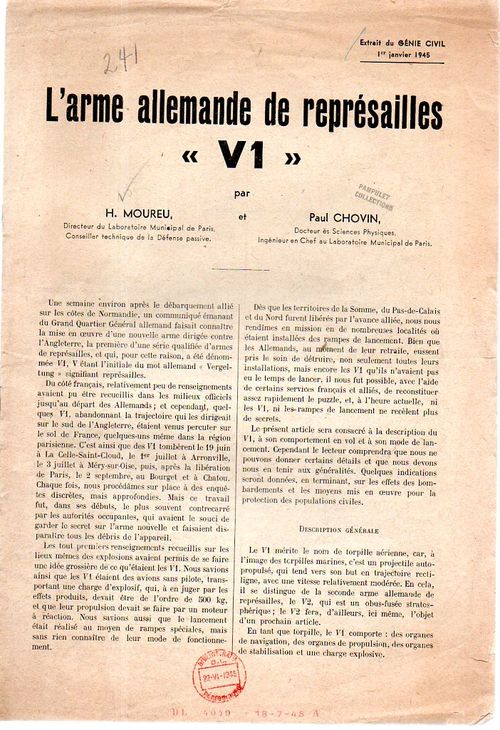
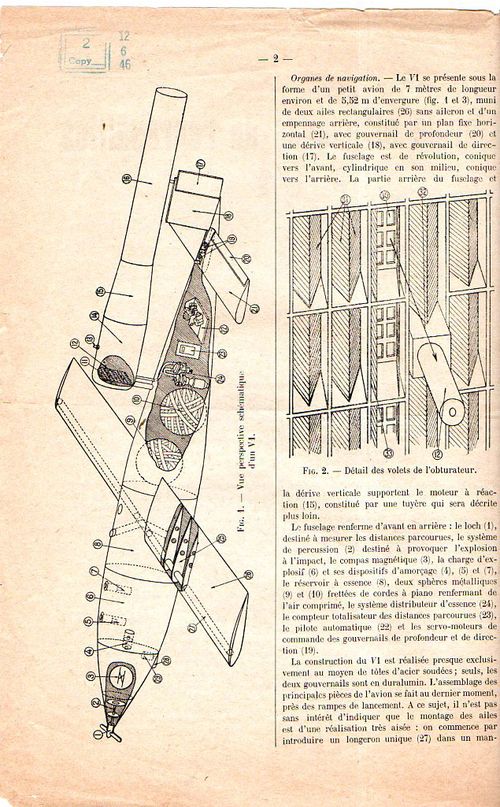
    This report by Henri Moreau (1893-1978) and Paul Chovin–“L’arme allemande de represailles V1”–is an offprint from Genie Civil, and printed 1 January 1945. It is  9×6 inches and runs a pretty-involved eight pages, and was printed in Paris (newly liberated from the German army 25 August 1944) on the first day of 1945.

    I was frankly surprised to find this fairly-well documented piece on the V-1, and couldn’t find much on it at all, so I reprinted the report in its entirety. Some of the text runs off the side of the scanner, but that is the best I can do in scanning the pamphlet without taking it completely apart. 

    V1_1_


    V1521

    ·Posted by :

    ·in:

    —

  • Tunneling the Thames, 1824

    JF Ptak Science Books    Post 2639

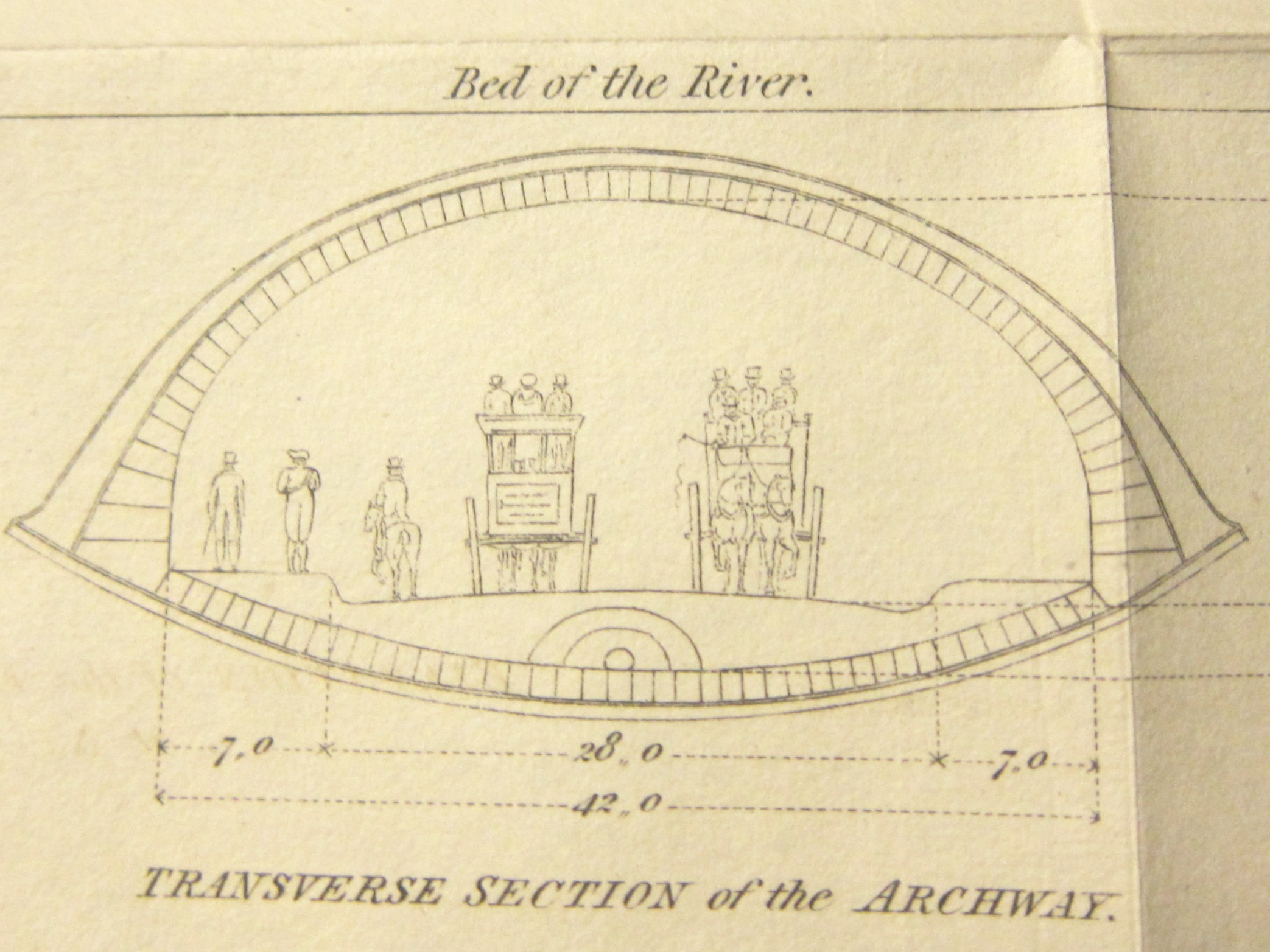
    Here’s an interesting find made while browsing a volume of The Quarterly Journal of Science, Literature, and the Arts1 (of the Royal Society of Great Britain): Samuel Ware’s2  “A Design for making a Public Road under the Thames from the east side of the Tower near Iron Gate Stairs to the opposite side of the River near Horseley down”. This interesting article outlines a proposal and plan by Ware for building a convenient/strategic tunnel under the Thames. This proposal was made a year before the M. Isabord Brunel/Isambord Kingdom Brunel Thames Tunnel project, which when completed in 1843 was called “the Eighth Wonder of the World”, being the first tunnel built under a navigable river. This project was an incomplete success, as it was opened to only pedestrian traffic for decades until in 1869 it was modified to accept trains (which were smoking coal trains, not replaced with a cleaner electric variety until 1913). In any event the idea was to be able to transport goods under the Thames, which would replace the practice of across-the-Thames shipment that would necessitate stopping the very vigorous sailing traffic on the river. It is interesting to note that in the Ware plan it is the snaking approaches to the tunnel that would accept wagons and carriages are plainly visible; the Brunel plan called for such access but ran out of money before the commerce aspect of entering the tunnel was built. “

    This is a cross section of the porposed tunnel, wide and tall enough for carriages and two walkways:

    Thames tunnel 1824

    [Detail from the 13″ folding cross section of the Thames tunnel.]

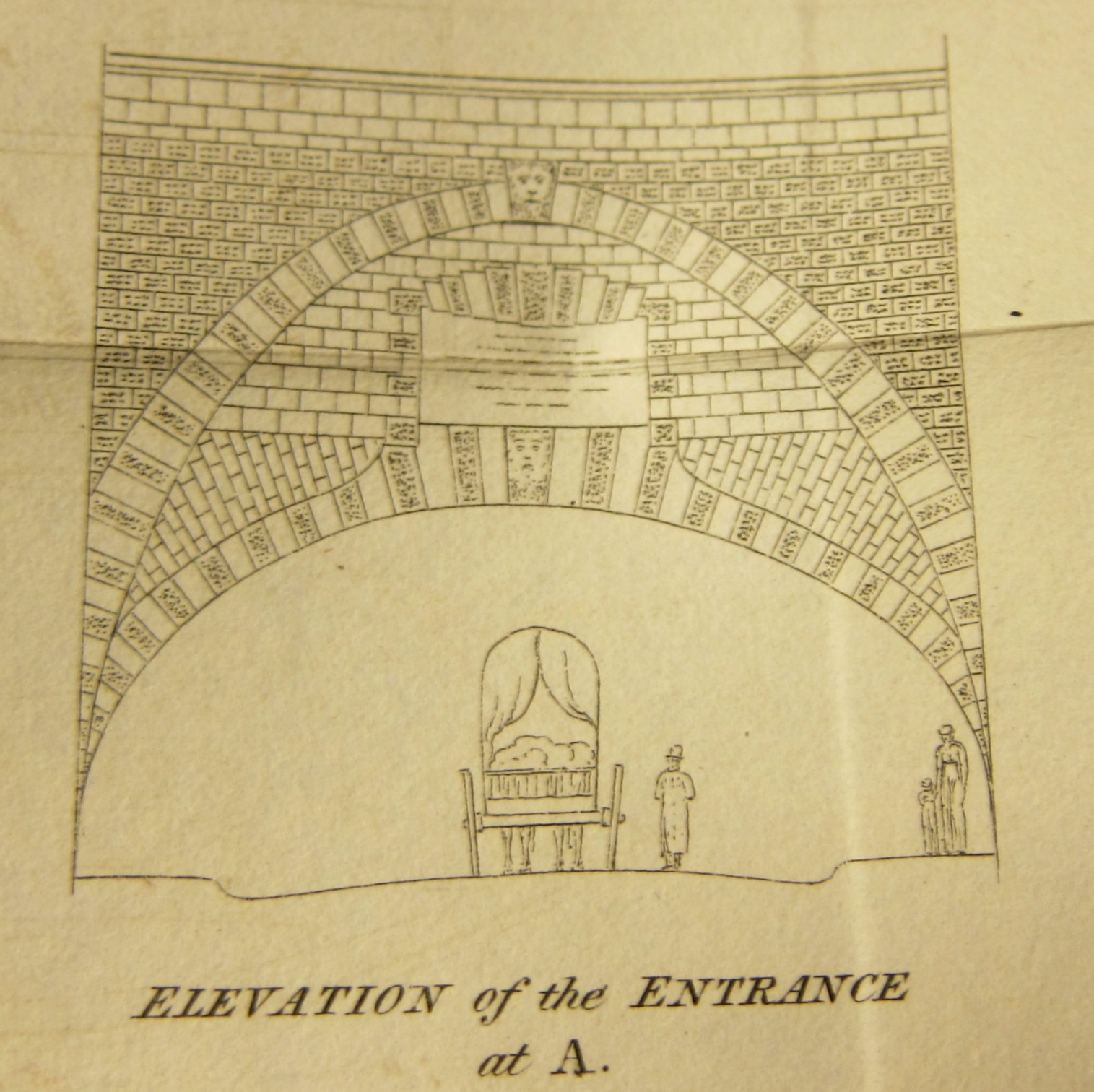
    And a rather massive entrance to the proposed tunnel:

    Thames tunnel 1824 entrance

    From the Ware article:

    “The following particulars of the Estimate describe the mode of erecting the arch way: Compensation for the ground and buildings on the north side of the river and for the ground and buildings on the south side to form the approaches cofferdams in ten successive lengths or removes to keep out the water and strutting to keep up the ground; Steam Engines to keep the works within the cofferdams dry and subsequently for draining the road should there be occasion; Digging out a channel in the bed of the river for the arch way and the ground for the approaches; Removing the refuse earth claying filling in and leveling two feet above the extrados of the arch Yorkshire; Ledgers for the foundations of the arch way and walls of the approaches and embankments and piling as occasion may require; Stone work cut in voussoirs of the arch and counter arch; Lining with lead 10lb to the foot superficial enveloping these arches; Super arch of brick work lined externally with tiles in; Centering for the arches; Forming and gravelling the road ascending one foot perpendicular to twenty feet horizontal; Drains pipes foot paths and lamps; Embankments and other walls and parapets in the approaches; Facings to the entrances to the arch ways and tollhouses. Estimated amount of the above works 250,000 [pounds]”

    “Political Advantages: The communications by this road between the officers of government and the Mint; Trinity House Custom House and the Tower may be facilitated; A readier transfer of soldiers arms and stores to and from the counties north and east of London and the Tower to and from Woolwich Chatham and Sheerness by land will be obtained by this arch way; This arch way may be made a military pass there being proposed a private way to it from the Tower…”

    Notes:

    1. London, printed by John Murray, 1824, volume XVII. 8.5×5”, 408pp, 3 plates, plus a long folding schematic of the engineering proposal for building a road under the Thames.

    2. Samuel Ware (1781-1860) was employed by the sixth Duke of Devonshire on both his English and Irish properties. In 1814 he exhibited a view of Lismore Castle at the Royal Academy. Ware was architect to ‘many excellent buildings in Ireland’…”–Dictionary of Irish Architects, 1729-1940.

    Also included in the volume:  

    Also:

    • Poisson, Simeon Denis. “Extract of a Memoir on the Theory of Magnetism, read at the Academy of Sciences, 2 Feb 1824, pp 317-334;
    • Daniell, Ferederic. “On Evaporation”, pp 46-62;
    • Olbers, Heinrich Wilhelm Matthias. “Remarks on the Catalogue of the Orbits of the Comets that have been hithertoo computed”, pp85-96;
    • Encke, Johann Franz. “Further Remarks on the Periodic Comets…” pp 98-100.

    ·Posted by :

    ·in:


  • Hollow Plans for the Sleeper–Protection from Bombs and Poison Gas (1927)

    JF Ptak Science Books  Post 2642

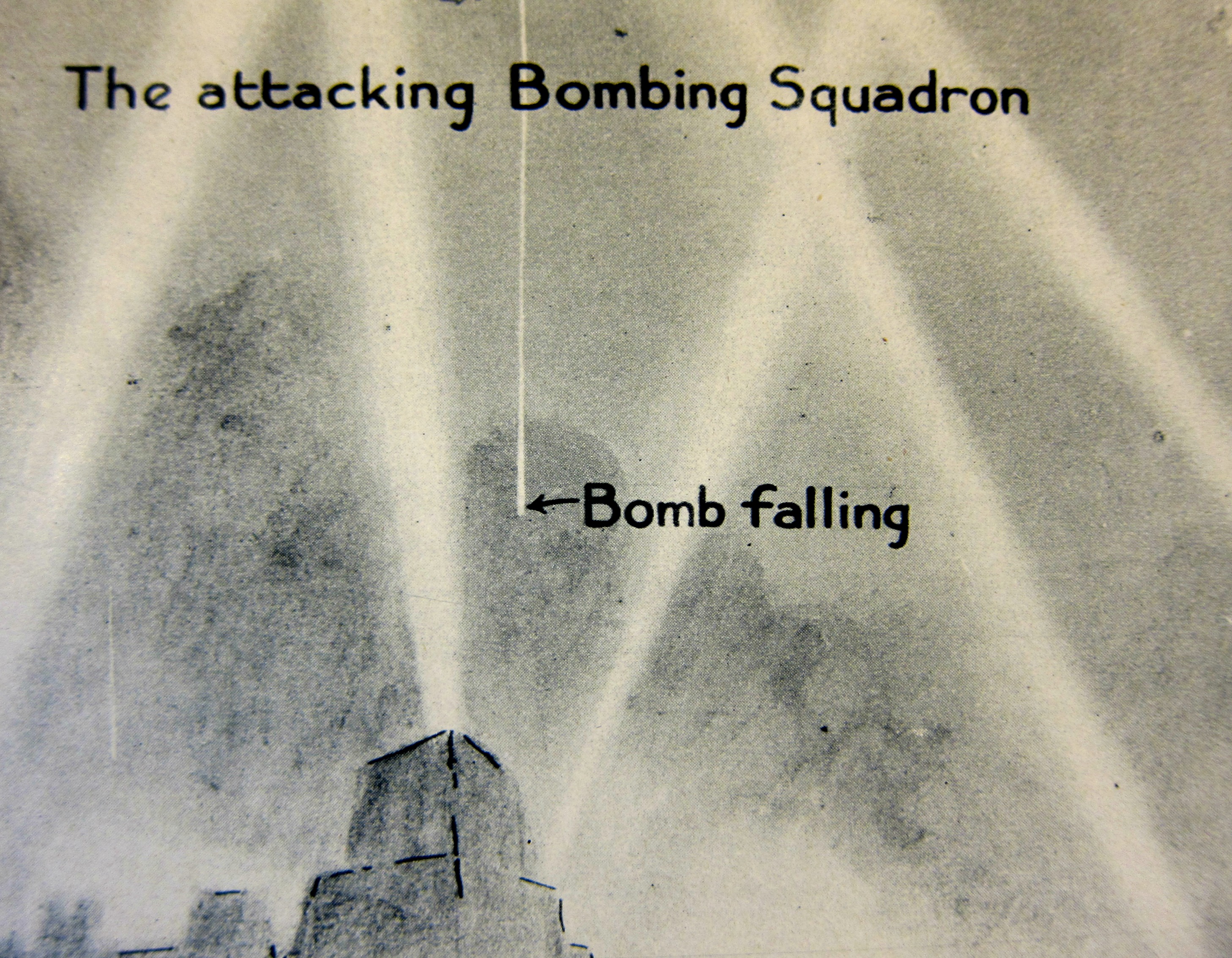
    Anti-aircraft moscow bomb falling

    The OED identifies the first usage of “anti-aircraft” 1914, which to me sounds about right–and pre-war, of course.  That said there were many opportunities to talk about something like anti-aircraft, as bombs had been dropped from balloons by 1849, and airplanes had been dropping grenades/bombs on soldiers and civilians since at least 1911–so the need for combating aircraft was there even though it took the English language a few years to catch up to expressing this idea in a hyphenated term.  By (July 23) 1927, when this short picture-article appeared in the Illustrated London News, there was enormous evidence and experience in anti-aircraft weaponry, and it seems that the Soviet Union was in a full-bore status to acquire a competent system, or at least they were talking about some aspects of it.  

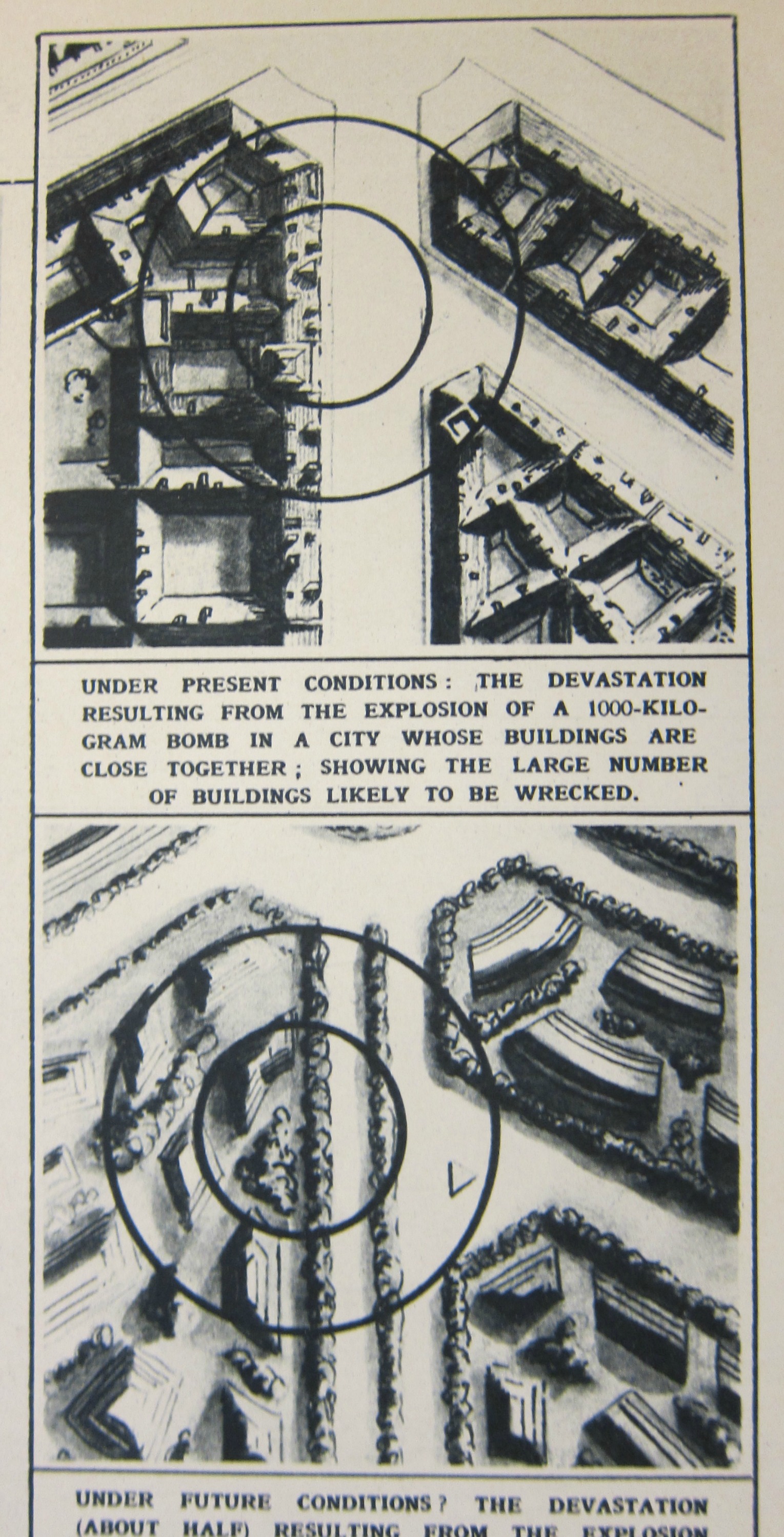
    Anti-aircraft Moscow city street

    And thank goodness for the artist who provided us with the right stuff to discern the “bomb falling”, dropped from one of the “attacking Bomber Squadron” able to elude the anti-aircraft defenses. The changes proposed were somewhat large in regards to the AA emplacements–on the other hand, the reassignment of space in a city, spreading stuff out so that dropped and exploded bombs would destroy less given the proximity of structures to one another, is an absolutely monumental undertaking. The city rebuilding is also predicated on a problem, as the bomb used in the scenario is only 1000-kilograms. This sort of thinking extends into the nuclear age when think tanks proposed Atomurbias, spreading out the population of the U.S. to basically everywhere, as well as evenly distributing industrial centers throughout the country (sometimes underground). There are problems enough relieving Flint of its water supply problems–it would be terrifying to think of redistributing the majority of the population of the U.S. and providing entirely new urban-ish areas for everyone to move into.  Of course there wouldn’t be enough material to do this, or workers, or more, or will, but that didn’t stop people from undertaking some federally-funded planning for it.  

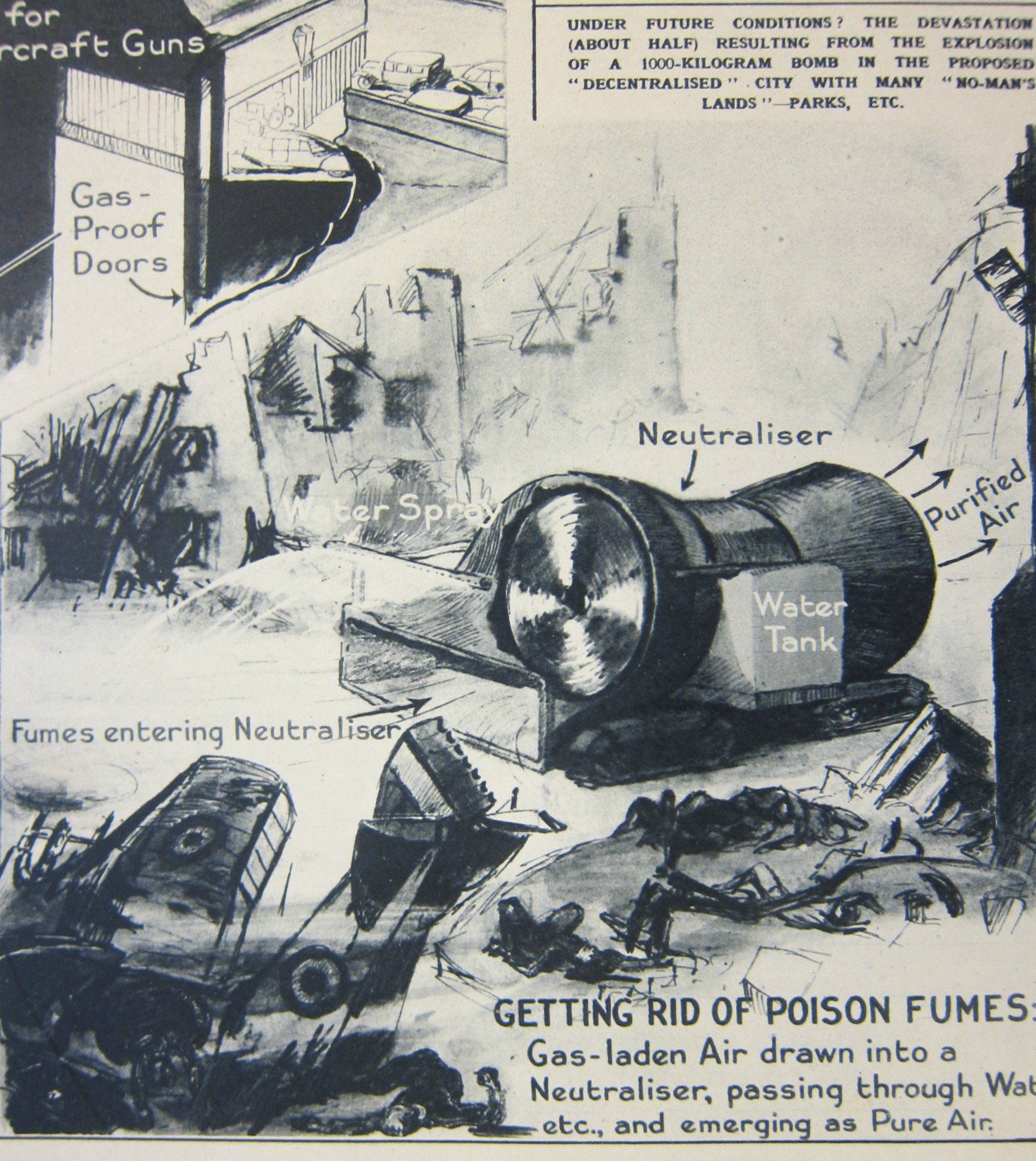
    Anti-aircraft moscow gas scrubber

    The other part of this scenario is the protection from poison gas. And I guess we can just stop right there, with that small tank “neutralizer” that is supposed to absorb poison fumes and release “purified air”, because that sort of protection just will not happen…especially back in 1927.  

    ·Posted by :

    ·in:

    —

  • An Elegant-Looking Torpedo Boat, 1887

    JF Ptak Science Books

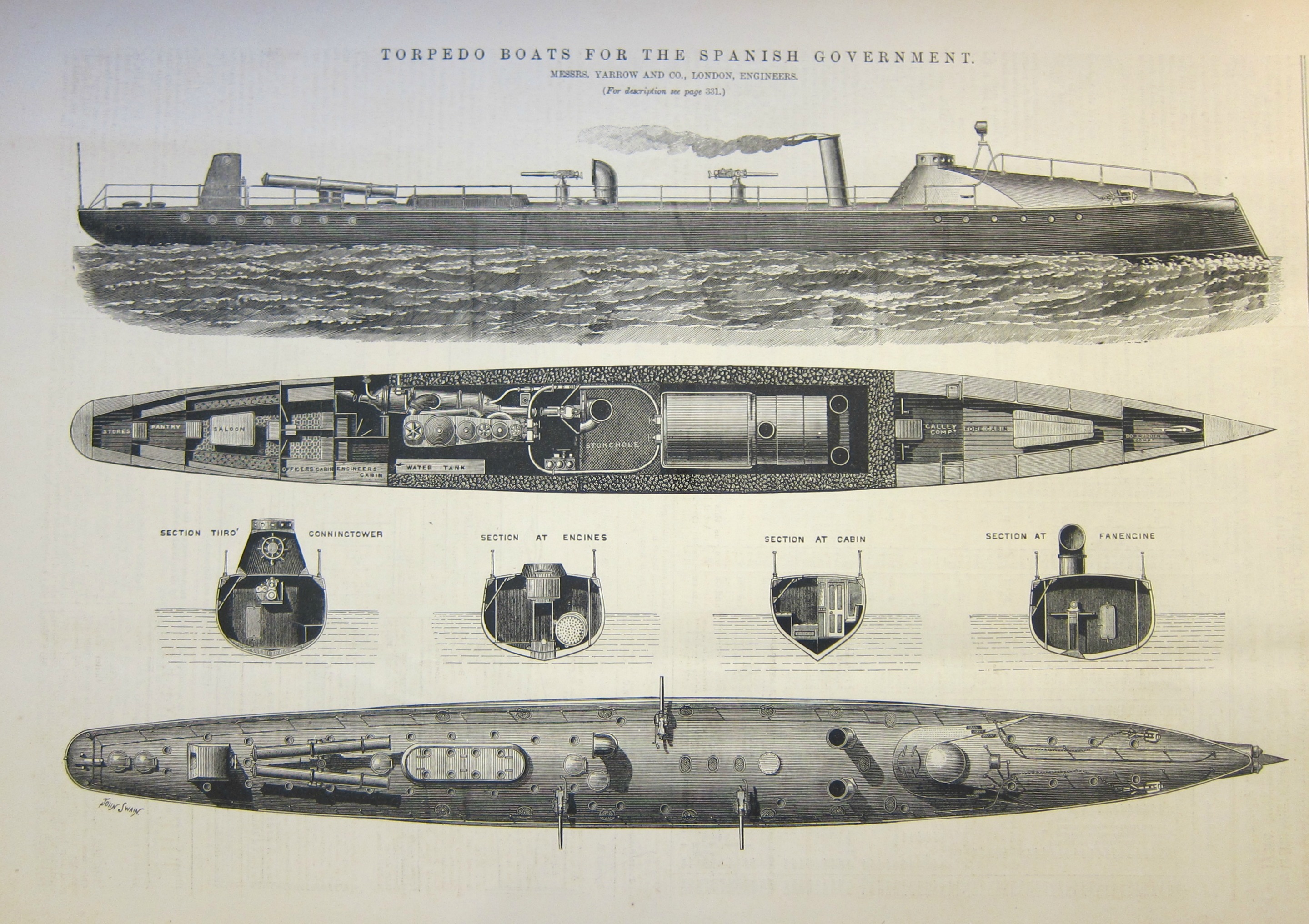
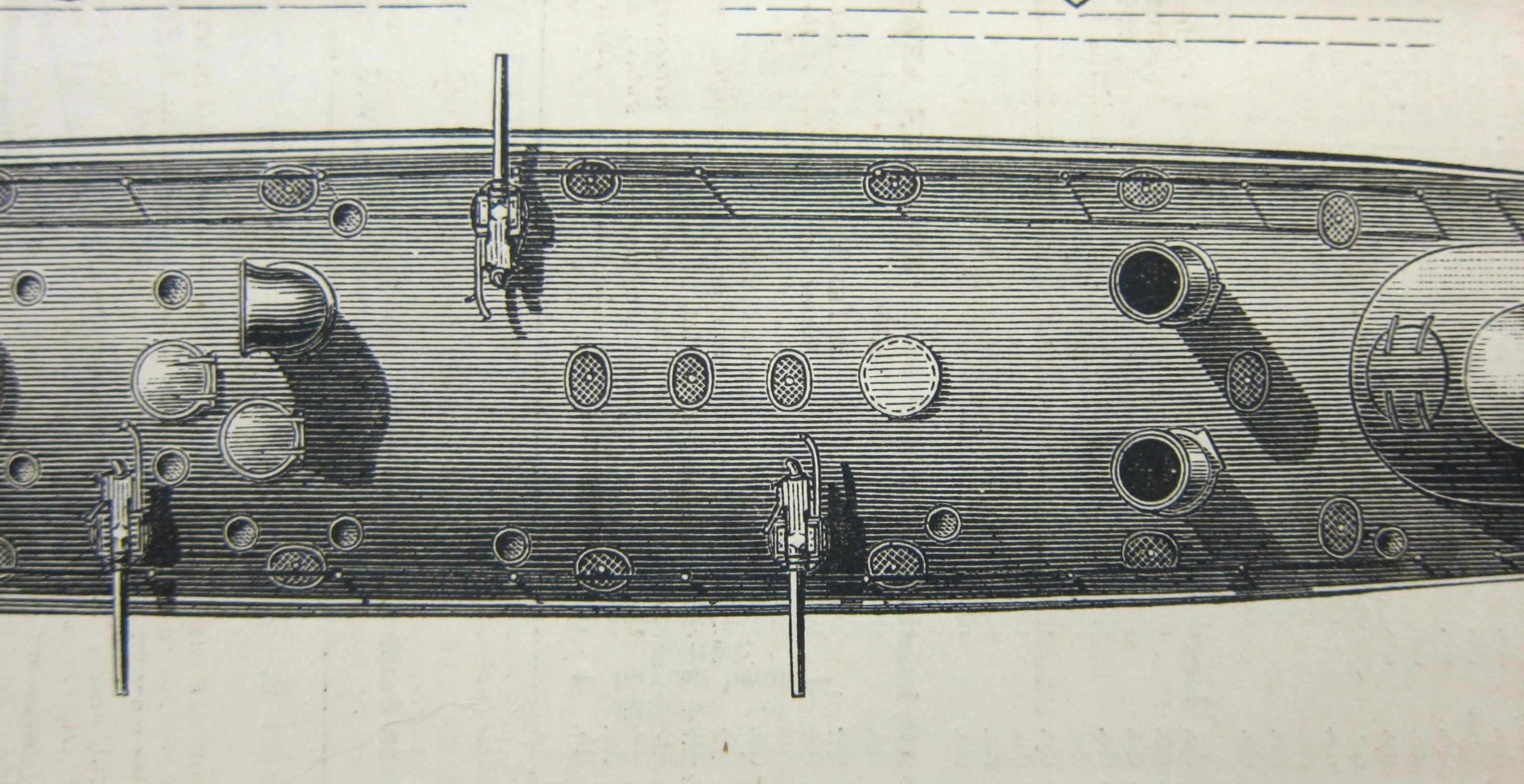
    This is the design for two sister torpedo boats, created by Yarrow & Co. (Poplar, East London) in 1887 for the Spanish government. The torpedo boat was not a terribly-new idea by this point, the first “modern” version of the craft built in 1875 (HMS Lightning), with earlier versions launched during the U.S. Civil War (like the CSS David). The designs shown here are for the Azor and the Halcon,135′ of attack-capacity (with 1600 hp), certainly making them high consideration for the folks on the receiving end, leading to the development of the torpedo boast destroyers to protect the big battleships and hunt the torpedo boats, and idea that would lead to “destroyers”. In any event, I found the image attractive and interesting, and thought I’d share it:

    Engineer 1887 torpedo boat

    [Image will become clearer when expanded/Source: The Engineer, October 21, 1887.]

    Engineer 1887 torpedo boat detail


  • Cross Section of the Comstock Lode

    JF Ptak Science Books   Quick Pos

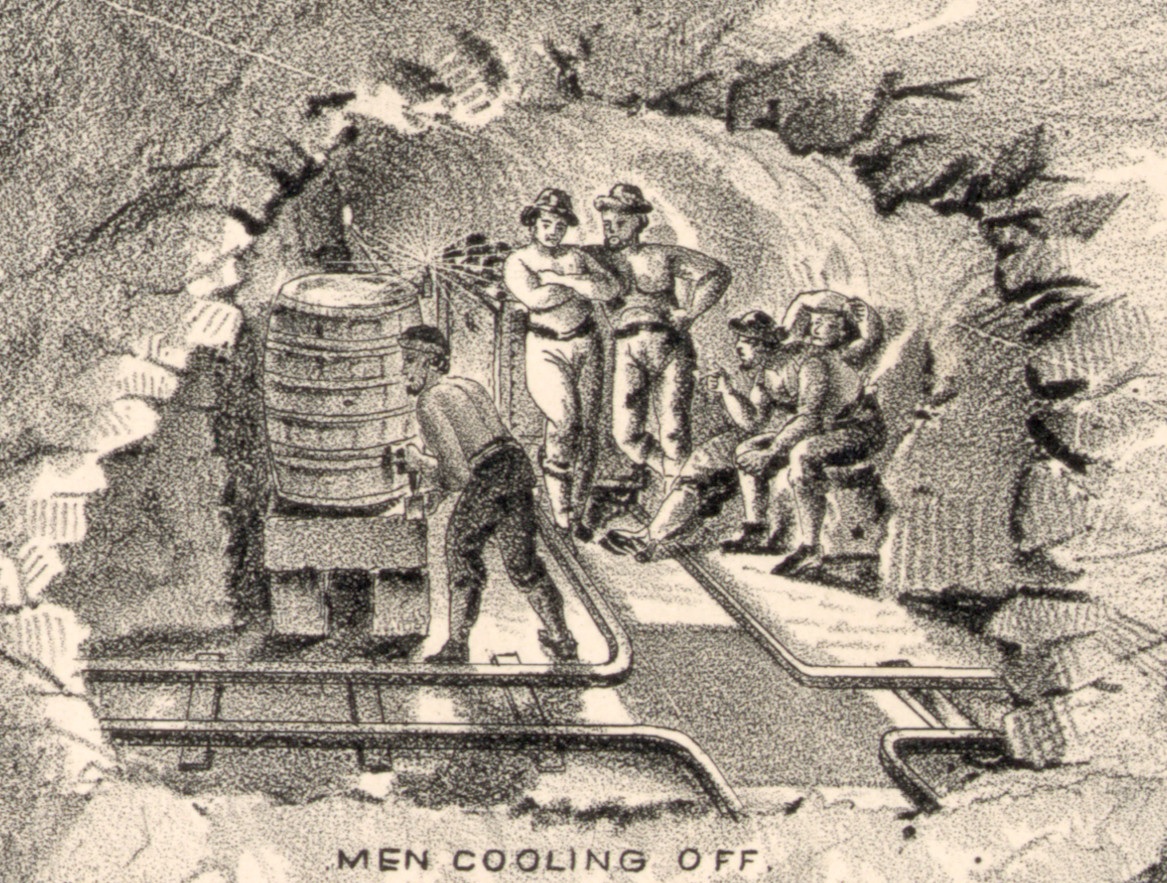
    I’m not that convinced that a lot of “cooling off” was being done down in the tunnels of the Comstock Lode, though I guess it is all relative, and so perhaps these guys were able to enjoy themselves a little compared to swinging a pick axe or shoveling with a shovel in a cramped, damp, loud, dark place, underground.  

    Comstock cross section men cooling off

    I found this in the detail of a great cross section image on the Library of Congress site http://www.loc.gov/pictures/resource/pga.01999/:

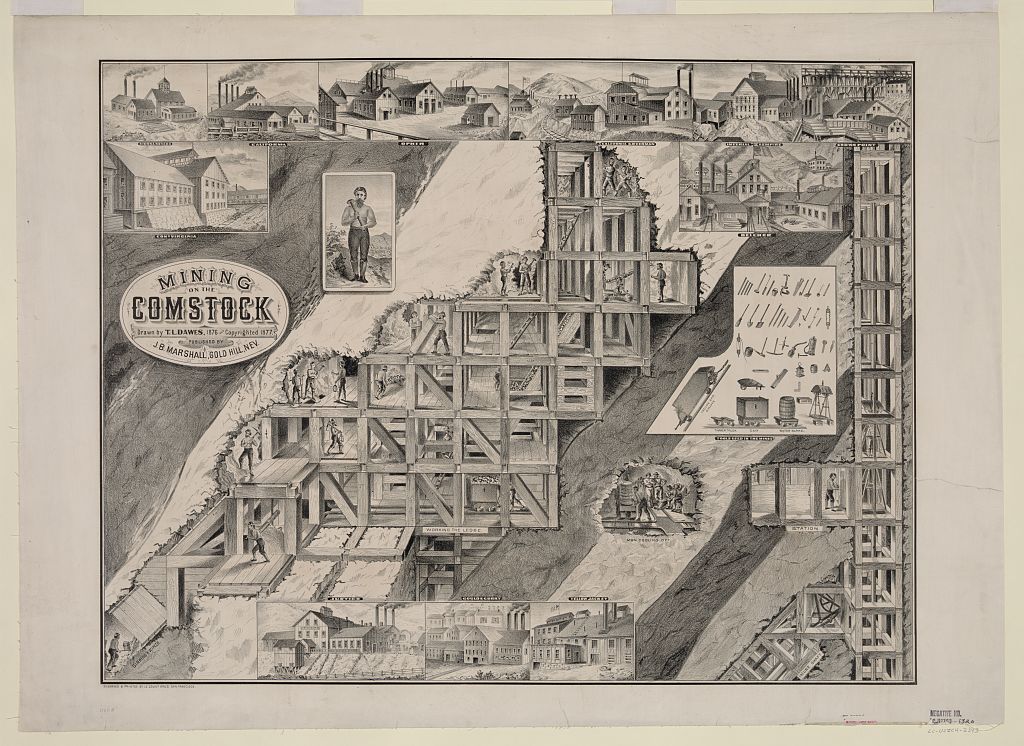
    • “Mining on the Comstock / drawn by T.L. Dawes ; engraved and printed by Le Count Bro’s., San Francisco” 

    which was printed by lithography by Le Count Brothers in San Francisco in 1877.

    The cross section shows how life and business was being conducted underground, and gives a sense of the claustrophobia-making closeness of it all:

    Comstock cross section

    In any event, it was very difficult work in a difficult spot, using difficult tools, breathing difficult air, and this cross section gives a pretty good idea of what that could have been like.  


  • The Majesty of Gears and Bolts–the Poe Locks, 1896

    JF Ptak Science Books   Quick Post

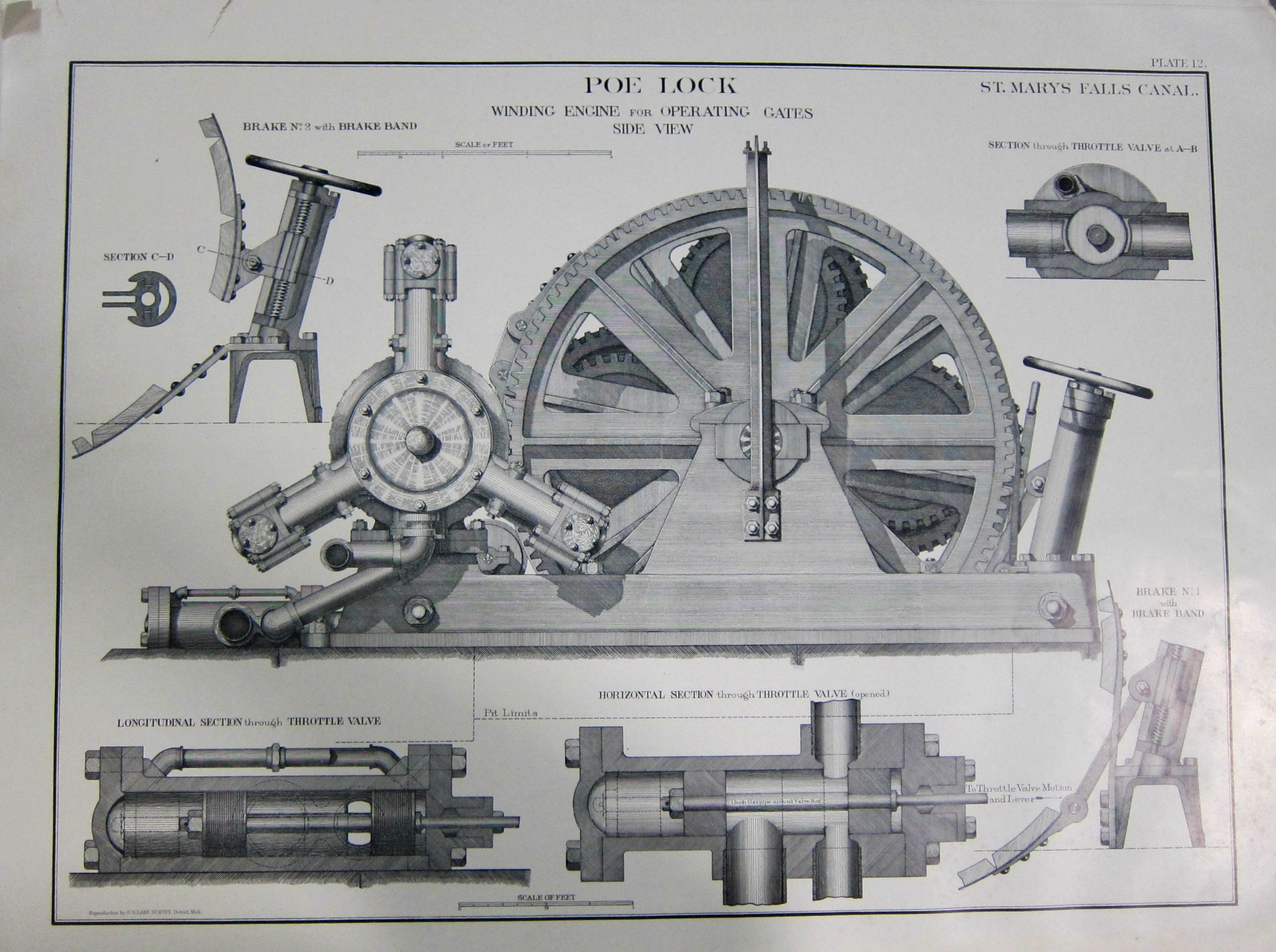
    The Soo Locks at Sault (the “soo” of “Soo”) Ste. Marie are the four parallel locks that connect Lake Superior with Lake Huron and thus the rest of the Great Lakes–the Poe Locks, designed by O.M. Poe, are on of the four, and when it was completed in 1896 it was the world’s largest. At 800’x100′ they were enormous, and controlled the displacement of a lot of water, and the illustrations below show some examples of the meat of the engineering that controlled that process.   I have these loose engravings from an unfortunately unidentified source (though they are from a U.S. Lake Survey,between 1898-1909) and decided to share them because of their deep engineering beauty.  They are fantastically-rendered objects, filled with steam and grease and huge amounts of The Heavy Stuff, all of which display a remarkable feat of engineering.  

    The images are clearer when you click and expand….

    Poe Lock Winding Engine


  • A Flying Mega-Brick and a Postal Torpedo Metallic Email–the Future, 1928

    JF Ptak Science Books  Quick Post

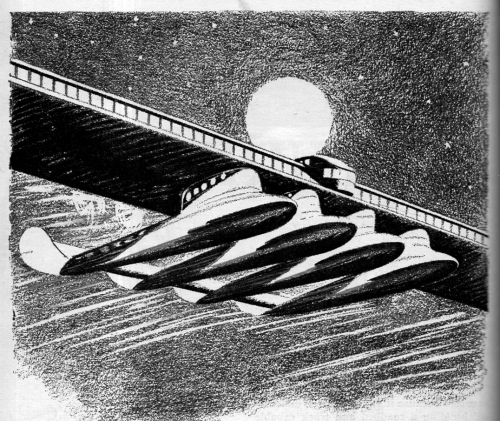
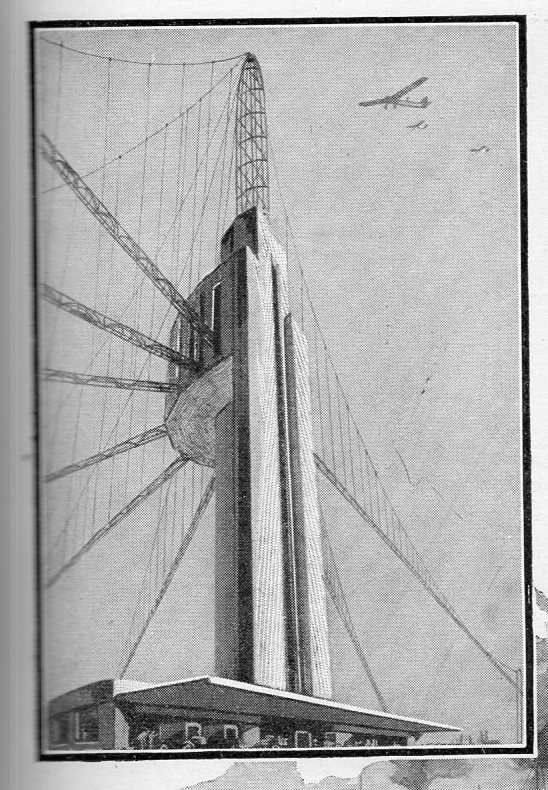
    In the midst of a short article on bits of transportation advances of the future are these two wonderful futuro-peeps, selected here because of their appearance more so than anything else, as there isn’t really anything else to go on. The article has 13 illustrations over four pages and perhaps is 750 words long, so the narrative is heavily dependent upon the images and imagination. That said, the two I’m interested in here have almost no text accompanying them. So be it.  

    The first is a mammoth transatlantic seaplane, “proposed by a German inventor”–and that’s it. I can’t tell how “giant” it is supposed to be, nor how many engines, or if there’s anything going on inside the wings, and so on. But it does look streamlined and tubular and blocky, which is a hard thing to do at the same time, in a loud-stealthy way.

    Pop mech future 1928679

    [Source, Popular Mechanics, August, 1928.]

    The other image is that of one tower in a series of untold numbers of such towers popping up throughout France, much like Rommel’s asparagus in Normandy, I guess, except more numerous, and far taller. Iterating the height of the structure by the cars at its base, I take this one to be about 150-175′ high, from which there are many suspended tubular cages within which travels a 10′ long torpedo-like tube that would speed mail from station to station across France at 200 mph.  The engineers were Hirschauer and Talon, and from another source1 I see the invention described as “la torpille postale”, which is what the mail carriers looked like, except sitting on four wheels, and going really fast on a skinny track suspended a hundred feet off the ground.  

    I can’t but help to think about this arrangement of wire and cable and flowing mail as a kind of non-computer email–it has seemed odd to me for a long time that the one of the backbones of our communication existence is strung up above the ground on wires that are for the most part hung on dead recycled trees.  Granted the mail would travel a lot faster in France in 1928 at 200 mph, but completely unforeseen and not-knowable is that email would be a little faster, cruising along at a big chunk of the speed of light.  Seems as though there would have to be thousands of these lighthouse-like structures built to accommodate the French mail demand–no doubt they would have been pesky reminders of a past’s attempt at the future, though perhaps being France and all the mail carriers might have blown them up.  

      Pop mech future 1928 cable mail680

    [Source, Popular Mechanics, August, 1928.]

    Notes:

    1. http://www.luxemburgensia.bnl.lu/cgi/getPdf1_2.pl?mode=page&id=1386&option=