A Daily History of Holes, Dots, Lines, Science, History, Math, Physics, Art, the Unintentional Absurd, Architecture, Maps, Data Visualization, Blank and Missing Things, and so on. |1.6 million words, 7500 images, 4.9 million hits| Press & appearances in The Times, Le Figaro, Mensa, The Economist, The Guardian, Discovery News, Slate, Le Monde, Sci American Blogs, Le Pont, and many other places… 5000+ total posts since 2008.

Category: Social History

  • An Extraordinary Protest Document to the Chicago World’s Fair of 1933

    JF Ptak Science Books  [An earlier post from 2008, expanded and updated now to August 2017]

     This short pamphlet is a very strong tonic to those thinking about Chicago’s “Century of Progress” celebration and World’s Fair that was taking place in the middle of the Depression in 1933. Its intent is to reveal the “real” Chicago that took place surrounding the flourished confines of the Fair, protesting that there was a lot of real life beyond the fairgrounds that was far more important than whatever the fair represented in the best that’s-not-real-but-this-is documentarian fashion.  (The Fair was intended to instill hope and foster a little forgetfulness during a time in which the Depression in full swing nationwide, plus relieve some negative impressions of  native-Chicago problems of gangsterisms, race riots, red scare, and economic distress.) As a matter of fact this pamphlet didn’t seem to find much distribution, or at the very least it didn’t get saved in spite of the fantastic documentary images that it contains.  This copy of Herman O. Duncan’s Chicago on Parade (1933), was his own, sent to the Library of Congress as a gift in 1942 before it came to me in 1999. I can find only five other copies of this pamphlet located in libraries world-wide in WorldCat/OCLC (Oxford, Duke, Chicago History Museum, Wisconsin Historical Society, BYU) which makes it seem very strangely underrepresented.
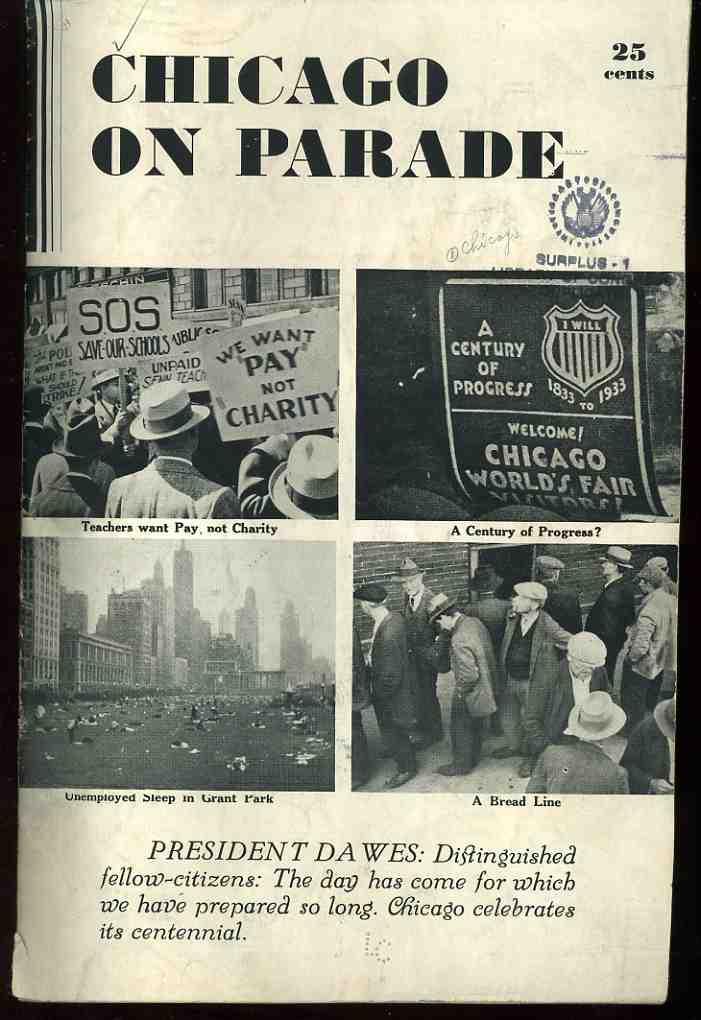
    Chicago on PArade

    Duncan addressed the work directly to the Rufas Dawes (President of the Century of Progress Celebration), and to the mayor of  Chicago and governor of Illinois as a very blunt request to not forget the actual world of real Chicagoans living in dire straits within site of the fairgrounds.  Duncan was obviously taking issue with the many statements of wonderment and flourishes of progress that accompanied the propaganda surrounding the fair, so that the attention of the public would not be “diverted by our political and civic leaders”.  Duncan continued that these photographs, “none of which had been published previously in the United States” could “perhaps suggest a point of reference from which Chicago can measure its Second Century of Progress”.
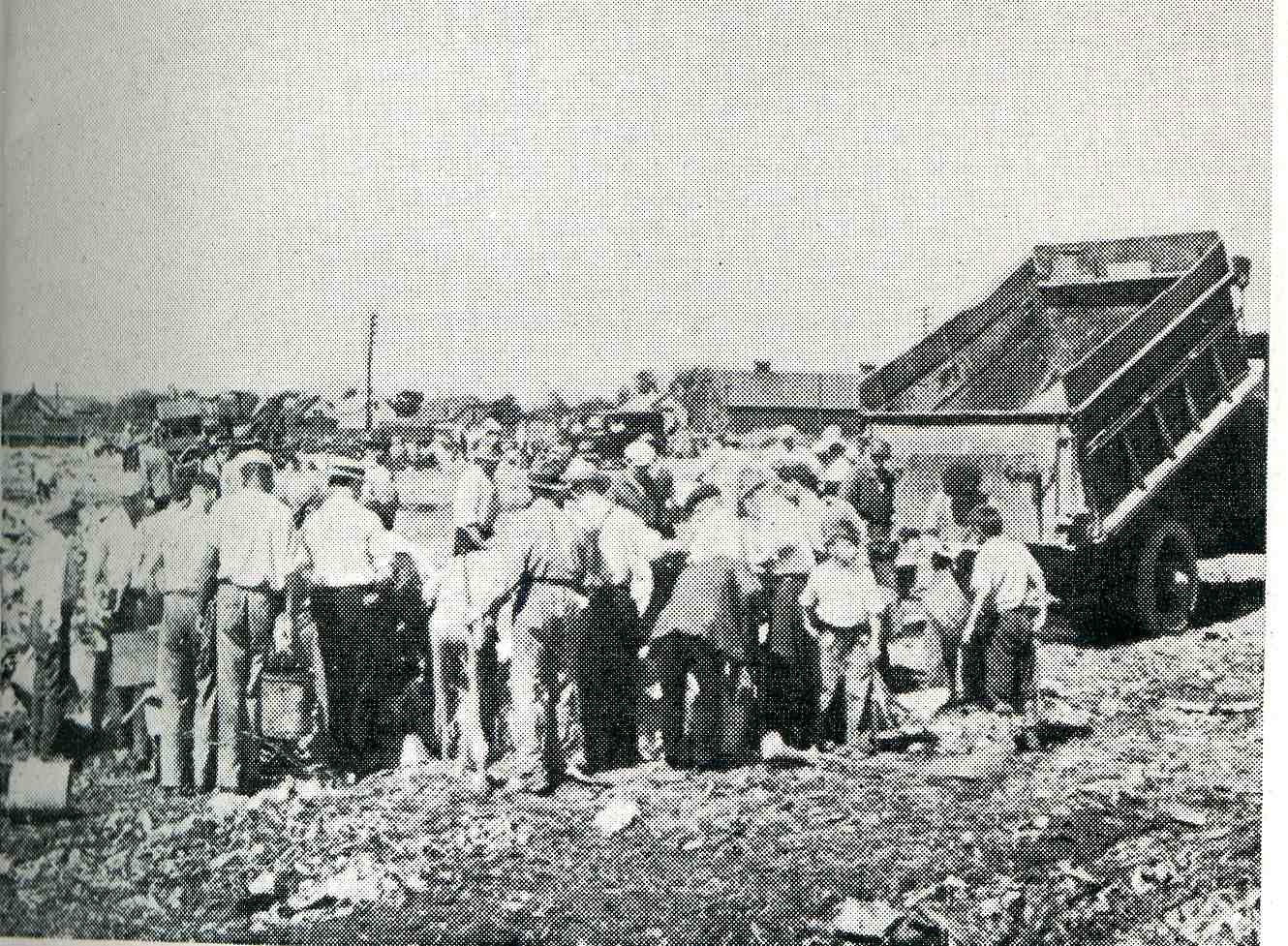
    CHicago on parade dump[Anxious men, women, and children welcoming the rubbish from a garbage truck.]

    Duncan (who unfortunately did not identify the photographer(s)) was very strong in the use of images.  He was not afraid to show long bread lines, people (including children) scavanging at the city dumps, blacks and whites marching together in protest of police brutality, (many hundreds) of people sleeping out of doors in Grant Park (Chicago’s “front yard”),because they had no where else to go, and much more.  The photographs had a real touch of journalistic acumen, and none of the images look forced or posed–they are the real stuff of social documentary, and how they have escaped wide notice is not known to me
    . 
    000-ebay--Nov 4--chic 2986
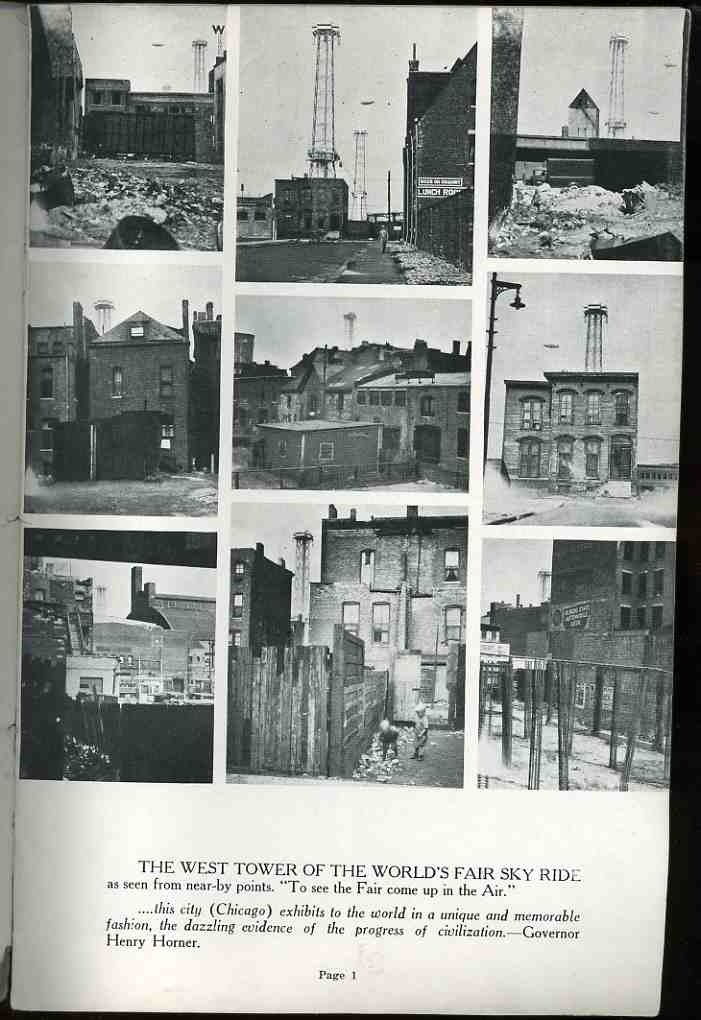
    Perhaps the strongest statement (outside of the
    photos of the children scrounging for food in dustbins and at the dump) is this series (below) showing views of the city of Chicago that were within site of the tower for the Century of Progress Sky Ride (“See the Fair / Come Up in the Air”).  The series make an elegant and strong and incontrovertible point, and that there was definitely something very wrong going on outside the walls of the celebration which had been scooped out of the city’s east side.  (The images remind me of series of photos of the US Capitol Building that appeared in the great classic of social and cultural recording of class division, Neglected Neighbors, which my friend Andy Moursund introduced me to many years ago in Georgetown.)

    The logo design for the event is terrific and I’m sure that everyone had seen it at least once in their lives, but out of the many hundreds of other pamphlets and display materials that I have here for the expo I’ve got to say that the overwhelming majority of them are luridly colored with a palette found outside nature.

    And anti-nature colors are somewhat schizoid-happy  colors, like MGM technicolor cartoons from 1949, which applies a massively ugly chromo-palette to the blight of the surrounding Depression problems.  Mr. Duncan was determined that this not happen, at least so far as he could help it, and published these arresting images to remind the rest of Chicago that the vividly colored happy face placed over the city like a stamp for the Century of Progress was not the case in fact. 

    There are another few images in the “continued reading” section.

    Note:  click on the photos for a larger, more detail view.


    ·Posted by :

    ·in:

    —

  • Map of Slave Sales, Washington, D.C., 1836

    JF Ptak Science Books    Post 2490

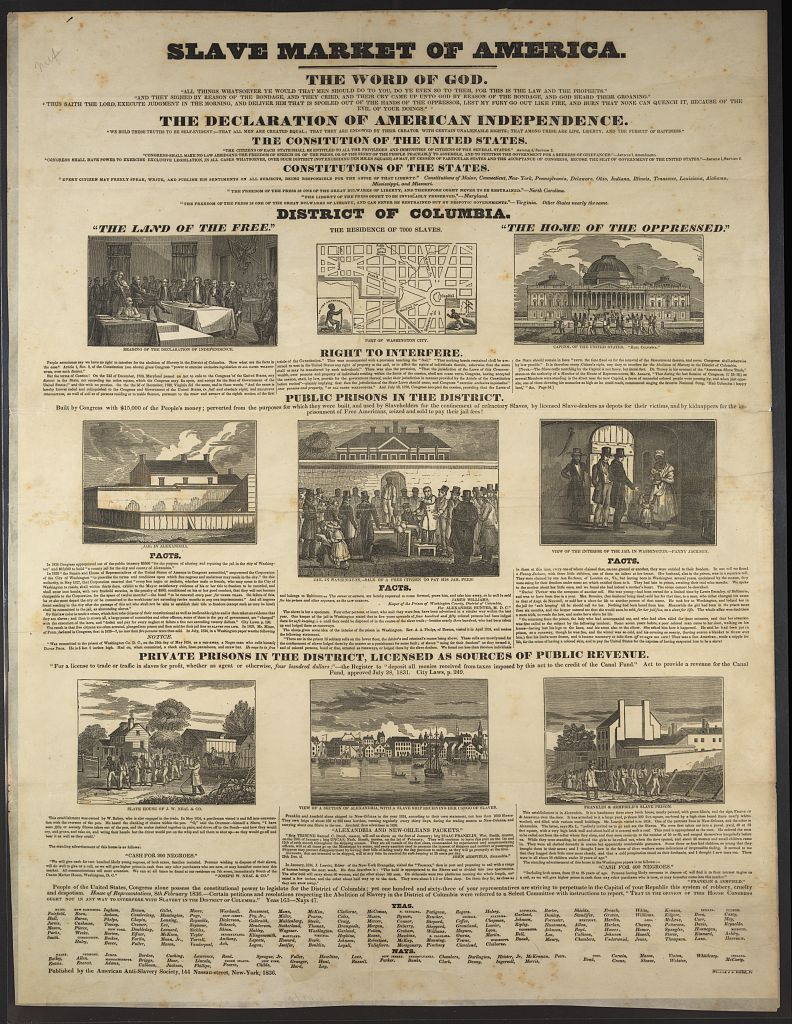
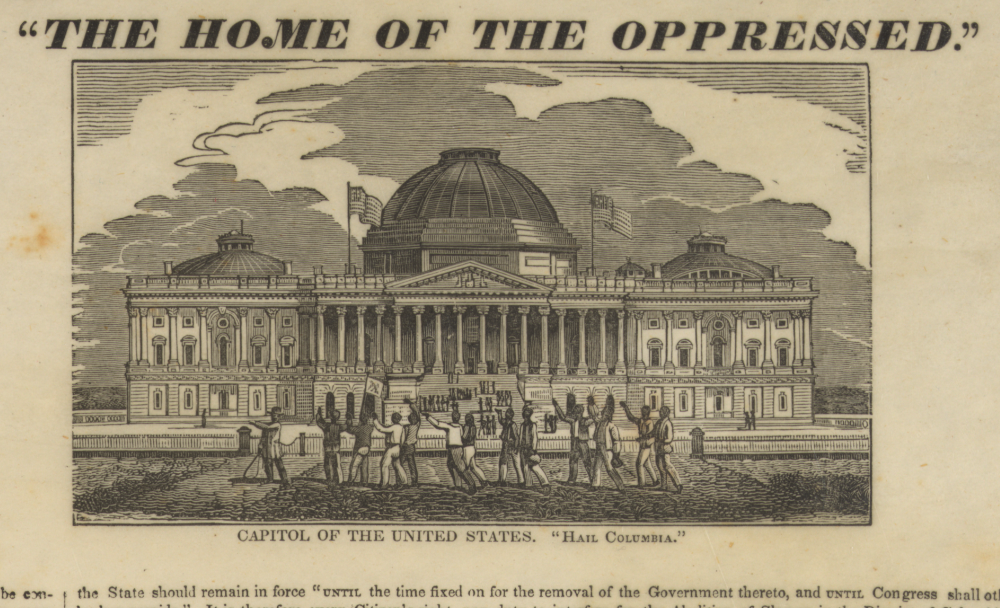
    Slavery DC capitol[Source: the Library of Congress, http://www.loc.gov/pictures/item/2008661294/]

    This is one of those graphics that tells an impossibly large story, too much for a short post like this, too much for a single book–it is a Grand Canyon of a story, a story about something so big that its gargantuan nature is self-evident.

    I meant to include this in yesterday’s post on a 200-word summation of slavery in an 1863 broadside by George Stroud, but it is better posted apart from anything.

    This is a shocking document.  It is big (64x48cm) and probably when it was pasted up on the side of a building or a fence or distributed with a newspaper that it must have stiffened its readers. The work is called Slave Market of America, and it is an indictment of the system of slavery, layering the institution of slavery on top of the great documents of U.S. history and portrays its practice on the background of the nation’s capital. 

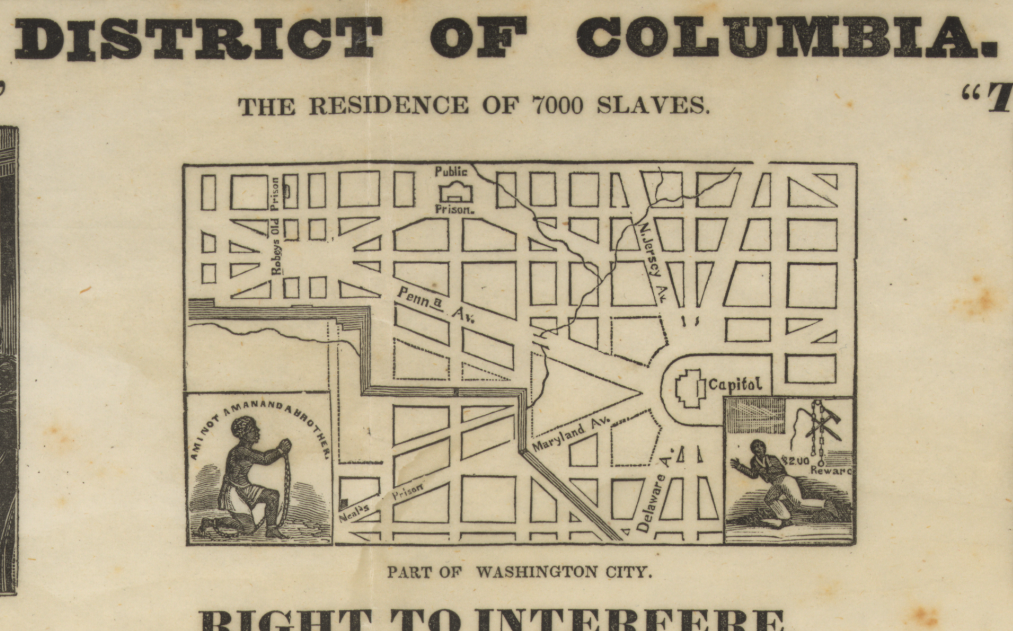
    Slavery DC map[Source: the Library of Congress, http://www.loc.gov/pictures/item/2008661294/]

    The inset map is one of the few from this period to identify the locations of slave establishments.  Here they are identified as “prisons”, which is what they were, but more accurately they were places to hold slaves during the slave sale process which would take place nearby. So the “prison” wasn’t necessarily for law-breakers, but more so for holding the slaves as they were sold as property the ownership being transferred from seller to buyer. 

    And it was not only the slave owners and auctioneers making profit from this–there was also the support industries, like taverns and hotels and restaurants that provided the necessary infrastructure for such business to be conducted.  The D.C. slave market was larger than the District–since it was situated between the two slave-holding states of Maryland and Virginia, it became a natural location for sales of slaves for the region. 

    I’m not going to say very much here and just let the broadside do the talking.

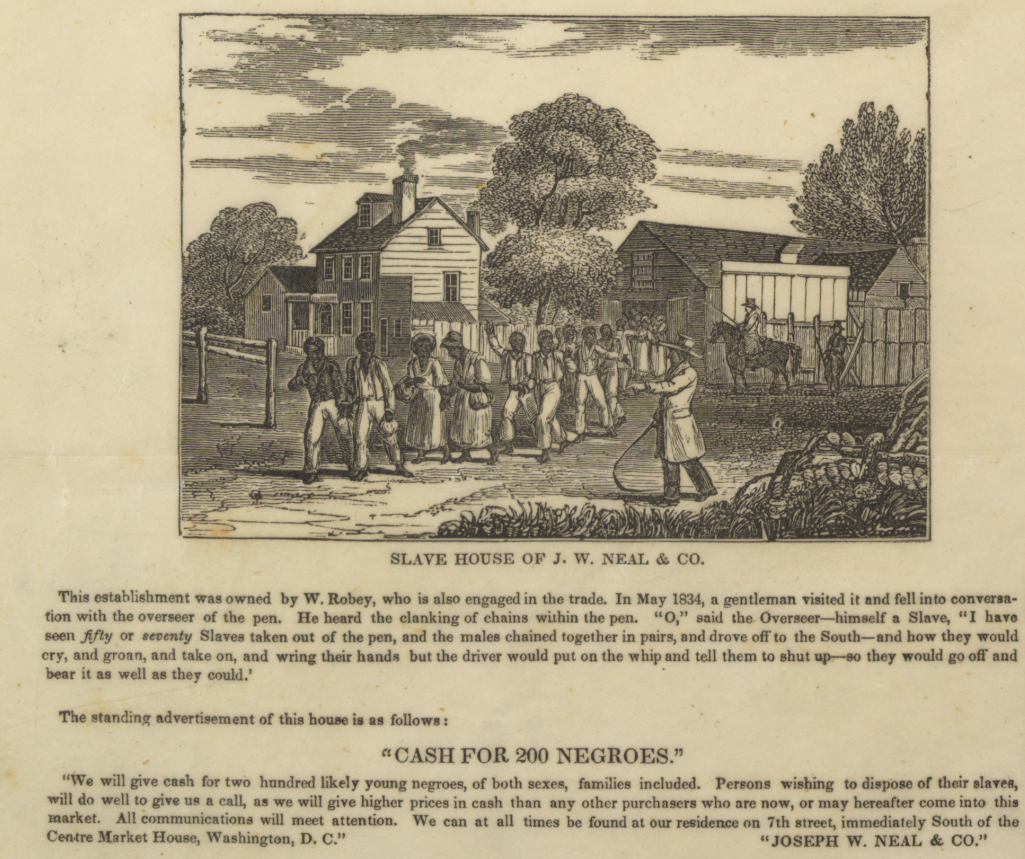
    And the inset from the bottom of the broadside illustrating the Neal Slave House:

    Slavery DC Neal slave house[Source: the Library of Congress, http://www.loc.gov/pictures/item/2008661294/]

    These are all details from:

    Slavery dc broadside[Source: the Library of Congress, http://www.loc.gov/pictures/item/2008661294/]

    “Summary: A broadside condemning the sale and keeping of slaves in the District of Columbia. The work was issued during the 1835-36 petition campaign, waged by moderate abolitionists led by Theodore Dwight Weld and buttressed by Quaker organizations, to have Congress abolish slavery in the capital. The text contains arguments for abolition and an accounting of atrocities of the system. At the top are two contrasting scenes: a view of the reading of the Declaration of Independence, captioned “The Land of the Free,” with a scene of slaves being led past the capitol by an overseer, entitled “The Home of the Oppressed.” Between them is a plan of Washington with insets of a suppliant slave (see “Am I Not a Man and a Brother?” no. 1837- ) and a fleeing slave with the legend “$200 Reward” and implements of slavery. On the next line are views of the jail in Alexandria, the jail in Washington with the “sale of a free citizen to pay his jail fees,” and an interior of the Washington jail with imprisoned slave mother Fanny Jackson and her children. On the bottom level are an illustration of slaves in chains emerging from the slave house of J.W. Neal & Co. (left), a view of the Alexandria waterfront with a ship loading slaves (center), and a view of the slave establishment of Franklin & Armfield in Alexandria.”–[Source: the Library of Congress, http://www.loc.gov/pictures/item/2008661294/]


  • Hounds for Hunting Escaped Slaves: “Negro Dogs”

    JF Ptak Science Books   Quick Post

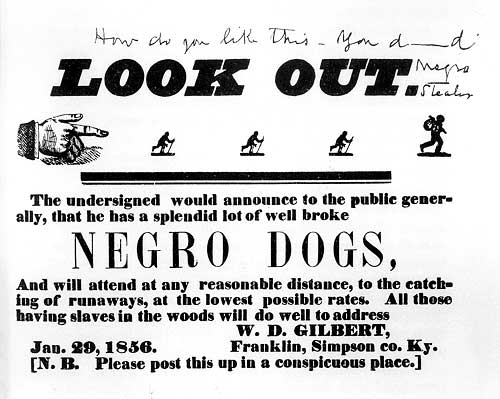
    Negro dogs

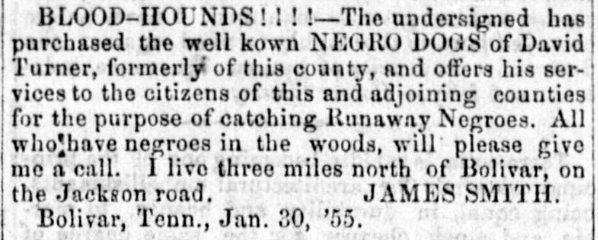
    [Source: http://historymatters.gmu.edu/d/6736/]


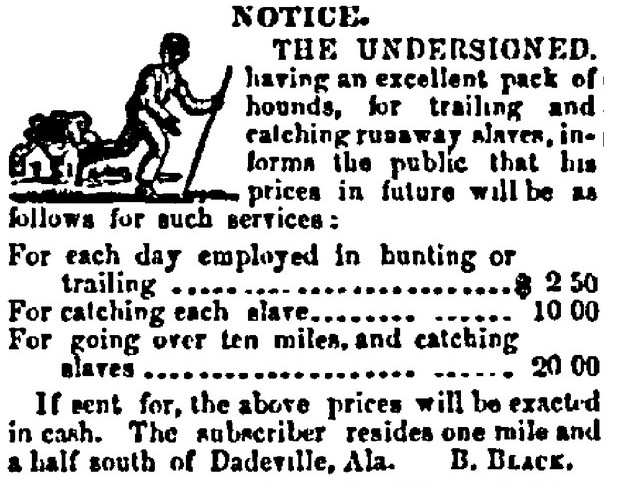
    In spite of many years of reading I have never before today come across the term “Negro Dogs”. I found this mention on my twitter feed via Liam Hogan (University of Limerick, here), who posted the following ad for the sale of “Negro Dogs” for “the purpose of catching Runaway Negroes”.  “All who have negroes [sic] in the woods, will please give me a call”.  

    Negro hounds

    Negro dogs 3

    [Source]  “This ad was originally published in the Dadeville Banner (Alabama), and was republished in Frederick Douglass’ Paper, April 8, 1859.”

    Notes:

    See:  From Dog Law Reporter, the fascinating article  “Dogs in the Economy and Operation of the Peculiar Institution: Evidence from Slave State Case Law”, here: http://doglawreporter.blogspot.com/2012/02/dogs-in-economy-and-operation-of.html

    A worthwhile appraisal of the “Negro Dog” can be seen a BlackVoices, here. 

    ·Posted by :

    ·in:

    —

  • The Drunken Sale of a Sober Wife, with Pig Jobbers and a Bloody Battle

    JF Ptak Science Books    Quick Post

    The title of the broadside is constrained though it does give a little bit of a pull and hint about the juicy tenders to follow, all brought to you from the National Library of Scotland:

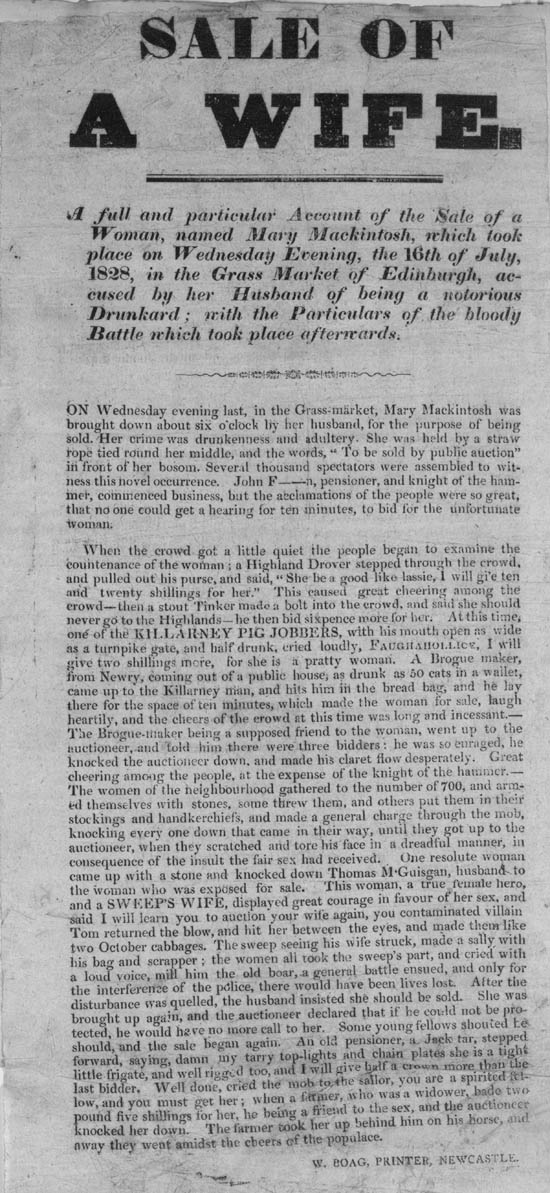
    ‘A full and particular Account of the Sale of a Woman, named Mary Mackintosh, which took place on Wednesday Evening, the 16th of July, 1828, in the Grass Market of Edinburgh, accused by her Husband of being a notorious Drunkard; with the Particulars of the bloody Battle which took place afterwards.’

    Unfortunately it was legal to sell your possessions and your wife, though it seems as though this was an activity of the “lower classes” and a much frowned-upon activity by most.  

    And here are one set of the details that you could purchase for a penny, with much colorful language and alliteration to come:

    “When, the crowd got a little quiet the people began to examine the
    countenance of the woman ; a Highland Drover stepped through the crowd,
    and pulled out his purse, and Said, ” She be a good like lassie,’l will gi’e ten
    and twenty shillings for her.” This caused great cheering among the
    crowd?then a stout Tinker made a bolt into the crowd, and said she should
    never go to the Highlands?he then bid sixpence more for her. At this time,
    one of the KlLLARNEY PIG JOBBERS, with his mouth open as wide
    as a turnpike gate, and half drunk, eried loudly, FAUGHAHOLLICE , I will
    give two shillings more, for she is a pratty woman. A Brogue maker,
    from Newry, coining out of a public house; as drunk as 5O cats in a wallet,
    came up to the Killarney man, and hits him in the bread bag,”

    Broadside wife seller

    Full transcription http://digital.nls.uk/broadsides/broadside.cfm/id/15971/transcript/1

    Source:  National Library of Scotland  http://deriv.nls.uk/dcn3/7441/74414096.3.jpg


  • List of African-American Newspapers, 1895

    JF Ptak Science Books   Quick Post

    African-american

    I found this list (below) of 19th-century African-American newspapers in James T. Haley’s Afro-American Encyclopaedia (Or, the Thoughts, Doings, and Sayings of the Race, Embracing Lectures, Biographical Sketches, Sermons, Poems, Names of Universities, Colleges, Seminaries, Newspapers, Books, and a History of the Denominations, Giving the Numerical Strength of Each. In Fact, it Teaches Every Subject of Interest to the Colored People, as Discussed by More Than One Hundred of Their Wisest and Best Men and Women), which was published in 1895 in Nashville (639pp,by Haley & Florida). The book  was digitized by the University of North Carolina at Chapel Hill as part of their digitization project,   Documenting the American South. It is a fantastic thing absolutely filled with information and insight.  

    • Full text found here: http://docsouth.unc.edu/church/haley/haley.html

    The newspaper section starts with this introduction about the need for newspapers followed by a statement on the involvement, intelligence, and capacity to publish a newspaper:

    Shall I Take a Paper?

    “AT this season of the year, when publishers are making special offers to the reading public, we are all debating the mental fare with which we shall spread our table in 1895. We ought to have first a good church paper thoroughly representative of our denomination.”

    “The Methodist ought to have the South- Western Advocate, published at New Orleans; the African Methodist ought to have the Christian Recorder, published at Philadelphia; the Congregationalist ought to have The Congregationalist, published at Boston, or the The Advance, published at Chicago, and so on for the Baptists, Episcopalians,”

    “Evangelists and other denominations among us. Each home ought to have its church paper. Next to that stands some good clean helpful race journal. Get one, in the columns of which the editors are seeking to help the race up, and not working to pull it down. When you subscribe for a race journal get one in which the editors display not pessimistic, but optimistic views of the race.”

    “It will be well to remember that it takes brains to edit a newspaper, and men who have not been trained to think are hardly men to be entrusted with the perilous task of giving direction to public opinion. The editorial chair requires more than that culture gotten from the reading of newspapers. The editor who is sending out week by week his paper into the world ought to be able to grapple with the problems of the day and think them through. There is too much guessing on the grave social problems of the day by editors. Riots and mobs are the result of false teaching, both on the part of the hotheaded anarchists and incompetent editors who are not anachists. In selecting your race journal for the next year find one whose editorial columns show moderation, and one which is not always squared off with a chip on its shoulder daring someone to knock it off. The paper which busies itself with fighting its contemporaries cannot be of very much help to you. When you raise the question about taking a race journal remember there are two reasons especially to be remembered why you should. The first is a duty you owe to yourself to keep up with the movements among your own people. Second, you owe it to the race to support laudable enterprises which look to the betterment of the race. Let us remember, too, that the press, the pulpit and the platform have been the great liberators of the nations In this land of ours we need the influence of all of these to plead our cause up and down the length of our land. Put some good race weekly on your list for 1895.”–Cleveland (Ohio) Gazette.

    NEWSPAPERS

            The following is a list of newspapers and magazines edited and published by and for Afro-Americans. Alphabetically arranged by States:


    ALABAMA.
    1 Birmingham Harrison’s Pet Weekly.
    2 Birmingham Wide Awake Weekly.
    3 Birmingham Southern Broadaxe Weekly.
    4 Eutaw Weekly Blade Weekly.
    5 Huntsville Huntsville Gazette Weekly.
    6 Huntsville Huntsville Journal Weekly.
    7 Huntsville Southern Freeman Weekly.
    8 Huntsville The Independent Weekly.
    9 Lovan The Eagle Weekly.
    10 Mobile Southern Watchman Weekly.
    11 Mobile Ferret Journal Weekly.
    12 Mobile Weekly Sentinel Weekly.
    13 Mobile West Alabama Advocate Weekly.
    14 Montgomery The Argus Weekly.
    15 Montgomery Baptist Leader Weekly.
    16 Montgomery Odd Fellow’s Journal Monthly.
    17 Opelika The People’s Choice Weekly.
    18 Selma Student’s Voice Weekly.
    19 Tuskegee The Tuskegee Student Monthly.
    ARKANSAS.
    20 Fort Smith The Post Weekly.
    21 Helena Helena Progress Weekly.
    22 Little Rock Arkansas Dispatch Weekly.
    23 Little Rock Baptist Vanguard Weekly.
    24 Osceola Afro-American Leader Weekly.
    25 Pine Bluff The Echo Weekly.
    CALIFORNIA.
    26 Los Angeles The Vindicator Weekly.
    27 Los Angeles The Eagle Weekly.

    ·Posted by :

    ·in:


  • On Saving the Jews, 1943

    JF Ptak Science Books  Post 2406

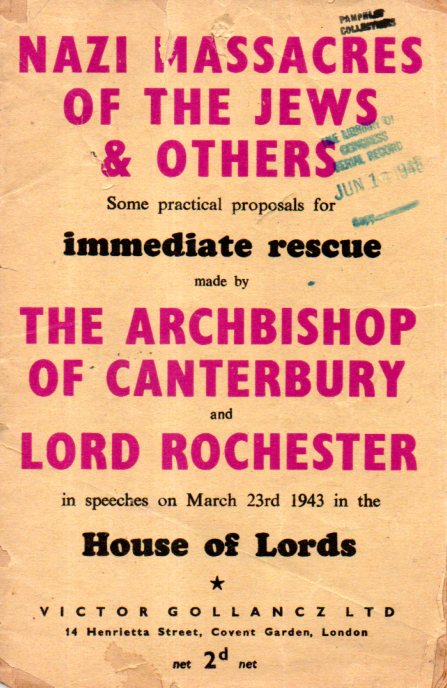
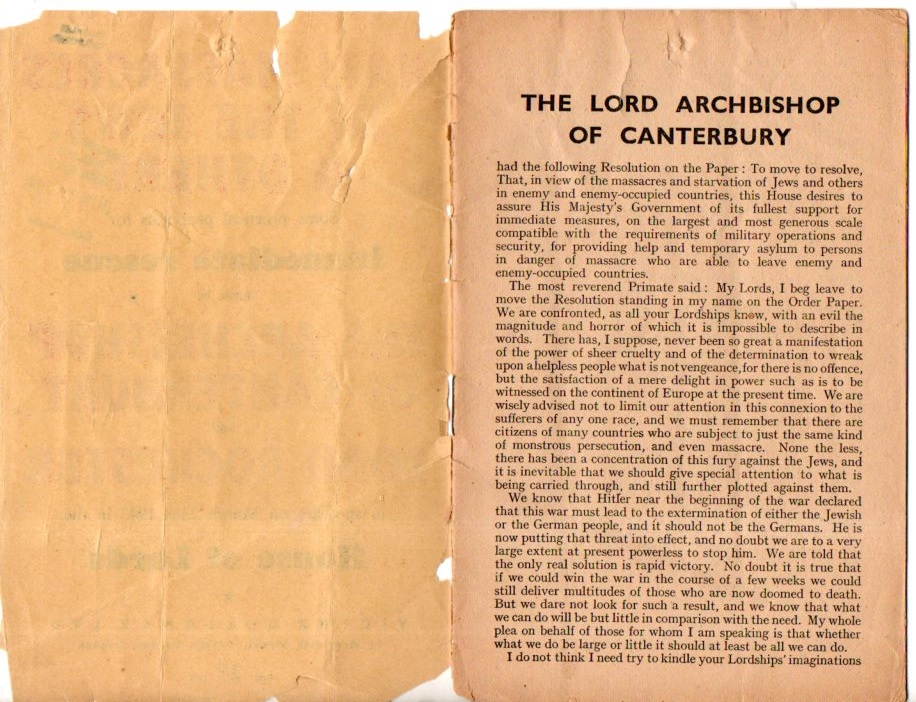
     There was a time in 1943, in London, that there was a great call for the “immediate rescue” of the Jews and other victims of Nazi massacre–given everything, those were pretty strong words, a call to instant action in helping populations in the immediate threat of “extermination”. Nazi massacres of the Jews & others : some practical proposals for immediate rescue (1943) was written with the addresses made by the Archbishop of Canterbury (William Temple) and Lord Rochester (Ernest Henry Lamb, Baron of Rochester) in speeches made on March 23rd 1943 in the House of Lords, an addressed an issue that few cared to discus.

    Save the Jews683


    There are volumes of reports and newspaper articles by 1943 on the extermination and deportation of the Jews and other people, but, really, there was very little discussion about what to do about it.  There were no plans for rescue.   Even when it came down to much more simple issue of raising the levels for accepting refugees (and this by the tens of thousands) there was usually struggle and defeat. On the practicable end of the argument, ships full of refugees were often turned away.  

    It is a very contentious issue as to whether the Allies could have taken pro-active measures against the concentration camps, and the issue of the discussion of whether help could have been given is contentious in itself. What makes this pamphlet noteworthy is that it showed there was a public display of concern during a time when there wasn’t much public thinking being done on that.  This is a complex issue, though I think the capacity to effect some sort of rescue of thousands, or hundreds of thousands (or millions) of people could have taken place2, though it did not, for reasons of indifference more so than for ability or capacity. 

    This pamphlet certainly laid the issue wide open:

    “My chief protest is against procrastination of any kind. … The Jews are being slaughtered at the rate of tens of thousands a day on many days. … It is always true that the obligations of decent men are decided for them by contingencies which they did not themselves create and very largely by the action of wicked men. The priest and the Levite in the parable were not in the least responsible for the traveller’s wounds as he lay there by the roadside and no doubt they had many other pressing things to attend to, but they stand as the picture of those who are condemned for neglecting the opportunity of showing mercy. We at this moment have upon us a tremendous responsibility. We stand at the bar of history, of humanity and of God.”

    I couldn’t find the full text online, so I scanned my copy and include it below:

    Notes:

    1. Nazi massacres of the Jews & others : some practical proposals for immediate rescue  made by the Archbishop of Canterbury and Lord Rochester in speeches on March 23rd 1943 in the House of Lords / [William Temple, Archbishop of Canterbury ; Ernest Henry Lamb, Baron of Rochester.

    2.  This has been shown work by David Wyman The Abandonment of the Jews, America and the Holocaust 1941-1945 (1998) and Richard Breitman  FDR and the Jews (2014), among others.  

    Save the Jews684

    ·Posted by :

    ·in:


  • Captives of Capitalism–the Red Streak in the Sky that Isn’t Santa

    JF Ptak Science Books  Post 2370

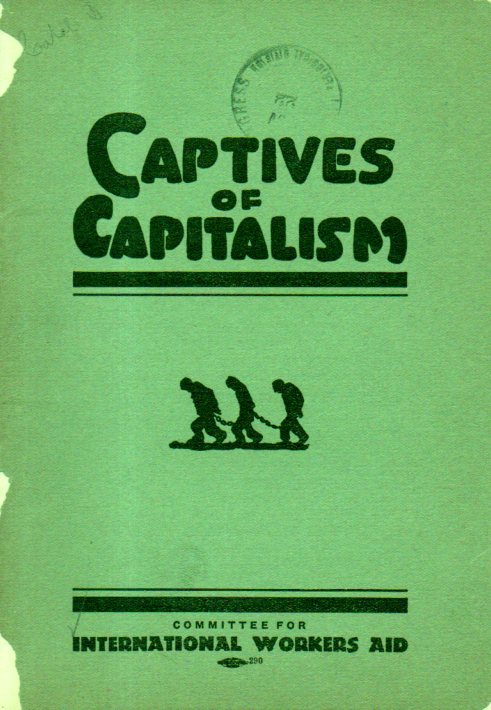
    Captives of Capitalism (printed ca. 1925) is a small pamphlet with a big reach. It was published by the Committee for International Workers Aid, a Communist organization created in Berlin in 1921 (as the International Arbeiter-Hilfe) to help raise money for famine and drought victims in Russia. It was evidently expanded to include collecting money to help victims and prisoner of Fascism, which seems to be the major target in this pamphlet. 

    Captives of Capitalism508


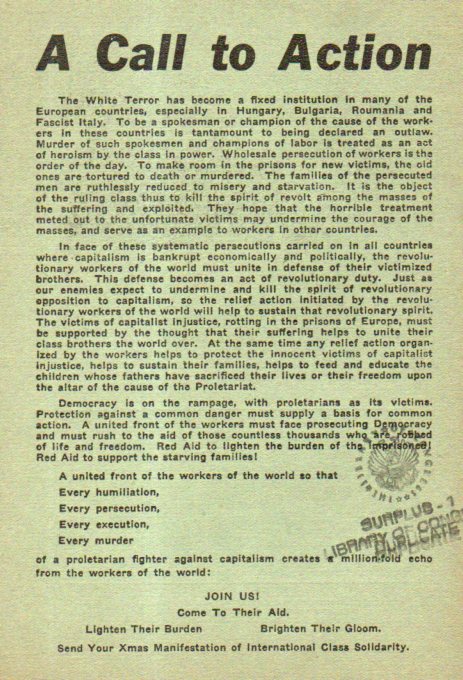
    Although pretty slight the pamphlet looses no time in getting to the heart of the matter, detailing atrocities and unjust imprisonments by fascists and capitalists in Germany, Roumania, Bulgaria, Hungary, Lithuania, Finland, Lithuania, and Italy.  Although not mentioning the United States the “Call to Action” states that “Democracy is on the rampage, with proletarians as its victims” with calls for unity of workers and donations to the International Workers Aid as well as to Red Aid–money to help “lighten the burden of the imprisoned” and to “support starving families”.  


    Captives of Capitalism513

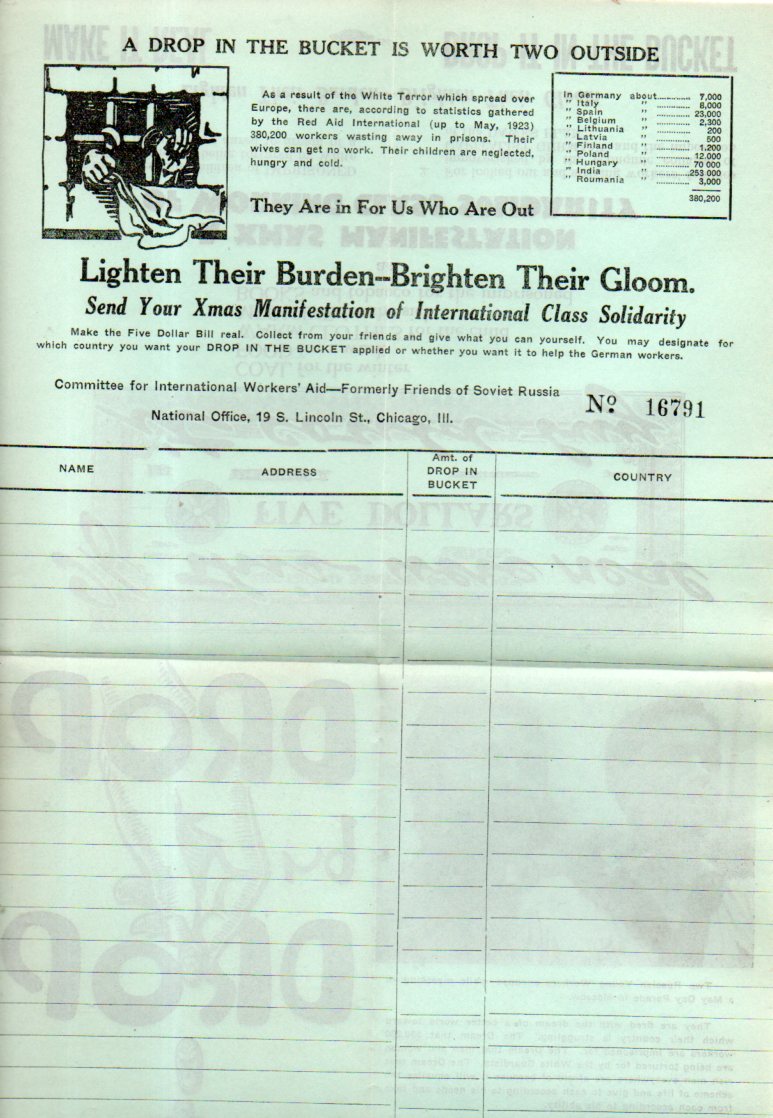
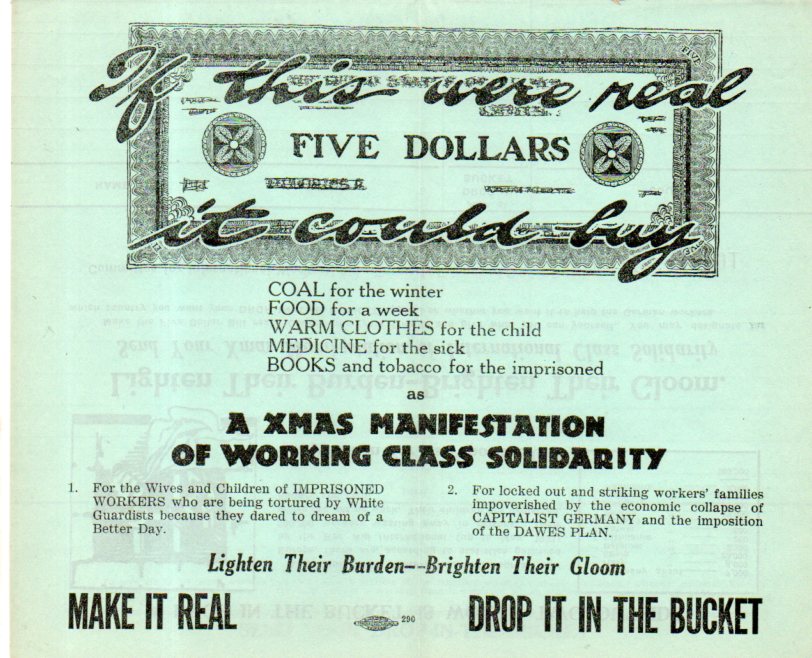
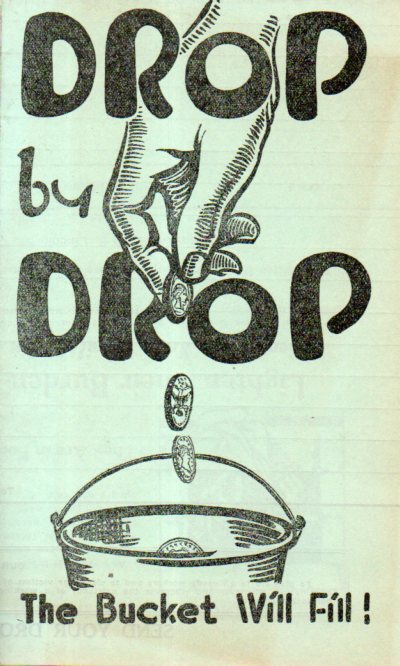
    Inside of my copy of the pamphlet was a small handout, a long sheet folded into quarters with the working “title” of “Drop by Drop the Bucket Will Fill”, and on opening the sheet the entire reverse is a form to fill in with the names of donors and amounts of the “drops” they send into the bucket.  This request series in particular was aimed at “Xmas Relief”

    Captives of Capitalism507

    The “Call to Action” ends very strongly: “A united front of the workers of the world so that

    Every humiliation

    Every persecution

    Every Eexecution

    Every murder

    of a proletarian fighter against capitalism creates a millionfold echo from the workers of the world.”

    Captives of Capitalism509


    Unfortunately the Soviet Union would become its own home-made disaster following the turmoil and famine(s) of the early ‘twenties.  Lenin’s death in 1924 led to Stalin, and Stalin went down a terrifically bad path, beginning his Five Year Plans in 1928 which would displace 25 million families to create the collective farm state; smashmouth industrialization lead to great gloom and the development of Stalin’s cult-of-state created the Great Famine in ’32-’33 and the rest of the hideousness that would cover the Soviet Union through the rest of Stalin’s existence. 

    Captives of Capitalism510


    Captives of Capitalism511

    Captives of Capitalism512


  • Fascist Anti-New Deal Propaganda, 1935

    JF Ptak Science Books  Post 2339

    Just a reminder that even blattant and bad propaganda has its sub rosa content…

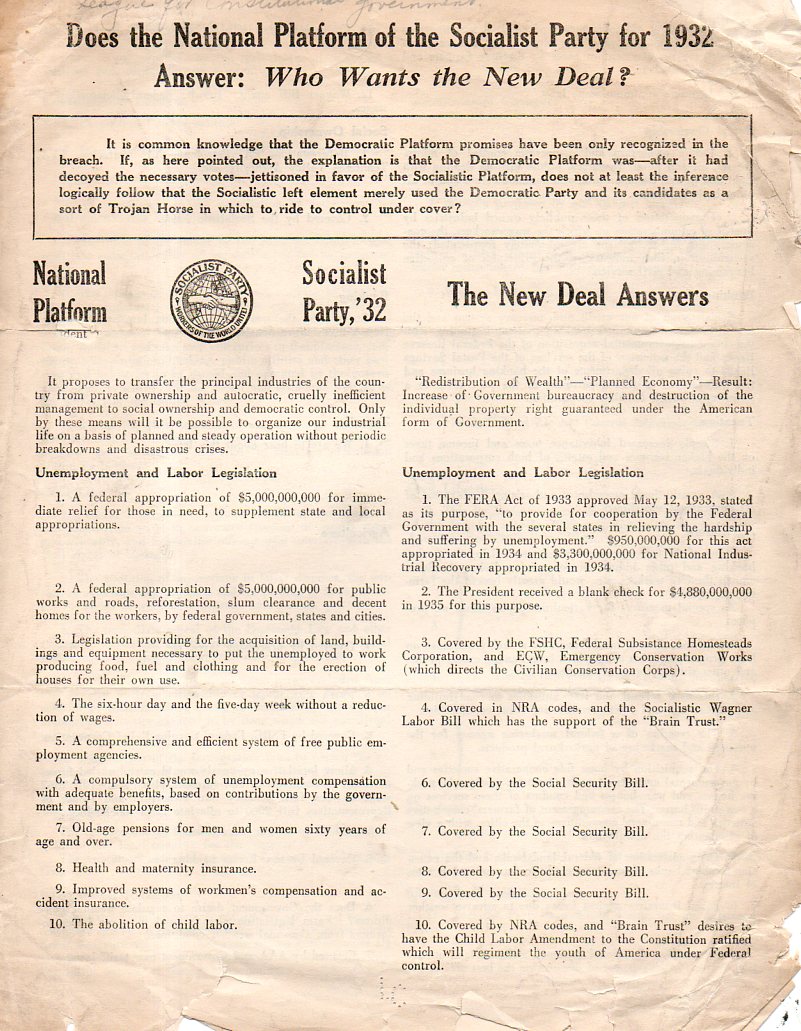
    This is a nasty (pronounced nazty) piece of work by the loftily-named League for Constitutional Government, comparing Roosevelt’s New Deal legislation and program to an overall regime for world domination under Socialist and Communist dictums/control. Everything is Communist, and whatever wasn’t Communist was Socialist, and there really wasn’t to much of a distinction in anything, except that under everything else were the Jews. It is rough and bumpy work, not well written, not well thought-out, though there was a lot of action that was taking place between the badly-formed lines, and if you looked a little hard at it everything starts turning up Fascist. 

    New Deal (anti)350

    It turns out that the League for Constitutional Government is a tough bit to research from home, with not that much written on the organization itself, though there is a fair amount of what can be learned about it by the company it keeps int eh histories of Right-Wing-Lugnut political movements from that period, and all of that association thus far is Fascist. It appears in lists along with the National American (“America’s National-Socialist Party”); “The American Guard, “The White Man’s Party”;  the German American Bund; America First; local bad boy Charles Pelley of Silver Shirts infamy; and in publications including The Revealer, a Christian News Journal, Social Justice, ( a Reverend T,. Coughlin organ), just to name a few.  It is in comfortable splendor with far Christian right organizations like the Christian Patriots (see Mark J, Mozzell, God at the Crossroads,  p.209), and evidently worked to gain control of the east coast section of the America First party (found via Ruth Sarlesp’s The Story of America First, page 28).  There’s also quite a spread on Fascist organizations in America that appeared in Life magazine (March 6, 1939, “Fascism in America: Like Communism It Masquerades as Americanism”). 

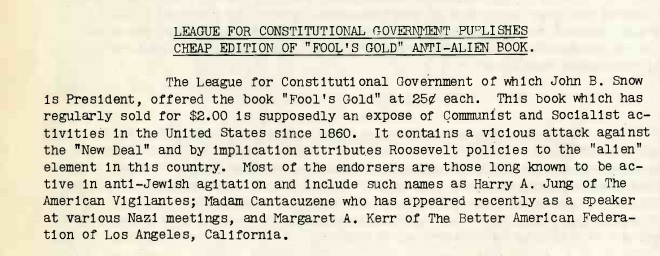
    And then there is this from the “Anti-Jewish Propaganda Front” issued by the American Jewish Committee in 1937 (here):

    League for Constitutional

    I had never heard of this  League for Constitutional Government before last night, and had a difficult time making my way through its somehow dense and loosely packed four-page contents–until it dawned on me that what I was really reading was Fascist propaganda–and that was surprising, mainly because it was so early on it the history of Fascist stuff going on in America.

    My copy of this document was once owned by H.L. Mencken, who gave the thing to the Library of Congress, which in turn decided it wasn’t worth having around (at least in duplicate). I don’t need to own it either, though as a piece of quiet-ish political junk it should be somewhere to remind people that even in flaming propagandistic rhetoric there’s more reading to be done between the lines.  

    ·Posted by :

    ·in:

    —

  • The “Jap Crow” Experiment: Against Japanese Internment, 1943

    JF Ptak Science Books   Post 2325

    Jap crow335

    Here’s an unpopular opinion for 1943: close the Japanese internment camps.  

    The Roosevelt administration’s Executive Order 9066 was the legal bombshell that gave the War Department the authority to authorize the removal of the Japanese (19 February 1942) and theoretically prevent those people from engaging in sub rosa and fifth column activities as wartime terrorists fighting for Imperial Japan,  and which basically authorized a 60-mile swath of the Pacific Coast as a military zone subject to national defense requirements. 100,000 men, women and children were removed to ten different relocation centers, barrack-enclosures located in remote areas, where the great majority of the “dislocated” waited out the war, some two-thirds of them American citizens. 

    Mostly desolate and occasionally beautiful, with light policing, they were still prisons.  

    The great majority of the American population saw this as a military and unfortunate necessity, a byproduct of war.  Citizenship did not come into play.  

    So it was a popular unpopular move; the policy occasionally met with resistance in print, like this example from the April 16, 1943 issue of The Nation, which I reprint in full below.  “Jap Crow” was a response to the treatment of the Japanese in America, a version of Jim Crow, which was the de facto regulatory discriminatory and racist behavior towards African Americans and other people of color in the U.S. 

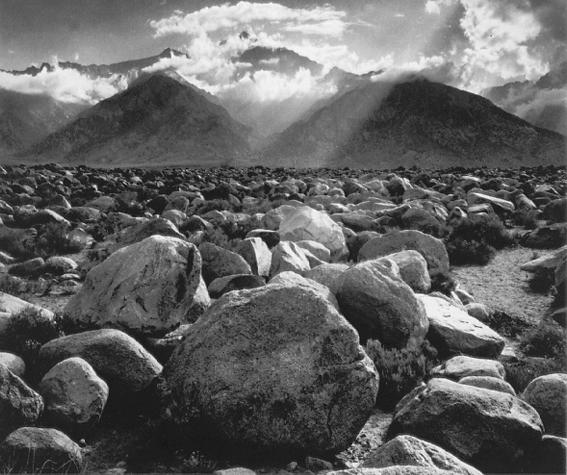
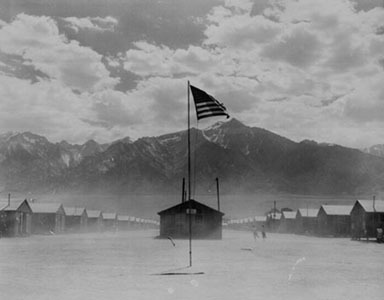
    The life and location of these camps was well documented, sometimes by some of the greatest photographers of the American 20th century. Dorothea Lange and Ansel Adams, in particular, made a long series of images at Manzanar.  One of the great, iconic images made by Adams comes from this period, and as it turns out, its one of those odd sorts of photos that turns in the opposite direction of what the photographer was there “for”.  Mount Williamson is just a drop-dead shot to be sure–it is also an image of what the Japanese in the  camp were looking out at.  Adams turns his camera around, around from the disgrace, and makes one of his greatest images.

    The pretty image:  

    Adams manzanar

    [Source, Ansel Adams, from here.]

    Which was basically the 180-degree view of this:

    Manzanr gate[Image source:  here.]

    The Japanese at the Manzanar relocation center were from the West Coast who were bused away from their homes and lives and businesses with extremely limited notice, and who were forced to sell nearly all possessions (including lands and businesses) at what were less than fire sale prices.  They were made to board buses and trains and were shipped to locations (mainly in California) where they were processed and sent further and deeper into the trying hinterlands of the west for their final destinations until the war was won.  (One of the processing centers was the Santa Anita racetrack, where thousands of Japanese were sent to live for periods in converted, just-painted horse stalls.)  Manzanar itself is well enough out there—removed, trying, desolate, difficult.  Beautiful, too , if you weren’t in prison there.  It was a high desert plateau with the snow-capped sierras, ringing the place; no grass, barely a tree, with extreme temperatures and a tough wind that was freezing in the winter and blew hot in the summer…tough enough to make it hard to keep the tar paper on the roof and sides of the thinly constructed barracks that held these people.  While every other relocation camp had barbed wire and guard towers, Manzanar had none—its location was so remote and difficult that it made the construction of these inferior barriers unnecessary. 

    As difficult was life was at Manzanar, and having being completely torn off of the American map and their way of life, the Japanese at the camp established irrigation systems and gardens, made their own furniture from bits and scraps, established a newspaper, created a government,  schools, police, and so on, making their life as orderly and hospitable as possible.  


    A government film, insisting that these people are “dislocated”, “evacuees”, casualties of war, and not “internees”:

    And the article:

    ·Posted by :

    ·in:


  • “The Negro Soldier” U.S. Army Recruitment Film, 1943

    JF Ptak Science Books   Post 2322

    Negro soldier

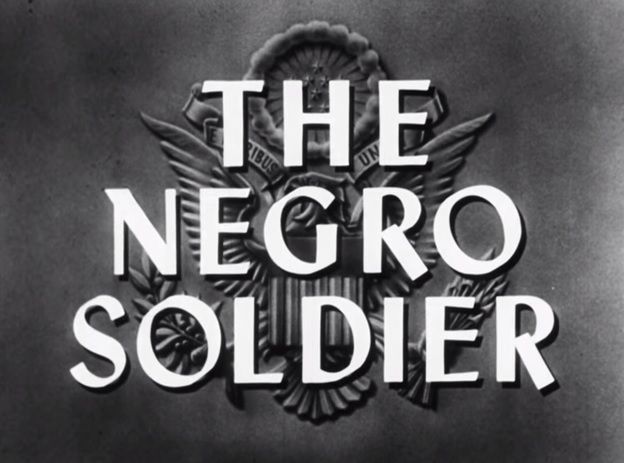
    The Negro Soldier  was a film produced by Frank Capra1 for the U.S. Army as part of a recruitment effort for African American soldiers–in addition to the being a small appeasement to the nearly 880,000 who were already serving in 1943. It was also used as an orientation film, and was required viewing by all servicemen.  It was a tricky business for the time, given the racist policies in place, the de facto segregation2, and the unfortunately high incidence of racist feeling among U.S. servicemen.  

    The armed services needed men.  The Army had a similar problem in 1918, though there seems to have been little effort to learn its lessons with segregation and appeasement. In World War I  there were over 400,000 Black soldiers, half of them in France, but fewer than 40,000 of them actually saw combat duty, the rest being left to construction/upkeep and menial tasks, an army of 760,000 trained men being kept from participation because of racial practices. The Negro Soldier was certainly a partial response to this issue and an appeal to social tolerance and an incorporation of the Black soldier into a unified fighting force.

    It was a difficult time for African Americans in films–not to mention in real life– where the vast majority of portrayals of Black people in cinema was a caricature, indecent. This film has none of the trappings of a contemporary movie about Black people, and was received with high acclaim by Langston Hughes among many others. Although the film portrayed Black people in honorable professions and with respect and dignity, it was also a propaganda film for domestic consumption, and showed a fractured history of African American contributions in quick run-throughs of U.S. history, while also failing to mention things like slavery, breezing through the Civil War in about 20 seconds. Again, that’s not what the film was intended to address–it really was supposed to be a “leveler” of sorts, evening the mountainous arena of race relations, attempting to portray the sameness of the races in the fight against Germany.  On the other hand I can help but think about the difference between what was shown in the film and what was happening in real life, and expect men to go and fight for a principle that for them mostly existed in theory.

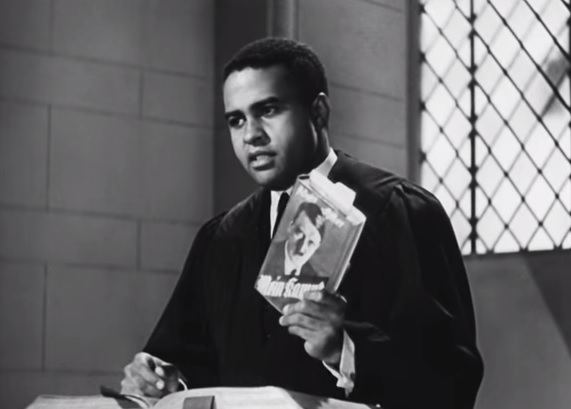
    Negro soldier preacher

    It is interesting to see this movie still of a minister (the screenwriter Moss)  preaching by using quotes from Mein Kampf; he spells out exactly what is there by Hitler concerning Black people, and it is very bad stuff, calling them half-apes and criminal that they should be allowed to have any position of responsibility….and that the Nazi goal was world domination.

    So although a flawed product it was much better than the average fare, not that there was anything to compare it to for the recruitment of Black troops, because (I believe) there weren’t any others.  In spite of the obvious lack of historical context top place the African American in some sort of context in the history of the U.S., this was probably a very good film, and evidently fulfilled its mission.

    Here’s another interesting propaganda film, the story of a Black farmer in Georgia.  Henry Browne, Farmer was made on what seems to be a pretty low budget in 1942, and presents the ideas of the soldier, the soldier of production, and the soldier of the soil, of which Mr. Browne was the later. The film is sympathetic, though Browne and his family are living pretty close-to-the-cuff, plowing with mule teams, taking their mule-driven wagon into a town (Macon?) highly populated with cars. Of high dignity, the Brownes are fairly poor, in spite of having a fine-looking 40 acres. On their wagon trip to town they visit their son, who is a pilot with the 99th Pursuit Squadron, and we watch them as they watch their son climb into a T6 and take off.  I liked that part quite a bit.  


    Notes:

    1. The screenplay was written by Carlton Moss–who also plays the Black preacher–and directed by Stuart Hiesler.

    2.  The U.S. Navy would officially end segregation in February 1946; the Army followed with Executive Order 9981 in July 1948. 

    ·Posted by :

    ·in:

    —