A Daily History of Holes, Dots, Lines, Science, History, Math, Physics, Art, the Unintentional Absurd, Architecture, Maps, Data Visualization, Blank and Missing Things, and so on. |1.6 million words, 7500 images, 4.9 million hits| Press & appearances in The Times, Le Figaro, Mensa, The Economist, The Guardian, Discovery News, Slate, Le Monde, Sci American Blogs, Le Pont, and many other places… 5000+ total posts since 2008.

Category: Prints–looking HARD/deeply at

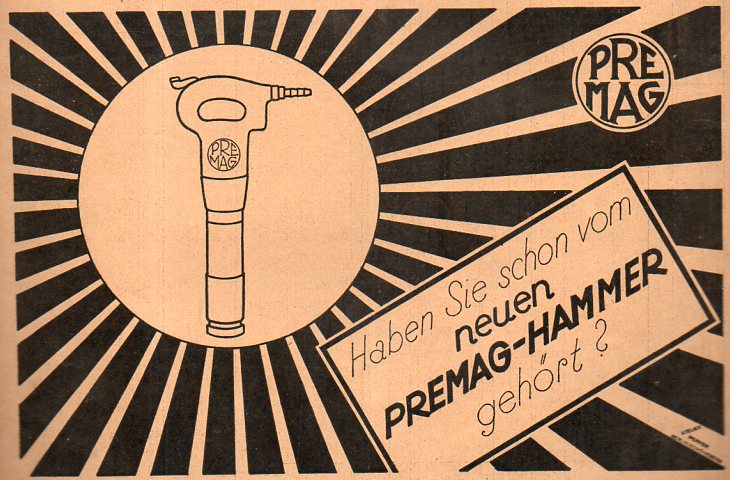
  • A Beautiful Jackhammer–Lovely Design, 1928.

    JF Ptak Science Books    Quick Post

    There are sometimes exquisite images found in the mundane and every-day, beautiful objects hiding in plain site. Perhaps that is all there is, really, everything around us being available for beauty just for the looking-at-it, finding it.  (See an earlier post, The Beauty of Ball Bearings, for example. There is another series of posts on Looking Hard and Closely at Prints, which is more like taking a paper microscope to complex prints and finding the glorious minuatiae lurking in their minimal worlds.) In this quick example here I was stopped by what looks like a fantastic illustration of a jackhammer found in the  Der Bauingenieur, Zeitschrift fuer das Gesamte Bauwesen for 24 February 1928–right there on the front cover.  It is one fine piece of design, and may be the finest imaging of a jackhammer I’ve seen.  

    Pneumatic hammer184


  • A Mini-Monumental Incidental Image, 1889

    JF Ptak Science Books   Quick Post 
    Follow Me on Pinterest


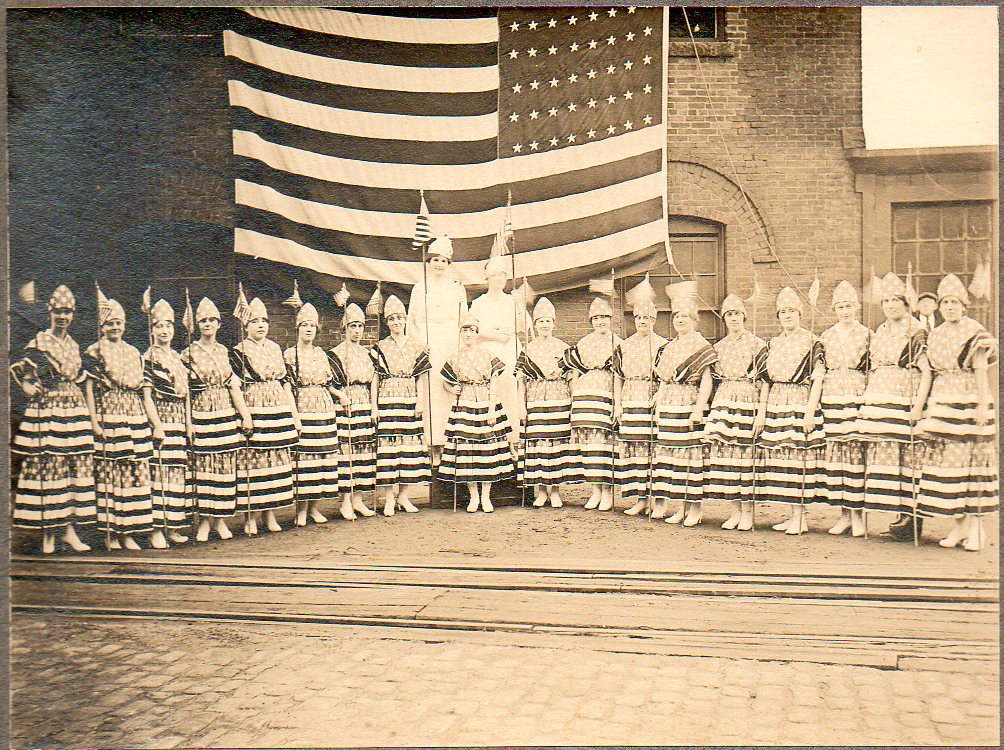
    Women flaGS762[Source: the author]

    This glorious and anonymous photograph features 22 women, 20 of whom appear in U.S. flag dresses in front of a 40-star American flag.  The 40-star appeared in 1889 with the entrance of South Dakota into the Union, one of the four new states in that single year. 

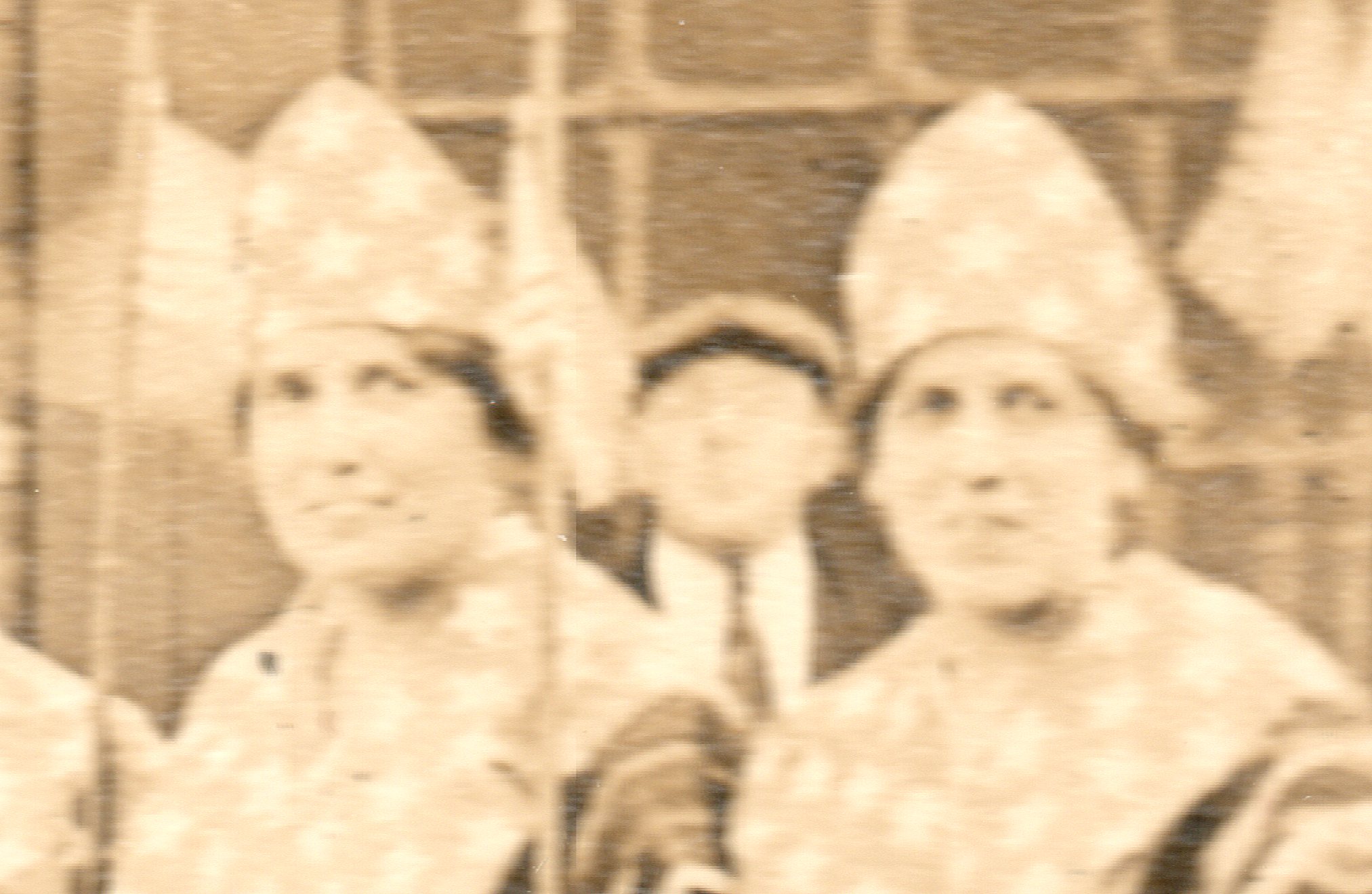
    When I looked though the original, looking for the image-within-the-image, I was surprised by a photobomb by the fellow in the tie and cap.

    Women flaGS764

    Here he is:

    Women flaGS769

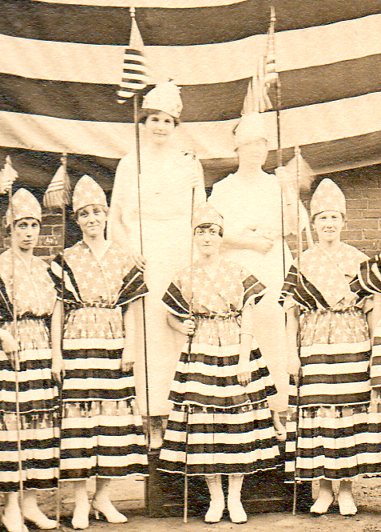
    The outfits/costumes are nothing but stars and stripes, and each woman holds a staff with a small flag. 

    Women flaGS763

    There is a great experience in this not-so-incidental image.

    Women flaGS765


  • A Note on the Fullness of Micro-Landscapes

    JF Ptak Science Books

    0 ebay 17 red cross fly282

    Here’s another in the Looking (Really) Closely at Prints series–actually they’re more like a Inner Life of Prints series than anything, each mico-investigation leading to another entirely new world, each a new image, each a new view and vision, an orders-of-magnitude appreciation of one single object. 

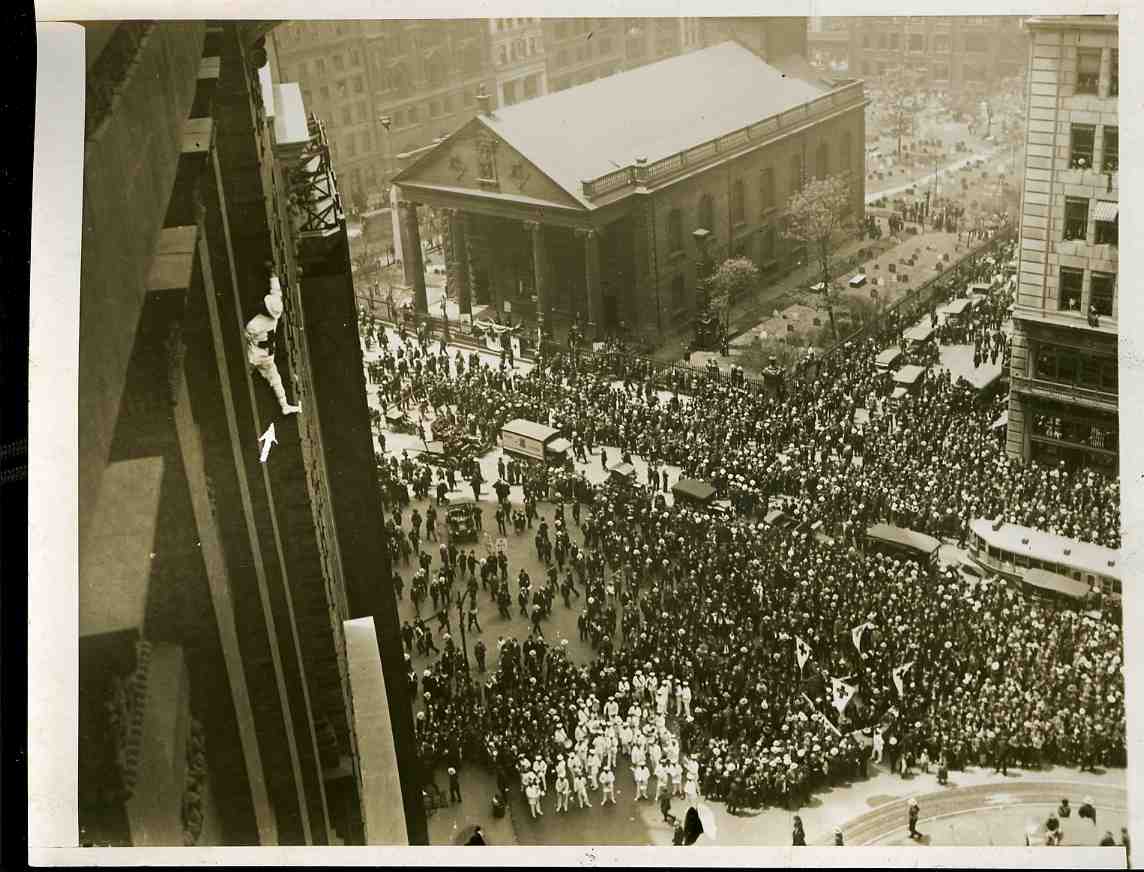
    This photograph depicts a “human fly” making his untethered way up the side of a high rise in Manhattan (?), each foot of his success no doubt raising money for relief effort of American troops or displaced persons or orphaned children, probably in 1918.

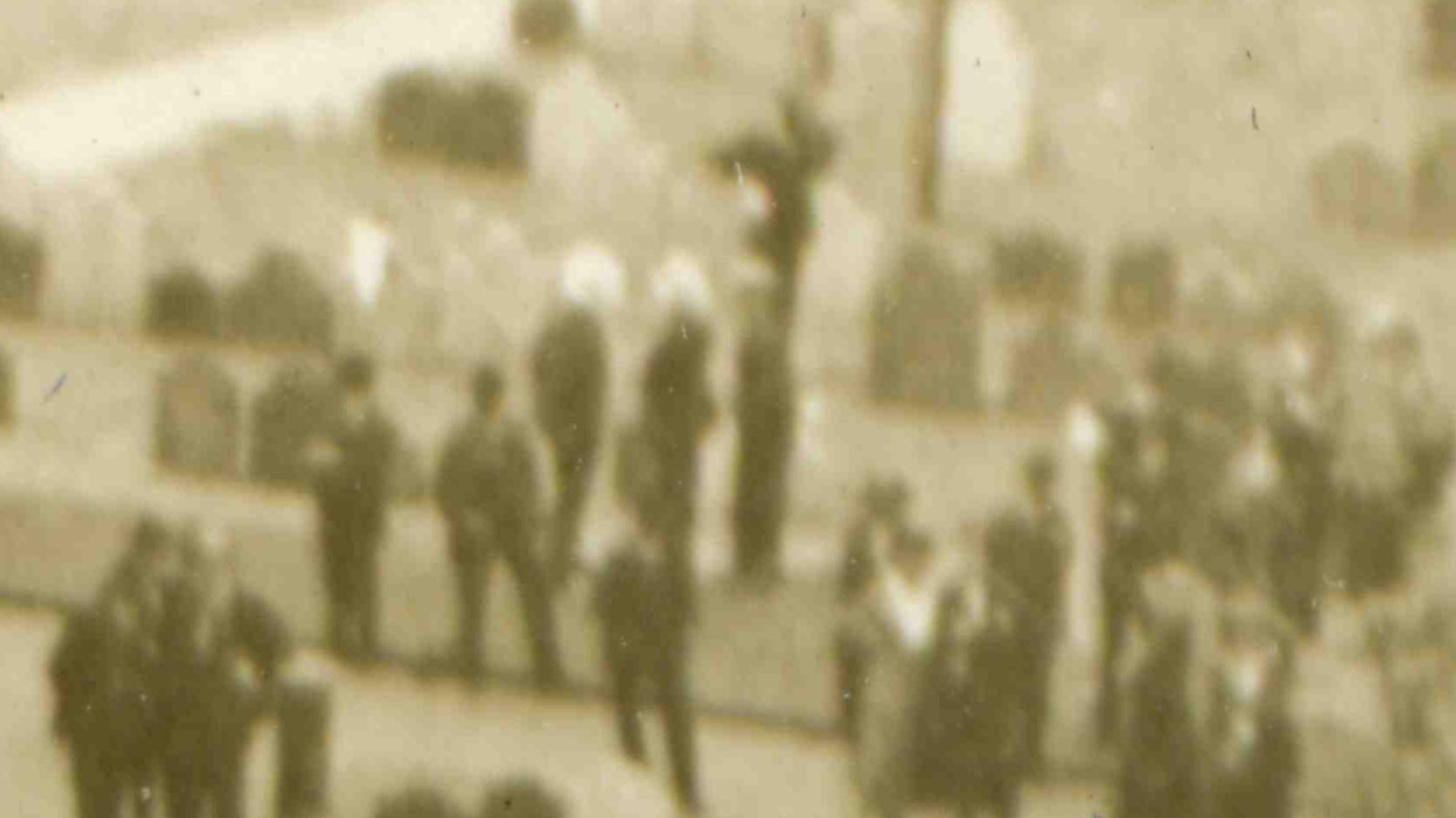
    Perhaps this is Mr. Harry G. Gardiner. the self-styled “human fly” who climbed many buildings in NYC and Boston and Philadelphia in 1918 and 1919.  I cannot identify the church (Episcopal?) in the background, sorry to say (though I’m sure that this will be easy for someone to do).  But I did have a very close and fairly thorough look at the crowd under some fair magnification, and found that not many were actually watching the climber.  On the other hand how interesting can it be to watch someone climb a building–slowly–observing it from hundreds of feet away?  I didn’t see any kids, I don’t think, and there are lots of people looking the other way.  Its difficult not to try and put yourself in the very shoes of these people under the ‘scope, trying to imagine what they were thinking, the heat of the sun on their boaters, the uncomfortable nature in general of wearing all of those clothes for the women, leaning against the black iron fence taking in the stubby sites of the graveyard next to the church….I stopped finally with the two guys in boaters (seen here in the enlargement, the original being just a specky bit at the rear of the cemetery  at the back of the church, to the right), looking very comfortable and relaxed, one with his hands loosely clasped behind, the other perhaps pointing.  Both are looking away from the climber, in the opposite direction, across the graveyard and above the gravestones.  The sun caught their hats perfectly.  They were enjoying a leisurely morning.  There are hundreds and hundreds of these mico-scenes caught in this moment, their suggested fullness revealed only under magnification, like looking through a telescope, in a way, back into a frozen moment of time, yet another photonic jewel.

    0 ebay 17 red cross fly284


  • Zoomology of the Lower East Side, NYC, 1900

    JF Ptak Science Books   Post 2038   
    Follow Me on Pinterest

    Part of a Paper Micrscope series, Zoomology

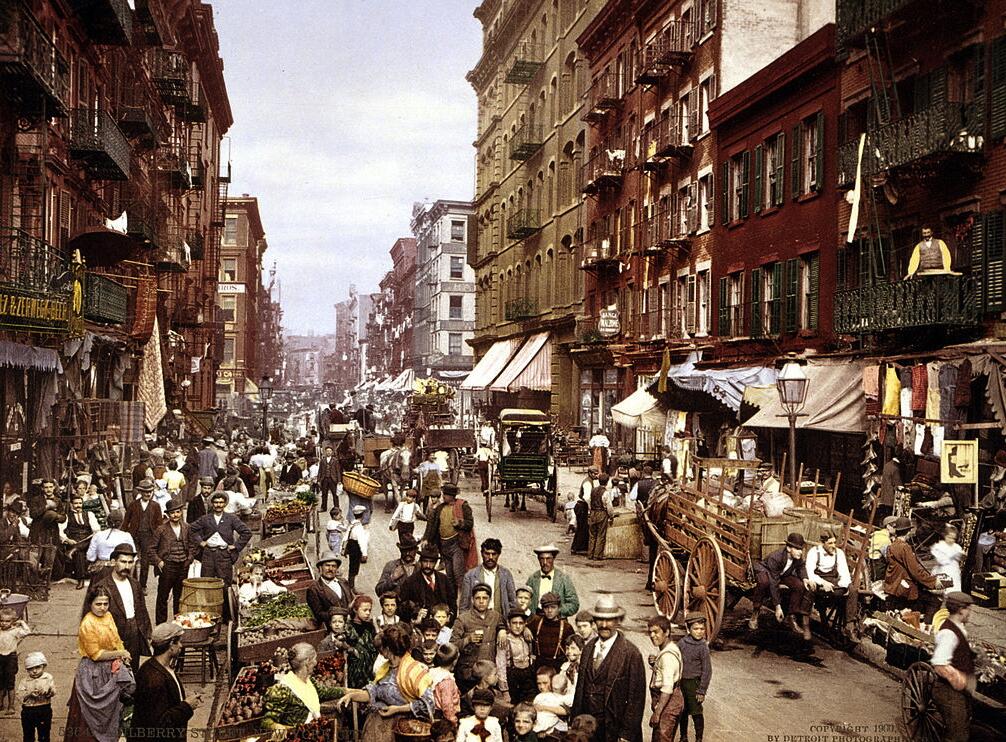
    Michael Beschloss posted this remarkable photograph of the Lower East Side on Mulberry Street, a rare color photo made around 1900.  There is a lot of life going on here–people posing for the photographer (standing on an elevated platform with a large view camera, no telling who or what he was imaging), people caught in their daily lives, people. Under the Paper Microscope the image reveals all sorts of sub-images, photos-within-photos, making it a fascinating exercise in exploration.

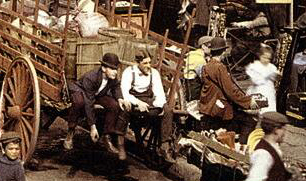
    For example, the two men hiked-up on the back of a moving wagon on the bottom-right seem to be enjoying themselves in expectation, the man on the left about to toss something underhanded, the guy on the right in a bow tie getting ready with a smile to enjoy what was going to happen.  To their right:  a man with a sales platform draped from his neck, watching a girl rush by, his pocket stuffed with paper. 

    NYC lower east side--guys tossingAnd the full mage:

    NYC lower east side


  • The Ophthalmology of a Redon-ized Bosch

    JF Ptak Science Books   Post 2026   Follow Me on Pinterest

                          Cave Cave Deus Videt (“Beware, Beware, God Sees”)
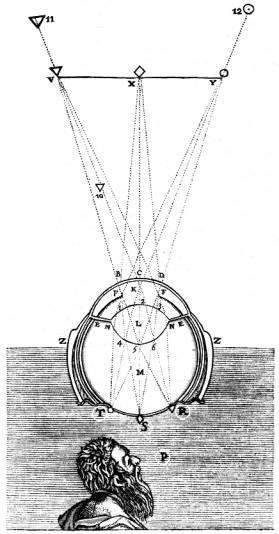
    Descartes dioptrique

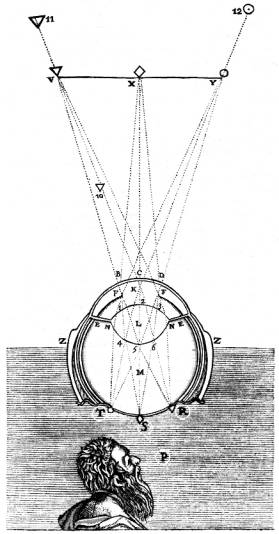
    When I think of the early-ish thinkers on optics and vision, and consider their fantastic images
    of the anatomy of the eye and the mind/brain/eye connection, the work of Rene Descartes usually appears first.  It is a general go-to illustration in optics and biology, and it appeared in his Dioptique in 1637.  It is standard iconography.

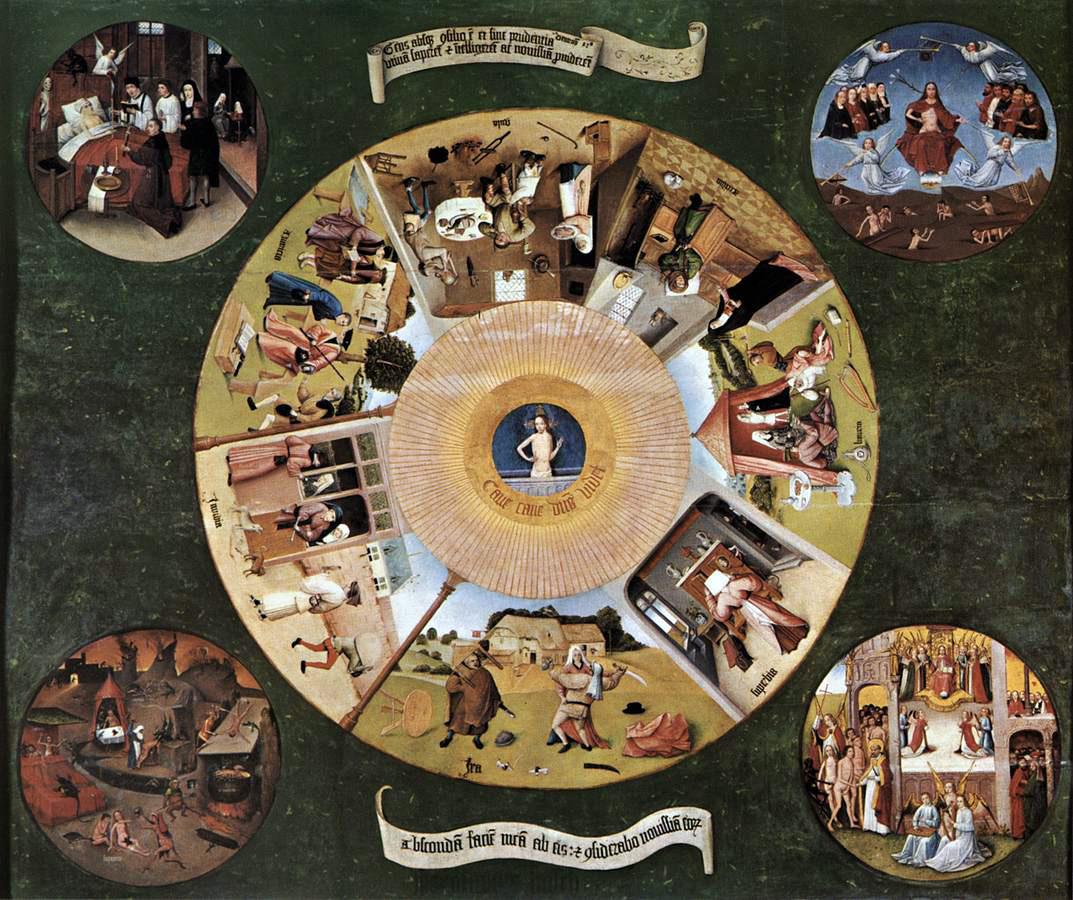
    For me, an antiquarian non-standard image of the eye appeared today. Hieronymous Bosch is not terribly well known as a person, as a walking and talking citizen of the world–it is known where he died, and where he spent the last twenty years of his life, but the details outside of this are scarce.  And even though he signed his adopted name of “Bosch”(he was born ca. 1450 as Jerome van Aken, and died in 1516) very boldly and clearly–and was among the earliest crops of artists to do so in the West–he never dated the paintings.  Scholars have determined their dates in some part by the increased realism and skill, which leads me to one of his latest works, the beautiful table top of the Seven Deadly Sins (ca. 1400). 
    Redon eye balloon

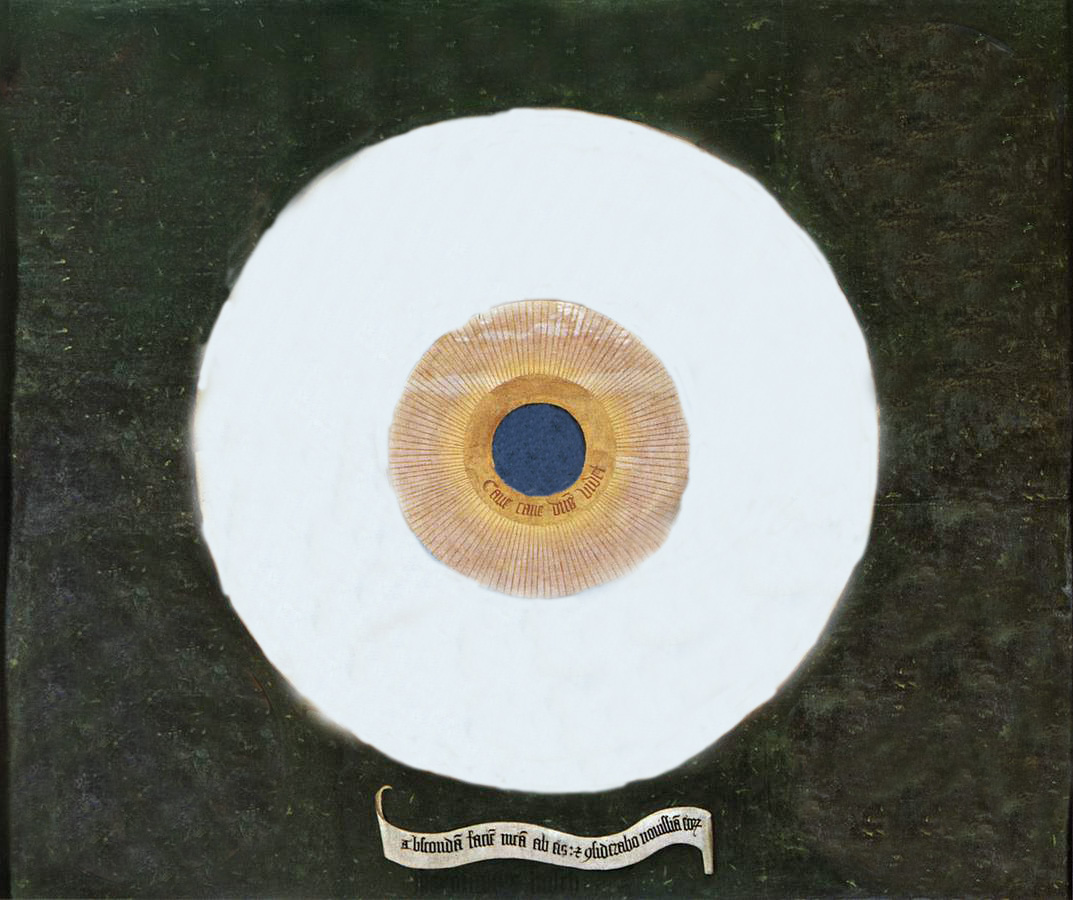
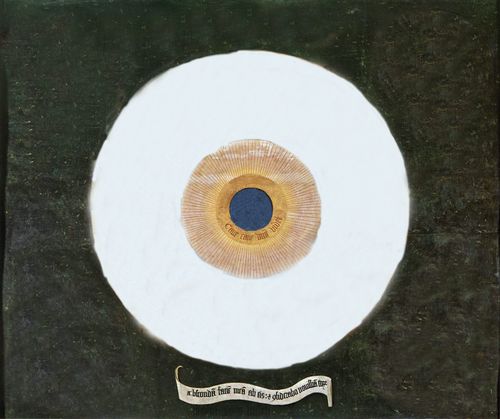
    I had never really noticed it before, but when I looked closely at some of the detail in the work it suddenly dawned on me that the central part of the work was an eyeball–this no doubt instantly seen by every other person, but for me it was a shock of recognition.  This became particularly clear when I (quickly and clumsily) photoshopped out most of the elements of the painting, leaving me with this:
    Bosch The Seven Deadly Sins eyeball

    Which is clearly an eye–and as a matter of fact the Latin inscription emblazoned underneath Christ reads Cave Cave Deus Videt ( or “Beware, Beware, God Sees”), meaning that the watchful creator sees everything and will be the judge and offer final dispensation depending upon past history.


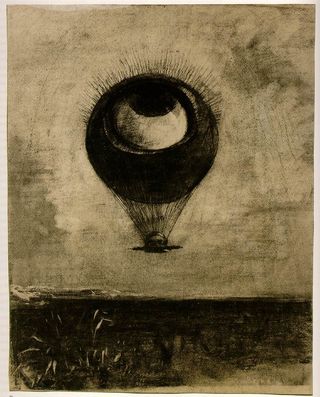
    Rendered like this the work reminds me strongly–at least in a symbolist sense–of Ordilon Redon’s (1840-1916) Eye Balloon (1878). Well, mostly it is the sense doctored image that drives this recollection more so than the painting–removing almost all of the elements of the Bosch suddenly gave the piece an escapist flavoring, like something in the early modernist movements. 

    And the original (47×59″ in real life), with the roundels elements restored and Christ replaced in the iris of the eye:
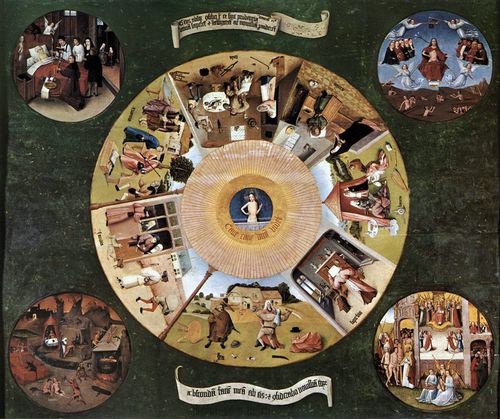
    Bosch The Seven Deadly Sins

    The motif of the painting clearly works its way outside-in, with the all-seeing omnipotent being seeing-all, there at the center of the eye, surveying everything that takes place on the living dominion, surrounded at the corners by depictions of Death, Judgment, Heaven, and Hell, and then immediately encompassed by the seven deadly sins.

    In the floating banner above the main circular image reads “For they are a nation void of counsel, neither is there any understanding in them,” and then below “O that they were wise, that they understood this, that they would consider their latter end!”

    I found it very striking. 

  • On the Early Magnificence of the Modern Mundane–Frost on Windows, 1555

    JF Ptak Science Books    Post 2017    Paper Microscope series

    Follow Me on Pinterest


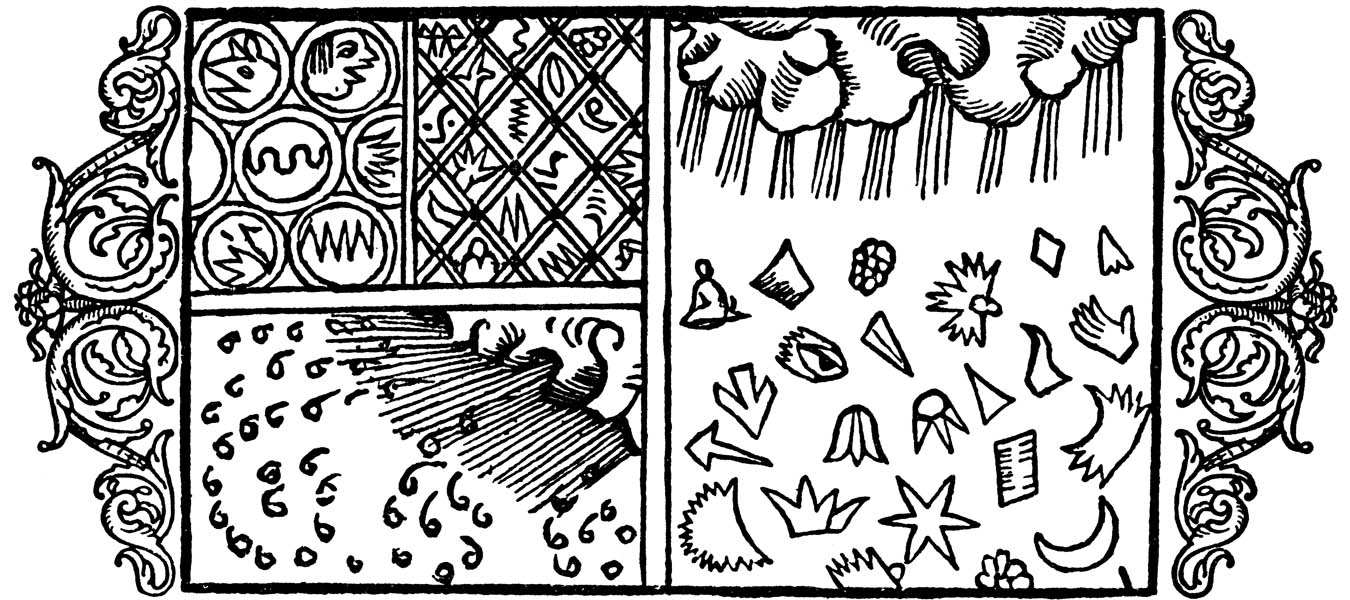
    Magnus weather snow--detail
    To paraphrase an idea often stated by our younger daughter, Tess, on her understanding of science–“Everything goes Somewhere”–the things that we take for granted today all made a first appearance somewhere, sometime. 

    This is the thought that struck me when I saw this illustration of frost on a pane of glass, on looking through a window that is covered with frost.  I really don’t know offhand when the very first record of an image of frost on a window occurs, but this one, found in the fantastic work on the history of Scandanavia (and etc.) in Olaus Magnus’ Histotria di gentibus septentrionale (“History of the Northern Peoples”), which was pubished in 1555, must be at least very early. 

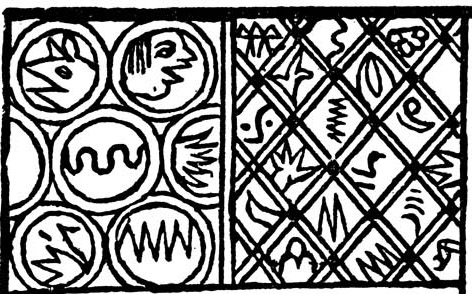
    Magnus weather snow[Image source: http://www.avrosys.nu/prints/index.htm]

    The sections of the print on the right shows different forms of ice crystals–most, or all, are fairly unbelievable, but then again this decades before the microscope was invented.  That said, it does take a little bit of imagination to see an eye in a crystal, though not long afterwards scientific investigators like the great and unusual Athansius Kircher found the Virgin Mary in agate–and there’s a very long and deep history of anthropomorphization of natural history elements beyond this. The image on the bottom left is of falling snow, but the images on the left (top) are said to be frost on windows. 

    What a fantastic realization, to imagine that this may be among the earliest representations of the great and graphical and physical world of ice.  Everything gets seen the first time somewhere–maybe this is it for frost-on-a-window, maybe not. I’m not a frost expert.  I did try to find the first photograph of frost on a window, and then the first photograph of frost, but there were no hits in Google, and of course nothing in my books on the history of photography.  Then again, this is a pretty arcane matter, except that frost on the window can be fantastically beautiful and complex, and I wonder why it would not have made very early appearances in print and photography.  Perhaps it did, but I have a feeling that it didn’t. 


  • Shovel-Leaners of 1565

    JF Ptak Science Books  Post 2011   Paper Microscope series

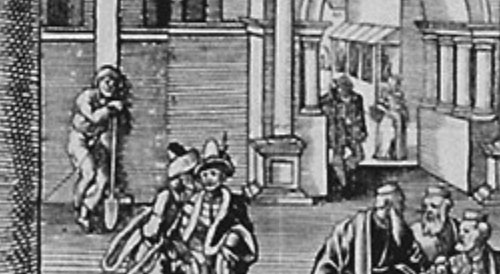
    Amman--shoveler_edited-1

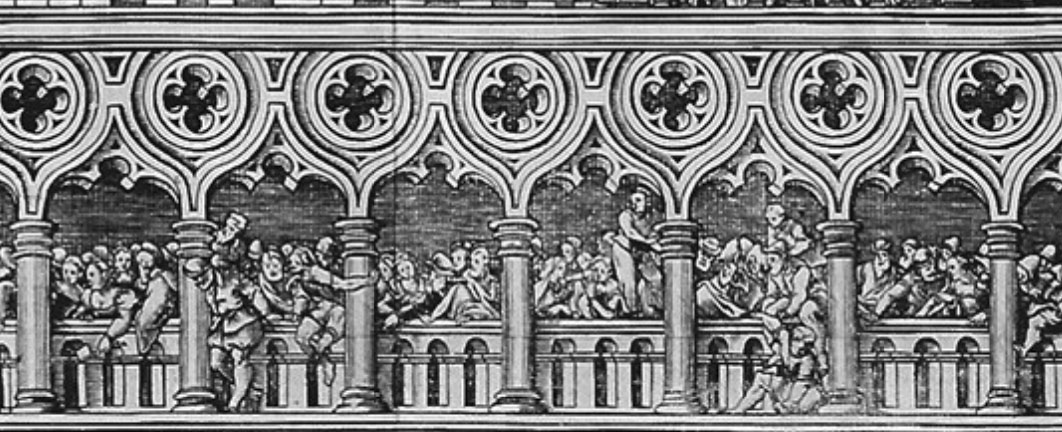
    There is a particular class of illustration in which, among the secondary figures of the image, there is a small happening, an everyday trifle, that has been captured by the artist and included in the overall communication for no necessary reason. (for example, see here ). I’ve written about this a little before on this blog in posts about finding images-within-images: the unecessaries among the unnecessaries, the bits and pieces of everyday human existence that in and of itself is not worth commentary but which nearly everyone experiences.  Small bits, they are, of a tremendous human nature, the things that are done in private, or are so universal but inconsequential that they are shocking to see when illustrated in print. Another fine example of the unexpected story enclosed in great detail is found in this earlier post,  On Antique Waves and Dropping Your Hat in Them, based in an engraving in Romische Historie…, published in Mainz by Johann Schoeffler 1450 years later in 1514, which was one of the most beautifully illustrated books ever produced in that city.

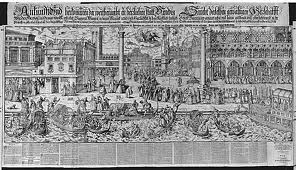
    Today’s example under the paper microscpe is a magnificent and complex recording of the procession of the Doge of Venice by Jost Amman (1539-1591, Swiss, Procession of the Doge to the Bucintoro on Ascension Day, with a View of Venice), and printed ca. 1565, (the full version of which is found here).

    Its the worker leaning on the spade (above) that attracted my attention–just a worker taking a moment out of his worday to watch the procession, caught in the act by Amman…and here we see him still, 447 years later, a wonder occupying 1% or less of the engraving.

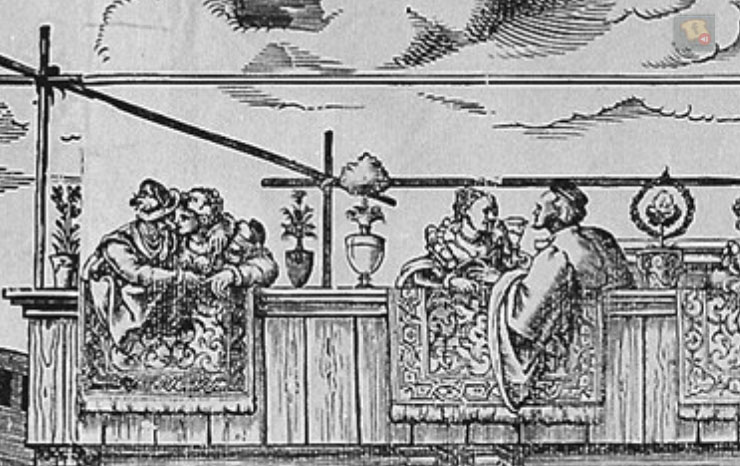
    There are many of these small vignettes laced throughout the engraving, like these upper-echelon folks having a few liberties with each other from the roof of one of the buildings:

    Amman--doge--upper level_edited-1

    Amman--railing

     And the full engraving:

    Amman doge full
    A full, searchable version is available here from the Metropolitan Museum of Art


  • A Found View of Brooklyn and Map of Green-Wood Cemetery, 1846

    JF Ptak Science Books   Quick Post 

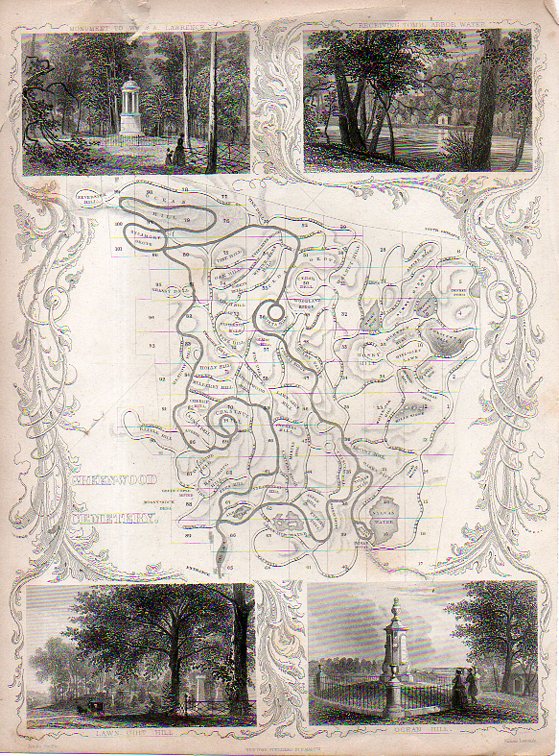
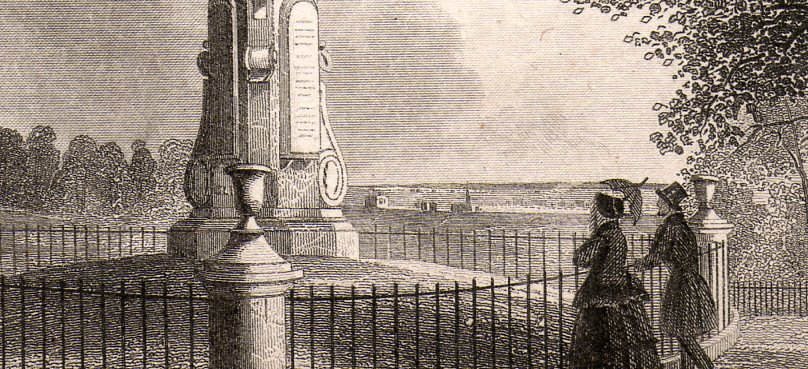
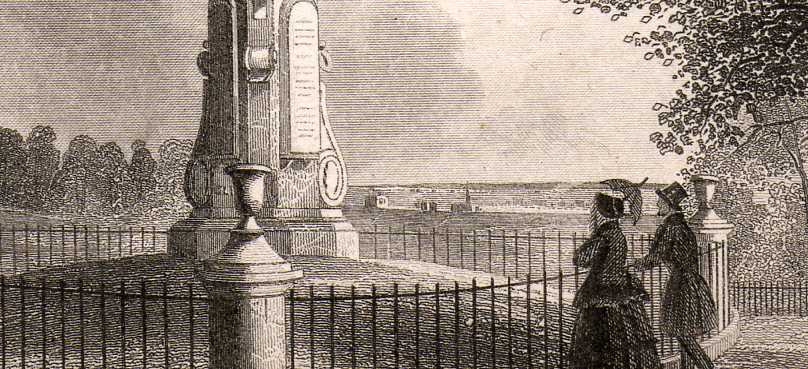
    Green-Wood223This interesting engraving shows a map of the relatively new Green-Wood Cemetery in Brooklyn, U.S.A. It was engraved by James Smillie (1807-1885) and published in 1846, 16 years after opening and addressing a need of the quick-growing burrough whose population grew from 47k in 1840 to 139k in 1850 to 279k in 1860. (Brooklyn would overtake Manhattan in population by 1930, with 2.5 million vs. 1.8 million for Manhattan. More population stats here.)  What interests me most is that small vignette at the bottom right, which shows a quiet scene at the rise in the cemetery called Ocean Hill–what it reveals in the background, though, is an uninterrupted view across Brooklyn and the Hudson River, and on into New Jersey.  Pastoral, Farmlands.  Its a found bit of history, a quiet, privileged view. 

    (The church in the engraving is about 2mm wide in the original.)

    Green-Wood224

    Green-Wood224


  • The Geology of Noses

    JF Ptak Science Books    Daily Dose from Dr. Odd Follow Me on Pinterest

    “The first principle [in science] is to not fool yourself.”  R.P. Feynman

    “The Woo-woo
    is all the same, everywhere, anytime, every time.”
    —James Randi on the
    history of   the pseudosciences .

    See also: the Geology of Hair

    If a person can read another person’s face “like a book”, then I suppose that the face might have some “tracks” on it–beastly objects like the tracks of words (a la Mr. McMurtry in Lonesome Dove) or perhaps something more like the elements of a map, something that is defined and pleads for interpretation, decisive and imaginative at the same time. 

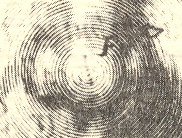
    This came to mind reviewing an older post on this blog, Maps of the Cosmos of Moles, and saw what looked like deeper geological entries on the subject’s face, which was a 17th century alchemical/astrological appraisal and mapping of human moles, but more so than the arrangement of the moles in question.  (Funny to go into a project mapping moles on humans and come out of it with a geology of noses, a phrase by the way which does not show up in a Google search).  In any event, a magnified view of Mole Man’s face coupled with its circular arrangement in the engraver’s technique seemed to suggest something of a volcano in the subject’s nose, complete with contour lines. 

    Mole map detail[Full image found below]

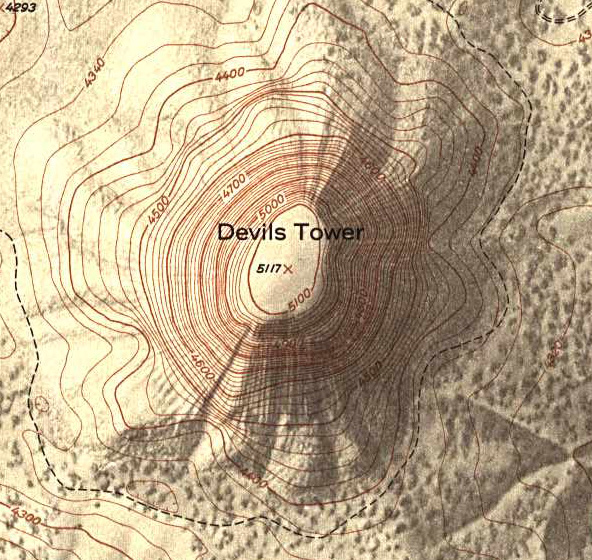
    There’s a very prominent similarity to any number of geological features, liek the one below of the Devil’s Tower:

    Devils_tower det

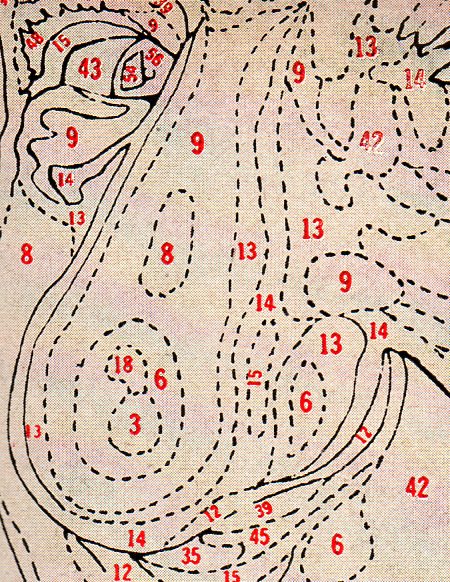
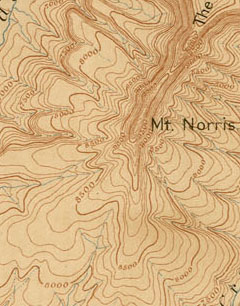
    The contour lines of Mole Man reminded me of something else, another map o fa human face that had a very distinctive geological flavor to it, and another nose:

    Geology of noses

    Contour yellowstone det
    The nose belongs to a Paint-by-Number portrait of Jimmy Durante, a vaudeville/stand-up/entertainer with a very prominent and probably the most famous nose of the 1940’s and 1950’s.

    I doubt that this means anything at all–it was a nice exercise of pulling together a few divergent images in a very odd forced alignment. 

     Notes:


  • A Telephone Call From TomorrowLand and the Idea of Weighing Antique Surprise

    JF Ptak Science Books   Post 1973  Follow Me on Pinterest


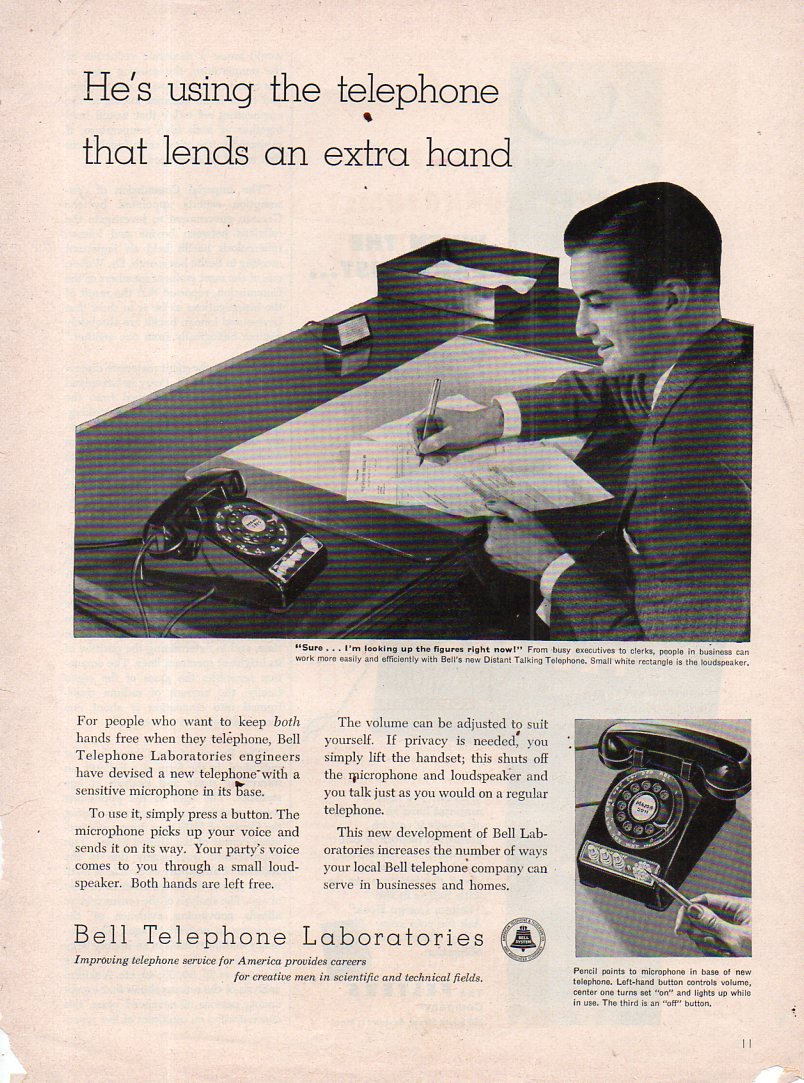
    This ad appeared only 59 years ago–that’s four generations in dog years, two human generations (or one for the more later-in-life crew, which is appealing as I knew a man whose grandfather was born in the 18th century), and 15 generations in managing data and communications. Perhaps more.  It is difficult to imagine the intense surprise that attended this ad showing a practical and popular adaptation of a communications breakthrough. 

    Telephone future064

    The electromagnetic telegraph, which is arguably the first electrically-powered iteration of the internet, was in the works from the 1820’s until it was nailed by Samuel Morse in 1837.  It was 40 years to the development of the Bell telephone (another dramatic example of an invention/technological idea/breakthrough that was “in the wind”, a popular undiagnosed monumental meme, some decades in the making in the hands of Bell anbd Reiss and Meucci and Gray and even Edison). Two more decades (just past the turn of the century) until more-widespread wireless telegraphy, another two decades after that (1920’s) for poular radio, and another two decades after that (post WWII/1950’s) for popular television broadcating. 120 years between the patented invention of the Morse telegraph to 50 million Americans with televisions in 1955. 

    The “telephone” of 2013 is as removed as the telephone of 1955 as the telephone of 1955 was removed from the electromagnetic telegraph–we’re not meeting half-way in the meeting of improbable impossible worlds, of worlds of the future unimagined in the past.  That is what comes to mind when I see this add for the speaking telephone in 1954–the astounding, astonishing, speaking telephone, the phone that allowed you to not have the receiver to the ear, tht allowed you to do free-hand work and communicate at the same time.  It was an ambitious improvement, and as soon as the phone appeared, it became a standard of necessity if that necessity was within budget. 

    It is the weight of surprise that is so abundant looking at pictures like this, giving us the opportunity to imagine the surprise elements of another time. It may well be that the new 1954 user of the speakerphone would have looked at the first telephone systems of 1894 as we look on that 1954 telephone today.  Probably not so, though, probably it was much more imaginable to have forseen the 1954 possibilities in 1894 than for 1954 to have seen in the same amount of time to 2013:  the technological pieces necessary for part of that imagination had not yet been invented, the science ahead of the scifi. 

    The other part of this surprise element is that 1954 is well within living memory, and that this combinaiton of technology and physics and mathematics has grown so incredibly from the speakerphone to the massive changes in 2013–it is as surprising to imagine this as to imagine the same scenario for what ahppened a year before in biology:  it is difficult to grasp the  sweeping changes in that field from the identification of DNA in 1953  and how far those fields have come since. 

    I think that if one could quantify this sort of “surprise” that the greatest amount of “Surprise Integers” (or whatever) ever recorded would have taken place within these past 50 or 60 years. Which makes me wonder–will people 59 years hence see the pictures of our fabulous accomplishments in 2013 as quaint reminders of how much things changed between 2013 and 2072?  Will those “Surprise Integers” be as great for that period of time as the (“our”) preceding period with concomitant revolutions in thought?  My guess is “yes”–its just hard to imagine.