A Daily History of Holes, Dots, Lines, Science, History, Math, Physics, Art, the Unintentional Absurd, Architecture, Maps, Data Visualization, Blank and Missing Things, and so on. |1.6 million words, 7500 images, 4.9 million hits| Press & appearances in The Times, Le Figaro, Mensa, The Economist, The Guardian, Discovery News, Slate, Le Monde, Sci American Blogs, Le Pont, and many other places… 5000+ total posts since 2008.

Category: Information, Quantitative Display of

  • Life Expectancy Graphs and Charts

    JF Ptak Science Books   Reference Tools

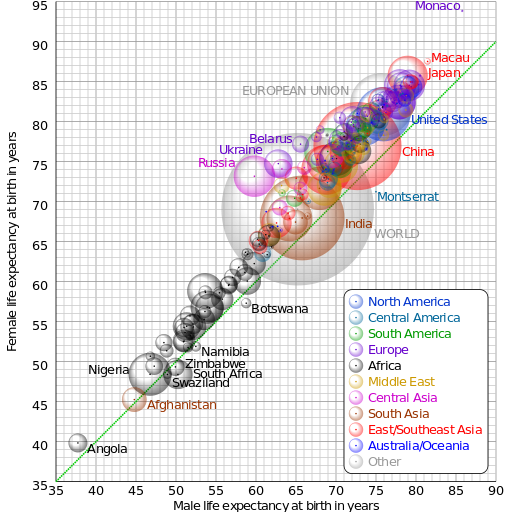
    I’ve put together several interesting graphs and maps displaying historic human life expectancies–perhaps they will be useful.  

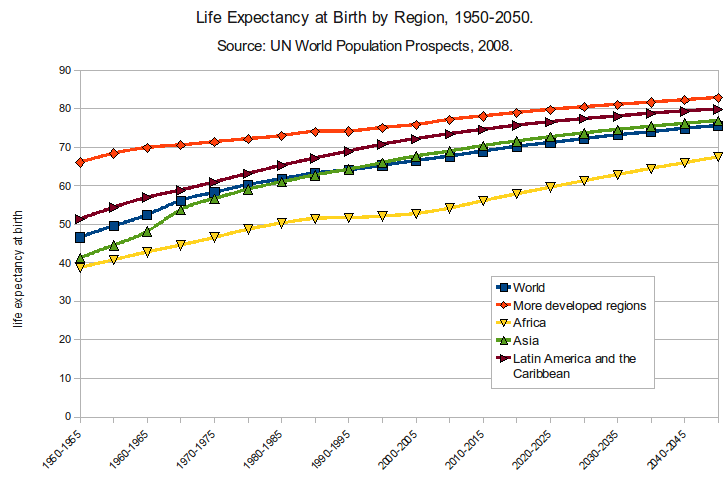
    • Life Expectancy at Birth by Region, 1950-1050
    • Male Life Expectancy via Region
    • Life Expectancy and Retirement Years
    • Life Expectancy by Region
    • Life Expectancy by Region, Concnetrating on Africa
    • Life Expectancy, U.S., 1850-2000
    • World Life Expectancy Map


    Life Expectancy--MapSource: http://upload.wikimedia.org/wikipedia/commons/2/29/Life_Expectancy_at_Birth_by_Region_1950-2050.png


    Life Expectancy graph

    Source: http://en.wikipedia.org/wiki/Life_expectancy#mediaviewer/File:Comparison_gender_life_expectancy_CIA_factbook.svg


  • Diagrams, the Display of Information, and Trees

    JF Ptak Science Books (An earlier post, expanded)


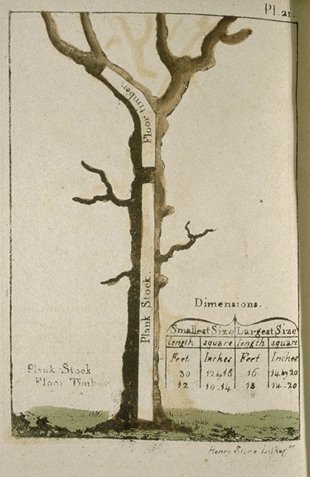
    I’m fond of images of trees, but mostly if they are forensic or employed to display relationships between ideas or data.  One of my favorites for the former is this great image from Peter Guillet’s  Timber Merchant’s Guide. Also, a Table, Whereby, at One View, May Be Seen the Solid and Superficial Measure of Any Square or Unequal Hewed Logs or Plank…1 (printed in Baltimore by J. Longrove in 1823).  Guillet was basically a tree dissector, a harvester of wood for the construction of naval ships.  His book shows how to make the best—the most efficient—use of various varieties of trees, displaying how to employ different sections of trees for different parts of a ship. The book must’ve been an indispensable handbook down at the mill.   At the every least, it certainly introduced a novel way of looking at trees.  

    Tree--timber guillet


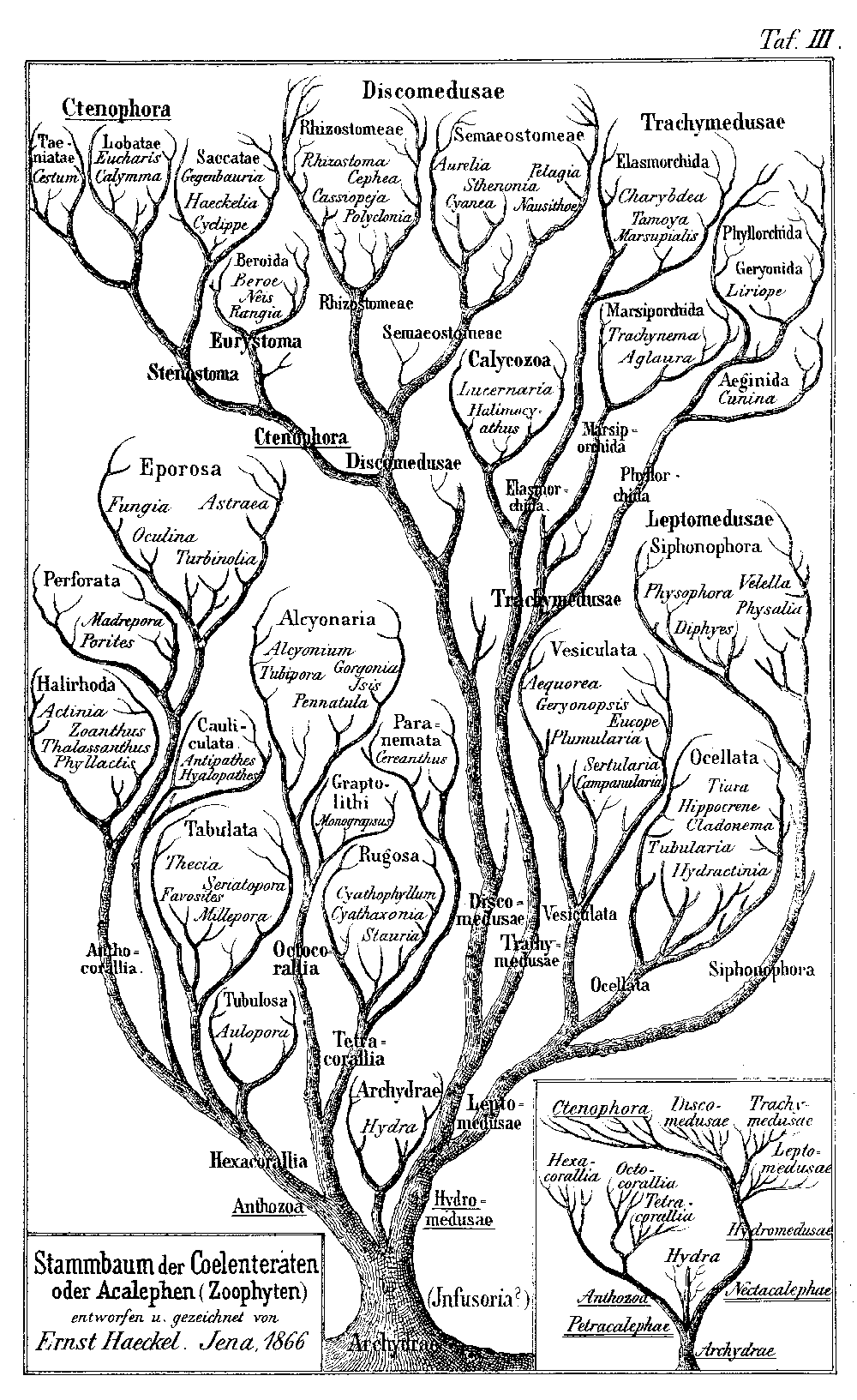
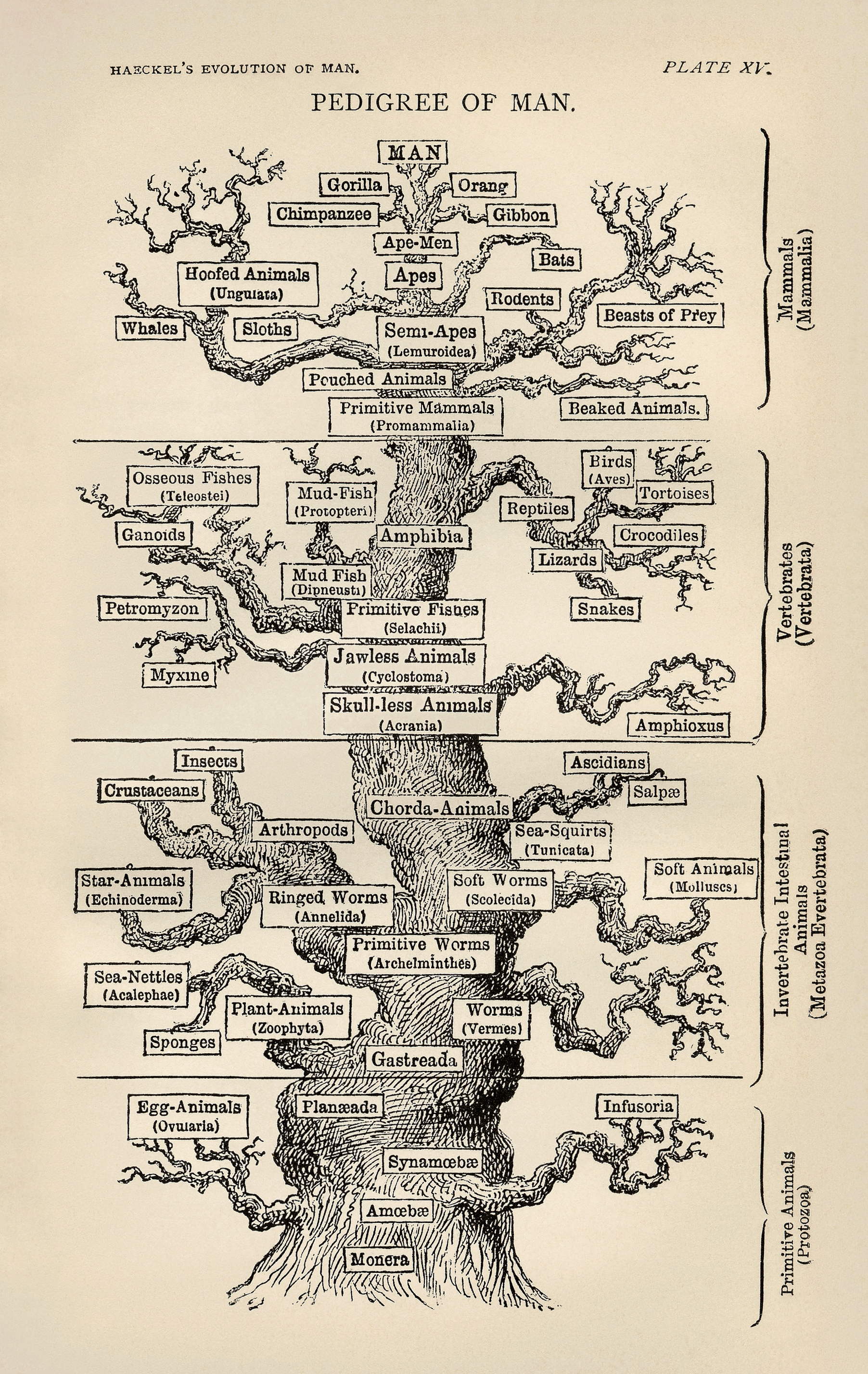
    This tree2 was a figure drawn by biologist and eminent Darwinian Ernst Haeckel3 (1834-1919), the branch spaces relating to intervals which were unrepresented in the fossil record. The image was perhaps the most popularly successful part of his two-volume double-wristbender—it was a difficult book, not well written or presented, with Charles Darwin himself finding it “impossible to read”.

    Tree-haeckel


  • A Bestiary in Maps?

    JF Ptak Science Books   Post 2351

    In the history of cartography besides the construction of map-y maps there are maps that stray beyond the strict geographical diction of necessity, some of which edify the data and others which creatively explain or decorate it.  There are unusual maps of hobo travel, the Garden of Eden, Hell, Heaven, moles, hair growth direction, slavery, suffering, invasion routes, time, prisons, aliens, population density, disease, education,  paved roads, trolley, electric lights, sewers, fire damage, and on and on, some of which are created in a way to make the map more identifiable and to also make it, well, fun, or at least more accessible.  Then there are maps whose explication or decoration or alliteration have little to do with the geographical reasons for the map existing in the first place. And this leads us to today’s post.  

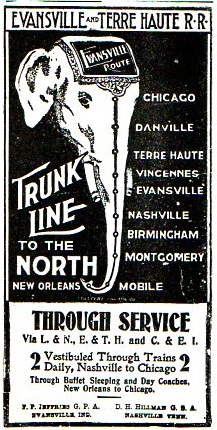
    I think it certainly possible to assemble a bestiary of maps–maps that take the qualities of an animal, or animals…I’ve seen a number of maps that show distributions of animals without taking their forms, and a lesser number representing a geographical area by an animal, but I do think it is possible to wrangle together not only the bestiary but also nearly an entire alphabet of animal maps.  That will need a little work.  For the start of it we have the following: 
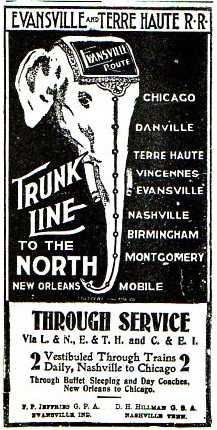
    Map--trunk line367

    [Source: the Confederate Veteran, volume 11, 1903, page 184.] This needs little comment except to say that it is interesting and that it shows up in an interesting publication.

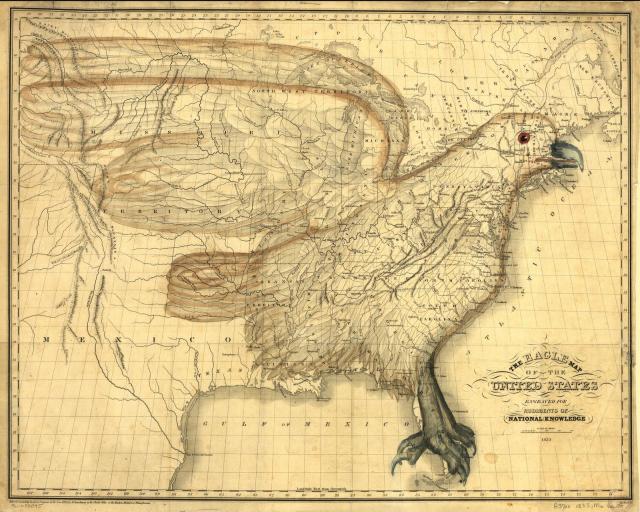
    Next is a great and rare classic, I.W. Moore’s 1833 map incorporating an eagle into the design of the early Republic, from  the Library of Congress (here):
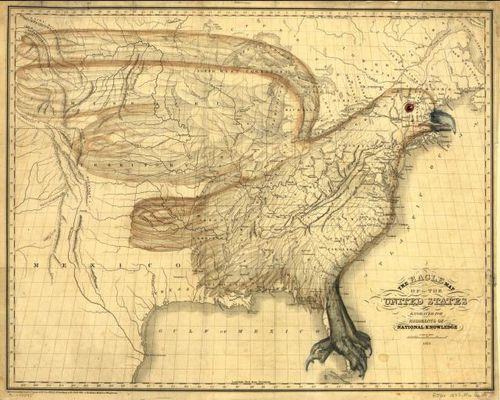
    Maps Eagle America

    The full text of the book in which it appears here (At Archive.org) and the cumbersome text relating to the map (on pp 244-249) is included below in the notes section.  

    There are also the advertisement/comical efforts like the Porcineographic map of the U.S. of 1876:

    This porcineograph

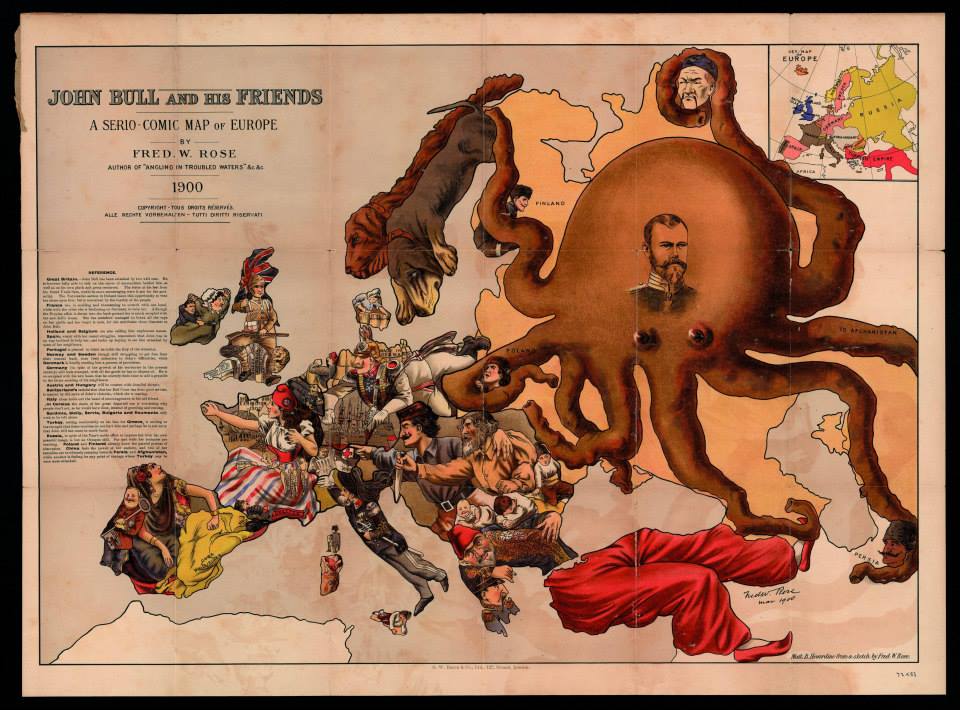
    And the Russian octopus map,  John Bull and His Friends. A Serio-Comic Map of Europe By Fred W. Rose…printed in 1900, and found at the Yale University Library Digital Collections, here:
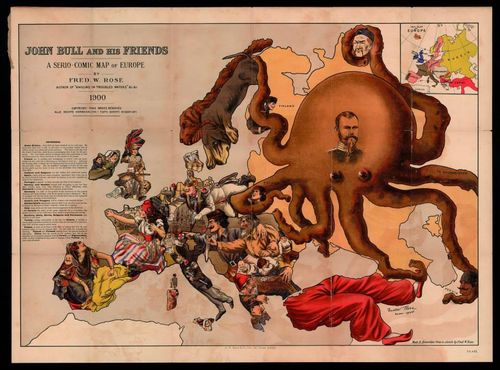
    Europa c

    [With thanks to Mark Dylan Sieber‘s Les Curiosites de Cartes, whose Twitter feed started this interest.]

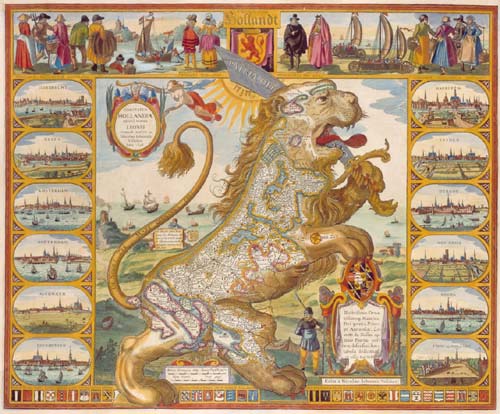
    There are also more maps in a “series” similiar to the Leo Belgicus:
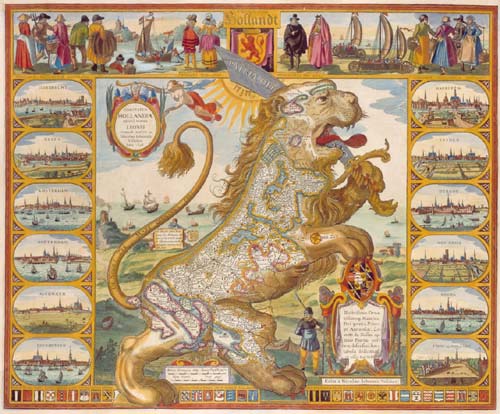
    Leo belgicus

    [Source: Wikipedia, here.]

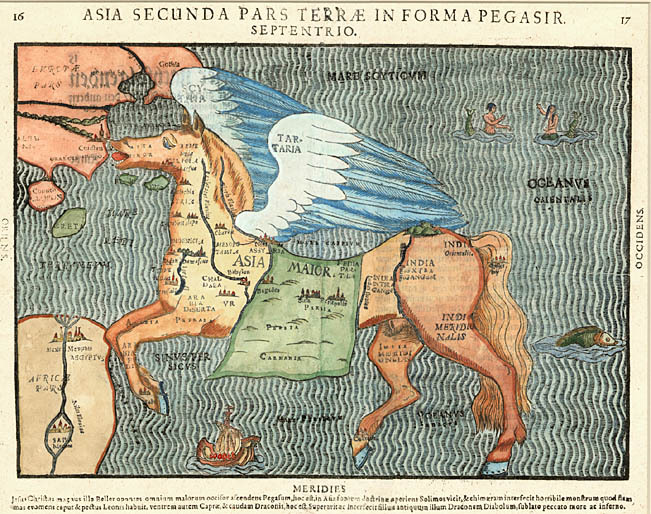
    And then there’s the mythological part, with Pegasus, with Heinrich Bunting’s  Asia Secunda Pars Terrae In Forma Pegasir (1581):
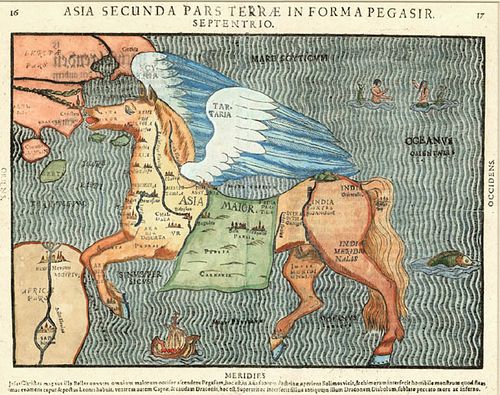
    Maps pegus

    [Source: Barry Ruderman’s mapselling blog, here.]

    Well, this is a start, anyway, covering Elephant, Lion, Octopus, Eagle, Pig, Horse..  It may be a long haul…

    Notes:

    CHAPTER XXXIX. 
    
    THE EAGLE MAP. 
    
    On presenting to the public a map upon the con- 
    struction here imperfectly exhibited, if an apology 
    be not necessary, perhaps at least, some notice of the 
    origin of the idea, and some of the reflections of the 
    author upon it, may not be misplaced. 
    
    The first sudden impress of the form of the figure 
    upon his attention, was under a combination of pe- 
    culiar circumstances. A map of the United States 
    happened to hang upon the wall of his apartment, 
    upon which a dim lamp light was reflected. The ef- 
    fect of the light, in the particular position in which it 
    was accidentally placed, seemed, as reflected from the 
    various colourings of the map, to cast a shade over 
    the state of Maine, and to mark a kind of separation 
    between it and the adjoining territory. The close 
    connexion of this state, as, always, under a common 
    view, necessarily combined with the great general 
    ground plan of the Union, he conceives to be the 
    principal reason why the notion of the figure has not 
    before been apprehended. 
    
    On its first presentation, he was disposed to discard 
    the idea, as merely a sportive play of the imaginar 
    tion, unworthy of notice. The figure, however, once 
    impressed, could not be eflaced from the imagination; 
    but was ever afterward in view when his eye happen- 
    ed to glance on a map, till he was at length induced 
    to give the subject a share of consideration, regarding 
    its possible usefulness and moral bearing. 
    
    Arguments which presented in favor of construct- 
    ing a map embracing the plan of the figure, appeared 
    conclusive with relation to the youth engaged in the 


    THE EAGLE MAP. 245 
    
    study of the geography of our country. Those argu- 
    ments were founded upon an apprehension of the in- 
    creased facility with which lessons may be impressed 
    and retained upon the youthful memory, when the 
    aid of figure, adapted with a tolerable degree of accu- 
    racy to the subject of study, can be resorted to. To 
    this opinion it is presumed teachers in general will 
    readily yield their accord, without further remark 
    upon the questions of Why? or Wherefore? 
    
    When extending his reflections further, the recollec- 
    tion was of course present, that the figure of the eagle 
    was the figure adopted by our national councils, as our 
    national badge. In this point of view, the coincidence 
    appeared as a circumstance peculiarly striking. A fur- 
    ther singular and surprising coincidence presented it- 
    self, in the circumstance that the bird is placed in a 
    position perfectly correct, with respect to a corres- 
    pondence with the lines of latitude and longitude; no 
    variation from the common principles of constructing 
    maps being required, to place it in a natural position. 
    
    As the subject has occasionally occupied a further 
    extension of thought, a variety of serious moral reflec- 
    tions have occurred to the mind of the author, in 
    which he is not disposed to anticipate his intelligent 
    readers, who are altogether capable of reflecting for 
    themselves. He will, therefore, under this head, con- 
    tent himself with offering a supposition of a single 
    example, illustrative of the manner in which visible 
    objects, as they stand associated in the mind with 
    ideas of order or deformity, may possibly be more or 
    less productive of moral effects. 
    
    If, from a selfish, or misguided policy, the citizens 
    of any one state, should propose to separate their in- 
    terests from the interests of the Uiiion, and claim a 
    right to withdraw from the general connexion, the 
    ugly chasm which would be produced by carrying 
    their design into effect, would be aptly represented 
    by supposing a line of separation drawn round the 
    seceding state, and admitting its whole internal de- 
    clinations, and even its very name, to be blotted out 
    21* 


    246 THE EAGLE MAP. 
    
    from the eagle map of the United States, — the signs 
    and notices, of all the delightful alternations of river, 
    mountain, hill, and plain — of cities, the seats of com- 
    merce and refinement — of villages, the abodes of in- 
    dustry and social enjoyment — of the rural residences 
    of friends whom we love — all shrouded, in a shade 
    of gloomy, impenetrable darkness — and then observ- 
    ing the distortion which would be thus effected, in the 
    beautiful figure before us. Thus, might not a moral 
    repugnance be strengthened, against the open or in- 
    sidious attempts, of artful, designing men, who might, 
    for some ignoble or selfish end, be disposed, by de- 
    ceiving their fellow citizens, to attempt a disorganiza- 
    tion of the republic? 
    
    In the common representations of the eagle as the 
    American ensign, an allusion seems to be generally 
    intended to a martial spirit; and it is therefore repre- 
    sented with an aspect of fierceness, and in an attitude 
    prepared for war. Here, on the contrary, having 
    possession of the whole country, and no enemy to 
    contend with, it is designed to appear as the placid 
    representative of national liberty, and national inde- 
    pendence; with an aspect of beneficent mildness, and 
    in an attitude of peace. 
    
    It is therefore to be conceived of, as having be- 
    come wearied and disgusted, with the oppressions, 
    perpetual discords, and tyrannizing of power over 
    right, prevailing from age to age in the old world, 
    and as having, in consequence thereof, taken its flight 
    across the western ocean, in search of a resting place; 
    where its administration of equal rights might be duly 
    appreciated and respected. 
    
    Having arrived at the shores of this western world, 
    and taken its aerial circuits with the continent under 
    review, it appears as though arresting its flight — its 
    wings raised with a graceful, natural, and easy curve, 
    as relinquishing their hold on the buoyant atmosphere 
    —and its feet extended, as in the act of gently settling 
    on the rocks of the Florida reef, to exercise a benign 


    THE EAGLE MAP. 247 
    
    presidence over a territory equal to the length and 
    l)readth of its own shadow. 
    
    Thus it appears as overshadowing the whole ex- 
    tent of the United States and territories, excepting the 
    state of Maine, and the home of the natives in the 
    distant regions of the west. The citizens of Maine, 
    it is presumed, will not be offended at the impossibi- 
    lity of comprehending their department in the Union, 
    within the regular form of the figure, when we assign 
    to it the appellation of the cap of liberty, attached to 
    the eagle's head. 
    
    The present small map, is supposed to be sufficient, 
    in its internal delineations, to serve the purposes of 
    illwstrating the subjects of the volume which it ac- 
    companies. It may also serve to impart a fair gene- 
    ral idea of the design of the figure. Yet it has not 
    the least pretension to showing a specimen of the 
    elegance, with which the combined circumstances of 
    coincidence of figure, and geographical utility, are 
    capable of being represented. By an enlargement of 
    the scale alone, the proportions of the figure would 
    be presented to the eye, with a general aspect greatly 
    improved. 
    
    It is contemplated to issue, simultaneously with 
    the present volume, proposals for publishing by sub- 
    scription^ an eagle map of the United States, upon a 
    large and liberal scale; to be executed by the ablest 
    artists in a superior style; and intended to furnish an 
    appropriate ornament, to decorate our halls of legis- 
    lation, judicature, literature, and science, with the 
    library of the retired gentleman, the office of the law- 
    yer, and the retreats of the farmer, manufacturer, and 
    merchant. It is conceived that the ornament would 
    be likely to be viewed with peculiar interest and gra- 
    tification, because of the circumstance of containing, 
    in correct proportion, a representation of our beloved 
    country. 
    
    In the large map proposed, much of the common 
    minutia will be omitted in the engraving, in order to 
    show the figure with greater advantage and beauty. 


    248 AGRICULTURE. 
    
    All the most important items, will, however, be re- 
    tained, and the place of the smaller supplied by a 
    neatly printed and bound accompanying volume of 
    references; so arranged, as to render all the usual pur- 
    poses of a map of the United States complete. In 
    exchange for the omitted minutia, will be engraved, 
    the regions of our different mineral and vegetable pro- 
    ductions, with various other interesting and ornamen- 
    tal delineations, never heretofore presented in similar 
    works. 


  • The Lost Einstein Film, 1922

    JF Pak Science Books   Quick Post

    EInstein image

    [Source: http://www.kinematographie.de/EINSTEIN.JPG]

    Here’s a movie that no longer exists and that may not be such a great achievement but would also be something I’d like to see just because it suddenly existed again.  It was a movie called “The Basic Principles of Einstein’s Theory of Relativity” which premiered  at the Frankfurt  Trade Fair on April 2, 1922 and made by Walter Kornblum–it was about Einstein and relativity, and was about the first of its kind; it was a successful film, but with varying reviews, and then managed not to survive them. No copy survives, nothing left of it to speak of save descriptions of the film and the reviews that appeared in newspapers. There is however a terrific piece of research by Milena Wazeck1 that reconstructs the film from a number of different sources–it is really a very impressive piece of work, a wonderful thing to read, watching the lost history unfold.  (Full text here; and see the abstract2 below.)


  • Diagrams of Outsider Logic, with Synesthesic Angels (1925)

    JF Ptak Science Books  Post 2341  (Poster Series 5)

     [A cleaned-and-colorized 13×19″ version of this cover design is available in the new Posters section of this blog.]

    +()+outsider cover

    There are some other more recent contributions in our Outsider Logic collection that reach the limits of outside, reaching far into the aspects of knowledge that lies more or less completely hidden and inaccessible to the vast majority of readers.  Sometimes bumping into outré thinking like this is very useful because it is just so very different; and sometimes this thought process is just and only that: very different.

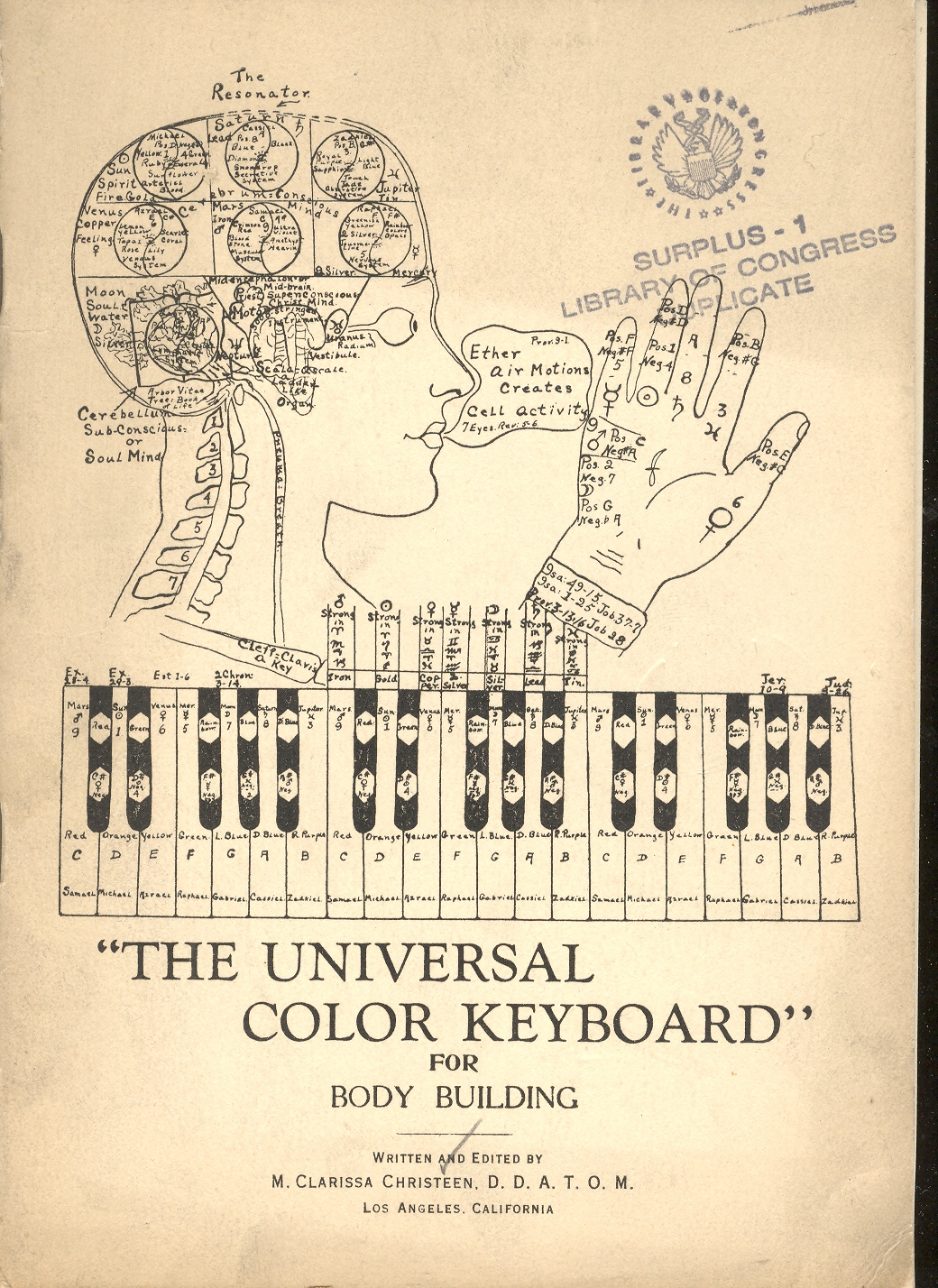
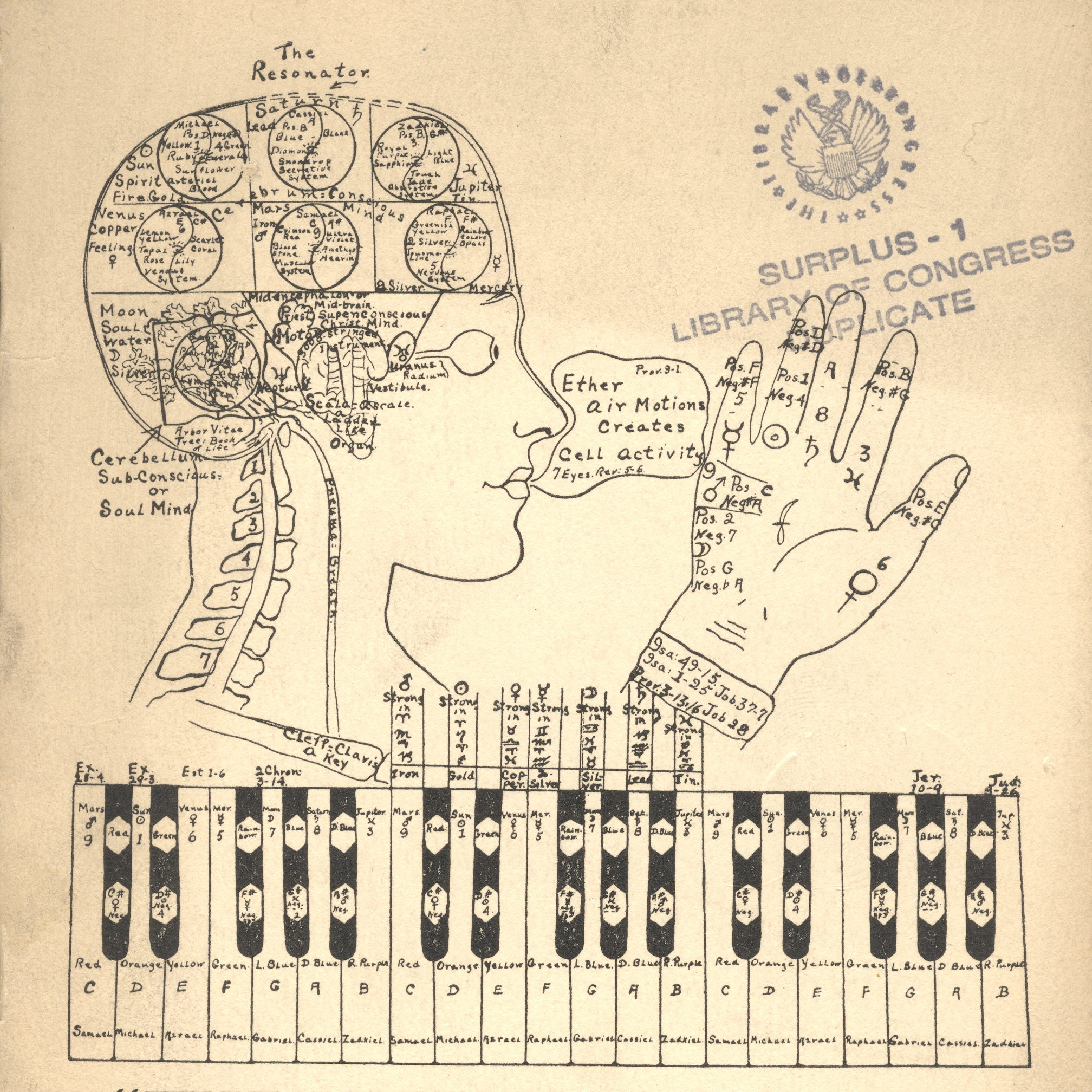
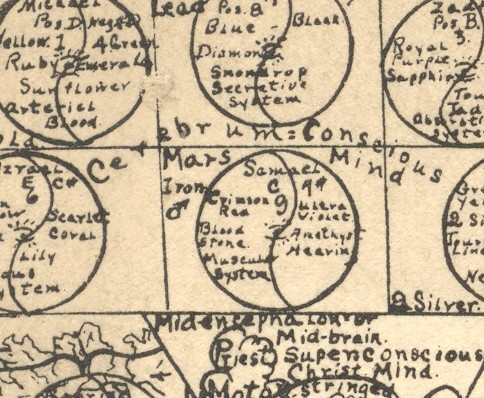
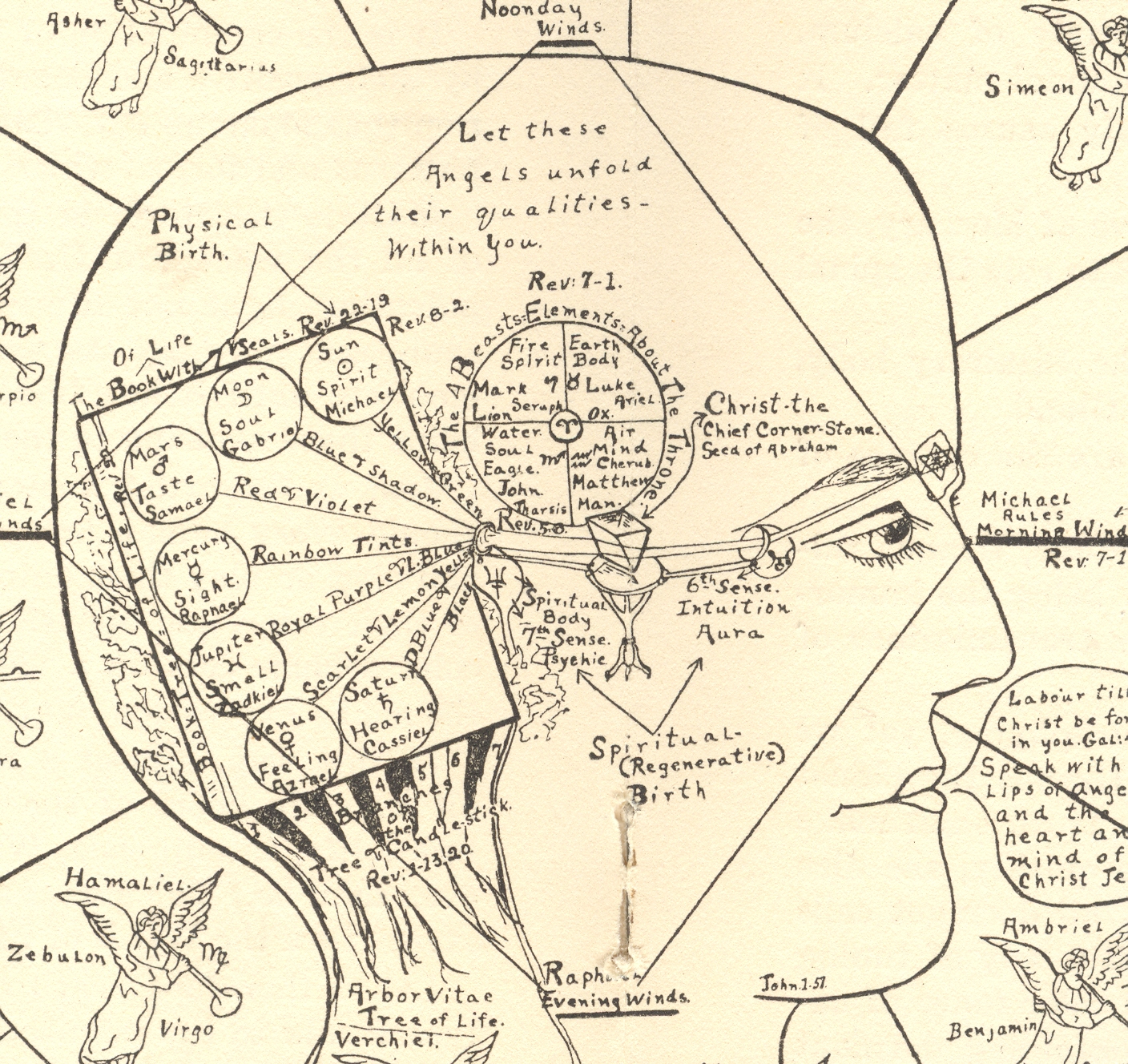
    This last bit is probably the case for W. Clarissa Christeen’s  (“D.D.A.T.O.M.”)The Universal Color Keyboard for Body Building, published in beautiful Los Angeles in 1925. In the many eyebrow-raising and vastly unexpected segments that she manages to share in her thin pamphlet she certainly strays into many unknown conclusion-processes and uniquely personal observations about the physical and spiritual world, testing the reader’s patience in many ways in 16 pages. But what Ms. Christeen absolutely does have going for her is her and which is easily appreciated is her artwork, which is, in its own special way, quite sensational—I’m really sorry that the pamphlet is limited to only two pieces of her work, as I’d really like to see more.  +()+outsider cover det

    Her philosophy is at the very least odd, though it may spring from a synesthesia.  Or not. 

    “Syn” (Greek, “together” and “Aisthesis” (“sensation”) combine to form this very interesting word and ability, being an automatic response to a stimulus by one sense when that stimulus is usually associated with another sense.  For example, there are “synesthetes” who perceive color as an auditory input, basically hearing yellow and so on; more famously are the musicians composing tone poems associating sound with color.  There are letter-color and number-color associatons, as well as taste-senses from colors and sounds and so and on.  For example in Kandinsky’s On the Spiritual in Art there is an attempt to relate color theory to touch and smell; Franz Liszt wrote color music; Isaac Newton attempted to establish the common distribution and association between color and tone frequencies; Rameau constructed a clavencin oculaire while Rimington made a color organ; Richard Feynman spoke of colored equations, and Nabokov recorded  (Speak, Memory) letter/color visions.  These are just a few examples of some of the more well-known practicing synesthetes. 

    In any event Ms. Christeen may be of that mold, and is attempting the universal perfection of mind and body through the combination of color and music (and scent), which “is valuable in building body-tissues of a harmonized order…the music chosen for social functions, the key notes being for the planet ruling or governing the day or the hours etc..  This brings celestial and terrestrial vibrations in direct contact, without interrupted angles which produce in harmony; in other words the creative powers which produce these various waves f light and sound or color or tone, acts upon the lower octave, matter or material manifestations recreating it, transforming it, and raising the vibrations of the said matter or material manifestations, thus, refining the temperature and quality of germ or tissue, etc.”

    This is a long passage, but I include it because, well, I just had no idea when an abrupt turn was going to be made in the discourse; nor did I have any idea of what the principles were of what was being discussed.  And this is still all on page one.  Sometimes passages like these are breathtaking, as in leaving you without breath, because their foundation for understanding is so elusive.  All you’re left with, sometimes, is a “wow!” reaction, like appreciating a pitcher who has just struck you out on three roughed-up-greasy-spit-laden nastiness pitches that were invisible and illegal, and didn’t matter at all.(What the figure in the cover illustration is saying. by the way, is “Ether air motions creates cell activity”, with a couple of Biblical references, somehow.)

    +()+outsider cover ultra det


    +()+outsider insideI do know that the major divulged secret is the Universal keynote (and “keyboard”) and its control through music and fragrance of all that is, “each individual is to harmonize his or her astral colors to the universal keynote that he or she may be surrounded by a correcting aura, which sends out its streamers of light rays into the cosmos”.  Things get more deeply possessed after this, stretching into the Old Testament and astrology, which we don’t need to get into here.  

    +()+outsider insidedetAs I said, perhaps Ms. Christeen was a synesthete, and perhaps multiply so.  In 1925, when this book was written, there mayn’t’ve been a place for people to go who had advanced sensibility of seeing colors in music, and perhaps colors in fragrance. Perhaps Ms. Christeen was working out there in Los Angeles completely alone, trying to figure out just what her special and very different gift actually was.  Perhaps her life was greatly enlivened by her synesthesia, and sent herself out on a mission to the world to have other people experience it, too,, with the help of her color-relational charts.  I do feel for her, though I have absolutely no connection to what she was trying to explain.  I do find the artwork fascinating—a true “outsider” contribution. 

    (By the way, I don’t think that we ever got to the “body building” part in this work.  Also, I think the “DDATOM” after Ms. Christeen’s name meant something like “Doctor of Divinity of the Atom” or something like that–it wasn’t mentioned in the text.)

     And so there you have it.  I think that I’m just making the point that the outcome of some of this very provocative work doesn’t necessarily come into play in its ultimate evaluation, and that it should all be judged by what short of thinking that it excites in its reader. 


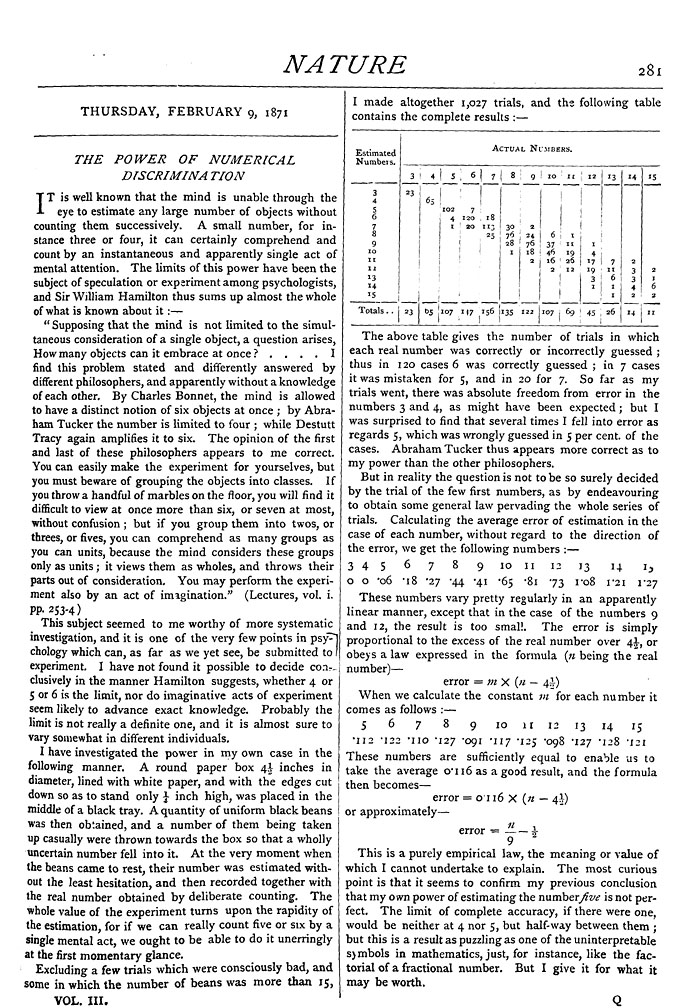
  • On the Power of Numerical Discrimination, 1871

    JF Ptak Science Books   Quick Post

    I’ve written a number of posts on this site about W. Stanley Jevons, a very talent all-around smart-guy who worked in many different fields and at very high levels.  Today’s installment on the Jevons’ from is his paper “The Power of Numerical Discrimination”, published in the third year of Nature, and published in London in 1871. Jevons contributes a rather odd bit here on the success of the brain to correctly formulate an accurate memory when shown a number of items. That is to say, when shown a certain group of X-number of items instantaneously and then removed, how often will the mind be able to remember the correct number upon recall (and without committing them to memory per se or counting them?) In this odd and fascinating study Jevons records not only right/wrong answers but how ‘close” the remembered fit is to the original number. Pretty cool, and an early effort towards understanding our abilities and limits in information processing.  

    Jevons Numerical discriminationSee the rest of the article here.  


  • Unusual Elevations

    JF Ptak Science Books  Quick Post

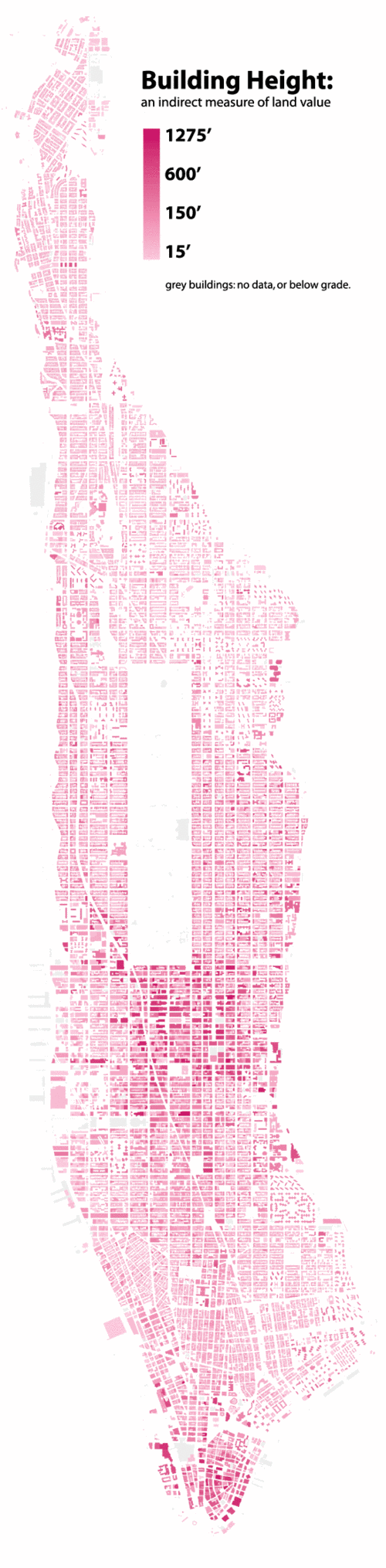
    It has seemed to me that an elevation map of the United States may be an interesting way of collecting and categorizing regional similarities and differences. For example, high desert folks probably have more affinity to one another than suggested by state maps–so to for Eastern states high elevation people in the Appalachian chain, similarities indicated more so by the number of feet above sea level than a state lines between North Carolina and Virginia (and so on). So far as I can tell no such map exists–but it came back to mind seeing this wonderful and innovative map of Manhattan building heights, brought to us by Bill Rankin of Radical Cartography.  


    Map manhattan-heights


  • How and Where Unwanted Fires Started in London,1836

    JF Ptak Science Books  Post 2334

     I’m pretty sure that I’ve not seen statistics on the origins and causes of fires in William IV’s London of 1836…probably the need for the numbers has never come up, nor has their serendipitous discovery.  I have been interested distantly in firefighting techniques in earlier times, especially in places like London and Amsterdam, (and especially in reaching upper floors of narrow tall buildings), but the occurrence and frequency part never came up out of the technical interest in the firefighting tools.  

    But in this article on firefighting gear (depicted in the previous post, referencing The Mechanics’ Magazine, Museum, Register, Journal, and Gazette, Volume 26, 1837) several pages in were these captivating numbers–they all seem to make sense, though overall seeing them together led to an overall feeling of surprise.

    For example, of the 564 recorded and responded-to fires the two top causes were chimney fires (72 cases of the 564) and “bed-curtains set on fire” with 71.  It is not clear to me what this means, but I’m guessing it had to do with having a bed too close to a fire, or perhaps coals were dropped somehow from a bedwarmer.  A related cause was incautiopusly hung linens in front of fires (31), gas (38), candles (51), stoves (28), and so on. 


    The list of the places that caught fire is fascinating in itself.  Most of the businesses no longer exist as sole entities, or if they do (for a business like ‘coach making”) they exist in very small numbers for a very specific and tiny niche market.  That said most of the fires were in private houses (211 of the 564 reported incidents) followed by victuallers (36, and I suppose in this case the word relates to anyone selling food, as in a pub or inn), lodging houses (35), carpenter shops (26), “shops, office &c.” (23), bakeries (20), bookshops and stationers (12), and so on down the list. 

    Then there are the other low-occasion fires in fascinating-sounding places, like straw-bonnet shops, feather merchants, cheesemongers, silk-weavers, oil-and-colourmen”, and others, not the least of which were the Lucifer-match-makers.  

    All fascinating, really. 


     And somehow there was only one case of fire caused by tobacco smoking–I mean cigarettes basically didn’t exist yet and especially so ion mass-produced form so there were no rolls of tobacco product enclosed with paper impregnated with chemicals to ensure that the ciggie will burn whether someone puffs or not–which is odd because it was still a fairly wide-spread habit in pipe-smoked form…still with the caveats it is a funny statistic. And I guess there was one case because so many others couldn’t be confirmed to point of origin because everything got burned up.  Or something along those lines.  


  • Feeding the London Zoo in Terms of 1944 Telephone Operators

    JF Ptak Science Books    (3,000+ total posts, including Quick Posts)

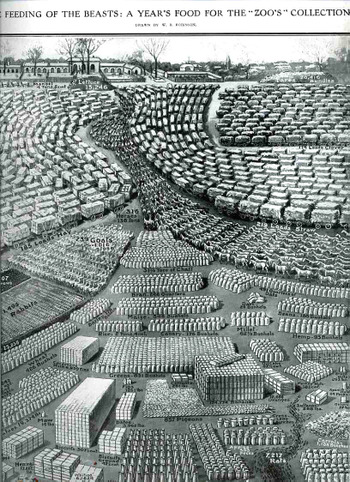
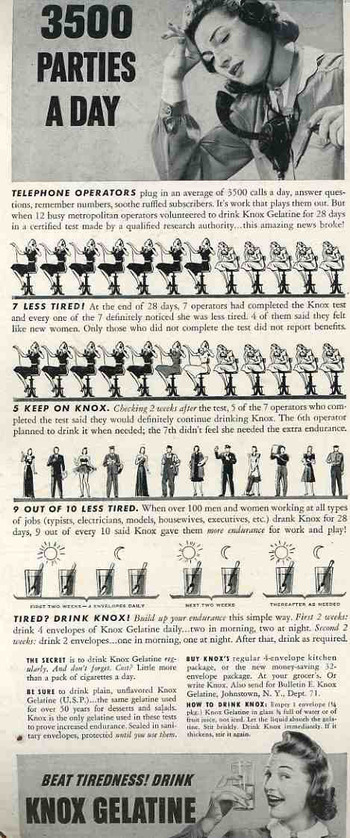
    I’ve put together a relatively large collection of images from 1850-1940 which are graphic comparisons of data and graphical displays of quantitative information..  In general they display the basic concepts of one idea in terms of something else, or they simply exhibit the idea or concept in cold hard one-to-one images.  The two images below are good interesting, standard representations of these categories.

    Zoo_story149_2

    The first is a very neat and complex display of the food eaten by animals in the London Zoo and was published in the Illustrated London News on May 17, 1913.   The data, found in the report of the Zoological Society of London (for the year 1912) is entitled “The Feeding of the Beasts:  a Year’s Food fore the “Zoo’s” Collection.  The real story though is in the subtitle:  “from shrimps to rats; from onions to oil cakes and mice, the food consumed by the animals at the “zoo” during 1912.    (I’m assuming that the word “zoo” is in quotations as it is a diminutive of “Zoological”, ad was seen as slangish.)  As you can see the language of the undoubtedly stiff report is beautifully brought to life (but not for long) in this work by W.B. Robinson.
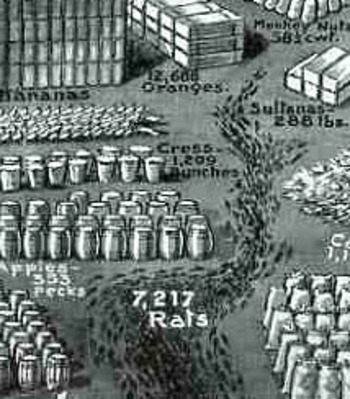
    Zoo_story_rats_2
       
    We see 15,000 pounds of lettuce in a lump and a pile of 4,220 bunches of carrots, along with a serpentine 185 wagons of hay and a snaking 219 wagons of straw; there are giant cubes of biscuits and milk tins, and an even larger cube of 183,000 bananas in boxes; there are orderly armies of goats and rabbits, and a very neat ordering of 19,000 pounds of potatoes in stiff white sacks.  At bottom we see comparatively lonely contingent of 28 ducks (undoubtedly hoping that something else besides what was happening was happening); and of course an ant-like column of 7,217 rats. There were also masses of clover, boxes of sparrows, 857 pigeons, 123 pounds of figs, 2 tons of dates, 93 bushels of hemp, 4500 pounds of grapes, 500 pounds of sugar (?), 34,000 eggs, and a slithering line of 25,000 mice.  Most disturbing though is the central figure of a long, quiet column of 318 horses.  I can’t help but feel sorry for them.  It is a remarkable and successful effort to put the data into a form that was somewhat more understandable, if less digestible, and a little more heinous.
    Telephone_ops150

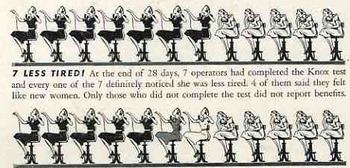
    The second image is a simple but somewhat bizarre rendering, changing counting units of numerals and replacing them with telephone operators—I can honestly say that I haven’t seen this before.  It is quietly bizarre, but still quite effective in making the sales pitch for the noxious element.
    Telephone_ops150_detail


  • The Computational Future-World of 1902, a Dozen Years Old

    JF Ptak Science Books

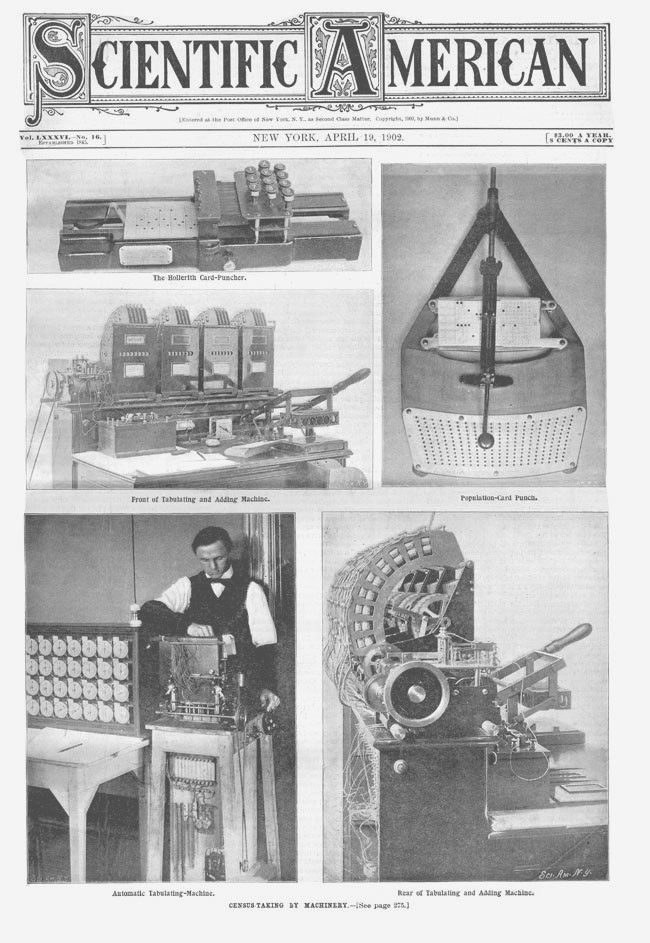
    This is sort of what the future of tabulation looked like in 1902–except that the people in this year were already living in this tabulating future, surprisingly already a dozen years old at this point. The cover illustrates an article on the machinery used in the production of statistics and tables and general data organization by the great work by Herman Hollerith, who had already performed this function for the U.S. Census of 1890.  (Hollerith had offices at Wisconsin Avenue and the C & O Canal, in Georgetown, D.C., about ten blocks from where my old store used to be at Volta & 33rd.)

    Hollerith 1902

    The 1880 census had cost about $6 million and took 9 years to tabulate; the 1890 census using the Hollerith machines cost $10 million and took seven years.  The main focus of many in government was the cost differential—not the incredible amounts of new controllable information.  The rent of the Hollerith machines was only $750,000 for the conduct of the entire census, so the differential must’ve been in the extra utility costs (for electricity, for example, which was used for the first time to run the tabulators) and for the small army of statisticians and data entry people.  Be that as it may, the government was not amused, particularly when Hollerith figured that he had actually saved the government $5 million.    The two parties left each other grumbling, though the roar of the trickle down from the Hollerith success drowned it out.  The tabulating system was quickly exported, and large private concerns in the U.S. saw a savior in the system that would soon rescue them from the sea of paper in which they were beginning to drown.   The Hollerith company did very, very well for itself, and soon merged with three other companies (in 1911) to ease the burden of success.  The resulting company was called the Computing-Tabulating-Research Company (CTR), which after a short while became the International Business Machine Corporation (IBM).   

    [Source of abstract: Publications Indexed for Engineering, PIE, volume 4.]

    And the article from the Scientific American, as follows. (It is worth pointing out that a few hundred pages following is an article about William Terrel’s fantastic tide-predicting machine, a beast of a sicentific instrument that weighed in at 2,500 pounds and functioned slendidly for 30+ years…)