A Daily History of Holes, Dots, Lines, Science, History, Math, Physics, Art, the Unintentional Absurd, Architecture, Maps, Data Visualization, Blank and Missing Things, and so on. |1.6 million words, 7500 images, 4.9 million hits| Press & appearances in The Times, Le Figaro, Mensa, The Economist, The Guardian, Discovery News, Slate, Le Monde, Sci American Blogs, Le Pont, and many other places… 5000+ total posts since 2008.
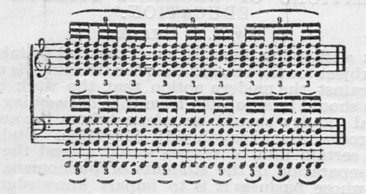
I went searching in the 1896 issue of the Scientific American Supplement for early articles on Roentgen’s x-rays (discovered just months earlier) when–flipping through the pages–I came upon this very impressive part of a score. But what is more impressive is that it sets to music the sound of Niagara Falls–the music of the falls.
At least music is what Mr. Eugene Thayer heard when he listened to the falls, and apparently he heard what few others did.
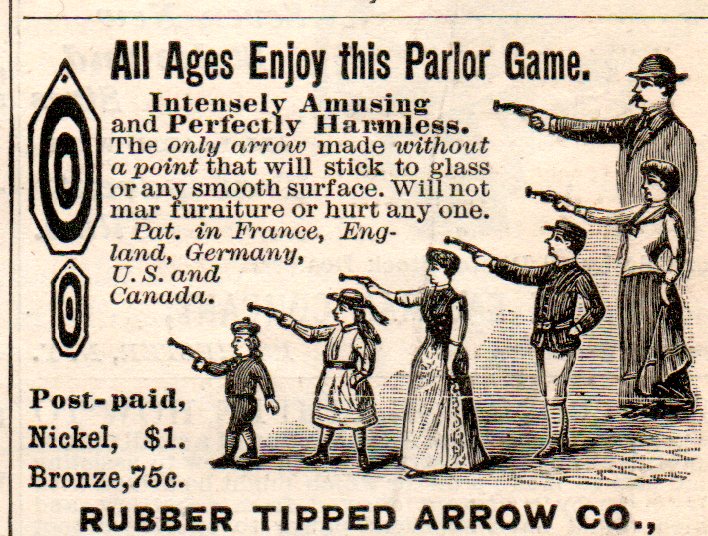
The beautifully and accurately named Rubber Tipped Arrow Company supplied an assortment of parlor games for children (and adults) for “perfectly harmless” shooting. The truth is that I really liked the image of progression of shooters, reminding me a little of the “Ages of Man” prints. This appears in the advertising section of the Scientific American for 3 August 1890–two issue before their famous cover showing Herman Hollerith’s critical calculating machines at use in the American census.
And this ad, from one of their competitors, found in The American Stationer, 1889, page 957:
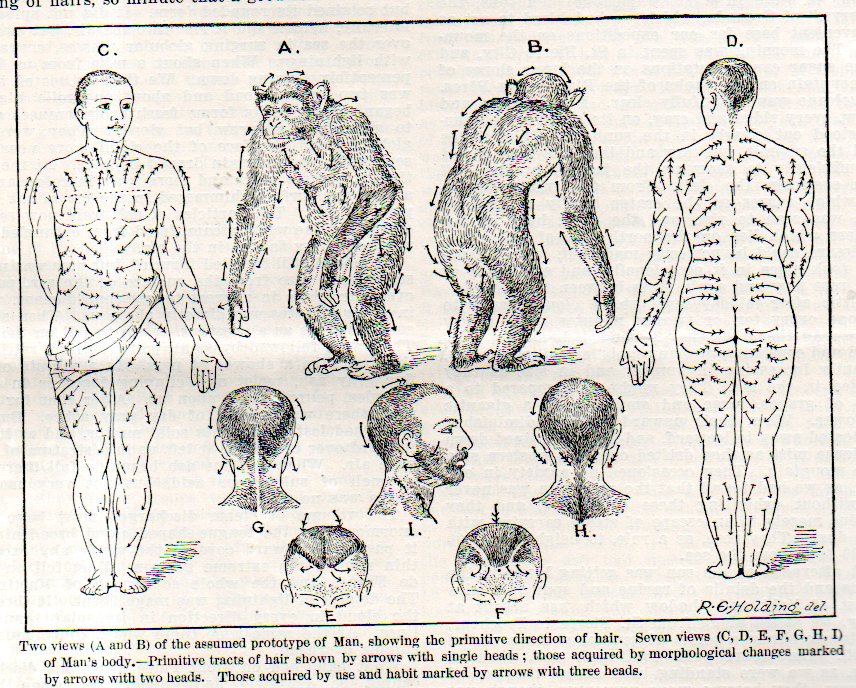
There is something exceptional about the exceptional. In this case, the category is maps, and in this instance the map that takes us away, far away, from the expected or standard is one showing the flow of human hair streams. (It fits very nicely with other exceptional maps found on this site, like Maps of the Cosmos of Moles–just browse the “maps” section in the archives.)
This unlikely title is the creation of Dr. Walter Kidd (Fellow of the Zoological Society, London) and his attempt to reconcile the the influences of gravity, inheritance, genetics, Weismannianism, and other assorted biological bits via his study of hair growth patterns. The article appears in the (many) pages of the ScientificAmericanSupplement for 13 September 1902, on page 22, 328. (Yes, the Supplement was paginated consecutively over dozens of years of publications, a cumbersome manner of ordering an 8-foot stack of paper over dozens of volumes.) In any event, this was an article to simply explain some of Kidd’s ideas and the chart that would appear in a more lengthy treatise of 153pp published in the next year by Adam Black. Contemporary views of Kidd’s book were not very supportive of his work. I should add that I was attracted to this article solely for the possibility that this may well be the first map of directional hair growth. (I think the idea is pretty interesting, but I’m just not in the mood for it presently.)
Some of the other posts on this blog dealing with unusual hairiana include the following:
At some point I think I would like to post an exhibition of some of the collection of the vastly/quietly weird/surreal/Outsidery titles from my BizzaroLand Today! pamphlet collection. Sometimes the titles are just incredibly weird, or wrong, or they’re not titles at all but something else, or they’re unintentionally absurdist of dadaist or Surreal, or they are just Outside what we might come to expect in the world of logic and its extensions. Sometimes the titles are just odd and the work is real; sometimes not. Sometimes they’re just terrifically understated or heartbreakingly simple, and even useful, like this example (from Clymer, New York, 1945):
There was a Bible-studying group headquartered in Haverhill, Massachusetts whose inspiration/idea interpreting the true nature of what was “Israel” according to bits and pieces in the Old Testament, and which found something to be radically different from what was seen to be the case. The pamphlet documents that the place we think of as Israel is not really so, and that the country best fitted to these OT statements was actually Great Britain. There are many reasons for this and they get mistily presented in the pamphlet Restoration of Kingdom Administration the Anglo Saxon Responsibility (published by the Anglo-Saxon Federation of America in 1929), but it is rather too much and tedious and tiresome to get into the milky details, except to say that Israel as was currently recognized could not be so unless they adopt the Christian faith. And so on.
The address of the organization put it on Merrimack Street in Haverhill, a block away from the river–the four story building now has it middle floor obscured by some teal 1950’s architectralolypse facing, and the bottom floor is now a dollar store (with redundant signs) with a sandwich board out front (captured by the Google car) reading “Design Perfume on Sale Beauty Supply”. I’m sure the store is necessary and fills a need, but it is a long way and many years from redefining the concept of Israel.
In my heaping pamphlet collection there is a sub-collection of works
with impossible, outsider-y, and stubbornly semi-confused titles that
simply cannot be ignored–I mean the titles can’t be ignored, though most of the time their texts beg to be.
Some of the titles change from cover to title page; some titles are non-existent and replaced by simple exclamations.
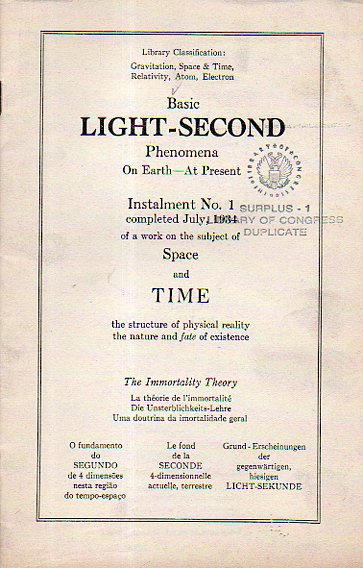
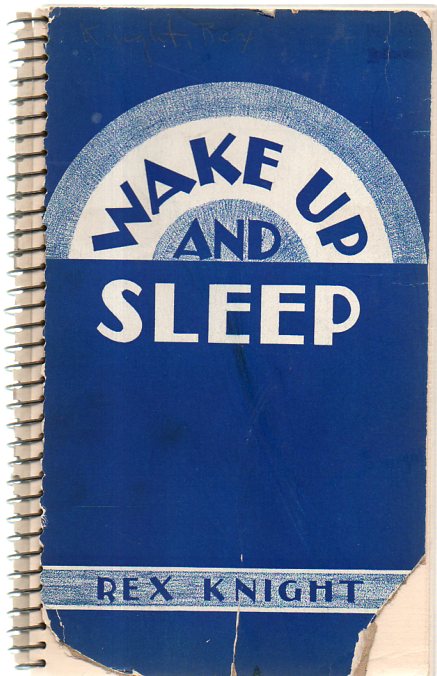
In this case, and the first instance that I can recall, there is a “Library Classification” at top-center of the cover, leading to other information about the book just before we get to the title, which seems nearly secondary, and which is followed by other non-title information right there on the cover. There is all manner of info there, a cover with a very busy pace–data galore for what should be a mostly blank space, except the author’s name.
Q: What is the one sure thing that is very impressive about this publication by Mr. Rex Knight?
A: The 35-ring wire binding on a six-inch tall publication. There’s not much to recommend itself to recommendation and memory.
[Perfection had better hurry up and get here given my own fast-short-sleep habits]
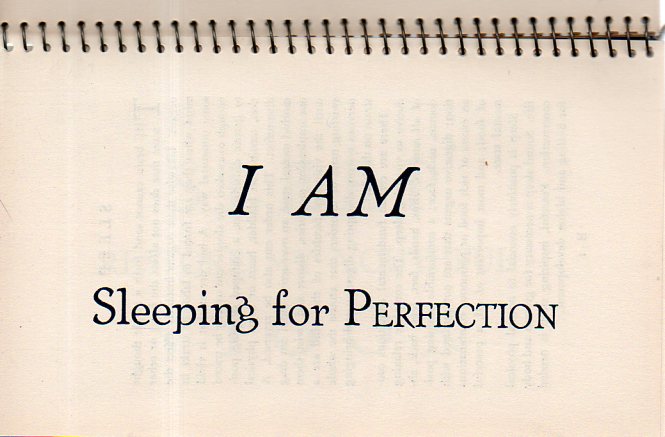
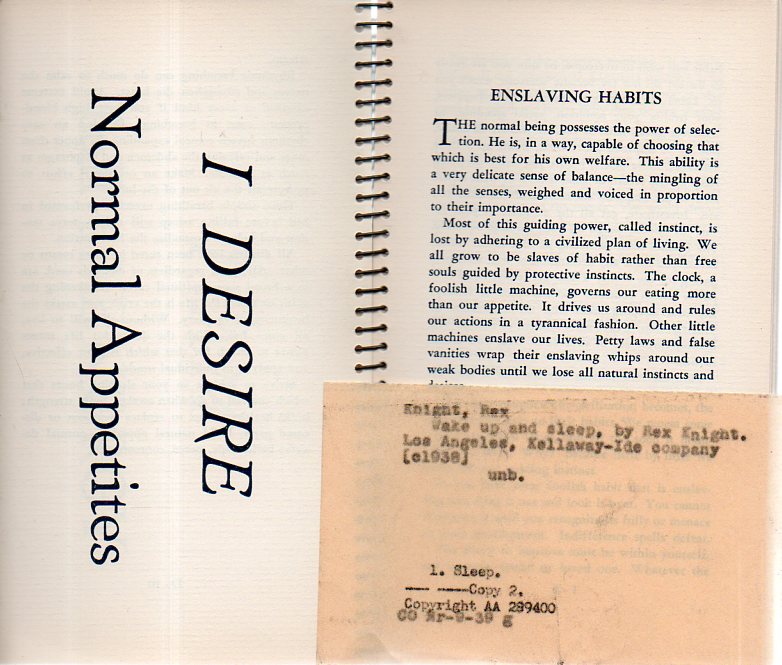
Mr. Knight had some ideas about sleep and well-being and achieving various states of normalcy and perfection, most of which had to do with waking up during hte night and staring at one of the many full-page neuro-demands which evidently were in direct confrontation with whatever it was in your head that was keeping you from success and strength and wealth and inspiration and self, combating “enslaving habits” and “lesser habits” by telling the brain what to do with the mind. Or something along those lines.
In any event, Mr. Knight tried something out and used a lot of wire to bind the really rather nice paper his effort was printed on, so Wake Up and Sleep had at least that going for it. Aside from that, his suggestions seem more disruptive and potentially rheumy-eyed more than anything else, waking you through the night to hand deliver messages to your sleeping and semi-enslaved brain to find its own appropriate “wave” to enrich your life. “The prize idea that you seek is in the air all around you”, he writes. “Ether waves, mental waves, cosmic or whatever you choose to call them, are everywhere. All you are trying to do is to get tuned in on the right wave”.
“Expect more and more of sleep” says Mr. Knight–at least that is one remedy that would sound good to almost everyone.
It is interesting to note that “Rex Knight” is very close to being “Rx Night”. And “King of the Night”.
Lastly, according to WorldCat, there is only one copy located in libraries worldwide–that at NYPL. My copy was from the copyright office/collection at the Library of Congress when it came to me in a Very Large Grouping (called with little imagination “The Pamphlet Collection”) many years ago. It never was a hit for the libraries.
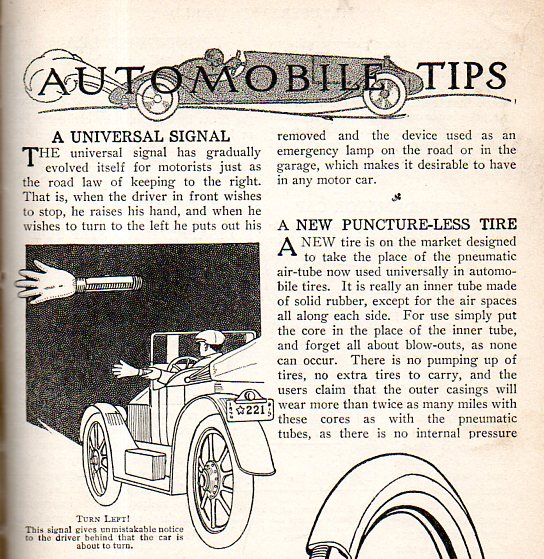
In general I’m not in favor of left turns for autos in cities of a size where traffic congestion is an issue. It seems that from a main thoroughfare that three rights should make a left, easy congestion in the center of a busy street, eliminating lines of cars waiting behind a left-turning car waiting for a break in oncoming traffic, and so on. This semi-crackpot notion was just sparked after seeing this As Seen on TV-style pre-televsion promotional for an artificial hand for a left-turning hand-directional 1916 automobile. The hand is actually illuminated, which would have made it more effective than a stark hand in the night. It seems that they were just about <this close> to figuring our a less mechanical-anthropomorphic and more elegant solution than the illuminated artificial hand-held hand.
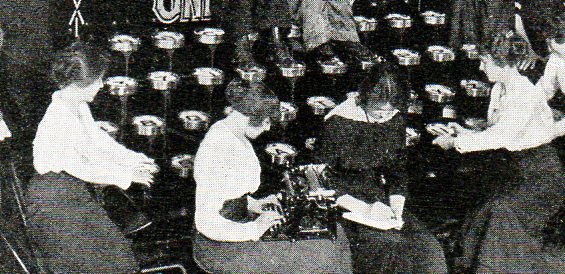
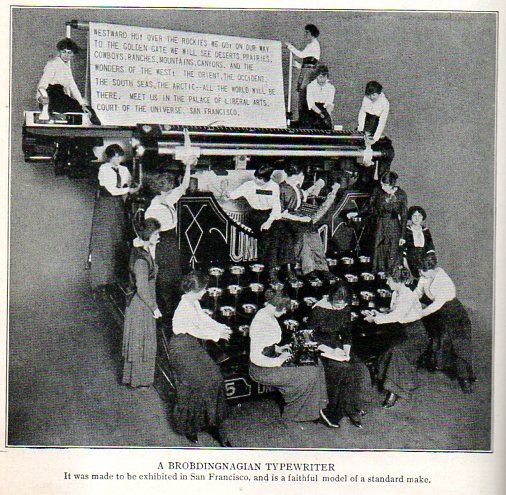
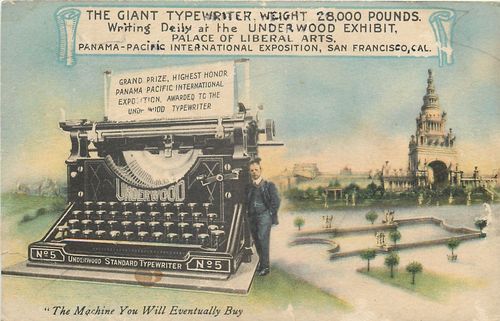
These would certainly make nice counter stools, if they were a little bigger–but they not, and they weren’t, though they were just what they looked like–typewriter keys–and were part of a working 28,000-pound machine built for the San Francisco Exposition in 1915.
Evidently the machine was operated by using a regular -sized typewriter, the keys working in unison to produce a gigantic text on a big piece of paper. It was an advertising vehicle built by the Underwood typewriter company, and seems to have been a star of the expo–it certainly got a lot of attention, and successfully delivered to itself plenty of hopeful buyers who would round-out the company motto about their product: “The machine you will eventually buy”.
[Source: Technical World Magazine, May 1915, page 346.]
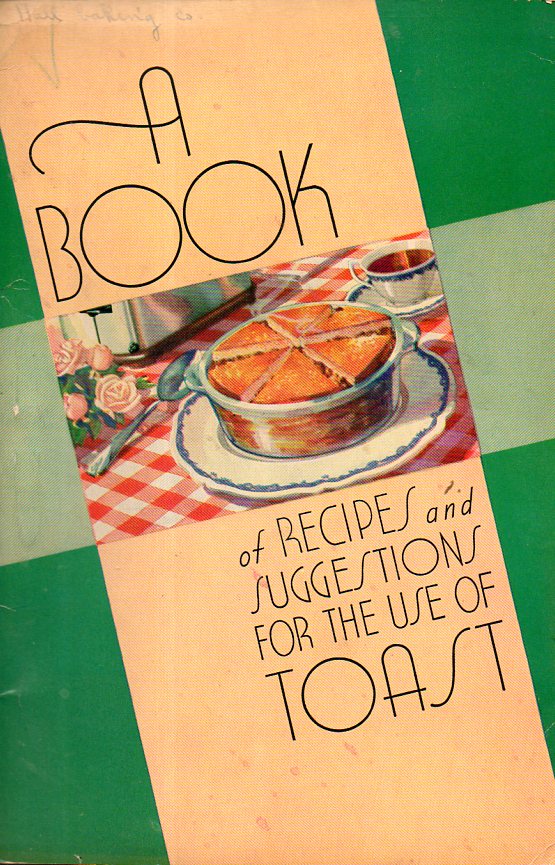
I’m not so sure that this is “odd”–it is certainly unusual, and unusual in an interesting, surprising, and constructive way. A Book of Recipes and Suggestions for the Use of Toast at first glance stretches the idea of necessity, and maybe it still does, but at the end of the day this is a very nicely designed, considered and encyclopedic end-all treatment of toast. It states on the title that it is “the first exclusive Toast Recipe Book ever published”, and I’ll take it at its word. Happily.
So, we have recipes for the Cinnamon: cinnamon toast, honey, marmalade, jam (!), maple, pineapple, marshmallow orange, super-toast griddle cakes, super toast waffles. the French Toasts: raisin, milk, prune, orange, banana, eggs royal, and French toasted bacon. Then there’s eggs in bread cakes, meat pies, deviled rarebit a la toast, tuna a la super-toast, shrimp Louisiana toast, sausage toast rolls, super-toast meat pies, toasted super cheese rings, super toast hash, crown frankfurter roasted toast, eggs benedict on super-toast, cannibal toast rarebit waffles, and so on. That’s about a quarter of the recipes, and it seems about 300% more toast recipes than I’ve ever heard of before. Probably more.