A Daily History of Holes, Dots, Lines, Science, History, Math, Physics, Art, the Unintentional Absurd, Architecture, Maps, Data Visualization, Blank and Missing Things, and so on. |1.6 million words, 7500 images, 4.9 million hits| Press & appearances in The Times, Le Figaro, Mensa, The Economist, The Guardian, Discovery News, Slate, Le Monde, Sci American Blogs, Le Pont, and many other places… 5000+ total posts since 2008.

Category: Daily Dose from Dr. Odd

  • When the Catcher’s Mitt Was a Cage (1904)

    JF Ptak Science Books  Quick Post
    PAtent catcher cage detail


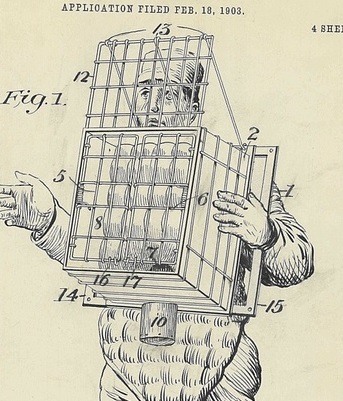
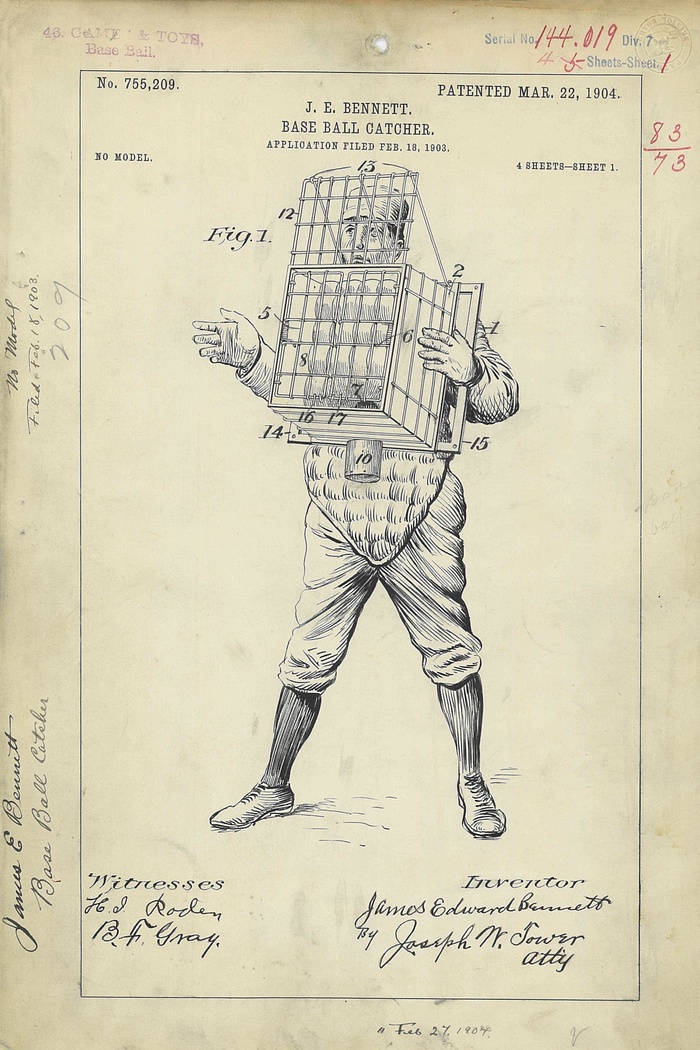
    In the history of baseball gloves–better still, in the history of the catcher’s mitt–there are few ideas that are as singular as the glove/mitt that isn’t a glove, or a mitt.  This was the patent report of the invention of J.E. Bennett in 1904, which proposed to replace the mitt with a cage.  The cage offered a receiving area easily double the size of a catcher’s mitt, with padding at the back of the cage to cushion the capture of the pitched ball, after which the ball would somehow be collected and deposited via that pipe.  I’m not sure what the catcher would do with pitched balls that were low, or high, but the cage certainly did not have any real versatility, particularly when comparing it to a real glove. It seems as though this idea didn’t go far, and that was a good thing. 

    http://www.theguardian.com/technology/gallery/2015/may/14/imagining-the-future-turn-of-the-century-us-patents-in-pictures
    Patent catcher cage


    ·Posted by :

    ·in:

    — —

  • The .50-Caliber Better Mousetrap

    JF Ptak Science Books   Quick Post    Daily Dose from Dr. Odd

    Patent better mouse trap

      [Source:  Google Patents, https://www.google.com/patents/US269766?dq=patent:269766&hl=en&sa=X&ved=0ahUKEwiyw_r6277JAhUGSiYKHV_eCdkQ6wEILDAC]

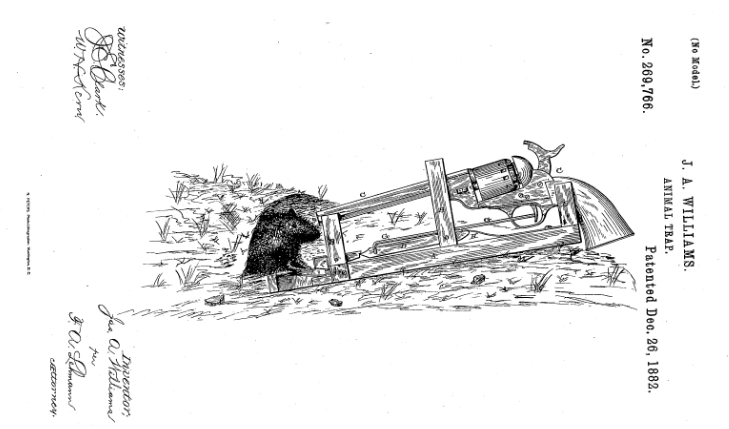
    Well, there’s not much that one can say about this that the reader is not already thinking.  

    The idea was that of J.E. Bennett of Fredonia, Texas, who patented the “trap” in 1882.  He reports that this apparatus has been used before, as a house “alarm”. He states in the patent that  “I am aware that burglar-alarms of various kinds have been used, and which have been connected to windows and doors in such a manner that the opening of the window or door causes a pressure upon a lever which discharges a tire-arm; but in no case have the parts been arranged and combined as here shown and described.”  Indeed.  I think that this sort of “alarm” was declared illegal decades ago because its use employed depraved indifference.  Poor little critter.  

    ·Posted by :

    ·in:

    — —

  • Book Fists

    JF Ptak Science Books  Quick Post      Daily Dose from Dr. Odd

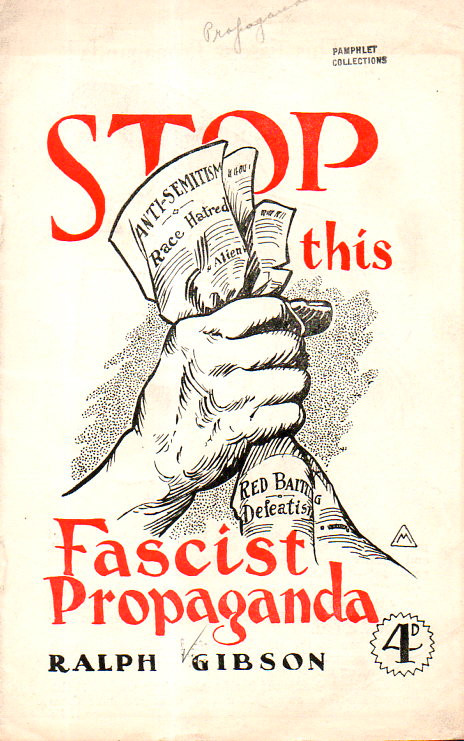
    Just a collection of hands on the covers of books and pamphlets. I guess it is sort of interesting that the hands that started this small collection in the first three examples are two fists and a gloved half-fist snuffing out a lamp; the fourth example is a power thumb, and the the rest of the examples I came up with were almost entirely open-handed. I’m sure that there must be plenty of fist images on book covers out there, but in my brief soiree I only found a few.  

    Books hands montage


    Books hands fascist prop293


  • History of Lines: Circles, Cartesian Vortices, Tree Rings, or ?

    JF Ptak Science Books  Quick Post

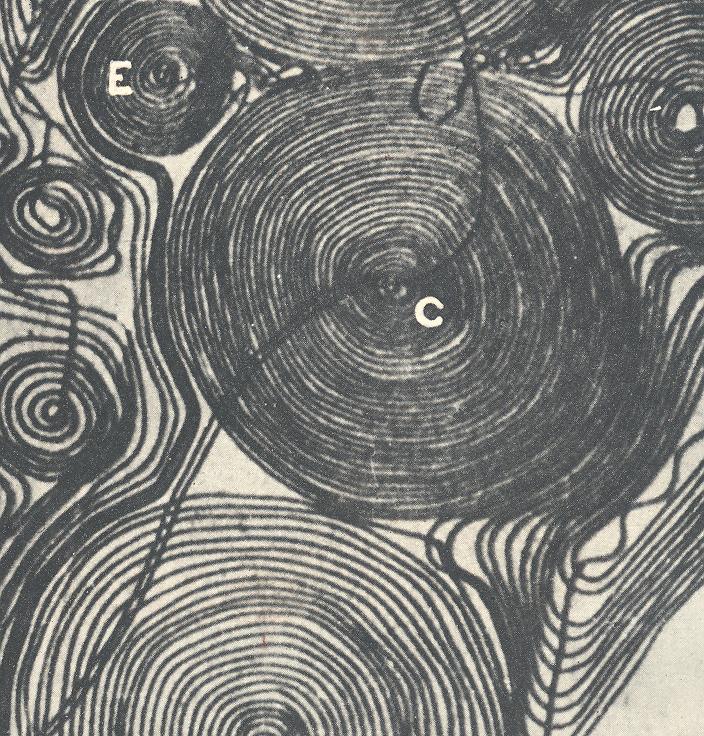
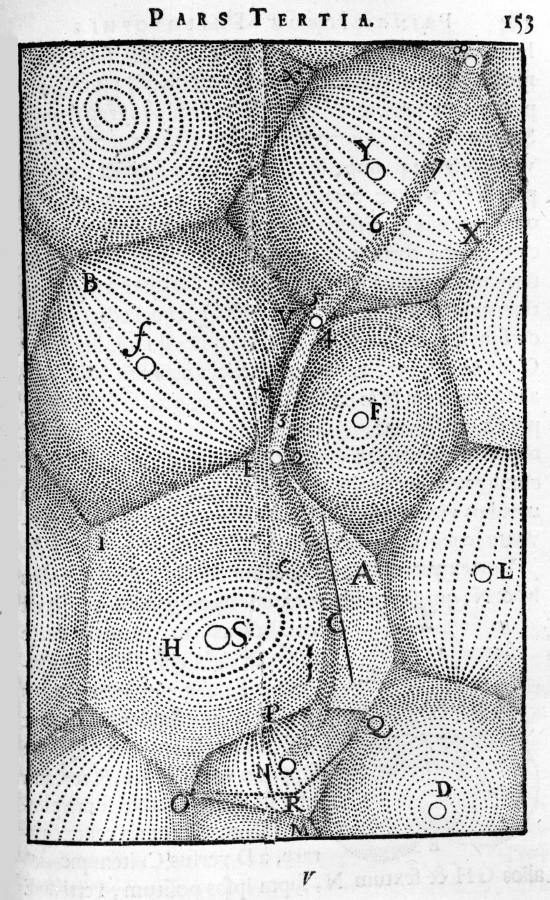
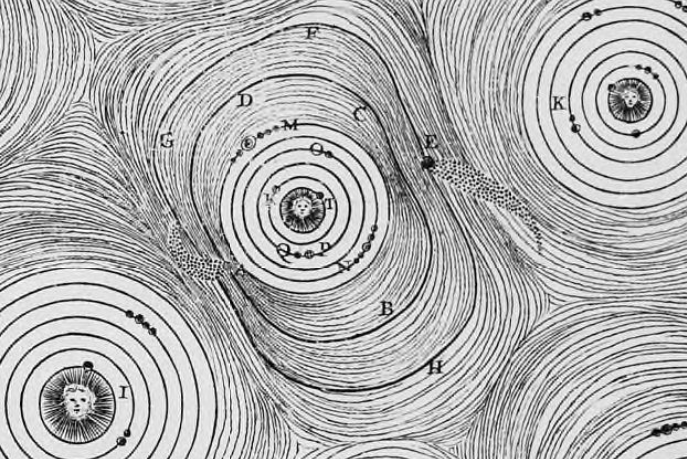
    At first (and second) glance this image comes very close to looking like a display of Rene Descartes’ illustrated cosmology (featuring his vortices (“tourbillons”)).  The images are indeed similar–first, the mystery image, followed by one of the Cartesian tourbillons (from Principes de la Philosophie from 1644):

    1--may 14 circles det

    [Primary image, detail.]

    And the image from Descartes:

    DEscartes tourbillons

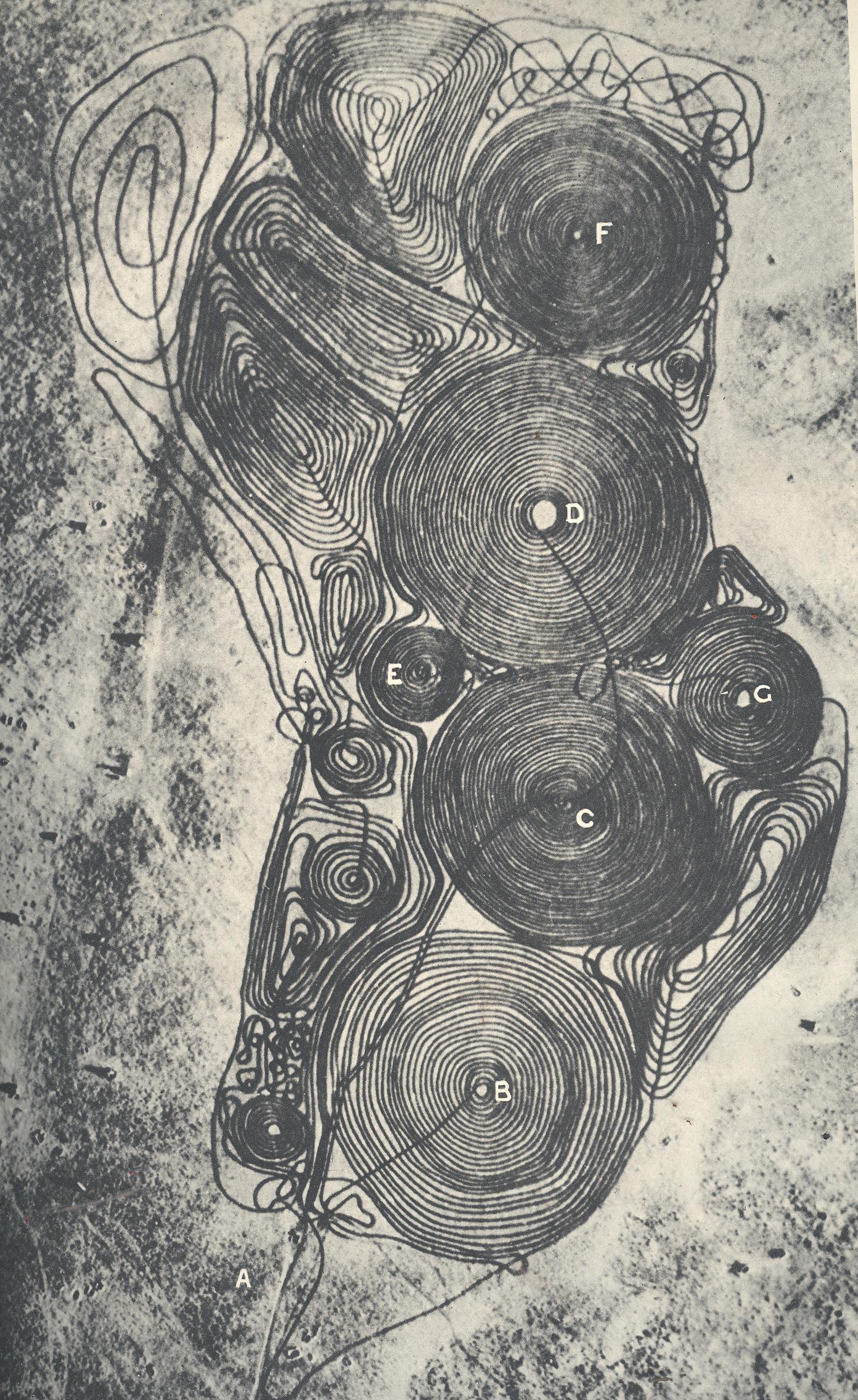
    1--may 14 circles

     [Primary image, receding.]

    Is the primary image another incidence of the Cartesian cosmology as we see in the original and in other places, like in Nicholas Bion (in 1710)?

    Bion tourbillons detail

    Surprise!

    The primary image in question is actually a plowed-over landing strip, the place done in by German sappers sometime in 1944, to render the airfield useless once the Germans pulled back.  In any event the image struck me as being similar in design to Descartes, though for the Germans it represented more a catastrophic collapse more than anything else.  


  • Judging Two Books by their Ten-Cent Covers

    JF Ptak Science Books   Quick Post

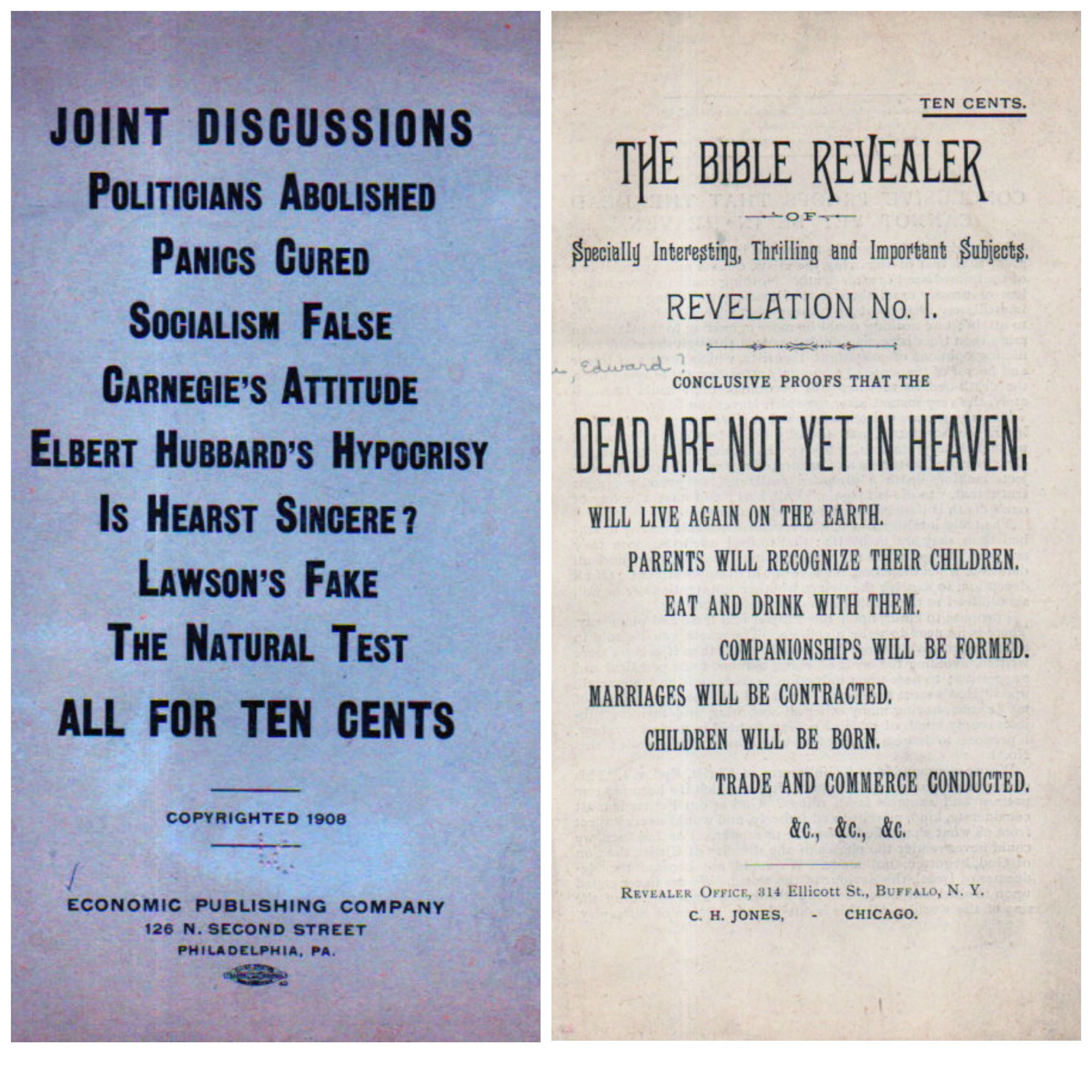
    These are two full-cover pamphlets that promise a compelling amount for the ten-cent admission fee.  The first is newer, published for ten cents in 1932; the second was printed in 1908, and for the same amount (and worth about 14 cents in 1908 monies, according to the Bureau of Labor Statistics inflation calculator).  They are each Outsidery-flavored efforts in their fields, so far as I can tell–they are also not quite interesting enough to spend any time with outside of remarking on their remark-able covers, which is sometimes that is all you need.  (The second pamphlet is actually by a very well known and influential theological person, Edward Hine, who may have achieved his greatest fame I try to establish that England is Israel, among other things, and developed a considerable following.)

    Ten Cent CollageI have other remarkable books with title similar to these in length, and composition–I’ll need to pull them all together, someday. I think that the most glorious days of enormous titles are hundreds of years in the past, and mostly 17th century from my perspective; these more-modern examples are not only long, but they are challenging and promising, all at the same time. 


  • What Did Sailors in the U.S. Navy Make in 1820?

    JF Ptak Science Books  Quick Post

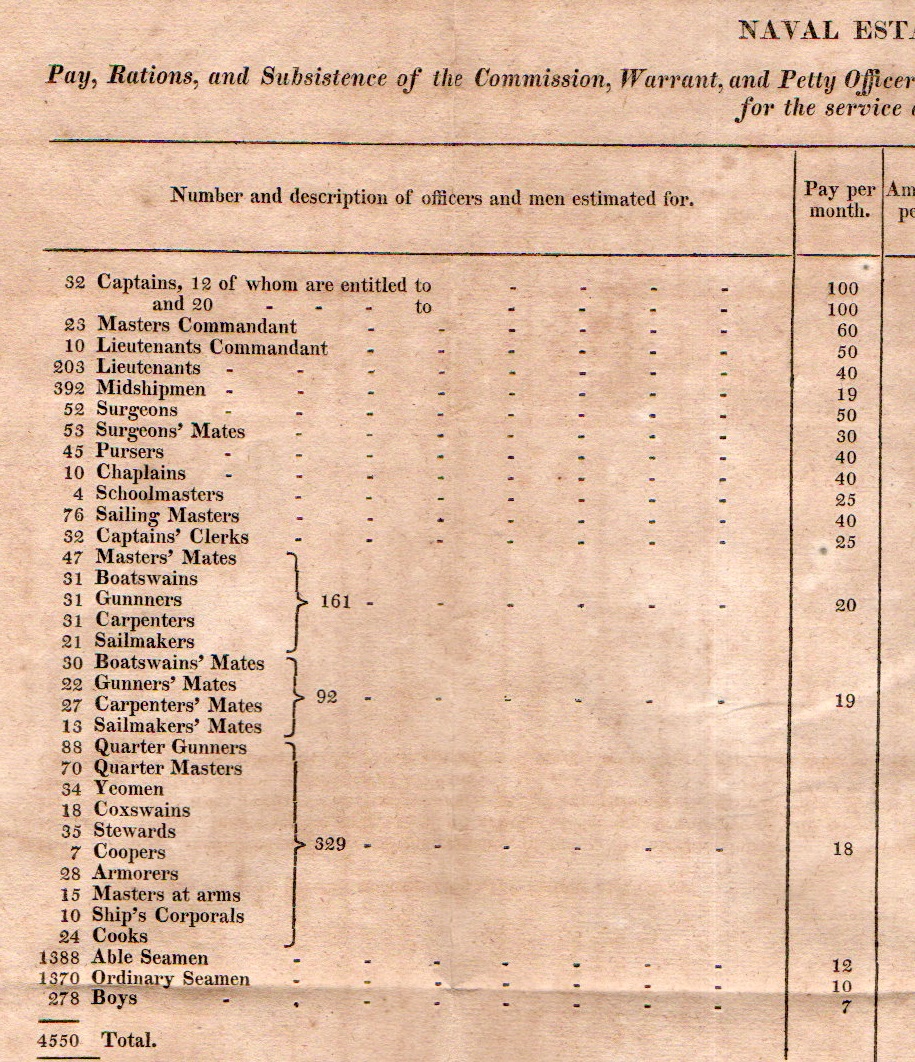
    This is one of those fascinating bits that you come across that in the moment are just thrilling, but overall really doesn’t have anywhere particular to live in your memory.  Still, it was curious to find this data on the positions and pay to the members of the U.S. Navy in 1820 and to see the amount and distribution of pay, and to see the aggregates.

    The pay ranges (for example) from $100/month for (52) Captains, $50/month for ( 52) surgeons, $40/month for (10) chaplains, $20/month for (21) sailmakers, $18/month for (24) cooks, $12/month for (1388) able seamen, $10/month for 1370 ordinary seamen, and $7/month for (278) boys.  

    Naval pay177

    [Source: can’t remember. This is a detail from a  loose, folding sheet from a U.S. government document from 1820, probably looking at the finances of armed forces, or some such.]

    So it looks as though the total pay for U.S. naval personnel in 1820 (excluding “rations”, which I believe included food and housing allotments) was $867, 578.00 (or pretty close to that) for 4,550  sailors/etc., which is about $200 per year per person, on average.  41% of that total outlay went to the 3,158 able and ordinary seamen, who composed 71% of the total naval force.  So it looks like if your removed the pay for “boys” then the highest paid officer made about ten times what the lowest paid seaman made, which by today’s standards is pretty corporate-responsible (a la Ben & Jerry’s).

    I’m not yet finding what a carpenter/laborer would make in salary for that year for comparison, but I will add that here later.  


  • The Dept. of Great Titles: “The Scientific Use of Common Things”

    JF Ptak Science Books    Quick Post

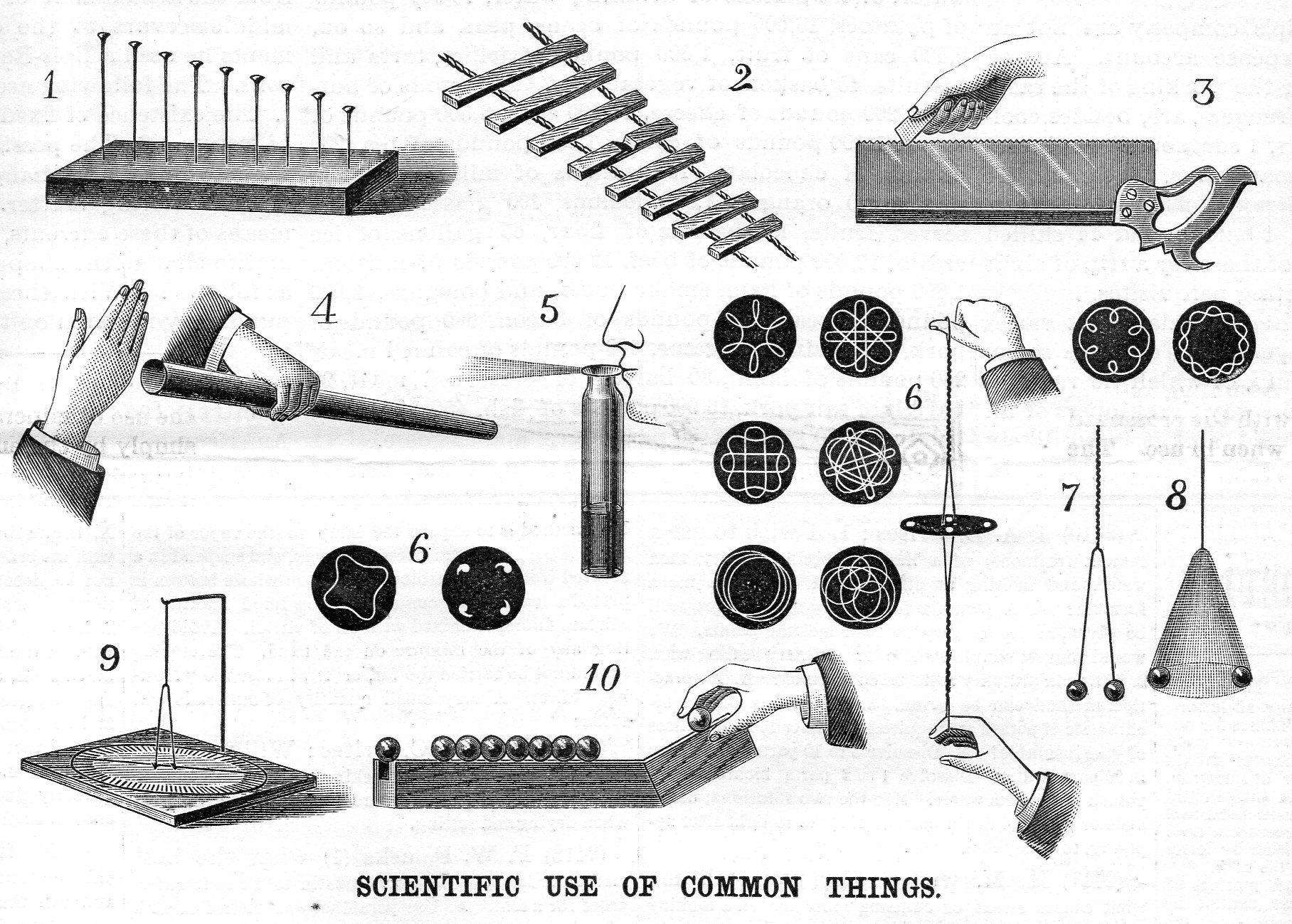
    This title, drawn from the identifier of an illustration from Scientific American (for September 13, 1890), I think would be a great way of teaching sci/tech principles, using stuff from your desk or hallway etc to illustrate the scientific method and to see how “science” can be found in  Real Life.   Of course this was from an era in which books like Ganot’s Physics would instruct not only on the principles of a pump but how to fix it as well–and also how to make the hardware like the nuts and bolts that you needed for the fix-up, and so on.  In general Scientific American was great for this sort of thing–these were the additional bits to the scientific news and drama of the week, the recipes on how to make the blackest ink and other such potentially useful recipes.  

    I’ve included this illustration because of the <sigh> requirements necessary to see what has been lost in scientific education at the elementary levels, and also due to its high/found artistic qualities.  It also looks like a puzzle, but isn’t. 

    Sci american use of common things086

    ·Posted by :

    ·in:


  • Daily Dose from Dr. Odd: Japanese Skeleton Cruiser in Californa Desert 1945

    JF Ptak Science Books  Quick Post  Daily Dose from Dr. Odd series

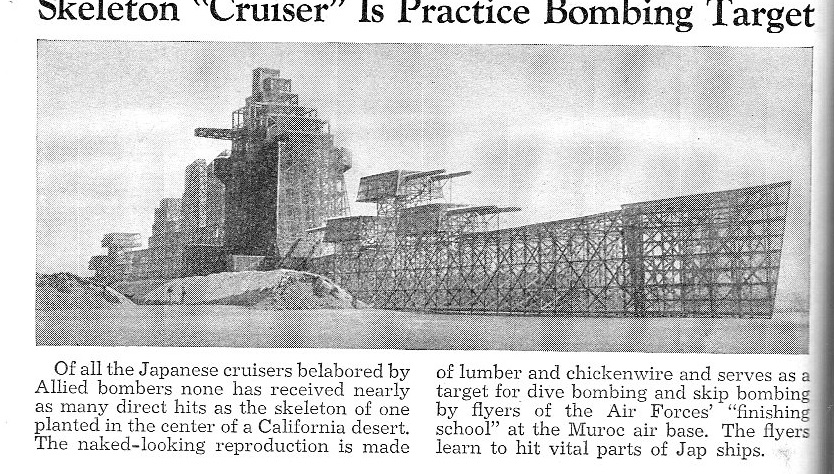
    It seems to me a lot of effort and material went into constructing this mock-up of a Japanese cruiser, but maybe not.  Perhaps that is just what was required.  In any event it is an odd image.   

    Japanese cruiser105Source:  Popular Mechanics, January, 1945.

    ·Posted by :

    ·in:


  • “Fluid Influence”, Magnetism, Clairvoyance, and Chewing Gum (1910)

    JF Ptak Science Books   Quick Post     Daily Dose from Dr. Odd

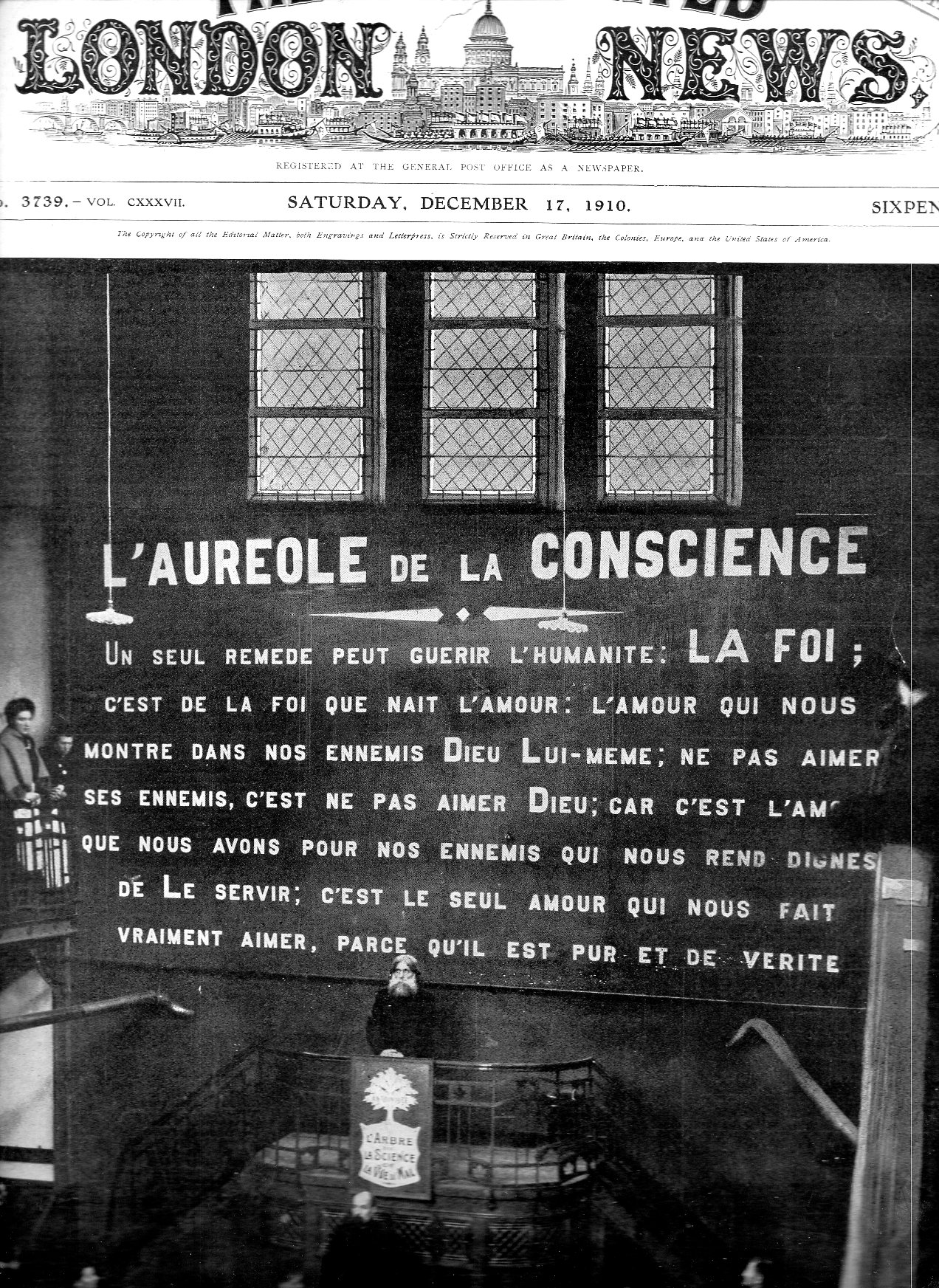
    I was quite taken with the sign behind the preacher in this picture. The photograph decorated the front page of the Illustrated London News, December 17, 1910, and showed the healing/clairvoyant “Antoine the Healer”, with a definite Rasputin-ish look to him. His deal was “fluid influence” in the good and evil fluid influence of magnetism, of reckoning the good/bad magnetism between people, and of course communicating with the good fluids in people.  Or something like that–I have no idea what he was talking about with the fluid/magnetism stuff.  In any event he collected 160,000 signatures of the faithful and whomever to present to the government of Belgian the case for Antoine and his fluids and Antoinettes as a recognized religion.

    Antoine088

    “Antoine’s followers obey him unhesitatingly in everything. In appearance he is a tall, rather round-shouldered man, with grey hair; he wears a black frock coat, but is always without a hat. He chews gum continually.”–The World’s News, January 14, 1911, pg 13. [Source: http://trove.nla.gov.au/ndp/del/article/128264839]

    In any event it was the enormous sign behind Antoine that attracted my attention–the fluid magnetism stuff is not so interesting, or attractive. 


  • Bombing Subs with Exploding Birds, 1918

    JF Ptak Science Books    Quick Post

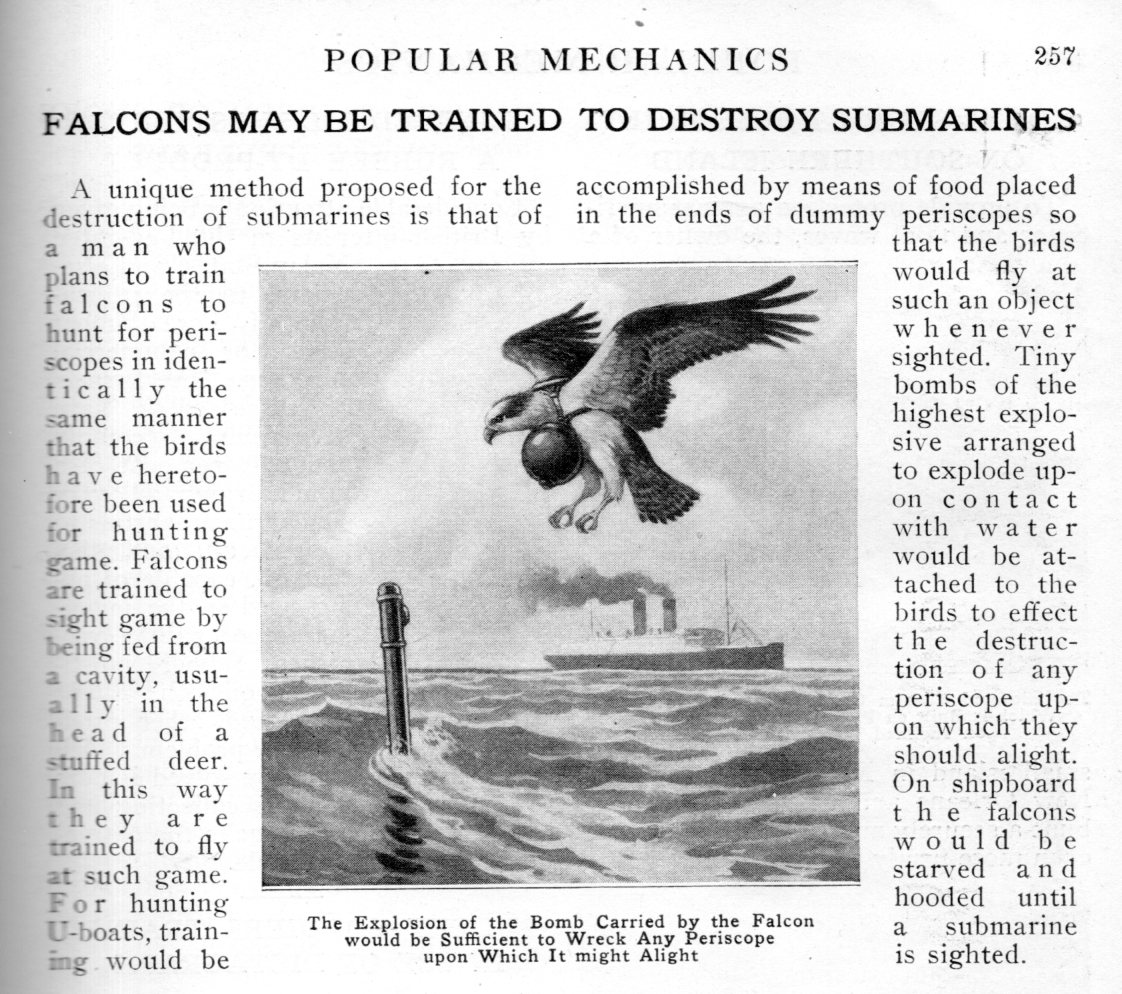
    This title sounds a little stretched and disingenuous, but it is not, not really–there was a plan to destroy periscopes of subs, rendering them ineffectual while submerged, and it did involved exploding birds, so the title to this quick post is largely true.

    The article/note explaining it all appeared in the February 1918 issue of Popular Mechanics, which is reproduced here in full. It is brief and to the point: a falcon would be trained to hunt a metal tube protruding from water, which is would attack while carrying a pouch of high explosives around its neck that would detonate when it came into contact with water.  No more periscope, no more sub, no more falcon.

    Exploding falcons956

    It does seem to be a wooden-cog reaction to a metal gear problem…and very off-putting.  

    I haven’t seen very many bits on using animals as actual weapons of mass destruction, though the ones I recall catapulted diseased animals over and into enemy lines, and a few other truly bad things not worth repeating. But I must say that I found this approach to warfare particularly repugnant, even for warfare of desperation.  

    ·Posted by :

    ·in:

    —