A Daily History of Holes, Dots, Lines, Science, History, Math, Physics, Art, the Unintentional Absurd, Architecture, Maps, Data Visualization, Blank and Missing Things, and so on. |1.6 million words, 7500 images, 4.9 million hits| Press & appearances in The Times, Le Figaro, Mensa, The Economist, The Guardian, Discovery News, Slate, Le Monde, Sci American Blogs, Le Pont, and many other places… 5000+ total posts since 2008.

Category: Daily Dose from Dr. Odd

  • Daily Dose of Dr. Odd: Magnetic Golf Hat

    JF Ptak Science Books  Quick Post

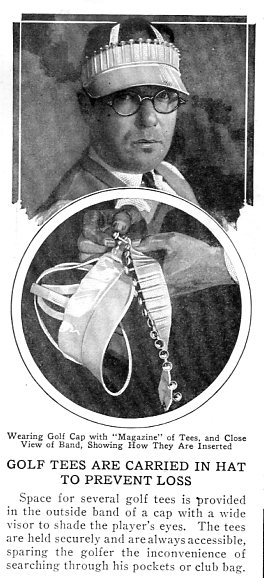
    Golf hat009I have not been a very faithful blogger to the Daily Dose of Dr. Odd series on this blog–certainly not from want of material, because when you allow yourself to see and record it then it is all around you; probably it is because there is so much material that it just washes over a person, like unexpected moonlight.  

    Anyway, I opened this 1926 volume of Popular Mechanics right at page 636, and this remarkably unnecessary use of, well, a hat.  A similar design with little bottles of Scotch might make more or less sense–and what ever it turned out to be didn’t matter one way or the other.  


    ·Posted by :

    ·in:


  • Odd Collections: Bone-by-Bone to 500,000 Wishbones

    JF Ptak Science Books Post 928 (from 2010, Expanded!)

    “One must go into oneself armed to the teeth”–M. Teste, Paul Valery

    “Do what you love. Know your own bone; gnaw at it, bury it, unearth it, and gnaw it still.” –H.D. Thoreau

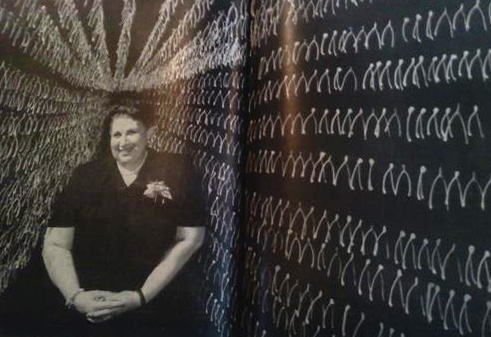
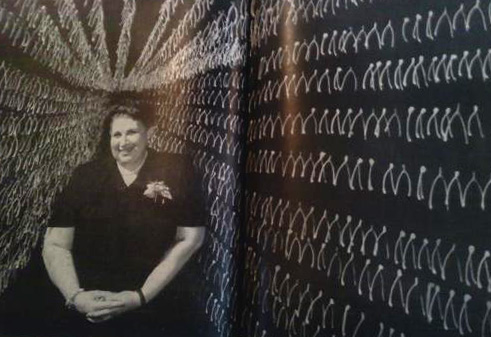
    Sometimes odd images just need to be surfaced for the pure sake of it.  Such is the case with this glorious photo by Greg Villet1 of Delphine Binger in LIFE magazine for  24 May, 1954 .   Ms. Binger (“a Manhattan spinster”) actually collected the wishbones with a business utility in mind, fashioning them into objets d’os.  (LIFE unfairly classified Ms. Binger in this way. In other accounts I have read of her Ms. Binger  is described as a funny, fun-loving person, and Pete Hamil/Meyer Berger describe her as “generous”, “bubbling” and “caring” in their 1954 Meyer Berger’s New York.)
     Turkey bone 1

    She purchased the wishbones for nothing, added a few bits of half-penny decorations, perfume, a pin, and SO! a piece of jewelry is born.  She evidently was able to sell her creations for $2.10 apiece, which in 1954 translates into 25 2009 dollars; so I guess if she sold some here and there she would be able to supplement her income.  Of course there’s the issue of overkill on the bones:  she seems to have probably two (or more) orders of magnitude more than she “needs”, so there may have been something else going on there.
      But then again, at the point where you collect 500k of anything you will have become expert enough to have any mostly-invisible nuance convey a large field of interest to your keen appreciation–the bigger something gets, the smaller it gets, in parts. 

    Turkey bone det

    An old friend of mine–we’ll call him Mr. Tulipfields, a brilliant mathematician/physicist/compsci guy with a deep appreciation for music–started buying classical cds when cds were a relatively new phenomenon.  Rare recorded material was being placed back into “print” at such a rate that he couldn’t really afford the appropriate sound system to actually listen to all of his new purchases.  He hurried into buying many of the cds because he thought that they would drop out-of-print again, and that he needed to act quickly.  I thought that the cds would stay available basically forever—as it turned out he was right (as usual) and I was wrong (ditto). And so Mr. T amassed an enormous collection of music—in the dozens of thousands—many of which are now impossible to find. 

    In some ways my friend didn’t need the cd player—he already knew the music, could play it in his head.  Somehow he was keeping all of this music on course in forming this fabulous collection  And once he had explained his reasoning behind the whole effort, it all made perfect sense, and you’d wonder why he didn’t have 100,000 more choice cds.

    Turkey bone det 2

    On the other hand I’m not sure why Ms. Binger2 needed her extra 497,500 bones—you’d expect there to be not very much difference from bone-to-bone, but there very well may be. A centimeter here and there may make all the world of difference and interest to the practiced eye, particularly if the bones are from many species of animals. Once a collection of almost anything gets to be that big, someone somewhere is going to be interested in preserving it.  

    But how does one get to 500,000 wishbones?  Simply put: bone by bone.  

    And that’s what Ms. Binger did.

    • See also this note in Popular Science from the Popular Mechanix site (“Wishbones Made Her Dreams Come True”). 

    Notes:

    1.  I don’t know much about Greg Villet.  He took a lot of preparations for this photo, stringing 5,000 wishbones on black string on a black backdrop–that is considerable dedication to the idea of an image.  I also know that he did some very significant documentary photography with Rosa Parks and the Montgomery strikes of 1955/6, which tells you maybe all you need to know about the man.  

    2.  I can’t help but wonder what happened to all of those bones on Ms. Binger’s passing? (She died in 1961, and I can’t find anything about the disposition of the collection.  It sounds like the vast majority of the bones were kept with relatives and not in her two-bedroom apartment at 145 W. 96th St in NYC.  And by the way according to Zillow a two-bedroom unit now rents at this address for $8700/month.  My guess is that Ms. Binger paid maybe 100/month in 1951.  
    ·Posted by :

    ·in:


  • How to Build a Living Flag Composed of 10,000 Sailors

    JF Ptak Science Books   Quick Post

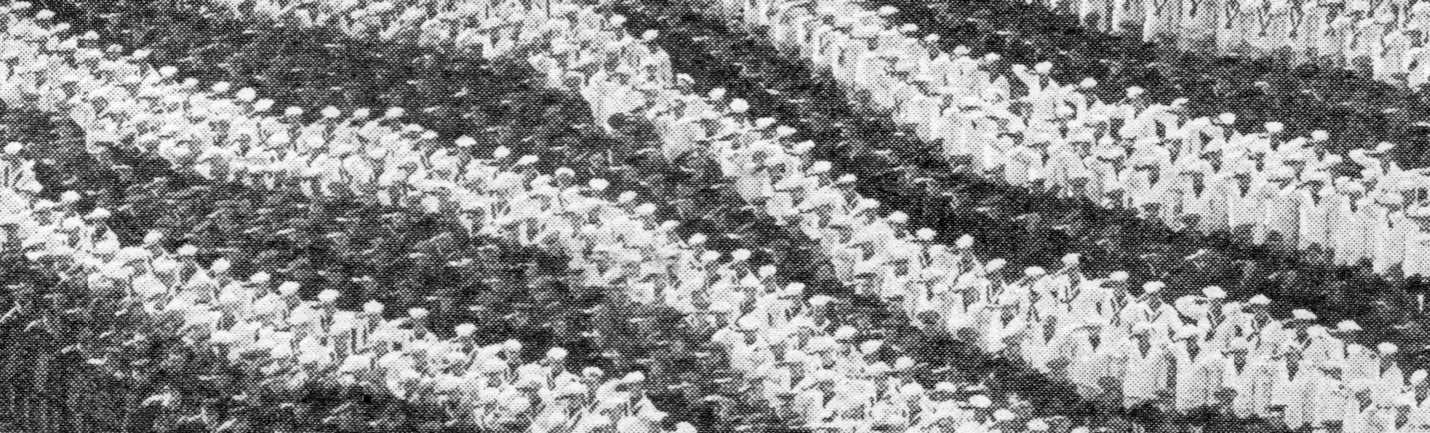
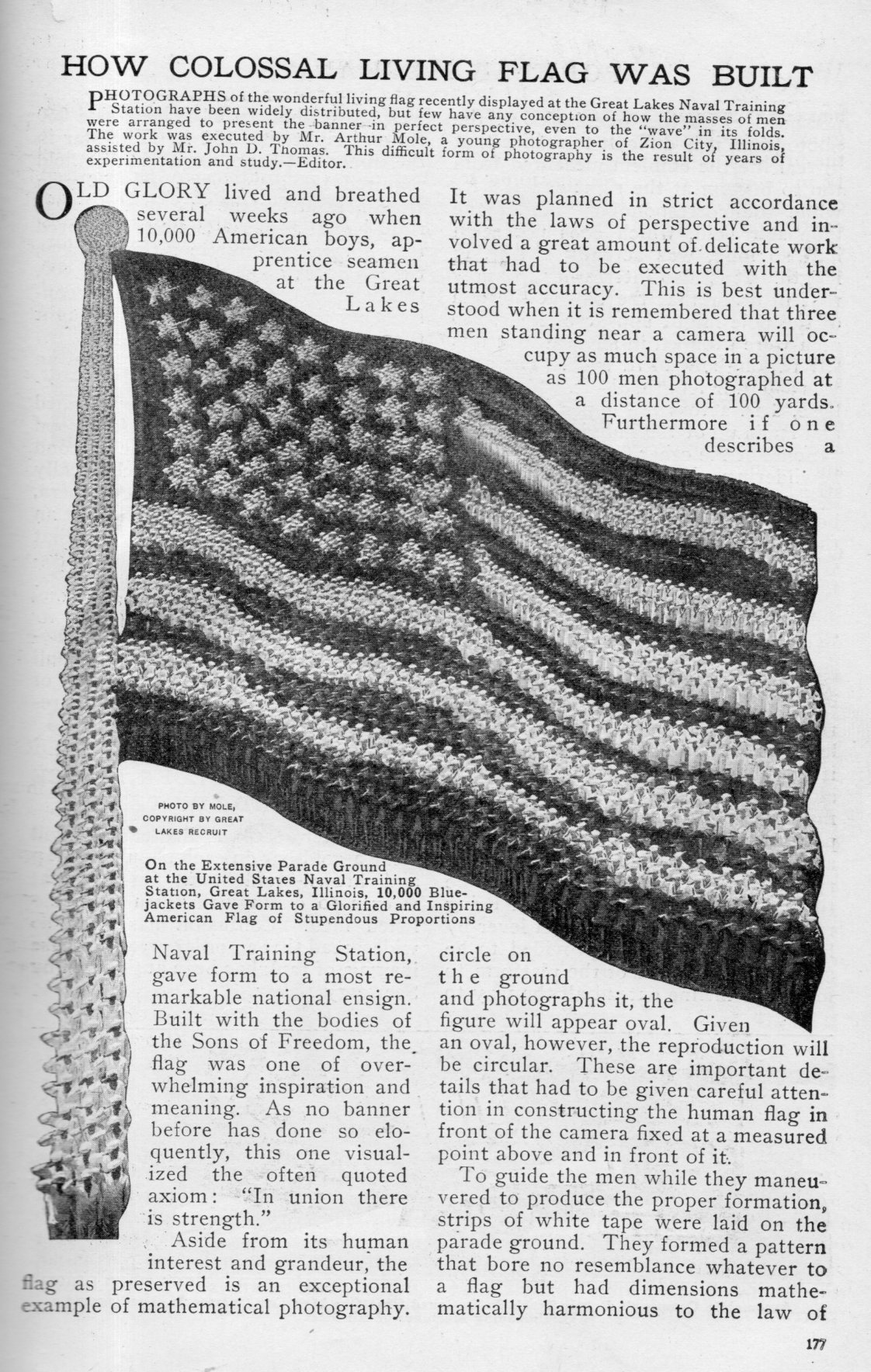
    This is an interesting display of perspective found in the article “How Colossal Living Flag was Built”, in  Popular Mechanics, volume 20, 1918, pp 177-8.  

    Measurements:

    • Staff on left: 550′ long, composed of 700 men
    • Ball on top of staff: composed of 250 men which measures 237′ x 20′ (and its widest as an oval)
    • Top of flag :293′; Bottom of flag: 73′
    • Left part of flag: 428′; right, 128′
    • Star upper left composed of 126 men; star bottom right, 12 men. 

    Flag massive958

     Oh–and according to the text, the shot took one hour to assemble.  

    Flag massive957


  • Bombing Subs with Exploding Birds, 1918

    JF Ptak Science Books    Quick Post

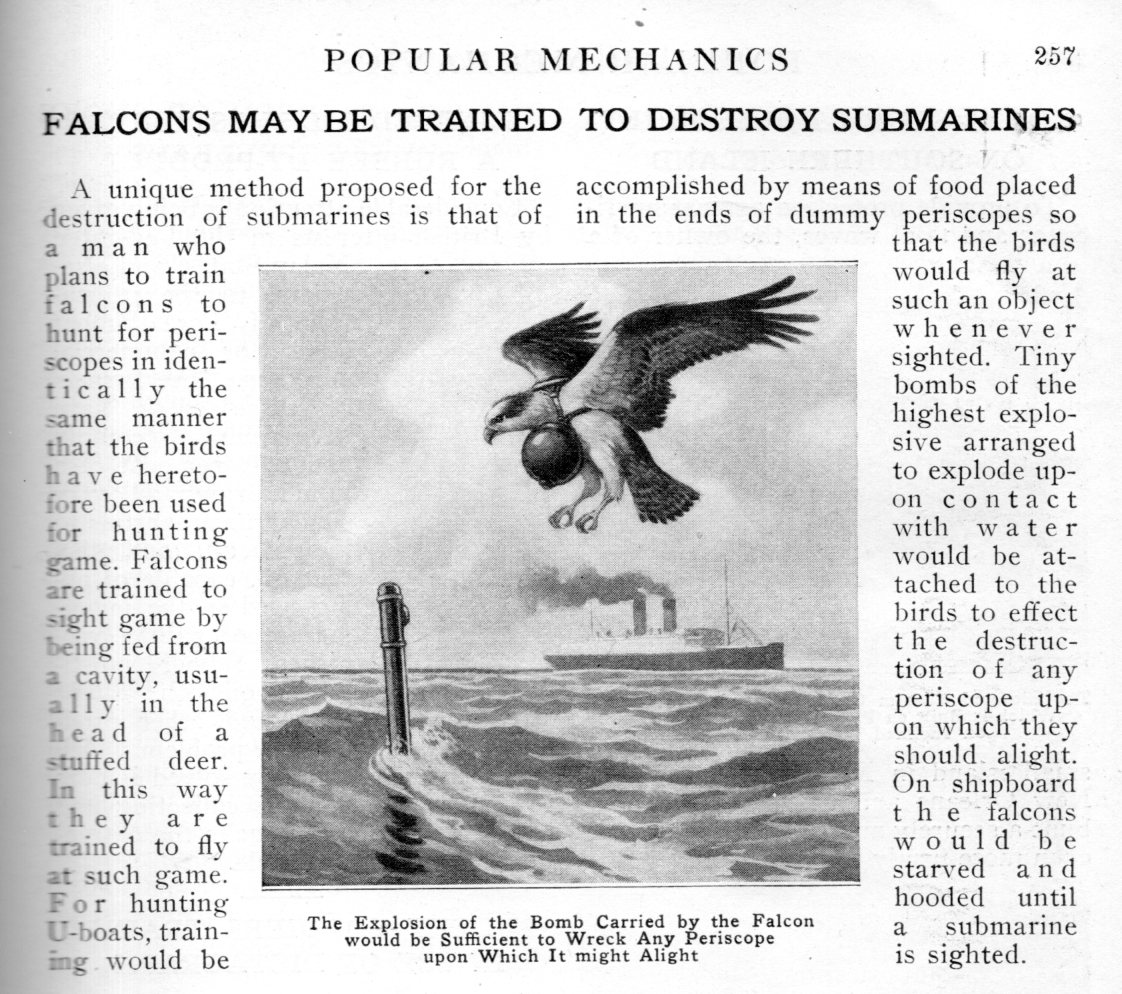
    This title sounds a little stretched and disingenuous, but it is not, not really–there was a plan to destroy periscopes of subs, rendering them ineffectual while submerged, and it did involved exploding birds, so the title to this quick post is largely true.

    The article/note explaining it all appeared in the February 1918 issue of Popular Mechanics, which is reproduced here in full. It is brief and to the point: a falcon would be trained to hunt a metal tube protruding from water, which is would attack while carrying a pouch of high explosives around its neck that would detonate when it came into contact with water.  No more periscope, no more sub, no more falcon.

    Exploding falcons956

    It does seem to be a wooden-cog reaction to a metal gear problem…and very off-putting.  

    I haven’t seen very many bits on using animals as actual weapons of mass destruction, though the ones I recall catapulted diseased animals over and into enemy lines, and a few other truly bad things not worth repeating. But I must say that I found this approach to warfare particularly repugnant, even for warfare of desperation.  

    ·Posted by :

    ·in:

    —

  • Dissonance of Color *and* Black & White, 1941

    JF Ptak Science Books  Post 2434    Color and Advanced Color-Abuse series

    Color kill889

    Dr. Benway lining up his colors before weighing them…

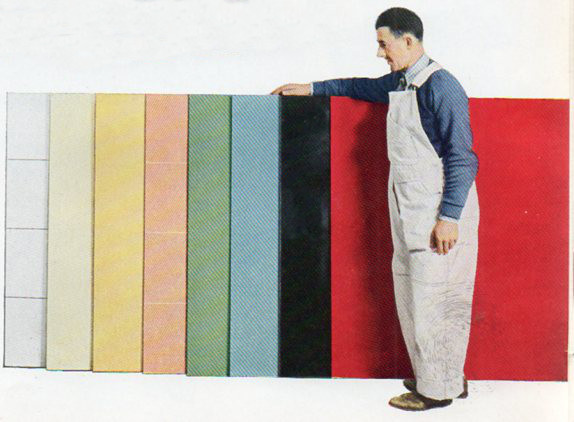
    Jarring experiences are good as displacers of the stuff that you’ve come to know without knowing and without explanation because they make you think about these things–along with thinking about why you haven’t though about thinking about them. For example, color: on the low end there is seeing Cary Grant in color (which is half-expected) and then seeing Humphrey Bogart (which is less so). Seeing Star Trek in color for the first time in 1967 at my grandparents’ house (a small miracle in that they only could receive a few stations with a good antenna given the mountains and such in that beautiful and then two-season Great Barrington MA). 

    Color kill886

    Color kill887I’m reminded of this today while looking through a decorating pamphlet by Johns-Manville from 1941. The images of the interiors of the Standard American Home started out in the pamphlet in black and white, and then, suddenly, came the appearance of color–and a lot of it, and in unexpected combinations. And then: unexpected colors in the unexpected color.  And in this case, perhaps the new color scheme is not one that is today seen as a beautiful thing.  

    Color in magazines and journals and newspaper was of great rarity before 1939, as color roll film was really introduced until the mid-20’s, and then the first book illustrated with color photographs didn’t appear until I think 1938 (was it an Agfa catalog, or Zeiss?).  In any event, the book/pamphlet illustrated with color photos was still a very newish thing when these photos appeared in the Johns-Manville The Home Idea Book 1of 1941

    Color kill888

    It is an unusual exercise–for me, anyway, a mostly b+w guy–to imagine these colors, together.  It is also surprising because my experience with so many of these catalogs is from an earlier period and the majority of them were illustrated with black and white photos or color drawings, or colorized photos. To see the color of the real walls and doors and tiles and carpeting is jarring.  


  • Candy & Cellophane & duPont=Food! For Profit! (1939)

    JF Ptak Science Books  Quick Post

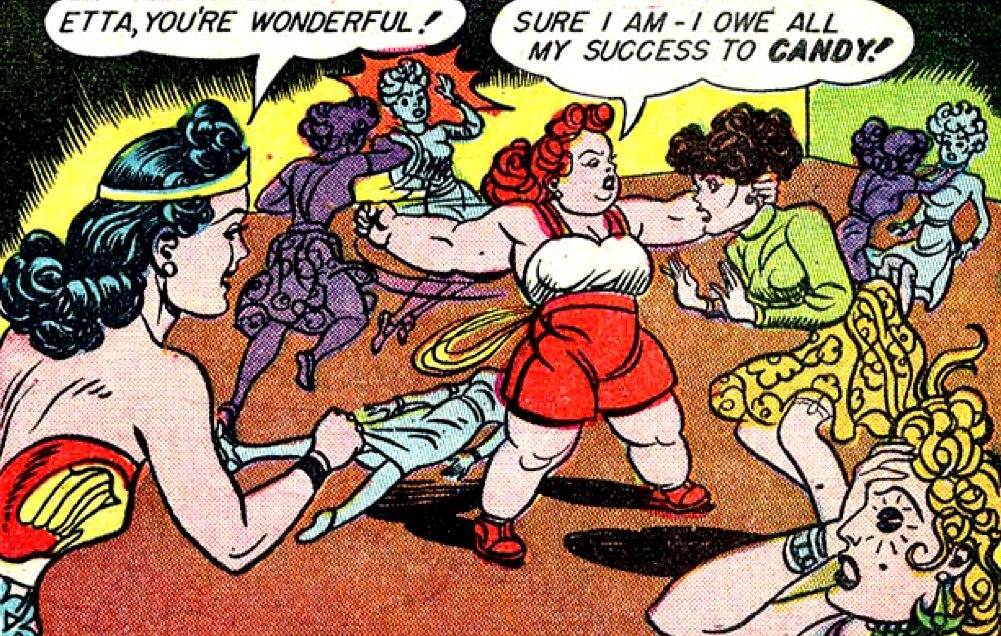
    Candy & WOnder Woman

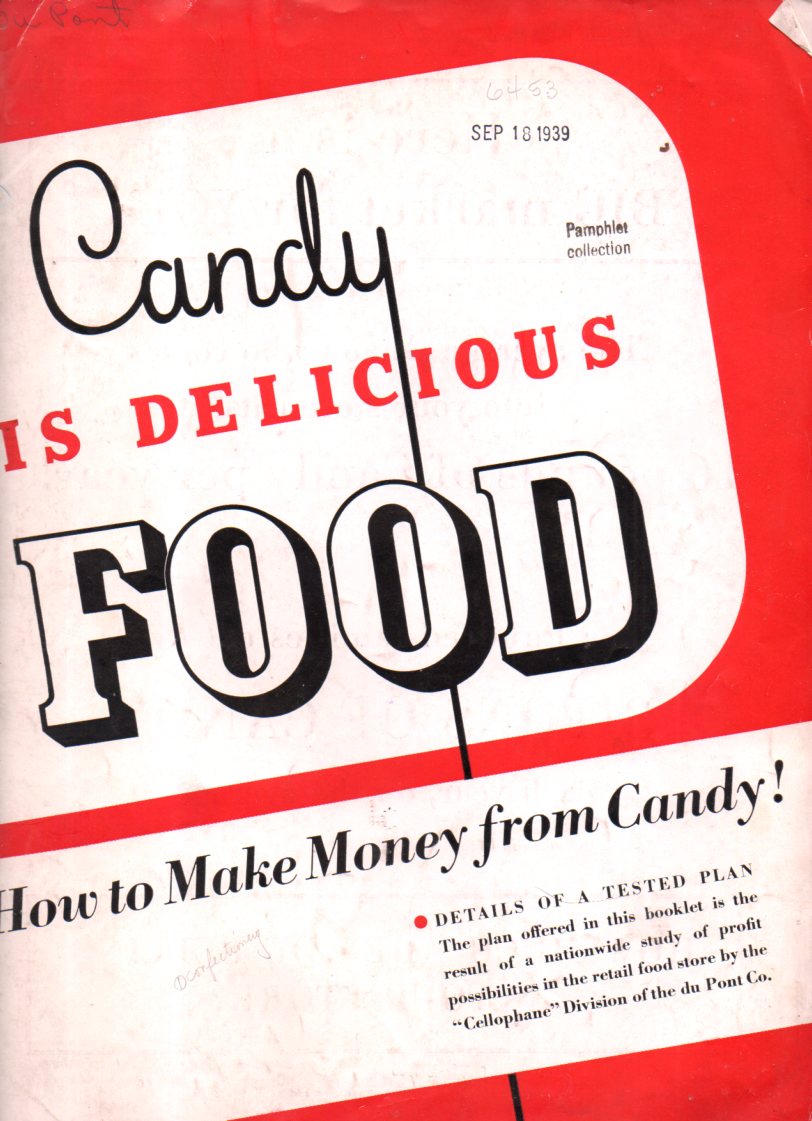
    This hand-out pamphlet seems to be a case where the sale of an edible product is made for the sale of its packaging.

    Candy is food609

    The pamphlet shouts that CANDY IS DELICIOUS FOOD, which is certainly a correct statement if food=digestible.  It tells/sells the story of candy as a profit-maker to the grocery seller, saying that “32% average gross profit on home consumption units“, those delicious-sounding unit-things being the candy.

    There are bits and pieces about candy display and placement, all on the advice of the maker of the stuff that in which the candy was wrapped–cellophane. The publisher and distributor of the pamphlet, the “Cellophane” Division of the E.I. du Pont de Nemours & Co. Inc., had a huge vested interest in candy sales: candy was mostly wrapped in Cellophane (starting with Whitman in 1912) and by the time du Pont achieved its water- and moisture-proof Cellophane in Delaware the product accounted (in 1938) for 25% of the company’s profits.  That’s pretty big, and so candy as a major muncher of Cellophane would be promoted by du Pont as pretty big, too. And as food, for added Bigness.  

    Candy is food610


  • Kingdoms of Dust and Street Dirt, and What People Breathed in 1878

    JF Ptak Science Books  Post 2307

    Here’s an extraordinary find, a bump in the grazing field in the Scientific American Supplement for January 19, 1878. The article is about dust–but not the cosmic dust that some folks say is what is being seen in the Big Bang (and not a background radiation signature), nor is it like the dust equation nor the dust of Einstein’s great dust paper of 1905.  It is more like a lower-level plague dust as we see in Arthur Rothstein’s iconic dust bowl photograph made in parched Oklahoma in 1936.  It is about the residue of industry and commerce that did’t get carried of by the mysterious carry-off winds associated with the high and higher chimneys of Victorian London and other industrialized cities, and the leftover bits of the operation of daily cosmopolitan life involving say horses and trains.  It is an article about the significant particulate  matter of dust, which we know today is a high-percentage contributor to air pollution, not to mention the low-level “atmosphere” of the kicked-up business that people would breathe in every day.

    And, evidently, this dust was very heavy-metal rich in composition, which is not so good.  

    The article is “Street Dust”, and the author, Henry G. DeBrunner (who would become professor of chemistry at the Pittsburgh College of Pharmacy), decided to take a look at the dust of Pittsburgh and compare it to reports of the dust of major European cities.  He notes that Paris and London and other cities consist of 35% of “metallic iron, given by the shoes of horses to the stones, besides from 30 to 40% of good glue from the hoofs”.  Now that seems an extraordinary figure, and surprising too in many ways that it came from horse shoes. 

    Dust mask296

     [Source: an advertisment from Scientific American, volume 79, 7 January 1893, back wrapper.

    DeBrunner conducted a study at Thirtieth and Smallman Streets (Pug) and found out that 30% of the sample of dust (“a deep black color”) consisted of silic acid, 26% of “fixed carbon”, ferric oxide at 12%, sulphuric acid at about 1%, gluten 1%, Metallic iron 8.55%.  The details of how all of this was extracted can be seen below, where the entire article is reproduced. There were other samples, and it is interesting to note that in one sample near horse tracks contained 32% heavy metal and lots of glue. 

    The entire article, January 19, 1878, Scientific American Supplement, No. 107:


  • An All-Roads-Lead-to-Soap Map

    JF Ptak Science Books   Daily Dose from Dr. Odd

    Soap map002

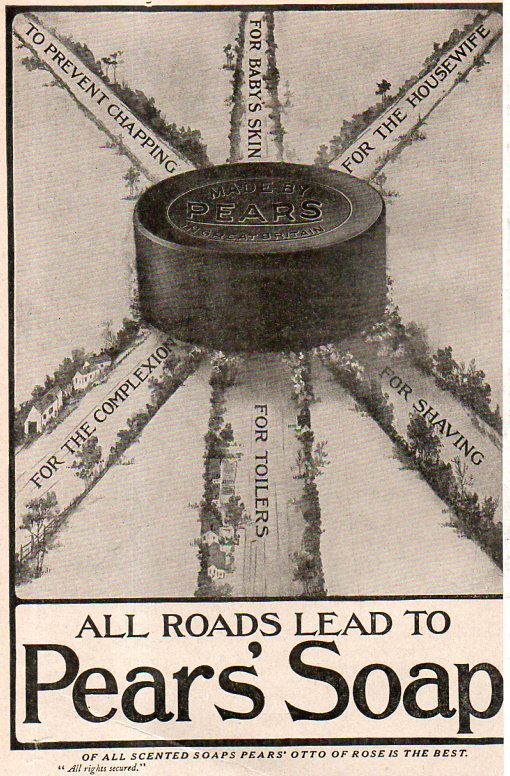
    Evidently all roads lead someplace other than Rome–a bold statement of imaginary cartographic exactness to come from a soap company.  What perhaps trumps this oddness is that this ad was improbably featured as a big back-of-the-cover ad in the relatively new Astrophysical Journal for November 1908.  I’m not suggesting that astronomers and astrophysicists don’t use soap, of course, but to find this ad as about the only piece of external revenue in this journal is very surprising.  Perhaps the owner/manufacturer had an interest in astronomy and gave a little funding to the publication…

    Here’s a more global outlook of the capacity of a soap-like cure:

    ·Posted by :

    ·in:


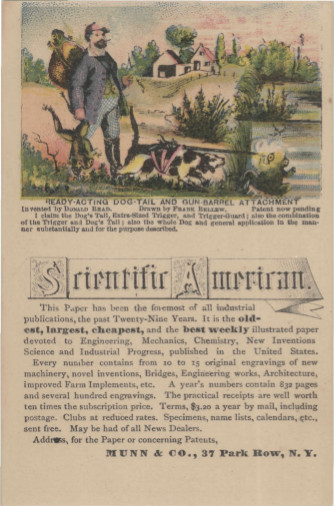
  • Ready-Acting Dog-Tail Gun Barrel Attachment for Frog Hunting

    JF Ptak Science Books   Daily Dose from Dr. Odd

    Sometimes there’s not much needed to say about something after you’re through with the title–and this may be one of those times.  

    Scientific American--frog hunting gun-toting dog[Found at paywall/subscription site, North Carolina State University libraries; another site plus text at the Library Company of Philadelphia, here]

    This is a trade card for Munn & Company, publishers of the Scientific American, then in its 29th year (which would be 1874).  I’m pretty sure that this was all done as a joke, to catch people’s ideal attention–especially since Bellew was a cartoonist, and a very well-known one at that. (For example, he created this iconic image of Lincoln, below.)  But the image is certainly arresting enough, odd enough, semi-insane enough, to have the casual nod turn into observation.

    ·Posted by :

    ·in:


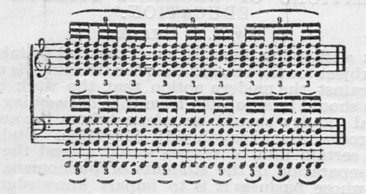
  • More Than Thunder: the Music of Niagara Falls, 1896

    JF Ptak Science Books  Quick Post

    I went searching in the 1896 issue of the Scientific American Supplement for early articles on  Roentgen’s x-rays (discovered just months earlier) when–flipping through the pages–I came upon this very impressive part of a score.  But what is more impressive is that it sets to music the sound of Niagara Falls–the music of the falls.

    Niagra167

    At least music is what Mr. Eugene Thayer heard when he listened to the falls, and apparently he heard what few others did.