A Daily History of Holes, Dots, Lines, Science, History, Math, Physics, Art, the Unintentional Absurd, Architecture, Maps, Data Visualization, Blank and Missing Things, and so on. |1.6 million words, 7500 images, 4.9 million hits| Press & appearances in The Times, Le Figaro, Mensa, The Economist, The Guardian, Discovery News, Slate, Le Monde, Sci American Blogs, Le Pont, and many other places… 5000+ total posts since 2008.

Category: Daily Dose from Dr. Odd

  • Daily Dose of Dr. Odd–Future of Air Travel, ca. 1900

    JF Ptak Science Books     Daily Dose of Dr. Odd 2

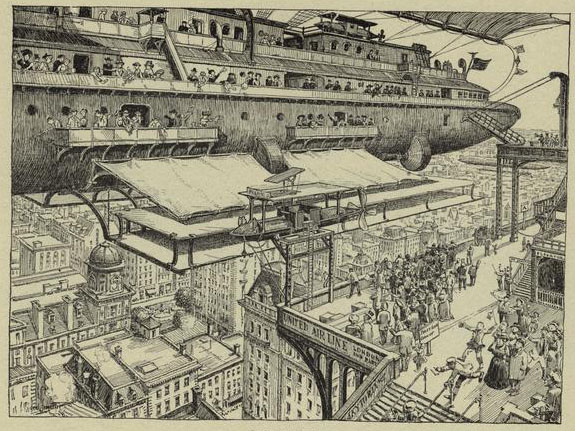
    In today’s quick dose from Dr. Odd we find the “United Air Line” (so close to the name that actually came into being), ca. 1900, featuring an enormous and extraordinarily heavily-bodied airship of a construction of pure speculation.  It is gigantic and weighty, and it seems as though the thing is powered by pulsating awning-like wings and a series of covered propellers, all under what seems to be sail. 

    The crowds bustling beneath the behemoth seem as any other crowd waiting for the subway, or third class, or, well, whatever sort of mass transport would await and was taken for granted.  There are no bands, no fireworks, no fanfare, just the arrival/departure of yet another airship leaving for London from New York City, as much a cause for attention as any airliner traveling overhead.
    Dailydose airship

    Source:  New York Public Library Digital Collections, here.

    Source:  New York City Digital Collection, here.

  • Daily Dose from Dr. Odd–Future of NYC Underground

    JF Ptak Science Books        Daily Dosage from Dr. Odd 1

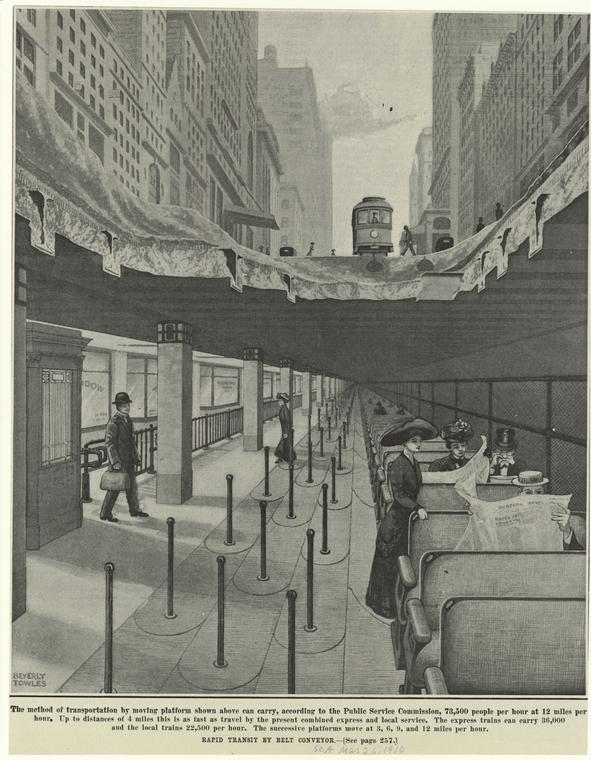
    Rapid transit by belt conveyor.
    This remarkable cutaway (1910) shows what might have been considered a possible future for the future of possible New York Citys .  This one features a very highly respectful continuous conveyor belt of humanity coursing through the Great Underneath, replacing the ideas of subway transport.  A seat would always be available if it was so, just a=one giant beltwork of seat stretching from SOuth Ferry to Uptown and to Brooklyn and so on.  But since it was always moving it would have to move a little slowly for people to hop on and off, so a trip to the then-Uptown might take some time. 
    Source:  New York Public Library Digital Collection, here.
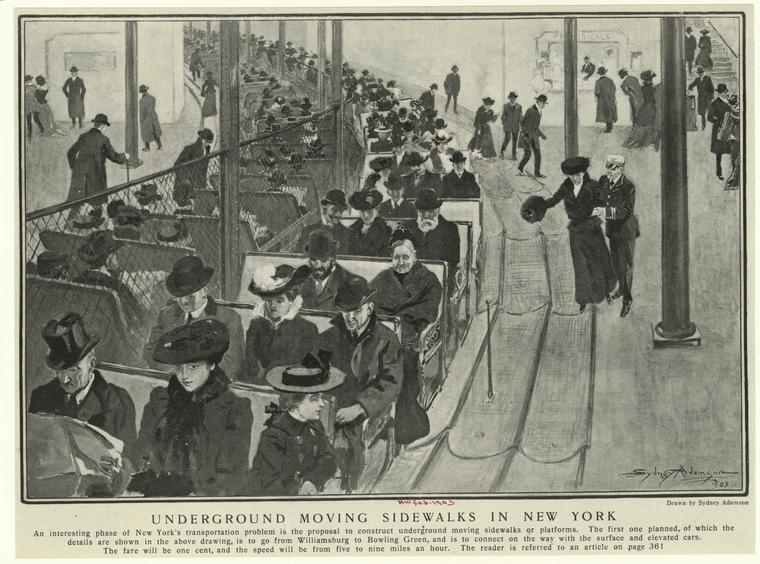
    Not to be out-belted, there was also an image of moving sidewalks (1903):
    Underground moving sidewalks in New York.
    Source:  New York Public Library Digital Collection, here.

  • God’s Atomic Bomb: the Divine, the Infinite, and its “Gift” of the Bomb, 1946

    JF Ptak Science Books  Post 234

    Blogsept_2_atomic_bomb_god481

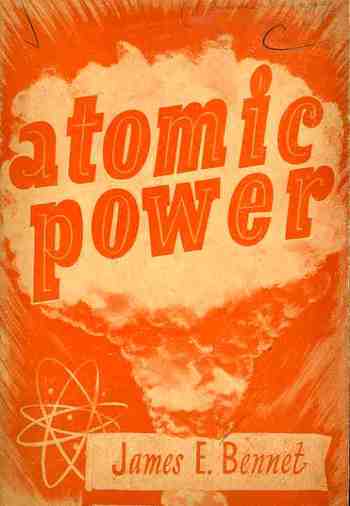
    I’d like to say that this was a class-of-its-own sort of work, but as it  goes this is hardly the case.  If I cared a little I guess I could establish a collecting sub-category in the nuclear fission–atomic–nuclear weapon collection for the popular belief that god ordained and transmitted the atomic bomb.  There are at least five other pamphlets like this floating around in the store, and I am certain that there must’ve been dozens of other grabby little publications like this proclaiming Almighty Influence in the creation of the atomic bomb.  I can understand the reasoning behind the power grab:  the bomb ended the war a week after its second use, sparing the lives, perhaps, of a million soldiers (American and Japanese) and years of societal/infrastructure rehabilitation by eliminating the need of an American invasion of the Empire.  So the denominator was simply the “saved (American) lives” part. 

    Blogsept_2_atomic_bomb_god_2482

    Again, I can understand how this felt in 1945/6, but I still feel that getting the suspected creator of the universe involved in the making and use of the bomb was ill-advised.  The author of the first pamphlet reached back into history and credited god with simple solutions to complex situations:  employing the more modern political technique of controlling language in the Tower of Babel case (wher he also said that since Babel was only 105 years after the flood that Noah was still alive, and that certainly Noah “would’ve voted ‘No’” for the building of the tower); and using “Johnny Snowflake” to stop the “non-satanic” Napoleon from reaching “Britain’s doorstep (and obviousy not the Soviet Reds).  Bennet also  credits god with giving “Dr. Currie” (sic) the genius to “split atoms” in 1896. 

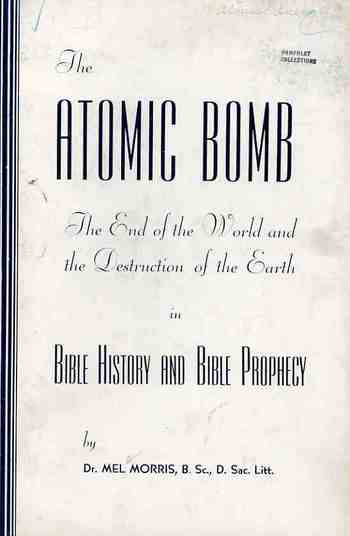
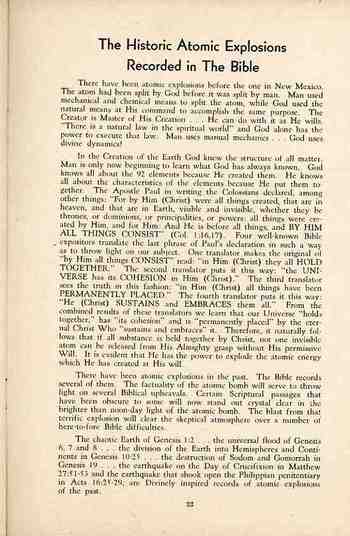
    The second pamphlet uses the atomic weapon a little more figuratively.  The author, Mel Morris, published this in 1945, which means he must’ve worked a little feverishly to pump up his bible prophesy and history to include the new atomic weapon to replace whatever else he had been using as a prophecy for end of times.  (As it turns out, “God’s Atomic Bomb” was more tempest and disaster in the bible, and not (whew!) the bomb itself.  Though as we’ve learned from scientologists and the sort-of creative mind of Ron Hubbard, a civilization came to the earth thousands of years ago and pummeled it with “atomic bombs” and other nastiness, polluting humans for milennia to come.  But that’s another story–suffice to say that Morris found many dozens of examples of “God’s Atomic Bomb” being used in the deep biblical past, and that the use of the real atomic bomb in 1945 was pre-ordained, and not without its figurative historical counterparts.  I’m not sure why any of this was necessary outside of proving to some small minority that these preachers could at least be contemporary and topical. 

    Blogsept_2_atomic_bomb_god_2txt483


  • Unusual Questions 1: Are the London Bridges Too Far Apart? 1904

    JF Ptak Science Books LLC   Post 136

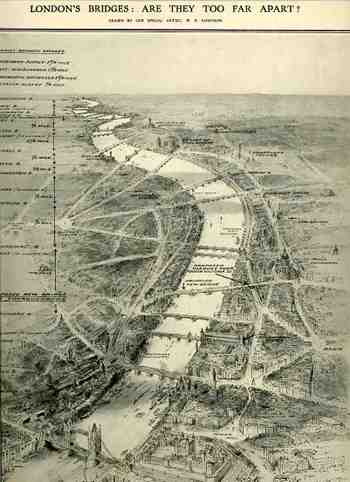
    This image (from the Illustrated London News of 10 July, 1909) asks an unlikely question, and one that I’ve never heard asked before of London:  are the London bridges too far apart?  The “new bridge” which was to be built was scheduled to be located between Southwark and Blackfriars bridges (for what looks like today to be a fabulous deal of 1.5 million pounds, or about 6 million USD, or about 95 millions dollars today), and would’ve been about where the Millenium Bridge is now. The bridge would be 80 feet wide and carry a double deck of trams, running on a diagonal  with the access nearly at Blackfirars.  I’m not terribly sure how to interpret the question, because the answer seems a little obvious to me, what with 14 bridges on just one side of the Tower Bridge in just a few miles.

    Bloglondon_bridges208


    [Image greatly expandable.]

    I’m not so sure what the engineers were expected to do, short of tunneling a great length of river and delivering land on top of it.

    This reminds me somewhat of a report that I saw some years ago about the plans for Rock Creek Park and Parkway in Washington, D.C. The park runs roughly north-south in the top center half of the city, and around 1890 the Federal government was trying to figure out how to best multi-task the area for parkland and roadway.  One (incredible) plan called for the creek, which in many places is bounded by some pretty steep embankments (25-75 feet or so) and extends about 8 miles north of downtown, to be filled in, leveled off, and paved over.  Now that, dear readers, would’ve been a lot of dirt.  The final plan was perfectly fine and had a series of small roads snaking their way through the park, making it one of the nicest rides (Central Park-like) of any major metropolitan cities in North America.