A Daily History of Holes, Dots, Lines, Science, History, Math, Physics, Art, the Unintentional Absurd, Architecture, Maps, Data Visualization, Blank and Missing Things, and so on. |1.6 million words, 7500 images, 4.9 million hits| Press & appearances in The Times, Le Figaro, Mensa, The Economist, The Guardian, Discovery News, Slate, Le Monde, Sci American Blogs, Le Pont, and many other places… 5000+ total posts since 2008.

Author: JF Ptak

  • A Telephone Book for the Dead and a Telephone to Deadville Redux (1912)

    JF Ptak Science Books     Daily Dose from Dr. Odd  

    Follow Me on Pinterest


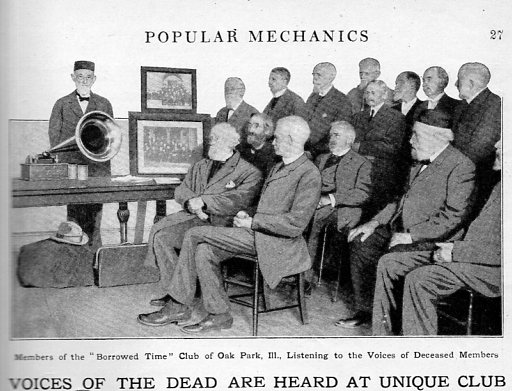
    Dead club334
    Two years ago I posted “My Zombie ‘Phone to Deadville” and Tales of the Infinite Boneyard, by Tom Edison which addressed a prickly mock-interview that the great inventor gave in 1910 about the possibility of communicating/telephoning with/to the dead.  On the other hand, his recording phonograph did accomplish this, in a one-way way–for the first time in human history it allowed a person to listen to the sounds of something that couldn’t make sounds anymore.  Dead People Talking must have been an enormous idea to those of the first few years of Edison’s 1877 recordable/playable device–it still its own enormity if you stop to think about it for a moment. 

    This is to some degree what was in the minds of the members of the Talking-with-the-Dead Club in Chicago’s Oak Park as seen in an article in the endlessly interesting Popular Mechanics (for 1912). The members of the “Borrowed Time” club really weren’t so much interested in talking with the dead but rather were more consumed with the dead talking to them. On waxed cylinders.  Perhaps it was a new modern miracle and a possible comfort to their own soon-to-be demise that it would be possible to reach out from the grave to have your voice heard.  The club was founded in 1902, and of its 25 charter members only 10  survived in 1912. It would have been an odd conceit to join a club to sit with fellow members to listen to the voices of dead members, a strange if new insistence on corporeal attention to dead stuff. But it is a very recognizable wish–“need’, even–to have your the memory of your dead self improved or at least substantiated with a recording of your years-dead voice available to the curious. 

    This makes me think about a telephone book for the dead–there’s certainly enough material out there for one, or to at least think about organizing one. Certainly in the near future there will be millions of new dead people, and given the extent of cell phone communication and etc. this will be one of the fastest-expanding communities of potential communicants. Probably the idea of a “telephone book” for the Dearly Departed is old fashioned, especially when we can have an entire internet (the world wide dead web) devoted to them, the them that are us. This may sound trivial and snarky, but it isn’t and I’m not trying to be–I’m dead serious.
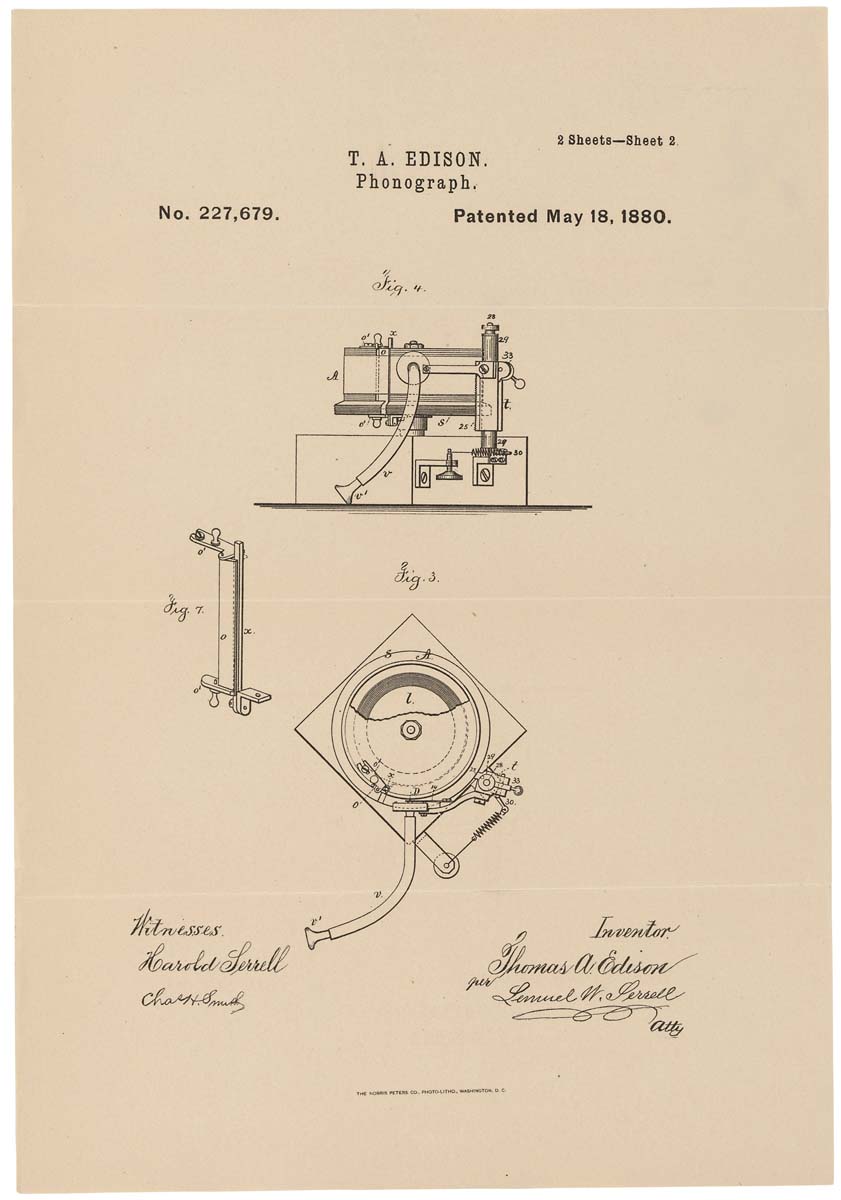
    PhonographPatentEdison1880


  • Negative Space Images: the Dark Imaging of an Absent Halo?

    JF Ptak Science Books   Post 2033  

    Follow Me on Pinterest


    Part of a series on the History of Blank, Empty and Missing Things

    Negative space di Credi[Image source: Metropolitan Museum of Art.]

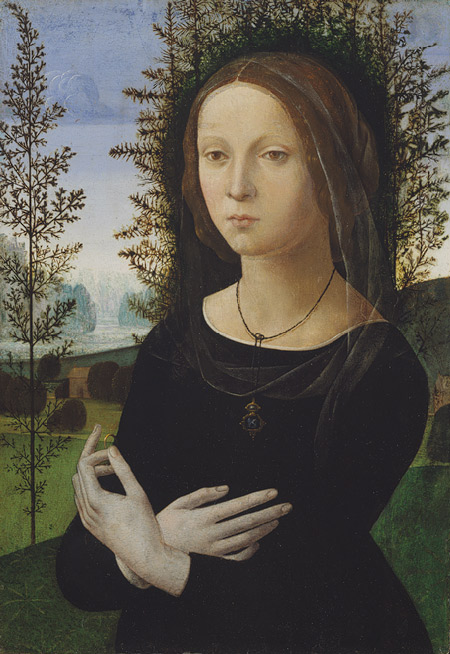
    The idea of negative imaging–of forming an image “backwards”, or by using a surrounding space to define the image’s properties–came into play for me while looking at this beautiful portrait in the collection of the Metropolitan Museum of Art in NYC.  Lorenzo di Credi (Florentine, ca. 1456-1536) painted Portrait of a Woman (an oil on panel) in the last decade of the 15th century, a beautiful work presenting the portrait of a woman who was possibly in mourning, modestly dressed in very dark clothing and holding a ring.  What strikes me is the “dark halo” around her head, a black space outlining her head and neck and shoulders, giving all of those features a further powerful light by the very wide border between them and the juniper in the background.  I imagine that this technique was used to establish a deep luminosity, but for me it also creates the presence of a halo by painting its absence–this is admittedly tenuous, but that is the way it seems, to me. 

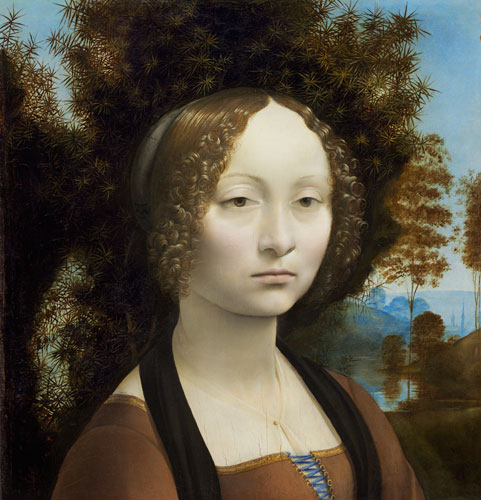
    It also reminds me in a way of Leonardo da Vinci’s  Ginevra de’ Benci, (c. 1474/1478, oil on panel), though there is much more detail in Leonardo’s non-halo. 


    Negative leonardo

    [Image source: National Gallery of Art, Washington D.C.]

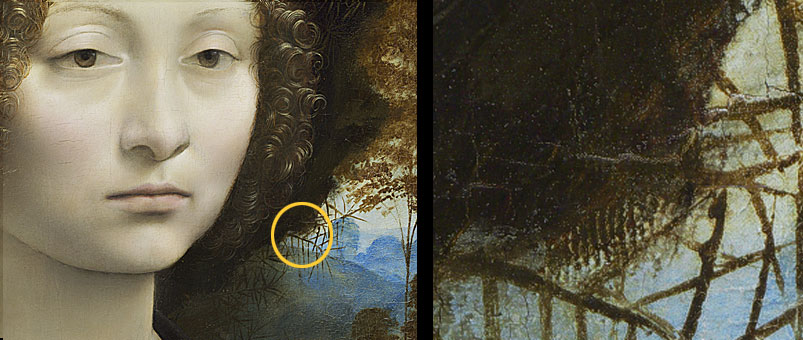
    Even
    though there does not seem to be a “halo” in the Leonardo, there does
    seem to be a fingerprint where the non-halo isn’t–evidently Leonardo
    did not limit himself to just the brush in his painting technique, but
    used his fingers as well.

    Negative space leonardo fingerprint


  • A Shining Singularity of 1896–the Glory of Lost Hardware Stores

    JF Ptak Science Books   Post 2032  

    Follow Me on Pinterest


    When I was a kid I liked to go to Reiman’s hardware store on Victory Blvd., Staten Island, New York, where there was everything and everything was in its place, though not every place was in its place.  There was a certain untidiness to the store that made it seem as though everything was a jumble, except it wasn’t.  The order was controlled by a collection of hardware men who seemed to know everything and absolutely knew where everything was.  I would walk in, go to the back, hold up the widget that I needed to the Old Man, and then he’d go to a half-wall filled with tiny boxes filled with tiny things, and find what I needed–or something better. The store was biggish, but very quiet, given all of the surface area of all of those thousands of tiny cardboard boxes.  It was all enveloped with the hardware store equivalent of the old bookstore aroma. 

    These were the thoughts that sprang to mind when I saw a post at the SecretPlans.org site displaying that robot-like figure riding the hardware bike. It is found in what must be the bible of 19th century books on the keeping of a hardware store, appropriately titled The American Hardware Store, written by R.R. Williams in 1896. It is remarkable for its organization and for its lovely presentation.  And of course for its very prominent  display of memory of what was necessary in building and maintenance from a hundred years ago.  There are instructions to the store owner on what and how to exhibit, with images of displays of axe heads, hurricane lamp glass,scythes, plumbs, hatchets, horseshoes, scale beams, belts, pumps, oil cloths, and much more of the stuff that is mostly gone.

    Thanks to this manual I think that when you go back in time and into that hardware store of 1896 you’ll be ready.


  • R.P. Feynman Publications, 1938-1999

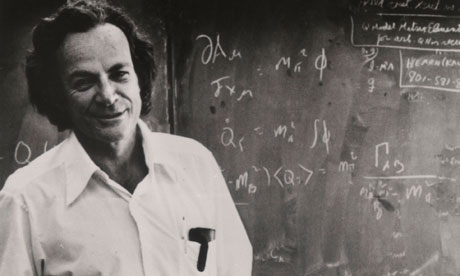
    FEYNMAN PORTRAIT
    Many thanks to Dr. Hagen Kleinert (University of Berlin) for creating this bibliography.  The original can be found on his website here. 

    1938
    [1] With M.S. Vallarta. Scattering of cosmic rays by the stars of a galaxy. Phys Rev 55: 340-343.

    1939
    [2] Forces in molecules, Phys. Rev. 56: 340-34

    ·Posted by :

    ·in:

    —

  • Subjugation, Surrender, Food, and the North American Indian

    JF Ptak Science Books  

    Follow Me on Pinterest


    Blogindian_ration194

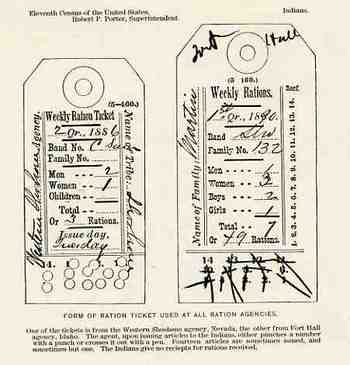
    These images of the Indian ration card and the Indian Police button were found opposite page 76 in the monumental Report on Indians Taxed and Indians Not Taxed in the United States (except Alaska) at the Eleventh Census 1890 (published in Washington DC in 1891, and perhaps the best single-volume statement on the conditions of the Indian tribes in the U.S. in the 19th century). 

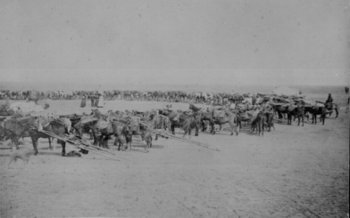
    Generally tribe members would wear the white ration card on a string and attached to a button.  When you see old photographs of the Indians queued up to receive their food and provisions, the little white cards stand in sharp contrast to everything else, when they are in focus,.  When not (as the lens weren’t necessarily fast enough to capture things in motion) they look semi-invisible, like a puff of smoke on the chests of so many people.  I can imagine then these people standing in line, waiting for food, having entered reservation life with enforced “sale” of their lands, still except for the fluttering of their ration cards, small white flags of surrender that they would fly for generations.  Certainly no other element of our society would be forced to surrender so often for the need of food.  And considering too the number of Indians who would die of starvation over decades’ time at the hands of this system and in the care of the federal government, it was a surrender that didn’t necessarily entitle them to the sort of treatment that a POW would receive.  (The following photo is of a queue for ration distribution at camp Supply, Oklahoma Territory, 1871.)
    Rationscamp_supply

    The amount of the ration was mysteriously worded, at least to me; I couldn’t really tell how much food people were allowed.  The explanation reads as follows:  “the table of quantity allowed to 100 rations is:  bacon, 10 pounds; beans, 3 pounds; beef (net) 150 pounds; baking powder, 1 pound; coffee, 4 pounds; ham, 50 pounds; salt, 2 pounds; soap, 2 pounds; sugar, 7 pounds; tobacco, ½ pound.”  (The salt part is curious; salt was very important, and ion relation to everything else, 2 pounds wasn’t really very much salt at all.  I am reminded of the very last part of the negotiations between John Ross, who was the principal chief representing the Cherokees, and the flatulent Gen.Winfield Scott, the head liaison between the Cherokees and the U.S. government, in the terrible last phases of the preparation for the Cherokee removal.  Ross pleaded, and in effect offered to buy, more provisions of salt for the walking winter journey for his 12,000 charges (children included).  That this was a point of negotiation is cruel and sickening.  Scott “gave in” and allowed the extra salt…his other practices in this enforced emigration though resulted in the deaths of about a third of the Cherokee people.  And Scott was about the best, most “Indian-friendly” general that the government had to offer.)

    It continues, badly written:  “Still, it frequently happens that issue same day finds the agency short of supplies and frequently rations are issued, and of limited quantity. 

    And closes:  “The Indian, however, arrives promptly on the appointed day, no matter whether he receives or not”. 

    Blogindian_ration_button195

    The button pictured here belonged to the uniform of the Indian Police. 
    It shows an Indian guiding a plow, with the legend written around the figure that reads:  “God helpeth those who help themselves”.  Or not. 


  • A First and a Fifth of Firsts, And So On, in the History of Cinematography

    JF Ptak Science Books  Post 2031

    The story of the history of the story of firsts, of the first time something was noticed or acknowledged or invented or composed, is a problematic one.  It isn’t so easy as it might seem to establish priorities–and once the major first of a particular field or interest is established, there may be a long line of minor firsts following the major one. 

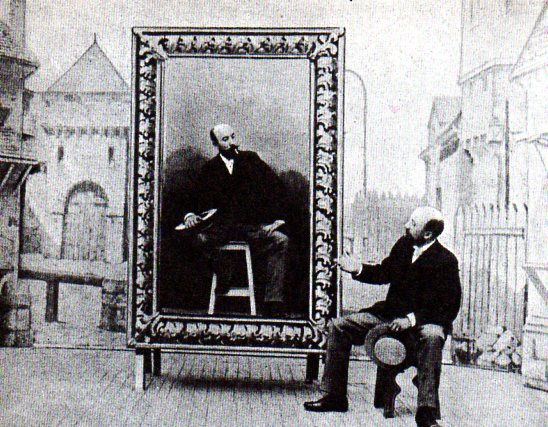
    Meiles329
    This is definitely true in photography and cinematography–even the first photograph is an item for discussion depending on how you define “photograph”.  Absent this, there is a long line of other firsts that come into play–the first photograph of a human, the first portrait, the first night-time photograph, and so on, and the same sort of issue is applicable in the history of the cinema–and they fall into a long list of Wittgenstein/Tractatus1 enumeration. 

    The subject of this post is an interesting “first” in the history of the cinema is this very interesting still of (the great) Georges Melies (1861-1938), who in 1888 opened his cinema in the Theatre Robert Houdin.  He was extraordinary, and highly gifted, a man of vast creativity (see for example his early A Trip to the Moon, 1902, here) and energy.  And it was here that in the long line of his own firsts that he produced the first cinematic experience of an a person appearing in a moving picture with themselves.  There had been inventive photography that accomplished this minor miracle decades earlier, but this was indeed the first instance of this magic being worked in film. This must have been an enormous moment for the viewer, being able to see a person having a conversation with their duplicate–my guess is that it would have seemed other-worldy, brought to earth by (according to Louis Lumiere) a great cinematician. 


  • Timeline of the Discovery of the Elements

    JF Ptak Science Books 
    Timeline of the Discovery of the Elements
    I found this very useful timeline presented in a not very friendly way at the about.com site. I couldn’t help but to coyp it and clean it up a little to make it a little more accessible.  Caveat: none of this is my own work–all of the credit for putting this list together goes to Anne Marie Helmenstine, Ph.D.   The original site for the list is About.com. 
    “Here’s a helpful table chronicling the discovery of the elements. The date is listed for when the element was first isolated. In many cases, the presence of a new element was suspected years or even thousands of years before it could be purified. Click on an element’s name to see its entry in the Periodic Table and get facts for the element.”

  • Some Ancient Forms of Numbers

    JF Ptak Science Books  Post 2030

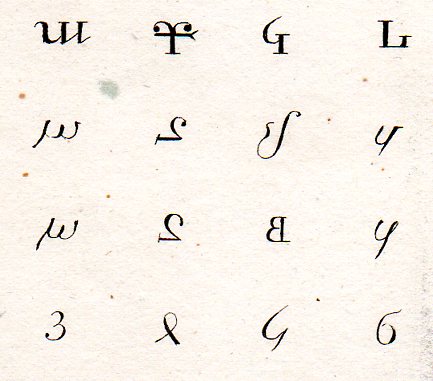
    With “all” of the recent talk about prime numbers I thought to post this elegant and small summary of the different ways of writing numbers.

    Number history316Above is a lovely detail of a collection of “ancient arithmetical characters”, including notations for the numbers 1 through 9 by “Boethius, Plenudes, al Sephadi, Sacro Bosco, Indian, Roger Bacon, and AL Sephadi”. 


  • Big Cities Missing from the Western Landscape, 1920

    JF Ptak Science Books  Quick Post


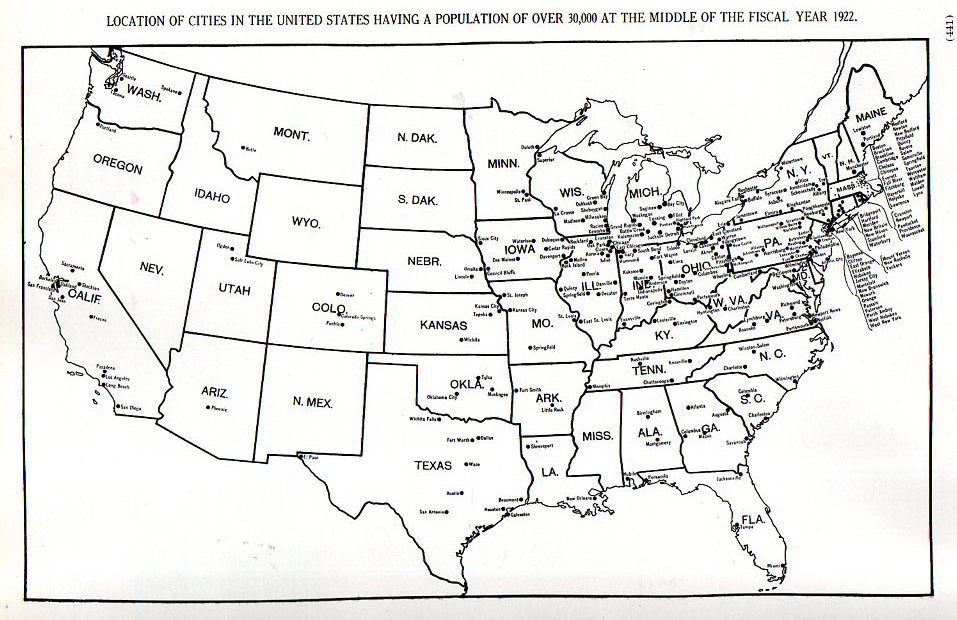
    Map census city pop318
    It is interesting to see in this found map that the U.S. was still a vastly under-citied place in 1920.  This map (from the Statistical Atlas of the United States, compiled by Charles S. Sloane in 1924) created for the census of 1920 shows the locations of cities with populations of 30,000 and above.  It is strikingly clear that once you move west of the Minnesota/Iowa/Missouri/Arkansas/Louisiana line, there are very few big cities.  38 in fact– and half of those in the two states of California and Texas.  The rest are distributed fairly widely: six states had no cities >30k, three had one, two had two, and four had three. Other than that, there was a 1000+mile swath of land hundreds of miles wide spreading from central Texas to Oregon in which there were none of these cities. 


  • Symbols in Francis Bacon’s Beautiful “Instauratio Magna”, 1620

    JF Ptak Science Books  Post 2029  Follow Me on Pinterest

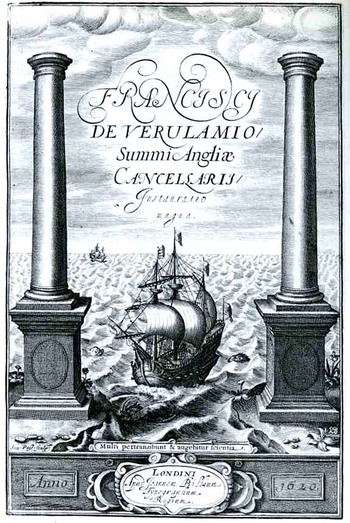
    Blogbacon038

    This sweepingly metaphorical title page belongs to Francis Bacon’s (1561-1626) superb Instauratio Magna, printed in 1620.  Bacon, the privileged and brilliant son of Nicolas Bacon, the Lord Keeper of the Seal of Elisabeth, entered Cambridge at the age of 12 and never looked back, becoming one of the leading thinkers of the English Renaissance. 

    The Instauratio contains his Novum Organum  (The New Oganon [New Instrument], or true Directions Concerning the Interpretation of Nature) a monumental pronouncement and a new way of looking at scientific thought, looking to break away from the established Aristotlean methods that had been in place in England and Europe for centuries. The “new instrument” part directly relates to Aristotle’s own work called Organon, which in short was a work of inquiry and a treatise on logic and syllogism—Bacon would present his own new instrument of logic base upon a simpler process of reduction. (Bacon famously begins this work “Those who have taken upon them to lay down the law of nature as a thing already searched out and understood, whether they have spoken in simple assurance or professional affectation, have therein done philosophy and the sciences great injury. For as they have been successful in inducing belief, so they have been effective in quenching and stopping inquiry; and have done more harm by spoiling and putting an end to other men’s efforts than good by their own.”  He continues in this vein, getting to the real crux of the biscuit, and broadly states in the second paragraph “Now my method, though hard to practice, is easy to explain; and it is this. I propose to establish progressive stages of certainty. The evidence of the sense, helped and guarded by a certain process of correction, I retain. But the mental operation which follows the act of sense I for the most part reject; and instead of it I open and lay out a new and certain path for the mind to proceed in, starting directly from the simple sensuous perception…”  And how!) This new approach to knowledge was foremost in the mind of the designer and artist who produced this title page, which is deeply indebted to the analogy between the (very deeply ingrained and mature) age of exploration and that of intellectual discovery.
    Blogbacon_bits

    The ship in this scene is passing through the Pillars of Hercules, exiting the relatively safe waters of the western Mediterranean and heading out to sea—-to accent this point we see two sea monsters at either side of the ship right at the beginning of this new-world trip, just feet beyond the established safe perimeter.  The pillars had long since been recognized as the western end of the world, as recognized by Dante in the Inferno, observing the voyage of Ulysses past the pillars, endangering the lives of his sailors in the justifiable

    Blogbaconplus_ultra
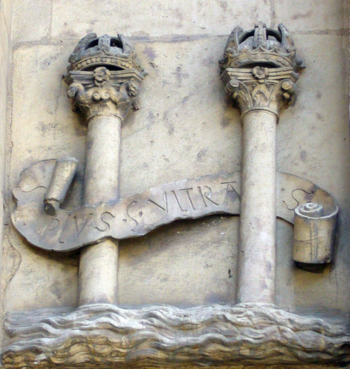
    search for knowledge of the unknown.  The Pillars appear in the coat of arms of Spain, originating with Charles V (the Holy Roman Emperor and also the King of Spain), with motto plus ultra (“further, beyond”) The plus
    ultra part fits nicely with the Bacon, even though the words are not there in the image, they really should be, emblazoned across the stern of the ship of Bacon’s imagination and intellectual enterprise.(The great voyage of discovery analogy and the  great new discovery in thought is probably painfully clear already.)

    Blogbacon_bits_latinThe image is captioned and summarized with the Latin phrase “Multi pertransibunt et augebitur scientia”, wrenched from the triumphantly problematic and slightly insane Book of Daniel (chapter 12, verse 4).  It is translated loosely as “many shall run to and fro, and knowledge shall be increased” or more elegantly “many will pass through and knowledge will be increased”—either way, whether by direct adventure and exploration or frenetic activity, the act of a new effort will be rewarded with a new knowledge.
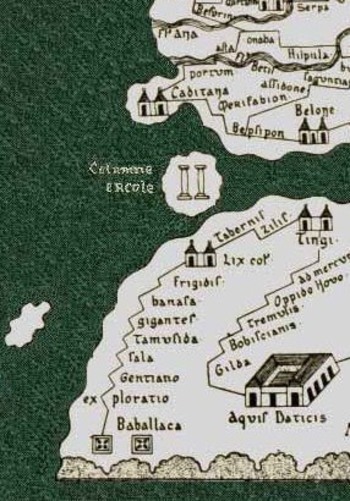
    The image below is from the Tabula Peutinger–basically a roman-era road map of the extent of Empire–and shows the location of the pillars.  They were mountainous metaphors existing at Gibraltar and Morocco, but folks were only too happy to relieve them in marble.

    Blogbaconpillars_2