A Daily History of Holes, Dots, Lines, Science, History, Math, Physics, Art, the Unintentional Absurd, Architecture, Maps, Data Visualization, Blank and Missing Things, and so on. |1.6 million words, 7500 images, 4.9 million hits| Press & appearances in The Times, Le Figaro, Mensa, The Economist, The Guardian, Discovery News, Slate, Le Monde, Sci American Blogs, Le Pont, and many other places… 5000+ total posts since 2008.

Author: JF Ptak

  • A Great Work of Artistic Display of Quantitative Data–German Losses in the Battle of Britain (1940)

    JF Ptak Science Books   Post 346 (from 2009)–extended

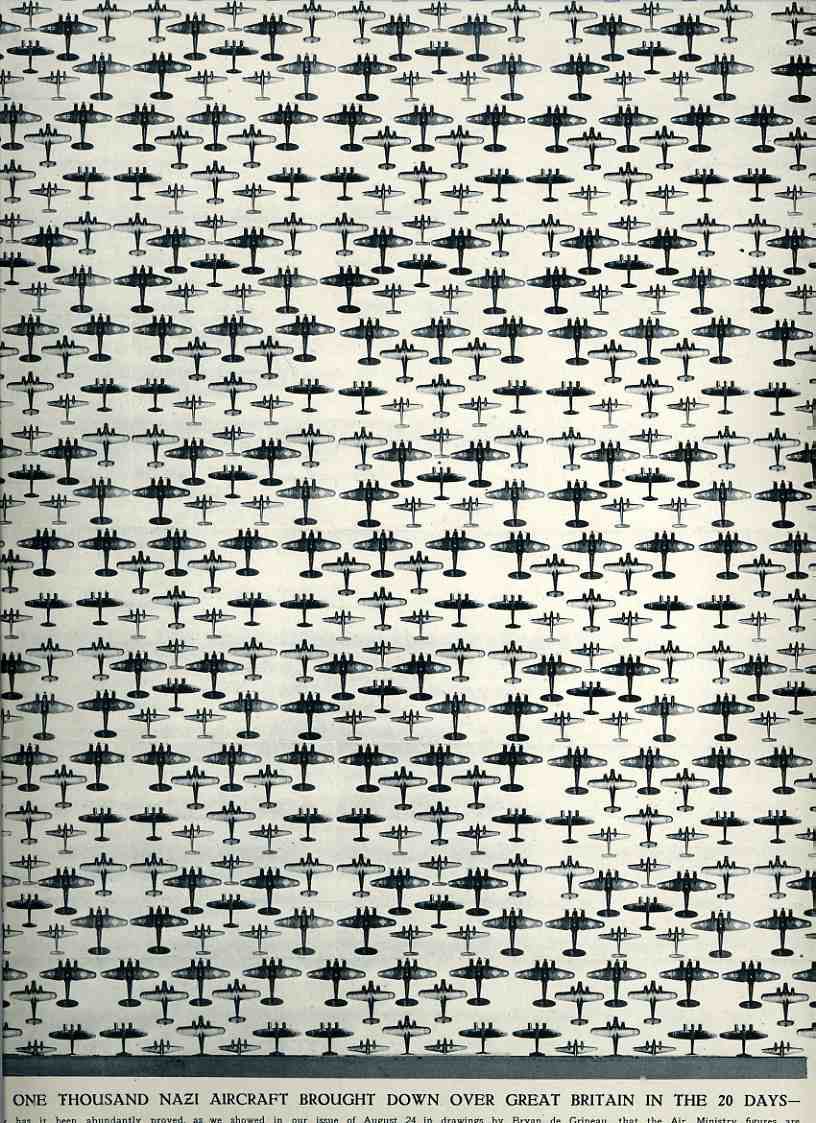
    This tremendous display is half of a double-page spread that appeared in The Illustrated London News for 7 September 1940.  It was meant to bolster the civilian population of Britain during the time of the German attacks, shoping that “Over one thousand Nazi aircraft (were) brought down over Great Britain in …20 Days…” The artwork, drawn by Bryan de Grineau, actually depicts 1000 planes, and accurately depicted ones at that.   What the graphic doesn’t tally though are the airmen losses, which would be considerably more than the 1000 aircraft:  for example, of the aircraft involved in the sustain air-invasion of England, the  Dornier 215’s had a crew of four, Dornier 17’s three, Heinkel 111’s four, Messerschmitt 110’s two, and Junkers 88’s three.  Thus  there were thousands more airmen lost, a commodity that the Nazis could little afford. 

    00-blog--Oct 29 battle britain Nazi planes952

      (This continues a thread on The Battle of Britain and also a post on “What 185,000 Planes Looks Like”).
     The results of the battle (and if you take a look at this earlier post for the full narrative), in terms of aircraft and humans, were,  for Great Britain: 1,023 fighters: 376 bombers, 148 coastal command aircraft  for a total of 1,547 aircraft and  544 pilots and aircrew killed.  There were also 27,450
    civilians killed and 32,138 wounded.  The Germans lost 873 fighters and 1,014
    bombers for a total of 1,887 aircraft and  2,500 pilots

    I find this visual display of quantitative data beautiful and compelling–and overwhelming in its way.

    The Battle of Britain was fought primarily from 10 July to 31 October 1940, so by the time this image was published the Brits had been able to turn the tide of Hitler’s plan.  (The air strikes wouldn’t really end until the Nazis turned their attention to the Soviet Union in Operation Barbarossa in May 1941.)  And that plan, named Luftschlacht um England, was to overtake and destroy the British capacity in the air, for as long as the English had command of the airspace there would be no way that the Nazis could force an invasion by land/sea (at least in the minds of the Oberkommando der Wehrmacht  and Hitler).  And so the Nazis failed–it was their first major defeat, and, especially, with the turning of attention east, it was a pivotal point of the war. 


  • Can Anyone Identify this Unusual Image?

    JF Ptak Science Books

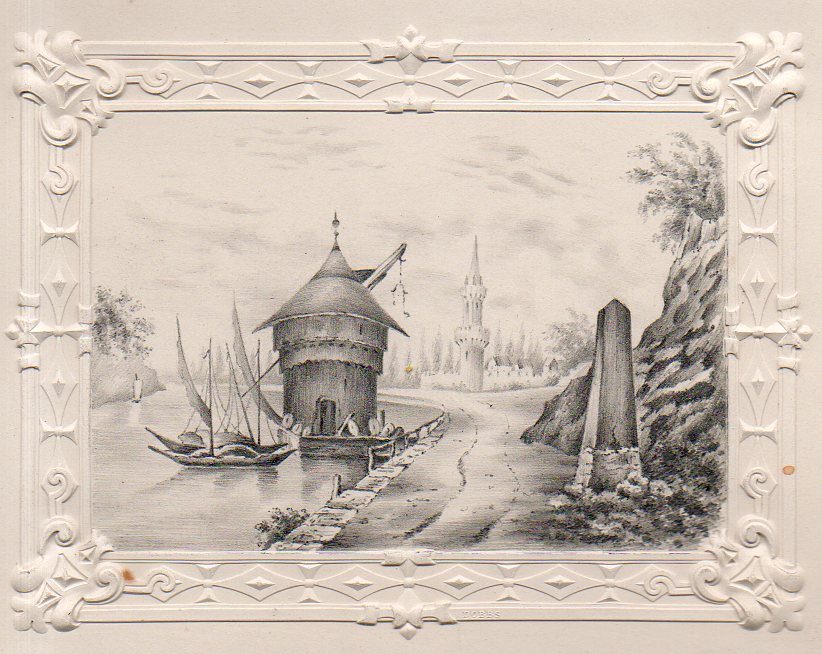
    I’ve owned this print for many years, and it has just recently returned from storage and is hanging up. I found it in a frame that seems to fit it perfectly, and the original paper seems not to have been cut to fit the frame.  The frame is old, perhaps 175  years old, with hand-forged nails and imperfect glass.  That really doesn’t help much, though.  I’m fairly certain that it is a print though I’m not 100% convinced it is not a drawing, and I feel as though the embossed border will be the biggest help.  The image is on a heavy card stock, and the embossed part is signed/printed “Dobbs”, the name of a manufacturer of embossed blanks and images and greeting cards and such, operating in the mid-19th century, though it looks like an earlier iteration of the firm (“Dobbs & Kidd”) was around at least from 1821.  So I guess the age of the image is pretty much half-guesstimated–I just haven’t a clue about the image, though it reminds me of several things…

    Odd print039
    And the detail:

    ·Posted by :

    ·in:


  • British Prisoners of War Calling! (1940)

    JF Ptak Science Books  Quick Post  See also an earlier post (with further links Humanitarian Propaganda–the Hope for those at Home.

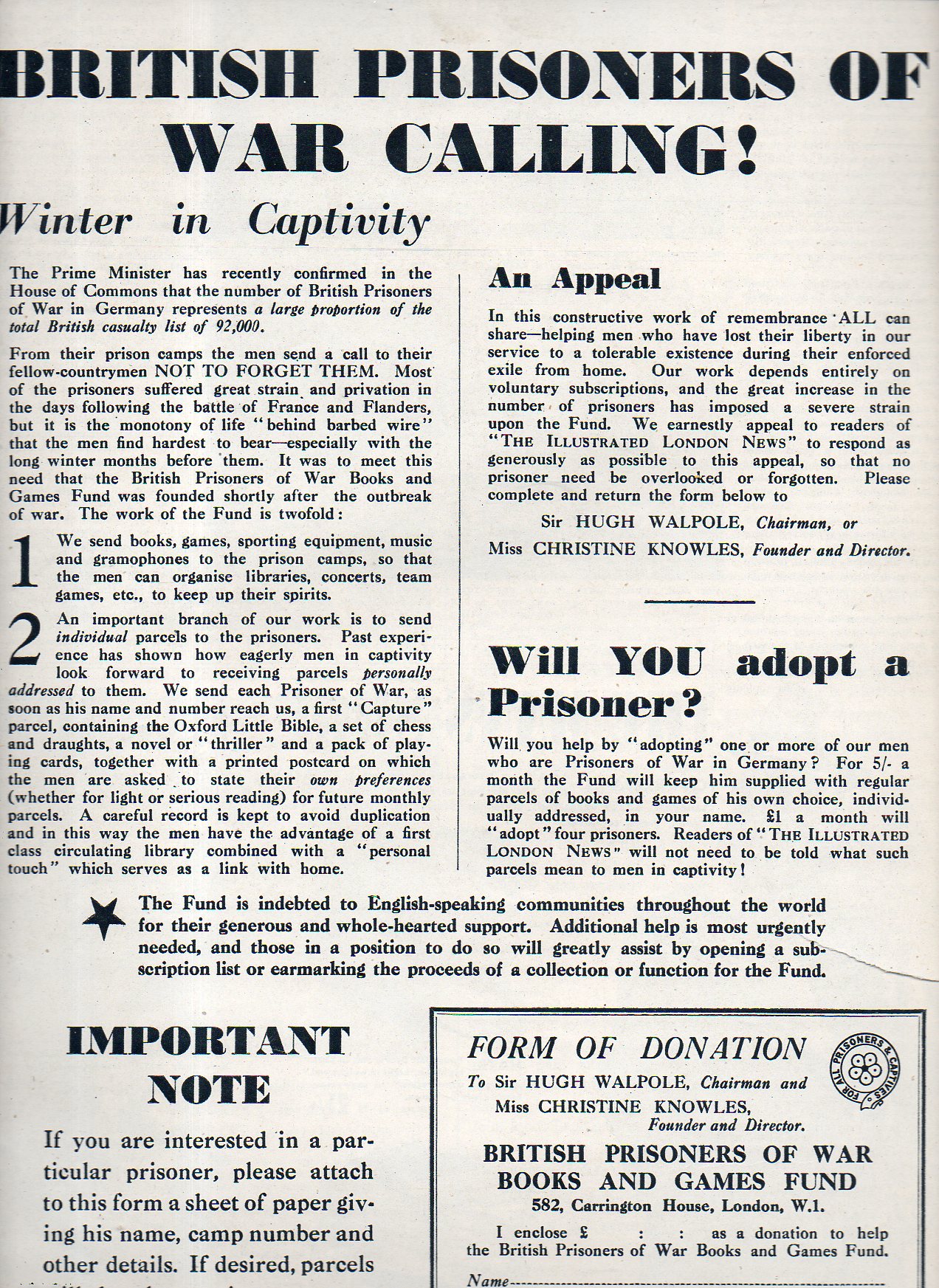
    This was certainly a civilized format to solicit sympathy and money for British P.O.W.s being held by the Germans, 13 months into a war that would force its way on for another 43 months.  It appeared as a bold full-page ad in The Illustrated London News on 16 November 1940, and it asked readers–who were now in the final phases of the Battle of Britain after full-on aerial assaults for through the summer months costing dozens of thousands of deaths–to think about the soldiers who had made the great sacrifice in protecting their country and being taken captive for it, and to give money so that some sort of comfort and aid could be sent to them in POW camps.  

    The goal from the outside seems reasonable enough–it remains to be seen how much of the million tons of good shipped to the POW camps by the Allied Forces ever made it to the prisoners. 

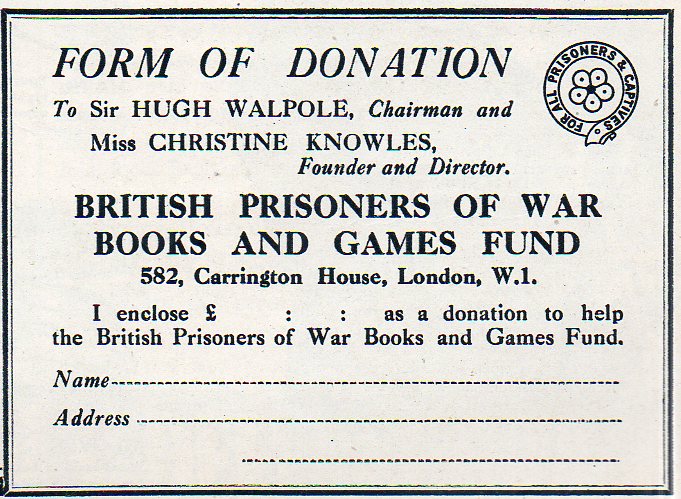
    I’ve included this short post in the History of Empty, Blank and Missing Things series not because of the hopelessness of delivering modest relief, but for a much more simple reason–exhibiting the unused coupon for sending funds to make that happen.  It has a certain emotional power to it that is difficult for me to identify.  

     “Communications have been reopened and it is the aim of the fund to equip every prisoners’ camp in Germany with a library, indoor and outdoor games, sporting gear, musical instruments and other goods. As a result of the debacle in the Lowlands and France the demand upon our resources has been very great and we are therefore issuing an appeal to Britons all over the world to help us in this work.”

    POW 1940037

    The donation form is a detail from thi sbig, full-page ad from the Illustrated London News for November 16, 1940: 

    POW 1940036

    The West Australian (Perth), 30 October 1940:

    “PATRIOTIC EFFORTS.PRISONERS OF WAR.A Books and Games Fund.Information was received yesterday concerning the formation of a British Prisoners of War Books and Games Fund in England, under the chairmanship of Sir Hugh Walpole. “As you know, there are now many thousands of British prisoners of war in German camps,”states Mr. J. A. Sinclair Pooley, of the appeal section of the fund, in a pamphlet received in Perth. “Communications have been reopened and it is the aim of the fund to equip every prisoners’ camp in Germany with a library, indoor and outdoor games, sporting gear, musical instruments and other goods. As a result of the debacle in the Lowlands and France the demand upon our resources has been very great and we are therefore issuing an appeal to Britons all over the world to help us in this work.”Owing to stringent Government regulations no books, games or other goods can be accepted by the fund, but monetary donations may be forwarded to the British Prisoners of War Books and Gamesfund, Carrington House, Hertford-street,London W.1, England.Under the scheme a prisoner can be adopted by any person so that, on receipt of donations, he will be supplied with books, puzzles and games in the name of the donor. The fund does not duplicate the work of the Red Cross Society in supplying food, clothing and educational literature.”

    ·Posted by :

    ·in:


  • Lowering the Mediterranean, 1930 (!)

    JF Ptak Science Books (continuing an earlier post) 

    A Monumental and Potentially Fantastically Bad Idea: Draining the Mediterranean

      Soergel403 [Image source: private collection.]

    “Simply the thing I am shall make me live.”–from Jorge Luis Borges, “Shakespeare’s Memory”

       
    It would be a Purgatory, or worse, to suddenly wake up one morning with another person’s memory–worse yet than to have wished it, only to find that you didn’t want it at all.  This evidently works out with memories high and low, though it is tempting to want to wish to see what the inspiration looked like for one idea located in a particular memory.  Or maybe not.  But I am curious about when and here the author of the pamphlet above got his idea, and what it looked like to him–did he hear or see or smell something that prompted the inspiration for this reverse-monumental jolt?

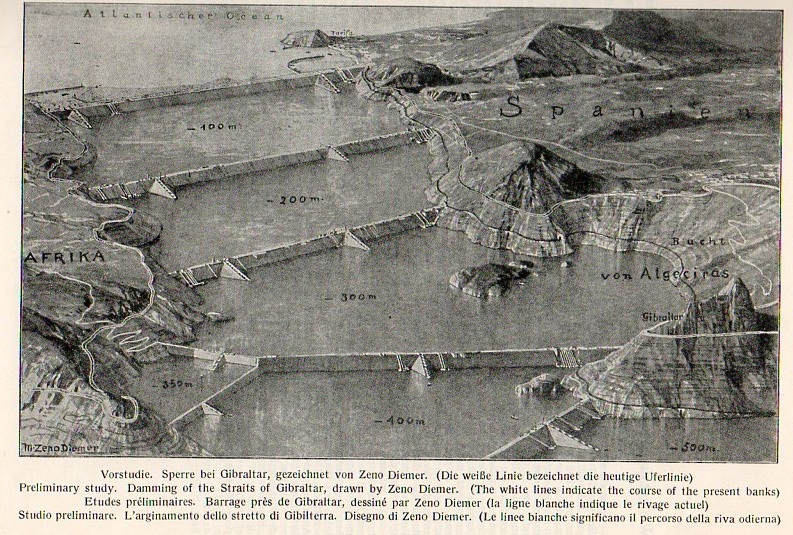
     It is interesting to pursue a loose thought like this to its not-necessarily logical end.  Such is the case with the self-styled Paneuropic ideas of Hermann Soergel (1885-1952), the author of the above. Soergel was a Bauhaus architect and author of a number of works on design and far more ethereal, floating-castle ideas. His most spectacular contribution—incubated in the mid-1920’s and still clinging by its fingertips as an idea among some current thinkers—was to put a dam across the straights of Gibraltar.  The dam would generate electricity of course, but most importantly to Soergel, it would also empty an enormous amount of water from the Mediterranean leaving vast new expanses of land to be developed and colonized over generations into the future.  The water of course would have to go somewhere, and that somewhere was the Sahara Desert, somehow in its wake creating farmable and productive lands. Soergel was creating a certain, very wide, fantastical future of uncertain monumental prospects.

    Soergel405
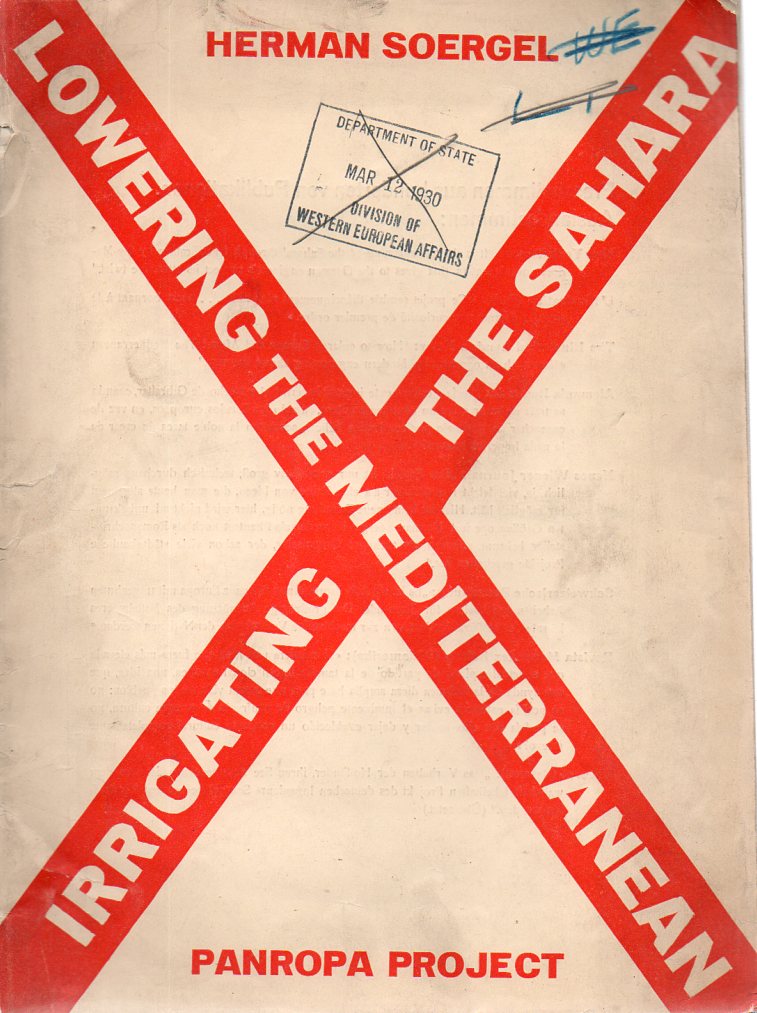
    A “brief outline” of the idea was published in this four-language pamphlet, Lowering the Mediterranean Irrigating the Sahara (Panropa Project), which was published by J.M. Gebhardt in Leipzig in the very bumpy year of 1929. (The Weimar years in Germany were already into deep bumpiness; the rest of the world would follow suit in October of that year.)  To be fair, Soergel didn’t plan on emptying the entire Mediterranean, just a bunch of it–at least enough to be able to rename it.

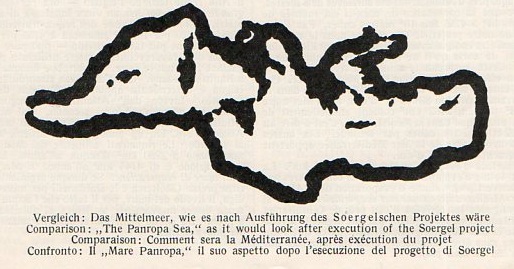
    [Here’s a map of the new Mediterranean, or the Mediterranean that would be made to go away.  As you can see at this point Sicily and Italy become enormous, and the Greek Islands are combined to form one large land mass–this last bit alone is enough to form total and complete reisstance to this idea. Also at this stage perhaps 150 or so miles of new lands have been reclaimed from the sea all along its former borders–more so in Turkey.  There is no mention as yet of any new islands that are formed in the sea water’s wake.]

    Soergel404

    The master plan at work was that the world would be divided into three economic spheres in the future, all beginning with the letter “A”:  American, Asia, and the new land to be created by Soergel, “Atlantropa”, which was the former Europe expanded into the new dry beds of the Mediterranean and North Africa.  And also of course Egypt, which would be covered with “thousands” of canals and become semi-submerged by the new borders of the meandering sea.  This would be the way for Europa to compete with the rest of the world in the future. 

    [I should point out that the image above comes from the Illustrierte Zeitung (Leipzig) for August 1931, and is a drawing by an artist named “AS. Christ” depicting a cross section of one of the bridge/dams of Soergel’s Panropa’s ideas.]

    Perhaps it is actually three steps to get from the idea of damming up the straits of Gibraltar to the osmosis of Shakespeare’s memories into someone else’s brain—a squinting acquiescence of the middle touch being the brilliant Jorge Luis Borges.  You see it was in the Argentine master’s last published story, “Shakespeare’s Memory”, that we meet Herr Soergel (as Hermann Sorgel) again.  But so far as I can remember Soergel exists only as a fictional character, with no reference to his real-life self.  In this wonderful story, Soergel inherits the memories of William Shakespeare—these bits come to him slowly but surely, until they start to conflict with his own memory, and things get difficult.  The man with Shakespeare’s memories winds up phoning strangers on the telephone, giving them away at random, until Soergel is left with his own mind again.  Superior as Bill’s memories were, they still weren’t Hermann’s, who wanted his own life back in the end. 

    And so from the titanic, pan-europic technodream of Bauhausian Hermann Soergel to the dead brains and living memories of William Shakespeare, all through the fingers of the beautiful Jorge Luis Borges.  

    ==Blog July 21==shakespeares memorie

    I’m sorry to report that at the end of it all, near the end of the pamphlet, Soergel releases his opinion on the political importance of his project.  And yes, his aim was to form an alliance between the new PanAmerica (of the “three Americas” with the new Pan-European African Union to thwart “the yellow peril” which “arises from the racial antipathy of India, China and Japan.  Soergel writes that “the fate of occidental civilization…will be settled on the Mediterranean”.  

    After it is all said and done, perhaps the best reiew of the work by Soergel is provided by the graphic designer who put the Big Red X on the cover of his work.  It fits. 

    Some of the works by Soergel include the following:

       Atlantropa. Fretz & Wasmuth, Zurich / Piloty & Löhle, Munich 1932

    Vorwort zu: Wayne W. Parrish : Technokratie – die neue Heilslehre , Piper, München 1933

    Die drei großen A, Amerika, Atlantropa, Asien , 1938. The three large A, , Atlantropa, Asia, 1938

    Atlantropa-ABC. Atlantropa ABC. Kraft, Raum, Brot. Kraft, Raum, Brot. Erläuterungen zum Atlantropa-Projekt , Arnd,Leipzig 1942 

    Some works about  Soergel: 

    Alexander Gall: The Atlantropa project. Die Geschichte einer gescheiterten Vision. The story of a failed vision. Herman Sörgel und die Absenkung des Mittelmeers .

    Herman Sörgel and the lowering of the MEditerranean . Campus, Frankfurt am Main 1998. 

    Wolfgang Voigt: Atlantropa. Wolfgang Voigt: Atlantropa. Weltbauen am Mittelmeer. Building the Mediterranean world.Ein Architektentraum der Moderne . An architects dream of modernity. Dölling und Galitz. Hamburg  1998.


  • Found-Art in Electrical Discharge, 1880

    JF Ptak Science Books   Post 2212  History of Anticipation series   

    It makes me wonder about how things were labeled “art” in the history of labeling things.  In a way it is not at all like naming where the American “West” is, or where the “South” begins, because those definitions seem to get very local and very detailed very quickly, and then the labels get bigger and wider and more open to interpretation.  That is to say that the labels make more accommodation for the idea, at least far more so than the labeling of “art” was concerned in the pre-Kandinsky/Cubist/Abstract era, or at the very least before the era of early impressionism.  
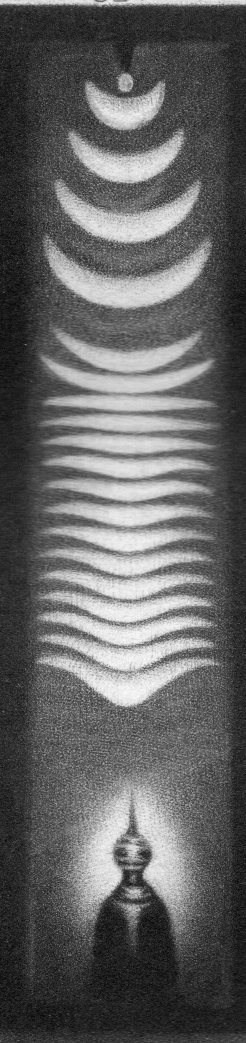
    Electrical discharge031

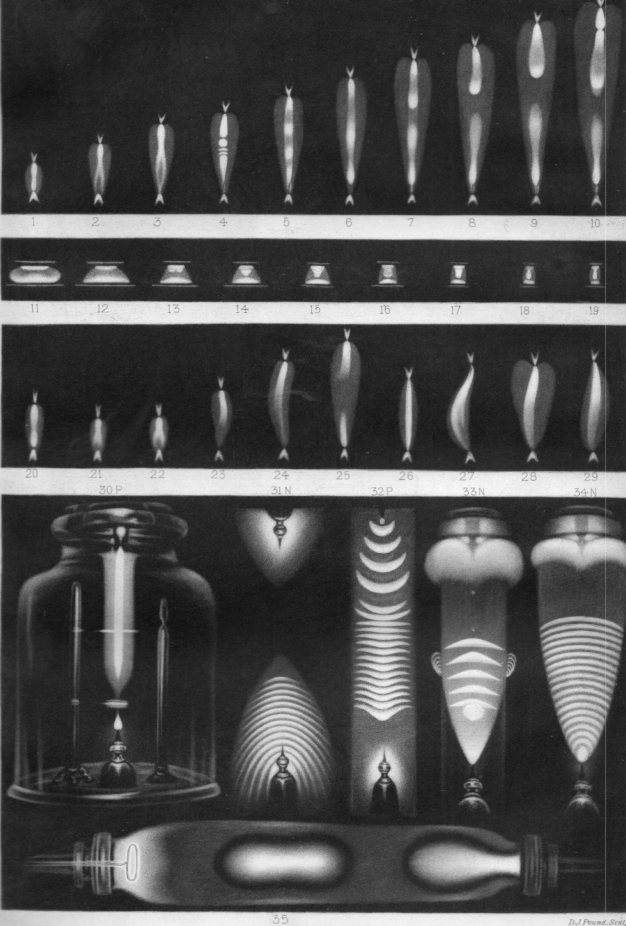
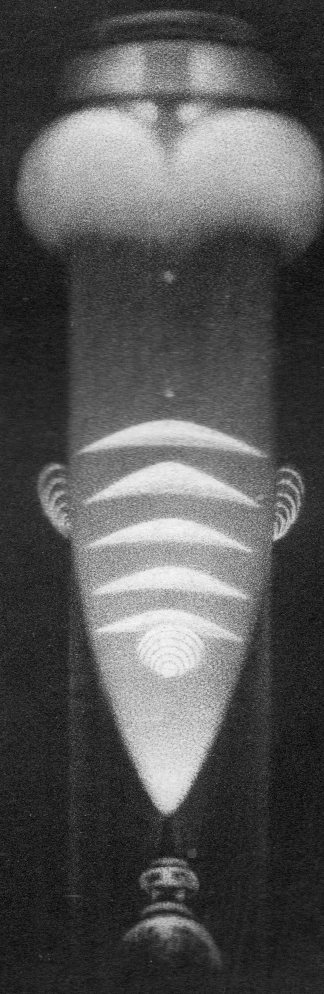
    This is a tiny detail from a full-plate plate from Nature, in an article by Warren de la Rue on electrical discharge (and printed 24 June 1880). (Actually, the big full-page images like this are fairly rare in Nature–more so when the image is mostly very dark, meaning they took a lot of ink to print.)  It is a beautiful thing, and was probably always considered beautiful in a scientific sense, though I think it would have been very highly unlikely for it to have been appreciated in an extra-scientific artistic sense by significant portion of the viewing population, let alone be called “art”.  Even if someone approached it as Impressionistic, it still did not resemble anything recognizable, and those days for non-representational art was still more than 30 years away.  

     Calling things “art” was far more regulated at this in the art history than what it would become in the decade of so after the popularization of discussion on the fourth dimension and the discovery of the X-rays and Thomson’s atom and then, just a little while later, the first appearance of the theory of relativity. The protocols were far more strict prior to the invention of Impressionism (I have no idea how J.M.W. Turner survived in his Outsider-y genre for all of those decades before progressive Impressionism) than those that existed in 1880, or at least for those that existed that could consider these electrical discharge images as “art”.  

    Of course Roualt and van Gogh and Rosseau and Braque and the rests had their own difficult experiences with acceptance, and some were even rejected by the groups that they helped to establish (like Duchamp with his readymades getting the heave-ho in NYC).  

    In general though there were very few people who had one foot in the Beaux Ecole school who could have another foot in the expansive world who could have considered scientific images like these as “art”.  

    The full image: 

    Electrical discharge030


    See also this post on Emily Van der Poel’s beautiful pre-abstract/cubist found art :  

    Art-vanderpoel186 


    Electrical discharge032


    ·Posted by :

    ·in:

    — —

  • A Beautiful, Complex Mess Illustrating the Entire Development of Human Society (1926)

    JF Ptak Science Books   Quick Post   Outsider Logic series

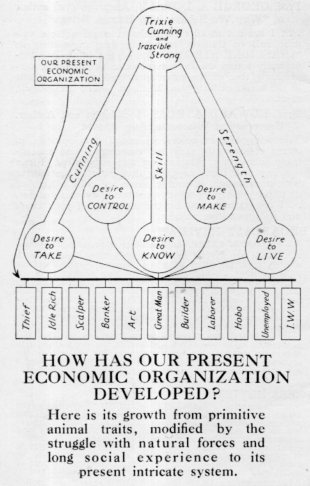
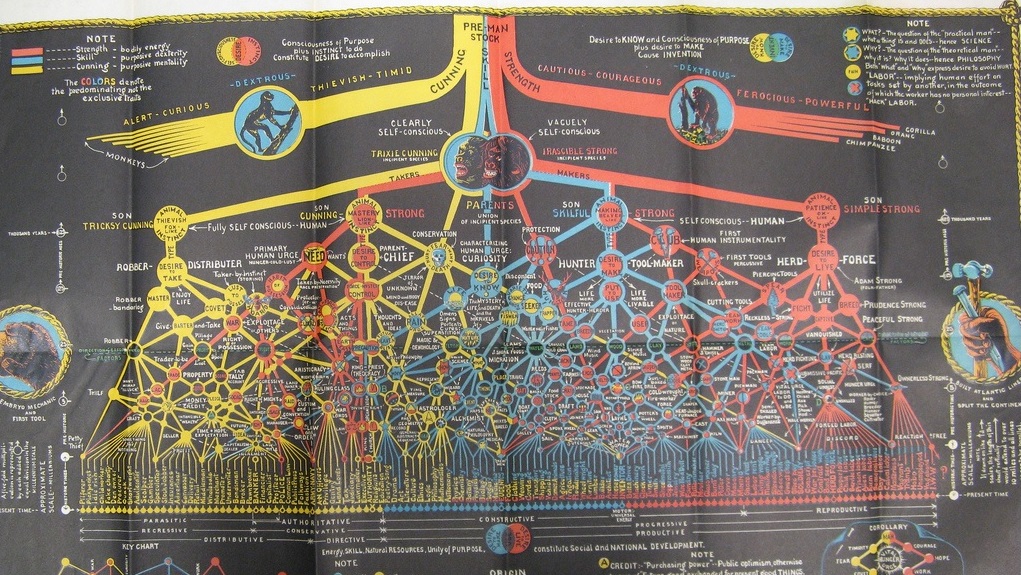
     I’m not sure what is going on or not going on in these diagrams/charts from the unusually-titled proto-outider-humorist  Concerning Irascible Strong and Trixie-Cunning, and their sons: Cunning-Strong, Skilful-Strong, Simple-Strong, Tricksy-Cunning, and their descendants, by William H. Smyth (and printed in 1926).  It is a lot of title to live up to.  Or down to.  In any event, the meaning behind it all is a mystery to me, but the mystery behind not wanting to know what it was all about is not a mystery at all–after all, isn’t a plate of spaghetti prettier as a mess than it is all straightened out? 

    Trixie chart029

     I suspect that this was intentional as an intended mess of confusion, but I really don’t need to know if this was a humorous work or not. But Mr. Smyth did produce a very involved display of something or other:

    Trixie

     [Source for graph images: here (Flickr account for Johnxlibris]


  • Sleep Aids for the Blitz, 1940

    JF Ptak Science Books   Post 2211

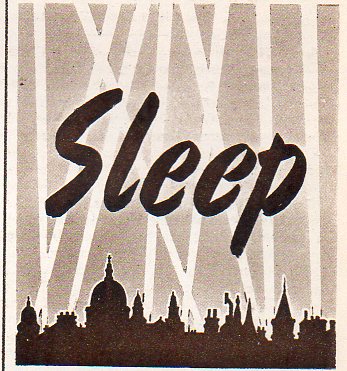
    Blitz sleep026

     Part of the winning-the-war effort in Great Britain in 1940 came with the expense of proceeding with as many normal bits of life as possible while still being bombed.  When this advertisement appeared in the Illustrated London News for 23 November 1940 the Battle of Britain–fought already for months and killing 24,000+ civilians (and wounding 30,000+)–had largely turned the corner though it would continue nearly half-way into 1941, with the more than 3,000+ civilians killed on 19 December 1940. It was in this issue that images from the Blitz at Coventry (from 14 November) are shared for the first time in this magazine–it was not the first raid on Coventry by any means, but it was perhaps the most infamous.  It was the belief at the time that continuous bombing of civilian populations (that is, “area” vs. “precision” bombing, which was theoretically outlawed in various forms by the Hague conventions of 1907 and again in the 1920’s and the Geneva conference on disarmament in 1932) would reduce the enemy’s will to fight–recognizing these rights of civilians in wartime was as little followed as the suspected moral-busting/war-ending reasons for the bombings were wrong.  

    Ads in the Illustrated London News were not very heavy at this time, and this was hardly the only ad making reference to the war–there were in fact a number of them using the war as a background to selling a product that really had nothing to do with the war effort.  For example, “Lorola” sold  a skin cream with a war-ish flavor, and Harmer’s was advertising stamp collecting as a way to understand the war.  There are others, like “Chilprufe”, who advertised their underwear “for national service”, which was partially true, as well as Players and Churchmans selling tobacco and cigarettes–mostly though those advertising goods for the war effort were so, like Burberry’s “RAF equipment”, Austin Reed for officers’ clothing, Hector Pave for “winning service” officers’ uniforms, Nicolls of Regent Street for ARP service coats, and the like.  Johnnie Walker had big color back cover ads, but they usually featured something war-related, like a war bonds booklet on a tray along with two glasses of Johnnie (neat).  Gunniess had a more humorous approach, for example, featuring an opened bottle of the great nectar and an empty used glass, with a taped notice “opened by censor” on the bottle. From my reading of LIFE during this time, the ads using the war as backdrop for non-war-effort goods in that magazine were far more common than those in the ILN–there were far fewer of those sorts of ads in LIFE by 1944, however.  

    ·Posted by :

    ·in:


  • Fun with Physics: Listening to a Spoon, 1880

    JF Ptak Science Books   Quick Post   Unintentional Absurd & Found Surreal Division 

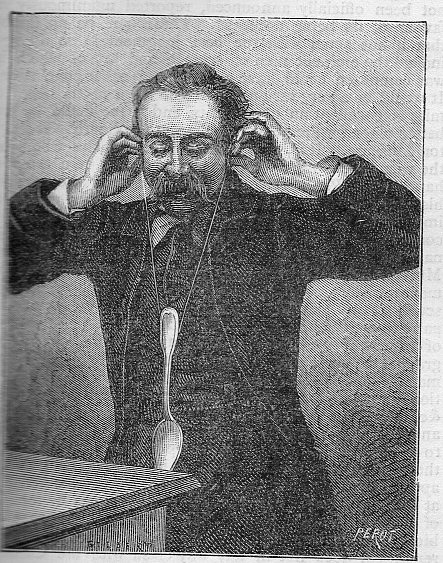
    String telephone027

    This is one of a series of images from six-part article in Nature in 1880 called “Physics without Apparatus”.  It is actually a fun series in a Victorian-science-high jinx sort of way, and this image is a little more fun than most, especially removed from their context. In-context, this gentleman is experiencing teh sound of church bells by bumping the spoon suspended from his ears on hempen lines lightly against the table’s edge; out-of-context, it looks like…

    ·Posted by :

    ·in:


  • “What the Frog’s Eye Tells the Frog’s Brain” and Walter Pitts

    JF Ptak Science Books  Post 2210

    I was walking around a 1959 issue of the Proceedings of the Institute of Radio Engineers I found this fantastic article by the great Walter Pitts.  What was Mr. Pitts and a frog’s brain article doing here?  Well, it all makes sense, really, and I was very happy to unexpectedly find Pitts here when I was looking for something else.  Walter Pitts (1923-1969) is one of those very important but now somewhat faded names in the history of American science.  He was a brilliant young man turned into a brilliant mature one, a logician/cognitive psychologist who corresponded with Russell on the Principia at age 15 and who went on to develop (with Warren McCulloch) some of the fundamental ideas in what would be known as neural networks.  The work was really much more far reaching, touching work in the fields of artificial intelligence, cybernetics, neuroscience(s), philosophy, cognitive sciences and of course computer science.

    https://historyofideasblog.com/a/6a00d83542d51e69e201156f67025e970c-piPitts was a genius I’m sure,  a sort of Matt Damon-type character from the movie Good Will Hunting1. He was offered a chance to study with Russell in the U.K. at 15, but refused and wound up running away from home to go to the University of Chicago to listen to Russell lecture, and where he stay on, finding another great logician, Rudolf Carnap (then at Chicago) and offering him critiques on his new work.  Pitts would blow like the wind in and out of Carnap’s office, the logician spending months trying to find out who and where Pitts was–and what he was was a homeless teenage boy.  Once found, Carnap got Pitts a low-level maintenance job.  I’m not sure what Pitts was doing before he switched ships and jumped (still homeless) to MIT in 1942, where he was introduced and was impressive to the not-to-be-impressed Norbert Wiener, and where he also met Warren McCulloch, with whom he would work on the Leinbizian idea of the nervous system as a sort of universal computer, publishing their outstanding “A Logical Calculus of Ideas Immanent in Nervous Activity” in September 1943.2

    Right before this paper–which is considered to be a founding effort in the field of neural networks–Pitts published three other papers of interest in this same area (and in the same journal)–all published when he was 19 years old. “Some observation on the simple neuron circuit”,    “The linear theory of neuron networks: The static problem”, and “Some Observations on the Simple Neuron Circuit” were all efforts leading up to his paper with McCulloch one year later.   Impressive work, especially for a 17-year-old, and particularly for a new, high entry point journal published by the University of Chicago, entertaining the logical structure of neural nets as coded circuitry, a new way of looking at the mechanistic view of philosophy of mind. 

    Things however really didn’t go well for Pitts: he was fiercely, probably tragically “shy” or demanding of his own attention, exceptionally modest, and with very few personal relationships.  Just a few years later, a rift developed between the wife of Norbert Wiener and McCulloch, and was of such vehemence that anyone maintaining a friendship with McCulloch would be shunned by Mrs. (and therefore, necessarily in this case, Dr. )Wiener.  And thus Pitts remained friends with McCulloch and lost contact with just about everyone else, making his working/contributing life quite difficult.  Little is known about what happens to Pitts in the 1960’s, but it wasn’t good, and he wound up dead, featuring symptoms indicative of severe alcohol abuse, in 1969.  He was 46, and his best work was already 25 years old. 

    _______

    Notes:

    1. We read in this  wonderful account of Pitts from Neil R. Smalheiser’s  appreciation, Walter Pitts ( found in: Perspectives in Biology and Medicine – Volume 43, Number 2, Winter 2000, pp. 217-226):
    [Introduction ] “The movie Forrest Gump made the point that the greatest, most heroic Americans are people of extraordinary character who flicker briefly into public consciousness and are quickly forgotten. Walter Pitts was pivotal in establishing the revolutionary notion of the brain as a computer, which was seminal in the development of computer design, cybernetics, artificial intelligence, and theoretical neuroscience. He was also a participant in a large number of key advances in 20th-century science. Yet while his contemporaries Alan Turing, Ludwig Wittgenstein, and John von Neumann entered the pantheon of fame, Pitts remains a shadowy folk hero. Stories about Pitts have circulated among the cognescenti for years, but almost nothing has been written about him. Here, I have collected reminiscences from his friends and associates to provide a unique insight into a remarkable life; if some exaggerations and embellishments have crept in, they only underscore the basic truth that Pitts was a man with Gumption ability…”

    2. Warren McCulloch remembers Pitts in this way:  “In 1941 I presented my notions on the flow of information through ranks of neurons to Rashevsky’s seminar in the Committee on Mathematical Biology of the University of Chicago and met Walter Pitts who then was about seventeen years old.  He was working on a mathematical theory of learning and I was much impressed.  He was interested in problems of circularity, how to handle regenerative nervous activity in closed loops. …   For two years Walter and I worked on these problems whose solution depended upon modular mathematics of which I knew nothing, but Walter did. “ (McCulloch, 1989, pp. 35-36, cf. McCulloch, 1965a, pp. 9-10).
     

    ·Posted by :

    ·in:


  • Strange Things in the Sky Department: Feathers

    JF Ptak Science Books    Strange Things in the Sky Department  Post 2209

    In the 30 or so posts I’ve made in this department I have yet to deal with anything having to deal with birds. This is understandable since they’re the ones who have been up in the air for 200+ million years (or at least late Jurassic), while humans have been in the air for only about .0001% of that time in our controlled falling.  

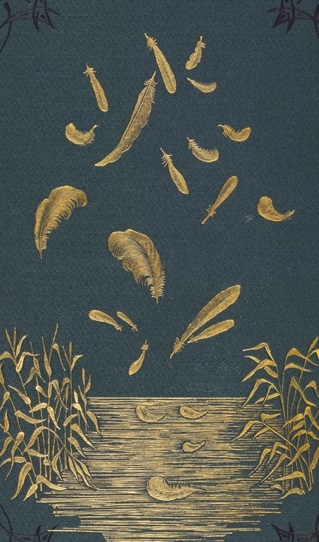
    Feathers detail

    But it still struck me as odd, these feathers in the air, and very uncommon to my decades+ experience of Looking At Pictures. They are simply a gilt-stamped decoration in a book cover, a piece of arresting design, for an ornithological journal (see below)–still, it is an unusual image, in-context or not. 

    I imagine that if you were resting on this little body of water from the journal cover and one of those feathers happened to fall on you that it would be quite the experience.  But there was a time when receiving a feather meant something far worse than an unusual natural history experience. That was the other thing about this unusual book cover decoration–it reminded me of a piece I read a few years ago (found again!) by Francis Beckett of The Guardian who tells a very difficult story about his grandfather receiving a white feather from a complete stranger on the street during WWI.  The brief story here is that his grandfather tried to enlist in 1914 but was not accepted because of poor eyesight and also being the father of three girls; but, while out and about in 1916 he was handed a white feather from a woman on the street, a complete stranger–that feather at the time being a symbol for cowardice.  Evidently the grandfather went the next day to enlist, and after millions of deaths the eyesight/children issue two years earlier was no longer an issue–he was accepted,  and fought for two years before being killed in 1918.  Beckett’s grandmother held the white feather woman responsible for her husband’s death.  

    The feather has meant many things to many cultures for thousands of years, and nearly all of it was good:  ascension, lightness of being, virtue, glory, flight, and so on, mostly having to do with cosmic connectivity.  On the other hand using the white feather for taking flight from duty and cowardice was a devastating thing.  


    ·Posted by :

    ·in: