A Daily History of Holes, Dots, Lines, Science, History, Math, Physics, Art, the Unintentional Absurd, Architecture, Maps, Data Visualization, Blank and Missing Things, and so on. |1.6 million words, 7500 images, 4.9 million hits| Press & appearances in The Times, Le Figaro, Mensa, The Economist, The Guardian, Discovery News, Slate, Le Monde, Sci American Blogs, Le Pont, and many other places… 5000+ total posts since 2008.

Author: JF Ptak

  • A Very Sympathetic Statement on the American Indian, 1880

    JF Ptak Science Books  Quick Post
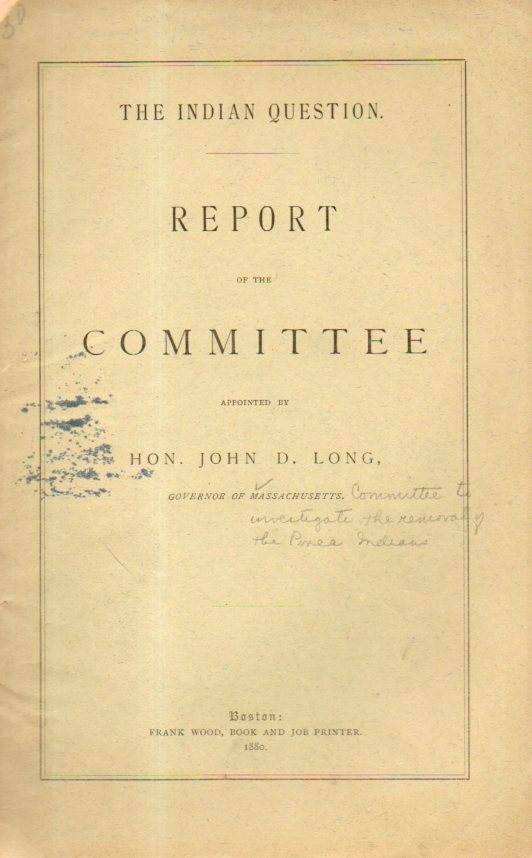
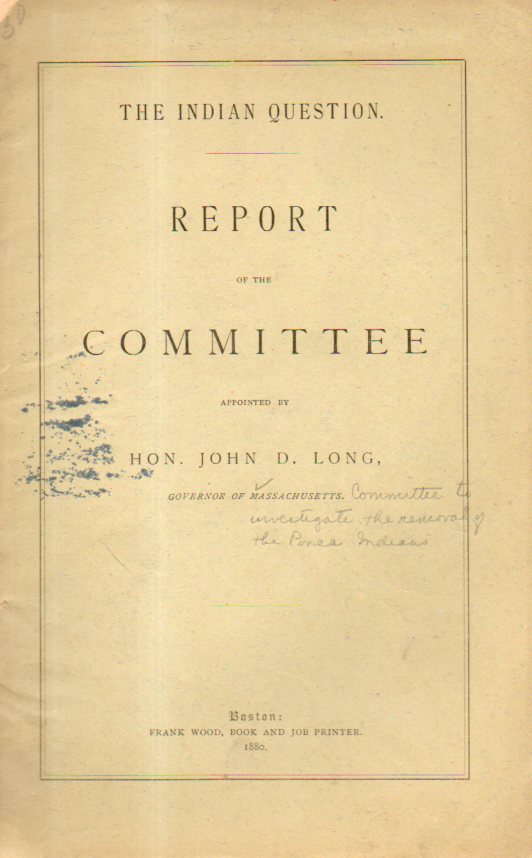
    Indian question576The fighting end of the American Indian Wars was coming to an end when this pamphlet was published in 1880.  When I opened it I fully expected to see the issue of the “questions” of the American Indian being Indian control, or the “problems” of Indians retaining reservation lands now much in demand by settlers, and so on. As it turns out, this report was a very sympathetic investigation of the problems that the Indians were having. The “Indian Question” was a big one–why were the Indians  being so hideously treated?  


    Some of the discussion presented in the pamphlet included section headings like  “unsuitable reservations”, “the way the government robs the Indian”, “evils of the present system”, “Indian children equal to the white in capacity”, “rapid advancement of Indians”, “robbery of property of Indians”, “gross mismanagement and cruel treatment of Indians, “the punishment of murderers of Indians” (which the pamphlet records as “none”), “violation of treaties by the U.S. government”, “inexcusable neglect of Indian Department”, and such.   Pretty impressive.

    Here’s the entire document from the Internet Archive–it is well worth at least a browse. 

     https://archive.org/stream/indianquestionr00indigoog#page/n10/mode/2up

    Notes

    1. LONG, John D. The Indian Question, Report of the Committee appointed by Honorable John D. Long, Governor of Massachusetts. Boston; Frank Wood, 1880.  8vo, 26, 47pp.  Original wrappers, institutional stamp on rear wrapper from the Library of Congress; U.S.  Geological Survey rubber stamp on back of the title page

  • An American Hobo in Europe (Well…Scotland) 1907

    JF Ptak Science Books  Quick Post

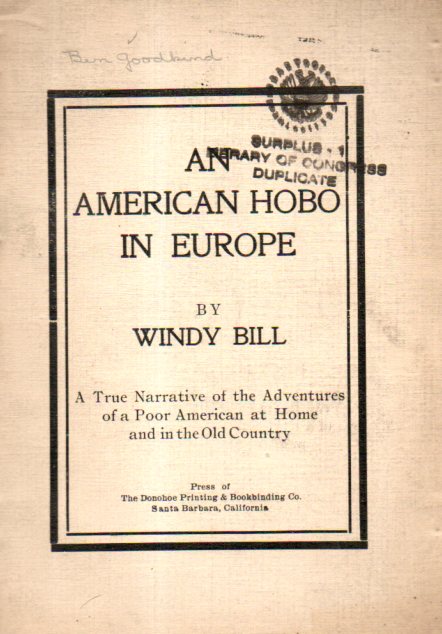
    American hobo575There’s plenty of European stuff and wind in this breezy recounting of a life on the road, but when I opened up this stubby pamphlet my eye feel by chance on his American travels, finding Windy Bill in Winnemucca, Nevada (a 550-mile drive north of Las Vegas).

    Windy does make some pretty interesting observation on Winnemucca, though:”Saloons are plentiful and all drinks are ten cents straight, with no discount for quantity. A pretty good meal can be had for two bits, but short orders and such things as life preservers, sinkers, or a bit of “mystery” with coffee, are all the same price—two bits. I found no place where I could get anything for less.There was a river or creek at the further end of town wherein I wished to bathe, but the water was so intolerably filthy that I deemed it wise to wait until I found a more suitable place along the route.”

    Windy takes more than half of the book to move himself from San Francisco to New York City, where he grabs a $27 ticket to Glasgow.  

    It really is a semi-interesting read, from what I can make of it, a U.S. vagabond vagabonding in Europe, though there are some unnecessary and inexplicably long quotations from Robert Burns that take up 40 pages or so. That said he does record some gems and pearls, like this:  

    “I drifted along Salt Market Street and then came upon a street which, for want of a better name, was called Sauchiehall Street, in the neighborhood of which I saw a restaurant called the “Workingman’s Restaurant,” on the side-wall of which was painted in large letters the following bill of fare:

    Tea, 2 cents.
    Coffee, 2 cents.
    Porridge and milk, 2 cents.
    Sandwiches, 2 and 4 cents.
    Eggs, 2 cents.
    Ham and eggs, 16 cents.
    Broth, 2 cents.
    Pea soup, 2 cents.
    Potato soup, 2 cents.
    Beefsteak pudding, 4 cents.
    Sausage, 2 cents.
    Collops, 4 and 6 cents.
    Dessert puddings, 2 cents.
    Fish suppers, 8 and 12 cents.
    Tripe suppers, 8 and 12 cents.

    Overall though his “European” trip isn’t much of one, unless people in the U.K. describe themselves as being “European”, which they are not wont to do. Windy Bill crosses the Atlantic and gets to Scotland, but doesn’t advance any further east. 

    ·Posted by :

    ·in:


  • The Discovery of the Future of Roads (1918)

    JF Ptak Science Books  Quick Post

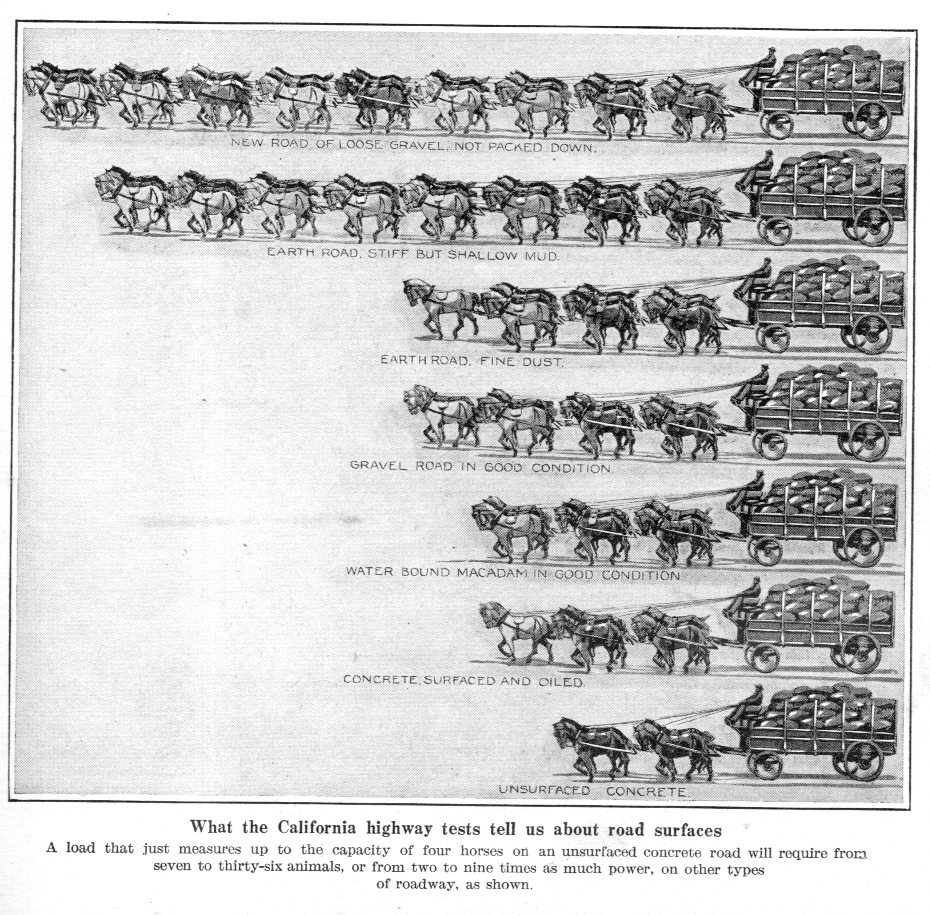
    “Only within very recent years has the paramount influence of roads upon the nation’s life been adequately realized”, so starts this article in the Scientific American for January 5, 1918. No doubt–between 1914 and 1918, the motor vehicle registration doubled and then nearly doubled again (1.7 million to 6.1 million over five years). And since it is far more relatively easy to make cars than  the roads they drove on, it is safe to assume that with this enormous increase in road traffic that it made planners and engineers of various shapes and sizes really think about the issue of roads in the future, as they could well see that car production was exploding and that car prices were making the auto affordable to just about everyone.    

    Roads571These artistic displays of quantitative data really do convey a message to a general audience–that aside from the engineering that went into them.  It is also useful to the historian or reader in history, or anyone interested in how people got from one place to another 100 years ago, and on what sort of surface they were making their way on…and what the surface of that road meant to the traveler.  I do not recall Mr. Holmes making any statements regarding travel time and the conditions of the roads on which the travel was made, but I have no doubt that he would have considered them using data much like this.  


  • Electricity, Holes, Punch Cards, and the Computer (1878)

    JF Ptak Science Books  Post 2375

    Jacquard loom142

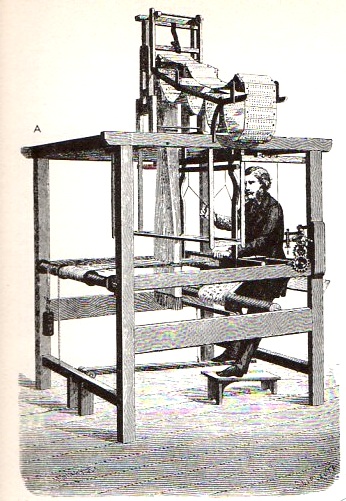
    Alfred Barlow wrote a splendid history of weaving1 in 1878, and in that book’s later pages–and I suspect much overcome with the recent developments in the electrical field (not the least of which were the newly-invented light bulb and telephone)–Mr. Barlow waxes considerably on the application of electricity to the Jacquard process.

    He writes,”It is scarcely to be wondered at that men acquainted with the application of electricity to telegraphy and other purposes should have believed it equally serviceable in some of the operations of weaving.  As it might be expected, the Jacquard apparatus seemed to offer and excellent opportunity for the needles [reading the holes ion the loom punch cards] to be worked, not by the direct pressure of a card, but by the connecxion of a series of electro-magnets.”

    Amd then this bombshell:   “By this means it was believed that paper may be substituted fir the cards, and the magnets might operate upon the needles through the perforations in the paper, or by passing a current of electricity through the medium of a metallic conducting surface on a sheet of paper or cloth representing the design to be woven, and thereby acting without the use or need of perforations.” (Pages 424-5)  

    It was certainly a capital idea.  Barlow may have been referencing the work of Alexander Bain and his punched-tape telegraph of 1841, though he does not mention him specifically.  Barlow does mention several inventors from the 1850’s who managed to make improvements with electricity in Jacquard-style machines, though none with the great effectiveness which he described here.  The real, great advancement in computation waited for quite some time, even beyond the great innovations of Herman Hollerith (who began his tabulating successes in the 1880’s, coming into international recognition with his work on the 1890 U.S. Census).  But Barlow’s imagination here is quite full,  and just a little beyond his time. 

    Footnotes:

    1. BARLOW, Alfred:  The History and Principles of Weaving by Hand and by Power.  London; Sampson & Low, 1878, xii, 443, iv pp, illustrated throughout with text illustrations.  


    ·Posted by :

    ·in:


  • Computer Requirements at America’s Biological Defense HQ (1957)

    JF Ptak Science Books  Quick Post

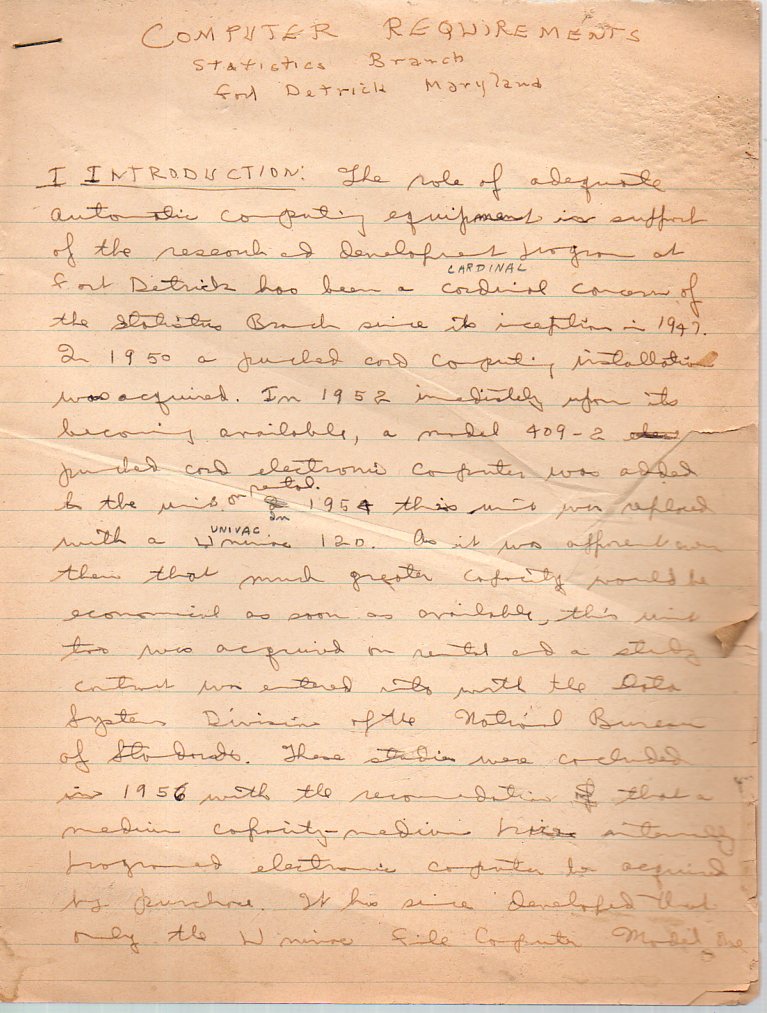
    I’ve found an unusual, informal document; a rough, manuscript outline for a consideration on the computing capacities at Fort Detrick, in Frederick Maryland.  Fort Detrick is a Medical Command, and was the seat of research for the  United States’ biological weapons program (1943–69, which is today a part of the U.S. biological defense system), and  is today a very large facility (on 1,200 acres) devoted to biomedical research. (It houses the “U.S. Army Medical Research and Materiel Command (USAMRMC) and its bio-defense agency, the U.S. Army Medical Research Institute of Infectious Diseases (USAMRIID)”, as well as  medical materiel management and global medical communications.)

     Computers fort detrick855

    The document (“Computer Requirements/Statistics Branch/Fort Detrick Maryland”)  is handwritten by the former chief statistician around 1957, and in five tight pages outlines the basic necessities for the needs of computing facilities at the fort.  The document mentions two machines in particular, the “409-2” (with is the Remington Rand 409-2, an ENIAC style machine, produced in 1952) and the UNIVAC 120 (which is a release of the 409-2, done in 1953).

    ·Posted by :

    ·in:


  • Some Interesting and Early Computer Ephemera

    JF Ptak Science Books  Quick Post

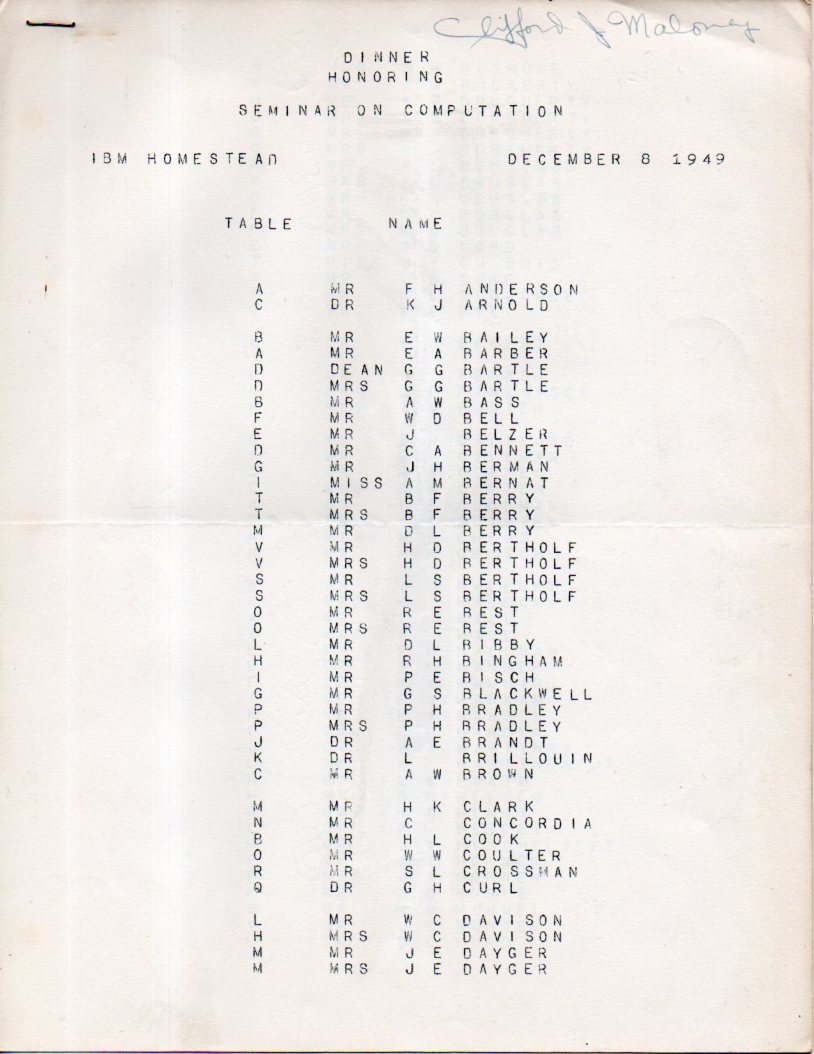
     I’m sharing this little stash of computer memorabilia (dated from 1949-1954) because in its age it is so, well, “fresh”and new and uncomplicated–and that’s because it was, relative to what we experience now.  In 1954 there about 10,000 people working in the field of computing; 61 years later the growth in involvement of people working in the field is perhaps three orders of magnitude–the growth in the sheer volume of printed and digitally-circulated material is probably somewhere on the order of the differences between post-Gutenberg European printing and the printing industry in the year 1990.  The changes are spectacular, and they seem to be so much more appreciable when one looks at the foundation efforts from the early years, some of which can be seen and represented in documents like those that follow.

    First up is this computer-printed list of attendees for “Dinner Honoring Seminar on Computation, IBM Homestead, December 8, 1949. It is a hand-stapled, four-page list with some big names in the history of computing including Brillouin, Eckert, Grosch, Hamming, Tukey, Yowell, and others. 


    Computer sci bits162


    The next document is the draft consideration for the Constitution of the ACM and is a 3-page cover later dated July 1953 regarding the voting on the new Constitution and also on officers of the ACM. It also details printing costs and distribution of the Proceedings, and other associated housekeeping, including a 3-page offset-printed ballot for voting on the Constitution.  

    ·Posted by :

    ·in:


  • The Future of Oil in 1921

    JF Ptak Science Books   Quick Post

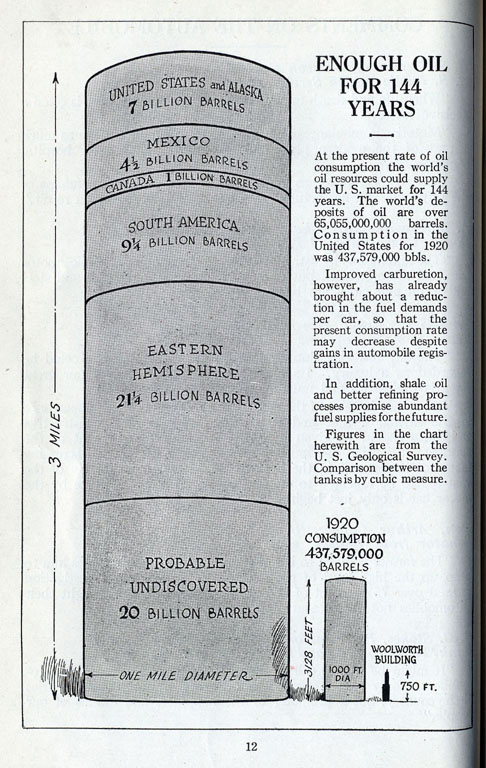
    Oil production

    [Image source:http://www.railsandtrails.com/AutoFacts/1921p12-100-8.jpg]

    There wasn’t that much of a comparative draw on what was supposed to be the world’s total supply of oil, assumed to fill a barrel about 3×1 miles, or 65 billion barrels.  (Also I assume that they are talking about oil oil, total oil, not some derivative of crude/natural/refined petroleum products and so on.) That was supposed to be enough for 140 years at the  level of consumption, about 65 billion barrels, which sounds like a lot when you drinking up 500 million/year. And it should be noted that this was for U.S. consumption only–I don’t know what happened to the rest of the world on this one; probably it was a failure of gathering statistics rather than a myopic America-only viewpoint.

    But that was 1921, and there is no mention of the Middle East (which wouldn’t become a player for a few decades) and other oil-rich regions, and other factors too numerous to mention in this quick post, so it was very much a prediction of the moment more so than of the future. The other very problematic issue with the graph is assuming the “current rate of consumption”, which would absolutely and totally miss the explosion of oil-consuming vehicles and the production of pretroleum-inclusive products.  The bottom line is that in 2013 the total world production of all aspects of oil was about 32 billion barrels1, or half of what was thought to be the total world reserves of oil in 1921.    

    Footnotes

    1. U.S. Energy Information Administration, http://www.eia.gov/cfapps/ipdbproject/IEDIndex3.cfm?tid=5&pid=53&aid=1


  • Measuring Things with Mountains & the German Big Gun of WWI (1918)

    JF Ptak Science Books  Quick Post

    The story of the (very) long-range bombardment of Paris from points unknown is filled with questions in this article that appeared in the Scientific American on April 6, 1918.  The writer hadn’t an idea of the type of gun being used, the weight of the shell (yet), and just about all other details.  The author did wonder about the reasons for such a gun–that the idea of a long-range indescrimient bombing from a great distance just seemed to be beyond the wanting capacity of the countries fighting Germany.  

    The big gun was The Big Gun, later identified as the Paris Gun–a mysterious entity during the war, and after the war as well.  It turns out that when the Germany army retreated beginning in August that they also destroyed the weapon and just about anything connected to it.

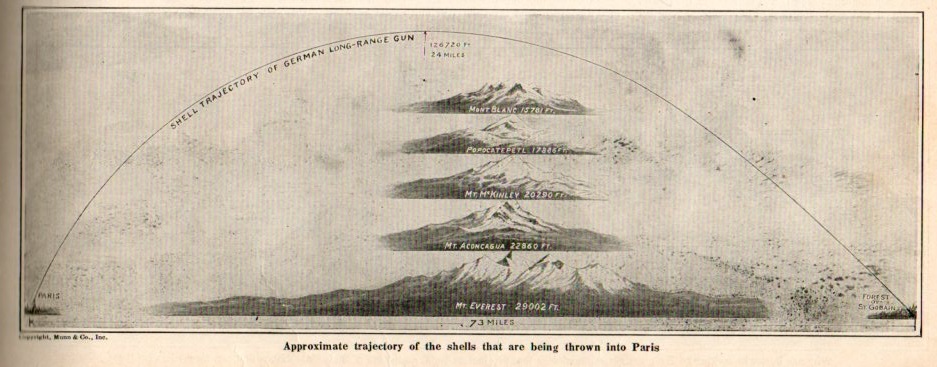
    The gun was extremely powerful.  At 256 tons it launched a 236-pound shell to a height never before achieved by humans launching/propelling stuff into the air–it left the barrel of the gun at about 1 mile/second, traveled 75 overland miles, reached a height of 26 miles…and then came down, exploding, killing.

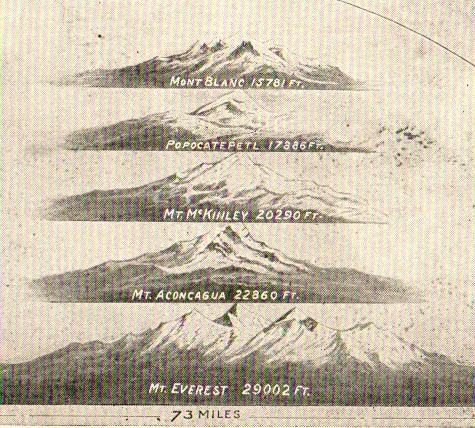
    One very effective way of explaining the incredible height that the shell reached was measuring the zenith of its trajectory in terms of mountains:

    WWI--german gun569

    Which is a detail from:

    WWI--german gun568

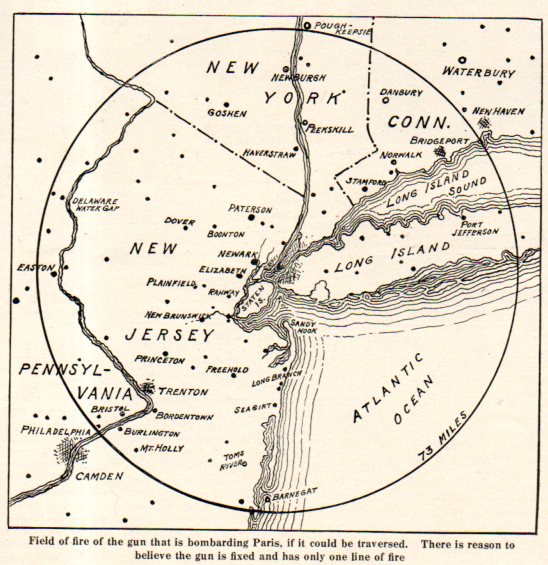
    And to give a more local understanding of the range of the gun:

    WWI--german gun567No doubt this map gave a true flavor and sense of dread to American readers on exactly what it meant to have to deal with a cannon whose reach was 75+ miles. 


  • An Enormous Bookplate and Some Found Book Art (1856)

    JF Ptak Science Books   Quick Post

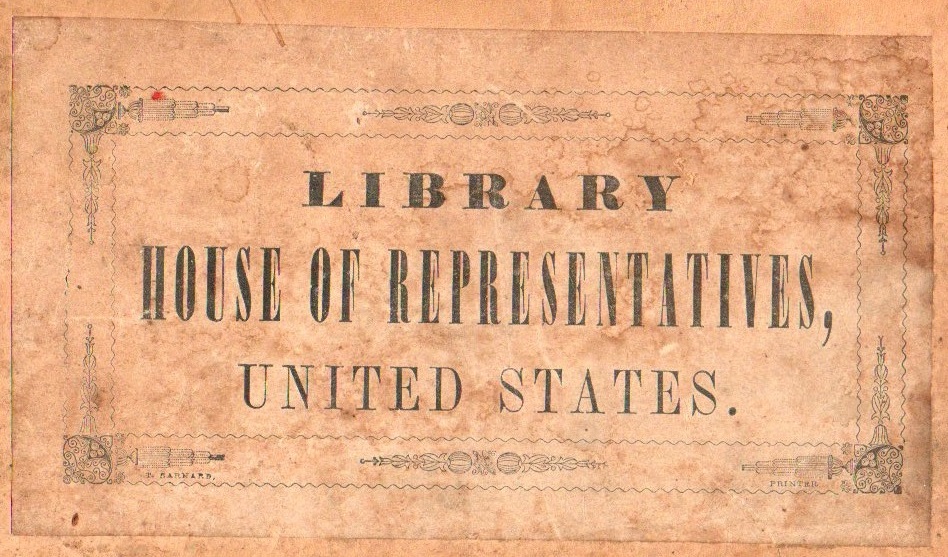
    I purchased this volume of House of Representatives reports from 1856 a number of years ago, mostly for the extraordinary bookplate that appears on the front cover of the double-brick-sized volume.  It is about as big a bookplate as I’ve bumped into or seen in 30+ years of bookselling (though admittedly the folks in the sciences seem overall to have less interest in bookplates for their library as non-science readers/collectors, so my viewpoint may be problematic).  Still, it is a big bookplate, about 5×7 inches, and as I said is on the outside of the volume rather than on the front inside cover.  There was no mistaking to whom the volume belonged, until now, when it belongs to the non-House-of-Representatives-me–anyway it is quite an object.

    Bokplates546


  • Robots: Swivels, Speed, and Stumps (1928)

    JF Ptak Science Books  Quick Post

    Sometimes the future of the past looks a little, well, dodgy, or at least it looks a little too quickly assembled. 

    I have a few robots to add to this blog’s collection of robots–both are from the same volume of Popular Mechanics for 1928.  The first features a large manikin-like robotic cut-out, with a few swivel joints, and performs a couple of tasks. More than likely this was all that it could do.

    Robot 1928560