A Daily History of Holes, Dots, Lines, Science, History, Math, Physics, Art, the Unintentional Absurd, Architecture, Maps, Data Visualization, Blank and Missing Things, and so on. |1.6 million words, 7500 images, 4.9 million hits| Press & appearances in The Times, Le Figaro, Mensa, The Economist, The Guardian, Discovery News, Slate, Le Monde, Sci American Blogs, Le Pont, and many other places… 5000+ total posts since 2008.

Author: JF Ptak

  • Children and Labor, 1937

    JF Ptak Science Books     Quick Post   

    • (There are several posts on this blog relating to child labor–a simple search in the Google box will bring up a few.)

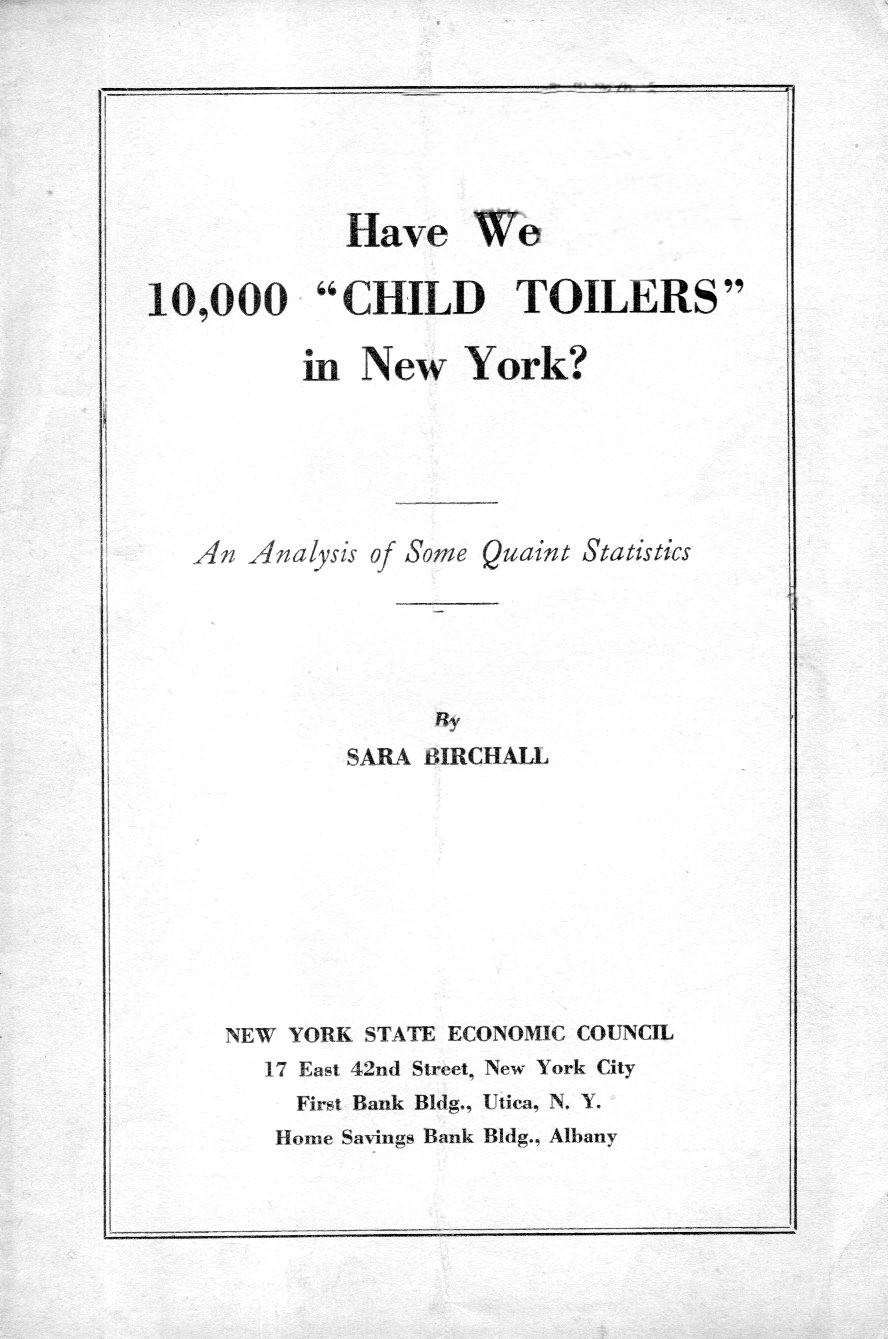
    What a dirty little pamphlet this is–at least that’s the way it feels in my hands.  The author, Sara Birchall, takes to task the results of a survey that finds 10,000 child toilers” in New York (in 1937). The push behind the survey was for the passage of a constitutional amendment banning all child labor. Birchall makes the case that the “quaint statistics” are incorrect, and that state in themselves have taken great leaps to end the child labor menace, and therefore the need for a federal involvement (“boondoggle”) was happily unnecessary.

    Child labor680

    I don’t know what the National Child Labor Committee (founded 1904) had to say about this in particular. They were certainly active in the push for a constitutional amendment, though that effort would be pretty much d.o.a. in the mid 1930’s.  Ironically just  a year after this missive was written came the Fair Labor Standards Act, which very heavily favored child labor laws pushed by the NCLC.  In the weight and gravitas of the issue, Birchall’s effort left a mean, red-knuckled impression on me, saying the federal initiative wasn’t worth the effort and that the whole deal could be handled at the state level.  That was sort of true, though my guess is that things might have happened quick for a couple of generations of child laborers had there been a cohesive national plan. 

    ·Posted by :

    ·in:


  • Early Flight Powered by Wind, Fishing Line, and Boys (1897)

    JF Ptak Science Books     Post 2406

    Pilcer679

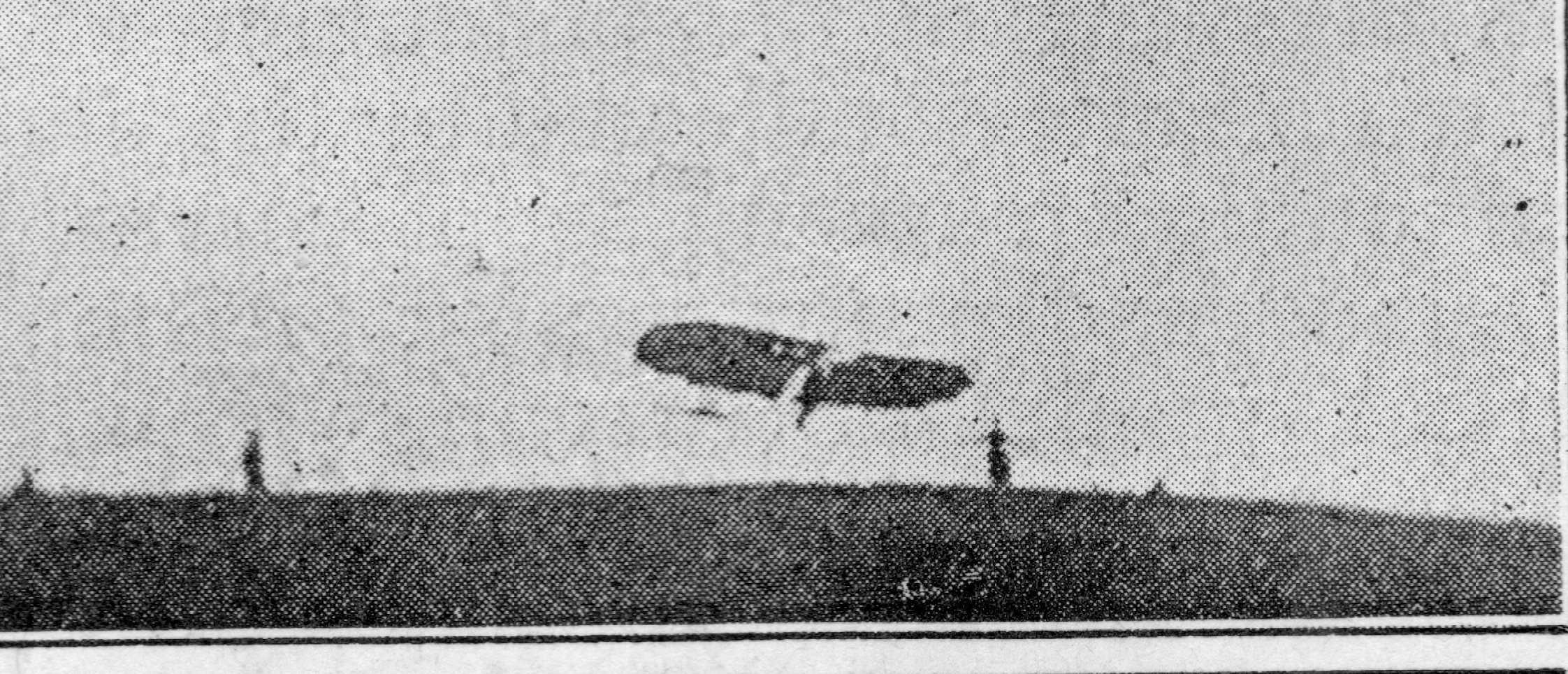
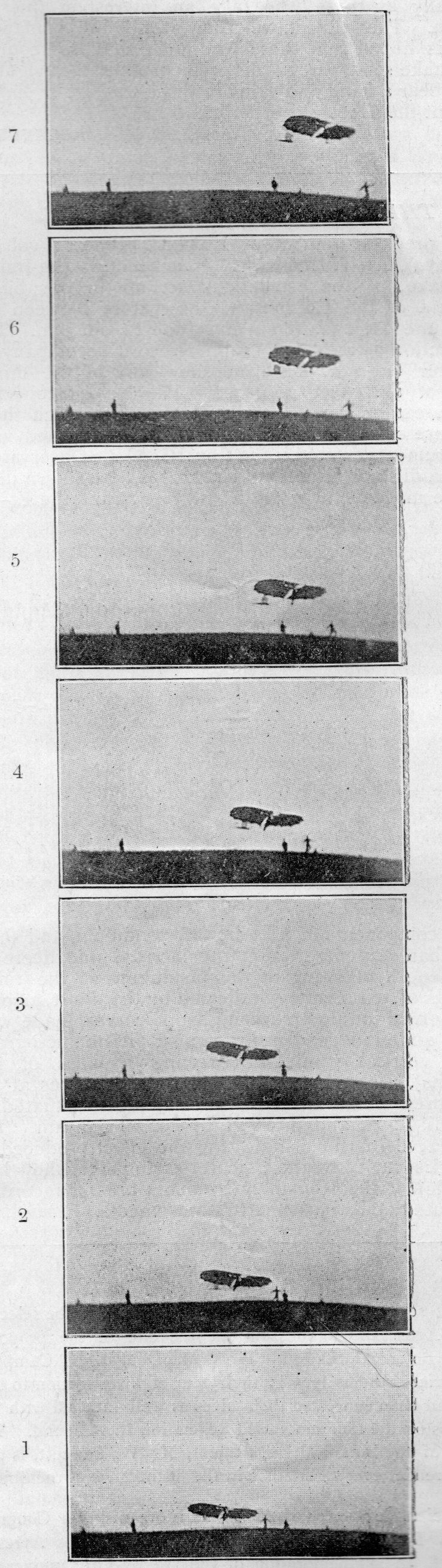
    Percy Pilcher was a true aviation pioneer who met his end very early, during an event that probably shouldn’t have happened, killed by in 30′-fall in 1899.  He was creative, and figured out a way to address the knotty problem of lift vs. wing dimensions vs. weight, coming to a tri-plane design in 1898, but was killed before he could fly it in public. His death comes about two years after this appearance in Nature magazine, which tells a quietly dramatic and essentially sotto voce story about attempted soaring flight. It seems so extraordinary to me because–aside from needing a fit of genius to try to figure out the physics of flight, there was a lot that could be done with canvas, pipes, fishing line, and boy-power. When I read this account I could literally feel that soft breeze that he looked for on my teeth–few pieces of major histories of technology get this close to the “common person”.  

    Pilcer678


    Someone made this nice, short video from the seven stills, perhaps making this one of the earliest “movies” of an human in flight:


    “At the time of the flight here illustrated the wind was so light and variable in direction that an ascent from even the elevated position taken up was almost impossible. Means however were at hand by which one end of a thin fishing line 600 yards long could be attached to the machine while the other end passed through two blocks placed close together on the ground at a distance from the aero plane of about 550 yards. These blocks were so arranged that a movement of the aerial machine in the horizontal direction corresponded to a fifth of the movement of the boys pulling the line.”

    “The start was made at a given signal the line being pulled by three boys and Mr Pilcher gradually left the ground and soared gracefully into the air attaining a maximum height of about 70 feet… A safe and graceful landing was made at a distance of 250 yards from the starting point. The photographs illustrate that part of the flight previous to the attainment of the greatest height…if the machine had been fitted with a small engine or motor to give (this) amount of thrust by means of a screw or otherwise perhaps an equal or further distance would have been covered.”

    “Mr Pilcher now proposes to employ as soon as possible a small and light engine indicating about four horsepower this being considerably more than sufficient for flights of moderate length. It is however thought advisable to have rather too much than too little power to commence with as a factor of safety. With this improvement it is hoped that further distances will be covered and a nearer approximation to a flying machine will be attained.”


  • A Wooden Mechanical Demonstration of Wave Propogation, 1897

    JF Ptak Science Books   Quick Post

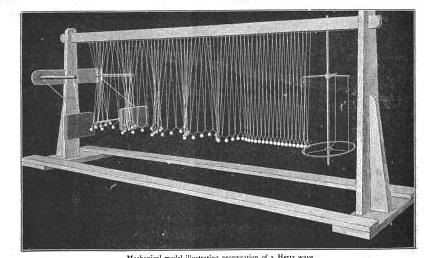
    This fine, geometrical wooden apparatus was made by electrician and physicist Sylvanus P. Thompson (1851-1911)–two metres long, the model was for a demonstration before the Physical Society of London, “illustrat(ing) the propagation of a transverse wave”.  The image appeared in Nature, August 12, 1897.

    Thompson mechanism

    ·Posted by :

    ·in:


  • Dr. Strangelove’s Computer

    JF Ptak Science Books   Post 2405

    ‘Russia reveals Cobalt Bomb; Total World Destruction Ahead”, ending of Philip K. Dick’s “Exhibit Piece”, 1952

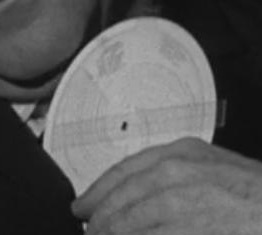
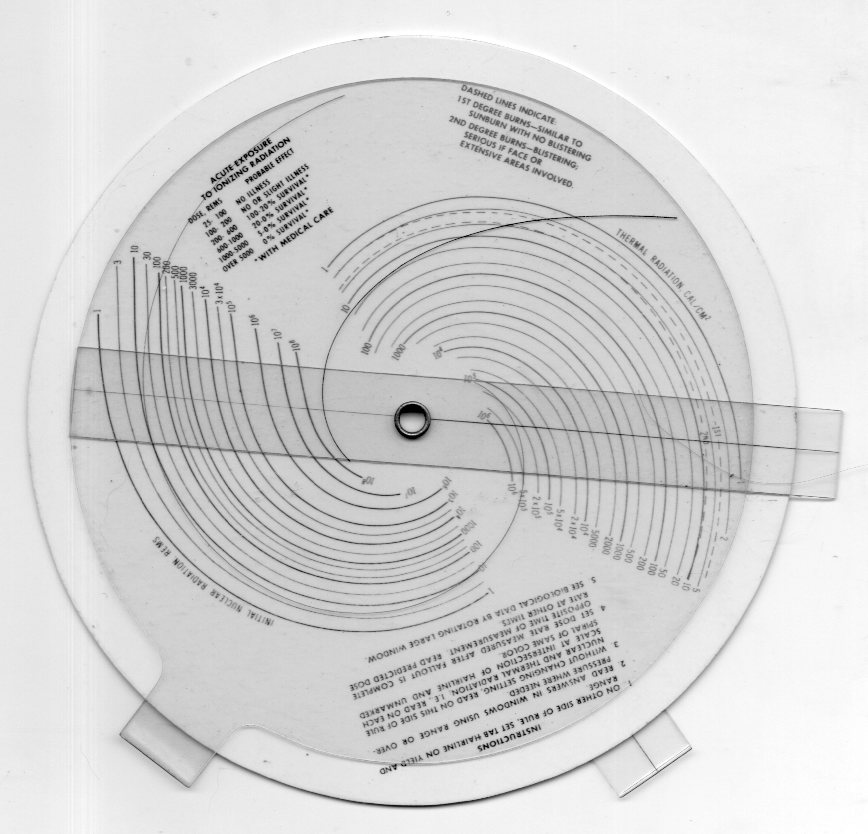
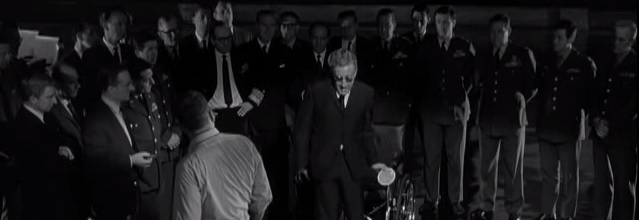
    I never really thought that much about what Dr. Strangelove was fiddling with to calculate the “half life of cobalt thorium-G” in Stanley Kubrick’s mega-dystopian steam-nuke 1962 film, Dr. Strangelove. (We’ve looked at this film a number of times on this blog–just search the title in the Google search box to see the others.) So I went to some clips online and found a still showing him putting away his circular slide, which turns out to be the 1962 version of the “Nuclear Bomb Effects Computer” that was published and issued along with Sam Glasstone’s The Effects of Nuclear Weapons (published by the Department of the Army as No 39-3, one edition n a continuing series.

    Dr. strangelove computer 1964

    My calculator is actually from the 1964 edition of the work–there seems to be no difference from computer to computer, but there are differences in the text of the book, one of which relates directly to Dr. Strangelove.  There is a very brief, barely-two-page section called “Radiological Warfare” in the chapter dealing with radioactive contamination from nuclear weapons. there is nothing overtly technical in it, though the writers seem not to like the idea, given the inherent difficulties in producing and storing such advanced gamma radiation weapons, saying too the the use of such beasts would be either “impossible of very hazardous”. The author also makes the point that the high fission energy yields of the new bombs, which make them “in effect, weapons of radiological warfare”.1

    Here’s the reverse of the computer, rendered in black and white:

    Nuclear bomb computer677

    So, that’s it. Dr. Strangelove though wasn’t the first to discus a cobalt-laced dirty dirty dirty bomb, with the idea managing to surface several times in the ’50’s (as with the PKD example, above, and Fritz Lieber’s Moon is Green, 1952, where there are cobalt bombs galore, then things happen, and then everything goes badly). The ideas of total destruction+total destruction=total destruction seems to have originated with Leo Szillard in a radio broadcast from the University of Chicago in February 1950 with the introduction of the cobalt-based bomb, which produces a far more intense radiation than U-238. Szillard presented his case as a what-we-will-soon-be-capable-of argument, putting not the destruction of entire cities into question, but the entire planet.  

    Dr stangelove computer bThis is about the final minute of the movie, when Dr. Strangelove  finds himself rising and walking by a secret Fuhrer-based miracle, his little computer still in his hand.  And then seconds later the really bad stuff happens.  

    ·Posted by :

    ·in:


  • Note on Two Very Early Papers on Gravitational Lensing: Zwicky, 1937

    JF Ptak Science Books   Quick Post

    Zwicky PR 1937647

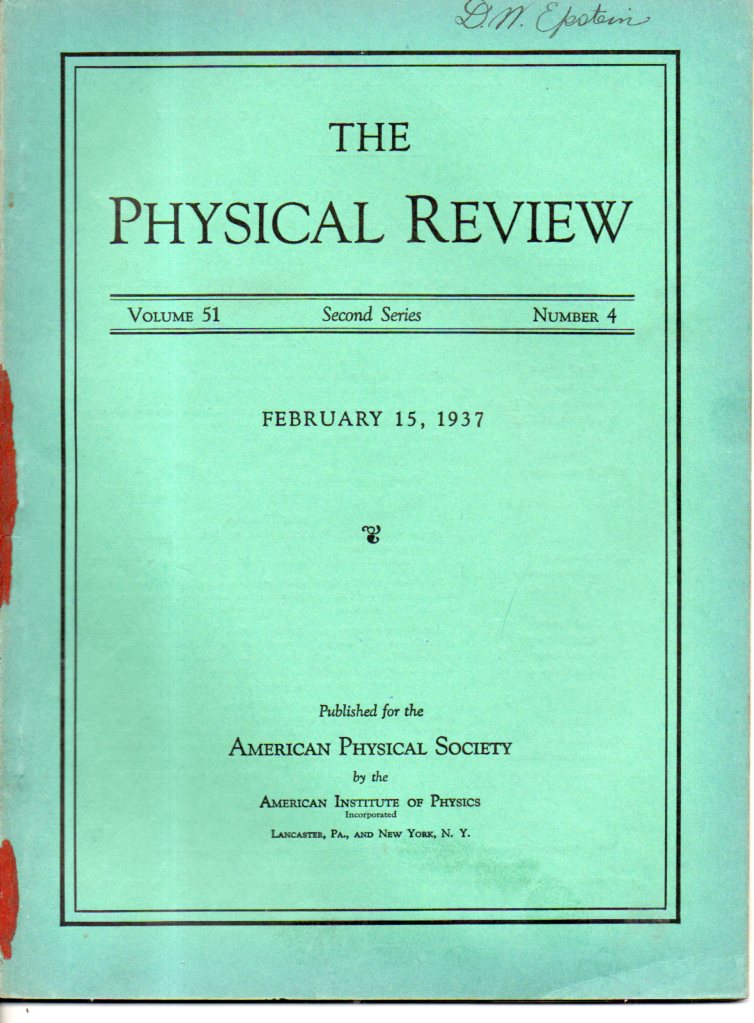
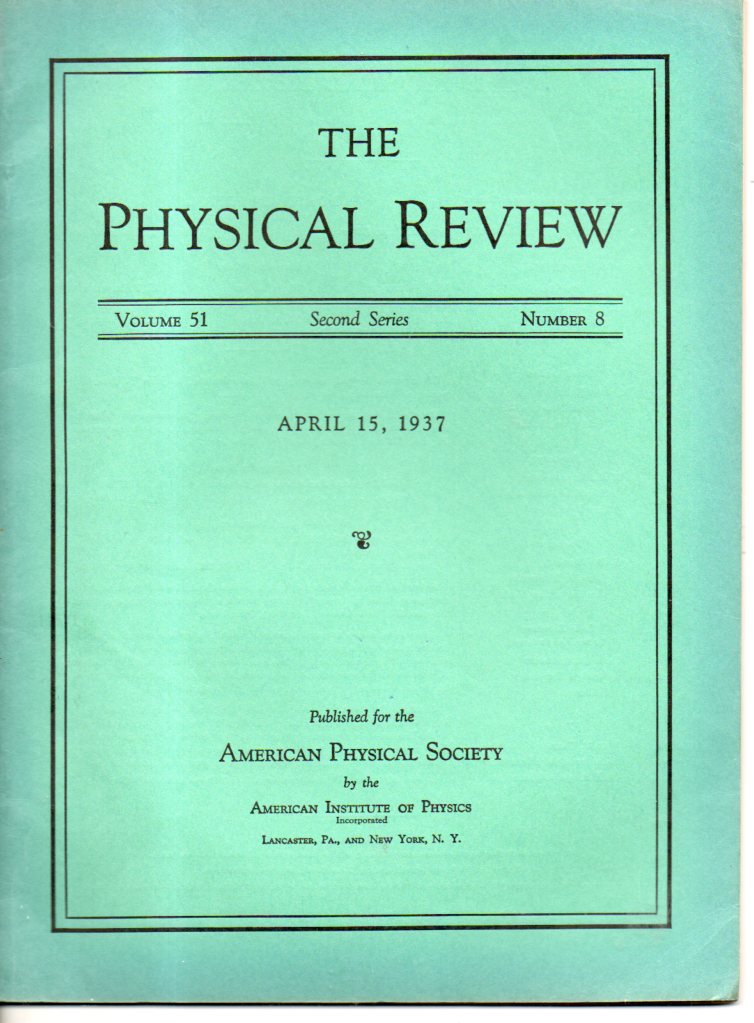
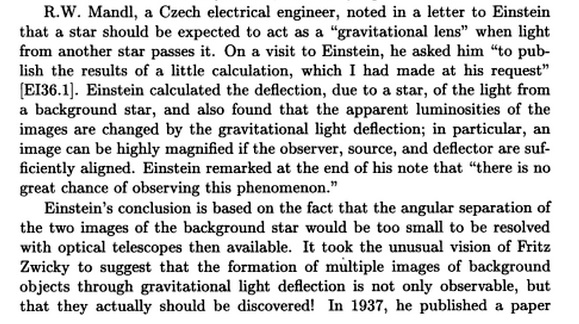
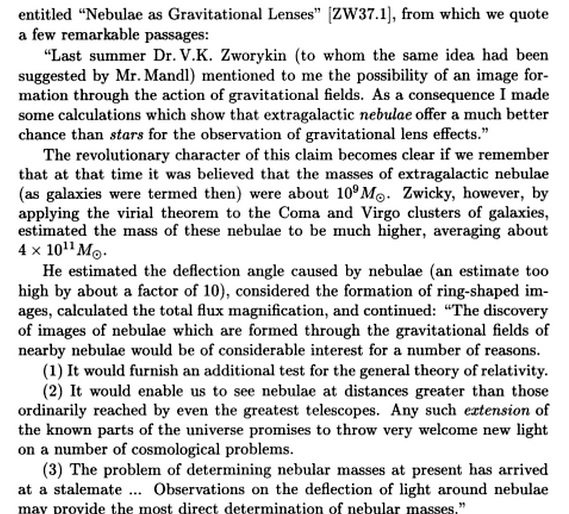
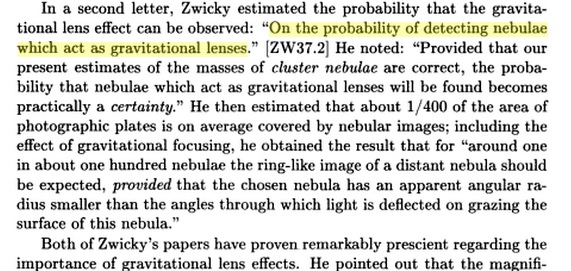
    These two papers by Fritz Zwicky constitute  among the earliest announcements on the use of gravitational lensing, and the first mention of the possibility of using galaxies as gravitational lenses. The  two letters to the editor followed the very brief notice that Einstein sent to Science magazine in 1936 (and which was a follow-up on some earlier thinking (24 years 


    earlier) he had done on the gravitational lens, this publishing as a result of “insistent prodding”1 by Rudi Mandl, a Czech engineer. Einstein all but disowned the idea, noting “of course, there is not much hope  of observing this phenomenon directly”2 The papers also follow a popular mention of the idea by Henry Norris Russell in Scientific American in 1936.  Aside from the appearance of the idea in Zwicky’s 1957 Morpholigical Astronomy, it is noted in Singularity Theory and Gravitational Lensing (see footnotes below) that there is a period of virtual silence on the subject for the next 25 years, and that from 1960 to 1980 there seem to have been fewer than two dozen additional papers. [ZWICKY, Fritz. “Nebulae as Gravitational Lenses”, 1937, in the Physical Review, 51(4), a one-page letter to the editor on page 290, and  ZWICKY,  Fritz. “On the Probability of Detecting Nebulae Which Act as Gravitational Lenses.”  American Physical Society,  1937, in  The Physical Review, 51 (8), April 15, 1937.]   

    Zwicky PR 1937646

    Zwicky lens

    Zwicky lens b

    Zwicky lens c

                                    Footnote 3, –Long quote from Gravitational Lenses, by P. Schneider, J. Ehlers, E.E. Falco

    ·Posted by :

    ·in:


  • Save Baseball for the Youth of America

    JF Ptak Science Books  Quick Post

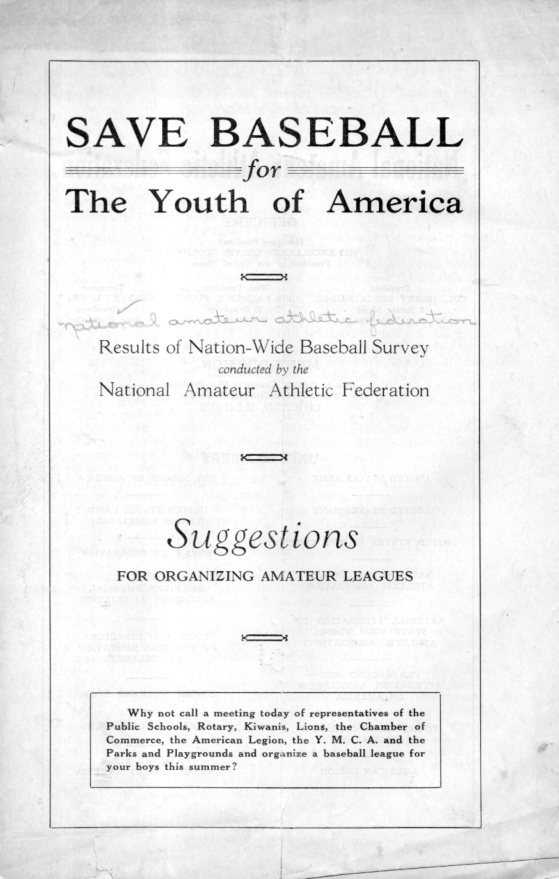
    Baseball, Save668The National Amateur Athletic Federation published this wonderfully-titled pamphlet, Save Baseball for the Youth of America, in 1925. in the attempt to bring some of baseball’s hurtful ways to public attention.  The pamphlet was in answer to the “results of a nation-wide baseball survey” sponsored by the Federation, which found, in short, that amateur and semi-pro baseball was in trouble, and it was hurting baseball in general. Most of the no-frills complaints had to do with stacking and overpaying semi-pro teams–evidently some were so strong that they could be beaten, sending many teams to disband. I’ve never heard of this before, but, then again, I’m not an historian of baseball.   In short, the positive response was found in kids, and for getting them involved in little league sports at a young age.  The “unit members” of the federation included the U.S. Army, Navy, Marines, NCAA, YMCA, BSA, Boys Club, Jewish Welfare Board, and the NRA.  (I’m posting this mostly because of the design and the title…)

    ·Posted by :

    ·in:


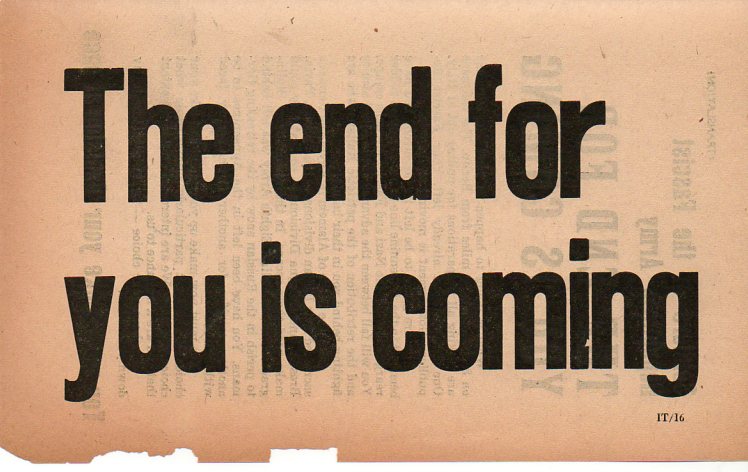
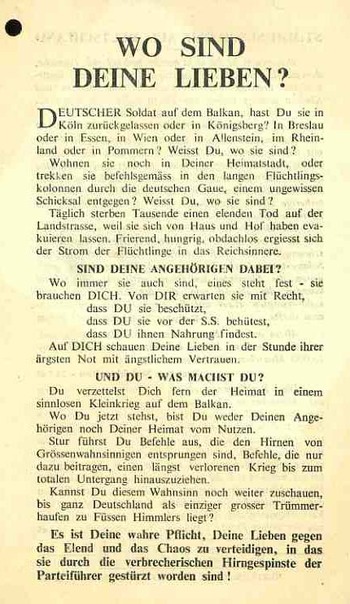
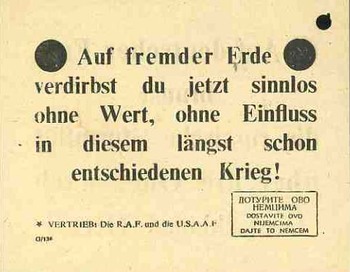
  • The End for You is Coming: WWII Propaganda Leaflets

    JF Ptak Science Books

    Propag--25753

    A part of the payload dropped on German and Japanese forces were not metal and explosive, but paper. Hundreds of thousands of pieces of paper with real and imagined information, tickets to surrender, reminders of the coming of the end of the war, passages to a prisoner of war camp somewhere that would ensure the soldier’s survival of the Blogpropogwhere_are099rest of the war.  Convincing someone to surrender, or making it easier for them to not fight too hard and to surrender, is sometimes easier than to confront and kill them.

    For the most part these were distributed in a combination effort between the U.S. Army Air Force (USAAF) and the Royal Air Force (RAF), while the other major segment was done by the Supreme Headquarters of the Army Expedition Force (SHAEF) and the 8th U.S. Army.  There pieces of directed information were very persuasive, but of course they were hardly new—not even the delivery system (via aircraft) was an innovation.  

    These leaflets were more or less an “information” service relating factual events and presented in such a way to persuade and convince whomever picked them up that their cause was at this point futile.  In just about every case in the 150 items in my small collection as far as I could determine all of the statements made were indeed correct and accurate.  Leaflets were dropped by the ton during the war that were pure fabrication, intended to confuse the scare the recipient into surrender, deceiving them;  but not these. (For example, a famous use of deception in major confrontations was Operation Quicksilver and the creation of the First United States Army Group (FUSAG), a non-existent fighting enemy that was supposed to distract the Germans while real preparations were underway elsewhere for the invasion of Europe (D Day).
    Blogpropogon_german_soil100  
    There was a distinct threat of terror in many of these leaflets, though the terror would never come from the Americans or Brits—the Russians, however, were another story. (Remember that the U.S. gets into the war at the end of 1941; the British had been fighting since 1939; and the Russians, well, they had been fighting too since 1939 [starting out without chivalry and with cold malice against the Finns], but they did fight against the Nazis once they had been completely deceived by them,  losing 20 million people in the process.  The Germans had much more to fear from them than anything on earth. And rightly so.) The use of terror in propaganda is probably as old as warfare itself—for example the Mongol leader Tamerlane built a pyramid of 90,000 human heads in front of the walls of Delhi to persuade the inhabitants to just forget about fighting, and leave.   The British employed a terror tactic in the use of the Gurkas and their curved and menacing Kukri to great advantage; the Americans had the Phoenix Program in Vietnam (for the assassination of leading Viet Cong and their supporters), and so on, into the sunset. 
    Blogpropogpunctured101

    ·Posted by :

    ·in:


  • Man as Robot and Robot as Man

    JF Ptak Science Books  

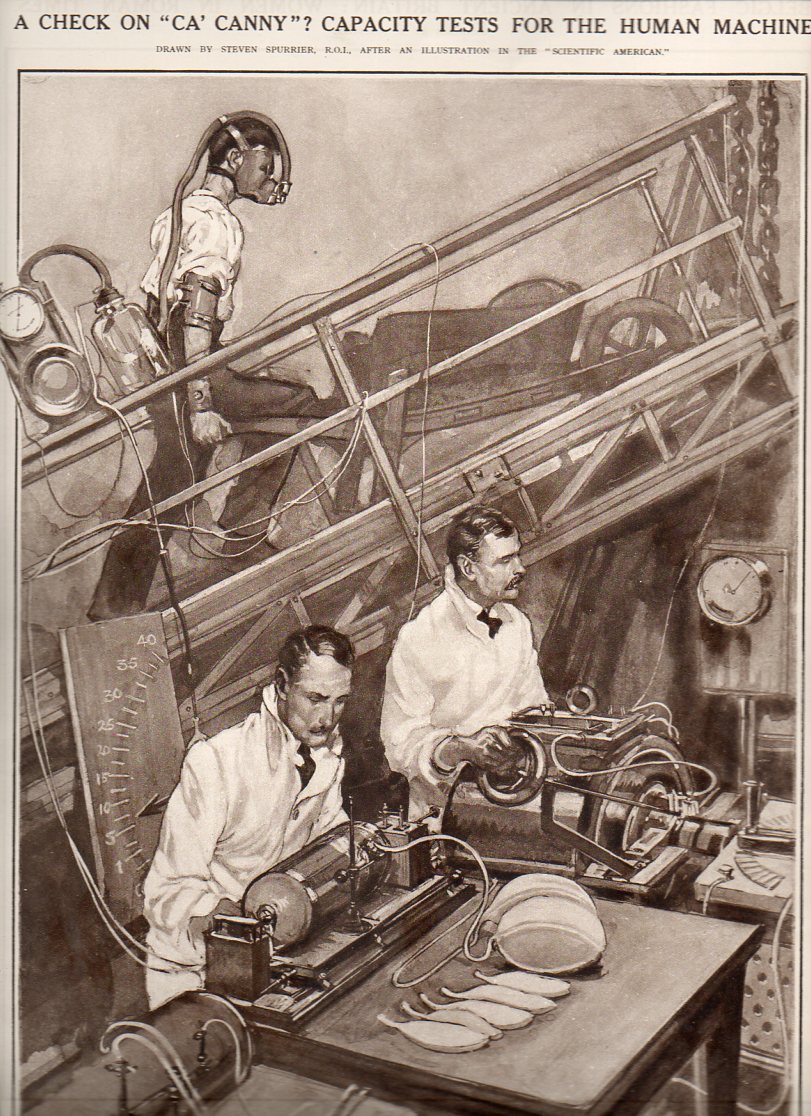
    I’ve written earlier in this blog about the advent of robots and human machines, and I’d like to add these two images to that thread.    Both are male, which is not horribly surprising since the earliest creation of a female robot belongs to the fertile Fritz Lang, who used his creation in his extraordinary movie Metropolis in 1927.  (Male robot-like creations go back fairly deeply into the 19th century; so perhaps the creation of female robots was verbotten because of the possibilities for unacceptable sexual fantasies in the high- and post-Victorian world, struggling under the weight of many and multiply-applied public inhibitions. Perhaps it was because of the possibility of sexual relations with an inanimate object that was the cause for uni-gender robots, or perhaps it was a fear of a powerful, intelligent, unstoppable, superior creation that was also “womanly”.  I don’t know.)
    Robot human machine817

    [And by the way “ca’ canny”–which I’ve never bumped into before–is evidently a practice of deliberately slowing down work.]

    The first is an image of the “human machine”, a cog-like adaptation of human workers in a Frederick Taylor-like Scientific Management study.  Though many people had written and worked around Taylor’s 1911 semi-revolutionary book (and not necessarily a good revolution, but one nevertheless), I’m not certain that I’ve seen the worker trussed up so before this, encumbered by so many technical testing elements as to make him look like a cyborg (though that term would still be a while coming into the vocabulary.  

    This image is actually testing a person’s energy expenditure while pushing a wheelbarrow on an incline, and utilizes the newly-created equipment of the French physiologist Langlois, which in 1921  may well have measured for the first time  the real-time changes in the rhythm of the heart and blood pressure, changes in body temperature and lung capacity of humans in an activity.  I have no doubt that the results would have been very interesting to cardiologists, and probably didn’t mean a thing to industrialists like Henry Ford, who would’ve plowed ahead with their demands on their workers regardless of what tests said, schedules being schedules and all. 

    Robot steam816 

    (I’m no tsure where this experiment fits in, historically speaking, even within the context of biological advances for that very year.  Frederick Banting was able to do some pretty nasty stuff to dogs in a basement lab somewhere at the University of Toronto and come up with a successful treatment for diabetes mellitus–insulin, which would save the lives of millions and earn Banting a Nobel two years later.  In the quasi/fake biological arenas came two biggish events: Jung’s creation of the concepts of introvert and extrovert, and Hermann Rorschach’s one-way conversational device for detecting psycho-pathological conditions (in people).  I suspect that the Langlois data would fit in there somewhere along the rough edge of Jung and Rorschack, if only because the data was real.          

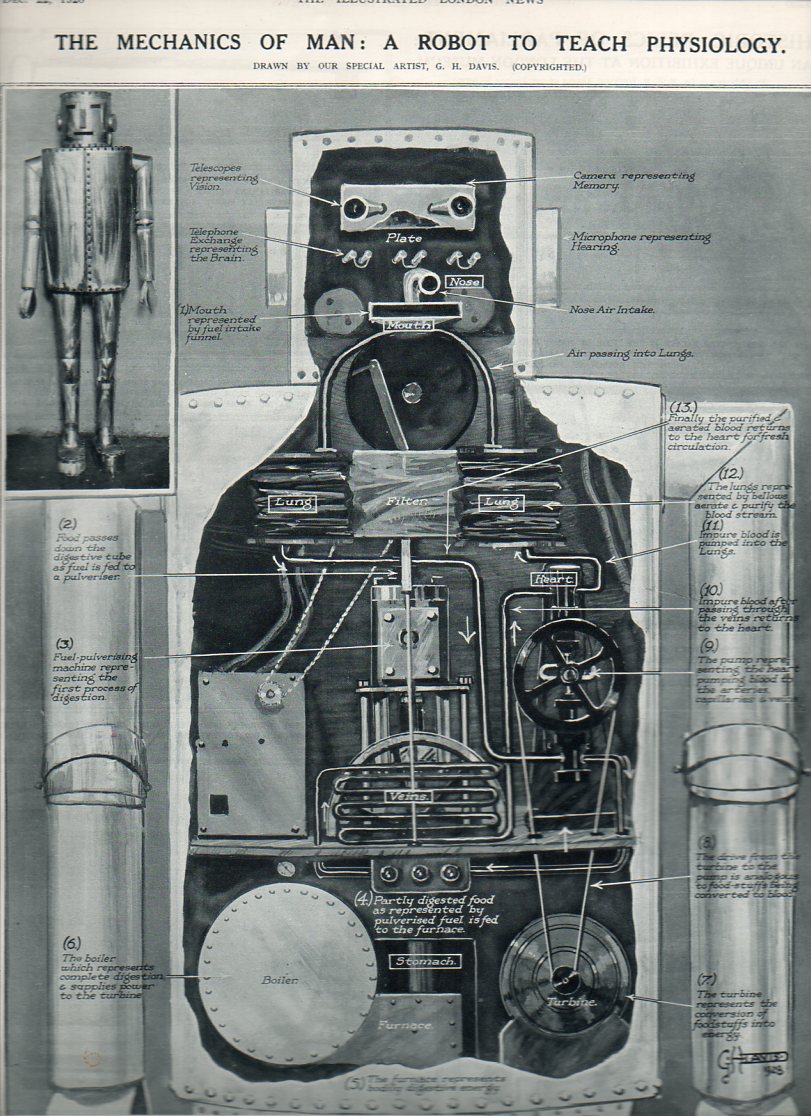
    The second image is in a way a reverse sequence of the preceding–an out-and-out robot that was being used to teach human physiology.  In this case, the robot was a steam engine, constructed for the Schoolboys’ Exhibition at the New Horticultural Hall for 1928, perhaps under the  influence of Karel Capek’s newly published drama R.U.R., which coined the term “robot”. The biological functions of humans were reinterpreted along a more user-friendly vocabulary of the steam engine, using pumps, boilers, hinges, belts, pulleys, filters, compressors and a furnace to explain the functions of respiration and circulation.   It was an interesting approach to show these functions on their most basic level–and in less than 75 years, many of these mechanically represented organs were actually replaceable by real mechanical units performing the same task as the biological (as in the heart), while others could be replaced (via transplant). 

    Man as machine and machine as man.


  • G. Washington Hunts His Lost Property: Miss Oney Judge

    JF Ptak Science Books   Post 2401

    George Washington was the first president of the United States, and so the first to own slaves while president–he was the first of 12 presidents who were slave-owners, and the first of eight to own slaves while serving in that office. (All of paper currency  celebrates celebratory people who also owned slaves–the $1, $2, $10, $20, $50, and $100; all but Lincoln.)

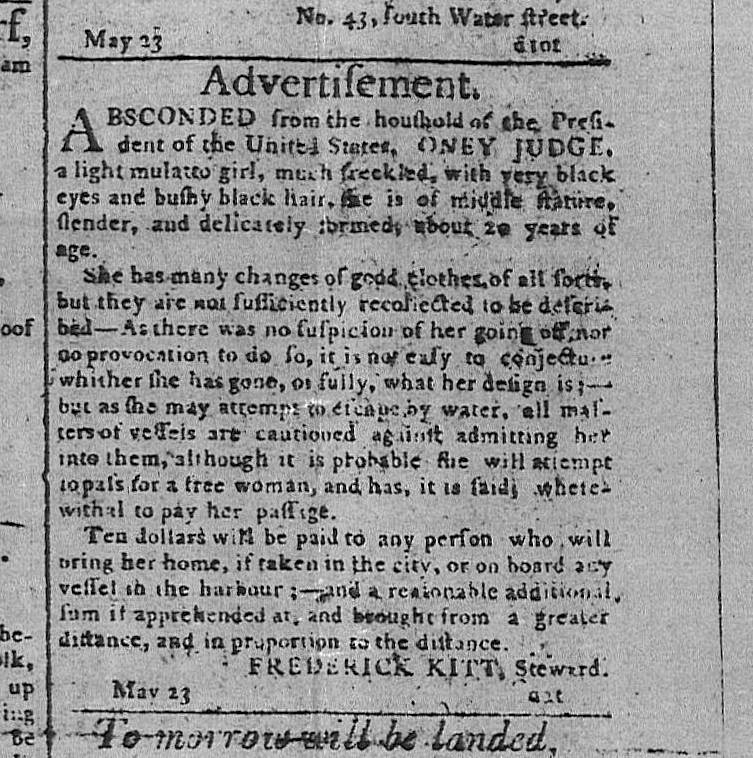
    After he served his terms as president, and two years before his death, Washington suffered a property loss.  Martha Washington’s personal servant fled, escaped, headed north, to freedom. President Washington wanted his property returned:
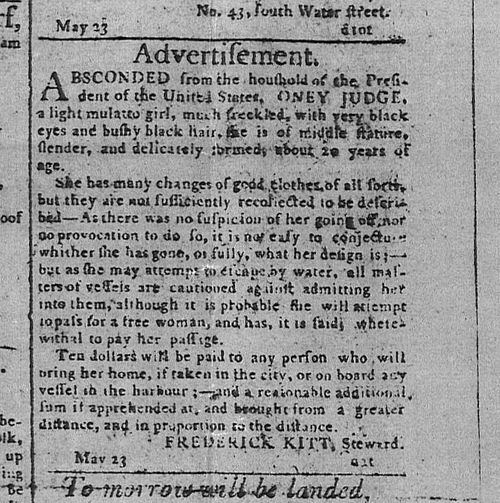
    Oney_Judge_Runaway_Ad

    [Originally in  The Pennsylvania Gazette, Philadelphia, Pennsylvania, May 24, 1796. Image source: Wikipedia.  The full text1 transcribed in below in Notes.]

    The ad was evidently placed by Frederick Kitt, who was a long-time steward of the Washington household, and it fell to him to look after the return of Ms. Judge.

    The Founding Father found the Founding Fathers law on his side, of course–it was right in there constitution, Article IV, Section 3. (“No Person held to Service or Labour in one State, under the Laws thereof, escaping into another, shall, in Consequence of any Law or Regulation therein, be discharged from such Service or Labour, but shall be delivered up on Claim of the Party to whom such Service or Labour may be due.)  Article IV section 3 was toothless for a while, until the machinery of enforcement was provided in the Fugitive Slave Act of 1793. which made it possible for slave catchers to proceed across all state lines in the hunt for escaped slaves, and made it a federal crime to assist a fugitive slave, among other things, but particularly ensuring that an escaped slave would remain a slave, always.

    Miss Judge was the baby of her enslaved mother [name?] and an indentured servant; even though the indentured servant was a free man, the mother was not, and the law stated that any fruits and/or labors or babies etc. coming from a slave is the property of the slave’s owner.  

    Miss Olney was actually the property of Martha Washington, who inherited 84 “dower” slaves from her first husband–this meant that the slaves were her’s to own but not to sell.  When Martha married George in 1759 they gathered their slaves together but separately, adding significantly to the slave population at the estate (a number that would grow to more than 300 by the time of Washington’s death 40 years later).  Washington freed his slaves after death, in his (1797) will; Martha kept her’s until she died in 1802, at which point her property was distributed to Custis heirs.  

    Oney Judge on the other hand made her way to New Hampshire, where she settled and married Mr. Jack Staines. She spent the rest of her life (she was 26 when she fled and lived to 1848, aged 75) as not-a-slave but unfortunately not-free, either.  

    Washington suffered another major loss–his prized cook, Hercules, took of from Mt. Vernon in 1798 and evidently met happiness in Philadelphia.  Washington wanted that property returned, too2.  

    Notes

    1.  “Advertisement. ABSCONDED from the houshold [sic] of the President of the United States, ONEY JUDGE, a light mulatto girl, much freckled, with very black eyes and bushy black hair. She is of middle stature, slender, and delicately formed, about 20 years of age. She has many changes of good clothes of all sorts, but they are not sufficiently recollected to be described—As there was no suspicion of her going off, nor no provocation to do so, it is not easy to conjecture whither she has gone, or fully, what her design is;—but as she may attempt to escape by water, all matters of vessels are cautioned against admitting her into them, although it is probable she will attempt to pass as a free woman, and has, it is said, wherewithal to pay her passage. Ten dollars will be paid to any person who will bring her home, if taken in the city, or on board any vessel in the harbour;—and a reasonable additional sum if apprehended at, and brought from a greater distance, and in proportion to the distance. FREDERICK KITT, Steward. May 23

    2. Letter from George Washington to Frederick Kitt, January 10, 1798:

    “Mr Kitt

    We have never heard of Herculas our Cook since he left this; but little doubt remains in my mind of his having gone to Philadelphia, and may yet be found there, if proper measures were employed to discover (unsuspectedly, so as not to alarm him) where his haunts are.

    If you could accomplish this for me, it would render me an acceptable service as I neither have, nor can get a good Cook to hire, and am disinclined to hold another slave by purchase.

    If by indirect enquiries of those who know Herculas, you should learn that he is in the City, inform Colo. Clemt Biddle thereof, and he will, I hope, take proper measures to have him apprehended at the moment one of the Packets for Alexandria is about to Sale, and put him therein, to be conveyed hither; and will pay any expence which may be incurred in the execution of this business; which must be managed with address to give it a chance of Success—for if Herculas was to get the least hint of the design he would elude all your vigilance. I wish you well and am Your friend &ca”

    [Source:   http://founders.archives.gov/documents/Washington/06-01-02-0019#GEWN-06-01-02-0019-fn-0002]
     

    ·Posted by :

    ·in:


  • Doughboys Marching into the Mist of the Past

    JF Ptak Science Books   Post 1328 (from 2011, revised)

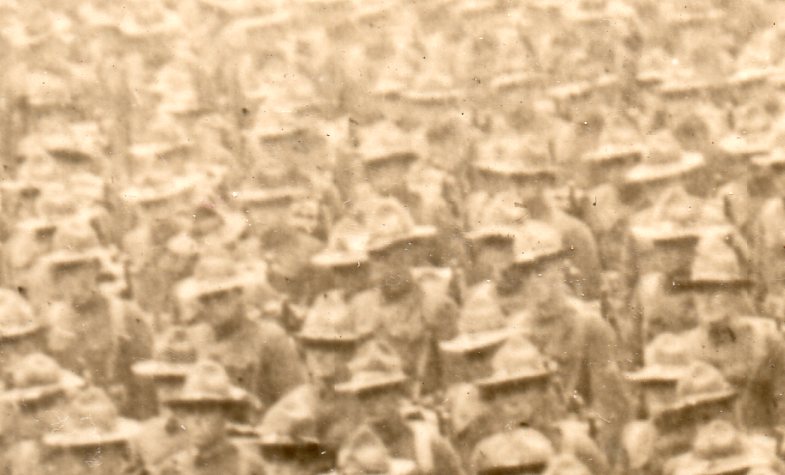
    .003%  That’s what I reckon this column of soldiers would represent of the total casualties of WWI.

    Generally images like this are a virtual image-host for me, a bucket of ice cold water thrown onto a sizzling summer sidewalk, all sorts of ideas steaming from it.  But for photographs of Doughboys1 marching, especially assembling for parade, this one struck me a little more oddly than most, giving instant pause, making me concentrate on the haze, or dust, that allowed the columns of soldiers to blend into one another and fade, losing their boundaries with their mass receding into a dull blur. 

    Marching london 350

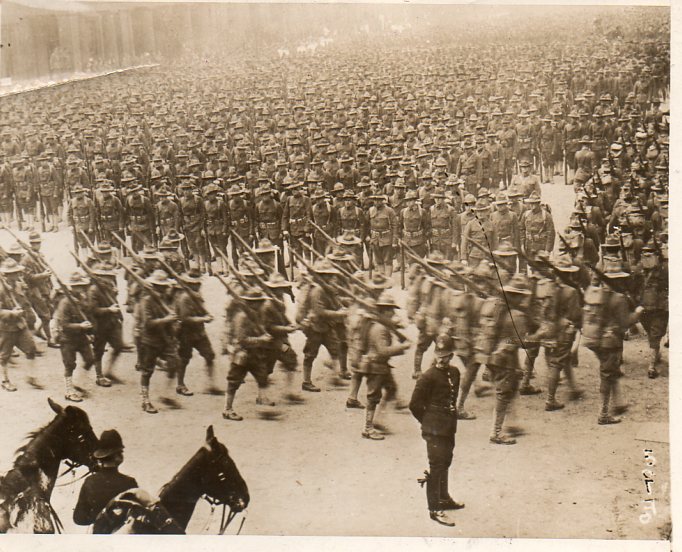
    The Western Newspaper Union was selling this image for insertion in newspaper or journal stories about the war, for a small use fee.  There were a few American organizations like Western Newspaper that were created to photographically cover the war, using pools of photographers who would distribute their work anonymously and which was available for common, general use for a small charge.  The photographs allowed out were certainly restricted and censored, though in my stash of these of objects (numbering about a thousand) I’d say that 10% of them look pretty edgy to my eyes.  Most of the action of war was not covered, but then again this aspect was still fairly technically difficult in 1918.  Images of pain were almost never allowed, and certainly not pain of Allied troops.  Aid stations were almost never covered as well, as were dead bodies, or at least those again of Americans or Brits or French or Canadian.  The imaging of the war was certainly under a fair amount of supervision and control. (The original is available for purchase through our blog bookstore. here.)

    Marching london det352

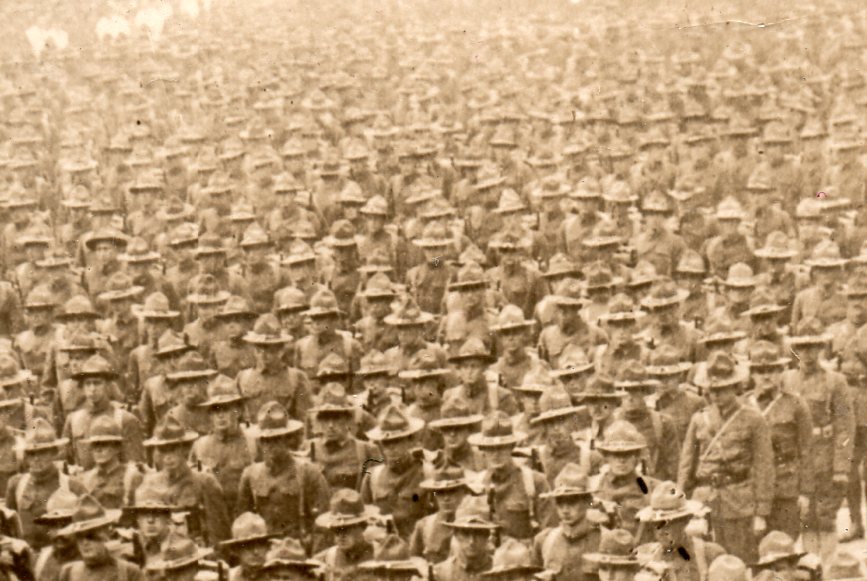
    The image shows American troops assembling for a parade through the streets of London before being deployed.  The mistiness of the composition looks like a statistic to me, these men standing for those who had come before and fallen.

    Marching london det353

     The U.S. lost .13%  of its population to casualties (125,000 killed and 205,000 wounded) during the war–a war which by the time America got here had already been visciously fought for three years, costing dozens of millions of lives.  The figures for everyone else weren’t nearly so “fortunate” as the U.S.:  New Zealand’s 18,000/41,312 killed/wounded amounted to 1.6% of its population.  The U.K. lost 2.19% (964,000/1,663,000), Italy was 3.48% (650,000/953,000 plus 650,000 civilian casualties), while France suffered a 4.29% (1.4 million/4.27 mil) blow of its total population to war.  Things were worse on the other side:  Germany 3.82% (2 mil/2.4 mil plus 426,000 civilian deaths, and the Ottoman Empire 12% (400,000/771,000 plus 2.1 million civilian deaths.   Worst of all was the Ally  Serbia, suffering a catastrophic 16% loss of its population to war, including 275,000/725,000 plus 426,000 civilian casualties.  As gruesome as the numbers were, the Americans felt only a small percentage of the total sting of war–by 11 November, more than 21 million soldiers would have been wounded, with 9.7 million soldiers and 6.8 million civilians killed.  It was an enormous price.

    And that’s what I see in the mist of what may be something like 10,000 soldiers on display n this photograph.  .003%  That’s two of these columns every day, twice a day, for the entire 1550 or so days of the war.   

    Notes

    1.  The origin of the term “Doughboy” is unclear, or varied, or rich, but it is at least pretty oldm beginning around the time of the Mexican American War in 1846-1848–evidently when the soldiers marched through dry, tough terrain they wound up being covered by earth with the color of dough.  Doughboy.

    ·Posted by :

    ·in: