A Daily History of Holes, Dots, Lines, Science, History, Math, Physics, Art, the Unintentional Absurd, Architecture, Maps, Data Visualization, Blank and Missing Things, and so on. |1.6 million words, 7500 images, 4.9 million hits| Press & appearances in The Times, Le Figaro, Mensa, The Economist, The Guardian, Discovery News, Slate, Le Monde, Sci American Blogs, Le Pont, and many other places… 5000+ total posts since 2008.

Category: Women, History of

  • Jigsaw Puzzle Girl/Women of Popularity and Unpopularity

    JF Ptak Science Books   Post 1062

    A little while ago I wrote a post called What
    Goes Into Making Human Robot Girls, 1941
    , which was a look at one of  a series
    of
    intolerably heavy eight-page pamphlets cementing the structure of female
    social
    intercourse at the hands of the magazine The
    Ladies’ Home Journal
    . 

    Blog jan 13 Puzzle cvr

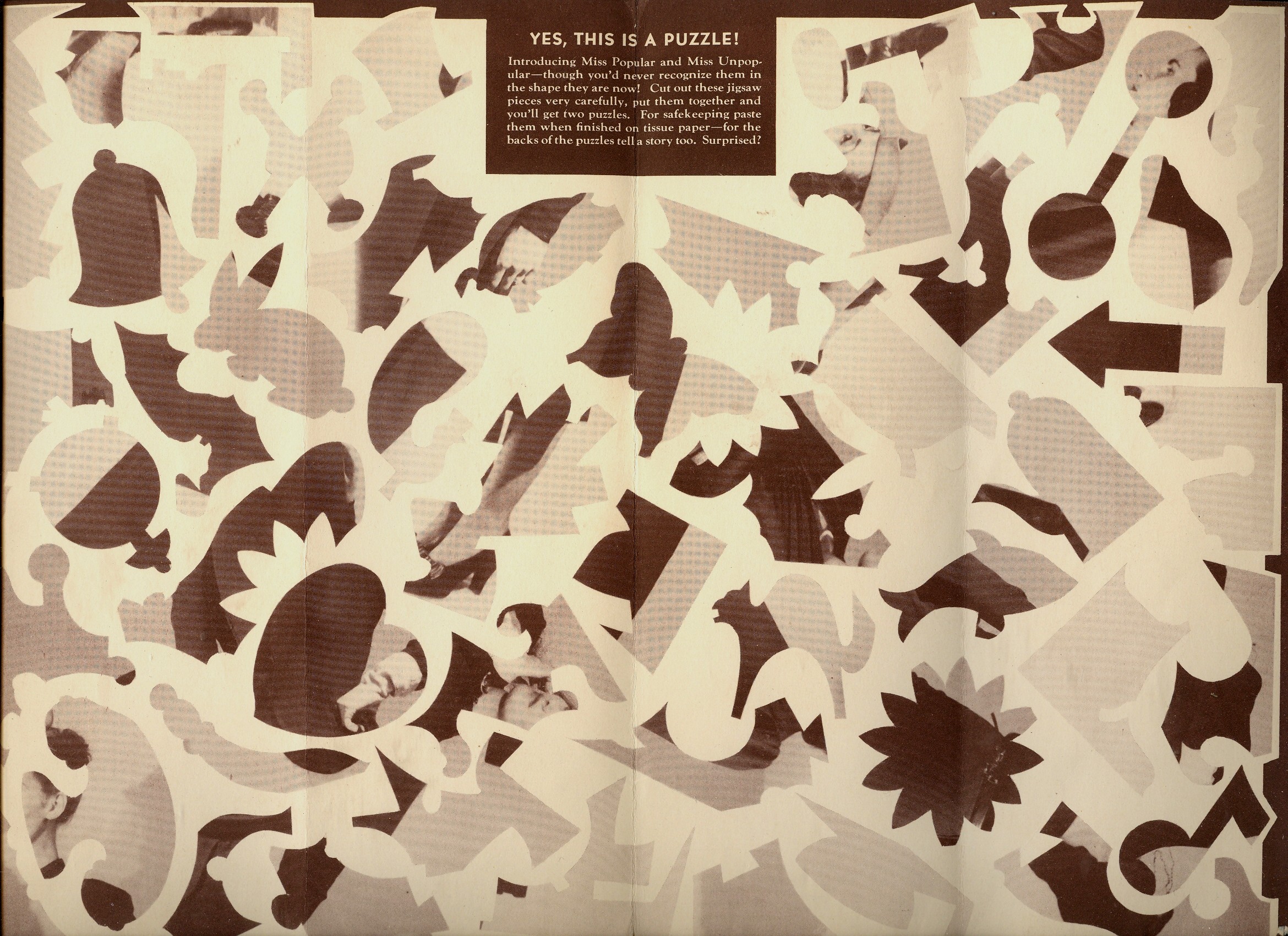
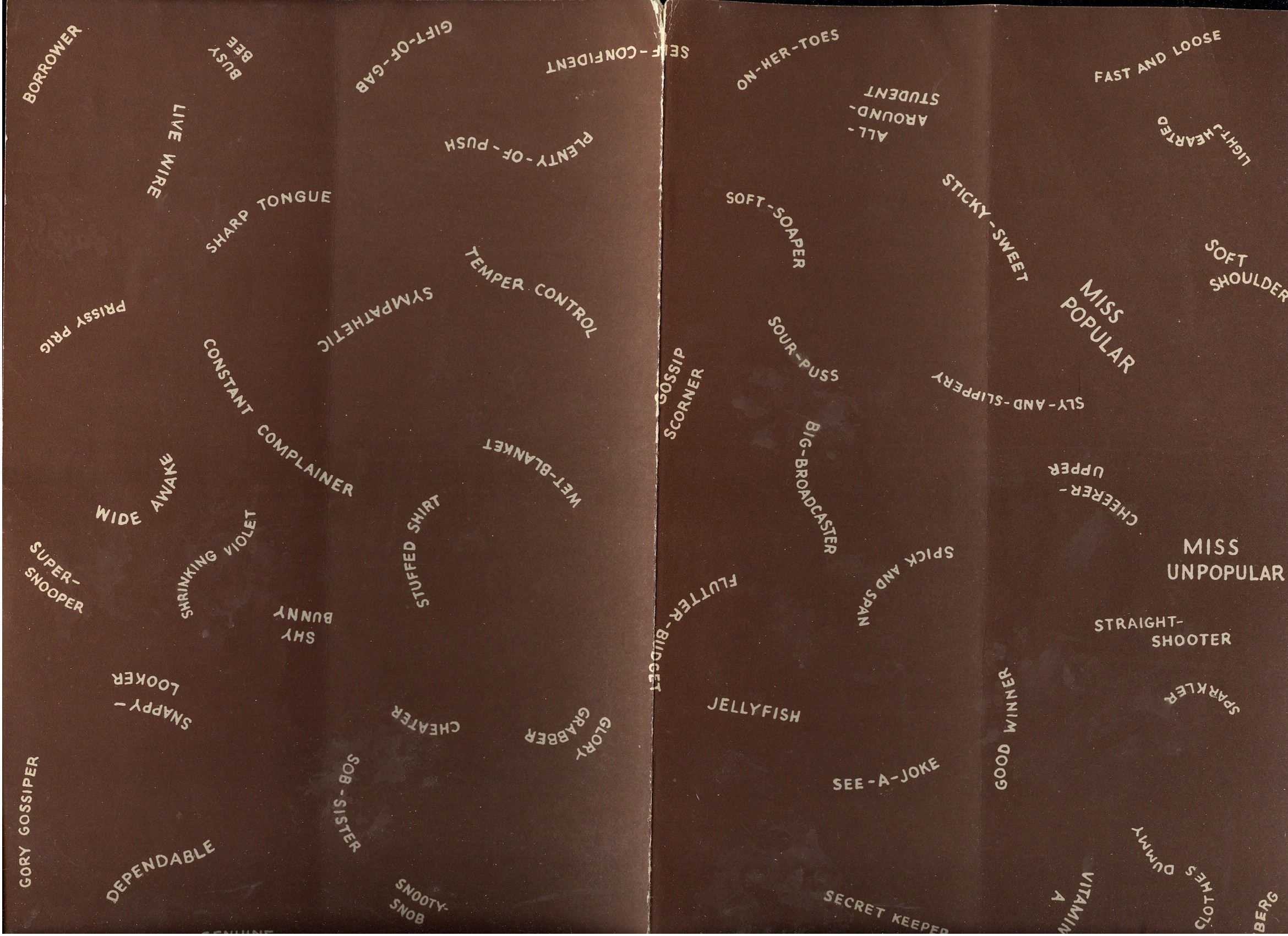
    Continuing on this thread of “constructing” females come this publication—hardly a pamphlet per se, just a folded 11×8 inch
    sheet of heavy
    stock—from that same series.  It was offered without a title, presenting itself as a do-it-yourself cut-out  puzzle. The puzzle
    pieces
    are parts of two women, “Miss Popular” and “Miss Unpopular”: the reader
    was to
    take the publication, cut out the pieces, and reassemble them into
    hidden role
    models, with phrases describing each on the back of each puzzle piece,
    all done with the with lost irony and  questionable metaphor.

    The twisted printing makes the description conform to the puzzle piece on the other side of the paper.  The descriptions for the Popular Girl are as follows:

    live wire, plenty of push, wide
    awake, snappy
    looker, dependable, genuine, secret keeper, on-her-toes, spick and span,
    light
    hearted, all-around-student, straight-shooter, gossip scorner,
    sympathetic,
    cheerer-upper, sparkle
    r.

    Blog jan 13 Puzzle pzl

    Miss
    Unpopular’s
    phrases/descriptors
    :

    glory grabber, sour puss,
    cheater, sob-sister,
    snooty-snob, wet-blanket, borrower, prissy prig, sharp tongue, gory
    gossiper,
    clothes dummy, iceberg, sly and slippery, jellyfish, sticky-sweet, soft
    soaper

    (?) and, of course, fast and loose.

    And
    so girls—or young women—picking up this publication in 1941 were
    expected to
    cut this thing up and piece together the proper (paper) role model using
    the
    reinforcing traits of meager acceptance printed on the back of the
    puzzle
    piece. Once together Miss Popular and Unpopular look pretty much the same, though in general Miss Unpopular seems a little darker than necessary, scorched I guess with her selfish sins. 

    And so double-click for a big image, save it to your desktop, print out and cut up your own Popularity Girl.  Or not.


  • Women in the Battle Between Martinis and Narcotics, 1902

    JF Ptak Science Books  Post 1052

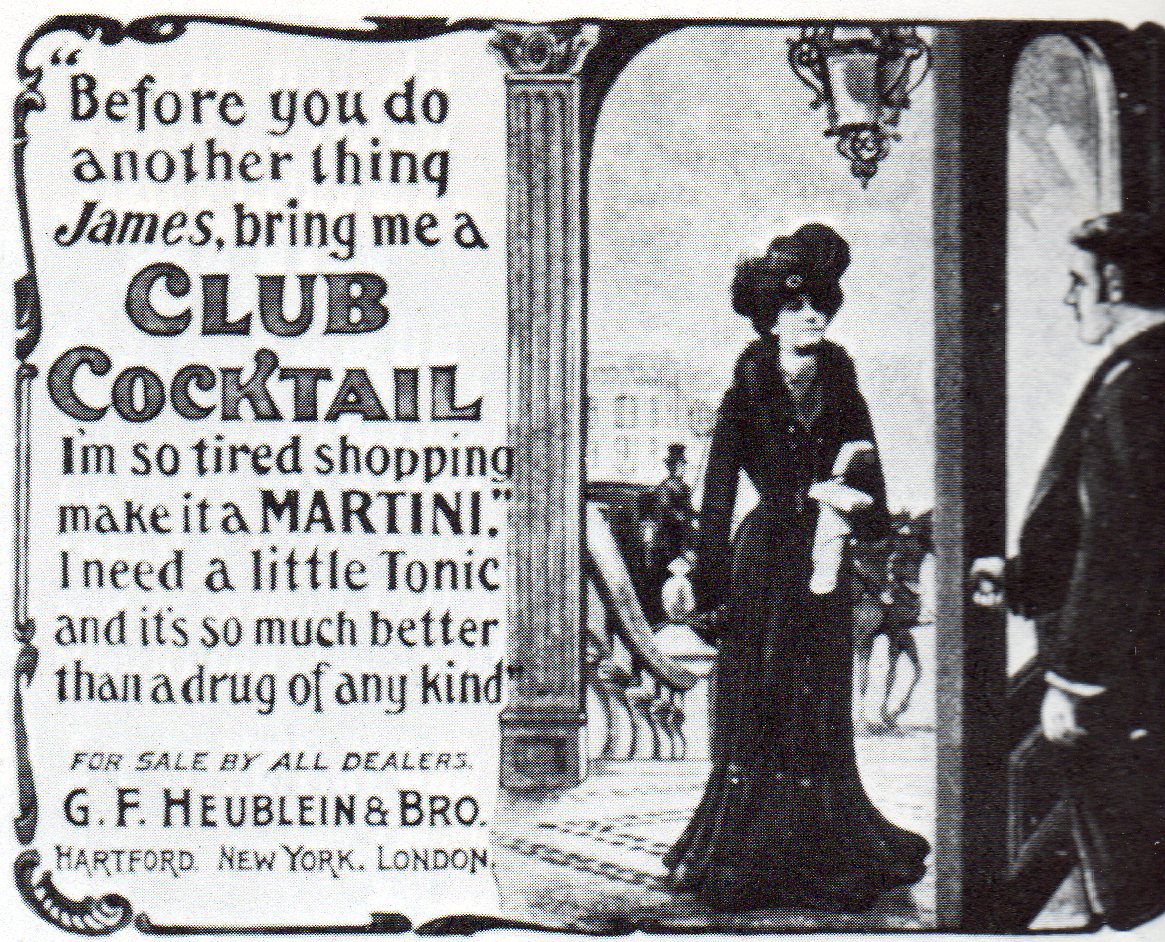
    Somehow I think that I’ve missed these ads of women pushing alcohol over narcotics and other drugs.  It certainly seems a more elegant solution to the “unwinding problem” of the more-or-less semi-idle privileged classes.

    Martini055
    At this point in the history of addiction in the United States all of the “any other drugs” that this woman is referring to were legal–very big drugs and very legal.  The opium trade was of course still very much alive and well, England and to a lesser degree France doing their brightest to bring the best (where “best” means “most”)  narcotics to the world inside and outside of the Golden Triangle, ruining as much as humanly possible while doing so.  Opium was the drug of choice, followed by morphine (which Dr. Alex Wood discovered in 1843 was better introduced into the body by injection) and then graduating to heroin.  (Heroin was synthesized first by C.R. Wright, who boiled out some morphine on a stove.  It was Heinrich Dreser who introduced diacetylmorphne in 1895 as the Bayer Company product called “Heroin”, which was marketed as a pleasant step-down to morphine addicts in 1898.)        

    So sparkling mixer with gin was the better part of valor for the Heublein company, even with legal heroin and morphine and opium to compete with.  It wasn’t until 1905 that a “ban” on opium came into effect in the U.S., though the first federal attempt to control narcotics did not appear until the Harrison Narcotics Act of 1914 (which required those dispensing narcotics to (a) register and (b) pay a tax). 

    But the sale and consumption of narcotics wasn’t made illegal until 1923, brought about through the U.S. Treasury Department’s Division of Narcotics.  This unfortunately came about 222 years after the Chinese Emperor Kia King ban all opium  products in China, subverted forty years later by the Brits. 

    The queer part of this story is that narcotics were banned in 1923, three years after the 18th Amendment to the U.S. prohibited the sale and use of alcohol.


  • The Emptiness of Gun Porn: Burlesque Dancers as Game, 1947

    JF Ptak Science Books   Post 1051

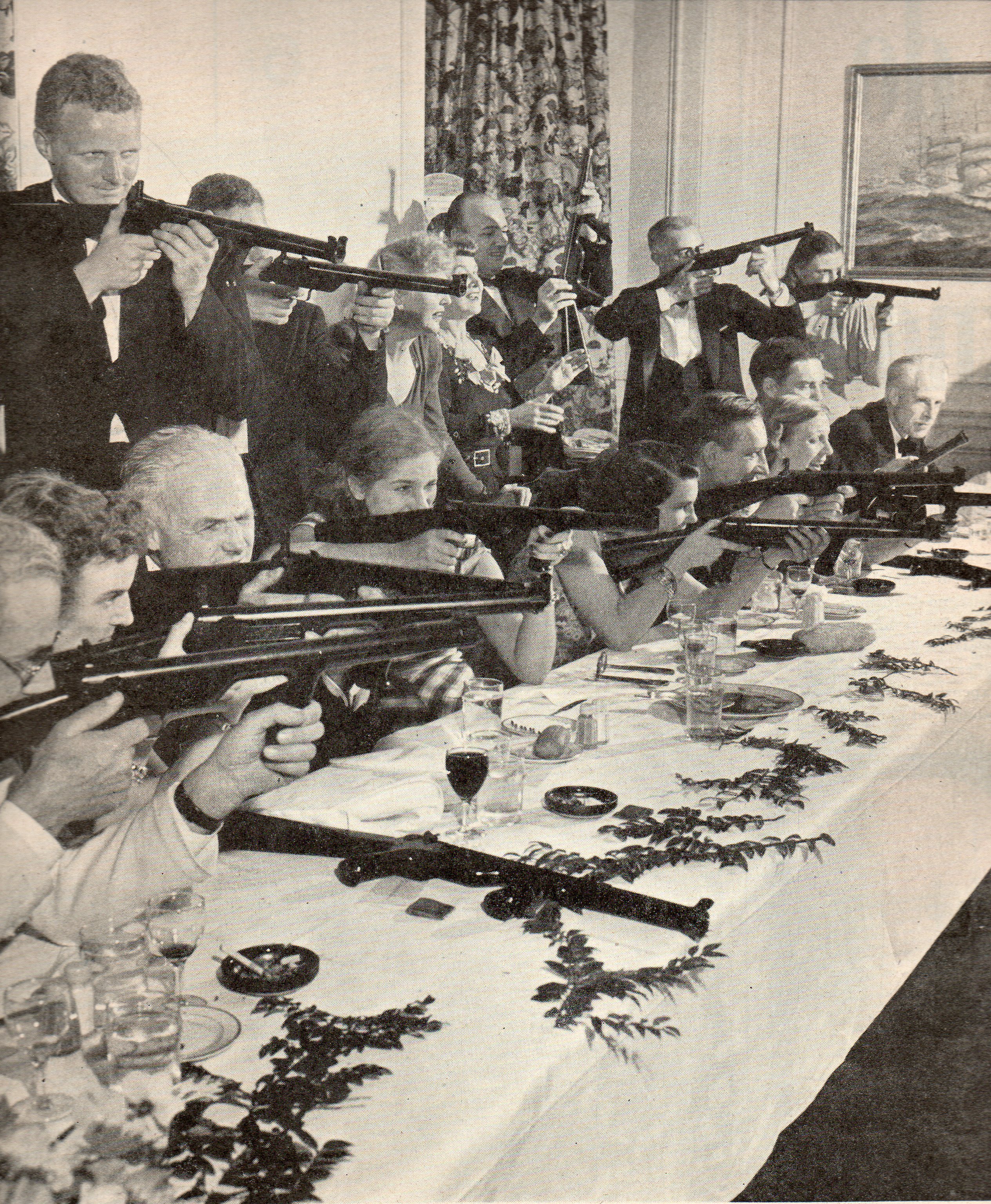
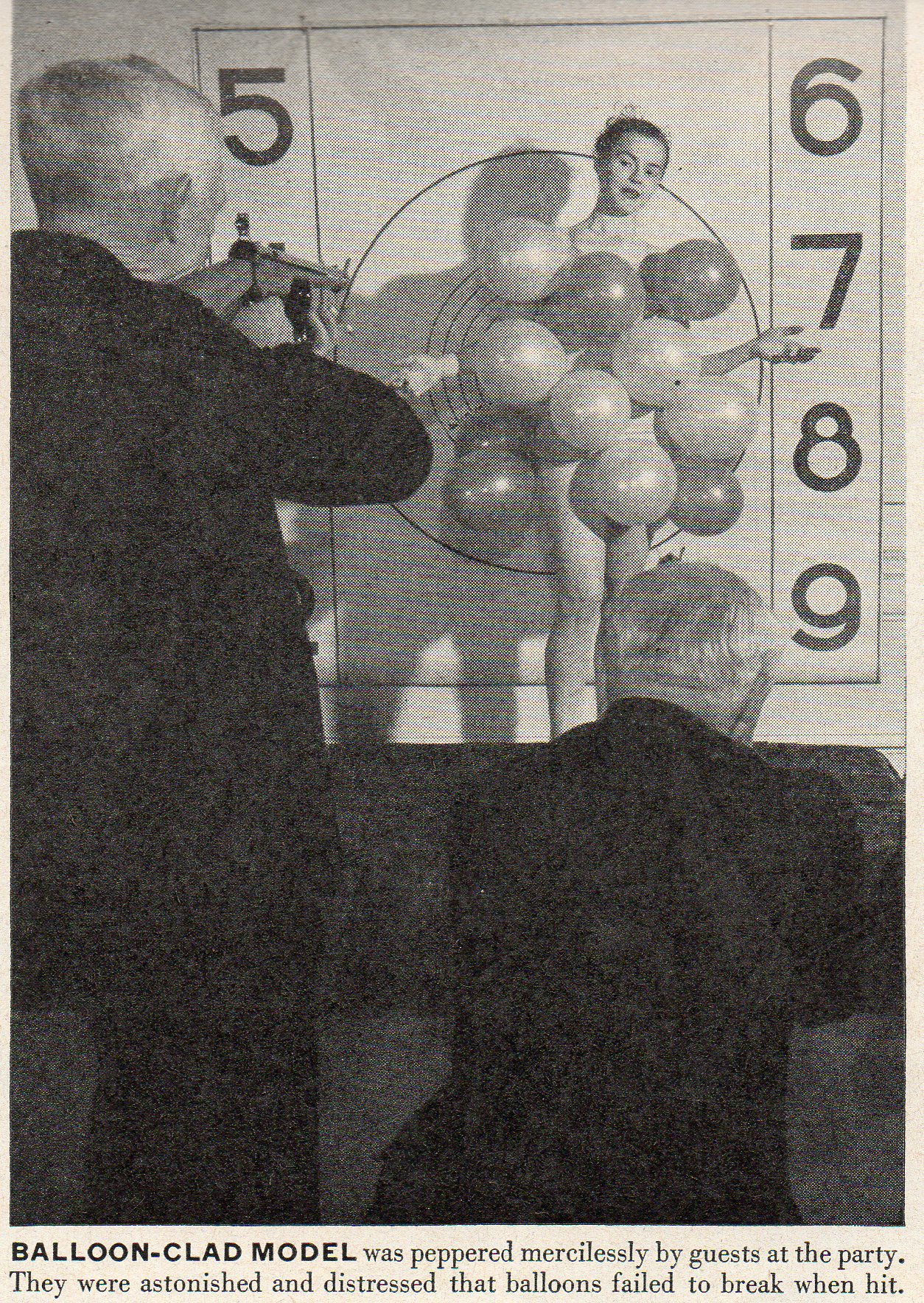
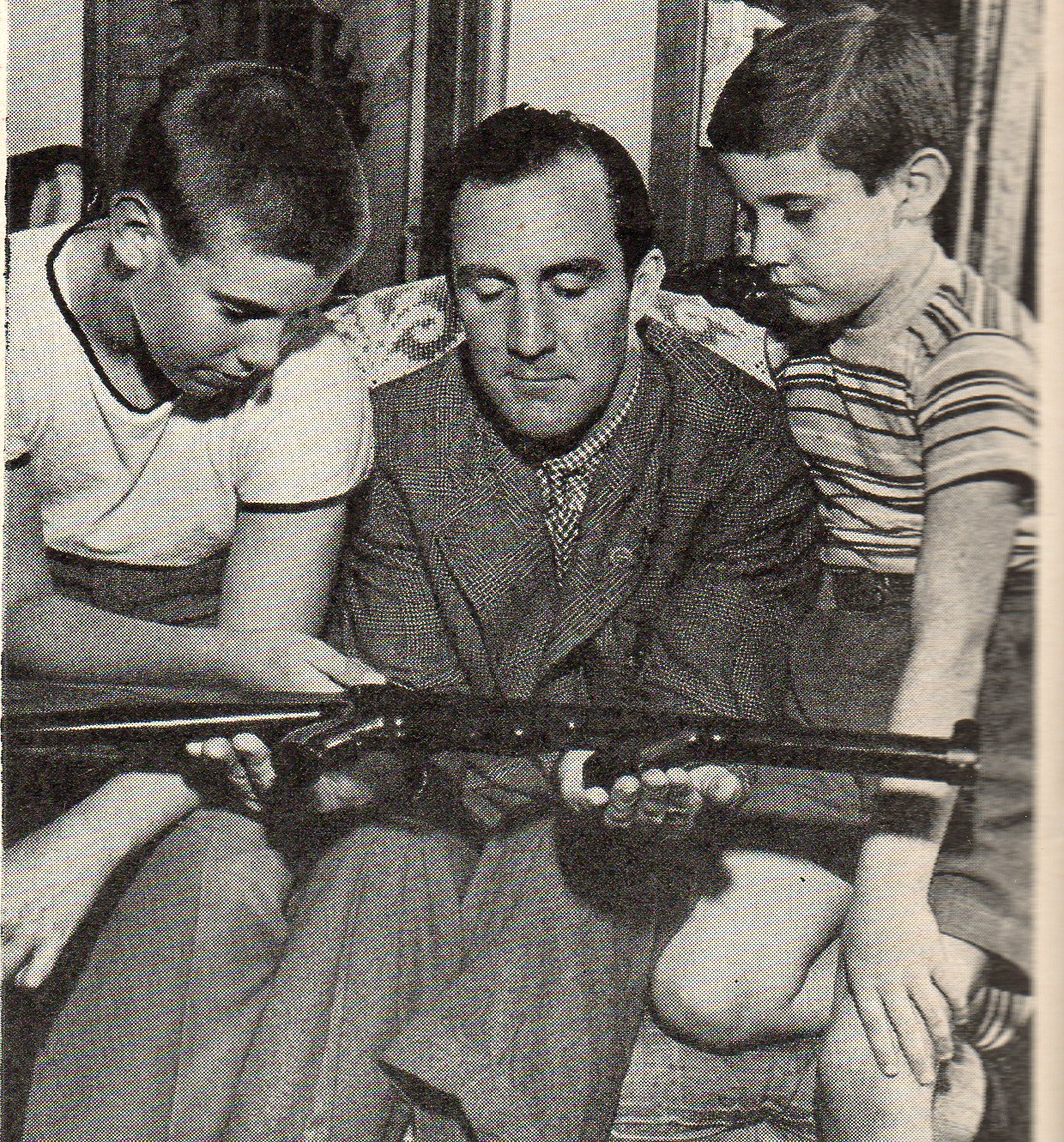
    It is unusual for me to find provocative photos that are more unusual in context rather than out.  But this is certainly the case here, with these photos of gun porn from Life magazine of 1947. This photo spread was meant to celebrate the launch of a “harmless” toy gun, the manufacturer demonstrating this point by having two dozen dinner quests shell dining room targets with imitation Tommy Gun-ish pellet guns. 
    00--shooting strip teas dinnere043

    Perhaps appropriate in more ways than one are these two older men shooting “ineffectually” at a model dressed in balloons–the point being to break the balloons to reveal her nakedness.  But the ejected pellets hit and dribble away, the rubber balloons remaining intact, with the foiled men left feeling “astonished and distressed”.  You can almost smell their impending failure in this picture (as well as the relief of the model).    
                                                   
    00--shooting strip tease042

    Then there’s the Holiness of the Gun moment, a father holding the toy gun in flattened palms., making himself a portable altar for his respectful sons, a deep reverence for the object present in the man’s face.     
     

    00--shooting strip holy grail044


  • The Coming Sameness of Beauty–Lessons from a Soda Bottle of 1947

    JF Ptak Science Books  Post 1050

    The great beauty of beauty is its great unidentifiable qualities–unidentified that is until they are identified, quantified, signified, geometized, libeling the concept of beauty until it is nothing but a soured criminal contempt.
    Barbie-history-2
    In an antiquarian sense one way of establishing what “beauty” meant in a particular time is by looking at painting or sculpture, the idealized form representing gods and goddesses of strength and beauty and grace. For more recent times of less idolatry and more commercialization advertisements using images of women to sell whatever product the seller was trying to push on the viewer could also be used as a certain standard of attraction and beauty. (Assuming of course that we are talking about the recent past when images other than the product itself were being used to try and establish a desire and loyalty to the product. In the history of publishing, this is a relatively recent innovation that I think belongs to the 19th century and not before.)   In the case of using pretty women, the advertiser was trying to associate their product with a certain sense of beauty, or to at least attract the attention of a lazy reader to look at their coal tar soap because a pretty face was lined up next to it.

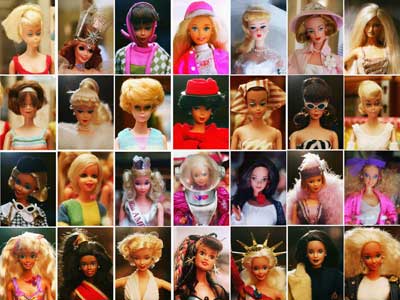
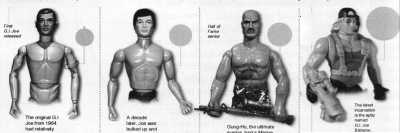
    Another interesting way of evaluating beauty could be found in the evolution of Barbie Dolls or GI Joes.  Or you could consult William Hogarth’s Analysis of Beauty.  And many other things of course, that deal with beauty in the human form (and more, or orders of magnitude more, that deal with beauty outside of ourselves, beauty in the forms of architecture or mathematics or the arrangement of sand or whatever). 
    00--beauty--gi joe
       
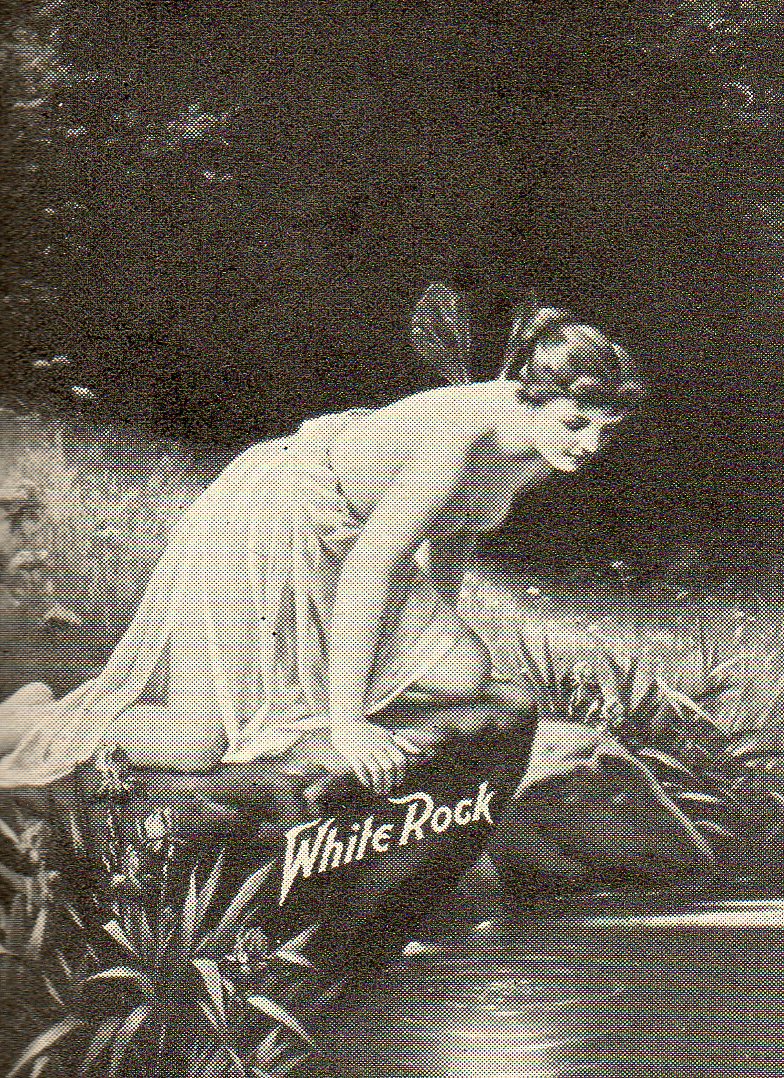
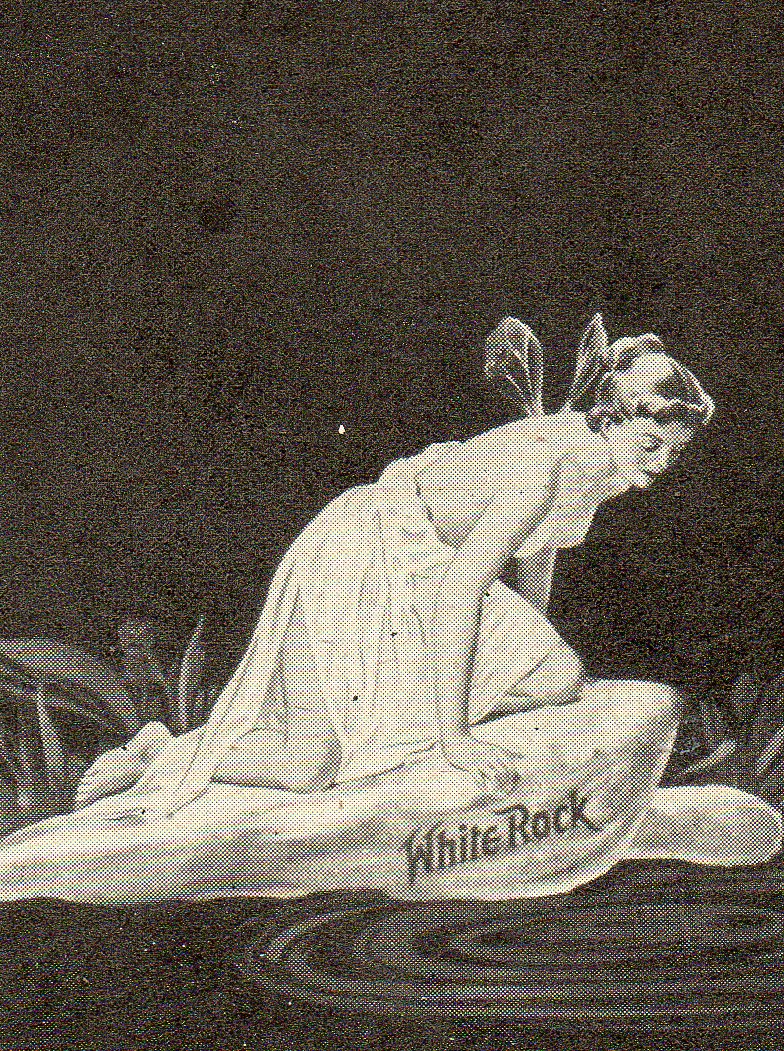
    I’m just going to give beauty 700 words here, or so, and so I’ll concentrate on just one picture of comparative beauty. (I guess that there have been 100 billion words written about beauty, though if you loosened up the definition of what ‘writing about beauty” mean, the number could probably be squeezed up to a trillion, which would mean 4 million books of 250k words each.  Probably the 10^10 is a better guess.)  As it turns out it is a picture from a story in Life magazine for 30 June 1947 of Psyche–the Greek goddess of the soul–used as the logo for White Rock soft drink company’s mineral water.  In general it’s a poor depiction of the goddess, and I’m not so sure that they even had the goddess in mind when the whole thing came into the bottler’s mind (she is after all described as a “sprite” in the LIFE magazine article).

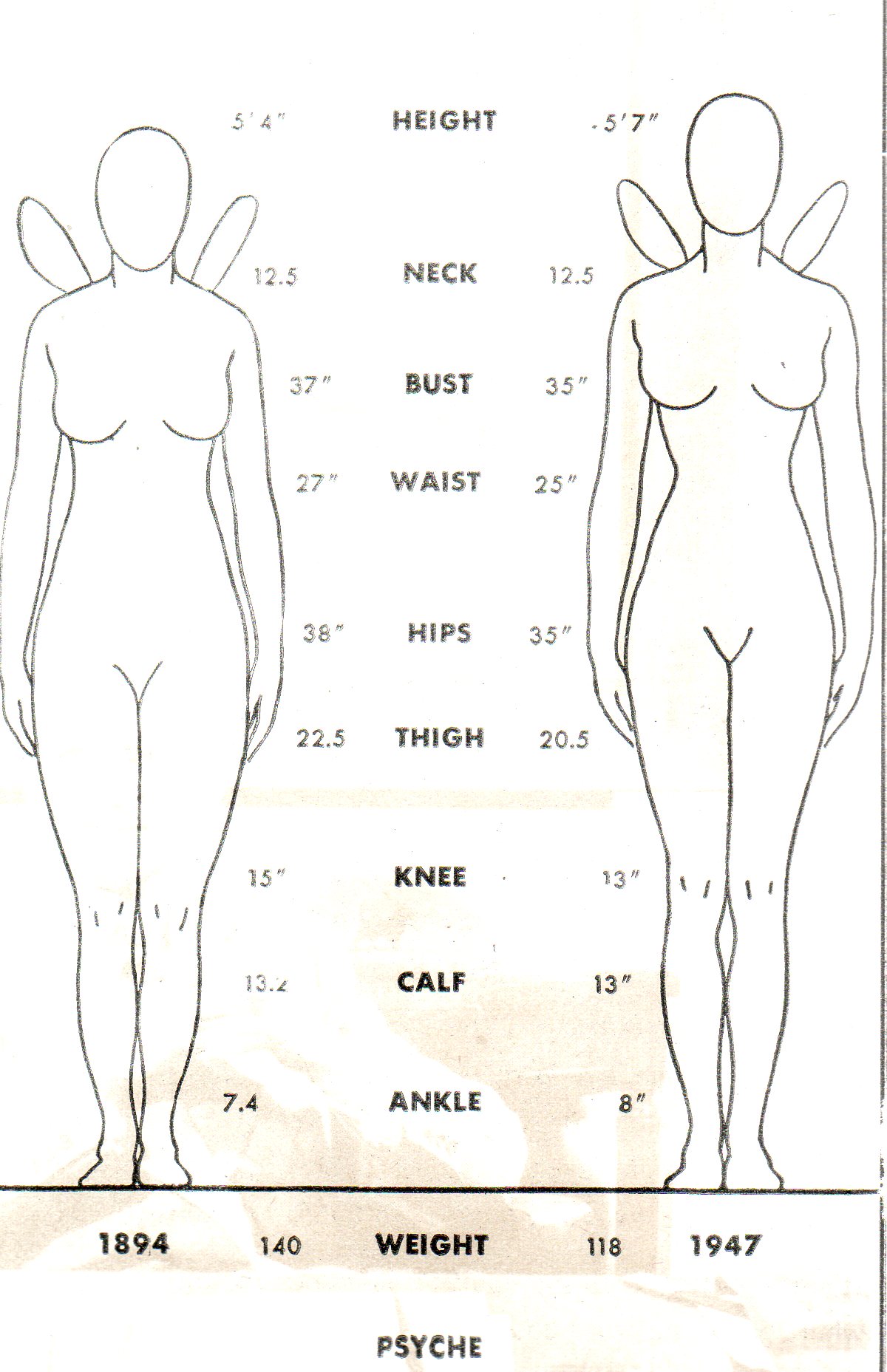
    What is of interest is the change in the image of Psyche on the face of the bottle over the years (shown here for 1893, 1924 and 1947) which is graphically depicted with measurement appraisals.
    00--beauty psyche 1038
    Psyche simply buffed up a little, getting taller, slimming down and generally made to be a little more common.  She did loose her nipples in 1947, or at least they became obscured, trailing away from their depiction in 1893.  (I once attended a U.S. Supreme Court argument on a case dealing with nipples and pasties and strip clubs.  It was a little bizarre, and as my mind wandered I took an interest in the court’s decoration, and particularly the frescoes–which of course included a full-nippled woman, staring down at the court from her height.)   
    00--beauty psyche 3040
    But it struck me that Psyche was simply becoming a more-generic depiction of beauty, which reminded me of this odd bit of beauty sanitizing prevalent among the wealthy of today, or at least among those–actors and advertising types–whose image helps set the stage for the beauty standard.  Now it is possible to vastly augment your appearance via surgical procedures to the common standard of what has been established as “beautiful”.  And the end result of this is that there is merging a certain sameness among the people whose faces everyone seems to know, and whose appearances change the way people think of beauty.  I find it striking that someone (for example)  like the actor Sharon Stone would turn her face into a common mask of someone else entirely, closing the ranks of differentiation in what is presented to mass market audiences as “beauty”.  Everyone is starting to look like everyone else, or so at least among movie actors. 

    And so it is perhaps finally appropriate that I chose Psyche to discuss here, because if the actors tend towards these procedures more and more, they’ll all be wearing the same sort of frozen mask that their ancient Greek precursors used to wear when in performance.  

    00--beauty psyche comp041


  • “Her Work” Visualizing the100-Hour Work Week of the 1947 Housewife.

    JF Ptak Science Books  Post 1047           Part of our History of Women Series

    “Like most busy young housewives, however, she gives little thought to
    the future–to satisfactory ways of spending the important years after
    her children have grown up and left home.” [See below.]

      
    00 marjorie

    0000 woman chores list024

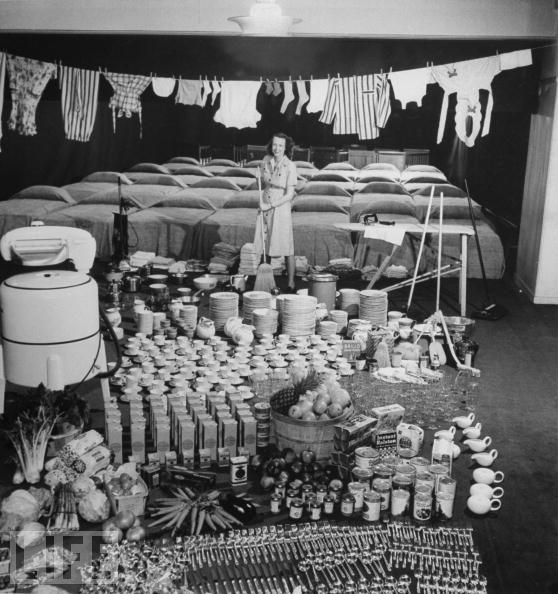
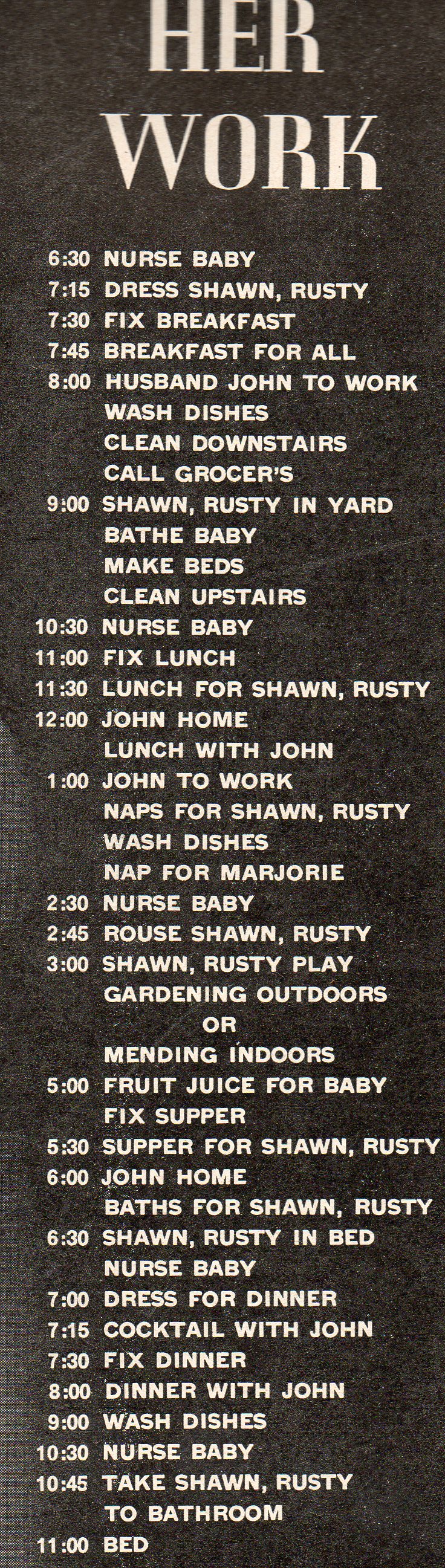
    This photo by Nina Leen [“Housewife Marjorie McWeeney amid symbolic display of her week’s housework” in “Woman’s Dilemma,” Life, June 16, 1947, p. 105] depicts part of the housewife-y stuff of attention in the course of her 100-long-week.  The remarkable part of the photo is that  all of this was displayed in a window display at Bloomingdales.

    Part of Ms. McWeeney’s average work week included “35 beds to be made, 750 items of glass & china, 400 pieces of silverware to wash, 174 lbs. of food to prepare, some of 250 pieces of laundry.on a line, & a ringer washing machine”–that plus paying attention to her children during  the 70+ hours a week in which they are awake.

    In the listing of Ms. McWeeney’s routine (“Her Work”) I see no evidence of Mr. McWeeney’s contribution to the daily chores. We see that he spends 15 minutes eating his breakfast before leaving for work at 8; returns home at 12 or a one-hour lunch before bolting at 1; and then returns at 6 for cocktails at 7:15 and then an hour long dinner at 8.  Perhaps he was helping bathe the kids before cocktails, perhaps not.  I can’t find evidence for Mrs. McWeeney’s present telephone number, so perhaps we’ll never know. But my sneaking suspicion is that Ms. McWeeney ran the house and kids solo, as was the general custom of the day, basically.

    Notes:

    From the LIFE magazine issue:

    “A nice husband, three fine children keep her busy 100 hours a week.

    “Mrs. John McWeeney of Rye, N.Y. has a big, good-looking husband who works in a nut and bolt company, and three children, Shawn, a grave little 4-year-old; John, called “Rusty,” almost 2, and baby Mark, 4 months old. She lives in a bright new seven-room house that has a safe backyard for Shawn and Rusty to play in and a number of modern machines to help her with her household chores. She uses a diaperservice and she can afford a cleaning woman once a week who does the heavy laundry.

    ” But even under these better than average circumstances Marjorie McWeeney’s hours are long and her work demanding. She must keep an eye on her children during their 70 waking hours a week and also watch over them when they are supposed to be in bed but may actually be popping down the stairs to ask for water or an extra goodnight kiss.

    “The picture [above] shows the household tasks that Marjorie must accomplish every week. She has a crib and four beds to make up each day, totaling 35 complete bed-makings a week. She has hundreds of knives, forks and utensils to wash, food to buy and prepare for a healthy family of five and a whole house to dust and sweep. . . .

    “Actually Marjorie’s chores are much lighter than they would have been a few generations ago. She cleans with machinery propelled by electricity, she uses food prepared in canneries, she buys clothes factory-made to fit every member of the family. But her jobs, though relieved of old-time drudgery, have none of the creative satisfactions of home baking, home preserving, home dressmaking. And, because her family unit is small with no aunts or cousins in the household, all the time she saves from housework must go into supervision of her children. Unless she makes special arrangements with a baby-sitter, she has no relief from child care.

    “Many women in Marjorie’s position feel that this is a life of drudgery, that it is not good for Marjorie, a graduate of a junior college, to stay with small children long, continuous hours. Marjorie herself has no desire to work outside. Because as an individual she likes the job that she does, she has no problem right now. Like most busy young housewives, however, she gives little thought to
    the future–to satisfactory ways of spending the important years after
    her children have grown up and left home.”


  • Alpha & Omega Department: Leashed Women

    JF Ptak Science Books   (Picture Post)

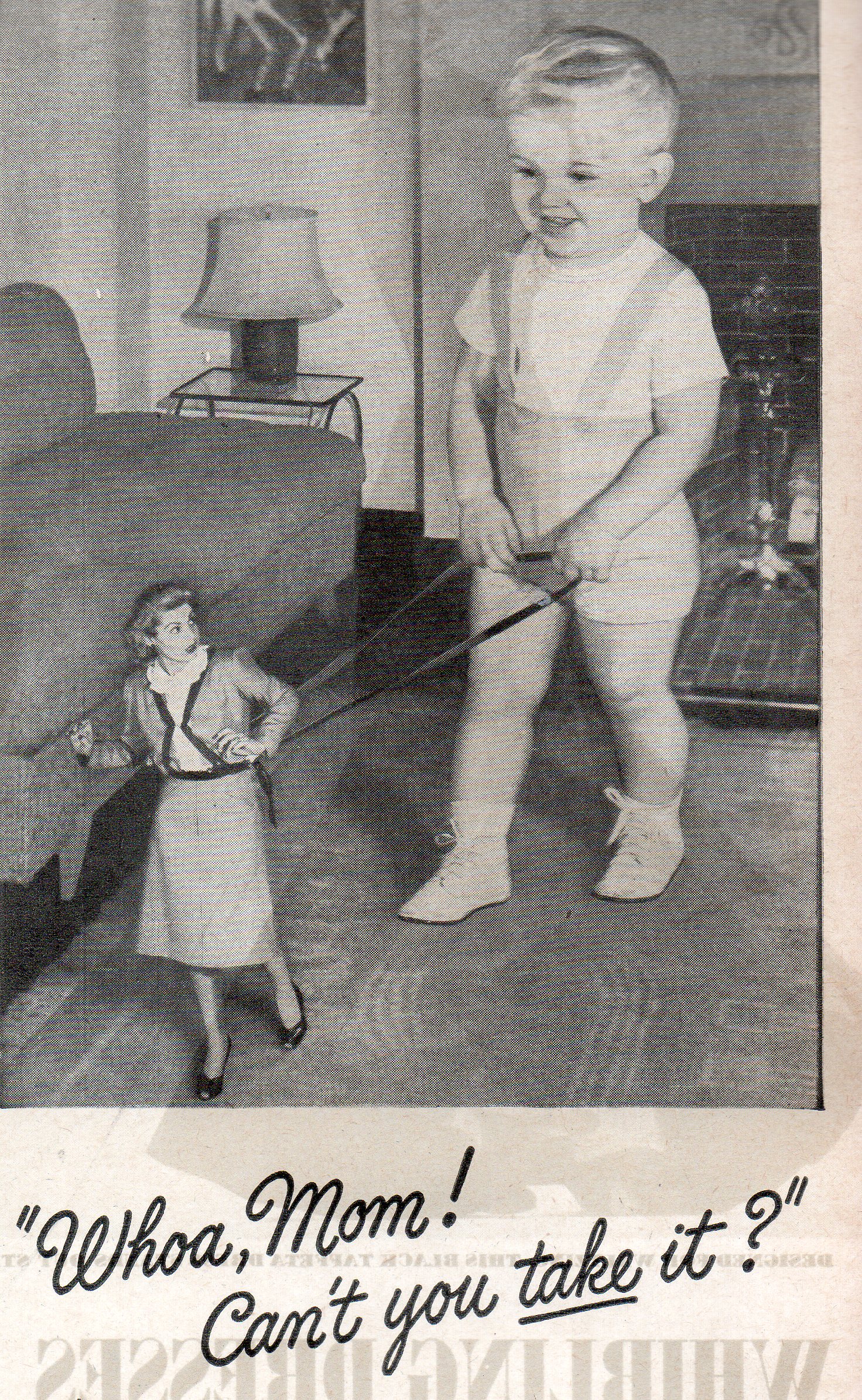
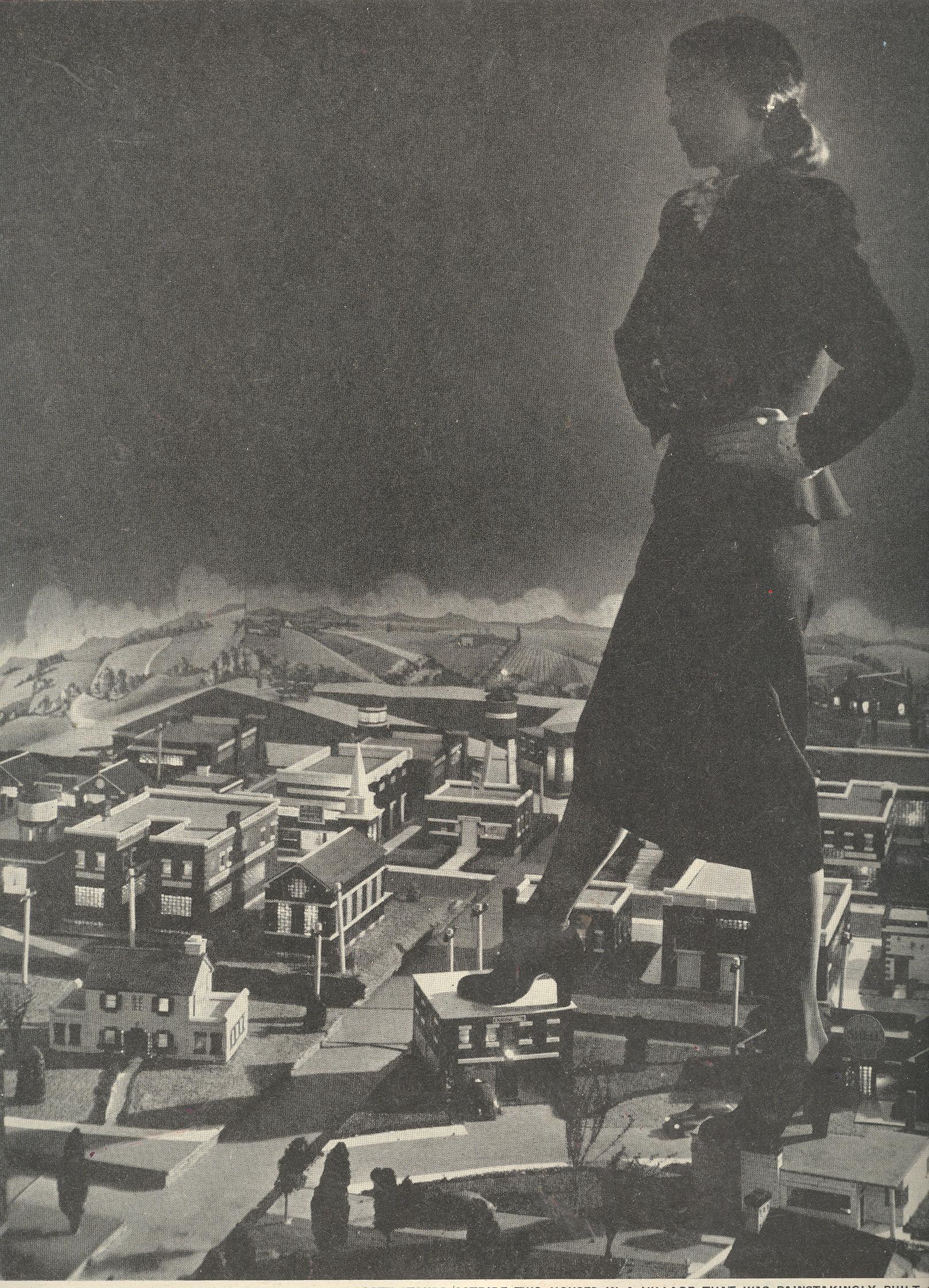
    This would also go nicely with my 200′-Tall Woman post, making the long and short of things and rounding out the other end of the spectrum for the greatest difference in hemline-to-ankle distance.

    000 women on a leash012 

    000 big woman


  • Imprisoned and Force-Fed Suffragists, 1910

    JF Ptak Science Books   Post 1037 

    {This is part of our History of Women series)

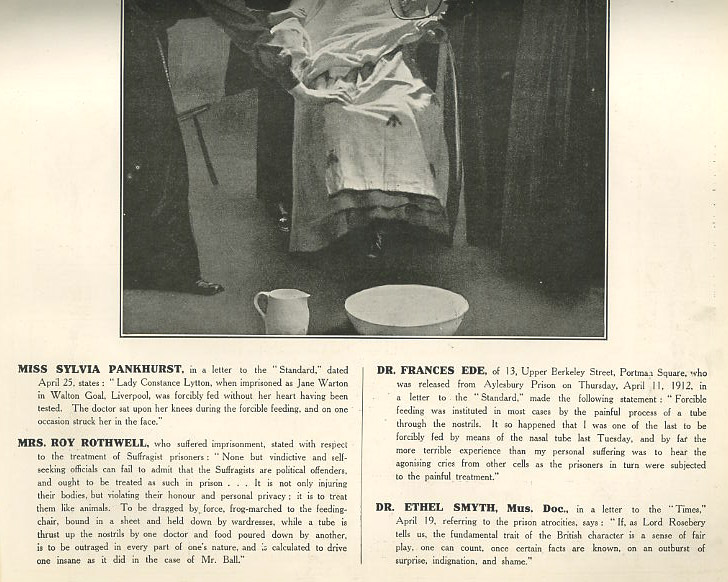
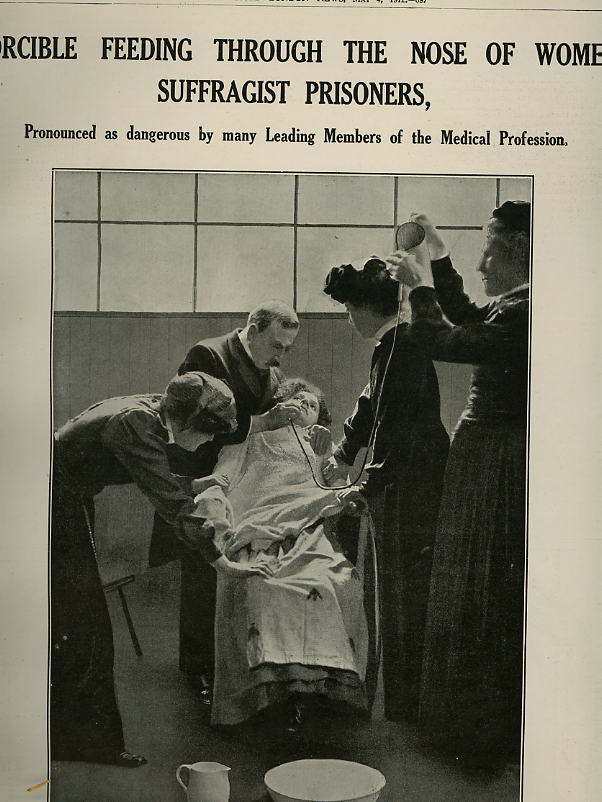
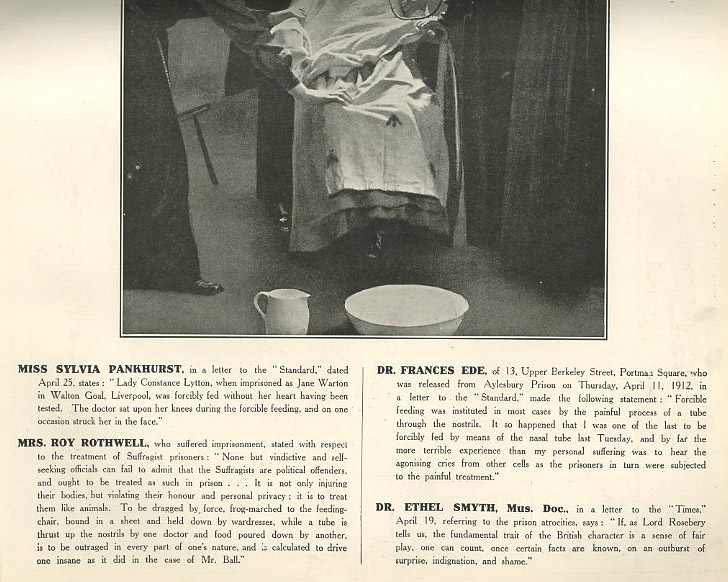
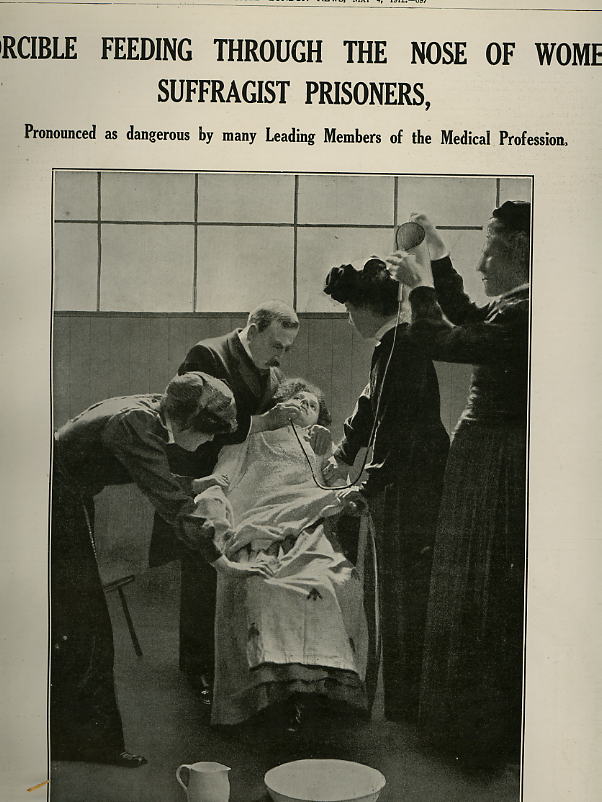
    In January 1910 the Illustrated London News (perhaps sympathetically) reviewed the case of the forced feeding of a leading female suffragist–very forced, very forcible, feeding-tube-up-the-nose-and-into-the-stomachDetail face forcible, the work of a grappling prison doctor and assistants.  The full-page illustration was entitled:
    “Forcible Feeding Through the
    Nose of Women Suffragist Prisoners”

    and then pointing out:

     “Pronounced as dangerous by many
    Leading Members of the Medical Profession…”

    It is the story of medical indulgence and state insistence of not recognizing any displays of independence while imprisoned–feeding a woman against her will, a 
    woman prisoner at the hands of what sounds to be cruel warders and an insistent doctor. The woman in question was Lady Contance Lytton (b. 1869, imprisoned in disguise as “Jane Warton”) in Walton Goal, 
     

    File0505

      
    File0507

    Liverpool. She was arrested and placed there for minor offenses to the civil code while protesting for the rights of women to vote in England. She carried her struggle further in jail, doing about the only thing she had left to do while she was put away–make herself into a political statement by refusing to eat or ingest  liquids.  Walton Goal would have none of it, and resisting the entreaties of professionals, decided to feed the woman themselves at whatever cost.  The doctor who administered the fluid
    evidently sat on her knees and slapped her until the Lytton’s resistance
    failed. My guess is that the white cloth covering her in the photo is not for drips and drops, but was used to cover restraints–I hardly think that the two female attendants would’ve been able to hold down Lady Lytton’s arms by themselves, especially in that posed posture. There are three other accounts of women being bound, restrained,
    held by wardresses, and in general being badly treated.  (There is a
    continuation of the story of Lytton, below.)

    The vote did not come until 1918 with the Representation of the People Act, which in June 1917 passed the House of Commons and which went through the House of Lords in February of the next year, granting full enfranchisement to all women (over the age of thirty. This is about two years before American women were given the right to vote–on August 26, 1920–and 25  years after women won the vote in New Zealand, which again was first on the scene like it has been so many times). Lady Lytton would do badly in prison after this, suffering a heart attack and then a stoke by 1911, and never really recovered–she was half-paralyzed , was hardly robust, and wound up in her grave in 1923, aged 54.

    The Story of Lady Constance Lytton:

    “I was visited by the Senior Medical
    Officer, who asked me how long I had been without food.  I said I had
    eaten a buttered scone and a banana on Friday about
    midnight.  He said, “Oh, then,
    this is the fourth day; that is too long, I must feed you at once.”

    “He urged me
    to take food voluntarily.  I told him that was absolutely out of the
    question, that when our legislators ceased to resist letting women vote then I
    should cease to resist taking food in prison.

    “Two of the
    guards took hold of my arms, one held my head and one my feet.  The doctor
    leaned on my knees as he stooped over my chest to get at my mouth.   I
    shut my mouth and clenched my teeth.  He seemed annoyed at my resistance
    and he broke into a temper as he plied my teeth with the steel implement. 
    He dug his instrument down and it pressed fearfully on the gums.  The pain
    of it was intense and at last I must have given way for he got the gag between
    my teeth, when he proceeded to turn it much more than necessary until my jaws
    were fastened wide apart, far more than they would go naturally.

    “Then he put
    down my throat a tube which seemed to me much too wide and was something like
    four feet in length.  The irritation of the tube was excessive.  I
    choked the moment it touched my throat until it had got down.   Then the
    food was poured in quickly; it made me vomit a few seconds after it was down
    and the action of my sickness made my body and legs double up, but the guards
    instantly pressed back my head and the doctor leaned on my knees.  The
    horror of it was more than I can describe.  I was sick over the doctor and
    the guards …

    “When the
    doctor had gone out of the cell, I lay quite helpless.   The guards were
    kind and knelt round to comfort me, but there was nothing to be done.  I
    had been sick over my hair, all over the wall near my bed, and my clothes
    seemed saturated with it, but the guards told me they could not give me a change
    that night as the office was shut.

    “Before long
    I heard the sounds of the forced feeding in the next cell to mine.  It was
    almost more than I could bear, it was Elsie Howey.  When the ghastly
    process was over and all quiet, I tapped on the wall and called out at the top
    of my voice, which wasn’t much just then, “No surrender,” and
    there came her reply, “No surrender.”

    — above taken from “Eyewitness to History” by
    John Carey, 1987,
    Avon Books,
    page 423
     

    ·Posted by :

    ·in:

    —

  • Archaeology of Concentration: Patti Digh’s Childhood Pencils

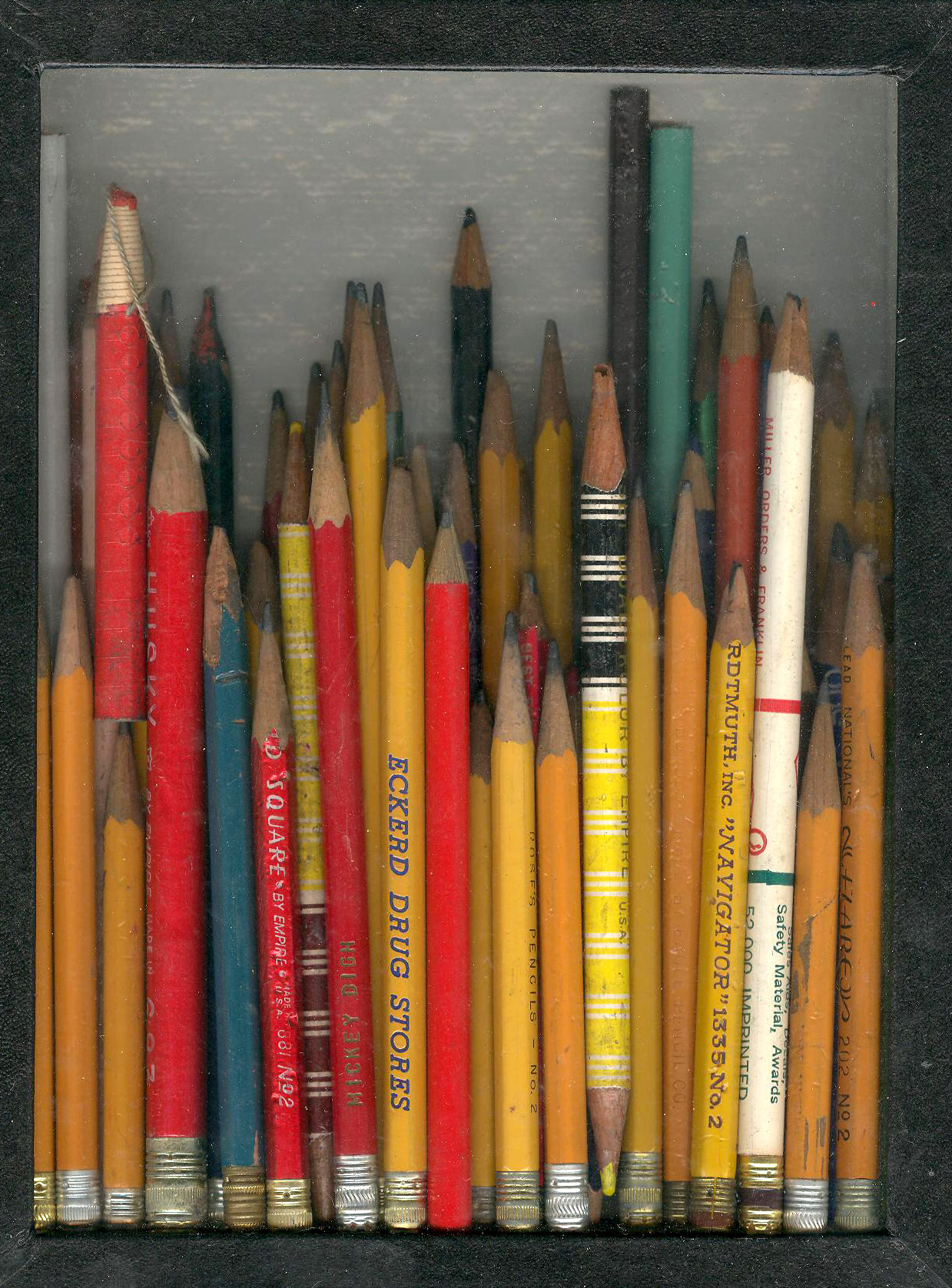
    My wife Patti Digh is an artist, and though she has great musical and painterly talents the greatest expression of her creative sensibilities is through words. And so I think that it is extraordinary that her childhood pencils have somehow made it here, into their future.  They are beautiful monuments to childhood creativity, their bite marks, gouges, scratches and just general wear and tear are testaments to Patti busily producing something from her mind, committing it to paper, back there in her deep past when she was only a couple of thousand days old.

    Patti--childhood Pencils points

    Patti--childhood Pencils
    Patti--childhood Pencils 2 det
    Patti--childhood Pencils corrections 

    A detail of Patti’s crayons, which I have written about elsewhere on this blog:

    Patti crayons 2

    Patti and I have saved virtually every bit of our daughters’ artworks–the really interesting stuff has been collected in one place, and then there’s the boxes of other artwork that they’ll have to deal with in their future. 

    And yes a Patti pencil box has also survived.

    ·Posted by :

    ·in:


  • Selling & Curing Sexual Ennui & Fixing the Fainting Woman, 1920

    JF Ptak Science Books   Post 1025

    There’s seems little more appealing to the false-chaste medical interests of 1920 England than helping fainting women, all to the betterment of social relations, clean houses and vibrant sexual partners.  The heritage of patriarchal piety’s rejection of sensual pleasure that was so common in England and Europe for many hundreds of years filed its way deeply into the 20th century.  Suspension of sexual discussion and understanding aside, it was well understood that women’s sexual nature was completely repressed unless in response to the pleasure of men.  It was a story of submission and subjugation, with all responsibilities for failed masculine sexuality falling to the shoulders of women (as clearly stated in the still-popular Stall’s marriage manual, a 19th century piece of rusty thinking still serving as the standard bearer in the early 20th century).  The manual is a codex of denial, submission, ignorance, boredom, tiredness, exasperation and triviality so far as sexuality is concerned for women–there is no hint of pride, or of enjoyment.  


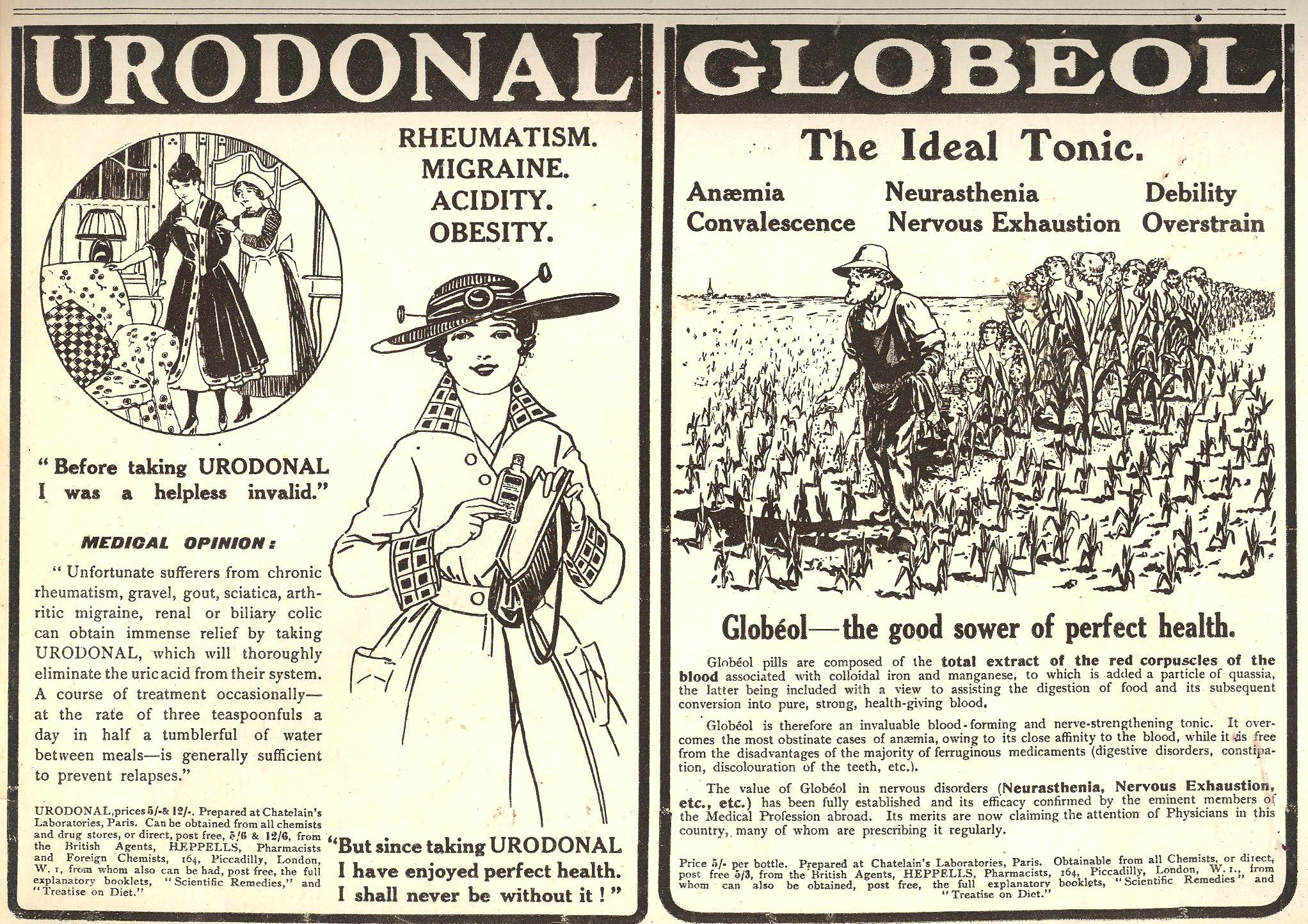
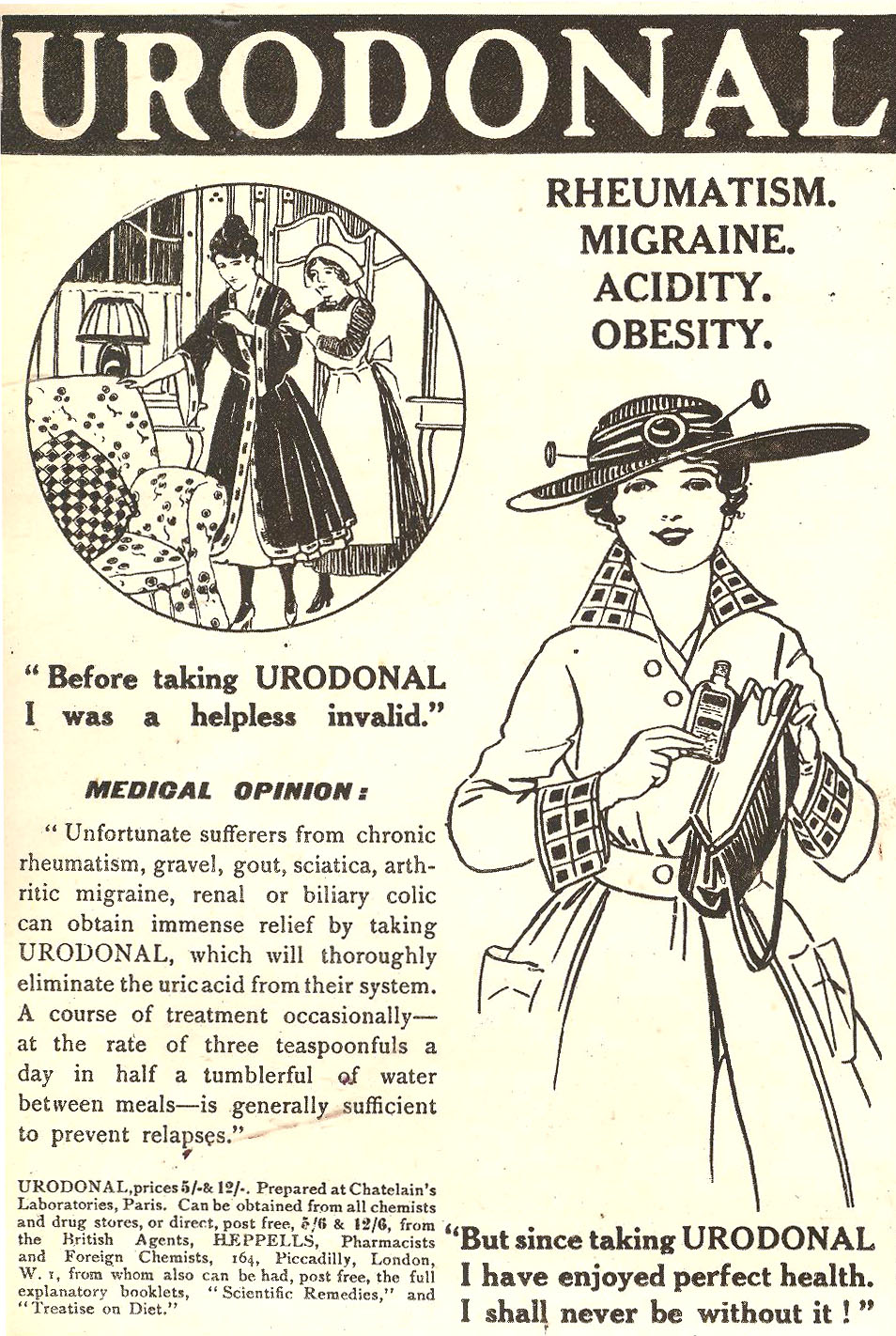
    1--may 11 globonol urodonol

    Urodonol was a product in long use in Europe and England, a quack medicinal of little harm that plagued the hopes of people with aliments elusive to medical detection, especially that of the greatly secret ennui and fatigue in response to sexual relations.  It claims to have cured rheumatism, migraine, acidity, gravel, gout, sciatica, arthritis, biliary colic and of course obesity, all taken care of with teaspoons and thimbles.   The most that it did perhaps was to not cause any of these aliments. But it did paint a picture of the failing, fainting woman being restored to stature so common to the pages of advertisement in The Illustrated London News (this issue for 5 June 1920).  Pre-Urodonol the lady is being assisted by the nurse to the well-pillowed fainting coach–“ahh” she says, her arms outstretched looking for balance, faking a tottering in her high heeled shoes.  The coach was a step away. 
    Urodonal was the cure, as we see Her refreshed and elegant in new hair and hat, rushing to get home to the man who now needn’t worry about not being cared for.

    1--may 11 urodonol

    Curiously the ad next to this one–same size, same typeface–is for another quack medicine for men whose seed is evidently growing moldy in the bottom of their sowing sack.  Globeol addresses the keyword problems for sexual malaise:  “debility, overstrain, anaemia, nervous exhaustion” by “conversion into pure, strong, health-giving blood”. Lest the use of STRONG BLOOD PURE BLOOD-FORMING HEALTH-GIVING GOOD SOWER be lost there is always the Johnny Appleseed person above, casting about his seed, growing children instantly.

    1--may 11 globonol

    If sexual malaise be, then Urodonol and Globeol is there for some sweet, secret sippings; a little shot here and there will bring the sexes together. Or not. 

    I might be completely wrong on this but, really, I like the possibility of this weird approach’s explanatory power–it doesn’t take a philo-shrinkologist to see the conjoined symbolisms in this set of ads and the approach to unmentionable complaints, and that’s what I think is exactly going on here.


  • The 200′-Tall Woman and the History of Skirt Lengths–Interesting Images

    JF Ptak Science Books  Post 1023

    [Part of this site’s History of Women series.]

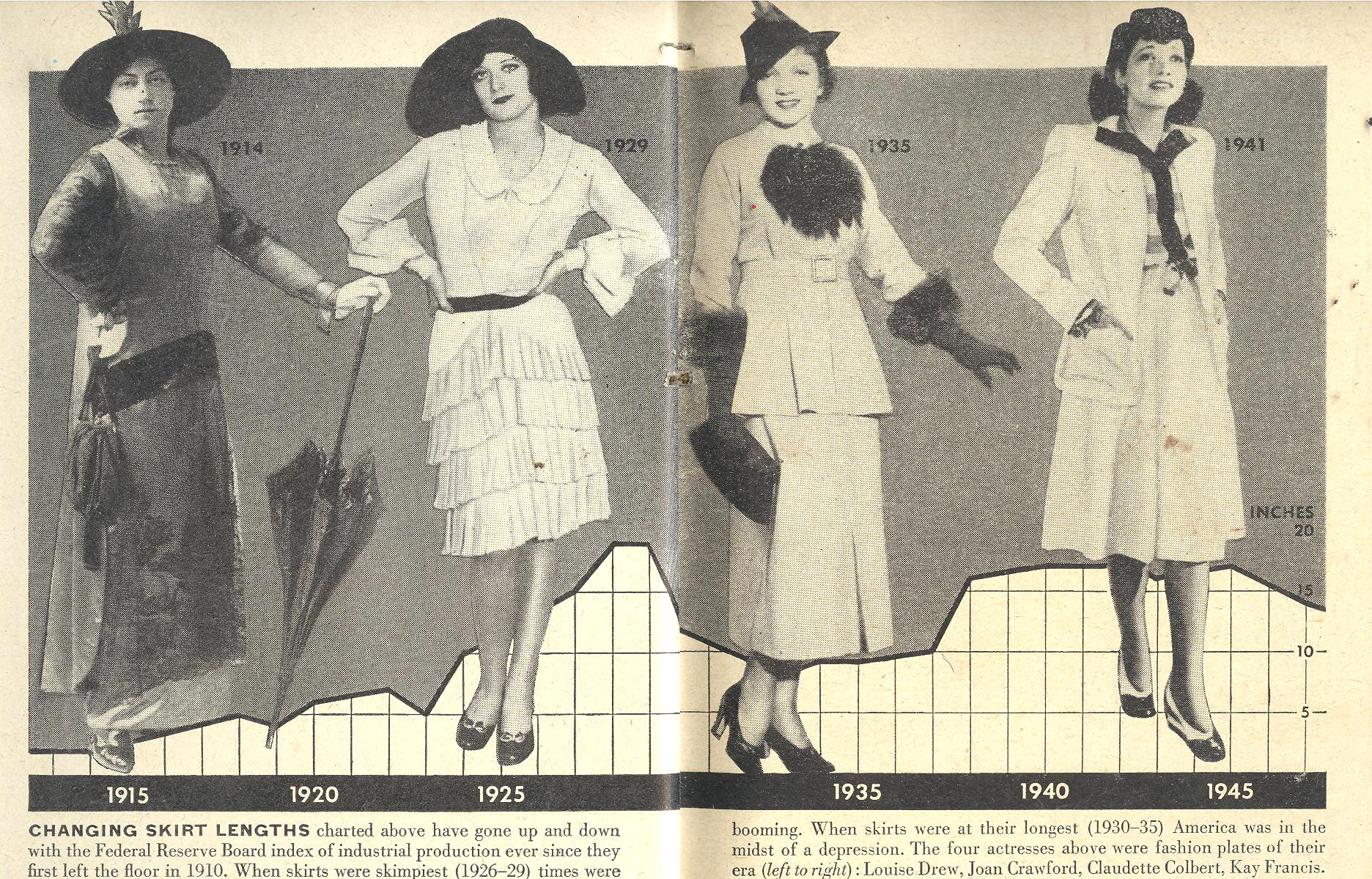
    This graph illustrating the history of skirt lengths in the United States is oddly interesting and appealing, a job well done.  I like that the graph lines fairly well reveal the amount of leg shown by the rising and lowering hemlines, measuring the height above the ankle from bottom to top. 

    1--may 7 skirt length 

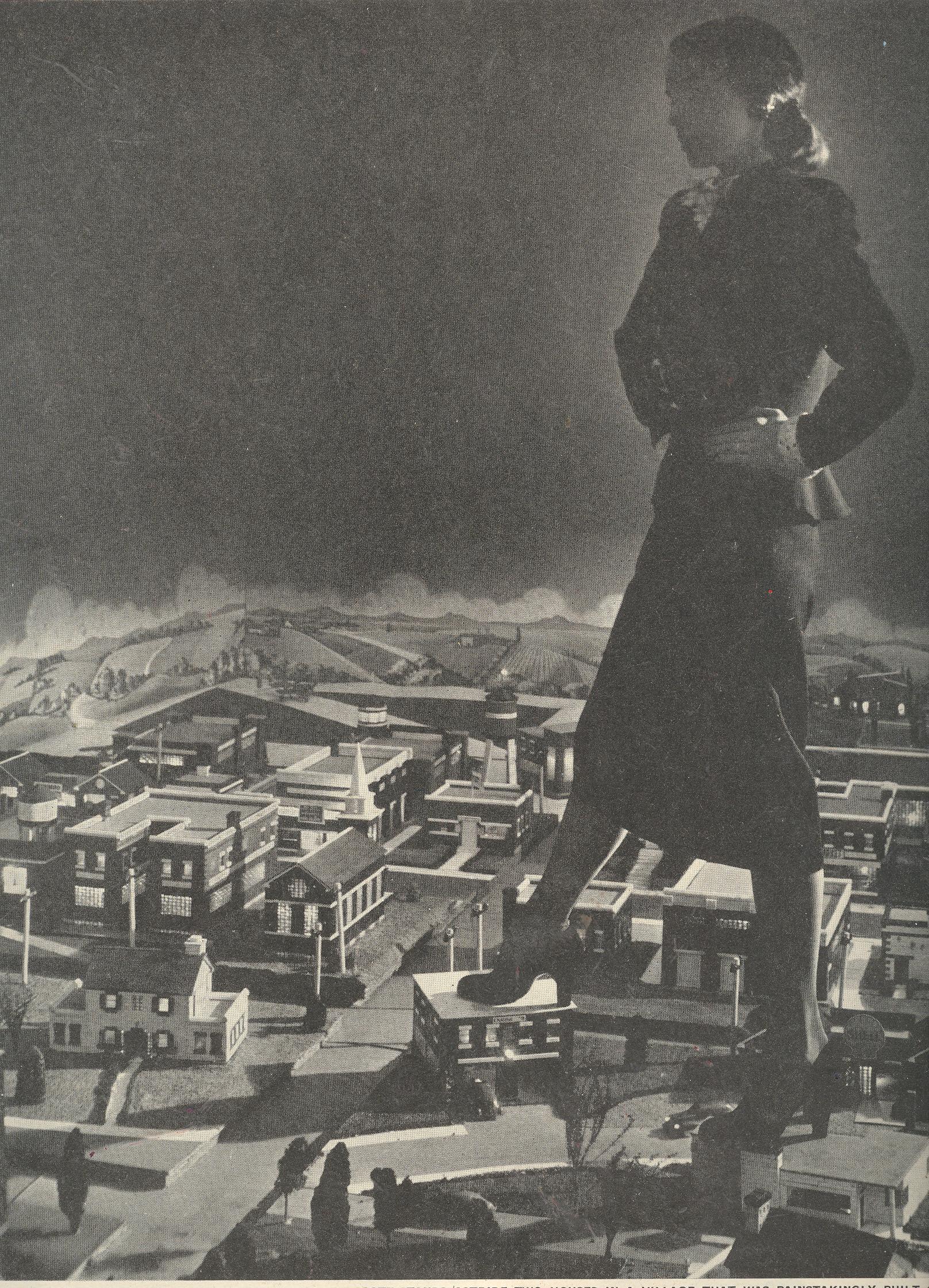
    Now:  I offer what I think must be the female record for the most distance between the ankle and the hemline–I reckon it to be about 60 feet. 

    There are certainly a wide universe of captions for this picture, but for some reason I’m most comfotable with the exposed-leg connection. 

    1--may 7 skirt length giant