A Daily History of Holes, Dots, Lines, Science, History, Math, Physics, Art, the Unintentional Absurd, Architecture, Maps, Data Visualization, Blank and Missing Things, and so on. |1.6 million words, 7500 images, 4.9 million hits| Press & appearances in The Times, Le Figaro, Mensa, The Economist, The Guardian, Discovery News, Slate, Le Monde, Sci American Blogs, Le Pont, and many other places… 5000+ total posts since 2008.

Category: Information, Quantitative Display of

  • A Million Violinists Playing Everything at the Same Time

    JF Ptak Science Books    Quick Post

    It isn’t quite that–wait a minute: yes, it is. But it wasn’t a “million”, but “millions”. The reference is to a thought experiment in which “millions of violinists performing every conceivable sound within the octave, with a view to the production of the purest and most ethereal of sounds”.  

    It seems like a musical experiment best left to stay inside the head, though I would of course love to hear a million of anything do anything at all.  

    The experiment occurs as a sidelight to a very interesting and very early article by Sedley Taylor, “Analogy of Colour and Music”,  found in Nature, volume 2, February 24, 1870, in the letters to the editor section, p. 430. His work on analogy in music and color is very early, particularly by someone who was conversant in both worlds. (Taylor would translate von Helmholt’s great work on the sensation of tone into English (On the Sensations of Tone as a Physiological Basis for the Theory of Music, publishing it in 1875.)  Also in 1875 Taylor published his work on the color/sound subject in a book, Sound and Music. According to Cyril Rootham (1920):

    “Sound and Music,” was… the earliest general exposition in short compass by a writer competent on both sides of the subject. An event which his characteristic energy rendered prominent was his invention of an apparatus which he named the phoneidoscope. It consisted essentially of a resonant cavity, with an aperture over which a soap-film was stretched: when the operator sang to it a note nearly in unison with the cavity, the aerial vibrations revealed themselves visibly in whirling movement of the coloured striations of the liquid film.”–quote via Wiki article on Taylor

    The entire article is included, below: 


  • Pianographics–Empirical Musicology, 1895

    JF Ptak Science Books    Post 2416

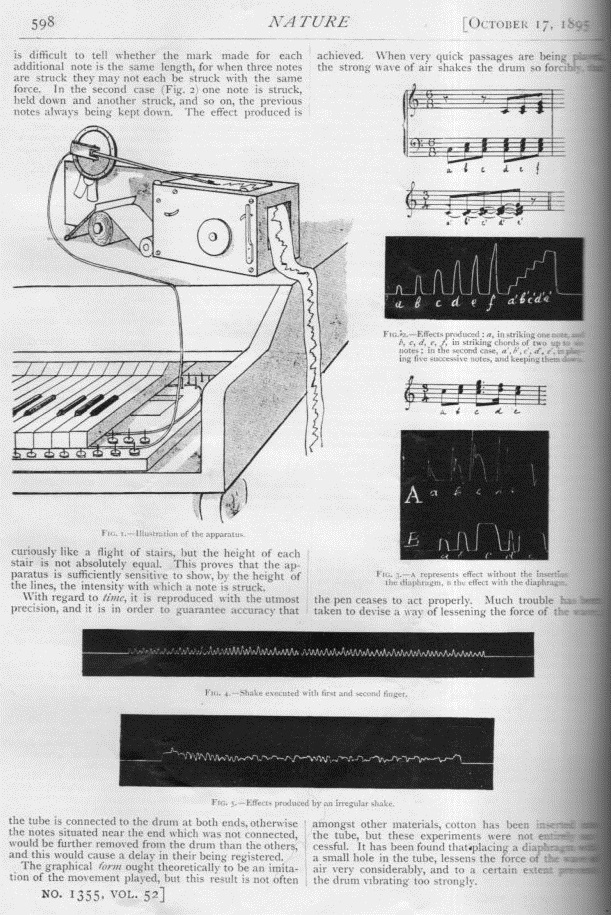
    Unlike the history of the vast majority of musical instruments, the piano could sort of play itself about 160 years after its invention.  The idea of making a device that would record notes from a piano, and then punch them out onto long strips of paper, and have them play through a music box or other automatic instrument (and later on, by Centennial time, on a player piano) was a truly inspired thing, I guess. That’s all fine and good, but none of these inventions really allowed for you to understand how a piano was actually played by a performer, and how that performer touched the keys–that would be  interesting on many levels beyond the mechanistic reproduction of note-playing. It seems though that it wasn’t until the close of the century that an invention was capable of recording the subtleties of key touch. And that was the work of A. Binet and J. Courtier  who published their results of their experimentation with new instrumentation in “Recherches graphiques sur la musique” (Graphic research on music) in Revue Scientifique.  The invention has been called “the start of the study of technical empirical musicology”.1

    The machine was described by C.H. Judd in Psychological Review2 in 1896:    “When a key is struck the style is deflected in such a way that the height of the deflection is proportional to the force of the pressure; the length of the deflection records the time; and finally the form of the curve gives a detailed account of the manner in which the movement was carried out.”

    In 1914 in “The Psychology of Piano Instruction” we find the following appraisal: “In much the same way have Binet and Courtier blazed the trail as Seashore puts it by tracing graphically the intensity form and time of finger movements in piano playing They point out the immense psychological interest there is in determining the kind of experience involved at the keyboard of a piano and the type of movements executed while at the same time graphic results obtained in this manner act as checks upon the performance Illustrations are given for instance to show the curve of a trill well performed in contrast to that of a trill poorly performed…”3
      
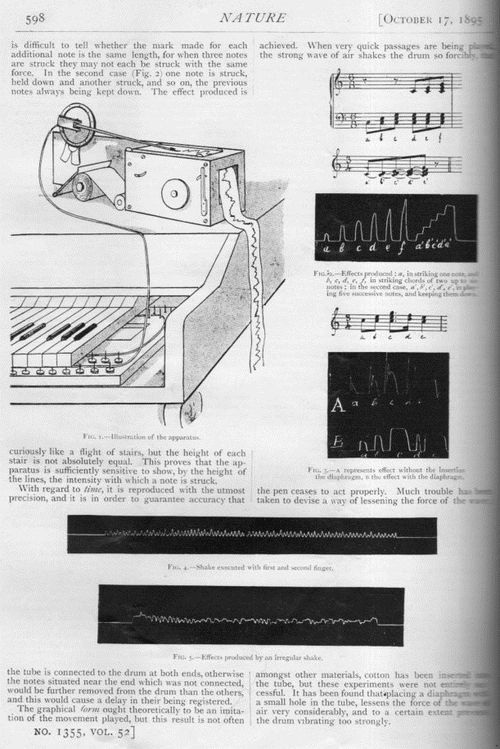
    In any event I found this article by chance in Nature for October 17, 1895, and thought the machinery and idea were fascinating. This was probably the first English translation of the paper, which soon again appeared in an article in Popular Science in the U.S. in the next month: 

    “When a certain point of perfection has been attained in piano playing it becomes very hard to distinguish inequality of touch yet owing to the varying strength of the fingers it is only with much practice that perfect equality is possible. As will be seen further on involuntary movements and irregularities scarcely perceptible to the shown by the graphical method…”
    Piano graphics756

    “The apparatus…is quite simple in construction and consists chiefly of an india rubber tube placed under the key board united at its two extremities by a registering drum also of india rubber When the notes of the piano are played the pressure on the tube causes a wave of air to be sent through it into the drum upon which is attached a pen that in the ordinary way is made to record its movement on a moving roll of paper The wave makes the drum vibrate which in its turn jerks the pen thus causing irregular marks to be left on the paper The board on which the tube rests is regulated by means of w edges adjusted by a screw the board being either lowered or raised When raised it almost reaches the notes of the piano and in this case the registering action takes place but if it is lowered the whole apparatus is disconnected from the key board…”

    The summation at the end of the Nature article: 

    “1. Dealing with its advantage from the psychological point of view it is found that the voluntary movements of the pianist can be observed without putting him to any restraint or embarrassment for the small tube does not affect the resistance of the notes nor is the exterior of the piano altered.”

    “2. For teaching purposes the device has been of great use.  The record on the roll of paper shows the faults so precisely that although they are scarcely perceptible to the ear there is no denying their existence.”

    “3. We are well aware that written music cannot show every slight change in the time the composer might desire. By applying the graphical method this difficulty is eliminated and the time will be reproduced with the smallest details.”

    Notes

    1. Empirical Musicology : Aims, Methods, Prospects: Aims, Methods, Prospects edited by Eric Clarke Professor of Music University of Sheffield, Nicholas Cook Professor of Music Royal Holloway,  p. 77

    2. Psychological Review in 1896, Vol 3(1), Jan 1896, 112-113.

    3. Journal of Educational Psychology, vol 5, 1914, “The Psychology of piano Instruction.”

  • A Great Map Showing a Complex Distribution of Nationalities, NYC 1895

    JF Ptak Science Books    (Post 1343–expanded)

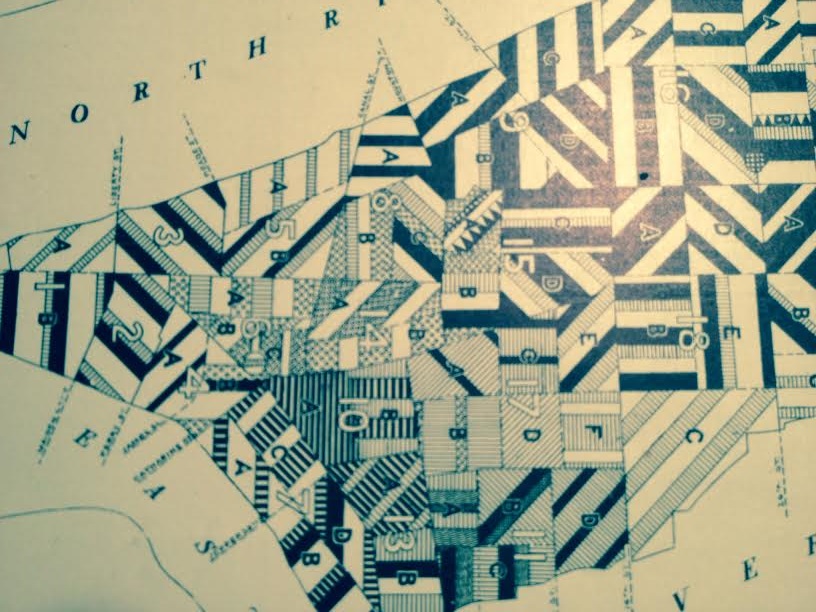
    Frederick Erastus Pierce (1878-1935) is the creator of the extraordinary The Tenement-House Committee Maps: printed on one sheet of paper for Harper’s Weekly in 1895, Pierce presents his data on the distribution of the population of Manhattan with two maps,  one showing the densities of Manhattan populations (on top) and the other the distribution of nationalities (at bottom). 

    [I should point out that the original of this map is for sale at our blog bookstore, here.]

    Nationalities Map 4

    Here’s an overall view of the maps–this example from the Library of Congress, as I could not make an accurate image of the one I have here–I do include some details of the maps from my own copy, however, which are found just above, with several below.


  • Cut-Away Schematic: British Vickers Medium Tank, 1925

    JF Ptak Science Books  Quick Post

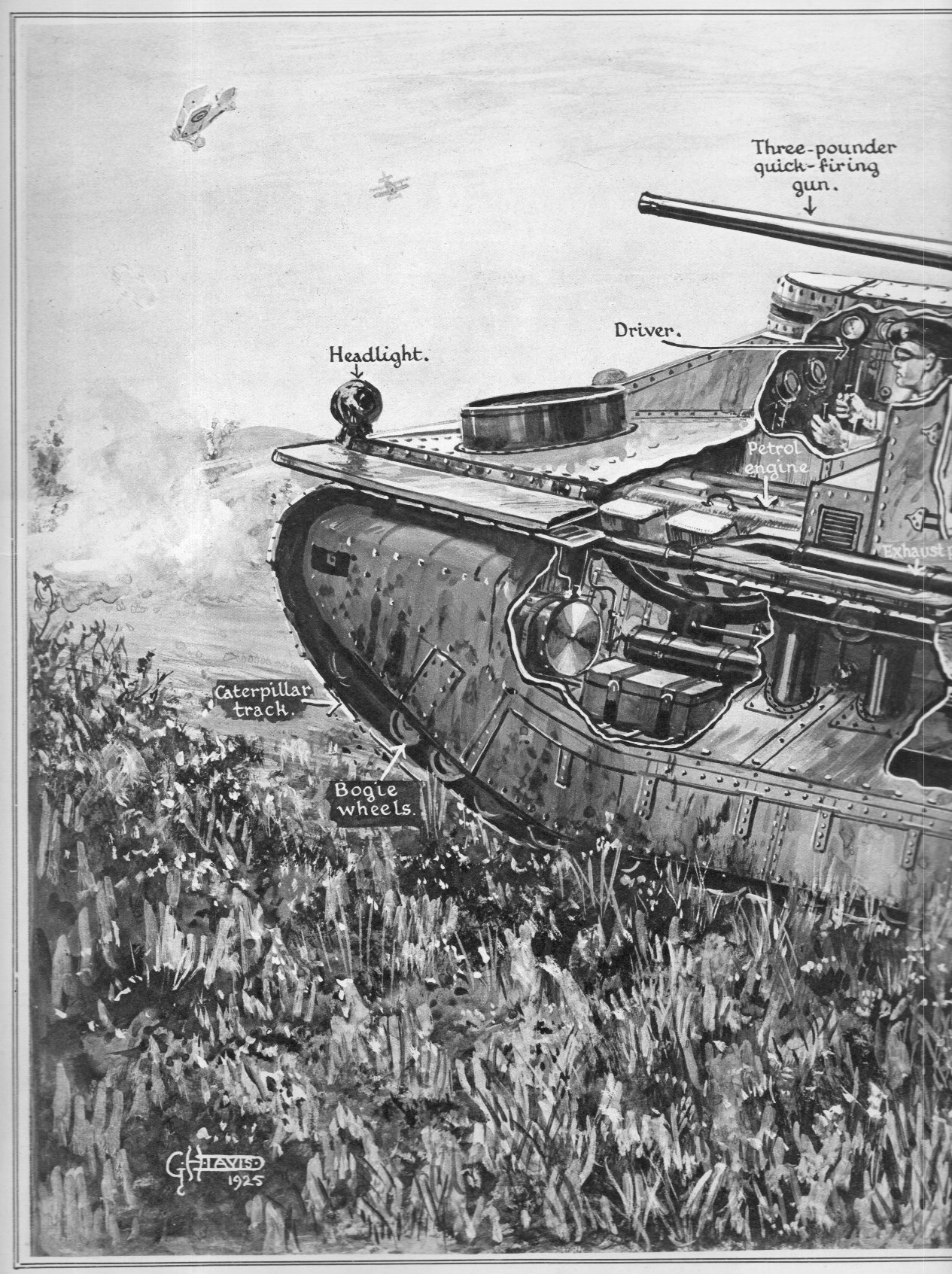
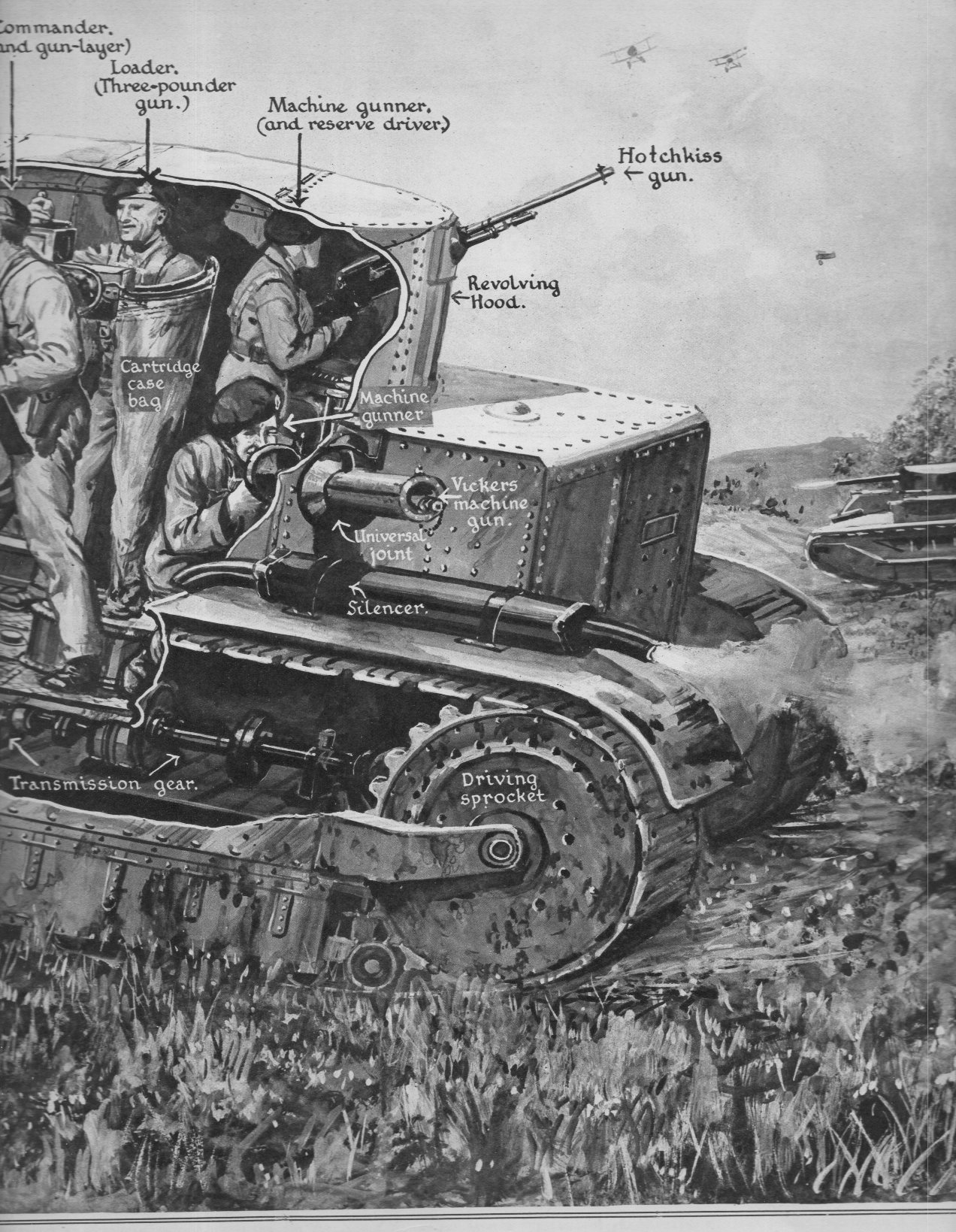
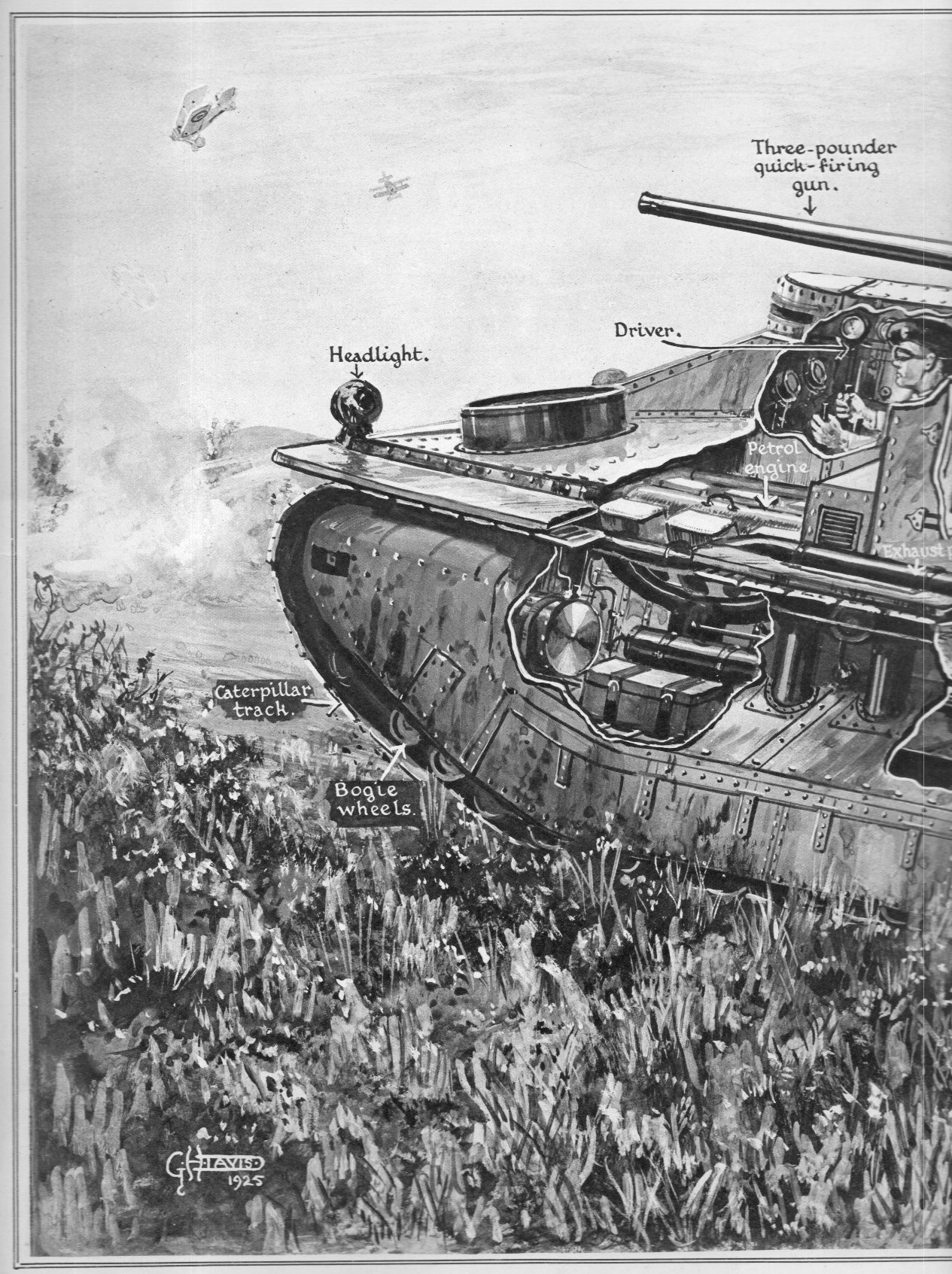
    One of my favorite popular technical illustrators of the 20th century was G.H. Davis (1881-1963), who worked enormous accomplishments for the Illustrated London News for some forty years.  His specialty seemed to be the cut-away schematic, showing half-exposed/half-not technical schematics on mostly oblique angles.  The example below is a fine one, showing the (not-named) British 1925 tank, which I believe must be the Vickers Medium I or variation thereof.  It was certainly an improvement over the tanks used in WWI, and for all intents and purposes it seems a “modern” tank. 

      Tank 1925743

    Tank 1925744


    Tank 1925743


  • Visual Display of Data: German Military Weakness, 1929

    JF Ptak Science Books   Quick Post

    Military graph canons734 bug

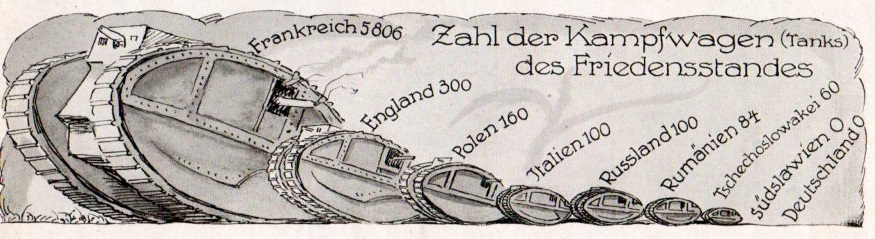
    In 1929 Germany was still abiding by the Treaty of Versailles, which was the peace treaty ending WWI and signed in 1919. The 440-clause treaty spent the first two dozen or so clauses were spent on President Wilson’s League of Nations, while the rest was a distribution of punishment and reparations against/on Germany.  The German military as directed by Versailles was limited to 100,000 soldiers, and had 1926 machine guns, and 2886 cannons.  as stipulated Germany could have no tanks and no air force, and was limited to six ships and no subs, and had to keep the Rhineland free of all armed forces.  

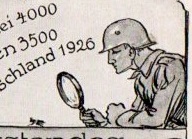
    By 1928 Germany was certainly having multiple regressive thoughts about the Treaty, and public demonstrations of questioning its efficacy began to appear with more frequency.  In this example–from the Illustrite Zeitung (Leipzig)–a strong statement was graphically displayed showing the state of the German military situation.  As you can see, there is scant measurement for just about anything in the military sphere for Germany–and to press the matter home ever more so, in addition to the nulls and tiny numbers, there (in the sixth section down, and magnified above) is a helmeted German soldier with a large magnifying glass inspecting the German totals of the nearly-invisible machine gun totals.  

    This would all be completely changed by 1934, when the Nazis were already well on the way to having a competitive (and modern) fighting force which counted 4.5 million troops.  It would only get worse.  

    Illustrirte Zeitung, 1928:

    Military graph canons732


  • Graphic Display of U.S. Patents, 1836-1915

    JF Ptak Science Books   Quick Post

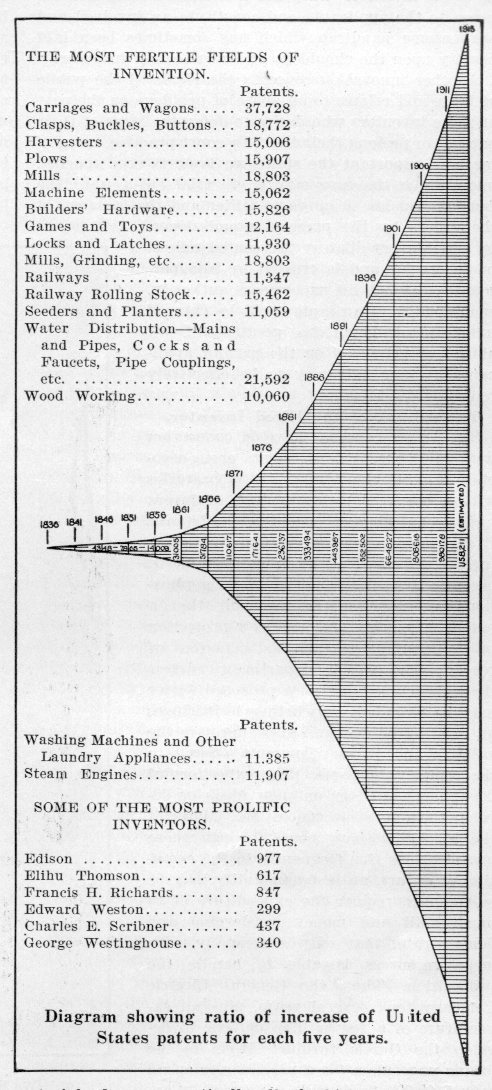
    In one of the articles celebrating its 70th Anniversary, Scientific American published these two graphs showing the development of patents from 1836 to 1915. They appeared in the June 5, 1915 issue, and distributed the patents also according to type. It is interesting to note that for decades that the magazine kept one page (or part of it) devoted to displaying newly-recorded patents–that practice was abandoned by the time the 1915 article appeared, which is too bad, because it was enjoyable to dip into the archive and see what was being patented at weekly intervals over the years.  In any event I’m not sure that I’ve seen visual displays quite like this, and so I share them:  

    Patent graph725


  • Tools of a Scientist, ca. 1700

    JF Ptak Science Books    Post 2409

    Friedlein941

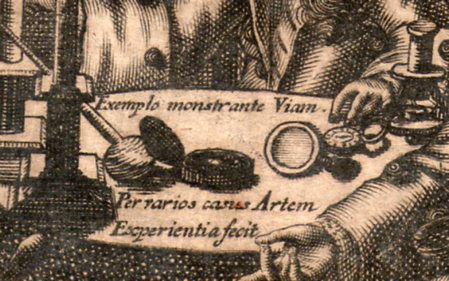
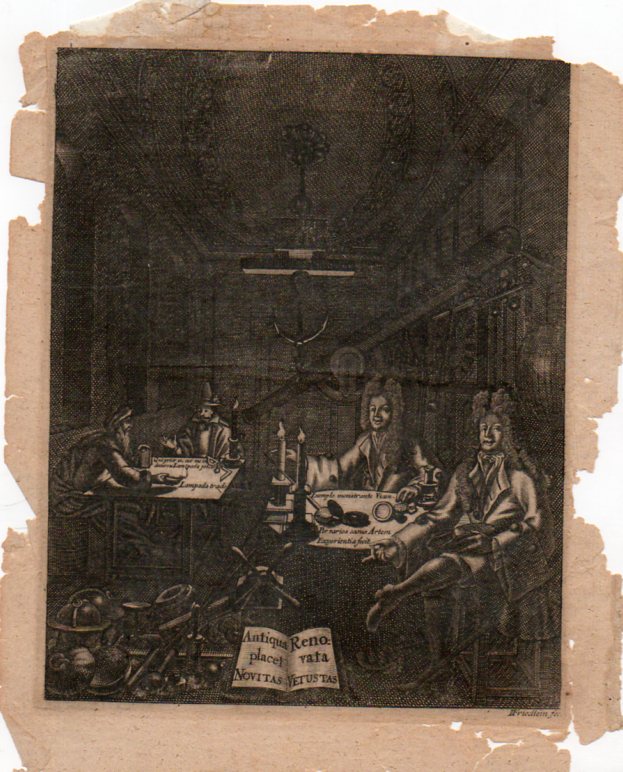
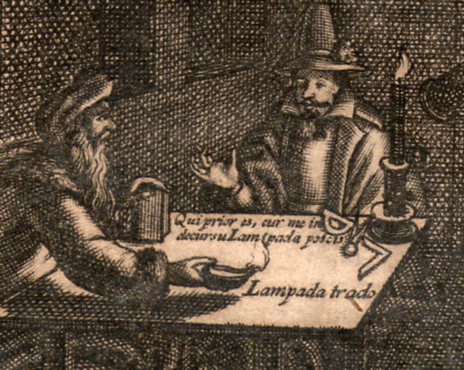
    This is an image of a  philosopher’s cabinet, engraving (on copper?) by “I. Friedlein fec”, who was Johnann Friedlein, an emigree from North Germany to Denmark, and who worked ca. 1680-1705. It shows the tools of the trade for someone working in natural philosophy (the name “scientist” would not come into use for another 130+ years or so1) and is an interesting insight into a small, polite gentleman’s club for experiment and investigation.

    Friedlein938

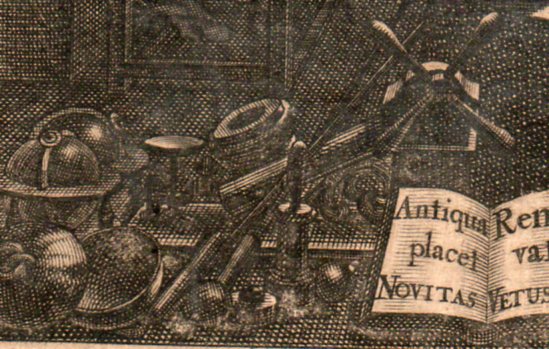
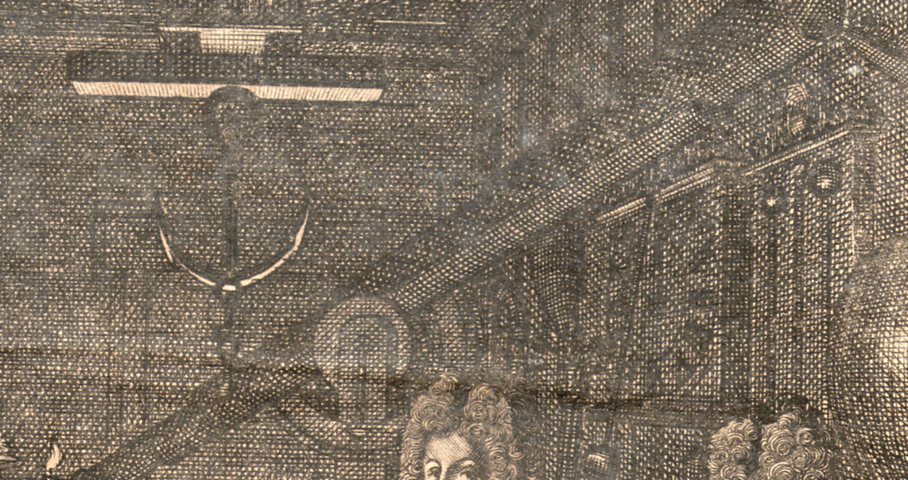
    The men surround a decent collection of scientific instruments–I can locate a compass, dividers, oil lamp, magnifying glass, microscope2  (at the right elbow of the figure on the right), terrestrial and celestial globes,  a (large) clock, barometer, and various weights and scales, and  behind it all looms a rather large refracting telescope3 (is it five inches?) 

    Friedlein939


    Friedlein940

    Friedlein942

    For all of these expensive and current instruments, the lighting these gentlemen set up for themselves is pretty poor, though of course it does add to the mystery and dark experience of the image.  

    Here’s another example of Friedlein’s  work, a frontispiece to Cryptographia, oder geheime Schrifften by Johann Balthasar Friderici, printed in 1685:

    Frontispiece, illustration from 'Cryptographia, oder geheime Schrifften' by Johann Balthasar Friderici, engraved by Johan Friedlein (17th century) published in Hamburg, 1685

    Nyt dansk kunstnerlexikon: bd. Indenlandske kunstnere (fortsættelse …)by Philip Weilbach:


    Notes:

    1. “Scientist”, in the Oxford English Dictionary (“science” is a much older word in English):

    1. A person who conducts scientific research or investigation; an expert in or student of science, esp. one or more of the natural or physical sciences.computer, earth, mad, natural, rocket scientist, etc.: see the first element.

    It is possible that the ‘ingenious gentleman’ referred to in quot. 1834  is Whewell himself.

    1834   W. Whewell in Q. Rev. 51 59   Science..loses all traces of unity. A curious illustration of this result may be observed in the want of any name by which we can designate the students of the knowledge of the material world collectively. We are informed that this difficulty was felt very oppressively by the members of the British Association for the Advancement of Science, at their meetings..in the last three summers… Philosophers was felt to be too wide and too lofty a term,..; savans was rather assuming,..; some ingenious gentleman proposed that, by analogy with artist, they might form scientist, and added that there could be no scruple in making free with this termination when we have such words as sciolist, economist, and atheist—but this was not generally palatable.
     
    1840   W. Whewell Philos. Inductive Sci. I. Introd. p. cxiii,   We need very much a name to describe a cultivator of science in general. I should incline to call him a Scientist. Thus we might say, that as an Artist is a Musician, Painter, or Poet, a Scientist is a Mathematician, Physicist, or Naturalist.
     
    2. “Microscope” (as a noun) in its earliest uses in English, in the OED: 
    1648   Bp. J. Wilkins Math. Magick i. xvi. 115   We see what strange discoveries of extream minute bodies, (as lice, wheal-worms, mites, and the like) are made by the Microscope, wherein their severall parts (which are altogether invisible to the bare eye) will distinctly appear.
    1651   N. Highmore Hist. Generation viii. 70   The white circle..by a Microscope appears now to be the Carina or back and neck of the Chick.
     
    3. “Telescope” (as a noun) in its earliest uses in English, in the OED:
    [1619   J. Bainbridge Astron. Descr. Late Comet 19   For the more perspicuous distinction whereof I vsed the Telescopium or Trunke-spectacle.]
    1648   R. Boyle Seraphic Love (1663) xi. 59   Galileo’s optick Glasses,..one of which Telescopioes, that I remember I saw at Florence.

  • Of Baseball Cards and Computer Companies, 1950’s

    JF Ptak Science Books  Quick Post

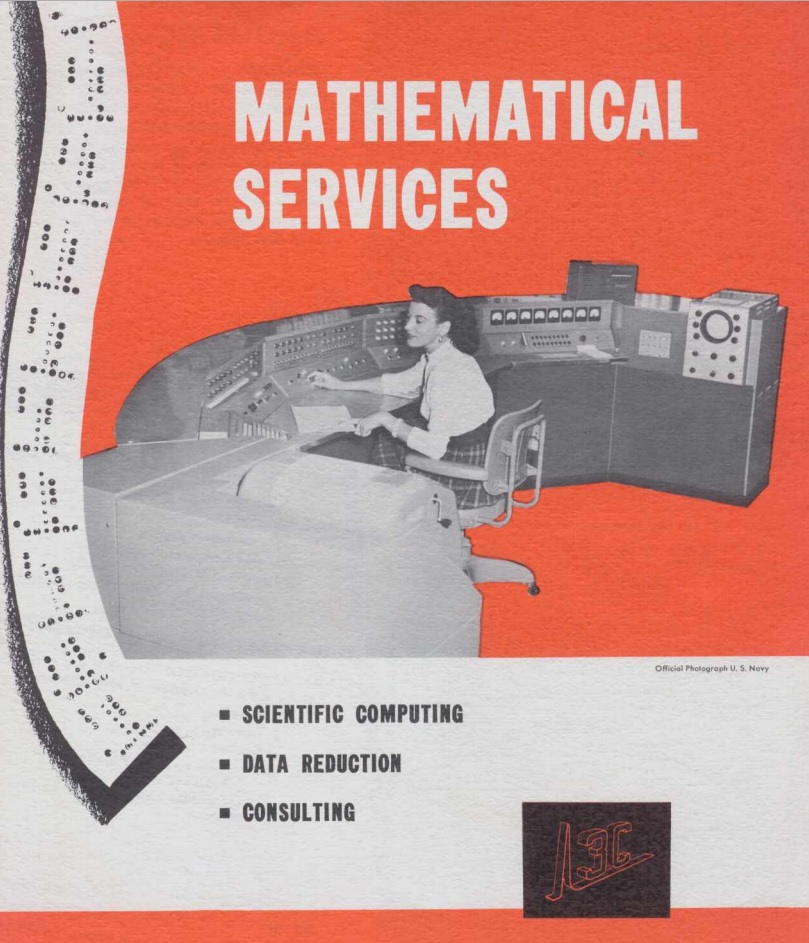
    Baseball cardsThis brochure for the Computer Control Corporation Inc (of Berry Drive, Los Angeles) has that peculiar background feel similar to 1950’s baseball cards–detail of the subject, while the rest of the platform is a sharp, no-nuance solid color.  On the other hand I have no doubt that work was getting done in this place.  For all of its simplicity, and for all that they were doing, this is a miniature and quiet monument to People Thinking.  


    3C Computer Corp


  • The First Field Recordings (1890)

    JF Ptak Science Books   Quick Post

    Anthropologist Jesse Fewkes (1850-1930) was the first to use the Edison phonograph for recording legends, songs, stories, rituals and so on of North American Indians, making him a pioneer in field recording. Work like his was essential to the preservation of vanishing ways and stories and languages and music, and provided inspiration to people like Frances Densmore, John Lomax and Herbert Halpert.  

    This came up just now looking for a paper by Lord Rayleigh in the journal Nature, and to my surprise bumped into this short note by Fewkes in that issue for April 17, 1890 (volume 41, # 1068). This was undoubtedly the first notice of his field work reported outside of the United States.  Music in the Social and Behavioral Sciences: An Encyclopedia (edited by William Forde Thompson) establishes Fewkes as making the very first field recordings of any kind (page XXX, chronology).  

    Recording sample via the Library of Congress, here. 

    ( “Mr. Phonograph.”  (1:11) Text in A National Project with Many Workers. Jesse Walter Fewkes talking to the new Edison cylinder recording machine in order to demonstrate its capabilities to a visiting Passamaquoddy man. Probably recorded in Boston, late 1890-early 1891. Jesse Walter Fewkes Passamaquoddy Cylinder Collection.)


  • Product Placement, 1615

    JF Ptak Science Books   Quick Post

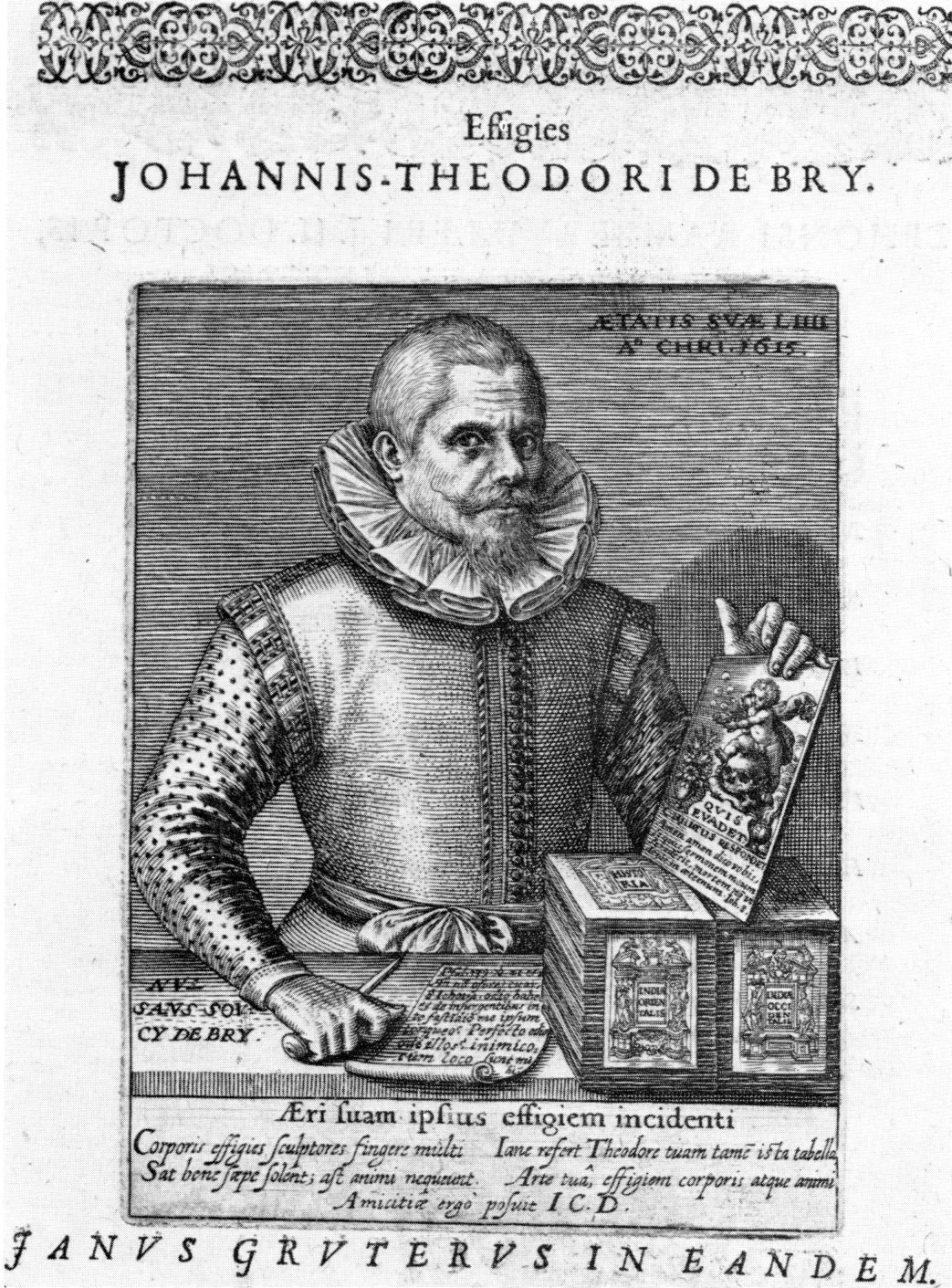
    It is a very uncommon sight to see a book illustrated with the self-portrait of its engraver standing next to the unbound sheets of his own (and unrelated) travel book. But so it goes, and it goes in Jean-Jacque’s great 1601 Baroque illustrated work on the occult arts,  Tractatus posthumus Jani Jacobi Boissardi … De divinatione & magicis praestigiis.  The book was published by Johann/Jean Theodore de Bry, who also engraved the images after Boissard’s designs, who had died 14 years earlier.  

    De bry711

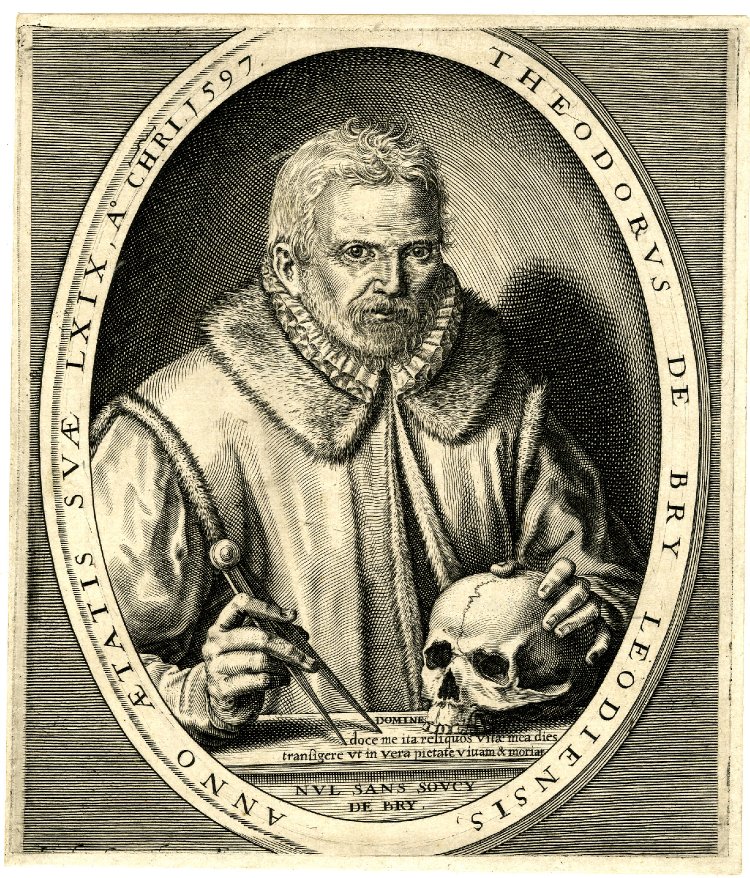
    De Bry–who with his brother had earlier helped his father (Theodor de Bry) with his massive work on the American Indian and travel in general–completed some 30 volumes of illustrated travel, which was a monumental achievement, even if some heaping part of his work was based on very little reality.  So Johann is standing there with the family coat of arms (on the right) and the family epigram (on the left). Theodor de Bry’s self portrait also makes use of the same epigram, “Nul sans soucy”, or “None without worry”.  

    De bry elder[Image source: wikipedia.]

    Another, earlier edition of this work is seen here, at Rara, and was formerly the copy of Carl Jung.