A Daily History of Holes, Dots, Lines, Science, History, Math, Physics, Art, the Unintentional Absurd, Architecture, Maps, Data Visualization, Blank and Missing Things, and so on. |1.6 million words, 7500 images, 4.9 million hits| Press & appearances in The Times, Le Figaro, Mensa, The Economist, The Guardian, Discovery News, Slate, Le Monde, Sci American Blogs, Le Pont, and many other places… 5000+ total posts since 2008.

Category: Industrial & Technological art

  • A Map of Fordlandia: the “Drama of Transportation”, 1932

    JF Ptak Science Books    Quick Post

    FORD_2_155

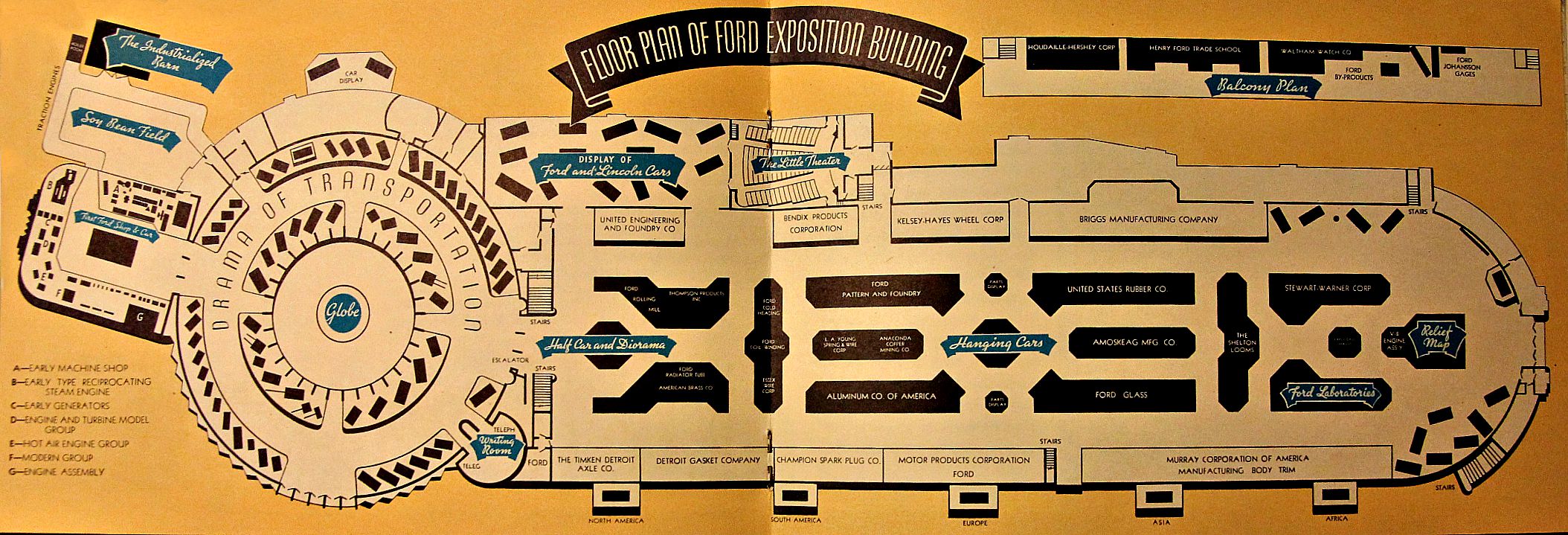
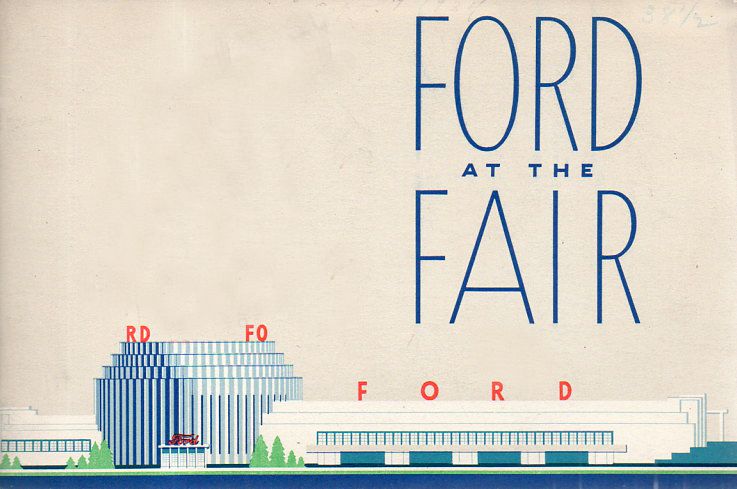
    The “fair” in this pamphlet, Ford at the Fair, was the Chicago World’s Fair of 1932, and it was a souvenir for the visitor to the Ford Motor Company pavilion.  Well, the building–pretty in profile, but odd/weird in plan–held other exhibitors whose business was related in support of Ford (Alcoa, Anaconda Copper, Bendix, etc.), and displayed in a singular turnaround the Cars as Consumable Products. (Remember that world’s fairs such as this were still mostly displays of technology and industry and business, so you were more likely to see a Meat Pavilion or Heinz Products then than to see curious rides and historical whatnots in present incarnations.) 

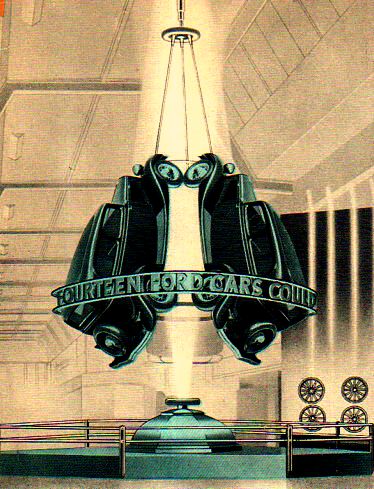
    This unusual Bavarian trophy/hunt display of a couple of Fords in the middle of the floor plan–which says simply “hanging cars” on the map looked impressive and a little alien-esque:

    FORD154


    And the map of the pavilion, which once you get over the possible Renaissance-like plan, and you pull back a little bit, it takes on a bit of a profile of a tank-like dragster:

    Ford _3_

    In any event, this was a glorification process wrapped around a celebration of old-timey industrial celebration, presented in gleaming metallic greens and blues, and rubber, and gasoline, and oil, and hope. 

    Here’s an interesting video showing the Ford pavilion at the fair, found at youtube.com:  


  • More Woolwich Heavy Stuff (1879)

    JF Ptak Science Books   Quick Post

    Woolich shells detail

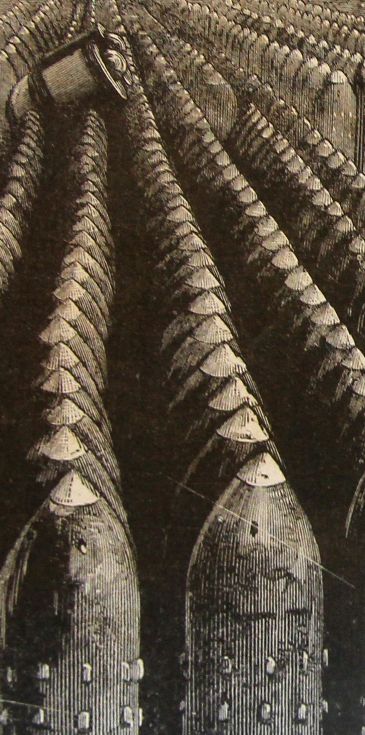
    [Detail of image below: “War Manufactures at Woolwich Arsenal:  700-lb Palliser Shells for the 38-ton Gun“.  Source: Scientific American Supplement, June 1879.]

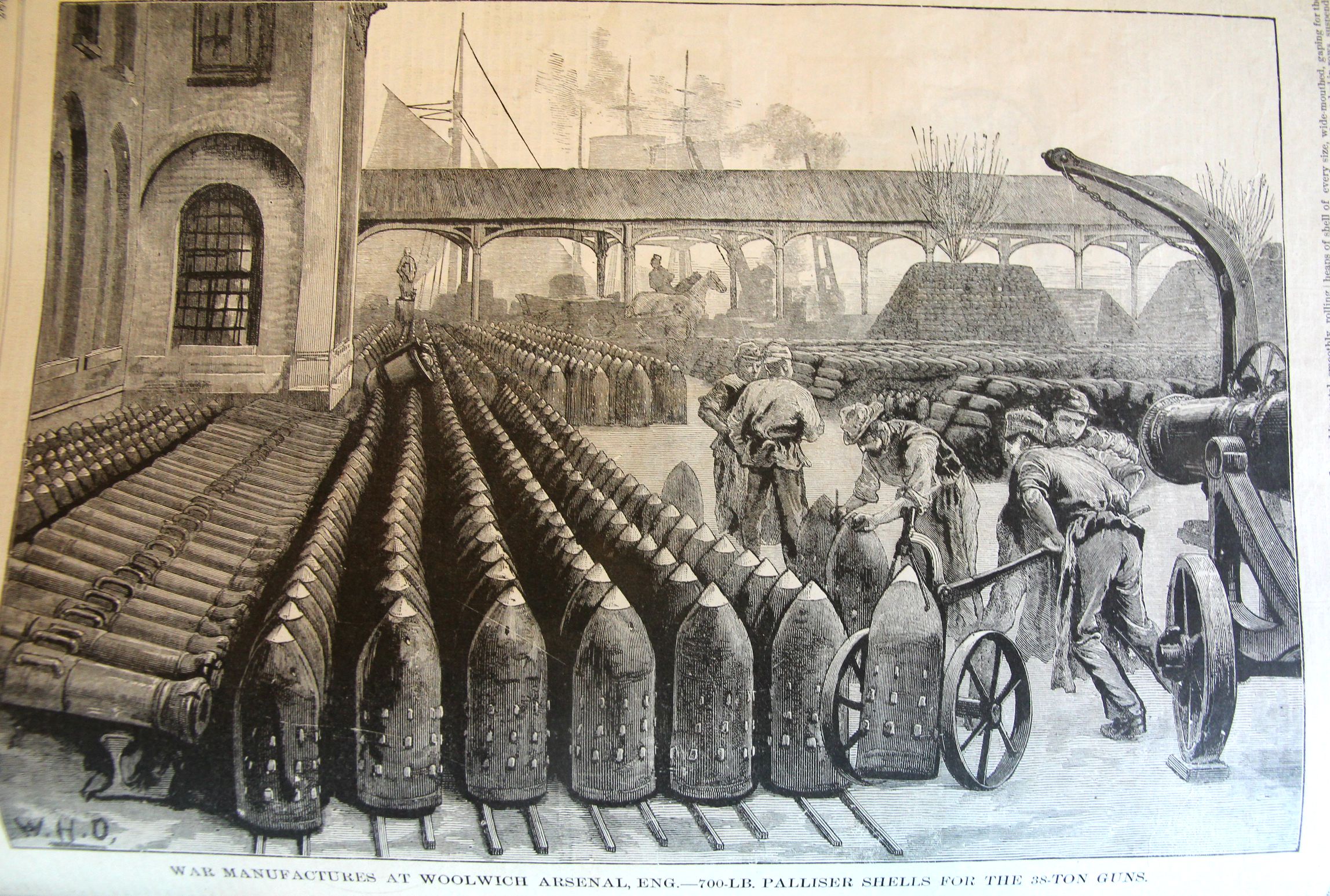
    I’ve written earlier on this blog on the Woolwich works (“Very, Very Heavy Metal–the Woolich Infant, 1876″) that touches on some very heavy artillery, superior monsters all, with the “Infant” in question being an 80-ton gun. That came to mind seeing this big full-page engraving in Scientific American of Woolwich in 1879 and this stationary parade of potential of  death and destruction (and we’re glad to have them on our side) 700-lb shells.  That’s Sir William Palliser shells, which were manufactured as armor-piercing, and intended to do major damage to armor-plated warships–hyper-damage, actually, considering the 410-pounder in this variety was very highly effective.  This shell was just an absolute brute. 

    This is a detail from:

    Woolwich arsenal 700


    [Apologies for  the waviness–the book is very large and getting it to lay flat was not really a consideration.]


  • Heavy Electricity, 1879

    JF Ptak Science Books  Post 2496

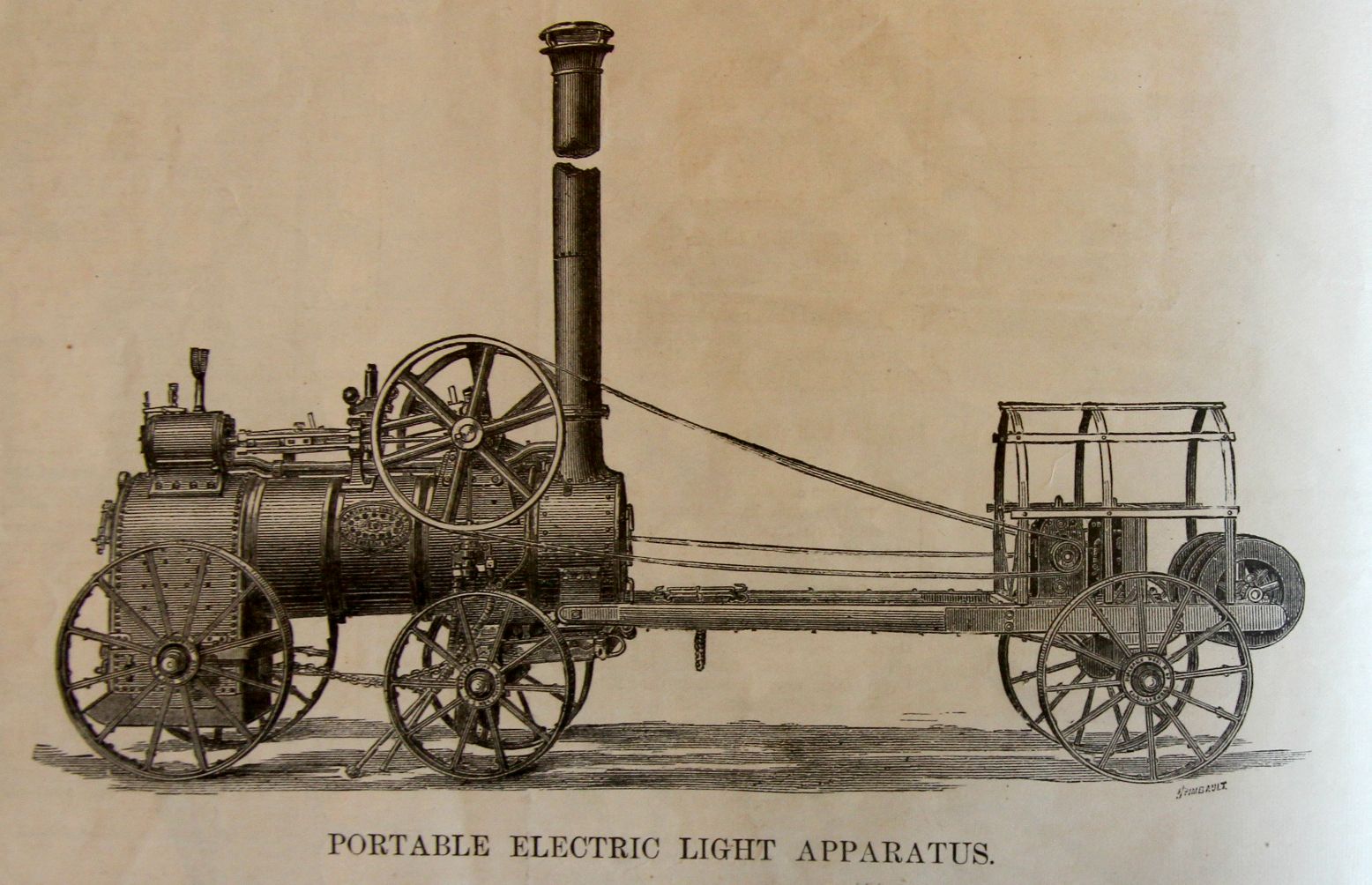
    Inventors had been experimenting with the electric light for decades before Thomas Edison patented his ever since it in the same year that this engraving appeared (1879).  Ever since is became possible to believe in the practicality of the power source of electricity (rather than the very problematic gas) with the demonstrate of Humphrey Davy’s electric arc lamp in 1809, people like Lindsay (1835) and Geisler (1856) and Becquerel (1867) and Woodward (1875) and many others tried to perfect the form of electrical lighting.  Edison of course came up with the best idea, and the rest is history (and adjudication).  

    It is really no that long ago–in my great-great grandfather’s time–that the possibility of the expansion of lighting by electricity was new and very exciting (as well as the delivery of electricity for other stuff, but that is another story). It is also a time of tremendous achievement in delivering the power, which really only extends backwards to 1820 with Oersted (and his electromagnetic motor, and the thought of seeing a land locomotive for providing portable electricity must have been an enormous intellectual treat.  And here it is:

    Electric light apparatus portable 1879[Source: Scientific American, Supplement, June 7, 1879; apologies for the uneven lighting, but the book was big and thick and making the surface flat was out of the question.]

    As stated in the short article, this is a “very convenient arrangement” for delivering lighting remotely (“to contractors”), and was produced by Gainborough’s Marhsall, Sons & Co. for the electrical engineering firm of Crompton & Fawkes of London.  The dynamo-electric machines are on the small two-wheeled carriage and is connected to the steam-powered source on the four-wheeled carriage; it was a 6hp engine that could produce 6,000 candle power illumination. To the right of the electric engines are spools with 300 yards of cable which would connect everything to the electric lamps–evidently from arrival to light would take one hour.  For the time this was a magical thing.  


  • The Automobile as a Dominating Life Form (1930)

    JF Ptak Science Books

    0 blog jan 07 car future364

    If I was an alien (of the outer-space variety) looking at the United States, I’d find it difficult not to assume that the biological units scurrying around the place were not put there to service the automobile.  Cars get born, then put on display, then selected and driven to their new home.  They get washed, and fed, and sometimes have their own places to sleep at night in their very own structure with their caretakers housed nearby.  They get taken out for airs in the morning and evening, resting while the humans labor all day to make enough money for their care and maintenance and feeding.  In the evening, they get brought back home and allowed to rest further.  They respond directly to inputs only and give no unsolicited response:  sort of like cats.  Fantastically large allowances are made for cars, humans going so far as to remove life- and atmospheric-sustaining biological units such as trees and good dirt so that the car can be taken virtually anywhere in the country on a path made specifically for them.  These pathways, which are padded and smooth, have ancillary bits attached to them so that the humans may walk beside them—houses and such are all connected to these paths to more easily enable the people to have access and maintain the car.  And, at the end of the day, humans breathe in the very excrement and excretia produced by the cars.  Placed under a microscope, the whole thing might resemble a biological unit, the cars being its very blood, everything else present to contain and move it.

     0 blog jan 222 car bfuture398


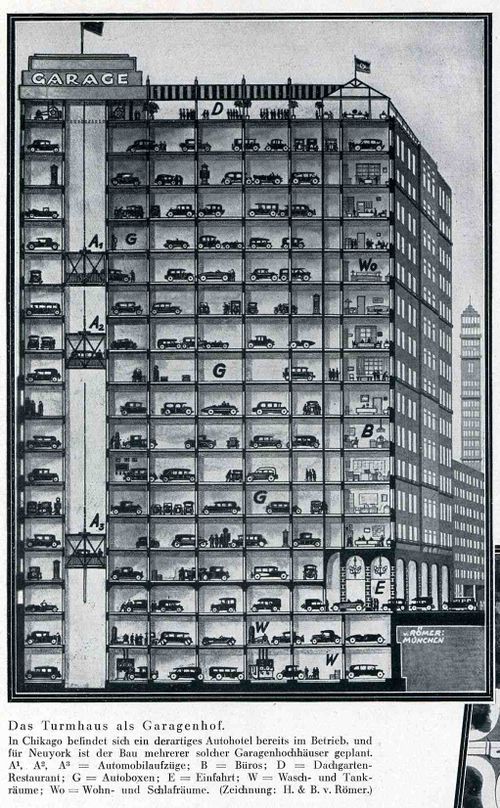
    These images from the Illustriete Zeitung (Leipzig, issue 4484, pp 239-240) for November 1930 speak to the exact issue of how to care for the now ever-present automobile.  Entitled “Wie Bringe Ich Meinen Kraftwagen Unter?”, the short article (by the engineer Botho von Romer of Munchen) addresses the need of what to do with cars at bedtime—where do we put them?  One answer was this spectacular carpark (“Garagenhof”) high rise—seventeen floors of parking (with two more underground), serviced by a variety of elevators, pointing out that varieties of this structure already existed in Chicago and New York

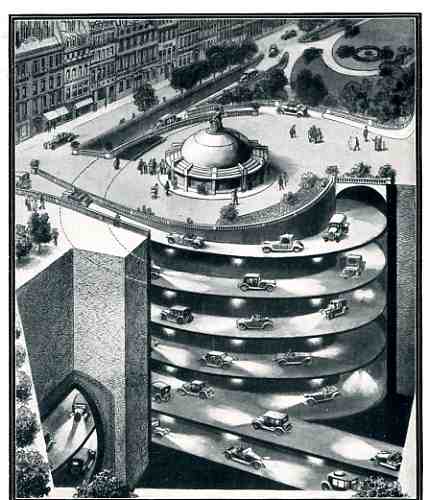
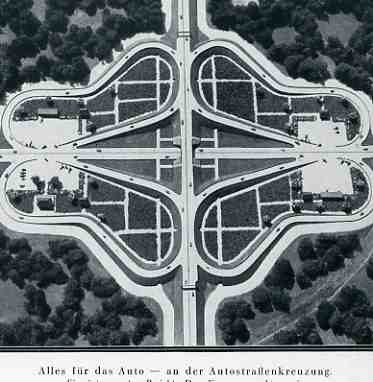
    There was also the possibility of vast masses of sunken garages, their entrance way screwed into the earth leading to tunnels and networked warehouses where the cars could be safely deposited and removed from city streets.  There were also these two versions of the simple above-ground garages and parking lots:  the apartment block gives over the entire interior area to individual parking and garages (doing away with any greenspace), while the massive semi-cloverleaf design is made for nothing else in mind than to park the cars in the four semi-centers.

     0 blog jan 222 car bfuture399

    By 1930 the production of the automobile had been revolutionized to such an extent that virtually anyone with a job and less than five kids could actually afford a car.  It is interesting to note that at the average price of say 30 cents a gallon for gasoline (in the U.S.A.) that folks 80 years ago were paying pretty more per gallon (adjusted via CPI, roughtly $4.25 iva the Bureau of Labor Statistics inflation calculator) than we are paying now at $2.75/gallon (in my mountain city at the far end of the pipeline). 


  • Not-Quite-a-Racing Line of Underpowered Convertibles (1928)

    JF Ptak Science Books  Quick Post

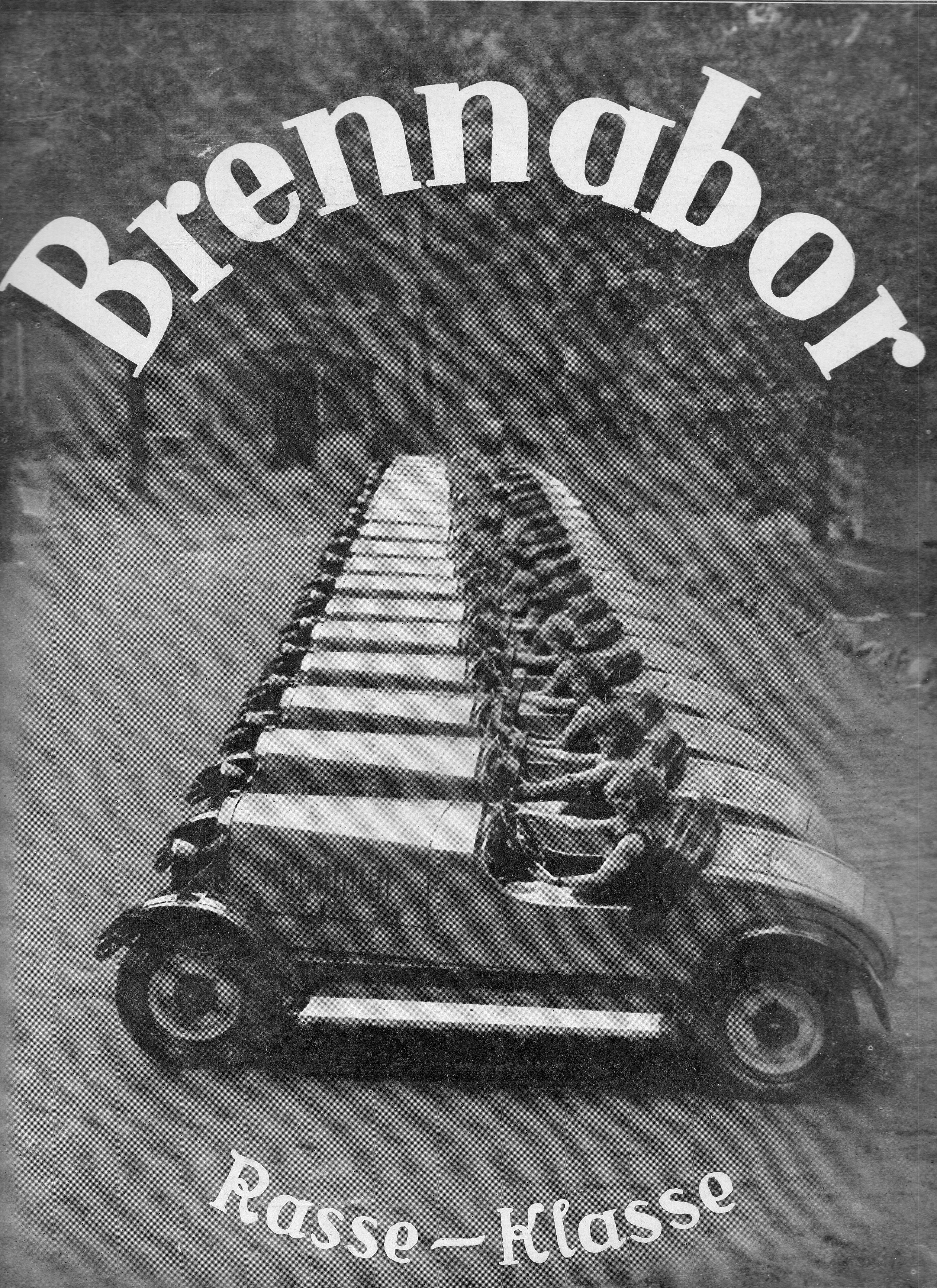
    Well, I really don’t have much to say about this ad except that I like the design and that it is not typical featuring nothing but women drivers in tanktops behind the wheel of the car you’re trying to sell.. It looks as though there are 20 cars in a row here, stretching back like 120′ or so from the camera.  The women are at the wheel of one of Brennabor’s four cylinder, 70 horsepower sports-ish vehicles, capable of seating two (not-big) people.

    Poster  brennabor089

    Source: Illustrirte Zeitung (Leipzig), ca. 1927/8


  • Avaition Cross-Section, 1940

    JF Ptak Science Books   Quick Post

    Schematic  bomber 1940850

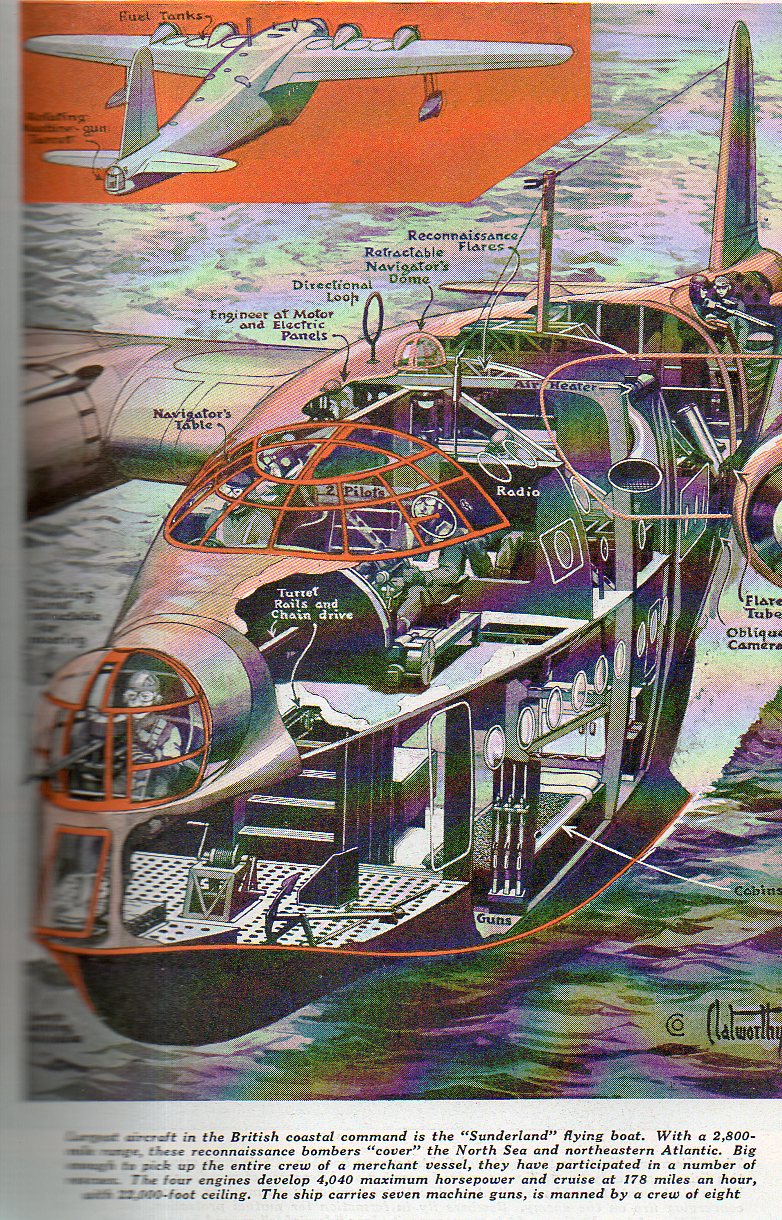
    This is a not-frequently-seen schematic of the Royal Air Force’s Sunderland, a flying boat, and the largest airplane in British service, pictured and slightly dissected in Popular Mechanics in 1940.  (Apologies for the blurry definition on the left side–the book is huge, and not very friendly to the scanner.)


  • Cut-Away Schematic: British Vickers Medium Tank, 1925

    JF Ptak Science Books  Quick Post

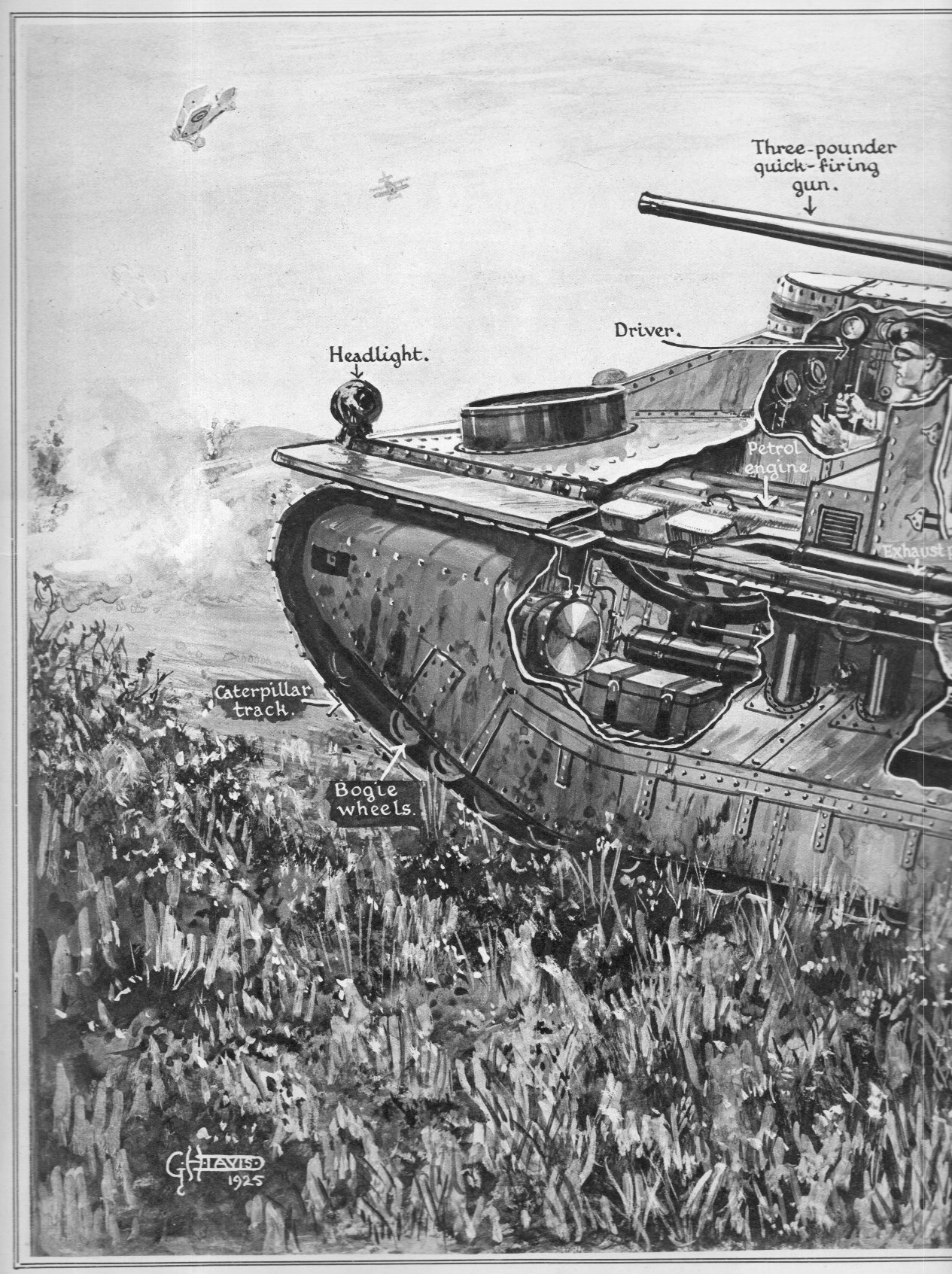
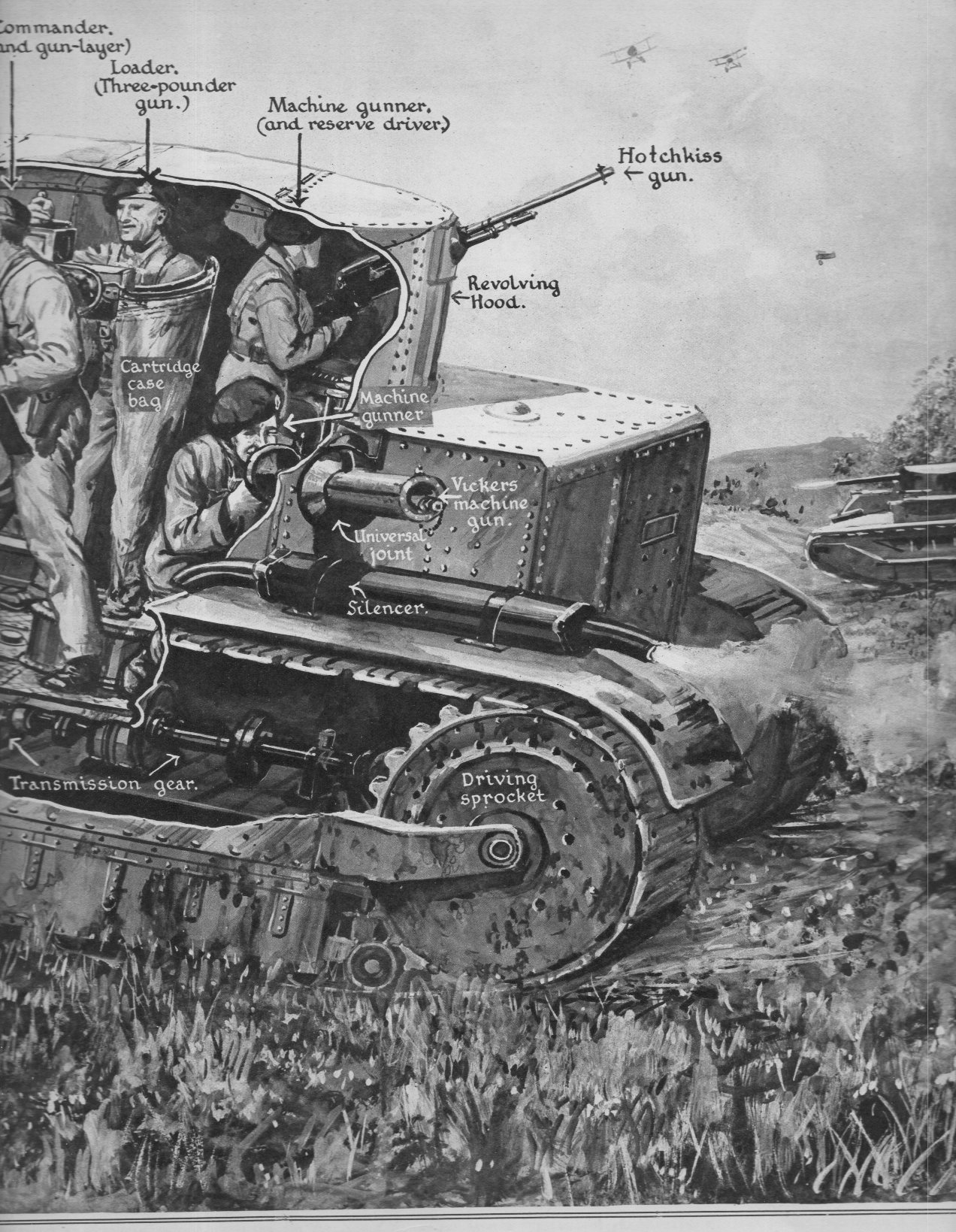
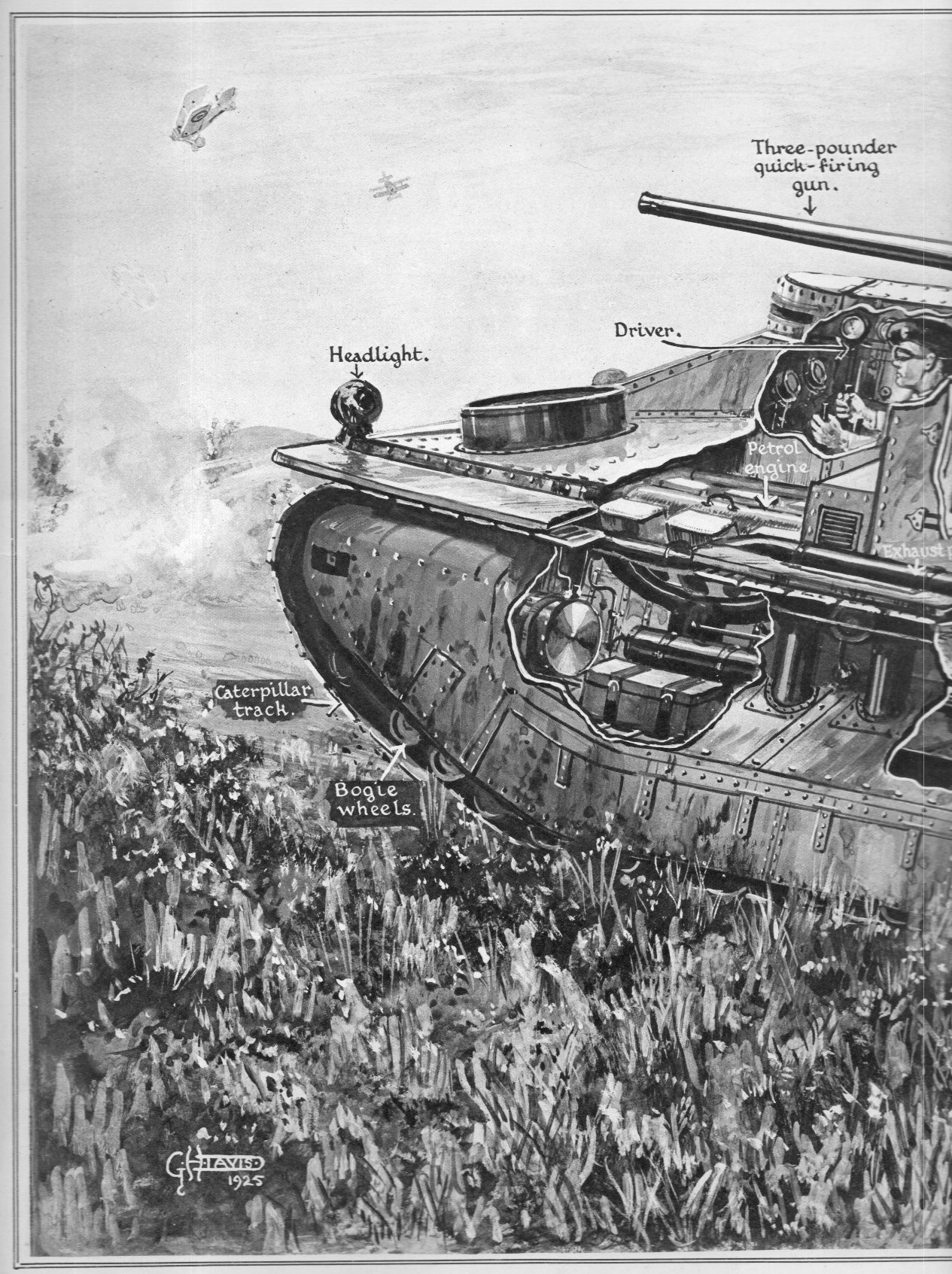
    One of my favorite popular technical illustrators of the 20th century was G.H. Davis (1881-1963), who worked enormous accomplishments for the Illustrated London News for some forty years.  His specialty seemed to be the cut-away schematic, showing half-exposed/half-not technical schematics on mostly oblique angles.  The example below is a fine one, showing the (not-named) British 1925 tank, which I believe must be the Vickers Medium I or variation thereof.  It was certainly an improvement over the tanks used in WWI, and for all intents and purposes it seems a “modern” tank. 

      Tank 1925743

    Tank 1925744


    Tank 1925743


  • Tools of a Scientist, ca. 1700

    JF Ptak Science Books    Post 2409

    Friedlein941

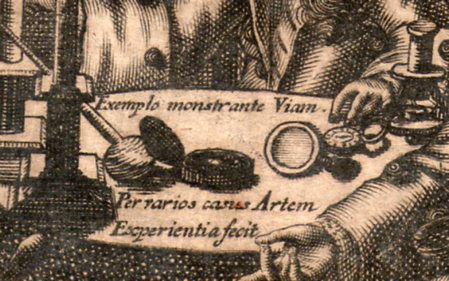
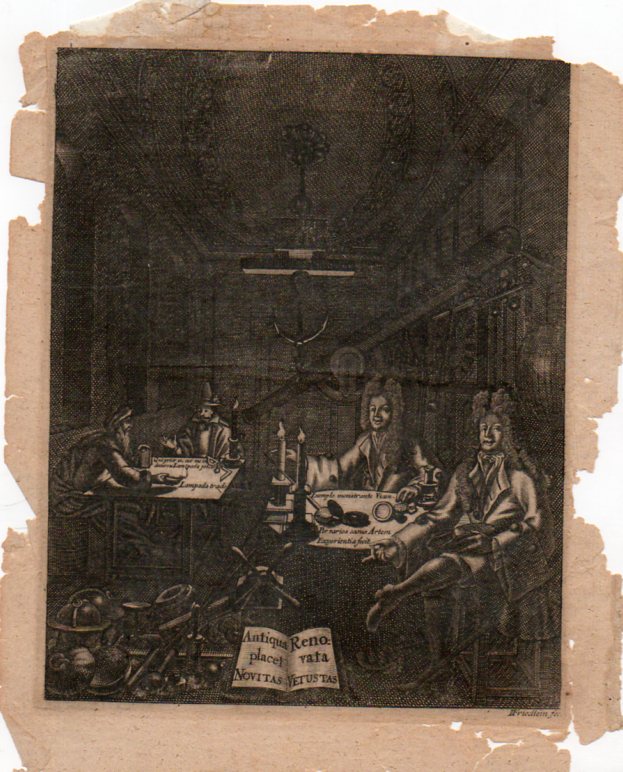
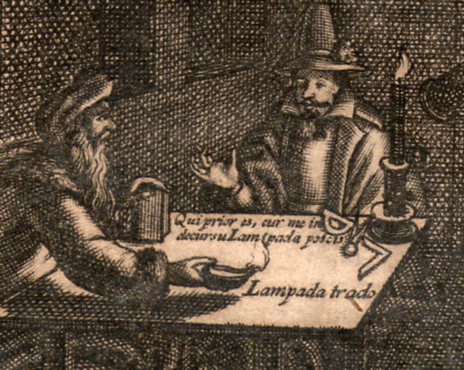
    This is an image of a  philosopher’s cabinet, engraving (on copper?) by “I. Friedlein fec”, who was Johnann Friedlein, an emigree from North Germany to Denmark, and who worked ca. 1680-1705. It shows the tools of the trade for someone working in natural philosophy (the name “scientist” would not come into use for another 130+ years or so1) and is an interesting insight into a small, polite gentleman’s club for experiment and investigation.

    Friedlein938

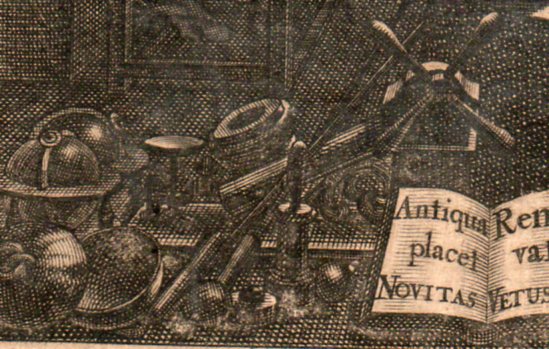
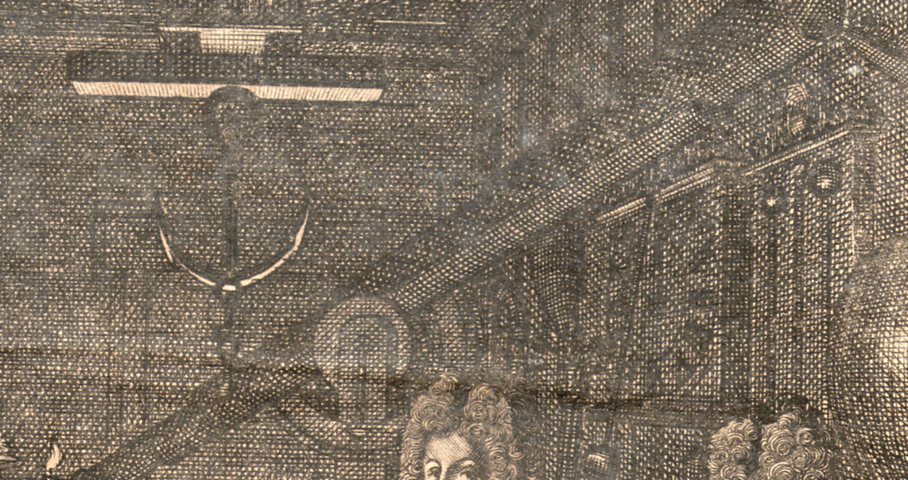
    The men surround a decent collection of scientific instruments–I can locate a compass, dividers, oil lamp, magnifying glass, microscope2  (at the right elbow of the figure on the right), terrestrial and celestial globes,  a (large) clock, barometer, and various weights and scales, and  behind it all looms a rather large refracting telescope3 (is it five inches?) 

    Friedlein939


    Friedlein940

    Friedlein942

    For all of these expensive and current instruments, the lighting these gentlemen set up for themselves is pretty poor, though of course it does add to the mystery and dark experience of the image.  

    Here’s another example of Friedlein’s  work, a frontispiece to Cryptographia, oder geheime Schrifften by Johann Balthasar Friderici, printed in 1685:

    Frontispiece, illustration from 'Cryptographia, oder geheime Schrifften' by Johann Balthasar Friderici, engraved by Johan Friedlein (17th century) published in Hamburg, 1685

    Nyt dansk kunstnerlexikon: bd. Indenlandske kunstnere (fortsættelse …)by Philip Weilbach:


    Notes:

    1. “Scientist”, in the Oxford English Dictionary (“science” is a much older word in English):

    1. A person who conducts scientific research or investigation; an expert in or student of science, esp. one or more of the natural or physical sciences.computer, earth, mad, natural, rocket scientist, etc.: see the first element.

    It is possible that the ‘ingenious gentleman’ referred to in quot. 1834  is Whewell himself.

    1834   W. Whewell in Q. Rev. 51 59   Science..loses all traces of unity. A curious illustration of this result may be observed in the want of any name by which we can designate the students of the knowledge of the material world collectively. We are informed that this difficulty was felt very oppressively by the members of the British Association for the Advancement of Science, at their meetings..in the last three summers… Philosophers was felt to be too wide and too lofty a term,..; savans was rather assuming,..; some ingenious gentleman proposed that, by analogy with artist, they might form scientist, and added that there could be no scruple in making free with this termination when we have such words as sciolist, economist, and atheist—but this was not generally palatable.
     
    1840   W. Whewell Philos. Inductive Sci. I. Introd. p. cxiii,   We need very much a name to describe a cultivator of science in general. I should incline to call him a Scientist. Thus we might say, that as an Artist is a Musician, Painter, or Poet, a Scientist is a Mathematician, Physicist, or Naturalist.
     
    2. “Microscope” (as a noun) in its earliest uses in English, in the OED: 
    1648   Bp. J. Wilkins Math. Magick i. xvi. 115   We see what strange discoveries of extream minute bodies, (as lice, wheal-worms, mites, and the like) are made by the Microscope, wherein their severall parts (which are altogether invisible to the bare eye) will distinctly appear.
    1651   N. Highmore Hist. Generation viii. 70   The white circle..by a Microscope appears now to be the Carina or back and neck of the Chick.
     
    3. “Telescope” (as a noun) in its earliest uses in English, in the OED:
    [1619   J. Bainbridge Astron. Descr. Late Comet 19   For the more perspicuous distinction whereof I vsed the Telescopium or Trunke-spectacle.]
    1648   R. Boyle Seraphic Love (1663) xi. 59   Galileo’s optick Glasses,..one of which Telescopioes, that I remember I saw at Florence.

  • Picking Up the Sagging Mississippi on a 2600′ Canvas

    JF Ptak Science Books   Post 2358

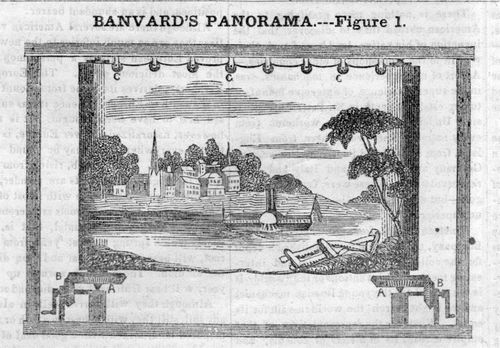
    Well, what was really being picked up was the canvas on which an enormous panorama of the Mississippi River was painted.  The work was that of New Yorker John  Banverd (1815-1891), a portrait painter who awoke with the notion of displaying the shoreline of the Mississippi River for its entire length. To that end he raised money (based on his painting income and investments) and set out with his $3000 in a skiff to paint the river, back in 1840.  According to a pamphlet that describes his effort (the full text of which is available at the Internet Archive, here), the effort took over 400 days–when his sketches were complete Banverd repaired to St. Louis where he built a wooden house specifically designed for him to transfer his sketches to an immense canvas.  The work was completed in 1846, at which point his work was 12′ high and 1500′ long–by 1848 the length of the work expanded to 2600′. (Banverd advertised his work as being “3 miles” long–that wasn’t the case, and that’s okay, because he had produced one of the largest paintings ever produced by a human.
    Panorama Bravasrd450

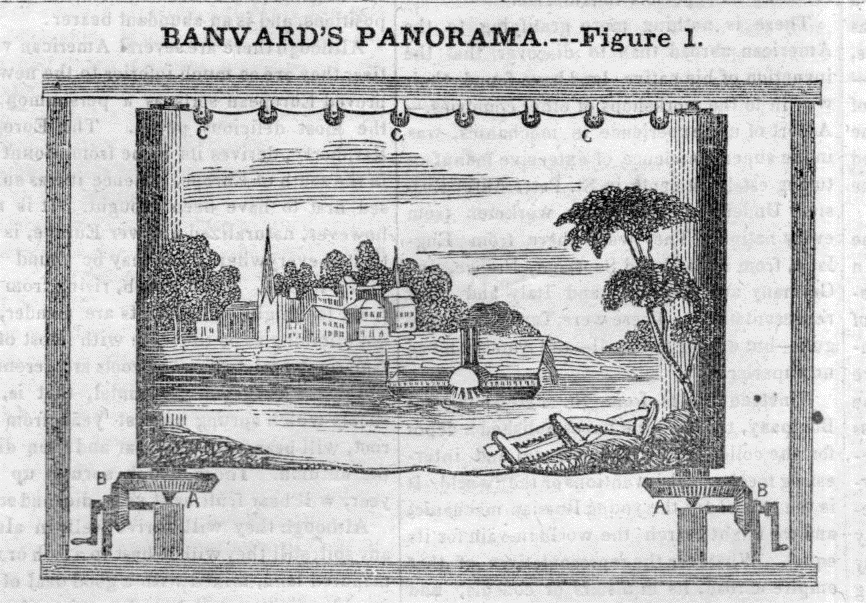
    The panorama (and diorama, and cyclorama, and other iterations of ‘raams) were a very  popular entertainment form, as popular as plays and other similar exhibits and spectacles, lasting deeply into the 19th century.  The Branverd panorama was on a large canvas that was advanced like a mechanism on a 35mm camera film advance–there were other sorts of displays, one of which kept the canvas static with the audience walking past it; others took place in a rotunda where the pano was on the walls of the structure and observers would be on a platform in the middle, where they would achieve a motion picture-like effect by turning slowly to see the entire image.  

    There were many panorama subjects, including subjects like Jerusalem, London, Rome, Lima, a journey down the Rhine, and so on.  The medium would take a fatal hit with the invention of flexible roll film and the accessibility of photography to the masses, the invention of the half-tone making it possible to reprint photographic images in newspapers and magazines, and other bits that could generate images from everywhere and cheaply.  

    The panorama was taken by Banverd on a tour of major cities where people would pay a fee to see the gigantic artwork displayed before them, shown segment by segment on a large frame with cranks that would roll/unroll/collect the painting before the audience, almost like a very primitive movie.  

    The image above is from The Scientific American for December 10, 1848, and shows how Mr. Branverd figured out a knotty problem with the display of his super-massive work. Unfortunately, at the end of the life of the canvas it was cut into smalkl fragments and sold–evidently none of it survives. 

  • Industrial Steampunk and the Menace of Corporate Reach

    JF Ptak Science Books   Quick Post–Poster Series #2

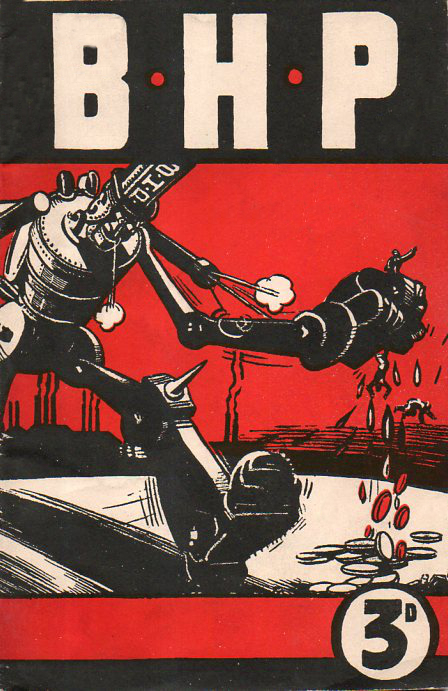
    This striking image is the cover of a pro-union pamphlet leveled at the Australian iron-producer, B.H.P. (Broken Hill Proprietary, a 150-year-old firm), and published in 1943 by the Federated Ironworkers’ Association of Australia. The great social observer and artist Thomas Nast was very aware that much of his “readership” couldn’t read, and so he made his work (which was usually text-heavy) completely understandable as a purely visual message.  So too for artists like the anonymous person who contributed this great cover–there is no question about what might be in the pages of the pamphlet.

    Poster Reprint BHP 96 dpi356

    It is also interesting to think about the “menacing” part of the title of this quick post–I would consider this still to be an early depiction of a robot (the term then still about a dozen years old) acting in a threatening manner towards humans–and in this case squeezing them until blood money is drawn.  

    This is a detail from the 600 dpi scan–click for an even larger image of this sample:

    Poster Reprint BHP 600 FINAL detail dpi357


    There is a very nice 13×19 inch 600 dpi poster being offered of this cover at the our POSTER Blog, here.