A Daily History of Holes, Dots, Lines, Science, History, Math, Physics, Art, the Unintentional Absurd, Architecture, Maps, Data Visualization, Blank and Missing Things, and so on. |1.6 million words, 7500 images, 4.9 million hits| Press & appearances in The Times, Le Figaro, Mensa, The Economist, The Guardian, Discovery News, Slate, Le Monde, Sci American Blogs, Le Pont, and many other places… 5000+ total posts since 2008.

Category: Cross-Sections

  • Submarine Cross Sections

    JF Ptak Science Books   Quick Post

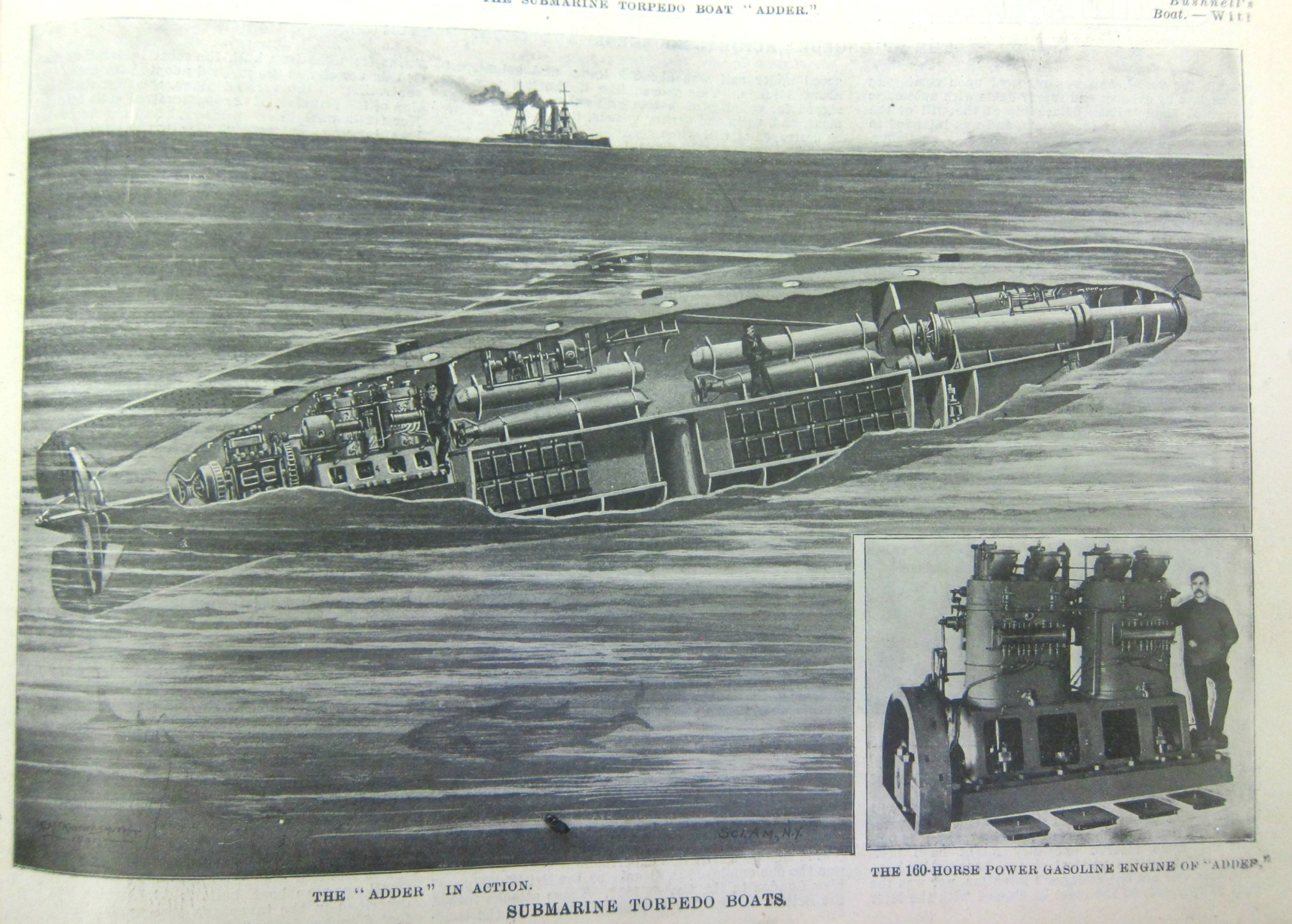
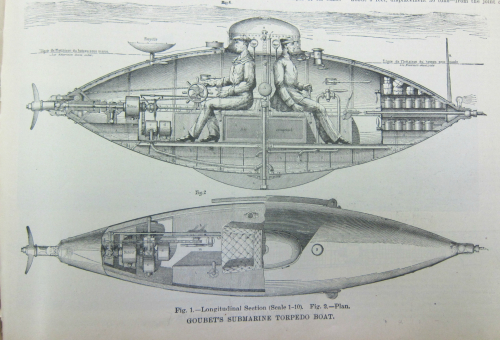
    This is a simple post adding to the collection of cross-section and cutaway images on this blog (see  https://historyofideasblog.com/thesciencebookstore/crosssections/ ). All of the images below are found in the February 15, 1903 edition of Scientific American Supplement: 

    Subnarine 4

    Subnarine 4


  • Found-Abstract Art in Electrical Hardware (1885)

    JF Ptak Science Books  Quick Post

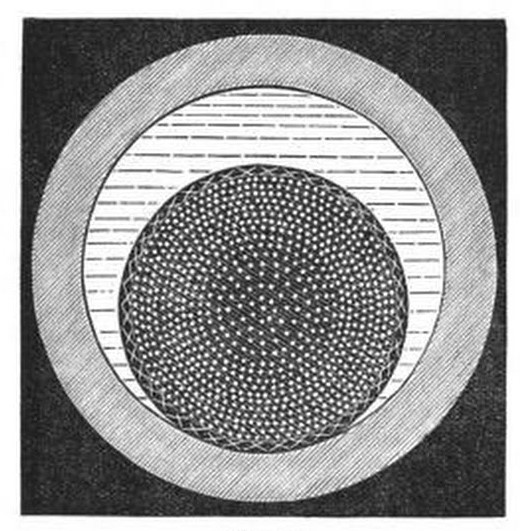
    I like this cross section as a piece of Found-Art–pre-nonrepresentational art, but it appears about 25 years too soon. It could be classified as “art” after Mr. Kandinsky makes an appearance…but we might have to look not very closely at the work of Whistler, Turner, Constable, and some others who came very close to abstract art but not quite…and we’ll also have to overlook some wide swath of Asian art (some quite ancient). 

    The actual element here is a cross section of a piece of 2.5″ pipe half-stuffed with 420 telephone lines, and belonged in 1885 to the Metropolitan Telephone Company of New York.  (“The dark shading shows the pitch filling the box around the pipe. The light ring next the pitch represents the wrought iron pipe inside of which rests the cable showing the ends of the copper wire surrounded with the insulating oil which fills the pipe full at all times.”–The Electrician, November 13, 1885)


    Electrical wires telephone electrician 1886

    And just conversationally I’ll include Robert Delaunay’s  1913 Premier Disque:

    Delaunay _1913 _Premier_Disque _134_cm _52.7_inches _Private_collection

    [Robert Delaunay, via Wikicommons]

    ·Posted by :

    ·in:

    —

  • Cross Section of the Cockpit of a Hawker Hurricane, 1940

    JF Ptak Science Books  Quick Post 

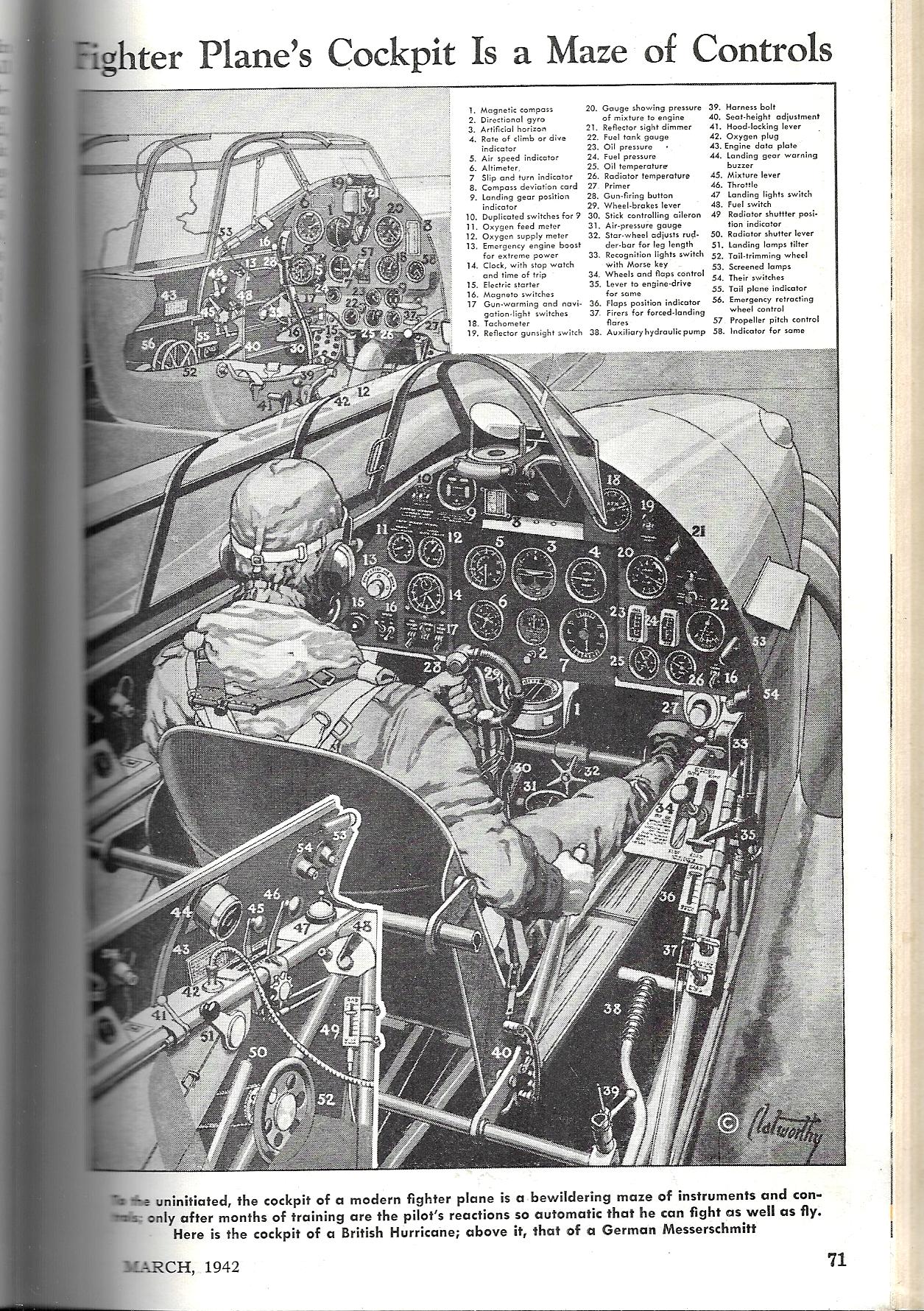
    I would say that there are perhaps 100 good, solid (mostly technical) cross sections on this blog, and to that number I’d like to add another. This one–barely a cross-section as things go but it does serve our purpose–comes via the cross-section-dependable Popular Mechanics for April 1942, and shows the cockpit controls for a British Hurricane as well as a smaller image for a German Messerschmidt. (Click and click again to greatly enlarge this image for the small print.)

    Cross section Pop Mech 1942 Hurricane aircraft


  • Dramatic Cutaway / Cross Sections of Two Great RAF Fighter Planes (1939)

    JF Ptak Science Books   Quick Post

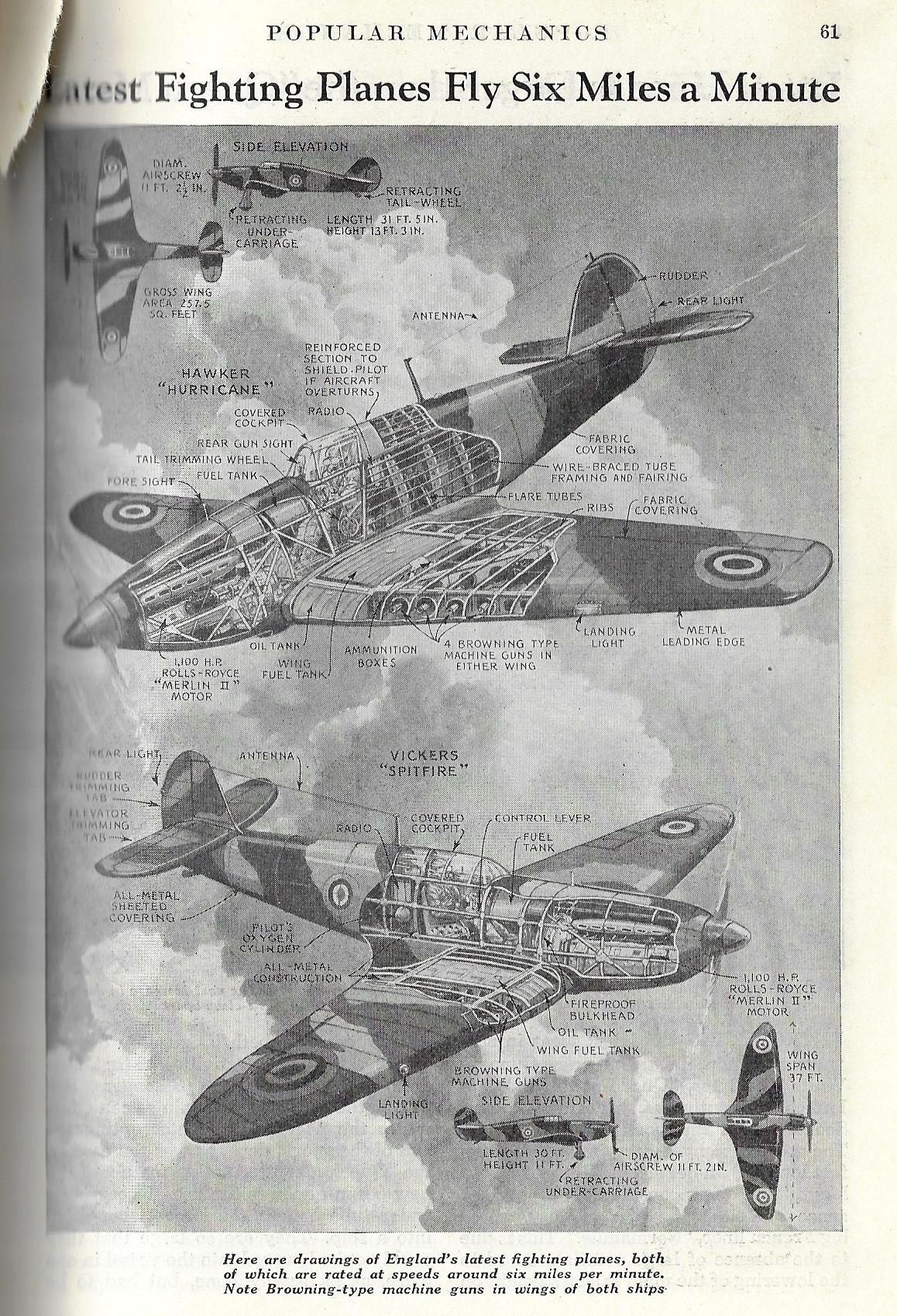
    Here’s an interesting and artistic cutaway of two of the great planes of the R.A.F., the Hawker “Hurricane” and the Vickers “Spitfire” (appearing in Popular Mechanics, 1939):

    Cross section 1939 Spitfire Hurricane


  • Cross Section of the Comstock Lode

    JF Ptak Science Books   Quick Pos

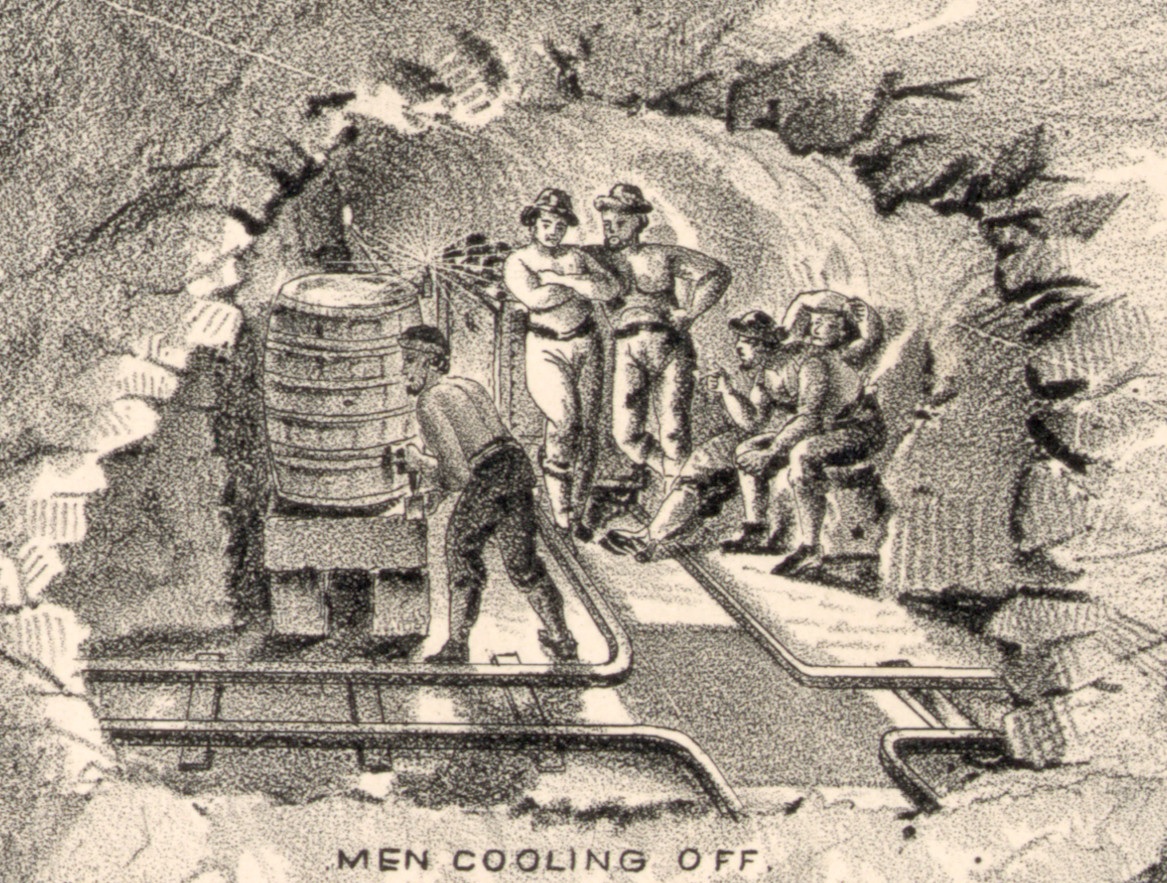
    I’m not that convinced that a lot of “cooling off” was being done down in the tunnels of the Comstock Lode, though I guess it is all relative, and so perhaps these guys were able to enjoy themselves a little compared to swinging a pick axe or shoveling with a shovel in a cramped, damp, loud, dark place, underground.  

    Comstock cross section men cooling off

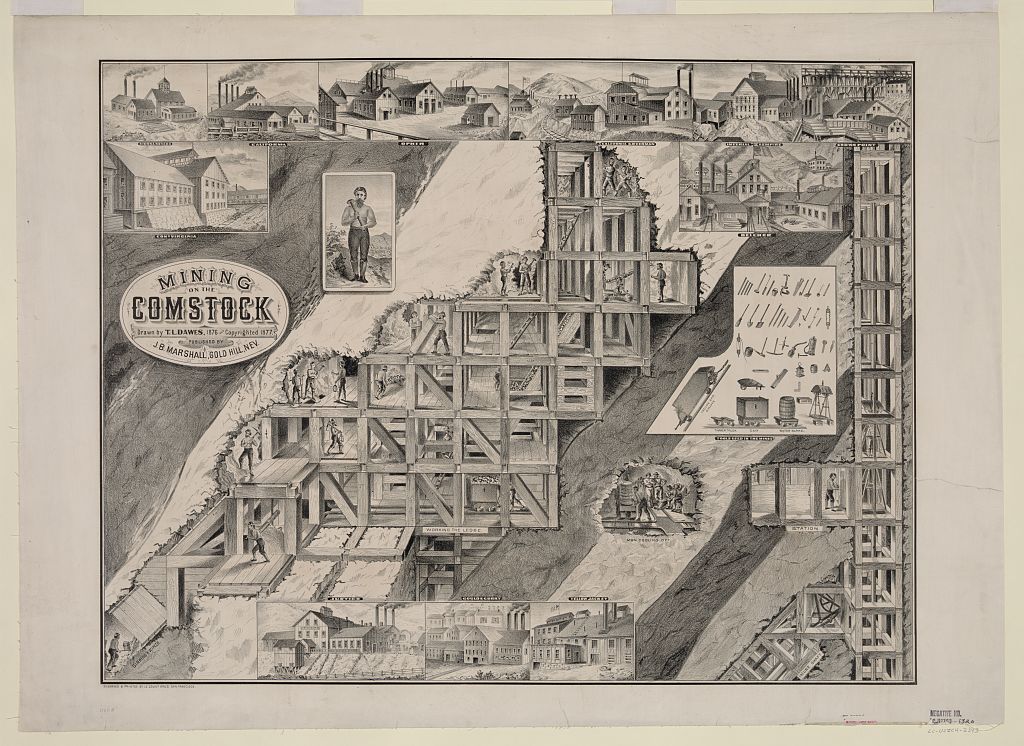
    I found this in the detail of a great cross section image on the Library of Congress site http://www.loc.gov/pictures/resource/pga.01999/:

    • “Mining on the Comstock / drawn by T.L. Dawes ; engraved and printed by Le Count Bro’s., San Francisco” 

    which was printed by lithography by Le Count Brothers in San Francisco in 1877.

    The cross section shows how life and business was being conducted underground, and gives a sense of the claustrophobia-making closeness of it all:

    Comstock cross section

    In any event, it was very difficult work in a difficult spot, using difficult tools, breathing difficult air, and this cross section gives a pretty good idea of what that could have been like.  


  • Great Cross Section of the HMS “Repulse”, 1939

    JF Ptak Science Books   Quick Post

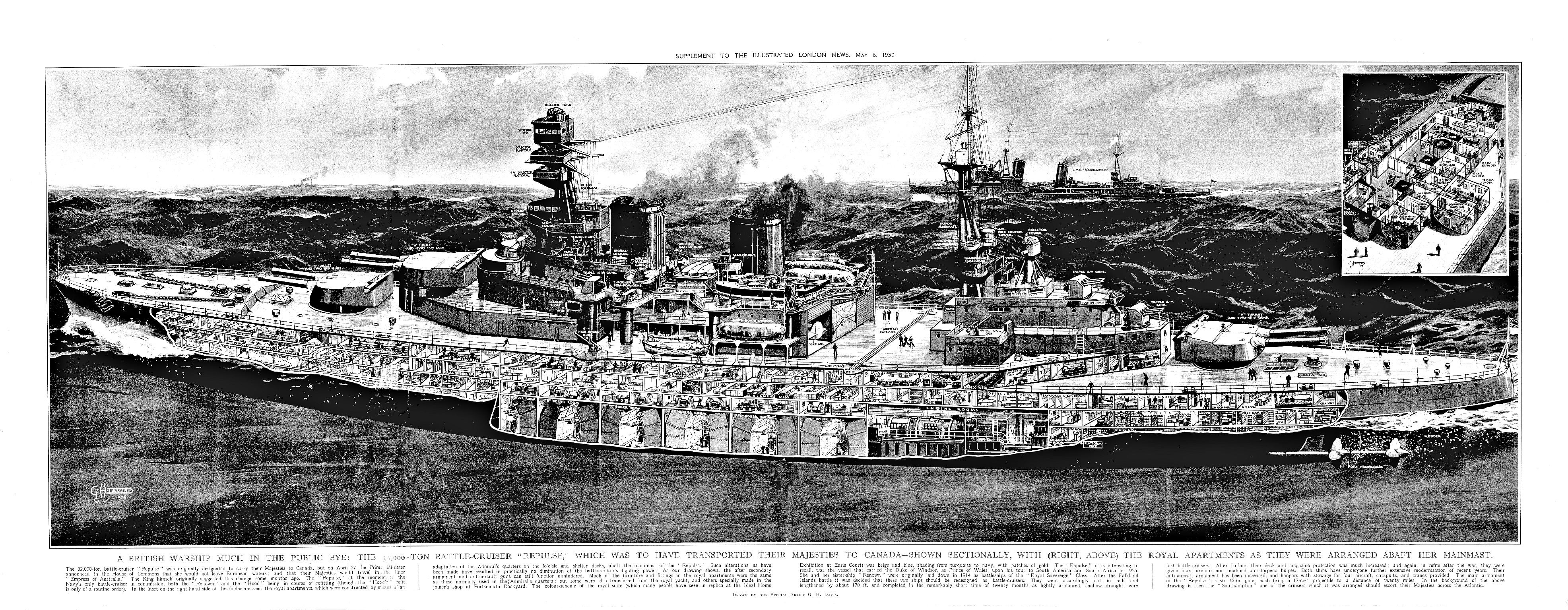
    Here’s a wonderful cross section HMS Repulse, published in 1939 in the Illustrated London News.  It is the work of the endlessly energetic and resourceful G.H. Davis, who I’ve written a about a number of times before on this blog (just enter his name in the Google search box at left.)  This is a cross section of the 11th of 12 Repulses of the Royal Navy–it was launched in 1916, and unfortunately was sunk in a battle on 10 December 1941, north of Singapore in the South China Sea.  

    Cross section REpulse 1939[Click for larger and more legible image]

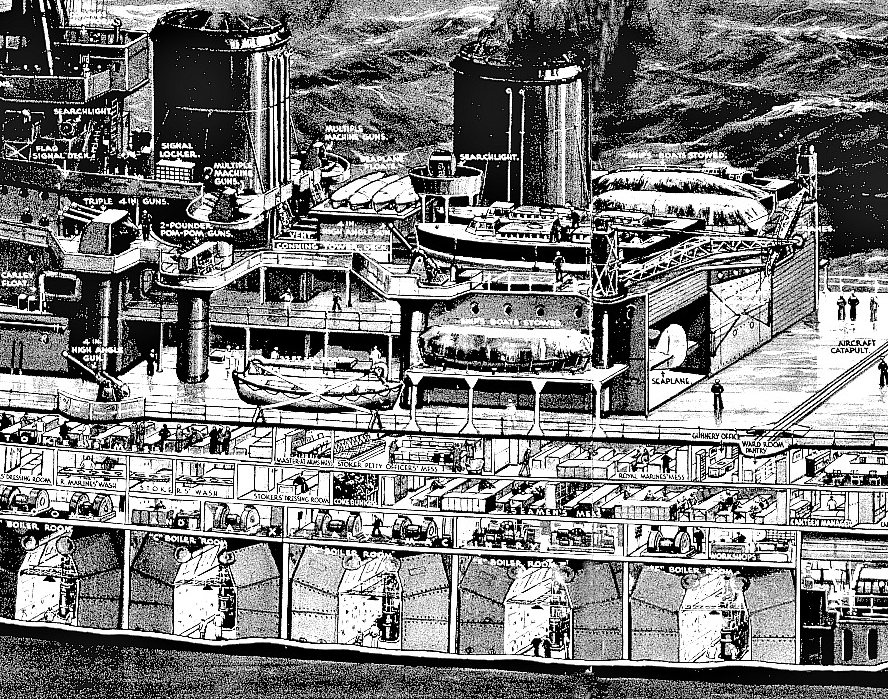
    Detail:

    Cross section Repulse 1939 detail

    ·Posted by :

    ·in:


  • The Automobile as a Dominating Life Form (1930)

    JF Ptak Science Books

    0 blog jan 07 car future364

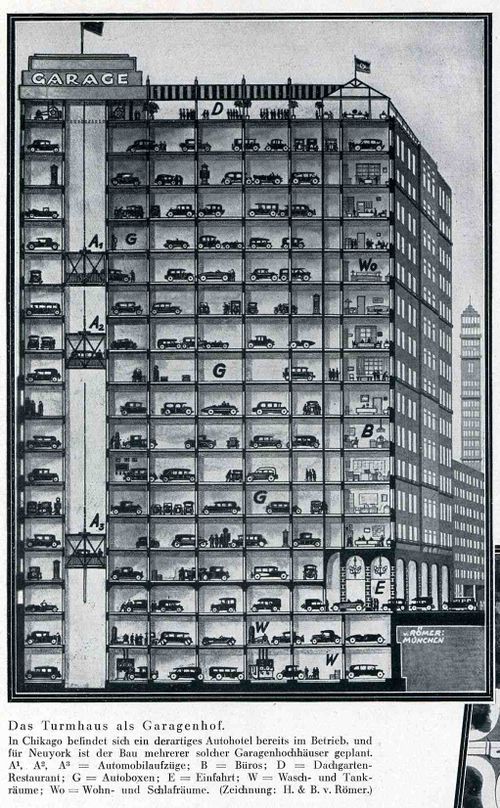
    If I was an alien (of the outer-space variety) looking at the United States, I’d find it difficult not to assume that the biological units scurrying around the place were not put there to service the automobile.  Cars get born, then put on display, then selected and driven to their new home.  They get washed, and fed, and sometimes have their own places to sleep at night in their very own structure with their caretakers housed nearby.  They get taken out for airs in the morning and evening, resting while the humans labor all day to make enough money for their care and maintenance and feeding.  In the evening, they get brought back home and allowed to rest further.  They respond directly to inputs only and give no unsolicited response:  sort of like cats.  Fantastically large allowances are made for cars, humans going so far as to remove life- and atmospheric-sustaining biological units such as trees and good dirt so that the car can be taken virtually anywhere in the country on a path made specifically for them.  These pathways, which are padded and smooth, have ancillary bits attached to them so that the humans may walk beside them—houses and such are all connected to these paths to more easily enable the people to have access and maintain the car.  And, at the end of the day, humans breathe in the very excrement and excretia produced by the cars.  Placed under a microscope, the whole thing might resemble a biological unit, the cars being its very blood, everything else present to contain and move it.

     0 blog jan 222 car bfuture398


    These images from the Illustriete Zeitung (Leipzig, issue 4484, pp 239-240) for November 1930 speak to the exact issue of how to care for the now ever-present automobile.  Entitled “Wie Bringe Ich Meinen Kraftwagen Unter?”, the short article (by the engineer Botho von Romer of Munchen) addresses the need of what to do with cars at bedtime—where do we put them?  One answer was this spectacular carpark (“Garagenhof”) high rise—seventeen floors of parking (with two more underground), serviced by a variety of elevators, pointing out that varieties of this structure already existed in Chicago and New York

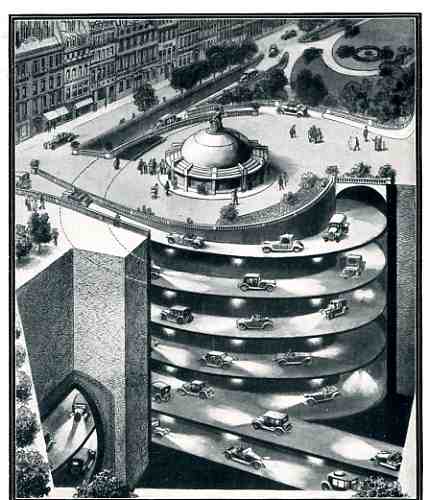
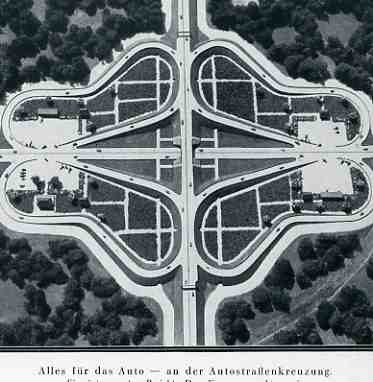
    There was also the possibility of vast masses of sunken garages, their entrance way screwed into the earth leading to tunnels and networked warehouses where the cars could be safely deposited and removed from city streets.  There were also these two versions of the simple above-ground garages and parking lots:  the apartment block gives over the entire interior area to individual parking and garages (doing away with any greenspace), while the massive semi-cloverleaf design is made for nothing else in mind than to park the cars in the four semi-centers.

     0 blog jan 222 car bfuture399

    By 1930 the production of the automobile had been revolutionized to such an extent that virtually anyone with a job and less than five kids could actually afford a car.  It is interesting to note that at the average price of say 30 cents a gallon for gasoline (in the U.S.A.) that folks 80 years ago were paying pretty more per gallon (adjusted via CPI, roughtly $4.25 iva the Bureau of Labor Statistics inflation calculator) than we are paying now at $2.75/gallon (in my mountain city at the far end of the pipeline). 


  • Cross-Section Series: Battleship “Deutschland”, 1931

    JF Ptak Science Books   Quick Post

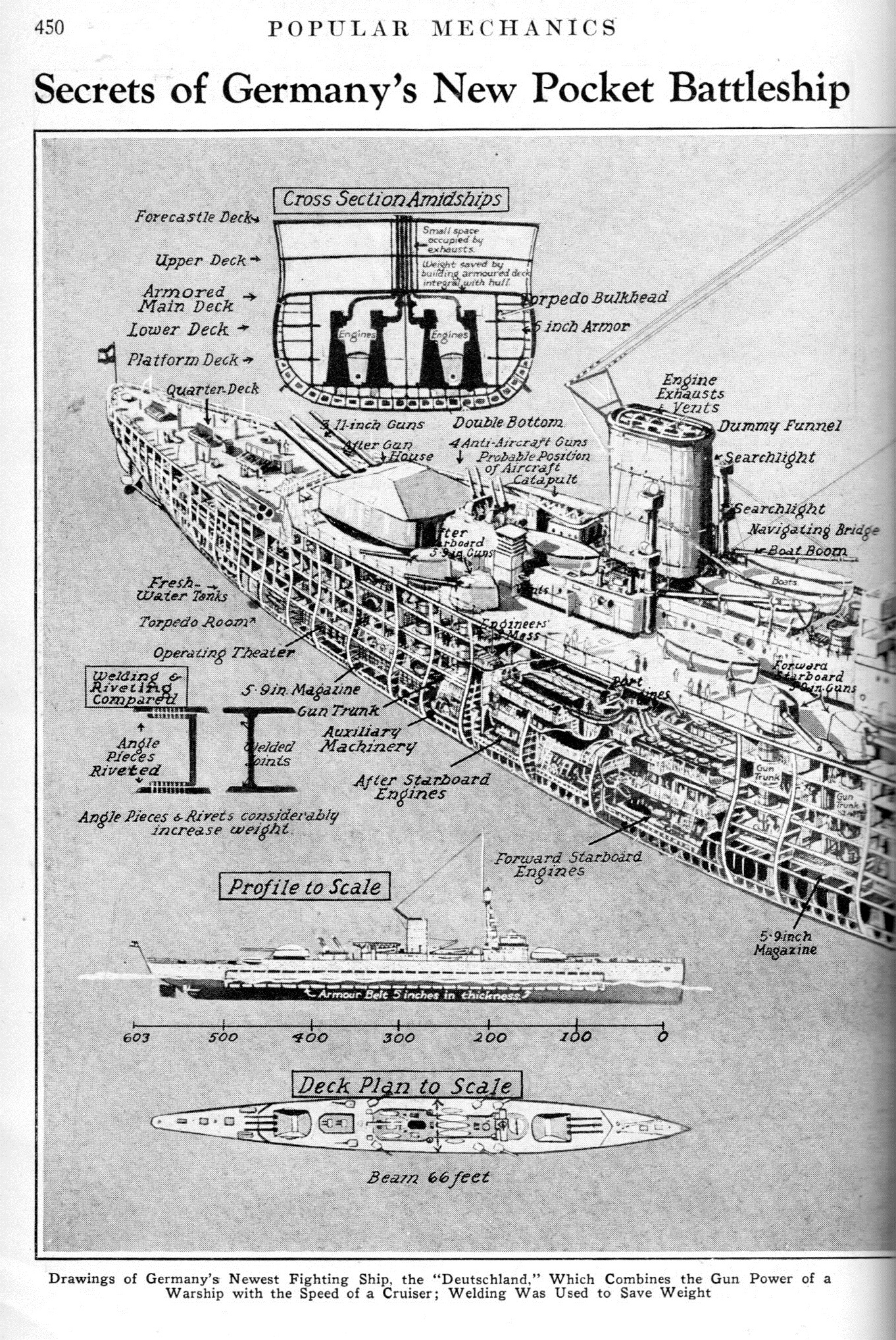
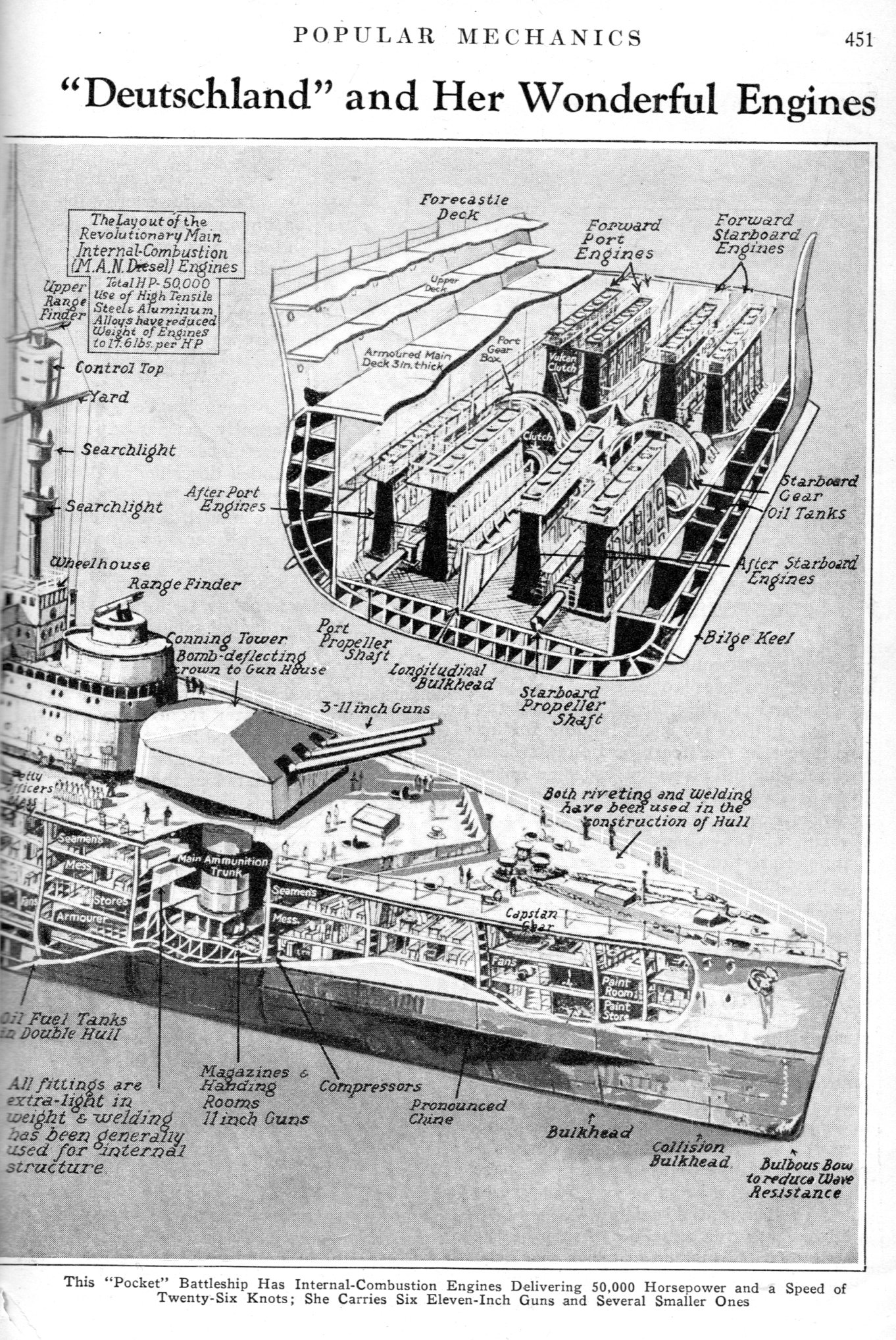
    This fine two-page spread, “Secrets of German’s New Pocket Battleship “Deutschland” and Her Wonderful Engines” appeared in Popular Mechanics in September 1931. I’m not sure offhand how the Weimar government was able to build this ship and abide by the Versailles Treaty, but it did. The ship–a 610′ heavy cruiser, also known as a pocket battleship–saw a lot of action during WWII, mostly under the name of Luetzow, as it was called after a major upfitting.  Anyway by 1939 the ship’s engines were probably not seen as being so “wonderful”, any more.

    [The images are very expandable] 

    Schematic deutschland868 Schematic deutschland867

    ·Posted by :

    ·in:

    —

  • Underground Airports, 1935-1941

    JF Ptak Science Books  Quick Post

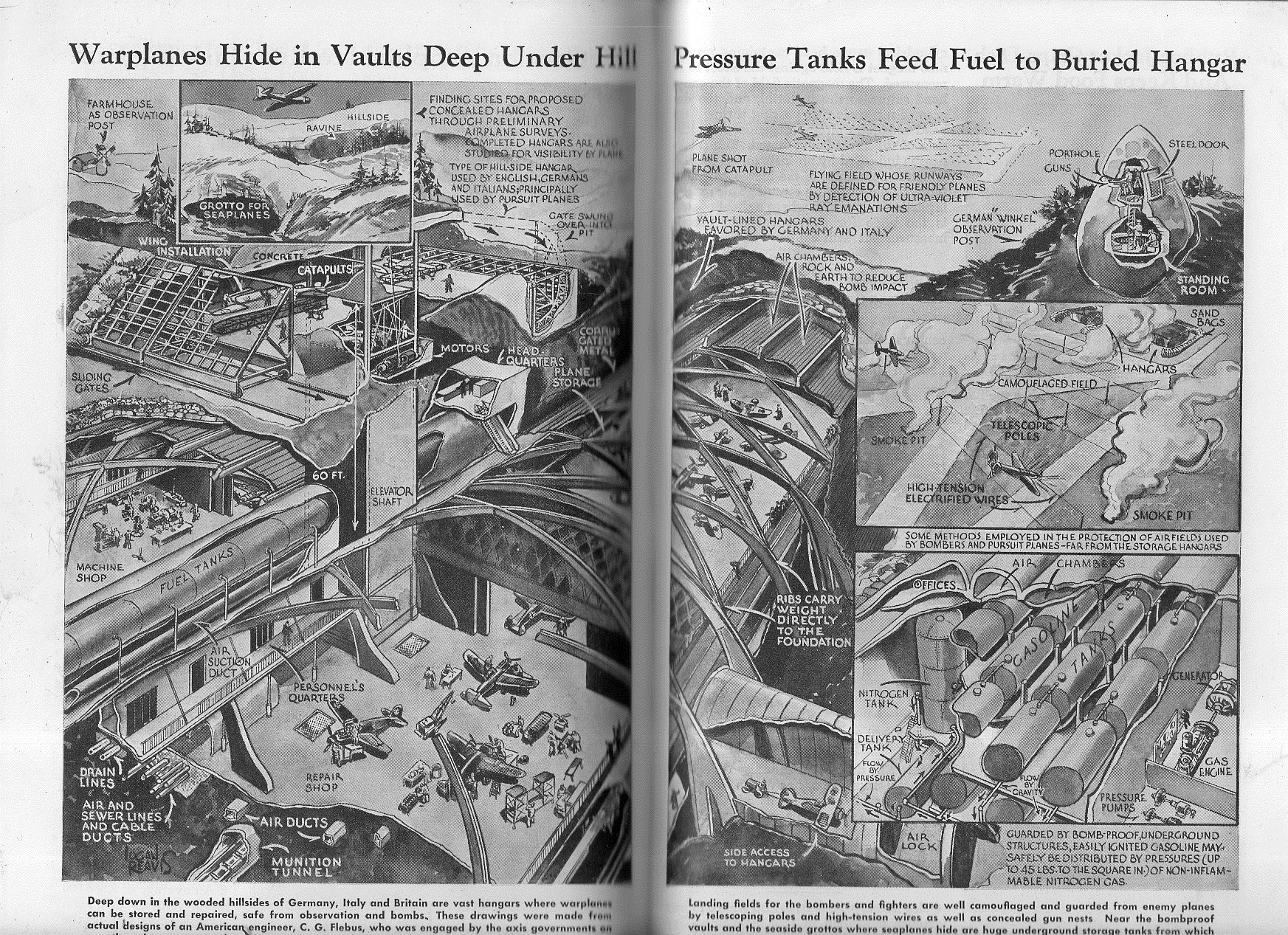
    I’ve seen a number of plans from the 1925-1935 period calling for skyscraper-topped airports, and airports built over a largely cover-ed themes, and over a covered-up Central Park, and floating in NYC harbor, and so on. I have not seen too many future visions of underground airports. This plan appears in Popular Mechanics for June 1941 and advocates a very tightly controlled underground environment for airports.  The war in Europe was nearly two years old at this point, and the bombing war from the air was very advanced. There is little doubt that all sorts of plans were being considered to protect air force complexes from bombing, though something of this scale, dealing with so few number of plans, could hardly have made it further than this public outing.) 

    Cross section under groun air908

    [Image is expandable]

    An earlier and peace-time example of underground tech is found at the great Modern Mechanix blog, and features an April 1935 article in the journal of the same name an effort to remove the airport underground.  Dr. William Christmas is the chief major domo in the piece and he is depicted with his visions of flight of the future,  holding a model of his 400′ 25,000hp plane with 75′ propellers set to cruise at 200 mph.  The monster could not be accommodated by the plans for an underground airport at right, which frankly looks like a hard drive, and which seems like a positively enormous amount of engineering for a spinning platter underground airport with room for eight planes.  

    Underground airport

    [Source:  Modern Mechanix, http://blog.modernmechanix.com/mags/ModernMechanix/4-1935/under_air.jpg]


  • A Beautiful Naval Cross-Section of Superb Detail, 1851

    JF Ptak Science Books   Quick Post

    Ship cross section 1810906

    J.G. Heck wrote and compiled a fascinating, complex, and magisterial work called The Iconographic Encyclopedia of Science, Literature and Art, which was published in America for the first time in 1851 following Spencer Baird’s translation from its original German (Bilder atlas zum conversations lexicon…)

    The key to his work is the amount of data displayed on each of the 500 engraved plates illustrating this work and the way in which it is arranged.  The design and layout of the 30,000 items on these 500 plates was a work of genius, and for my money it is easily the best-presented complex means of the display of data and objects that was published in the 19th century.   

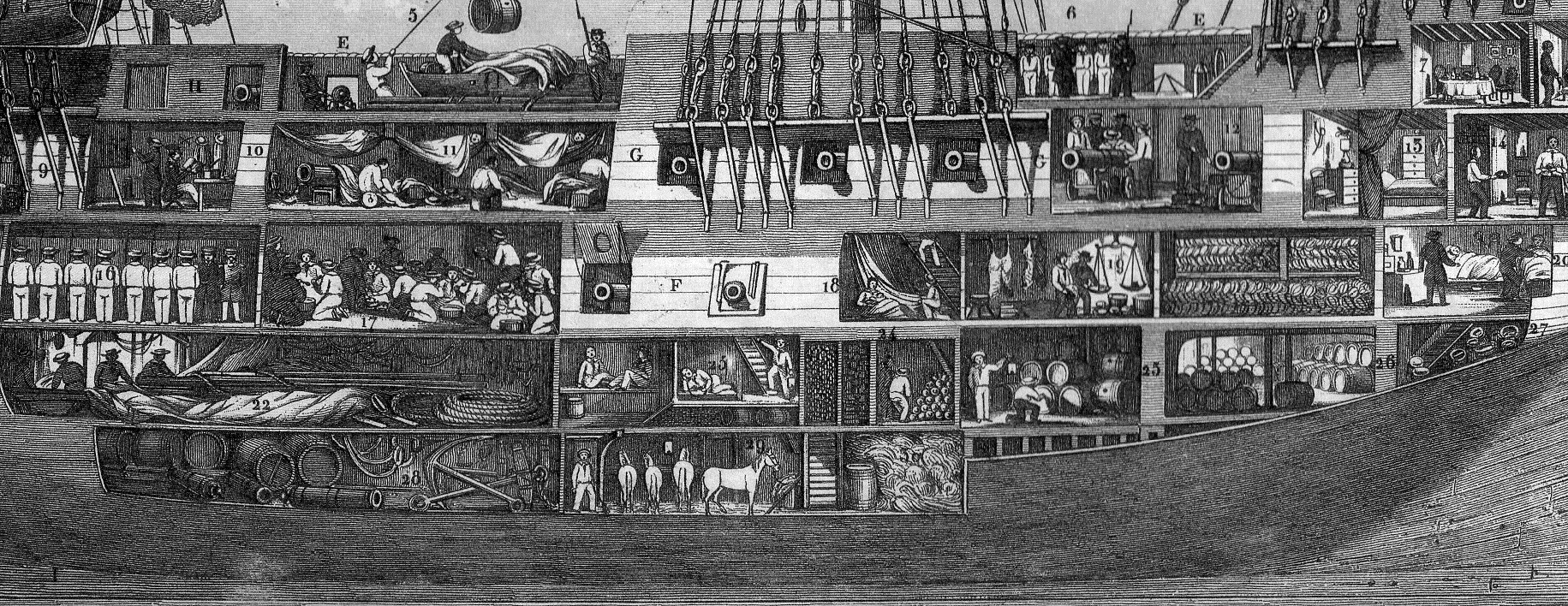
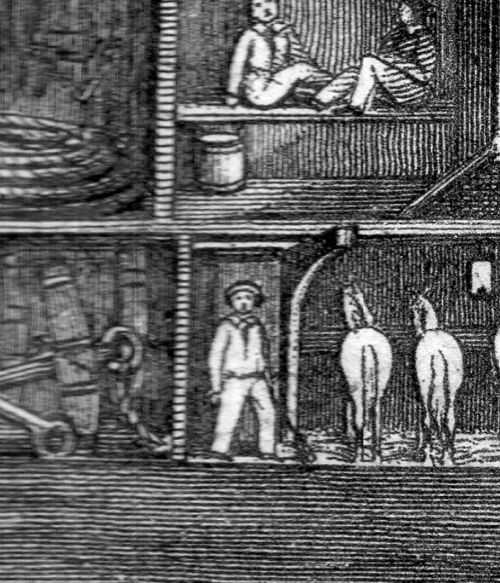
    In this sample (on one sheet of paper) we see three views of a naval war ship (of at least 24 guns) showing above-deck fore and aft, and then a fantastic cutaway/cross-section showing the four decks below deck.  To my experience the technical cut-away is not a common thing to encounter in the 19th century 9or before), and this one happens to be tight, very compact, very detailed, and for all of that quite small.  The entire print measures 12×9″, with the cross section being only about 2.5″ tall.  

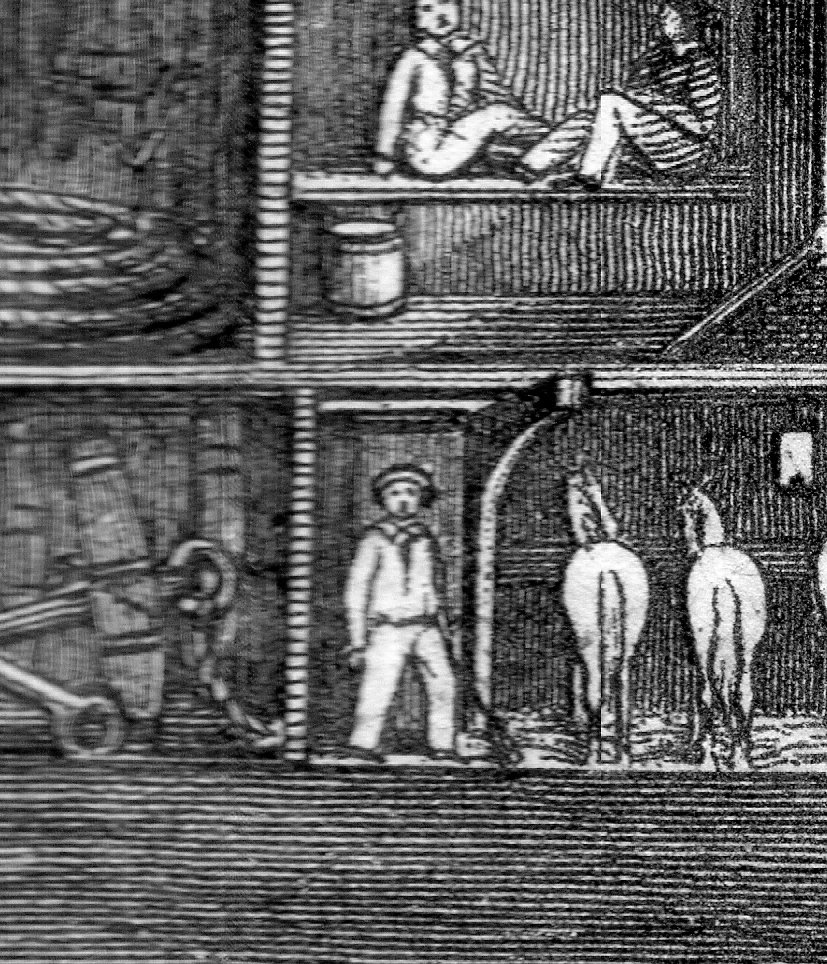
    I’ve concentrated on one figure at the center-bottom of the engraving, a man four decks down who seems to be shoveling out the horse stalls.  In the print he’s about 1/4″ tall, but as you can see scanned in high resolution it turns out that the artist/engraver gave some fair amount of effort to this tiny figure, which is an impressive act of craftsmanship. He even has a collar:
    Ship cross section 1810907