A Daily History of Holes, Dots, Lines, Science, History, Math, Physics, Art, the Unintentional Absurd, Architecture, Maps, Data Visualization, Blank and Missing Things, and so on. |1.6 million words, 7500 images, 4.9 million hits| Press & appearances in The Times, Le Figaro, Mensa, The Economist, The Guardian, Discovery News, Slate, Le Monde, Sci American Blogs, Le Pont, and many other places… 5000+ total posts since 2008.

Category: Books: Title Pages, Unusual

  • Enormous Title of Visionary Work Utterly Defeats Library Cataloguer

    JF Ptak Science Books  Post 2076   Outsider Logic  Daily Dose from Dr. Odd


    Follow Me on Pinterest

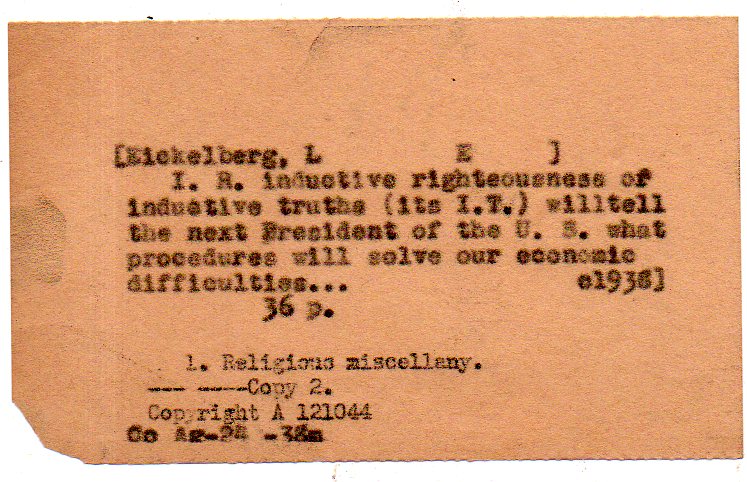
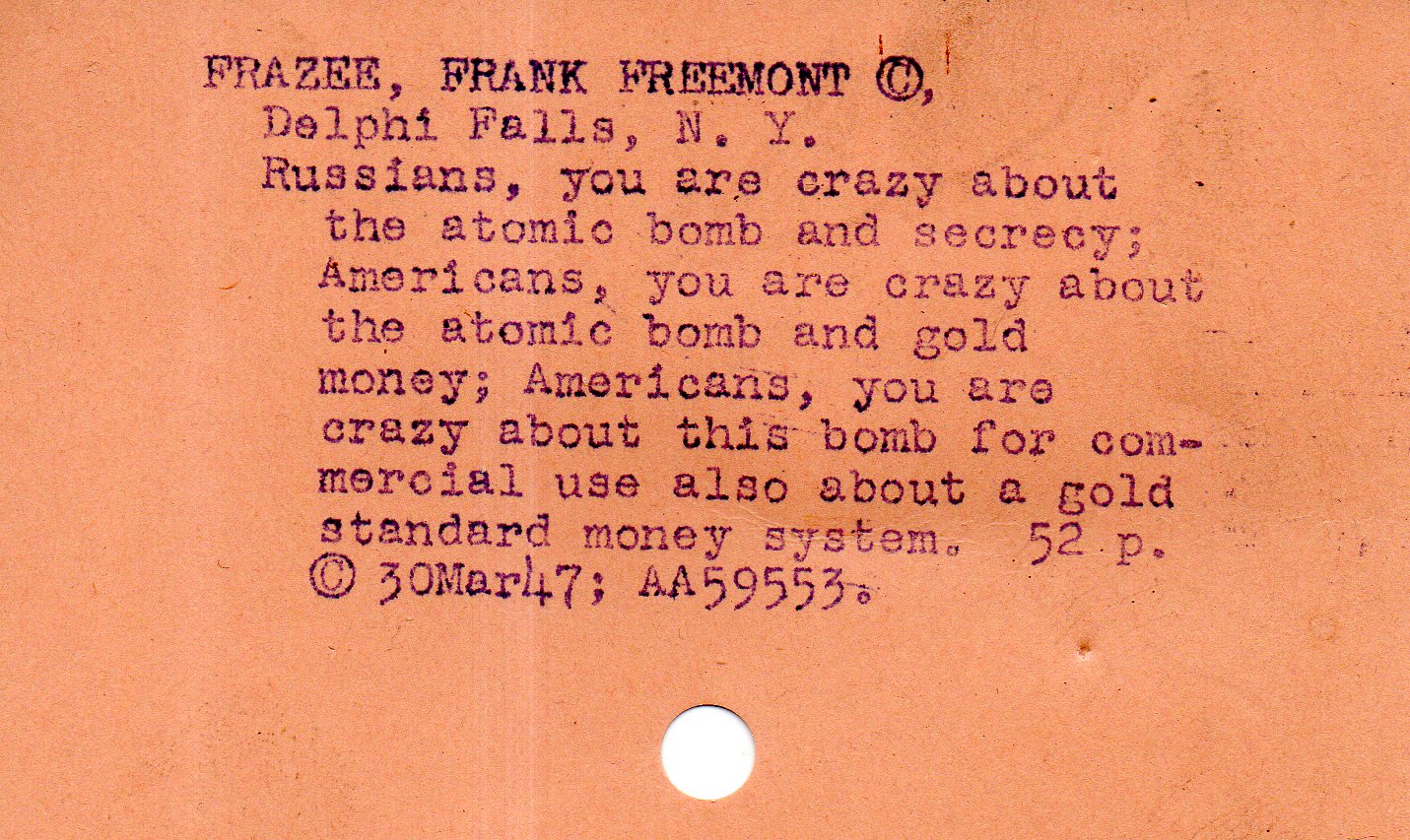
     There appeared on this blog last week a post regarding a library cataloguer who was not threatened or defeated by a work with an enormous and meandering title. The good librarian got right to it, recorded the deed, and moved on. Today’s installment of card catalog magic presents a Library of Congress librarian who decided that enough-was-enough, and that there was simply too-much-title to record, and so simply left the rest of it to dots and to the imagination.
    Title--gigantic424
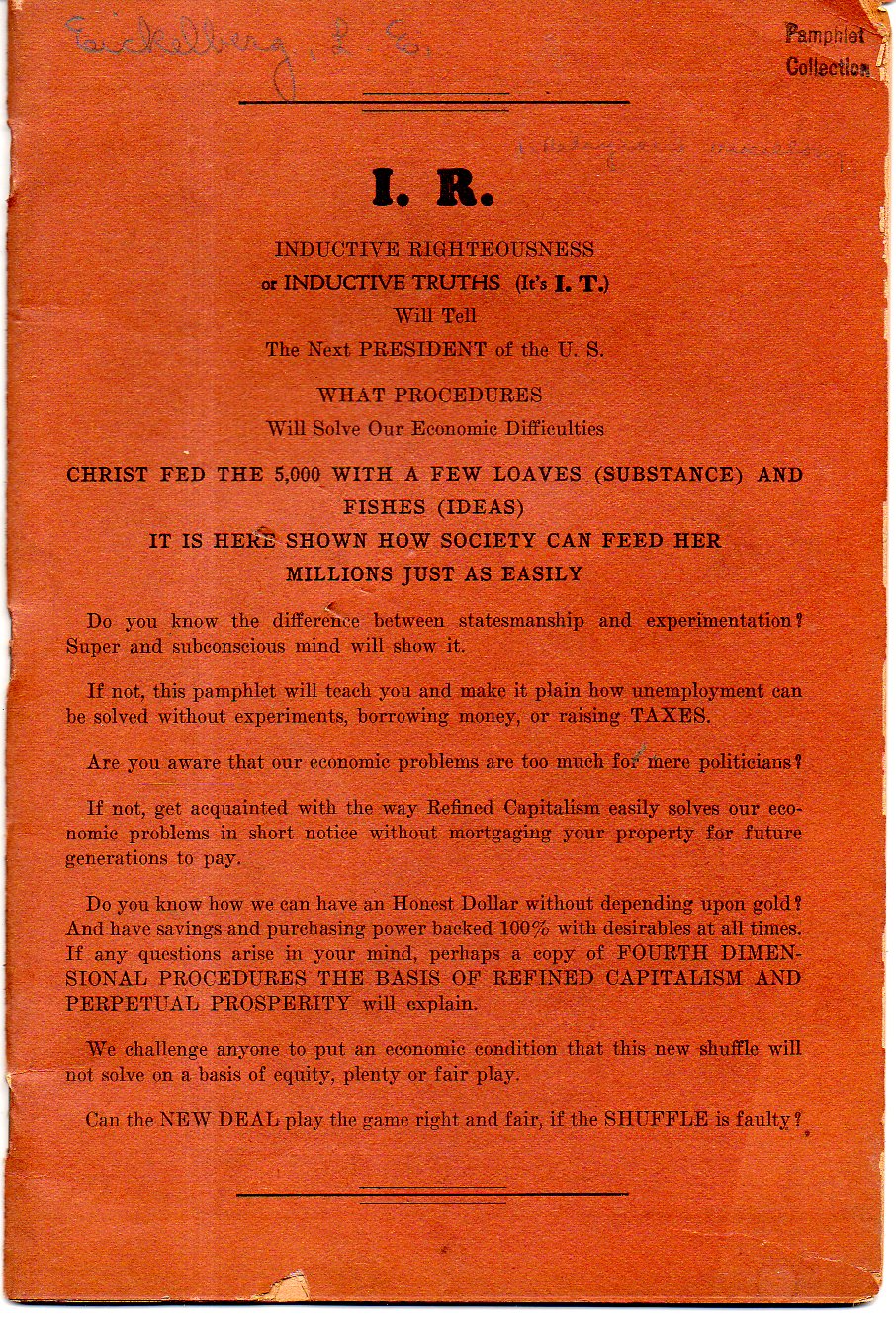
    Now for the pamphlet itself and the rest of the title:
    Title--gigantic423
    The author of this 1938 pamphlet simply started to write on the cover and continued through the rest of the work, and ended on the back cover.  There was no title page, no chapter headings, just a collection of ideas with lots of lists and seemingly nowhere to go.  For a short work (36 pages) the author could’ve dedicated another quire to some blank space, which really doesn’t exist in the pamphlet but which is surprisingly helpful even if the message you are trying to deliver is somewhat, well, outre.  There is a lot of very compressed talk about multi-dimensional spirit and conscience and bank deposits and replacing the dollar and tax collection with “circulation of values”, and so on, deep into itself and a closed system of interpretation of the existence of the universe, harmony of spirit, and economic interpretations of “radio bulbs” and the (often misspelled) fourtth [sic] dimension.  The writing is exhausting and enumerated, and even though by its colossal subject matter and the complex brevity it should be a reliably porous document, it is fairly rigid and brittle. It is a visionary work that somehow worked its way into print, and I’m happy for that, and even it is impossible to keep up with its runaway logic it is still a good ride.

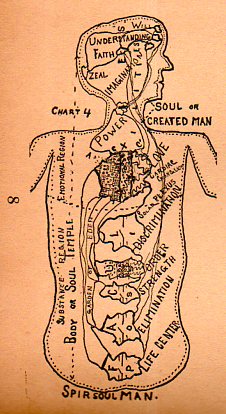
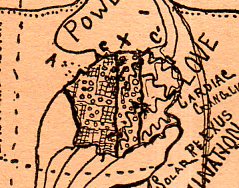
    The author’s representation of a semi-vitruvian spiritual anatomy of humans, called Spirisoulman:
    Title--gigantic426
    A detail of the fabulously-decorated heart region:
    Title--gigantic427
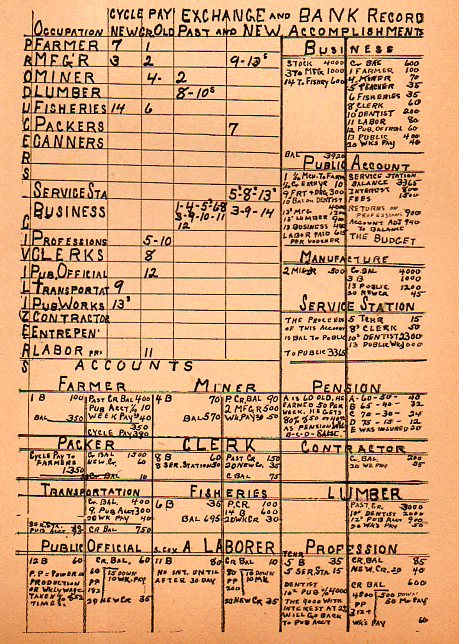
    And of course part of the plan for universal economics which somehow wraps up the theory of in I.R., or the Inductive Rightousness of Inductive Truths:
    Title--gigantic428
    Early on in the history of printed books there was a practice of extended title pages, where there would be the title, and then “support literature” further explaining the title to sometimes some great detail, occasionally winging its way into a title 200 words long.  But that was pretty much before the 18th century and mostly before the 17th and mostly a not-common practice.  The gigantic title in the 20th century seems to be mostly relegated to the less-traveled-road variety of public thinking.

    And the card catalog for the undefeated librarian mentioned above:


    Card catalog409 


  • Odd Designs in the Meat Spectrum & Butter Tub Comparisons

    JF Ptak Science Books   Quick Post     Follow Me on PinterestPart of a Series on Unusual Book Titles & Design

    +  meat pork chop team
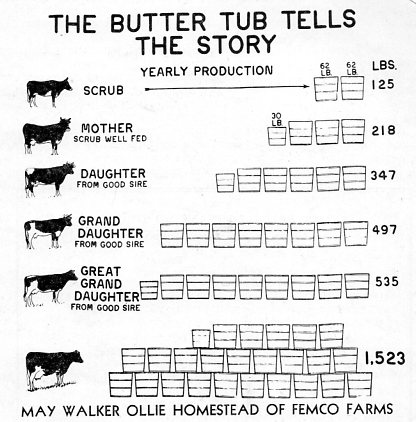
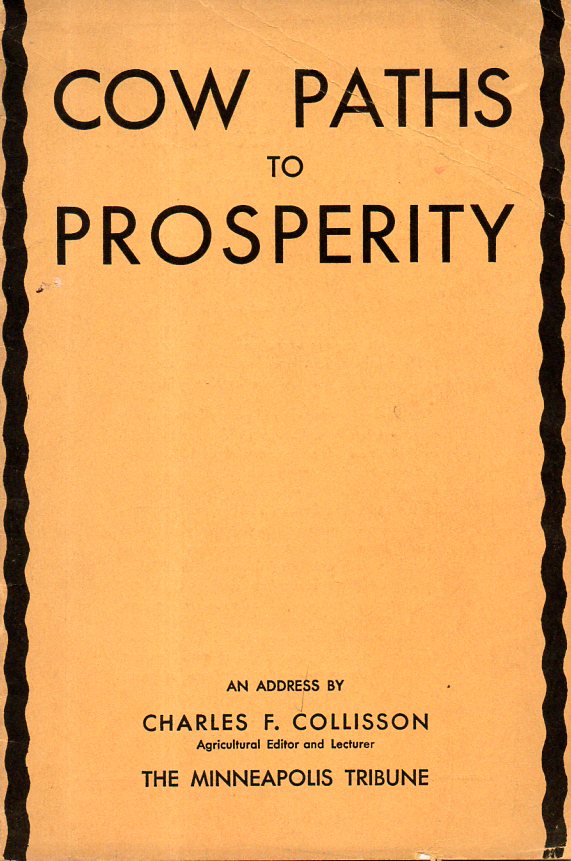
    This is another entry in a developing thread on marvelous/incredible/Outersider-y book covers and the ideas that go with them.  “Butter Tub” units of comparison jumped straight into my brain when I flipped through the pages of Cow Paths to Prosperity (1934), which is basically a very sober appraisal of the cattle industry for the smaller rancher–except of course that it has a fabulous cover and also has a bar graph employing tubs of butter. The Butter Tubs makes perfect sense, of course, but if view just slightly out of context the graph sustains a slightly covert semi-absurdist feel to it.

    Butter tub302
    The graph comes from this jumpily-designed pamphlet:

    Butter tub cover303
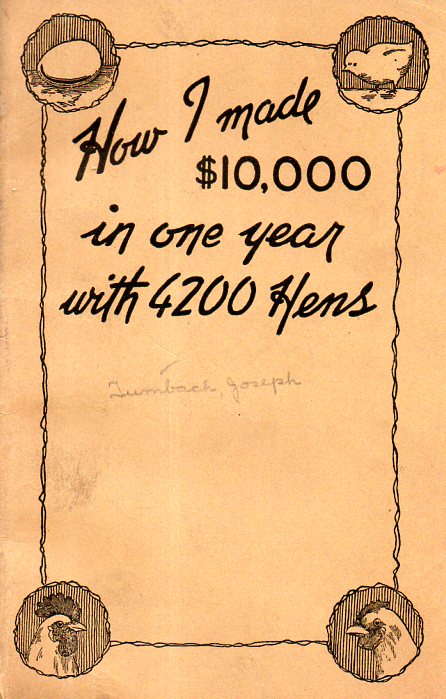
    And not to be outdone in the serendipity department, I offer this unusually-titled effort from the other side of the Meat Spectrum Civil War between beef and chicken:

    Hens304
    $10 grand doesn’t sound like a lot in today’s money for having to put up with 4000 modern dinosaurs on an egg farm–but when this pamphlet was printed in Pasadena in 1925, it was a 300+% increase over the average American yearly income.  I think the money was a little better and certainly much cleaner for writing about making chicken money than it was to actually do it. 


  • Selling U.S. Airpower with Hermann Goering

    JF Ptak Science Books  Quick Post

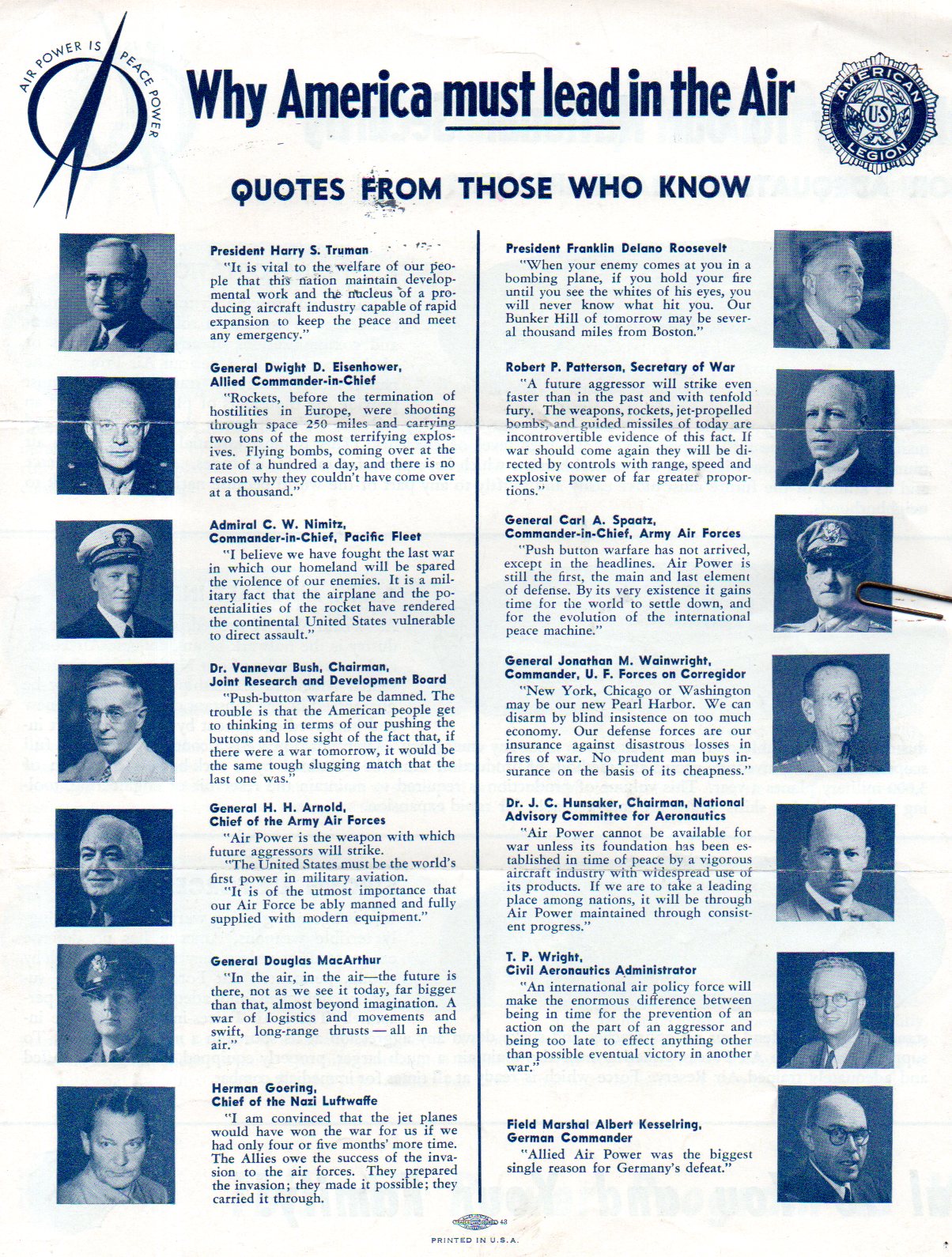
    I know it makes a certain amount of sense to try and sell an idea by using the words of your defeated enemy and how they were defeated by the very thing you’re trying to “sell”.  But, still: at the bottom of the list (The American Legion Program on Adequate Air Power for National Security, 1947) of pictures and opinions of Truman, Eisenhower, Nimitz, Bush, Arnold, and MacArthur, comes Goering.  The soft, badly-placed, I-helped-to-kill-my-air-force Hermann Goering.  It just doesn’t look right–particularly since this is the portrait of him as a skinny Goering, the Goering waiting to be executed, the Goering who lost all of that weight at Nuremberg while on trial before he swallowed a pill and killed himself.  On the other side, in the opposite column, is Roosevelt, Patterson, Spaatz, Wainwright, Hansaker, and Wright–president, secretary of state, commander-in-chief of the USAAF, commander of U.S. forces at Corrigador, chairman of NACA–and then Field Marshall (Generalfeldmarschalls) Albert Kesselring. Kesselring was a major leader, was highly respected, and very successful,  and also sentenced to death at Nuremberg for war crimes (though his sentence was commuted which found him relseased in 1952). 

    This was a good and necessary argument–using Goering and Kesselring, well, was not such a good idea, or at least using their portraits in a line of American heroes to make the point was not a good move.

    Airforce270


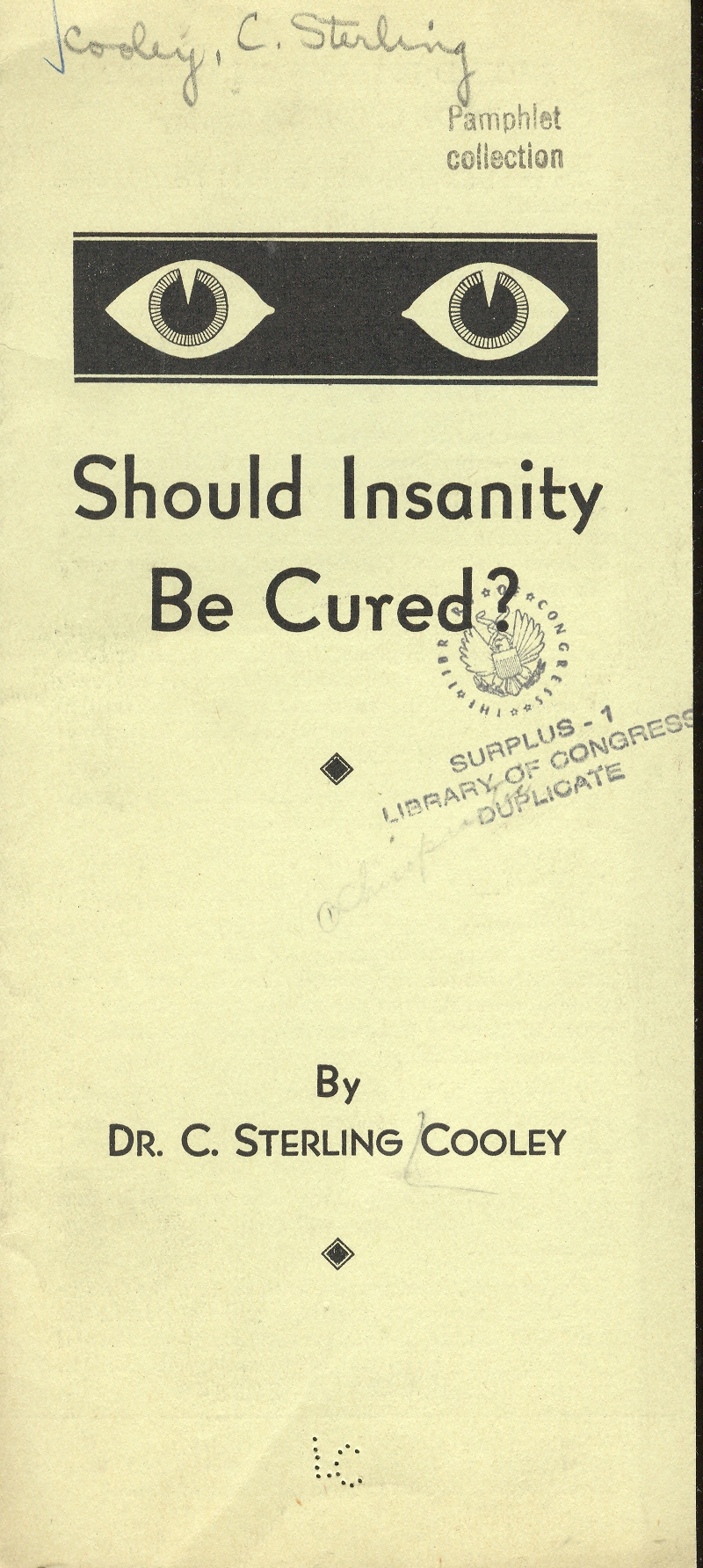
  • Should Insanity be Cured? (1938)

    JF Ptak Science Books    Post 2001

    Should insanity eyes

    ++00++ 9.15 insanity Dr. C. Sterling Cooly wrote an incredibly-titled pamphlet of
    slim means called Should Insanity be Cured? 
    How could anyone proceed further than this?  Dr. Cooley wasn’t a eugenic apologist, nor
    was he an accountant for a life insurance firm—he was advocating a drugless
    cure for all different sorts of “insanity”, which was a term he doesn’t really
    stop to identify and classify, which of course is deeply problematic. 

    Or it is so until you hear how one can treat the insane via
    his new drugless method: 
    chiropractic.  I didn’t see that
    one coming.  “An insane mind is a sick
    brain, a sick body is an insane body” writes Dr. Cooley with leading
    confidence, claiming that chiropractic can release “the power within…marvels of
    healing are performed not only in mental cases but in virtually ALL forms of
    disease”.  That’s a lot to live up to in
    theory, let alone in practice. 

    Dr. Cooley was evidently a deeply important founder father of modern chiropractic, with a 50-year career in the area (1908-1957), and who was also very prolific–this is one work that he probably shoud’ve edited out of the publishing phase. 

    I don’t know why the eyes are so very prominently featured–except I guess to enhance some understanding of the subject area,


  • A Sharp Insight on Fascists, Union-Busters & other Armed Vigilantes, 1937

    JF Ptak Science Books  Quick Post 

    Follow Me on Pinterest


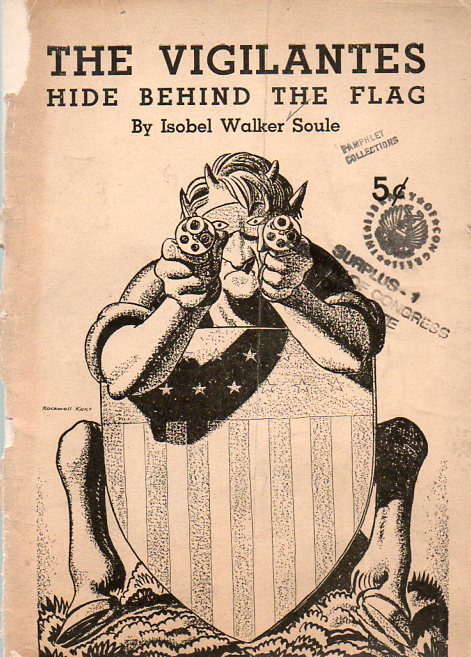
    Vigilante071

    The iconic, prodigiously-talented illustrator, old lefty and great inventive soul Rockwell Kent designed and drew this cover for Isobel Walker Soule’s The Vigilantes Hide Behind the Flag, a slim but powerful little pamphlet published by the National Committee for Defense of Political Prisoners in 1937.  Ms. Soule was a very present social worker and protagonist for the rights of workers–she and Kent would have shared this great passion–and published this work dealing with armed strike breakers (the “vigilantes”) as small targets and Fascists and the like as the larger–those, as well as the groups established by “the economic royalists (who) have given marching orders to their hordes and hope to trap the middle class into the vigilante net they’ve spread”.  

    {Soule could really spike a paragraph:  here’s an example of her addressing former Ashevillean William Dudley Pelley, founder of the lost-soul hate group the Silver Shirts:

    “…He was a YMCA representative with the AEF to Siberia in 1917. Returning to America he wrote for pulp magazines. he became a spiritualist. He had an inspiration and wrote  a story in which he claimed to have died,and spent seven minutes in eternity. On the basis of his fan mail he founded a magazine in North Carolina  with his clair-audient voices from the ether as assistant editors. Out of the magazine he founded the Silver Shirts”.)

    Soule fills up a stubby thirty pages like few others, addressing the very-present issues of thug-backed union-busting and the powerful growth of fascists at home and abroad.

    Vigilante070


  • Drugs Against Men (1939)

    JF Ptak Science Books  Quick Post

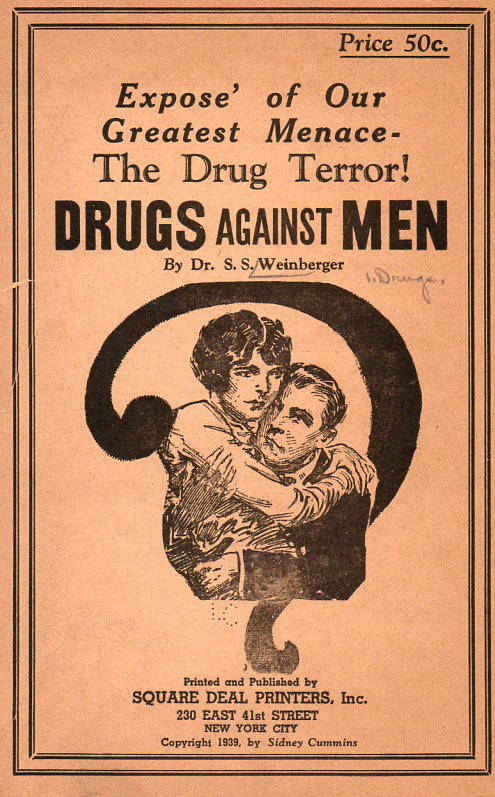
    Drugs against men933

    This is a fairly straight-forward report on the growing drug menace in the U.S.–it is a little melodramatic in places but beyond that it is a reasoned and sensible account of the terrors of addiction and its social cost. And as the cover art suggests, this short pamphlet by Dr. S.S. Weinberger (which was published in 1939) the work takes it aims mostly at the social and family damages associated with drug use. 

    This is a detail from the full cover, as so:

    Drugs against men932
    [As it turns out this is a rare pamphlet, with no copies located in the 150-million-item library cataloging tool, WorldCat.]


  • Dogs as Book Reviewers, 1697

    JF Ptak Science Books  Quick Post

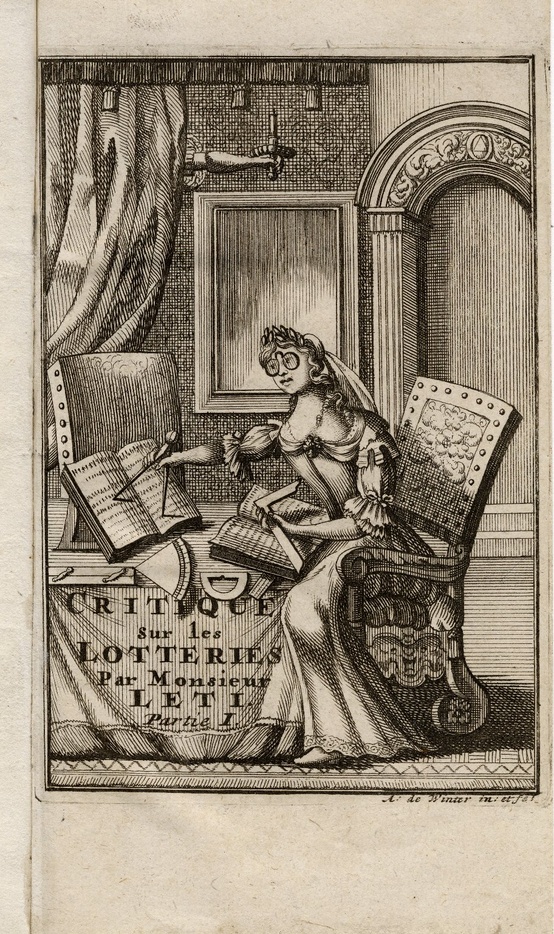
    Having a go at Pinterest I came across a very interesting image–a satirical, and very biting, portrayal of a woman as a scholar (here, with thanks to Whitney Trettien). The artist gives the woman a very monkey-ish feeling, a trained animal aspect, sitting there trying to figure our the words in a book with a right angle and a compass, and sporting monstrous glasses. 

    Books woman
    The work is by Gregorio Leti (1630-1701), Critique historique, politique, morale, economique et comique sur les lotteries, which was published in 1693. (Available at the Folger Shakespeare Library, here.) Leti was a critic of many things, but most particularly of the Catholic Church and of the Pope, a collection of efforts which earned a place for all of his works on the Index Librorum Prohibitorum.

    Within the same book is another double page image, the top showing a writer besieged by his demons, and the bottom, well, the bottom shows the work of dog reviewers of the written word. It is the only antiquarian print that I have seen of such behavior.   


  • German Rocketry, 1920’s & 1930’s: Cover Designs

    JF Ptak Science Books   Post 1901

    Rockets ley794

    I’ve selected a few representatives of design for the covers of pamphlets and books published in the field of rocket development and space flight published in Germany in the 1920’s and 1930’s (with one from the 1951).  They have a certain expectant sameness them, and, as leading publications in their field, have a remarkable similarity in their (black and white) design.  The combined efforts of these works wound up in the engineering labs of Peenemuende and then int he V-1 and V-2 rockets that pulverized the United Kingdom during WWII.  Later this same expertise, and some of the same engineers, “wound up” in the United States developing the American space program.  The most famous of these Paperclipped scientists was Wernher von Braun, whose name is so intimately connected with the Vengeance Weapons as well as the Apollo space program.  It is interesting to note that for many years if twas impossible to find von Braun’s name on any exhibition description in the Air and Space Museum in D.C.–it just wasn’t there, so far as I could tell, on no displays, even though I went looking for it pretty closely.  On the 30th anniversary of the Moon landing, I went to von Braun’s grave to see if it had been remembered in any way–there wasn’t anything there, just his simple small slab, next-door to and within eyesight of a Jewish cemetery. 

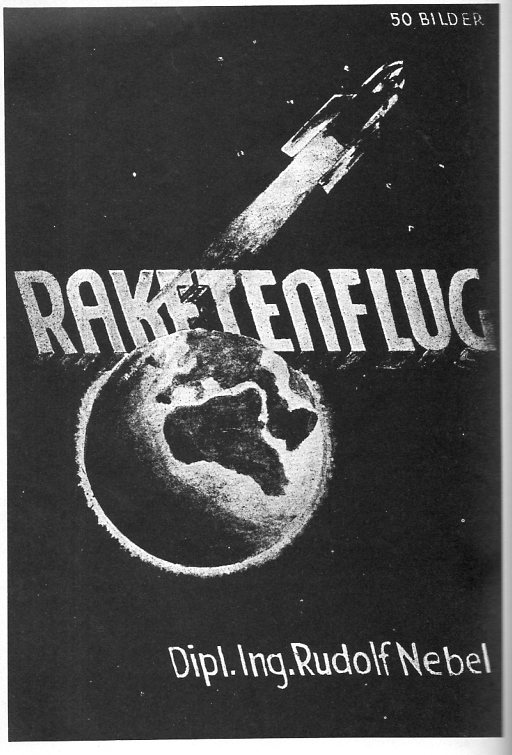
    Rudolf Nebel (1894-1978), very early member of the Raketenflugplatz, assistant to Hermann Oberth and very nearly the first to successfully conduct an experiment with a liquid-fueled rocket, beaten to the finish line by a man whose work he was not familiar with, Robert Goddard.  He defined right-wing in the Weimar era, and was part of a paramilitary organization called Stralheim; Wernher von Braun seems to have succeeded in the avenue that Nebel tried to travel along.  Nebel published this work in 1932, a year before the Nazi party came into power, and before his crotchety problems with teh SA began.

    Rocket nebel797


  • Unusual Title Pages: Burning Metal, 1530

    JF Ptak Science Books   Quick Post

    Title pages burning metal774

    The Probierbuchlein (Probir Buechlin/auff Goldt/SIlber/Alle ertz und Metall. Mit vil kostbarlichen Alechimeijischen Kunsten…) printed in Augsberg by Christian Egenolph in the autumn of 1530, was the first German book to deal with the significance of alchemy and metallurgy.  I think it usual to think of the work of Georgius Agricola (1495-1555)  and his justifiably famous  De Re Metallica, but the anonymous (?) Pribierbuchlein predates the work by at least 36 years. There’s not much else of a comparison between the two works save for the earliness of the Probierbuchlein, as it was 48 folio leaves and somewhat restricted–but first is first, and it may have made the way easier for Agricola, whose own efforts paved the way for the systematic study of the Earth   Agricola made fundamental contributions to mining geology and metallurgy, mineralogy, structural geology, and paleontology, and outlined them all beautifully in a book that was ten times the length of the Probierbuchlein, and also fabulously and sumptuously (and usefully) illustrated.


  • Great & Lost-in-the-Dust Books: Love & Sex and the Freedom from Sin, 1549

    JF Ptak Science Books   Quick Post 

    In Agustus Niphus, Libri Duo de pulchro liber primus, de amore librer secundus, and printed in Lyon by Beringen in 1549, the scholar and Aritotelian Agostino Nifo of Sessa (1473-1546) wrote two significant treatises on the nature of beauty and love (liber primus and secundus, respectively).

    The amazing thing about this work is that Nifo analyzes the conditions of love and sexual expression as respondents to a  psychological basis, and since this was so, that love and sex are a product of the mind and not necessarily a simple undisclosed deire, that the act and thought coul dno tbe considered to be of siunful natures–basically, the two were as natural a thing as could be, and one does not condemn the acts of nature.

    Title pages bona fide775