A Daily History of Holes, Dots, Lines, Science, History, Math, Physics, Art, the Unintentional Absurd, Architecture, Maps, Data Visualization, Blank and Missing Things, and so on. |1.6 million words, 7500 images, 4.9 million hits| Press & appearances in The Times, Le Figaro, Mensa, The Economist, The Guardian, Discovery News, Slate, Le Monde, Sci American Blogs, Le Pont, and many other places… 5000+ total posts since 2008.

Category: Absurdist, Unintentional

  • The Coloring Book of Hell–Hell in Black & White (ca. 1600)

    JF Ptak Science Books   Post 2676

    If you were to wish a foul curse upon the soul of the dead in Hell, then it is Prosperine/Persephone who would carry it out. The Hitman of Hades had the capacity to inflict damage upon the already damaged, what with being the Queen of the Underworld and wife of Hades. She is also the daughter of Zeus and the harvest goddess Demeter, so there is also that life/death struggle bit going on in the background. 

    Brueghel hell

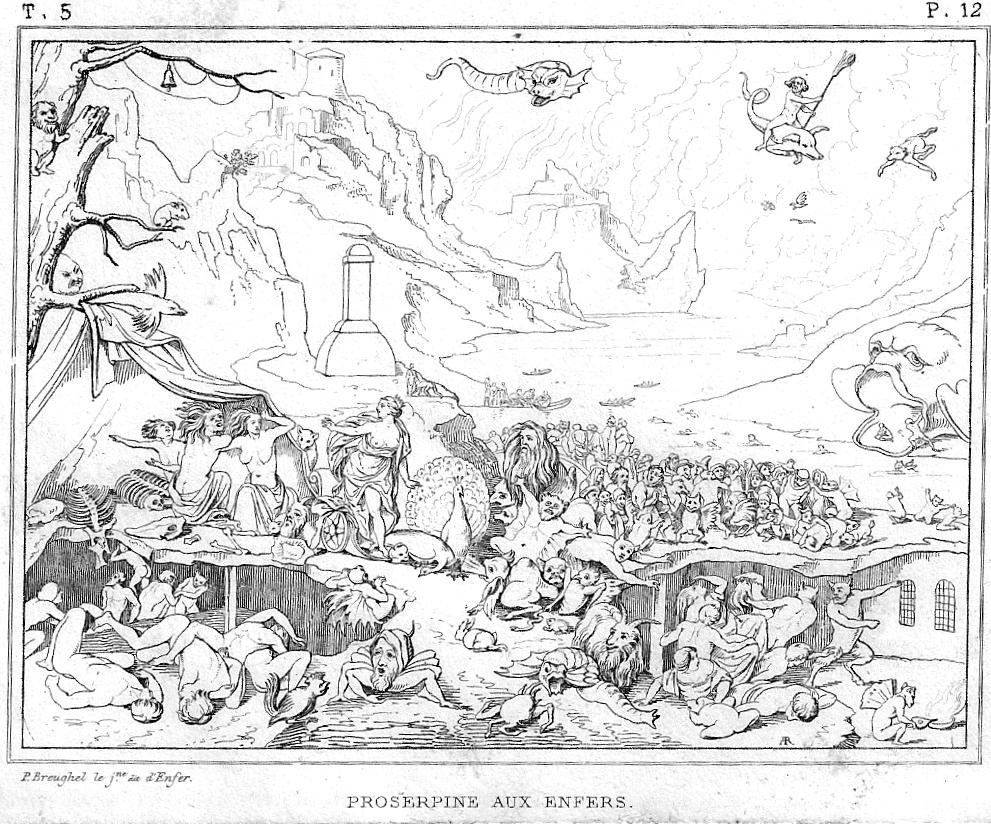
    This image is made from the painting by Pieter Brughel the Younger (1564-1638), son of Pieter Bruegel  and part of the dynastic family of painters. (They spelled their surname differently, depending upon the time and the user.) The legend of the engraving tells us that “P. Breughel [sic] le jne, dit l’Enfer” was also known as the “Hell Brueghel” for his interest in depicting that place, and he certainly does live up to the nickname.  Even though the engraving is pretty small (about 3×5″) it does communicate at least the sense of what the painting delivered, which was a very detailed and massive account of the underworld.  Even though the engraving is only a shadow skeleton of the original, we do get a sense of Mr. Cash’s lake of fire, and though we see the torments of the damned we generally do not see what it is they are suffering from.  Prosperine is at center left, having just arrived in Hell (according to the description1 of the plate found in Museé de peinture et de sculpture, ou, Recueil des principaux ..., volume 12, 18312, and behind her we see a river with boats dispensing new arrivals; at right, background, we see a gaping Hell Mouth though without fangs/teeth, which has at least one newly-damned trying to climb his way back into the mouth to perhaps retrace his steps to the surface of the regular world.  The image is creepy enough without the color and great detail of the original, what with the dozens of horrified dead falling about and a floating pig-snake flying above.  

    The imagination ran high on the imaging of Hell, mostly for ever and ever–Dante, Botticelli, Japanese Hell Scrolls, Bosch, and on and on, though the flavor of it slacks off a bit when most of the image is white.  So, if you were of a mind to do so, here’s your chance to color in one version of Hell as you please.  

    Notes:

    1.  “PROSERPINE AUX ENFERS. Le peintre Pierre Breughel le jeune est souvent désignésous le nom de Breughel d’Enfer parce qu’il aimait à traiter des incendies et des sujetsdiabcliques. On en voit un exempledans ce petit tableau où il a représenté Proserpine à l instant où elle arrive aux enfers tandis que tous les autres artistes anciens et modernes se sont pliis à retracer le moment où Pluton enlève la jeune déesse des riantes plaines de la Sicile. La fille de Cérès descend de son char et parait vouloir s’éloigner de l’ endroit où sont assises les trois furies, Alecto, Mégère et Tisiphone. Mais en détournant la vue de dessus les impitoyables déesses elle trouve partout des figures monstrueuses qui Iourmentent les mortels. Le lointain offre la vue de bautes montagnes d où sort un grand fleuve sur lequel on aperçoit plusieurs barques remplies des âmes des mortels qui viennent de quitter la terre. Ce charmant tableau peint sur cuivre fait partie delà galerie de Dresde. Il n avait jamais été gravé.”

    2.  I have the full set of 22 volumes for sale elsewhere on this blog–if anyone is interested in owning it, send me an email.  


  • When Man Becomes Degenerate is Woman Then to Blame? (1907)

    JF Ptak Science Books  Quick Post

    Capital punishment woman _2_773

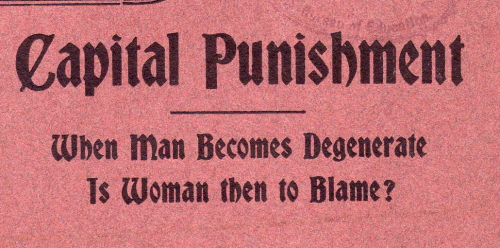
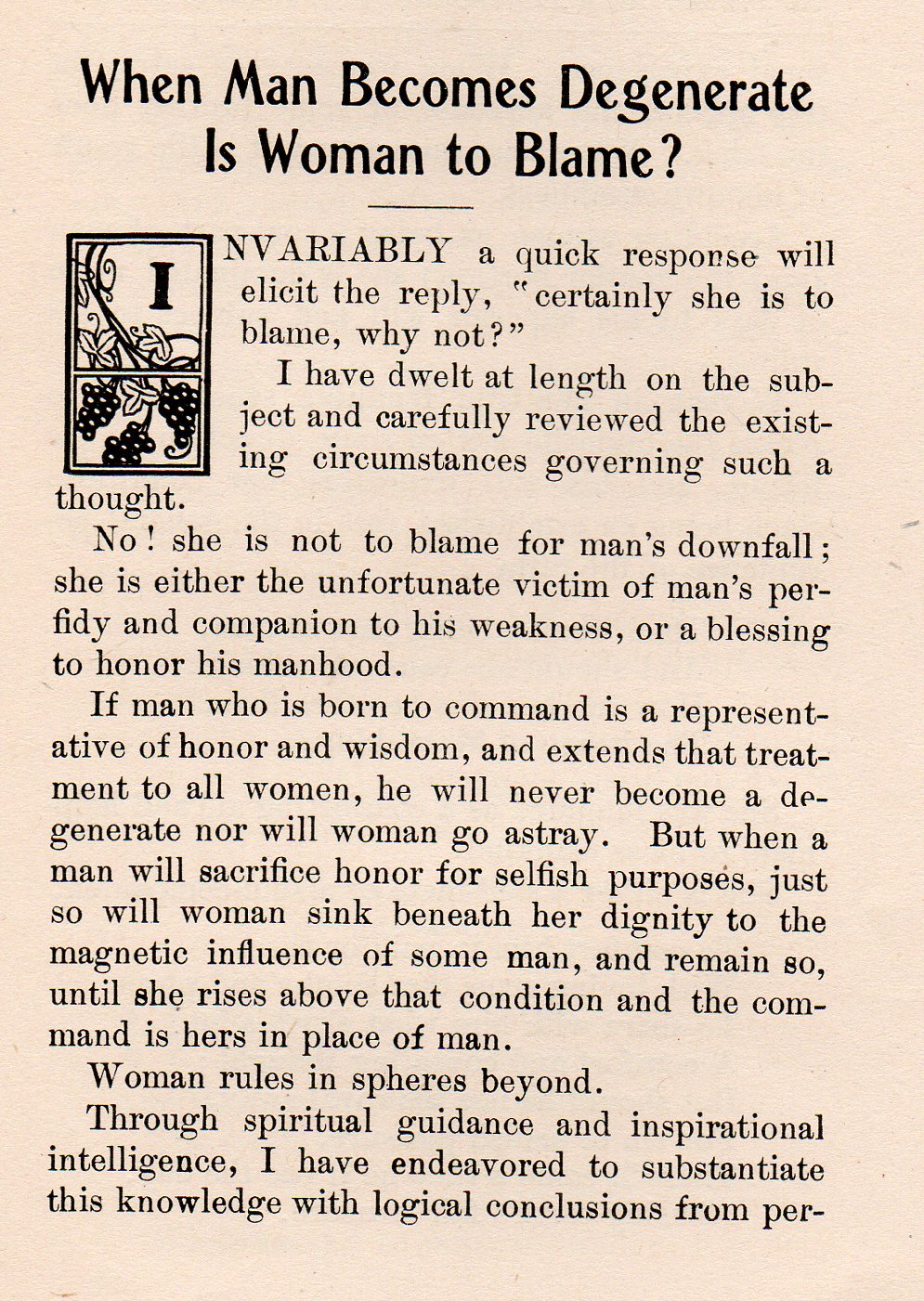
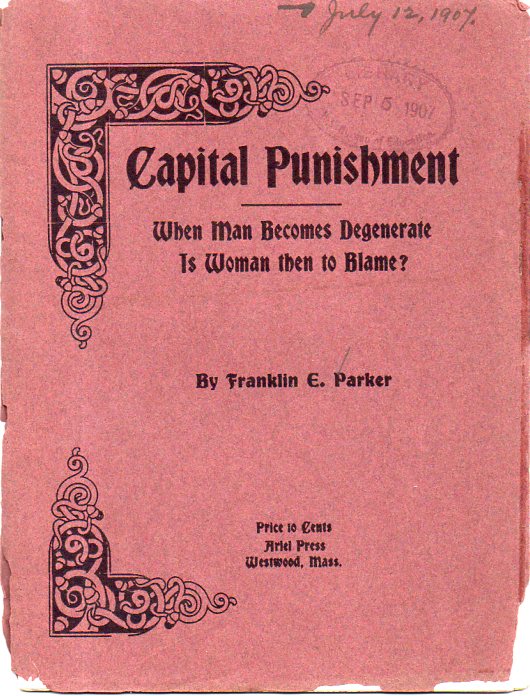
    I guess I’ve seen this question before, though not nearly as full-frontal-assault as this one. One of the odd things in this little pamphlet (Capital Punishment, When Man Becomes Degenerate is Woman then to Blame?”, self published by Franklin E. Parker at the appropriately-named  Ariel Press in Westwood, Massachusetts in 1907)is that the question in its title is only relatively lightly addressed and that at the end of the short work. What Mr. Parker is mostly concerned with is capital punishment, which in the end he sees only as another form of murder, and makes a number of biblical arguments against it.  Relative to the responsibility of woman in the degeneracy of man (which doesn’t seem necessarily related to the issue of capital punishment) the argument is made that she is not–conditionally. That is, if a woman stays with the degenerate man than she does share responsibility–on the other hand in 1907 I do not know what religious beacon suggesting what a woman might do about that situation. On the third hand another statement maintains that is a “soul-part of man”…(and is) “dominated more or less by his superior will and subject to his ruling”, which presents a different issue altogether so far as being married to a degenerate man goes.  

    I only gave about five minutes to this pamphlet, so there may be a more adaptable answer somewhere–there is actually a long poem at the end that was light and sugary and withering, and I knew that reading it would be like watching a baseball player adjusting his batting glove for a full five minutes, which means you needed it to stop as soon as it started.  Anyway, I think the ultimate answer to this woman/blame question was both “yes” and “no”. 

    Capital punishment woman _3_774


    Capital punishment woman _1_772


    ·Posted by :

    ·in:


  • Moving Product by Embracing the War–Making Memory Dents in 1914

    JF Ptak Science Books  Quick Post

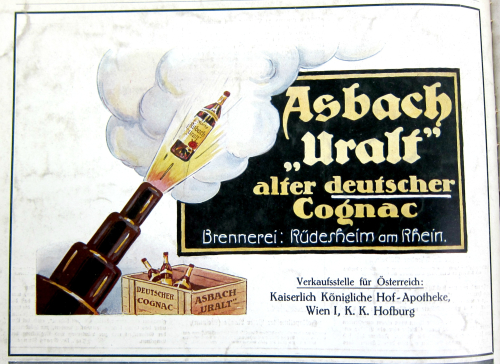
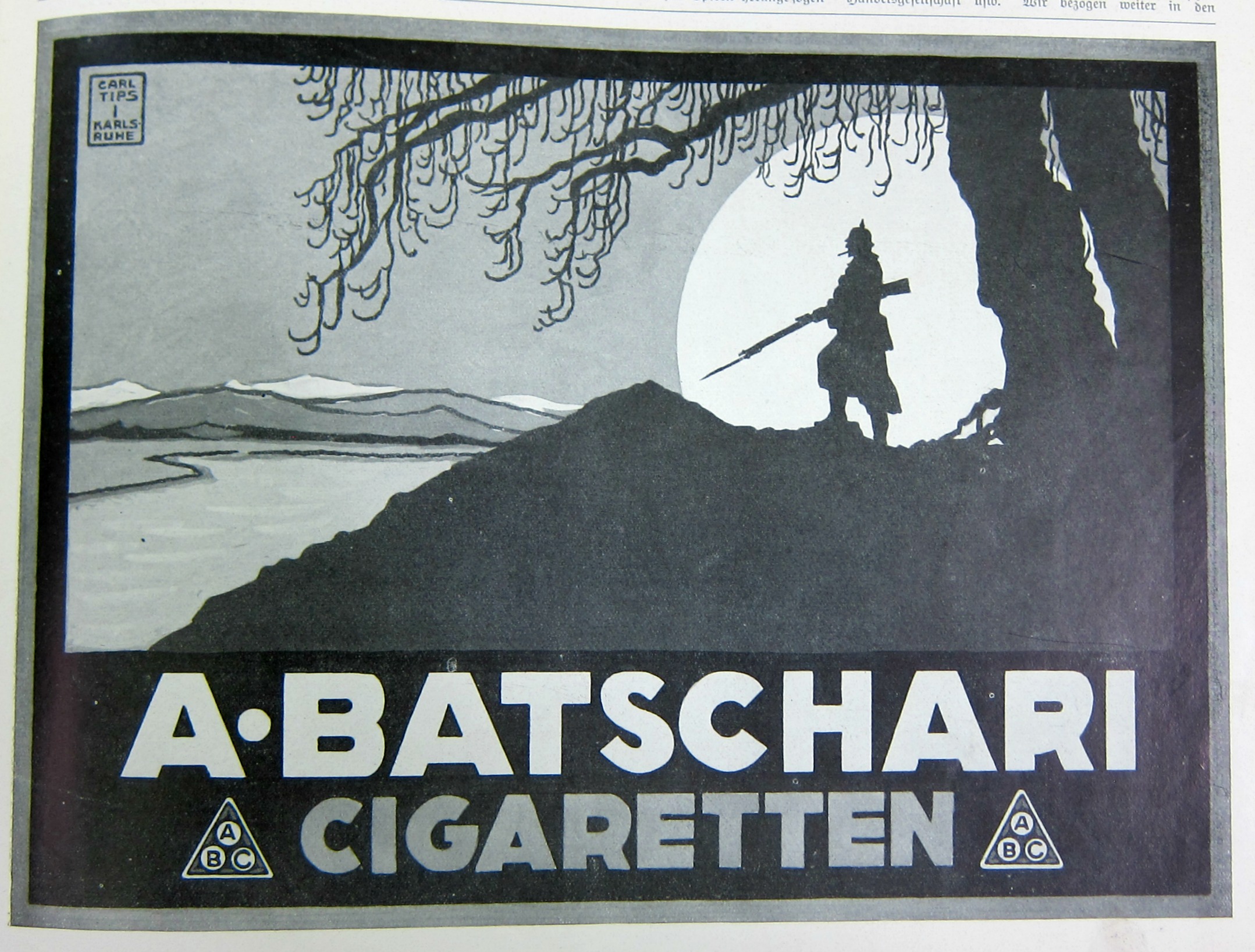
    There is some inexplicable something about advertising in popular magazines and newspapers during war time, and how inappropriate it seems to used the circumstance of conflict to sell a product.  Of course, everything doesn’t come to a standstill in war time, not even in World War, as economies still run and society still functions (at least to the very end).  So, even though there could be millions of soldiers in uniform, and millions dead, and tens of millions (hundreds of millions peripherally) involved in the conflict, the daily life of living and the stuff of society keep on.  This is what strikes me about these ads, all seen in two consecutive weekly issues of the Leipzig-based Illustrirte Zeitung in November 1914: chocolate, cigarettes, cognac, and of course a Benz automobile, though it was the cognac that seems to me to have the most noise about it–I don’t know how you relate cognac to a war effort (let alone having it being fired from a howitzer) but they did manage to wrap themselves up in a patriotic-something and associative themselves with the national war effort. Over time manufacturers and ad folks would manage to see connections between the war effort and whatever it was they were producing–scissors, laxatives, buttons, razors, toys, pool tables, and so on.  Then again, in a presidential cycle such as what we are witnessing in the U.S., people can relate anything to anything else in spite of the nonsensical and mythological nature of it, like the impossible Donald Trump stating he can relate to racism because “the system” has been “stacked against” him. You can say anything you want in these circumstance, evidently–the point is not making sense, it is about making a vague memory dent, and how that dent got there is immaterial to the lingering notion of the association.  

    WWI Project Ads _7_

    WWI Ads _7_


  • Beef Fat, Bones, and the Flu (1918)

    JF Ptak Science Books

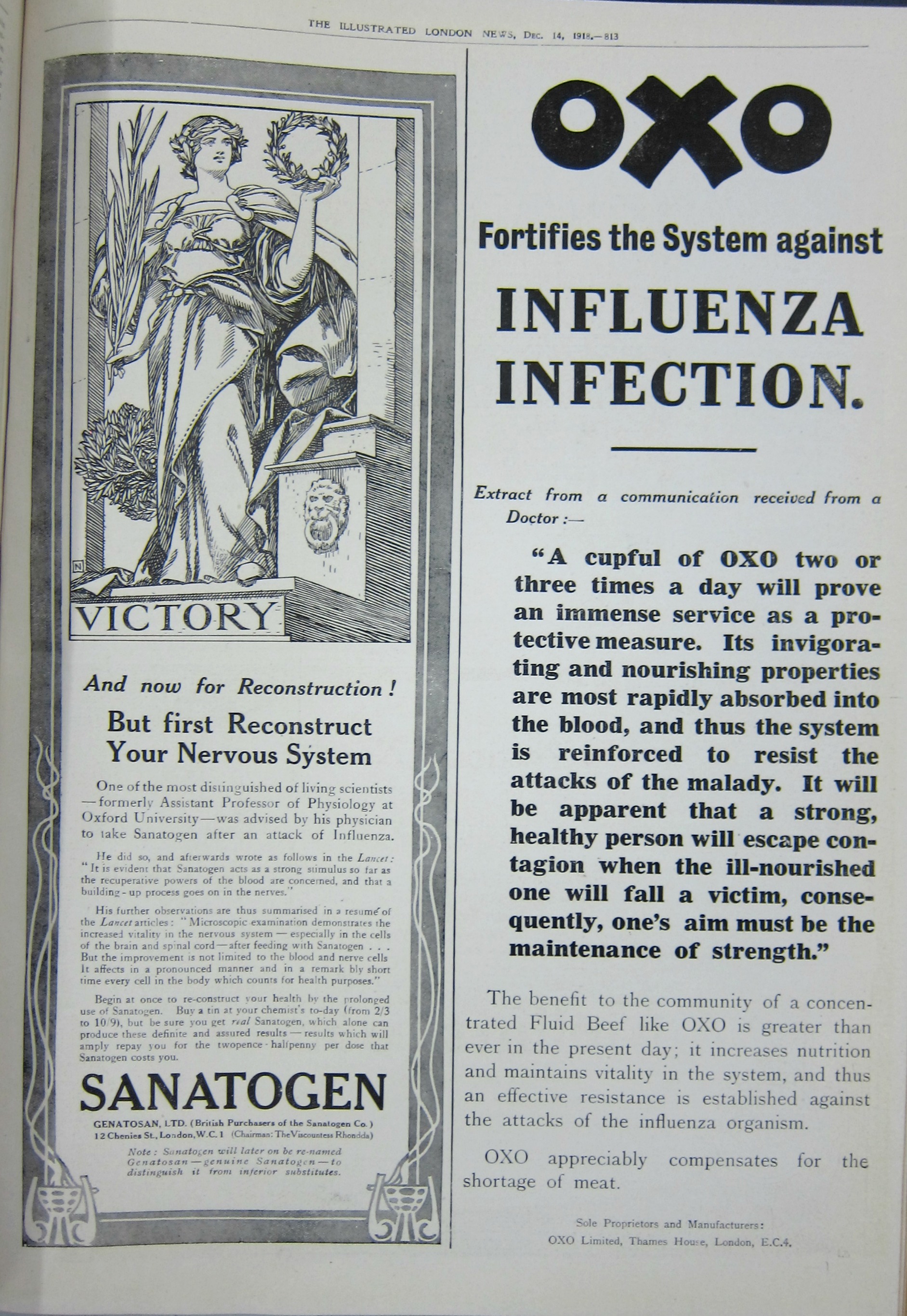
    Riding the last waves of wear into the public conscience and pocketbook come these two ads, published in a very large full-page format in the Illustrated London News in August 1918, just a few months before the end of WWI.  Yes, no doubt there was a public “nervousness” about the affairs of the self/state/world in general, and yes there was a problem at this point with the beginning of flu season (which would soon develop into a world-wide pandemic that killed millions), and I guess the makers of Sanatogen and Oxo thought that they could make a positive impact on these things.  Considering that Sanatogen was a tonic and both a relaxing and a vitalizing agent, and made of 95% milk protein, probably would not make much of an impact in anyone’s nervous system. Same deal too to Oxo–apart from water the major ingredients were flour, beef fat, and dried beef bone, and probably whatever beefy thin might have fallen to the floor at the slaughterhouse.  Certainly there was no good to come of treating a deadly influenza with beef fat–except of course that the manufacturer would do well distributing dietary supplement made of the stuff that has almost no value of any sort. 

    So, I guess I’ll need to check out Oxo for the winter of 1918/19 and see how often this ad appears–it wouldn’t be until the fall of 1918 that the pandemic would begin, killing about as many people who were killed in the just-ended war. Combating infectious disease with left-over stuff from a beef killing floor was probably not a hope-filled thing.  

    WWI Project Influenza Cured with Meat


  • Punctuation and its Elimination: Spongebobian Sentence-Enhancers and a Pickle for the Knowing Ones (1847)

    JF Ptak Science Books 

    (This is an expanded version of an earlier post from 2008, more than 4000 posts ago. I’m reposting it here on the top of the heap today because no doubt the only person who would see the revised version left under the burden of a million other words would be me, so here it is, new-ish and fresh.)

    I’ve made several posts about Blank and Missing People which seem to me—having had long exposure to images over the last 30 years—to be quite unusual in the history of popular-published prints.  This may actually be a simple corollary to a wider category of Blank Things, or Missing Things.  Like Dark Matter.  Or white, open, blank spaces on early, honest, maps. (And this may be part of another larger story on The  Spaces in Between, (a concept in German known as Zwischenraum), but that’s another story, identifying where the missing stuff might actually “be”. 

    Right now though I’d like to address blank spaces in literature.  It is surprising to me that in Google searches that “blank books” and “blank literature” and “books without words” (once you remove all of the hits for new diaries and new artists’ notepads and such) direct you to graphic novels.  This category hardly strikes me as being “blank” as the art and action more than accommodate the absence of written words.  (And by the way the graphic novel seems to be a fairly new invention—perhaps the work of Frans Masereel and Rockwell Kent in producing sequential, worldess books were among the first of their genre when they were published in the mid-1920’s?)

    Blank literature doesn’t mean hollow literature.  In one skinny example James Fenimore Cooper’s writings may be a little translucent and a little empty, but they aren’t blank. (Twain ripped Cooper on this point, cursing Cooper for using a bagful of woodsy woodsmen tricks to drive his story when he should’ve been writing, and not waiting for them to fill up the spaces of his missing narrative: “in his little box of stage properties he kept six or eight cunning devices, tricks, artifices for his savages and woodsmen to deceive and circumvent each other with, and he was never so happy as when he was working these innocent things and seeing them go…(another) favorite stage property that he pulled out of his box pretty frequently was his broken twig.  He prized his broken twig above all the rest of hi effects, and worked it hardest…”

    An excruciatingly direct example of the worldess book  is a remarkable, hoaxing or perhaps just simply demented set (!) of books by Timothy Dexter (Newburyport, Massachusetts).   Dexter wrote a semi-incompressible work called A Pickle for the Knowing Ones, which followed his own logic, sentence structure, vocabulary and spelling. It was also printed and published without punctuation.  In one sentence. (A sample is found below in the continued reading section.)  I think that it is interesting in that someone did it and that it exists and that it was printed in 1802, but aside from that I find little comfort or twisty inspiration from it.  His second edition of that work though is much more interesting, not so much in that it continued ((?), I use that word loosely) the shredded intellectual threads laid out in the first edition; it also contains one page of what I think of as a blank book:  the missing punctuation marks from the first edition.   

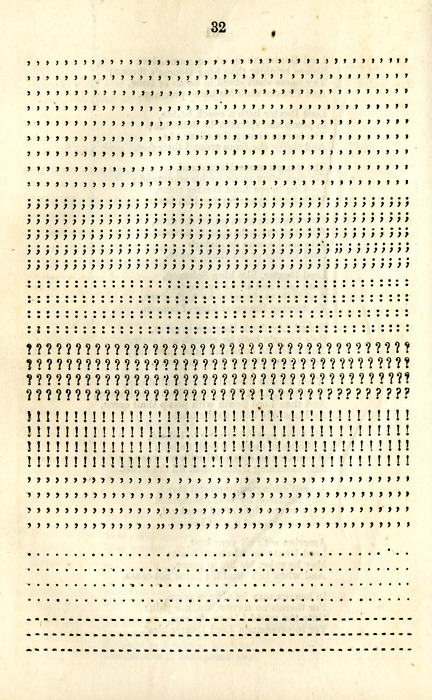
    Well, not ALL of the missing punctuation, but enough, in the mind of Dexter, to silence some of the complaints of the more faint-hearted readers of his one-sentence, non-punctuated, made-up vocabulary of the first edition.  He at least provides the punctuation–separately–in case a weak reader needed some: 
    Pickle for knowing ones

    [Image from a good treatment of Dexter at http://northofboston.org/north-of-boston-historical-figures-a-pickle-for-your-thoughts/]

    He writes “Fourder mister printer the Nowing ones complane of my book the fust edition had no stops I put A nuf here and that may peper and solt as they please.”

    That’s much in the spirit of Spongebob Squarepants and Patrick Star when they “discovered” the use of swear words and curses, which they figured had no meaning except as a sort of comfrot food to be sprinkled in conversation for flavoring–“sentence enhancers” they called them, without knowing (of course!) that their sounds were more than simple garnishes and intellectual punctuation.  

    As follows (please consult http://www.lordtimothydexter.com/the_holl_pickle.htm for a full transcription of the Dexter work–the author of the site also transcribes the Dexterian-speak into plain English, which was no doubt a labor of love): 


    ,,,,,,,,,,,,,,,, ,,,,,,,,,,,,,,,,, ,,,,,,,,,,,,,,,,, ,,,,,,,,,,,,,,,,,,, ,,,,,,,,,,,,,,,,,

    ,,,,,,,,,,,,,,,, ,,,,,,,,,,,,,,,,, ,,,,,,,,,,,,,,,,, ,,,,,,,,,,,,,,,,,,, ,,,,,,,,,,,,,,,,,

    ……………. ……………. …………….. ………………. ……………..

    ,,,,,,,,,,,,,,,, ,,,,,,,,,,,,,,,,, ,,,,,,,,,,,,,,,,, ,,,,,,,,,,,,,,,,,,, ,,,,,,,,,,,,,,,,,

    . . . . . . . . . . . . . . . . . . . . . . . . . . . . . . . . . . . . . . . . . . . . . . . . . . . . . . . . . . . .

    . . . . . . . . . . . . . . . . . . . . . . . . . . . . . . . . . . . . . . . . . . . . . . . . . . . . . . . . . . . .

    …………………………! ! ! ! ! ! ! ! ! ! ! ! ! ! ! !………………………..

    …………………………….. ! ! ! ! ! ! ! ! ! ! ! …………………………..

    …………………………………. ! ! ! ! ! ! ……………………………….

    ………………………………………!……………………………………..

    . . . . . . . . . . . . . . . . . . . . . . . . . . . . . . . . . . . . . . . . . . . . . . . . . . . . . . . . . . . .

    , , , , , , , , , , , , , , , , , , , , , , , , , , , , , , , , , , , , , , , , , , , , , , , , , , , , , , , , , , , ,

    ……………????????????????????????……………

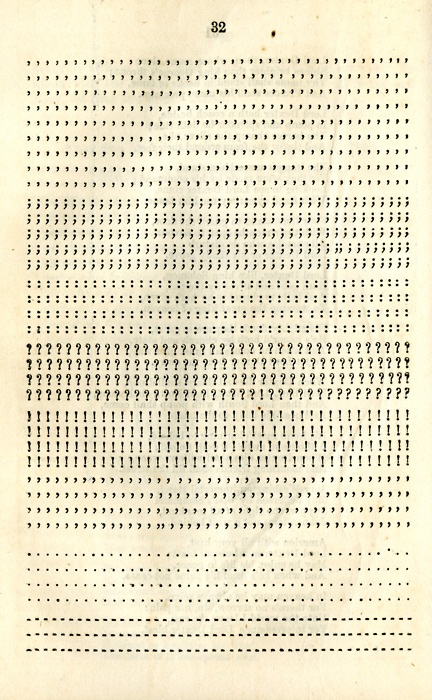
    And on page 32 more of the “missing” punctuation is provided:

    ,,,,,,,,,,,,,,,,,,,,,,,,,,,,,,,,,,,,,, ,,,,,,,,,,,,,,,,,,,,,,,,,,,,,,,,,,,,,, ,,,,,,,,,,,,,,,,,,,,,,,,,,,,,,,,,,,,,, ,,,,,,,,,,,,,,,,,,,,,,,,,,,,,,,,,,,,,, ,,,,,,,,,,,,,,,,,,,,,,,,,,,,,,,,,,,,,, ,,,,,,,,,,,,,,,,,,,,,,,,,,,,,,,,,,,,,, ,,,,,,,,,,,,,,,,,,,,,,,,,,,,,,,,,,,,,, ,,,,,,,,,,,,,,,,,,,,,,,,,,,,,,,,,,,,,, ,,,,,,,,,,,,,,,,,,,,,,,,,,,,,,,,,,,,,, ;;;;;;;;;;;;;;;;;;;;;;;;;;;;;;;;;;;;;; ;;;;;;;;;;;;;;;;;;;;;;;;;;;;;;;;;;;;;; ;;;;;;;;;;;;;;;;;;;;;;;;;;;;;;;;;;;;;; ;;;;;;;;;;;;;;;;;;;;;;;;;;;;;;;;;;;;;; ;;;;;;;;;;;;;;;;;;;;;;;;;;;;;;;;;;;;;; :::::::::::::::::::::::::::::::::::::: :::::::::::::::::::::::::::::::::::::: :::::::::::::::::::::::::::::::::::::: :::::::::::::::::::::::::::::::::::::: ?????????????????????????????????????? ?????????????????????????????????????? ?????????????????????????????????????? ??????????????????????!??????????????? !!!!!!!!!!!!!!!!!!!!!!!!!!!!!!!!!!!!!! !!!!!!!!!!!!!!!!!!!!!!!!!!!!!!!!!!!!!! !!!!!!!!!!!!!!!!!!!!!!!!!!!!!!!!!!!!!! !!!!!!!!!!!!!!!!!!!!!!!!!!!!!!!!!!!!!! ””””””””””””””””””” ””””””””””””””””””” ””””””””””””””””””” ””””””””””””””””””” ……………………………….. ……………………………….. ……………………………….. ……………………………….. ————————————– ————————————– ————————————–


    It is a brilliantly empty book, all of the characterization present and waiting for the last bit that would make this a book:  the words.

    The depths or shallownesses of Dexter’s private insight is a mystery to me, if that mystery extended beyond an elaborate and peculiar (and deep) sense of humor.  The man was a successful if not very odd businessman, after all, so he did have some sort of regulating principle in his life–its just that this sort of dark, removed humor is so incredibly pre-modern that I’ve gotten stuck thinking about Dexter being a little deranged rather than be prescient. 

  • Mysteries of Science: Atomic Power and Scotch Tape (1946)

    JF Ptak Science Books  Quick Post   Outsider Logic series

    Tomic power adhesive tape _1_485

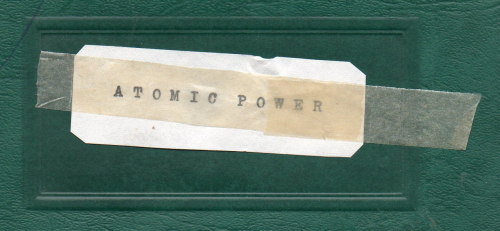
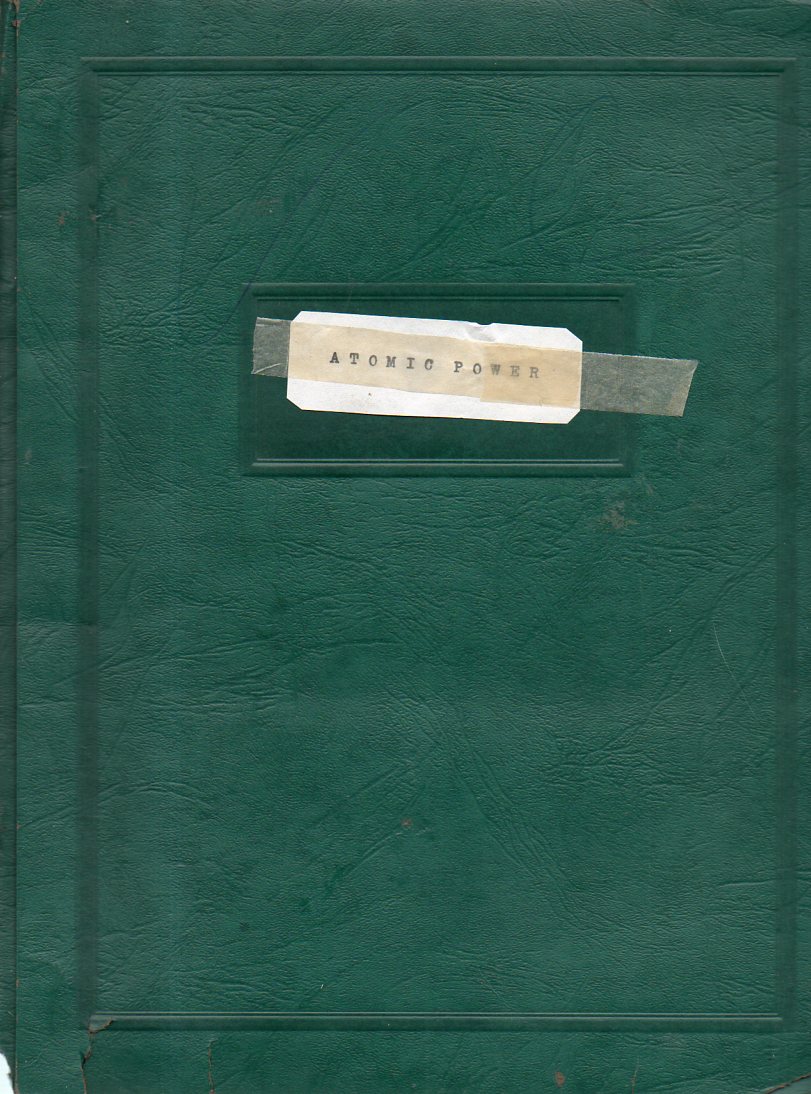
    About two miles from my house stands a sign for a housing development called “Solar-Vista”, and right next to it is the street sign, which is “Shadow Valley Drive”–somewhat ironic, I’d say. That’s what came to mind when I saw the cover of this self-published screed atomic power called Atomic Power–it just struck me as as little M. Hulot-ish to have the typed piece of paper attached with band adhesive tape to the cover of the missive. That, and the title strip has fallen off.  It seems perfect, in its own, odd, way.


    Tomic power adhesive tape _1_484


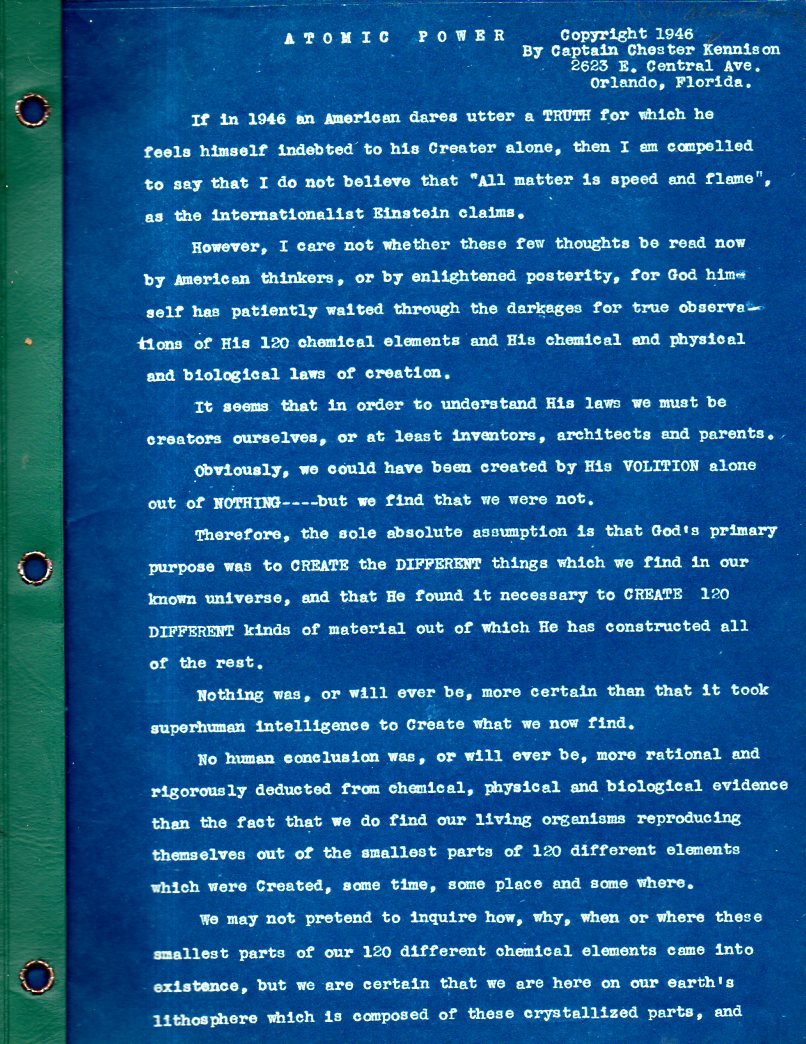
    Here’s the first page of the work–I have one of the copies that were submitted to the Copyright Office and then sent over to the Library of Congress, and after decades was deaccessioned, and then came to me.  The author tried tro make some sort of point, but it is lost on me, though I didn’t make it but only two pages into the 24-page blueprinted work.  (And yes, “Scotch Tape” is a couple of decades older than atomic power.)


    Tomic power adhesive tape _1_487


  • Spheres of Recognition: the Portable Gym and Expulsion from Eden

    JF Ptak Science Books   Quick Post

    Spheres

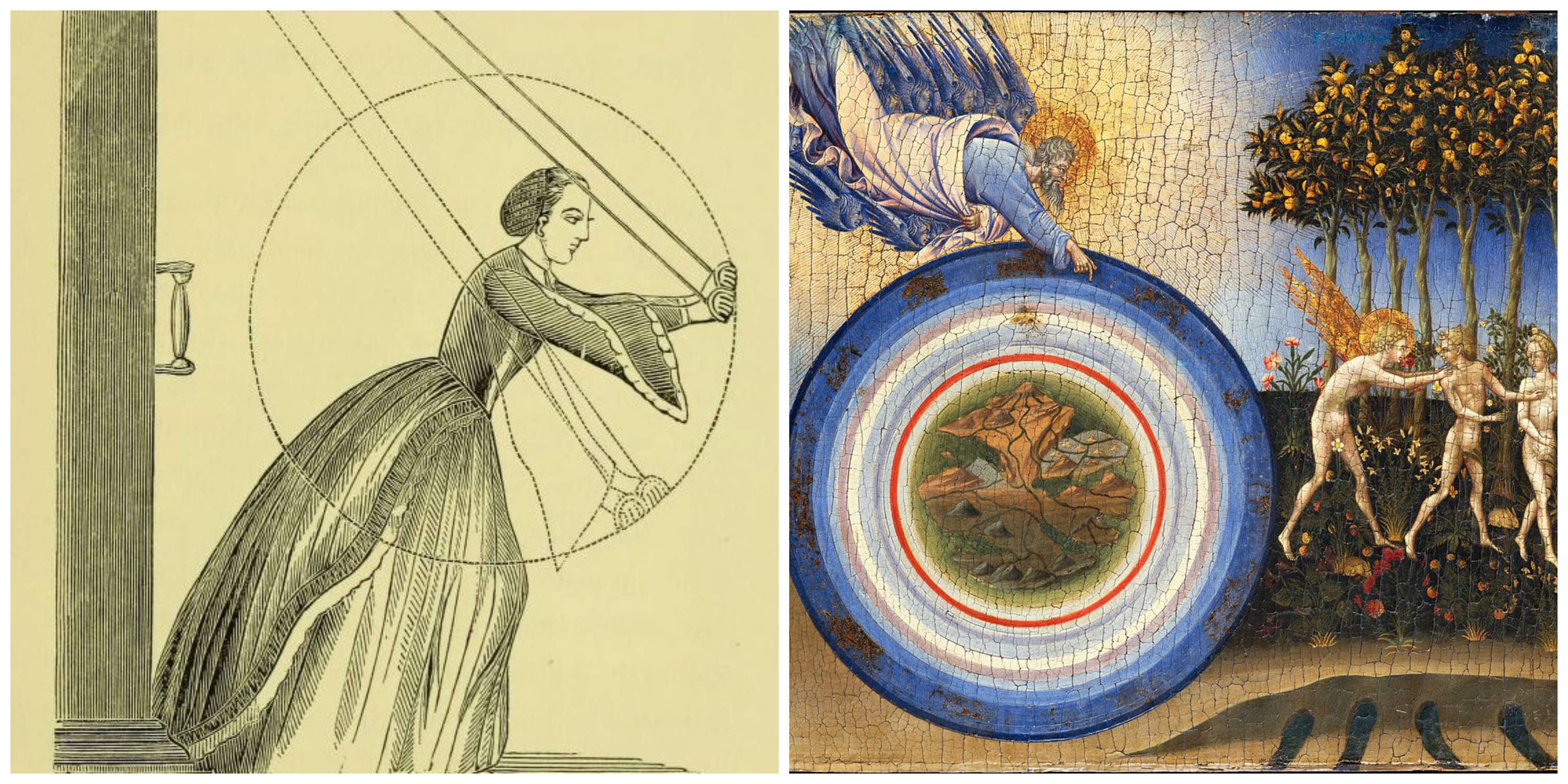
    There was some immediate shock of recognition1 in seeing this image, not for its exact earlier-appearing twin, but in the sense of the spherical delivery of something. In this case, it is a Victorian woman and the depiction of her movements in exercise–but what I remember and associate with this is the Sienese Giovanni di Paolo, and his depiction of the monumentalist giveth-and-taketh cycle of the creation of Eden and the epic fall of humanity and its expulsion from it.  Di Paolo put a lot of history into that one image, the perfection of Paradise and the disposal of Adam and Eve, all via the intercession of the creator of the universe, with is hands of the sphere of being. (Talk about building a wall….).  

    The image of the exercising woman is found in a delightful book used in the banner of  Chloe Roberts (@) a web producer for the Wellcome Library (http://blog.wellcomelibrary.org/) collection and which is available in full in a very nice copy at Internet Archive, here: The portable gymnasium : a manual of exercises, arranged for self instruction in the use of the portable gymnasium, by Gustav Ernst, London 1861: https://archive.org/details/b20399789  Image source for the di Paolo:  https://de.wikipedia.org/wiki/Giovanni_di_Paolo#/media/File:Creation-and-the-expulsion-from-the-paradise-11291.jpg

    Notes

    1. And with that phrase comes other immediate recognitions, mainly in book form: William Gaddis’ The Recognitions, and Edmund Wilson The Shock of Recognition; both are excellent, and the Gaddis may well be a contender for Great American Novel. 


  • The Slim Ubiquity of Smiles in Patent Reports, 1850-1925

    JF Ptak Science Books   Post 2623

    “Better is the last smile, than the first laughter.”–J. Heywood Dialogue Prouerbes Eng. Tongue, 1550. 

    Young communist league detail


    I haven’t written very often on the word “smile” on this blog–less than ten times in 4000 posts, I think. (“Did Teeth Exist in the Renaissance?”, “The Mystery of the Sun’s Missing Smile”, “Is the Mona Lisa’s Smile Nothing?”, that sort of thing, all searchable in the Google search box.)  This came up this morning because I had an idea for morning coffee to check out “smile” in a patent search for 1850-1925 to see what sort of smile-somethings existed in the Patent Office records.  It turns out that even though “smile” appears in two dozen patents for this period, none of them are about the smile of smiling; rather they’re all anthropomorphized for varied and unrelated purposes–except that the thing it is they refer to looks like a “smile”. I thought I’d find something for an artificial smile, or smile-maker (whatever that would be), or something along those lines, but no.

    The differences in the patents in which the word “smile” was used is pretty impressive, and can almost approach a found-poetry status, but not quite–the word appears describing elements of patents for: chuck for bowspirits (1908), production of fertilizer (1918), window cleaner (1909), antifriction cage for roller-bearing rollers (1910), mechanism for a milking apparatus (1919), self-closing funnel (1913), life vest (1912), guide for a molding apparatus (1909), car-coupling for railroad cars (1876); bridle bit (1909); convertible freight car (1914), design for a horse shoe calk (1897), design for a stool (1885)…there are some others, but I think the point is made. Even though the word “smile” is used in many different ways to describe divergent pieces of machinery, they don’t really have anything in common from one patent to the next, save for the anthropormorphized shape of the object, which I find amusing. 

    The slightly odd thing that I have found in this adventure is that “smile” doesn’t seem to makes its way into English until 1550 (?), at least according to the OED, which sources the opening quote above from J. Heywood as the first appearance. Perhaps my post on “Did Teeth Exist in the Renaissance?” which is really about the smile in art shoud have asked that question more directly about the word “smile”…

    ·Posted by :

    ·in:

    — —

  • Being Seen in ’17!

    JF Ptak Science Books   Quick Post

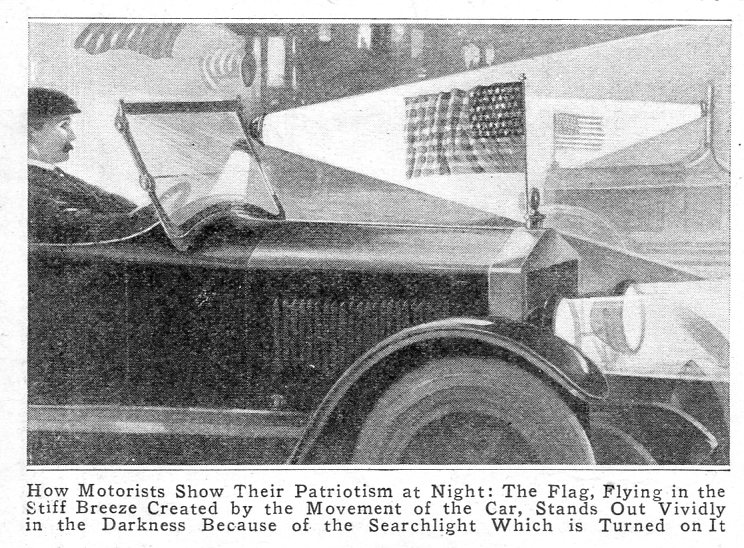
    What is the point of being patriotic in the dark when no one can see you?  Now there’s

    New and Improved Patriotism!

    where you can be seen to be patriotic, in the dark!

    Q: What more patriotic proof is needed when you can display your flag waving in the dark?

    A: Precisely! 

    Patriotic at night435

    [Source: Popular Mechanics, May, 1917, pg 802]


    ·Posted by :

    ·in:


  • Underwater Curtains, 1942-3

    JF Ptak Science Books  Quick Post

    One thing is for certain with this dream of an amphibious car  (Popular Mechanics, July 1942)–it certainly has a lot of curtains. I looked around a bit for the patent on this vehicle in the obvious places/keywords for patents 1935-1942 but couldn’t find it. I did however bump into some other interesting amphibious craft, two of which I’ve reproduced below for their spherical natures and lack of curtains.  

    Amphibious car 409


    Amphibious car 410

    A spherical amphibious craft with no curtains: