A Daily History of Holes, Dots, Lines, Science, History, Math, Physics, Art, the Unintentional Absurd, Architecture, Maps, Data Visualization, Blank and Missing Things, and so on. |1.6 million words, 7500 images, 4.9 million hits| Press & appearances in The Times, Le Figaro, Mensa, The Economist, The Guardian, Discovery News, Slate, Le Monde, Sci American Blogs, Le Pont, and many other places… 5000+ total posts since 2008.

Author: JF Ptak

  • Labor Unions as Red-Commie Battalions of Death (1940)

    JF Ptak Science Books   Post 2165
    Battalions of death064

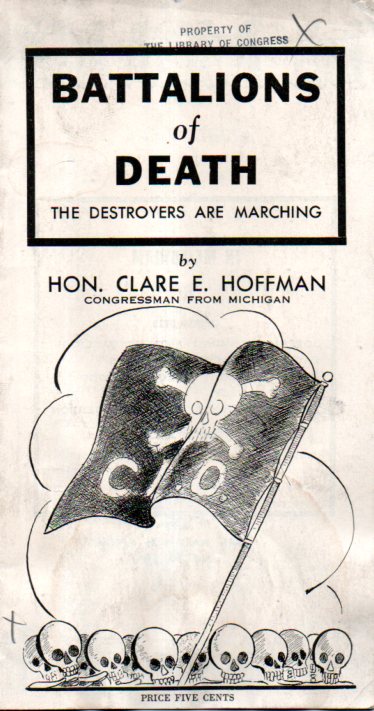
    Representative Clare E. Hoffman wrote (or lent his name to) this insane and blistering attack on the CIO (the other half of the AFL-CIO) which was the Congress of Industrial Organizations founded by John L. Lewis in 1928.  Hoffman (1875-1967) was a conservative “Republican” from the 4th District/Michigan, who was pretty much an outsider to either major party, making and destroying his own roads and bridges in a long Congressional career. He was a recognized anti-Semite, a race-baiter, a leading exponent in the Impeach Roosevelt movement (publishing and distributing by Congressional franking privileges “Roosevelt is Judas”), and a person who supported and spoke for a number of “isolationist” and national socialist-supporting groups.  He saw Soviets/Communists everywhere, including his campaign against polio immunization, which he feared was too heavily influence by commies and Jews.  

    In addition to saving America from Communists and Jews, saving America for the “true American”, Hoffman was strongly aligned with the Constitutional Educational League, which published this pamphlet. The CEL was indicted in 1942 with 27 other groups for sedition and conspiracy and working to aid Nazi Germany and the Axis Powers–which is a tough business, but not too tough for Hoffman.  The CEL and Hoffman and the associated ilk and cancers were associated with a panoply of other Isolationist/Fascist groups operating int he U.S. during the war including such wincingly-named groups as the Christian Mobilizer, Christocrats, American Destiny, National Workers League, Black Legion (perhaps the most infamous of these groups), National American, Silver Shirts (started by bizarro local boy Pelley and very nasty), Citizens USA, and a host of others.  And of course America First, which may have been the most well known of these groups, having the famous affiliation and support of Charles Lindbergh (until Pearl Harbor at which point the Colonel back away).  

    Getting back to the pamphlet–it has the feel of old bad fetish porn, and makes endless claims that the trade unions were thuggy Communist–and even worse, “red Communist”– and would wind up controlling and destroying the U.S., putting the country under control of the U.S.S.R.  The aim seems to be equating the CIO with Communism, and so to stop Communism you must stop the CIO, the great destroyers of the American way.

    I can’t help but seeing many similarities between some current right-wing attacks against unions and pieces of the Hoffman piece–we’ll see how silly/abhorrent these claims really are with historical perspective in another few decades.

    Sources:  Ellen Parsons, “Anti-Jewish Manifestations” in American Jewish Yarbook, 1945/6, pp 135-143; Glen Yeadon, Nazi Hydra in America, p. 151.

    ·Posted by :

    ·in:


  • An Aggressive Cover Illustration for Sputnik (1957)

    JF Ptak Science Books  Quick Post

    Sputnik063

    This cover illustration for Alte Welt und Neue Sterne (“Old World / New Star”) really does break through the headlines and into its own space.  It is a DDR publication and although my copy has two outer wrappers for decoration and title it has no title page–the celebration skips the necessaries and gets right into the forward and then the crux of the matter, most of which was a high-principled statement of accomplishment and a low-dark anti-American humor in having “lost” the space race.  (While Eisenhower golfs, the Soviet Union has launches a new moon, losing not only the apce race but prestige as well–one cartoon places a joyous Khrushchev successfully courting a young woman labelled “Lesser Countries” with a beaming gesture to an orbiting Sputnik as Uncle Sam reels on his heels and drops his going-courtin’ flowers in the process. “Wer sonst koennte dir einen Mond schenken” (“Who else can give you a moon?”), proudly offered as commentary that had appeared in the New York Times.

    In any event, I just wanted to share the design, which is pretty strong. (The pamphlet is undated but I suspect it was in print immedaitely following the 4 October 1957 launch.)


  • The Speed of Stuff, 1: the Speed of Bad Ideas

    JF Ptak Science Books    Post 2164

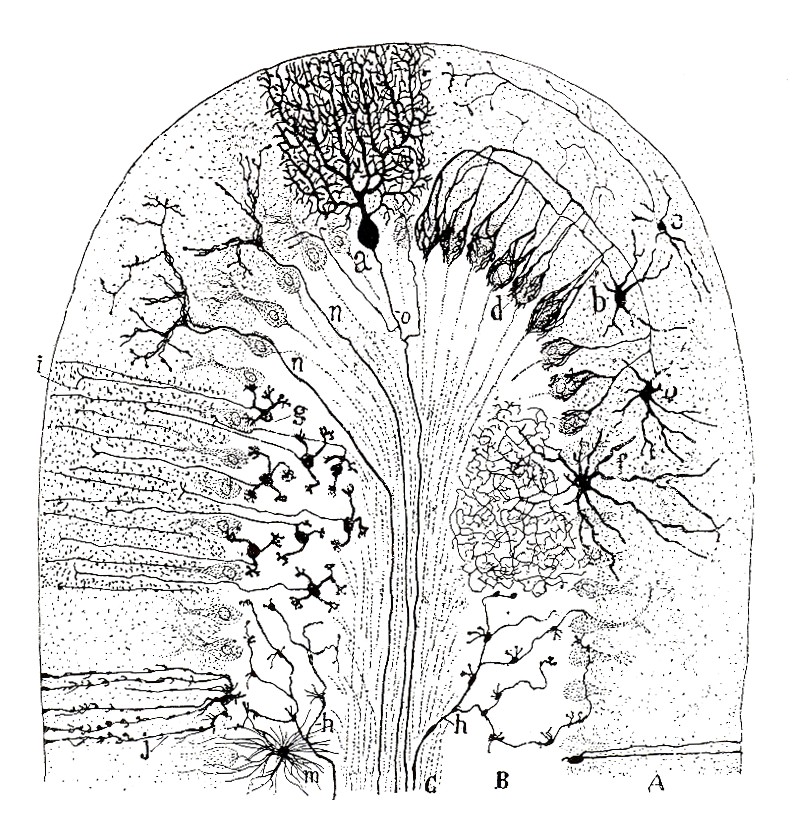
    Johannes Mueller (1801-1858), a heavyweight physiologist/anatomist and idea-adventuring-synthesizer, had the idea that the speed of nerve impulses in humans was about 11,000,000 mps—that’s somewhat like the Enterprise’s Warp 2, almost two orders of magnitude faster than the speed of light. At about the same time the remarkable and thorough Hermann von Helmholtz (1821-1894), a universal knowledge guy who knew pretty much everything, a polymath’s polymath, had a different idea about this speed, performing a series of elegant experiments and showing the speed to be about 150-300mph.

    March 6 sperm cajal[This is a detail from an image by the great Santiago Ramon y Cajal ( 1852-1934), who drew the first accurate picture of nerve cells in the cerebellum (found in one convolution of a mammalian cerebellum), which helped formulate his theory that the basic structural unit of the nervous system as the neuron.] 

    At the time of Mueller’s appraisal the speed of the nerve impulse seemed an unknowable entity. I wonder about other unknowables like this and what their estimated speeds might be that might put us more in touch with the major domo Mueller’s imaging the impossibility of knowing this reclusive and invisible speed?

    What is the speed of attribution? The speed of recognition? Of growth? Of absent love resuscitated? The speed of caring and not so? The speed of being in a space that you want to be in? The speed of imagined motion, of a bending cane, of finding the perfect broken seashell?

     Perhaps though the most interesting thing about the idea of speed is the speed of ideas.

    An Alphabet of the Suggested Speed of Various Types of Ideas

     Abstract idea: 35 mph

    Bad ideas: 375 mph

    Cryptic ideas: 50 mph

    Dangerous ideas: 250 mph

    Envious ideas: 350 mph

    Fanciful and farcical ideas: 100 mph

    Great ideas that are not Your’s: 28 mph

    Half-an-idea: 150 mph and a buck-two-eighty

    Ideas that are not ideas: 200 mph

    Jokingly-said ideas that are taken for real ideas: 200 mph

    Knowledgeable but sniffily restrictive ideas: 30 mph

    Lyrical ideas told in a non-lyrical way: 31.23 mph

    Mincing, broken tea-cup weak-tea ideas: 4 mph

    Nonsensical ideas: 150 mph

    Overheard-from-someone-else’s-cellphone idea: 300 mph

    Practical ideas that have no direct application: 45 mph

    Quixotic, queenly-quizzical, and not understandable ideas: 125 mph

    Random idea: 125 mph

    Salacious ideas: 450 mph

    Tiresome ideas that are really notions: 20 mph

    Underthought and underwhelming ideas: 55 mph

    Vexating, poorly-ventilated, porous ideas of multiple misunderstandings: 44 mph

    Wonderful ideas that belong to someone else: 4 mph

    Zealous and impudent ideas: 75mph

    Of course I’ve had some fun with this idea—but it came to me in a flash (at 250 mph) so I went ahead with it. And possibly it delivers some sense of the impossibility of knowing something that even the leading lights of those fields sensed as being unknowable.

    ·Posted by :

    ·in:


  • The Beauty of Pi, Times Two (and More)

    JF Ptak Science Books  Quick Post 

    Pi060

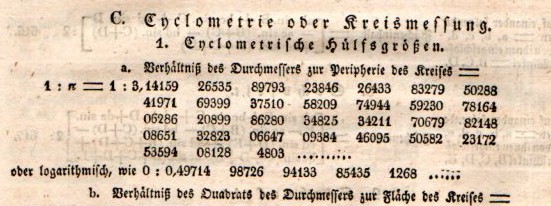
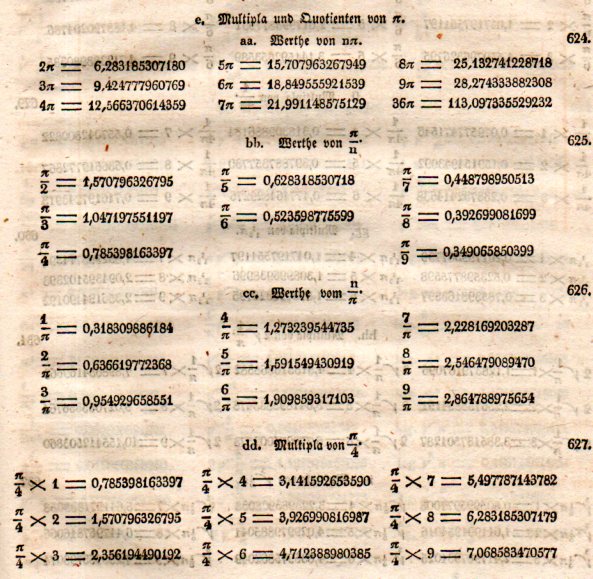
    Very little is pretty as pie, especially when there’s more than one.  Double that for pi.  I happened to be breezing through an 1829 book of mathematical formulas by C.P. Biel and found this lovely section on an extended computation of pi.It occurs on page 38, and carries pi out to 155 places–which for the time was very significant. (Pi was computed to 9 places  by Francoise Viete in 1579; 15 places by Adriaan van Roonan, 1593; 32 by Ludolph van Ceulen in 1596; 35 by Willebrord Snell in 1621; 38 by Christoph Grienberger; 75 by Abraham Sharp in 1699; 100 by John Machin in 1706; 137 by Jurj Vega in 1794; and 152 by Legendre in 1794.)

    In any event, it is a lovely display.

    And so to for the multiplication of pi:

    Pi061

    ·Posted by :

    ·in:


  • A Note on the Finite Infinite Library: McBorges’ and Influenced Forgetting

    JF Ptak Science Books   Post 2163

    Jorge Borges wrote a powerful and wonderful short story called The Library of Babel, where the universe is basically composed of books the center of which is an anti-black-book-hole. I was thinking about this in a waiting room a few hours ago, and thinking of the Infinite in general, all of which somehow led me to the Finite Library and Forgetting. 

    Archibaldo books[“The Librarian”, is a 1566 work by Giueseppe Archimbaldo, 1526-1593, who painted incredible portraits such as this at a time when expressioin in this form would have been extremely uncommon–his semi-Boschian sense and image palette makes him the Vermeer of constructed object painting, I think.]

    In a country set into thin mists, compulsive and repetitive feeding instruments were replaced with Ideaoterias. Rather than an endless maps of interwoven McDonald’s restaurants set at predictable intervals, there are libraries.

    1. Each library contains 10,000 books.

    2. All 10,000 books are the same from library to library.

    3. Each location must organize their 10,000 volumes differently, each grouping identifying ideas inherent in the contents of each volume, in support or negation of one another, arranged with other books that were complimentary, or supplementary, or antagonistic, or worse, or better.

        4. The organization of thought contained in those 10,000 volumes would be different from location to location, the librarian-explorers having organized the library so that the books were freed into new spaces.

        5. The number of books is finite; the infinite aspect is the continuous shifting of material and the expanding structure for the display of ideas. The simplest aspect of this arrangement makes it possible for every book to actually be seen. (Even in cursory browsing the mind has certain expectations of what-come-next when browsing a shelf, sweeping past things that have been swept-past before, rejected or unneeded for whatever reason. The deeper aspect is for the association of ideas by the placement of book, the arrangements suggesting themselves for the reader to have a new experience witn an old idea or book or set of books.

        6. The McBorges’ Library is a learning, memory, and forgetting experience.

        7. Forgetting may be a key to making these libraries an infinite experience: re-re-re-etc.-learning does not imply necessarily that the learned bits will be cumulative, and useful. Maybe the best we can do is have learned and re-learned bits in a new context, making it possible to have more ideas; this means that a certain amount of forgetting is necessary, where that forgetting unleashes existing associations of ideas.

        8. At McBorges’, forgetting is an important aspect of learning, but really only in regard to what it would take to open the possibilities for new ideas by rearrangement of old relationships. The palaces of memory work hand-in-hand with the Palaces of Forgetting.

    ·Posted by :

    ·in:


  • The Non-Talking Talkie–Soundless Talking Pictures (1917) and the Beauty of Timelessly Bad Ideas

    JF Ptak Science Books   Post 2162

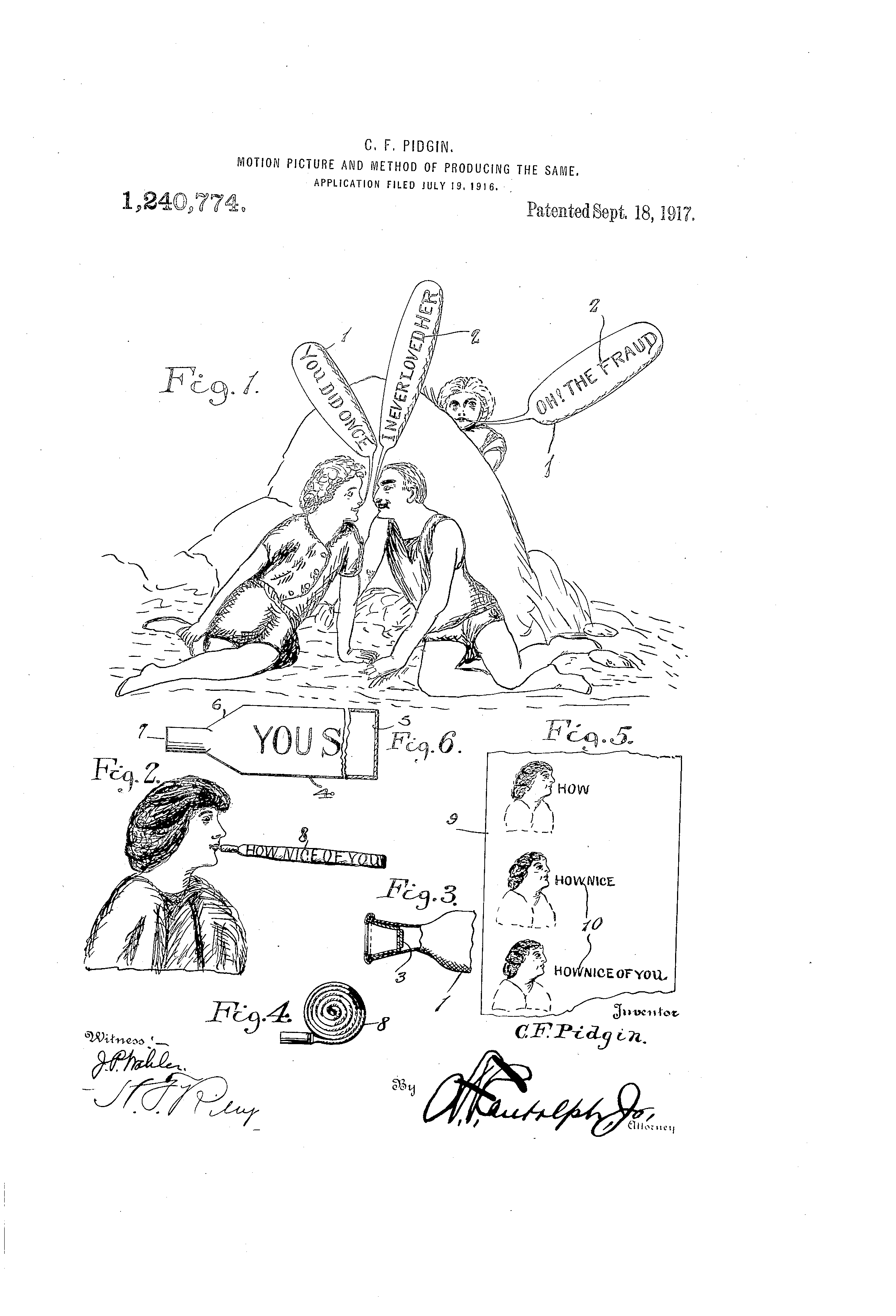
    “Motion-picture and method of producing the same.”


    I’ve written a note earlier on this blog about the history of word balloons–it is the stuff that we think of today as the little clouds filled with words over the heads of comic book characters and such, but which had a long history stretching back at least to the Renaissance when speech was illustrated in a similar way, but with lovely scrolls instead of blank clouds (as we see above).

            See for example:

    The following illustrations though come at a great expense to the imagination, and were a weak but fully patented  attempt to replace spoken-word captions in the pre-audio motion picture–that is silent films before the Talkies.  In general I guess the complaint with illustrating speech during a photoplay was that the text card was a breakaway from the moving-picture part of the experience, necessitating a clean break from action so that the audience could read about what was being pantomimed.

    Folks were well underway in processes to produce sound motion pictures, though up to this point–1917–the systems were separate recordings of sound and speech which would be played in conjunction/synchronously though not necessarily at exactly the right moments with the motion picture. Edison was hot on this trail but with blemished trials, combining his kinetoscope and phonograph in very early and novel attempts at producing a sound motion picture in the first decade or so in the development of moving pictures. The next 20 years in this development are fairly complex, but the matter is fairly well solved by at least three different technologies by 1923 with the production of successful continuous sound-on-film motion pictures, and then most famously and successfully debuting with The Jazz Singer in 1927.  

    And then there is this colossal bit of overdeveloped-underdeveloped thinking that would link the seamless word of not needing text card interruptions with non-spoken speech–and coming just this shy of not meaning anything at all. The work is that of Charles F(elton) Pidgin (1844-1923) who was a very successful author of genre/historical romance books (though he did have an interesting-sounding title in The Letter H, a Novel). He was also an engineer of some sort with some advanced patents in calculating machines and devices, which is the way I came to his name (via a letter I have written to him by the director of the U.S. Census rejecting his tabulating apparatus because it basically produced too much info for too much money, but that’s another story). 

    Pigdin’s idea–in short–was to have an inflating paper text bubble issue from the mouth of the actor during a scene–in that way the view could see what the other actors on the screen were “hearing”. 

    Pigdin motion picture

    [Source:  the lovely Google Patents, here.]

    I know this might sound as though I’m judging a technological effort from the vantage point of the idea’s deep future, but I believe that this idea was a truly bad one right from the moment of conception, a two-beer idea that should’ve stayed in the bar, no matter if it was 1917 or 1967 or 2017.  Sometimes bad ideas are just bad ideas, top to bottom–and some of them are timesless, like this one.  

    NOTES:

    And from Pidgin’s patent, explaining it all: 

    ·Posted by :

    ·in:

    —

  • The Unexpected Unintentional Unusual: Maps of America

    JF Ptak Science Books  Post 2162   An offshoot of the Unintentional Absurdist series

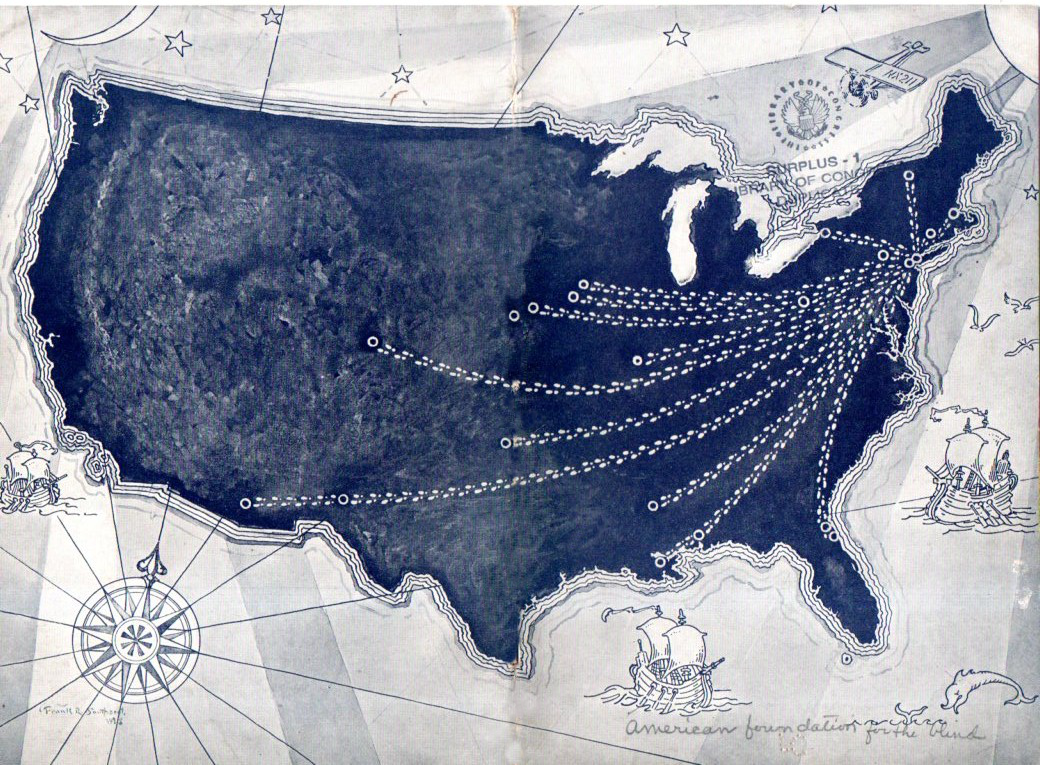
    After all of this time on this blog–six years now and 3,000 posts–I think that I would have paid more attention to Unintentional and Unexpectedly Odd Maps of America that bobble up here and about in the home collection. The are odd and strange maps though none really relegated to America–there are strange maps of NYC (as in NYC being disappeared, or lifted by strange anti-gravity implements to float serenely above its hollowed ground below)–but none of the entire country.  And so a few have come up, unexpected and unusual things, though not so much in and of themselves, but separately.  What I mean to say is that the maps (for the large part) make sense with regards to their texts–not terribly much though without.  And so, here are the first few (and brief) examples:

    Maps of US GIMP

    This rather strange example was printed as the covers of a pamphlet in 1928 and comes from the American Foundation for the Blind, simply showing the progression of the agency’s representatives extending out beyond the originating point of New York City, though on  first sight the map is very unusual, and naively odd.

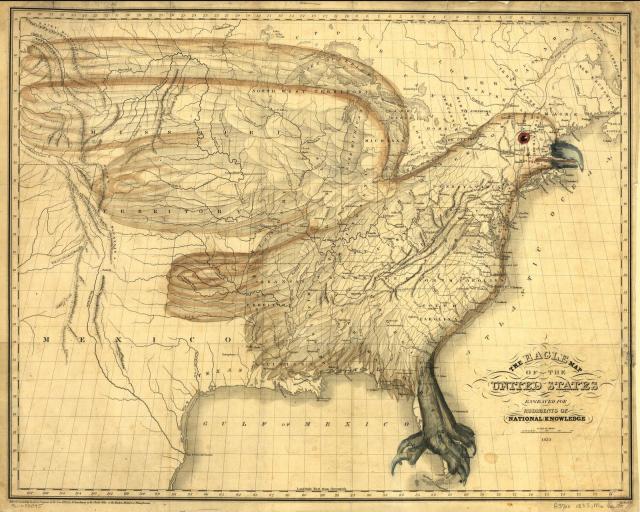
    This sort of map in the “Unexpected” category differs from the intentional oddness of maps like (the very recent) map of the U.S. showing distances to McDoanld’s, or I.W. Moore’s 1833 map incorporating an eagle into the design of the early RepublicMaps Eagle America

     or even the Porcineographic map of the U.S. of 1876:

    This porcineograph

    Again, they are very unusual images–particularly the latter–and they were trying to be so.  The Unexpected Unusual map is unusual but not by choice. 

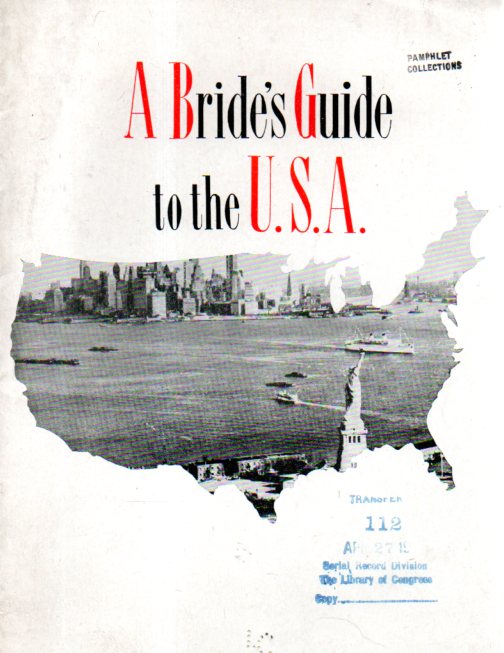
     Another example is the cover illustration for A Brides Guide to the U.S.A., which was intended for the (British) brides of American servicemen returning to the U.S. following the end of WWII.  More than anything, the whole arrangement of the pamphlet is just a little off.Maps of US 2 odd043

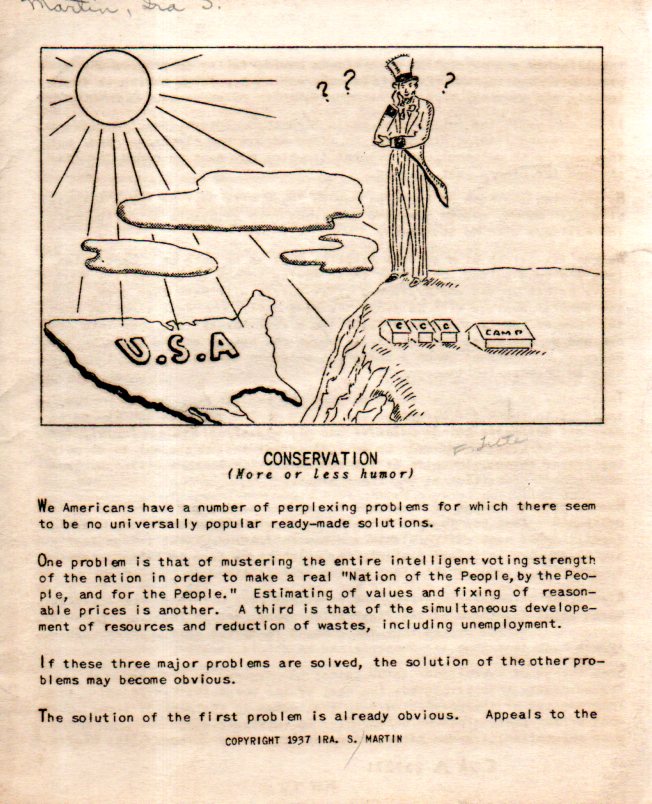
    And lastly, for now, comes a puzzling map from an oddly-named pamphlet called Conservation (More or Less Humor) which was an appreciation of some of C.C.C. camps (Civilian Conservation Corps) and shows little sign of authorship (“S. Martin”) and none of place of publication.

    Maps of US 3 odd044

     The whole production is pretty happenstance, somewhat crude, and probably quickly undertaken and completed, giving it an air of slim and slippery mystery.  The end result for the pamphlet cover, though is unusual, and a little creepy, somehow, and in a way it is a great representative of the Unexpected/Unusual/Unintentional in maps.  


  • An Early Camel-Driven Solo Internet from the 10th Century

    JF Ptak Science Books   Quick Post

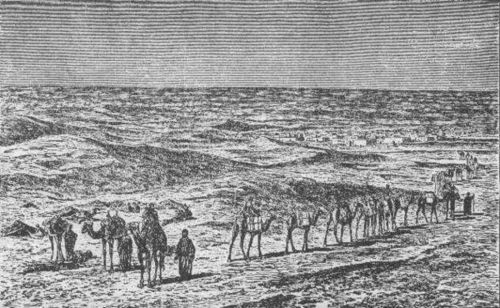
    If you defined the internet as a transporting device for vast amounts of information and data then perhaps Abdul Kassem Ismael (938-995), the Grand Vizier of Persia, produced such a thing over one thousand years ago. I found the story in Albert Manguel’s A History of Reading (a fabulous book published in 1996), who relates that when the Vizier traveled he did so with his library.  That was an enormous effort, as ther were 117,000 volumes in the library, all of which were packed up onto 400 camels, and sent on their way.

      Camels[Source, here]

    That camel train–which I imagine must’ve been 1.5 miles long–was piloted by 400 drivers, and then attended to by an entirely different camel train of support of food and water for the perhaps other 400 people traveling in support, making the whole enterprise 2 miles long or more.  The books were all arranged alphabetically, so the drovers maneuvered their camels in a certain way, making them mobile librarians in their way.  

    In any event, the whole movement of that vast library 1000 years ago can romantically be seen as a sort of internet–for one man.  

    It seems that this is a mostly not-true story/interpretation of a near-event, but I’m running with the interpretation.  

    ·Posted by :

    ·in:


  • The First Personal Computer (?)–“Simon”, 1950


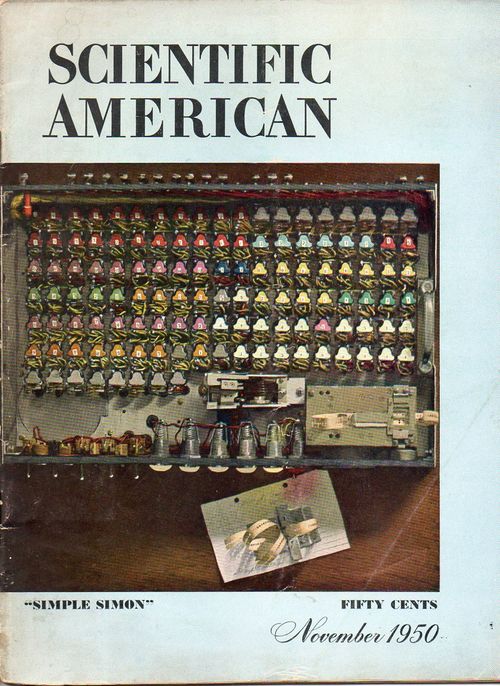
    Berkeley simon915

    The first exposure of the American public in general to a “personal computer” may have been in this issue of the Scientific American for November 1950–an article called “Simple Simon” by the very busy Edmund Berkeley.  (Amidst much else, Berkeley also wrote a book called Giant Brains, which seems to me to be the first mass-consumption book–written in terns for the general public–on how the computer works, and the design of “how a machine will think”.  Berkeley looks at the MIT Differential Analyzer #2, the Moore School ENIAC, Bell Labs’ General-Purpose Relay Calculator, and the IBM Automatic Sequence-Controlled Calculator.) 

    The Simon was a five-hole paper tape (which was its data entry and memory) 2-bit storage relay-based computer that could use numbers from 0 to 3.  It was extremely limited, but it worked, and it was real.  And affordable.  And a baseline for things to come.

    Berkeley introduced the idea for Simon in Giant Brains:

    “We shall now consider how we can design a very simple machine that will think. Let us call it Simon, because of its predecessor, Simple Simon… Simon is so simple and so small in fact that it could be built to fill up less space than a grocery-store box; about four cubic feet….It may seem that a simple model of a mechanical brain like Simon is of no great practical use. On the contrary, Simon has the same use in instruction as a set of simple chemical experiments has: to stimulate thinking and understanding, and to produce training and skill. A training course on mechanical brains could very well include the construction of a simple model mechanical brain, as an exercise…”–Edmund Berkeley, in Giant Brains, 1949, p. 22 

    In the Scientific American paper Berkeley introduced the machine and how it functioned; he also described three  three outcomes for Simon:

    First: “Simon itself can grow.  It possess all the essentials of a mechanical brain…”

    Second: “It is likely to stimulate the building of other small mechanical brains.  Perhaps the simplicity and relatively low cost of such machines may make them attractive to amateurs as the radio set and the small telescope.”  [The “low cost” in 1951 was $600–equal to about $4000 today.]

    Third:  “It may stimulate thought and discussion on the philosophical and social implications of machines that handle information…”

    Berkeley finishes the three-page article with the following paragraph, looking into the not-too-distant future:

    “Some day we may even have small computers in our homes, drawing their energy from electric-power lines like refrigerators or radios … They may recall facts for us that we would have trouble remembering. They may calculate accounts and income taxes. Schoolboys with homework may seek their help. They may even run through and list combinations of possibilities that we need to consider in making important decisions. We may find the future full of mechanical brains working about us.”

    ·Posted by :

    ·in:


  • Rare Technical Report on the V1, January 1945, Reprinted in Full

    JF Ptak Science Books   Quick Post

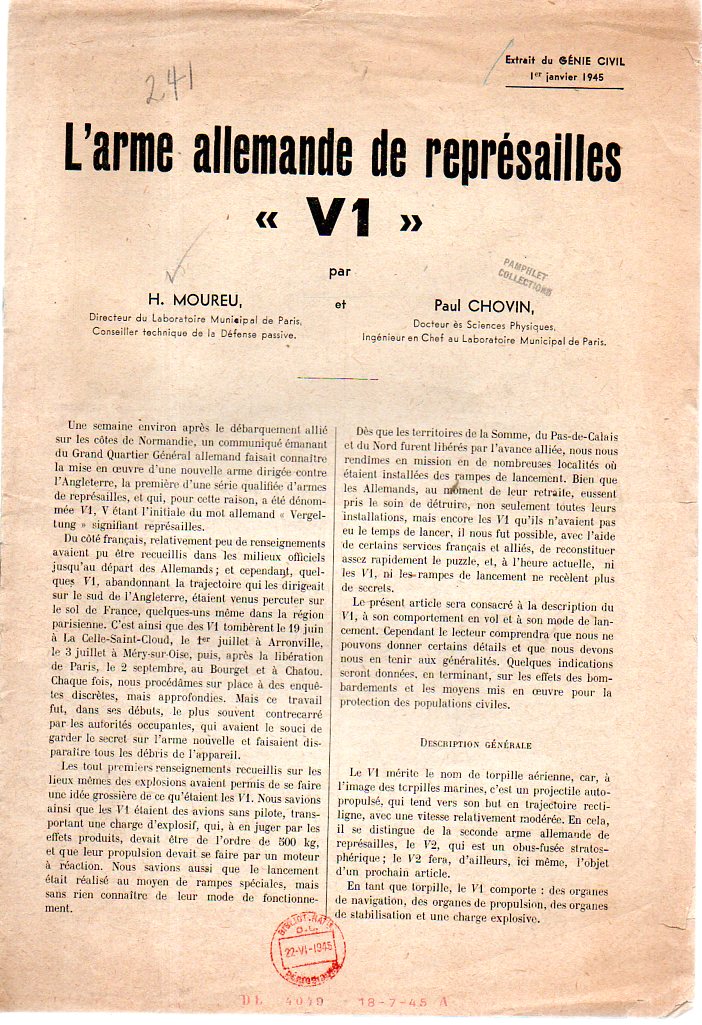
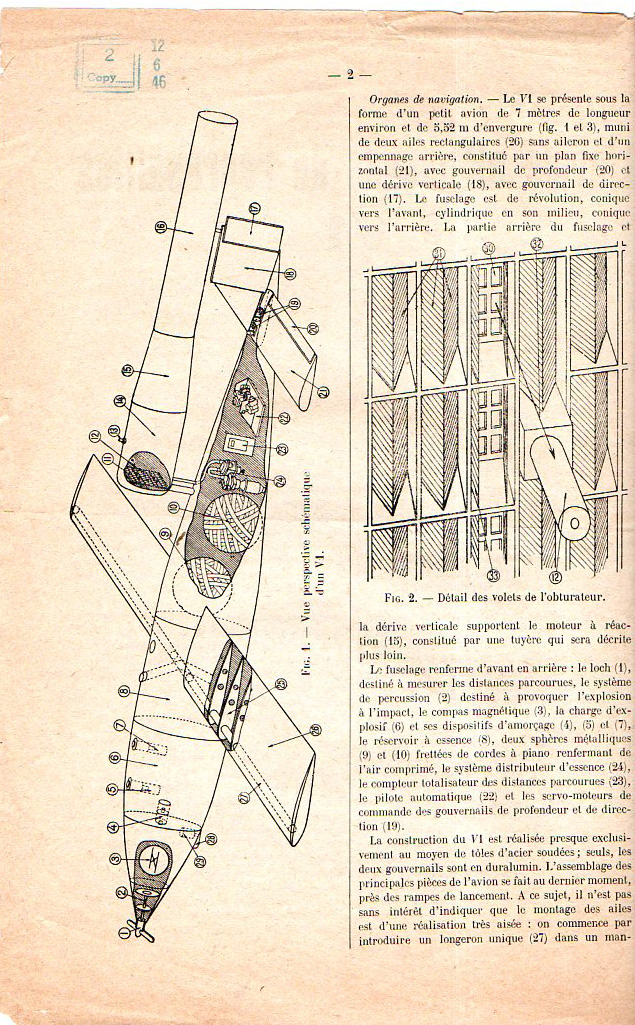
    I found this unusual report in the Library of Congress Pamphlet Collection stash here in the warehouse–surprised that it was printed, and surprised that it was printed in Paris in January 1945.  Paris had been liberated by this time, but I wasn’t so sure how much of this sort of technical data would have been liberated during the last stage of the war.  Of course the Germans were past the V1 with the V2, but, still, I thought it the data was unusual to find reprinted in a technical journal (Genie Civil, 1 Januar 1945).

    [Moreau, Henri (1893-1978) and Paul Chovin.  “L’arme allemande de represailles V1”, offprint from Genie Civil, 1 January 1945.  9×6 inches, 8pp, printed in Paris (newly liberated from the German army 25 August 1944) in early 1945.]  And for some reason there are no reprints of this available in libraries worldwide, or so says the OCLC/WorldCat catalog.

    I’ve reprinted the document below in its entirety. Some of the text runs off the side of the scanner, but that is the best I can do in scanning the pamphlet without taking it completely apart. 

    V1519
    V1521

    ·Posted by :

    ·in: