A Daily History of Holes, Dots, Lines, Science, History, Math, Physics, Art, the Unintentional Absurd, Architecture, Maps, Data Visualization, Blank and Missing Things, and so on. |1.6 million words, 7500 images, 4.9 million hits| Press & appearances in The Times, Le Figaro, Mensa, The Economist, The Guardian, Discovery News, Slate, Le Monde, Sci American Blogs, Le Pont, and many other places… 5000+ total posts since 2008.

Author: JF Ptak

  • On a Certain Part of the History of Echoes

    JF Ptak Science Books   Quick Post

     There is a wonderful, short paper by Lord Rayleigh in the August  21, 1873 issue of Nature on echoes, “Harmonic Echoes”, echoes which have a life of their own, seemingly, after their initiation….echoes with 5 or 10 or more reverberations, echoes which seem to advance, or recede or both.  

    The mythological, beautiful nymph, Echo, a creature of Greek invention–or discovery–was much in love with her own voice and thus some of this interest in repetitive reverberations.  Echo was interested in Narcissus, which means that between the two of them, there was more more than enough interest in them for anyone outside themselves, but neither could get enough of themselves. And with Echo there were others who couldn’t get enough of her, though she denied herself to everyone. And so the tragedy.  Pan wants her, the old lech, and is denied, and becomes enraged which leads to her tragedy of being torn to pieces. She is resurrected, a little bit, her voice surviving everything else, repeating the last words of others.  

    I’ve repeated below a story on the Rayleigh paper which in some respects is as interesting as the original. 


  • Grace Murray Hopper and “Compiling”: Computers, 1953

    JF Ptak Science Books  Post 2305

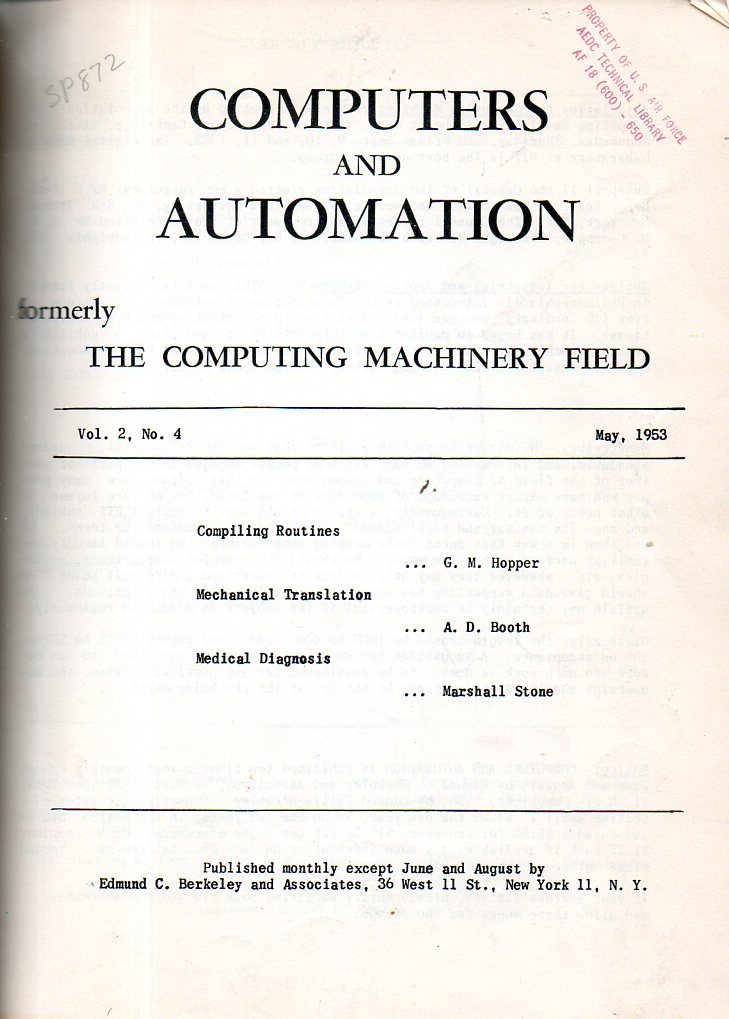
    Hopper511Grace Murray Hopper.  “Compiling Routines”, in Computers and Automation, volume 2, no.4, May 1953.  11×8 inches, ii + 33pp.  The Hopper article occupies pp 1-5.  Also in this issue, keeping Hopper good company: A.D. Booth “Machine Translation” and Marshall Stone, “Medical Diagnosis”, plus a Who’s Who in Computers (A-D) and section 2 (C,D,E) of  the first edition of the computer glossary.

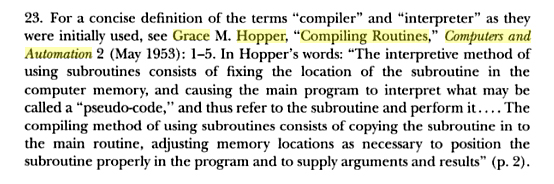
    It was in the article “Compiling Routines” that the pioneer and visionary Grace Murray Hooper (1906-1992, and at last, Admiral Hopper) laid out the foundations of compiling (which is a program that translates a program written in a high-level language into another language, usually machine language). Vassar ’28 and Princeton Ph.D. ’34, she worked at the Harvard Computation Lab on the Mark I, II, and III, and then seemed to be at a high level just about everywhere else.

    Grace hopper[Image source: National Women’s History Museum, here.]

    The following from Paul Ceruzzi, A History of Modern Computing, page 367:

    Hopper compilerComputers and Automation, the brainchild of the brainy not-child Edmund Berkeley, was the first popularly-published magazine published regarding the computer, its applications, it programming, and really just about everything else. (It appeared seven years after the Mathematical Tables and Aids to Computation was published in 1943, almost entirely to the mathematics and engineering communities.) Computers was published by Edmund Berkeley & Associates in NYC beginning in 1952., beginning its publishing journey as The Computing Machinery Field, its name changing toComputers and Automation in February 1953 (in volume 2, number 2). All issues have some fair space devoted to advertising, even though the issues generally ran between 32 and 40pp. Berkeley was a real-enough mathematician, engineer and computer pioneer, but he also had a pretty large taste for making these interests pay–which was essential, as the original print runs were not very large, though his advertisers were impressive. (According to the first issue, approximately 1200 people were on the mailing list for the journal, with around 2000 issues being printed each number. All told, this is not a large print run, and thus not many of the early issues have survived.) He was not averse to being somewhat outre with his journal—in addition to having contributors like Grace Hopper and Alton Householder, he also had Fletcher Pratt and Isaac Asimov writing some pretty arresting pieces from the SciFi/Futurama point of view.

    ·Posted by :

    ·in:


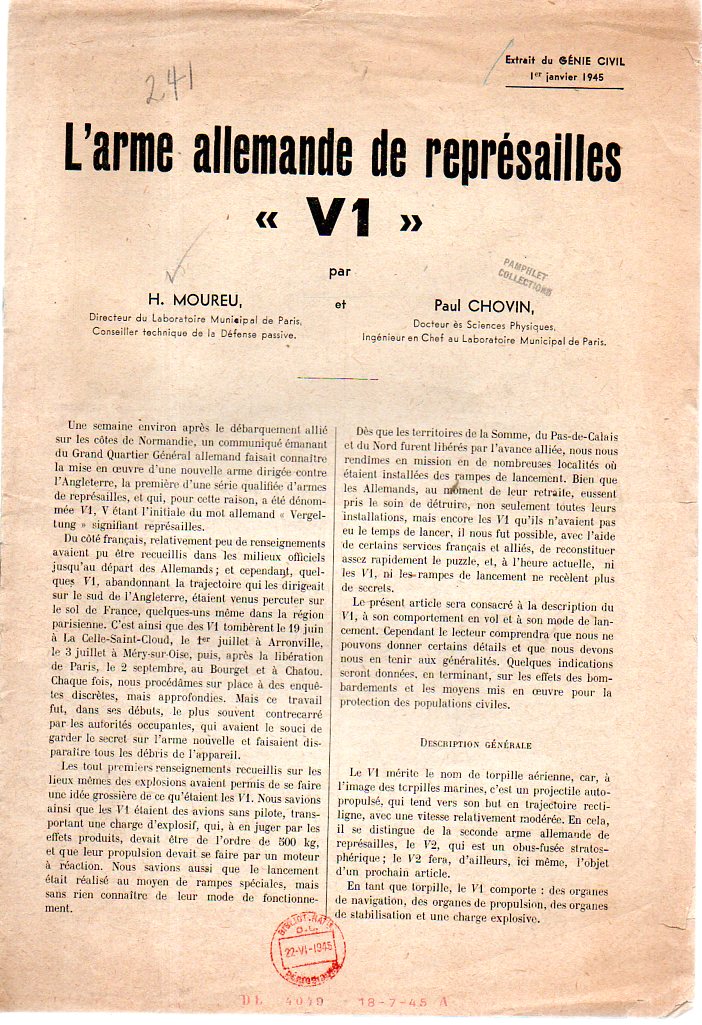
  • A Rare Technical Report on the V-1, 1945, Published in Newly-Liberated Paris

    JF Ptak Science Books   Post 2304

    The eyes of top-ranking Nazis must have popped when they saw this work by Henri Moreau  (1893-1978) and Paul Chovin.  It is a fairly technical paper on the V-1, the progenitor of their supposedly war-ending “secret weapon” the V-2, and to see the data and detail published in a tech journal in the city that was until very recently held in Nazi hands….well, there was very strong irony there.  “L’arme allemande de represailles <<V1>>”, seen here in offprint form, was published in Genie Civil, 1 January 1945–it is eight pages long, and printed in Paris (newly liberated from the German army 25 August 1944) in early 1945.  The offprint itself is a rare thing, with no copies whatsoever located in WorldCat, and nothing floating around on the interwebtubes. I was frankly surprised to find this fairly-well documented piece on the V-1, but no report itself, so I decided to reprint the report in its entirety. Some of the text runs off the side of the scanner, but that is the best I can do in scanning the pamphlet without taking it completely apart. 

    V1519


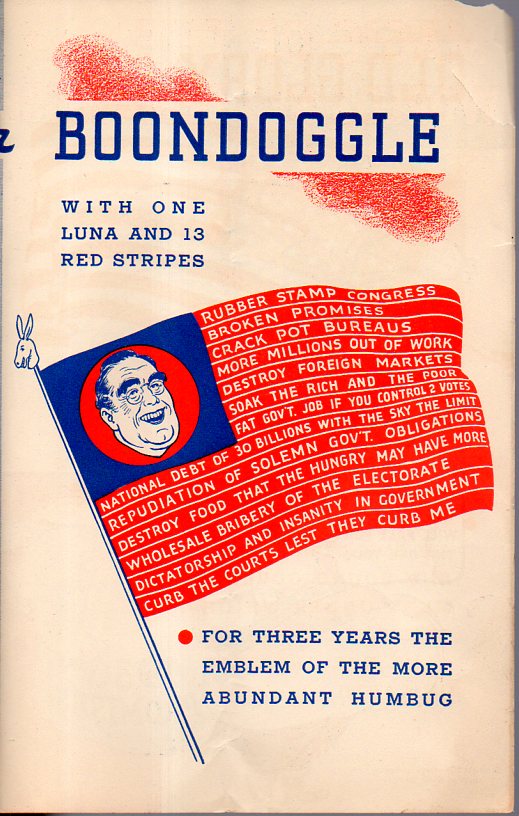
  • The Minority Speaks: F.D.R. as Boondoggling Demagogue (1936)

    JF Ptak Science Books  

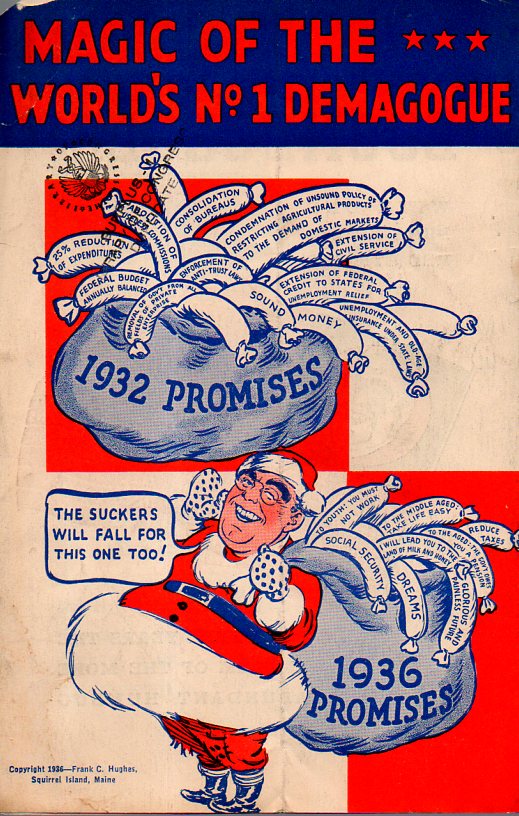
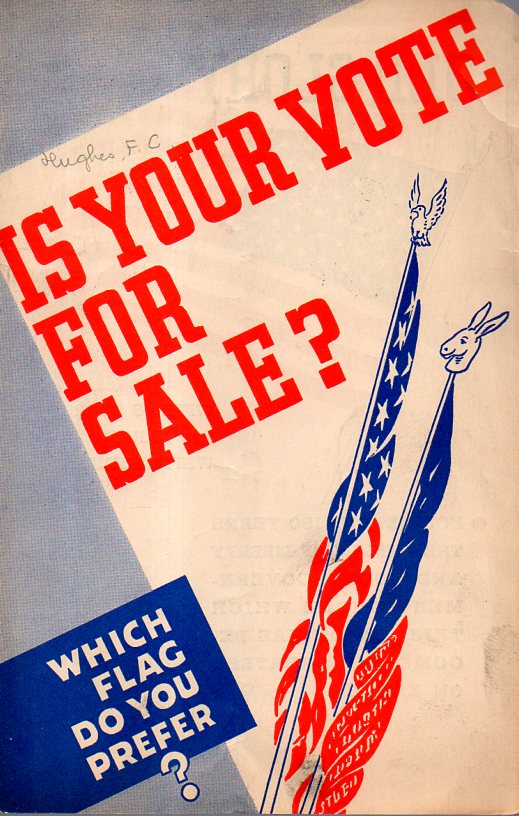
    This is quite a flag being flown by Republican interests, waving in a relatively non-existent lunar breeze prior to the 1936 election. That was a lot of discrimination leveled on FDR in that flag, which is particularly disdainful given the successes of the administration in its first term.  (Of course FDR would go on to win in the mother of all landslide, beating Alf Landon and Frank Know 523 to 8 in the electoral college).   The electoral map has seldom been so monochromatic as in ’36, though George McGovern took only a single state in his bid against RMN in ’72.  Landon took Vermont and Maine, and Maine (Squirrel Island) is where the holder of the copyright on this pamphlet–Frank C. Hughes–was from.  Hughes was, um, not a fan of the administration, and seems to have written a number of little pamphlets proclaiming himself as the dire opposition, the ruined associate of democracy, the injured party…a gadfly.

    FDR279


    Anyway I guess some of the meaty stuff that could be the cause of some of the stripes on that flag are the occasional favorite of revised opinion and theory nowadays, that FDR messed around with taxes and wages when he shouldn’t have, and imposed the tariff that some think pushed the country further/deeper into Depression. Bottom line is that he saved us all.  

    FDR278

    FDR277


    By the way, that’s pretty much the whole pamphlet–there’s one more image, but the whole of it was one sheet of paper, folded.  

    ·Posted by :

    ·in:


  • TV Field Trials, the Beginning of Networks, and an Early TV Dinner, 1936

    JF Ptak Science Books  Post 2302

    The first broadcast images in the history of television transmission were revolutionary if not very interesting.  Beginning in 1928 the first experimental Radio Corporation of America (RCA, via the National Broadcasting Company, NBC, its broadcasting division) images were of Felix the Cat, and something that would be received with 60-line clarity on a two-inch display.  For the most part, the daily two-hour broadcasts consisted of Felix or test patterns, broadcast from NYC, until 1931.  

    Tv 1936 set924

    Image quality increased markedly by the 1932 field trials with the use of iconoscope cameras, which allowed for 240-line reception though still with very noticeable flickering. The 1934 trials were improved further to 343 lines and with some less amount of flicker. 


    For the 1936 field test the transmitting station and offices for NBC and RCA were located in the Empire State Builidng (utilzing the mooring mast at the top of the building for the antenna, as well as some of the upper floors for the transmitter and offices on the 52nd floor, while the transmitting studio was located in the RCA building in Rockefeller Center).  The broadcast began on 29 June 1936 from W2XF/W2XK “to an audience of some 75 receivers in the homes of high level RCA staff and a dozen or so sets in a closed circuit viewing room…(in the RCA building)”.1


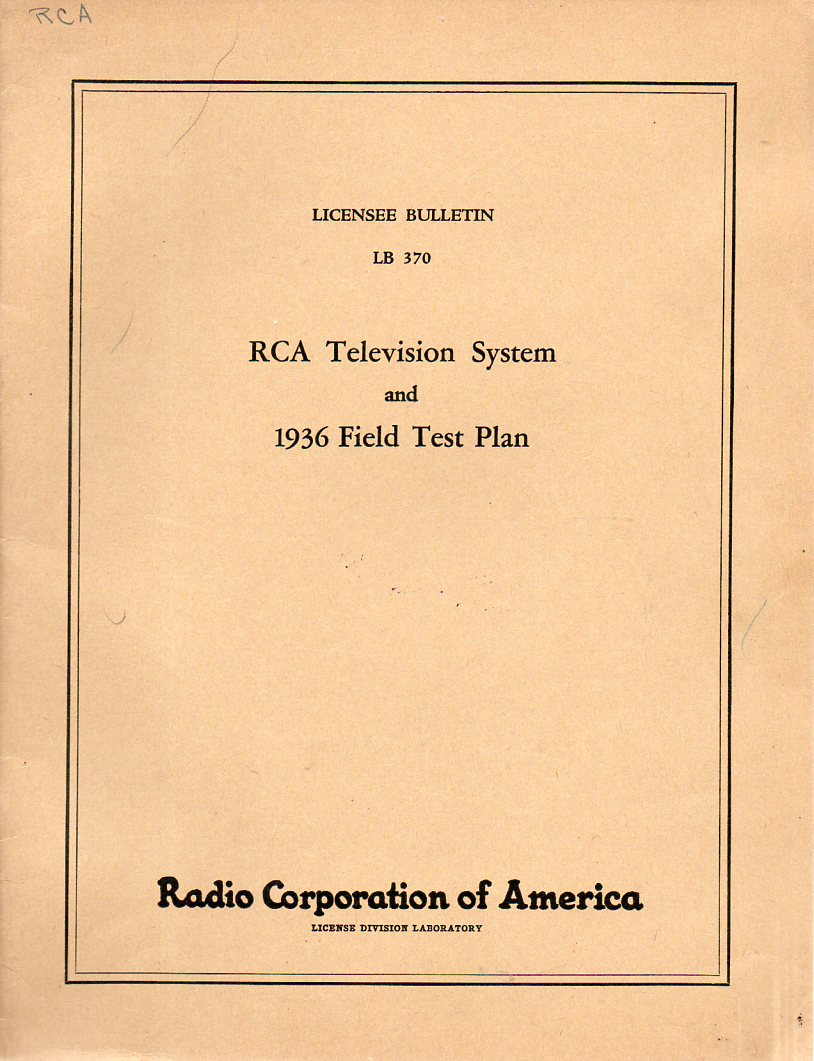
    The rare pamphlet [available for purchase from our blog bookstore, here] that I uncovered in the attic speaks to the first public demonstration. “The first public demonstration of these field trials took place on July 7, 1936 to RCA’s 225 licensees. Major General J. G. Harbord, chairman of the board of RCA announced that there were three sets in operation at the time, the most distant in Harrison, N. J.”2  It addresses the history of the field tests as well as the tech specs for the 1936 test, as well as the need to address the fuller and complicated issues of establishing a network of transmission capabilities:  “Television services required the creation of a system, not merely the commercial development of apparatus.”–July, 1936, RCA Field Test Plan, page 8.

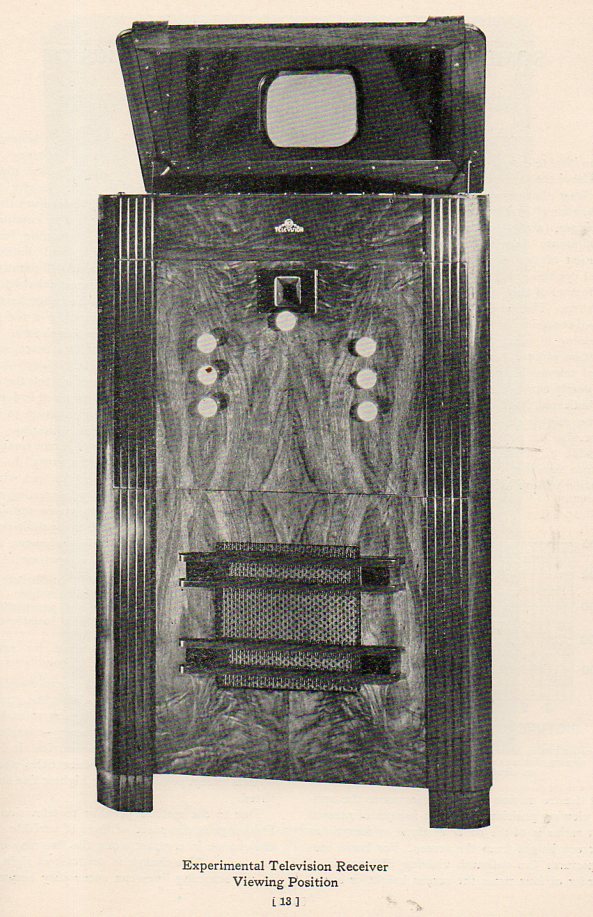
    The set on which the transmission was received was the RCA RR-359 trial set:

    Tv 1936 set922
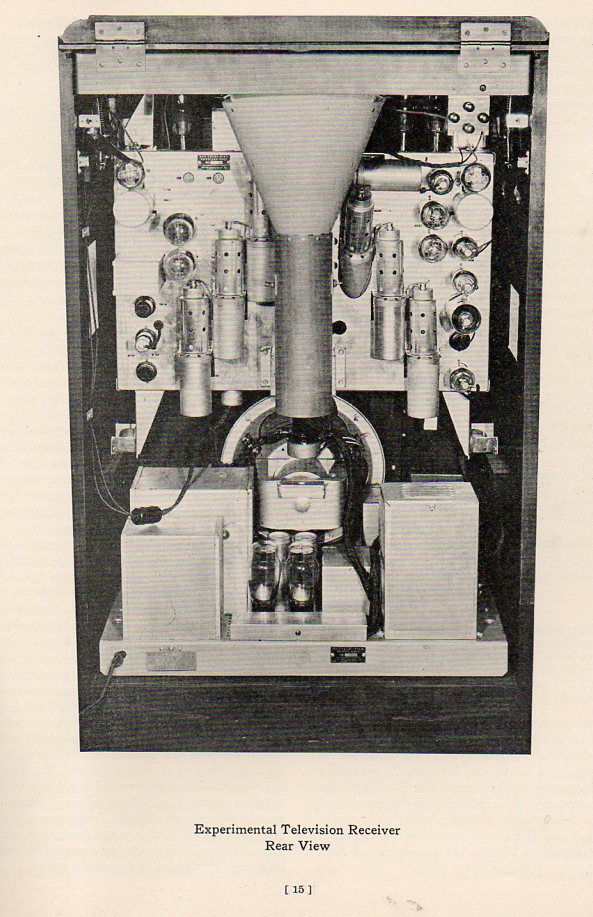
    and the innards:

    Tv 1936 set923

     Notes:

    1.  See The Television Museum, at Earlytelevision.org, here.

    2.  The Early Television Museum, located here.

    ·Posted by :

    ·in:


  • Superior Cover Design, Chem Industry, Nazism, and “Race Suicide” (1944)

    JF Ptak Science Books   Post 2301

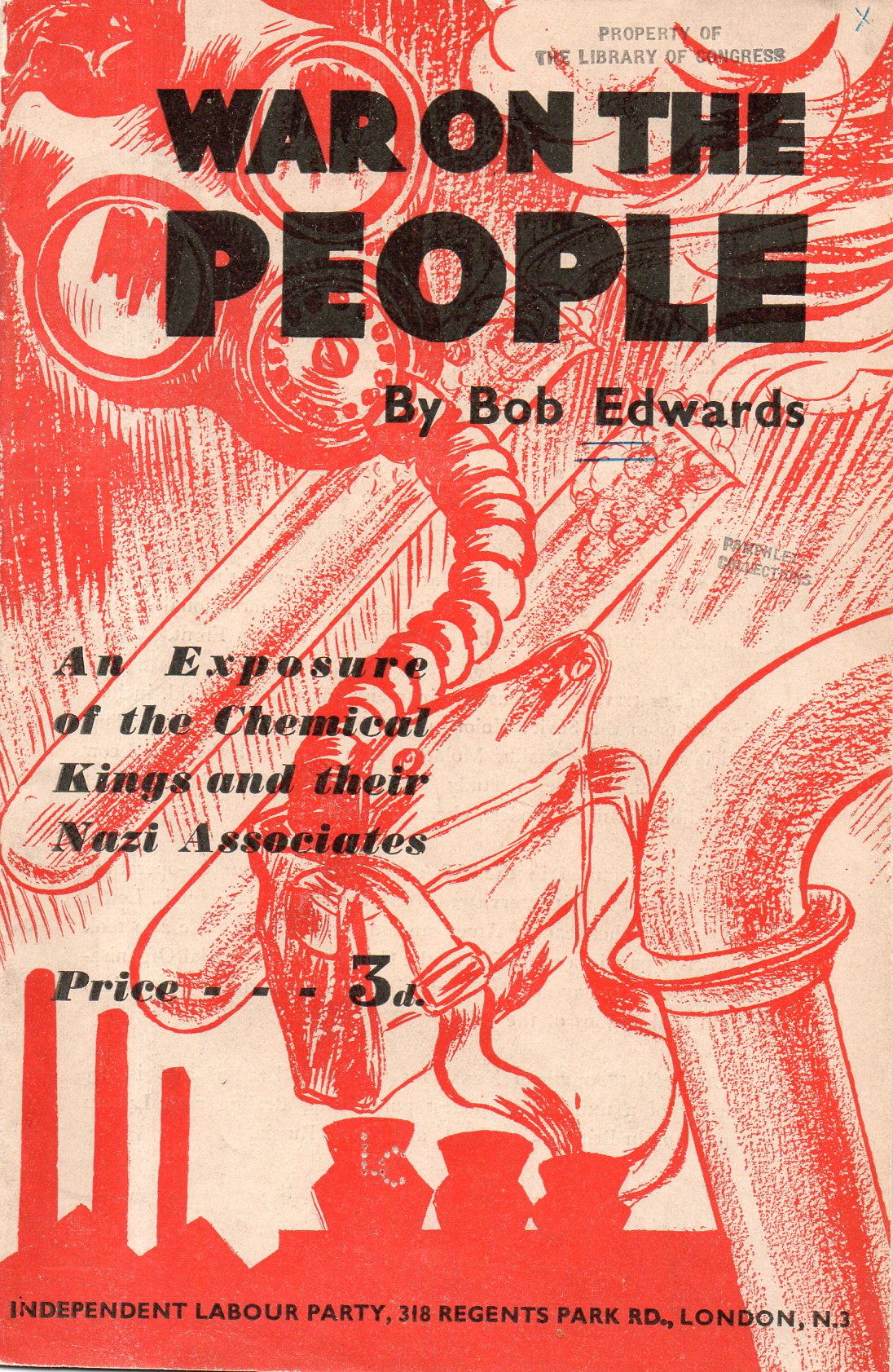
    Bob Edwards, MP (1905-1990) was a trade unionist and socialist who wrote a particularly savage appraisal of the British chemical industry during WWII.  The pamphlet stopped me because of the cover design, and then of course by its subtitle:  War on the People, an Exposure of the Chemical Kings and their Nazi Associates.  And the big deal about this was that it is the second edition, and it was printed in 1944.  

    War on the People273

    I don’t want to start even just a little on the matter of American/Allied multinationals  (like Brown Brothers, Standard Oil, Renault, I.C.I., Ford) doing business with Nazi-controlled companies and concerns, mainly because it is a very deep story and a simple scratch reveals too much and it sounds too odd to be true, but it all seems to be so.  Edwards though concentrates on the British chemical industries, and in particular the Imperial Chemical Industries (I.C.I.), which Edwards has a long association with as his personal labor affiliations in general have been with the chemical trade.

    This is already the “third edition” in two years for Edwards, so the pamphlet must have proved (a) interesting  or (b) printed in very small runs allowing for corrected bits here and there.  He addresses the “Chemical Kings” and how much  they effect local and international communities, and extend their political power, and about unfair labor practices, and large profits, swindles, and in one three-paragraph section the association of I.C.I. and I.G. Farben–Edwards concentrating on business arrangements and profits, though at this point there is no mention of any of the Farben connections to the Holocaust.  He moves on to chemical warfare, the “prostitution of science” , poison gas, a magnesium conspiracy with Hitler, and other bits…and allows himself the position of having a solution for it all–the socialization of the I.C.I.  

    It is unclear from this pamphlet how Edwards stood on the war, or what it would mean to socialize the massive chemical industry, though it seems at least that the reorganized industry would not be doing business with Hitler, though it is unclear if there would be any involvement with the war beyond that.  

    ·Posted by :

    ·in:


  • An X-Ray of Hate: a Bitter, Biased, Horribly Racist Pamphlet (1936)

    JF Ptak Science Books   Post 2300

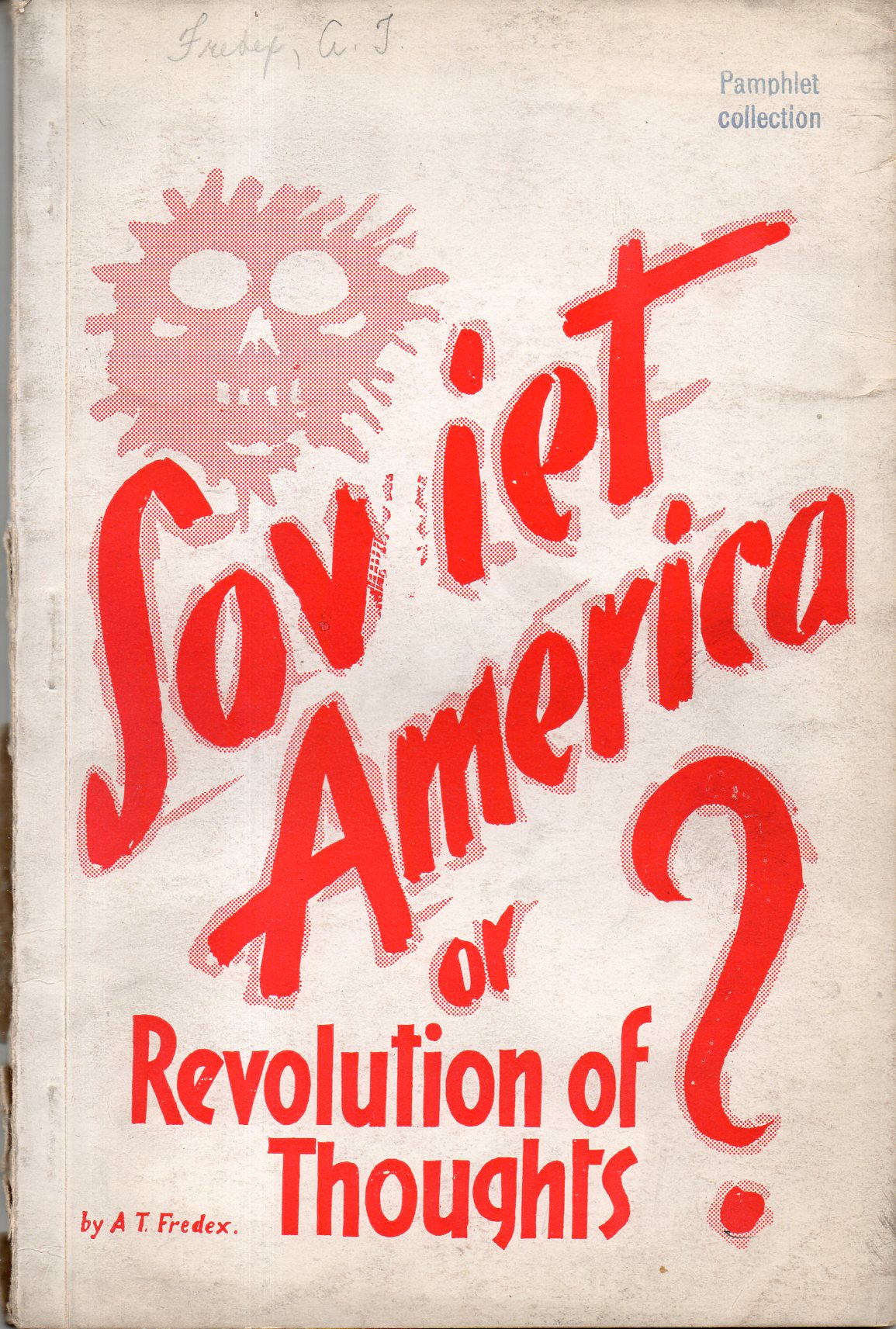
    I wondered about this pamphlet, with the odd cover design, odd question, odd feel, odd smell, odd paper.  It turns out that it is a raving, sodding racist work of low order and high hate.  

    We are told that Democracy is a menace in the United States now, with an uncontrolled melting pot, being overtaken by “inferior raced hodge-podge”, “inferior human material”, ranting against Democracy and Communism (as written and “contrived” by “the Jew” Marx and the “Half-Jew” Lenin), while the press continues to put out its “stupid emanations” and “poison” against the German government and the “tormented” German people.  

    And this is just from two paragraphs.  Quite remarkable, and about as bad as I’ve read. 

    Bottom line seems to have been that the U.S. is headed towards an unspeakable betrayal without a revolution of thought aligning the Anglo-Saxon elements against all of the other “filthy elements” of society.  Well.  ALl of these people are dead now, and the U.S. is doing okay, while the  dream-date Nazis of ’36 were gone nine years later.  

    Soviet America272

    ·Posted by :

    ·in:


  • Moving Manhattan and Brooklyn Together at the Speed of…Slow (1903)

    JF Ptak Science Books   Post 2299

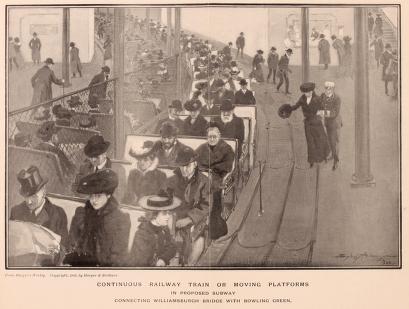
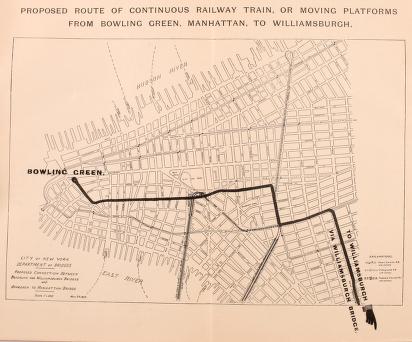
    If New York City was populated by nothing but people wearing hats, carried mink muffs, used gold-handled walking sticks, and really didn’t have to be anywhere at a particular time, then I think this invention might have been useful.  But seeing that off the engineer’s table that Manhattan was not god’s waiting room and far more Darwinian  than a high-Victorian imaginary noblese-chaste class of slow and deliberate people waiting to be waited on, then this idea wouldn’t have worked very well at all.  The seed of it all is found in Transportation of Passengers in Greater New York by Continuous Railway Train, or Moving Platforms.  Argument in favor of equipping the East River Bridges, and connecting subway to Bowling Green, Manhattan, with a continuous railway train or Moving Platforms, which was  prepared by Schmidt & Gallatin of New York in 1903.  It was only 20 pages, but it had  four folding plates, including two maps, and two drawings of the envisioned walkways, and that is the stuff upon which dreams are laid, made, and stayed.

    Sidewalks 3


    “Moving Platforms for the conveyance of passengers were recommended by Mr. Horace Greeley thirty years ago. They were successfully operated, first, at the World’s Columbian Exposition of 1893, where 2,700,000 people were transported. In 1896 they were installed at the Berlin Exposition, and again at the Paris Exposition of 1900, where they carried over eight million passengers. Few persons know what Moving Platforms are. From the face that sometimes they are called ” Moving Side- walks,” it is believed that they must be some sort of a pavement on rollers, on which it is difficult to step with safety and maintain equilibrium. The Moving Platforms are to all intents a railway, operated like other railways, propelled by electricity, with cars, seats, motors, passenger stations, ticket booths, guards, electric lights — in fact, everything belonging to a first-class railway.” 


    Sidewalks map


    “Where it differs from the ordinary railway is that the cars, or trains, are not running at intervals, but are coupled up continuously, so that there is no interruption of traffic at any time, but a large seating capacity at all times. It differs also in the construction of the cars, which are mere flat cars, provided with seats placed crosswise, and so ar- ranged that all rmssengers face in the direction of motion. Each of these seats may be made wide enough to accommodate one, two or more persons. The most approved plan is to provide seats on one side of the cars only and leave the other for passengers to walk, thus giving them an opportunity to further accelerate their speed if they so desire…”


  • Single-Line Entries of Revolutionary Ideas: the Transistor, (1949)

    JF Ptak Science Books   Post 2298

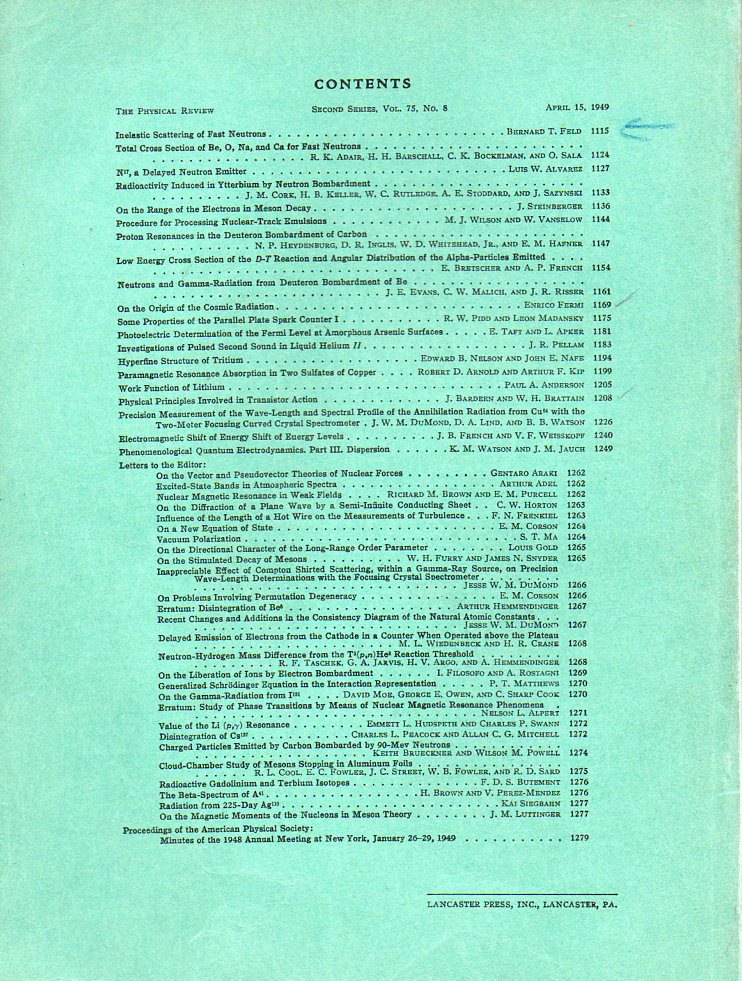
    Transistor 066
    One of the things I love about working my way through old scientific journals is when I find the issue that I’m looking for and scroll down the list of contributors to find the significant article that I want.  Long list, usually; and then, after making my way through 30 or 40 lines of tight type of the index I find it. [This by the way is one of those experiences that is being replaced by the digital library.]   Even though the paper on pp 1208 through 1226  of the 15 April 1949 issue of The Physical Review looks like any other, it is today seen as revolutionary. The entry for “Physical Principles Involved in Transistor Action” by John Bardeen (two-time Nobel in physics) and Walter Brattain (Nobel ’72) shows up about halfway down the index, sandwiched in some very good company (Enrico Fermi’s “Origins of Cosmic Radiation” and a number of others), and does not show up bolded, or highlighted, or with an asterisk.  Such is the nature of publication in the academic journal world, everything delivered with equal weight–the bolding stuff will happen later, in other venues.  But to see it right there in the flesh, so to speak, fresh and new and revolutionary, and looking like everything else, is really thrilling.  [See this entry for a similar report on the most valuable patent in history.]

    Transistor 064

    It makes me wonder though how it would’ve felt to open this journal for the first time back there in mid-April ’49, turning to page 1210 to see the microphotograph of the cutaway of a model of the transistor.  This was the defining technical publication on the transistor1, which was the first massive step towards microminiaturization and the explosive new growth in the computer, allowing far more powerful machines to be designed in far less space, in far less amounts of time, and on and on.  It is one of the first steps in the Information Revolution, moving the computer from massive racks of electronic tubes to more simple, elegant, nimble and by-far faster circuit boards with transistors (and resistors, capacitors, inductors, diodes, etc.) to make an electronic circuit.  This would be the standard for computer construction, only supplemented by Jack Kilby (TI)  and Robert Noyce (Fairchild Camera) in 1958/9 with the integrated circuit, where transistors are made smaller still and produced in groups on circuit boards rather than individually.

    The photo above shows a cutaway of the transistor, and is the first time it was published–the first photo of what was one of the 20th century’s greatest inventions. 

    Transistor 065

    Notes

    1.  The paper was published simultaneously in the Bell System Technical Journal; Bardeen and Brattain were with the Bell Labs.  The Bell journal also contained another revolutionary paper in the same volume, Claude Shannon’s “Communication Theory of Secrecy Systems”, which is one of the most important early papers on electronics and cryptology.

    The full bit: BARDEEN,  John and Walter Brattain:  Physical Principles Involved in Transistor Action;  Lancaster, Pa:  Physical Review,  1949.  1st edition.  The Physical Review, Vol 75, Second Series, No. 8    8vo.


  • Really Deep Depth: the Universe and SpongeBob SquarePants.

    JF Ptak Science Books   (Expanding an earlier post from 2013, but different enough to get its own Post # 2297)Follow Me on Pinterest 

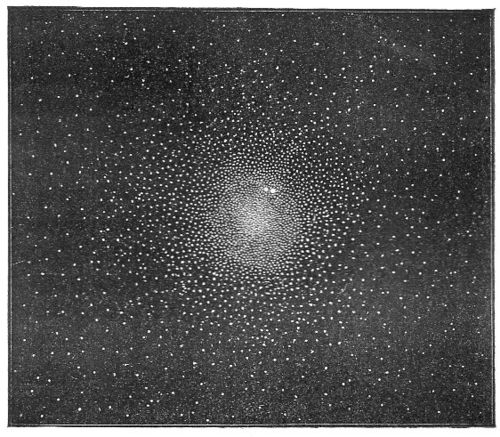
    Astronomy--47 Tuc189

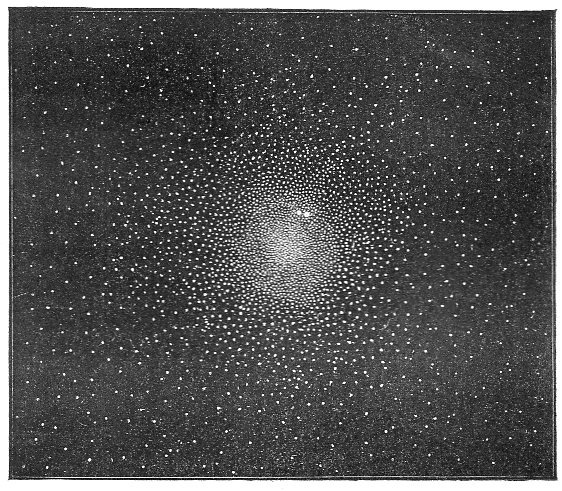
    Thinking about the depth of space and visually explaining it are two different things–vast numbers and the deepest depths, all colliding with the imagination, which really has a hard time keeping up with it all.

    This beautiful engraving appeared in Amedee Guillemin’s  Le Ciel: notions d’astronomie a l’usage des gens du monde et de la jeunesse, which was published by Librairie de L. Hachette and Company, and printed in 1865 (the images from which are available here). Guillemin (1826-1893) was a social/culture writer who became a very respected science journalist/writer, becoming very popular with works in physics, technology, astronomy and general science, many lavishly illustrated. 

    There are many striking images in this book, The Sky/the Heavens…, but I’ve chosen this one because it has a certain deep depth to it, and relays a complexity and distinctness to something that is generally imaged as being less so, being a massive star cluster and all.  Unlike many of his other books, the great illustrations here are the small text images, some only 25% of the page, and in most cases rendered sparingly, and with a real feel of “difference” to them (at least so to me).

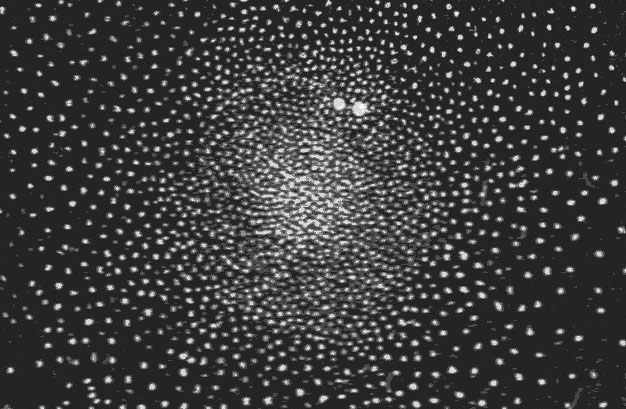
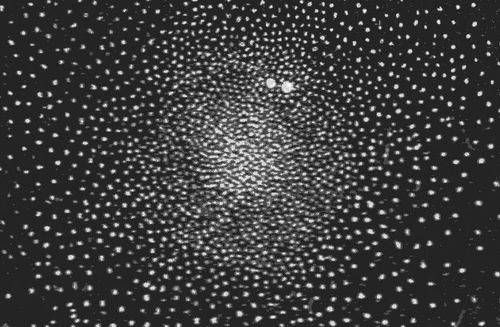
    The “Amas du Toucan”, known now more familiarly as 47 Toucanae or 47 Tuc (NGC 104), is a bright element in the southern sky, a huge cluster 120 light years wide and 16,700 light years from Earth, visible to the naked eye in the constellation Toucan (created by Petrus Plancius in 1598 or so).   And here it is, in a little 9×8 cm engraving with hundreds of white points as stars, made after an engraving of Sir William Herschel (1738-1822, a German-born English astronomer who–with his sister Caroline and brother John–spent decades observing and recording stars, double stars, clusters and nebulae).  
    Astronomy--47 tuc big detail

    47 Tuc was first catalogued as not-a-star by Abbe Nicolas Louis de Lacaille (1713-1762),  a French astronomer who found it too be too fuzzy to be a single star, and who produced a 10,000 (Southern) star catalog, Coelum Australe Stelliferum, which was published in 1762, and which also introduced 14 new constellations.  47 Tuc made another quick appearance in the great Catalogue des Nébuleuses et des Amas d’Étoiles (“Catalogue of Nebulae and Star Clusters”), a superb and meticulous work by Charles Messier, and published in 1771.

    But distances and depths such as we know them now were not-conceivable at this point for Guillemin–and really would be for another 60 years or so.  At this point, and for some time to come, the Milky Way was considered to be the entirety of the universe. The business of galaxies being outside of the Milky Way is a relatively recent development, determined so by Harlow Shapley in 1924, expanding the size of the universe ten-fold to 300,000 light years; this was blown up a quite a bit by Edwin Hubble in ’24 to 900,000 light years, and then five years later in one of his most famous papers Hubble blew the figure up a lot, expanding the universe to 280 million light years.  Walter Baade and others added to the figure in the 1950’s (4 billion light years or so), and during the 1960’s-1990’s the figure expanded to 25-30 billion light years, finding its way to 94 billion light years in 2006.  

    I would imagine that the concept of galaxies outside of our own, and that the universe was vastly larger than we thought, and that the potential for there being new/unforeseen discoveries was great, that in 1924/1929 it may have seemed somewhat like Galileo suddenly seeing an order of magnitude more stars than had ever been seen before by the naked eye…that the sky which had basically been unchanged in appearance to humans for thousands of years really wasn’t what people thought it was.  Perhaps it was like the Two Dimensional beings in Flatland  trying to comprehend the first appearance of a Three Dimensional entity.  Or of course the realization could have been like when Sandy Cheeks came to the shocking epiphany in an episode of the Immortal Sponge Bob Square Pants that the titanic battle she had been waging and ostensibly won with an Alaskan Bull Worm was just her fighting with the tip of the beast’s tongue–oh. Oh my.  Something along those orders.  Deep depth.  

    Sandy cheeks

    The Guillemin work is simply a lovely and elegant thing–one of many accomplishments in a beautiful and relatively simple book.