A Daily History of Holes, Dots, Lines, Science, History, Math, Physics, Art, the Unintentional Absurd, Architecture, Maps, Data Visualization, Blank and Missing Things, and so on. |1.6 million words, 7500 images, 4.9 million hits| Press & appearances in The Times, Le Figaro, Mensa, The Economist, The Guardian, Discovery News, Slate, Le Monde, Sci American Blogs, Le Pont, and many other places… 5000+ total posts since 2008.

Category: Social History

  • Time, Motion, and Awe in Regards to Moving Pictures

    JF Ptak Science Books   (This is a revision and expansion of a post from 2012.)
    Backwards--magritte

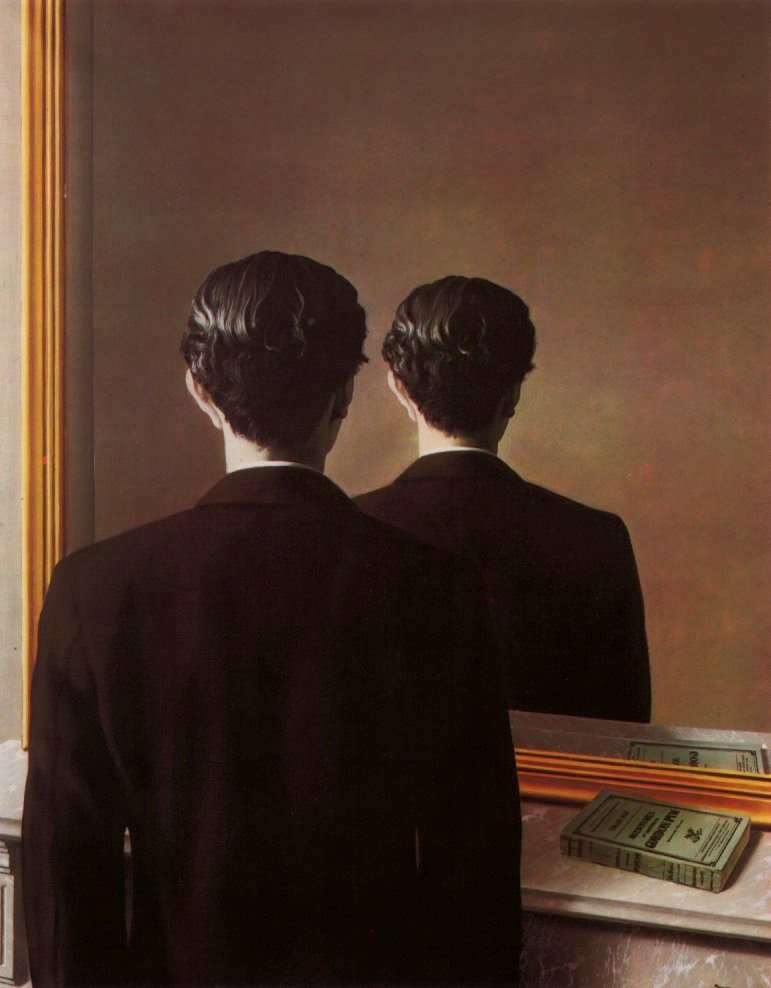
    Leonardo wrote backwards and from right to left, Benjamin Button lived backwards at the hands of Scott Fitzgerald, Rene Magritte’s man in the mirror saw the back of his head, Ignatz the Mouse I am sure saw the back of his head looking around the world with the world’s most powerful telescope, rugby passes are all done backwards, paper images of vue optiques appear backwards, lightning for all intents and purposes starts backwards from the ground up, reverse mathematics are worked from theorems to axioms, the Chicago River (1900) was engineered to flow backwards for the foreseeable future, while the Mississippi River famously flowed backwards for just a bit in the New Madrid earthquake of 1812. 
    Backwards--marey12

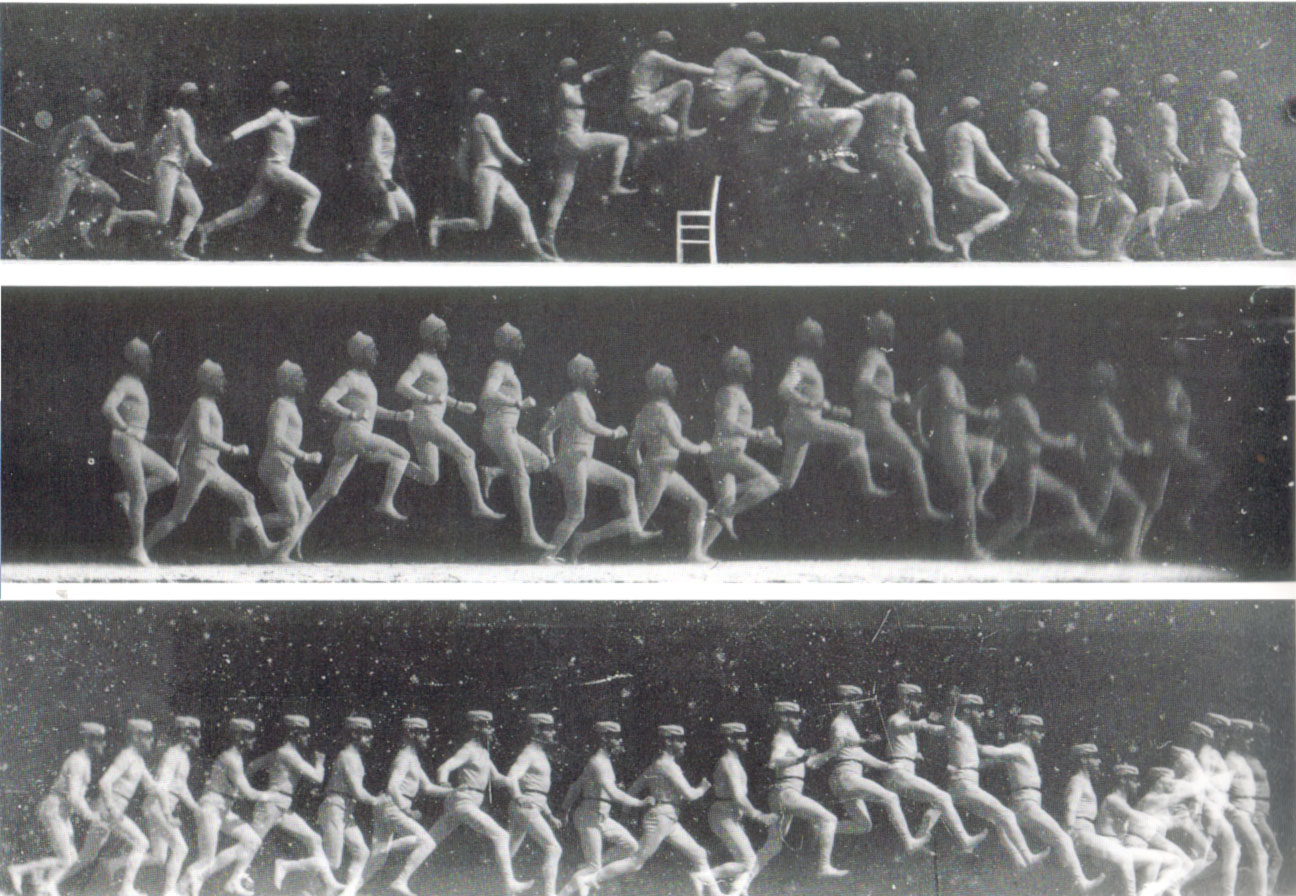
    I can only imagine what audiences must have felt when they saw the first moving pictures played backwards–seeing them played forwards was a novel-enough (and revolutionary) idea, but the simple idea of reversing the direction of the film would have proved to be equally fascinating.  Imagine the first time you witnessed a staged train wreck on film, back there in 18951, and imagine being able to see it played over and over again, until you were filled.  I’m not so sure that there were even any still photographs of a train wreck as it occurred to this point, even with advances in film speed and lens, so seeing the even unfold in front of you at leisure must have been overwhelming.  Now imagine these same folks seeing the event and watching the locomotives reconstitute themselves.  It would have been an extraordinary event.  Even observing the Marey sequences (above) and seeing what actually happens when a person bends over to pick up a pail of water would have revealed almost as much in new detail as when Galileo was in the middle of his earliest observations. 

    In a way the chance of controlling the direction telling of a story and seeing it displayed via moving images, and being able to see them backwards, may well have seemed a form of third-person time travel.  This came on the heals of what is for all intents and purposes the first time travel novel in  H.G. Wells’ (also in) 1895 The Time Machine (appearing earlier as “The Chronic Argonauts,” in 1888)2 and Mark Twain’s 1889 but much earlier than the first motion picture to use the idea of time travel (which was in 1921 and based on Twain’s work).  Being able to show a motion picture, and then stop it at will, and then reverse the order of time to begin everything all over again–visually–must have seemed a magnificent advantage. 

    And so to this end I’ve got the following few questions for which I have no firm answers:

    1. When was the first time people saw moving images of a of a currently deceased person? That is, when did the first dead person become “reanimated” by virtue of their images being captured by a motion picture? This question could be asked of the first viewing of a photograph of a dead person, and also the first experience of listening to a now-dead person whose voice had been recorded by an Edison machine, but I think the moving picture element is much more powerful. 

    1. When exactly was the first viewing of backwards motion, of seeing action in reverse?

    2. When was the first viewing of a continuous moving picture in which motion was purposely interrupted ?

    I’ve probably overlooked some long list of “firsts” in film, somewhere, but for now these questions are still questions. If anyone out there has answers, I’d love to hear them. 

    Notes:

    1.  It is interesting that this very early motion picture , made by the great scientist-brothers Lumiere, l’Arrivee d’un train en gare, was produced in the same year as the Wells book.  Just two years later, the Lumiere Brothers published a catalog of their available movie strips, numbering 338 productions.  In 1898, after six catalogs, there were over a thousand strips.  This is remarkable, especially considering that there wasn’t a cinema industry yet.  The Lumieres are an interesting pair of people (both of whom survived their invention by about a half-century), making perhaps the most important discoveries in the history of cinema, and continued to be interested in other fields throughout their lives.  The cinema-industry part of their work didn’t seem to interest them all that much. 

    The history of moving images is complex and long.  I’m not saying at all that it begins with the Lumieres, or with Edison, as the pre-1900 field is well sprinkled with different and interesting attempts at fooling our eye–Chronophotograposcopes, Counterfivoscopes, Phantasmagorias, Klondikiscopes, Vileocigraphiscope, and so on, are just a few examples of the many attempts at locating the seat of photographic motion in the brain.  There are very early efforts, principally by J.A.F. Plateau (1801-1883) who rediscovered in 1829 the “persistence of vision” effect in which the eye will see a continuous stream of images if presented with a flow of static pictures at 16 frames per second over a one second period, which of course is the basis for the rest of everything that was to come.  There’s much more, but I wanted to at least point out these few important bits. 

    2..  I’m not sure what to  with Mr. Dickens, if he fits in this order with the time traveling Scrooge in A Christmas Carol (1843), or not.  Perhaps he does, and if so, then he precedes Mr. Wells, though the latter’s time traveler is outfitted with a machine and a scientific basis for the belief in it.  At the very least he is worth mentioning in the same moment.

  • The Fires of London, 1832

    JF Ptak Science Books  Quick Post

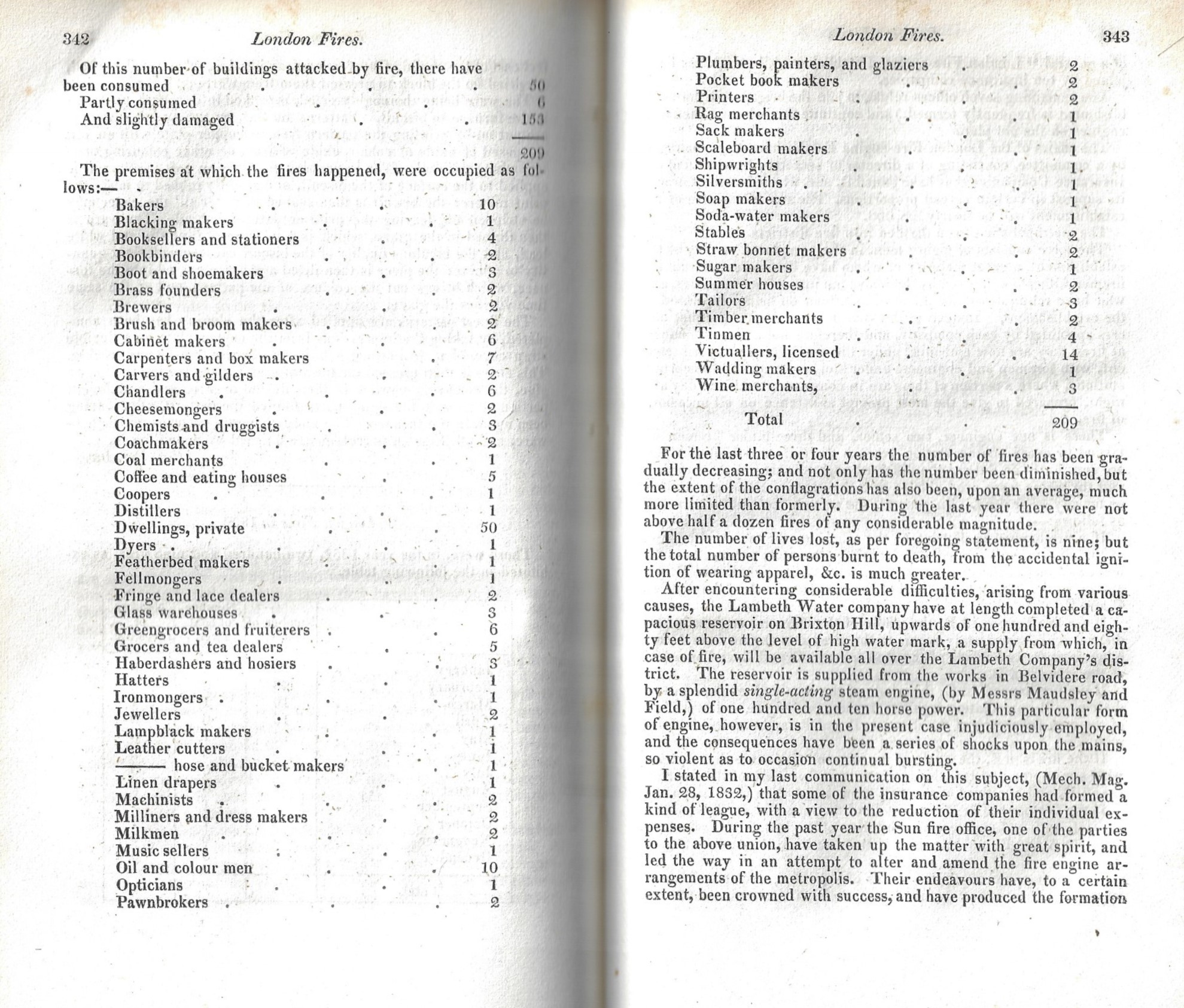
    This bit of not-common data (below) just came to me while I was fussing around in a volume of the Journal of the Franklin Institute (January-June, 1833), and details the fires and the businesses in which they started. It is a curious bit, reminding me of a post I did some years ago about Charles Babbage’s tour of the broken windows of London. There were 209 fires, which really doesn’t seem to be an awful lot, all things considered. The business, though (“the buildings attacked by fire”), the ones consumed by fire, are mostly in themselves consumed now by time. Blacking makers, brass founders, brush makers, carvers and gilders, coachmakers, coopers, feltmongers, fringe makers, lampblack makers, milkmen,, , oil and color men, rag merchants, sack makers, scaleboard makers, straw bonnet makers, tinmen, and wadding makers, are all pretty much gone as standard enterprises. 

    JFI 1833 Fires in London

    ·Posted by :

    ·in:

    —

  • One of the Earliest Appearances of “Arbeit Macht Frei” (Spring, 1944)

    JF Ptak Science Books   Post 2788

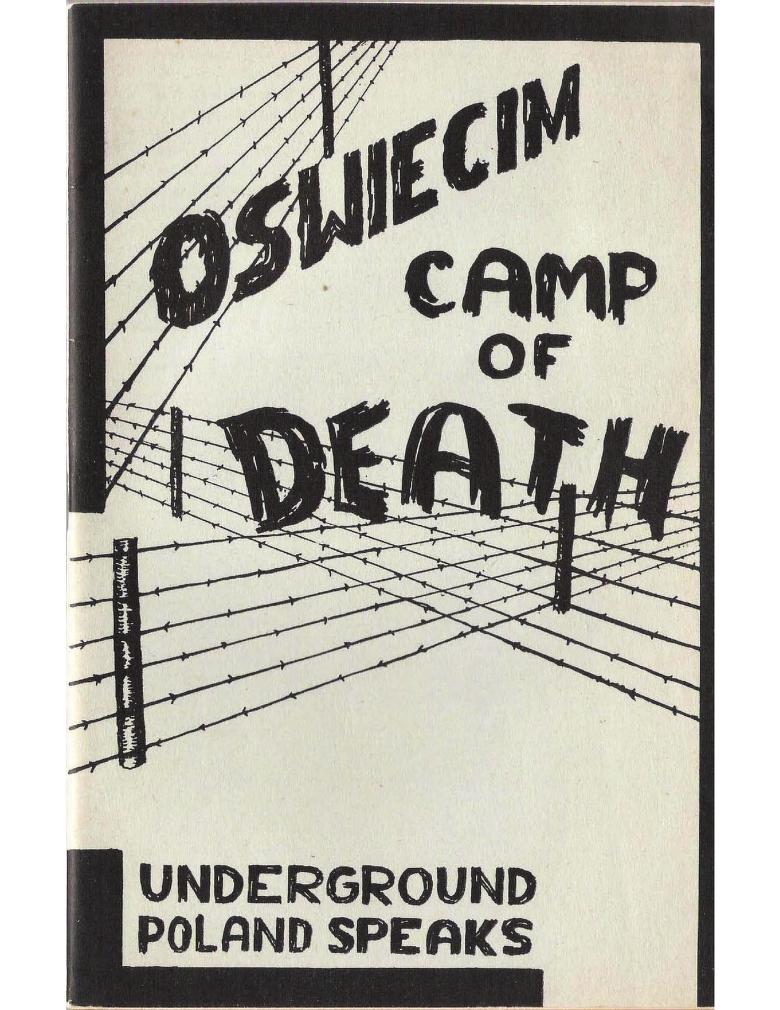
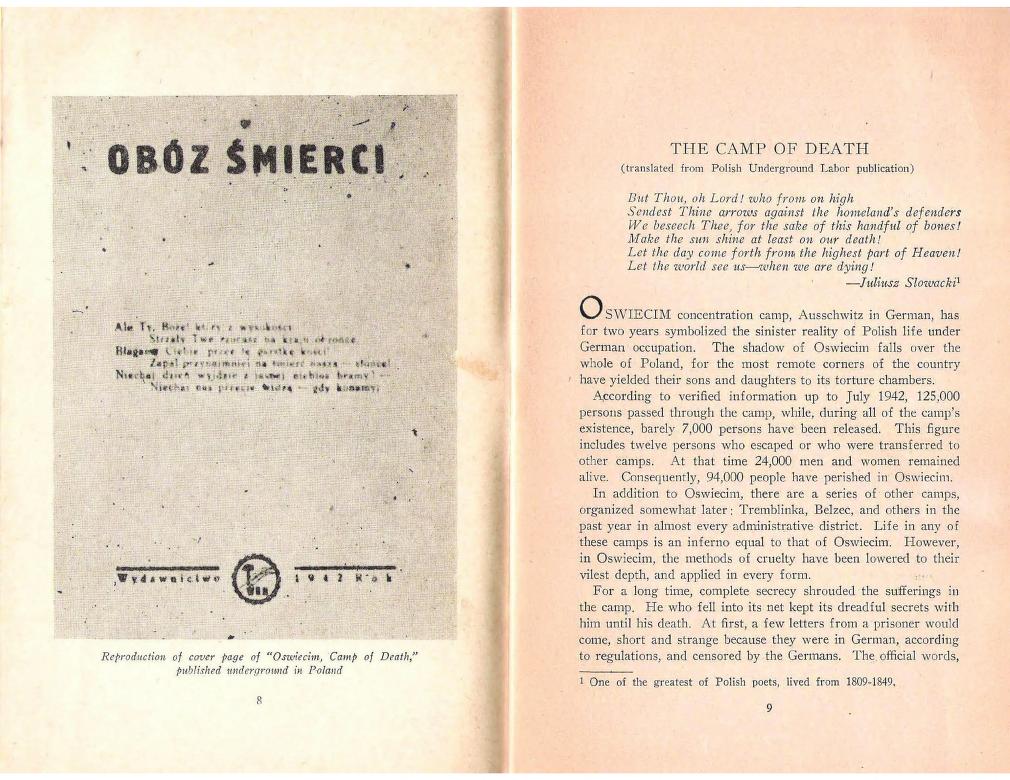
    Auschwitz 1944 English titleI stopped by my old friend the amazing Andy Moursund’s fantastic Flickr site, where in just the first 30 seconds or so I needed to stop and follow Andy’s lead on an astonishing book. The cover1 is stark, and justifiably so as  Oswiecism—Camp of Death. (Underground Report)2 is one of the earliest separately published reports on Auschwitz, published in March, 1944. (Auschwitz, which is the German rendition of the Polish “Oswiecism”, comes into being in May 1940, grows by 140,000 prisoners in March 1941, another 200,000 in 1942, and then many more until the end, when something on the order of 1.1 million people were murdered there, 90% of them being Jewish.)

    See Andy’s site here: https://www.flickr.com/photos/145907841@N08/albums/721577056751817750

    I checked the title on the internet archive, where there is a full-text copy available to read (here:

    https://archive.org/details/OswiecimCampOfDeath/page/n1

    Reading this pamphlet is a very stiffening experience, even if you have a background in reading about the Holocaust.

    I imagine too that this may be one of the earliest appearances in print of the hellish sign at the entrance to the KZ, “Arbeit Macht Frei” (“Work Brings Freedom”).

    We read of it on page 24 of the pamphlet:

    “HERE is a large sign over the camp entrance with the words “Arbeit Macht Frei”, (“Work Brings Freedom”), while from any spot in the camp one can see the huge chimney of the crematory. It is an ugly, brownish red.”

    “A prisoner’s life moves between these two points — the sign and the chimney —from the moment he “loses” his life when he enters the camp until the moment he “regains” it as a bit of ashes coming from the crematory.”

    “Surrounding the camp for an area several miles in width are cultivated fields from which the previous owners have been evicted. Many farm buildings and workshops adjoin the camp and its barracks. Scores of miles beyond the actual camp boundaries are the coal mines. All work, above ground or underground, is done by prisoners. They till fields, build houses, mine coal, load and unload trains. They produce goods of which only a part is for the camp; the major share goes to the German army…”

    Auschwitz 1944 polish version

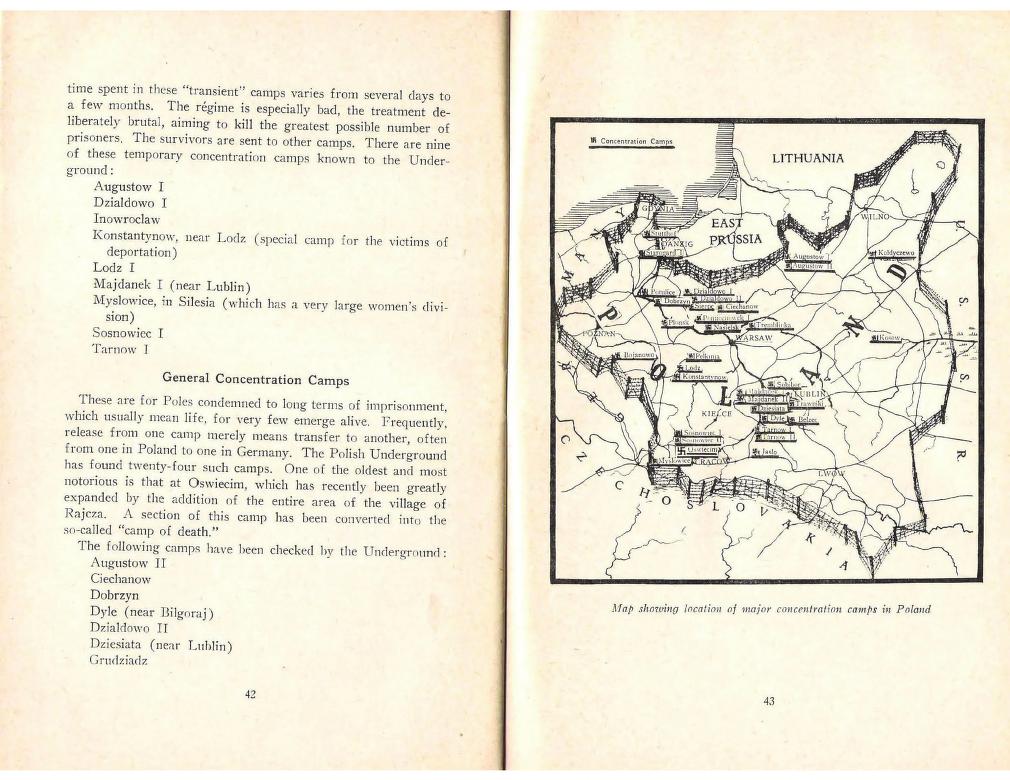
    And of further interest is this map of concentration camps in Poland:

    Auschwitz poland map

    Notes

    1. Cover by Teresa Zarnower (Teresa Żarnowerówna was a Polish avant-garde artist, painter, sculptor, scenographer, and architect). “One of the most important artistic personalities of the Polish constructivist avant-garde in the 1920s…” (Jewish Women’s Association Archive)
    2. Oswiecism—Camp of Death. (Underground Report), Sponsored by NATIONAL C.I.O. War Relief Commission, First Edition: March 1944. Copyright 1944 by Poland Fights New York, N. Y. Sponsored by American Friends of Polish Democracy; Published by Poland Fights, 55 West 42 Street, New York 18, N. Y. Assisted by Polish Information Center

    ·Posted by :

    ·in:

    —

  • Infiltrating Fascist Sympathizer Groups in the U.S. (1943)

    JF Ptak Science Books  Quick Post

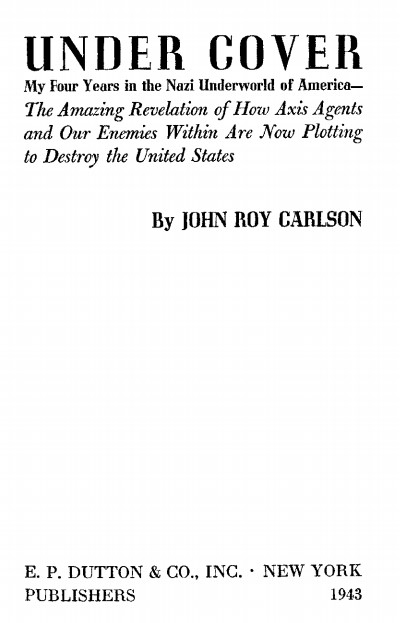
    UndercoverJohn Roy Carlson (the pseudonym of Arthur Derounien, 1909-1991) was an investigative journalist and during WWII he went undercover and infiltrated many of the right wing/fascist/”patriot” groups operating in the U.S.  The result of that work as a  well-received book called Undercover, My Four Years in the Nazi Underworld of America1, which was published by Dutton in 1943 and which went through seven printings in its first two months of publication.  It wasn’t yellow journalism, either–it was an expose of Nazi and fascist sympathizers, who–even after Pearl Harbor–supported the ideas of fascism.

    Derounien was a busy man, joining and infiltrating such groups as:

    • National Socialist White People’s Party (formed by George Lincoln Rockwell in a shabby store front on Wilson Blvd in Arlington,Virginia, and renamed the American Nazi Party in 1960);
    • Christian Mobilizers (allied with the Bund, this was a militant arm of the Christian Front which had a more-militant spin-off in the American Unity Party);
    • America First Committee (a mixture of patriotic, isolationist far right-wing and Nazi sympathizers, infamously spearheaded by Lindbergh, the group disappeared on 7 December 1941; 
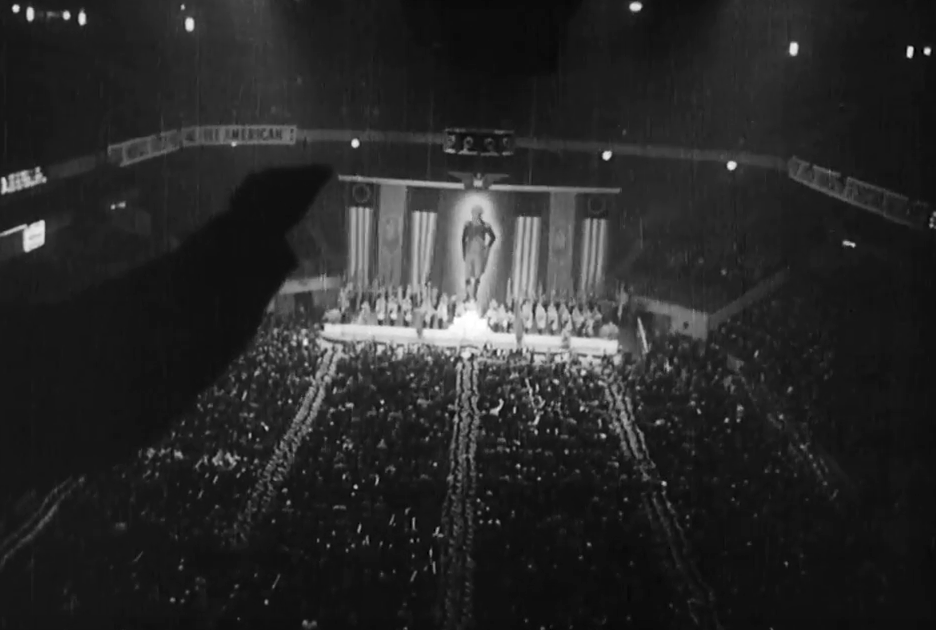
    • German American Bund, (a loud German-patriotic pro-Nazi group which filled Madison Square Garden in 1939 with 20,000 members, sweatily drenched in Hitler rhetoric, an enormous portrait of G. Washington, Brownshirts,  and swastikas: https://www.theatlantic.com/video/index/542499/marshall-curry-nazi-rally-madison-square-garden-1939/);

    plus the Gray Shirts (not to be confused with local boy Pelley’s Silver Shirts, abandoned after his jail sentence for sedition and replaced in the 1950’s with his new religion of UFOs and religious-something called “Soulcraft”), American Nationalist Party, American Women Against Communism, The American Defense Society, Anglo-Saxon Federation of America, National Workers League, Yankee Freemen, Flanders Hall, American Patriots, and others2–it was a very impressive undertaking. 

    Nazi Madison Square[German American Bund at Madison Square Garden, 20 February 1939.  Source: https://youtu.be/WpaYQqzFouw]

    His book had a very wide impact, contributing to some degree in bringing together thirty leaders of such groups to trials for sedition during wartime. Carlson had in the intervening year or so, 1943/4, been subject to many accusations and charges of being an enemy alien himself, or Communist, or something–accusations initiated by many of the groups that he exposed. So it seems that in preparing himself for the trials to come that in anticipation of more libels to come Carlson published this short broadsheet call Under Cover News, which appeared five days before D-Day, June 1, 1944.  In it he asked himself questions that he thought his detractors might ask, and answered them. 

    Note:

    1.  Full text is available here: http://dlib.nyu.edu/undercover/sites/dlib.nyu.edu.undercover/files/under_cover-%20john%20roy%20carlson-1b.pdf

    2. A fuller list of the organizations:
    American National-Socialist Party, German-American Bund, Christian Front, The Ultra-American, Nationalist Party,
    American Nationalist Party, American Women Against Communism, The Gray Shirts , America First Committee,
    No Foreign War Committee, Christian Mobitizers, American Destiny Party, American Brotherhood of Christians
    Congress, The Ethiopian Pacific Movement, Citizens Protective League, Social Justice Distributors Club,
    The American Defense Society, Anglo-Saxon Federation of America, Paul Revere Sentinels, Ra-Con Klub,
    Crusaders for Americanism, Inc.


    ·Posted by :

    ·in:

    — —

  • The Situation of the Jews in Europe, a 1941 Assessment

    JF Ptak Science Books   Quick Post

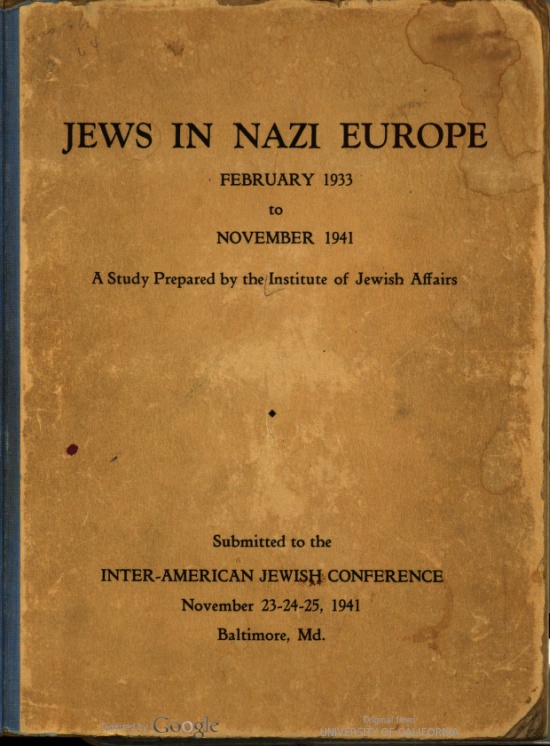
    Jew in Nazi Europe 1941Jews in Nazi Europe, February 1933 to November 1941; a study prepared by the Institute of Jewish affairs, submitted to the Inter-American Jewish conference, November 23-24-25, 1941, Baltimore, Md., .Institute of Jewish Affairs.Institute of Jewish Affairs, [New York, 1941]. This 175pp (or so) report made at the end of 1941 was a sort of census about what was happening  to the Jews delegated in geographical sections, at the end of which was an overview summation. The writer(s) were seeing things accurately in terms of overall viciousness towards the Jews, and amongst other conquered peoples, but did not see the full and overwhelming, impossible, extent of the situation and the enormous numbers, not in 1941. (In that year alone, addressing solely the construction of concentration camps, six death/extermination camps were constructed in Poland, including Auschwitz-Birkenau, Treblinka, Belzec , Sobibór, Lublin ( Majdanek ), and Chelmno, with the result of murdering millions.)

    This from the “Conclusion”:

    “How does the general picture of Jewish life in Axis Europe look? The most important elements are the following: 1. Decrease in the number of Jews in Europe At the beginning of 1933» the area now under Axis domination had a population of about 8,500,000 Jews. Since that time, about 600,000 Jews have migrated. Another 400,000 are now homeless refugees, interned in concentration camps, building railways in deserts, waiting vainly in harbors for a ship, rotting on floating prisons, in the heat of the Sahara and in the cold of Siberia…addition, hundreds of thousands of Jews of the Soviet Union have been forced to leave their homes as evacuees and as refugees. The Jewish birth rate has been decreasing steadily during this period, while the death rate has been increasing at an accelerated speed of between five and ten times the normal pace. The population has been further decimated by the death of thousands in concentration camps, at the hands of the Gestapo and in the flames of total war, while many thousands more took their own lives in hopeless despair…”–Jews in Nazi Europe…, final section (unpaginated). 

    The entire document is well worth reading: 

    [Source for page images: https://babel.hathitrust.org/cgi/pt?id=uc1.c070874352;view=2up;seq=1

    [Source for text version: https://babel.hathitrust.org/cgi/ssd?id=mdp.39015002352097;seq=303;num=

    ·Posted by :

    ·in:

    —

  • Finger Prints by Wire (1921)

    JF Ptak Science Books  Quick Post

    The use of finger prints in identification is fairly old, used in Asia and India long before it became a popular practice in the West.  Also it seems that finger prints as forensic instruments occurs in literature before it occurred in actual police work. Mark Twain uses finger prints as essential legal elements (as well as comic relief) in his novels Life on the Mississippi (1893) and Puddn’head Wilson (1894), no doubt inspired by Francis Galton’s pioneering work on the subject (Finger Prints, published in 1892). Conan Doyle takes things a step further and describes the forging of finger prints, which I think was a brilliant idea.  All of this takes place before finger prints were more or less firmly established as an identifying tool, as the first conviction based on finger print evidence did not occur (in Great Britain) until 1902, while its weight in the conviction of murderers wasn’t felt until a first conviction was made using them in 1905 (and then 1910 in the U.S.). 

    Finger prints _1_

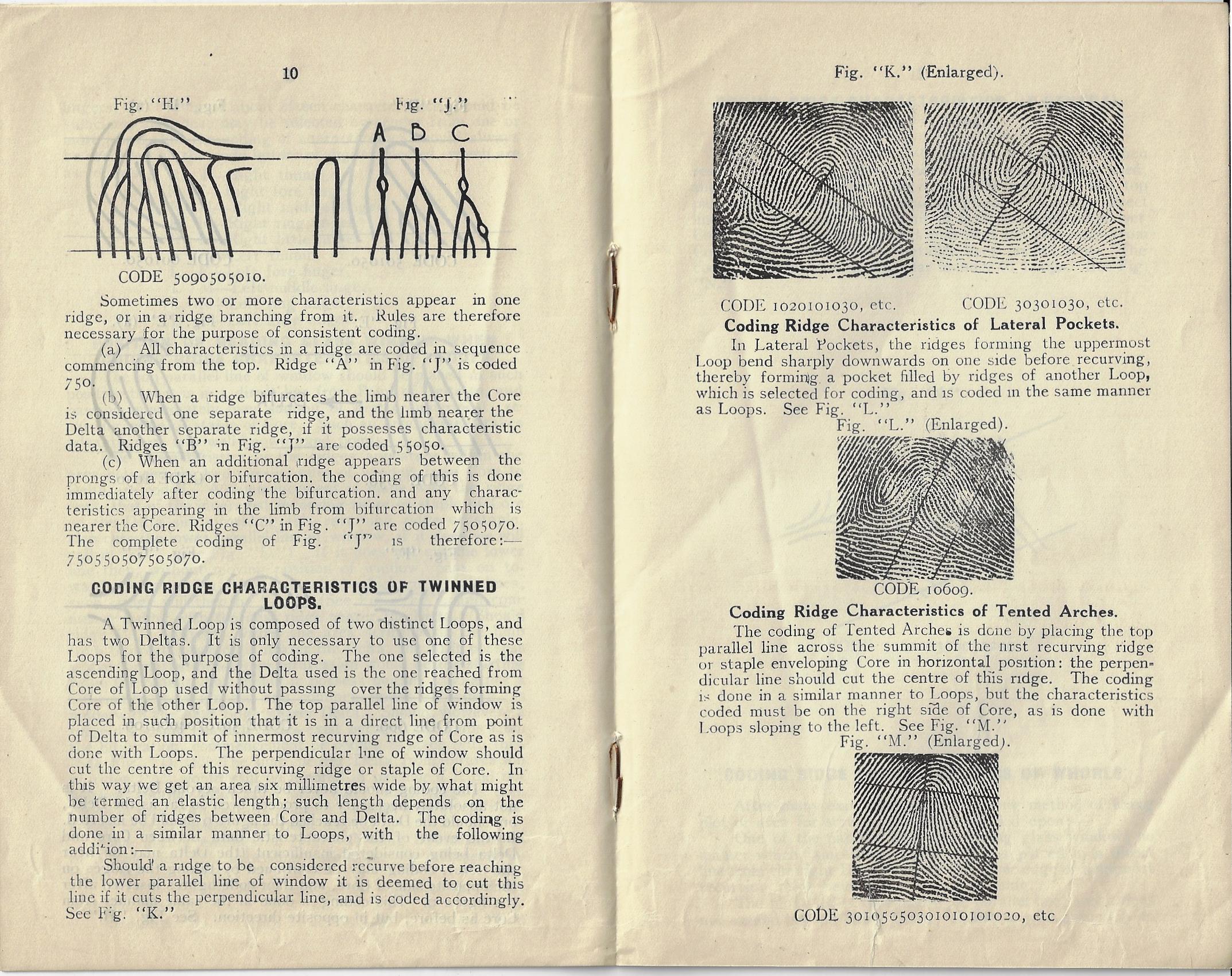
    Which brings us to these fascinating images of finger prints and their enumeration and transmission by wire,  which was the brainchild of the foremost finger print expert in the U.K., Detective Chief Inspector Charles Stockley Collins1 (M.B.E.), chief of the Finger Print Bureau at the New Scotland Yard.  I cannot determine how long in advance of this publication that he employed the idea of transmitting finger print data by telegraph, but it seems to be an excellent idea, sending important information relatively instantly over distances to help in conducting criminal investigation. It may be that this idea–far in advance of modern transmission practices, even though Arthur Korn’s first “facsimile” images were made as early as 1902–was seen at the time as both fantastic and obvious, the second impression coming almost immediately on the heals of the first, like one of those terrific ideas that seemed “obvious” once it was first stated.

    Notes:

    1. Charles Stockley Collins. A Telegraphic Code for Finger-Print Formulae and a System for Sub-Classification of Single Digit Impressions. Published at the Office of the Police Chronicle, London, (1921).  9×6″, 17pp, with two plates and 15 illustrations/drawings in text. Provenance: Library of Congress, with their rubber stamp surplus/duplicate on the front cover. There are only two copies of this work located in WorldCat/OCLC (Cornell and the British Museum); for all of what Mr. Collins accomplished, this seems to be his only publication outside of journals. 


  • A Small World of Rubber Bands and Erasers (1903)

    JF Ptak Science Books   Quick Post

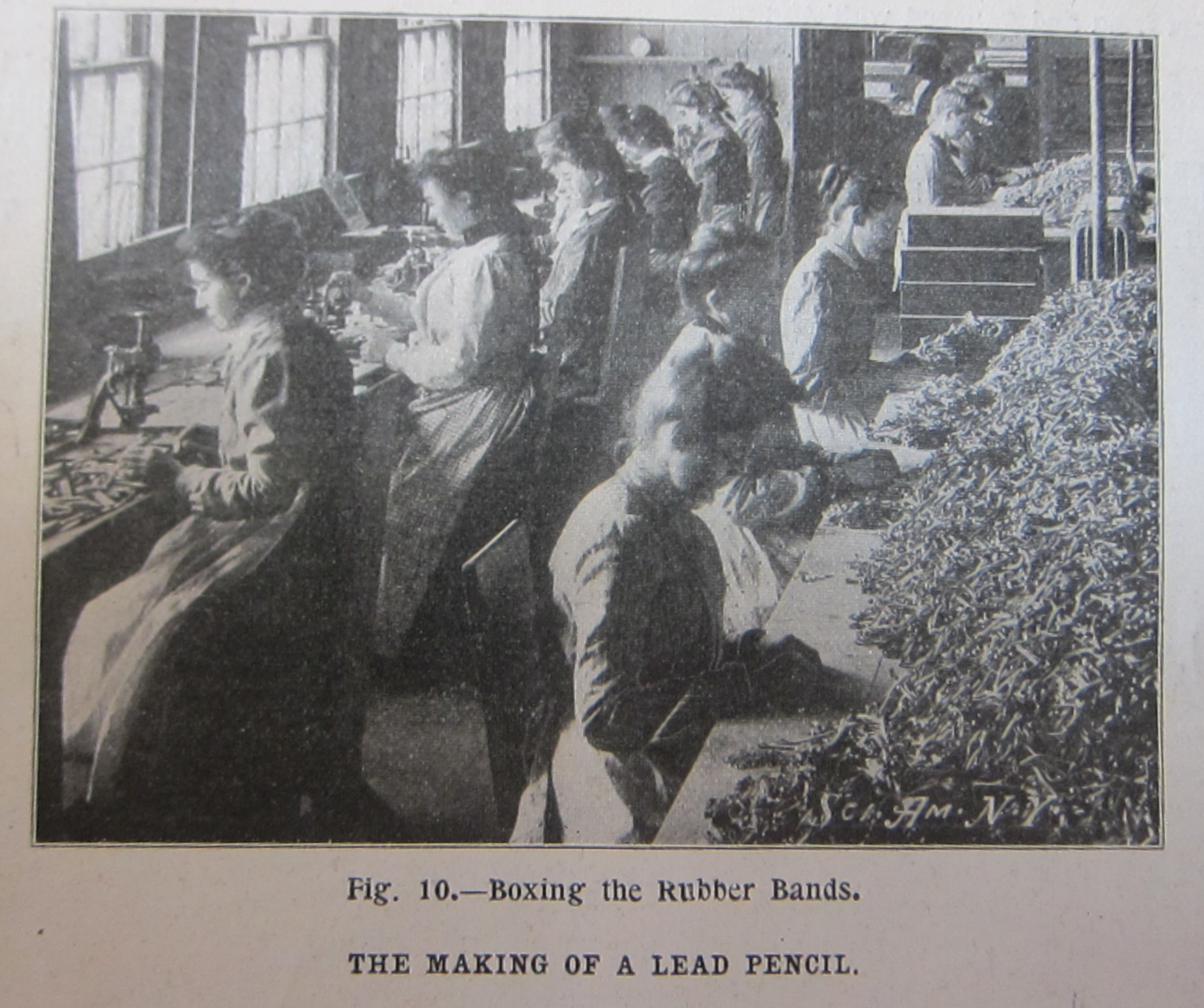
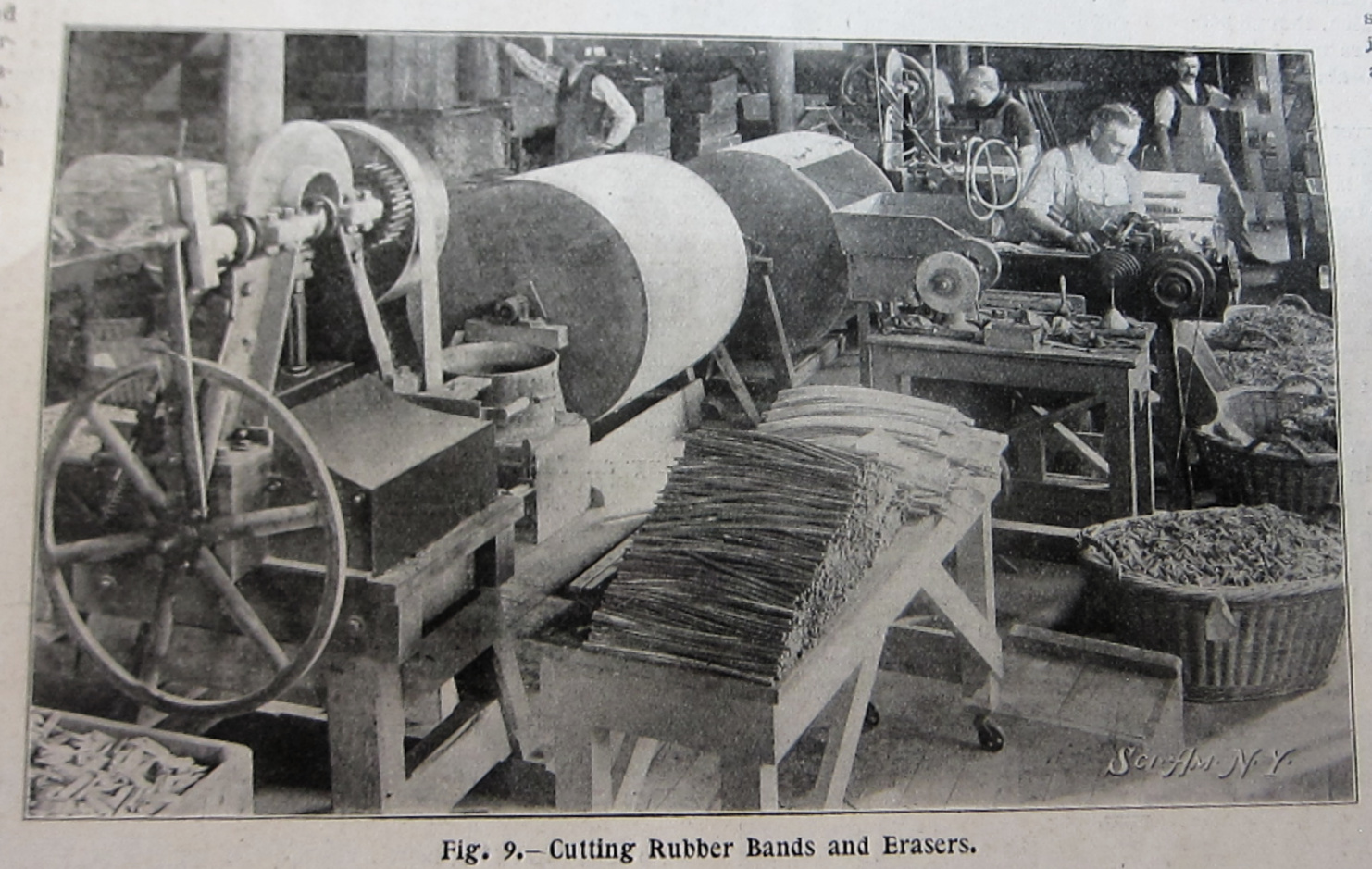
    Back in the days of burgeoning human-machine interfaces there were many industries employing some automation and independent machine operating assembly lines, though there were many more in 1903 that were not. This pictures struck me for the number of people working on what looks like an endless mountain of little tasks combined to make a little product, though there was nothing “little” about the labor that went into it all. In this case, it is a “lead” pencil and rubber band manufacturing establishment, and appears in a rather lengthy article in Scientific American for August 22, 1903. The machines seem to be run by hand, though there were a number of steps int eh process that were hand-done, including gluing the graphite into the pencil, polishing the wood, stamping the pencil, and applying the metal tips for the eraser (called “ferrules” which I hadn’t known about before) and the erasers themselves. An offshoot of the eraser here was the production of rubber bands, and as we can see below the work of sorting and boxing them was dauntingly accomplished by hand.  I wonder what the working conditions were like, and if any precautions were taken with the graphite dust that must’ve been misty here and there in the factory…

    Sci AM 1903 rubber bands _2_

    Here’s the rubber being prepared for both pencil and rubber bands:

    Sci Am 1903 Pencil rubber bands


  • Rising to a Higher State of Misery–Are You Outread by Victor Frankenstein’s Creation?

    JF Ptak Science Books   [An earlier Post from 2014, expanded]

    “Did I request thee, Maker, from my clay
    To mould Me man? Did I solicit thee
    From darkness to promote me?”–John Milton, Paradise Lost (X.743–5)

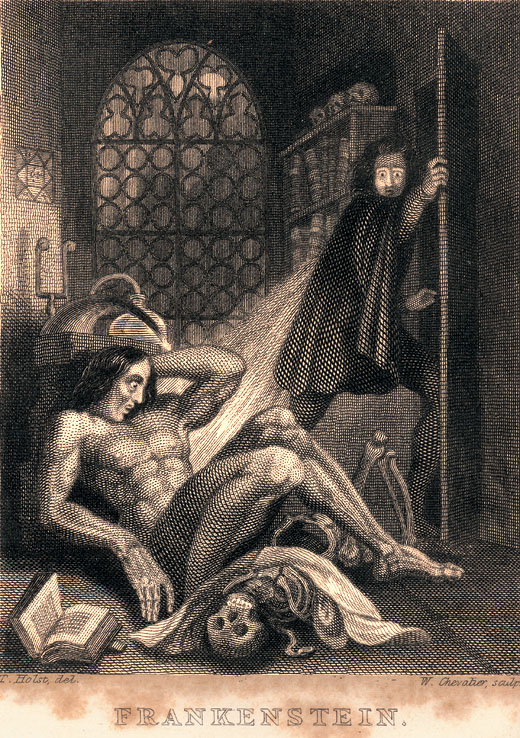
    Frankenstein_2_The animated human created by Victor Frankenstein in 20-year-old Mary Shelley’s anonymously published Frankenstein, or the Modern Prometheus (1818) was a far more intelligent being than portrayed in the many movies and stage productions that made the novel famous. “Frankenstein” usually refers to Dr. Victor, not the creation, who refers to himself as the  possible “Adam” of his maker’s labors (and then later as Victor’s “Fallen Angel” following his murderous and nearly-uncontrollable rage), while elsewhere in the book he is called “it”, as well as “being”, “creature”, “daemon”, “Fiend, “monster”, “vile insect” and “wretch”,  among other adjectival variants. 

    [Illustration at left by Theodor von Holst for the 1831 edition of Shelley’s book.]

    He has been “Frankenstein” as much as he has been the “monster”, and portrayed so in so many films and other adaptations that there is a virtual dictionary of the actors who have played the role. So many, in fact, that there are near duplicates of the actors’ names (as with for example “Gwynn” and “Gwynne”, and “Sarazin” and “Sarandon”). Actors have changed in the role but the iconic makeup first worn by Karloff remained the same after Karloff signed off from the role, though in a twist he returned to play Victor in a later movie. In another variation “Frankenstein” remarks that Dracula is his “master” (I think this is in Abbott and Costello Meet Frankenstein), and in a Hollywoodish irony Lugosi the master tries his hand in one film to portray Frankenstein himself. There are very few instances where Victor’s creation is portrayed sympathetically, at least before the 1980s. Generally he has been slow-witted, slow-footed, unintelligent and unremarkable, with little reasoning power and almost no verbal skills, none of which have anything to do with Shelley’s character. The adaptations seem to just appropriate the horror aspects of the novel, detach them, and sink them solely into the Boris Karloff character, which seems to have sold a lot of popcorn.

    “Remember that I am thy creature; I ought to be thy Adam, but I am rather the fallen angel, whom thou drivest from joy for no misdeed. Everywhere I see bliss, from which I alone am irrevocably excluded. I was benevolent and good; misery made me a fiend. Make me happy, and I shall again be virtuous.”

    Mostly the creation in Shelley’s text is referred to as a “monster”–the word being used 35 times, mostly in reference to Victor’s animated man.

    It is difficult to refer to the creation as a “monster” once you get to know him a little—he is exceptionally smart, teaching himself to read, and then reading difficult and complex works with deep understanding, which is hardly something that is expected from what Boris Karloff gave to us.

    This man is deeply conflicted, and in chapter 13 he says:

    “Was I, then, a monster, a blot upon the earth, from which all men fled and whom all men disowned?”

    “I cannot describe to you the agony that these reflections inflicted upon me; I tried to dispel them, but sorrow only increased with knowledge. Oh, that I had forever remained in my native wood, nor known nor felt beyond the sensations of hunger, thirst, and heat!”

    And then, in a couple of pages in chapter 15, we are given a great insight into this man, as he is about to understand these agonies via a discovery of three books in a portmanteau. These included The Sorrows of Werter by Goethe, a section of Plutarch, and John Milton’s Paradise Lost. The reading appears to elevate his state of understanding and of his misery, particularly with the Goethe.


  • A World Going on, Underground: Tugger Boys, Trench Blasters, George Orwell, & Tom Waits

    JF Ptak Science Books   [An earlier post from 2008, expanded]

    Underground working steep102


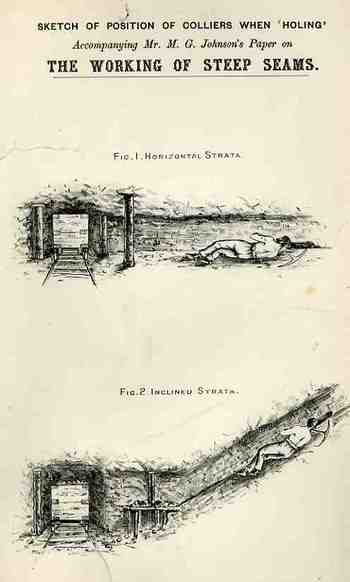
    Looking at these two images of the shirtless miner laying down and working on his side in the semi-dark way underground in what looks to be a tunnel about twice the width of his shoulders makes you wonder about how in the name of great bog could people have done this, day in and day out.  The fact that the appearance of these images were both essential and mundane further tells us—as we sit here in a comfortable chair in the print’s future—that this is, simply, what people did, and what they had to do.

    Blogjuly_17_work334

    This was “holing”, as in working in a hole, and served to illustrate a point in Mr. M.G. Johnson’s paper “The Working of Steep Seams”, which I think appeared in a West Australian mining journal around 1900.  It seems that the miner in the picture would spend his day chunking coal from a hard vein, laying down, scrapping (I think) away at the coal in a too-tight tunnel.  Did he do this for hours?  Days?  Weeks?  I guess the bad answer is that he did this as long as the coal could be followed, though I suspect that the miners must’ve traded out positions to prevent any one man from doing this sort of extremely difficult work for too long, sharing the responsibility of The Bad Job.  (Also, it looks as though that the major tunnel in which the coal car is located may be 4 or 5 shoulders high—certainly not tall enough to walk in, which means that this guy could’ve crab-walked to this position for a half mile or more, just to get to work.  The tenacity of this worker to do his work and collect his pay to feed his family was just incredible. 

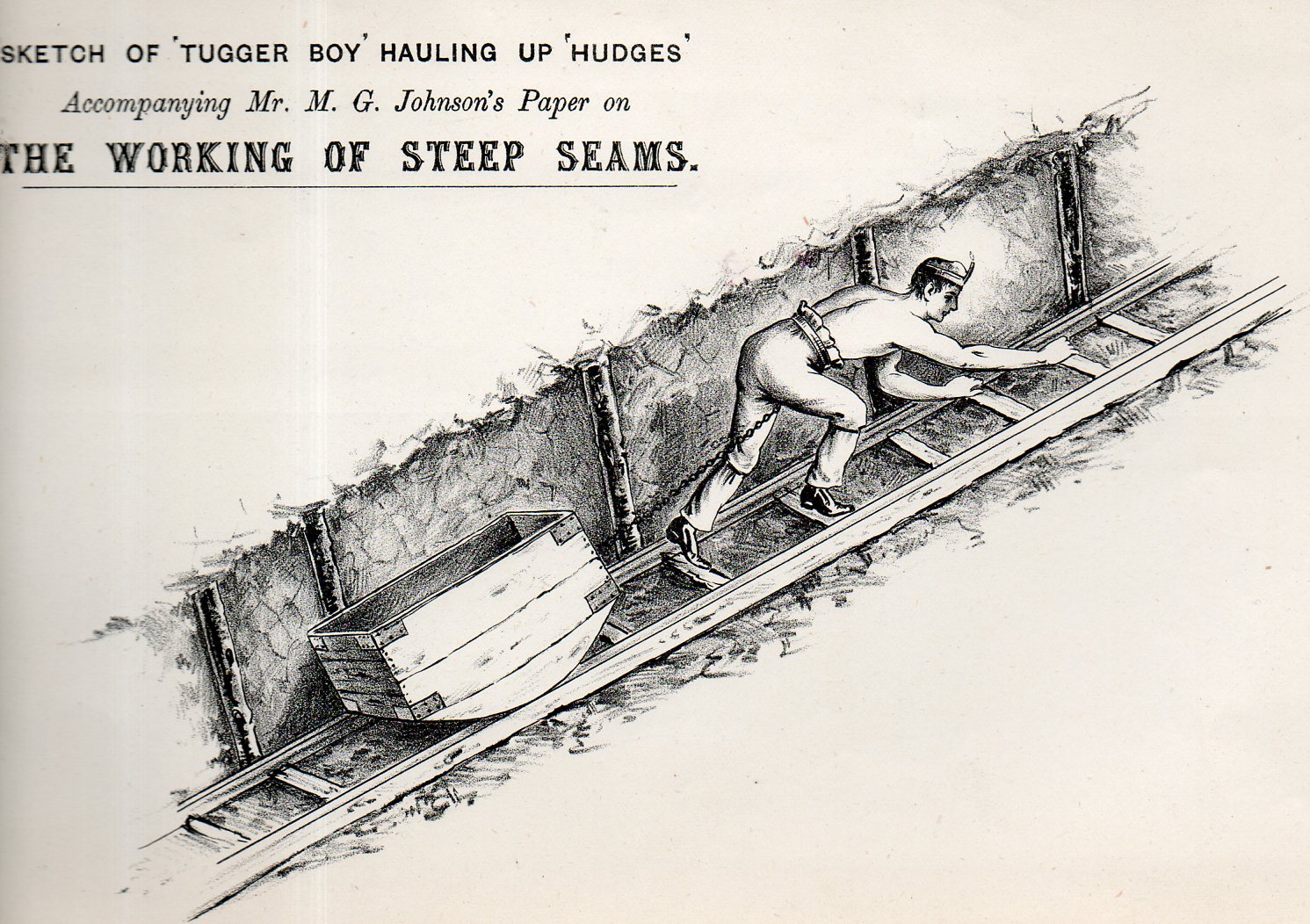
    The first image really doesn’t need much commentary, though calling the worker a “tugger boy” pulling up a “hudge” was probably a bit of sardonic camaraderie–except that the doing of the job would distance you from its folksy name.

    • “Tugger boy (Brist). One who draws small tubs or sleds underground by means of a tugger. Called Tugger-work. (Gresley), 1883. 

    The depiction of what seems to be a mature man in the image might be a piece of propaganda. In any event,  the Tugger Boy carries his own flame on the top of his headgear, and the chain that attaches him to the heavy coal bucket runs from his waste down the front of his body and through his legs.  

    George Orwell wrote perhaps one of the most brilliant descriptions of the mining environment in his superb The Road to Wigan Pier. (It is well worth reading all of Orwell’s books at this point—his insights almost never looked so fresh.)

    He  describes the crab-walk from the elevator to the place of work, telling how difficult and exhausting the process was of just getting to the place where you would then begin your difficult workday.  Of the miners he says at one point:  “Watching coal-miners at work, you realize momentarily what different universes people inhabit. Down there where coal is dug is a sort of world apart which one can quite easily go through life without ever hearing about. Probably majority of people would even prefer not to hear about it. Yet it is the absolutely necessary counterpart of our world above.” 

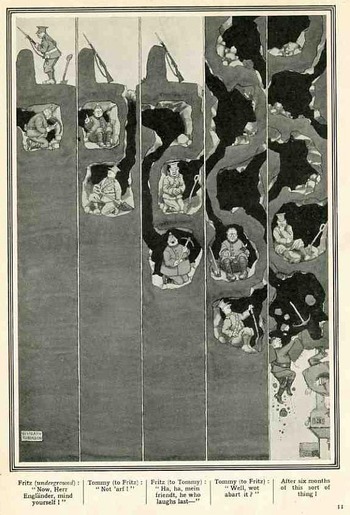
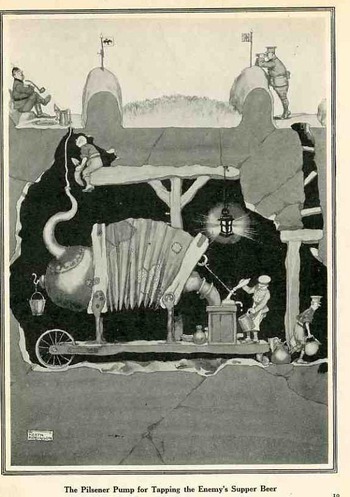
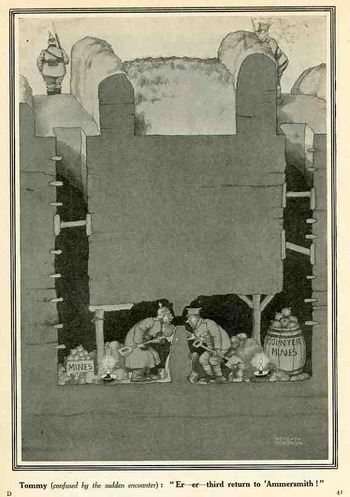
    The next series of images come from the pen of W. Heath Robinson (1872-1944) who was a lovely, quirky, charming, skewed, dark, stiff-bouncing and creative illustrator capable of considerable whimsy (light and complex) and deep skepticism.  The images I’ve selected are from one of his three WWI books, Hunlikely, published in 1916 (Some “Frightful” War Pictures (1915), and Flypapers (1919), were the other two) and depict scenes from the intra-trench tunnel wars, which were battles fought in the midst (or, actually, beneath) other battles.  This was a savage, grueling, post-adjectival affair—exceedingly dangerous, difficult, awful.  And it happened a lot during the war, given the experience of stalemates between vast armies sunk into mole city trenches, with no one going anywhere for long periods because there was nothing in between the two impervious lines but a death vacuum. 

    Blogjuly_18_mining_robinson338

    So one of the solutions was to try and tunnel underneath the opposing army’s defenses, fill the far end with high explosives, and blow them up.  The other side was doing it too, and in the middle of it all was the incorporation of newer/better listening devices to detect forces rummaging around underneath your position dozens of feet into the ground.  It was a bad business. (One of the other means of breaching the trench lines was aerial combat, but bombers carrying tons of HE were still yet to be invented; poison gas was another.  Most of the time the armies would just meet in the middle  in wide plains of nothingness in a sea of hot, expanding metal,  where to this day in many of those places nothing can live).

    Robinson’s illustrations are odd, and oddly funny, the dark humor coming at the expense of both sides of the conflict, piercing each.   

    Blogjuly_18_tunnel_2_robinson340

    This all puts me in mind of Tom Waits’ concrete-toothed “There’s A world Going On Underground” song from the Swordfishtrombones album: 

    Rattle big black bones in the danger zone
    There’s a rumblin’ groan down below
    There’s a big dark town, it’s a place I’ve found
    There’s a world going on underground
                
    They’re alive, they’re awake
    While the rest of the world is asleep
    Below the mine shaft roads, it will all unfold
    There’s a world going on underground
                
    All the roots hang down, swing from town to town
    They are marching around down under your boots
    All the trucks unload beyond the gopher holes
    There’s a world going on underground

    Blogjuly_18_tunnel_3_2_robinson341


  • RedOdd and RedEven–a Small Collage of Some Unusual Red Pamphlet Covers

    JF Ptak Science Books   Quick Post

       “He is too picked, to spruce, too affected, to od as it were.”–Shakespeare Love’s Labour’s Lost  (1598) v. i. 13

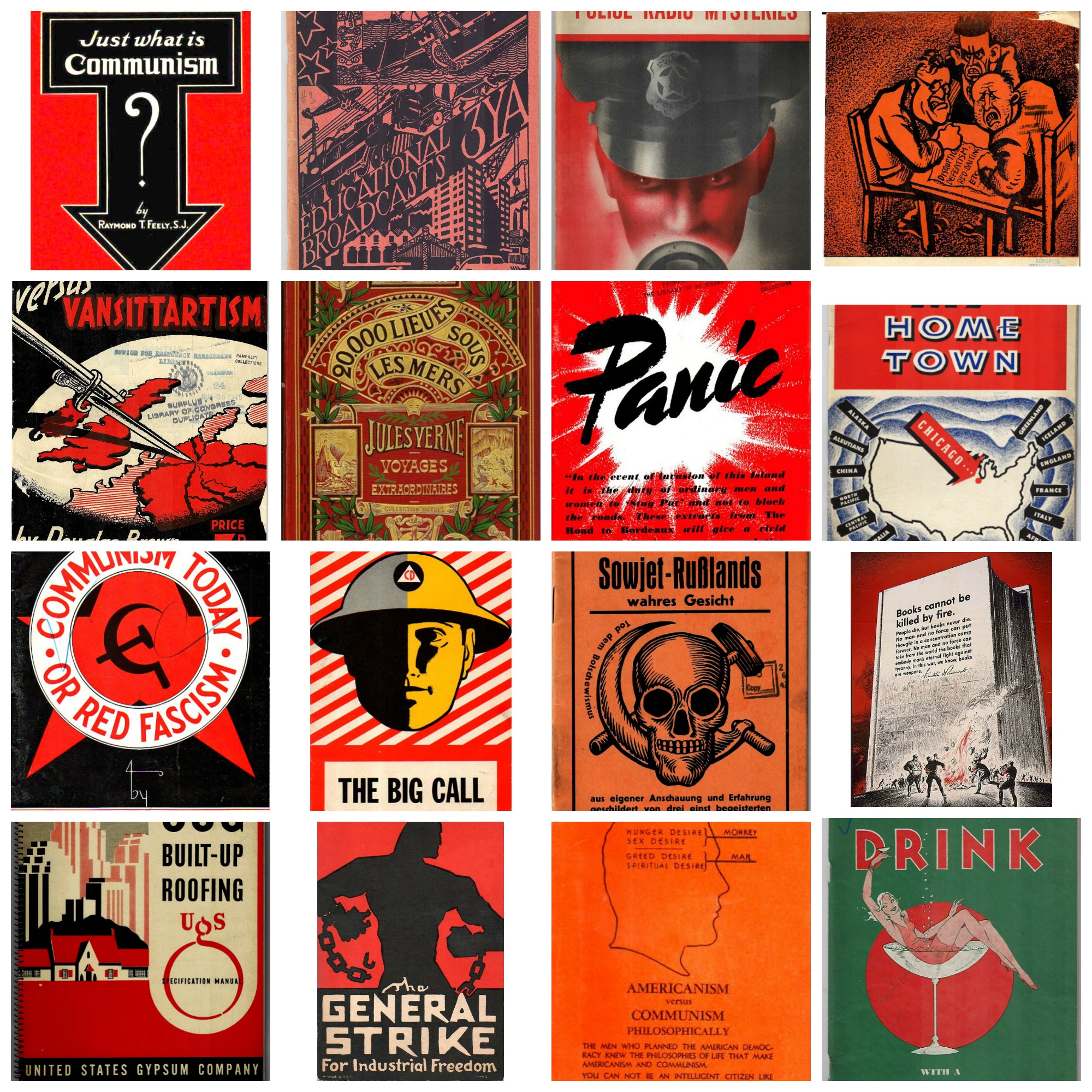
    I just threw this together, pulling in some of the red-based pamphlet cover designs from different odd areas here–there are many many more, but this again is a selection of odd and red: OddRed, RedOdd. Or if not odd, the at least red and even, EvenRed, RedEven. 

    Books covers montage red

    “OddRed” isn’t a color, it just designates that red is being used in relation to something odd, which is very different from nouns or adjectives that get thrown in front of “red”, as in “blood-”, “brick-”, “flame-”, and so on, which are actual colors. OddRed is just an idea. As is EvenRed.

    The OED finds “red” to be as old as OE, and defines it so: “Designating the colour of blood, a ruby, a ripe tomato, etc., and appearing in various shades at the longer-wavelength end of the visible spectrum, next to orange and opposite to violet; of or having this colour.”

    ·Posted by :

    ·in: