A Daily History of Holes, Dots, Lines, Science, History, Math, Physics, Art, the Unintentional Absurd, Architecture, Maps, Data Visualization, Blank and Missing Things, and so on. |1.6 million words, 7500 images, 4.9 million hits| Press & appearances in The Times, Le Figaro, Mensa, The Economist, The Guardian, Discovery News, Slate, Le Monde, Sci American Blogs, Le Pont, and many other places… 5000+ total posts since 2008.

Category: Social History

  • What to Tip a NYC Soda Jerk, 1938

    JF Ptak Science Books   Post 2821
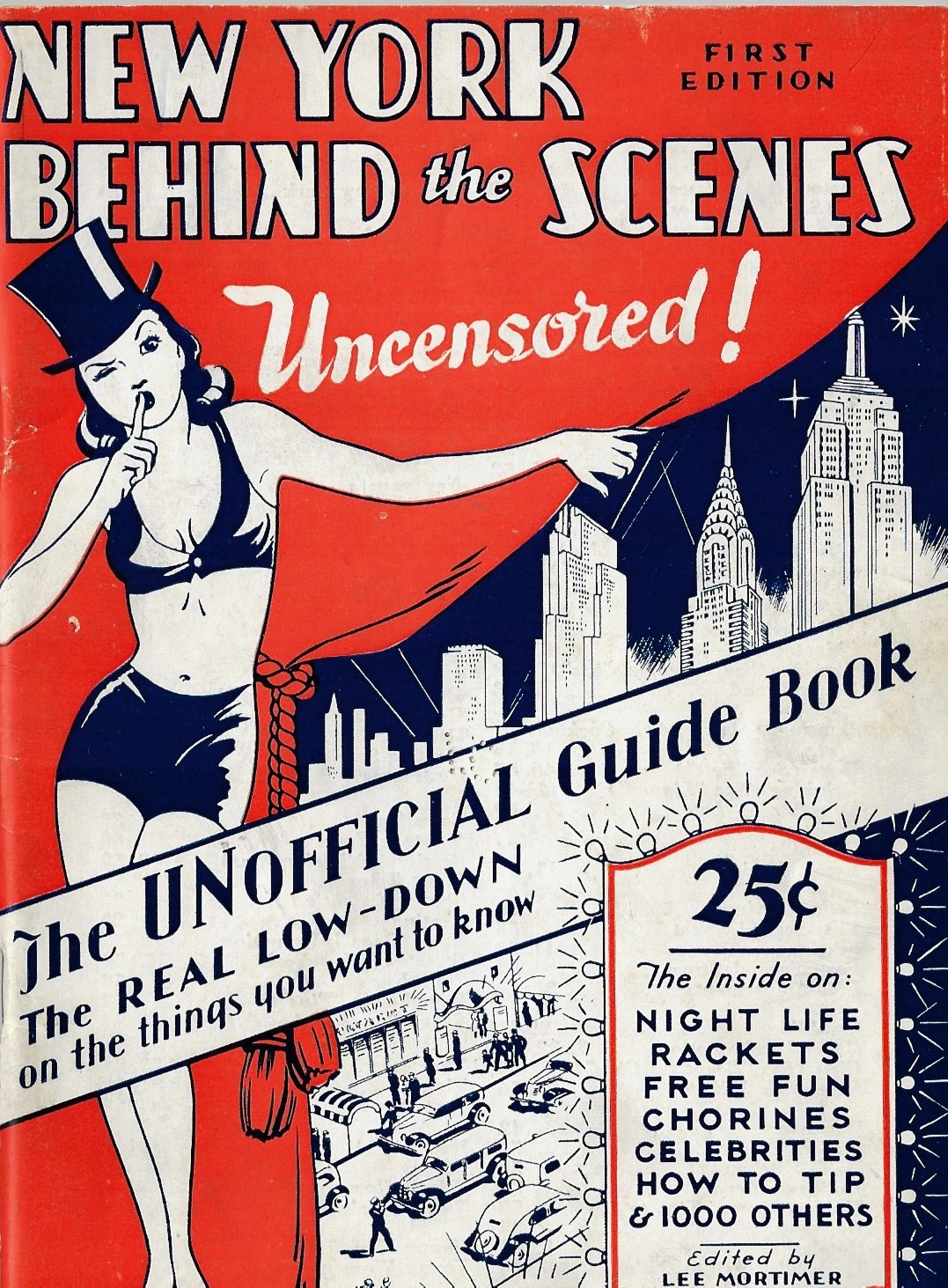
    NYC Behind scenes cvrs 1938New York Behind the Scenes, Uncensored–the UNofficial Guide Book the Real Low-Down on the Things You Want to Know (1938), certainly lived up to its name, especially at the cover price of two bits. Lee Mortimer (the author of Washington Confidential and other such works)  promised inside dope on “Night Life, Rackets, Free Fun, Chorines, Celebrities, How to Tip & 1000 Others”, and delivered on a number of them, though “1000” is a bit of an exaggeration in the 66-page pamphlet. [A “Chorine” by the way is a chorus girl.]

    Found here are guides to theaters, movies, beaches, hotel, taxis, buses, nude shows, gambling, and that sort–there’s also info on public rest rooms, also where to drink, find free dancing, how to talk to people, what to wear, and so on.

    Also there are boxed pearls sprinkled throughout the publication, like: “How to Meet a Young Lady: visit a taxi dance hall, dance with a dime-a-dance girl’ and following several other useful find-a-date bits,  including the ancient “take your dog for a walk”, a la 101 Dalmations.  

    And there are also the bon mots salted hither and yon like Patrick Star’s Spongebobian sentence enhancers:  “Pets: New York may not be a place for children, but for dogs its a paradise”.  

    There’s also a collection of “does and don’ts” though mainly don’ts: “DON’T swim in the Hudson River below the NYC line…” and “don’t light a match to read your (theater) program, it may cause a fore and panic”;  “You’ll see the prettiest bathing girls at Manhattan Beach in Brooklyn” (where my mother used to go at about this time) among them.

    And then there’s just flat-out statements like “New York emphatically is not a children’s town” and “If strange men or women come to you with offers of jobs in New York, call the police immediately”. Welcome to new York!

    Second only to the what-to-tip pages is the low numbers for New York license plates, which I’ve got to say I’ve never seen before. I like that Fiorello Laguardia’s plate was “NYC”, and that Ed Wynn’s was “YY2”, Walter Winchell’s was “WW1”, and for some reason FDR was “3”. (Numbers 1, 2, and 16 were reserved for the governor, Herbert Lehman…I think I’d have to give the president the tag “1+”.)

    There is  lot of info about neighborhoods in the city, though I wonder now how good the info is. (For example “Harlem, as  night Mecca for New Yorkers, went into a decline immediately following the repeal…today, Harlem’s clubs are patronized by local colored folk and by jaded down-towners who have nothing else to do”, which seems a bit sniffy and stiff). 

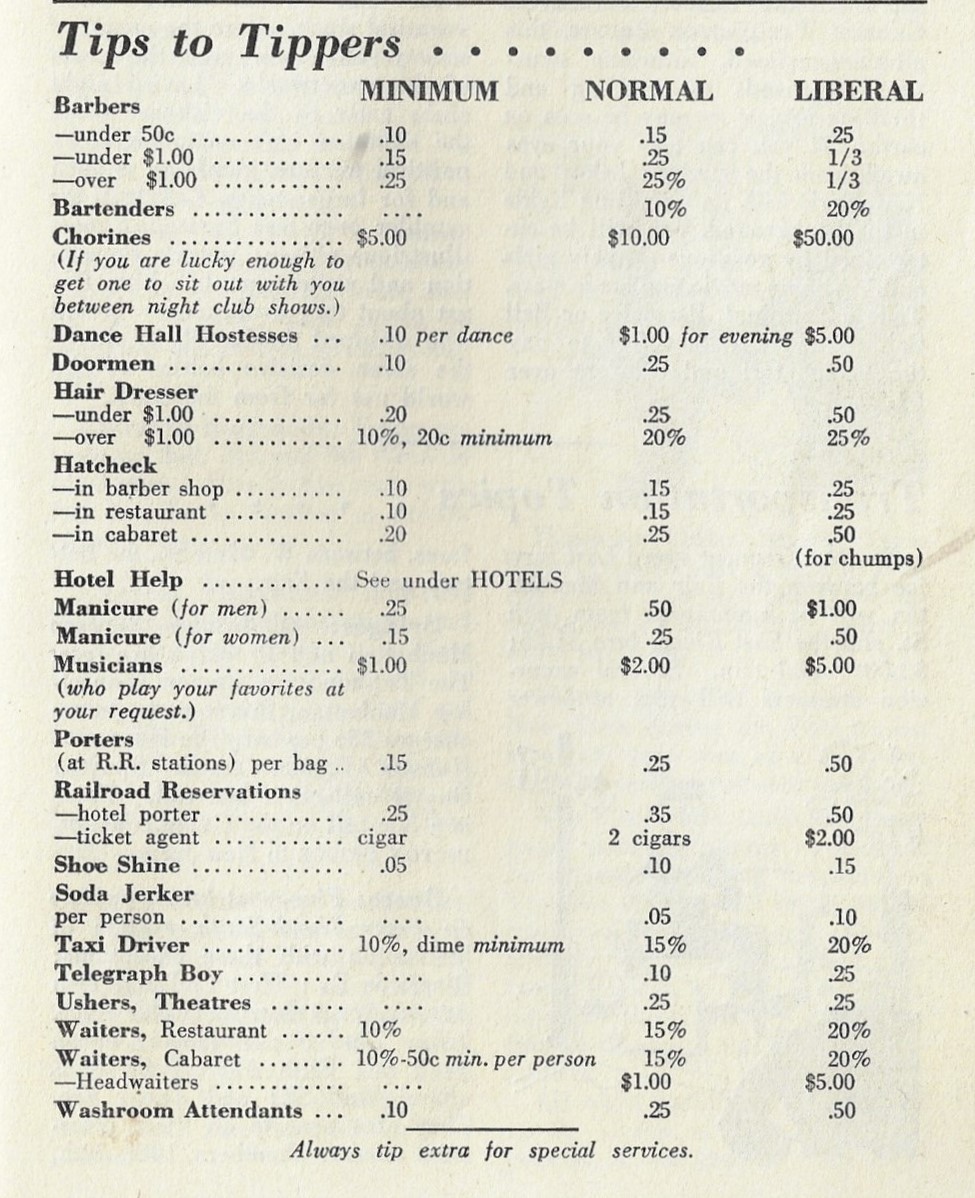
    In the nude/amusement pages we see how relatively expensive it was to attend one of these venues–in addition to standard entrance fees, drink costs, and show and food charges, there was the tipping of the waiters (10%), headwaiters ($1-$10 for a good table), cigarette girl (20-25 cents), hatcheck girl (20-25 cents), wash room attendant (25 cents), and the doorman (25 cents to put you ion the cab). Don’t forget the cabbie (10%), the doorman at your hotel (25 cents), and the elevator man (10 cents).  I guess it added up…

    Anyway what I wanted to share here was the tip chart, in case anyone is writing about social NYC in 1938 and needed some good stinking detail:
    NYC Behind scenes tips 1938

    ·Posted by :

    ·in:


  • The Famine of 1920

    JF Ptak Science Books   Post 2820

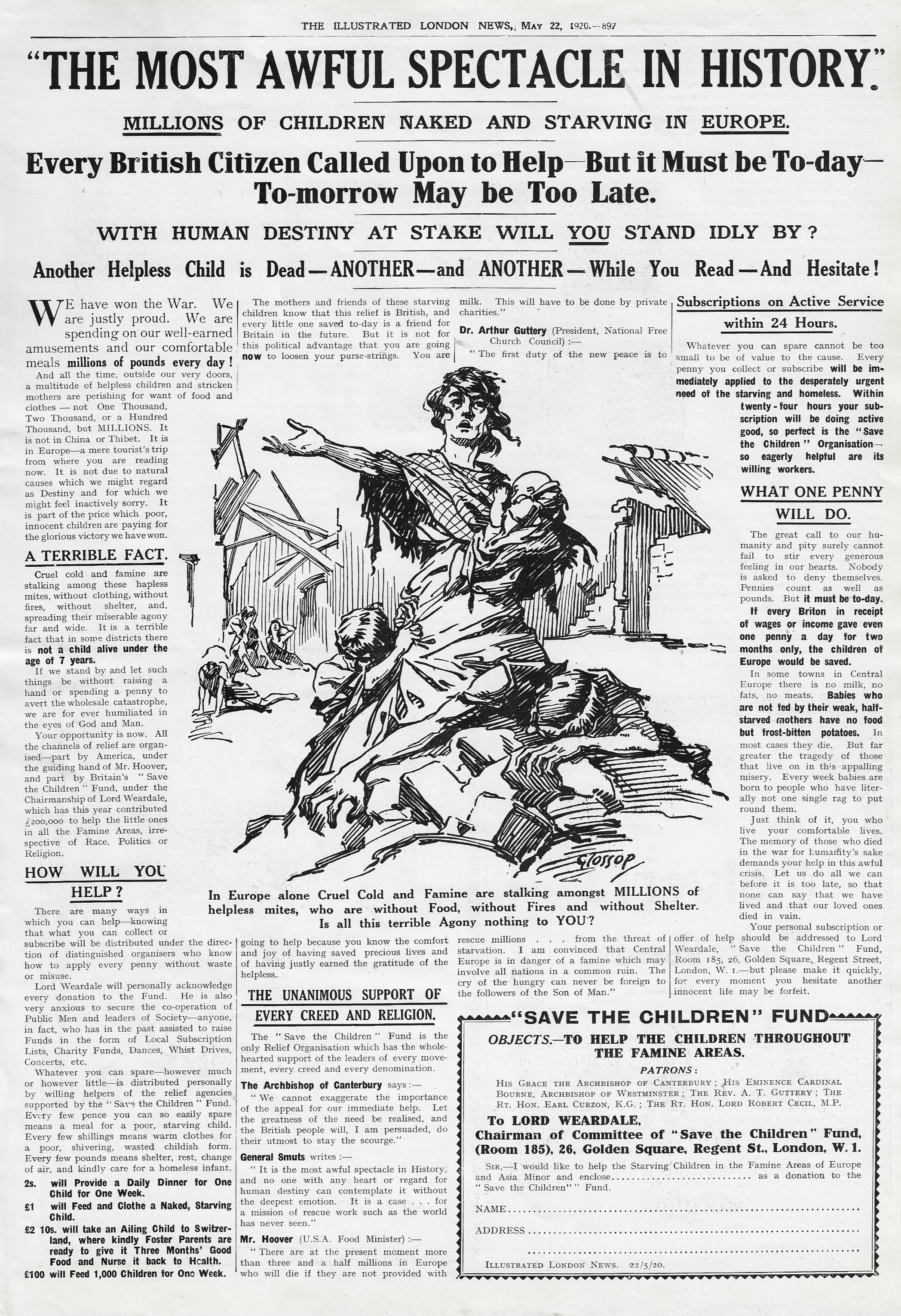
    “The Most Awful Spectacle in History” screams the headline of this full-page (16″ tall)  Illustrated London News advertisement for the “Save the Children” fund, appearing 22 May 1920.  There was good reason for the screaming–following the Great War there were millions and millions of people in dire need of food in the months and years following 11.11.18.  Hundreds of thousands–millions–of these people were children. The ad makes a direct plea for the sake of the children, where the reader is told that in some districts there is “not a child under the age of 7 years”, as all have died. To not donate a penny or a shilling and allow the catastrophe to continue would mean that “we are for ever humiliated in the eyes of God and Man”.  

    ILN 1920 Famine adThe appeal here is simple–Lord Weardale (Philip Stanhope, 1847-1923), who was the chair of the “Save the Children” fund (London) is asking for a penny, from everyone, as the accumulation of that penny a day for two months “the children of Europe would be saved”. 

    With assistance from other countries–including the U.S. where the effort was spearheaded by Herbert Hoover–the Fund raised more than a million pounds and averted an enormous catastrophe. Unfortunately, a larger disaster loomed to the east–the Great Famine in Russia of 1921-1922 (following by just thirty years the Russian Famine of 1891-2)–and in rhis circumstance the relief efforts failed. The Russian famine began with a natural disaster which was then inflamed by complete (sometimes intentional) mismanagement by the government, the result of which caused the deaths of between five and eight million people.  Hoover–as Secretary of Commerce–guided the Russian Famine Relief Act spending of 20 million dollars for the purchase of U.S. foods to be sent to Russia, but the combinations of political intrigue, capital mismanagement, and of course natural disasters leading to more disease and death, left millions dead.  

    As the 1920 ad sums the situation: “the cry of the hungry can never be foreign to the followers of the Son of Man”–but they were, and are. 

    ·Posted by :

    ·in:


  • The Not-so-Shiny Diamond: Mining Compounds, South Africa, 1906

    JF Ptak Science Books   Post 2815

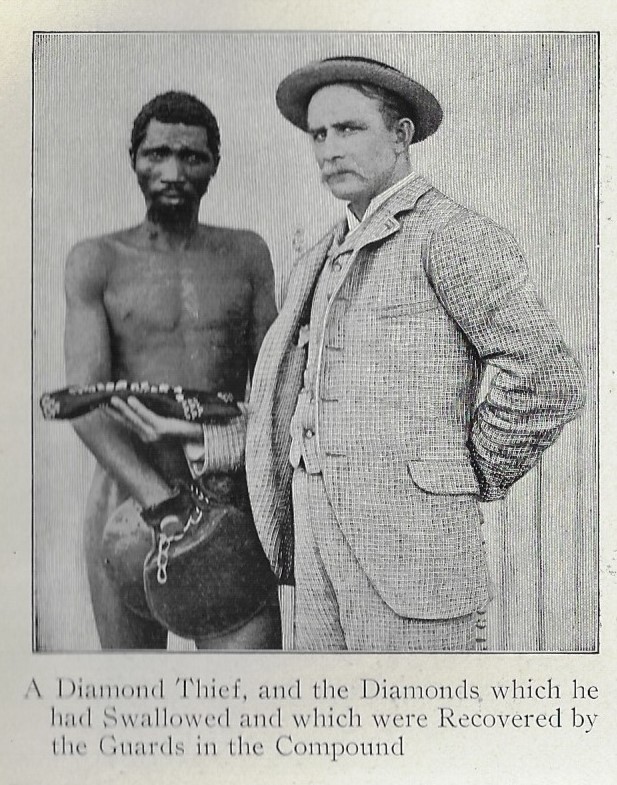
    National Geog 1906 diamond thiefI uncovered a little cache of National Geographic magazines from 1900-1915, and picked out the 1906 volume to have a look at what I hoped for would be photo coverage of the San Francisco earthquake. There’s a good and very strikingly-illustrated article to be found there, but what got my real attention was the article “The Diamond Mines of South Africa”. Actually it was one photograph that grabbed me away from the rest of the book—an image of a diamond miner who was caught stealing diamonds from the mine, extracted during his shift. It is a singularly sad photo—the man’s face is pained and troubled, standing there behind a mine official, naked, and wearing gigantic baseball mitt type gloves with a heavy chain.

    Here are a few questions that sprang to mind: Who were the workers? How did they steal” How did the company catch them? How did the company prevent such theft?

    In this case the theft occurred in one of the De Beers mining facilities in South Africa. Although De Beers used convict labor, at this camp the workers were there of their own free will (I guess), joining the company to work for periods of about three months.

    • “To enter the service of the company, each applicant must sign a written con tract binding himself to live in the com pound and work continuously and faith fully for a period of at least three months or longer if he so desires. At the expiration of a contract the applicant may leave if he chooses or his contract may be renewed indefinitely. Some of the natives in De Beers compound have been employed continuously for ten years or more in the service of the company,…”

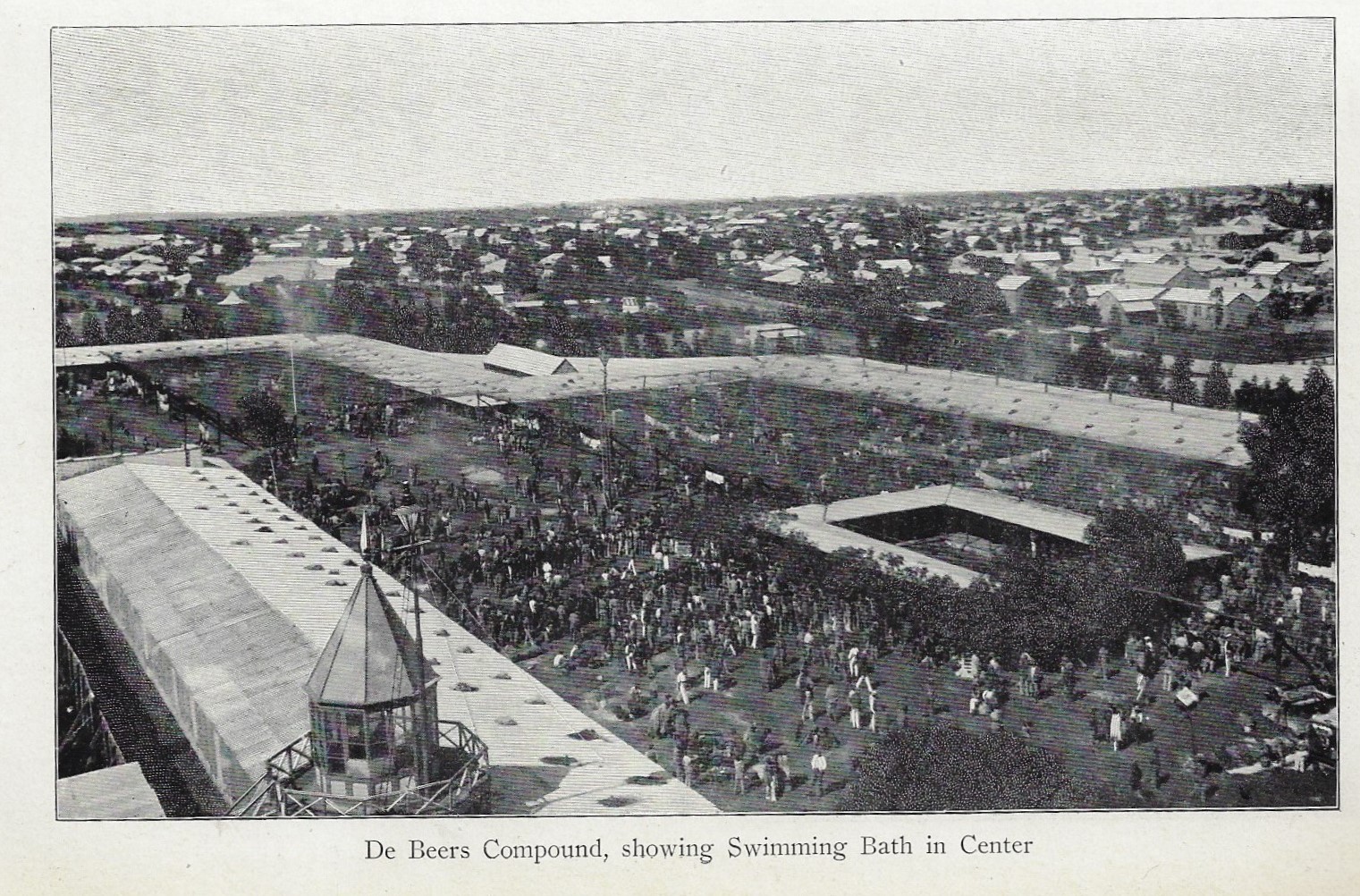
    National Geo 1906 de beers _2_Once the contract was signed, the agreement was strictly enforced,and the lifestyle of all who worked at the mind seemed to become of one solid mass, the workers held there life inmates. It looks as though every aspect of their lives was regulated, not the least of which involved travel outside the compound or interacting with any outsiders—this to prevent the theft and exchange of diamonds.

    The article describe the general layouts of the compounds housing the diamond workers: there were 17 in the diamond fields, 12 owned by De Beer. The largest belonged to De Beer: it was 4 acres and held 3,000 workers, who were contained in the area by 10′ tall corrugated iron fences; they slept 20-25 to a 25’x30′ room. 3K people on 4 acres is a huge number:

    ·Posted by :

    ·in:


  • The Beautiful Ephemeral: the Perfect Desktop, plus Ads for Pencils and Matches (Japan, 1955)

    JF Ptak Science Books  Quick Post (Part of the “Magnificent Mundane” series) 

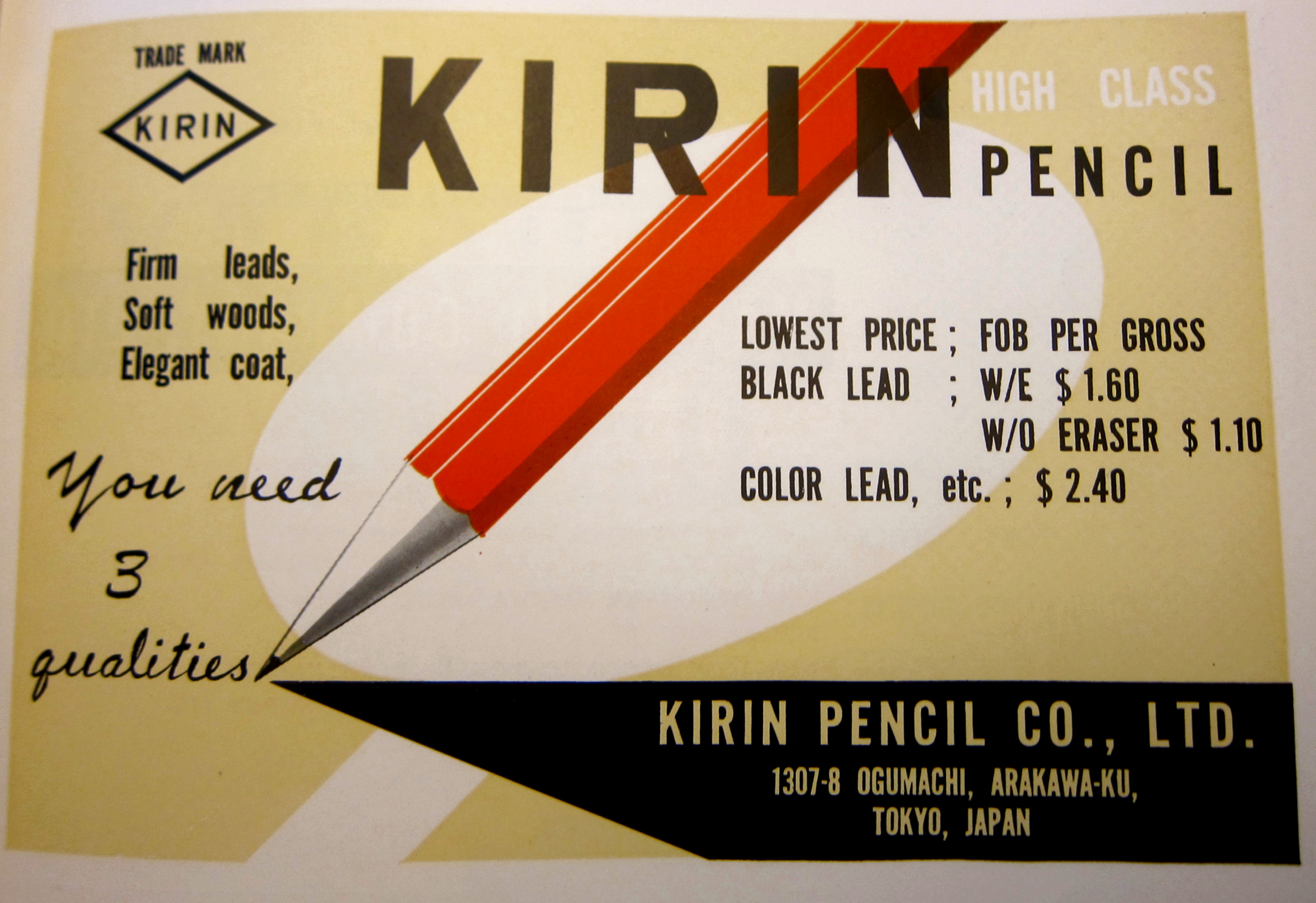
    The Japan External Trade Recovery Organization’s General Merchandise of Japan was an “effort is made to introduce every category of general merchandise” being made in the country in 1955.  Ten years after the war the country was still of course recovering from its devastating defeat, though the national economy did make tremendous progress back to some sort of normalcy during that time, particularly during the ‘fifties. This is not a Sears catalog, though, as it weighs in at 110 (thick) pages plus 30 pages of advertisements. The merchandise does spread out wide, if not very deep at all, and it makes for an interesting browse to see what sorts of goods were being manufactured and sold overseas so soon after the war.  What caught my eye (following ads for tribal table art, “Japanese-style lanterns”, cigarette lights, reed organs, toys, glasses, shoes, scissors, wooden bowls, eyeglasses (two varieties), and so on were the ads for pencils. There were at least four of them, three of which are visually striking. (And speaking of that, there’s also a great ad for matches.)  On the “Pencils of Japan” page there is also a peep into perfection, showing an office desktop outfitted with goods manufactured in Japan. There’s not much, but the necessaries are there, and it is very tidy in a geo-Spartan way (and nothing like my own desk). In any event, I share the “Pencils of Japan”:
    Japan merch 1955 pencil _1_

    Japan merch 1955 pencil _1_

    ·Posted by :

    ·in:

    —

  • A Rare Work Detailing the Minor but Important Social Aspects of Life in the USSR, 1933

    JF Ptak Science Books  Post 2815

    Here’s a very unusual and interesting pamphlet that I just found, and partially read. Philena Weller Montgomery and John Ferguson Montgomery wrote Traveling Hard Through the USSR1, a travelogue on their trip through the old country in the mean and bitter summer of 1933. They printed the pamphlet themselves in 1934, giving their address as 1105 Morrison Ave, Bronx, NYC.

    They produced a remarkable major-minor work, I think, making hundreds of small observations on the little bits and bobs of everyday life that one usually does not see in a work like this. For example, they walk around Stalingrad and rather than remark on the great sights and vistas they report on the state of window displays—that there were unrelated objects on display, like urinals with lamp lights and pictures of clothing for sale that the storekeep didn’t have, and that the windows were dirty and hadn’t been cleaned in months or years, and that the broken ones were fixed with metal and rivets; that sort. That’s the real strength of this work, I think; the ability of the writers to see the small local, personal detail—they weren’t interested so much in a grand building, but rather the women who were scrubbing the marble floors with some evil-smelling something because there was a shortage of soap; and not so much the boat they were passengers on, but rather the shabby dress whites of the captain and how he moved through the crew and how the crew responded to that; not the grand vistas of old St. Petersburg but rather the dirty shop windows that displayed pictures of items that they didn’t have in stock.

    The authors left with a group of 10 other people (fellow students?) for a loosely-guided trip through the Soviet Union. This was not a North Korean-style tourist experience for this group; they write that even though they had a guide that they were in no way constrained from wandering off or speaking to anyone they wished; they felt that there was no control over their activity outside of the route they were following for their visit. The fact that they saw so much poverty and hardship, and interviewed whomever they pleased, attests to the limited control the state placed on their tour.

    Their adventure begins in Leningrad, and moves to Moscow, Gorki, Kaza, Samara, Saratov, Stalingrad, Rostov, Yalta, Odessa, and then back west via Kiev. The authors write that if the USSR were really trying to control what the visitors saw that they would positively not send people out of or into the country via Kiev because of the state of the city and the people.

    I’m sharing this here just in case anyone out there knows anything about this work—I do plan on posting the full work here in the near future.

    Here are some notes from my reading:

    Kiev

    • pale children working elevators at night of their hotel;

    • more Bezpreysosny (orphans) here than they saw in all the rest of the Soviet Union combined;

    • city swarmed with red Soldiers and OGPU;

    • shop windows displayed odd assortments—corks, urinals, bridge lamps, washboards, side-by-side, with very little consumer goods;

    • buildings were shabby as were the people, especially the children, “who show the effects of suffering”’;

    • visit to a Jewish collective farm

    ·Posted by :

    ·in:


  • “What’s Left of the Jews?” (July 26, 1945)

    JF Ptak Science Books   Quick Post

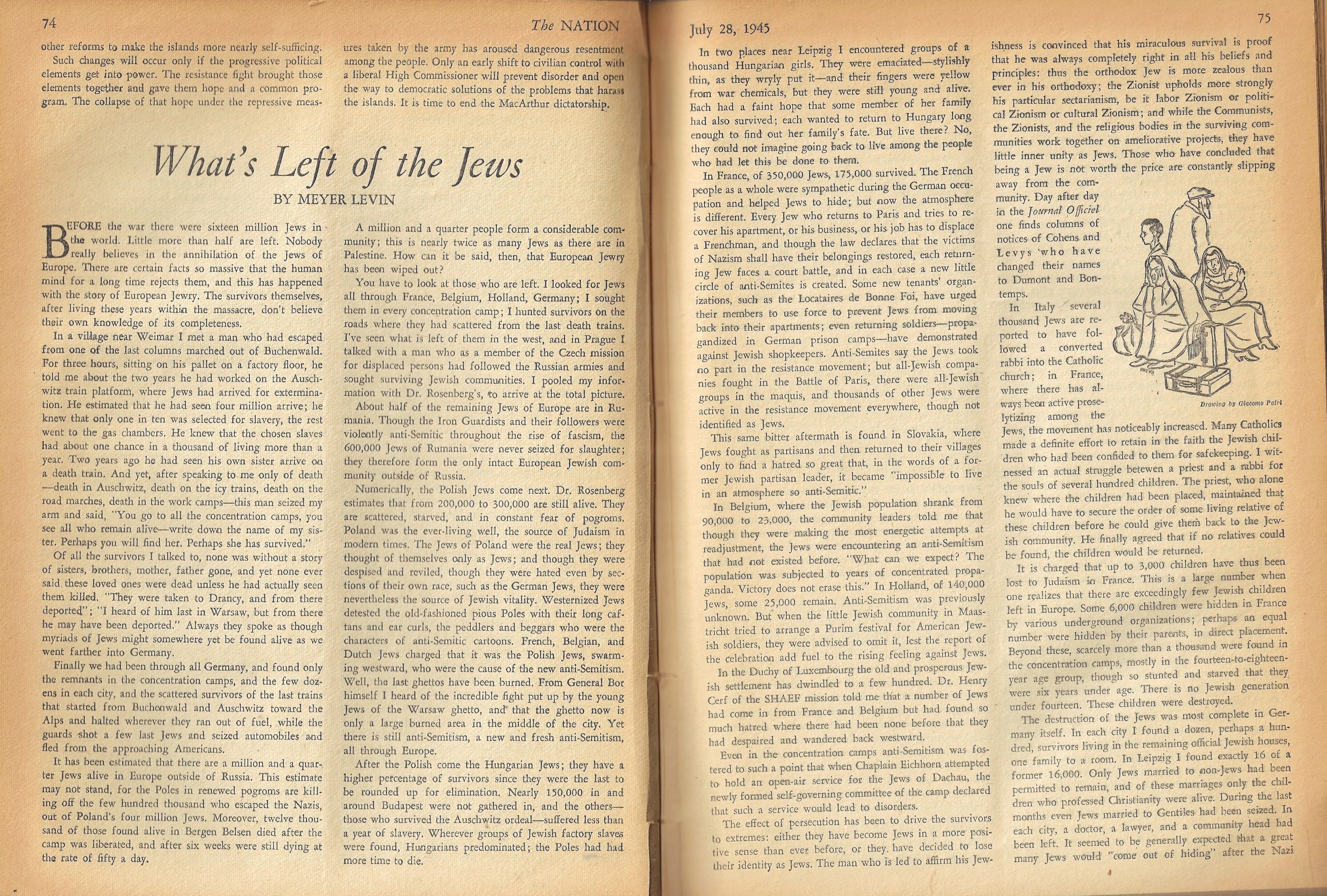
    Meyer Levin (1905-1981, journalist, editor of Esquire from 1933-39, and author of numerous books and articles) encountered and confronted the Holocaust in-person at the end of WWII in Europe and wrote about it in the pages of The Nation. His article, “What’s Left of the Jews”, bluntly confronts the millions of murdered Jews, and then locates where the remaining populations were. And then he discusses the improbable and incredible rise in anti-Semitism that survivors faced. His piece was published July 28, 1945, two months after VE Day.  I reprint the article below.

    Levin writes:

    “Before the war there were sixteen million Jews in the world. Little more than half are left. Nobody really believes in the annihilation of the Jews of Europe. There are certain facts so massive that the human mind for a long time rejects them, and this has happened with the story of European Jewry. The survivors themselves, after living these years within the massacre, don’t believe their own knowledge of its completeness…”

    Nation July 26 1945 whats left of jews

    ·Posted by :

    ·in:


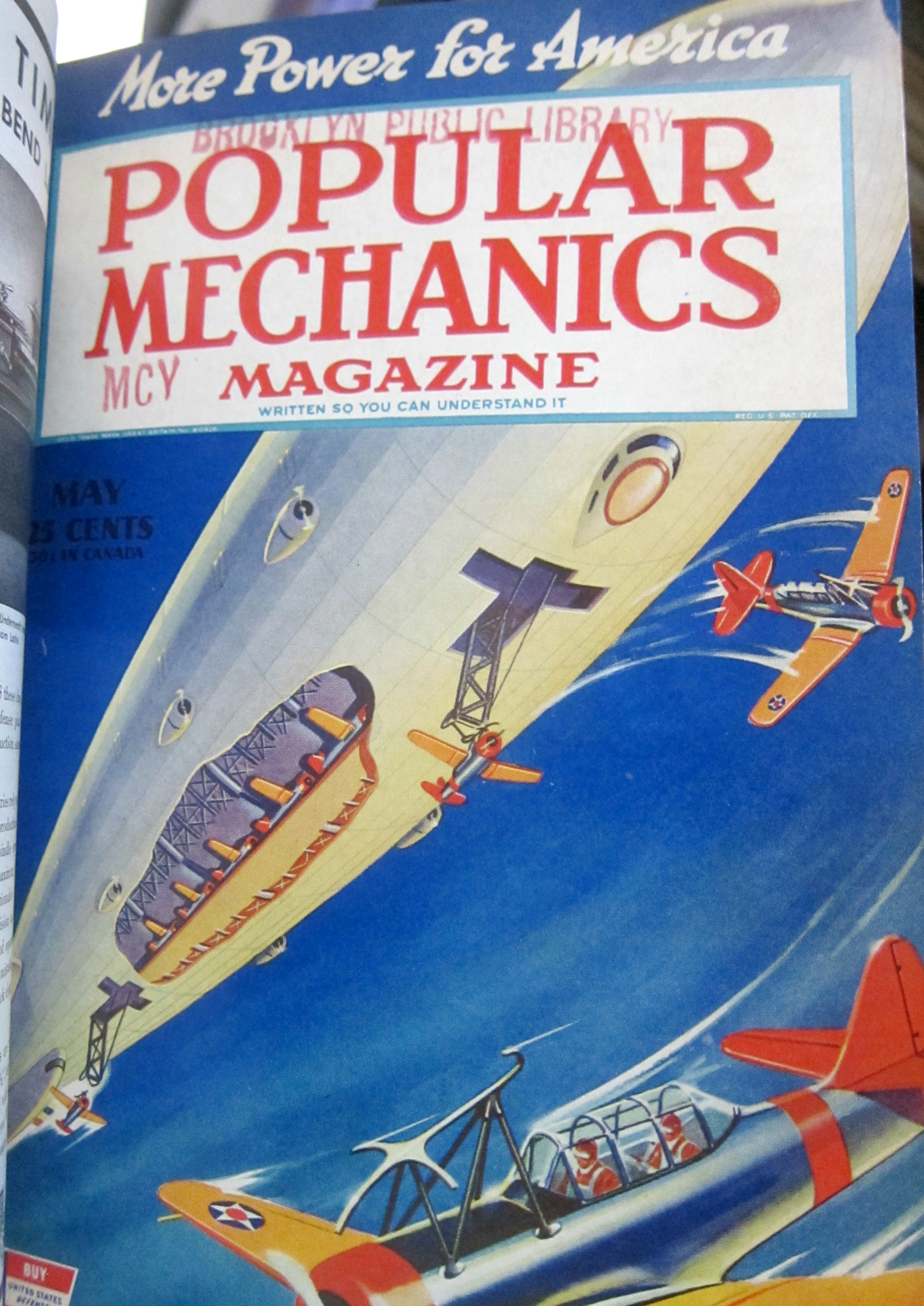
  • Great Images Found in “Popular Mechanics”, 1942

    JF Ptak Science Books  Quick Post/Annual Image Series

    I’ve posted many times on interesting  images that I’ve found in many different journals, my favorite and most commonly used sources being Scientific American (1845-1920), Journal of the Franklin Institute (1828-1960), Popular Mechanics (1920-1950), Science and Invention (1920-1940), Popular Science (1880-1920), and that sort, though I prefer those listed as I have them here and they’re a delight to browse…you learn something every time you open the volume. While saving and naming a scanned image just now, dropping it into place according to publication/year, it occurred to me that I could create a simple series of posts on selected images per given year by journal/magazine. This would give the images some context (or at least more so than as stand-alones) and it would also be very easy to do since the work is already done. 

    The first of the series will be for Popular Mechanics, January-June, 1942. The volume is heavily war-related, and offhand I’d say the general impression is that most of that is defensive (coastal defense, air raid wardens, gas masks) than offensive (attack plans, fighter planes, warships, etc.).  Here’s a sample:

    Pop Mech 1942 invasion scenario


  • Full Text Psychological and Intelligence Tests (1941)

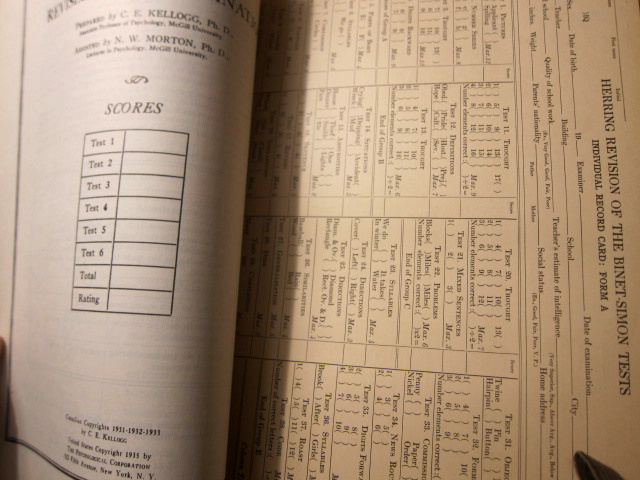
    Manual of the Psychological Tests and Procedures in Use at the Neuro-Psychiatric Institute of the Hartford Retreat. Published by the Neuro-Psychiatric Institute of the Hartford Institute, the Institute of Living, Founded 1822. Printed by the Hartford Retreat, 1941. Offset printed, 11” 8”, ca. 125pp. Staple bound, with original wrappers. Condition: very good condition, save that the rear wrapper is missing. NO COPIES are located in WorldCat/OCLC. Provenance: Library of Congress, with their 6mm “LC” perforated in the front wrapper, deaccessioned in the Pamphlet Collections sale. $450

    A covering letter for the publication—coming from the psychiatrist -in-chief of the Hartford Retreat—states that “this descriptive booklet has been prepared to enable the members of the Medical Staff to have full information concerning the facilities and services offered by the Psychological Division”. Evidently staff was supposed know the tests and their details and so the tests in their full text were bound together.

    This is an extremely interesting and possibly in-house collection of 25 different intelligence tests, personality inventories, diagnostic tests, and a few other miscellaneous exams and tests. Each test is an obvious stand-alone, and I was surprised to see them all together—in general the entire test seems to only rarely be reproduced in full. Included in the publication are:

    [A] Intelligence Tests: (1) Terman-Binet; (2) Otis Self-Administrating Test; (3) Kuhlmann-Anderson Test; (4) Weschler-Bellevue Scale; (5) Army Alpha; (6) Army Beta; (7) Arthur Performance Scale; (8) Herring Revision of the Binet.

    [B] Personality Inventories: (9) Bernreuter Personality Inventory ; (10) Colgate B-2; (11) Colgate C-2; (12) Pressey X-O Test; (13) Thurstone Personality Schedule; (14) Neymann Kohlstedt Test.

    [C] Diagnostic Tests: (15) Jung Free Association Test; (16) Babcock Test; (17) Shipley-Hartford Retreat Test for Mental Impairment; (18) Bolles, Rosen and Landis Performance Tests.

    [D] Miscellaneous Tests: (19) Terman M-F Test; (20) Specific Interest Tests; (21) Educational Achievement; (22) Steinquist Mechanical Aptitude Test; (23) MacQuarrie Mechanical Ability Tests; (24) National Safe Drivers Test; (25) Moral Judgment Test.

    All of these are listed in the preface of the document and are complete and present. There is a listing for “Rorschach Ink Blot Test” though that test is not present, and it seems as though it was never bound (i.e. “stapled) with the rest of the tests. (There is a small penciled “x”next to this entry, which leads me to believe that it was just never included with the assembly.)

    Hartford _2_


  • On Dr. Frankenstein and a Female Creation

    JF Ptak Science Books    Post 2705 

    Why did Dr. Frankenstein create a male and not a female being? I guess it would be easy to slip into a rolling piece of guesswork as to why the good doctor took on what he referred to as feminine Nature to substitute himself for the job and bring forth yet another male.

    It is perhaps a little odd that Mary Shelley took this route, given her proto-feminist-founding mother and anarchist father, but then again her novel was published in 1818 when she was all of 21, which means she probably wrote it in her ‘teens, which means there was only so much time at that point to have given much long thought to the rights of women ideas. Or not—this is purely speculative. In any event, I liked the idea of the question.

    Victor Frankenstein did indeed nearly create a female being, and was half-way or so there. He wasn’t a fan of this thinking earlier on in the novel, as we hear him addressing his Monster:

    • “Abhorred monster fiend that thou art the tortures of hell are too mild a vengeance for thy crimes. Wretched devil you reproach me with your creation come on then that I may extinguish the spark which I so negligently bestowed…” (By the way, “sparks” is what brought the Frankenstein’s creation to life, this being an early heyday of electricity, though “spark” is mentioned only three other times in the book.)

    His creation pleaded with him for companionship, but old Dr. Vic thought better of the idea and destroyed “her”, ripping the new creation literally limb from limb. It is an unpretty story, though the case made to the doctor from his “monster” is excellent, and I include a good selection of the dialog below.


  • A Famous Book and its 170-Word Title (1828)

    JF Ptak Science Books  Quick Post

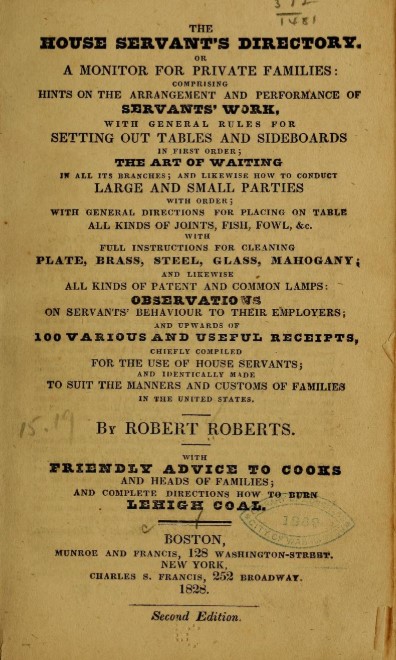
    Books covers robert roberts Before I recognized the importance of this book I was attracted to its endless title, which always seems to be truncated when looking for a version to cut-and paste: The House Servant’s Directory, or a Monitor for Private Families: Comprising Hints on the Arrangement and Performance of Servants’ Work, with General Rules for Setting Out Tables and Sideboards in First Order; the Art of Waiting in all Its Branches; and Likewise how to Conduct Large and Small Parties with Order; with General Directions for Placing in Table all Kinds of Joints, Fish, Fowl, &c.. With Full Instructions for Cleaning Plate, Brass, Steel, Glass, Mahogany; and Likewise all Kinds of Patent and Common Lamps: Observation on Servants’ Behaviour to their Employers, and Upwards of 100 Various and Useful Recipes Chiefly Compiled for the use of House Servants; and Identically Made to Suit the Manners and Customs of Families in the United States…with Friendly Advice to Cooks and Heads of Families, and Complete Instructions on How to Burn Leigh Coal. 

    I enjoy the stab of a three-word-long book title–but if the title can’t be short, then just let it all go, I say.

    Mr. Roberts is recognized to be the first African-American author of a book intended for commercial enterprise, and it evidently did quite well–when he died 32 years after the appearance of this second edition, he left an estate of $7,000, which was a considerable sum in 1860. (A skilled carpenter in 1860 might make $500/600 or so for a filled-up year of 52 60-hour weeks; a free African-American would have made far less–here I’d guess that they would make a fraction of a white unskilled laborer’s wages, if there were jobs like that to be had, and make $100 or so a year. So Mr. Roberts was able to live his 80-year life and support a family of 12 and still was able to save a lot of money.)

     There’s a lot of wide interest in this book, not the least of which is “The Art of Waiting all its Branches”.

    See the full text here, via the Library of Congress:

    https://archive.org/details/houseservantsdir00robe/page/n7