A Daily History of Holes, Dots, Lines, Science, History, Math, Physics, Art, the Unintentional Absurd, Architecture, Maps, Data Visualization, Blank and Missing Things, and so on. |1.6 million words, 7500 images, 4.9 million hits| Press & appearances in The Times, Le Figaro, Mensa, The Economist, The Guardian, Discovery News, Slate, Le Monde, Sci American Blogs, Le Pont, and many other places… 5000+ total posts since 2008.

Category: Social History

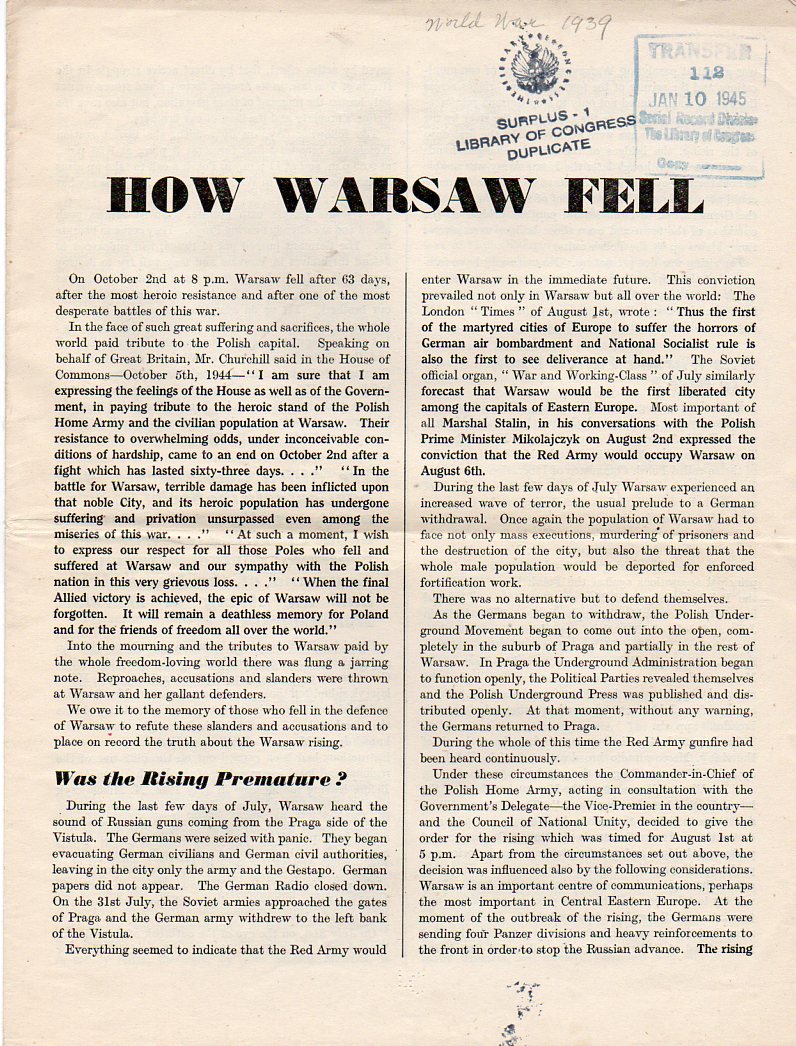
  • How Warsaw Fell (1944)

    JF Ptak Science Books  Post 2757 (expanding an earlier post) 

    The bottom line of the 63-day-long Second Warsaw Uprising (August/September 1944) is that the Soviet Union allowed the Polish Home Army to fail, watching from its position across the Vistula as the Nazis and Poles slugged it out, both exhausting themselves, the Nazis ultimately defeating the Poles, eliminating most of the Soviet concern for the Polish military and government, allowing the Soviet Union to take the country over more completely when the time came a few months earlier.  It was the Soviets’ choice to see two enemies annihilate themselves to have more control over Poland and immediately turn it into a vassal state when it rolled into Warsaw in January, with 85% of the city destroyed (“at the moment of its fall practically the whole city was [razed] to the ground”) and 600,000 of the city’s population  dead, along with 80% of the Home Army. 

    • Full text (though not from my copy) here, at Instytut Józefa Piłsudskiego w Londynie :http://pilsudski.org.uk/archiwa/dokument.php?nonav=&salatka=1&nrar=709&nrzesp=108&sygn=88&handle=709.238/632

      Warsaw774

    ·Posted by :

    ·in:

    —

  • A Dedicated Man Dedicated to his Dedicated Dog

    JF Ptak Science Books   Post 2756  [Dedicated to Bluey, Cowboy, Watson, Finbar, Dudley, and Perry. Also dedicated to Ralph Kenat, a great and understanding friend to dogs; and Alexandra Horowitz, author of the keenly penetrating and insightful Inside of a Dog.)

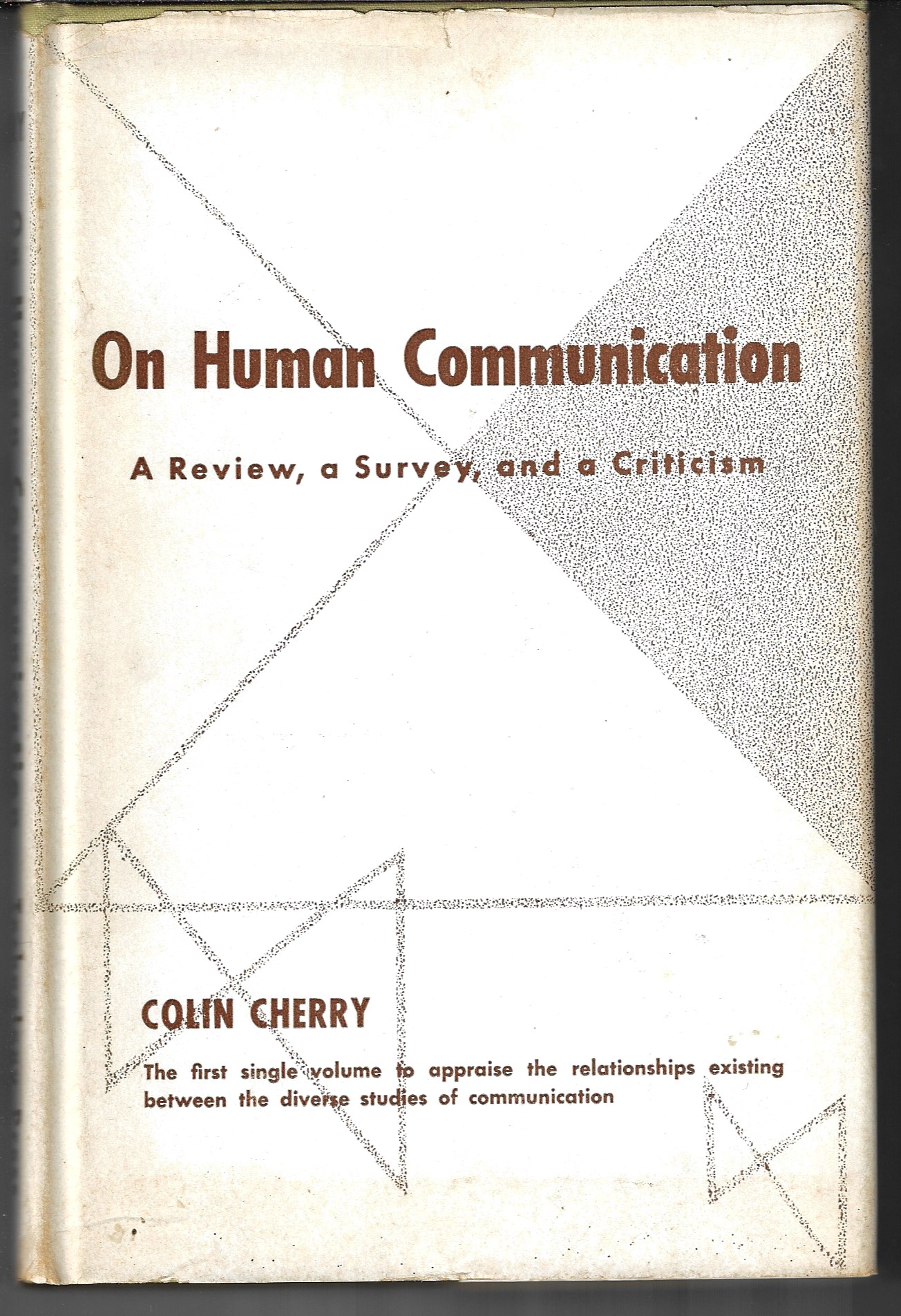
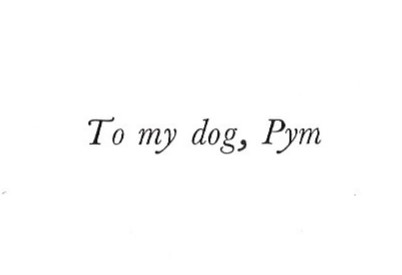
    One of the most intriguing bits I’m taking away from an intriguing book (On Human Communication…M.I.T., 1957) is its dedication page. The author, Colin Cherry (1914-1979) was an interesting pioneer in cognitive science, AI, and associated areas, and did what very very few other writers have done: he dedicated a major book to his dog.

    What came to mind immediately was Poe’s only novel, The Narrative of Arthur Gordon Pym, of Nantucket,  which is the only “Pym” I know–but there the dog in the story was named Tiger, and he was certainly not the object of dedication. Next came Isaac Newton’s dog, who infamously caused (or not) the destruction of a Newton manuscript…but that dog’s namePymwas Diamond, and that little doggie certainly didn’t get anything dedicated to him or her after that (assuming the dog was real).  Then John Steinbeck’s Travels with Charley bubbled up—Charley being one of Steinbeck’s dogs and the subject of the title, though the book was not dedicated to him in spite of that. I’m hard-pressed to recall any other books besides Cherry’s dedicated to a dog, although there’s no doubt plenty of room to pay homage to a loyal friend on a dedicatory page.Evidently there are virtually no books dedicated to dogs known and unknown. Certainly at some point dogs real and imagined like Argos, Brian, Buck, Bullseye (Oliver Twist), Cerebus, Clifford, (Hagrid’s) Fang, Goofy, Huckleberry, Laelaps, Lassie , Nana, Nipper, Pluto, Pongo, Rin Tin Tin, Sirius, Snowy, Snoopy, (Buster Brown’s) Tige, Toto, and so on, could have had some work dedicated to them, though it seems like not. (If so, I’d like to hear about it…also I just realized that all of the dogs I’ve mentioned are fictional.) Many writers have had dogs and pets, and some famously so, and some have become characters in books (as with Vonnegut and Dicken’s ravens1), but not as a dedicatee.

    And so I recognize at this late date Colin Cherry, a man who liked his dog.

    (A helpful reader pointed out that the dedication changed in the second edition of the book: “To all those human beings who have enquired so kindly after my dog Pym”. Twenty years later the third edition dedication changes again; this time , it is “To the memory of my dog Pym”.) 

    CHerry Human com coverNote:

    1. Dickens had a series of ravens named “Grip”, one of whom may have had an influence on a young Edgar A. Poe when he met Dickens in 1842. Poe also met Grip, as Dickens traveled with his family and the bird on his U.S. Tour. Some say Grip was an inspiration for Poe and his big poem; if so, he didn’t dedicate the poem to Grip or Dickens. Anyway, I’m talking about dogs here, and Dickens the animalist so far as I can remember didn’t spend too much time on them in any of his novels (Bullseye being an exception noted above), though he did write something about the death of his cat, Bob.

    ·Posted by :

    ·in:


  • A Business Card and the Coming Destruction of the Jews

    JF Ptak Science Books  Quick Post

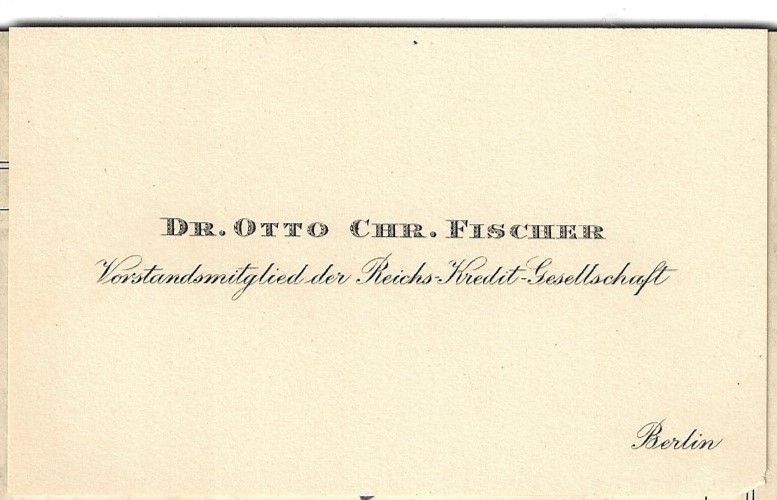
    Fischer biz card detail
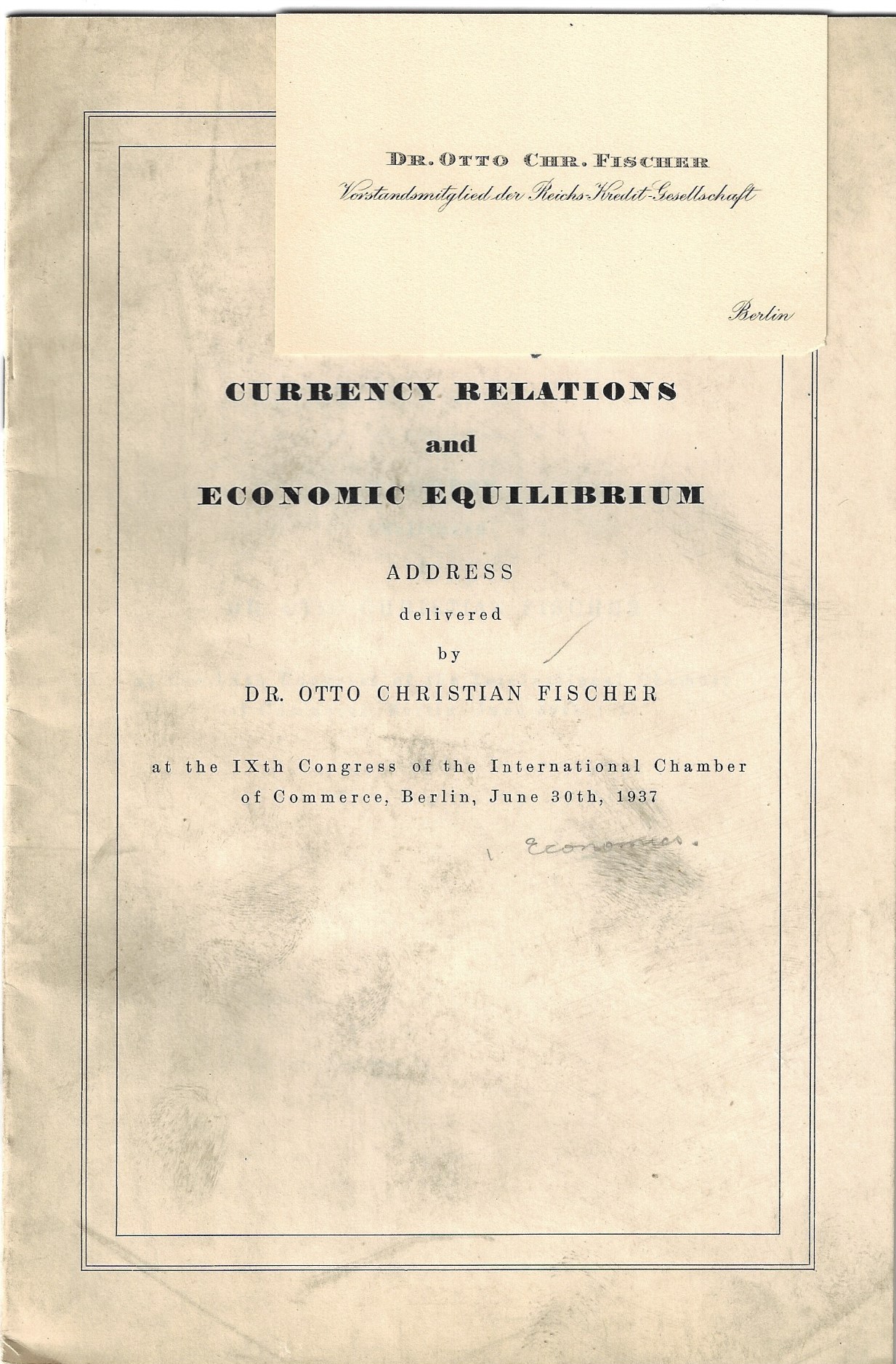
    I have opened dozens of thousands of pamphlets over the years, and usually the only thing that happens is that the pamphlet opens. On very rare occasions, something will fall out. Today, that happened twice, within minutes: two pamphlets with two falling business cards. The first business card was the bigger surprise–it came with the card owner’s short work, Economic relations and Economic Equilibrium, Address by Dr. Otto Christian Fischer, (presented at the 9th Congress of the International Chamber of Commerce, Berlin, June 30, 1937). 

    The engraved card identifies Fischer as  “Verstandsmitglied der Reichs-Kredit-Gesellschaft”

    Fischer (1882-1953 (?)) approached the National Socialists and Hitler as early as 1931, at which point he seems to begin his rapid and lofty ascent to the heights of Nazi banking. Seven years later:

    • “…when the National Socialists began to collect Jewish assets in the course of the “Aryanization”1, it was also about blocking the assets of bank deposits against the access of the owners.”
    • “Fischer made no resistance to these measures in his area of ​​the Reichsgruppe, nor did he delay such actions.”
    • “He also took no initiatives.  He simply put them through and thus made in the view of historian Christopher Kopper a contribution to the destruction of the economic existences of Jewish citizens and societies. In November 1938 he took part in a meeting in the Reich Chancellery, where the questions of the so-called atonement of the Jewish citizens in the amount of one billion RM was negotiated.”–Wikipedia

    The “?” next to his death date is suggested—he was picked up at the end of the war by authorities of the Soviet Union, and was disappeared for his contributions towards the destruction of the Jews. It is was assumed that by 1953 with no word whatsoever regarding him Fischer was presumed to be dead. 

    Fischer biz card

    Notes.

    1.  (Aryanization/Arisierung), “…the transfer of Jewish-owned businesses to German ownership throughout Germany and German-occupied countries. The Aryanization process included two stages: from 1933–1938 the Jews were gradually removed from German economic life, termed by the Nazis as “voluntary” exclusion; after 1938, Jewish businesses and property were forcibly confiscated by the Nazis.”

    “Aryanization was organized by government economic counselors within each district in order to ensure that the best businesses were given to longstanding Nazi Party members. In some cases, Jewish business owners were jailed until they agreed to give up their ownership; in others, the government just confiscated the businesses. After the 1936 Olympics Aryanization was intensify. During the summer of 1938 Jewish professionals were banned from their jobs. After the Kristallnacht pogrom of November 1938, the Nazis legalized forced Aryanization—allowing the forcible confiscation of Jewish property. The German Jewish community had to pay a fine of one billion reichsmarks for the damage inflicted upon them during the pogrom.”–Yad Vashem website http://www.yadvashem.org/odot_pdf/Microsoft%20Word%20-%205775.pdf

    ·Posted by :

    ·in:


  • Orders and Instructions on Living in France and on the “Disposition” of the Jews, September 1940

    JF Ptak Science Books  Post 2751

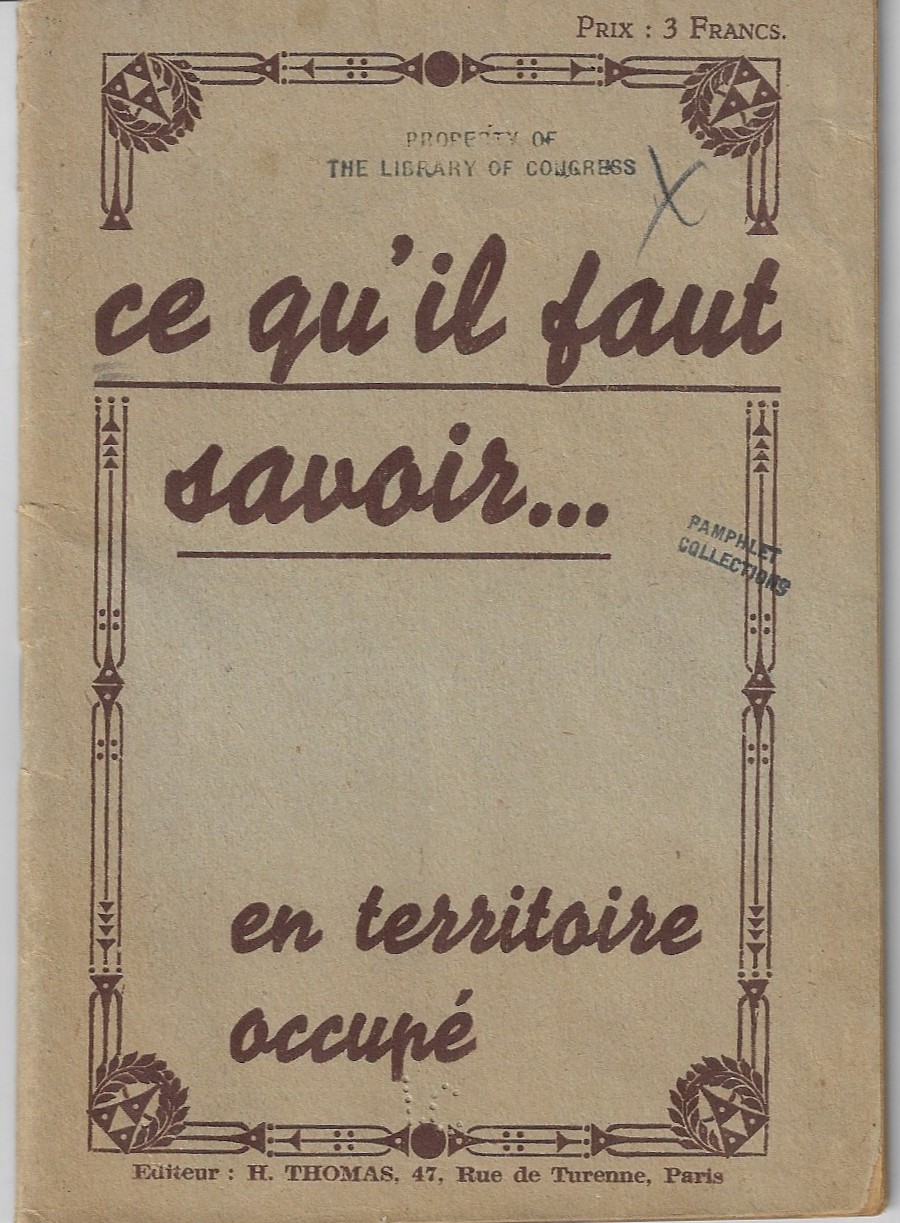
    Books covers france occupied territories JewsBy the title, Ce qu’ill faut savoir en territoire occupe1 (“what you need to know in the occupied territories”) we see that this short/small and rather plain pamphlet is an outline of expected behavior of conquered France…or shall I say “overrun” in its six miserable weeks of fighting which found no good end, all of it coming to a close on 22 June 1940, though there were strong pockets of resistance that would arise and take hold until the defeat of the Germans five years later. It is almost ephemeral, having virtually no “presence”, if appearance were to judge—it looks like nothing, nearly. It is hardly that, and represents a coming great evil.

    It contained the rules of society from the Germans and from Vichy, and in no small way dictated the expectations of the conquerors. The thinking was wide and brutal and trite, defining the occupied territories, the new justice system, economics of the occupation, and the like, as well as the “camouflage” of street lights, rates of exchange, bicycle rules, and the use of motorcycles.

    What caught my eye was the header for a two page section on French Jewry, “Les Dispositions pour les Juifs”.

    It is announced simply that the “German authorities” and of course the Vichy government have taken measures against Jews in the occupied territories.

    • (“Les autorites allemands ont pris des dispositions contre les Juifs demeurant en territoire occupe…a ces dispositions pourront en etre adjointes d’autres prises par le gouvernement francais de Vichy…”) and then went about its business.

    The first thing to do was for the Jews to make themselves available and report to authorities before 20 October 1940. It encouraged the head of a household to make a report on the entire family.

    • (“Pour le moment, les obligations faites aux juifs en territoire occupe sont les suivantes de ne pas rentrer, pour les juifs qui ont lui la zone occupe de se presenter avant le 20 Octobre 1940 a la sous-pretecture de leur arronfissement de domicile pour se faire inscribe a un registre special. La declaration du chef de familie est valable pour toute la familie.”)

    Next of course came the subjugation, demanding the identification of all businesses either run by or principally owned by Jews to identify themselves as such, with fines and imprisonment (and confiscation) the consequences of not doing so. A Jewish business was also defined as having more than 50% investment by Jewish interests.

    • (“…d’afficher en langue allemand et francais la mention entreprise juive a tout comemrce dont le proprietaire ou le deteneur est juif. Les dirigeants des communautes israelites doivent fournir. Les contraventions sont punies de prison et d’amende, ou d’une de ces deux peines. La confiscation des bien pourra en outre etre prononcee…”)

    Then comes the identification of who is a Jew, and according to this document, someone is a Jew if their grandparents were (“or appeared to be”) Jews.

    • (“Sont retenus comme Juifs ceux qui appartiennent ou, la religion juive ceux qui ont plus de deux grands-parents.”)

    Just a couple of hundred words. Two pages. And yet it outlines the basics of population control and discrimination, setting the stage for removal. All contained in this little pamphlet, which I should point out was not free, but sold for 3 Francs. There would be a many-orders-of-magnitude price to pay in the very near future.

    Notes:

    1. Ce qu’il faut savoir … en territoire occupé, (Ed : H. Thomas, 47 rue de Turenne, Paris,) 6×4”, 46pp. No doubt the work of the Nazi government. Printed ca. August/September 1940. Original wrappers. Provenance: Library of Congress, with their stamp on the front wrapper and their surplus/duplicate stamp on the cover’s back.


    ·Posted by :

    ·in:

    —

  • Striking Artwork from the Wobblies, 1933

    JF Ptak Science Books   Quick Post

    • I’ve been mostly on a sabbatical this summer.  The blog will return to its normal output of 20-40 posts per month by September.

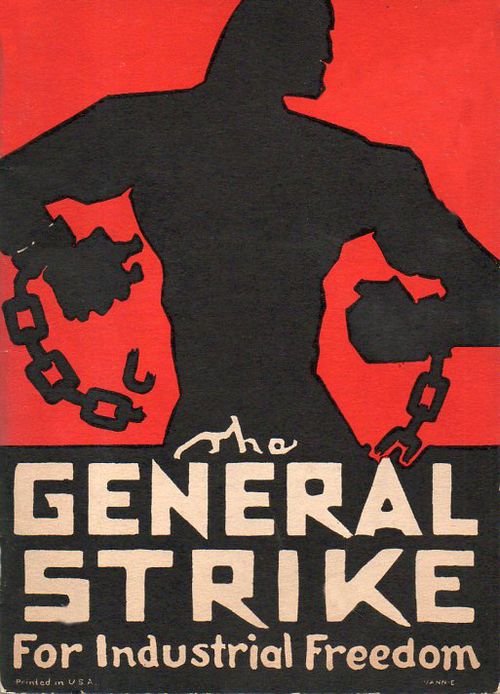
    This is  fantastic artwork is for the cover of the pamphlet The General Strike for Industrial Freedom which was printed in Chicago in January 1933 by the Industrial Workers of the World (the Wobblies).  The IWW was pretty far left–okay, very far–and was founded in 1905 by Eugene V. Debs, Mary Harris “Mother” Jones, William D. (“Big Bill”) Haywood, Daniel De Leon,  Thomas Hagerty, Lucy Parsons,  and others.  By the ’30’s membership in the organization was off probably an order of magnitude, its heyday more “day” than “hey”, its flash gone. Also the Great Depression hurt membership, as well as the coming and fighting of WWII.  In this instance, there was no one particular “general strike” that was being advanced, but (so far as I can tell) the idea of a general strike itself was being explained. Not only was the strike about a general work stoppage across multiple industries, but also advocated the seizure of industries/factories/properties by the workers to fight oppression and Fascism. 

    The artwork for this work, though, was terrific. 

    Books covers general strike red

    ·Posted by :

    ·in:


  • Hospital Experience with Foreigners: Defining “Desirable” and “Undesirable” (1903)

    JF Ptak Science Books  Quick Post 

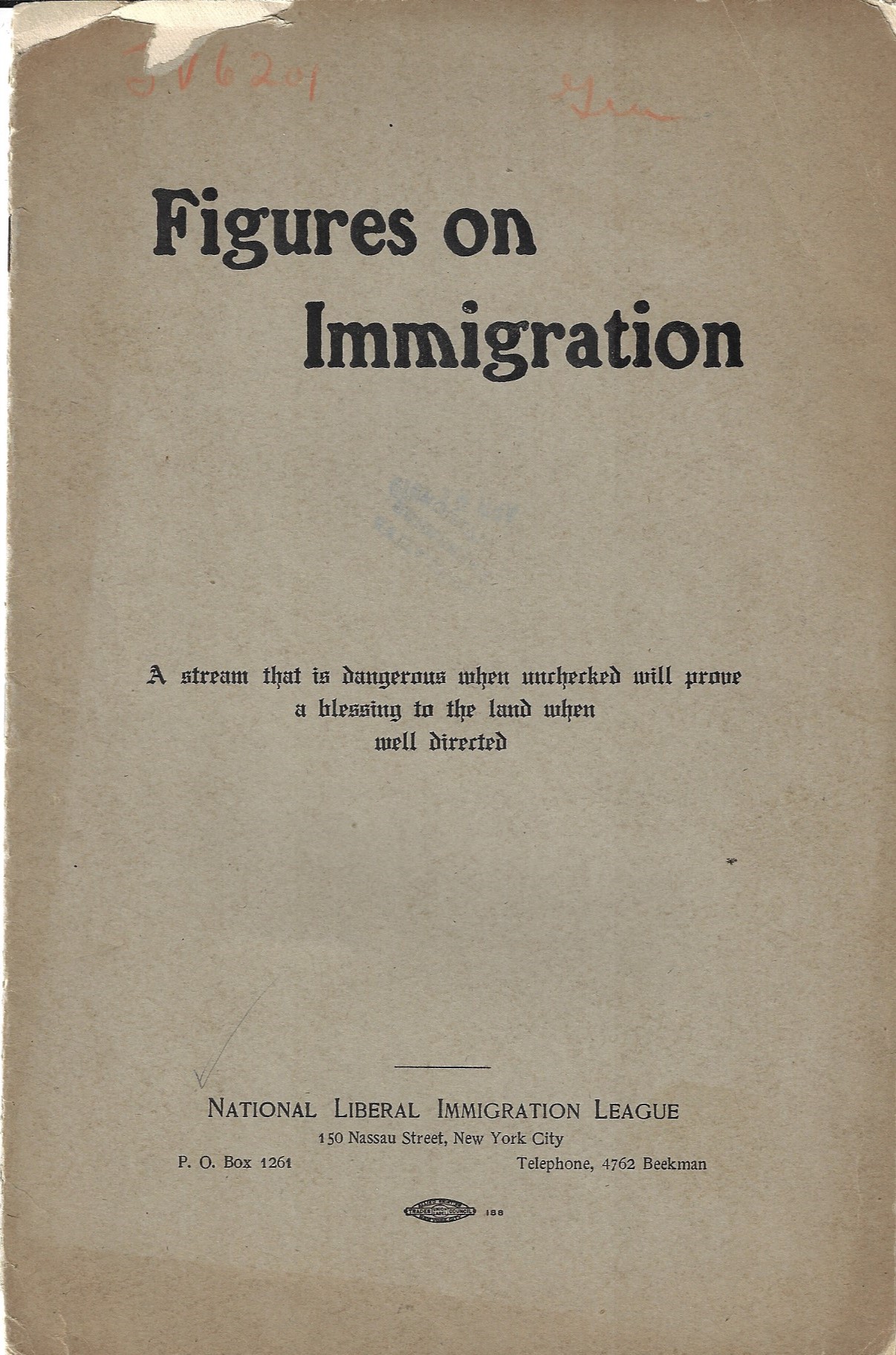
    Immigration League 1902What Ho! The pamphlet, Figures on Immigration, presents the reader with info necessary for the continuation of “desirable” immigration. Published by the National Liberal Immigration League (150 Nassau St., NYC), the League exclaims immigration in terms danger and blessing. “A stream that is dangerous when unchecked will prove a blessing in the land when well directed”, they say, and then gets right ot the heart of the matter, identifying what is dangerous and what isn’t by defining the “desirable” from “undesirable” aliens

    To be very simple and clear about it, the League states the following:

    Desirables: “Northern and Western Europe”, including “Australia, Belgium, Canada, Denmark, England, Finland, Norway, Nova Scotia, Scotland, South America, Switzerland, Wales”

    Undesirables: “Eastern and Souther Europe”, including “Greece, Hungary, Italy, Romania, and Russia, plus Asia and Africa, including China, Egypt, Japan, and Syria”, for example

    The purpose of the report was to establish the “desirable” from “undesirable” patients of various NYC hospitals. But the main point in this note is to establish the contemporary ease of marking “acceptabilities” of entire classes of people. This practice was much more visible and plain in 1902; it is still an exercise today, of course, though the signs of it are generally much more subtle. 

    ·Posted by :

    ·in:


  • On the History of Kindness to Children (1687)

    JF Ptak Science Books   Post 2745
    Bibliotheque Universelle 1687

    Another piece of great serendipity fell from the sky, again this week, this time on the idea of the history of childhood–more accurately, it is on the history of kindness extended to children. The idea of looking at childhood in that way lies in the work, for example, of Phillipe Aires (Centuries of Childhood, first French edition 1960) and Lloyd deMause (The History of Childhood, 1974), among others, who maintain that kindness towards children is a modern invention. (This is kind of wildly brief statement of this idea–suffice to say though that the treatment of children through long history has not been necessarily “kind”. For example, the word “childhood” appears only twice in the Bible (KJV), and really only once in reference to what childhood might have been rather than a simple statement regarding a period of human life. That occurs in Ecclesiastes 11:10: “Therefore remove sorrow from thy heart, and put away evil from thy flesh: for childhood and youth are vanity.” This is in line with an older variety of that book, the Cloverdale Bible, in Ecclesiastes xii. “A   Childehode and youth is but vanite” which again makes the point of childhood being something to get away from rather than a chance to improve the life of the new person. The Oxford English Dictionary takes the word back to Middle English times, but even into the 19th century I can’t really point to an applicable use of the word in connection to this discussion.)

    The issue came up while listening to a public reading by my wife’s (Patti Digh) favorite living author, Richard Powers. He was taking questions after a lovely read from his newest, called The Overstory, when a question came to him regarding human-like senses in animals. Powers responded saying that all was possible, seeing as how people question those human qualities in other human beings. He used the term “Anthropomorphism of Man”, which I found fantastic, as he was correct. For centuries certain people simply weren’t regarded on the same human level as other people (those people doing the judging). For example, in the U.S., women, African Americans, the poor, Asians, and so on from a long list, have only recently been elevated to the prospect of “sameness” with those in power in this country. Before this, they were something “lesser”. And it was here that Powers offered “children” as not being children, not even a full human, for most of the history of humans, and so only recently come into their own as full humans.

    Then came the serendipity.

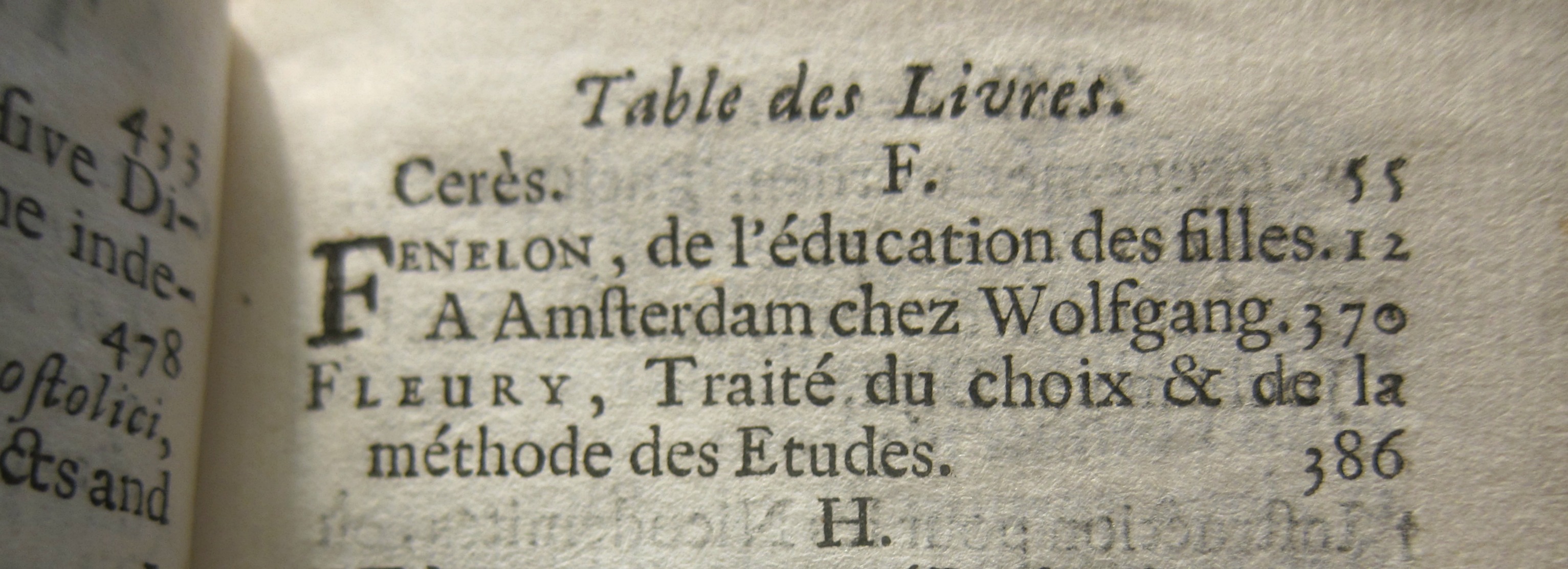
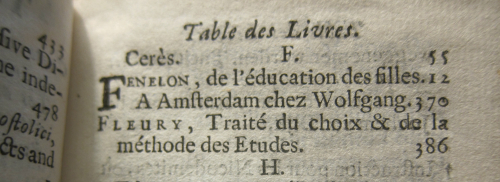
    I was browsing through one of the 30 volumes or so of an Amsterdam-published 17th century magazine/journal called Bibliotheque Universelle looking for articles of scientific interest. There’s a lot in these little bricks of books, and they do have some occasionally good (and great) scientific efforts in them, the one I was working on, one of several volumes for the Principia year of 1687 (July 5), yielded nothing of any great sci-interest in its 500+ pages. Then, I spotted it, just a simple four lines of 6-point type in the 5”-tall book: “Fenelon, de l’Education de filles…” That’s François de Salignac de La Mothe- Fénelon, of Telemachus (son of Ulysses, etc.) fame, and his book was on the education of daughters. It was published the year before, in 1686, and the editors of the Bibliotheque gave it 14 pages or so of review and explanation.

    It seems to me from this reading that in this account—really on education of children in general–M. Fenelon was an advanced thinker, a human human-rights person, treating children and their education as individuals, with understanding, and kindness.

    Evidently the man speaks to curiosity and rational amusement in the book—that curiosity must precede the rational, and that one must be careful in doing that, because there is a danger of “imitation”–curiosity is the thing that banishes ennui.

    At the same time instruction must be realistic, so that once mature and grown that the real world is not a total shock, and that once subjected to the daily routine of “housewifery” there will be no denouement from the dreams of childhood—all of that seems like a pretty sticky wicket. Fenelon did seem to insist on the beginning of education from infancy, but not to overdo the instruction as that would “oppress the facilities”.

    Perhaps the most surprising positive thing of them all to me was Fenelon’s insistence on being careful with your words with the mature child, and to never be guilty of a falsehood with children, which is pretty good and sane advice.

    There’s other stuff that doesn’t translate any longer into where we are today, but there seems to be a lot of material that is timeless.


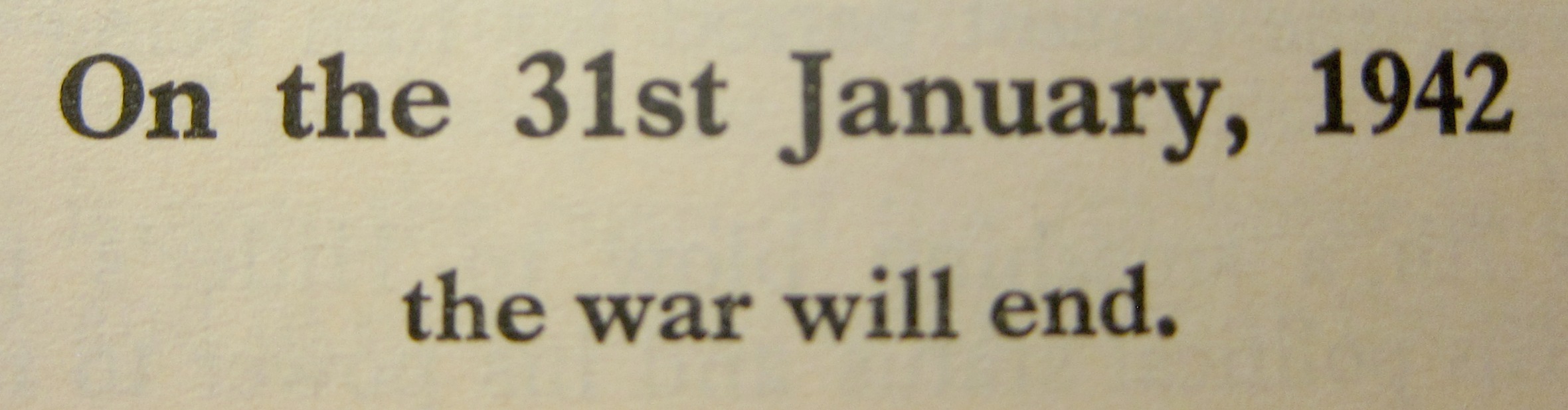
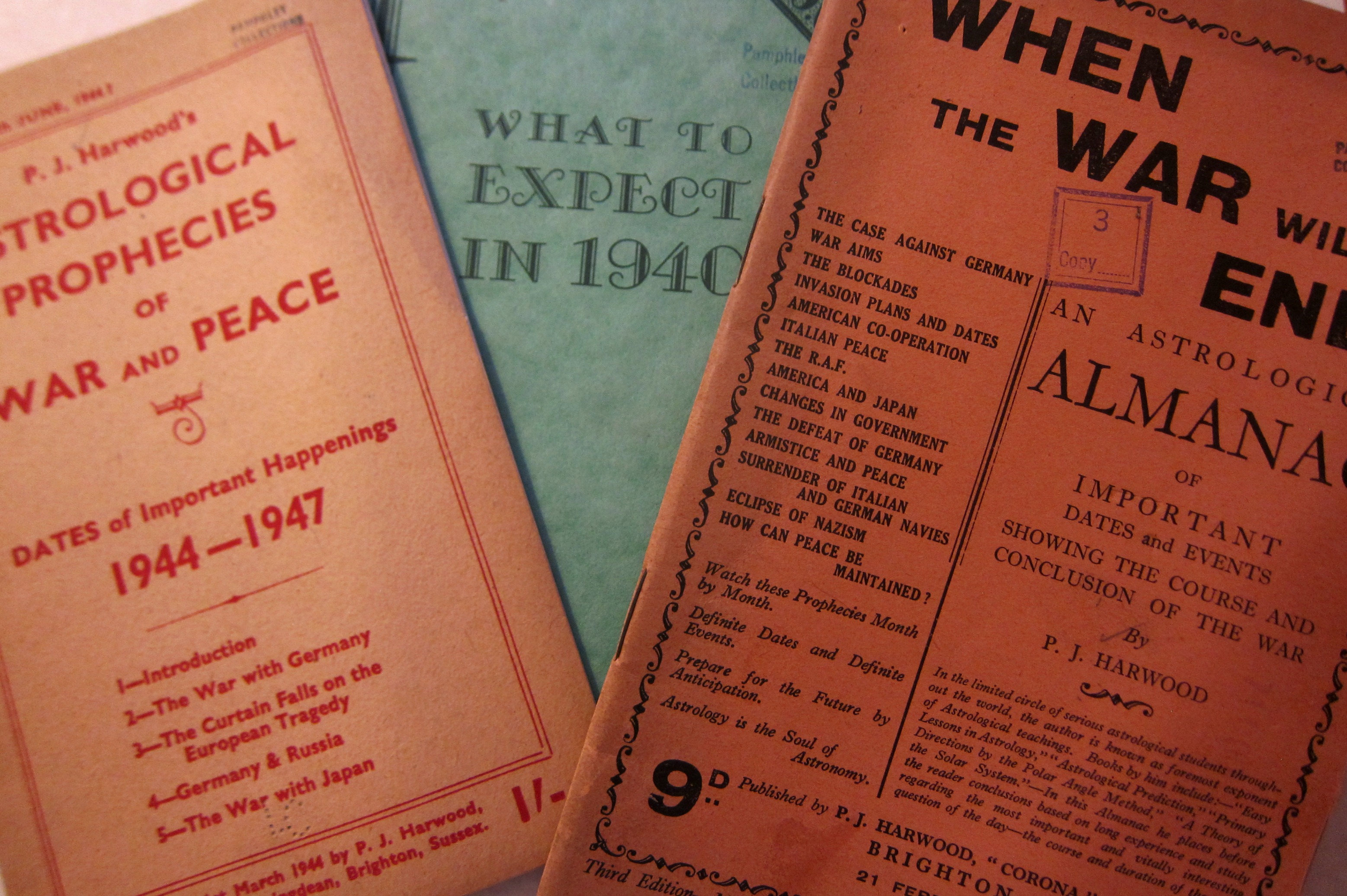
  • “On the 31st January, 1942, the War will End”, or not. An Astrologer Looks into the Future of WWII and Gets Confused.

    JF Ptak Science Books   Quick Post

    The great Woo-woo (a blanket term used by James Randi to describe all manner of fake and fraud) of astrologers picking moist bits out of an imagined future during WWII proved to be of value for making an income for its users. One such person was P.J. Harwood, an astrologer who wrote two of the pamphlets I uncovered yesterday. He had shapely visions of the future metamorphised via the light of stars (and galaxies) that traveled for millions and billions of years, evidently their purpose in such vast time and impossibly enormous reaches of space being to cue in people on this planet about some influence their position in eternity has on future human events. The only predictive success these pamphlets by Harwood had was to ensure some sort of income and attention for himself. 

    I would not have stopped to say anything about these pamphlets (printed in 1941 and 1944) at all had I not opened one of them to a 32-pt announcement:                 

    Books astrology WWII war will end

    The funny thing is that this statement occurs in the third edition of the 1941 pamphlet. The way to move forward in publishing his views of the future was to ignore all of the misses and publish hios astrological results under a new title, which he did with his astrological prophesies book for 1944-1947, printed several times in 1944.  Britain was to invade Europe and speed towards Germany in May 1941, leading Hitler to eventually sign a peace treaty in 1944. The U.S. would suffer an enormous defeat on July 6, 1944, but recover enough to defeat Japan sometime in 1947, and so on.  This was one way for one man to make a living during WWII. 

    Books astrology WWII war will end

    ·Posted by :

    ·in:


  • An Early Indictment of the Japanese Invasion of China, 1931

    JF Ptak Science Books  Quick Post

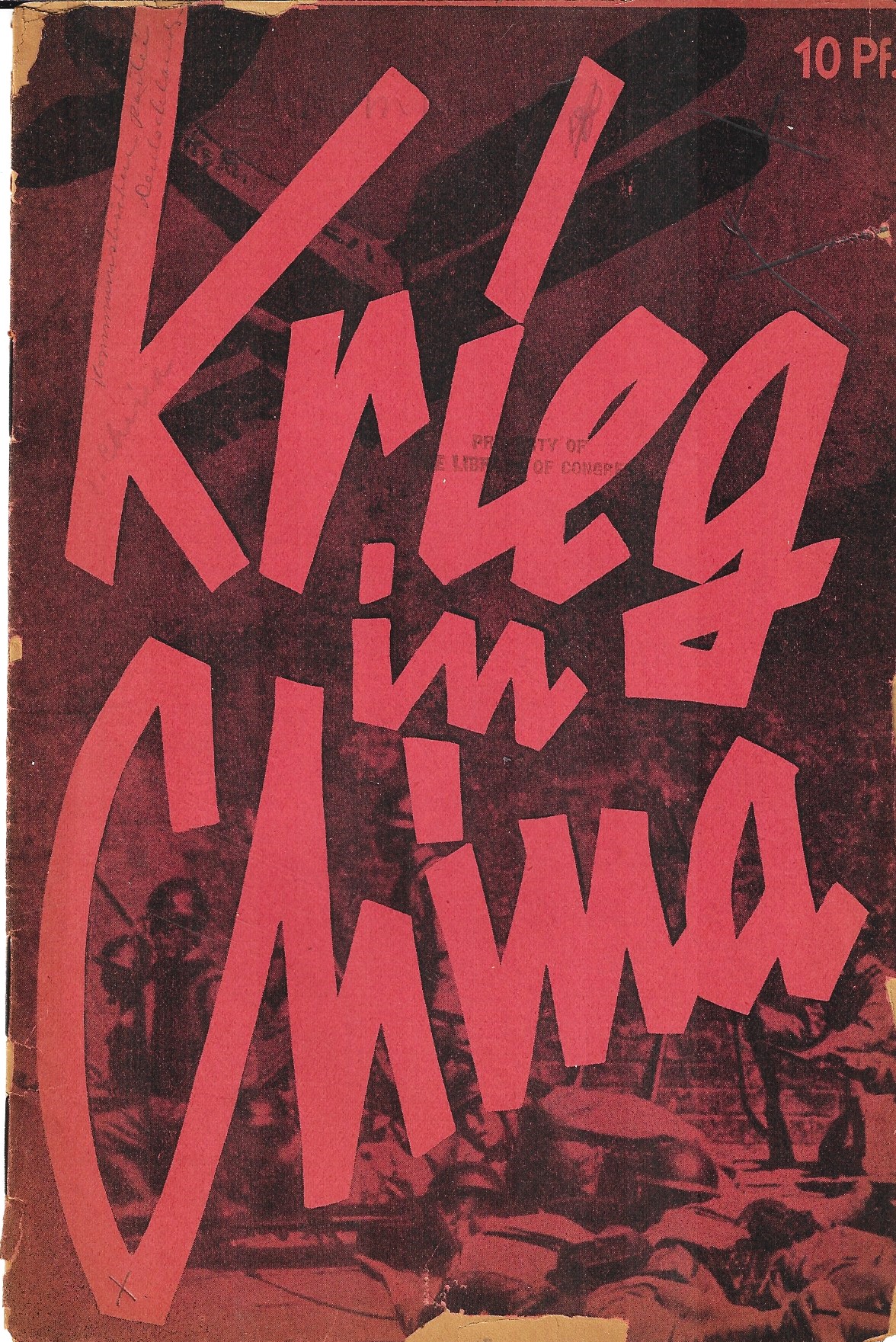
    Here’s another bit of graphic design, a very aggressive cover from 1932 for Krieg in China! by Ernst Schneller1.   Schneller–a long-time KPD member–wrote this short work as an expose on the “war” and in support of the Chinese, published it seems just months after the Japanese invasion and conquest of Manchuria and another few months after the battle known as the January 28 Incident, all of which was foundational for the war that would officially be declared in 1937 (and last until the end of WWII). 

    Schneller was himself a persecuted communist intellectual who was arrested became among the first to be imprisoned in the Nazi KZ system in 1933, and who would stay in the system until he was executed at Sachsenhausen in 1944. 

    It is interesting to note that in one chapter heading the pamphlet refers to the war as a new threat to the world (“eine neue welt droht”).

    DocFile (4)

    Notes

    1. Berlin : Kommunistische Partei Deutschlands, [1932] 9×6”, 15pp. A little confusing, though it seems that there are only three copies of this book located in WorldCat/OCLC. Provenance, Hoover Institution, and then in 1933 to the Library of Congress.


  • The Dictatorship of Hunger (1931)

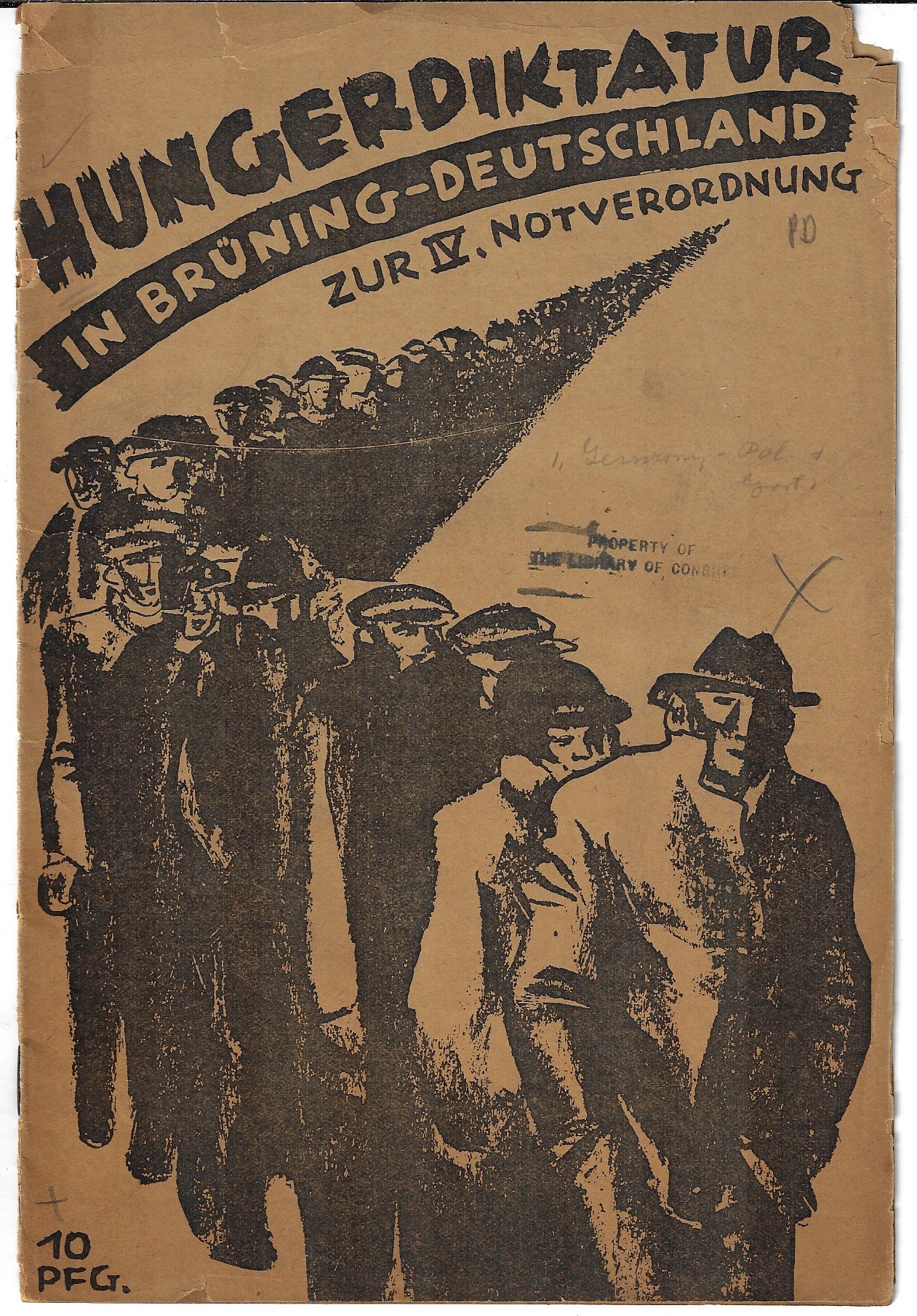
    DocFile (2)From what I can tell this pamphlet–Hungerdiktatur im Brüning-Deutschland zur IV. Notverordnung. Zk. Der KPD. 1931– is an indictment of the responses of German Chancellor Heinrich AME Bruning to the explosive Depression in Germany beginning in 1930. Bruning became Chancellor right at the outset of the Depression in 1930 and his options were already very limited, economically speaking, without the failure of the world economy adding to an already deeply compromised situation. Nevertheless, his policies are seen in different perspectives, and he was out of office by 1932 and fled Hitlerism and Germany altogether in 1934. (Bruning was two chancellors removed from Adolf Hitler taking the position in 1933.) In any event the pamphlet here leaves no doubt about the impossibility of the social situation in Germany in 1931 and places a long legion of the Hungry at the feet of Bruning’s Germany.

    The cover design is very striking, and unattributed.