A Daily History of Holes, Dots, Lines, Science, History, Math, Physics, Art, the Unintentional Absurd, Architecture, Maps, Data Visualization, Blank and Missing Things, and so on. |1.6 million words, 7500 images, 4.9 million hits| Press & appearances in The Times, Le Figaro, Mensa, The Economist, The Guardian, Discovery News, Slate, Le Monde, Sci American Blogs, Le Pont, and many other places… 5000+ total posts since 2008.

Category: Social History

  • East St. Louis Massacre and the Silent Parade, July 1917

    JF Ptak Science Books  Post 2752

    The Crisis, a journal of the NAACP, called for attention and action in response to the terrible 2 July East St. Louis Riot and massacre in their issue of September 1917. The leadership published a long article detailing the background and the horrors of the event, which you can read if you follow the link. The back of the cover of the journal featured a plea for membership (actually calling for people to “enlist”, much like the people doing so during WWI which the U.S. finally entered 6 April 1917 after nearly three years of European warfare) which was followed in a few pages by the details of the event. 

    Long story short, racial tensions in East St. Louis were increased due to northerly African American migration from the Southern states, causing anxiety among the whites on purely racial reasons as well as the belief that there would be stiffer competition for work. The main catalyst though seems to have been a strike at American Steel, the management hiring hundreds of Black workers to replace the White strikers. Tensions high, a carload of Whites drove into the segregated Black side of town and opened fire on a group of Black men. Shortly afterwards another car of Whites–this time including two policemen–made a similar tour of the area, the Blacks responding with gunfire thinking that it was another drive-by. The two policemen were killed, and then things escalated quickly and brutally, with tens of thousands of Whites turning out to ESL and rioting, beating, clubbing, shooting, and setting fire to buildings (while cutting the hoses of the fire department to ensure that the arson burned the buildings to the ground. Impartial eyewitnesses to the event reported that the National Guard and the police were in very large part unresponsive to the threatened population, and in many cases aided and abetted the rioting. In the end estimates ranged stating that 50-200 African Americans were killed and 6,000 made homeless, while later on a Congressional investigation reported that an accurate estimate of the murdered could not be made. 
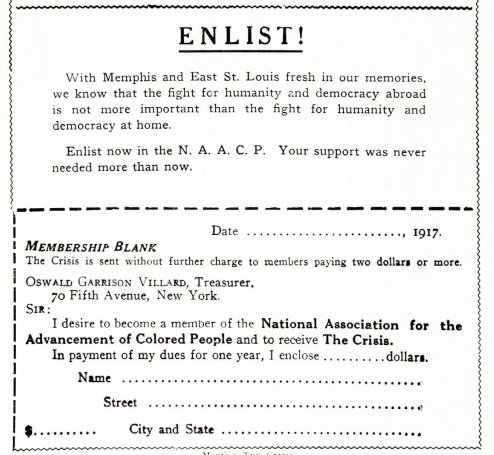
    Crisis East St Louis ENLIST

    • Source: The Crisis, September  1917, vol 14/5, pp 218-238,  via Marxists.org: https://www.marxists.org/history/usa/workers/civil-rights/crisis/0900-crisis-v14n05-w083.pdf
     

    ·Posted by :

    ·in:


  • Creating National Monuments Made of the Ashes of the Dead (1917)

    JF Ptak Science Books  Quick Post

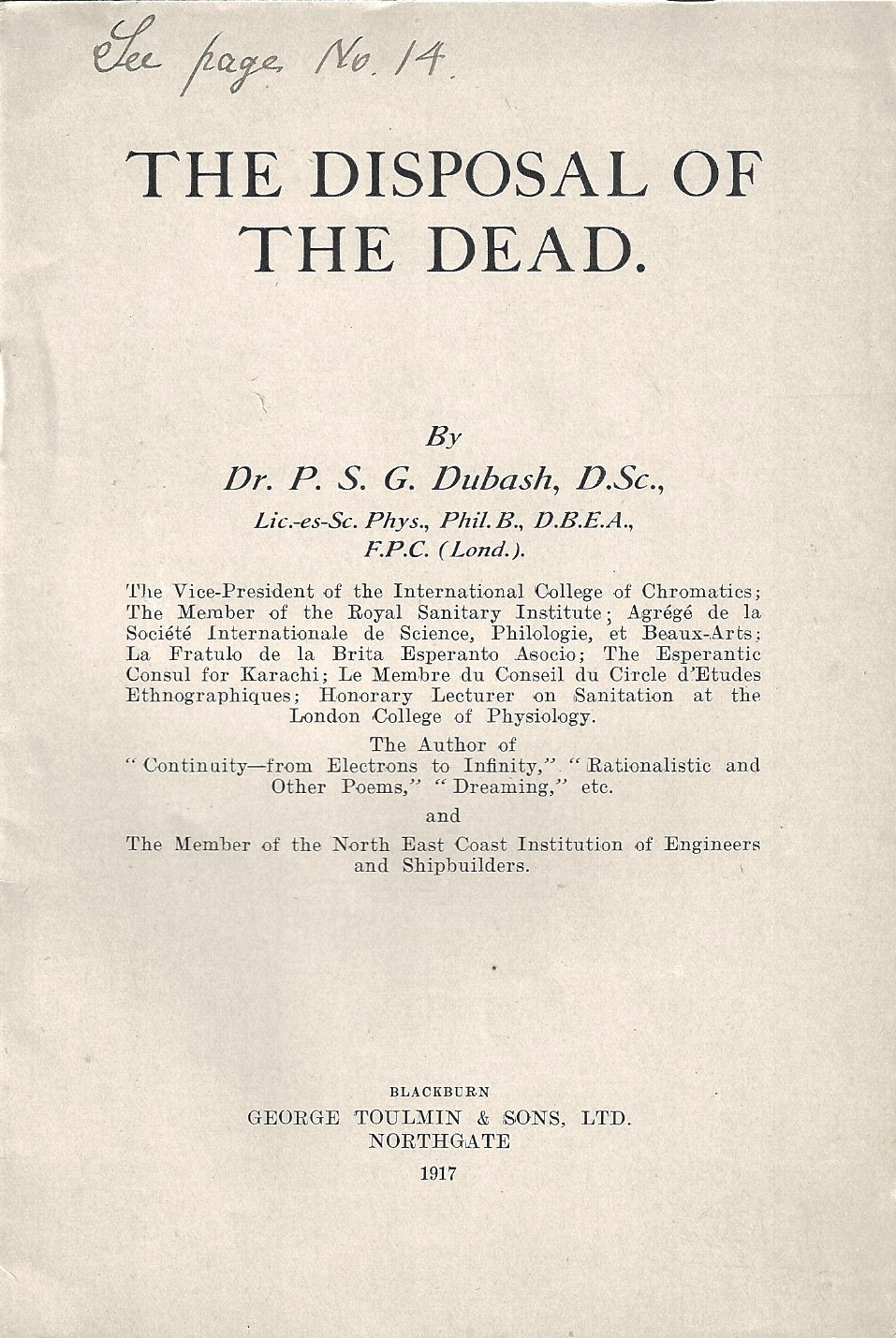
    Books covers disposal deadIn the death-drenched year of 1917, in the third year of the then Great War, P.S.G. Dubash offered to readers here and there the idea of transforming the ashes of the dead into something “useful”, using them as the material for creating statues of the “Great Departed”.  “The world today is so much the poorer for not having the ashes of such great men as Isaac Newton, Lord Kelvin, Martin Luther…”  and so, we can create statues of them using the ashes of others. This would be particularly so for people contributing their ashes to the statue of someone whom they admired. In that way, as Dubash points out, the remains of soldiers would live a more sustained post-death state by being part of a statue of, say, Lord Kitchener. “Towns can be thus adorned with the living memories of the great dead.”

    Part of this 18-page pamphlet (published by George Toulmin & Sons of Northgate) describes the four ways of disposal of the dead: internment, embalming, burning in the open, and the towers of silence (where bodies are brought to a height and displayed to be eaten by birds).  Dubash makes the case of great waste in three of the four, only finding use in the “exposure” category.  

    And so, there you have it. There’s a certain something here that makes sense, using thousands and tens of thousands of remains to create statuary. Gravestones and memorials aren’t made of ashes, but they are reminders of what sleeps underneath, and in a way they are a type of mostly-repetitive statuary sans biological remains. 

    There is an interesting part here at the end of the pamphlet, where Dubash makes the case that “there should be no colour prejudice, because after death there is no colour prejudice, because in the eyes of God the colour prejudice is a sin”. This is a provoking comment, and makes me think of the history of the skin color in Heaven…a history that I do not know.


  • Interesting Dust-Covered Numbers–Apartments in NYC in 1933

    JF Ptak Science Books   Post 2749

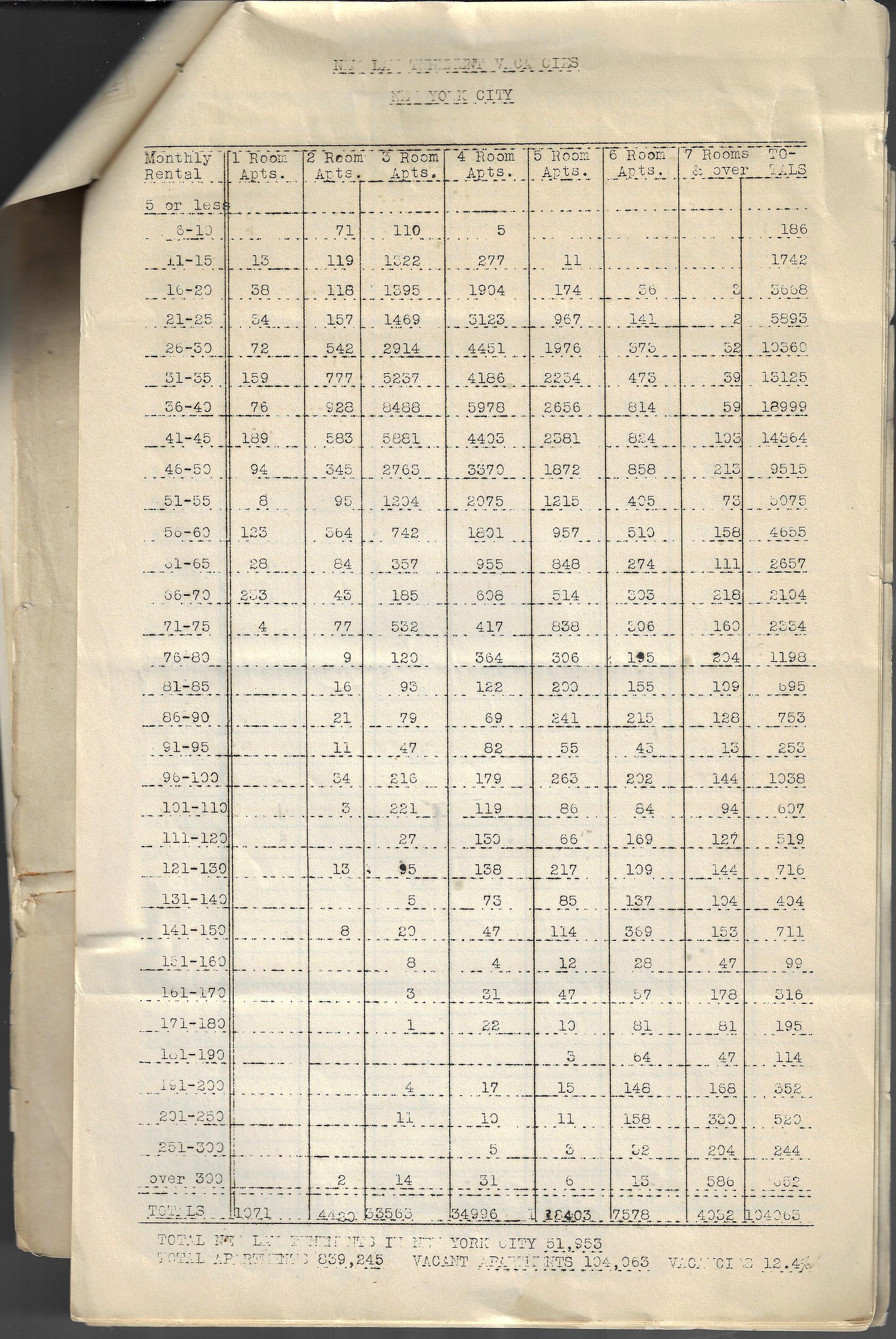
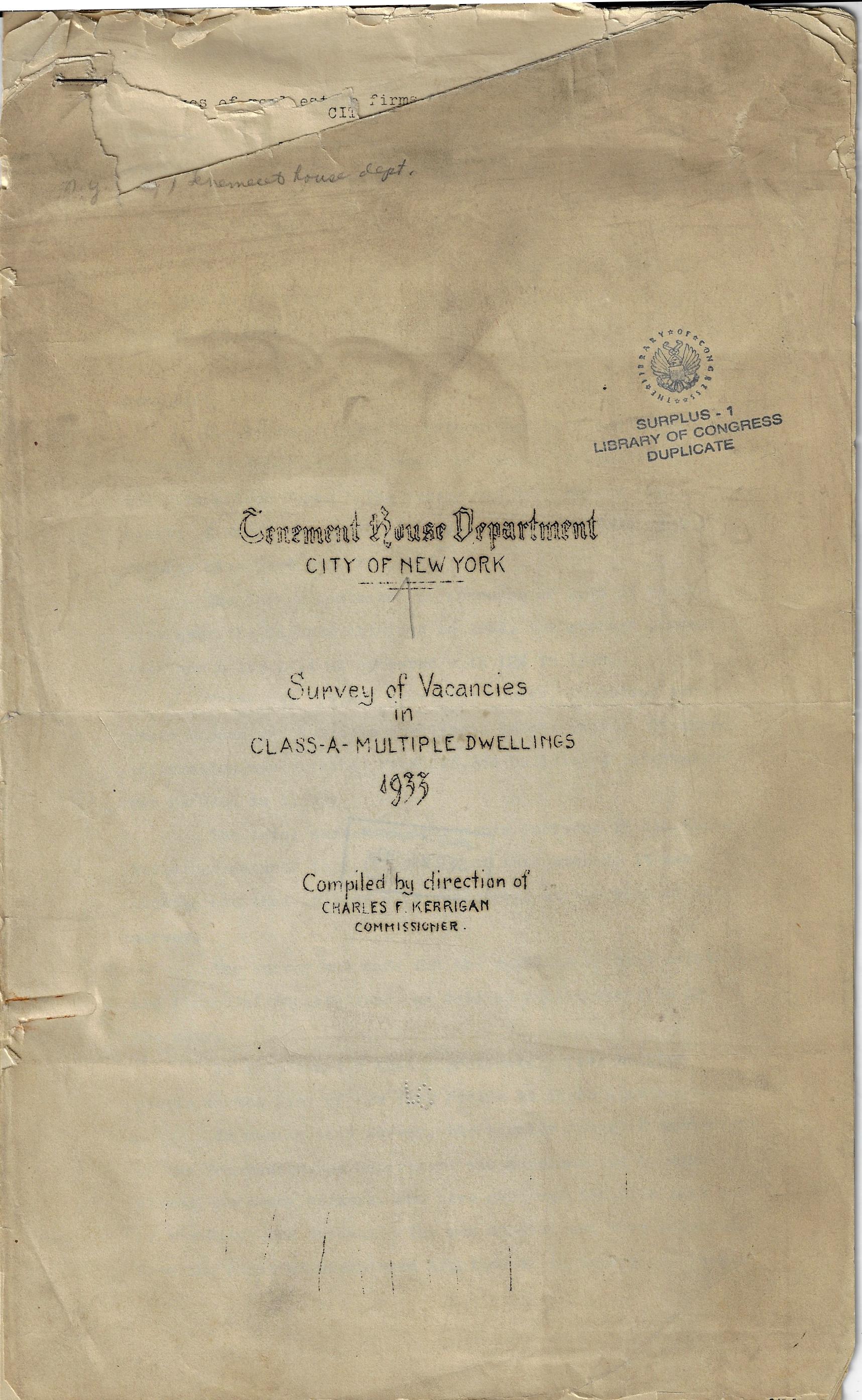
    NYC apartment rents 1933 coverI know that there must be someone out there in Webtubiana desperately looking for this in a way in which they didn’t know they (a) needed it at all and (b) didn’t know that that unknown need was desperate. And so here it is: New York City apartment vacancies in 1933. There is a tale being told here, in NYC, in the fourth year or so of the Depression and the first year of FDR, about what could be afforded and how much that all was. The list is found in eight pages of Tenement House Department, City of New York: Survey of Vacancies in Class-A-Multiple Dwellings, compiled by the Commissioner Charles F. Kerrigan, and dated in the text “May 11, 1933”.  It is a mimeographed production with a done-at-the-office quality to it, the typewriter having a problem with “9” and “0” and “O” as they tended to be filled in with ink. 

    I know this sounds as brittle as ice on an ego, but once you get past the dust, there is definitely a story being told, if you looked for it.

    At the very least this document will tell you what the rent was like on apartments from 1-7 rooms (elevator and non-elevator buildings), which means that if you consult the ever-useful Bureau of Labor Statistics inflation calculator you can at least establish a common denominator for value interpretation into current dollars. There are 33 (!) price classifications for monthly rental, ranging from $5 (or less) to “over $300”.  So, using the BLS formula $1 in 1933 is worth about $19.21 in 2018 (or for the sake of convenience let’s say 1:20). So the cheapest monthly rent in 1933 for a vacant 1-room apartment in 1933 was $100…except there weren’t any available. The next step up was $6-10, and using the upper end at $300/month there were only 13 1-rooms vacant. The most-available of these price ranges was 189 1-rooms in the $31-$35 range, or about $700 vacant. There was nothing vacant over $75/month in a total of 1071 vacancies. 

    The most commonly-vacant category was in the $26-$40/mo (or $800/month) 3 room apartments, where there were 8,488 apartments available in the 33,563 vacancies. 

    It turns out that of the 839,245  “total apartments” in NYC there were 194,963 vacancies for a rate of 12.4%. Nowadays the vacancy rate for Manhattan hit a high of 2.6% in 2017 and the average studio apartment rented for about $3k (or $156 in 1933 dollars, which would have put you in the upper tier apartment dwellers back then). 

    Different times.

    There’s more, and if anyone needs it they can let me know and I’ll provide what I can. Right now I’m dead-up against my THX-1138 time limit of 30-minutes/post, so this one ends now. 

    NYC apartment rents 1933


    ·Posted by :

    ·in:


  • A Utopia in a Couple of Thousand Words, or Fewer (1893)

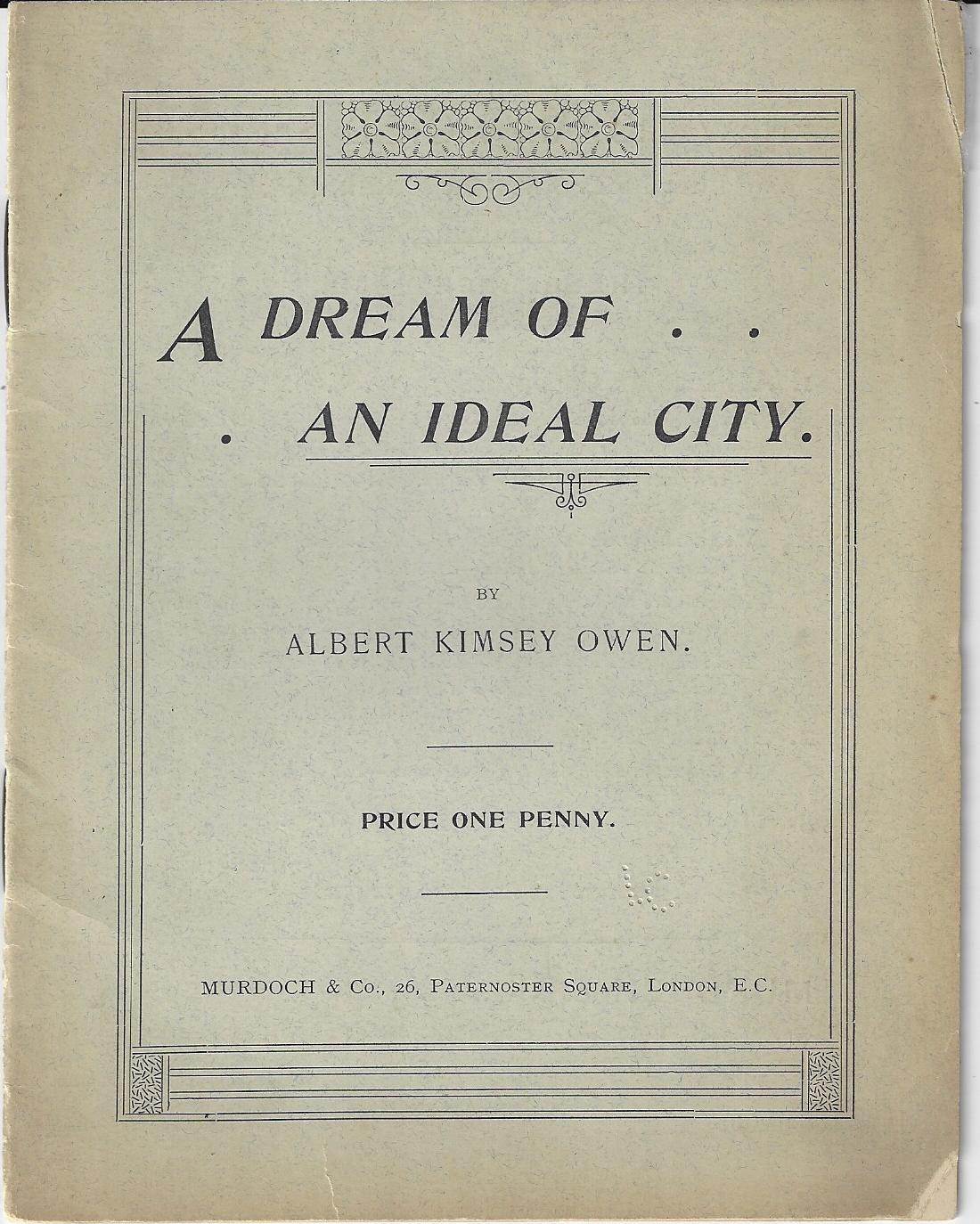
     Book UtopianWritten in 1893, A Dream of an Ideal City is a very short treatise on a very long topic. The author, Albert Kimsey 
    Owen1, was a civil engineer (when there weren't many, according to US census reports) and a dreamer,
    part of which was a vision of a Utopian community situated in Mexico on the Gulf of California.
    There is so much about this planned community that is suggested in these few short pages that it is
    hard to summarize, because the text is mostly summary—so I think I'll just quote from it at length from the online
    copy at the Internet Archive. (And frankly sumamrizing a bouncing summary like this that is nothing but very long
    sentences and very many commas would just be too annoying a process for the end result. Reading the quotes though
    is perfectly fine if not tiring.)

    Overall View, Placement and Work:

    • “I love to dream of the citizens in a large community being associated, for life’s work, in one great firm incorporated to build, by and for themselves, the best appointed, the most beautiful, and the greatest city on earth; a park residence, a city in which the metropolis, with its facilities,
      entertainments and cultures, and the country, with its green fields, hedgerows and shades;
      a seaside resort, where surf-bathing, fishing and yachting will be only an hour’s remove from the places
      of industry, commerce and home;
      every citizen may have self-appointed employments, a sufficiency of
      this world’s goods, and an elegant leisure in which to enjoy life with all its well-appointed pleasures and
      modern advantages.”

    Here’s another section of a sentence that seems almost to never end in spite of it varied contents:

    • “…the municipality being laid out, built up and managed with order, system and authority from the
      start to the finish — of the plan being studied, fixed and approved, before a step has been taken to execute
      the work — of the construstion of stone piers, the laying of giant sea-walls fronting the Straits of Joshua
      and Ohuira Bay, the digging of canals to extend and improve the water front, the planting of palms- along
      these great quays, the eredting of model blocks, the opening and shading of thoroughfares, the establishing
      and perfecting of varied and useful home industries upon areas reserved especially for them, and the
      building and furnishing for each resident family of a handsome and permanent home from the centre,
      solidly and rapidly to the four quarters of the compass, over one of the fairest plains, and in one of the
      most health-giving localities ever selected for the dwelling-place of mankind.”

  • Outsider’s Guide to 57 Things that Weaken America (1923)

    JF Ptak Science Books  Quick Post   From the series on Questionable Quidity

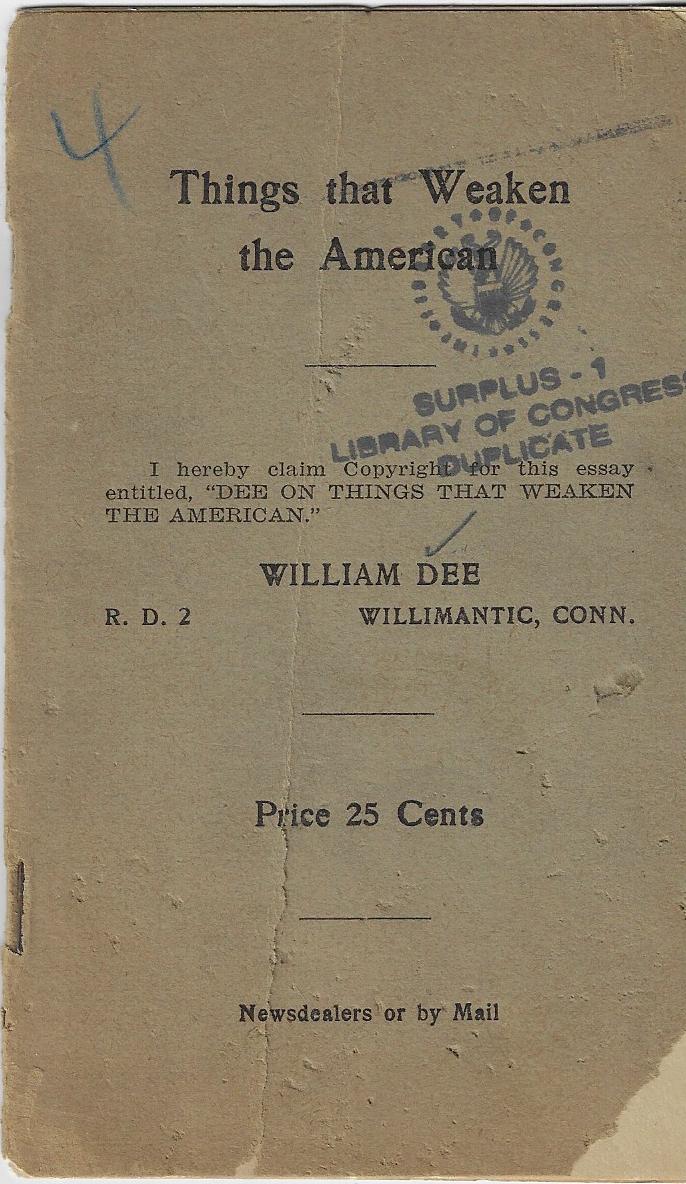
    Books covers things that weaken americaWilliam Dee, of Willimantic, Connecticut, set out in 11 pages his 57 complaints of Things That Weaken America. Some of them are actually more or less relatively maybe sometimes semi-correct with qualifications, others not so, and still many others being most definitely anti-correct. Some bits are straightforward and make no argument or explanation, as with the entries for artificial teeth (“remove them after eating”), tragedies (“avoid them”),  and city living (“is unnatural”). Others are more expansive and inscrutable, as with the entry that rails against a vegetarian diet, ending with the need to sleep alone so that your bedmate does not draw off your vitality with their magnetism.  The short and skimpy pamphlet has a sort of Devil’s Dictionary feel to it, though without the barbed wit and insight and artfulness. Why Mr. Dee stopped at 57, and why he didn’t really address anything that really threatened the United States, I do not know. 

    The writer strikes me more a 19th century person than a 20th c–perhaps he was born in 1863, which means instruction from his parents were probably taken from their 18th c parents, and the sentiments of the newness of the 1880s and 1890s just never gave way to the modern age. And maybe not.

    Here are other examples (spelling, grammar, and etc. as found in the original):

    • City Living: “Is unnatural.”
    • Artificial teeth: the only advice was to “remove them after eating”.
    • Exercise: “Hurtful to those whop are already over-exercised, by 100 times, from modern efficiency.” (?)
    • Night-time work: “Good for night-hawks, but bad for honest workmen. It is another short cut to the poor house.”
    • Steadily Working: “This gives no chance for the workman to rest and become his original self again” In lieu of frequent vacations, “take two hours’ rest at mid day.”
    • Doctors: “Some doctors have been known to keep their patients ill for income.”
    • Choir singing: “People who are not making a living at it should avoid it.”
    • Unfortunate marriages: “Have a reliable physician examine both for perfect health and avoid hell on earth…”
    • Sentimental music: “It weakens the body.”
    • Graduation exercises: “A strain on the strongest and a set-back to others. Unnecessary. Abolish.”
    • Too Ambitious: “Causes too much draft on the vitality.”
    • Public Opinion: “Bad if against you.”
    • Too Much Work: “Four hours in 24 is enough for Ford efficiency. Have frequent vacations.”
    • Vegetarian Diet: “Avoid it.” Also, without explanation: “Sleep alone to be sure that the larger oneis not drawing on your vitality by a more powerful magnetism”. 
    • Weakening Dreams: “Very bad.”
    • Love: “Very weakening. Marry the girl.”
    • Houses: “They should be small to be easy to burn in case they become infected by germs.”
    • Polluted Water Veins: [Too long and odd to transcribe.]
    • Psychological Illness: “Keep away from sick people if you are troubled.”
    • Strains: “Avoid them.”
    • Hard Study: “Avoid as much as possible.”
    • Tragedies: “Avoid them.”
    • Home Talent Shows: “Utterly ruinous to those who work for a living.”
    • Piano and Organ Playing: “Mental and nerve burden. Avoid. Health is better than music.”
    • Love Letter Writing: “Very bad. Marry the girl.”


  • “Youth too often fails to interpret itself to age” (1927)

    JF Ptak Science Books  Quick Post

    I found an interesting bit a the end of an article that I happened to see–a wonderful last line, and the second good line I’ve seen in this young day. (The other one comes from my friend Jeff Donlan out in Santa Fe, who started the sentence of an email yesterday with “The ice sublimed…”, but that is another story.)  The sentence that I had in mind is “Youth too often fails to interpret itself to age”, which is the half-inscrutable closer to the anonymous book review “The Numerical Measurement of Genius” of Lewis Terman’s Genetic Studies of Genius which appears in Nature magazine for 14 May 1927. The reviewer is referencing the translation of childhood IQs of their  later-to-be-famous selves. The reviewer points out that Ben Franklin’s intelligence quotient was estimated at 145 IQ at a young age, while Darwin as a child was 135, and (somehow) Newton was given 130 and  John Locke a 125.

    Where this was going, I don’t truly know (though the reviewer ultimately found high potential in Terman’s work here in 1927, and Terman lists as top-100 or so of all-time cited work in psychology). I do know that this one one installment of Terman’s work on genius and is one of the longest-conducted longitudinal studies in the history of psychology. One conclusion that Terman reached after many years up to his elbows in geniousity was that high-IQ doesn’t necessarily make a “success”, that there isn’t a correlation between intellect and achievement. So I guess the mostly “normal” IQs for the geniuses named earlier also didn’t correlate to their later super-achievements, or something.  

    I just liked the sentence for its oddness, disappointing as it is, because it is almost artful in its vaguely condescending nature. 

    ·Posted by :

    ·in:


  • Indicting Documents on Conditions in the Soviet Union, and the Holomodor, 1933/4

    JF Ptak Science Books   Post 2737

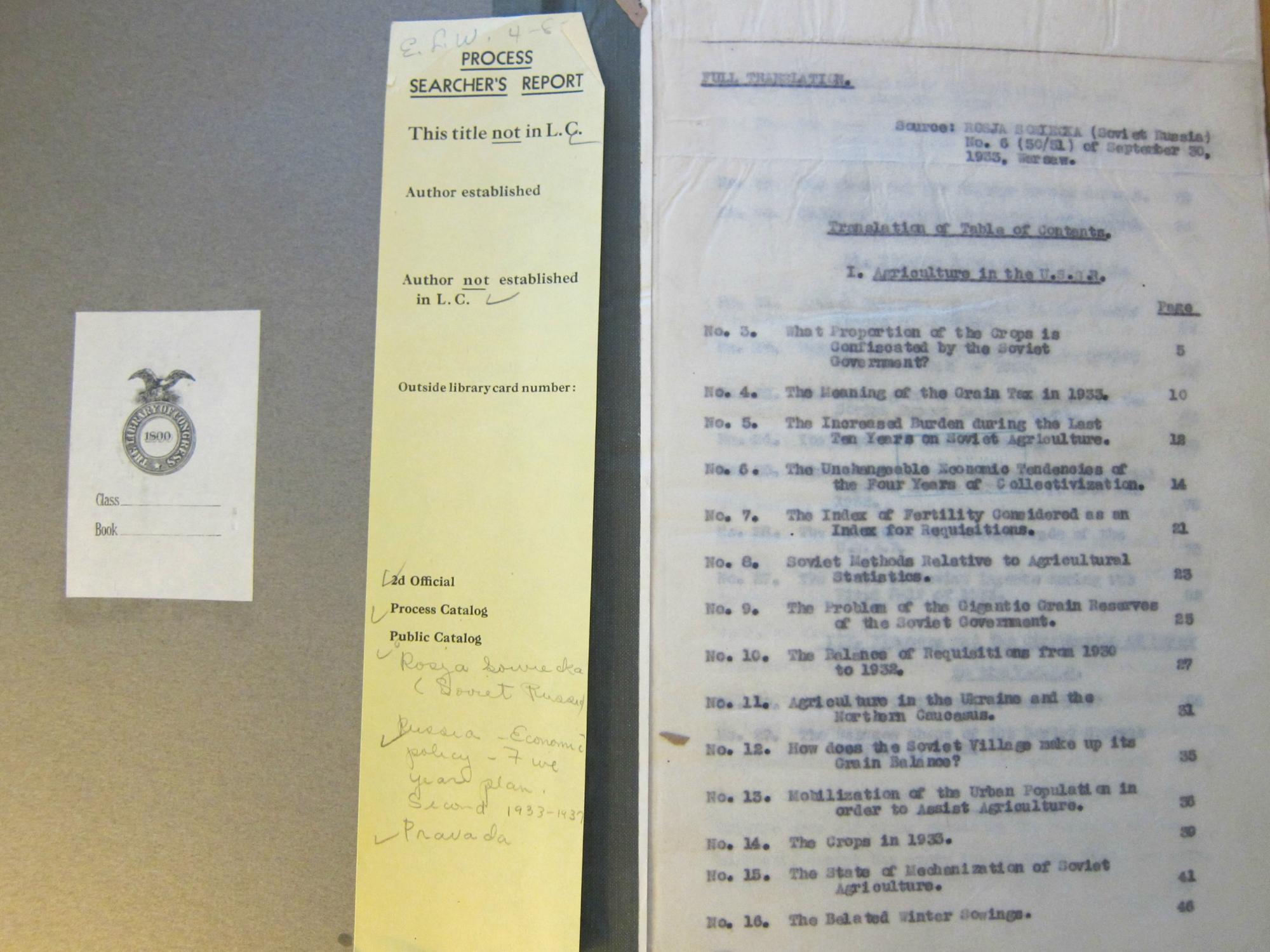
    I’m reposting the following from my books-for-sale section, as I think it may be useful for someone out there who happens to read this blog to know that this fairly rare resource is out there in the world, and available. I am not well acquainted with this area except for the basics of the Soviet Union in the 1930’s, so the descriptions of the contents and interpretations are necessarily rudimentary, though there’s enough there I think for someone interested in this area to be able to know if this material may be useful.

    The post is on three volumes of translations of news and reports coming out of the cloaked and secretive U.S.S.R. in 1933 and 1934. The publication was produced at the U.S. Embassy in Warsaw, a translation from the Polish journal, as referenced by Kris Dietrich in his Taboo Genocide: Holodomor 1933 & the Extermination of Ukraine. There are definite and numerous statements in this journal that—even for the limited amount that I have read in it—are very critical of the Soviet leadership, particularly in regard to the grain tax and the effect of collectivization in Ukraine and the Northern Caucasus. This comes at the time of massive political and social repression, manipulating the criminal code, establishing a new constitution, and the beginning of the next wave of extermination by starvation in Ukraine (the Holodomor). For example, in the chapter on agriculture in the Ukraine (on page 7 of that section) we read the summary of the extent of the “participation of the Soviet State in the grain balance” by the kolkozi was at least 70% in Ukraine and about 100% in the Norther Caucasus, meaning that there there would be no food left for those farming it, with this particular paragraph ending “what is left for the peasants”?  The answer to that question was written in millions of lives lost to the monster that was Stalin

    Rosja Sowieka. 3 documents, September 1933, February 1934, March 1934. 

     (1) Rosja Sowieka (“Soviet Russia”, printed originally in Warsaw) No. 6 (50/51) of September 30, 1933.


    Rosja

    ·Posted by :

    ·in:


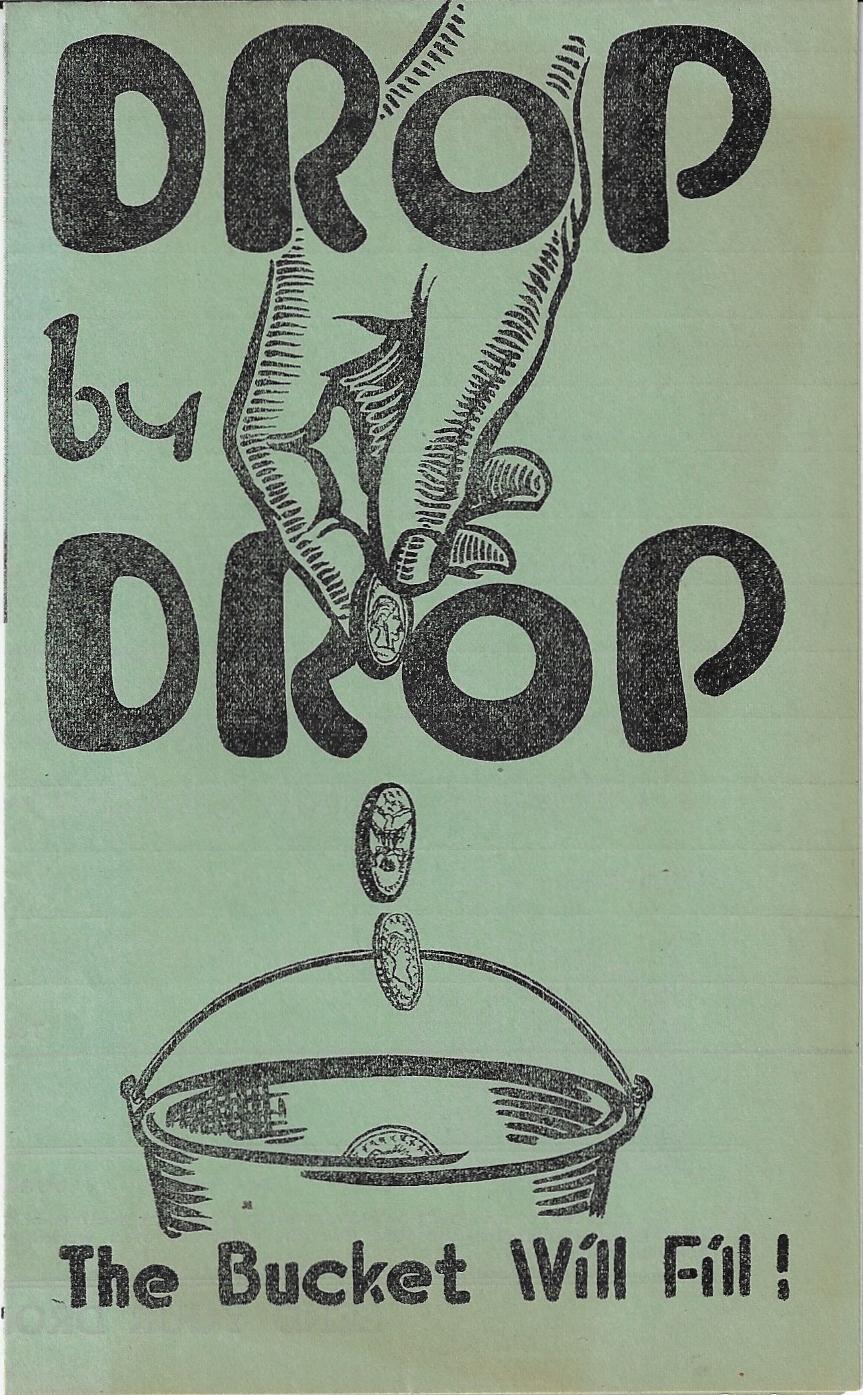
  • Pledge Sheet for Imprisoned Workers of the World, ca. 1923.Â

    Drop by drop _2_ JF Ptak Science Books  Quick Post

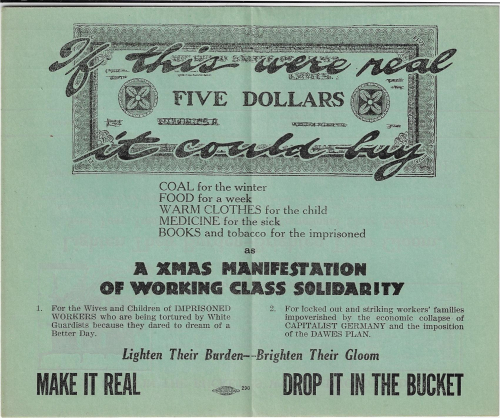
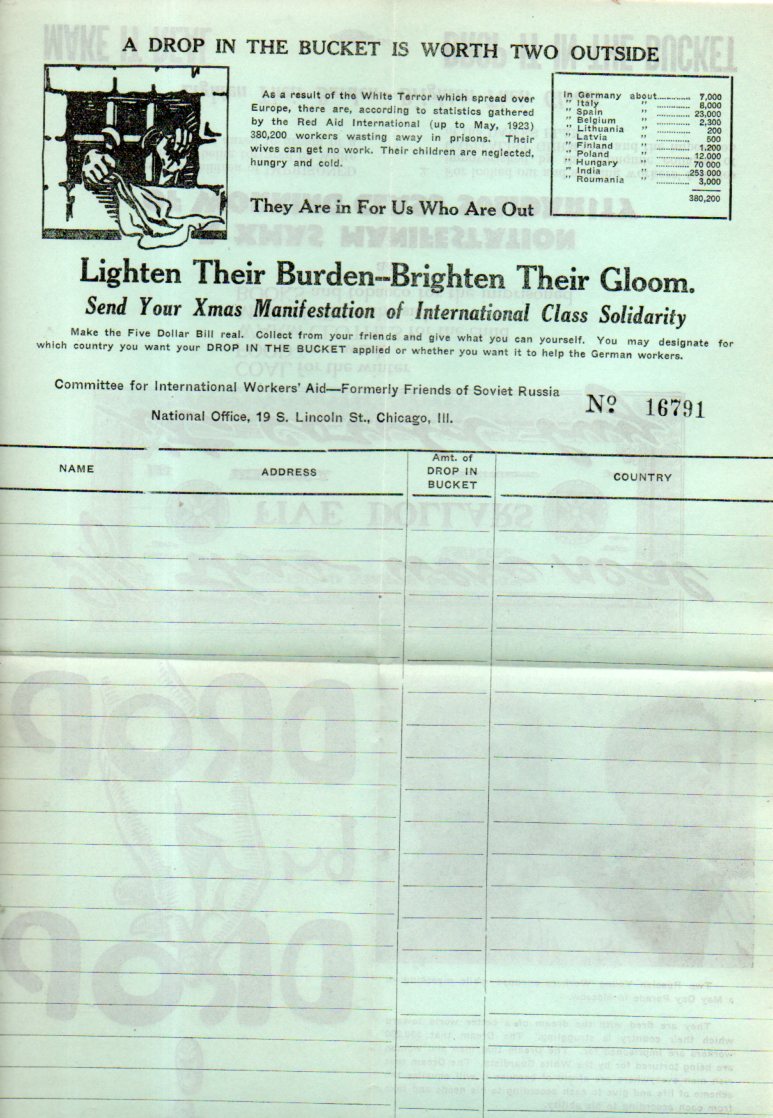
    Committee for International Workers Aid (formerly “Friends of Soviet Russia”) was a Communist organization created in Berlin in 1921 (as the International Arbeiter-Hilfe) to help raise money for famine and drought victims in Russia. It was evidently expanded to include collecting money to help victims and prisoner of Fascism, which seems to be the major target of this folding broadside.


    Drop by drop _3_

    The bucket here is a paper one, the pamphlet unfolding to be a broadside or broadsheet onto which you’d record peoples’ names and addresses and the amount of their contribution to help “class war victims of the laboring masses”, to help the imprisoned and their families (“they are in for us who are out”.  12.5×8 sheet folded into quarters. Fine condition save for a tear that I just made at the bottom center fold.  

    This is a scarce item–I could only find two copies (Yale and UC Davis) in WorldCat.  

    Drop by drop _4_

    ·Posted by :

    ·in:


  • A Rusty Paper Clip and Some Found Soviet History (1934)

    JF Ptak Science Books   Quick Post

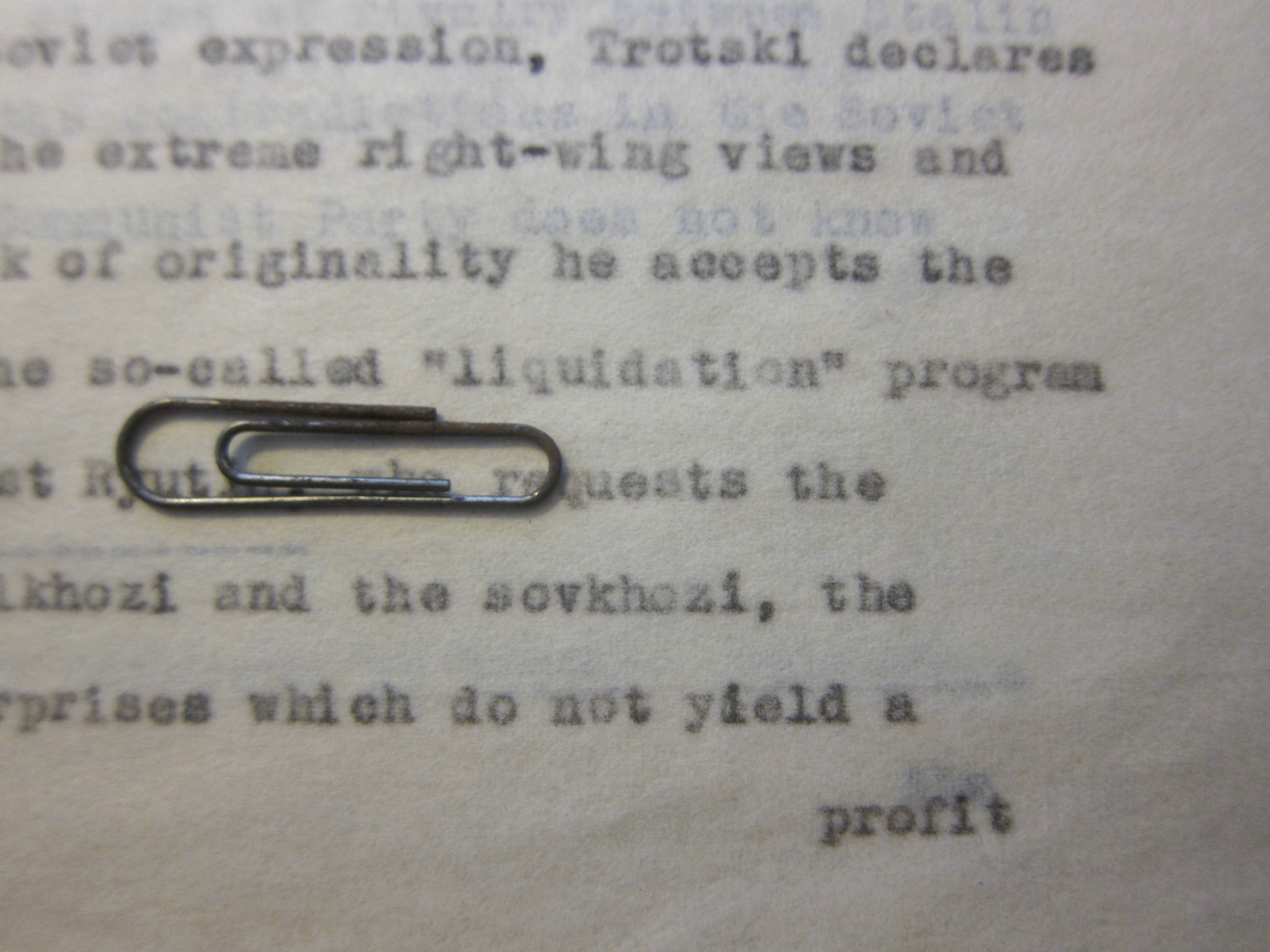
    Leafing through an unusual piece of 1930’s Soviet news I came upon a rusty paper clip secured at the bottom of a single page. I’m a fan of found book art, so I read a bit of what it was that it was possibly marking for attention. There was a word that jumped right out at me just above the metal dog ear–“liquidation”. The document, Rosja Sowiecka (Soviet Russia), was part of a Polish translation program of Soviet new that was done at the request of the U.S. Embassy in Warsaw, with each slim (ca. 100pp) volume it seems to me reviewing events in the U.S.S.R. primarily from the few months before its publication date. This one was volume and published February 28, 1934, which would place it in the thick of a particularly brutal period of Soviet history: there was the Soviet famine of 1932-33 (just ten years after the last great famine there), the Holomodor of 1932-3 (in which 10 million Ukrainians were murdered via famine), a completely oppressive police state of massive suspicion that would lead to the deportation and death of millions, the Great Purge, and much more that would nearly cause a collapse of the Soviet Union come 1941. 

    Paper clip

    The “liquidation” here though was being used in reference to dismantling the farm collectivization scheme that lead to the destruction of so many millions of people, and was coming at the suggestion of ‘rightist” (meaning more liberal) leadership in the Soviet government. In this particular case, the suggestion was that of Martemyan Nikitich Ryutin, a high-level political functionary who was pro-peasant and definitely anti-Stalin, a stance that would lead in 1937 to his arrest and execution (all in a 24-hour period, like so many of them). Even though I really only know the highlights of Soviet history in the 1930’s, reading this section of the document definitely left me with a sad admiration for this man and his allies, because nobody was allowed to survive under Stalin who was not a believer in his removed self. 

    This was the path of following a simple paper clip.  

    ·Posted by :

    ·in:


  • The Warsaw Uprising, 1944. (And 1943.)

    JF Ptak Science Books 

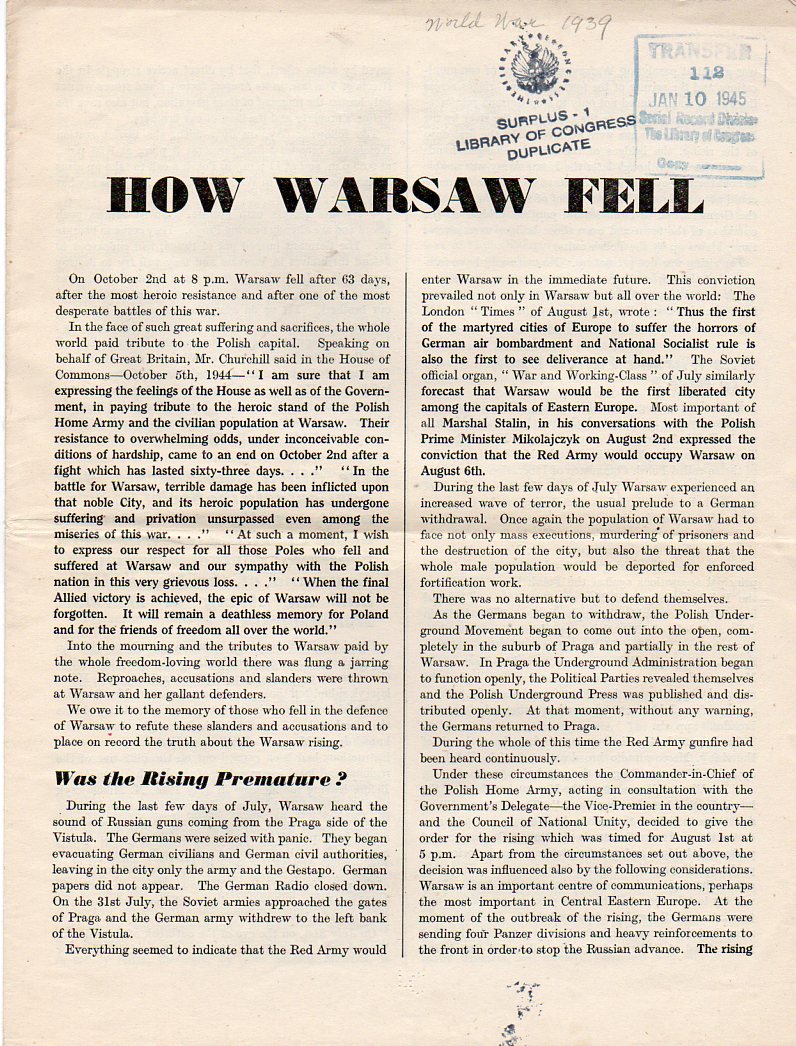
    The bottom line of the 63-day-long Second Warsaw Uprising (August/September 1944) is that the Soviet Union allowed the Polish Home Army to fail, watching from its position across the Vistula as the Nazis and Poles slugged it out, both exhausting themselves, the Nazis ultimately defeating the Poles, eliminating most of the Soviet concern for the Polish military and government, allowing the Soviet Union to take the country over more completely when the time came a few months earlier.  It was the Soviets’ choice to see two enemies annihilate themselves to have more control over Poland and immediately turn it into a vassal state when it rolled into Warsaw in January, with 85% of the city destroyed (“at the moment of its fall practically the whole city was rased [sic] to the ground”) and 600,000 of the city’s population  dead, along with 80% of the Home Army. 

    • Full text (though not my copy) here, at Instytut Józefa Piłsudskiego w Londynie :http://pilsudski.org.uk/archiwa/dokument.php?nonav=&salatka=1&nrar=709&nrzesp=108&sygn=88&handle=709.238/632

      Warsaw774

    With this in mind,  where was the Polish Home Army or the Americans or the Brits-or anyone–when the first Warsaw Uprising occurred? Absent.1 This battle–generally known as the Warsaw Ghetto Uprising–took place about three years after the Nazis established it as a means of control for the city’s 400,000 or so Jews. In the intermediary years hundreds of thousands of Jews had been “deported” (that is, sent to the concentration camps to be exterminated or worked to death), so that by the time of the Uprising only 60,000 people remained in the Ghetto.  And by this time there was no doubt in anyone’s mind who lived there (and perhaps too in Warsaw as a whole) what the euphemism of “deportation” actually meant.  The battle started off well for the home defence (the ZOB2) but, ultimately, with little access to resource and with nowhere to actually retreat or regroup in the few acres that remained of the original Ghetto, whoever was left in the Ghetto were either killed or captured by 16 May.  The German commander, SS Brigadefuhrer Jurgen Stroop reported on that day that “the former Jewish quarter in Warsaw is no longer in existence”:

       “Progress of large-scale operation on 16 May 1943, start 1000 hours.
       “180 Jews, bandits, and subhumans were destroyed. The former Jewish quarter of Warsaw is no longer in existence. The large-scale action was terminated at 2015 hours by blowing up the Warsaw Synagogue.
        Total number of Jews dealt with 56,065, including both Jews caught and Jews whose extermination can be proved. “

    Stroop was arrested and hanged in Poland, in Warsaw, in 1952.

    Warsaw775

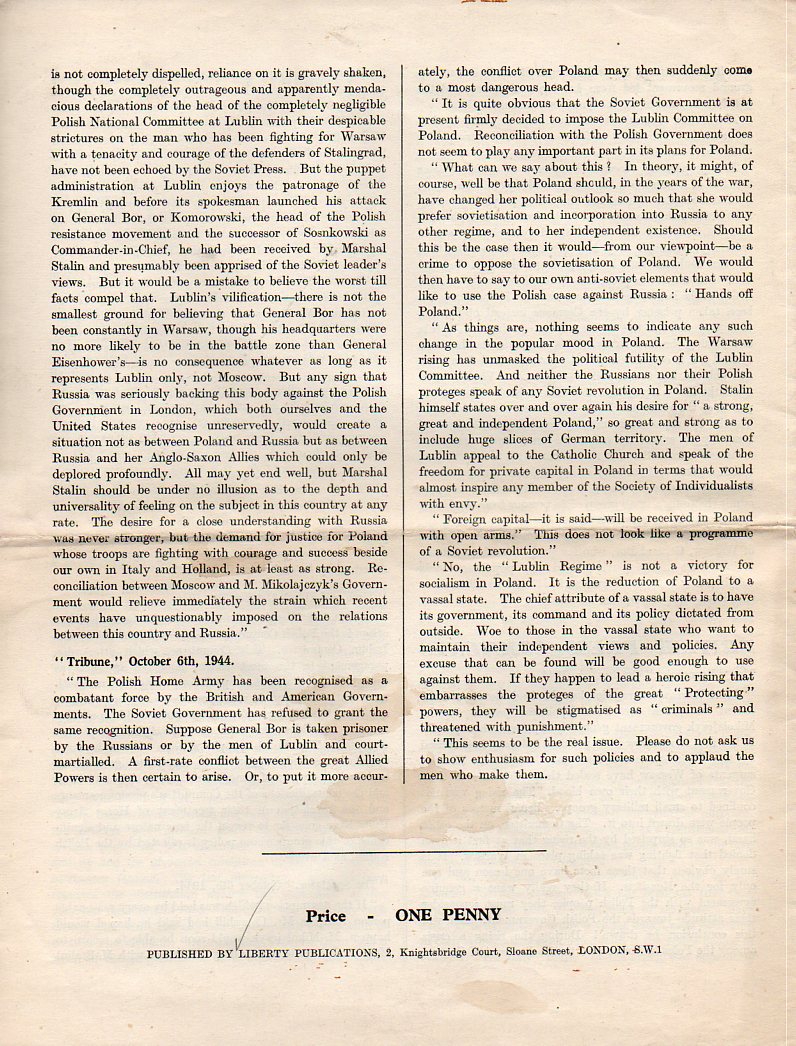
    So, this 6-page pamphlet, published by Liberty Publications in London at the end of 1944 (and received by the Library of Congress on 10 January 1945), detailed the misery of the non-recongition of the second Warsaw Uprising and the reason(s) for it. It details the travesty, the disinterest, and the political accomplishment of the Soviet Union gained by its criminal inaction. There is of course no mention whatsoever of the first Warsaw Uprising.  Selfish inaction breds itself, consumes others and then–like yeast–consumes itself.

    Notes

    1. “WHEN THE revolt in the ghetto broke out in April 1943, all of Warsaw was aware of the fighting. The news of the revolt was transmitted to the Allied capitals by the Polish underground, but no help came for the Jewish fighters – not from the US or England, nor from the Soviet Union; not even a sign of recognition or an acknowledgement by the Allies of the battle raging in the ghetto. The Jewish fighters in the Warsaw Ghetto were unknown soldiers, isolated from the world. Only two years later, after the end of the war, did their valiant battle receive universal recognition.”–“Who Defended The Warsaw Ghetto?”, by Moshe Arens, in the Jerusalem Post, 29 April, 2003.

    2.  The ZOB  was the Zydowska Organizacja Bojowa, led by Mordechai Anielewicz, and ZZW (Zidowski Zwiazek Woskowy) led by Pawel Frenkel.

    ·Posted by :

    ·in: