A Daily History of Holes, Dots, Lines, Science, History, Math, Physics, Art, the Unintentional Absurd, Architecture, Maps, Data Visualization, Blank and Missing Things, and so on. |1.6 million words, 7500 images, 4.9 million hits| Press & appearances in The Times, Le Figaro, Mensa, The Economist, The Guardian, Discovery News, Slate, Le Monde, Sci American Blogs, Le Pont, and many other places… 5000+ total posts since 2008.

Category: mathematics, logic

  • Mental Arithmetic by Sound, Imaginary Symbols, and Smell–1894

    JF Ptak Science Books   Quick Post
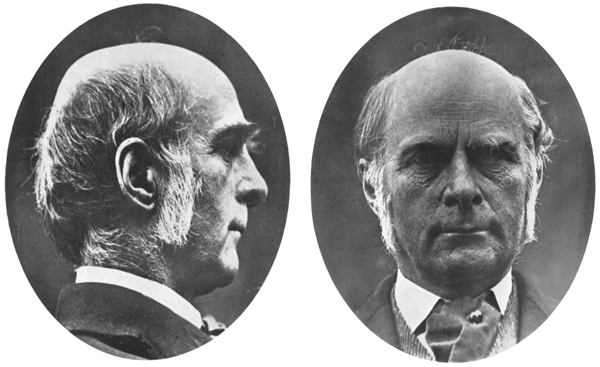
    Crusing through some issues of Nature down in the studio–this is the current  long-lived Nature, though mine are from 1869-1949, so not-so modern–I was working my way through a few issues before all hell breaks loose with the Roentgen publications in late 1895, and found this very interesting article by Francis Galton.  Now Galton was a very interesting man with very advanced interests in many different fields, though he does have some unfortunate bits to his personality and eugenic-based beliefs, so he is an extremely accomplished if not a problematic man. Actually one of my earliest posts on this blog (more than 2,500 posts ago–yes there are only 2147 numbered posts but there are also something like 500 unnumbered “quick posts” as well) was relating another occasion of thumbing my way through another Nature volume, and finding Sir Francis again, though in this one he wrote what may be among the earliest papers on synesthesia (“Visualized Numerals”, 1880, appearing here, with full text). 

    The present Galton (in 15 November 1894) is his review of work done by Alfred Binet, “Psychology of Mental Arithmeticians and Blindfold Chess-Players”, who looked at the extraordinary abilities of  “two groups of remarkable men”, one of which possessed fantastic mental calculating abilities, and the other with the capacity of playing multiple games of chess while blindfolded.  A closer look at the first group revealed two men who relied on quite different benefits: one having a great ability to calculate according to “imagined sounds” and another who “relied on…imagined sounds”, both endowed with considerable numerical abilities as well as memories. 

    Galton reviews a number of calculators and then remarks on experiments he performed on himself, trying to “visualize” a calculating process via olfactory means.   The rest of the story of this fascinating article can be found here.  (Also see–from Galton.org–a bibliography of his journal articles works in psychology.)

    • This is somewhat off the mark, but it may be interesting–given Galton’s olfactory/math experiment–to have a quick look at an earlier post on this blog regarding the first photograph of a smell, here.

    I should say that Galton wrote more for Nature than any other journal, some 115 contributions from 1870-1910.

    See also this take on the Galton from J.M. Stoddart’s The New Science Review, 1894/5:

    ·Posted by :

    ·in:

    —

  • On Mathematics and the Imagination, J.J. Sylvester, 1869

    Photo of SylvesterJF Ptak Science Books   Quick Post

    “When I imagine a triangle, even though such a figure may exist nowhere in the world except in my thought, indeed may never have existed, there is nonetheless a certain nature or form, or particular essence, of this figure that is immutable and eternal, which I did not invent, and which in no way depends on my mind.–Rene Descartes, Meditations on First Philosophy (1641) tr. John Cottingham, Descartes: Meditations on First Philosophy (1986)

    This is the lovely response by the great mathematician J.J, Sylvester to Thomas Huxley’s muckety comment on the lack of imnagination in the mathematical sciences.  Huxley’s remarks were made at a meeting of the British Association for the Advancement of Science, stating that (Mathematics) “is that study which knows nothing of observation, nothing of induction, nothing of experiment, nothing of causation”1 This quote is taken from Sylvester’s quick and elegant responses in two articles in Nature, December 30, 1869 (231-3) and January 6, 1870 (pp 261-3), as “A Plea for the Mathematician” and “A Plea for the Mathematician II”.

    SYlvester copy“For Sylvester, the ability to be able to imagine  what the experience of space would be like in dimensions other than three is sufficient to establish the empirical basis of geometry–the three-dimensional Euclidean is not the science of space in general, but the science of the space of our experience.”–Fact and Feeling: Baconian Science and the Nineteenth-Century Literary …by Jonathan Smith, pp 181-182

    Ex nihilo nihil fit/Nothing comes out of nothing.–R Descartes, Principia philosophiae, Part I, Article 49

    The original papers are available on this blog’s bookstore section.

    ·Posted by :

    ·in:


  • Pi-matic-tron Posie Mnemonic Device Fail

    JF Ptak Science Books   Quick Post
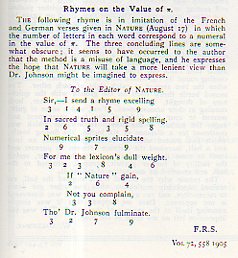
    “How I want a drink, alcoholic of course, after the heavy lectures involving quantum mechanics.”--mnemonic device by James Jeans on remembering pi to 15 places, where each word length assoicates a number in pi.  Arndt, Jörg; Haenel, Christoph (2006). Pi Unleashed. Springer-Verlag, pp 44-5.

    There are simpler ways of remembering something than developing an odd mnemonic for remembering pi, especially when the memory device will get you only 30 places or so…and so it hardly feels worth the effort to remember some posie and then write it down to perform a pi-matic numerical translation.  This is especially so when you consider that the man recognized as being the world record holder but not so (Akira Haraguchi) committed the fist 100,000 places of pi and took nearly a day to recite it–megaefforts like this make the smaller accomplishments of remembering pi to 100 places seem fairly insignificant. 

    Some of the people set to remembering pi (piphilologists) use methods similar to this as memory devices, including an entire book of 10,000 words constructed in just this way–many more, I think, use a memory palace/method of loci method, locating numbers and identifying sub-patterns and placing them in connecting “departments” in the brain.  (The Big Book on memory devices is by Frances Yates, The Art of Memory, University of Chicago Press, 1966; also Jonathan Spence, The Memory Palace of Matteo Ricci, Viking Penguin, 1984.)

    I’m not sure what the need is for remembering the number to so many places when it seems as though the first seven digits will be sufficient for most (when “most” = “just about everything”) things. 

    On remembering pi, from Nature, volume 72, p 558, 1905:

    Pi mnemonic744

    ·Posted by :

    ·in:


  • A Great but Not a Good Idea: the Symbolic Logic of Law

    JF Ptak Science Books  Quick Post
    This is a very special effort on behalf of logic and the law, and may have been the first effort to codify the idea of the law in symbolic logic.  It appeared in the journal Nature on 24 April 1913, and I think in spite of it being interesting and even pretty, it just doesn’t work for me.  But I’m reproducing the article (a long one for Nature) because it is really such an audacious thing, and a terrific idea, if not a good one.

    ·Posted by :

    ·in:


  • The First Image of a Tetrakaidekaderon on a 19th Century Pillow?

    JF Ptak Science Books  Quick Post  
    Follow Me on Pinterest

    Pillow453

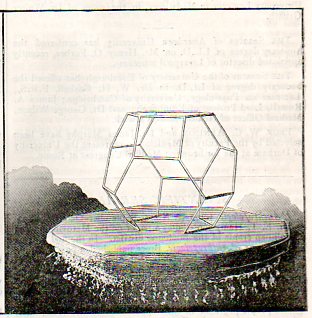
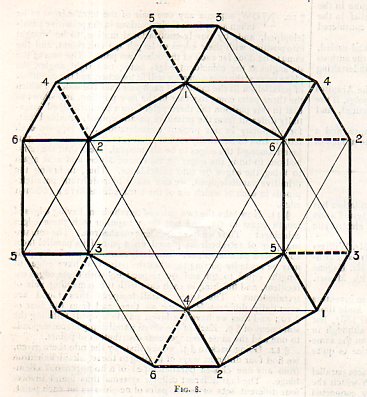
    The question above is probably seldom asked and probably even less than so required, but it sure does look good for the title of a post.  The pillowed polyhedra came into light while I was breezing through some issues of the British Nature magazine for 1893/4–the title of the work of course was a lovely thought and the author of the paper was the mega-gifted and highly significant Lord Kelvin (William Thomson), but the bait that made me swallow the hook on the paper was the illustration.

    There are many (i.e., 1,496,225,352)  different forms of the convex 14-faced polyhedron tetrakaidekahedron (see Wolfram Math
    for a quick summary)–this is the first I can remember being displayed
    on a 19th century pillow.  Kelvin was particularly interested in
    displaying geometrical figures in three dimensional space, and would
    return to the issue numerous times, particularly in the Baltimore Lectures on Molecular Dynamics and the Wave Theory of Light (see page 606ff).

    Pillow455

    Notes:

    Lord Kelvin, (William Thomson, 1824-1907), “On the Homogeneous Division of Space”, in Nature, two issues, as follows:  (1) 8 March 1894, pp 445-448; and (2) 15 March 1894, pp 469-471. A version of this paper appears slightly earlier (17 January) in the Proceedings of the Royal Society. 

    Both papers are available for purchase via our blog bookstore, here.

    These are remarkably interesting papers–especially considering their brevity.

    Pillow454
    It is interesting to note the list of what Thomson “is known for” in his Wiki entry:

    ·Posted by :

    ·in:


  • A Mathematical Anti-Triumph from Beyond: Lewis Carroll’s Last Work, on Long Division

    JF Ptak Science Books   Post 2095

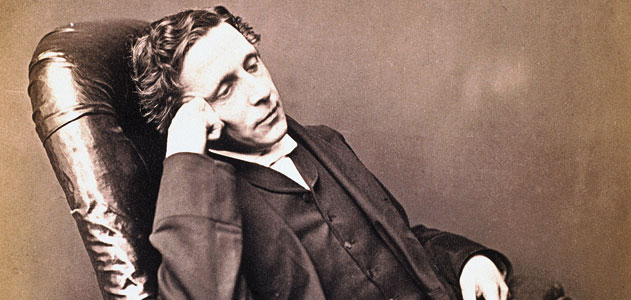
    I am probably not understanding this wonderful effort1 by the dead Lewis Carroll, establishing a new algorithm for doing long division.  It came into view while I was looking for a paper in Nature by A.A. Michelson on his analog computer, the harmonic analyzer, a fantastic device that he used to help measure the speed of light back in 1898.  Carroll (as Dodgson) appeared just a few pages away2; his obituary appears not much after the division article, thus making the paper the last of his career here on Earth. 

    Presence-Lewis-Carroll-Charles-Dodgson-631
    It is a very interesting effort, and it perhaps is even brilliant and of a wonderful construct, but the bottom line is that it makes the process of division harder to do–perhaps it is mire understandable as a process, but the process itself is decidedly not a preferred one.  Perhaps it is appropriate for his last work to have been on mathematics, since the majority of his 20 published books relate to mathematics or logic.

    Notes

    1.  DODGSON, Charles Lutwidge (‘Lewis Carroll’). “Abridged Long Division”, in Nature, page 269, in the weekly issue for 20 January 1898, with the original outer wrappers removed from larger bound volume. Very good copy. It is here that Carroll announces (in a long 3pp letter to the editor) his implementation of a new algorithm for division–it makes the process longer and more difficult, unfortunately.

    The article is abstracted here, a few weeks after publication:

    Article abstract:  Nature 57, 390-391 (24 February 1898), “Abridged Long Division” abstracted by ROBT. W. D. CHRISTI:

    “HAVING been working on similar lines for some years, I was very much interested in the late Mr. Dodgson’s letter on abridged division in NATURE of January 20, and I should like to offer a few observations and to give a variation of the method which appears much simpler. It will be admitted that Mr. Dodgson’s plan is of limited application, and rather complicated for general use. There is nothing to hinder the method given below from being universally used, though it may not in all cases be the shortest. It also has the merit, I think, of directness and uniformity.”

    2. This is one of three publications of Carroll’s mathematical works that appeared in Nature, being “Abridged long division”, Nature 57, 269-271; “Brief method of dividing a given number by 9 or 11”, Nature 56, 565-566; “Pillow problems. Curiosa mathematica. Part II”, Nature XLVIII. 564. 

    The following list of Carroll’s mathematical works is taken from the table of contents of The mathematical pamphlets of Charles Lutwidge Dodgson and related piece, compiled, with introductory essays, notes, and annotations, by Francine F. Abeles. (New York : Lewis Carroll Society of North America ; Charlottesville : Distributed by the University Press of Virginia, 1994.)

    Geometry

    • 1. Notes on the First Two Books of Euclid (1860)
    • 2. Enunciations of Euclid, Books I and II (1863)
    • 3. Fifth Book of Euclid (1868)
    • 4. Enunciations of Euclid I-VI (1873)

    Trigonometry

    • 5. Formulae of Plane Trigonometry (1861)
    • 6. Formulae (Group C) (undated)
    • 7. Simple Facts about Circle-Squaring (1882)
    • 8. Proof Sheets: Propositions I, II (undated)
    • 9. Question 11530 (1893)

    Algebra

    • 10. Condensation of Determinants (1866)
    • 11. Algebraical Formulae for the Use of Candidates for Responsions (1868)
    • 12. Formulae in Algebra (1868?)
    • 13. Algebraical Formulae and Rules for the Use of Candidates for Responsions (1870)
    • 14. Algebra (1877)
    • 15. Formulae (1878)
    • 16. Question 9995 (1889)

    Probability

    • 17. Note on Question 7695 [including Question 7695 and its solution (1885)]
    • 18. Response to “Infinitesimal or Zero?” (1886)
    • 19. Something or Nothing? (1888)
    • 20. Question 9588 (1889)

    Arithmetic Computation and Theory

    • 21. Arithmetical Formulae and Rules for the Use of Candidates for Responsions (1870)
    • 22. Examples in Arithmetic (1874)
    • 23. Arithmetic I (1870-74?)
    • 24. Arithmetic II (1870-74?)
    • 25. Arithmetic (undated)
    • 26. Practical Hints on Teaching. Long Multiplication Worked with a Single Line of Figures (1879)
    • 27. Divisibility by Seven (1884)
    • 28. To Find the Day of the Week for Any Given Date (1887)
    • 29. Question 9636 (1888)
    • 30. Question 12650 (1895)
    • 31. Number-Guessing (1896)
    • 32. Question 13614 (1897)
    • 33. Brief Method of Dividing a Given Number by 9 or 11 (1897)
    • 34. Variant of Item 33 (same title, date)
    • 35. Rule for Finding Easter-Day for Any Date till A.D. 2499 (1892-97?)
    • 36. Abridged Long Division (1898)

    Cryptology

    • 37. Key-Vowel Cipher (1858)
    • 38. Matrix Cipher (1858)
    • 39. Alphabet Cipher (1868)
    • 40. Telegraph Cipher (1868)

    Curriculum

    • 41. Circular to Mathematical Friends (1862)
    • 42. Proof Sheets Accompanying the Circular (undated)
    • 43. Guide to the Mathematical Student (1864).


    ·Posted by :

    ·in:


  • A Note on Mr. Venn and his Diagrams

    JF Ptak Science Books
     

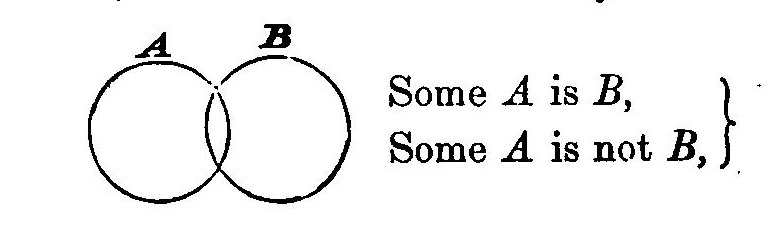
    It seems so unlikely that the Venn diagrams took so long to appear, that it hadn’t been Aristotle’s Diagrams, or Cartesian Diagrams; rather, these elegant creations–about a different way to represent propositions by diagrams– belong to Mr. Venn’s invention in 1880. Mostly. It was in that year that these famous more fully-developed diagrams first appeared in a paper entitled “On the Diagrammatic and Mechanical Representation of Propositions and Reasonings“ in the Philosophical Magazine and Journal of Science.  They seem so beautiful, and so simple, and so powerful, and so elegant. So necessary.  And so why-did-they-take-so-long-to-appear, so obvious.  In a way, they are in that category of The Great Obvious Invention, in a similar vein to Mr. Luke Howard first classifying the names of clouds  in 1803.  Sometimes things are not obvious until they are.  


    Venn diagram
    [Source: Internet Archives, John Venn, Symbolic Logic, 1881, full text.]


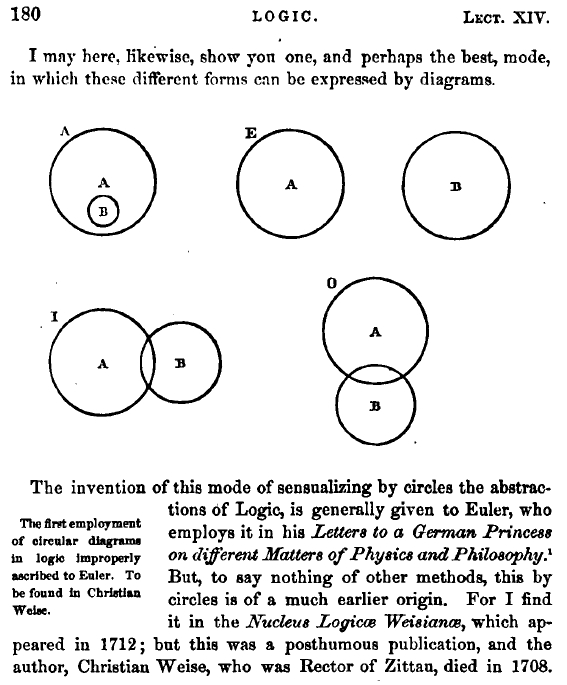
    Well, almost.  The diagrams did mostly make an appearance earlier–though not in the Venn form–in the work of Christian Weise (d. 1708) and then in that of Leonhard Euler (1707-1783), that according to the great William Rowan Hamilton, explained in his work Metaphysics and Logic (1858-1860). But the final form seems to be that of Venn.  

    Hamilton’s work appears so:

    Euler diagram


    They also appeared in the Proceedings of the Cambridge Philosophical Society, volume 4, 1880, in his article “On the employment of geometrical diagrams for the sensible representation of logical propositions” in which he discusses the history of the diagrams, including the Hamilton history.  Venn also includes this beautiful logic template of Bolzano:

    I found a wonderful book review of Venn’s book Symbolic Logic that appeared the following year, appearing in the journal Nature on 14 July 1881, and reviewed by the inimitable W. Stanley Jevons (which is reproduced below).

    ·Posted by :

    ·in:


  • Bibliography of George Boole

    JF
    Ptak Science Books  Quick Post        Reference Series
    This bibliography for George Boole just came in very handy, so I decided to distribute it. It appears in  Treatise on Differential Equations, printed in 1865 and edited by Isaac Todhunter, the full text of which is found here.  A very good entry on Boole is found in the Encyclopedia Britannica 11th, here.


    ·Posted by :

    ·in:

    —

  • A Beautiful Manuscript of Square Roots, 1830’s

    JF Ptak Science Books   Post 2082

     309

    (Note: we’ll deal with square root of  3 at another time…)

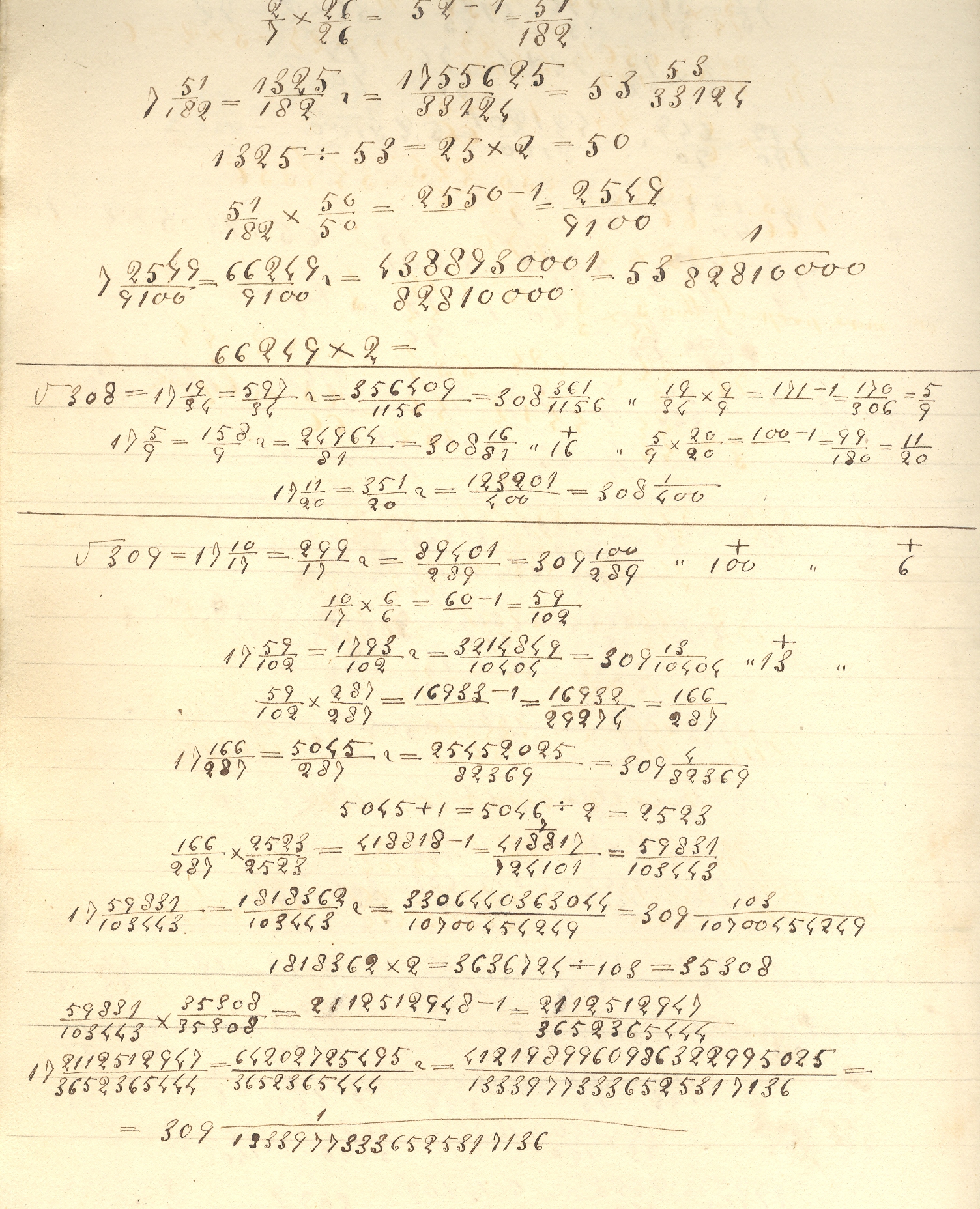
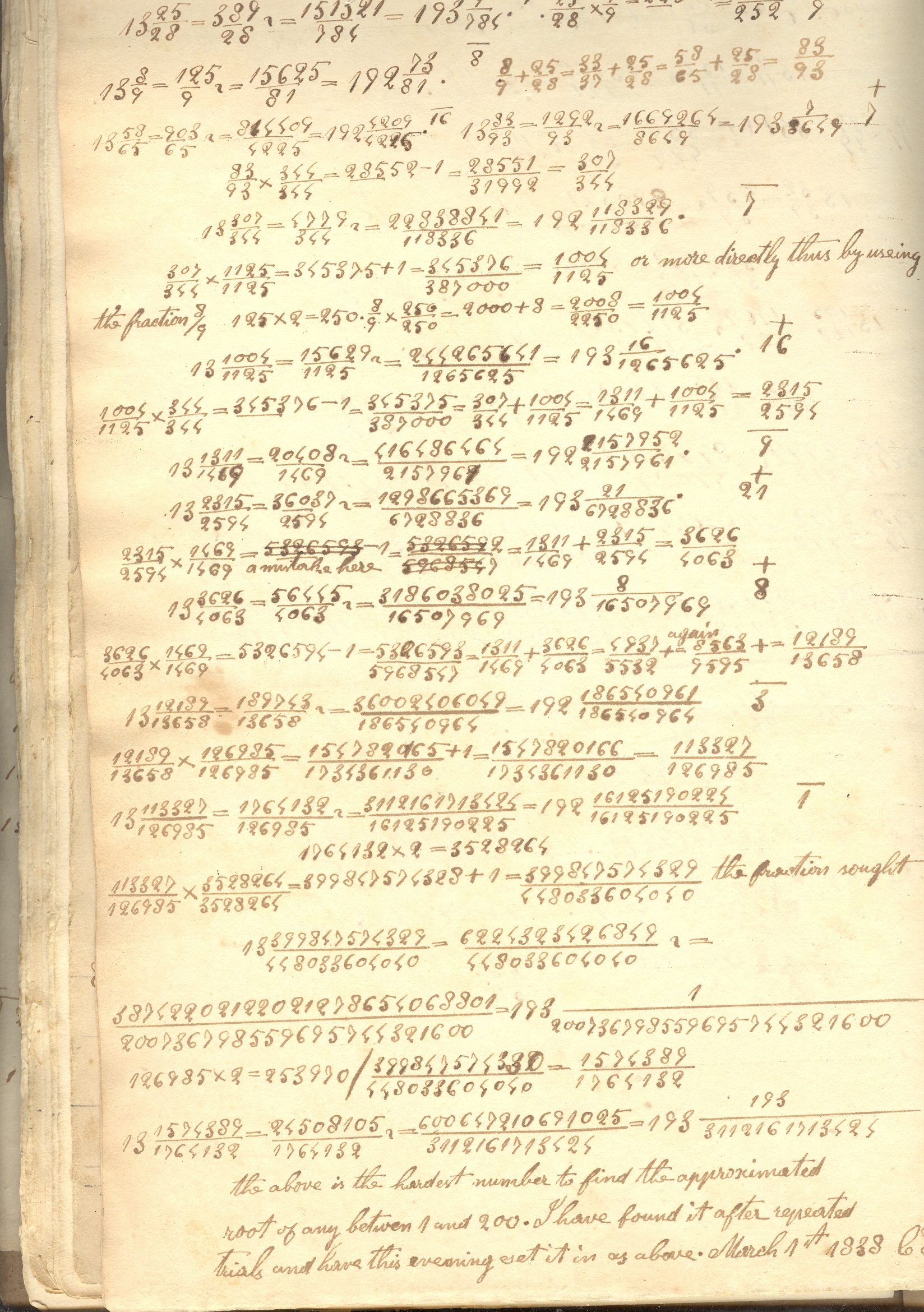
    The author of this manuscript, Charles Fisher, took a solitary pleasure in calculating the square roots of numbers from 2  to 589, not bothering to write down the 24 perfect squares to 576.  (The sqrt being r2 = x for every non-negative real number x.) From the few bits that I have checked the man seems to have done a good job back there in the 1830’s. 

    I cannot determine where this book was written or who Mr. Fisher was, though it is possible that he was a (Baptist) Minister from the few short textual notes that pop up here and there. 

    [This 140pp manuscript is being offered for sale at our blog bookstore, here.]


    His work is pretty elegant.  Take for example his solution (and proof) for the square root (hereafter sqrt(x)) 309,

    309 det

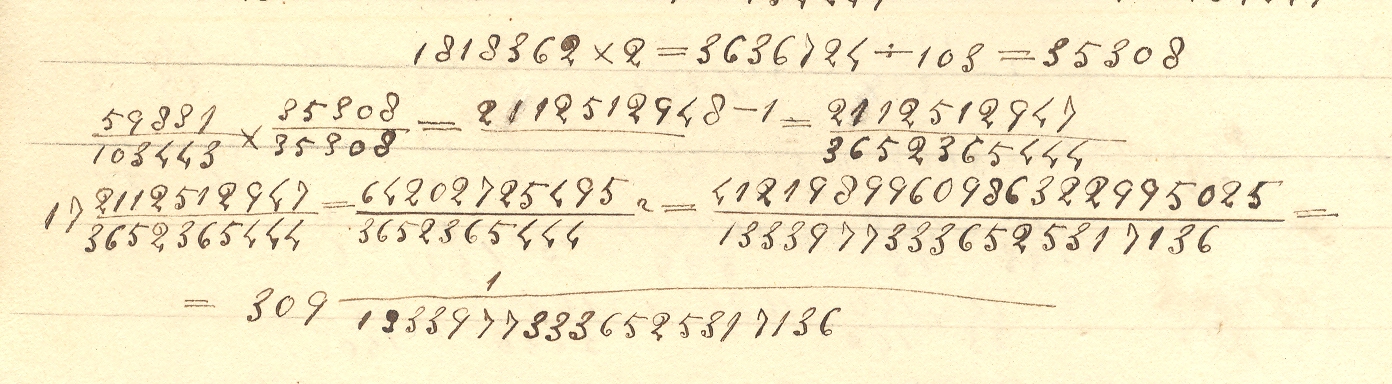
    which the calculator living under this page says is 17.578395831246947    Mr. Fisher’s answer is 17 10/17 = 799/17=89401/989=309 100/989, and after some more involved arithmetic comes t the lovely proof number of   

    4121989960986322995025 /13339773336525317136 or

    309.00000000000000000007496379247

    Which is getting pretty close. 

    309 193

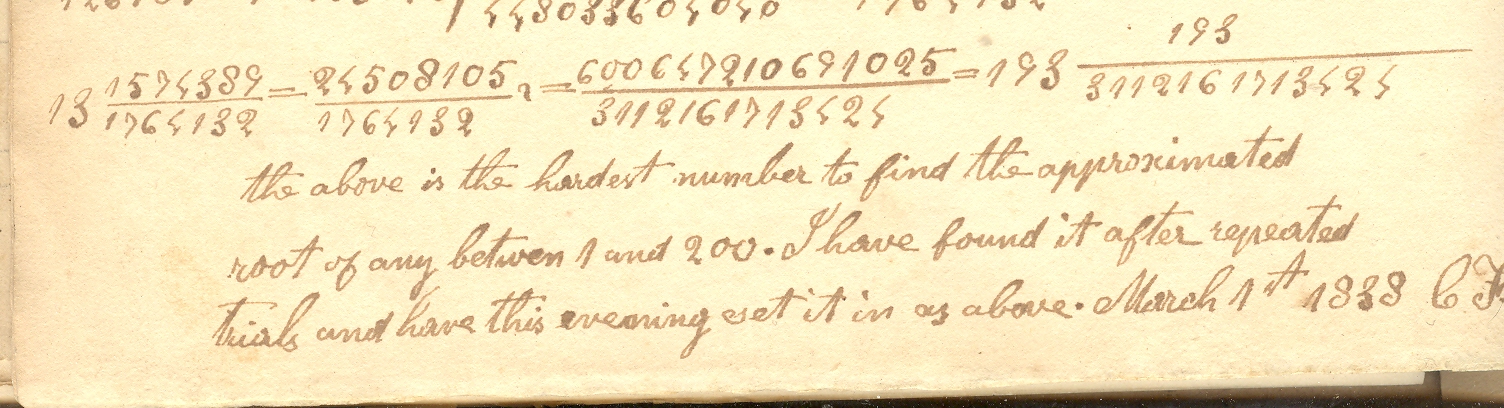
    The only note that Mr. Fisher makes on his calculations is for the sqrt(193), which he notes as “the hardest number to find the approximate root of any between 1 and 200. I have found it after repeated trials and have this evening wrote it in as above. March 1st, 1833. CF.”

    309 193 det

    ·Posted by :

    ·in:

    —

  • The Sense of Old Numbers & the Geometry of Squirrel-Shooting

    JF Ptak Science Books   Post 2065

    Old math400

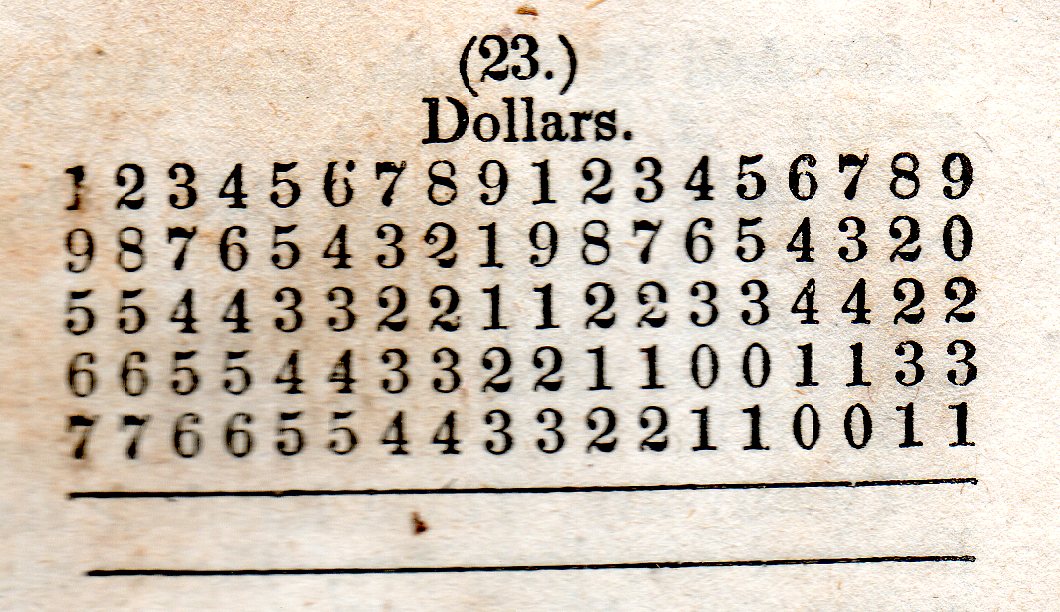
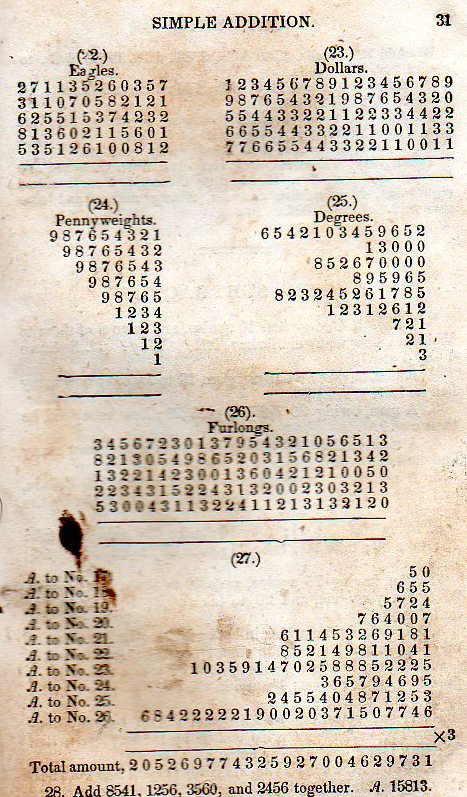
    There is something enormously appealing in the general nature of old numbers, numbers written or printed long ago, numbers making an appearance in the general sense of ordinary and commonplace, everyday garden variety numbers (like the example above and it continuation below), as well as in more famous numbers, numbers that present a concept for the first time, or offer a proof in thought and conjecture (as seen further below with Mr. Stevin).

    The first example is from a worn copy of a common early-ish 19th century American math textbook by Rosell C. Smith, Practical and Mental Arithmetic, on a New Plan, in which Mental Arithmetic is Combined with the Use of the Slate… which was printed in Hartford beginning in 1829 (my copy being printed in 8136).  It was a popular book, and it claimed to make math more useful by using calculations for problems to be figured in terns of dollars and cents, thus giving the exercises the chance of direct application to the daily grind.  My copy of this book is very worn–not the worn that comes from mistreatment, but rather use-worn, the book being smooth and lustrous from repeated and deep use, handled so much over the years that the paper covers have a very definite and smooth patina. 

    In any event Mr. Smith’s numbers have a special bit to them, something nor-quite-like-everything-else. The care and the design and placement of the numbers is very attractive, even if it makes the numbers sometimes a little illegible. 

    The numbers have a certain beauty to them, as does the space aloted for their answers:

    Old math399

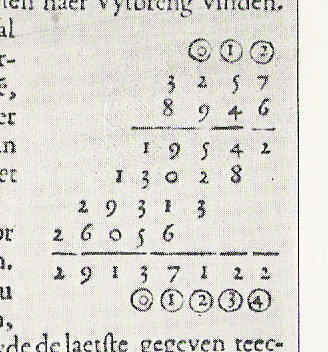
    Famous numbers have a distinct beauty as well, in the more refined and exalted antithesis as those numbers for a simple sum problem:  from two ends of the spectrum ,sometimes, though they both meed in the middle where the numerological beauty occurs.  A great example f famous numbers might belong with Simon Stevin (1548-1620), who introduced the idea of decimal numbers in his 36-page De Thiende (‘The Art of Tenths”)
    in 1585  His was an idea that replaced much more cumbersome earlier methods of
    representation.  So, the number 3.14159 would be written in the Stevin
    notation as (where in this case numbers enclosed by brackets, i.e. “[9]”
    would have been represented in print as a 9 within a circle)
    3[0]1[1]4[2]1[3]5[4]9[5].  It is also seen here:

    Stevin decimal

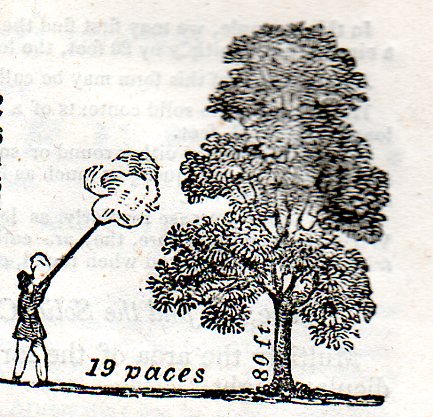
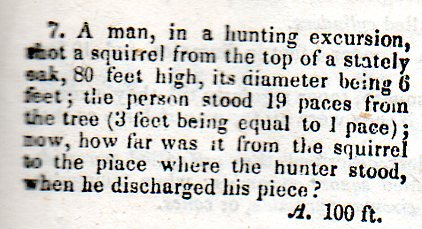
    One item that attracted my attention–easily so–was the following problem:

    Old math shooting tree401

    Old math shooting tree402
    It was also the only illustration in the 284-page book.  And it makes sense, I think, because squirrel hunting is just what people did at this time, and the calculation could be a useful one.  Still, it is an unusual image to set to work illustrating a math problem–and interesting. 

    ·Posted by :

    ·in:

    —