A Daily History of Holes, Dots, Lines, Science, History, Math, Physics, Art, the Unintentional Absurd, Architecture, Maps, Data Visualization, Blank and Missing Things, and so on. |1.6 million words, 7500 images, 4.9 million hits| Press & appearances in The Times, Le Figaro, Mensa, The Economist, The Guardian, Discovery News, Slate, Le Monde, Sci American Blogs, Le Pont, and many other places… 5000+ total posts since 2008.

Category: Alphabets

  • The False Card Catalogs for the Library of Babel

    JF Ptak Science Books  Post 2538
    Books

    “Cataloguing is an ancient profession; there are examples of such “ordainers of the universe” (as they were called by the Sumerians) among the oldest vestiges of libraries.” ― Alberto Manguel, A History of Reading (and also translator of Borges and co-editor of A  Dictionary of Imaginary Places, a book worthy of high consideration as the The Book that you could have with you on a desert island.)

    • [On the other end of the infinite library, see an earlier post here on “The Library of One Book”, here: https://historyofideasblog.com/thesciencebookstore/2009/10/the-library-of-one-book.html]

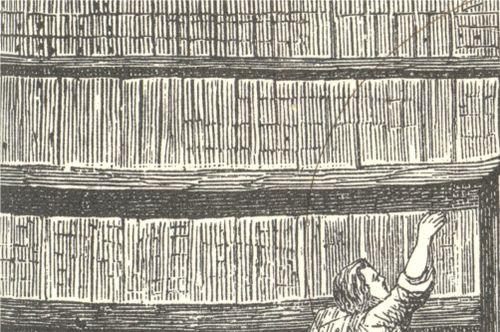
    In Jorge Borges’ “The Library of Babel” (published in 1944 and translated into English in 1962) we find that an infinity, or a universe, or a heaven, is declared to be a sort of endless library, stocked with hexagonally-shaped rooms books filled with books, all the same size, with the same number of characters. The rooms are endless, as are the books, which are written in every conceivable language and containing 29 necessary elements (including the alphabet, and the period, comma, and very interestingly concluding with the space). There are endless varieties of possibilities, and the place is staffed by librarians who have interests and obsessions from, well, A to Z, or Az^Z^Z^Z to ZA^A^A and so on, until we run out of time.  (Others have done some smart thinking on Borges’ great thought experiment/short story, and have estimated the size of the library in terms of stacked orders of magnitude beyond the atoms of the universe–but you can find all of that stuff elsewhere with a quick google search.)

    And then there’s this sample fro Borges on what sorts of books make up the library:

    “…the detailed history of the future, the autobiographies of the archangels, the faithful catalog of the Library, thousands and thousands of false catalogs, the proof of the falsity of those false catalogs, a proof of the falsity of the true catalog, the gnostic gospel of Basilides, the commentary upon that gospel, the true story of your death, the translation of every book into every language . . .”

    Here’s how you arrange an infinite library: you don’t.

    The books are not sorted to any sort of classification, only collected to the point that they are together.

    The many seem to be written in indefinable languages. Some of the librarians spent their time pursuing the holy grail–since all books that could ever be published would be present here, which theoretically include an index to library, or some sort of organizing principle.

    But since there was no verifiable organizing principle at play here, the library was useless as a “library”, though for the individual bits, it was perfectly fine. The structure though just turned into a long, endless, shelf.  This might explain why the caretaker/librarians of the place are so desperate.

    I cannot recall a mention of a card catalog, which I guess could be as all-powerfully impossible as the library, given that the library is not-classifiable. This is particularly true when you consider that there must also be a catalog of the arrangement of all possible false catalogs of all possible false books in the library, in addition to the true catalog. Perhaps the cards from this catalog would take up all of the space in the universe that would bump up against our own.  

    On the other hand, the logician W.V.O. Quine has written in a short piece that the Borges library is finite, because at some point there will come a time that all that can be written or will be written has been written:

    “It is interesting, still, that the collection is finite. The entire and ultimate truth about everything is printed in full in that library, after all, insofar as it can be put in words at all. The limited size of each volume is no restriction, for there is always another volume that takes up the tale — any tale, true or false — where any other volume leaves off. In seeking the truth we have no way of knowing which volume to pick up nor which to follow it with, but it is all right there.”

    He reduces this argument elegantly but completely without the humor of Borges, and says that all that is known can be represented in two symbols from which everything else can be derived–a dot, and a dash. He writes: 

    “The ultimate absurdity is now staring us in the face: a universal library of two volumes, one containing a single dot and the other a dash. Persistent repetition and alternation of the two is sufficient, we well know, for spelling out any and every truth. The miracle of the finite but universal library is a mere inflation of the miracle of binary notation: everything worth saying, and everything else as well, can be said with two characters.”

        “The ultimate absurdity is now staring us in the face: a universal library of two volumes, one containing a single dot and the other a dash. Persistent repetition and alternation of the two is sufficient, we well know, for spelling out any and every truth. The miracle of the finite but universal library is a mere inflation of the miracle of binary notation: everything worth saying, and everything else as well, can be said with two characters. It is a letdown befitting the Wizard of Oz, but it has been a boon to computers.” [Quine’s “Universal Library” is found at Hyperdiscordia, here: http://hyperdiscordia.crywalt.com/universal_library.html]

    Quine’s approximation cuts way down on the size of the library, which evidently would not fit in the known universe, which opens the gates for Heaven, which I think doesn’t depend on such restrictions–unless of course it was too big for that, which means believers would be in trouble, and none too happy with being kicked out of paradise to make space for a book.


  • An Alphabet of the Opening Lines of Charles Dickens’ Works

    JF Ptak Science Books   Post 2532

    Dickens

    I was thinking about the opening line from Dicken’s Tale of Two Cities, yesterday, one of the author’s great books, and probably one of his greatest sentences, period.This longish, single-sentence opener is 115 words long and punctuated with 16 commas, most of which are in the first half of the sentence, and all of which seem to work together like a piece of music. It is lyrical, and sweeping, and tells the story of everything and nothing.  

    So I decided to round up all of Dickens’ opening sentences for all of his books, and place them alphabetically, just for the sake of comparison.

    And here we are to begin, the beautiful opening sentence of a Tale of Two Cities, published almost at the same time as on the Origins of Species, in 1859:

    “It was the best of times, it was the worst of times, it was the age of wisdom, it was the age of foolishness, it was the epoch of belief, it was the epoch of incredulity, it was the season of Light, it was the season of Darkness, it was the spring of hope, it was the winter of despair, we had everything before us, we had nothing before us, we were all going direct to Heaven, we were all going direct the other way–in short, the period was so far like the present period, that some of its noisiest authorities insisted on its being received, for good or for evil, in the superlative degree of comparison only.”

    And by the way, TOTC has a great ending line, as well:

    ‘It is a far far better thing I do, than I have ever done; it is a far, far better rest that I go to than I have ever known.”

    I was going to add ending sentences to this list but this time, before looking all of it up in Gutenberg, I tried finding the list online, already completed—and there it was, on the literary/writing blog of Brett James, http://brettjanes.com/charles-dickens-last-sentences. It turns out that Brett James also has a list of opening sentences, too, with his listed chronologically—I would have done the same if I didn’t already have a bunch of posts on alphabets and the alphabetization of stuff. So it is unnecessary to reproduce that list here—just follow that link to James.

    And so to the list:

     American Notes, 1842

    “I shall never forget the one-fourth serious and three-fourths comical astonishment, with which, on the morning of the third of January eighteen-hundred-and-forty-two, I opened the door of, and put my head into, a ‘state-room’ on board the Britannia steam-packet, twelve hundred tons burthen per register, bound for Halifax and Boston, and carrying Her Majesty’s mails.”

    Barnaby Rudge, 1841

    “In the year 1775, there stood upon the borders of Epping Forest, at a distance of about twelve miles from London–measuring from the Standard in Cornhill,’ or rather from the spot on or near to which the Standard used to be in days of yore–a house of public entertainment called the Maypole; which fact was demonstrated to all such travellers as could neither read nor write (and at that time a vast number both of travellers and stay-at-homes were in this condition) by the emblem reared on the roadside over against the house, which, if not of those goodly proportions that Maypoles were wont to present in olden times, was a fair young ash, thirty feet in height, and straight as any arrow that ever English yeoman drew.”

    ·Posted by :

    ·in:


  • Extraneous Alphabets: Imperative Incidentals in Dante. And the Devil.

    JF Ptak Science Books  Post 2533

    There is a peculiar beauty to discovering a sleeping obviousness–something that is so present and apparent and minor that it can present for a while before you suddenly recognize it, and then the obviousness is all that you can see. “Hiding in plain site” is something that it might be called, though I don’t think we have a word for it in English.  
    Dante beatrice237

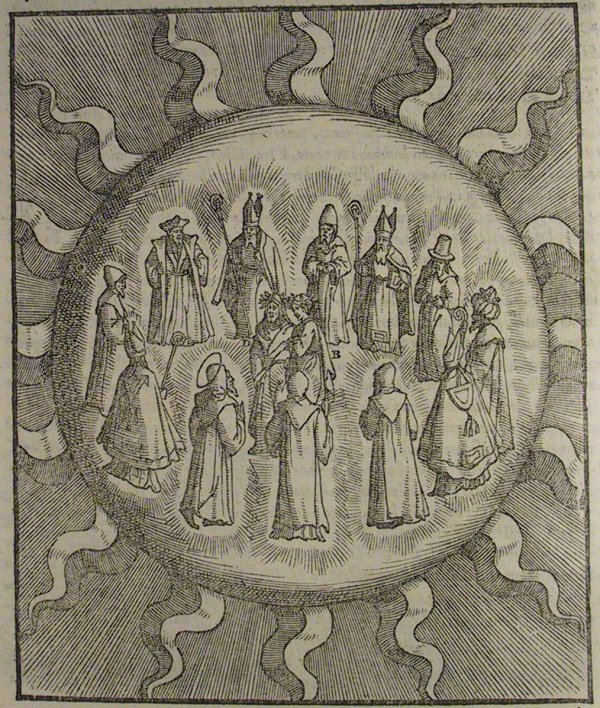
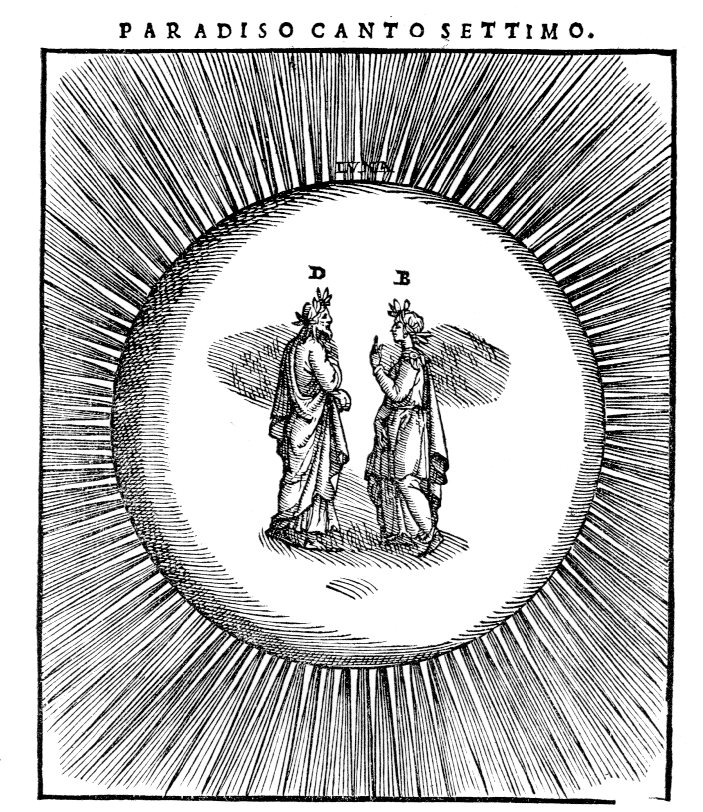
    Here’s an example of it, found in Dante. It may seem perverse to look at beautiful images like this/these illustrating one of the greatest stories that has ever been spun, but the tiny letters signifying the actors defined in the motion take on their ow unusual lives for me.  It seems very odd to identify objects that are so obvious and form the direction of the story and need no identification. (Some things need no introduction, like Dante and Beatrice, and Yogi Berra. (A friend told me a story of going to a function and being seated next to Berra for dinner, Yogi walking up to him and extending a hand saying “Hi, I’m Yogi”. No kidding?))  But I guess someone thought the notation was necessary, even if it both spoils and beautifies the simplicity of the design.  

    The edition of Dante is by Alessandro Vellutello, (La Coemdia con la nova espostione de Alessandro Vellutello…published in Venice in 1544) who extended himself to include the (87) illustrations that I just mentioned, and included a text full of glosses. No doubt the signifiers in the illustrations are aids to the supplementary text–still, they seem to be fairly unnecessary. 

    • Here’s an entire gallery of the Vellutello illustrations at World of Dante, http://www.worldofdante.org/gallery_vellutello.html

    Dante sun big

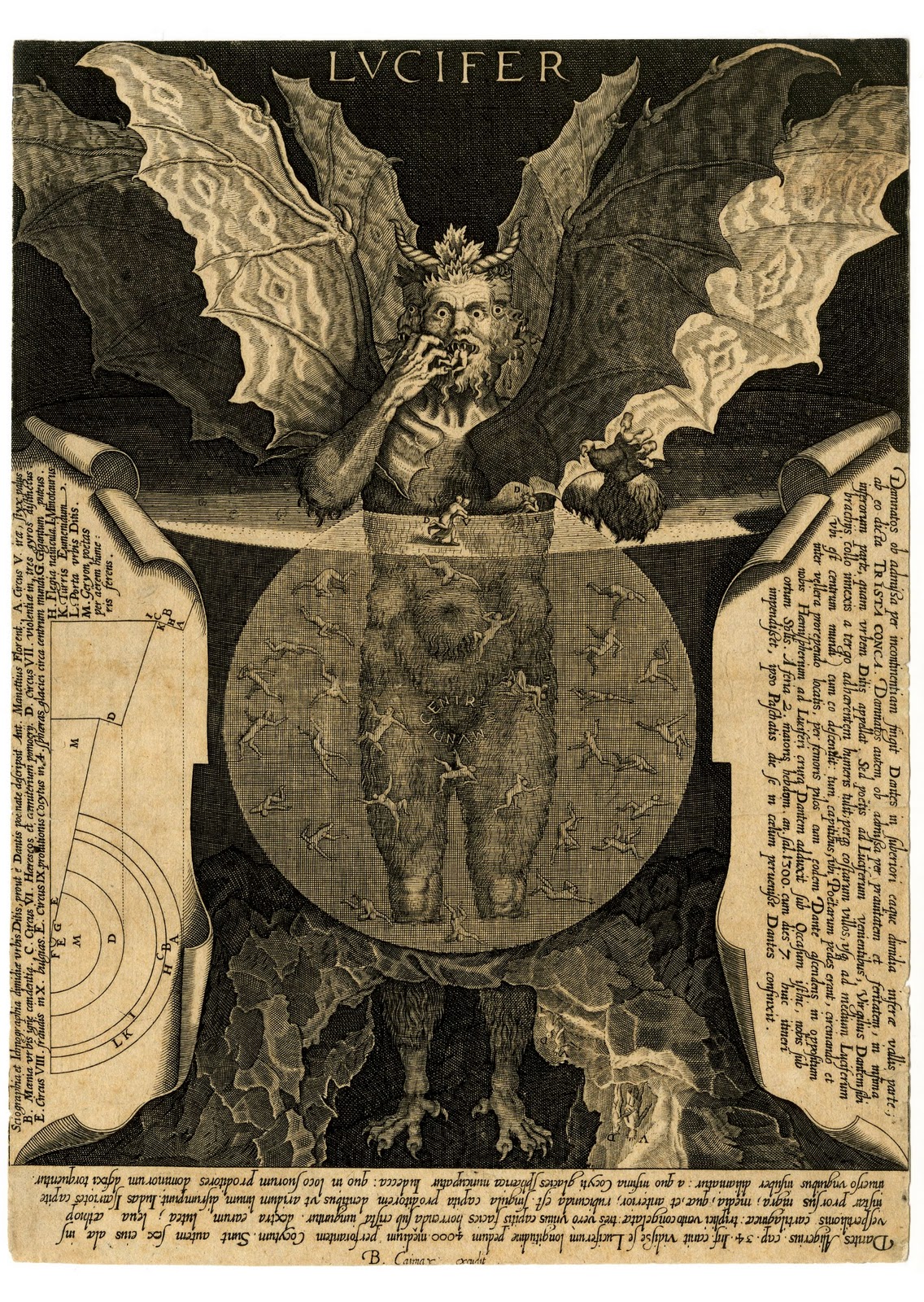
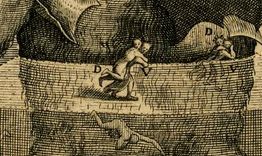
    That said, most of the time I appreciate the annotated image (speaking here of the non-technical/scientific ones)  mainly because without the help the iconography sometimes escapes me.  The Vellutello illustrations are much more “modern” than previous illustrations made for Dante, and seem to bridge the centuries of differentiated understanding so far as the interpretation of the images are concerned. On the other hand I appreciate the effort made for explanation in the engraving by Cornelis Galle of the Devil as it lived and breathed in Dante, the help coming in many forms. For example, without the annotations I would probably never have noticed the “D” and “V” figures (Virgil carrying Dante) so I  am thankful for the help:

    Lucifer

    Lucifer detail


  • Mind Your Stops! On Punctuation and an Abundance of Commas, 1855

    JF Ptak Science Books  Quick Post

    Mind your stops!191

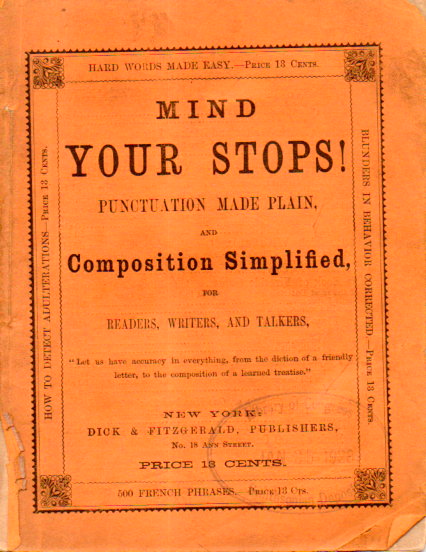
    Mind Your Stops! Punctuation Made Plain and Composition Simplified for Readers, Writers, and Talkers, was a slim volume produced in the U.S. version of the “Sixpenny Library” series, with this version published in New York City by Dick & Fitzgerald in 1855. (It cost 13 cents in the U.S.) It is small (5×4 inches or so) and 32 pages long, and promises a lot, (“Hard Words Made Easy”). There is nothing particularly eventual that takes place in this work, at least from what I can fast-read. The main concern here is the comma (pp 6-16), which takes up about a third of the work and is but one of ten punctuation marks.  (Here are a bunch of them in case I’ve forgotten to use some here–I know there are too many,but you may keep the others for a rainy day===> ,,,,,,,,,,,,,,,,,,,,,,,,,,,,,,,,,,,,,,,,,,,,,,,,,,,,,,,,,,,,,,,,,,,,,,,,,,,,,,,,,,,,,,,,,,,,,,,,,,,,,,,,,,,,,,,,,,,,,,,,,,,,,,,,,,,,,,,,,,,,,,,,,,,,,,,,,,,,,,,,,,,,,,,,,,,,,,,,,,,,,,,,,,,,,,,,,,,,,,,,,,,,,,,,,,,,,,,,,,,,,,,,,,,,,,,,,,,,,,,,,,,,,,,,,,,,,,,,,,,,,,,,,,,,,,,,,,,,,,,,,,,,,,,,,,,,,,,,,,,,,,,,,,

    Also included are the colon (pp 16-18), the period (18-20), the dash (20-25), the stopped-dash (25-26), the long dash (26-28), the hyphen (28-29), the note of interrogation (29-30), the note of admiration (30-31), the marks of quotation (31-32), and then all by it self in a lonely half-page or so, the parenthesis (on page 32). 

    I’m reproducing this mostly for the cover. Oh: and for some reason only two copies of this work are located in WorldCat, both at the British Library.

     A review from Mechanics Magazine, (Volume 63) edited  by John I Knight, Henry Lacey,, which appeared in 1855:

    ·Posted by :

    ·in:


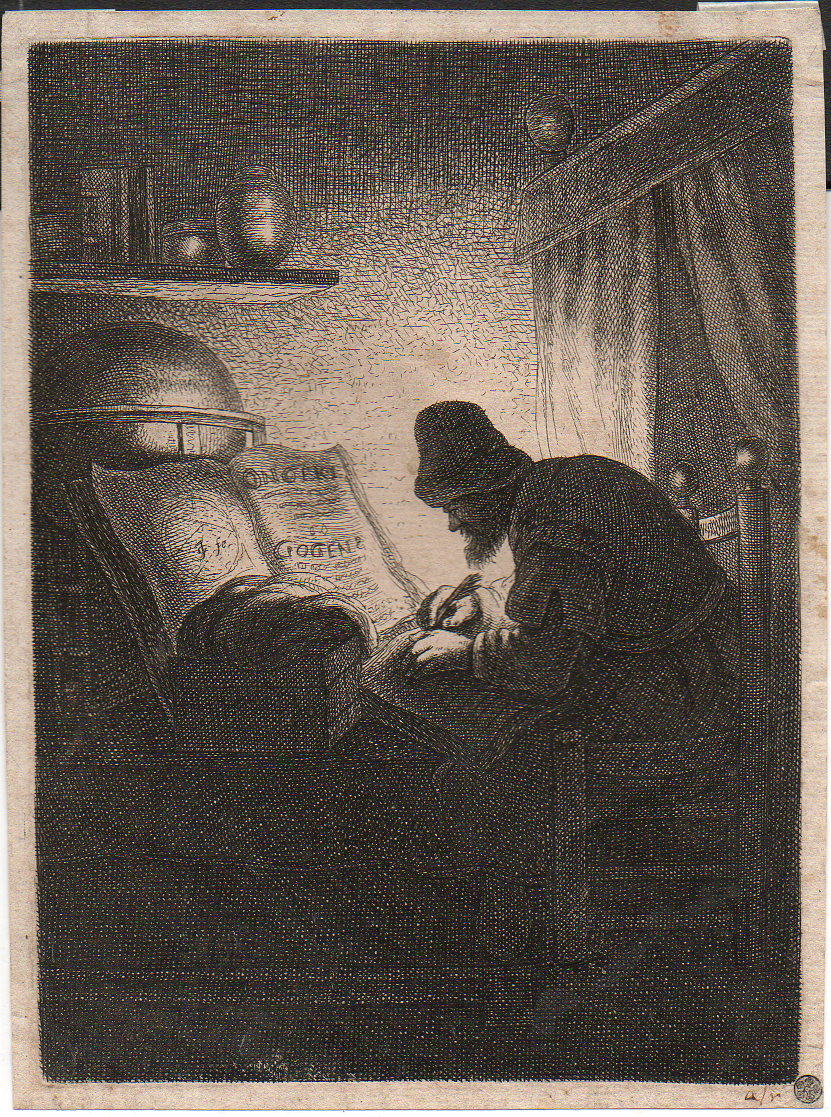
  • Fine 17th century Etching of a Scholar at Work

    JF Ptak Science Books   Post 2476

    Etching man in study110

    I’ve long thought that this (ca. 17th century) etching of a scholar in his study was alchemical in nature–that just for the the appearance and sound of the two words printed int he large open book on the table. As it turns out, I cannot find those words, anywhere–at least with meanings that could be related to the book or the scene. 

    • The original print is available for purchase via the blog’s bookstore, here. 

    That said it is still an interesting and very personal scene–one man, still heavily clothed in the dark (and what seems to be late at night, though there is no evidence for that, that is just how it feels t me), working away at something with the benefit of only a single semi-weak light source

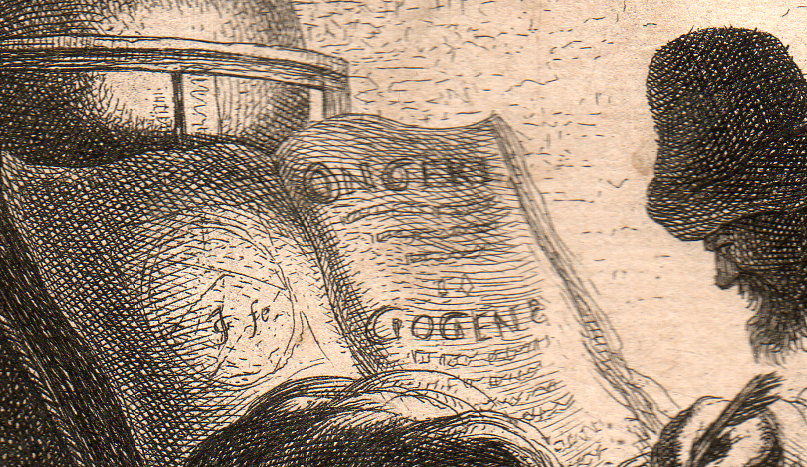
    The artist/etcher looks to be “JG”, or “IG” or “GT”, and other permutations and possibilities.  I have not been able to identify who the artist is, having scoured the Big Book of Initials and Monograms: Francois Brulliot’s Dictionnaire des Monogrammes, Marques Figurees, Lettres Initiales, Nom Abreges, etc., avec lesquels les Peintres, Dessinaeurs…. The book is a masterpiece of a type, sorting out the difficult and twisted means by which the originators of artworks identified themselves. It was published in Munich in 1832 in two volumes, and runs an easy 1200pp, though there is probably a half-inch of very thin paper that is unpaginated for various appendices.  (For some reason the letter “T” is represented in only one page in the monogram section. Odd.)

    The artist’s monogram followed by a “fe”, which is an abbreviation of “fecit”, or “faciebat”, which is also abbreivated as “f”, “fac”, and “fect”, which seems to be a kind of ambiguous term, referring to “JG” as being the maker, as either the artist or etcher/engraver, or both.  (This is less seldom scene than the more common indicators like “del” and “delin”, which abbreviates the Latin word for draw/drew, and so indicating the artist; “eng” and “engd” would stand for “engraved”, for the person who prepared and executed the plate made from the artist’s work.)

    Here’s the detail of the open book, as well as the initials of the artist (located on the left-hand page):

    Etching man in study111

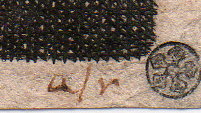
    And an early (and tiny, 2mm)  collector’s mark, stamped in the extreme right bottom corner:

    Etching man in study112I think that we’ll just have to appreciate this print at this point for what it makes us feel–though I am sorry not to have more detail on what it is/where it came from/who made it. 

    ·Posted by :

    ·in:

    —

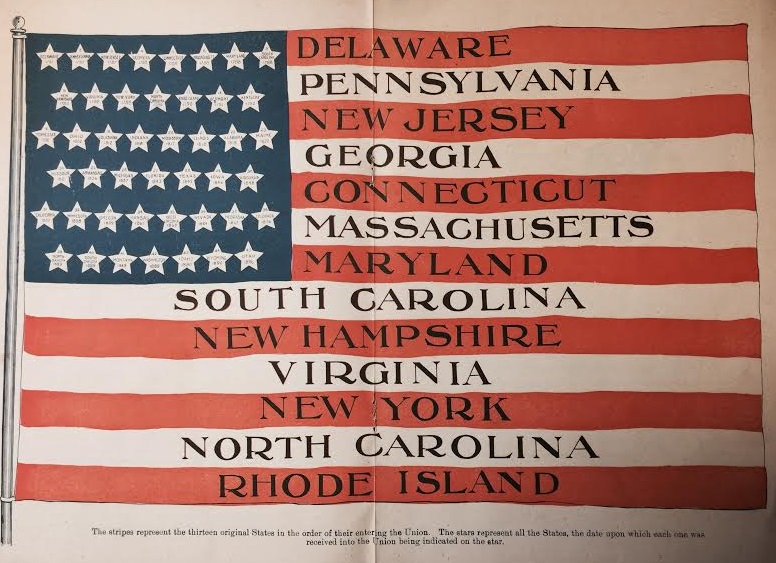
  • A Strong U.S. Flag, 1903, and an Alphabet of Advertised Needs

    JF Ptak Science Books    Post 2444

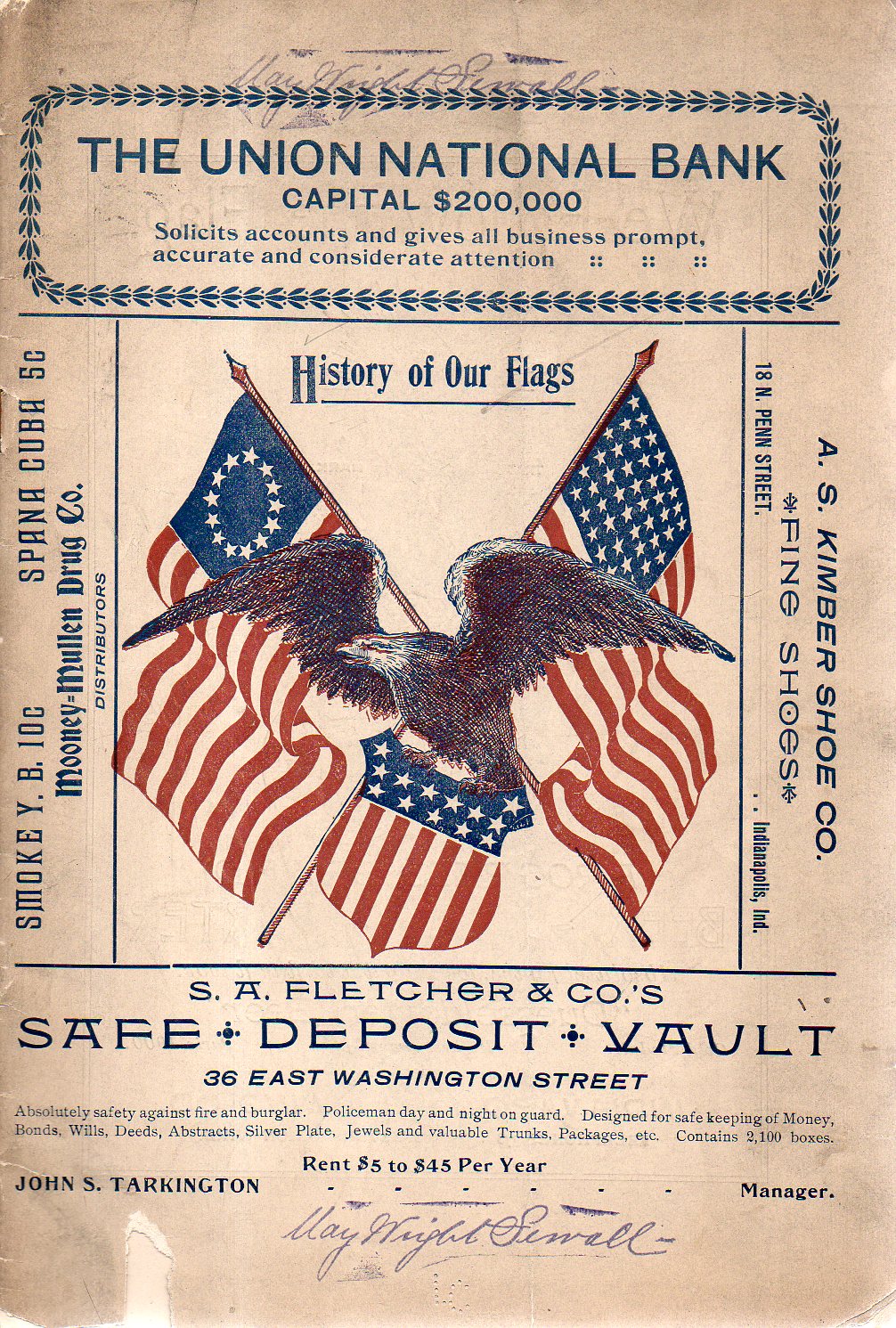
    Aside from everything else in this pamphlet, there is a lovely double-page illustration of a United States flag that is very striking:

    Flag history

    The other nice part is that the pamphlet–part of my haul of the “Pamphlet Collection”of the Library of Congress some years back–is that it was once the property of May Wright Sewall (1844-1920), who was one of the major leaders in the history of women’s rights in the USA, her influence and leadership spread over several decades. (She was on the executive committee of the  National Woman Suffrage Association from 1882 to 1890; was president of the National Council of Women for the United States from 1897 to 1899, and president of the International Council of Women from 1899 to 1904, among much else.) The pamphlet also has a stamp showing that it was donated from the Sewall estate by her literary executor in 1923.

    • This item is offered for sale via our blog bookstore, here.

    Flag Sewall919

    The other bit that strikes me are the ads which are everywhere on the pamphlet–from crowding out the title on the front cover to loading up the interior pages; the work does have some nice illustrated history of the flag which is engulfed by ads. It is interesting to look at the ads to get a bit of an idea of the geography of need-and-satisfying it:   

    A Near Alphabet of (100+) Advertisers  in the 28pp document include:

    • Bailing Machines
    • Beer Dusseldorfer Beer–we follow the flag! (“Telephones 576”)
    • Beer (“American Brewing Company” Telephones 407″)
    • Boarding, Feed and Sale Barn 
    • Books (“Blank books and stationery”)
    • Canned Fruits from Ko=We=Ba
    • Carriages (“The Co-operative Carriage Co.”)
    • Clay working machinery (from C.A. Potts)
    • Coal, Coke and Wood
    • Dental College of Indiana
    • Electrical Supply 
    • Flour, Grain and Hay from the Wm Rouse & Son central elevator
    • Groceries (“Groceries, Meats and Canned Goods, always fresh”)
    • Iron work 
    • Jewelry
    • Lumber & Shingles
    • Millinery
    • Oil and Supply for the mill
    • Pharmacy 
    • Pianos
    • Pianos, player (from “the Aeolian Company”)
    • Pulleys, Paper
    • “Pictures and Picture Framing”
    • Regalia (“The Indianapolis Regalia Co., for Lodge Regalia, Costumes, Flags, Badges, Banners”)
    • Rocking Chairs (and go-carts and children’s carriages)
    • Safe Deposit Vault
    • School (“Knickerbocker Hall, Boarding and Day School for Girls”)
    • School (“Girls’ Classical School”–this is actually a school run by Ms. Sewall)
    • School (“Tudor Hall School for Boys”)
    • Shoes
    • Stationery
    • Tailor
    • Tin, sheetwork and furnace work
    • Undertaker
    • Upholstery
    • Wagons
    • Water (“Indianapolis water Co supplies excellent water for domestic use”)


  • An Alphabet of Guillotines

    JF Ptak Science Books   Quick Post

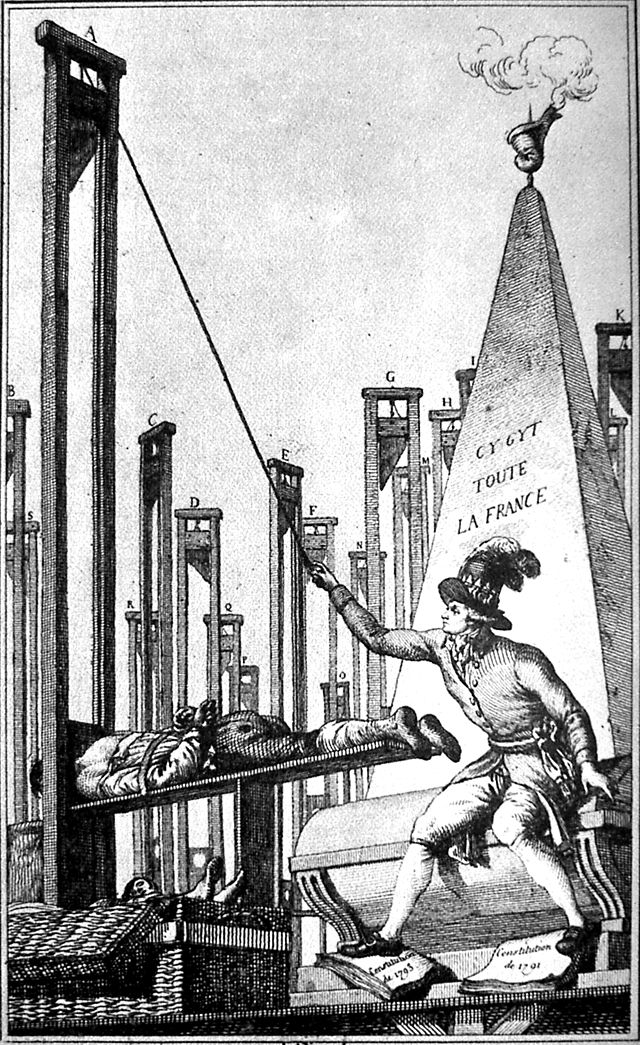
    There is a developing thread on this blog of Alphabets of Various Things (An Alphabet of Apocalypses, An Alphabetical Bestiary of Bob, An Alphabet of Death and Destruction in Antique Childrens’ Verse, to name the most recent three entries), and so when I saw this engraving I thought there must be a place for it in that series.

    The image shows hammer-happy Maximillian Robespierre, one of the executors of the Reign of Terror during the French Revolution, as he is executing the execution, who has made his way through the citizens of France, most of whom are depicted in the labeled guillotines in the background, though the alphabetiziation of death curiously ends with the letter “R”. This print is ostensibly showing activity in 1793; in the following year Robespierre himself would visit the “National Abbreviator” and meet his own fate with the blade he sharpened so well.

    It is worth pointing out that poor Dr. Guillotin had nothing to do with the instrument–he was really only looking for a more humane way of putting away people sentenced to death and was appalled that the new instrument introduced to that function bore his name.  It turns out that the family kept the name until the good Doctor died in 1814, and then abandoned the name to history.  

    Robespierre guillotine

    [Image source: wikipedia commons, here.]

    ·Posted by :

    ·in:


  • Alphabetical Apocalypse(s): Apocalypse Now and Then

    JF Ptak Science Books   Post 2431

    “Just as psychoanalysis reconstructs the original traumatic situation in order to release the repressed material, so we are now being plunged back into the archaeopsychic past, uncovering the ancient taboos and drives that have been dormant for epochs… Each one of us is as old as the entire biological kingdom, and our bloodstreams are tributaries of the great sea of its total memory.”–The Drowned World, J.G. Ballard, Millennium 1999, p. 41.

    Is there a plural of apocalypse? Is there even a need for one (plural)? There is, of course, even if it is a word that is supposed to spell out the end of times–there can be more than one apocalypse, and they can happen at the same time, although given my very limited knowledge of the scifi genre I don’t know of any books addressing dual/multi-combative apocalypses. (And here I’m not talking about one apocalypse generating all manner of associated badness, but a second, completely unrelated, apocalypse.) 

    So in trying to understand the nature of apocalypse storytelling I decided to make a very abbreviated  overview of a vast literature of the end of times/apocalypse/technocaust/end of the world themes.  This is just a short working list, really, and includes only short stories or novels, and to keep it relatively crisp I’ve chosen the artificial delimiter of an alphabet of apocalypse types.  In many cases there is just one example (where there could be hundreds, so please don’t fault the list for completeness because that would take years of assembly and understanding). The same goes for the categories of apocalypse–I’m certain I not included the majority of them, though I think that this is a good start (There are no movies or television shows listed independent of a text, so Soylent Green will show up but under Harrison’s Make room! Make Room!. I think that tv shows/movies etc  must be enormously outnumbered and the scale of orders of magnitude by the print media.) 

    Evidently this list can be reproduced in the same spirit but with iterations–for example, Juvie Apocalyptic Lit (see here).

    Also–the list is a little heavy with Wells, Chrisopher, Aldiss, Heinlein, and Ballard; this simply because I’m a little familiar with these writers.  So, the list:

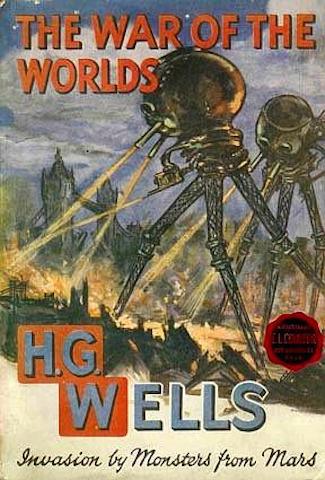
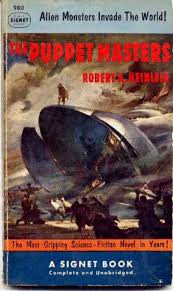
    Alien Invasion:  the great initiator, The War of the Worlds 1898, H. G. Wells; The Moon Men 1926, Edgar Rice Burroughs; The Puppet Masters, 1951, Robert A. Heinlein. There were other earlier incarnations of extra-terrestrial visits, especially if you considered religious/mythological aspects, though in literature it was far less common–like Swift’s mathematicians of Laputa and Voltaire’s titans in his Micromegas. For the modern era though it is Wells who seems to create this idea. 


    Apoca war of the worlds Apoca--heinlein puppet
    [Of course this could not possibly be complete by the genre-bender/creator H.G. Wells’ War of the Worlds–Flavorwire has a selection of 15 different covers for this classic best-seller, here.  ]

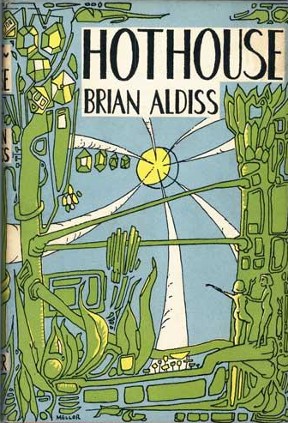
    Botanical endgame virus destroying all plant life: The Death of Grass by John Christopher.  On the opposite end is  1962 novel Hothouse by Brian Aldiss where the plants take over everything.

    Apoca--aldiss hothouse

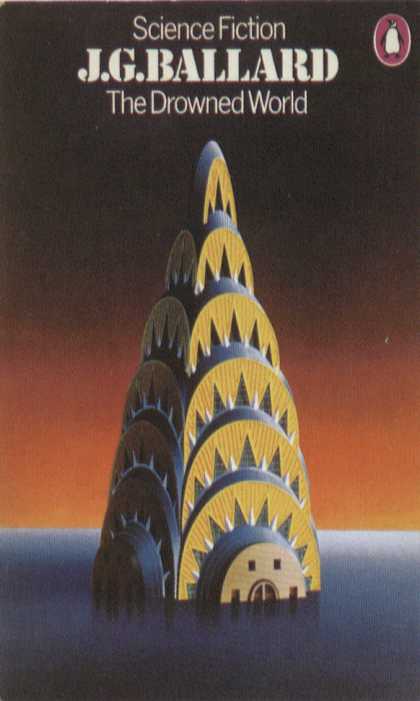
    Climate Change: apart from the state of globa;l warming as we know it now, The Drowned World by J.G. Ballard 1962 is perhaps the best and most well-known adventure in this field.. In this book in 2145 solar radiation has shrunk and mostly melted the polar ice caps, which is a lot of water, and has turned most cities into architectural swamplands of vertical mangrove. Conversely Ballard wrote the novel The Drought  in 1964 about all of the water on earth drying up.

    Apoca--ballard drowned world


    ·Posted by :

    ·in:

    — —

  • A Bestiary of Bob

    JF Ptak Science Books  Quick Post

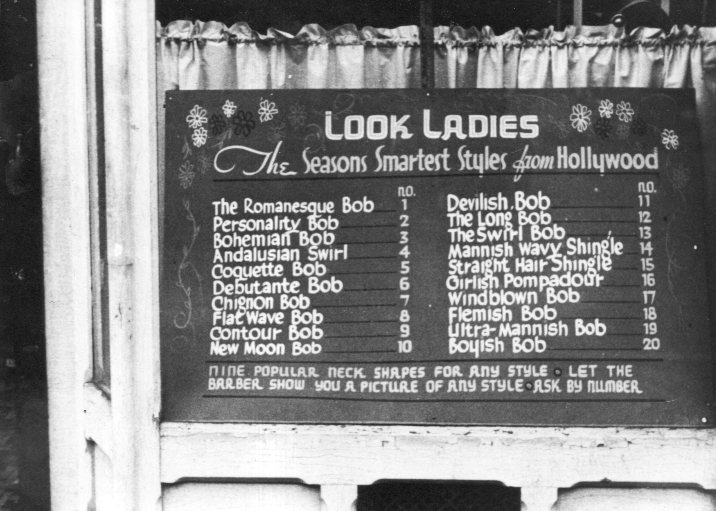
    Years go when this photograph was first made the vast majority of women who were having their hair cut not-at-home went to barber shops, with their hair cut by men–so explaining the “see the barber” part of this style menu in the window of a chop shop.  Unfortunately I do not have the reference for the photograph–the image I am working with is from a newly-found set of photographs I made years ago copying FSA photographs from the mid-1930’s found at the  Prints & Photographs Division at the Library of Congress. Of the 20 style cuts 16 were “Bobs” of one sort or another, including the beguiling “Ultra-mannish Bob”…

    Barber Bob531

    ·Posted by :

    ·in:


  • On Death and Mayhem in Children’s Alphabets–the New England Primer

    JF Ptak Science Books   Post 2355

    Now I lay me down to sleep, I  pray thee Lord, my soul to keep;If I should die before I wake, I pray thee, Lord, my soul to take.–New England Primer, 1784 edition

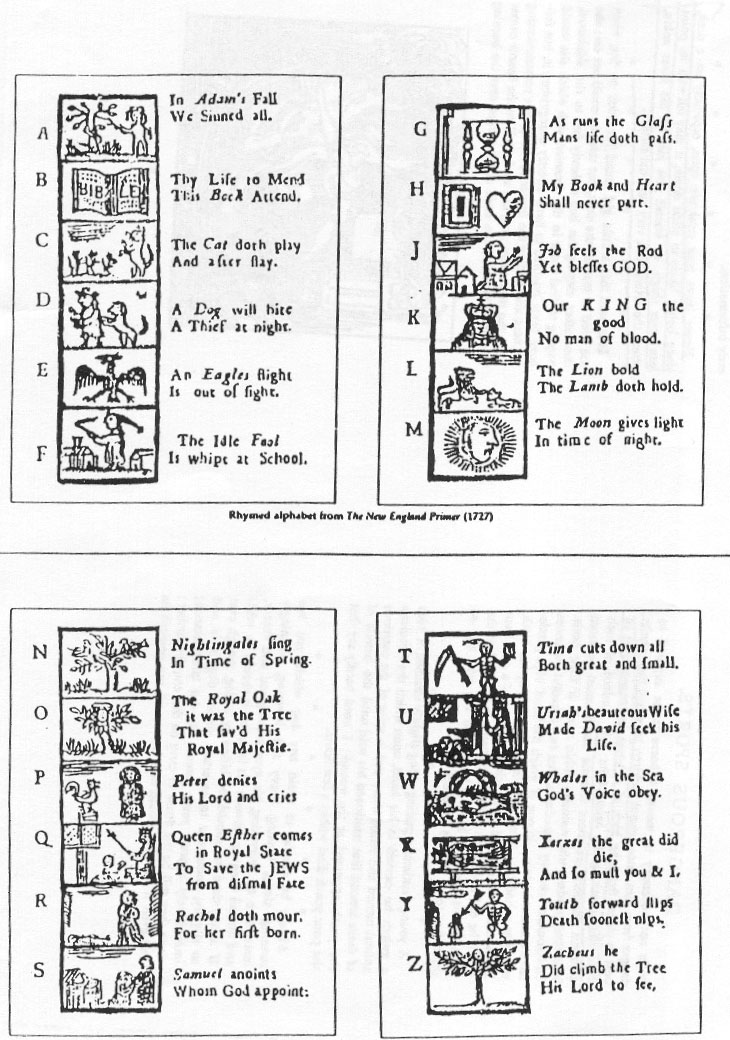
    There’s nothing scary in that is there?  The nightmare-maker may have its first introduction in the New England Primer, a book which was the backbone of North American education for many decades. as popular as it was and as much as it was used, print runs were not enormous, and most children would never actually own a copy of the book. It would be read to them for lessons, and that being the case much info was presented by vivid short rhymes , some of which are hard to forget because of the mental imagery they present.

    NEPrimer

    [Image source: Wikipedia, here.]

    For example the mnemonic devices used to help learn the alphabet is riddled with murder, mayhem, vice, death, and not all that much hope….except if you include stuff like “Job feels the rod, and praises God” as a Puritanical form of hope/salvation. Perhaps the writers were after the indelible impression as well as searing the cerebellum with the moral code. In fact, in the 24-letter alphabet presented in the   edition (“i” and “v” are not included), 12 of the letters are death- or violence-related, including the statements that we are all sinners, that cats kill things, dogs bite, fools are whipped at school, life runs out like sand in an hourglass, punishment deserves prayer, offensive things as big as armies can be swallowed up whole, a teary Rachel cries over her tiny dead child, time will kill you (again), kings will do and so will so, and youthful bits can of course kill you.  It is part-and-parcel I guess of the rearing of kids in the not-necessarily-glorious history of childhood.  Death and the possibilities of it or some close relative of it was a lot closer to reality than it is today, especially when the average life span at the time was well under 50 and infant mortality easily an order of magnitude more prevalent than it is today1.  And of course outside of the plague-of-death culture and the subjugation of kids for a better behavior there was also the screaming Calvinist theology that beat up/taught readers the abandonment of the self to the creator available to young and old.  

    This sort of indoctrination was hardly limited to the New England Primer, printed in this country as the first of its type beginning in the late 17th century (and with some familiarity several printings can be remember for famously having the “printed by B. Franklin” imprint in the 1760’s). It would be easier to name the child’s instructional that did not have this leaning (at least before 1880) though I am presently hard-pressed to think of an example off-hand).

    And lest we forget, the Grimm brothers wrote stuff for kid the vast majority of which we wouldn’t think of reading to our kids today–I didn’t.  

    Notes:

    1. Good national statistics for the U.S. before 1870 begin to get sketchy in this area, though from 1900 onward the numbers look pretty good.  Suffice to say that historians of medicine and Medieivalists and so on make pretty good educated estimates for these rates, and they’re not so good.  For example, in 1900 in America the average life span was 47 and the infant mortality at 16% (compared to about 80 or so and .7% today), though I cannot offhand find the stats for childhood survivability by age 10.  Looking back in time the numbers get really big, with some people  saying that childbirth mortality in the Medieval and Renaissance times were in the 30-50% range, and the survivability rate passed 10 was about the same.  I don’t have these rates for American colonial times, but I assume that they are closer to the Renaissance than they are to 1900 numbers.  And of course this does not apply to slaves, whose rates of survivability were smaller still.  

    ·Posted by :

    ·in:

    —