A Daily History of Holes, Dots, Lines, Science, History, Math, Physics, Art, the Unintentional Absurd, Architecture, Maps, Data Visualization, Blank and Missing Things, and so on. |1.6 million words, 7500 images, 4.9 million hits| Press & appearances in The Times, Le Figaro, Mensa, The Economist, The Guardian, Discovery News, Slate, Le Monde, Sci American Blogs, Le Pont, and many other places… 5000+ total posts since 2008.

Category: Absurdist, Unintentional

  • Fun with Physics: Listening to a Spoon, 1880

    JF Ptak Science Books   Quick Post   Unintentional Absurd & Found Surreal Division 

    String telephone027

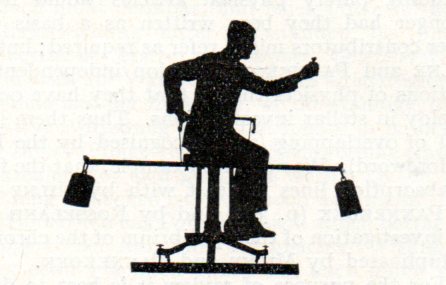
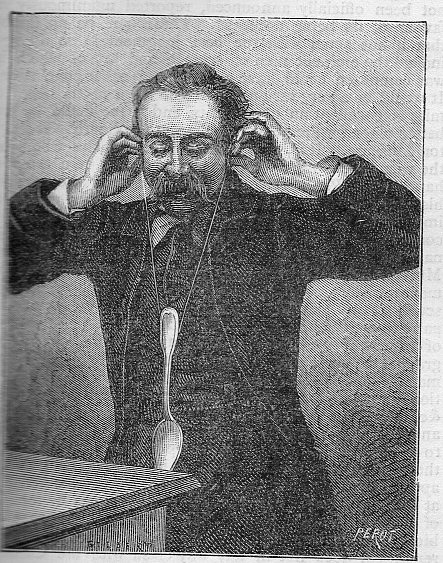
    This is one of a series of images from six-part article in Nature in 1880 called “Physics without Apparatus”.  It is actually a fun series in a Victorian-science-high jinx sort of way, and this image is a little more fun than most, especially removed from their context. In-context, this gentleman is experiencing teh sound of church bells by bumping the spoon suspended from his ears on hempen lines lightly against the table’s edge; out-of-context, it looks like…

    ·Posted by :

    ·in:


  • Dangerous & Impossible Books: Writing that Hurts When Read

    JF Ptak Science Books  Post 2203 (an earlier post continued and expanded)

    “Sometimes a book is just entirely bad, and sometimes it is entirely nothing. It is impossible for a book to be both very bad and very nothing. Impossible.  Except for this book, whose badness is exceeded only by its nothingness, and vice versa“.  (probably not) Oscar Wilde

    And so into this black hole of imaged Wildeian description we go, into a very real-ish book.

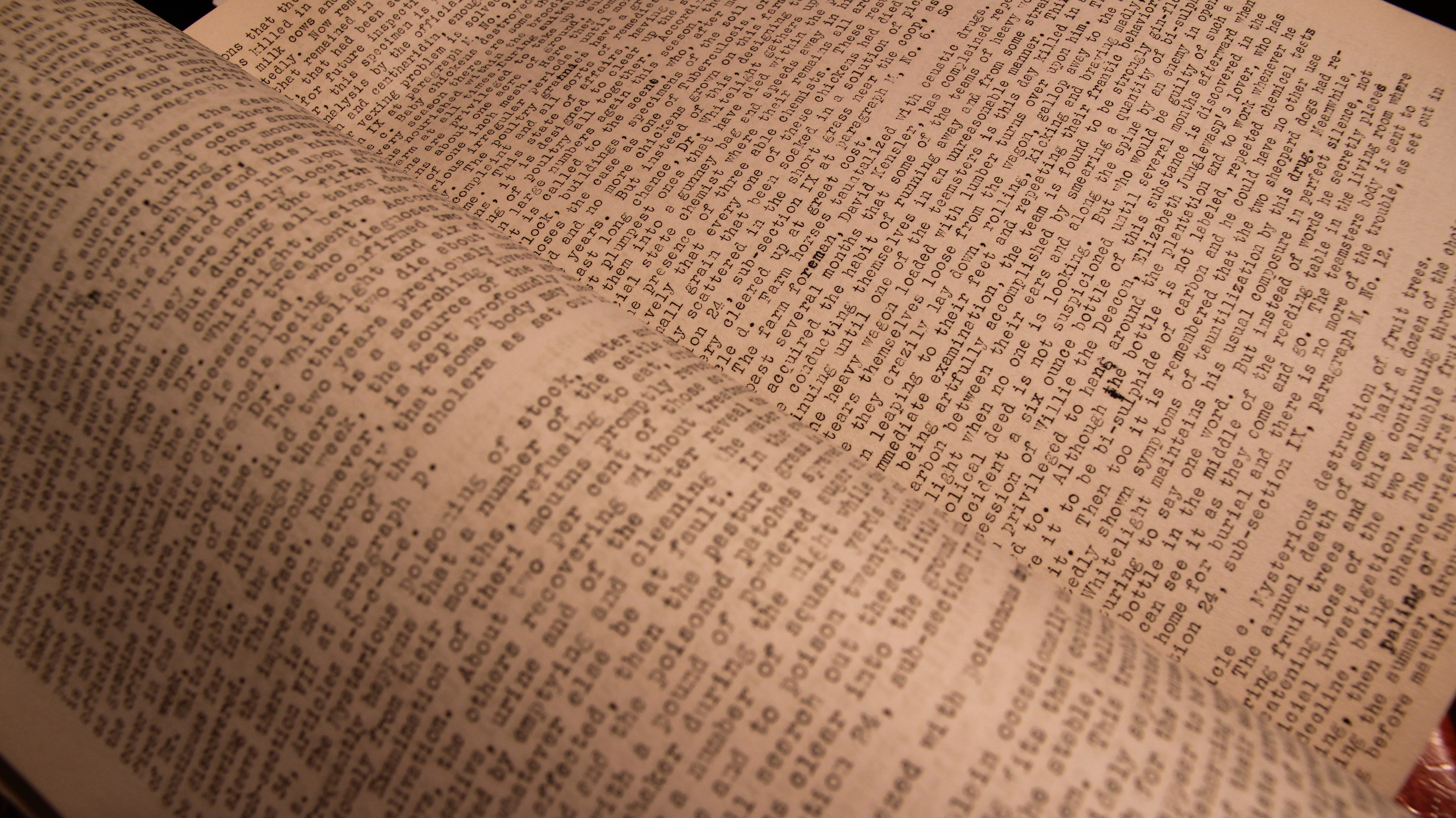
    I found a novel tonight, bought long ago and long ago mostly lost.  It was written by a doctor who worked in the District Hospital in Lima, Ohio, and written in 1934.  The Lima Hospital was the largest poured concrete structure in the world when it was built in 1915, and stayed so until the Pentagon was completed.  The hospital was established for the criminally insane, had 14″-thick walls, and reinforced steel bars laid into the walls that went “right down to bedrock”. 

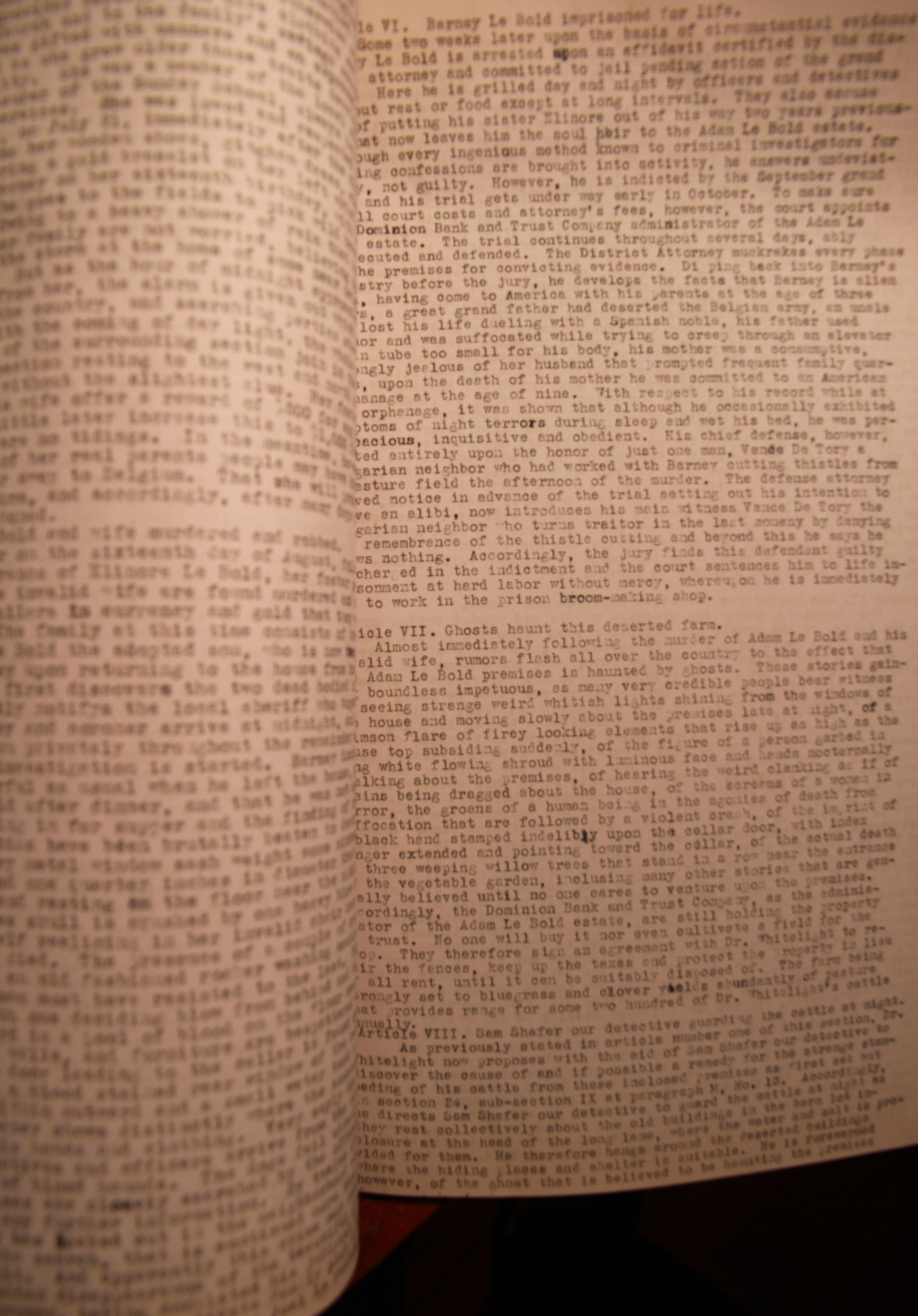
    It was somewhere in there that this doctor wrote something that was really so toweringly bad that it escapes comprehension. I own the carbon copy of the unpublished work, which is typed on 14×8.5″ sheets of paper, front and back, running 94 pages. It is a very crowded affair, with 90 lines of single-space typed lines, making the work about 115,000 words long. 

    There wasn’t enough space evidently for paragraphs, which gives the work a kind of insistent, casket-cramped cruelty.  To read it takes your breath away for its dullness–the book moves so weirdly and at the same time so very slowly that it doesn’t move at all even while moving.
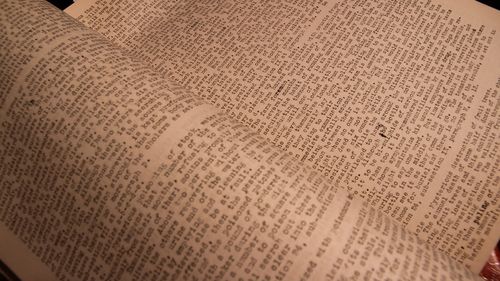
    Manuscript insane one

    A few months ago I found the seven-foot-long scroll of the book’s plan–a work of crowded magnificence of nothing and confusion, being very orderly at the same time.  It went to a friend of mine who created artwork around it, and as it happens made a very noticeable appearance in a very significant yearly show in NYC last week. I was stunned to find that there was actually a text to go with the scroll-outline–it emerged from the warehouse this week, so perhaps this too will find a very celebrated life as art as well. Certainly the book would go nowhere on its own as a book, though it stood a chance at surviving on the grounds of its considerble design weirdness, which is of a complexified beauty.
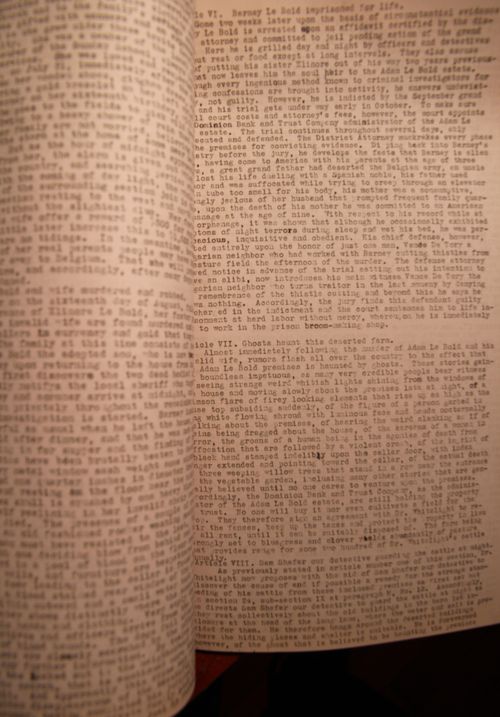
    Manuscript insane two

    In the meantime, before all of the letters slide themselves off the page from sheer boredom and before the thing is resurrected as a magnificent artistic effort, I’ll share some ianges of the extra-ordinary book of reversed brilliant badness. I’ve also culled a few imaginary descriptions of the book from writers known and not:

    Potboiler scribbler:

    “He couldn’t speak.  He could barely see. Blinded by the flames ignited inside his eyeballs from the novel in his lap.  The words were like molten lead, sucked off the page by his eyes, forming a vacuum in his brain.  It was a bad book”.

    The first-time published novelist’s approach:

    “He couldn’t speak the words of the thoughts in his head, because they and all of his breath were stolen by the magic of the complete badness of the book in his lap”.

    Gertrude Stein:

    “The book was bad and bad, and bad was the book. Even the badness of the bad was bad, a whole new insight into being bad. It was the bad book by which bad books are called bad”.

    Ernset Hemingway:

    “He didn’t read the book so much as he looked through it.  It was easy–there was nothing there. As bad as it was, it could get no worse. So he shot it, and poured a drink”.

     You might wonder what this book is about.  Me too.
    ·Posted by :

    ·in:

    —

  • The Department of Irony: the Unselfish Society

    JF Ptak Science Books  Quick Post

    1502   tr. Ordynarye of Crysten Men (de Worde) iv. xxii. sig. ff.iii,   Suche synne is named yronie, not that the whiche is of grammare, by the whiche a man sayth one and gyueth to vnderstonde the contrary.  —  Oxford English Dictionary, in an example of the earliest usage of “irony” in English.

    I wonder if there are such things as “small” and “big” ironies?  Perhaps it is more a question of small and big wonders. 

    Eugenics198

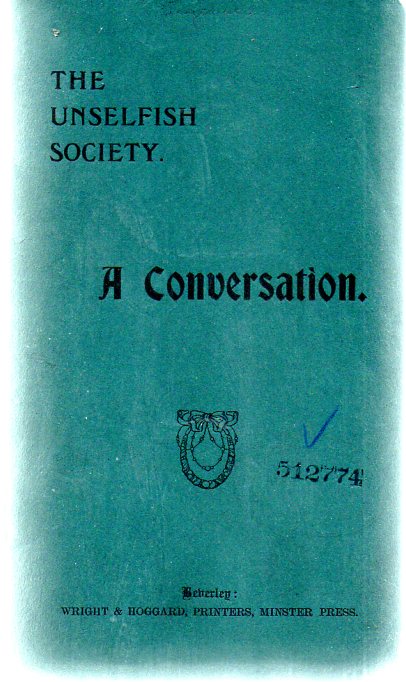
    In any event, the Unselfish Society of this pamphlet refers to a eugenics Society, or eugenics in general, and was part of a Socratic dialog in the pamphlet concerning eugenic principles and education.  It feels more like backlash of theatrical Shavian wit, what with the eugenics folks being about as far removed from principles of un-selfishness as possible.  Or perhaps they are interested in “unselfishness” as a principle expressed by others in order to better the genetic and societal lot of the more-privileged people.  But the expectation of unselfishness in others is not being unselfish in yourself, unless you’re Ayn Rand.  And in this instance we’re talking about the so-called “positive” eugenics, and not the “negative” one, where there is an enforced elimination of what is deemed (by them) to be society’s “weak links”.  “Unselfishness” is not a currency expected (and sometimes extracted) from others and used for yourself.  

    Eugenics1971883   F. Galton Inquiries into Human Faculty page 44.   “The investigation of human eugenics, that is, of the conditions under which men of a high type are produced.”

    Full text here

    ·Posted by :

    ·in:

    —

  • The Makings of a Scheme Alphabet of Antique Schemes

    JF Ptak Science Books   Quick Post

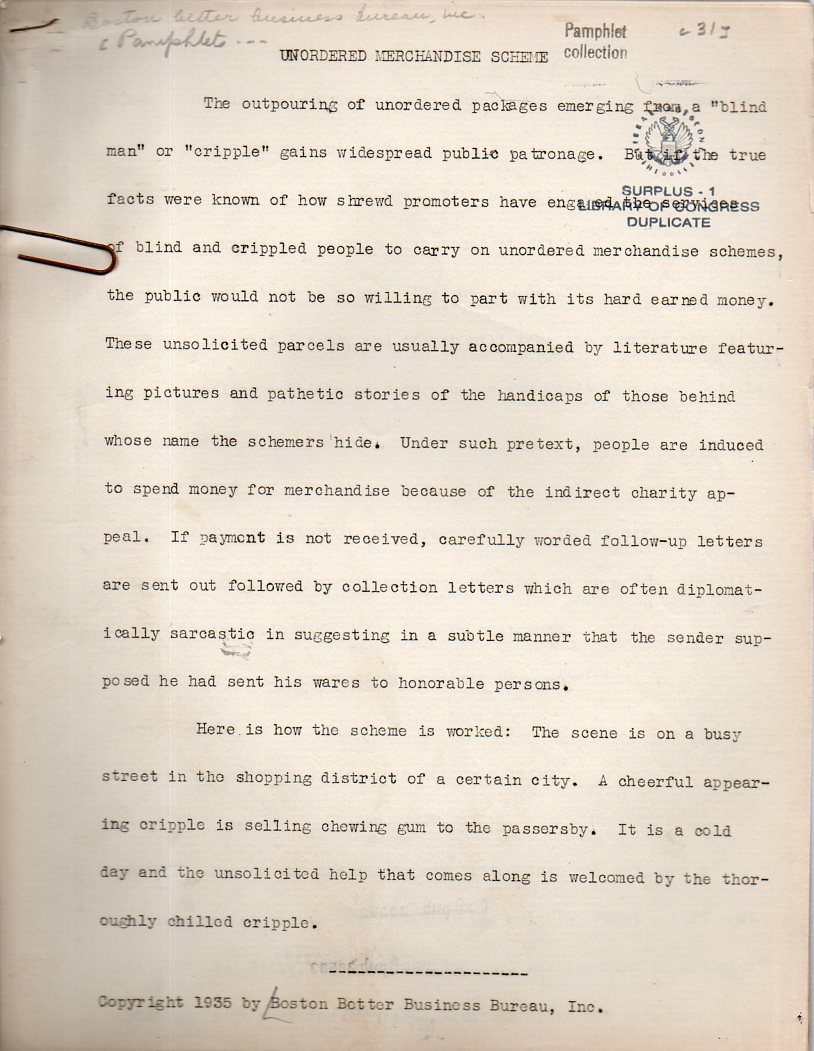
    I found this sub-magnificent collection of Police-Sponsored Anti-Crime Bunko-Squad pamphlets in a collection of other material from long ago that today looks so mundanely sublime.  They were published by the Boston Better Business Bureau, and listed an alphabet or thereabouts of small- (and not-so) time grifters and frauds and what-have-you who were set to produce ill among the good folks of Beantown, and how to recognize and avoid them.  (The reports are all in the same format, printed via offset on 11×8.5 inch sheets, titled in pencil “Pamphlets on Fraudulent Business Methods and Schemes” and printed in 1936.)  There are  34  in all, stapled sheets at left-top, each about 10pp  long (making for about 350 leaves), with each having an example of a conversation between the consumer and the grifter.  

    BBB310

    [Source: ex-library with the occasional stamp from the Library of Congress (“Pamphlet Collection”), via the U.S. Copyright Office and then to my collection.] 

    These schemes have a colorful flavor, and some sort of antique pleasantness to them, except that they were all based on fraud and deceit.  The schemes include numerous out-and-out bait-and-switch approaches:   Bait Window Advertising Scheme,  Free Permanent Wave Scheme, Smuggled Goods Scheme, Bait Advertising Scheme, Business Opportunity Scheme, the Re-load Scheme, A Switch and Sell Scheme, Bucket Shop Scheme, Tipster Sheet Scheme, Sewing Machine Scheme, Memorial Park Cemetery Scheme, Heir Scheme, Bait Advertising Scheme, Song Writing Scheme, Is It Bait? Bait Scheme, Action Sale Scheme, Stuffed Plate Scheme, Stuffed Flats (Furs) Scheme, Buy Wholesale Scheme, Insurance Association Scheme, Partner-Wanted Scheme, Long Distance Tailoring Scheme, Bait Advertising (T.C. System) Scheme, Free Lot Scheme, Home Work Scheme, Furniture Club Lottery Scheme, Charity Merchandise Scheme, Suit Club Scheme, Picture Enlargement Scheme, Puff Sheet Scheme, Territorial Rights Scheme, Obesity Cure Scheme, Territorial Rights Scheme, Cash Bond Scheme, Unordered Merchandise Scheme.  Schemes enough for one and all, and all with a flavor of Mony Python’s Spam routine.  

    ·Posted by :

    ·in:


  • On the Possible Delusion of the Inhumanity of Poison Gas, 1921

    JF Ptak Science Books   Post 2171

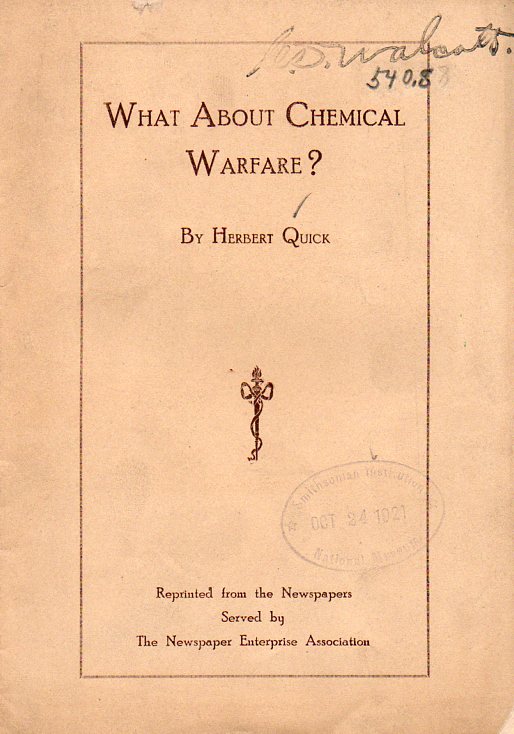
    Herbert Quick did a fair amount of thinking about the military use of poison gas, and it winds up, in the final analysis, thinking that it was tolerable.  What About Chemical Warfare? (published by the Newspaper Enterprises Association in 1921) is certainly a possible title for a Duck-and-Cover A-Bomb or You and Your Hormones kind of film.   But Mr. Quick took the slow boat around his issue, thinking about it a little long and out loud, before coming to his final conclusion in the chapter titled “Gas Warfare Cheapest and Most Effective Arm of Defense”.

    Air raid885

    He points out the enormous impact in the war effort that relatively small chemical corps played in WWI–something on the order of hundreths of one percent of all serving soldiers were employed in the combined chemical corps, saying “how small a body to produce such great results!” Which is true, assuming that by “great” he meant ‘widespread’, though it is unclear exactly what he was talking about.

    Nr. Quick does make a case for poison gas being not so inhuman as presented by most civilized people, pointing out both its high quick-death rate and survivability/recovery rates, which seems to be giving/taking at the same time. No matter:  “But woe to the army or nation that does not keep up with the times.  The Angel of Death will breathe in their faces” he writes. 

    The author also warns that though Germany was “stripped” of her war-making capacities, he thought it was not so of the industries necessary to produce poison gas. He points out that Germany can produce these munitions in secret, and that if any “militaristic nation conquers the world in the future”, it will be through the use of the poison gas it developed in secret. 

    Defense was also important:  “in the absence of efficient defense worked out beforehand, our great cities might be wiped out with gas bombs dropped from aircraft”.  Mr. Quick believes that protecting cities is possible, writing simply “preparation will prevent such a crisis”.  Indeed.  Unfortunately no ideas about this defensive posture were forthcoming, though he did bring himself around to writing about gas as a defensive tool.  Against looters. And rioters. And snipers.  “Gas puts the sniper in the power of his enemy” Quick writes, using the Marine action in Vera Cruz, Mexico, as a good example of where gas (“gas grenades”) would have come in handy.

    The bottom line is of course the bottom line, practically stating that poison gas as a weapon was indisputably more cost-conscious than anything else, by far, each dollar spent on chemical warfare being worth “from three to five hundred for the army”.  Poison gas services Quick says should be pursued, because “gas warfare cannot be stopped until all war is stopped”.

    Gas warfare “gives the educated, intelligent nations the advantages over the people of lower civilizations”.

    “When both sides are prepared it is much less inhumane than war with bullets and high explosives; but it means horrible annihilation to the army which is unprepared.”

    It is an interesting exercise to replace “poison gas” with other types of weapons, just to see how it reads.

    Mr. Quick was up and down in his treatment of poison gas and war, though almost entirely down.  One thing he didn’t see, that no one saw, really, was the use of a particular gas that was used to destroy millions of people, and which was developed quite in the open in Germany for many years, used for killing rats.  The Nazis simply used it instead on people.  No one saw Zyklon-B coming, and no one could have, even when they did.


  • Maps of Human Hair Streams (1902)

    JF Ptak Science Books     Daily Dose from Dr. Odd

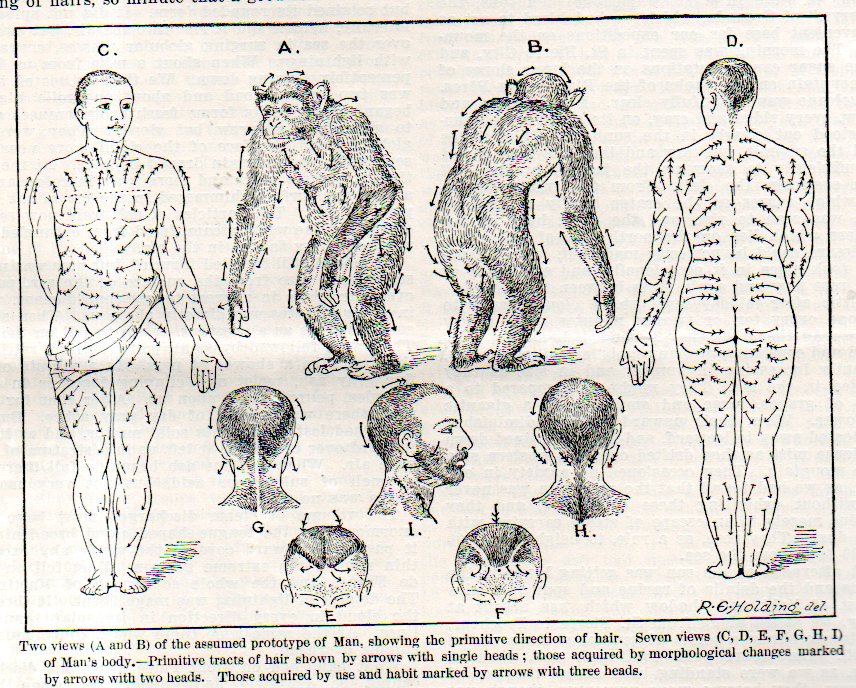
    There is something exceptional about the exceptional.  In this case, the category is maps, and in this instance the map that takes us away, far away, from the expected or standard is one showing the flow of human hair streams.  (It fits very nicely with other exceptional maps found on this site, like Maps of the Cosmos of Moles–just browse the “maps” section in the archives.)  

    Hair map contract087

     This unlikely title is the creation of Dr. Walter Kidd (Fellow of the Zoological Society, London) and his attempt to reconcile the the influences of gravity, inheritance, genetics, Weismannianism, and other assorted biological bits via his study of hair growth patterns.  The article appears in the (many) pages of the Scientific American Supplement for 13 September 1902, on page 22, 328. (Yes, the Supplement was paginated consecutively over dozens of years of publications, a cumbersome manner of ordering an 8-foot stack of paper over dozens of volumes.)  In any event, this was an article to simply explain some of Kidd’s ideas and the chart that would appear in a more lengthy treatise of 153pp published in the next year by Adam Black.  Contemporary views of Kidd’s book were not very supportive of his work.  I should add that I was attracted to this article solely for the possibility that this may well be the first map of directional hair growth. (I think the idea is pretty interesting, but I’m just not in the mood for it presently.)

    Hair map contract086

     Some of the other posts on this blog dealing with unusual hairiana include the following:


  • Beautiful Scientific Illustration Silhouettes (1931)

    JF Ptak Science Books  Quick Post

    Science silhouettes080

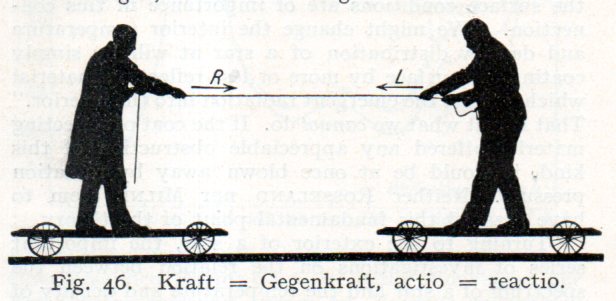
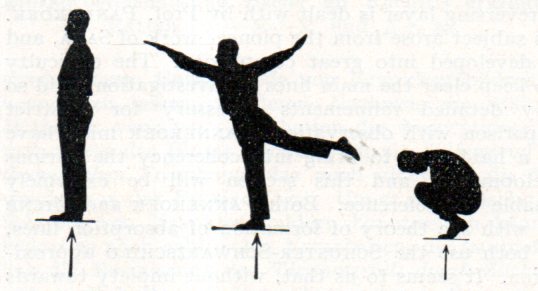
    In my experience of paying attention to unusual found-art found in unusual places, I have paid particular attention to found-art in the sciences that have full lives out-of-context of their text. [See the series  Unintentional Absurdist.] And so while reading through an issue of Die Naturwissenschaften (1931)  for an article by Herman Weyl (“Geometrie und Physik”) I found in its closing pages a review by Arnold Berliner of R.W. Pohl’s Einfuhrung in die Physik–complete with these three fantastic silhouette illustrations.  They’re simply beautiful things, exceptionally designed, simplistic but detailed and dramatic and way beyond what was necessary to illustrate the intended physical principle. It is a nice and unexpected artistic find.  

    Science silhouettes081

    Science silhouettes082

    ·Posted by :

    ·in:


  • Capt Quantrell and his Murderous Raiders Defeated by Flowers, 1863

    JF Ptak Science Books   Quick Post

    Quantrell070

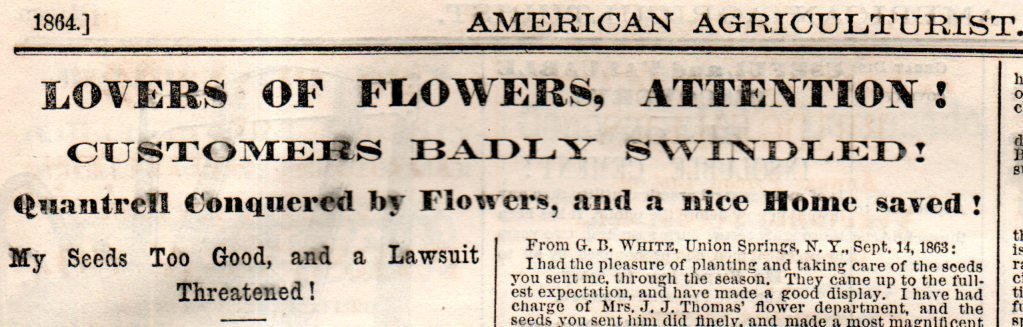
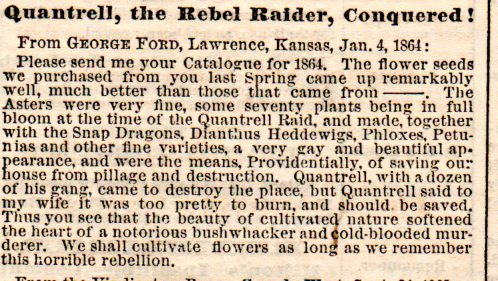
    I found this unusual heading in a half-page ad in March 1864 issue of American Agriculturalist for the Farm, Garden, and Homestead–as it can well be imagined it stopped me pretty quickly, if for no other reason than to make certain that the heading was correct.  And it was.  The seed manufacturer, James Vick (from Rochester NY) in the midst and throes of other oddness reprinted a letter from a correspondent named George Ford, who was writing from Lawrence, Kansas, about his experience in that town in 1863, and Quantrell, and (maybe bu tmaybe not) Vick’s flowers.  

    Quantrell071

    Capt William Clarke Quantrell–a sociopath who led a group of avengers and bushwhackers and various sorts of murderers and guerrillas in service of the Confederacy–was in Lawrence in 1863 committing acts of vengeance and murder against its citizens.  Mr. Ford expressed his admiration for Vick’s seeds and how lovely they were, and that they were responsible for saving his house from destruction by Quantrell.  It is  a remarkable thing to include in ad advert for flower seeds, closing in on the end of the war–it is also the only mention of the war for this issue and one of the few acknowledgements of it in this entire year.  

    Quantrell eventually pissed almost all of his men off, winding up with a dozen die-hards, and then in Kentucky and dead in June 1865, ironically and mortally wounded in a Union ambush.

    ·Posted by :

    ·in:


  • The Non-Talking Talkie–Soundless Talking Pictures (1917) and the Beauty of Timelessly Bad Ideas

    JF Ptak Science Books   Post 2162

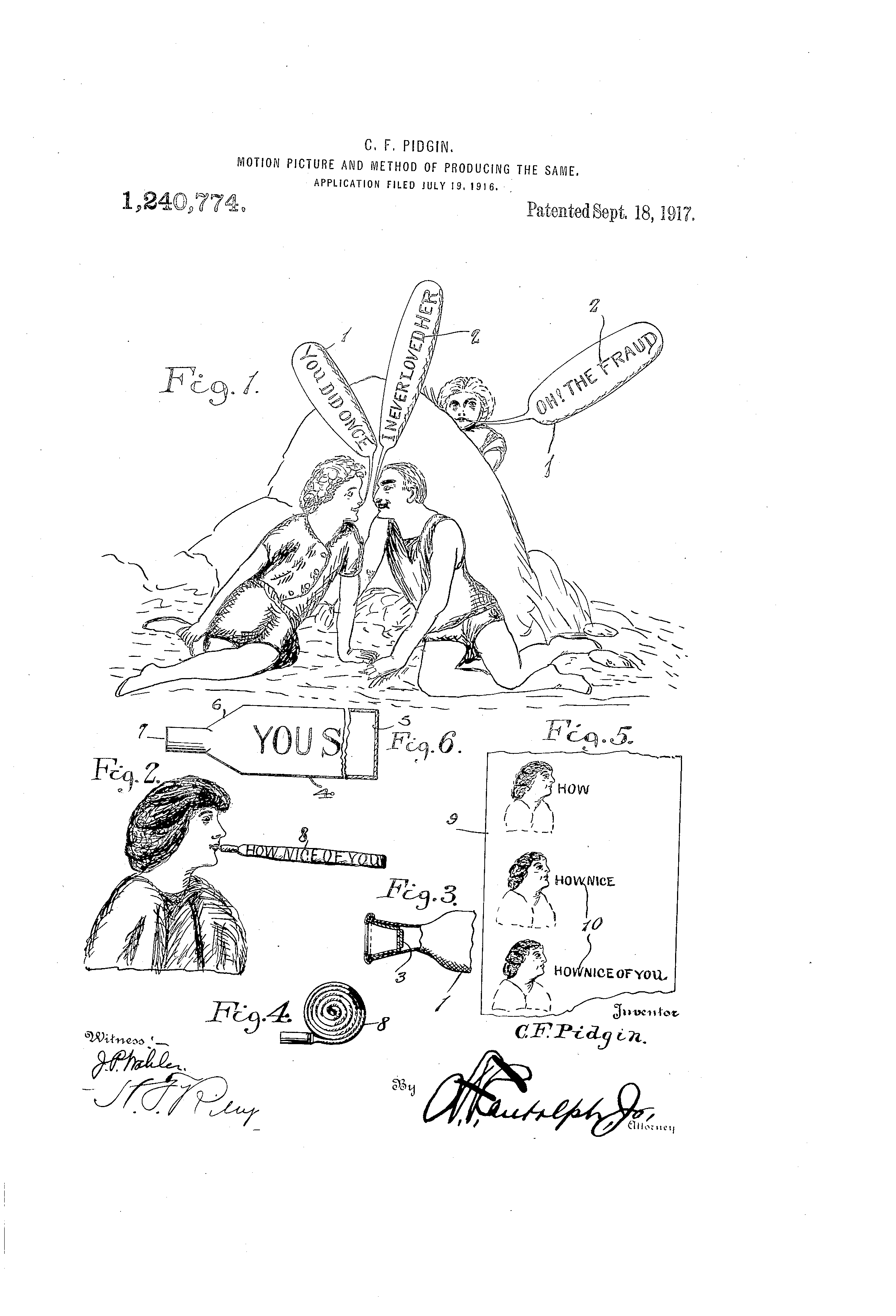
    “Motion-picture and method of producing the same.”


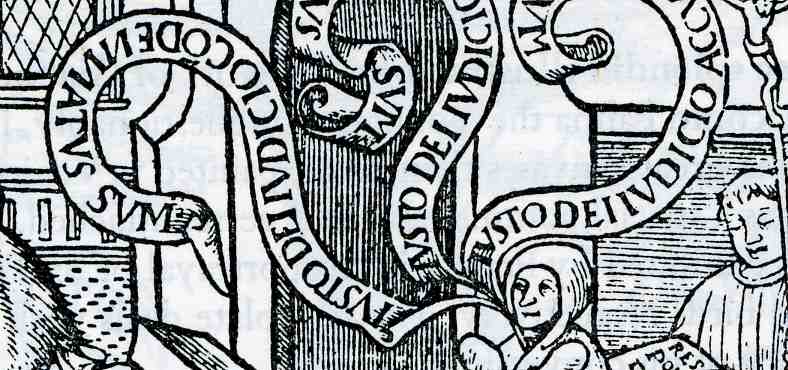
    I’ve written a note earlier on this blog about the history of word balloons–it is the stuff that we think of today as the little clouds filled with words over the heads of comic book characters and such, but which had a long history stretching back at least to the Renaissance when speech was illustrated in a similar way, but with lovely scrolls instead of blank clouds (as we see above).

            See for example:

    The following illustrations though come at a great expense to the imagination, and were a weak but fully patented  attempt to replace spoken-word captions in the pre-audio motion picture–that is silent films before the Talkies.  In general I guess the complaint with illustrating speech during a photoplay was that the text card was a breakaway from the moving-picture part of the experience, necessitating a clean break from action so that the audience could read about what was being pantomimed.

    Folks were well underway in processes to produce sound motion pictures, though up to this point–1917–the systems were separate recordings of sound and speech which would be played in conjunction/synchronously though not necessarily at exactly the right moments with the motion picture. Edison was hot on this trail but with blemished trials, combining his kinetoscope and phonograph in very early and novel attempts at producing a sound motion picture in the first decade or so in the development of moving pictures. The next 20 years in this development are fairly complex, but the matter is fairly well solved by at least three different technologies by 1923 with the production of successful continuous sound-on-film motion pictures, and then most famously and successfully debuting with The Jazz Singer in 1927.  

    And then there is this colossal bit of overdeveloped-underdeveloped thinking that would link the seamless word of not needing text card interruptions with non-spoken speech–and coming just this shy of not meaning anything at all. The work is that of Charles F(elton) Pidgin (1844-1923) who was a very successful author of genre/historical romance books (though he did have an interesting-sounding title in The Letter H, a Novel). He was also an engineer of some sort with some advanced patents in calculating machines and devices, which is the way I came to his name (via a letter I have written to him by the director of the U.S. Census rejecting his tabulating apparatus because it basically produced too much info for too much money, but that’s another story). 

    Pigdin’s idea–in short–was to have an inflating paper text bubble issue from the mouth of the actor during a scene–in that way the view could see what the other actors on the screen were “hearing”. 

    Pigdin motion picture

    [Source:  the lovely Google Patents, here.]

    I know this might sound as though I’m judging a technological effort from the vantage point of the idea’s deep future, but I believe that this idea was a truly bad one right from the moment of conception, a two-beer idea that should’ve stayed in the bar, no matter if it was 1917 or 1967 or 2017.  Sometimes bad ideas are just bad ideas, top to bottom–and some of them are timesless, like this one.  

    NOTES:

    And from Pidgin’s patent, explaining it all: 

    ·Posted by :

    ·in:

    —

  • Episodes in the History of Dropping Things: Baby Bombs, Bomb Babies, and Dropping Women on Manhattan

    JF Ptak Science Books   Post 1670 from December 2011, revised.

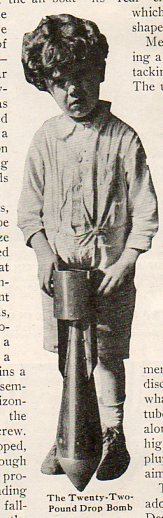
    Dropping things036In the history of dropping things–as distinguished from simple falling things–it must be said I think that this is the easiest of all human activities ever invented, and people have been trying to improve on this creation ever since.  After all, almost anyone can do it and–if you include pushing things over a ledge so that they might fall–most complex life forms can do it, too. 

    Of course there have been intellectual and technological adaptations, particularly when you include throwing and shooting things so that the objects have been charged with a “created height” so that they will be dropped in the designated location.  Cannons have been particular benefit to this aspect of advanced dropping.  And then of course there are the “Galileos” of dropping–like Galileo–and Jonas Moore and David Letterman and of course Seinfeld’s Kramer, and to a lesser extent there’s also every other person from the Boston area who represent hundreds of millions of people who drop a letter from somewhere in their spoken vocabulary.  There are people who drop their accents altogether, and of course politicians who drop the truth, and the tantalizers who drop suggestions, and paid-for pharmaceutical consultants who drop the untoward test results and their accountants who drop a zero when necessary.

    [Image source:  June, 1936, Popular Mechanics.]

    People drop options, they drop in and out and off, pennies and dimes, lawsuits and dumplings, coverage and names and the f-bomb.  They also drop dead and bombs, the last two being closely related, though more people “drop dead” when bombed because they are killed. 

    Bombs seem to be the biggest of all dropped things, especially bombs dropped by airplanes, and especially those bombs dropped on collections of people, which are called cities.

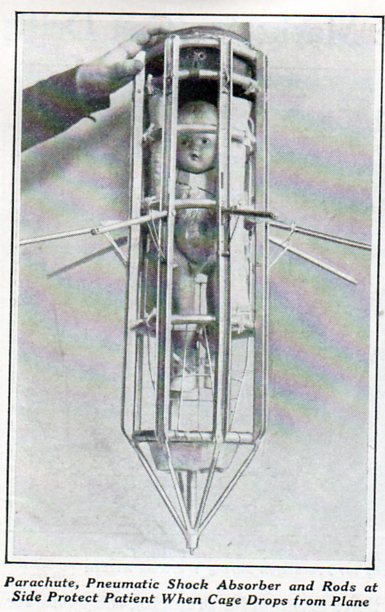
    Perhaps one of the strangest things to be dropped, though, is the following, found in  the September 1935 issue of Popular Mechanics

    Dropping things 2038This was a model of sorts for a critical-care-parachute-gurneystretcher, or something, for when a crew member of a U.S. Army Air Force aircraft was injured and needed care, though the article doesn’t specify where the person would be dropped. Overall it seems not the height of workable ideas, and suffered no doubt from its model using a baby doll, which just looks altogether wrong. 

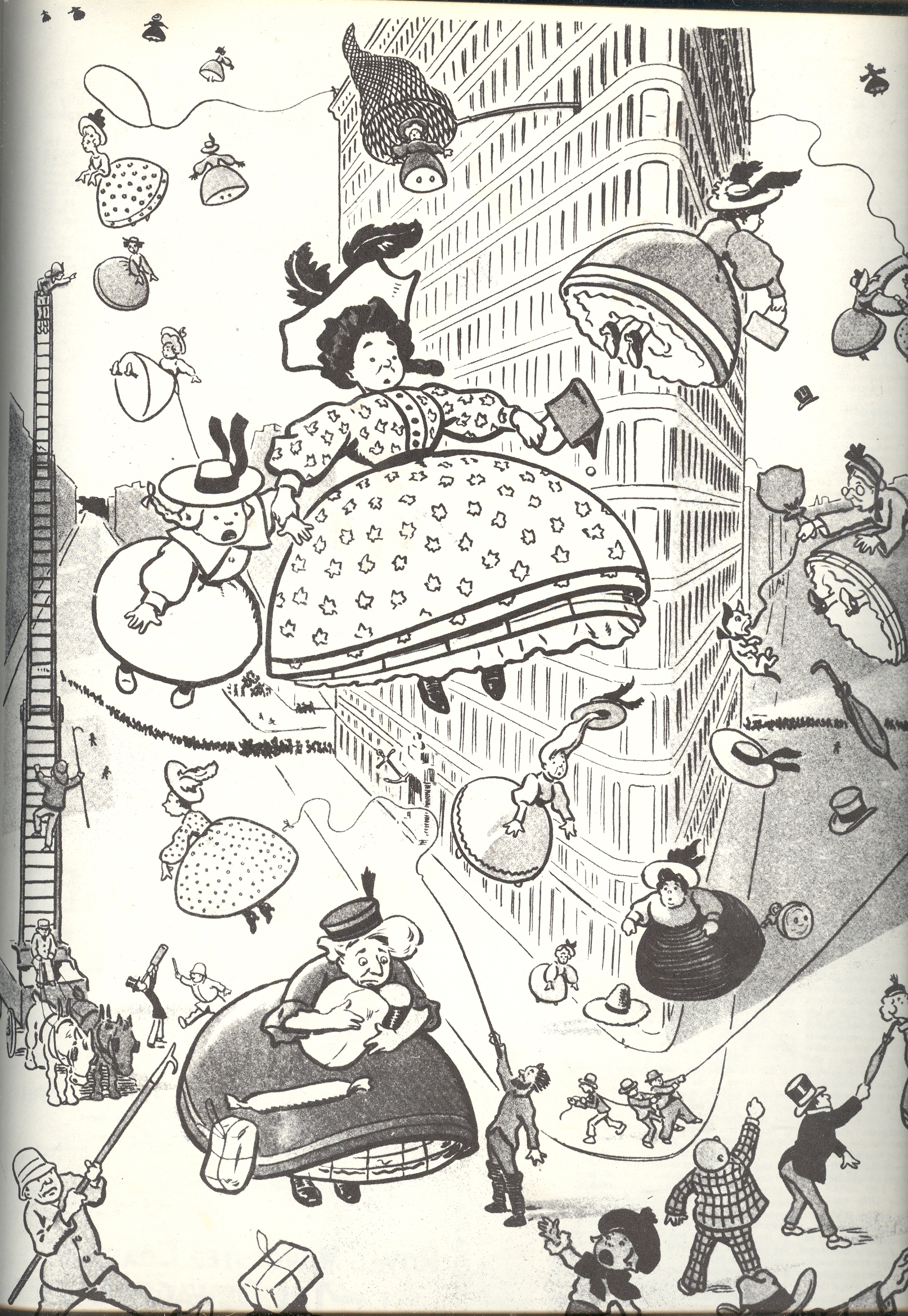
    And the last part of this episode is another strange bit:  dropping women on Manhattan. The  image comes from 1904 and–when taken out of context–it seems as though Manhattan is in for the worst of it, with a view in front of the Flat Iron Building of an aerial bombardment of women.  This is probably one of the few bad things that weren’t done with/at women, and would actually significantly predate the first use of explosives being dropped from aircraft.  Unfortunately the original, intended image was a poke at  crinoline  and featured women being blown up into the air rather than the other way around, though I like my interpretation better.

    5-women


    ·Posted by :

    ·in: