A Daily History of Holes, Dots, Lines, Science, History, Math, Physics, Art, the Unintentional Absurd, Architecture, Maps, Data Visualization, Blank and Missing Things, and so on. |1.6 million words, 7500 images, 4.9 million hits| Press & appearances in The Times, Le Figaro, Mensa, The Economist, The Guardian, Discovery News, Slate, Le Monde, Sci American Blogs, Le Pont, and many other places… 5000+ total posts since 2008.

Category: Impossible Books

  • Outsider Logic: Breathtakingly Impossible Plan for Reorganizing Life in the U.S, 1936.

    JF Ptak Science Books LLC  Post 212

    Blogaugust_23_impossible_books_plum

    This pamphlet comes from our extensive Naïve Surreal collection, which is composed of (a) pamphlets that were concerned with commonplace ephemera in the past that today looks implausible or impossible, and (b) pamphlets that addressed issues of, shall we, a mostly-internal, very personal, High Imagination that may or may not have been part of the visual world.   

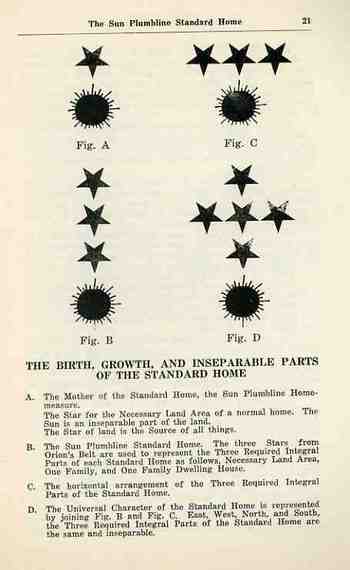
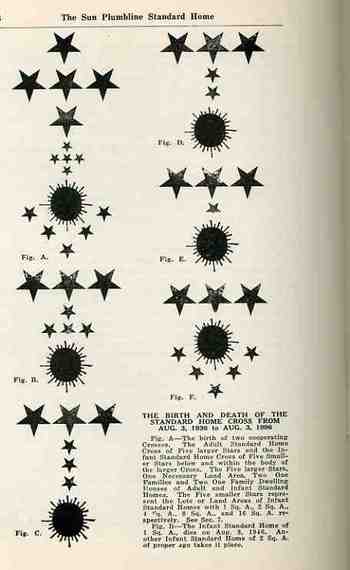
    This pamphlet, written in 1936 by Arthur Russell Groves, calls for nothing short of the reorganization of the social structure of the United States via systematic adherence to the “Coming Sun Plumbline Standard Hone via the National Constitution”–an idea which came in several parts to Mr. Groves through dreams.  The philosophy of the Sun Plumbline etc. is so spectacularly odd that it nearly defies description.  (For example, “sun plumbline” is “the absolute perfection of the Standard Home Measure  Sunspascc (not misspelled) Trip”, where “Sunspascc” was “the second name of the Tentative Standard Home Amendment, a two-fold meaning of unquestionable perfection and of the journey of life in perpetual sunlight, and consists of the first letter of the following eight words—standard, universal, normal, perpetual, abundant, self-supporting, cooperating, and creating…”  Oh dear.
    Blogaugust_23_impossible_books_pl_2

    As irresistible as this document seems, its unconnectedness is just far too demanding to allow understanding.  One good measure of this:  it defies memorization.  The pieces and bits that form this work are so logically fractured that quoting from memory would be exceptionally difficult, or hopefully so. 

    Another interesting bit about this pamphlet is that no matter where you may lose your place when reading it (and which happens often as your eyes easily slide off of the page) you have no idea of where you are, and you can pick up the reading anywhere at all.  It is a perfect example of a very interesting sub-set of books:  books whose words disappear while being read.  You can also read it backwards with little observable difference. 

    Mr. Groves was definitely, deeply engrossed in this philosophy–my guess is that he was pretty well consumed by it.  In his defense I’ve got to point out that he lovingly dedicated his work to his daughters.  He undoubtedly had little doubt in his own doubtful visions (one of which was about the letter “S”), and was certainly proud enough and sure enough to honor his daughters with the publication of his work.  So, as far out and as deeply removed as his ideas were, the bottom  line was that he was still someone’s daddy.
    Blogaugust_23_impossible_books_pl_3

    ·Posted by :

    ·in:


  • Big Weirdness: Eating Glaciers AND Moving Glaciers Cross-Country (??) 1921

    JF Ptak Science Books LLC   Post 162
    Astrography311

    So, in a collection of thousands of odd pamphlets with categories and sub-categories which are in themselves odd (“History of Biological Transformation”) there occasionally springs from the well a particularly singular effort that doesn’t fit anywhere:  when I can’t find a place to put something in a collection (read “assemblage”) that has a place for everything, I know its really weird. 

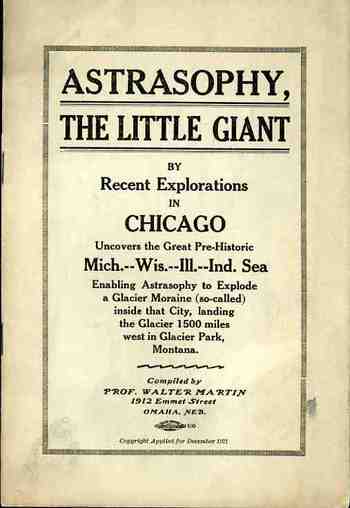
    And so we have the singular tale of “Prof.” Walter Martin, author of Astrasophy, the Little Giant, by Recent Explorations in Chicago Uncovers the Great Pre-Historic Mich.—Wis.—Ill.—Ind. Sea Enabling Astrasophy to Explode a Glacier Moraine (so-called) inside that City, landing the Glacier 1500 miles west in the Glacier Park, Montana.

    Sometimes you have to read something to find out what its all about; other times, like here, the whole thing gets pretty much told in the title.  Once inside, there’s no trail of words to describe exactly what Prof. Martin had in mind with the exploding Chicago glacier; the trail picks up and disappears all over the place, leading even the best tracker to stand and scratch, lost.  (I should point out, too, that the glacier is not only “exploded”, but it is placed “whole”, somehow, in Montana from Chicago.  That’s really not a lot of ‘sploding, if you ask me.). There’s talk about stars, and the “future Chicago”, the tilting of the continents, “slipping earth”, and disappeared “drift piles of ice”, punctuated with wonderful non sequitors like “Yes with my heart all gone I had to eat two glaciers and put one in my pocket”, and then right back into star control,  earth miasmas,  solar system electricity, and other cloudy things. 

    Only eleven pages long, the pamphlet reads as though it were several pages shorter.  On pages 7-11 is a “University Short Course in Astrasoph”, and seems to explain all things in seven quick points.  In #2, we read “space is matter in its utmost expansion”, which is a tricky statement (in that we usually think of matter “taking up” space, but never mind), which we can get by quickly with #3:  “matter is the result produced by creation pressure upon the Eotonic Sea of space, condensing to the fifth form”.  This somehow forms the “four nebulas”, the fourth of which “when enlarged, is a divine message to inform us of the existence of other universes”  In this part I think he’s dealing with the idea of the powers-of-ten type, where, Zeno paradox-like, the greater the detail the more is revealed in that youi never actually get “there”.   I do like though that he gets into alternative universes back there in 1921
    Astrography312
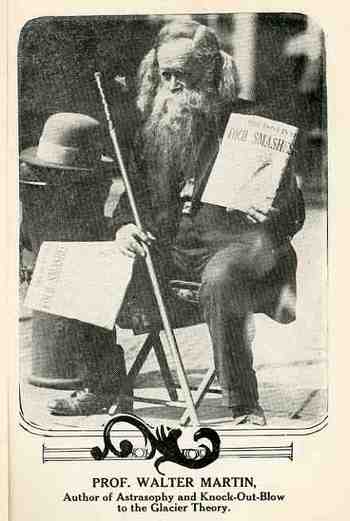
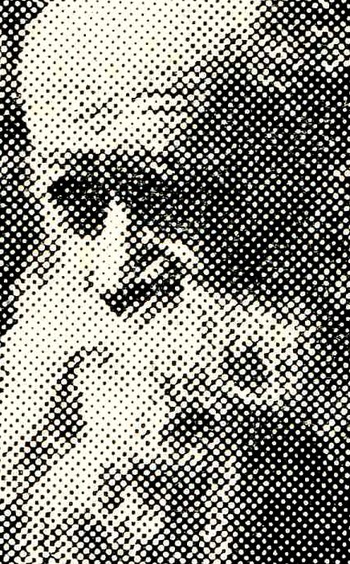
    I know that “astrasophy” has an astrological sumpin’ sumpin’ going on nowadays, but that is a slow boat with a fast terminal leak that I have no desire to board.  Mr. Martin got his hands on the term pretty early from what I can tell, and made it his own.  I’d like to celebrate him a little for his singular, spectacular view of the world, but I don’t quite know how, except to say that he came up with a unique set of ideas, and if you squint hard he looks a little like Leonardo, if you pixilate him some. The picture of Mr. Martin seems to show him sitting on the street in a folding chair, evidently selling newspapers (“Foch Smashes…” reads the headline, relating to WWI.)  I hope that he had the chance to proselytize as he dispensed the other worldly news.  In those wily pre-mega-treatment days, Mr. Martin found voice for his dreams and put them in print, and so they exist to this day, if only here—and now he belongs to the web.

    Astrography_det_por314

    ·Posted by :

    ·in:

    —

  • Food Packaging, Plastics and the New Desire: the du Pont Company, WWII.

    JF Ptak Science Books LLC Post 159
    Blogcandy282

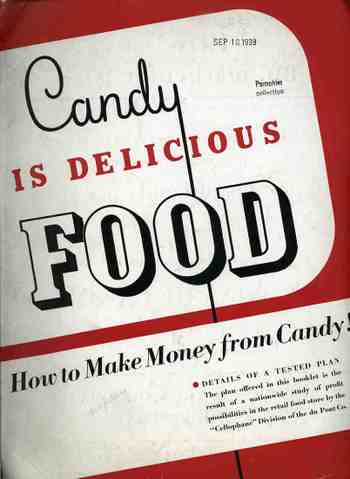
    I was initially drawn to this small collection of pamphlets because of the very provocative assertion that candy is food (but is food candy?) which, I guess, it is, technically speaking.  (Maybe we should determine what food is on a sliding scale of what we would take to a deserted island somewhere and have to depend on those foods for survival.  I don’t think that I’d have a trunk full of Mounds bars with me.  Evidently if you had to choose one food product (and one product only) to survive on for a year it looks like the best thing to select is dry dog food.)

    The Candy is Delicious Food pamphlet was published in 1939 with the intent of instructing the grocer how to better sell candyFood—expressing the ease, storage and profit margin.  Curiously, the thing was published in September  1939, a few months into the war—I wonder if the publisher (saved for naming below to more effect) was prescient in determining the coming problems with food, and that candy would certainly not have those issues during a global conflict? 

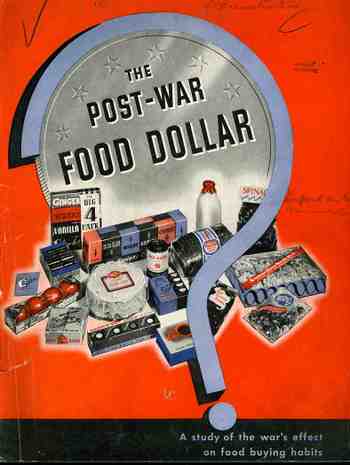
    The Post-War Food Dollar was also the product of the same publisher.  Published in 1943, this pamphlet exhorted the grocer to prepare for the coming peace, explaining where the new dollars might be spent once the war (and the supply and ration problems) was won.  Blogcandy_post_war287

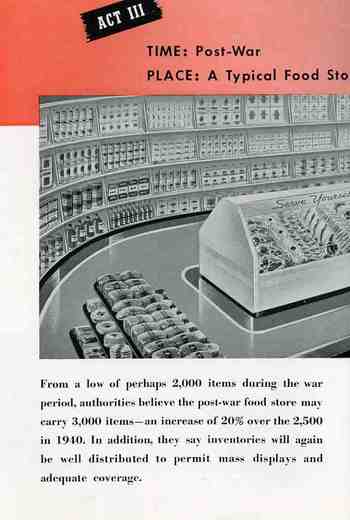
    As it turns out these pamphlets were mostly about display and merchandising, and finding the goods that looked best on the shelves—and evidently that which looked best was that which the product could be seen.  And the way that the product could be seen was with the use of the “new”packaging filament, cellophane, produced in the United States (almost exclusively) by du Pont (E.I. du Pont de Nempours & Co. with  their chemist William Hale Charch figuring out how to make cellophane moisture –proof, which led to very large-scale good packaging using the product.)   Another very big bit which turns up unmentioned but illustrated in this pamhlet is seen in this The Future is Now! scene of a modern supermarket–the “SERVE YOURSELF” butcher/meat section, which was a new idea in the early 1940’s, and one that was not at all common in the consuming world.  This idea wasn’t as big a deal as the invention of mass produced sliced bread (or, as Squidward Tentacles encountered in one episode of SpongeBob, “Bread in a Can–the best Thing Since Sliced Bread”), but it was a very important de3velopm,ent in marketing–and also another gargantuanly consumptive venue for the sale of the packaging element, cellophane.

    It was DuPont who published this series of pamphlets for the sole purpose of marketing foods and ideas to grocers that were almost entirely dependent upon cellophane, and DuPont manufactured 75% of all cellophane made in the U.S.  So, to me, it seems as thought all of this business about Food being Candy and the Post-War food spending dollar was really just about selling cellophane—the food was incidental, which is why the cellophane-encased candy was called “food” to begin with.  (It was Whitman Candies who first used cellophane in the U.S. , in  1912, to package their goods for retail.)
    Blogcandy_post_war285_2
    As an aside it is interesting to note that du Pont was brought to court in 1947 over their alleged monopolization of cellophane manufacturing in the United States.  Thus was the U. S. v. DUPONT (THE CELLOPHANE CASE)  filed December 13, 1947, which “charged Du Pont with monopolizing, attempting to monopolize and conspiracy to monopolize interstate commerce in cellophane and cellulosic caps and bands in violation of Section 2 of the Sherman Act”.   DuPont successfully defended themselves in this case.

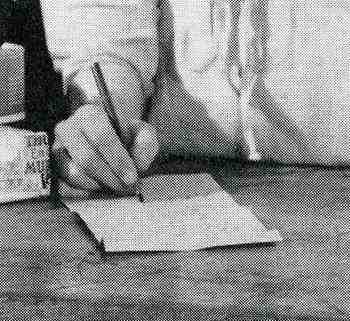
    The other, minor, thing here that really caught my attention was on page 10 of the Candy is Delicious Food pamphlet—an innocent picture of the grocer tallying up the customer’s purchases, sure enough, but if you look at the detail you can see the grocer writing it all down on the bag that he’d use bag up the purchases.  I have a dim memory of seeing this done in the across-the-street-from-the-A&P Mom & Pop grocery sawdust-strewn store (on Main Street, of course) in Great Barrington, Massachusetts, when I was a kid in the early 1960’s.  I
     
    don’t recall this being done after that, what with real cash registers and then, much later on, with more sophisticated inventory control hardware.  I’m sure that I recall this being done in hardware shops (almost all gone), and my Mother recalls this more recently—in the 1970’s—in butcher shops, but I think this recording practice was pretty much extinct by the mid  1960’s.  I know that this means nothing, but the picture of this guy writing on the bag was so sharp in my memory that I needed to record the emotion.
      Blogcandy_bag283Blogcandy_bag284


  • Subduing Insanity with Narcotic Induced Sleep: Mental Illness Treatments in 1845

    JF Ptak Science Books Post 153
    Blogdrugs_crazy254
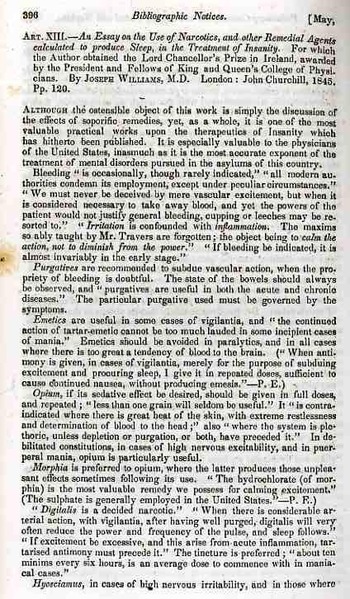
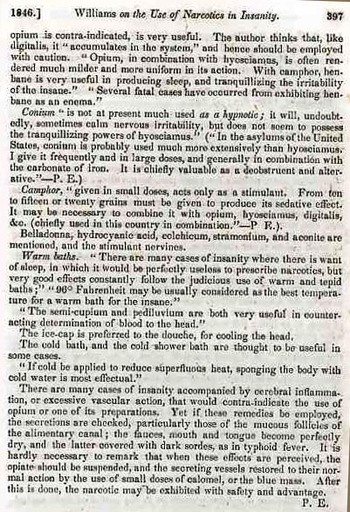
    This book review on the use of narcotics in treating the insane appeared in the New York Journal of Medicine for 1846.  The book, “An Essay on the Use of Narcotics, and other remedial Agents calculated to produce Sleep in the Treatment of Insanity….”, by Joseph Williams, M.D., and published in London in 1845.  The theory behind the sleep treatment was that the basic mechanism of insanity was “cerebral inflammation” or “excessive vascular action” in the brain—inducing deep sleep, evidently, was a good way to combat the over-active brain.

    The article itself comes at an odd time in the history of the treatment of the insane.  It came almost 40 years after the establishment of  McLean Hospital (first known as the “Asylum for the Insane,” a division of the Massachusetts General Hospital), which opened on Oct. 1, 1818, and was the first hospital dedicated to the treatment of the insane in the U.S.  It came 70 years after the great advances of Benjamin Rush, who elevated the “Mental Patient” from chains on the floor to the status of medical or nervous illness or disease.  The use of narcotics over this period seems to have surged and waned.  In 1879, in an article in the New York Times, the reputation of the Asylum for the Insane on Ward’s Island in NYC was considered—and one of the high points was that it had (largely) discontinued the use of narcotics. (There were still problems, of course, what with the asylum being overcrowded, housing 1100 in an institution meant to house 700, and where the chores and even nursing positions were staffed by the inmates, who were feed on 32 cents a day.)  As late as 1921, though, Jacob Alter Goldberg notes in his Social Aspects of the Treatment of the Insane, that there was a new, sharp increase in “toxic narcotic” treatments of the insane.  Of course, I guess one could replace “narcotic” with some sort of other misplaced treatment, like shock therapy, or Freudian mélanges, or something.  Each age must necessarily have their entry in the encyclopedia of embarrassments
    Blogdrugs_crazy255 . 

    In this article we find sleep assaulted by the use of the following:  purgatives (“to subdue vascular action when the propriety of bleeding is doubtful’), emetics, opium (to be used “in cases of high nervous excitability and in puerperal mania”), morphia (“the most valuable remedy for calming excitement”), hyosciamus (“to produce sleep, tranquilizing the irritability of the insane”).  It is weird to see that the last sentence in the description of hyosciamus reads “some fatal cases have occurred from exhibiting henbane as an enema”.  A narcotic enema?  Still to come in the review is conium (“I have used it frequently and in large doses…it is chiefly valuable as a deobstruent and alternative”, followed by camphor, Belladonna, hydrocyanic acid, colchirum, stramonium aconite, and others.  “Warm baths’ makes an appearance (“90 degrees may be considered to be the best temperature for a warm bath for the insane”), as do cold baths, and the applications of ice caps. 

    I’m not so sure about what to make of it all, the sleep treatment of insanity I mean—after all, Joseph Lister only makes his epochal pronouncements on cleanliness in the operating theatre 15 or so years after this paper, which seems today to be the most rudimentary thing that one could do in treatment in the surgical room, so treating extra blood in the brain through drug-induced sleep doesn’t seem all that far away from the realm of possibility back there in early Victorian England.

    I don’t think I’ll forget the toxic narcotic enema any time soon, though.  Or the word “deobstruent”. 


  • Bizarre Thinking and a Towering Classic of Lost Logic: the Japanese War Lords and Kaiser Wilhelm, the “True Kidnappers” of the Lindbergh Baby and the Beginning of World War Two

    JF Ptak Science Books LLC Post #122
    Lindberh_japanese168

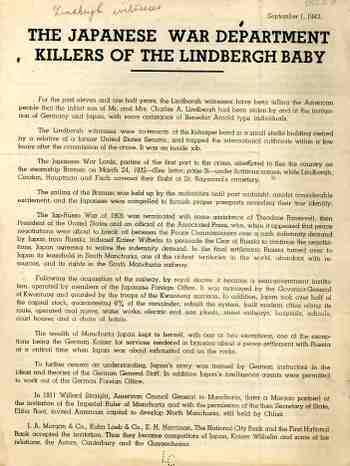
    This four page pamphlet, received by the Library of Congress (and probably nobody else) on 1 October 1943, divines the origins of World War Two and the kidnapping of the Charles Lindbergh baby to a complex and impossible cabal of Japanese “War Lords”, Kaiser Wilhelm of Germany, the assassination of Leon Trotsky, the League of Nations, Elihu Root,  “3 cent gallon kerosene”, the South Manchurian Railway, and some sort of “historical documents of posterity countersigned by Tokyo and Berlin” in the possession of Mrs. Renee Valentine (“Secretary”) of Staten Island, New York. 

    The entire affair began with “co-tenants of the kidnappers band in small studio building owned by a relative of a former U.S. Senator” under the instigation of “Germany, Japan and certain Arnold Benedicts types” brought about by the end of the “Jap-Russo” War of 1905.

    We are told it was an “inside job”.

    Somehow Teddy Roosevelt gets involved with Kaiser Wilhelm in arranging for the Russians to pay indemnity to the Japanese in terms of a land agreement of Southern Manchuria, opening the way to exploitation of China by the Japanese.  Something else happens, the South Manchuria Railroad gets thrown in as well as four competing U.S. banks and Elihu Root and a failed League of Nations agreement which upsets a balance of power and brings “the Astors, Canterbury and the Guggenheims” into competition with the Japanese and Kaiser Wilhelm, doing something to the Treaty of Washington.

    After this incredible and unconnected and partially non-existent series of events is both untangled and entangled before our eyes, the writer reaches the lonely and very solitary conclusion that “the necessary documents to prove these charges (??) could be secured through the kidnapping of the Lindbergh baby”.  I was waiting for the  author to make a case for Lindbergh’s real-life (and long held) Nazi sympathies, but that just didn’t happen. 

    I really have no idea of what the writer is talking about, but the failure of making any connection whatsoever with any of the “facts and circumstances” is magnificently appalling, and has moved itself from the realm of being so bad that it isn’t even “bad” anymore.  It is that singular sort of “badness” that makes the printed words seep into the paper and disappear before your very eyes, and the only thing that you can say is “wow”. 

    ·Posted by :

    ·in:

    — —